'Fight Smart' - 7
March 2008
Don't
Take the Bait - Fight Smart
ANIMATED 911 SUMMARY -
CLICK HERE
Who is the enemy?
From 'Operation Ajax' To
'Operation Iraqi Freedom'
How 1953 CIA Iranian Coup Cost The US Taxpayer $3
Trillion And Rising
Iran, Iraq,
And The Law Of Unintended Consequences
www.nlpwessex.org/docs/watunintended.htm
Half A Century After Britain And America
Destroyed Democracy In Iran
"During his state visit to Iraq
on Sunday and Monday, Iranian President Mahmoud Ahmadinejad spoke of fraternal ties between the two countries, announced a
billion-dollar reconstruction loan that will be used for contracts with Iranian firms, and
said foreign forces should withdraw from Iraq immediately. The irony was hardly lost on
Iraqis and their neighbors. The virulently anti-American Ahmadinejad could only be received with pomp and ceremony by Iraq's president, prime minister and
foreign minister because President George W. Bush's bungling
has given Iran predominant influence in Iraq."
George Bush's gift to Ahmadinejad
International Herald
Tribune, 5 March 2008
What American Taxpayers
Got In Return For
Their Government's $3 Trillion Iraq Campaign |
“The truth is that
Iran is emerging as one of the big winners of the US and Britain's disaster in
Iraq...”
The Iran Crisis Is Blair’s True Legacy
Mail
On Sunday, 30 March 2007 |
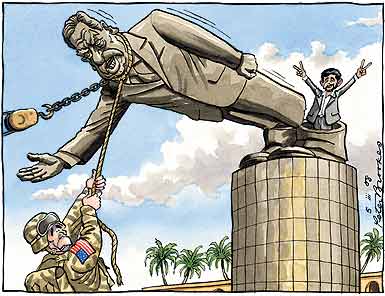 |
Cartoon
London
Times, 5 March 2008 |
"Nobel
economics laureate Joseph Stiglitz, author of a new book
that claims the Iraq war will cost the U.S. more than
$3 trillion, said the final tally is likely to climb
much higher than that. 'It's much more like five
trillion,' Stiglitz said yesterday in an interview
with Bloomberg Radio. 'We were trying to make Americans understand how expensive this war
was so we didn't want to quibble about a dime here or a dime there.' His analysis comes as
the Senate debates a Democratic plan to begin withdrawing troops from Iraq.... 'This war
is the first war ever that's been totally financed by borrowing, by deficits,' said
Stiglitz, a professor at Columbia
University in New York....Bills from the Iraq war will pile up for decades to come as
the government spends hundreds of billions of dollars providing medical care and
disability benefits to about 70,000 soldiers injured in the conflict, he said.... Stiglitz
and co-author Linda Bilmes release their new book,
called the 'The Three Trillion Dollar War: The True Cost of the Iraq Conflict,' starting
this month."
Economist Stiglitz Says Iraq War Costs May Reach $5
Trillion
Bloomberg,
1 March 2008 |
"Ahmadinejad didn't get just
one 'kiss for luck'; he got four, when he was welcomed by U.S.-backed Iraqi Prime Minister
Nouri al-Maliki, who threw in a symbolic hug by standing impassive while the Iranian
leader told a joint press conference: 'The Americans have to understand the facts of the
region. Iraqi people do not like America.' Many of them, notably the Sunni minority, don't
care all that much for Iran either. But, even they were impressed by the fact that
Ahmadinejad flagged his trip well in advance, made a ceremonial arrival in full view of
Iraqi media, traveled by road and did not stay in the fortified Green Zone. The show was in stark contrast to President Bush and other
American VIPs who, if they deign to venture off secure U.S. military bases after they
arrive here unannounced and in secret, do so by helicopter."
Iran Winning Iraqi Hearts And Minds
CBS News, 4
March 2008
From 1953 Coup To 9/11
"Fifty years ago this week, the CIA
and the British SIS [MI6] orchestrated a coup d'etat that toppled the democratically
elected government of Mohammad Mossadegh. The prime minister and his nationalist
supporters in parliament roused Britain's ire when they nationalised the oil industry in
1951, which had previously been exclusively controlled by the Anglo-Iranian
Oil Company. Mossadegh argued that Iran should begin
profiting from its vast oil reserves....A new book about the coup, All the Shah's Men,
which is based on recently released CIA documents, describes how the CIA - with British
assistance - undermined Mossadegh's government by bribing influential figures, planting
false reports in newspapers and provoking street violence. Led by an agent named Kermit
Roosevelt, the grandson of President Theodore Roosevelt, the CIA leaned on a young,
insecure Shah to issue a decree dismissing Mossadegh as prime minister. By the end of
Operation Ajax, some 300 people had died in firefights in the streets of Tehran. The crushing of Iran's first democratic government ushered in more
than two decades of dictatorship under the Shah, who
relied heavily on US aid and arms. The anti-American
backlash that toppled the Shah in 1979 shook the whole region and helped spread Islamic
militancy, with Iran's new hardline theocracy declaring undying hostility to the US....The
author of All the Shah's Men, New York Times reporter Stephen Kinzer, argues that the coup
planted the seeds of resentment against the US in the Middle East, ultimately leading to the events of September 11."
The spectre of Operation Ajax
Guardian, 20
August 2003
Ready For Some More Unintended
Negative Consequences?
"2008 presidential hopeful John McCain
said Sunday that the consequences of a military conflict with Iran over that country's
nuclear program could be so serious they could lead to 'Armageddon.'....McCain said that
if sanctions fail, the U.S. must be prepared to resort to the use of military force."
John McCain Warns of Iran 'Armageddon'
Newsmax, 2 April
2006
Or Would You Like To Try Something Different For A
Change?
"Conservative
Arab elites now seem to have concluded that the way to control Shia Iran's popularity
among their Sunni-majority masses is to befriend rather than confront Tehran....In back-to-back, unprecedented friendly moves blessed by Egypt in
December, the Saudi monarch played host to Iran's president Ahmadinejad at the Haj
pilgrimage. And the six-nation Gulf Cooperation Council (GCC), established in 1981 to
blunt Iran's revolution, invited him to its summit."
Nervously and Rapidly, Iran Courts Egypt
Foreign Policy In Focus, 14 February 2008
"Many Americans are familiar with only
one episode in the history of US-Iranian relations: the hostage crisis of 1979-80.
Few realize that the miltants who seized the U.S. embassy in Tehran have stated
that they were primarily motivated by fears that the
events of 1953 were about to be replayed. In
that year, the Shah fled his country but was placed back on his throne after a coup organized by CIA agents working in the basement of the U.S. embassy. The 1953 coup brought an end to democratic rule in Iran. That makes it difficult for Iranians to take the American leaders
seriously when they demand that Iran democratize itself. Iranians naturally react by
thinking, 'We had a democracy until Americans took it
away from us.'.... [So what would happen now if the
US attacked Iran?] Some of the effects are easy to predict. The Iranian population,
which is now strongly pro-American, would naturally erupt in outrage. There would be an instant and
perhaps devastating spike in violence against U.S. forces in Iraq. Violence would also
likely erupt in Afghanistan, Pakistan and other Muslim countries. Iran might retaliate by
firing missiles at Israel and U.S. allies in the Persian Gulf. The cause of democracy in Iran would be set back by a generation. Iranians would rally around their government, as all people do when their
country is under attack, thereby giving a new boost to a regime that is now highly
unpopular. Iranian nuclear scientists whose homes are bombed and whose children are
killed would have a special motivation to use their knowledge in ways that could be
devastating to the U.S. If the events of 1953 and the
history of other U.S. interventions are a guide, though, the most devastating effects of
such an attack would be ones we cannot now predict. No one in 1953 could have
foreseen that the CIA coup in Iran would have produced the 1979 Islamic Revolution, which
in turn set off the Iran-Iraq war that brought the U.S. into its death-embrace of Saddam
Hussein, and that also led the Soviet Union to
invade Afghanistan, thereby setting in motion the U.S. war there that led to the rise of
the Taliban and al Qaeda. The lesson is that
when a big power violently intervenes in the political development of another country, it
sets off consequences no one can imagine.... Iran is
a bitter enemy of radical movements like the Taliban and al Qaeda, and was fighting them
at early stages when the U.S. had not yet begun to consider them serious threats.
Iran, like the U.S., is eager to prevent the spread of Russian influence in the Middle
East. Iran's oil industry is in a parlous state, and American companies have the
capital and expertise to rebuild it. No other Muslim country in the Middle East offers
such tantalizing possibilities as a potential partner of the United States. The path of negotiation is practically cost-free. Not to pursue it
is to pass up the greatest opportunity the U.S. has in the world today to rearrange the
global strategic balance in ways that could decisively strengthen American national
security."
Stephen Kinzer - Iran is an opportunity, not a target
Ask
This, 27 February 2008
American Unintended Consequences
'As You Sow, So Shall You Reap'
The Fifty Year Sequence
“In
1953 the United States played a significant role in orchestrating the
overthrow of Iran's popular Prime Minister, Mohammed Mossadegh. The Eisenhower
Administration believed its actions were justified for strategic reasons; but the coup was
clearly a setback for Iran's political development. And it is easy to see now why many Iranians continue to resent this intervention by
America in their internal affairs.”
Madeline Albright, US Secretary of State
Speech before the
American-Iranian Council, March 2000
How
A $1 Million US Covert Operations 'Success' In 1953
Spiralled Into A $ Multi-Trillion Foreign Policy Disaster Fifty Years Later |
| Date |
Cause
|
Effect |
| 1953 |
In a joint conspiracy
with Britain's MI6, and armed with a covert budget for the purpose of $1million, the
CIA topples Iran's democratically
elected government in a coup d'etat code named 'Operation Ajax' aimed at
protecting western oil interests in Iran |
The dictatorship of the Shah
is established and is seen as a puppet
instrument of the west, eventually leading to the backlash of the fundamentalist Islamic
Revolution in 1979 led by Ayatollah Khomeini |
| 1979 |
Iranian Islamic Revolution |
Iran-Iraq war as Saddam
Hussein invades Iran in an effort to capitalise on regional instability following the
Iranian revolution |
| 1980 |
Iran-Iraq War |
War continues until 1988.
United States provides Saddam Hussein, under the authorisation
of George Bush Senior as US Vice President, technology for weapons of mass destruction
in an effort to ensure that Iran does not win the war and
overrun Gulf oil fields |
| 1990 |
Still holding an arsenal of WMDs Saddam
Hussein invades Kuwait which he accuses of slant drilling into Iraqi oil fields |
Britain's
Margaret Thatcher fears Saddam will overrun Saudi oil
fields after taking Kuwait, and persuades George Bush Senior (now as President) to fight
Saddam leading to 'Operation Dessert Storm' |
| 1991 |
United States expels Saddam
from Kuwait after gaining permission from the Saudi government to station hundreds of
thousands of US troops in Saudi Arabia, on the understanding
that the troops will leave the Kingdom once the war is over |
Despite the initial
understanding, thousands of US troops remain in Saudi Arabia after the war to the intense anger of Saudi Islamic militant leader Osama Bin Laden |
| 1996 |
Bin Laden
issues a fatwa against the United States and launches his struggle to remove 'infidel'
US foreign troops from the 'Land of the Two Holy' places (the Muslim shrines of Mecca and
Medina in Saudi Arabia) |
The fatwa is preceded by bombings
on US military facilities in Saudi Arabia, (1995 and 1996). Bin Laden expands
the campaign overseas, including bomb attacks on American embassies in Africa (1998) and
on USS Cole in Yemen (2000). Many Bin Laden supporters are Arabs whom the United States
encouraged (through Saudi Arabia) to fight the Soviets in Russia during the previous
decade, and in its more recent covert war against
Serbia in the Balkans |
| 1998 |
Donald Rumsfeld and others write to President Clinton urging
military action against Saddam Hussein because they claim his potential to deploy WMDs is
a threat to Gulf oil supplies |
The 1998 letter provides the
bedrock for later US foreign policy in the Persian Gulf when Rumsfeld and others enter
government in 2001 under the Bush administration, which begins planning war against Iraq within ten days of the President's inauguration |
| 2001 |
Four commercial airliners are
simultaneously hijacked in the United States on 11 September. Three of the planes fly into
the World Trade Center in New York and the Pentagon in Washington, killing thousands. The
fourth plane crashes in Pennsylvania. Later the hijackers are identified by the US
government as being mostly from Saudi Arabia. |
Ensuing anthrax attacks are traced to a US military
facility as President George Bush Jnr uses the
post 9/11 atmosphere of fear to begin a WMD propaganda campaign against Saddam as a
pretext to invade Iraq, even though the US government holds evidence that Iraq had
decommissioned its WMDs following
the Gulf War of 1991 |
| 2003 |
America invades Iraq under
'Operation Iraqi Freedom' |
Immediately following the
invasion of Iraq US
begins pulling combat troops out of Saudi Arabia, with
the last units leaving in August 2003, thereby conceding to Bin
Laden's principle political demand. The troops are moved into Iraq where America
intends to maintain
permanent military bases in order to enable it to continue policing Gulf oil supplies. Al Qaeda begins galvanising to drive US
troops out of Iraq, another Arab country, to where it recenters its jihad. |
| 2005 |
With democratic reformists
on the rise in Tehran the US carries out covert operations in Iran aimed at destabilising
the country, including
radio broadcasts into Iran and bombings executed by the US sponsored MEK. These clumsy
actions backfire causing a sudden swing away from the reformists towards religious
hard-liners, in a wave of nationalist defiance against US interference in the country's
internal affairs of a type still well remembered from 1953 |
US covert actions once again cause a set-back for democracy in Iran
and the hard-line Mahmoud Ahmadinejad becomes Prime Minister. Further west the occupation
of Iraq fails to bring stability, and Iran becomes the dominant foreign influence in the
country |
| 2008 |
In March
President Armedinejad becomes the first Iranian leader to visit Iraq since the 1979
Iranian revolution in a mutual show of solidarity with the now Shia dominated Iraqi
government. He is able to do so openly, whereas the US President has previously been
forced to visit the country in secret for fear of attack. There is broad acknowledgement
that Iran, not the US, has been the principle beneficiary of 'Operation Iraqi Freedom'.
This result is despite the lengthy US military campaign which is estimated to eventually
cost American taxpayers at least $3 Trillion |
Also in March, Iraq and China are reported to be close to re-signing a
$1.2 billion oil
deal that was called off after the 2003 U.S. invasion - a further sign of weakening US
influence. Meanwhile Iran and China’s biggest refiner, Sinopec, sign a $2 billion
agreement on developing the Yadavaran oil field in Iran |
"It could take some time for
authorities to make an official determination of the motives behind Tuesday's bombing in
Saudi Arabia. But some are already speculating that this attack was inspired, as others
have been, by anti-Western sentiments. Saudi resentment towards the West breaks down into
two main groups of thought. The first believes the West is propping up Saudi Arabia's
monarchy, while the other feels that the presence of Westerners is corrupting the area's
strong Islamic beliefs....The anti-Western theme began in 1991, when hundreds of thousands of Western troops poured into Saudi Arabia
for the 1991 war against Iraq. The troops touched a
sensitive nerve with many Saudis, some of whom considered the semi-occupation a violation
of Islamic religious sites. Others felt the troops were infringing on the sovereignty of
Saudi Arabia. 'What you're really seeing in Saudi Arabia is this great influx of the
outside world on a people who just haven't been ready for it,' said Gulf analyst Sandra
Mackey. The sensitivity to a large military presence persists today. As U.S. President
Bill Clinton has said, 'We've tried not to be an obtrusive presence' in Saudi Arabia, and
both the U.S. and Saudi Arabia minimize the number of U.S. troops on Saudi soil. In public, their officials say there are only 5,000 U.S. troops
within the Saudi borders. But diplomatic sources tell CNN the actual number is three or
four times greater -- as many as 20,000. And Saudi
military and political ties to the West are stronger than ever since the Gulf War, as the
country seeks to protect itself against Saddam
Hussein's Iraq and against radical, political
Islamists. Analysts say those close ties to the West anger ardent Muslims, many of whom
fought in defense of Islam against the Soviets in Afghanistan, against the Serbs in
Bosnia, and helped the radical government of Sudan. 'They came back trained, somewhat
equipped and still inspired by the idea that the Lord called upon them with a special
mission,' said former U.S. Assistant Secretary of State Richard Murphy. For some, that
mission has evolved into undermining the centuries-long rule of Saudi royalty, its oil
sales, and its military dependency on the United States. Will terrorist tactics drive the
West out of Saudi Arabia, and lend to the eventual collapse of King Fahd's
government?"
Anti-U.S. sentiments growing in Saudi Arabia
CNN, 26 June 1996
It's The Oil Stupid
"U.S.
concerns about safeguarding Western oil supplies were uppermost when the allied coalition
went to war against Saddam in 1991.... After attacking his unpopular neigbor and adversary Iran in 1980, which was then considered a greater
threat to Western interests than Iraq, Saddam
apparently believed that he had the hidden support of the Rea-gan and Bush administrations
— until in the spring of 1990 he threatened Israel openly with attack by chemical
weapons. The United States gave Saddam critical
military intelligence on Iran, generous loan guarantees, and sales of dual-use equipment
such as helicopters. It encouraged or turned a blind eye to assistance from American
private industry and Europe to Iraq's conventional and nuclear armament efforts, such as France's rental to Iraq of Super Etendard fighter-bombers to
attack Iranian oil targets."
It's Time to Think Straight About Saddam
International Herald
Tribune, 23 December 1997
"On September 22, 1980, Iraq invaded
Iran, starting a war that continues to devastate both
countries. Over one million casualties have been
reported. The interest shown in this conventional war
had been low due to superpower noninvolvement and restrictions on foreign
press agents in the war zone. Yet, because of oil resources, Southwest Asia has been determined
to be of vital interest to the United States. The
stability of the entire region is jeopardized by this war. At the end of the [second world] war, Iran's oil became an
important factor in area politics. The
Soviet Union began to interfere in Iran, but by mid-1946, had
retreated. The United
States, sensitive to what was happening, decided to strengthen Iran by selling
arms and providing advisors. This occurred in 1948.... The most important U.S. concern
in the Gulf is oil, though this is
not the sole concern. In 1973, Western Europe derived 60 percent of its oil,
and Japan 90 percent, from Gulf suppliers. In 1984, these figures were about
40 and 60 percent respectively. The U.S. gets only about 3 percent
of its oil from the Persian Gulf. Because of
this heavy supply of oil to allied countries, keeping the oil flowing has become a vital interest to the
United States. Of primary concern, then, is
keeping the Strait of Hormuz open to shipping. Khomeini
threatened closure of the Strait when Iraq started shooting at tankers, but has not
yet attempted this drastic step. Oil production
seems to have continued at a relatively even pace with no
serious degradation since the war began. Though Iraq has
continued to shoot at tankers in the Gulf, driving insurance rates up, there is no
shortage of vessels and voluntary crews to transit the Strait. The U.S. has three major policy objectives with
respect to the current Gulf crisis. One is to prevent
disruption of oil shipments that would cause serious hardship for Western
economies. Another is to ensure the security of oil-producing governments in the
area that have been friendly to the West and have resisted Soviet
expansionism in the Gulf. And lastly, the U.S.
would like to ensure that whatever the outcome of the war, the Soviet
Union would not have a dominant position in either country. The
Carter Doctrine of 1980 addressed the stated intention of the U.S. to intervene militarily
in the region if the shipment of oil was halted or curtailed. President Reagan, in a February 22, 1984 press
conference, also said that the U.S. is committed to keeping the
Strait of Hormuz open. Keeping friends in the area is vitally important
for the prosecution of a military campaign. And, the U.S. is taking steps to
defuse Soviet influence in Iraq; diplomatic relations were renewed
with the opening of embassies in both countries in December 1984. Iraq had been removed from the 'anti-terrorist'
list in early 1982, opening the way for renewed relations. ...Iran could
emerge as too powerful in the Gulf and could coerce other
Gulf states. This Iranian victory would subject other
Arab nations to the prospect of exported Islamic revolutions....
If Khomeini wanted to escalate the war to other Gulf states, he
would probably attempt to close the Strait of Hormuz, drawing the U.S.
into the action.... Given the apparently strong position of Iran in the
war, the U.S. must take precautions to
ensure the Islamic revolution does not spread. If it did,
Iran would control the entire Persian Gulf and oil prices, or embargoes, could hurt Western economies....While claiming strict neutrality, the U.S. has taken steps to
ensure a strong blocking position against
Iran. Diplomatic relations have been reopened with Iraq. Support for the GCC member nations has been
ensured. U.S. arms sales continue to Saudi Arabia as well as
participation in the AWACS program....The U.S. Central
Command is charged with the military responsibility of Iran
and Iraq. By studying the Iran-Iraq war, some lessons can be learned to
enhance U.S. forces success should military intervention ever be
required. Before listing those lessons, though, the U.S. military
should determine where and how they could intervene. Iran is the most likely target
for hostile military intervention, given its control of the Strait
of Hormuz, the choke point to Persian Gulf oil....The
U.S., and the Soviet Union, will continue to remain neutral,
though covertly trying to influence events in the region.
Iran, the strategic prize for both superpowers, will not be
touched by either side until Khomeini is removed. At that time,
it would seem prudent for the U.S. to attempt to
bring Iran back into the fold. Something like injecting the Shah's exiled son into power would
serve the U.S. well. Whatever happens, though,
the U.S. must be ready to intervene militarily
in the region to ensure the currently thriving economies of
the Western nations continue."
The Iran-Iraq War: Strategy of Stalemate
Major Robert
E. Sonnenberg, USMC 1 Apri1 1985
Marine Corps Command and Staff College
Marine Corps Development and Education Command
Quantico, Virginia 22134
Oil On Dick
Cheney's Mind - 2007
"Q: And what are the stakes here? The diplomatic effort has been going on for
a long time and it has not worked. In fact, Iran has gone in the other direction. So what
are the stakes here?
THE VICE PRESIDENT: Well, remember where Iran sits. It's important to backup I think for a minute and set aside the nuclear question, just look at what Iran represents
in terms of their physical location. They occupy one whole side of the Persian Gulf, clearly have the capacity to
influence the world's supply of oil, about 20 percent of the daily production comes out through the Straits
of Hormuz."
Interview of US Vice President Dick Cheney
ABC
News (Australia), 23 February 2007
Oil On Dick Cheney's Mind - 1999
"For the world
as a whole, oil companies are expected to keep finding and developing enough oil to offset
our seventy one million plus barrel a day of oil depletion, but also to meet new demand.
By some estimates there will be an average of two per cent annual growth in global oil
demand over the years ahead along with conservatively a three per cent natural decline in
production from existing reserves. That
means by 2010 we will need on the order of an additional fifty million barrels a day. So
where is the oil going to come from? Governments and the national oil companies are obviously in control of
about ninety per cent of the assets. Oil remains fundamentally a government business.
While many regions of the world offer great oil opportunities, the Middle East with two thirds of the
world's oil and the lowest cost, is still where the prize ultimately lies, even though
companies are anxious for greater access there, progress continues to be slow."
Dick Cheney, Chief Executive of Halliburton,
now Vice President of the United States
Speech at London
Institute of Petroleum, Autumn Lunch 1999 |
Big Crimes - Iraq
"Donald Rumsfeld's visit to
Baghdad to embrace Saddam Hussein on behalf of the Reagan-Bush government in December 1983
was driven by similar motives. In particular they included
preserving access to Gulf oil as Iran became a threat to US supplies following Tehran's
Islamic revolution of 1979 which ousted the Shah, and led to the ensuing Iran-Iraq war.
One of Rumsfeld's specific goals during his 1983 visit, according to the New York Times 14 April, was to
do a deal with Iraq over the building of an oil pipeline from Iraq to the Jordanian Port
of Aqaba. The project was to be built by Bechtel, a company previously led by George
Shultz who had become Secretary of State by the time of Rumsfeld's courtship of Saddam as
special representative of the US government. According to the National Security Archive at
George Washington University 'The U.S. promoted the Aqaba pipeline project strenuously for several
years during the early to mid 1980s. It would have carried oil from northern Iraq to the
Gulf of Aqaba in Jordan, alleviating the disruptive effect on Iraq's oil output that
resulted from Iran's attacks on oil transshipment facilities in the Persian Gulf and from
Syria's closing of a pipeline that had transported Iraqi oil. The proposed project
reflected the U.S.'s extreme nervousness about threats to the world oil supply resulting
from the Iran-Iraq war.' In
the end Saddam would not play ball with the US on the pipeline, but in the meantime the US
offered some 'interesting' assistance to Iraq. In an article entitled
'Who Armed Iraq ' 17 April
the highly respected and authoritative Jane's Defence News wrote 'An investigation of US corporate sales to
Iraq, headed by Republican Congressman Donald Riegle and published in May 1994, listed
some of the biological agents exported by US corporations with George Bush's approval as
head of the CIA and later as vice-president under Ronald Reagan. The Iraqis are reported
to have acquired stocks of anthrax, brucellosis, gas gangrene, E. coli and salmonella
bacteria from US companies.'"
Iraqgate 2003
'Fight Smart', Special Report, October 2003
"ABC News Nightline opened last June 9
with words to make the heart stop. 'It is becoming increasingly clear,' said a grave Ted
Koppel, 'that George Bush, operating largely behind
the scenes throughout the 1980s, initiated and supported much of the financing,
intelligence, and military help that built Saddam's Iraq into the aggressive power that
the United States ultimately had to destroy.'"
Iraqgate - The Big One That (Almost) Got Away - Who Chased it, and Who Didn't
Columbia
Journalism Review, March/April 1993
"Back
in the 1980's Italy became involved in the Reagan-Bush exercise to illegally arm Saddam
Hussein. An important part of the under-reported scandal was the Banca
Nazionale del Lavoro (BNL) affair, which came to the attention of the authorities and the
public during the summer of 1989. This
followed the revelation that the small Atlanta
branch office of BNL, one of Italy's largest Banks whose shares were almost entirely
owned by the Italian government, had provided Iraq with several billion dollars in
off-book loans and credits. Amongst other matters the bank had handled a major portion of
U.S. agricultural credit guarantees for Iraq. These were used as a back door route for
pumping funds into Saddam Hussein's regime and his military programmes. According to the National Security archive at George
Washington University 'In addition, the [BNL]
managers had signed a series of agreements obligating the bank to provide some $1.155
billion in medium-term loans to Iraq’s Ministry of Industry and Military Production,
a government organization that was in charge of Iraq’s efforts to obtain western
technology for military research and development programs, including those involving
chemical, biological, and nuclear weapons and missiles.' The archive reveals
that the bank was also providing loans to Matrix-Churchill Corporation in Ohio, whose
sister company was at the heart of the British 'Iraqgate' episode. Three of the company's
managers were put on trial in Great Britain in 1992 on charges of illegally exporting
machinery with military applications to Iraq. The case was dismissed after documents and
testimony showed that British
government officials had approved the exports, knowing that they would be used for
weapons manufacture. The collapse of the case led to the setting up of the Scott
inquiry in 1994 which revealed a situation which was
described by the former head of the Iraq Desk in Whitehall as a 'culture of lying' at the
British Foreign Office. Banca Nazionale del Lavoro was raided by the FBI on 4 August 1989. The National
Security Archive holds 147 documents
in relation to the involvement of BNL."
Iraqgate 2003
'Fight Smart', Special Report, October 2003
"BCCI was also involved with the Banco
Nationale del Lavoro (BNL), Italy's biggest bank, whose Atlanta office was involved in a
scheme to provide as much as $4 billion in fraudulent loans to facilitate illegal arms
sales for the government of Iraq.... when BCCI was closed, its Swiss affiliate was almost
immediately sold to a Turkish banking group, Cukorova, whose subsidiary, EndTrade, was BNL's partner in the illegal
arms sales from the U.S. to Iraq, and part of the federal investigation into BNL.... Beginning in the fall of
1986, and continuing through early 1989, BCCI initiated a series of contacts with perhaps
the most politically prominent international and business consulting firm in the United
States -- Kissinger Associates. At the time, Kissinger Associates had five partners:
former Secretary of State Henry Kissinger, former Assistant and current National Security
Advisor Brent Scowcroft, former Under Secretary and current Acting Secretary of State
Lawrence Eagleburger, international economist Alan Stoga, and investment bank T. Jefferson
Cunningham III.... the Banco Nationale del Lavaro, [was] an Italian bank from whom Kissinger was a consultant, and which
has recently been under investigation by the House Committee on Banking, Finance and Urban
Affairs for its role in the illegal arming of Iraq
using U.S. commodity credits."
The BCCI Affair- A Report to the Committee on Foreign Relations United
States Senate
by Senator John Kerry and Senator Hank Brown
December 1992, 102d Congress 2d
Session Senate Print 102-140
"As the Saudi Ambassador, Prince Bandar, was urging Mr. Bush and Mr. Baker
to buy the friendship of the Iraqi dictator in August 1989, the F.B.I. uncovered a huge
scam at the Atlanta branch of the Lavoro Bank [BNL] to finance the buildup of Iraq's war machine by diverting
U.S.-guaranteed grain loans. Instead of pressing the investigation or curbing the
appeasement, the President turned a blind eye to lawbreaking and directed another billion
dollars to Iraq. Our State and Agriculture Department's complicity in Iraq's duplicity
transformed what could have been dealt with as 'Saddam's Lavoro scandal' into George
Bush's Iraqgate ... When House Banking Chairman Henry Gonzalez gathered documents marked 'secret' showing this pattern of corruption, he
put them in the Congressional Record. Two months later, as the media awakened, Mr. Bush
gave the familiar 'gate' order; stonewall.... Policy blunders are not crimes. But
perverting the purpose of appropriated funds is a crime;
lying to Congress compounds that crime; and obstructing justice to cover up the original crime is a criminal conspiracy."
THE ADMINISTRATION'S IRAQ GATE SCANDAL
New York
Times, 18 May 2004
"Almost every Monday for the past
couple of months, Rep. Henry B. Gonzalez (D-Tex.), the feisty chairman of the House Banking Committee, has been
setting the Bush administration's teeth on edge with fiery exposes about its courtship of
Iraq before the invasion of Kuwait in August 1990. So far, hardly anyone has been
listening. Gonzalez's `special orders'--as such uninterrupted speeches are called--are
delivered to a virtually empty House floor. But they are full of excruciating detail--much
of it classified `'secret' and `confidential'--that could haunt the White House before
this election year is over. Gonzalez's charges are simple and direct: Senior Bush
administration officials went to great lengths to continue supporting Iraqi President
Saddam Hussein and his unreliable regime long after it was prudent to do so. U.S.
officials insisted in 1989, for instance, on playing down the importance of a scandal
involving an Atlanta-based bank and more than $5 billion in unauthorized loans to Iraq,
including $900 million guaranteed by the U.S. government. They even intervened in the case
to prevent indictment of the Central Bank of Iraq while the Persian Gulf War was
raging..... in the wake of the gulf war when Congress began demanding more information
about the prewar conduct of U.S. policy toward Iraq, administration officials tried to
hide their embarrassment under a cloak of national security and created what Gonzalez has
called a `coverup mechanism' to keep investigators at bay.... The centerpiece of the
controversy is the scandal involving the Italian government-owned Banca Nazionale del
Lavoro (BNL).
It broke open on Aug. 4, 1989, when FBI agents and Federal Reserve officials, tipped off
by two bank executives, raided BNL's Atlanta branch and confiscated thousands of documents.... There
were also allegations, still unresolved, that food shipments destined for Iraq under the
loan program never got there and may have been diverted to other countries in exchange for
cash or goods. Investigators say they now believe some food may have been traded for
weapons or Soviet bloc military assistance..... [in October 1989] President Bush stepped
into the fray, issuing National Security Directive 26 (NSD-26). Gonzalez said the order
has been withheld from his committee on grounds of executive privilege, but other
documents show that it ordered `pursuit of improved economic and political ties with
Iraq.' A report to Baker, dated Oct. 26, 1989, cited the directive in recommending
approval `on foreign policy grounds' of a $1 billion CCC program for Iraq, to be paid in
two installments in light of the BNL investigation. Baker called then-Secretary of Agriculture Clayton Yeutter
and urged him to go forward with the $1 billion program. Deputy Secretary of State
Lawrence S. Eagleburger made similar appeals to Treasury and OMB, explaining in one note
that `the CCC program is important to our efforts to improve and expand our relationship
with Iraq, as ordered by the President in NSD-26.' The full $1 billion was approved at a
high-level interagency council meeting on Nov. 8, 1989. According to a confidential memo,
Treasury, the Federal Reserve and OMB still felt that `allegations of Iraqi wrongdoing in
the BNL case,
though not backed by evidence at this time, could eventually embarrass the
administration.' But once again, the State Department representative invoked NSD-26 and
said that `to abruptly terminate the [CCC] program would . . . clearly run counter to the
president's intention.' "
Gonzalez's Iraq Expose - Hill Chairman Details U.S. Prewar Courtship
Washington Post, 22
March 1992
"Mr. Speaker, today I will talk about
Henry Kissinger, his consulting firm Kissinger Associates, two former Kissinger Associates
directors, Lawrence Eagleburger and Brent Scowcroft, and the chief economist at Kissinger
Associates, Alan Stoga. I will explore their links to Banca Nazionale del Lavoro [BNL] and Iraq, and the Bush
administration's handling of the BNL scandal. But first, I will provide some background information on the BNL scandal...The $4 billion
plus in BNL
loans to Iraq between 1985 and 1990 were crucial to Iraqi efforts to feed its people and
to build weapons of mass destruction. In addition, the BNL loans were crucial to Reagan and Bush administration efforts to assist
Saddam Hussein.... In addition, I will reveal that both Mr. Eagleburger and Mr. Scowcroft
played a key role in the Bush administration's handling of the BNL scandal, even though BNL was a paying client of
Kissinger Associates just months prior to the BNL scandal becoming public..... I will now show that President Bush's top
advisers at the White House were directly involved in the handling of the BNL scandal. They intervened
in late 1989 to make sure that Iraq received a $1 billion allocation of CCC credits for
fiscal year 1990 despite the findings of the BNL investigators in Atlanta. The former Deputy Assistant to the President,
and Director of Cabinet Affairs, Mr. Steve Danzansky was one of President Bush's staff
assigned responsibility for overseeing the late 1989 decision to provide Iraq with $1
billion in CCC credits. Mr. Danzansky received regular updates on the BNL scandal as well as
progress reports on the USDA's efforts to win approval for the CCC program for Iraq.....
Given Mr. Danzansky's role in the CCC decision and his job as adviser to President Bush
and Director of Cabinet Affairs, it is clear that President Bush was directly involved in
the decision to provide Iraq with a $1 billion in CCC credits just months before the
invasion of Kuwait."
Henry B. Gonzalez, (TX-20)
Congressional Record,
House of Representatives - April 28, 1992
"The
overriding and obvious motivation for engaging Saddam Hussein was access to cheap oil. In return, Iraq received the green light to purchase sophisticated United
States military technology. National Security Directive-26 clearly states the Bush
administration's motivation: Access to Persian Gulf oil and the security of key friendly
states in the area are vital to U.S. national security. As a quid pro quo for access to
Iraqi oil, the Bush administration made a commitment to facilitate the sale of U.S. goods
and services to Iraq..... In return for continued access to technology and credit, Iraq
granted United States oil companies favorable deals on purchases of Iraqi oil. The United
States bought the bait and purchases of Iraqi oil skyrocketed during the Bush
administration. A recently declassified State Department memorandum to Secretary Baker,
dated March 23, 1989, sheds light on that policy tradeoff. The memo was crafted to provide
background information for the Secretary's meeting with the Iraqi Ambassador Nizar
Hamdoon. The memo states: Iraq would also like freer export licensing procedures for high
tech. The memorandum also states: As part of its approach to the United States, Iraq has
in the last year given favorable deals to U.S. oil companies; oil experts to the U.S. have
soared to around 500,000 barrels per day. Giving favorable oil deals to U.S. firms
furthered Iraq's ultimate strategy of increasing its importance to the United States. The
success of this plan, as measured by oil sales, is illustrated in a recently declassified
CIA report dated April 1990 which states: The U.S. purchase of Iraqi oil have jumped from
about 80,000 barrels per day in 1985-1987 to 675,000 b/d so far in 1990-- about 24 percent
of Baghdad's total oil exports and eight percent of new U.S. oil imports. By the time Iraq
invaded Kuwait, United States purchases of Iraqi oil had grown to over 1.1 million barrels
per day.... Obviously, Iraq's approach of providing United States oil companies with
favorable deals was well received in the Bush administration. During the same period that
United States purchases of Iraqi oil skyrocketed, the Bush administration approved nearly
200 export licenses for Iraq. As I have shown in previous reports, many of those licenses
were approved despite ample evidence showing the United States equipment was destined for
known Iraqi weapons complexes. The Bush administration clearly made the proverbial `deal
with the devil' ...So, Mr. Speaker, I suggest to my colleagues, `Don't try to exorcise me.
Get your bell, book and candle, and troop all of you over to Langley, and exorcise the
Devil out of that CIA.' The Bush administration, as I said, approved the sale of United
States technology for Iraq, and, in return, United States oil companies received a
discount when purchasing Iraqi oil. Maybe this was natural. The President himself is an
oil man and so are his closest advisers who were responsible for setting and implementing
the United States policy toward Iraq. Secretary of
State James Baker and Commerce Secretary Robert Mosbacher understand the oil business, and
they understood the significance of the deal Iraq offered. Our main goal was access to
cheap oil; Hussein wanted cash, credit, and military technology. Oil made it all possible, and remember, my colleagues, I placed in the Record the Executive order
where President Bush about this time exonerated; that is, took out of the coverage of the
conflict of interest proviso, to exempt 11 of his Cabinet and top adviser level. That
means all these oil companies. So, he exempted them from any kind of conflict of interest,
and I reported that several reports ago. As part of its policy of appeasing Saddam
Hussein, the United States Government turned a blind eye to many of the procurement
activities of Iraq. In fact, the CIA had information showing that Matrix-Churchill Corp.
in Cleveland, OH, was part of Iraq's military technology procurement network, yet
Matrix-Churchill was allowed to gather United States technology for Iraq until 2 months
after the invasion of Kuwait. I will now provide more background on the operations of
Matrix-Churchill.....In previous reports I have indicated that BNL was one of the major
sources of funds for Iraq's military industrialization program. Iraq's Ministry of
Industry and Military Industrialization [MIMI], which was headed by Saddam Hussein's
son-in-law, Hussein Kamil, eventually utilized over $2 billion in BNL loans for its ambitious
military industrialization effort. Where do we come in here? I will tell my colleagues
where. The taxpayers had to make up for that one with the 10 U.S. banks that BNL had used to sort to
syndicate its exposure, and they have already been paid back, at least a billion. And
where do my colleagues think that money came from?... BNL funds were used to procure equipment for weapons projects including the
clandestine nuclear weapons program...."
OIL SALES TO IRAQ AND MORE DETAILS ON MATRIX-CHURCHILL CORP.
Henry B. Gonzalez, (TX-20)
Congressional Record,
House of Representatives - September 21, 1992
"Mr. Thornburgh's efforts fit
perfectly into the pattern of administration efforts aimed at thwarting congressional
investigations of Iraqi policy and the preinvasion pattern of obstructing justice insofar
as the BNL case
is concerned. In fact, the Department of Justice continues to refuse the Committee on
Banking, Finance and Urban Affairs access to thousands of BNL-related documents claiming that they are subject to grand jury secrecy
rules. Just as Mr. Thornburgh tried to falsely use national security to thwart the
committee's investigation of BNL, I have to wonder if the Justice Department is not abusing the grand jury
secrecy rules to spuriously hide embarrassing documents that reveal additional details of
the Bush administration's close alliance with Saddam Hussein. It is sad enough that the
Departments of State and Agriculture repeatedly lied to Congress and the American public,
thereby, about the United States policy toward Iraq. The Justice Department role in
obstructing the investigation of the Committee on Banking, Finance and Urban Affairs of BNL is the ultimate
hypocrisy. One would think that the Justice Department has a special obligation to protect
the integrity of our Government.... While the administration publicly expressed
consternation over the actions of Saddam Hussein, behind closed doors and out of the sight
of the Congress and the American people, in secrecy, and that is where all of these things
have happened, the S&L scandals, and what will be equally scandalous, the banking
scandals; they were all bred out of secrecy in those dark, moist rooms in the
subterraneans of the regulators and the White House and other places. They were not in the
open.... with the backing of President Bush, the State Department and National Security
Council staff conspired in 1989 and 1990 to keep the flow of United States credit,
technology, and intelligence information flowing to Iraq despite repeated warnings by
several other agencies and the availability of abundant evidence showing that Iraq used BNL loans to pay for United States technology destined for Iraq's missile,
nuclear, chemical, and biological weapons programs.
In order to minimize public exposure to the embarrassing failed United States policy
toward Iraq, just after the fighting in the gulf ended the White House formed a group of
high-level agency attorneys, headed by the National Security Council's General Counsel, to
frustrate, evade, and stifle congressional investigations, which I brought out 2 weeks ago
in detail. The group of attorneys, which I called then and I call now the Rostow gang,
because that is what it amounted to, a gang, it was not a consortium, it was a gang. Just
like street gangs are out there for their own purposes of evading this, that, and the
other, and mugging, this gang was there for the purpose of mugging the Congress in its
attempt to know what was going on and how it was affecting the proper exercise of our
legislative judgment in forging the laws we still do not have in order to protect the
national interest from the behavior of huge sums, billions of dollars, a trillion almost,
that none of our regulatory agencies at this time can adequately, fully, and responsibly
oversee and account for. Should we be surprised that instead of less we have infinitely
more illicit drug peddling and the laundering of drug money?.... Since we incarcerated
Noriega in Florida the amount of drugs out of Panama has doubled. It is not happenstance.
It is because of this intimate connection between high finance, business, public
officials, and the wrongdoer. So, in order to minimize the possible adverse impact after
the war we have the Rostow gang. One of the reasons the Rostow gang was formed was to
cover up embarrassing and potentially illegal activities of persons and agencies
responsible for the United States-Iraq relationship. For example, persons from the State
Department and Agriculture Department repeatedly lied to the Congress and the American
public about its policy toward Iraq. Members of the Rostow gang have actively worked to
slow down and possibly impede permanently the Banking Committee's investigation of these
lies, and they continue to withhold important BNL-related documents from the committee. Now we learn from recent stories in
the Los Angeles Times and the New York Times that the State Department intervened to stop
indictments of BNL in early 1990. Earlier press reports indicated that the State Department
worked to delay the indictment of BNL because of the further damage the indictments would have caused to
rapidly deteriorating United States-Iraq relations since the BNL case involved the highest levels of the Iraqi Government. Of course,
those concerns evaporated with the invasion of Kuwait. The committee has over a dozen
documents indicating that the U.S. attorney's office in Atlanta was prepared to bring the BNL indictments in early
1990. Yet, the indictments did not occur until over a year later on February 28, 1991,
just hours after the President ordered a cease-fire in the Persian Gulf war or, in other
words, after Saddam Hussein was rapidly transformed from friend to foe."
EFFORTS TO THWART INVESTIGATION OF THE BNL SCANDAL
Henry B. Gonzalez, (TX-20)
Congressional Record,
House of Representatives - March 30, 1992
Gonzalez 1992 Congressional Documents - Click here
"Unanswered questions include, but are
not limited to, the relationship between BCCI and the Banco Nazionale del Lavoro; the alleged relationship between the late CIA director William Casey and
BCCI; the extent of BCCI's involvement in Pakistan's nuclear program; BCCI's manipulation
of commodities and securities markets in Europe and Canada; BCCI's activities in India,
including its relationship with the business empire of the Hinduja family; BCCI's
relationships with convicted Iraqi arms dealer Sarkis Sarkenalian, Syrian drug trafficker,
terrorist, and arms trafficker Monzer Al-Kassar, and other major arms dealers; the use of
BCCI by central figures in the alleged 'October Surprise,' BCCI's activities with the
Central Bank of Syria and with the Foreign Trade Mission of the Soviet Union in London;
its involvement with foreign intelligence agencies; the financial dealingst of BCCI
directors with Charles Keating and several Keating affiliates and front-companies,
including the possibility that BCCI related entities may have laundered funds for Keating
to move them outside the United States; BCCI's financing of commodities and other business
dealings of international criminal financier Marc Rich; the nature, extent and meaning of
the ownership of other major U.S. financial institutions by Middle Eastern political
figures; the nature, extent, and meaning of real estate and financial investments in the
United States by major shareholders of BCCI; the sale of BCCI affiliate Banque de Commerce
et Placement in Geneva, to the Cukorova Group of Turkey, which owned an entity involved in
the BNL Iraqi
arms sales, among others."
The BCCI Affair- A Report to the Committee on Foreign Relations United
States Senate
by Senator John Kerry and Senator Hank Brown
December 1992, 102d Congress 2d
Session Senate Print 102-140
| British Accomplices "The 1994 Scott Inquiry into Britain's
illegal supply of arms to Saddam Hussein found that
deception was widespread among senior British officials and diplomats. One of those
commended by Sir Richard Scott for the honesty of his evidence was the former head of the
Iraq Desk in Whitehall, Mark Higson, who described 'a culture of lying' in the Foreign
Office."
IRAQ: THE LYING GAME
The
Mirror, 27 August, 2002
"My company Astra
gave rise to much of the circumstances which created the [Arms to Iraq] Scott Inquiry, the
Supergun revelations (we reported it first), the Aitken affair, the murder of Gerald Bull
in Brussels in March 1990 and much else.....
The story of Astra is too long to recount here but a
summary is contained in my book, 'In the Public Interest' published by Little Brown UK
hardback 1995, Warner paperback 1996, London. Astra became involved in covert weapons and ammunitions operations organised by MI5 and MI6 and the CIA, the MOD, DOD, FCO and the State Department and the DTI..... In 1989/90, following a reappraisal of Foreign Policy
in the light of the demise of the Cold War and changing circumstances in the Middle East,
where it became apparent the US, UK and EEC had transferred Nuclear, Biological, and
Chemical weapons technology as well as conventional weapons to countries like Iran and
Iraq, and the discovery Pakistan had the atomic bomb, the whole covert network was
reorganised.... The directors of Astra were to a
large extent ignorant of the full range of covert activities carried out in their name but
aware of some of these activities and the likely destination of their goods. As however all operations were sanctioned by the DTI,
MOD, FCO, and in the US by the DOD and the State Department and in Belgium by the Belgian
Government, not too many questions were raised initially. However,
in late 1988 and 1989 it became clear to me as Chairmen that the clandestine operations
far exceeded anything remotely sanctioned by the full Board and I set out to investigate
in depth. I became aware that certain plants
were used to secretly store and ship goods; that monies were being transferred to other
operations without book records or board approval in secret commission payments; that our
paper work and parallel bank accounts were being used to process arms shipments from major
UK defence companies like British Aerospace, Royal Ordnance, GEC Marconi, Thorn EMI
etc.... [It] also became clear that all our main operations were involved in covert
operations in the USA Belgium and the UK, and that Astra, when it acquired these
companies, had inherited a hard core of MI6, MI5, DIA agents who operated behind the back of the original directors
and who treated them as 'useful idiots'. All our main companies were involved with Space
Research Corporation ('SRC') and the late Dr Gerald Bull who was behind the Supergun and
other secret projects which Astra companies were also involved in. In 1989 I realised
we had a hugely dangerous individual on our main Board and the BMARC Board who was an MI6
agent. This individual, Stepahnus
Adolphus Kock had high level political connections to Thatcher, Hesletine, Younger,
Hanley, etc as well as MI5 and MI6 connections. It
is now clear to me that he was involved in the murder of Gerald Bull in Brussels on 22nd march 1990 and Jonathan
Moyle in Santiago, Chile on 31st March 1990....
Kock had a cover as a consultant in Midland Bank’s secret arms department, Midland
and Industrial Trade Services ('MITS'). This was staffed by ex service officers, MI5, MI6, agents and intelligence
affiliated bankers. Midland with the Bank of
Boston were Astra’s main bankers and dominated by MI6 CIA agents. Kock was also said
to be head of Group 13, the Government’s assassination and dirty tricks squad
according to Richard
John Rainey Unwin, a close associate of Knock himself who was a contract MI6 agent and Consultant to
Astra. Kock and Unwin, with Martin Laing
Construction, negotiated the £2bn Malaysian defence deal before George Younger, the
Defence Secretary even knew of it..... All these
cases and others and the Astra case involved the gross abuse of power by Government and
its agencies and servants, concealment of key evidence, intimidation, threats, false and
selective prosecutions, manipulation of evidence, perversion of the course of justice..... As Douglas Hurd told a Commons Select Committee
regarding nuclear proliferation they are but two tributaries of the main stream of
intelligence..... Each regularly circumvents
domestic laws for the benefit of the others under programmes like 'echelon'
and agreements between UK and USA. Politicians and civil servants and other leading figures who get
out of line can be surveyed or bugged and then threatened, blackmailed, framed up or worse."
My Experiences, the Scott Inquiry, the British Legal System
Gerald
Reaveley James, former Astra Holdings PLC Chairman from 1980-90
Extract
From Speech Given At The Environmental Law Centre, UK, 2000
(includes typographical transcript errors)
"A British defence journalist whose
body was found hanging in a wardrobe in a hotel room in Chile eight years ago was
unlawfully killed, an inquest found yesterday. Jonathan
Moyle, 28, a former RAF pilot from Branscombe,
Devon, was investigating links between the Chilean arms industry and the Iraqi regime at
the time that he died. According to a new book on the case, he was supplying information
to MI6 about
Saddam Hussein's international arms procurement network as part of an espionage operation
codenamed Valkyrie. Mr Moyle, editor of Defence Helicopter World, was working on a story
about plans by Chilean manufacturers to turn civilian helicopters into gunships for the
Iraqis. He was found dead hanging in room 1406 of the Hotel Carrera, Santiago, on March 31
1990, four months before Iraq invaded Kuwait. A shirt was tied around his neck and he was
naked from the waist up. Chilean police said at the time that they were investigating a
suspected suicide. Richard van Oppen, the East Devon coroner, opened the inquest in 1990
but has had to wait until now to resume it because of lengthy delays in receiving
documents from Chile. Mr Moyle's death has been investigated by two Chilean judges who concluded that he was murdered but were unable to discover who the murderer was. They discovered that Mr Moyle had been sedated at least two hours
before he died."
Arms trade journalist 'was killed'
Daily
Telegraph, 28 February 1998
"And speculation still surrounds the 'suicide' of Jonathan Moyle, the 28-year-old editor of the British trade journal Defence Helicopter
World in March 1990—he was found hanging in a closet in a hotel room in Santiago,
Chile. Intelligence sources have long suggested that there was a, so far unproven, SIS
[MI6] involvement in Moyle's death as his 'Iraqgate' investigations were believed to be uncovering highly embarrassing facts for the senior management at Century House, then the
headquarters for M16 and the Conservative government of Margaret Thatcher....."
Assassination And The License To Kill
Asia
Times, 13 June 2003 |
Big Crimes - Iran
"The Islamic Republic of Iran was
born out of a power struggle over the extent of foreign influence inside Iran. The
conflict began in the early 1950s, when Prime Minister Mohammed Mossadeq, who intended to
nationalize the country's oil wealth, momentarily seized control from Shah Mohammad Reza
Pahlavi, the constitutional monarch representing Anglo-American
oil interests. The CIA intervened in 1953,
engineering a coup that ousted Mossadeq and reinstated Shah Pahlavi's pro-Western regime.
Iranians came to perceive the shah's state, characterized by despotic repression and
economic upheaval, as the betrayal of their nation for the benefit of Western powers,
particularly the United States. Growing opposition to the shah found a leader in the
influential cleric Ayatollah Ruhollah Khomeini. His calls for a new religious government,
to be based on the strict fundamentalist principles of Shi'iah Islam, represented a
complete rejection of Western influence and values. Khomeini's message, readily accepted
by a population angry at foreign
intervention, ignited the Islamic
Revolution that toppled the shah in 1979. "
The Modern Past - The Islamic Republic of Iran is born out of
revolution
PBS Frontline, January
2004
"The Pentagon
is considering a massive covert action program to overthrow Iran's ruling ayatollahs...
The proposal, sources say, includes ... backing armed Iranian dissidents and employing the
services of the Mujahedeen e Khalq [People’s
Mujahidin], a group currently branded as terrorist by
the United States..."
The Iran Debate
ABC News, 29 May 2003
"The People’s Mujahidin is seen by Washington as a possible instrument for 'regime change' in
Tehran....The Marxist movement, which initially supported the Islamic revolution and then
broke with the fundamentalist regime, was formally designated last year as 'terrorist' by
the State Department
and the EU but it is known to have links with the CIA and other US agencies."
France rounds up US-linked Iranian exiles
London
Times, 16 June 2003
"Iranians reacted with anger and fear on Monday to a rare string of
bomb attacks that killed nine people and wounded more than 70 ahead of presidential
elections. Officials have blamed Sunday's attacks on exiled opposition groups, such as the
[US Sponsored]
People's
Mujahideen Organization [which is listed by the US State Department as a terrorist
group], and foreign agents seeking to deter Iranians from voting... The bombings in
Ahvaz and Tehran jolted a country where such attacks have become a rarity in the past
decade..."
Bombs scare Iran voters ahead of presidential vote
Reuters,
13 June 2005
"Six bombs have exploded in Iran, killing at least 10 people, days
before the presidential election. Four blasts targeted public buildings in the
south-western city of Ahwaz, killing at least eight people and wounding more than 70
others. Hours later, a bomb exploded in the capital Tehran, killing two people. Three
other bombs were defused. Bombings have been rare in Iran since the war with Iraq ended in
1988. No group has claimed responsibility.... A spokesman for the Supreme National
Security Council, Iran's top security decision-making body, blamed the attacks on
separatist Arabs aided by members of the armed Iraq-based opposition group, the
People's Mujahideen, and remnants of the Baath Party. The spokesman, Agha Mohammadi, told the BBC he
was sure the Americans were behind the attacks and also suggested that Britain might be
involved"
Iran rocked by series of blasts
BBC Online, 13 June 2005
"....
It is bitter irony that the CIA is using a group still labelled as a terrorist
organisation, a group trained in the art of explosive assassination by the same
intelligence units of the former regime of Saddam Hussein, who are slaughtering American
soldiers in Iraq today, to carry out remote bombings
in Iran of
the sort that the Bush administration condemns on a daily basis inside Iraq. ...
[these actions are] exposing as utter hypocrisy the entire underlying notions governing
the ongoing global war on terror... history will show that the US-led war with Iran will
not have begun once a similar formal statement is offered by the Bush administration, but,
rather, had already been under way since June 2005, when the CIA began its programme of MEK-executed terror bombings in Iran."
'The US War With Iran Has Already Begun'
Scott
Ritter, 19 June 2005
"Iran's spy chief used just two
words to respond to White House ridicule of last week's presidential election: 'Thank
you.' His sarcasm was barely hidden. The backfire on Washington was more evident. The sharp barbs from President Bush were widely seen in
Iran as damaging to pro-reform groups because the comments appeared to have boosted
turnout among hard-liners in Friday's election — with the result being that an ultraconservative now is in a two-way
showdown for the presidency. 'I say to Bush: 'Thank you,' ' quipped Intelligence Minister
Ali Yunesi. 'He motivated people to vote in
retaliation.' Bush's comments —
blasting the ruling clerics for blocking 'basic requirements of democracy' — became a
lively sideshow in Iran's closest election since the 1979 Islamic Revolution. And they
highlighted again the United States' often crossed-wire efforts to isolate Iran... the
harder the United States has pushes, even with the best of intentions, the more ground it
has seems to lose among mainstream Iranians, who represent possible key allies against the
Islamic establishment, say some analysts of Iranian politics. 'Unknowingly, (Bush) pushed Iranians to vote so that they can prove their
loyalty to the regime — even if they are in disagreement with it,' said Hamed al-Abdullah, a political science professor at Kuwait
University. In 2002, most Iranians were indignant when Bush placed their nation in an
'axis of evil' with North Korea and Saddam Hussein's Iraq. Since then, U.S.-led pressure
over Iran's nuclear program has put even liberal Iranians on the defensive. Bush's
pre-election denunciations seemed to do the same. Iranian authorities claim Bush energized
undecided voters to go to the polls and undercut a boycott drive led by liberal dissidents
opposed to the Islamic system. The unexpectedly strong turnout — nearly 63 percent
— produced a true surprise in the No. 2 finish of hard-line Tehran Mayor Mahmoud
Ahmadinejad, He will face the top finisher, moderate statesman Ayatollah Hashemi
Rafsanjani, in a Friday runoff. Rafsanjani, Iran's president in 1989-1997, has said he is
open to greater dialogue with the United States. But Ahmadinejad offered no such opening
after the vote was tallied Saturday, and he could take a harsher stance toward the United
States and its concerns — especially accusations that Iran is secretly seeking
nuclear arms. Iran denies the charges and puts them down to U.S. anger with the clerical
regime. 'You only have to look at the comments' by Bush to understand that he 'seeks
hostility' against Iran, Ahmadinejad said. The conservative hard-line Iranian newspaper
Kayhan wrote: 'People crushed the U.S. comments and wishes under their feet.' But even many opponents of the Islamic establishment
objected to Bush's tone and timing. The
president's words sounded too much like the
prewar rhetoric against Saddam, and many
on-the-fence voters were shocked into action, said Abdollah Momeni, a political affairs
expert at Tehran University.'People faced a dilemma,' Momeni said. 'In people's minds it became a choice between voting or
giving Bush an excuse to attack.'... The
Bush comments are an example of 'the kind of American intervention' that often boomerangs
in the region, said Egyptian political analyst Salama Ahmed Salama. 'Bush meant to
discourage the hard-liners,' he said, 'but instead he mobilized their supporters.'"
Bush criticism of Iran vote backfires
Associated Press, 19 June
2005
Bush, Cheney And Rumsfeld
Foul Up Big Time In Persian Gulf
US Covert And Overt Operations
Precipitate Victory For Mullahs In Iran
www.btinternet.com/~nlpwessex/Documents/WATIran2005.htm
Scott Ritter Provides 'Heads Up' Analysis Of US Covert War In
Iran
As Bungling White House Plays Into Hands Of Rivals In Tehran And Beijing |
Iran Comes Out On Top
".... most
serious analysts feel that Iran has already been the biggest beneficiary of the US
invasion. It destroyed a serious opponent of Iran,
Saddam Hussein. It has placed Shia and Kurdish groups in considerable power in Iraq,
groups that have had close links with Iran and will probably continue to maintain and
strengthen these links. There is no indication that the US presence is weakening Iran's
position. Quite the contrary. ... withdrawal [from Iraq] would hurt US access to the oil supplies of the Middle
East. However, the US presence has led to a decrease, not an increase, in Iraqi
production, which will not resume seriously as long as the war is going on. Furthermore,
the decline in US power resulting from the failed invasion has led Saudi Arabia, Iran, and
other producers to begin to expand their role as a supplier of oil to China, India, and
other countries, at the long-run expense of US access....What then would be the plus in
'walking away'? First let us clarify what this means. It means a statement by the US
government that it will withdraw all troops without exception and shut down all bases in
Iraq within say six months of the date of announcement. Is this better than being evicted
(that is, asked formally to leave) by a new government, resulting from a new nationalist
alliance within Iraq? Yes, of course. US withdrawal would mark the first step on the long
and difficult path to healing the United States of the sicknesses brought on by its
imperial addiction, the first step in a painful effort to restore the good name of the
United States in the world community. Walking away will indeed be difficult and painful.
But it is just as necessary for the United States to withdraw as it is for an alcoholic to
withdraw, taking the first step on the path to total renunciation of the addiction."
Immanuel Wallerstein, Senior Research Scholar at Yale University,and
author of The Decline of American Power: The US in a Chaotic World (New Press)
Walking Away: The Least Bad Option
Middle East Online, 15
February 2008
The White House Knows That After 50 Years Of Fighting For
Its Oil America Is Losing The Middle East
And So Far Iran And China Have Been Winning Without Firing A Shot
"... we've been in the
Middle East more than 50 years. We've been in
the Middle East ever since the -- however you would like to call the dependency upon oil has developed. And our forces have been there
either as naval, air or land forces in one way or another for an awful long time. And once
the British pulled out the Arabian gulf, it became more and more necessary for us to
provide more and more force in the region..... And ultimately, it comes down to the free flow of goods and resources on which the
prosperity of our own nation and everybody else's depends upon.... We need to maintain a
presence that protects the small nations and ensures the continued stability of the region
and the flow of those resources
that are essential to our well-being."
General John Abizaid, Commander of the
United States Central Command overseeing US operations in Iraq, confirming to a US
Congressional Committee that the United States needs permanent
military bases in Iraq in order to maintain access to Gulf oil
"President Bush says the United
States has to change its habits and 'get off oil' to reduce the nation's dependence on
foreign suppliers. Bush made his comments in a speech in Washington after OPEC said it
would not put more oil on the global market. During a trip to the Middle East in January,
Bush had urged OPEC to increase production in order to ease soaring gasoline prices. While
calling for energy conservation, Bush joked on Wednesday that it probably did not help
that he rode to his speech in a 20-car motorcade."
Bush: US Must 'Get Off Oil'
Associated Press, 5 March
2008 |
"Iraq
and China are close to re-signing a $1.2 billion oil deal that was called off after the
2003 U.S. invasion, an Iraqi Oil Ministry official said Thursday. Iraq sits on more than 115 billion barrels of oil, the world's
third-largest reserves, but violence and sabotage have crippled efforts to use the
resource to fund the country's reconstruction. As security improves, Iraq is trying to
bring in foreign companies to help increase crude output from the current 2.5 million
barrels a day to 3 million barrels a day by the end of 2008, and 4.5 million barrels a day
by the end of 2013. Saddam Hussein's government signed a deal with the state-owned China
National Petroleum Corp. to develop the billion-barrel al-Ahdab oil field, despite U.N.
sanctions that barred direct dealings with Iraq's oil industry. Beijing was waiting for
the sanctions to end when the U.S. invasion overthrew Saddam. The two countries restarted
talks in October 2006. 'We are expecting that the next round of discussions, due to be
held in April, will finish the negotiations,' the official told The Associated Press on
condition of anonymity because he was not authorized to release information. The field
could produce an estimated 115,000 barrels a day, the Iraqi official said. The Chinese
Foreign Ministry said it had no information about the talks. Officials with CNPC and
China's Commerce Ministry could not be reached for comment. The two sides met last week in
Amman, Jordan, and the governor of Wasit province, where the al-Ahbad field lies, assured
the Chinese that their workers and facilities would be protected by Iraqi security forces,
the official said."
Official: Iraq, China Nearing Oil Deal
Associated
Press, 6 March 2008
"China’s
biggest refiner, Sinopec, and Iran have signed a $2 billion agreement on developing the
Yadavaran oil field, on Tuesday, firming Beijing’s business links with Tehran despite
global sanctions over Iran’s peaceful nuclear program. The long-awaited agreement signed in Tehran completes a 2004 memorandum
of understanding for state-owned Sinopec Group to help develop the huge oilfield.
Iran’s oil minister, Gholam Hossein Nozari, praised the deal as a vindication of his
country’s efforts to counter pressures to isolate the country over its nuclear
program. 'Various companies are continuing to invest in Iran and that we are witnessing
the full presence of foreign investments in the country,' the Iranian radio network Voice
of the Islamic Republic of Iran, quoted Nozari as saying. 'The other message this contract
has is that if other countries intend to invest in our major oil and gas fields, they
should not waste time, otherwise they will surely lose investment opportunities in Iran,'
he said. Nozari estimated the cost of the project at $2 billion, the official Xinhua news
agency reported."
China’s Sinopec, Iran sign agreement on developing
Yadavaran oilfield
Tehran Times, 5 March 2008
Operation Iraqi Freedom 2003
Mission Failure
"The 2003 invasion of Iraq, which
began on March 20 to May 1, 2003, was led by the United States, backed by British
forces and smaller contingents from Australia, Poland and Denmark. Some other countries
were involved in its aftermath. The invasion launched the Iraq War, which is ongoing.....United
States military operations were conducted under the codename Operation Iraqi Liberation.[79] The codename was later changed to Operation Iraqi Freedom,
possibly to avoid the acronym 'OIL.'"
2003 Invasion Of Iraq
Wikipedia Entry, 5 March 2008
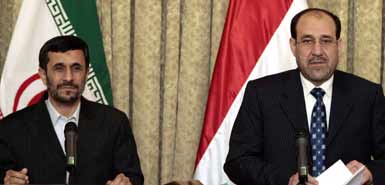 |
Iran's
Mahmoud Ahmadinejad and Iraq's Nuri al-Maliki hold a joint press conference in Iraq March 2008 |
"Mahmoud
Ahmadinejad was right to look smug at the end of his two-day state visit to Iraq. Not only
did he become the first Iranian president to visit Baghdad, but he also took a big step
towards achieving the victory that had eluded Ayatollah Khomeini, the father of the
Iranian revolution. Twenty years ago the Ayatollah conceded defeat after his country was
fought to a standstill in the bloody trenches of the Iran-Iraq battlefield. After the
deaths of one million people over eight years of combat, he compared giving up the
struggle to drinking 'poison', and died the following year. As Mr Ahmadinejad discovered
when he was greeted by 'Uncle Jalal' (President Jalal Talabani of Iraq) in Baghdad, Iraq today is now ripe for Iranian domination. While the US-led
invasion of Iraq ['Operation Iraqi Freedom'] has been criticised widely across the Middle
East and around the world, Iran has emerged as the main beneficiary from the conflict....
Without the need to fire a shot, Iran is becoming Iraq’s indispensable political ally
and trading partner."
Iraq ripe for Iranian domination
London
Times, 4 March 2008
"Ahmadinejad didn't get just one 'kiss
for luck'; he got four, when he was welcomed by U.S.-backed Iraqi Prime Minister Nouri
al-Maliki, who threw in a symbolic hug by standing impassive while the Iranian leader told
a joint press conference: 'The Americans have to understand the facts of the region. Iraqi
people do not like America.' Many of them, notably the Sunni minority, don't care all that
much for Iran either. But, even they were impressed by the fact that Ahmadinejad flagged
his trip well in advance, made a ceremonial arrival in full view of Iraqi media, traveled
by road and did not stay in the fortified Green Zone. The show was in stark contrast to
President Bush and other American VIPs who, if they deign to venture off secure U.S.
military bases after they arrive here unannounced and in secret, do so by
helicopter."
Iran Winning Iraqi Hearts And Minds
CBS News, 4
March 2008
"Bush's trip to the Middle East this
January failed to rally Washington's Arab allies against Tehran, as did vice president
Dick Cheney's and defense secretary Robert Gates' visits previously. This is a sharp
reversal. Only a year ago, the ascendance of Iran's allies in Iraqi politics and
Hezbollah's steadfastness in Lebanon gave rhetorical ammunition to Egyptian and other Arab
leaders, who warned of a renewed Iranian plan to export revolution. Since then, the White
House's failure to make its accusations about Iranian nuclear mischief stick or impose
effective UN sanctions on Iran has changed the region's geopolitical calculus. Conservative Arab elites now seem to have concluded that the way
to control Shia Iran's popularity among their Sunni-majority masses is to befriend rather
than confront Tehran....In back-to-back,
unprecedented friendly moves blessed by Egypt in December, the Saudi monarch played host
to Iran's president Ahmadinejad at the Haj pilgrimage. And the six-nation Gulf Cooperation
Council (GCC), established in 1981 to blunt Iran's revolution, invited him to its
summit."
Nervously and Rapidly, Iran Courts Egypt
Foreign Policy In Focus, 14 February 2008
"When the Bush administration decided
to invade Iraq two years ago, it envisioned a quick handover to handpicked allies in a
secular government that would be the antithesis of Iran's theocracy -- potentially even a
foil to Tehran's regional ambitions. But, in one of the greatest ironies of the U.S.
intervention, Iraqis instead went to the polls and elected a government with a strong
religious base -- and very close ties to the Islamic republic next door. It is the last
thing the administration expected from its costly Iraq policy -- $300 billion and
counting, U.S. and regional analysts say..... the top two winning parties -- which
together won more than 70 percent of the vote and are expected to name Iraq's new prime
minister and president -- are Iran's closest allies in Iraq. Thousands of members of the
United Iraqi Alliance, a Shiite-dominated slate that won almost half of the 8.5 million
votes and will name the prime minister, spent decades in exile in Iran. Most of the
militia members in its largest faction were trained in Shiite-dominated Iran. And the
winning Kurdish alliance, whose co-leader Jalal Talabani is the top nominee for president,
has roots in a province abutting Iran, which long served as its economic and political
lifeline. 'This is a government that will have very good relations with Iran. The Kurdish
victory reinforces this conclusion. Talabani is very close to Tehran,' said Juan Cole, a
University of Michigan expert on Iraq.' 'In terms of regional geopolitics, this is not the
outcome that the United States was hoping for.'... For
decades, both Republican and Democratic administrations played Baghdad and Tehran off each
other to ensure neither became a regional giant threatening or dominant over U.S. allies,
notably Saudi Arabia and the oil-rich Gulf sheikdoms. But now, Cole said, Iraq and Iran
are likely to take similar positions on many issues, from oil prices to U.S. policy on
Iran.... the Iraqi secular democrats backed most
strongly by the Bush administration lost big. During his State of the Union address last
year, Bush invited Adnan Pachachi, a longtime Sunni politician and then-president of the
Iraqi Governing Council, to sit with first lady Laura Bush. Pachachi's party fared so
poorly in the election that it won no seats in the national assembly.And current Prime
Minister Ayad Allawi, backed by the CIA during his years in exile and handpicked by U.S.
and U.N. officials to lead the interim government, came in third. He addressed a joint
session of Congress in September, a rare honor reserved for heads of state of the closest
U.S. allies. But now, U.S. hopes that Allawi will tally enough votes to vie as a
compromise candidate and continue his leadership are unrealistic, analysts say."
Iraq Winners Allied With Iran Are the Opposite of U.S. Vision
Washington
Post, 14 February 2005
Operation Ajax 1953
'Blowback'
"Fifty years ago this
week, the CIA and the British SIS orchestrated a coup d'etat that toppled the
democratically elected government of Mohammad Mossadegh. The prime minister and his
nationalist supporters in parliament roused Britain's ire when they nationalised the oil
industry in 1951, which had previously been exclusively controlled by the Anglo-Iranian
Oil Company. Mossadegh argued that Iran should begin profiting from its vast oil
reserves....A new book about the coup, All the Shah's Men, which is based on recently
released CIA documents, describes how the CIA - with British assistance - undermined
Mossadegh's government by bribing influential figures, planting false reports in
newspapers and provoking street violence. Led by an agent named Kermit Roosevelt, the
grandson of President Theodore Roosevelt, the CIA leaned on a young, insecure Shah to
issue a decree dismissing Mossadegh as prime minister. By the end of Operation Ajax, some
300 people had died in firefights in the streets of Tehran. The crushing of Iran's first
democratic government ushered in more than two decades of dictatorship under the Shah, who
relied heavily on US aid and arms. The anti-American
backlash that toppled the Shah in 1979 shook the whole region and helped spread Islamic
militancy, with Iran's new hardline theocracy declaring undying hostility to the US....The
author of All the Shah's Men, New York Times reporter Stephen Kinzer, argues that the coup
planted the seeds of resentment against the US in the Middle East, ultimately leading to
the events of September 11."
The spectre of Operation Ajax
Guardian, 20
August 2003
Comment
The spectre of Operation Ajax
Britain and the US crushed Iran's first
democratic government. They didn't learn from that mistake
- Dan De Luce, Tehran
- The Guardian,
- Wednesday August 20 2003
Ignoring international law, Britain and the US opted for the
high-risk strategy of regime change in order to pre-empt a volatile enemy in the Middle
East. It was not Iraq, however, that was in the firing line but Iran, and the aftershocks
are still being felt.
Fifty years ago this week, the CIA and the
British SIS orchestrated a coup d'etat that toppled the democratically elected government
of Mohammad Mossadegh. The prime minister and his nationalist supporters in parliament
roused Britain's ire when they nationalised the oil industry in 1951, which had previously
been exclusively controlled by the Anglo-Iranian Oil Company. Mossadegh argued that Iran
should begin profiting from its vast oil reserves.
Britain accused him of violating the company's legal rights
and orchestrated a worldwide boycott of Iran's oil that plunged the country into financial
crisis. The British government tried to enlist the Americans in planning a coup, an idea
originally rebuffed by President Truman. But when Dwight Eisenhower took over the White
House, cold war ideologues - determined to prevent the possibility of a Soviet takeover -
ordered the CIA to embark on its first covert operation against a foreign government.
A new book about the coup, All the Shah's Men, which is based
on recently released CIA documents, describes how the CIA - with British assistance -
undermined Mossadegh's government by bribing influential figures, planting false reports
in newspapers and provoking street violence. Led by an agent named Kermit Roosevelt, the
grandson of President Theodore Roosevelt, the CIA leaned on a young, insecure Shah to
issue a decree dismissing Mossadegh as prime minister. By the end of Operation Ajax, some
300 people had died in firefights in the streets of Tehran.
The crushing of Iran's first democratic government ushered in
more than two decades of dictatorship under the Shah, who relied heavily on US aid and
arms. The anti-American backlash that toppled the Shah in 1979 shook the whole region and
helped spread Islamic militancy, with Iran's new hardline theocracy declaring undying
hostility to the US.
The author of All the Shah's Men, New York Times reporter
Stephen Kinzer, argues that the coup planted the seeds of resentment against the US in the
Middle East, ultimately leading to the events of September 11.
While it may be reaching too far to link Mossadegh's
overthrow with al-Qaida's terrorism, it certainly helped unleash a wave of Islamic
extremism and assisted to power the anti-American clerical leadership that still rules
Iran. It is difficult to imagine a worse outcome to an expedient action.
The coup and the culture of covert interference it created
forever changed how the world viewed the US, especially in poor, oppressive countries. For
many Iranians, the coup was a tragedy from which their country has never recovered.
Perhaps because Mossadegh represents a future denied, his memory has approached myth.
On yesterday's anniversary, there was no official government
ceremony honouring Mossadegh's legacy. Deemed too secular for the Islamic Republic, the
conservative clergy never mention him. But at a time when the Bush administration
expresses impatience with diplomacy and promotes "regime change" as a means of
reshaping the Middle East, the anniversary recalls some unwelcome parallels.
The mindset that produced the coup is not so different from
the premises that underpin the current doctrine of "pre-emption" or the belief
that the war on terror can justify ignoring the Geneva convention, diplomacy and the
sentiments of a country's population.
Veterans of the cold war in President Bush's administration
are cultivating relations with Iranian monarchists in exile while Congressmen are calling
for a campaign to undermine Iran's clerical leadership. Washington's tough rhetoric and
flirtation with the Shah's son are a kind of nightmarish deja vu for the embattled
reformists and students struggling to push for democratic change in Iran.
"Now it seems that the Americans are pushing towards the
same direction again," says Ibrahim Yazdi, who served briefly as foreign minister
after the Shah fell. "That shows they have not learned anything from history."
The reformists allied with President Khatami believe their
country now faces another choice between despotism and democracy, and they worry that the
combination of outside interference and internal squabbling within their own ranks could
once again defer their dream. The more neo-conservatives attempt to pile pressure on Iran,
the more ammunition they provide for the most hardline elements of the regime.
Beyond Iran, America remains deeply resented for siding with
authoritarian rule in the region. It would be comforting to think "reshaping the
Middle East" means promoting democratic rule. But if it merely allows for the ends to
justify the means, then the spectre of Operation Ajax will continue to haunt the region.
· Dan De Luce is the Guardian's correspondent in
Tehran
· dandeluce@yahoo.com
|
'The Secret CIA History
Of The Coup In Iran, 1953'
View Operation Ajax Documents At
George Washington Univeristy National Security Archive
Click Here |
"The Central Intelligence Agency's secret history
of its covert operation to overthrow Iran's government in 1953 offers an inside look at
how the agency stumbled into success, despite a series of mishaps that derailed its
original plans. Written in 1954 by one of the coup's chief planners, the history details
how United States and British officials plotted the military coup that returned the shah
of Iran to power and toppled Iran's elected prime minister, an ardent nationalist. The
document shows that:
Britain, fearful of Iran's plans to nationalize
its oil industry, came up with the idea for
the coup in 1952 and pressed the United States to mount a joint operation to remove the
prime minister.
- The C.I.A. and S.I.S., the British intelligence service,
handpicked Gen. Fazlollah Zahedi to succeed Prime Minister Mohammed Mossadegh and covertly
funneled $5 million to General Zahedi's regime two days after the coup prevailed.
- Iranians working for the C.I.A. and posing as Communists
harassed religious leaders and staged the
bombing of one cleric's home in a campaign to turn the country's Islamic religious
community against Mossadegh's government.
The shah's cowardice nearly killed the
C.I.A. operation. Fearful of risking his throne, the Shah repeatedly refused to sign
C.I.A.-written royal decrees to change the government. The agency arranged for the shah's
twin sister, Princess Ashraf Pahlevi, and Gen. H. Norman Schwarzkopf, the father of the
Desert Storm commander, to act as intermediaries to try to keep him from wilting under
pressure. He still fled the country just before the coup succeeded."
The CIA In Iran
New York
Times On The Web, 2000
1953 |
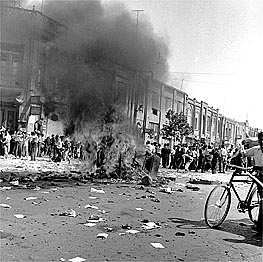 |
Violence
in Tehran, 19 August 1953
Associated Press, 1953
"The Director, on April 4, 1953,
approved a budget of $1,000,000 which could be be used by the Tehran Station in any way
that would bring about the fall of Mossadegh." — C.I.A. Document, Part I,
page 3
"The purpose will be to create,
extend, and enhance public hostility and distrust and fear of Mossadegh and his
government." — C.I.A. Document, Appendix B, page 15
Click Here
To Read 1953 Coup Details Published On New York Times Web Site |
"For nearly five decades, America's
role in the military coup that ousted Iran's elected prime minister and returned the shah
to power has been lost to history, the subject of fierce debate in Iran and stony silence
in the United States. One by one, participants have retired or died without revealing key
details, and the Central Intelligence Agency said a number of records of the operation
— its first successful overthrow of a foreign government — had been destroyed. But a copy of the agency's secret history of the coup has
surfaced, revealing the inner workings of a plot that set the stage for the Islamic
revolution in 1979, and for a generation of anti-American hatred in one of the Middle
East's most powerful countries. The
document, which remains classified, discloses the
pivotal role British intelligence officials played in initiating and planning the coup, and it shows that Washington and London shared an interest in maintaining the West's control over Iranian oil. The secret history, written by the C.I.A.'s chief coup planner
and obtained by The New York Times, says the operation's success was mostly a matter of
chance. The document shows that the agency had almost complete contempt for the man it was
empowering, Shah Mohammed Reza Pahlevi, whom it derided as a vacillating coward. And it
recounts, for the first time, the agency's tortured efforts to seduce and cajole the shah
into taking part in his own coup. The operation, code-named TP-Ajax, was the blueprint for
a succession of C.I.A. plots to foment coups and destabilize governments during the cold
war — including the agency's successful coup in Guatemala in 1954 and the disastrous
Cuban intervention known as the Bay of Pigs in 1961. In more than one instance, such
operations led to the same kind of long-term animosity toward the United States that
occurred in Iran."
How a Plot Convulsed Iran in '53 (and in '79)
New York
Times On The Web, 2000
'Democracy Now' Interviews
Stephen Kinzer On The 1953 Coup - 25 August 2003 - Click
Here
1953-2003
Yes, It Was The Oil Stupid
“I am saddened that it is politically
inconvenient to acknowledge
what everyone knows: the Iraq war is largely about oil.”
Alan Greenspan, Chairman Of The US Federal Reserve 1987 - 2006
Sunday Times, 16 September 2007
"... we've been in the
Middle East more than 50 years. We've been in
the Middle East ever since the -- however you would like to call the dependency upon oil has developed. And our forces have been there
either as naval, air or land forces in one way or another for an awful long time. And once
the British pulled out the Arabian gulf, it became more and more necessary for us to
provide more and more force in the region..... And ultimately, it comes down to the free flow of goods and resources on which the
prosperity of our own nation and everybody else's depends upon.... We need to maintain a
presence that protects the small nations and ensures the continued stability of the region
and the flow of those resources
that are essential to our well-being."
General John Abizaid, Commander of the
United States Central Command overseeing US operations in Iraq, confirming to a US
Congressional Committee that the United States needs permanent
military bases in Iraq in order to maintain access to Gulf oil
The Perennial Battle For
Iraq's Oil
(And That Of Its Neighbours)
www.nlpwessex.org/docs/iraqoil.htm
Why They Really Hate Us
Anglo-American Access To Middle East Oil
Is What It Has Always Been About Since At Least 1913
'Democratic' Britain, Not Saddam Hussein, Was The
First To Gas The Kurds
As Favoured By Winston Churchill
Click Here |
"It is hardly surprising that the
crisis is proving fertile ground for Iranian conspiracy theorists.....Historically,
Iranians have some ammunition for viewing Britain as perfidious. It was a British-inspired coup, engineered by
MI6 with the CIA, that in 1953 toppled Mohammad
Mossadegh, the popular Prime Minister, two years after
he nationalised Iran’s oil industry, which had been controlled by Britain."
Conspiracy theories bubbling under
London
Times, 3 April 2007
"If the 15 British sailors currently
held by Iran's revolutionary guards are shocked by the hostility to Britain shown by their
captors, it will be less surprising to British diplomats engaged in the delicate process
of securing their release. Hostility to all things British is, as every foreign office
mandarin knows, the default mode of Iran's staunchly anti-western political leadership.
From its perspective, Britain - along with America - is in the vanguard of 'global
arrogance', Iranian political shorthand for the contemporary western interventionism whose alleged goal is to dominate and control the resources of developing nations such as Iran.... But this is not just President Ahmadinejad. The antipathy goes back
to colonial times, and the long and tortured history of British intervention in Iran. This
anti-British sentiment is shared by ordinary Iranians. Its resonance defies boundaries of
age, education, social class or political affiliation. In the eyes of a broad
cross-section of the population, Britain - as much,
or even more than, the US - is the real enemy. Four
decades after the sun set on its imperial might, the Machiavellian instincts of the 'old
coloniser' are believed to be alive, well and still acting against the interests of Iran.
For every mishap - whether a bombing, rising living costs or simply the advent of an
unpopular government - a hidden British hand is often thought to be at work..... In 1901,
William Knox D'Arcy, a London-based lawyer and businessman, was granted exploration rights
in most of Iran's oil fields for the princely sum of £20,000. It took several years for
D'Arcy's investment to bear fruit but when it did - after he struck oil in Masjid-e
Suleiman in 1908 - its effect was enduring and fateful. It turned out to be the world's
largest oil field to date and a year later, D'Arcy's concession was merged into the Anglo-Persian Oil Company (APOC). In 1913, with war clouds gathering in Europe, the British admiralty -
under Winston Churchill - discarded coal in favour of oil to power its battleships. To
safeguard the decision, the government bought a 51% stake in APOC. The importance of oil -
and Iran - in British imperial expansion was now explicit. It was a priority of which
Churchill, for one, would never lose sight.... anger over the arrogant behaviour of the
now-renamed Anglo-Iranian Oil Company - it later became BP - was leading inevitably to a
fateful confrontation between Britain and Iran. Resentment over Iran's paltry share of
company profits had festered for years. In 1947, out of an annual profit of £40m, Iran
received just £7m. Iranian anger was further fuelled by the treatment of oil-company
workers who were restricted to low-paid menial jobs and kept in squalid living conditions,
in contrast to the luxury in which their British masters lived. Attempts at persuading the
oil company to give Iran a bigger share of the profits and its workers a fairer deal
proved fruitless. The result was a standoff that created conditions ripe for a nationalist
revolt. Into this ferment walked Mohammad Mossadegh, a lawyer and leftwing secular nationalist
politician fated to go down as perhaps Iranian history's biggest martyr before British perfidy. Mossadegh
was elected prime minister in 1951 advocating a straightforward solution to the oil
question - nationalisation. It was a goal he carried out with single-minded zeal while
lambasting the British imperialists in tones redolent of a later Iranian leader, Mahmoud
Ahmadinejad. Within months, he had ordered the Iranian state to take over the oil company and expelled its
British management and workers. The company and the British government reacted furiously.
The Labour government of Clement Attlee imposed a naval blockade in the Gulf and asked the
UN security council to condemn Iran. Instead, the council embarrassingly came out in
Iran's favour. Meanwhile, Mossadegh - who often did business in his pyjamas - embarked on
an American tour in the naive belief that the US would back him against the British
'colonisers'. It was a serious misjudgment. The oil
company's executives were clamouring for a coup to overthrow Mossadegh. Attlee rebuffed the idea but when a Conservative government took office
in October 1951, led by Churchill, it fell on more sympathetic ears. With British power in
decline, however, Churchill was unable to mount such a venture alone. American help would
be needed. The result was Operation
Ajax, a CIA-MI6 putsch that co-opted a loose
coalition of monarchists, nationalist generals, conservative mullahs and street thugs to
overthrow Mossadegh. With the economy teetering in the face of the British blockade,
Mossadegh was ousted after several days of violent street clashes. The
shah, at that time a weak figure, had fled to Rome fearing the coup would fail. When he
heard the news of Mossadegh's demise, he responded: 'I knew they loved me.' He
subsequently returned to install a brutally repressive regime - maintained in power by the
notorious Savak secret police -backed to the hilt by both America and Britain for the next
25 years.... After the revolution, the Islamic authorities continued to
draw on national resentment at more than a century of British interference, damning
Britain as the 'little Satan' (the US was the 'Great Satan'). Such feelings were further
fed by London's support for Saddam Hussein during the 1980-88 Iran-Iraq war, despite
Baghdad having started the war and subsequently resorting to chemical weapons. London and
Tehran were at loggerheads again in 1989 after the revolution's spiritual leader,
Ayatollah Ruhollah Khomeini, issued a fatwa (religious edict) sentencing the British
author, Salman Rushdie, to death for blasphemy over his novel, The Satanic Verses. The
antipathy resurfaced most recently in June 2004 in an incident with uncanny parallels to
the current stand-off. Then, eight British sailors were seized and paraded blindfold on
state TV after allegedly straying into Iranian waters in the Shatt al-Arab waterway, where
the 15 currently in detention were intercepted and arrested last Friday. On the previous
occasion, the Britons were released following an apology from the foreign secretary at the
time, Jack Straw.... The British RAF personnel and marines in Iran's
captivity may well be oblivious to the long-accumulated resentments that have provided the
backdrop to their detentions. Perhaps they are learning something of this tortured history
from their captors."
A bitter legacy
Guardian, 30 March 2007
"Ever
since oil was discovered there in 1908, Iran had attracted great interest from the West. The British played a dominant role there until World War II, when the
Soviet Union joined them in fighting to keep the Germans out. Until 1953, the United
States mostly stayed on the sidelines, advocating for an independent Iran under the
leadership of the young king, Reza Shah Pahlavi. But that year, fearing that charismatic
prime minister Mohammed Mossadegh might be moving Iran closer to Moscow, the CIA directed an operation to oust him and consolidate power
under the Shah. "
People & Events: The Iranian Hostage Crisis, November 1979 - January 1981
Public
Broadcasting Service, USA (Undated)
"The Islamic Republic of Iran was
born out of a power struggle over the extent of foreign influence inside Iran. The
conflict began in the early 1950s, when Prime Minister Mohammed Mossadeq, who intended to
nationalize the country's oil wealth, momentarily seized control from Shah Mohammad Reza
Pahlavi, the constitutional monarch
representing Anglo-American oil interests.
The CIA intervened in 1953, engineering a coup that ousted Mossadeq and reinstated Shah
Pahlavi's pro-Western regime. Iranians came to perceive the shah's state, characterized by
despotic repression and economic upheaval, as the betrayal of their nation for the benefit
of Western powers, particularly the United States. Growing opposition to the shah found a
leader in the influential cleric Ayatollah Ruhollah Khomeini. His calls for a new
religious government, to be based on the strict fundamentalist principles of Shi'iah
Islam, represented a complete rejection of Western influence and values. Khomeini's
message, readily accepted by a population angry at foreign intervention, ignited the Islamic Revolution that toppled the shah in
1979. "
The Modern Past - The Islamic Republic of Iran is born out of
revolution
PBS Frontline, January
2004
'Value For Money'
How To Spend $3 Trillion Of Other People's Money
And Still Be Worse Off Than When You Started
“The truth is that Iran is emerging
as one of the big winners of the US and Britain's disaster in Iraq….”
The Iran Crisis Is Blair’s True Legacy
Mail
On Sunday, 30 March 2007
"The war in Iraq will ultimately cost
U.S. taxpayers not hundreds of billions of dollars, but an astonishing $2 trillion, and
perhaps more. There has been very little in the way of public conversation, even in the
presidential campaigns, about the consequences of these costs, which are like a cancer
inside the American economy. On Thursday, the Joint Economic Committee, chaired by Senator
Chuck Schumer, conducted a public examination of the costs of the war. The witnesses
included the Nobel Prize-winning economist, Joseph Stiglitz (who believes the overall
costs of the war — not just the cost to taxpayers — will reach $3 trillion), and
Robert Hormats, vice chairman of Goldman Sachs International. Both men talked about large
opportunities lost because of the money poured into the war. 'For a fraction of the cost
of this war,' said Mr. Stiglitz, 'we could have put Social Security on a sound footing for
the next half-century or more.' Mr. Hormats mentioned Social Security and Medicare, saying
that both could have been put “on a more sustainable basis.” And he cited the
committee’s own calculations from last fall that showed that the money spent on the
war each day is enough to enroll an additional 58,000 children in Head Start for a year,
or make a year of college affordable for 160,000 low-income students through Pell Grants,
or pay the annual salaries of nearly 11,000 additional border patrol agents or 14,000 more
police officers. What we’re getting instead is
the stuff of nightmares.”
The $2 Trillion Nightmare
New
York Times, 4 March 2008
http://www.timesonline.co.uk/tol/comment/columnists/guest_contributors/article3419840.ece
The three trillion dollar war
The cost of the Iraq
and Afghanistan conflicts have grown to staggering proportions
The Bush Administration was wrong about the
benefits of the war and it was wrong about the costs of the war. The president and his
advisers expected a quick, inexpensive conflict. Instead, we have a war that is costing
more than anyone could have imagined.
The cost of direct US military operations - not even including long-term costs
such as taking care of wounded veterans - already exceeds the cost of the 12-year war in
Vietnam and is more than double the cost of the Korean War.
And, even in the best case scenario, these costs are projected to be almost ten
times the cost of the first Gulf War, almost a third more than the cost of the Vietnam
War, and twice that of the First World War. The only war in our history which cost more
was the Second World War, when 16.3 million U.S. troops fought in a campaign lasting four
years, at a total cost (in 2007 dollars, after adjusting for inflation) of about $5
trillion (that's $5 million million, or £2.5 million million). With virtually the entire
armed forces committed to fighting the Germans and Japanese, the cost per troop (in
today's dollars) was less than $100,000 in 2007 dollars. By contrast, the Iraq war is
costing upward of $400,000 per troop.
Most Americans have yet to feel these costs. The price in blood has been paid by
our voluntary military and by hired contractors. The price in treasure has, in a sense,
been financed entirely by borrowing. Taxes have not been raised to pay for it - in fact,
taxes on the rich have actually fallen. Deficit spending gives the illusion that the laws
of economics can be repealed, that we can have both guns and butter. But of course the
laws are not repealed. The costs of the war are real even if they have been deferred,
possibly to another generation.
On the eve of war, there were discussions of the likely costs. Larry Lindsey,
President Bush's economic adviser and head of the National Economic Council, suggested
that they might reach $200 billion. But this estimate was dismissed as “baloney”
by the Defence Secretary, Donald Rumsfeld. His deputy, Paul Wolfowitz, suggested that
postwar reconstruction could pay for itself through increased oil revenues. Mitch Daniels,
the Office of Management and Budget director, and Secretary Rumsfeld estimated the costs
in the range of $50 to $60 billion, a portion of which they believed would be financed by
other countries. (Adjusting for inflation, in 2007 dollars, they were projecting costs of
between $57 and $69 billion.) The tone of the entire administration was cavalier, as if
the sums involved were minimal.
Even Lindsey, after noting that the war could cost $200 billion, went on to say:
“The successful prosecution of the war would be good for the economy.” In
retrospect, Lindsey grossly underestimated both the costs of the war itself and the costs
to the economy. Assuming that Congress approves the rest of the $200 billion war
supplemental requested for fiscal year 2008, as this book goes to press Congress will have
appropriated a total of over $845 billion for military operations, reconstruction, embassy
costs, enhanced security at US bases, and foreign aid programmes in Iraq and Afghanistan.
As the fifth year of the war draws to a close, operating costs (spending on the
war itself, what you might call “running expenses”) for 2008 are projected to
exceed $12.5 billion a month for Iraq alone, up from $4.4 billion in 2003, and with
Afghanistan the total is $16 billion a month. Sixteen billion dollars is equal to the
annual budget of the United Nations, or of all but 13 of the US states. Even so, it does
not include the $500 billion we already spend per year on the regular expenses of the
Defence Department. Nor does it include other hidden expenditures, such as intelligence
gathering, or funds mixed in with the budgets of other departments.
Because there are so many costs that the Administration does not count, the
total cost of the war is higher than the official number. For example, government
officials frequently talk about the lives of our soldiers as priceless. But from a cost
perspective, these “priceless” lives show up on the Pentagon ledger simply as
$500,000 - the amount paid out to survivors in death benefits and life insurance. After
the war began, these were increased from $12,240 to $100,000 (death benefit) and from
$250,000 to $400,000 (life insurance). Even these increased amounts are a fraction of what
the survivors might have received had these individuals lost their lives in a senseless
automobile accident. In areas such as health and safety regulation, the US Government
values a life of a young man at the peak of his future earnings capacity in excess of
$7 million - far greater than the amount that the military pays in death
benefits. Using this figure, the cost of the nearly 4,000 American troops killed in Iraq
adds up to some $28 billion.
The costs to society are obviously far larger than the numbers that show up on
the government's budget. Another example of hidden costs is the understating of US
military casualties. The Defence Department's casualty statistics focus on casualties that
result from hostile (combat) action - as determined by the military. Yet if a soldier is
injured or dies in a night-time vehicle accident, this is officially dubbed “non
combat related” - even though it may be too unsafe for soldiers to travel during
daytime.
In fact, the Pentagon keeps two sets of books. The first is the official
casualty list posted on the DOD website. The second, hard-to-find, set of data is
available only on a different website and can be obtained under the Freedom of Information
Act. This data shows that the total number of soldiers who have been wounded, injured, or
suffered from disease is double the number wounded in combat. Some will argue that a
percentage of these non-combat injuries might have happened even if the soldiers were not
in Iraq. Our new research shows that the majority of these injuries and illnesses can be
tied directly to service in the war.
From the unhealthy brew of emergency funding, multiple sets of books, and
chronic underestimates of the resources required to prosecute the war, we have attempted
to identify how much we have been spending - and how much we will, in the end, likely have
to spend. The figure we arrive at is more than $3 trillion. Our calculations are based on
conservative assumptions. They are conceptually simple, even if occasionally technically
complicated. A $3 trillion figure for the total cost strikes us as judicious, and probably
errs on the low side. Needless to say, this number represents the cost only to the United
States. It does not reflect the enormous cost to the rest of the world, or to Iraq.
From the beginning, the United Kingdom has played a pivotal role - strategic,
military, and political - in the Iraq conflict. Militarily, the UK contributed 46,000
troops, 10 per cent of the total. Unsurprisingly, then, the British experience in Iraq has
paralleled that of America: rising casualties, increasing operating costs, poor
transparency over where the money is going, overstretched military resources, and scandals
over the squalid conditions and inadequate medical care for some severely wounded
veterans.
Before the war, Gordon Brown set aside £1 billion for war spending. As of late
2007, the UK had spent an estimated £7 billion in direct operating expenditures in Iraq
and Afghanistan (76 per cent of it in Iraq). This includes money from a supplemental
“special reserve”, plus additional spending from the Ministry of Defence.
The special reserve comes on top of the UK's regular defence budget. The British
system is particularly opaque: funds from the special reserve are “drawn down”
by the Ministry of Defence when required, without specific approval by Parliament. As a
result, British citizens have little clarity about how much is actually being spent.
In addition, the social costs in the UK are similar to those in the US -
families who leave jobs to care for wounded soldiers, and diminished quality of life for
those thousands left with disabilities.
By the same token, there are macroeconomic costs to the UK as there have been to
America, though the long-term costs may be less, for two reasons. First, Britain did not
have the same policy of fiscal profligacy; and second, until 2005, the United Kingdom was
a net oil exporter.
We have assumed that British forces in Iraq are reduced to 2,500 this year and
remain at that level until 2010. We expect that British forces in Afghanistan will
increase slightly, from 7,000 to 8,000 in 2008, and remain stable for three years. The
House of Commons Defence Committee has recently found that despite the cut in troop
levels, Iraq war costs will increase by 2 per cent this year and personnel costs will
decrease by only 5 per cent. Meanwhile, the cost of military operations in Afghanistan is
due to rise by 39 per cent. The estimates in our model may be significantly too low if
these patterns continue.
Based on assumptions set out in our book, the budgetary cost to the UK of the
wars in Iraq and Afghanistan through 2010 will total more than £18 billion. If we include
the social costs, the total impact on the UK will exceed £20 billion.
© Joseph Stiglitz and Linda Bilmes, 2008. Extracted from The Three Trillion
Dollar War, to be published by Allen Lane on February 28 (£20). Copies can be ordered for
£18 with free delivery from The Times BooksFirst 0870 1608080.
Joseph Stiglitz was chief economist at the World Bank and won the Nobel Memorial
Prize for Economics in 2001. Linda Bilmes is a lecturer in public policy at the Kennedy
School of Government at Harvard University |