'Fight Smart' - 23
October 2007
Don't
Take the Bait - Fight Smart
ANIMATED 911 SUMMARY -
CLICK HERE
Who is the enemy?
An End To Terror?
Retiring British Ambassador To Washington Proposes Global Education Fund
Britain's Top Diplomat Takes Parting
Shot At Bush Administration
www.nlpwessex.org/docs/watmanning.htm
Sir David Manning Highlights Importance Of 'Thinking Outside
The Box'
For Security Of Energy Supplies
But What Was Manning Doing In Washington On 9/10?
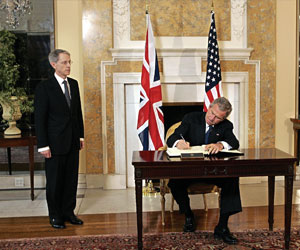 |
Sir David Manning, Britain's Ambassador
To Washington 2003 - 2007,
With President George W Bush
After his overrunning meeting with National
Security Adviser Condoleezza Rice the previous day Manning took a flight from Washington to New York on the morning of 9/11. Unlike
most of the rest of the world, he knew what the score was immediately following the
attacks on the World Trade Center and the Pentagon.
The next day he told the director of the CIA, at a face to face meeting in
Virginia,
"I hope we can all agree that we should concentrate on Afghanistan and not be
tempted to launch any attacks on Iraq". |
"The [British] Ambassador to
Washington tells our correspondent that warfare alone is not enough to counter world
terrorism.... Sir David Manning, formerly Tony Blair’s right-hand man on foreign
policy, said: 'It’s not enough just to go on about terrorism and the Middle East
peace process . . . we need to find new ways of bridging and reaching out.'... 'When I see
how much money we’re spending on other things, it does seem to me to be a very poor
investment on our part.' He asked: 'How many schools could you get for an aircraft
carrier?' Sir David, who leaves his post as British Ambassador to the United States next
month, has rarely spoken out publicly in such forceful
fashion during an illustrious 35-year diplomatic career.
Indeed, as Tony Blair’s chief foreign and security policy adviser in 2001-03 and
thereafter Ambassador to Washington, he has been at the heart of decisions to invade
Afghanistan and Iraq. In an interview with The Times he emphasised that existing foreign
policy priorities remain 'terribly important', but added: 'We
have to move beyond that. I suppose at the end of my time
I’m allowed to think outside the box.'. Sir David, 57, does not know what he will do when he quits the Foreign
Office next month and denied that his idea for a world education fund is a pitch for a new
job. But he does not need much invitation to expand on the scheme: A global education fund would have to operate
like the World Bank, he said, without 'any one country’s fingerprints all over it'.
It could also attract investment from big corporations, particularly those with a stake in
the security of energy supplies....
His own departure next month will mark that of the last member of Mr Blair’s foreign
policy team which established extraordinarily close relations with that of Mr Bush.
Indeed, on the eve of the September 11, 2001, attacks on America, he had stayed so late in Washington discussing
policy with Condoleezza Rice
that he had to catch a flight to New York the next morning."
'Muscular diplomacy failing the West'
London Times,
14 September 2007
"In the run-up to war, senior British
security and intelligence officials as well as diplomats made it clear that they were
strongly opposed to the invasion of Iraq - though not clear enough. Why now, why Iraq,
they asked; it would merely increase the terrorist threat, as the joint intelligence
committee warned ministers less than a month before British troops and bombers joined the
US attack on the country. Concern in Whitehall was shared by some perspicacious Americans,
including General Tony Zinni, the former head of US central command, which is responsible
for operations throughout the Middle East. He called it the wrong war, fought in the wrong
place, at the wrong time. Now comes fresh evidence that senior British officials tried to
persuade the Bush administration to keep off Iraq and concentrate on Afghanistan, the real
source of terrorist violence inspired by al-Qaida. On the Brink, the newly published
memoirs of Tyler Drumheller - the CIA's chief of clandestine operations in Europe until
2005 - tells of a meeting on September 12 2001. The day after al-Qaida's attacks on America, George Tenet, then CIA
director, met three British guests - Sir David
Manning, then Tony Blair's foreign policy adviser;
Richard Dearlove, then head of MI6; and Eliza Manningham-Buller, then head of MI5. 'I hope we can all agree that we should concentrate on Afghanistan
and not be tempted to launch any attacks on Iraq,' Drumheller
quotes the leader of the British delegation as telling Tenet. In a recent article in
the New York Review of Books on Tenet's autobiography, At the Center of the Storm, Thomas
Powers points out that Tenet names his British guests but omits what was said at the
meeting - while Drumheller reports what was said but was prevented by the CIA (which did
not want to upset the British) from identifying who said it.... Powers says the appeal not to attack Iraq came from Manning."
The calamity of disregard
Guardian, 4
August 2007
"Now most Americans accept seven
damning facts: (1) President Bush did little
or nothing about terrorism before 9/11, (2)
there was no Iraqi threat to the United States, (3) the Bush
administration began plotting to invade Iraq early in their term, well before 9/11,
(4) there is no evidence of an Iraqi hand in 9/11, or of any significant support to al
Qaeda, (5) there were no weapons of mass destruction and the White House and Pentagon
justified their claims about WMD by citing phony evidence from Iraqi exiles to whom they
paid millions of dollars, (6) the Bush administration had no real plan to administer Iraq
after the invasion, and (7) Secretary of Defense Donald Rumsfeld ignored professional
military advice and sent too few troops to Iraq to protect our forces.... There is at least one momentous error that is inescapable: President Bush
has sowed the seeds of current and future terrorism against the United States by his
needless, counterproductive, deceitful invasion of Iraq.... It pains me
that so much of what I wrote in this book is coming to pass.... It is a war we are losing, as more and more of the Islamic
world develops antipathy toward the United States and some even develop a respect for the
jihadist movement."
Richard Clarke - White House Head Of Counterterrorism 1992 - 2003
'Against All Enemies' - Edition first published in Great
Britain by The Free Press in 2004
"Much that is still classified as secret by the U.S. government is
omitted in this book."
Richard Clarke - White House Head Of
Counterterrorism 1992 - 2003
'Against All Enemies' - Edition first published in Great
Britain by The Free Press in 2004
In This Bulletin |
From
9/11 To Iraq And Beyond
The Story Of Sir David Manning |
'The
Special Relationship'
What Did Britain Know About 9/11? |
The
Silence Of George Tenet
9/11 And The Russian-Israeli Connection |
Why
Condoleezza Rice's Pre-9/11 Priority
Was Oil And Gas, Not Counterterrorism |
The Desperate World of James Woolsey
Ex-CIA Chief And Iraq War Hawk Predicted 'Peak' Oil Crisis In 1999 CFR
Paper |
Bush
Treasury Secretary Paul O'Neill
On How The Bush Administration Began Preparing For Military Acton Against Iraq
Within Days Of The President's Inauguration |
Wolfowitz
Claimed Sophistication Of 9/11 Required State Sponsors
But Who If Not Iraq? |
From
Manning To Lynch - 'Education For Peace'
David Lynch Awarded 'Legion D'Honneur' By Sarkozy
Tours UK On Peace Initiative With Donovan October 2007 |
Lynch's Multi-Country Tour October 2007
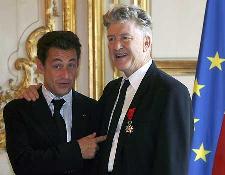
With French President Nicolas Sarkozy
October 2007
"Lynch arrived in Israel on Sunday for
a five-day visit, during which he'll meet with thousands of film students and movie
enthusiasts at the Sam Spiegel School and at the Jerusalem, Haifa and Tel Aviv
Cinematheques. A two-time award winner at the Cannes Film Festival, the 61-year-old
director has also scheduled meetings with Culture, Science and Sport Minister Ghaleb
Majadle, and with Education Minister Yuli Tamir. He'll receive an honorary fellowship
during his visit from the Sam Spiegel School, an award that follows his induction earlier
this month into France's Legion of Honor. Lynch will spend his Israel visit promoting his Foundation for Consciousness-Based Education and World Peace..."
Meditation could bring peace, says director David Lynch
Jerusalem
Post, 16 October 2007
And Now The UK
"... when David Lynch and
Donovan appear on an Edinburgh stage later this
month the focus is not expected to be on their long-running careers and famed talents....
The Queen's Hall, on South Clerk Street, is expected to be full to its 900-strong capacity
for the event on October 26. The event will be introduced by movie critic Mark Cousins, a former
director of the Edinburgh International Film Festival."
Hollywood great gets into spirit in Capital
Edinburgh
Evening News, 12 October 2007
Listen To Lynch And Donovan
On BBC Radio 4 Today Programme, 23 October
Click
Here
(Go to 20 mins into recording) |
Manning Proposes Global Education Fund
“Manning
had been in Washington on the eve of 9/11, and there has long been speculation
about the significance of his visit at that critical time. Did it represent anything more
than a visit simply to introduce himself to the Bush administration following his
new, at that time, Downing St appointment? Until recently not too much has been known about the trip, other than that he was
due to see Richard Armitage, Assistant Secretary of State, on 10 September. However, on 14 September 2007 the London Times reported on its
retirement interview with Sir David. It mentioned that 'on the eve of the September 11,
2001, attacks on America, he had stayed so late in Washington discussing policy with
Condoleezza Rice that he had to catch a flight to New York the next morning.' At that time
Rice was President Bush's National Security Adviser. The apparent length of the meeting
with Manning suggests there was a lot to talk about. One possibility (the Times
does not say what was discussed) is that Manning may have brought with him more
information about warnings of terrorist attacks on the United States. The Times had
earlier reported (14 June 2002) that Britain had received
pre-9/11 intelligence that attacks on 'the west' were being planned by al Qaeda
and that Britain had shared this intelligence with the US government..... Between
2001 and 2005 Tyler Drumheller had been head of the CIA's Clandestine Operations for
Europe. After quitting the agency he published a book entitled 'On The Brink' in 2006. In the second chapter he discloses
that on 12 September 2001, the day after the attacks on the Twin Towers and the Pentagon,
George Tenet and others (including Drumheller) received a ‘powerful delegation from a
very close European ally’ on the seventh floor of the CIA's headquarters at Langley,
Virginia. Drumheller did not say which ally was involved (the matter being classified),
but he quoted the head of the delegation as saying, ‘I
hope we can all agree that we should concentrate on Afghanistan and not be tempted to
launch any attacks on Iraq.’
...... Only later still did it emerge that the prescient comment about Iraq had come from
Manning.... In his September 2007 interview
with the Times Manning dares to publicly criticise the Bush administration for the
failings of its 'muscular' foreign policy. He advocates introducing a more constructive
approach which, in stark contrast, includes a proposal for the establishment of a global education fund for the furtherance of world peace. Manning is
keen to think ‘outside the box’ as an alternative to what he clearly regards as
America's counterproductive 'war on terror'. Indeed, right from the start,
Manning appears to have seen through and beyond a lot of what he can only
privately consider to be the, at best, crass actions of the Bush Administration......We
will probably never know whether Sir David had brought more British warnings of the
impending attacks on America to his meeting with Condoleezza Rice on 9/10. But if he did,
it can only be hoped that, six years later, his advocacy of a
global education fund to move beyond the disastrous response which
followed, will prove to be more timely.”
From 9/11 To Iraq
And Beyond - The Story Of Sir David Manning
Fight Smart, 23 October 2007
It's Time To Put An End To All This War,
Criminality, And Ignorance
"The Iraq conflict has wreaked
'terrible damage' on the region - far more than has been acknowledged, the Archbishop of
Canterbury has said.... A survey published in September 2007 suggested that up to 1.2m people might have died because of the Iraq conflict. Speaking following his visit, Dr Williams also said he regards any
further 'deliberate destabilisation' of the region - such as action against Syria and Iran
- as 'criminal, ignorant...and
potentially murderous folly'. Referring to US
political advisers, he added that 'we do hear talk from some quarters of action against
Syria, or against Iran'."
Archbishop speaks of Iraq damage
BBC Online, 5 October 2007
'Go Find Me A Way To Do This'
"A year ago, Paul O'Neill was fired from
his job as George Bush's Treasury Secretary for disagreeing too many times with the
president's policy on tax cuts. Now, O'Neill - who is known for speaking his mind - talks
for the first time about his two years inside the Bush administration. His story is the
centerpiece of a new book being published this week about the way the Bush White House is
run. Entitled 'The Price of Loyalty,' the book by a former Wall Street Journal reporter draws on interviews
with high-level officials who gave the author their personal accounts of meetings with the
president, their notes and documents. But the main source of the book was Paul O'Neill....
he is going public because he thinks the Bush Administration has been too secretive about
how decisions have been made.... Not only did O'Neill give Suskind his time, he gave him
19,000 internal documents.... And what happened at President Bush's very first National
Security Council meeting is one of O'Neill's most startling revelations. 'From the very
beginning, there was a conviction, that Saddam Hussein was a bad person and that he needed
to go,' says O’Neill, who adds that going after Saddam was topic 'A' 10 days after the
inauguration - eight months before Sept. 11.....'It
was all about finding a way to do it. That was the tone of it. The president saying ‘Go find me a way to do this,’' says O’Neill."
Bush Sought ‘Way’ To Invade Iraq?
CBS News,
11 January 2003
It's The Energy Crisis Stupid
'Access To Critical Areas Of Europe, The Middle East, And
Asia'
"On the afternoon of January 30 [2001], ten days
after his inauguration as the forty-third president, George W.Bush met with the principals
of his National Security Council for the first time.... He turned to Rice. 'So Condi, what
are we going to talk about today? What's on the agenda?' 'How Iraq is destabilising the
region, Mr. President,' Rice, said in what several observers understood was a scripted
exchange.... The hour almost up, Bush had assignments for everyone.... Rumsfeld and
Shelton [Chairman of Joint Chiefs of Staff], he said, 'should examine military options.' That
included rebuilding the military coalition from the 1991 Gulf War, examining 'how it might
look' to use U.S. ground forces in the north and the south of Iraq and how the armed
forces could support groups inside the country who could help challenge Saddam Hussein....
Meeting adjourned. Ten days in, and it was about Iraq.... Shortly after he returned to his office, O'Neill opened a memo from
Donald Rumsfeld.... In describing why the military budget was due for a dramatic increase,
Rumsfeld articulated, with a five-point illustration of a dire global landscape, the underlying ideas that were now guiding foreign policy...[including] 'The civil sector, not the defense sector, now creates the
enabling technologies for advanced military capabilities. These universally available
technologies can be used to create 'asymmetric' responses by small or medium sized states
to our conventional military power that cannot defeat our forces, but can deny access
to critical areas of Europe, the Middle East, and Asia.'.....'There was never any rigorous talk about this sweeping idea that
seemed to be driving all the specific actions,' O'Neill said, echoing the comments of
several other participants in NSC discussions. 'From the start, we were building the case
against Hussein and looking at how we could take him out and change Iraq into a new
country. And, if we did that, it would solve everything. It was all about finding a way to
do it. That was the tone of it. The President saying,
'Fine. Go find me a way to do this.'.... It was Powell and his
moderates at the State Department versus hard-liners like Rumsfeld, Cheney, and Wolfowitz, who were
already planning the next war in Iraq and the shape
of a post-Saddam country. Documents were being
prepared by the Defense Intelligence Agency, Rumsfeld's intelligence arm, mapping Iraq's oil fields and exploration areas and listing companies that might be interested in leveraging the precious
asset. One document, headed 'Foreign Suitors for Iraqi Oilfield Contracts,' lists
companies from thirty countries - including France, Germany, Russia and the United Kingdom
- their specialities, bidding histories, and in some cases their particular areas of
interest. An attached document maps Iraq with markings for 'supergiant oilfield,' 'other
oil-field,' and 'earmarked for production sharing,' while demarking the largely
undeveloped southwest of the country into nine 'blocks' to designate areas for future
exploration. The desire to 'dissuade' countries from engaging in 'asymmetrical challenges'
to the United States - as Rumsfeld said in his January articulation of the demonstrative
value of a preemptive attack - matched with plans for
how the world's second largest oil reserve might be divided among the world's contractors made for an irresistible combination, O'Neill later said. Already by
February, the talk was mostly about logistics. Not the why, but the how and how quickly. Rumsfeld, O'Neill recalled, was focused on how an incident might cause escalated tensions - like the shooting down of an American plane in the regular engagements
between U.S. fighters and Iraqi antiaircraft batteries - and what U.S. responses to such
an occurrence might be..... [On], March 19, O'Neill and members of the Vice
President's National Energy Policy Development Group
filed into the cabinet room to present their findings to the President about the state of
energy production and consumption in the United States. This presentation marked the
completion of the first two phases (the second would be creating policy recommendations)
that had been decided on in late January, when the President officially
empowered Dick Cheney to handle energy.... This task
force, Cheney's, would operate in utmost privacy.... So, on March 19, at an hour-long meeting in the cabinet room, the President was hearing
dark predictions about the economic effects of a looming
energy crisis... The
Imperial Hotel in Tokyo, one of the world's great hotels, offered an oasis of luxury and
comfort for the U.S. delegation after an exhausting week of meetings in Beijing with
Chinese leaders in early September.... [O'Neill] flipped on the television to CNN. And sat on the edge of
the bed. .... Good God, O'Neill thought, this must be the worst FAA mistake in history -
some air traffic controller guided a plane into the Twin Towers...Then, as he watched
smoke billow into the Manhattan sky, the second plane hit... Military cars arrived at
midmorning the next day to pick up the O'Neill delegation..... The next morning, September
13, at 9:45 a.m., the NSC met with Bush in the situation room..... At an NSC meeting the
day before, just as O'Neill's C-17 was landing at Andrew's Air Force Base, Rumsfeld, had raised the question of Iraq. The Pentagon had been working for months on a military plan for the overthrow of Saddam Hussein."
The Price Of Loyalty
By
Ron Suskind - Free Press 2004
"'It was all about finding a way to do
it. That was the tone of it. The president saying ‘Go
find me a way to do this,’' says
O’Neill."
Bush Sought ‘Way’ To Invade Iraq?
CBS News,
11 January 2003
"Tension Between FBI Chiefs Ex-FBI
director Louis Freeh's new book, 'My FBI,' has kicked up controversy over its stinging
attacks on Bill Clinton. But it has also frayed relations with current director Bob
Mueller. Freeh takes a little-noticed shot at his successor in the book, describing a
testy encounter in the early days of the Bush
administration with an 'acting deputy attorney
general' - a clear reference to Mueller who at the time held that post. In Freeh's
account, the acting deputy A.G. tells him the department now has new top priorities
- guns, drugs and juvenile crime. Freeh replies that terrorism and 'just about everything
else' are more important. 'Those are our marching orders,' Mueller says, according to Freeh's account. 'Those aren't my marching
orders,' Freeh shoots back. Freeh then writes that 'lockstep,
blind obedience' by an FBI director to 'potentially unlawful or even 'dumb orders' is a 'formula for disaster.' Mueller declined an invitation to attend Freeh's book party last
week after telling one bureau official that Freeh was 'too controversial,' according to a
Freeh associate who asked not to be identified because of the sensitivity of the
matter.'"
Fabricated Links?
Newsweek, 26 October 2005
"Under the influence of U.S. oil
companies, the government of George W. Bush
initially blocked U.S. secret service investigations on terrorism ....In the book 'Bin Laden, la verite interdite ('Bin Laden, the
forbidden truth), that appeared in Paris on Wednesday, the authors, Jean-Charles Brisard
and Guillaume Dasquie, reveal that the Federal Bureau of Investigation's deputy director John O'Neill resigned in July [2001] in protest
over the obstruction. Brisard claim O'Neill
told them that 'the main obstacles to investigate Islamic terrorism were U.S. oil
corporate interests and the role played by Saudi Arabia in it'... [Brisard] worked for French secret services, and wrote for them in
1997 a report on the now famous Al Qaeda network, headed by bin Laden. Dasquie is an
investigative journalist and publisher of Intelligence Online, a respected newsletter on
diplomacy, economic analysis and strategy, available through the Internet"
U.S. Policy Towards Taliban Influenced by Oil - Say Authors
Inter Press Service, 15
November 2001
"... in January 2001,
Vice President Cheney allegedly reinstated the intelligence block and expanded it to effectively preclude any investigations whatsoever of Saudi-Taliban-Afghan oil connections. Former FBI counter-terrorism chief John
O’Neil resigned from the FBI in disgust,
stating that he was ordered not to investigate Saudi-Al Qaida connections because of the Enron
pipeline deal. Loftus has confirmed that it was O’Neill who originally discovered the
AL Qaida pipeline memo after the Embassy bombings in Africa. O’Neill gave an overview of the
Enron
block to two French authors who will soon be publishing in the United States..... The Enron
cover-up confirms that 9/11 was not an intelligence failure or a law enforcement failure
(at least not entirely). Instead, it was a foreign policy failure of the highest order. If
Congress ever combines its Enron
investigation with 9/11, Cheney’s whole house of cards will collapse".
What Congress Does Not Know about Enron and 9/11
Press Release, former
federal prosecutor, John Loftus, 31 May 2002
"During
the summer of 2001, the U.S. Intelligence Community was in a state of heightened alert,
due to concern about an imminent al-Qa’ida attack. However, this concern was not reflected in the FBI’s National Law
Enforcement Threat System (NLETS) reports, which are
the means through which the FBI communicated terrorist threat information with state and
local law enforcement entities."
REPORT OF THE JOINT INQUIRY INTO THE TERRORIST ATTACKS OF SEPTEMBER 11, 2001 –
BY THE HOUSE PERMANENT SELECT COMMITTEE ON INTELLIGENCE AND THE
SENATE SELECT COMMITTEE ON INTELLIGENCE
10
December 2002
"This commission was formed about
mid-December, the 9/11 Commission. We were supposed to use the joint inquiry report as a
launching pad to get into this issue of not only fixing the intelligence community, but
moving beyond, and getting into what is the al Qaeda all about? What is this terrorist
global network that we're fighting? A new kind of war and all that. Well, the independent,
bi-partisan commission, hello, didn't even get the stuff 'til a few weeks ago. I'm saying
that's deliberate. I am saying that the delay in relating this information to the American
public out of a hearing… series of hearings, that several members of Congress knew
eight or ten months ago, including Bob Graham and others, that was deliberately slow
walked… the 9/11 Commission was deliberately slow walked, because the
Administration's policy was, and its priority was, we're gonna take Saddam Hussein out....
You can read between the lines and see that there were foreign governments that were much
more involved in the 9/11 attack than just supporting Islamic fundamentalist teachings and
schools. Now, that has been redacted. A whole 28 page section..... The Administration, the
White House, has put several blocks in the road. One, they run all the information to the
9/11 Commission through a political coordinator in Ashcroft's Justice Department.....
Secondly, they want to put minders — that's people who sit in the room when we have
an interview with people in NSA, FBI, CIA, Department of… in DIA — in the
Pentagon, and Immigration and Naturalization Services. They want to put minders in there.
That's to shut down information. That's not to reveal information."
Former Senator Max Cleland and member of the 9/11
Commission who later resigned
PBS Interview,
25 July 2003
"FBI information since
that time [1998] indicates patterns of suspicious activity in this country consistent with
preparations for hijackings or other types of attacks, including recent surveillance of federal buildings in New York.... "
'Bin Ladin Determined To Strike
in US'
Presidential Daily Brief received by President George W. Bush on August 6, 2001
THE 9/11COMMISSION REPORT (p.262)
"During the spring as initial
policy debates in the Administration began, I e-mailed Condi Rice and NSC Staff colleagues
that al Qaeda was trying to kill Americans, to have
hundreds of dead in the streets of America. During
the first week in July I convened the CSG and asked each agency to consider itself on full
alert. I asked the CSG agencies to cancel summer vacations and official travel for the
counterterrorism response staffs. Each agency should report anything unusual, even if a
sparrow should fall from a tree. I asked FBI to send another warning to the 18,000 police
departments, State to alert the embassies, and the Defense Department to go to Threat
Condition Delta. The Navy moved ships out of Bahrain.The next day I asked the senior
security officials at FAA, Immigration, Secret Service, Coast Guard, Customs, and the
Federal Protective Service to meet at the White House. I asked the FAA to send another security
warning to the airlines and airports and requested special scrutiny at the ports of entry......
Somewhere in the CIA there was information that two al Qaeda terrorists had come to the United States. Somewhere in the FBI there was
information that strange things had been going on at flight
schools in the United States. I had asked to
know if a sparrow fell from a tree that summer. What was buried
in CIA and FBI was not a matter of one sparrow
falling from a tree; red lights and bells should have been going off. They had specific information about individual terrorists from
which one could have deduced what was about to happen. None of that information got to me
or the White House. It apparently did not even make
it up the FBI chain to Dale Watson, the Executive Assistant Director in charge of
counterterrorism."
Richard Clarke - White House Head Of Counterterrorism 1992
- 2003
'Against All Enemies' - Edition first published in Great
Britain by The Free Press in 2004
"....[there]
was an article in the August 6 Presidential Daily Brief titled 'Bin Ladin Determined to
Strike in US.' It was the 36th PDB item briefed so far that year that related to Bin Ladin
or al Qaeda, and the first devoted to the
possibility of an attack in the United States..... [the briefing stated] 'FBI information since [1998] indicates
patterns of suspicious activity in this country consistent with preparations for hijackings or other types of
attacks, including recent surveillance of federal buildings in
New York.'....No CSG [Counterterrorism Security
Group] or other NSC [National Security Council] meeting was held to discuss the possible
threat of a strike in the United States as a result of this report.... We have found no
indication of any further discussion before September 11 among the President and his top
advisers of the possibility of a threat of an al Qaeda attack in the United States. DCI Tenet visited President Bush in Crawford
Texas, on August 17 and participated in PDB briefings of the President between August 31
(after the President had returned to Washington) and September 10. But Tenet does not
recall any discussions with the President of the domestic threat during this period. Most
of the intelligence community recognized in the summer of
2001 that the number and severity of threat reports were unprecedented. Many officials told us that they
knew something terrible was planned...."
THE 9/11COMMISSION REPORT (p.260 - 262)
"Reprising the scene in the White
House on 9/11, [White House head of counterterrorism] Mr. [Richard] Clarke says Dale
Watson, the F.B.I.'s counterterrorism chief, called him. 'We got the passenger manifests
from the airlines,' Mr. Watson said. 'We recognize some names, Dick. They're Al Qaeda.'
Mr. Clarke recalled: 'I was stunned, not that the attack was Al Qaeda but that there were
Al Qaeda operatives on board aircraft using names that F.B.I. knew were Al Qaeda.' Mr.
Watson told Mr. Clarke that 'C.I.A.
forgot to tell us about them.'"
Truth as a Weapon
New
York Times, 25 March 2004
"Israeli intelligence officials say
that they warned their counterparts in the United States last month that large-scale terrorist attacks on highly visible targets on the
American mainland were imminent. The Telegraph
has learnt that two senior experts with Mossad, the Israeli military intelligence service,
were sent to Washington in August to alert the CIA
and FBI to the existence of a cell of as
many of 200 terrorists said to be preparing a big
operation...."
Israeli security issued urgent warning to CIA of
large-scale terror attacks
Daily
Telegraph, 19 September 2001
"Mossad chiefs insist the Israeli
spy agency was tracking Osama Bin-Laden's terrorists in America before September 11 and
that that the information was passed on to the CIA on Five separate occasions before the
attacks on the WTC and Pentagon. As late as
August 24, less than two weeks before the
attacks, a Mossad warning, confirmed by German intelligence, BND, said that 'terrorists plan to hijack commercial aircraft to use as
weapons to attack important symbols of American and Israeli culture.' The warning alert was passed to the CIA. The warning was also
passed to MI6. The agency made its own checks and also informed the CIA. Frustrated by its
inability to alert the CIA to an impending attack, Mossad arranged on September 1, according to Tel Aviv sources last week, for Russian intelligence to
warn Washington 'in the strongest possible terms of imminent assaults on airports and government buildings.'... According to similar documents shown to the Sunday Express,
Mossad was running a round-the-clock surveillance operation on some of the September 11
hijackers. The details, contained in classified papers, reveal that a senior Mossad agent
tipped off his counterpart in America's Central Intelligence Agency that a massive
terrorist hit was being planned in the US. A handful of the spies had infiltrated the
Al-Qaeda organisation while a staggering 120
others, posing as overseas art students, launched massive undercover operations
throughout America... The spying operations first came to the attention of the DEA in
January 2001 according to a classified 90-page dossier which has been seen by the Sunday
Express."
BUSH: THE IGNORED WARNING THAT WILL COME TO HAUNT
HIM
GLOBE-INTEL - NUMBER :- 104 DATE :- 21/05/02
(Globe-Intel is run by Gordon Thomas
who writes on
intelligence matters for the UK's Sunday Express. Thomas
is an expert on Mossad, the
Israel intelligence service. His book on the subject, 'Gideon's
Spies', was made into a documentary
for Channel 4)
"'We had clearly warned them,' said Mr.
Patrushev, who is head of the FSB, the successor organization to the KGB. He added that
their U.S. counterparts
'did not pay the
necessary attention' to their warnings, the
Interfax news agency reported."
Russia Gave 'Clear Warning'
Agence
France-Presse, 16 September 2001
"Since Sept. 11, more than 60 Israelis
have been arrested or detained, either under the new patriot anti-terrorism law, or for
immigration violations. A handful of active Israeli military were among those detained,
according to investigators, who say some of the detainees also failed polygraph questions
when asked about alleged surveillance activities against and in the United States. There
is no indication that the Israelis were involved in the 9/11 attacks, but investigators suspect that the Israelis may have gathered
intelligence about the attacks in advance.....
"
Carl Cameron Investigates
Fox News, 17
December 2001
(Note, that controversially this
four part report was subsequently removed by Fox
from its web site)
"It is rather strange that the US
media, with one notable exception, seems to be ignoring what may well prove to be the most
explosive story since the 11 September attacks - the alleged break-up of a major Israeli
espionage operation in the United States.... US officials admitted to reporters that the
entire investigation had become 'too hot to handle', but declined to give further details."
Allies and Espionage
Jane's
Intelligence Digest, 15 March 2002
"New revelations are putting the CIA
in a tight spot. Apparently the Israeli
intelligence service Mossad gave early warnings to their American counterparts about the terrorist group around Mohamed
Atta. Furthermore, German investigators found out after the attacks that their U.S.
colleagues had already known a great deal about the Hamburg students two years in advance
of Sept. 11, 2001. The latest discoveries were made by the Hamburg weekly newspaper DIE ZEIT, which on Thursday
(Oct. 3) intends to publish an extensive dossier on the failures of the Central
Intelligence Agency. Freelance author Oliver Schroem therein sums up the results of his
research among various European and American agencies..... Apparently the CIA acquired
very specific information on several of the later suicide pilots of Sept. 11. These clues
were ignored, although the suspects were already in the United States. Two of the later
pilots were on an FBI wanted list starting in August 2001. Nevertheless, they were able to
move unrecognized around the country and get on to the death jets using their own real names. The hottest lead would have led the
Americans straight to the Hamburg terrorists around Mohamed Atta - if they had listened to
their colleagues from the Israeli Mossad. Israeli agents were observing several of the
terror pilots in the United States. According to research by ZEIT, between December 2000 and April 2001 a whole horde of Israeli
counter-terror investigators, posing as students, followed the trails of Arab terrorists
and their cells in the United States. In their secret investigations, the Israelis came
very close to the later perpetrators of Sept. 11. In the town of Hollywood, Florida, they
identified the two former Hamburg students and later terror pilots Mohammed Atta and
Marwan al-Shehhi as possible terrorists. Agents lived in the vicinity of the apartment of
the two seemingly normal flight school students, observing them around the clock. Not long after, however, the [Israeli] agents were discovered by
the U.S. authorities and deported to Israel. As is
usual in such cases, the discovery was not made public and caused much annoyance between
the traditionally competitive intelligence services, Mossad and CIA. .... With the
deportation of the agents, the observation of the later terrorists was terminated. The Israelis provided a list including the names of at least four
out of the 19 hijackers of Sept. 11, but this was
apparently not treated as sufficiently urgent by the
CIA and also not passed on to the FBI. What is clear
is that the U.S. agencies did not react quickly in following up on the tips from the
Israeli agents. The ongoing congressional joint
investigation has also found out about the Israeli angle. However, the Israelis also had not yet found out about the specific plan
for the Sept. 11 attacks. At the same time, they believed that the 19 persons named in
their list were potential terrorists who 'were
planning attacks in the United States,' as DIE ZEIT writes. Only later
did the American police search for Khalid
Almihdhar and Nawaf Alhazmi. Both were on the Israeli list, and both later sat in the
airplane that crashed into the Pentagon in Washington. Although their names were on an FBI national watch list starting in the
late summer of 2001, they traveled without trouble in the United States and also boarded
the death jets on Sept. 11 with passports in their real names."
Mossad Agents Were On Atta's Tail
Der Spiegel
(Germany), 1 October 2002
(original German click
here)
"The federal government's 'no-fly' list had 16 names
on it on
Sept. 11, 2001.... The list...
identifies suspected terrorists seeking to board commercial airplanes...."
Faulty 'No-Fly' System Detailed
Washington Post, 9 October 2004
"If, as has been reported, some of
the terrorists used the names by which intelligence agencies knew them, the attacks could have been disrupted, perhaps completely defeated, simply by requiring
all airlines to deny them boarding and
report their reservations to law enforcement agencies. "
Cathal Flynn, FAA Associate Administrator for Civil Aviation Security 1993 - 2000
9/11 Commission, Seventh Public Hearing
"Richard A. Clarke knows too much, and
'Against All Enemies' is too good to be ignored. The
explosive details about President Bush's obsession with Iraq in the immediate aftermath of
the Sept. 11 attacks captured the headlines in the days after the book's release, but
'Against All Enemies' offers more.... By Sept. 11, 2001, Dick Clarke had become the
ultimate White House insider; he was not only a Clinton holdover, he was a holdover from
the first Bush administration and had served in the Reagan State Department. He had been
working at the National Security Council for about a decade, and in 1998 had been named
White House counterterrorism coordinator by President Clinton. He was asked to stay on in
the same post by the second Bush administration. But he had quickly become frustrated by the new team's unwillingness to address the mounting threat from
Osama bin Laden..... The most controversial incident
in 'Against All Enemies' deals with the president's eagerness to link the Sept. 11 attacks
to Iraq, and comes on the night of Sept. 12. Clarke writes that he saw Bush wandering alone through the Situation
Room. The president then stopped and asked Clarke and a few aides to 'go back over everything, everything. See if Saddam did this.'... After the president left, one of Clarke's aides said, 'Wolfowitz got to him.'....
the key allegation in the book -- that the Bush team was obsessed with Iraq even when faced with overwhelming evidence that it was Al Qaeda
that was attacking the United States -- can't be
dismissed by assertions that he was out of the loop. During those early days, Richard
Clarke was the loop."
What Clarke Knew and When He Knew It
New
York Times, 11 April 2004
"On the eve of a Republican National
Convention invoking 9/11 symbols, sound bytes and imagery, half (49.3%) of New York City
residents and 41% of New York citizens overall say that some of our leaders 'knew in advance
that attacks were planned on or around September 11, 2001, and that they consciously
failed to act,' according to the poll conducted by Zogby International. The poll of New
York residents was conducted from Tuesday August 24 through Thursday August 26, 2004....
The poll is the first of its kind conducted in America that surveys attitudes regarding
U.S. government complicity in the 9/11 tragedy. Despite the acute legal and political
implications of this accusation, nearly 30% of registered Republicans and over 38% of
those who described themselves as 'very conservative' supported the claim...... Less than
two in five (36%) believe that the 9/11 Commission had 'answered all the important
questions about what actually happened on September 11th,' and two in three (66%) New
Yorkers (and 56.2% overall) called for another full investigation of the 'still unanswered
questions' by Congress or Elliot Spitzer, New York's Attorney General."
Zogby Poll: Half of New
Yorkers Believe U.S. Had 9/11 Foreknowledge
NewsMax, 31 August 2004
From 9/11 To
Iraq And Beyond
The Story Of Sir David Manning
A Visit To Washington
Manning And 9/10
Sir David Manning retired this month as British Ambassador to the United
States, a post he has held since 2003. From 2001 to 2003 Sir David had been chief foreign and
security policy adviser to British Prime Minister Tony Blair.
It was in that capacity that Manning had been in Washington on the eve
of 9/11, and there has long been
speculation about the significance of his visit at that critical time. Did it represent
anything more than a visit simply to introduce himself to the Bush administration
following his new, at that time, Downing St appointment?
Until recently not too much has been known about the trip, other than
that he was due to see Richard Armitage, Assistant Secretary of State, on 10 September.
However, on 14
September 2007 the London Times reported on its retirement interview with Sir David.
It mentioned that "on the eve of the September 11, 2001, attacks on America,
he had stayed so late in Washington discussing policy with Condoleezza Rice that he had to
catch a flight to New York the next morning."
At that time Rice was President Bush's National Security Adviser. The
apparent length of the meeting with Manning suggests there was a lot to talk about.
One possibility (the Times does not say what was discussed) is that
Manning may have brought with him more information about warnings of terrorist
attacks on the United States. The Times had earlier reported (14 June 2002) that Britain
had received pre-9/11 intelligence that attacks on 'the west' were being planned
by al Qaeda and that Britain had shared this intelligence with the US government.
As a former British Ambassador to NATO and Israel, as well having held a suite of other senior Foreign Office
positions, Manning is unlikely to have been a stranger to intelligence briefings.
In the run up to the attacks that were to take place the following day, Rice had
been a key recipient of threat warnings from other quarters. Her
lack of response to those warnings has come under attack from her critics, the most
forceful coming from George Tenet, who was Director of the CIA in 2001.
On
1 October 2006 the Washington Post reported that:
"... two months before the attacks on the World Trade Center and
the Pentagon, then-CIA Director George J. Tenet met with his counterterrorism chief, J.
Cofer Black, at CIA headquarters to review the latest on Osama bin Laden and his al-Qaeda
terrorist organization. Black laid out the case, consisting of communications intercepts
and other top-secret intelligence showing the increasing likelihood that al-Qaeda would
soon attack the United States. It was a mass of fragments and dots that nonetheless made a
compelling case, so compelling to Tenet that he decided he and Black should go to the
White House immediately. Tenet called Condoleezza Rice, then national security adviser,
from the car and said he needed to see her right away. There was no practical way she
could refuse such a request from the CIA director....
Two weeks earlier, he had told Richard A. Clarke, the National Security
Council's counterterrorism director: 'It's my sixth sense, but I feel it coming. This is
going to be the big one.' But Tenet had been having difficulty getting traction on an
immediate bin Laden action plan, in part because Defense Secretary
Donald H. Rumsfeld had questioned all the National Security Agency intercepts and
other intelligence....
On June 30, a top-secret senior executive intelligence brief contained
an article headlined 'Bin Laden Threats Are Real.' Tenet hoped his abrupt request for an
immediate meeting would shake Rice. He and Black, a veteran covert operator, had two main
points when they met with her. First, al-Qaeda was going to attack American interests,
possibly in the United States itself. Black emphasized that this amounted to a strategic
warning, meaning the problem was so serious that it required an overall plan and strategy.
Second, this was a major foreign policy problem that needed to be addressed immediately.
They needed to take action that moment -- covert, military, whatever -- to thwart bin
Laden. The United States had human and technical sources, and all the intelligence was
consistent, the two men told Rice.... Tenet and Black felt they were not getting through
to Rice. She was polite, but they felt the brush-off. President Bush had said he didn't
want to swat at flies....
Rice seemed focused on other administration priorities, especially the
ballistic missile defense system that Bush had campaigned on. She was in a different
place. Tenet left the meeting feeling frustrated. Though Rice had given them a fair
hearing, no immediate action meant great risk.... The July 10 meeting between Tenet, Black
and Rice went unmentioned in the various reports of investigations into the Sept. 11
attacks, but it stood out in the minds of Tenet and Black as the starkest warning they had
given the White House on bin Laden and al-Qaeda....
Afterward, Tenet looked back on the meeting with Rice as a tremendous
lost opportunity to prevent or disrupt the Sept. 11 attacks. Rice could have gotten
through to Bush on the threat, but she just didn't get it in time, Tenet thought. He felt
that he had done his job and had been very direct about the threat, but that Rice had not
moved quickly. He felt she was not organized and did not push people, as he tried to do at
the CIA. Black later said, 'The only thing we didn't do was pull the trigger to the gun we
were holding to her head.'"
What this account would have us consider (although Tenet himself is not a
disinterested party, with a reputation to defend in his handling of the worst
'intelligence failure' in modern American history) is that Rumsfeld and Rice were
obstacles to the United States taking up an appropriate defensive posture to a known
domestic threat to the United States.
Wilful Neglect
'Counterterrorism' At The White House
Like Tenet, Richard Clarke was one of the few holdovers from the Clinton
administration. He was to hold the post of head of counterterrorism at the White House
from 1992 - 2003.
In the summer of 2001 he convened a special meeting at the White House,
described by the Washington
Post 17 May 2002 as follows:
"On July 5 of last
year, a month and a day before President Bush first heard that al Qaeda might plan a
hijacking, the White House summoned officials of a dozen federal agencies to the Situation
Room. 'Something really spectacular is going to happen here, and it's going to happen
soon,' the government's top counterterrorism official, Richard Clarke, told the assembled
group, according to two of those present. The group included the Federal Aviation
Administration, along with the Coast Guard, FBI, Secret Service and Immigration and
Naturalization Service. Clarke directed every counterterrorist office to cancel vacations,
defer nonvital travel, put off scheduled exercises and place domestic rapid-response teams
on much shorter alert. For six weeks last summer, at home and overseas, the U.S.
government was at its highest possible state of readiness -- and anxiety -- against
imminent terrorist attack. That intensity -- defensive in nature -- did not last. By the
time Bush received his briefing at his ranch in Crawford, Tex., on Aug. 6, the government
had begun to stand down from the alert."
In July that summer Deputy Defense Secretary Paul Wolfowitz had tried to
downplay the seriousness of the warnings. Two years later he was to find himself becoming
the Jerusalem Post's Man
of the Year for his role in precipitating the invasion of Iraq out of the aftermath of
9/11.
At the time of making the award the paper observed, "No question:
This was Paul Wolfowitz's year. On September 15, 2001, at a meeting in Camp David, he
advised President George W. Bush to skip Kabul and train American guns on Baghdad. In
March 2003, he got his wish. In the process, Wolfowitz became the most influential US
deputy defense secretary ever - can you so much as name anyone else who held the post?....
There's a downside. Earlier in the year, the notion took hold that the president was
taking the country to war at the urgings of his Jewish advisers, themselves shills for
Israel. 'Richard Perle, Paul Wolfowitz and Bill Kristol [are]... the clique of
conservatives who are driving this war,' wrote New York Times columnist Maureen Dowd. She
may as well have written 'the clique of Jews,' some felt. Other critics of the war were
more explicit. 'If it were not for the strong support of the Jewish community for this war
in Iraq,' said Democratic Congressman Jim Moran, 'we would not be doing this.' In
this year when anti-Semitism is once again a fact of life, the name 'Wolfowitz has become
its lightning rod'."
But, as we will see later, Wolfowitz was more likely to have been interested in
securing the future of Persian Gulf oil production for the benefit of the American and
world economy, than in doing any alternative bidding from Tel Aviv (Wolfowitz is indeed
Jewish, but his partner is Arab - in the words
of the Daily Telegraph in 2004, "Shaha Ali Riza is a senior World Bank
official who was born in Tunis, grew up in Saudi Arabia and holds an international
relations masters degree from St Anthony's College, Oxford. Close acquaintances of the
couple have told The Telegraph that she is romantically linked with Mr Wolfowitz, 61, a
fellow divorcee with whom she has been friends for several years. Even by the discreet
standards of Washington's powerful inner circle, it is a remarkably closely guarded
secret.").
Yet if there was any validity in the concerns of the Jerusalem Post, it seems
Wolfowitz was more than happy to turn the issue to his advantage. For it transpires he was
quick to use the 'anti-Semitic' card even in debate at the highest levels of Bush
administration in order to get the focus of national security discussion switched away
from al Qaeda and on to Iraq.
In 2004 Clark published a book about his counterterrorism experiences at the
White House entitled 'Against All Enemies'. The
following episode occurred at the meeting of Deputy Secretaries at the White House in
April 2001, convened to discuss the al Qaeda threat, as described in Chapter 10:
"I could hardly believe it but Wolfowitz was actually spouting the
totally discredited Laurie Mylroie theory that Iraq was behind the 1993 truck bomb at the
World Trade Center, a theory that had been investigated for years and found to be totally
untrue.
It was getting a little too heated for the kind of meeting Steve Hadley
[Condoleezza Rice's deputy] liked to chair, but I thought it was important to get the
extent of the disagreement out on the table: 'Al Qaeda plans major acts of terrorism
against the U.S. It plans to overthrow Islamic governments and set up a radical
multination Caliphate, and then go to war with non-Muslim states.' Then I said something I
regretted as soon as I said it: 'They have published all of this and sometimes, as with
Hitler in Mein Kampf, you have to believe that these people will actually do what they say
they will do.'
Immediately Wolfowitz seized on the Hitler reference. 'I resent any
comparison between the Holocaust and this little terrorist in Afghanistan.'
'I wasn't comparing the Holocaust to anything.' I spoke slowly. 'I was
saying that like Hitler, bin Laden has told us in advance what he plans to do and we would
make a big mistake to ignore it.'"
By July, Wolfowitz was still trying to change the subject.
The official 9/11 Commission report says, "Tenet told us that in
his world 'the system was blinking red.' By late July, Tenet said, it could not 'get any
worse.' Not everyone was convinced. Some asked whether all these threats might just be
deception. On June 30, the SEIB [Senior Executive Intelligence Brief] contained an article
titled 'Bin Ladin Threats Are Real.' Yet Hadley told Tenet in July that Deputy Secretary
of Defense Paul Wolfowitz questioned the reporting. Perhaps Bin Ladin was trying to study
U.S. reactions. Tenet replied that he had already addressed the Defense Department’s
questions on this point; the reporting was convincing. To give a sense of his
anxiety at the time, one senior official in the Counterterrorist Center told us that he
and a colleague were considering resigning in order to go public with their
concerns."
Meanwhile it was clear that Clarke was expecting an attack on the United States
itself. "Something really spectacular is going to
happen here, and it's going to happen soon," he said.
But it was not just in the US that alarm bells were ringing. The style of attack
that the broader international intelligence community was anctipating was telling.
Later that month Bush attended the G8 Summit meeting in Genoa, Italy. Trouble
from anti-globalisation protestors was only one of the anticipated security risks the
Summit had to deal with. An al Qaeda air attack on the US President and other world
leaders was feared.
The BBC reported
18 July 2001 that "The huge force of officers and equipment which has
been assembled to deal with unrest has been spurred on by a warning that supporters of
Saudi dissident Osama bin Laden might attempt an air attack on some of the world leaders
present. Anti-aircraft missiles have been deployed at the airport, and naval vessels are
patrolling the seas."
Bush seemed to be the key target. CNN reported the same day
that "The head of Russia's Federal Bodyguard Service has warned of a plot by
terrorist Osama bin Laden to assassinate George W. Bush at the summit."
The concerns were sufficiently acute that a no-fly zone
was set up around the Summit and Bush slept
on a US aircraft carrier in the Adriatic. Shortly after
9/11 Italian Deputy Prime Minister Gianfranco Fini said on television
that "Many people were ironic about the Italian secret services. But in fact
they got the information that there was the possibility of an attack against the U.S.
president using an airliner. That's why we closed the airspace and installed the
missiles." Subsequently it was disclosed, so
the 9/11 Commission hearings report, "that President Mubarak of Egypt had
warned of a potential suicide flight using explosive-packed airplanes to fly into the
summit meeting".
On 6 August the President, by now back home and on vacation at his ranch in
Texas, received an intelligence briefing headed "Bin Laden
Determined To Strike In US". The brief says "Al Qaeda
members - including some who are U.S. citizens - have resided in or traveled to the U.S.
for years, and the group apparently maintains a support structure that could aid
attacks". It refers to FBI information indicating "patterns of
suspicious activity in this country consistent with preparations for hijackings or other
types of attacks, including recent surveillance of federal buildings in New York."
The following month, on 11 September, four commercial aircraft were near
simultaneously hijacked in the United States and three were flown into prominent
American national landmark buildings.
In the first chapter of his book Clarke gives a particular account of a
fundamental security hole left open in the period running up to 9/11. It was one which
effectively gave the terrorists a clear run. He stumbled across the hole on the day of the
attacks themselves.
After the first strike on the World Trade Center Clarke reports that
"Bursting in on the Vice President and Condi - Condoleezza Rice, the
President's National Security Advisor - alone in Cheney's office, I caught my breath....
In June I had given her a checklist of things to do after an attack, in part to underline
my belief that something big was coming and we needed to go on the offensive."
After an exchange with Rice and Cheney Clark then set up and chaired a secure
video teleconference from the White House Situation Room. The conference was of the 'CSG',
the Counterterrorism Security Group, comprising the leaders ('principals') of each of the
federal government's counterterrorism and security organisations. Clarke had chaired the
group since 1992.
Clarke launched the conference saying, "Let's begin. Calmly.
We will do this in crisis mode, which means keep your microphones off unless you
are speaking. If you want to speak, wave at the Camera. If it's something you don't
want everyone to hear, call me on the red phone."
And indeed later in the morning that proved to be necessary.
Clarke wrote that "Dale Watson, counterterrorism chief at the
FBI, was waving at the Camera indicating he had an update. 'Go ahead, Dale'..... Dale
had something he did not want to share with everyone in the conference. Frank Miller
took over the video conference and I stepped out and called Watson on a secure line. 'We
got the passenger manifests from the airlines. We recognise some names, Dick. They're al
Qaeda.' I was stunned, not that the attack was al Qaeda, but that there were al Qaeda
operatives on board aircraft using names that FBI knew were al Qaeda. 'How the f*** did
they get on board then?' I demanded. 'Hey, don't shoot the messenger, friend. CIA forgot
to tell us about them.'"
The role of the CIA therefore deserves some closer scrutiny.
What the world was to learn in due course was that the CIA had known, firstly,
the names of at least some of the hijackers in advance of 9/11; secondly, that they were
members of al Qaeda; and thirdly, that they were in the US. CIA director George Tenet also
knew that Zacarias Moussaoui, a known Islamist extremist, had been arrested by the FBI after behaving
suspiciously at a flight school in Minnesota.
Moussaoui was held in custody for three weeks before 9/11.
According
to whistleblower FBI agent Coleen Rowley, "George Tenet was briefed on
the facts of the investigation surrounding Moussaoui's detention in August with a
powerpoint entitled something like 'Fundamentalist Learns to Fly.' At the time, DCI Tenet
inexplicably took no action and did not even seek to confer with the Acting FBI Director
about the case. But Tenet IS reported to
have immediately linked Moussaoui to the Al Qaeda attack on 9/11 as soon as he was
informed at breakfast of planes flying into the World Trade Center. "
Newsweek reported 20 May 2002
that "[Moussaoui] had been arrested in August on immigration charges after a
Minnesota flight instructor reported that he showed a suspicious interest inlearning how
to steer large airliners. When agents learned, from French intelligence, that he had
radical Islamic ties, they sought a national-security warrant to search his
computer—and got turned down.... The agents were 'in a frenzy,' 'absolutely convinced
he was planning to do something with a plane,' said a senior official. One agent wrote
that 'one possibility' was that Moussaoui might be
planning to crash into the Twin Towers."
Local FBI agents were repeatedly denied
permission to search Moussaoui's possessions. Yet when searched after 9/11 these were found
to include valuable information that could have been used to unravel the 9/11
conspiracy.
In his book Richard Clarke states that "For years George Tenet had
called me directly when he read a piece of raw intelligence about a threat ".
But on this occasion, the one that turned out to be the most important of all, Tenet
didn't.
TIME
Magazine commented 4 Aug 2002 that "The
extraordinary thing about Moussaoui's case - like the Phoenix memo - is that it was never
brought to the attention of top officials in Washington who were, almost literally,
sleepless with worry about an imminent terrorist attack. Nobody in the FBI or CIA ever
informed anybody in the White House of Moussaoui's detention. That was unforgivable. 'Do
you think,' says a White House antiterrorism official, 'that if Dick Clarke had known the
FBI had in custody a foreigner who was learning to fly a plane in midair, he
wouldn't have done something?' In blissless ignorance, Clarke and Tenet waited for the
meeting of the Principals.'".
Except that in reality Tenet knew about Moussaoui, and
Clarke didn't.
This is how Clarke described the emerging situation in his book:
"During the first week in July I convened
the CSG and asked each agency to consider itself on full alert. I asked the CSG agencies
to cancel summer vacations and official travel for the counterterrorism response staffs.
Each agency should report anything unusual, even if a sparrow should fall from a tree. I
asked FBI to send another warning to the 18,000 police departments, State to alert the
embassies, and the Defense Department to go to Threat Condition Delta. The Navy moved
ships out of Bahrain.
The next day I asked the senior security officials
at FAA, Immigration, Secret Service, Coast Guard, Customs, and the Federal Protective
Service to meet at the White House. I asked the FAA to send another security warning to
the airlines and airports and requested special scrutiny at the ports of entry. We
considered a broad public warning, but we had no proof or specificity.....
Somewhere in the CIA there was information that two
al Qaeda terrorists had come to the United States. Somewhere in the FBI there was
information that strange things had been going on at flight schools in the United States.
I had asked to know if a sparrow fell from a tree that summer. What was buried in
CIA and FBI was not a matter of one sparrow falling from a tree; red lights and bells
should have been going off. They had specific information about individual
terrorists from which one could have deduced what was about to happen. None of that
information got to me or the White House. It apparently did not even make it up the FBI
chain to Dale Watson, the Executive Assistant Director in charge of
counterterrorism."
The President's intelligence brief of 6 August referred to hijackings and
potential bin Laden sponsored attacks within the United States. Despite this, it
transpired that none those names of al Qaeda suspects already known to be in the United
States were put on the national 'no-fly' list. So even if the hijackings been 'only' conventional ones, rather than suicide
missions, they would still not have been stopped under these circumstances (the
unconventional nature of the hijackings is often pleaded in mitigation by the Bush
administration as having wrong footed it).
Yet Newsweek reported
27 May 2002 that that as many as 10 to 12 warnings "were issued to all
U.S. airlines and major airports in the period between June 2001 and September 11"
and that "more than two of the warnings specifically mentioned the
possibility of hijackings."
Cathal Flynn was Associate Administrator for Civil
Aviation Security at the Federal Aviation Administration from 1993 to 2000. He
later told the 9/11
Commission Seventh Public Hearing that "If,
as has been reported, some of the terrorists used the names by which intelligence agencies
knew them, the attacks could have been disrupted, perhaps completely defeated, simply by
requiring all airlines to deny them boarding and report their reservations to law
enforcement agencies. "
Pre-Attack
Warnings From
British, Russian, And Israeli Intelligence
With the names of potential attackers already in its hands before 9/11 it is
clear that the Bush had administration failed to adopt the most basic of defensive
measures at its disposal, despite the flood of warnings coming from foreign intelligence
services at the time (at least eleven countries issued warnings).
Russia and Israel were prominent among these.
According to Britain's
Daily Telegraph 19 September 2001,
"Israeli intelligence officials say that they warned their counterparts in the United
States last month that large-scale terrorist attacks on highly visible targets on the
American mainland were imminent. The Telegraph has learnt that two senior experts with
Mossad, the Israeli military intelligence service, were sent to Washington in August to
alert the CIA and FBI to the existence of a cell of as many of 200 terrorists said to be
preparing a
big operation...."
Only in 2007 did it become known that up to 60 officials within the CIA had been
aware of at least two of the eventual nineteen 9/11 hijackers prior to the attacks,
and it may well have been aware of more. Yet the information was not shared with the parts
of the organisation able to do anything about it, according to the
agency's own subsequent internal investigation.
Germany's Diet Zeit reported 1
October 2002 that as part of its August 2001 warnings Israel in fact gave the
CIA four names who turned out to be part of the hijacking team (a related by Der Spiegel
refers to "19 persons named" in the Israeli list, with "at
least four out of the 19 hijackers").
Despite the CIA having been given the names of at least some the hijackers, all
the individuals concerned boarded their scheduled flights unimpeded on 9/11. None of the
names were added to the already existing federal government 'no-fly' list (which only had
16 names on it at the time, according to a later report by the Washington Post). .
The Telegraph's report of the Israeli tip-off was later supplemented by another
from Gordon Thomas, an intelligence reporter for Britain's Sunday Express. Thomas is also
the author of the book on Israeli intelligence 'Gideon's Spies', which was later
turned into a TV documentary for Channel 4.
On 21 May 2002 Thomas
wrote a piece for his online intelligence journal entitled 'Bush: The Ignored
Warning That Will Come To Haunt Him', which ran as follows:
"Mossad chiefs insist the Israeli spy
agency was tracking Osama Bin-Laden's terrorists in America before September 11 and that
that the information was passed on to the CIA on Five separate occasions before the
attacks on the WTC and Pentagon. As late as August 24, less than two weeks before the
attacks, a Mossad warning, confirmed by German intelligence, BND, said that 'terrorists
plan to hijack commercial aircraft to use as weapons to attack important symbols of
American and Israeli culture.' The warning alert was passed to the CIA. The warning was
also passed to MI6. The agency made its own checks and also informed the CIA. Frustrated
by its inability to alert the CIA to an impending attack, Mossad arranged on September 1,
according to Tel Aviv sources last week, for Russian intelligence to warn Washington 'in
the strongest possible terms of imminent assaults on airports and government
buildings.'... According to similar documents shown to the Sunday Express, Mossad was
running a round-the-clock surveillance operation on some of the September 11 hijackers.
The details, contained in classified papers, reveal that a senior Mossad agent tipped off
his counterpart in America's Central Intelligence Agency that a massive terrorist hit was
being planned in the US. A handful of the spies had infiltrated the Al-Qaeda organisation
while a staggering 120 others, posing as overseas art students, launched massive
undercover operations throughout America... The spying operations first came to the
attention of the DEA [Drug Enforcement Administration] in January 2001 according to a
classified 90-page dossier which has been seen by the Sunday Express."
Although not disclosing any potential link up with
Israel, the Russians have themselves confirmed that they warned the United States of the
impending attacks.
A few days prior to Thomas's report, the conservative
Fox TV network covered the matter in the US. On 17 May 2002 Fox reported that "Russian President
Vladimir Putin has said publicly that he ordered his intelligence
agencies to alert the United States last summer that suicide pilots were training
for attacks on U.S. targets."
In a domestic press interview
the day after 9/11 the head of the Russian air force, Anatoli Kornukov, had previously expressed astonishment that the US air force had
not intercepted the hijacked airliners, stating that "Generally it is impossible to carry out an act of terror
on the scenario which was used in the USA yesterday. We had such facts too. As soon as something like that happens here, I am reported about that right away
and in a minute we are all up [in our fighter aircraft]."
Only later did it become apparent what facts Kornukov was
referring to - namely, it can now be assumed, the intelligence that Russia had passed
to Washington.
Certainly the Israeli arts-student
spying operation within the US referred to by Thomas has been reported on by several
other sources, including
the highly respected intelligence journal 'Jane's Intelligence'. Even greater coverage
was provided in a three part TV report run by Fox News, details of which Fox later removed from its web site
(although these are still available on the internet having been downloaded and reposted
elsewhere on the web by others, including
video footage posted to YouTube).
However, especially interesting within Thomas's account
of the advance warnings from Mossad is the claim that British intelligence's MI6 was in on
the loop regarding the information held by the Israelis. If so, then this was information
potentially available to Sir David Manning at the time of his meeting with Condoleezza
Rice on 9/10.
The following account from the London Times 14 June 2002 is additionally relevant.
"Britain's spy chiefs warned the Prime
Minister less than two months before September 11 that Osama bin Laden’s al-Qaeda
group was in 'the final stages' of preparing a terrorist attack in the West, it was
disclosed yesterday....Their warning was included in a report sent to Tony Blair and other
senior Cabinet Ministers on July 16..... The JIC [Cabinet Office Joint Intelligence Committee] prediction
of an al-Qaeda attack was based on intelligence gleaned not just from MI6 and GCHQ but
also from US agencies, including the CIA and the National Security Agency, which has staff
working jointly with GCHQ. The CIA sometimes has a representative on the JIC. The contents
of the July 16 warning would have been passed to the Americans, Whitehall sources
confirmed. ... John Scarlett, who took over as chairman of the JIC a few days before the
attacks in America, told the committee, according to the report, that there was 'an acute
awareness in the period before September 11' that bin Laden and his associates
'represented a very serious threat' and that there was 'planning activity'..."
In addition Thomas's reference to the Israeli tip-off
having been confirmed by the BND (German intelligence) may also give a clue as to where
the German newspaper Die Zeit obtained its own story on the matter, as summarised here by
the BBC 2 October 2002:
"The American
intelligence agency, the CIA, could have prevented the 11 September attacks if it were not
for systematic failures, according to the German newspaper Die Zeit. The paper has
uncovered details of a major Israeli spy ring involving some a 120 agents for the
intelligence service Mossad operating across America and some masquerading as arts
students. The ring was reportedly hard on the heels of at least four members of the hijack
gang, including its leader Mohammed Atta. But the Israeli agents were detected by their
American counterparts and thrown out of the country, it says."
The Israeli spies (or at least some of them) may have been
thrown out of the US earlier in the year, but what about the subsequent Mossad warnings of
August 2001? George Tenet appears to have made no public comment on the matter. Neither
does there appear to be any reference in the official 9/11 Commission report, despite all
the above accounts having emerged into the public domain before the Commission had
conducted its own inquiry.
In its report of 1 October 2002 Die
Zeit claimed to have acquired testimonies and reports seen by the US House and Senate
intelligence committees investigating the attacks. The paper says that:
"[On 23 August 2001] The Israeli intelligence
service Mossad presents to its American counterpart a list of names of terrorists who are
living in the United States and seem to be planning to carry out an attack in the near
future. According to documents obtained by DIE ZEIT, Mossad agents in the United States
were following at least four of the 19 hijackers, including Almihdhar. The CIA now finally
does what it should have done 18 months earlier. It informs the State Department, the FBI
and the INS about Almihdhar and Alhazmi.... The immigration service writes back that
according to its documents, both of the wanted men are currently in the United States....
One of the New York FBI agents calls headquarters in Washington and asks for
reinforcements. He wants to widen the dragnet cast for Almihdhar. The FBI agent knows how
dangerous Almihdhar is, for he spent months working on the [USS] Cole case. As a result he
met CIA agents who mentioned the name Almihdhar. When he reads the name again on the watch
list, with the additional notation that Almihdhar is suspected of involvement in the Cole
bombing, the FBI agent becomes annoyed at his CIA colleagues, for having previously kept
this information from him. But he becomes even more annoyed when his own
headquarters refuses any support.... ".
Put simply, it would appear from these various reports
that the CIA only informed the FBI of known key suspects after being pressured by Mossad
with its warning that "terrorists plan to hijack commercial aircraft to use as weapons to attack
important symbols of American and Israeli culture".
Israel's concern was hardly surprising.
The New York City area is home to the word's
largest Jewish Community outside Israel. Manhattan had already been established as a
terrorist target with the earlier bombing attempt on the World Trade Center in 1993 (two
hours before the World Trade Center was hit on the morning of 9/11, two employees at a
Tel Aviv office of the Israeli telecoms and instant messaging company Odigo received a electronic
message predicting that the attack would happen).
But what does remains surprising, given the nature and
urgency of the threat warnings, is that it appears that at no point did the CIA or FBI
pass over the names of the suspects provided by Israel for inclusion on the national
no-fly list for US airports.
Tenet 'Forgets'
Intelligence Briefings To Bush
So by this stage in 2001 the picture was looking
distinctly odd - or rather, distinctly odder.
The previous month, John O'Neill, the FBI's leading al Qaeda
investigator, had decided to quit the FBI.
John Loftus is a former federal prosecutor who has
represented a large number of whistleblowers in the intelligence community over the years,
as well as working as an intelligence expert for a variety of governmental and media
organisations, including major television
networks.
After 9/11 Loftus claimed that
O'Neill had resigned from the FBI because he was being obstructed by his
superiors from investigating al Qaeda (a claim also made by two
French intelligence journalists whom O'Neill had been in contact with).
Having made his decision in July, O'Neill left the FBI
on 22 August. Almost immediately he took up a job as head of security at the Word
Trade Center, where he was shortly to be killed in one of the collapsing twin towers on
9/11.
Also in
July an FBI agent in Phoneix, Arizona, had issued a memorandum to his Washington
headquarters warning about suspicious activities involving a group of Middle Eastern men
taking flight training lessons in Arizona. The memo is
sub-titled "Osama bin Laden and Al-Muhjiroun supporters attending civil
aviation universities/colleges in Arizona.” The agent, Ken
Williams, warns of a possible "effort by Usama bin Laden to send students
to the U.S. to attend civil aviation universities and colleges."
Williams'
memo recommended that “FBI should accumulate a listing of civil aviation
universities and colleges around the country. FBI field offices with these types of
schools in their area should establish appropriate liaison. FBI [headquarters] should
discuss this matter with other elements of the US intelligence community and task the
community for any information that supports Phoenix’s suspicions.”
(after 9/11 it was found that at least one of the hijackers, Hani Hanjour, had attended a
flight school in
Phoenix in early 2001). The recommendations were not adopted. William's memorandum on
the subject later became known as the 'Phoenix
memo', infamous for the way the advice it contained had been rejected by his
superiors.
The following month Zacarias Moussaoui (a Muslim French national, later known as
the '20th hijacker') was arrested on immigration charges by other FBI agents. He had
aroused suspicion at a Minnesota flight school, asking to
learn to fly a Boeing 747 and paying in cash. The local FBI became concerned that he
might be part of larger hijacking conspiracy. French intelligence warned the FBI that
Moussaoui was connected to militant Islam. One local agent told
FBI headquarters that Moussaoui might “fly something into the World Trade
Center.”
On
26 May 2002 the Observer in Britain reported on a letter sent that had been
sent (also in May 2002) to FBI director Robert Mueller by Coleen Rowley, the FBI agent
in Minnesota who had warned her superiors during August 2001 about Moussaoui:
"In a scathing indictment, Rowley accused her
supervisor of altering her application to investigate Moussaoui in order to play down the
significance of information provided by French intelligence that Moussaoui was a suspected
terrorist - not merely a radical Islamic fundamentalist. Rowley accused Mueller of making
'misleading' statements on how the FBI handled the Moussaoui case before and after 11
September, and claimed Mueller had covered up FBI mistakes.... Furthermore, Rowley
disputes FBI claims that their failure to act last summer did not make a difference in
preventing the attacks. After her application to investigate Moussaoui was turned down,
Rowley took her suspicions to the CIA. She was later reprimanded for going to the rival
agency. The impression of incompetence at FBI headquarters in Washington is further
underscored by new revelations that Rowley's 'Minnesota memo' was sent to the same
counter-terrorism supervisor who received the now infamous 'Phoenix memo' that warned of
Arab nationals enrolled in flight schools who should be urgently investigated. For unknown
reasons, David Frasca, who heads the FBI's Radical Fundamentalist Unit, did not see Agent
Kenneth Williams's 'Phoenix memo' until after 11 September, officials said
yesterday."
Not everyone thinks this was necessarily down to mere incompetence,
however.
In
her letter to Mueller Rowley wrote that the FBI supervisory special agent concerned "seemed
to have been consistently, almost deliberately thwarting the Minneapolis FBI agents'
efforts" to push the Moussaoui investigation. Despite Moussaoui's detention
neither a criminal search warrant nor a special national security warrant to search his
computer and other possessions were authorised prior to the attacks.
Two other FBI personnel, Robert Wright
and Sibel
Edmonds, have since tried to speak out about the deliberate internal sabotage of FBI
investigations into al Qaeda and 9/11. Both have had government gagging orders imposed
upon them to ensure their silence.
The FBI is not an innocent party in all of these matters. There are strong
indications that the Bureau is aware of who funded 9/11, and that this information is
being suppressed (Saudi
Arabia and Pakistan
are the prime suspects, with the widow of murdered journalist
Daniel Pearl most recently taking out a law suit against Pakistan's
Habib Bank, an institution 49% owned by the Pakistani government, in order to try and
gain the release more of information in this area. A particularly sensitive issue is the
question of any governmental involvement).
In 2001 Senator Bob Graham was Chairman of the Senate Select Committee On
Intelligence. He later co-chaired the joint congressional investigation into the 9/11
attacks. On 11
December 2002 Graham told a PBS television programme in the US that:
"I was surprised at the evidence that
there were foreign governments involved in facilitating the activities of at least some of
the terrorists in the United States. I am stunned that we have not done a better job
of pursuing that to determine if other terrorists received similar support and, even more
important, if the infrastructure of a foreign government assisting terrorists still exists
for the current generation of terrorists who are here planning the next plots. To me that
is an extremely significant issue and most of that information is classified, I think
overly-classified. I believe the American people should know the extent of the challenge
that we face in terms of foreign government involvement. .... I think there is very
compelling evidence that at least some of the terrorists were assisted not just in
financing -- although that was part of it -- by a sovereign foreign government .....
It will become public at some point when it's turned over to the archives, but that's 20
or 30 years from now."
What is not known is why this information is being suppressed by the Bush
administration, although many have offered educated guesses.
In the first chapter of 'Against All Enemies' (this simple title turns out to refer both to terrorists, and to those "who
would use the terrorist threat to assault the liberties the Constitution enshrines.") Richard Clarke says that John O'Neill was his closest friend at the FBI,
and that he was "a man determined to destroy al Qaeda until the Bureau had
driven him out because he was too obsessed with al Qaeda and didn't mind breaking crockery
in his drive to get USA bin Laden. O'Neill did not fit the narrow little mold that
Director Louis Free wanted for his agents."
What Clarke does not mention is that Freeh's instructions
for a narrow law-enforcement role for the FBI were coming from a higher authority.
Newsweek gave this account 26
October 2005:
"Tension Between
FBI Chiefs Ex-FBI director Louis Freeh's new book, 'My FBI,' has kicked up controversy
over its stinging attacks on Bill Clinton. But it has also frayed relations with current
director Bob Mueller. Freeh takes a little-noticed shot at his successor in the book,
describing a testy encounter in the early days of the Bush administration with an 'acting
deputy attorney general' - a clear reference to Mueller who at the time held that post. In
Freeh's account, the acting deputy A.G. tells him the department now has new top
priorities - guns, drugs and juvenile crime. Freeh replies that terrorism and 'just about
everything else' are more important. 'Those are our marching orders,' Mueller says,
according to Freeh's account. 'Those aren't my marching orders,' Freeh shoots back. Freeh
then writes that 'lockstep, blind obedience' by an FBI director to 'potentially unlawful
or even 'dumb orders' is a 'formula for disaster.' Mueller declined an invitation to
attend Freeh's book party last week after telling one bureau official that Freeh was 'too
controversial,' according to a Freeh associate who asked not to be identified because of
the sensitivity of the matter.'"
Yet under the Clinton administration Freeh had made
counterterrorism the Bureau's top priority announcing in
May 1998 that “Some terrorism now comes from abroad. Some
terrorism is home-grown. But whatever its origin, terrorism is deadly and the FBI has no
higher priority than to combat terrorism, to prevent it where possible. Our goal is to
prevent, detect and deter.”
The downgrading of counterterrorism efforts in 2001
appears to have been a conscious decision by the Bush administration, rather than the
result of some more general bureaucratic decline within the FBI. Far from it.
In an article 27 May 2002 Newsweek
indicated that similar pressure were being placed on the FBI by Attorney General John
Ashcroft: "When FBI officials sought to add hundreds more
counterintelligence agents, they got shot down even as Ashcroft began, quietly, to take a
privately chartered jet for his own security reasons. The attorney general was hardly
alone in seeming to de-emphasize terror in the young Bush administration."
Before
And After 9/11
The Cheney And Mueller Effects
In the words of
the BBC, Freeh later "surprised observers on 1 May [2001] by announcing
his resignation well in advance of the end of his term in 2003. Mr Freeh did not give
specific reasons for his decision to leave".
He departed 25 June. Freeh
had been a supporter of John O'Neill, and the next month O'Neill was to make his
decision to leave as well.
Subsequently Freeh told
the tenth public hearing of the 9/11 Commission that in the years 2000 and 2001 the
subject of 'planes as weapons' was "always one of the considerations in
the planning" of security for 'National Security Special Events' (e.g.
major sporting events), and that "resources were actually designated to deal
with that particular threat." He confirmed that the use of aeroplanes,
either packed with explosives or otherwise, in suicide missions, was "part of
the planning for those events".
Freeh also told a
congressional hearing into 9/11 in October 2002 that “the 1993 bombing of
the World Trade Center by foreign terrorists clearly demonstrated the effort to target
America and Americans. Osama bin Laden's 1998 fatwah, calling for the deaths of Americans
anywhere, left no doubt that terrorist attacks within the United States were as likely as
those in Saudi Arabia, East Africa, Yemen and elsewhere.... Before the end of 1999, the
FBI and the intelligence community clearly understood the foreign-based al-Qaeda threat
regarding targets within the United States. Congress and the Executive were fully briefed
as to this threat analysis…The radical fundamentalist threat posed a clear and
present danger here, and everyone knew it and understood it to be the same.... In several
appearances before this committee, I used a chart to depict the locations around the
United States where radical fundamentalists cells were active.”
After a temporary interregnum run by the FBI's Deputy
Director Thomas Pickard, the vacancy left by Freeh was taken by Robert Mueller, an
experienced insider at the Department of Justice (from where, in an earlier
posting, he had overseen the Lockerbie Pan Am 103 bombing prosecution, a case now
increasingly thought to have been used to frame
Libya using false evidence).
Muller took over the FBI one week before 9/11. His
performance since has been 'interesting'.
Under his watch the FBI has been 'pursuing' an
investigation of the post-9/11 anthrax attacks. The attacks killed or infected 22
people, and further traumatised an already deeply shaken nation. The anthrax had been
delivered through the simple expedient of letters in the post, which then released spores
when opened.
On 18 August 2002 the BBC reported
that the FBI had discovered that the anthrax case traced back to two suspects who had
worked for the US Department of Defense and the CIA. From that point on little further has
been heard of the investigation. Postal union workers are
currently demanding that the FBI and Justice Department publicly disclose what they
know about the unresolved case, which is now six years old.
It is easy to forget about the anthrax attacks which took
place immediately after 9/11. But at the time they proved to be of great political
importance to the Bush administration.
The attacks created a particular climate of hysteria
which helped to bounce the authoritarian Patriot Act through
the US legislature without
proper scrutiny. Two senior Senators, Tom Daschle (Senate Majority
Leader) and Patrick Leahy (Chairman of the Senate
Judicial Committee), both Democrats, had been sent letters through the post containing
anthrax.
The attacks resulted in the closure of the House of
Representatives for the first time in its history,
further embedding the scare deep into the minds of lawmakers and the public alike. "The
fear of anthrax is sweeping America" reported the BBC. News
media offices were also targeted, in a move which encouraged maximum
press coverage.
Senator Leahy has been far from impressed with the
subsequent investigation. In September 2007 he said in an interview that "I wish they had turned this investigation over
to some good sheriff or police chief somewhere. I think it’s been very badly
handled..... What I want to know — I have a theory. But what I want to know is why
me, why Tom Daschle, why Tom Brokaw [NBC news anchor]?... I
don’t think it’s somebody insane..... I think there are people within our
government — certainly from the source of it — who know where it came
from."
But if the scare had helped to get the Patriot Act through with the minimum of
amendment and delay that was not the full extent of the political ramifications.
The attacks were also sensitising the American public to the issue of biological
weapons, a dimension that would soon become important in the emerging 'Weapons of Mass
Destruction' propaganda campaign against Iraq. As one
sixth anniversary press report in Palm Beach Florida put it, "the anthrax
scare ratcheted up the nation's nerves by about 2,000 percent" (at the time
former CIA Director James Woolsey, one of the
leading forces behind the 2003 invasion of Iraq, quickly promoted
the idea that Iraq was responsible for the US anthrax attacks).
Robert Stevens, a Briton, was a media worker who had been killed in one of the
anthrax attacks. His widow is currently suing the Bush administration to release more
information on the FBI's investigation. The Palm Beach anniversary press report on her
case concluded that, "It boils down to this. Attorney Richard Schuler
is alleging that the strain of anthrax that killed Stevens was the Ames strain, which can
be traced to Fort Dietrich, the Army's biowarfare defense lab outside Washington.
Government lawyers have nickel-and-dimed Schuler's legal team, he says, stalling with
motion after motion. But he thinks it will eventually get to court, and a fairly important
piece of the case should be heard before the Florida Supreme Court early next year.....
Top guys in the field, from a noted handwriting expert to a key anthrax guy, have been
told not to discuss the government's investigation. In court, Schuler will do this
questioning using subpoenas. That's what Maureen Stevens wants. Some answers to her
questions."
Too bad Mrs Stevens and her attorney are grappling with Robert Mueller.
Professor Francis Boyle, an international law expert at the University of
Illinois who worked under the first Bush administration as a bioweapons advisor in the
1980s, has accused the FBI
of authorising the destruction of the Ames cultural anthrax database in Iowa. Boyle maintains
that destruction of the anthrax culture collection at Ames, from which the Fort Dietrick
laboratory got its pathogens, constitutes blatant destruction of evidence - a federal
crime.
Boyle told the Middle
East Times 11 December 2006 "the trail of genetic evidence would have led
directly back to a secret but officially-sponsored US government biowarfare program.... I
believe the FBI knows exactly who was behind these terrorist anthrax attacks upon the
United States Congress in the Fall of 2001, and that the culprits were US
government-related scientists involved in a criminal US government biowarfare
program".
A claim of a US secret biowarfare programme may seem something of a stretch. But
just a week before 9/11, on 5 September,
the London Times had reported that:
"The Pentagon has secretly built a germ factory capable of
producing enough deadly bacteria to kill millions of people, it was revealed yesterday.
The project is one of a number of covert biological initiatives pursued by the United
States over recent years. One proposal awaiting final approval is to manufacture a more
potent version of anthrax using genetically engineered biological agents. Last night,
Donald Rumsfeld, the US Defence Secretary, confirmed that the Administration planned to
proceed with these tests. The disclosure suggests that the US has been severely testing
the spirit, and possibly the letter, of the 1972 convention on biological weapons. The
treaty forbids nations from developing or acquiring weapons that spread disease, but
allows work on vaccines and other protective measures. The White House insisted yesterday
that all research conducted by military and CIA scientists in the field of biological
warfare was 'purely defensive'....Yesterday’s disclosure was seen as one reason why
Mr Bush had also refused to sign up to a draft agreement strengthening the 29-year-old
convention on biological weapons, even though it had been ratified by 140 other countries.
By signing, the US would have had to reveal if, and where, it was conducting defensive
germ research."
The hypocrisy of this in the context of the subsequent chemical and biological
weapons propaganda campaign waged against Iraq stands in a league of its own.
Meanwhile the Middle East Times report expanded on the subject, saying that
after the attacks Boyle "contacted senior FBI official
Marion 'Spike' Bowman, who handles counter-terrorism issues, and provided him with the
names of the scientists working with anthrax. Boyle told Bowman the Ft. Detrick scientists
were not to be trusted. In addition to then destroying the anthrax, the FBI 'retained
every independent life-scientist it could locate as part of its fictitious investigation,
and then swore them all to secrecy so that they cannot publicly comment on the
investigation or give their expert opinion,' Boyle said. Boyle pointed out that
Bowman is the same FBI agent 'who played a pivotal role in suppressing evidence which in
turn prevented the issuance of a search warrant for the computer of Zacarias Moussaoui,
the alleged 20th Al Qaeda hijacker on 11 September 2001, which might otherwise have led to
foreknowledge and therefore prevention of those terrorist attacks in the first
place.'"
In a
subsequent radio interview Boyle claimed Bowman had 'sabotaged' the Moussaoui search
warrant application.
Bowman
was given the Presidential Rank Award and a cash bonus by Mueller in 2003, the award
having been recommended to the White House by Mueller.
Shortly before the award, the joint congressional inquiry into 9/11 had
published its report. In the report Senator Shelby (the
Republican Vice Chairman of the Senate Select Committee on Intelligence) had accused
Bowman’s unit of giving Minneapolis FBI agents pursuing the Moussaoui case
“inexcusably confused and inaccurate information”, and said that the
legal advice given was "was patently
false".
The award lead
to a formal complaint submitted to Mueller by Senator Grassley.
Mueller's 'dedication to duty' was illustrated long ago in
a 10 November 1991 TIME
magazine article. This shed some light on his efforts to 'co-ordinate' the Justice
Department's investigation into the Bank of Credit and Commerce International (BCCI) banking scandal, when Muller was head of the Department's criminal
division under George Bush
Snr. TIME recounts the situation as follows:
"B.C.C.I. was the largest criminal enterprise in history, a bank
whose principals stole an estimated $12 billion from their depositors....
TIME reported in July that the Justice Department was understaffing FBI
and U.S. attorneys' teams assigned to the case. Morgenthau's complaints that Justice was
withholding potential witnesses and blocking access to critical records led then Attorney
General Richard Thornburgh to pledge greater cooperation. That promise has not been kept,
according to Morgenthau's investigators and Justice Department officials in the field, who
have declined to speak on the record for fear of retaliation.....
.... long-standing grand jury probes of B.C.C.I. in Miami and Washington
have languished, some for as long as two years without visible progress.
The frustration has spread to the ranks of federal law enforcement. In October a U.S.
Customs officer wrote to Senator John Kerry of Massachusetts, (chairman of the Senate
subcommittee on terrorism, narcotics and international operations), and complained that
'tons of documents were not reviewed . . . and the CIA put a halt to certain investigative
leads' in a 1988 Florida inquiry that eventually led to the indictment of five mid-level
B.C.C.I. officers. 'We had drug traffickers, money launderers, foreign government
involvement, Noriega and allegations of payoffs by B.C.C.I. to U.S. government political
figures. I will not elaborate on who these U.S. government figures were alleged to be, but
I can advise you that you don't have all of the documents. Some were destroyed or
misplaced.'
Similar reports, coupled with the Justice Department's heavy censoring of B.C.C.I.-related
documents subpoenaed by the Senate, have angered Kerry, who claims that the Justice
Department is stonewalling his investigation. Kerry, who has held several hearings into
the B.C.C.I. affair, is battling a Justice Department decision to prohibit him from taking
testimony from former U.S. Customs Service agent Robert Mazur.
Mazur, who led the undercover sting operation that produced the first indictments of
B.C.C.I. in 1988, quit the agency to work for the Drug Enforcement Administration. He
reportedly was disgusted over the government's failure to pursue leads concerning secret
B.C.C.I. ownership of U.S. banks and alleged payoffs to U.S. politicians. Although Kerry
has declined to release correspondence from Mazur, sources who have seen Mazur's
allegations about a cover-up say they are political dynamite.....
Several federal attorneys and agents
contend that they have been told by Justice Department officials that B.C.C.I. is a
'political' case and that prosecutorial and investigative decisions must be made in
Washington. 'We are constantly flabbergasted that the Justice Department says we should go
forward and yet we never get the permission from Washington,' says a senior investigator.
Others complain that applications to subpoena witnesses, suspects and records have backed
up in Washington. Reporters on the B.C.C.I. story find as they interview former officers
of the bank who possess critical knowledge that these people have never been contacted by
law-enforcement officials. 'None of us can figure out why the department has become a
roadblock on B.C.C.I.,' says another high-level investigator. 'Why hasn't there been a
departmental priority on B.C.C.I.?'
But according to the Justice Department official who heads the B.C.C.I. investigation,
such bickering from the field is the result of Washington's efforts to centralize and
coordinate the far-flung investigation. 'The orders from the top are to aggressively
pursue this investigation and not to spare resources,' says Robert S. Mueller, head of the
Justice Department's criminal division. 'There may be people who are frustrated, but the
investigation is not being held up, it's being coordinated. We've got some blemishes, but
we have not covered up.' .....
The question that has not been answered is why the Justice Department has limited its
inquiry and allowed the law-enforcement community to believe the B.C.C.I. case is too
sensitive to be handled in a routine manner. Former B.C.C.I. officers have told
investigators that they believe the bank's extensive U.S. intelligence connections --
which figured importantly in such undertakings as the Pakistan-based supply operation to
the Afghan rebels, the bank's role in the covert resupply of the Nicaraguan contras, and
the sale of arms to Iran -- help explain why the Justice Department is treating the
inquiry so gingerly."
The Iran-Contra
crowd, of course, came back into power with the arrival of Bush Jnr in the White House
in 2001. And by then it seems there was a new can of worms developing.
John Loftus claims that a previous block on investigating al Qaeda was re-instituted and expanded by Vice
President Dick Cheney in January 2001, as a result of sensitive negotiations which had
begun during the Clinton administration between Enron and the Taliban over the
construction of an oil and gas pipeline through Afghanistan. If so, then access to
hydrocarbons was clearly taking precedence over national security (it is a matter of
remarkable record that during 2001 the National Security Council had indeed
established its own Enron-focused 'working group'
concerning the Enron power station in India that was due to be supplied by the pipeline).
In May
2002 Loftus wrote:
"A captured Al Qaida document reveals that US energy companies were
secretly negotiating with the Taliban to build a pipeline. The document was obtained by
the FBI but was not allowed to be shared with other agencies in order to protect Enron.
Multiple sources confirm that American law enforcement agencies were deliberately
kept in the dark and systematically prevented from connecting the dots before 9/11 in
order to aid Enron’s secret and immoral Taliban negotiations....
..... In the early 1990’s, a consortium of American oil companies
(lead by Unocal) had hired Enron to determine the profitability of building an oil and gas
pipeline across Afghanistan so that America could have access to the Caspian Sea Basin,
holding 1/8th of the worlds energy supplies.....
Former Afghanistan CIA agent Robert Baer has recently published a book
charging that the cover-up of the 1990’s pipeline negotiations revealed extensive
financial corruption inside the Clinton administration, and contributed to the lack of
intelligence before 9/11. The Taliban negotiations temporarily collapsed in 1999 after
Clinton reversed his NSC [National Security Council] advisor’s policy, and ordered a
missile strike against terrorists in Afghanistan.
However, in January 2001, Vice President Cheney allegedly reinstated the
intelligence block and expanded it to effectively preclude any investigations whatsoever
of Saudi-Taliban-Afghan oil connections. Former FBI counter-terrorism chief John
O’Neill resigned from the FBI in disgust, stating that he was ordered not to
investigate Saudi-Al Qaida connections because of the Enron pipeline deal. Loftus has
confirmed that it was O’Neill who originally discovered the Al Qaida pipeline memo
after the Embassy bombings in Africa.
O’Neill gave an overview of the Enron block to two French authors
who will soon be publishing in the United States. The FBI is currently investigating
Loftus’ links to John O’Neill, and is also refusing FBI agent Robert Wright
permission to publish his own findings about the Enron block.
Loftus asserts that the Enron block, which remained in force from
January 2001 until August 2001 when the pipeline deal collapsed, is the reason that none
of FBI agent Rowley’s requests for investigations were ever approved. As numerous
British and French authors have concluded, the information provided by European
intelligence sources prior to 9/11 was so extensive, that it is no longer possible for
either CIA or the FBI to assert a defense of incompetence.
It is time for Congress to face the truth: In order to give Enron one
last desperate chance to complete the Taliban pipeline and save itself from bankruptcy,
senior levels of US intelligence were ordered to keep their eyes shut and their
subordinates ignorant...
... The two rebels, Baer of CIA and O'Neill of FBI, were of
course, driven into retirement.
Much of the Saudi information was blacked out of Baer's book by CIA censors, but enough
remains to thoroughly document the brazen avarice of senior Clinton NSC officials
for a Caspian Basin pipeline.
Baer names a few names, but he was driven into retirement before he could learn too much.
Still, he learned that both Republican and Democratic officials were involved with the
pipeline coverup to the great detriment of American intelligence....
Most of my sources say that Bush and Rice may have been deliberately
kept out of the loop by Cheney. For example, it was Cheney, not Rice, who saw the Phoenix
memo before 9/11."
Robert
Baer is the author of the book 'Sleeping With The Devil: How Washington Sold
Our Soul for Saudi Crude'. Baer believes that
because of its dependence on Middle Eastern oil the US will not impose a peace plan on
Israel and leave the region.
Baer was at one time considered perhaps the best on-the-ground CIA
field officer in the Middle East (the film
'Syriana' is based loosely on his experience, with Baer, aka Bob Barnes, being played
by George Clooney). Baer led an aborted coup
d'etat plot against Saddam Hussein in Iraq in 1995 on which the Clinton administration
pulled the plug at the last minute.
On
30 September 2002 United Press International reported on Baer's prior-knowledge of al
Qaeda's Khalid
Sheik Mohammed's (the alleged mastermind of 9/11) preparations for hijackings before
9/11:
"According to Baer, he was first informed of [Khalid
Sheikh] Mohammed's role as a key aide to terrorist mastermind bin Laden as early as
December 1997 when he met a former police chief from Doha, Qatar, at a dinner in Damascus.
In 1997, Baer had left the agency to become a consultant in Beirut. Terrorism was Baer's
field and Baer began to meet the ex-Doha police chief from time to time. The ex-Doha
police chief, who Baer declined to identify by name, told Baer that during the course of
his work he found that there was a bin Laden cell in Qatar, being sheltered by the Qatari
government. The two main members of the cell were Khalid Shaikh Mohammed and Shawqui
Islambuli..... what worried the former police chief was the fact that Mohammed and
Islambuli were experts in hijacking commercial planes. The ex-police chief told Baer that
Mohammed 'is going to hijack some planes.' The ex-police chief said his basis for this was
evidence developed by police and Qatari intelligence.... Baer sent this information to a
friend in the CIA Counter-terrorist Center who forwarded the information to his superiors.
Baer heard nothing. 'There was no interest,' he said."
Well before the 9/11 Commission was established Congress had
conducted its own inquiry into the attacks. It published its report 10 December 2002.
The report is infamous for 28 pages which have been redacted (censored). This was against the wishes of one of the joint chairman of
the committee that conducted the inquiry, Senator Bob Graham.
Former Senator Max Cleland (appointed as one of
the Commissioners for the more well known 9/11 Commission inquiry, from which he later
resigned and accused the Bush administration of engineering a cover-up) was also unhappy
with the level of obstruction.
Cleland had spoken to PBS TV 25 July 2003 about both the then new 9/11
Commission and the previous congressional joint inquiry. He said, "This
commission was formed about mid-December, the 9/11 Commission. We were supposed to use the
joint inquiry report as a launching pad to get into this issue of not only fixing the
intelligence community, but moving beyond, and getting into what is the al Qaeda all
about? What is this terrorist global network that we're fighting? A new kind of war and
all that. Well, the independent, bi-partisan commission, hello, didn't even get the stuff
'til a few weeks ago. I'm saying that's deliberate. I am saying that the delay in relating
this information to the American public out of a hearing… series of hearings, that
several members of Congress knew eight or ten months ago, including Bob Graham and others,
that was deliberately slow walked… the 9/11 Commission was deliberately slow walked,
because the Administration's policy was, and its priority was, we're gonna take Saddam
Hussein out.... You can read between the lines and see that there were foreign governments
that were much more involved in the 9/11 attack than just supporting Islamic
fundamentalist teachings and schools. Now, that has been redacted. A whole 28 page
section..... The Administration, the White House, has put several blocks in the road. One,
they run all the information to the 9/11 Commission through a political coordinator in
Ashcroft's Justice Department..... Secondly, they want to put minders — that's people
who sit in the room when we have an interview with people in NSA, FBI, CIA, Department
of… in DIA — in the Pentagon, and Immigration and Naturalization Services. They
want to put minders in there. That's to shut down information. That's not to reveal
information."
The 28 page redaction that Cleland refers to is the one in the
original congressional inquiry report, and the censored section is widely believed to
concern the role of the Saudi
and Pakistani
governments in 9/11. In his remarks to PBS Cleland refers to 'foreign governments' in the
plural (in 2002 Graham himself had already made similar remarks to PBS, also referring to the involvement of 'foreign governments' in
the plural).
One interesting section of the original congressional inquiry
report which is not redacted, however, reads as follows: "When the FBI did complete analytic products, the quality was
inadequate. During the summer of 2001, the U.S. Intelligence Community was in a state of
heightened alert, due to concern about an imminent al-Qa’ida attack. However, this
concern was not reflected in the FBI’s National Law Enforcement Threat System (NLETS)
reports, which are the means through which the FBI communicated terrorist threat
information with state and local law enforcement entities. In a May 2001 NLETS report, for
example, the FBI assessed the risk of terrorism as 'low,' and, in a July 2, 2001 NLETS
report, stated that the FBI had no information indicating a credible threat of terrorist
attack in the United States, although the possibility of such an attack could not be
discounted. Additional FBI notices that were issued later in July 2001 indicated that
there was a potential for attacks against U.S. interests abroad, but again that the
possibility of an attack in the United States could not be discounted."
It appears that Clarke's 5 July warning to the meeting of the various federal
agencies convened at the White House, including the FBI and the Federal Aviation
Administration, that 'Something really spectacular is
going to happen here, and it's going to happen soon,' had fallen on deaf ears.
In his book Richard Clarke does not describe an intelligence block, but nonetheless
he does present a picture which a reader could easily interpret as such, albeit it one
masquerading as disinterest or distraction. Cheney is once again a key figure:
"In January 2001, with the Florida fiasco
behind us, I briefed each of my old friends and associates from the first Bush
administration, Condi Rice, Steve Hadley, Dick Cheney, and Colin Powell. My message
was stark: al Qaeda is at war with us, it is a highly capable organization, probably with
sleeper cells in the U.S., and it is clearly planning a major series of attacks against
us; we must act decisively and quickly, deciding on the issues prepared after the attack
on the [USS] Cole, going on the offensive.
Each person reacted differently. Cheney was, as
ever, quiet and calm on the surface. The wheels were spinning behind the mask. He asked an
aide to arrange for a visit to CIA to learn their view of the al Qaeda threat. That was
fine by me because I knew that George Tenet would be even more alarmist than I had been
about what al Qaeda was planning. Cheney did make the trip up the Parkway to CIA
Headquarters, one of many he would make. Most of the visits focused on Iraq and left
midlevel managers and analysts wondering whether the seasoned Vice President was right
about the Iraqi threat; perhaps they should adjust their own analysis. In the first weeks
of the Administration, however, Cheney had heard me loud and clear about al Qaeda. Now
that he was attending meetings chaired by Condi Rice (something no Vice President had ever
done), I hoped he would speak up about the urgency of the problem, put it on a short list
for immediate action. He didn't.....
Now Condi Rice was in charge [of the National
Security Council]. She appeared to have a closer relationship with the second President
Bush than any of her predecessors had with the presidents they reported to. That should
have given her some manuver room, some margin for shaping the agenda. The Vice President,
however, had decided to be involved at the NSC Principals level. The Secretary of Defense
also made clear he didn't care about anyone else's relationship with the President; he was
doing what he wanted to do."
In other words Cheney had 'gate crashed' himself onto the
National Security Council in unprecedented fashion, and promptly focused on Iraq, not
terrorism. At the same Rice had also downgraded the post of National Coordinator for
Counterterroism, effectively leaving Clarke marooned without direct access to the
top-decision making meetings. Clarke writes,
"Rice decided that the position of National Coordinator for Counterterrorism would
also be downgraded. No longer would the Coordinator be a member of the Principals
Committee. No longer would the CSG report to the Principals, but instead to a committee of
Deputy Secretaries."
Clarke had been White House head of counterterrorism since
1992. At one point in his book he compares the inclusive management style of Clinton with
the exclusive style of Bush. Although he doesn't use the term 'cabal' Clarke observes that
"Bush was informed by talking to a small set of senior advisors"
and that "thinking back to the ten months that I had served President Bush as
his National Coordinator for Counterterrorism and Infrastructure Protection, I am still
amazed that I had never been given the chance to talk with him about terrorism until
September 11. In fact, during that time I had only three meetings where I developed the
agenda and briefed him on issues, but each time on subjects other than terrorism."
So despite having given very strong warnings of the growing
terrorist threat to both Cheney and Rice, Clarke was kept away from the President on the
subject of terrorism until after 9/11.
Yet Clarke's warnings were relating specifically to the
American 'homeland'. He had made that clear at the major inter-agency meeting he was to
convene in July 2001. Clarke also writes that "During the spring [of 2001] as
initial policy debates in the Administration began, I e-mailed Condi Rice and NSC Staff
colleagues that al Qaeda was trying to kill Americans, to have hundreds of dead in the
streets of America."
But whether or not there was intelligence stonewalling
within the US, outside it at least eleven foreign countries
had tried to issue warnings of impending al Qaeda attacks. We now know that Israel and
Russia had played an especially important role here.
Yet, if Israel was sufficiently alarmed as to attempt to
use Russia (America's old cold war enemy) to get the threat message through to the Bush
administration, would it not also have tried to use Britain as well, given the
long-standing 'special relationship' between Washington and London? It would have been a
more obvious choice.
The brings us back to the question of Sir David
Manning's meeting with Condoleezza Rice in the 24 hours before the attacks of 9/11.
If the accounts from the Telegraph, Die Zeit, and Gordon
Thomas are at least partially true (and they don't appear contradictory), it is difficult
to imagine what issue could have been more pressing at that time in a discussion between
the National Security Adviser of the United States and her British counterpart.
Competing For
The President's Attention
Zacarias Moussaoui V Iraq
In his preface to 'Against All Enemies' Clarke unambiguously states that
"President Bush did little or nothing about terrorism
before 9/11" and that "the Bush administration began plotting to
invade Iraq early in their term, well before 9/11".
The latter claim is well supported by others involved,
most notably Paul O'Neill who, as Bush's original Treasury Secretary, attended meetings of
the National Security Council. O'Neill confirms that regime
change in Iraq was right at the top of the agenda of the very first meeting of NSC at the
end of January 2001. Iraq also took up the whole of the second meeting in early February.
After resigning in December 2002 O'Neill eventually let the press know that the goal of removing
Saddam Hussein from power in Iraq was already self-evident in those early stages of the
Bush administration. CBS quoted
O'Neill in 2004 as saying, "It was all about finding a
way to do it. That was the tone of it. The president saying 'Go find me a way to do
this."
Additional
reporting by the BBC TV's flagship current affairs programme, Newsnight, has also
revealed that the Bush administration had been planning regime change right from the
outset (the BBC broadcast the account of a witness who had been tasked to interview
potential successors to Saddam Hussein on behalf of the Bush administration. Secret
meetings took place in California, Washington and the Middle East).
Yet
the 9/11 Commission report states
that "Every official we questioned about the possibility of an invasion of
Afghanistan said that it was almost unthinkable, absent a provocation such as 9/11 ....
because they believed the public would not support it."
If that was true of a Taliban-ruled
Afghanistan with strong ties to Bin Laden and al Qaeda, how much more true was it in
respect of an invasion of Iraq, a country which had no such connections?
Although we know now that military planning against Iraq had been going on since
that first NSC meeting in January described by Paul O'Neill (of which a bit more later),
there would be no opportunity to market such a 'high octane' venture to the American
public until after the national trauma of 9/11.
Whilst 9/11 clearly opened the door to that opportunity, there are some
unresolved questions as to what opened the door to 9/11.
On 14 April 2004
the BBC reported that "The head of the CIA [George Tenet] has told the
9/11 commission that ..... he did not speak to George Bush in the month before the
attacks, when Mr Bush was on holiday in Texas. 'He's in Texas and I'm either here [in
Washington] or on leave for some of that time,' Mr Tenet said in response to a question
from commissioner Tim Roemer. 'In this time period, I'm not talking to him, no.' "
Forgetfulness is not one of the most obvious personal characteristics that might
be sought when choosing a Director of Central Intelligence for the world's sole remaining
superpower. But it turns out Tenet had 'forgotten'
about some of his briefings to Bush during that very sensitive time. It also appears that
when Tenet did brief the President he also 'forgot' to mention the FBI's detention of
Zacarias Moussaoui, although he himself had been briefed on the matter.
On 16 April 2004 the Salt Lake Tribune published a
Hearst Newspapers report which went as follows:
"CIA Director George Tenet met with President
Bush at least eight times in the 42 days before the catastrophic terrorist attacks on
Sept. 11, 2001, a CIA spokesman said Thursday, correcting Tenet's testimony that he hadn't
talked with the president during the entire month of August.... Tenet's contacts with Bush
during that period are significant because the CIA director was the highest ranking U.S.
official who was aware of both the FBI's arrest of flight student Zacarias Moussaoui in
Minnesota and the CIA warning to Bush that Osama bin Laden was 'determined to strike'
inside the United States. The CIA warning memo to Bush on Aug. 6, 2001, also
noted that the FBI had detected 'patterns of suspicious activity in this country
consistent with preparations for hijackings or other types of attacks.'.... Tenet learned
of Moussaoui's arrest on Aug. 23 or Aug. 24 in a CIA memo entitled 'Islamic Extremist
Learns to Fly,' investigators disclosed Wednesday.... Former Acting FBI Director Thomas
Pickard, who served as acting director for 10 of the 11 weeks before the Sept. 11 attacks,
told the inquiry Tuesday that he had learned of Moussaoui's arrest in Minnesota on the
afternoon of Sept. 11 -- after the attacks. Word of Moussaoui's arrest never reached the
White House National Security Council's interagency Counterterrorism and Security Group,
former counterterrorism czar Richard Clarke testified on March 24. After the Sept. 11
attacks, FBI agents obtained the legal go-ahead to examine the hard drive on his laptop.
It contained information on using crop-dusting airplanes."
It is, to say the least, curious that having been detained
by local FBI agents, the head of the CIA was briefed (several
times) on Moussaoui's arrest before 9/11, but not apparently the head of the FBI.
Tenet himself does not seem to have been much interested in discussing
it with anyone outside of the CIA. News of Moussaoui reached neither the President nor Richard Clarke at
the CSG. Yet, this was more than a 'sparrow' falling.
The report of the 9/11 Commission
itself provides a further disconcerting description of the level of inaction at this time:
"....[there] was an article in the August 6
Presidential Daily Brief titled 'Bin Ladin Determined to Strike in US.' It was the 36th
PDB item briefed so far that year that related to Bin Ladin or al Qaeda, and the first
devoted to the possibility of an attack in the United States..... [the briefing stated]
'FBI information since [1998] indicates patterns of suspicious activity in this
country consistent with preparations for hijackings or other types of attacks, including
recent surveillance of federal buildings in New York.'....No CSG [Counterterrorism
Security Group] or other NSC [National Security Council] meeting was held to discuss the
possible threat of a strike in the United States as a result of this report.... We have
found no indication of any further discussion before September 11 among the President and
his top advisers of the possibility of a threat of an al Qaeda attack in the United
States. DCI Tenet visited President Bush in Crawford Texas, on August 17 and participated
in PDB briefings of the President between August 31 (after the President had returned to
Washington) and September 10. But Tenet does not recall any discussions with the President
of the domestic threat during this period."
Yet the next sentence of the report reads,
"Most of the intelligence community recognized in the summer of 2001 that the number
and severity of threat reports were unprecedented. Many officials told us that they knew
something terrible was planned."
News of some of the more alarming parts of the Moussaoui 'dropped ball'
episode had emerged into the public domain soon after the publication of Clarke's book
on the eve of the 9/11
Commission hearings (although the book itself does not discuss Moussaoui).
Contemplating these various matters, one book
reviewer for Forbes exclaimed at the time "I am astounded that Tenet did not pass on his own staff's discovery
that an Arab terrorist was taking flying lessons". Tenet's staff had, of
course, learned of the situation from staff at the FBI.
In the event local FBI agents were prevented by their
own headquarters from obtaining a warrant to search Moussaoui's possessions.
But it was not until September 2007 that it became fully apparent as to how
important those possessions were. Only then was it disclosed that the post- 9/11
search of Moussaoui's paper notebook had unearthed details of wire transfers from Ramzi
Binalshib, one of the principal overseas organisers of the attacks. A McClatchy report
published by the Seattle
Times 11 September summed up the significance of all this as follows:
"Two numbers scrawled in a notebook that belonged to terrorism
suspect Zacarias Moussaoui could have given the FBI a chance to identify several of the
Sept. 11 hijackers before they struck six years ago, according to officials familiar with
the bureau's investigation of the attacks. The notebook entries recorded the control
numbers for two Western Union wire transfers in which suspected al-Qaida coordinator Ramzi
Binalshibh, using an alias, sent Moussaoui $14,000 from Germany in early August 2001,
before he went to a Minnesota flight school to learn to fly a Boeing 747 jumbo jet. A
check of Western Union records probably would have uncovered other wires in the preceding
days for similar sums of money to Binalshibh — who had been turned away at the U.S.
border four times because he was a suspected terrorist — from an al-Qaida paymaster
in Dubai. On one of those receipts, the paymaster listed a phone number in the United Arab
Emirates that several of the hijackers had called from Florida. FBI headquarters, however,
rejected Minneapolis FBI field agents' repeated requests for a national security warrant
to search Moussaoui's belongings after he was arrested Aug. 16, 2001. One agent, Harry
Samit, was so convinced Moussaoui was a terrorist that he sent scores of messages to FBI
headquarters pressing for a search warrant. It's not clear whether the FBI would have been
able to trace the money and telephone calls fast enough to pre-empt the Sept. 11 attacks,
but the decision to reject the requests for a warrant meant they never had the chance.
Instead, Moussaoui's tattered, blue spiral notebook sat in a sealed bag at an immigration
office — unopened until after four hijacked jets slammed into New York's World Trade
Center, the Pentagon and the Pennsylvania countryside. On Monday, FBI spokesman Rich Kolko
said the bureau had 'worked diligently on the case' but 'the trail of evidence was
complex, and additional information was not available until after the 9/11 events.' He
declined further comment. Officials familiar with the Sept. 11 investigation and the items
in Moussaoui's possession when he was arrested provided the most detailed description to
date of FBI agents' pre-Sept. 11 path toward the hijackers. The officials declined to be
identified because the decision not to seek the warrant has caused friction and
embarrassment within the FBI."
If there was a block on al Qaeda investigations, as
claimed by John Loftus and John O'Neill, then this is where the tip of the
iceberg appeared to be poking out of the water.
Tenet's lack of interest in discussing Moussaoui with Bush does not seem to have
upset the President, who later presented him
with the Presidential Medal of Freedom despite having presided over the biggest
'intelligence failure' in modern American history. Rather it was a case of medals
all round for both Tenet at the CIA, and Bowman at the FBI, both of
whose inactions had resulted in Moussaoui remaining below Richard Clarke's pre-9/11
counterterrorism radar.
Bush, after all, had soon had some things other than al Qaeda on his mind after
the attacks.
Clarke writes in his book about a scene which
took place the day after 9/11: "Later, on the evening
of the 12th, I left the Video Conferencing Center and there, wandering alone around the
Situation Room, was the President. He looked like he wanted something to do. He grabbed a
few of us and closed the door to the conference room. 'Look', he told us, 'I know you have
a lot to do and all .... but I want you, as soon as you can, to go back over everything,
everything. See if Saddam did this. See if he's linked in any way....' 'Look into Iraq,
Saddam,' the President said testily and left us. Lisa Gordon-Hagerty stared after him with
her mouth hanging open. Paul Kurtz walked in, passing the President on the way out. Seeing
our expressions, he asked, 'Geez, what happened here.' 'Wolfowitz got to him, ' Lisa said
shaking her head."
Meanwhile Tenet is not the only one who appears to have been, at
best, ineffectual before the attacks. Rice was at this time working beneath the
dominant influence of Cheney and Rumsfeld. Despite her reputed closeness to the President,
and her position as chair of the National Security Council, she was clearly of no use to
Clarke in trying to gain access to Bush.
Clarke writes that "I realized then that until today [9/11] I had
not ever briefed the President on terrorism, only Cheney, Rice, and
Powell".
Clarke had infact developed a plan "to go after bin Laden and the
al Qaeda leadership." He says, "Bush had never seen the plan,
the pieces of which had first been briefed to Cheney, Rice, Powell, and others on his team
in January. It had taken since January to get the Cabinet-level meeting that I had
requested 'urgently' within days of the inauguration to approve an aggressive plan to go
after al Qaeda. The meeting had finally happened exactly one week earlier, on September
4."
So it seems Cheney got to see parts of Clarke's plan as the Bush presidency
began, but the plan only reached Cabinet level a week before the attacks. In short, Clarke
was to find himself as frustrated as John O'Neill was at the FBI.
The 6 September 2007
edition of the British political periodical the New Statesman maintains that during
this period Condoleezza Rice was largely an irrelevance despite her status as National
Security Advisor to the President. The journal is blunt in its assessment of her: "[Bush]
is genuinely fond of her, but that doesn't mean he has ever paid any serious attention to
what his inexperienced appointee has had to say. He always listened much more closely to
hugely experienced Washington infighters such as Dick Cheney and Donald Rumsfeld, both of
whom considered foreign policy to be part of their portfolios. As national security
adviser, Rice flailed around desperately in the middle, letting both men trample all over
her, and took command of US foreign policy away from Colin Powell, theoretically Bush's
secretary of state..."
The New Statesman adds "In some desperation, he [Tenet] took a
senior CIA undercover man as part of a deputation to warn Rice at her White House office
on 10 July 2001 that al-Qaeda was planning 'spectacular' attacks 'designed to inflict mass
casualties' against the United States, and that 'multiple and simultaneous attacks are
possible and they will occur with little or no warning'. Rice turned to [Richard] Clarke
and asked: 'Dick, is this true?' Clarke leaned forward and buried his face in his hands
before managing to croak out, 'Yes.' In what has been a pattern of duplicity and
truth-shading unrivalled even by the likes of Cheney and Rumsfeld, Rice has subsequently
repeatedly denied and/or played down that she received multiple briefings (and memos) such
as these."
Gulf Oil
And Wolfowitz's State Sponsored Terrorism
In reality the small neoconservative group (Cheney, Rumsfeld, Wolfowitz and
their associates), who were actually running the Bush show, were barely the slightest bit
interested in countering al Qaeda pre-9/11. And it is apparent that
in reality even immediately after the attacks, the so-called 'war on terror' was still not
their first priority despite all the public rhetoric to the contrary. Clarke writes:
"On the morning of the 12th, DOD's [Department of Defense]
was already beginning to shift from al Qaeda. CIA was explicit now that al Qaeda was
guilty of the attacks, but Paul Wolfowitz, Rumsfeld's deputy, was not persuaded. It was
too sophisticated and complicated an operation, he said, for a terrorist group to have
pulled off by itself, with out a state sponsor - Iraq must have been helping them.
I had a flashback to Wolfowitz saying the very same thing in
April when the administration had finally held its first deputy secretary-level meeting on
terrorism. When I had urged action on al Qaeda then, Wolfowitz had harked back to the 1993
attack on the World Trade Center, saying al Qaeda could not have done that alone and must
have had help from Iraq. The focus on al Qaeda was wrong, he had said in April, we must go
after Iraqi-sponsored terrorism. He had rejected my assertion and CIA's that there had
been no Iraqi-sponsored terrorism since 1993. Now this line of thinking was coming
back."
In other words Wolfowitz (and by implication his closest associates, Rumsfeld
and Cheney) had been spuriously gunning for Iraq, not al Qaeda, all year. In fact for much
longer.
In 1998 Rumsfeld and Woolfowitz had signed an open letter to Present
Clinton (co-written with several others who also became important figures in the
ensuing Bush Administration) urging “a willingness to undertake military
action” against Iraq, and citing Saddam Hussein as a threat to US allies in
the Middle East. Otherwise, these and “a significant portion of the
world’s supply of oil will all be put at hazard”.
This, of course, was 'unfinished business' from the first Gulf war in 1991.
At the time of that war Richard Clarke was Assistant Secretary of State for
Politico-Military Affairs. In 'Against All Enemies' he writes
about America's reaction to Saddam's invasion of Kuwait during the tenure of the first
President Bush:
"President Bush was hesitant about how America should
respond. His foreign policy alter ego, Secretary of State Jim Baker, and his Defense
Secretary, Dick Cheney, were reluctant to act. National Security Advisor Brent Scowcroft,
however, thought that Iraq had just changed the strategic equation in a way that could not
be permitted. So did British Prime Minister Margaret Thatcher. The two argued that nothing
stood between the advance of units of the Iraqi army in Kuwait and the immense Saudi oil
fields. If we did nothing in response to Iraq's seizing Kuwait, Saddam Hussein would think
that he could get away with seizing the Saudis' eastern oil fields. If that happened,
Baghdad would control most of the world's readily available oil. They could dictate to
America.
Reluctantly, Bush and his team decided that they
needed to defend the Saudi oil fields, and do so quickly. They needed Saudi permission for
the defensive deployment, but there were some in the Pentagon and White House who thought
U.S. forces needed to protect the Saudi oil with or without Saudi approval.
The mission to persuade the Saudi King to accept
U.S forces was given to Defense Secretary Dick Cheney. He assembled a small team,
including Under Secretary of Defense Paul Wolfowitz, Central Command head Norman
Schwarzkopf, Sandy Charles of the NSC, and me, then the Assistant Secretary of State for
Politico-Military Affairs...
Cheney concluded the presentation [to the King],
promising that U.S forces would come only to defend the Kingdom. President Bush wanted the
King to know that he had the President's word that the U.S. forces would leave as soon as
the threat was over, or whenever ordered to do so by the King.
..... Unknown to the Americans at the time, the
intelligence chief, Prince Turki, had been approached by the Saudi who had recruited Arabs
to fight in the Afghan War against the Soviets, Usama Bin Laden....
.... When Kuwait was invaded, he offered to make
them available to the King to defend Saudi Arabia, to drive Saddam out of Kuwait. After we
left the palace, perhaps bin Laden was told of the King's decision.
His help would not be required. He could not
believe it; letting nonbelievers into the Kingdom of the Two Holy Mosques was against the
beliefs of the Wahhabist branch of Islam. Large numbers of American military in the
Kingdom would violate Islam, the construction magnate's son thought. They would never
leave."
After the first Gulf War American troops did not leave Saudi Arabia
as proposed. Many thousands remained.
Ultimately the long-term basing of ‘infidel’ US troops in
‘the land of the two Holy Places’, Saudi Arabia’s Mecca and Medina,
precipitated Bin Laden’s 1996 Fatwa (entitled 'Declaration of
War against the Americans Occupying the Land of the Two Holy Places') and the ensuing
attacks of 9/11.
Ironically, and unnoticed by most, the withdrawal of US combat
troops from Saudi Arabia was announced little more than a month after the invasion of
Iraq.
De facto, this was America conceding to bin Laden's principal
political demand, a striking situation which Britain's Daily Telegraph 30
April 2003 reported on as follows: "America's announcement of its
intention to withdraw its military bases from Saudi Arabia answers Osama bin Laden's most
persistent demand. More than any other cause it was the presence of 'crusader' forces in
the land of Islam's holiest sites - Mecca and Medina - that turned bin Laden from Afghan
jihadi into an international terrorist. A wealthy Saudi with royal connections, bin Laden
fell out with the House of Saud largely because it permitted US bases in the country. When
Saddam Hussein invaded Kuwait in 1990, bin Laden offered his own forces to the Saudi
regime to help expel the Iraqis from the Gulf. He was enraged when the Saudi royal family
turned instead to Washington and more than 500,000 US troops were sent. The same year the
Americans arrived, bin Laden fled Saudi - where he faced house arrest - and established
his base in Sudan. He and his al-Qa'eda forces moved to Afghanistan in 1996, issuing the
first of his international fatwas through the London-based Al Quds Al Arabi
newspaper."
In
another article the same day the Telegraph commented that "America began
a historic reshaping of its presence in the Middle East yesterday, announcing a
halt to active military operations in Saudi Arabia and the removal of almost all of
its forces from the kingdom within weeks. The withdrawal ends a contentious 12-year-old
presence in Saudi Arabia and marks the most dramatic in a set of sweeping changes in the
deployment of American forces after the war in Iraq. Withdrawal of 'infidel' American
forces from Saudi Arabia has been one of the demands of Osama bin Laden, although a senior
US military official said that this was 'irrelevant'.... Behind the dry talk of
rearranging America's military 'footprint' in the Gulf, the great imponderables were bin
Laden and Muslim radicals' complaints about the presence of 'infidels' in the birthplace
of Islam. That presence was cited as one of the main justifications for the September 11
attacks. Despite American insistence that the withdrawal had not been 'dictated' by
al-Qa'eda and that bin Laden was 'irrelevant', there can be little doubt that undercutting
a central plank of al-Qa'eda's platform is one of several advantages offered by withdrawal
from Saudi Arabia."
On several other levels the move looked attractive.
The world's largest reserves of conventional oil reside in
Saudi Arabia, Iran, and Iraq.
Between the 1991 and 2003 Gulf wars the list of countries
around the world where oil production had reached a peak and was plateauing or entering decline,
particular in the non-Opec world, had expanded and the importance
of Middle Eastern oil to the global economy was intensifying. To make matters worse
the emergence of China as an economic power meant that it had become a net importer of oil in 1996,
later overtaking Japan as the world's second largest
importer of oil.
Within the Middle East Iraq had the largest quantity of
unexploited reserves yet to be brought into production. But that was not its only, or most
important, feature.
At the time of the 2003 invasion Iraq was notable for its
secular civic society, and also its key strategic location situated in between Saudi
Arabia and Iran. Logistically Iraq was a much better location to establish permanent
military bases from where the whole of Gulf oil production could be policed.
In March 2006 General John Abizaid, Commander of the United
States Central Command overseeing US operations in Iraq, was asked by a
congressional committee: "But in the long run, do you
believe that it's in our national interest to have permanent bases in the Middle
East?" Abizaid's repines was, "Sir,
we've been in the Middle East more than 50 years. We've been in the Middle East ever since
the - however you would like to call the dependency upon oil has developed. And our forces
have been there either as naval, air or land forces in one way or another for an awful
long time. And once the British pulled out the Arabian gulf, it became more and more
necessary for us to provide more and more force in the region..... And ultimately, it
comes down to the free flow of goods and resources on which the prosperity of our own
nation and everybody else's depends upon.... We need to maintain a presence that protects
the small nations and ensures the continued stability of the region and the flow of those
resources that are essential to our well-being."
Moreover (although this was not referred to by Abizaid)
moving out of Saudi Arabia wood reduce the chances of the oil-pumping-US-friendly Saudi
government being toppled by an Islamic revolution agitated
from below by bin Laden supporting jihadists.
Unfortunately swapping the military occupation of one Arab
country for another has not proved acceptable to al Qaeda.
Although there remains in place a general political
pretence that the 2003 invasion was not about oil, a large proportion of the general
public are able see through it.
'Weapons of Mass Destruction' were supposed to have been
the issue, but if such had still existed in Iraq what do most people think those weapons
would have been a threat to, other than Gulf oil supplies? There was absolutely no chance
of such weapons being able to strike America itself.
The original Rumsfeld-Wolfowitz letter to Clinton is quite
clear on the issue. It was not so much that the neoconservatives
thought Saddam had WMDs (for it is clear now that they had no evidence), but rather they
feared that sooner or later he would get them again.
The letter to Clinton states that "As recent events
have demonstrated, we can no longer depend on our partners in the Gulf War coalition to
continue to uphold the sanctions or to punish Saddam when he blocks or evades UN
inspections. Our ability to ensure that Saddam Hussein is not producing weapons of
mass destruction, therefore, has substantially diminished.... As a result, in the
not-too-distant future we will be unable to determine with any reasonable level of
confidence whether Iraq does or does not possess such weapons..... It hardly needs to be
added that if Saddam does acquire the capability to deliver weapons of mass destruction,
as he is almost certain to do if we continue along the present course, the safety of
American troops in the region, of our friends and allies like Israel and the moderate Arab
states, and a significant portion of the world’s supply of oil will all be put at
hazard."
So the concern was the potential threat to US troops, Middle East
allies, and oil supplies. But in reality the first two of these three derive their
significance in most part from their role in protecting and delivering the third.
Some of the more prominent public figures who have openly
ventured to try and prick the balloon of this 'not for oil' patent fiction include Alan Greenspan, former Chairman
of the Federal Reserve; Hans Blix,
former Chief weapons inspector for the UN in the run up to the invasion; and most recently
President Vladimir Putin of Russia.
On 19 October
2007 the London Times reported, "Vladimir Putin signalled
the return of the arms race yesterday when he boasted of developing new nuclear weapons
and warned the United States not to ignore Russia’s objections to a missile defence
shield in Europe. The Russian President announced a 'grandiose plan' to restore
Russia’s armed forces, which he appeared to link to the US invasion of Iraq. He
described the invasion as an attempt to seize control of oil supplies and warned that
Russia could defend its energy reserves against external threats."
Today
a transcript of the 1998 letter to Clinton sits proudly on the web site of 'The
Project For The New American Century' (PNAC), a neoconservative group openly backed by Cheney,
Rumsfeld, Wolfowitz and other members of the Bush administration. A few
months before Bush entered the White House the same group published a lengthy paper
entitled 'Rebuilding
America's Defenses'.
The PNAC document articulates aspirations to take military control of the Gulf
region whether or not Saddam Hussein was in power. Having emphasised America's role in "the
preservation of a favorable balance of power in Europe, the Middle East and surrounding
energy producing region", the text says "the United States has
for decades sought to play a more permanent role in Gulf regional security. While the
unresolved conflict with Iraq provides the immediate justification, the need for a
substantial American force presence in the Gulf transcends the issue of the regime of
Saddam Hussein."
The document's accompanying proposal for US military 'transformation' (i.e.
re-equipping with new weapons technology, on the back of an aspired-to increase in defence
budgets) was, however, seen as likely to be a hard sell to the American public. The report
states that "Further, the process of transformation, even if it brings
revolutionary change, is likely to be a long one, absent some catastrophic and catalyzing
event – like a new Pearl Harbor.
Domestic politics and industrial policy will shape the pace and content of transformation
as much as the requirements of current missions."
Domestic politics in America were transformed on 9/11 like they have never been
transformed before.
The fundamental driver behind the neoconservative's interest in the Persian
Gulf is not a mystery as can be seen from the 1998 Clinton letter. But Ron's
Suskin's book 'The Price Of Loyalty' puts a little more flesh on the bones.
The book is based mostly on interviews with Bush's former Treasury Secretary
Paul O'Neill, and on thousands of White House internal documents provided by O'Neill after
his resignation from that post. Suskin, a Pulitzer Prize winning author, describes one
particular experience which O'Neill encountered after returning to his office shortly
after the first meeting of Bush's National Security Council on 30 January 2001:
".... O'Neill opened a memo from Donald Rumsfeld.... In describing
why the military budget was due for a dramatic increase, Rumsfeld articulated, with a
five-point illustration of a dire global landscape, the underlying ideas that were now
guiding foreign policy...[including] 'The civil sector, not the defense sector, now
creates the enabling technologies for advanced military capabilities. These universally
available technologies can be used to create 'asymmetric' responses by small or medium
sized states to our conventional military power that cannot defeat our forces, but can
deny access to critical areas of Europe, the Middle East, and Asia.'....."
Those "critical areas of Europe, the
Middle East, and Asia", including the Persian Gulf,
Russia, and the Caspian Sea region, are where most of the world's conventional oil and gas
resources reside. Also located within them are the equally crucial pipeline corridors
required to transport those resources to international shipping ports.
Further on in the book O'Neill is more specific about the
Bush's administration's particular interest in Iraqi oil right from the start:
"Beneath the surface was a battle O'Neill had seen brewing since
the NSC meeting on January 30. It was Powell and his moderates at the State Department
versus hard-liners like Rumsfeld, Cheney, and Wolfowitz, who were already planning the
next war in Iraq and the shape of a post-Saddam country.
Documents were being prepared by the Defense Intelligence Agency,
Rumsfeld's intelligence arm, mapping Iraq's oil fields and exploration areas and listing
companies that might be interested in leveraging the precious asset.
One document, headed 'Foreign Suitors for Iraqi Oilfield Contracts,'
lists companies from thirty countries - including France, Germany, Russia and the United
Kingdom - their specialities, bidding histories, and in some cases their particular areas
of interest. An attached document maps Iraq with markings for 'supergiant oilfield,'
'other oil-field,' and 'earmarked for production sharing,' while demarking the largely
undeveloped southwest of the country into nine 'blocks' to designate areas for future
exploration. The desire to 'dissuade' countries from engaging in 'asymmetrical challenges'
to the United States - as Rumsfeld said in his January articulation of the demonstrative
value of a preemptive attack - matched with plans for how the world's second largest oil
reserve might be divided among the world's contractors made for an irresistible
combination, O'Neill later said.
Already by February, the talk was mostly about logistics. Not the why,
but the how and how quickly. Rumsfeld, O'Neill recalled, was focused on how an incident
might cause escalated tensions - like the shooting down of an American plane in the
regular engagements between U.S. fighters and Iraqi antiaircraft batteries - and what U.S.
responses to such an occurrence might be....."
Eventually it would not be agent
provocateur US fighters over Iraq, but rather US commercial aircraft over America,
which would provide the necessary 'incident' to begin the war.
The ultimate backdrop to this emerging situation was, however, the onset of an
anticipated American energy crisis identified by Dick Cheney's secretive energy task
force, established at the beginning of the Presidency. This scenario is described in
another chapter of 'The Price of Loyalty', which reads as follows:
"[On], March 19 [2001], O'Neill and members of the Vice President's
National Energy Policy Development Group filed into the cabinet room to present their
findings to the President about the state of energy production and consumption in the
United States. This presentation marked the completion of the first two phases (the second
would be creating policy recommendations) that had been decided on in late January, when
the President officially empowered Dick Cheney to handle energy.... This task force,
Cheney's, would operate in utmost privacy.... So, on March 19, at an hour-long meeting in
the cabinet room, the President was hearing dark predictions about the economic effects of
a looming energy crisis... "
Some of the task force papers regarding Iraq eventually came into the public
domain as a result of litigation, here
described by the Daily Telegraph in the summer of 2003: “Documents
released under America's Freedom of Information Act reveal that an energy task force led
by vice-president Dick Cheney was examining Iraq's oil assets two years before the latest
war began. The papers were obtained after a long battle with the White House by Judicial
Watch, a conservative legal charity that opposes government secrecy and which is suing for
the dealings of the task force to be made public. The emergence of the documents could
fuel claims that America's war in Iraq had as much to do with oil as national security. It
also indicates that the Bush administration is beginning to lose the battle to keep its
internal workings secret. The 16 pages, dated March 2001, show maps of Iraq oil fields,
pipelines, refineries and terminals. A document titled Foreign Suitors for Iraqi Oilfield
Contracts is also included, listing which countries were keen to do business with Saddam's
regime. Judicial Watch requested the papers two years ago as part of its investigation
into links between the Bush administration and senior energy executives including Enron's
former chairman Ken Lay. Mr Cheney has fought the release of the documents at every
stage."
Global Education Fund
Manning Sees Through And Beyond The Bush Administration
If Cheney really had put a block on al Qaeda investigations, as Loftus
claims, then the consequences were there for all to see on 9/11.
Yet to a degree not possible in more poorly informed circles, Sir David
Manning, the British Prime Minister's personal foreign policy and security adviser, was
able to see almost immediately where those consequences might well lead.
Between 2001 and 2005 Tyler Drumheller had been head of the CIA's Clandestine
Operations for Europe. After quitting the agency he published a book entitled 'On The
Brink' in 2006. In the
second chapter he discloses that on 12 September 2001, the day after the attacks on
the Twin Towers and the Pentagon, George Tenet and others (including Drumheller) received
a "powerful delegation from a very close European ally" on the
seventh floor of the CIA's headquarters at Langley, Virginia.
Drumheller did not say which ally was involved (the matter being classified),
but he quoted the head of the delegation as saying, "I hope we can all agree
that we should concentrate on Afghanistan and not be tempted to launch any attacks on
Iraq."
Drumheller further writes that at the meeting "Everyone at the CIA
was of the opinion that we should concentrate on Afghanistan and avoid the temptation of
Iraq. No one needed to be reminded of who was on the other side of this argument -
Wolfowitz, Rumsfeld, Vice President Dick Cheney, and the others..."
Subsequently two former intelligence officials told Newsweek (30 October 2006) that the
delegation had been led by Britain's Sir David Manning, and the head of Britain's MI6
foreign intelligence service, Sir Richard Dearlove (Newsweek also
confirmed from a British source that the delegation had visited Tenet that day).
Only later still did it emerge that the prescient comment about Iraq had
come from Manning, with the last piece of the puzzle eventually being reported by the
Guardian in Britain on 4 August 2007.
Everyone now knows that such fears were well founded. But few outside
such circles were discussing Iraq the day after 9/11. For the general public at that time,
it was only 'Bin Laden' on almost every news bulletin.
What is so striking is that Manning, a non-American official, seems to
have recognised almost instantly exactly what the score was regarding Iraq.
The geopolitical and international security disaster that has since
flowed from that secret military agenda has had many dramatic consequences. One is that
the United States is left with considerably fewer enthusiastic friends around the world.
Not least Manning himself.
In his
September 2007 interview with the Times Manning dares to publicly criticise the Bush
administration for the failings of its 'muscular' foreign policy. He advocates introducing
a more constructive approach which, in stark contrast, includes a proposal for the
establishment of a global education fund for the furtherance of world peace. Manning is
keen to think "outside the box" as an alternative to what he
clearly regards as America's counterproductive 'war on terror'.
Indeed, right from the start, Manning appears to have
seen through and beyond a lot of what he can only privately consider to be the, at
best, crass actions of the Bush Administration. But only by talking to the press as his
diplomatic career was coming to an end, did he venture to make his views more openly
known. By then little of his tenure remained, but his remarks were nonetheless notable for
having been made whilst still in post. As such they were clearly intended to be heard
widely and taken seriously.
Firm and open criticism of the Bush administration from such an
'impeccable' quarter is rare. But it is Manning's understanding of the problems faced by
America and his perception of the necessary alternative way forward which offers the
greatest grounds for hope.
Manning told the Times, "It’s not enough
just to go on about terrorism and the Middle East peace process . . . we need to find new
ways of bridging and reaching out.... When I see how much money we’re spending on
other things, it does seem to me to be a very poor investment on our part. How many
schools could you get for an aircraft carrier?'"
The Times reports that Manning's proposal for a world education fund
"could also attract investment from big corporations, particularly those with a stake
in security of energy supplies". In effect this particular observation
(presumably originating from Manning himself) articulates a direct conceptual link between
foreign policy, 'the war on terror', and global energy supplies. This recognition is
fundamental to finding solutions to America's most pressing domestic and international
problems (and, of course, to those of many other nations who are facing similar
difficulties, not least of which is China).
This is not the first reference to such linkages by Manning.
On 13 March
2006 Manning gave an important foreign policy speech at Standford University in which
he explicitly spoke about the subject of 'peak oil' - the point at
which global oil production reaches a ceiling and then begins to decline. Part of his
speech ran as follows:
"The scarcity of energy supplies and the
energy imbalance between nations is a threat to our prosperity and national security. As
resources contract, oil-hungry economies will compete for dwindling supplies of
hydrocarbons. Competition for fossil fuels will increase.... Energy resources have long
been a major strategic concern: access to secure sources, control over supply lines: these
are issues of national security.... The energy challenge is now more pressing than
ever.... Global oil production is apparently nearing its peak.... current estimates seem
to be converging on some point between 2010 and 2020.... [there] are five factors which
are changing the energy landscape: rising demand; dwindling supply; greater concentration
of resource in the hands of a few; limited spare capacity; and the environmental impacts
of energy use..... This is not a problem that can wait ten years."
Also notable is the fact that as he begins Foreign Office retirement it is clear
that Manning is prepared to let it be publicly known that he does not regard the Bush
Administration as trustworthy.
The day before publishing details of its interview with Manning, the
Times also ran an article entitled "Washington ‘misled’ Blair
over plans for postwar Iraq". This in turn reported on a piece about Manning in the New Statesman
entitled "Stitch-Up".
According to the Times, Manning "claimed that Mr Blair never wanted
to go to war in Iraq and instead wanted a diplomatic solution". Manning
also accuses the Bush Administration of misleading the British Prime Minister
over its much-criticised plans for the reconstruction of Iraq after the invasion of
2003. Britain was not informed that it would be the Pentagon, rather than the State
Department, that would be given the task.
Manning may have an outstanding grievance against the Bush administration over
this issue. The New Statesman piece
reports that "Even as the defence department (DoD) prepared to take over the
running of Iraq, using Rumsfeld's infamous 'invasion-lite' idea, Blair and Manning were
being assured by Bush that the state department would take the lead role and that he was
'very confident' about the postwar plans. They believed him. 'We now know that the
preparations were all blocked. There were plans made and deployed in the state department,
but in the end the state department wasn't allowed to take the job.'"
Manning resists the suggestion put to him that he and Blair were duped
(a particularly tricky state of affairs for a Prime Minister who, by his own indignant
admission, has boasted of having 'no
reverse gear'). Manning replies with, "Was it a double-cross? I don't
think they set out to double-cross the prime minister." However, it's clear
the British were kept in the dark, as Manning adds, "I did not know that the
DoD was going to take over the running of the country. We didn't have any sense that that
was about to be the way postwar Iraq was going to be run."
There also remains the bigger question as to whether Blair, as commonly
believed, signed up in principle to Bush's war aims when the two men met at the
presidential ranch in Crawford, Texas, in April 2002, a full 11 months before the war
began. Manning accompanied Blair on that trip. Referring to the meeting, but
acknowledging that Blair and Bush dined alone on the night in question, Manning tells the
New Statesman: "If he did, he didn't do it in my hearing."
On the morning of 11 September 2001, some seven months or so after Vice
President Dick Cheney had taken charge of his confidential energy task force, Sir David
Manning took a flight from Washington to New York following his overrun meeting with
Condoleezza Rice the day before. As he flew in
Manning saw the burning World Trade Center. He was witnessing at first hand what was soon
to become known as America's 'New Pearl Harbor'.
The live TV coverage of the ensuing pulverisation of the Twin Towers, with their
unimaginable collapse to the ground at near free-fall speed, was to traumatise the
collective American psyche in unprecedented fashion. And, as quickly feared by Manning,
the door to the war in the Persian Gulf which the neoconservatives in the Bush
administration had been secretly planning from their very first days in office was prised
open.
It was a door which opened onto the vast canvass of mindless violence and
destruction that the whole world has witnessed ever since.
We will probably never know whether Sir David had brought more British warnings
of the impending attacks on America to his meeting with Condoleezza Rice on 9/10. But if
he did, it can only be hoped that, six years later, his advocacy of a
global education fund to move beyond the disastrous response which followed, will prove to
be more timely.
NLPWESSEX
'The Special Relationship'
What Did Britain Know About 9/11?
Countries which provided
advance warning of the 911 attacks to America include
Argentina, Britain, France,
Germany, Italy, Russia, Egypt,
Jordan, Morocco,
Israel
and Afghanistan
"As
time passes it becomes increasingly clear that the British government knew a great deal
about was in the offing by the end of the summer of 2001, and that it was communicating
its knowledge to the Bush administration. A few
press reports provide something of an outline in this respect: - According to the London
Times, 14 June 2002 'Britain's spy chiefs warned the Prime Minister less than two
months before September 11 that Osama bin Laden’s al-Qaeda group was in 'the final
stages' of preparing a terrorist attack in the West, it was disclosed yesterday....Their
warning was included in a report sent to Tony Blair and other senior Cabinet Ministers on
July 16.....The JIC [Cabinet Office Joint Intelligence Committee] prediction
of an al-Qaeda attack was based on intelligence gleaned not just from MI6 and GCHQ but
also from US agencies, including the CIA and the National Security Agency, which has staff
working jointly with GCHQ. The CIA sometimes has a representative on the JIC. The contents
of the July 16 warning would have been passed to the Americans, Whitehall sources
confirmed. ... John Scarlett, who took over as chairman of the JIC a few days before the
attacks in America, told the committee, according to the report, that there was 'an acute
awareness in the period before September 11' that bin Laden and his associates
'represented a very serious threat' and that there was 'planning activity'...' - The London Times 17 July also relays some of Prime Minister Blair's own comments made
to a recent meeting of the House of Commons Liaison Committee. These shed further light on
the extent of Britain's prior knowledge: 'We knew about al-Qaeda for a long time. They
were committing terrorist acts, they were planning, they were organising. Everybody knew, we all knew...'"
'What Did Britain Know About 9/11?'
Fight Smart, 28
August 2007
The Silence Of George Tenet
9/11 And The Russian-Israeli Connection
Tenet 'Forgets'
"As many as 60 people within
the CIA read a cable referring to two of the 19 hijackers
involved in the attacks on America on September 11 2001 before the event, yet the
information was not shared with the parts of the
organisation able to do anything about it, according
to the agency's own internal investigation."
CIA blew chances to spot 9/11 threat, says report
Guardian, 22
August 2007
"The head of the CIA [George
Tenet] has told the 9/11 commission that ..... he did not speak to George Bush in the
month before the attacks, when Mr Bush was on holiday in Texas. 'He's in Texas and I'm
either here [in Washington] or on leave for some of that time,' Mr Tenet said in response
to a question from commissioner Tim Roemer. 'In this
time period, I'm not talking to him, no.' "
US was 'unprotected' on 9/11
BBC Online, 14 April 2004
"CIA Director George Tenet met with
President Bush at least eight times in the 42 days before the catastrophic terrorist
attacks on Sept. 11, 2001, a CIA spokesman said Thursday, correcting Tenet's testimony
that he hadn't talked with the president during the entire month of August.... Tenet's contacts with Bush during that period are significant
because the CIA director was the highest ranking U.S. official who was aware of both the
FBI's arrest of flight student Zacarias Moussaoui in Minnesota and the CIA warning to Bush
that Osama bin Laden was 'determined to strike' inside the United States. The CIA warning memo to Bush on Aug. 6, 2001, also noted that
the FBI had detected 'patterns of suspicious activity in
this country consistent with preparations for hijackings or other types of
attacks.'.... Tenet learned of Moussaoui's arrest on Aug. 23 or Aug. 24 in a CIA memo
entitled 'Islamic Extremist Learns to Fly,' investigators disclosed Wednesday.... Former
Acting FBI Director Thomas Pickard, who served as acting director for 10 of the 11 weeks
before the Sept. 11 attacks, told the inquiry Tuesday that he had learned of Moussaoui's
arrest in Minnesota on the afternoon of Sept. 11 -- after the attacks. Word of Moussaoui's
arrest never reached the White House National Security Council's interagency
Counterterrorism and Security Group, former counterterrorism czar Richard Clarke testified
on March 24. After the Sept. 11 attacks, FBI agents
obtained the legal go-ahead to examine the hard drive on his laptop. It contained information on using crop-dusting airplanes."
CIA's Tenet did speak to Bush before 9-11, spokesman
says
Salt
Lake Tribune, 16 April 2004
"Israeli intelligence officials say
that they warned their counterparts in the United States last month that large-scale
terrorist attacks on highly visible targets on the American mainland were imminent. The
Telegraph has learnt that two senior experts with Mossad, the Israeli military
intelligence service, were sent to Washington in
August to alert the CIA and FBI to the
existence of a cell of as many of 200 terrorists said to be preparing a big
operation...."
Israeli security issued
urgent warning to CIA of large-scale terror attacks
Daily
Telegraph, 19 September 2001
"Mossad chiefs insist the Israeli
spy agency was tracking Osama Bin-Laden's terrorists in America before September 11 and
that that the information was passed on to the CIA on Five separate occasions before the
attacks on the WTC and Pentagon. As late as
August 24, less than two weeks before the
attacks, a Mossad warning, confirmed by German intelligence, BND, said that 'terrorists plan to hijack commercial aircraft to use as
weapons to attack important symbols of American and Israeli culture.' The warning alert was passed to the CIA. The warning was also
passed to MI6. The agency made its own checks and also informed the CIA. Frustrated by its
inability to alert the CIA to an impending attack, Mossad arranged on September 1, according to Tel Aviv sources last week, for Russian intelligence to
warn Washington 'in the strongest possible terms of imminent assaults on airports and government buildings.'... According to similar documents shown to the Sunday Express,
Mossad was running a round-the-clock surveillance operation on some of the September 11
hijackers. The details, contained in classified papers, reveal that a senior Mossad agent
tipped off his counterpart in America's Central Intelligence Agency that a massive
terrorist hit was being planned in the US. A handful of the spies had infiltrated the
Al-Qaeda organisation while a staggering 120
others, posing as overseas art students, launched massive undercover operations
throughout America... The spying operations first came to the attention of the DEA in
January 2001 according to a classified 90-page dossier which has been seen by the Sunday
Express."
BUSH: THE IGNORED WARNING THAT WILL COME TO HAUNT
HIM
GLOBE-INTEL - NUMBER :- 104 DATE :- 21/05/02
(Note: Globe-Intel is run by Gordon
Thomas who writes on
intelligence matters for the UK's Sunday Express. Thomas
is an expert on Mossad, the
Israel intelligence service. His book on the subject, 'Gideon's
Spies' was made into a documentary
for Channel 4)
"'We had clearly warned them,' said Mr.
Patrushev, who is head of the FSB, the successor organization to the KGB. He added that
their U.S. counterparts 'did not pay the necessary attention' to their warnings, the
Interfax news agency reported."
Russia Gave 'Clear Warning'
Agence
France-Presse, 16 September 2001
"At the same time that the FBI was getting close
to investigating [911 hijackers] Alhazmi and Almihdhar, the Mossad, Israel's feared secret
service, gave the US an urgent warning, according to recent reports from Germany. These
reports say that on August 23, 2001, the Mossad gave the CIA a list of terrorists living
in the US and said that they appeared to be planning to carry out an attack in the near
future. The list of terrorists contained 19 names. It is unknown if these are the same
exact 19 names as the actual hijackers or if the number is a coincidence. However, four
names on the list are known and were names of the 9/11 hijackers: Nawaf Alhazmi, Khalid
Almihdhar, Marwan Alshehhi, and Mohamed Atta. It appears that a spy ring run by the Mossad
had been closely following these terrorists for many months. In December 2000, Mossad
agents rented an apartment in Hollywood, Florida, close to where Atta and Alshehhi were
staying and attending flight school. They were closely spied upon until at least April
2001, when many of the Israeli agents were thrown out of the country. [Die Zeit,
10/1/02, Der Spiegel,
10/1/02, BBC,
10/2/02, Haaretz, 10/3/02] It has not been stated how the Mossad knew of
Alhazmi and Almihdhar, but a Drug Enforcement Administration report on the Israeli spy
ring internally released in June 2001 (and leaked after 9/11) noted the presence of
Israeli spies in San Diego, California and Phoenix, Arizona at times when Alhazmi and
Almihdhar would have been in those cities. [DEA Report, 6/01]
Yet, apparently this warning and list were not treated as particularly urgent by the CIA
and also not passed on to the FBI. [Der Spiegel,
10/1/02]"
Alhazmi and Almihdhar:
The 9/11 Hijackers Who Should Have Been Caught
Centre
for Co-operative Research, 18 October 2002
"The American intelligence agency, the
CIA, could have prevented the 11 September attacks if it were not for systematic failures,
according to the German newspaper Die Zeit. The paper has uncovered details of a
major Israeli spy ring involving some a 120 agents for the intelligence service Mossad
operating across America and some masquerading as arts students. The ring was reportedly
hard on the heels of at least four members of the
hijack gang, including its leader Mohammed Atta. But
the Israeli agents were detected by their American counterparts and thrown out of the
country, it says."
Report details US 'intelligence failures'
BBC, 2 October 2002
"New revelations are putting the CIA in a tight spot. Apparently
the
Israeli intelligence service Mossad gave
early warnings to their American counterparts about the terrorist group around Mohamed Atta. Furthermore, German investigators
found out after the attacks that their U.S. colleagues had already known a great deal
about the Hamburg students two years in advance of Sept. 11, 2001. The latest discoveries
were made by the Hamburg weekly newspaper DIE
ZEIT, which on Thursday (Oct. 3) intends to
publish an extensive dossier on the failures of the Central Intelligence Agency. Freelance
author Oliver Schroem therein sums up the results of his research among various European
and American agencies..... Apparently the CIA acquired very specific information on
several of the later suicide pilots of Sept. 11. These clues were ignored, although the
suspects were already in the United States. Two of the later pilots were on an FBI wanted
list starting in August 2001. Nevertheless, they were able to move unrecognized around the
country and get on to the death jets using
their own real names. The hottest lead
would have led the Americans straight to the Hamburg terrorists around Mohamed Atta - if
they had listened to their colleagues from the Israeli Mossad. Israeli agents were
observing several of the terror pilots in the United States. According to research by ZEIT,
between December 2000 and April 2001 a whole horde of Israeli counter-terror
investigators, posing as students, followed the trails of Arab terrorists and their cells
in the United States. In their secret investigations, the Israelis came very close to the
later perpetrators of Sept. 11. In the town of Hollywood, Florida, they identified the two
former Hamburg students and later terror pilots Mohammed Atta and Marwan al-Shehhi as
possible terrorists. Agents lived in the vicinity of the apartment of the two seemingly
normal flight school students, observing them around the clock. Not long after, however, the [Israeli] agents were
discovered by the U.S. authorities and deported to Israel. As is usual in such cases, the discovery was not made public and
caused much annoyance between the traditionally competitive intelligence services, Mossad
and CIA. .... With the deportation of the agents, the observation of the later terrorists
was terminated. The Israelis provided a list
including the names of at least four out of the 19 hijackers of Sept. 11, but this was apparently not
treated as sufficiently urgent by the CIA and also not passed on to the FBI. What is clear is that the U.S. agencies did not react quickly in
following up on the tips from the Israeli agents. The
ongoing congressional joint investigation has also found out about the Israeli angle. However, the Israelis also had not yet found out about the
specific plan for the Sept. 11 attacks. At the same time, they believed that the 19
persons named in their list were potential terrorists who 'were planning attacks in the United States,' as DIE ZEIT writes. Only later did the American police search for Khalid
Almihdhar and Nawaf Alhazmi. Both were on the Israeli list, and both later sat in the
airplane that crashed into the Pentagon in Washington. Although their names were on an FBI national watch list starting in the
late summer of 2001, they traveled without trouble in the United States and also boarded
the death jets on Sept. 11 with passports in their real names."
Mossad Agents Were On Atta's Tail
Der Spiegel
(Germany), 1 October 2002
(original German click
here)
"...the Central
Intelligence Agency... learned about plans for an attack 18 months before Sept. 11, and
did nothing against the terrorists. In the meantime, the joint investigation of the House
and Senate intelligence committees is investigating this matter. ZEIT has acquired the testimonies and reports seen by the
committee. Almost on a daily basis, the joint
investigation is revealing new details that are slowly showing the certainty of what at
first seemed like a nasty insinuation: The CIA could
have prevented the attacks of Sept. 11, had it not
committed a series of systematic mistakes..... [9/11 hijacker] Almihdhar is well-known to
the CIA. Long before his appearance in Malaysia, the American spy agency knew his name,
his passport number and other personal data. The CIA also knows that Almihdhar has for a
long time possessed the multiple re-entry visa that allows him to travel to the
United States at will. He received the visa from the U.S. consulate at Jeddah in Saudi
Arabia.... Almihdhar
and Alhazmi .... line up for passport control. Both have U.S. visas in their own
names, which the CIA knows by now. Although they have come in under their own names, the
passport control lets them through without problems. The Customs computers do not show
that the two Saudi Arabian citizens are actually terrorists. For
reasons still unknown to this day, the CIA did not inform either the FBI or the INS or the
State Department that the two were something other than respectable students. This is surely the most fateful error in a whole chain of omissions and
mistakes by which the American services allowed the later Sept. 11 hijackers to get away.....
Although the CIA can see from its own reports that Almihdhar
possesses a valid U.S. visa and Alhazmi must still be in the United States, the
investigators do not set off any alarms, and they do not pass the names on to the FBI.
Under the law, the CIA as a foreign intelligence agency is not allowed to be active within
the United States.... New York, June 11, 2001. FBI agents from the New York office and
from Washington headquarters meet to exchange information with CIA representatives, with
the aim of advancing the investigation into the Cole bombing. The CIA agents show the
photos from Malaysia to their colleagues from the FBI and name Khallad as the mastermind
of the attack. The CIA agents also mention Almihdhar, who can see in one of the photos
together with Khallad. When the FBI agents ask for more exact information, the CIA people
fall silent. They do not tell their FBI colleagues that Almihdhar possesses a valid U.S.
visa and is at that same moment presumably in the United States. One year later, one of
the CIA agents will be on the brink of tears as he tells a congressional committee that his group were not yet authorized to tell this information to the
FBI.... Crawford, Aug. 6, 2001. U.S. president
George W. Bush is on vacation. He wants to spend the whole month at his ranch in Texas.
Every morning, however, he still receives his Presidential Daily Brief, or PDB, wherein
the CIA informs the president about the country's security situation. On this morning, the
report is straight from the CIA director. His PDB runs 11 and one-half printed pages,
instead of the usual two to three, and carries the title, 'Bin
Laden Determined to Strike in U.S.' Therein the CIA
chief explains that al Qaeda has decided to carry out attacks within the United States,
and that presumably members of the terrorist organization have been in the country for
some time. It is unclear whether the CIA director informed the president about the
statements of arrested al Qaeda members. According to their confessions, the terrorist
organization for some time has been thinking about hijacking planes and using them as
missiles... Langley, Aug. 23, 2001.
The Israeli intelligence service Mossad presents to its American counterpart a list of names of terrorists who are living
in the United States and seem to be planning to carry out an attack in the near future.
According to documents obtained by DIE ZEIT, Mossad agents in the United States were
following at least four of the
19 hijackers, including Almihdhar. The CIA now
finally does what it should have done 18 months earlier. It informs the State Department,
the FBI and the INS about Almihdhar and Alhazmi, who are immediately put on a watch list
as presumed members of al Qaeda. In Almihdhar's case, the warning adds that he most likely
participated in the Cole bombing. A response does not take long. The immigration service
writes back that according to its documents, both of the wanted men are currently in the United States.... One of the New York FBI agents calls headquarters in Washington and
asks for reinforcements. He wants to widen the dragnet cast for Almihdhar. The FBI agent
knows how dangerous Almihdhar is, for he spent months working on the Cole case. As a
result he met CIA agents who mentioned the name Almihdhar. When he reads the name again on
the watch list, with the additional notation that Almihdhar is suspected of involvement in
the Cole bombing, the FBI agent becomes annoyed at his CIA colleagues, for having previously kept this information from him. But
he becomes even more annoyed when his own headquarters refuses any support.... Washington, D.C. June 4, 2002. The FBI does not want to serve as the
sole scapegoat for what the CIA has burdened it with. After all, the CIA committed the decisive mistake by not passing on the information about Alhazmi and Almihdhar for 18
months. This information is leaked to NEWSWEEK, which quotes an FBI man, 'No question, if
we had gotten the information in time, we would have bagged all 19 of the hijackers.' The
spies have started to sling mud at each other. Did the CIA and FBI fail disastrously? A
joint commission of Senate and House members is supposed
to explore these questions.... Washington, D.C.,
Sept. 11, 2002. The joint investigation began its work more than three months ago, but is being torpedoed by the Bush administration, says the Republican Senator Richard C. Shelby, vice-chairman of the
committee to the New York Times. The government refuses to reveal just what information
was passed on to President Bush in advance of the attacks. 'I am certain that so far our
questions have only scratched the surface,' says Shelby. 'I am sure that one or two
bombshells are still going to go off.' As more information about mistakes and omissions of
the CIA and FBI end up leaking to the media, an investigation is initiated against the congressional committee
members. The FBI begins an investigation and asks the senators and House members if they
are prepared to take polygraphs. Washington, D.C., Sept. 18, 2002. The joint
investigation's public hearings begin. Relatives of the victims of Sept. 11 also get to
testify. 1,300 of them have joined an interest group, their spokesperson is Stephen Push,
who lost his wife. She sat in the plane that was hijacked by the group around Almihdhar.
'If the intelligence community had been doing its job, my wife would be alive today.' FBI
and CIA agents then testify before the committee. They have been promised anonymity and
testify from behind a wall that conceals them from the eyes of the attending public. Many
relatives of the victims sit there, silently holding photos. As a few agents confess how they were kept from investigating by their superiors, the widow of a firefighter who died in the WTC is overwhelmed. 'These
people are guilty of negligence in their jobs,' she says. 'They should be put in front of
a court. They are at least partly responsible for the death of 3,000 people.'"
Deadly Mistakes
U.S. Investigators Knew About Planned Terror Attacks, Let the Suspects Get Away.
More Clues That CIA and FBI Could Have Prevented the Attack on America
Die Zeit (Germany),
1 October 2002
"Since Sept. 11, more than 60 Israelis
have been arrested or detained, either under the new patriot anti-terrorism law, or for
immigration violations. A handful of active Israeli military were among those detained,
according to investigators, who say some of the detainees also failed polygraph questions
when asked about alleged surveillance activities against and in the United States. There
is no indication that the Israelis were involved in the 9/11 attacks, but investigators suspect that the Israelis may have gathered
intelligence about the attacks in advance.....
"
Carl Cameron Investigates
Fox News, 17
December 2001
(Note, that controversially this
four part report was subsequently removed by Fox
from its web site)
"It is rather strange that the US
media, with one notable exception, seems to be ignoring what may well prove to be the most
explosive story since the 11 September attacks - the alleged break-up of a major Israeli
espionage operation in the United States.... US officials admitted to reporters that the
entire investigation had become 'too hot to handle', but declined to give further details."
Allies and Espionage
Jane's
Intelligence Digest, 15 March 2002
Why Condoleezza Rice's
Pre-9/11 Priority
Was Oil And Gas, Not Counterterrorism
"But by the summer, policy reviews
were hardly what was needed. Intelligence services were picking up enough chatter about a
terrorist attack to scare the pants off top officials..... In mid-July, Tenet sat down for
a special meeting with [Condoleeza] Rice and aides. 'George briefed Condi that there was going to be a
major attack,' says an official ..... Tenet
couldn't rule out a domestic attack.....
One date already worrying the Secret Service was July 20, when Bush would arrive in Genoa
for the G-8 summit; Tenet had intelligence that al-Qaeda was planning to attack Bush
there. The Italians ..... closed airspace around the town and ringed it with antiaircraft guns."
Could 9/11 Have Been Prevented?
Time Magazine
Online, 4 Aug 2002
".... for the foreseeable future oil
will remain an essential commodity. Greater attention must therefore be given to
increasing supplies of oil in ways that diversify supplies from areas other than the
Persian Gulf. The most promising new source of world supplies is the Caspian region, which
appears to contain the largest petroleum reserves discovered since the North Sea."
Commission on America's National Interests, July 2000
Co-Authored
by Condoleeza Rice
"I'm very proud of my association
with Chevron, and I think we should be very proud of the job that American oil companies
are doing in ... making certain that we have a safe energy supply."
Condoleeza Rice
Fox News
'Sunday', 27 August 2000
"'We can't live without oil' --
nearly any member of George W. Bush's administration might be given to such a declaration,
which seeks to place our favorite fossil fuel in the rarefied company of food, water, and
air. The speaker in this case was National Security Adviser Condoleezza Rice, responding
matter-of-factly to the revelation last summer that Chevron, on whose board of directors she served for nine years, had named an oil
tanker in her honor. Capable of carrying 130,000 tons of cargo, the Condoleezza Rice,
whose certificate of survey is pictured here, is one of more than 3,400 oil tankers
operating worldwide; these tankers generally run from the Third World, where most oil is
located, to the First World -- presumably the 'we' in Rice's formulation where most oil is
consumed. Seen from the stem of the Condoleezza Rice, the world would doubtless seem more
distressed by its life with oil than by the thought of a life without it..... 'I'm very
proud of my association with Chevron, and I think we should be very proud of the job that
American oil companies are doing in ... making certain that we have a safe energy supply,'
Rice continued last summer, in her (and Chevron's) defense. Perhaps she did not care to
contemplate her namesake's pernicious wake, as it were -- the oil spills, labor
exploitation, and political destabilization endemic to the global oil trade, not to
mention the smog, global warming, and other consequences of the West's reliance on
hydrocarbon fuels. At any rate, the mutual pride in Rice's association with Chevron
appears to have dimmed; in late April, Chevron quietly renamed the ship, gracing it with
the pleasingly generic moniker Altair Voyager. Henceforth, it seems, Condoleezza Rice's
good name will have to serve the interests of Big Oil in person."
A Crude Likeness - oil tanker named for National Security Adviser
Condoleezza Rice
Harpers
Magazine, July 2001
"The situation in the Balkans raises
a number of questions, and some of these relate to the role played by Condoleeza Rice. One such question, particularly in the light of a report by former Canadian
Ambassador to Yugoslavia James Bisset published in Canada's National Post 13 November 2001,
was why in the weeks of high security alerts immediately prior to 911 was Rice
apparently giving such high priority to protecting Muslim terrorists in Yugoslavia closely
connected to Osama Bin Laden - specifically the ethnic Albanian KLA (Kosovo Liberation
Army)... From Bisset's point of view America was clearly determined to make sure that
Macedonia was forced to capitulate to these terrorists and Condoleeza Rice played a
crucial part in this concerted effort. On the face of it Rice was prepared to
travel personally to Kiev for the purpose. This she did even during the days leading up to
911, the very period when warnings
of terrorist attacks on US targets were pouring into Washington from foreign countries
- in other words precisely the time when intense focus on homeland security was most
urgently required. Far from the priority being counter-terrorism, the US government was in
fact continuing to covertly back Islamic militants in their strikes against a European
sovereign state in whose region it had pressing oil related geo-strategic ambitions.... The grim reality is that both the Bush and
Clinton administrations have indeed been focused on the importance of Islamic militancy,
but as often as not their interest has been in the
covert co-opting of Islamic jihad as a vehicle for pursuing US global geopolitical
ambitions by proxy. Even post 911 this tendency quietly continues in some quarters ....
Ultimately had Rice's priorities been more focused on National Security
instead of US economic development, 911 might have been prevented. More than that. There
is strong evidence that certain actions of the Bush administration in this area appear to
have directly contributed to the success of the attacks on 911. This is particularly so
when taking into account (as we shall see below) the information concerning Enron and an FBI intelligence block allegedly imposed by Vice President
Cheney that former
Federal prosecutor John Loftus claims to have in his possession. The US government was not
only highly focused on securing pipeline routes coming west out of the Caspian Sea region
via the Black Sea and the Balkans, into the Mediterranean. Just as importantly it was
also focused on other routes for the Caspian Sea region travelling east and down to the
Indian ocean, a priority of particular importance to Enron."
Rice Must Explain Pre-911 National Security
Priorities
'Fight
Smart', 5 April 2004
"Did those who died on September 11
do so as a consequence of a wider effort by the Bush Administration to promote Enron's
overseas business interests as an integral part of emerging US energy and foreign policy? ....... at the very least
it seems clear (as reported in the Washington Post 19
and 25
January) that the US
National Security Council had established its own Enron-focused task force during 2001.
The purpose of the so-called 'Dabhol Working
Group' was to try and rescue Enron's
beleaguered power plant at Dabhol on
India's west coast. This was a power plant whose economic survival was dependent on access
to cheap gas - gas that was due to pass into the region from Turkmenistan via Afghanistan
had it not been for been for the failure of the US administration to agree terms with the
Taliban, followed by the US threatening them with war shortly before September 11. The National Security Council is the President's nerve center for international crises and
strategy. Its direct intervention on behalf of Enron in this way is extraordinary. In the words of the Washington Post:
'The India episode demonstrates the ability of Enron -- once one of the nation's most
aggressive and innovative firms, and one of the biggest political donors -- to command the
attention, and sometimes the intervention, of the nation's highest government officials.'
It also suggests that the activities of Enron were regarded by the Bush
Administration as of key relevance to the implementation of US government foreign and trade
policy."
Did Sept 11 victims die for Enron?
'Fight Smart',
8 March 2002
"Rice, U.S.
President George W. Bush's in-house specialist on the former Soviet Union, was in Kiev on
a two-day working visit.... She hinted U.S. aid might be forthcoming to maintain stability
in the former Soviet republic during the run-up to the election. 'The administration of
the United States understands the importance of financing civil society in Ukraine,
especially on the eve of elections,' she said.... Rice also discussed .... an oil pipeline across Ukraine
connecting the Black Sea to Europe with her Ukrainian counterpart."
U.S. Security Advisor Rice Hits Ukrainian on
Journalist Deaths
Deutsche
Presse Agentur, 26 July 2001
"According to
contemporary political lore, the Bush clan exalts loyalty above every other virtue....This
is how dynasties are built to endure....But at the highest level, in the inner councils,
such feudal allegiances often require awful sacrifice and compromise. For those who now
work for George W. Bush, loyalty means surrendering professional integrity and accepting
public humiliation. Loyalty means uttering words and phrases that nobody can believe.
Loyalty means misleading the people and the press about the gravest matters of state.
Loyalty means lying. Consider the poignant case of Condoleezza Rice [click
here for details]...."
To show loyalty, Rice lies for Bush
Dr. Rice soils previously
unblemished record with string of deceptions
New York Observer, 16 July 2003
"These regimes [like North Korea and
Iraq] are living on borrowed time, so there
need be no sense of panic about them.
Rather, the first line of defense should be a clear and classical statement of deterrence
-- if they do acquire WMD, their weapons
will be unusable because any attempt to use
them will bring national obliteration."
Condoleeza Rice - Campaign 2000: Promoting the National Interest
Council
On Foreign Relations, January/February 2000
"Both Colin Powell, US Secretary of
State, and Condoleezza Rice, President Bush's closest adviser, made clear before September
11 2001 that Saddam Hussein was no threat - to America, Europe or the Middle East. In
Cairo, on February 24 2001, Powell said: 'He (Saddam Hussein) has not developed any
significant capability with respect to weapons of mass destruction. He is unable to
project conventional power against his neighbours'. This is the very opposite of what Bush
and Blair said in public. Powell even boasted that it was the US policy of 'containment'
that had effectively disarmed the Iraqi dictator - again the very opposite of what Blair
said time and again. On May 15 2001, Powell went further and said that Saddam Hussein had
not been able to 'build his military back up or to develop weapons of mass destruction'
for 'the last 10 years'. America, he said, had been successful in keeping him 'in a box'.
Two months later, Condoleezza Rice also described a weak, divided and militarily defenceless Iraq.
'Saddam does not control the northern part of the country,' she said. 'We are able to keep
his arms from him. His military forces have not been rebuilt.'"
The Big Lie
Mirror,
22 September 2003
"Under
the influence of U.S. oil companies, the government of George W. Bush initially blocked
U.S. secret service investigations on terrorism, while it bargained with the Taliban the delivery of Osama bin Laden in exchange
for political recognition and economic aid, two French intelligence analysts claim. In the
book 'Bin Laden, la verite interdite' ('Bin Laden, the forbidden truth'), that appeared in
Paris on Wednesday, the authors, Jean-Charles Brisard and Guillaume Dasquie, reveal that the Federal Bureau of Investigation's deputy director
John O'Neill resigned in July in protest over the obstruction. Brisard claim O'Neill told them that 'the main obstacles to
investigate Islamic terrorism were U.S. oil corporate interests and the role played by
Saudi Arabia in it'. The two claim the U.S. government's main objective in Afghanistan was to consolidate the position of the
Taliban regime to obtain access to the oil and gas reserves in Central Asia. They affirm that until August, the U.S. government saw the
Taliban regime 'as a source of stability in Central Asia that would enable the
construction of an oil pipeline across Central Asia', from the rich oilfields in
Turkmenistan, Uzbekistan, and Kazakhstan, through Afghanistan and Pakistan, to the Indian
Ocean. Until now, says the book, 'the oil and gas reserves of Central Asia have been
controlled by Russia. The Bush government wanted to change all that'. But, confronted with
Taliban's refusal to accept U.S. conditions, 'this rationale of energy security changed
into a military one', the authors claim. 'At one moment during the negotiations, the U.S.
representatives told the Taliban, 'either you accept our offer of a carpet of gold, or we
bury you under a carpet of bombs',' Brisard said in an interview in Paris....The last meeting between U.S. and Taliban representatives
took place in August, five weeks before the attacks on New York and Washington, the
analysts maintain.....Bush's family has a
strong oil background. So are some of his top aides. From the U.S. Vice President Dick
Cheney, through the director of the National Security Council Condoleeza Rice, to the
Ministers of Commerce and Energy, Donald Evans and Stanley Abraham, all have for long
worked for U.S. oil companies. Cheney was until the end of last year president of
Halliburton, a company that provides services for oil industry; Rice was between 1991 and 2000 manager for Chevron; Evans and Abraham worked for Tom Brown, another oil giant....
The book confirms earlier reports that the U.S. government worked closely with the United
Nations during the negotiations with the Taliban.....These meetings, also called '6+2'
because of the number of states (six neighbours plus U.S. and Russia) involved, have been
confirmed by Naif Naik, former Pakistani Minister for Foreign Affairs. In a French
television news programme two weeks ago, Naik said during a '6+2' meeting in Berlin in
July, the discussions turned around 'the formation of a government of national unity. If
the Taliban had accepted this coalition, they would have immediately received
international economic aid. And the pipe lines from Kazakhstan and Uzbekistan would have
come,' he added. Naik also claimed that Tom
Simons, the U.S. representative at these meetings, openly threatened the Taliban and
Pakistan. 'Simons said, 'either the Taliban
behave as they ought to, or Pakistan convinces them to do so, or we will use another
option'. The words Simons used were 'a military operation',
Naik claimed.".
U.S. Policy Towards Taliban Influenced by Oil - Say Authors
Inter Press Service, 15
November 2001
"A former translator for the FBI
with top-secret security clearance says she has provided information to the panel
investigating the 11 September attacks which proves senior officials knew of al-Qa'ida's
plans to attack the US with aircraft months before the strikes happened. She said the
claim by the National
Security Adviser, Condoleezza Rice, that
there was no such information was 'an outrageous lie'. Sibel Edmonds said she spent
more than three hours in a closed session with the commission's investigators providing
information that was circulating within the FBI in the spring and summer of 2001
suggesting that an attack using aircraft was just months away and the terrorists were in
place. The Bush administration, meanwhile, has sought to silence her and has obtained a
gagging order from a court by citing the rarely used 'state secrets privilege'. She told
The Independent yesterday: 'I gave [the commission] details of specific investigation
files, the specific dates, specific target information, specific managers in charge of the
investigation. I gave them everything so that they could go back and follow up. This is
not hearsay. These are things that are documented. These things can be established very
easily.' She added: 'There was general information about the time-frame, about methods to
be used but not specifically about how they would be used and about people being in
place and who was ordering these sorts of terror attacks. There were other cities that
were mentioned. Major cities with skyscrapers.' ...... 'President Bush said they had no
specific information about 11 September and that is accurate but only because he said 11
September,' she said. There was, however, general information about the use of airplanes
and that an attack was just months away.... in an opinion piece in The Washington Post on
22 March, Ms Rice wrote: 'Despite what some have suggested, we received no
intelligence that terrorists were preparing to attack the homeland using airplanes as
missiles, though some analysts speculated that terrorists might hijack planes to try and
free US-held terrorists.' Mrs Edmonds said that by using the word 'we', Ms Rice
told an 'outrageous lie'. She said: 'Rice says 'we' not ' I '. That would include all people from the FBI,
the CIA and DIA [Defence Intelligence Agency]. I am saying that is impossible."
'I saw papers that show US knew al-Qa'ida would attack
cities with aeroplanes'
Whistleblower the White House wants to silence speaks to The Independent
Independent,
2 April 2004
"The Bush Administration began
making plans for an invasion of Iraq, including the use of American troops, within days of President
Bush's inauguration in January of 2001 -- not eight months later after the 9/11 attacks,
as has been previously reported. That's what former Treasury Secretary Paul O'Neill says
in his first interview about his time as a White House insider.... In the book, O'Neill is
quoted as saying he was surprised that no one in a National Security Council meeting
questioned why Iraq should be invaded. 'It was all about finding a way to do it. That was
the tone of it. The president saying 'Go find me a way to do this,' says O'Neill in the
book.... "
Saddam Ouster Planned Early '01?
CBS News,
10 January 2003
".... it
is clear the US authorities did little or nothing to pre-empt the events of 9/11. It
is known that at least 11 countries provided advance warning to the US of the 9/11
attacks. Two
senior Mossad experts were sent to Washington in August 2001 to alert the CIA and FBI to a
cell of 200 terrorists said to be preparing a big operation. The list they provided
included the names of four of the 9/11 hijackers, none of whom was arrested... All of this
makes it all the more astonishing - on the war on terrorism perspective - that there was
such slow reaction on September 11 itself. The first hijacking was suspected at not later
than 8.20am, and the last hijacked aircraft crashed in Pennsylvania at 10.06am. Not a
single fighter plane was scrambled to investigate from the US Andrews airforce base, just
10 miles from Washington DC, until after the third plane had hit the Pentagon at 9.38 am.
Why not? There
were standard FAA intercept procedures for hijacked aircraft before 9/11. Between
September 2000 and June 2001 the US military launched fighter aircraft on 67 occasions to
chase suspicious aircraft. It is a US legal requirement that once an aircraft has moved
significantly off its flight plan, fighter planes are sent up to investigate.... The
evidence again is quite clear that plans for military action against Afghanistan and Iraq
were in hand well before 9/11.... Given this background, it is not surprising that some
have seen the US failure to avert the 9/11 attacks as creating an invaluable pretext for
attacking Afghanistan in a war that had clearly already been well planned in advance....
the PNAC blueprint of September 2000 states that the process of transforming the US into
'tomorrow's dominant force' is likely to be a long one in the absence of 'some
catastrophic and catalyzing event - like a new Pearl Harbor'. The 9/11 attacks allowed the
US to press the 'go' button for a strategy in accordance with the PNAC agenda which it
would otherwise have been politically impossible to implement. The overriding motivation
for this political smokescreen is that the US and the UK are beginning to run out of
secure hydrocarbon energy supplies."
Michael Meacher, former Blair government
Minister - 'This war on terrorism is bogus'
Guardian, 6 September 2003
John Pilger Exposes 9/11 'Protocolgate' In The New Statesman - 15
November 2004
"Stanley Hilton, a San Francisco
attorney and former aide to Senator Bob Dole, filed a $7 billion lawsuit in U.S. District
Court on June 3rd. The class-action suit names ten defendants, among whom are George W.
Bush, Dick
Cheney, Condoleezza Rice, Donald Rumsfeld and Norman Mineta.
Hilton's suit charges Bush and his administration with allowing the September 11th attacks
to take place so as to reap political benefits from the catastrophe.... Hilton's
plaintiffs in this case are the families of 14 victims of 9/11, numbering 400 people
nationwide. These are the same families that rallied in Washington recently to advocate
for an independent investigation into the attacks. The current 9/11 hearings are being
conducted by Congress behind closed doors, a situation these families find
unacceptable...."
All Along the Watchtower
T r u t h o u
t, 20 June, 2002
“Documents released under America's
Freedom of Information Act reveal that an energy task force led by vice-president Dick Cheney was examining Iraq's oil assets two years before
the latest war began. The papers were obtained
after a long battle with the White House by Judicial Watch, a conservative legal charity
that opposes government secrecy and which is suing for the dealings of the task force to
be made public. The emergence of the documents could fuel claims that America's war in
Iraq had as much to do with oil as national security. It also indicates that the Bush
administration is beginning to lose the battle to keep its internal workings secret. The
16 pages, dated March 2001, show maps of Iraq oil fields, pipelines, refineries and
terminals. A document titled Foreign Suitors for Iraqi Oilfield Contracts is also
included, listing which countries were keen to do business with Saddam's regime. Judicial
Watch requested the papers two years ago as part of its investigation into links between
the Bush administration and senior energy executives including Enron's former chairman Ken
Lay. Mr Cheney has fought the release of the
documents at every stage. A court ordered two
weeks ago that at least some of the task force's working papers should be made public.
Judicial Watch president Tom Fitton said: ‘People will draw their own conclusions
about the documents, but that is what an open society is about. Given the delay in their
release, the Bush administration clearly did not want them to come out.’ A spokesman
for Mr Cheney did not return calls yesterday…Until now it had been assumed that the
US government was stonewalling over the energy task force papers because they would show
the extent to which major party benefactors, including Enron, effectively wrote national
energy policy…. Maps of oil fields and pipelines in Saudi Arabia and the United Arab
Emirates and a list of energy development projects in those two countries are also
included. Mr Cheney argues that his consultations with the energy industry should be
private so that all parties can speak freely. A US court recently described this invoking
of executive privilege ‘extraordinary’ and ‘drastic’.”
Cheney had Iraq in sights two years ago
Telegraph, 22 July 2007
"On the eve of a Republican National
Convention invoking 9/11 symbols, sound bytes and imagery, half (49.3%) of New York City
residents and 41% of New York citizens overall say that some of our leaders 'knew in advance
that attacks were planned on or around September 11, 2001, and that they consciously
failed to act,' according to the poll
conducted by Zogby International. The poll of New York residents was conducted from Tuesday August
24 through Thursday August 26, 2004.... The poll is the first of its kind conducted in
America that surveys attitudes regarding U.S. government complicity in the 9/11 tragedy.
Despite the acute legal and political implications of this accusation, nearly 30% of
registered Republicans and over 38% of those who described themselves as 'very
conservative' supported the claim...... Less than two in five (36%) believe that the 9/11
Commission had 'answered all the important questions about what actually happened on
September 11th,' and two in three (66%) New Yorkers (and 56.2% overall) called for another
full investigation of the 'still unanswered questions' by Congress or Elliot Spitzer, New
York's Attorney General."
Zogby Poll: Half of New
Yorkers Believe U.S. Had 9/11 Foreknowledge
NewsMax, 31 August 2004
The Desperate World of James Woolsey
Ex-CIA Chief And Iraq War Hawk Predicted 'Peak' Oil Crisis In 1999 CFR Paper
"If you speak to people in the
industry, they will conceed that whatever my company may say publicly, we understand that
we are facing decline in our own production and worldwide, we are not going to be able to
produce more fuel liquids or crude oil in the near future... I was recently at a
conference in New Mexico, sitting next to one of the recent CEOs of a major oil company
and he, in response to a question from the audience, said 'of course I am a peakist, it is
just a question of when it is coming' and I think that that is illustrative of once one is
retired as a CEO, one is freer than one was in position to say I am a peakist. And what you hear privately from almost all people is we are coming to
it.... I think that many of these politicians will
ultimately find that the public blames them for its failure to warn them. Of course in a
sense the public is responsible because it is the present public attitude to which
politicians play up, and tell them what they want to hear but when the view of the world
changes, what the public wanted to hear some time ago is no longer what they want to hear
in the future."
James Schleshinger, former US Energy Secretary
Interview with David
Strahan, ASPO 6, September 2007
"Optimists about world oil reserves, such as the Department of
Energy, are getting increasingly lonely. The International Energy Agency now says that
world production outside the Middle Eastern Organization of Petroleum Exporting Countries
(opec) will peak in 1999 and
world production overall
will peak between 2010 and 2020. This projection is
supported by influential recent articles in Science and Scientific American. Some
knowledgeable academic and industry voices put the date that world production will peak
even sooner—within the next five or six years. The optimists who project large
reserve quantities of over one trillion barrels tend to base their numbers on one of three
things: inclusion of heavy oil and tar sands, the exploitation of which will entail huge
economic and environmental costs; puffery by opec nations lobbying for higher production
quotas within the cartel; or assumptions about new drilling technologies that may
accelerate production but are unlikely to expand reserves. Once production peaks, even
though exhaustion of world reserves will still be many years away, prices will begin to
rise sharply. This trend will be exacerbated by increased demand in the developing
world..... The recent report by the
President's Committee of Advisers on Science and Technology... concluded 'A
plausible argument can be made that the security of the United States is at least
as likely to be imperiled in the first half of the next century by the consequences of
inadequacies in the energy options available to the world as by inadequacies in the
capabilities of U.S. weapons systems. It is striking that the Federal government
spends about 20 times more R&D money on the latter problem than on the former.'... The
nearly $70 billion spent annually for imported oil represents about 40 percent of the
current U.S. trade deficit.... Research is essential to produce the innovations and
technical improvements that will lower the production costs of ethanol and other renewable
fuels and let them compete directly with gasoline. At present, the United States is not
funding a vigorous program in renewable technologies.... The United States cannot afford
to wait for the next energy crisis to marshal its intellectual and industrial
resources....Our growing dependence on increasingly
scarce Middle Eastern oil is a fool's game—there
is no way for the rest of the world to win. Our losses may come suddenly through war,
steadily through price increases, agonizingly through developing-nation poverty,
relentlessly through climate change—or through all of the above."
Richard G. Lugar and R. James Woolsey (Former Director of the CIA)
The New Petroleum - Foreign Affairs
January/February 1999
"Even some of the people and countries
are the same. And the methods - particularly the pursuit by a network of well-placed
individuals of a covert, parallel foreign policy that is at odds with official policy -
are definitely the same. Boiled down to its essentials, the Iran-Contra affair was about a
small group of officials based in the National Security Agency (NSC) and the Central
Intelligence Agency (CIA) that ran an 'off-the-books' operation to secretly sell
arms to Iran in exchange for hostages. They used the proceeds to sustain the
Nicaraguan contras - U.S. sponsored rebels fighting Managua's left-wing government - in
defiance of both a congressional ban and of official U.S. policy as enunciated by the
State Department and President Ronald Reagan. It was never clear whether Reagan
understood, let alone approved, the operation. The picture emerging from the latest
reports about the manipulation of intelligence in the drive to war with Iraq, as well as
efforts by administration hawks to deliberately aggravate tensions with Syria, Iran, and
North Korea in defiance of official State Department and U.S. policy, suggest a similar
but much more ambitious scheme at work. As with Reagan, in this case, too, it is difficult
to determine whether Bush or even his NSC director, Condoleezza Rice - fully
understands, let alone approves, of what the hawks are doing. There was some hint of
a parallel policy apparatus dating back just after the terrorist attacks of Sep. 11, 2001.
It was known early on, for example, that the Pentagon leadership, without notice to the
State Department, the NSC, or the CIA, convened its advisory Defense Policy Board (DPB),
headed by Richard Perle, to discuss attacking Iraq within days of the attacks. The three
agencies were also kept in the dark about a mission
undertaken immediately afterward by former CIA director and DPB member James Woolsey to
London to gather intelligence about possible links between Iraqi President Saddam Hussein
and Osama bin Laden's al-Qaeda, as if the CIA or the
Pentagon's own Defense Intelligence Agency (DIA) could not be trusted."
Iran-Contra, Amplified
Inter
Press Service News Agency, 9 August 2003
Peak Oil And Energy Crisis News - Click Here
Bush
Treasury Secretary Paul O'Neill
On How The Bush Administration Began Preparing For Military Acton Against Iraq
Within Days Of The President's Inauguration
"A year ago, Paul O'Neill was fired from
his job as George Bush's Treasury Secretary for disagreeing too many times with the
president's policy on tax cuts. Now, O'Neill - who is known for speaking his mind - talks
for the first time about his two years inside the Bush administration. His story is the
centerpiece of a new book being published this week about the way the Bush White House is
run. Entitled 'The Price of Loyalty,' the book by a former Wall Street Journal reporter draws on interviews
with high-level officials who gave the author their personal accounts of meetings with the
president, their notes and documents. But the main source of the book was Paul O'Neill....
he is going public because he thinks the Bush Administration has been too secretive about
how decisions have been made.... Suskind says he interviewed hundreds of people for
the book – including several cabinet members. O'Neill is the only one who spoke on
the record, but Suskind says that someone high up in the administration – Donald
Rumsfeld - warned O’Neill not to do this book.... Not only did O'Neill give Suskind
his time, he gave him 19,000 internal documents.... And what happened at President Bush's
very first National Security Council meeting is one of O'Neill's most startling
revelations. 'From the very beginning, there was a conviction, that Saddam Hussein was a
bad person and that he needed to go,' says O’Neill, who adds that going after Saddam was topic 'A' 10 days after the inauguration - eight months before Sept. 11.....'It was all about finding a way to do
it. That was the tone of it. The president saying ‘Go
find me a way to do this,’' says
O’Neill."
Bush Sought ‘Way’ To Invade Iraq?
CBS News,
11 January 2003
The Majority Of The World's Oil And
Gas
Is In Russia, The Middle East, And Central Asia
"On
the afternoon of January 30, ten days after his inauguration as the forty-third president, George W.Bush met with the principals of
his National Security Council for the first time.... The designated topic was 'Middle East
Policy,' but the agendas that had been sent round over the preceding days had offered only
thin details.... He turned to Rice. 'So Condi, what are we going to talk about today?
What's on the agenda?' 'How Iraq is destabilising the region, Mr. President,' Rice, said
in what several observers understood was a scripted exchange. She noted that Iraq might be
the key to reshaping the entire region. Rice said that CIA director Tenet would offer a
briefing on the latest intelligence on Iraq. Tenet pulled out a long scroll, the size of
an architectural blueprint, and flattened it on the table. It was a grainy photograph of a
factory. Tenet said that surveillance planes had taken this photo. The CIA believed the
building might be 'a plant that produces either chemical or biological materials for
weapons manufacture.'... Cheney motioned to the deputies, the backbenchers, lining the
wall. 'Come on up,' he said with uncharacteristic excitement, waving his arm. 'You have to
take a look at this.'... After a moment, [Treasury Secretary Paul] O'Neill interjected,
'I've seen a lot of factories around the world that look a lot like this one. What makes
us suspect that this one is producing chemical or biological weapons?' Tenet mentioned a
few items of circumstantial evidence - such as the round-the-clock rhythm of shipments in
and out of the plant - but said there was 'no confirming intelligence' as to the materials
being produced... The hour almost up, Bush had assignments for everyone.... Rumsfeld and Shelton [Chairman of Joint Chiefs of Staff], he said,
'should examine military options.' That included
rebuilding the military coalition from the 1991 Gulf War, examining 'how it might look' to
use U.S. ground forces in the north and the south of Iraq and how the armed forces could
support groups inside the country who could help challenge Saddam Hussein.... Meeting
adjourned. Ten days in, and it was about Iraq. O'Neill walked back to Treasury, running
scenes from the situation room through his head. 'Getting Hussein was now the
administration's focus, that much was already clear,' he recalled... The meeting had
seemed scripted. Rumsfeld had said little, Cheney nothing at all, though both men had long
entertained the idea of overthrowing Saddam. Rice orchestrated, and Tenet had a
presentation ready. Powell seemed surprised that we were abandoning the
Israeli-Palestinian dispute and making Iraq the focal point. General Shelton appeared
concerned. Was there already an 'in group' and an 'out' group.?... Shortly after he
returned to his office, O'Neill opened a memo from Donald Rumsfeld. It was titled 'Talking
Points, FY01 and FY02-07 Budget Issues.' For the most part, however, it was not a
traditional budget document. In describing why the military budget was due for a dramatic
increase, Rumsfeld articulated, with a five-point illustration of a dire global landscape,
the underlying ideas that were now guiding foreign policy...'The civil sector, not the
defense sector, now creates the enabling technologies for advanced military capabilities.
These universally available technologies can be used to create 'asymmetric' responses by
small or medium sized states to our conventional military power that cannot defeat our
forces, but can deny
access to critical areas of Europe, the Middle East, and
Asia.'.....The next meeting of the NSC principals
was called for 3 p.m. on Thursday, February 1, in the White House Situation Room. O'Neill
arrived a few minutes early and read the cover sheet of his briefing materials [which
indicated that the whole meeting was concerned with Iraq including 'Political-Military
Plan for Post-Saddam Iraq Crisis (interagency working paper) - SECRET'.].... Powell began
by discussing the new strategy for 'targeted sanctions.' But, after a moment, Rumsfeld
interrupted. 'Sanctions are fine,' he said. 'But what we really want to think about is
going after Saddam.' He then launched into an assessment of the broader U.S. goal of
getting rid of Saddam and replacing the current regime with one more inclined towards
cooperative relations with the United States and its Western allies.... Rumsfeld began to
talk in general terms about post-Saddam Iraq, dealing with the Kurds in the north, the oil
fields, the reconstruction of the country's economy, and the 'freeing of the Iraqi
people'. The hanging question was how to arrive at this desired goal.... O'Neill thought
about Rumsfeld's memo.... A weak but increasingly obstreperous Saddam might be useful as a
demonstration model of America's new, unilateral resolve.... 'There was never any rigorous
talk about this sweeping idea that seemed to be driving all the specific actions,' O'Neill
said, echoing the comments of several other participants in NSC discussions. 'From the
start, we were building the case against Hussein and looking at how we could take him out
and change Iraq into a new country. And, if we did that, it would solve everything. It was
all about finding a way to do it. That was the tone of it. The President saying, 'Fine. Go
find me a way to do this.'"
Chapter 2 - A Way To Do It
The
Price Of Loyalty - Free Press 2004
(Ron Suskin's book about Bush Treasury Secretary Paul O'Neill based on interviews with
O'Neill and copies of over 19,000
Bush Administration documents provided by O'Neill - the book was vetted for accuracy
by O'Neill prior to publication and serves as his own insider account of the workings of
the Bush administration)
"Beneath the surface was a battle
O'Neill had seen brewing since the NSC meeting on 30 January. It was Powell and his
moderates at the State Department versus hard-liners like Rumsfeld, Cheney, and Wolfowitz,
who were already planning the next war in Iraq and the shape of a post-Saddam country.
Documents were being prepared by the Defense Intelligence Agency, Rumsfeld's intelligence
arm, mapping Iraq's oil fields and exploration areas and listing companies that might be
interested in leveraging the precious asset. One document, headed 'Foreign Suitors for
Iraqi Oilfield Contracts,' lists companies from thirty countries - including France,
Germany, Russia and the United Kingdom - their specialities, bidding histories, and in
some cases their particular areas of interest. An attached document maps Iraq with
markings for 'supergiant oilfield,' 'other oil-field,' and 'earmarked for production
sharing,' while demarking the largely undeveloped southwest of the country into nine
'blocks' to designate areas for future exploration. The desire to 'dissuade' countries
from engaging in 'asymmetrical challenges' to the United States - as Rumsfeld said in his
January articulation of the demonstrative value of a preemptive attack - matched with
plans for how the world's second largest oil reserve might be divided among the world's
contractors made for an irresistible combination, O'Neill later said. Already by February,
the talk was mostly about logistics. Not the why, but the how and how quickly. Rumsfeld,
O'Neill recalled, was focused on how an incident might cause escalated tensions - like the
shooting down of an American plane in the regular engagements between U.S. fighters and
Iraqi antiaircraft batteries - and what U.S. responses to such an occurrence might be.
Wolfowitz was pushing for the arming of Iraqi opposition groups and sending in U.S. troops
to support and defend their insurgency. He had written in Foreign Affairs magazine in 1999
that 'the United States should be prepared to commit ground forces to protect a sanctuary
in southern Iraq where the opposition could safely mobilise."
Chapter 3 - No Fingerprints
The
Price Of Loyalty - Free Press 2004
(Ron Suskin's book about Bush Treasury Secretary Paul O'Neill based on interviews with
O'Neill and copies of over 19,000
Bush Administration documents provided by O'Neill - the book was vetted for accuracy
by O'Neill prior to publication and serves as his own insider account of the workings of
the Bush administration)
"Any student of the presidency knows
it is extremely rare for a campaign pledge to be broken in the first one hundred days, the
time when a newly elected leader carries, most forcefully, the banner of vox populi, ready
to do 'what I was elected to do.'... Yet Bush's campaign positions, that the United States
would be noninterventionist ... were the very opposite of the policy that O'Neill, Powell,
and the other NSC principals now saw unfolding. Actual plans, to O'Neill's astonishment,
were already being discussed to take over Iraq and occupy it - complete with disposition
of the oil fields, peacekeeping forces, and war crimes tribunals..."
Chapter 4 - Base Elements
The
Price Of Loyalty - Free Press 2004
(Ron Suskin's book about Bush Treasury Secretary Paul O'Neill based on interviews with
O'Neill and copies of over 19,000
Bush Administration documents provided by O'Neill - the book was vetted for accuracy
by O'Neill prior to publication and serves as his own insider account of the workings of
the Bush administration)
"Later that afternoon, March 19,
O'Neill and members of the Vice President's National Energy Policy Development Group filed
into the cabinet room to present their findings to the President about the state of energy
production and consumption in the United States. This presentation marked the completion
of the first two phases (the second would be creating policy recommendations) that had
been decided on in late January, when the President officially empowered Dick Cheney to
handle energy. The Vice President, upon receiving his charge, had vowed it wouldn't be the
way it was before. In this case, before meant the energy task force that the first
President Bush called into action in 1989 to assess what powered America and how to wean
the country from dependence on oil. Back then, Energy Secretary James D. Watkins was in
charge. There were eighteen public hearings. Four hundred and ninety-nine individuals from
forty-three states participated in the forums..... In this Bush administration, Dick
Cheney looked to keep it simple. Also quiet and efficient. He had been in both the Nixon
and Ford administrations in periods of energy crises. He had witnessed sound and fury on
energy policy during Bush I that in the end amounted to nothing. He'd run an energy
company, Halliburton, for five years in the 1990s, and - all things considered - viewed
himself an expert. That meant no public hearings or debate from opposing factions were
required. Cheney was sure he knew all he needed to know..... O'Neill thought Cheney's task
force was oddly constructed: made up solely of government officials. Most task forces go
in the other direction: their strength is in creating a structure for government officials
to mix with leading experts, former top public officials, or respected businessmen. Such
entities are covered under the Federal Advisory Committee Act, or FCA, which mandates that
the activities of groups that combine governmental and nongovernmental officials be fully
disclosed to the public; lists of members, advisers, agendas, and minutes of meetings must
be made available. Because this was a task force with only government employees, there
were no reporting requirements. O'Neill knew Cheney liked it that way... This task force,
Cheney's, would operate in utmost privacy. Not that other voices didn't join in the
conversation. Industry representatives - in bureaucratic language, the 'nonfederal
stakeholders' - were just outside the door.... According to documents in O'Neill's files,
along with those obtained in various disclosure actions filed against the Cheney task
force, Secretary of Energy Spencer Abraham met with Corporations and trade groups,
including Chevron, the National Mining Association, and the National Petrochemical and
Refiners Association, each of which delivered policy recommendations in detailed
reports... If process drives outcomes - an axiom O'Neill and his fellow pragmatists live
by - this combination of confidentiality and influence by powerful interested parties
would define the task force's analysis of energy issues... So, on March 19, at an
hour-long meeting in the cabinet room, the President was hearing dark predictions about
the economic effects of a looming energy crisis... For today's meeting, the stage
direction had come from the Vice President's office and, as expected, Dick went first,
sitting in the chair directly across from the President. He talked about the task force's
structure, its methodology, and the sources it had relied upon. He said that the goal of
phase one had been to 'assess more clearly what the energy needs are of a growing country
and how to meet them.' O'Neill then talked, as scripted, about the way rising energy costs
would cripple the economy and how the California crisis could spread to other regions,
driving up energy costs for the coming summer. Spencer Abraham addressed the beleaguered
coal industry, which still produces half the nation's energy, and how rising gas prices
could be caused by 'unfolding supply constraints' in the United States. Secretary of
Agriculture Ann Veneman offered a short rendition of how rising fuel prices would affect
agriculture. Larry Lindsey described how energy costs washed through many parts of the
U.S. economy and hit certain areas of manufacturing particularly hard. And around the
table they went."
Chapter 4 - Base Elements
The
Price Of Loyalty - Free Press 2004
(Ron Suskin's book about Bush Treasury Secretary Paul O'Neill based on interviews with
O'Neill and copies of over 19,000
Bush Administration documents provided by O'Neill - the book was vetted for accuracy
by O'Neill prior to publication and serves as his own insider account of the workings of
the Bush administration)
"The Imperial Hotel in Tokyo, one of
the world's great hotels, offered an oasis of luxury and comfort for the U.S. delegation
after an exhausting week of meetings in Beijing with Chinese leaders in early
September.... [O'Neill] flipped on the television to CNN. And sat on the edge of the bed.
He stared at the flaming building, and his mind reeled backward to 1945, when he was a kid
in Missouri and saw a newsreel at the movie theatre of a plane hitting the Empire State
Building. The plane looked so small, like a penknife stuck in a sequoia. Good God, O'Neill
thought, this must be the worst FAA mistake in history - some air traffic controller
guided a plane into the Twin Towers...Then, as he watched smoke billow into the Manhattan
sky, the second plane hit...There were no commercial flights available back to the States,
many airports were closed. 'How do we get our hands on a military plane?' O'Neill
asked.... Military cars arrived at midmorning the next day to pick up the O'Neill
delegation..... The next morning, September 13, at 9:45 a.m., the NSC met with Bush in the
situation room..... At an NSC meeting the day before, just as O'Neill's C-17 was landing
at Andrew's Air Force Base, Rumsfeld, had raised the question of Iraq. The Pentagon had
been working for months on a military plan for the overthrow of Saddam Hussein."
Chapter 5 - The Scale Of Tragedy
The
Price Of Loyalty - Free Press 2004
(Ron Suskin's book about Bush Treasury Secretary Paul O'Neill based on interviews with
O'Neill and copies of over 19,000
Bush Administration documents provided by O'Neill - the book was vetted for accuracy
by O'Neill prior to publication and serves as his own insider account of the workings of
the Bush administration)
Wolfowitz Claimed Sophistication
Of 9/11 Required State Sponsors
But Who If Not Iraq?
"There is 'no credible evidence' that
Saddam Hussein's government in Iraq collaborated with the al Qaeda terrorist network on
any attacks on the United States, according to a new
staff report released this morning by the commission investigating the Sept. 11, 2001, attacks. Although Osama bin Laden briefly explored the idea of forging
ties with Iraq in the mid-1990s, the terrorist leader was hostile to Hussein's secular
government, and Iraq never responded to requests for help in providing training camps or
weapons, the panel found in the first of two reports issued today.The findings come in the
wake of statements Monday by Vice President Cheney that Iraq had 'long-established ties'
with al Qaeda, and comments by President Bush yesterday backing up that assertion. The
commission issued its report on al Qaeda's history at the start of a two-day round of
hearings this morning. In a separate report on the planning and deliberations for the
Sept. 11 plot, the panel cited numerous pieces of FBI evidence in concluding that
ringleader Mohamed Atta never met with an Iraqi intelligence officer in Prague on April 9,
2001, as Cheney and some other Bush administration officials have alleged....In testimony
before the commission, CIA and FBI officials said they agreed with the staff report's
assessment of the abortive relationship between al Qaeda and Iraq. A CIA counterterrorism
analyst who testified using the pseudonym Ted Davis said, 'We’re in full agreement
with the staff statement,' which he said did 'an excellent job' of representing the
agency’s current understanding of the al Qaeda-Iraq relationship. John Pistole, the
FBI's executive assistant director for counter-terrorism, concurred."
No Evidence Connecting Iraq to Al Qaeda, 9/11 Panel Says
Washington
Post, 16 June 2004
"On the
morning of the 12th [September 2001], DOD's [Department of Defense] focus was already
beginning to shift from al Qaeda. CIA was explicit now that al Qaeda was guilty of the
attacks, but Paul Wolfowitz, Rumsfeld's deputy, was not persuaded. It was too sophisticated and
complicated an operation, he said, for a terrorist group to have pulled off by itself,
with out a state sponsor - Iraq must have been
helping them."
Richard Clarke - White House Head Of Counterterrorism 1992
- 2003
'Against All Enemies' - Edition first published in Great
Britain by The Free Press in 2004 |
".... I was surprised at the
evidence that there were foreign governments involved in facilitating
the activities of at least some of the terrorists in the United States. I am
stunned that we have not done a better job of pursuing that to determine if other
terrorists received similar support and, even more important, if the infrastructure of a
foreign government assisting terrorists still exists for the current generation of
terrorists who are here planning the next plots. To me that is an extremely
significant issue and most of that information is classified, I think overly-classified. I believe the American people should know the extent of the challenge
that we face in terms of foreign government involvement. .... I
think there is very compelling evidence that at least some of the terrorists were assisted
not just in financing -- although that was part of it -- by a sovereign foreign government ..... It will become public at some
point when it's turned over to the archives, but that's 20 or 30 years from now."
Senator Bob
Graham, Chairman of the Senate Select Committe On Intelligence
Improving Intelligence
PBS
Online, 11 Dec 2002
"This [9/11] commission was formed about mid-December, the 9/11
Commission. We were supposed to use the joint inquiry report as a launching pad to get
into this issue of not only fixing the intelligence community, but moving beyond, and
getting into what is the al Qaeda all about? What is this terrorist global network that
we're fighting? A new kind of war and all that. Well, the independent, bi-partisan
commission, hello, didn't even get the stuff 'til a few weeks ago. I'm saying that's
deliberate. I am saying that the delay in relating this information to the American public
out of a hearing… series of hearings, that several members of Congress knew eight or
ten months ago, including Bob Graham and others, that was deliberately slow walked…
the 9/11 Commission was deliberately slow walked, because the Administration's policy was,
and its priority was, we're gonna take Saddam Hussein out.... You can read between the
lines and see that there were
foreign governments that were much more involved in the 9/11 attack than just supporting
Islamic fundamentalist teachings and schools. Now,
that has been redacted. A whole 28 page section.....
The Administration, the White House, has put several blocks in the road. One, they run all
the information to the 9/11 Commission through a political coordinator in Ashcroft's
Justice Department..... Secondly, they want to put minders — that's people who sit in
the room when we have an interview with people in NSA, FBI, CIA, Department of… in
DIA — in the Pentagon, and Immigration and Naturalization Services. They want to put
minders in there. That to shut down information. That's not to reveal information."
Former Senator Max Cleland and member of the 9/11
Commission who later resigned
PBS Interview,
25 July 2003
"... After September 11, I thought the
arguments would be over, that finally everyone would see what had to be done and go about
doing it.....Roger Cressey, my deputy at the NSC Staff, came to me in early October, after
the time that I had intended to switch from the terrorism job to Crtical Infrastructure
Protection and Cyber Security. The switch had been delayed by September 11.... Replacing
me as the senior NSC counterterrorism official was Wayne Downing, the retired four-star
Army general who had led Special Operations Command.... Withing months of replacing me,
Wayne Downing quit the White House in frustration at the Administration's continued
bureaucratic response to the threat. Wayne was replaced by two people, John Gordon and
Randy Beers... Beers called from the White House months later and asked if he could stop
by my house for a drink and some advice.... When Beers sat down next to me his first words
were, 'I think I have to quit.' I thought I knew why, but I asked. His answer flowed like
a river at flood: 'They still don't get it. Insteada goin' all out against al Qaeda and
eliminating our vulnerabilities at home, they wanna f**kin' invade Iraq again. We have a token force in Afghanistan,
the Taliban are regrouping, we haven't caught bin Laden, or his deputy, or the head of the
Taliban. And they aren't going to send more troops to Afghanistan to catch them or to help
the government in Kabul secure the country. No, they're holding back, waiting to invade
Iraq. Do you know how much it will strengthen al Qaeda and groups like that if we
occupy Iraq? There's no threat to us now from Iraq, but 70
percent of the American people think Iraq attacked the Pentagon and the World Trade
Center. You wanna know why? Because that's what the Administration wants them to think!'"
Richard Clarke - White House Head Of Counterterrorism 1992 - 2003
'Against All Enemies' - Edition first published in Great
Britain by The Free Press in 2004
"In a statement made to the Web site
patriotsquestion911.com, University of Massachusetts Geosciences professor Lynn Margulis
called for a new investigation of the Sept. 11 attacks.... [which she descirbed as] 'the most effective television commercial in the history of
Western civilization.'"
UMass professor questions 9/11 attack
Daily
Collegian (Massachusetts), 14 September 2007
"On the eve of a Republican National
Convention invoking 9/11 symbols, sound bytes and imagery, half (49.3%) of New York City
residents and 41% of New York citizens overall say that some of our leaders 'knew in advance
that attacks were planned on or around September 11, 2001, and that they consciously
failed to act,' according to the poll conducted by Zogby International. The poll of New
York residents was conducted from Tuesday August 24 through Thursday August 26, 2004....
The poll is the first of its kind conducted in America that surveys attitudes regarding
U.S. government complicity in the 9/11 tragedy. Despite the acute legal and political
implications of this accusation, nearly 30% of registered Republicans and over 38% of
those who described themselves as 'very conservative' supported the claim...... Less than
two in five (36%) believe that the 9/11 Commission had 'answered all the important
questions about what actually happened on September 11th,' and two in three (66%) New
Yorkers (and 56.2% overall) called for another full investigation of the 'still unanswered
questions' by Congress or Elliot Spitzer, New York's Attorney General."
Zogby Poll: Half of New
Yorkers Believe U.S. Had 9/11 Foreknowledge
NewsMax, 31 August 2004
Pakistan And 9/11
America's Leading Ally In The 'War On Terror'
"Significantly, [Omar] Sheikh is also the man who, on the
instructions of General Mahmoud Ahmed, the then head of Pakistan's Inter-Services
Intelligence (ISI), wired $100,000 before the 9/11 attacks to Mohammed Atta, the lead
hijacker. It is extraordinary that neither Ahmed nor Sheikh have been charged and brought
to trial on this count. Why not? Ahmed, the paymaster for the hijackers, was actually in
Washington on 9/11, and had a series of pre-9/11 top-level meetings in the White House,
the Pentagon, the national security council, and with George Tenet, then head of the CIA,
and Marc Grossman, the under-secretary of state for political affairs. When Ahmed was
exposed by the Wall Street Journal as having sent the money to the hijackers, he was
forced to 'retire' by President Pervez Musharraf. Why hasn't the US demanded that he be
questioned and tried in court?.... It has been rumoured that [murdered jounalist Daniel]
Pearl was especially interested in any role played by the US in training or backing the
ISI. Daniel Ellsberg, the former US defence department whistleblower who has accompanied
Edmonds in court, has stated: 'It seems to me quite plausible that Pakistan was quite
involved in this ... To say Pakistan is, to me, to say CIA because ... it's hard to say
that the ISI knew something that the CIA had no knowledge of.' Ahmed's close relations
with the CIA would seem to confirm this. For years the CIA used the ISI as a conduit to
pump billions of dollars into militant Islamist groups in Afghanistan, both before and
after the Soviet invasion of 1979. W ith CIA backing, the ISI has developed, since the
early 1980s, into a parallel structure, a state within a state, with staff and informers
estimated by some at 150,000. It wields enormous power over all aspects of government. The
case of Ahmed confirms that parts of the ISI directly supported and financed al-Qaida, and
it has long been established that the ISI has acted as go-between in intelligence
operations on behalf of the CIA. Senator Bob Graham, chairman of the Senate select
committee on intelligence, has said: 'I think there is very compelling evidence that at
least some of the terrorists were assisted, not just in financing ... by a sovereign
foreign government.' In that context, Horst Ehmke, former coordinator of the West German
secret services, observed: 'Terrorists could not have
carried out such an operation with four hijacked planes without the support of a secret
service.' That might give meaning to the reaction on
9/11 of Richard Clarke, the White House counter-terrorism chief, when he saw the passenger
lists later on the day itself: 'I was stunned ... that there were al-Qaida operatives on
board using names that the FBI knew were al-Qaida.' It was just that, as Dale Watson, head
of counter-terrorism at the FBI told him, the 'CIA forgot to tell us about them'."
Michael Meacher, former Blair Minister
The Pakistan connection
Guardian,
22 July 2004
What Geostrategic Goals Do Pakistan And The
Bush Administration Share? - Click
Here
"An
FBI official has told a Senate
hearing here that investigators had 'traced the origin of the funding of 9/11 back to
financial accounts in Pakistan, where high-ranking and well-known Al Qaeda operatives
played a major role in moving the money forward, eventually into the hands of the
hijackers located in the US.' John S. Pistole, deputy assistant director of the FBI’s counter terrorism division, did not specify how those accounts in
Pakistan were funded. He was testifying
before the Senate Governmental Affairs committee on Thursday."
Pakistan linked to 9/11 funds
Daily
Times (Pakistan), 2 August 2003
"Pakistan's Habib Bank Ltd. denied on Thursday
allegations by the widow of slain Wall Street Journal reporter Daniel Pearl that it
transferred funds on behalf of charities supporting 'terrorist organisations'.
Mariane Pearl filed a
lawsuit at the U.S. District Court for the Eastern District of New York on Wednesday
against al Qaeda, other radical groups and Habib Bank Ltd. over the 2002 abduction,
torture and murder of her husband. The government
holds a 49 percent stake in the bank, though it
plans to sell up to 7.5 percent of the bank through an initial public offering later this
month....Among those sued is Ahmed Omar Saeed Sheikh, or Sheikh Omar, who was convicted and sentenced to death in a Pakistani
court for his role in the abduction and murder. Three others were jailed for life. Another
defendant is Khalid Sheikh Mohammed, a suspected high-ranking al Qaeda leader and Sept. 11 mastermind who is
in U.S. custody. Mohammed admitted to a U.S. military tribunal that he beheaded Pearl, the
U.S. military said."
Pakistan's Habib Bank denies Pearl allegations
Associated
Press, 19 July 2007
"A top FBI
counter-terrorism official told the US Senate governmental affairs committee on Thursday
that investigators have 'traced the origin of the funding of 9/11 back to financial
accounts in Pakistan.' John S Pistole, deputy assistant director of the FBI’s counter-terrorism
division, however, did not specify how those accounts in Pakistan were funded, or the role
of Pakistani elements. The Times of India first reported on October 10, 2001 that India
told the US that some $100,000 had been wired to the leader of the hijackers, Mahmud Atta,
by British-born
terrorist Ahmad Saeed Umar
Sheikh.
Indian authorities also told the US that the trail led back from Sheikh to the then chief
of ISI, Lt Gen Mahmud Ahmad who was subsequently
forced to retire by Pakistan president Pervez Musharraf. The FBI had been provided with
the details, including Sheikh’s mobile numbers. But Pistole’s testimony is
silent on these issues.... The FBI has estimated the September 11 attacks cost between
$175,000 and $250,000. That money — which paid for flight training, travel and other
expenses — flowed to the hijackers through associates in Germany and the United Arab
Emirates. Those associates reported to Khalid Shaikh Mohammed, who managed much of the planning for the attacks from Pakistan,
US officials have said. The Bush
Administration is being cagey about declassifying 28 secret pages
in a recent report on the 9/11 incident which officials say outline connections between
Saudi charities, royal family members and terrorism. US authorities are silent about the role some Pakistanis may have played in the
conspiracy. The
role of Sheikh and Lt Gen Ahmad has yet to
see the light of the day. Sheikh, wanted for
kidnapping and terrorist conspiracy in India, has since been sentenced to death in
Pakistan for the murder of Wall Street Journal reporter Daniel Pearl."
9/11 funds came from Pakistan, says FBI
Times of India, 1
August 2003
Who Else Besides Saudi Arabia?
"What [Senator Bob] Graham is trying to
establish in his book and previous public statements in this regard, and doing so under
state imposed ‘secrecy and classification’, is that the classification and cover
up of those 27 pages is not about protecting ‘U.S. national security, methods of
intelligence collection, or ongoing investigations,’ but to protect certain U.S.
allies. Meaning, our government put the interests of certain foreign nations and their
U.S. beneficiaries far above its own people and their interests. While Saudi Arabia has been specifically pointed to by Graham, other countries involved
have yet to be identified."
The Hijacking of a Nation - Part I: The Foreign Agent Factor
Sibel Edmonds, Former FBI Language Specialist
National Security
Whistleblowers Coalition, 15 November 2006 |
Who
Else?
Californian 'war on terror' researcher Paul Thompson has
produced a 9/11 'Terror Timeline' which is considerably more comprehensive than that of
the official 9/11 Commission. Its usefulness is to the point where Thompson
reports that Richard
Clarke, formerly the US government’s head of counterterrorism under the
administrations of both Bill Clinton and George W Bush, has put the timeline on the
required reading list for his
terrorism class at Harvard's Kennedy School of Government (Clarke is a strong critic
of the conduct of the 'war on terror' having warned the Bush
administration in July 2001 that a spectacular terrorist attack on the United States
homeland was going to "happen here soon").
Below is a quotation from a video
recording of a presentation of his reasearch and analysis that Thompson gave at
conference in Los Angeles October 2004 which focused on America's relationship with
Pakistan.
"In my 9/11 timeline, everything that's
in the timeline I use only mainstream sources - New York Times, Newsweek, that king of
thing.... everything I am going to be talking about today is going to be coming from
these types of sources. And if you listen to what I say you might wonder why you're not
familiar with this material. How come I've never heard of any of this stuff before? How
come I've never seen these reports? And that's because this material often gets in the
mainstream but in [page] 'B17', some sort of small mention in the back of the
newspaper.....
So we find that a lot of curious connections
between some very important governments in the Middle East - Saudis,
United Arab Emirates, Pakistan, the Taliban - and we find
these strange connections with the CIA. And then we find this [... ] extensive cover up
and rewarding of Pakistan [after 9/11], when you would think that Pakistan would be
punished. You know, why are we going after Iraq and attacking Iraq, when we have all this
evidence here of Pakistani involvement [in 9/11]? And yet we have this very strange
behaviour by the Bush Administration.
And so I would pose one of two possibilities
to consider from all this information I have given you. One is, either the US was directly
involved with Pakistan, and these other countries, in the 9/11 plot, and allowed it to
happen or helped make it happen. Or the US government was completely taken for fools, and
then aftewards they covered up their foolishness and have actually, instead of punishing
these countries and these actors, they've actually rewarded them. And I would argue that -
personally I would favour the first - but I would argue in either case, this is really
treasonous behaviour to deceive the American people in this way, to let the true
perpetrators of 9/11 go free, and in either case it should lead to impeachment of
President Bush."
To View Thompson's Full Presentation Click Here |
".... I
think there is very compelling evidence that at least some of the terrorists were assisted
not just in financing -- although that was part of it -- by a sovereign foreign government and that we have been derelict in our
duty to track that down, make the further case, or find the evidence that would indicate
that that is not true and we can look for other reasons why the terrorists were able to
function so effectively in the United States. It will become public at some point
when it's turned over to the archives, but that's 20 or 30 years from now. And, we need to have this information
now because it's relevant to the threat that the people of the United States are facing
today...."
Senator Bob
Graham, Chairman of the Senate Select Committe On Intelligence
Improving Intelligence
PBS
Online, 11 Dec 2002
"There are reports that US
investigators have uncovered evidence of financial transfers linking Osama Bin Laden to
the 11 September attacks on America. According to FBI
sources, Mustafa Mohamed Ahmad, a suspected Bin
Laden financial operative, transferred money to Mohamed Atta, one of the hijackers, in the
days running up to the attacks. Furthermore Atta and two of the other
hijackers transferred some $15,000 back to an account under the same name just two days
before the attacks. Mr
Ahmad, also
known as Sheikh Saeed, [and
also as Omar
Sheikh who is not mentioned at all in the 9/11 Commission report published July 2003] is one of 27 individuals or groups with
a known link to Bin Laden who have had their assets in America frozen.... Cash transfers
were made to Atta via a money service in Florida on 8 and 9 September from an account in
Dubai, under the name of Mustafa Ahmad."
Bin Laden's 'cash link' to hijackers
BBC Online, 1 October 2001
"Director
General of Pakistan's Inter- Services Intelligence (ISI) Lt Gen Mahmud
Ahmed has been replaced after the FBI
investigators established credible links between him and Umar
Sheikh, one of the three militants released in
exchange for passengers of the hijacked Indian Airlines plane in 1999. The FBI team, which
had sought adequate inputs about various terrorists including Sheikh from the intelligence
agencies, was working on the linkages between Sheikh and former ISI chief Gen Mahmud which
are believed to have been substantiated, reports PTI website. Informed sources said there
were enough indications with the US intelligence agencies that it was at Gen Mahmud's
instruction that Sheikh had transferred 100,000 US dollars into the account of Mohammed
Atta, one of the lead terrorists in strikes at the World Trade Centre on Sept 11, it
adds."
Gen Mahmud's exit due to links with Umar Sheikh
Dawn (Pakistan), 9
October 2001
More On This - Click Here |
"In London's prestigious The Guardian
(July 22, 2004), Michael
Meacher, a Labor MP
writing a piece on 'The
Pakistan Connection'
has made [the] sensational disclosure that a British Pakistani Islamist Omar Saeed Sheikh,
waiting to be hanged in Pakistan
for the alleged murder of the Wall Street Journal reporter Daniel Pearl in 2002 [is] held
by both the US government and Pearl's wife not responsible for the murder while
Islamabad refuses to try other suspects newly implicated in Pearl's kidnap and murder for
fear the evidence they produce in court might acquit Sheikh. Sheikh is the man who knows
too much and Pakistani authorities fear that if he gets
out of their hands, he might spill their secret beans since he had been involved in their
key operations. According to Meacher Sheikh had been the conduit for transferring
US$100,000 by Gen Mahmud Ahmed, the then head of Pakistan's Inter-Services Intelligence (ISI) to Mohammed Atta, the [9/11]
lead hijacker'. Meacher
wants General Mahmud to be questioned and put on trial.... For years the CIA used the ISI as a conduit to pump billions of
dollars into militant Islamist groups in Afghanistan, both before and after the Soviet
invasion of 1979.... The case of Ahmed confirms that parts of the ISI directly supported
and financed Al-Qaeda, and it has long been established that the ISI has acted as
go-between in intelligence operations on behalf of the CIA."
Wajid
Shamsul Hasan, Former Pakistan High Commissioner to UK
Is Aziz the
Continuity Factor For Washington After Musharraf
South Asia Tribune, 29
July 2004
From Manning To Lynch - 'Education For
Peace'
David Lynch Awarded 'Legion D'Honneur' By Sarkozy
Tours UK On Peace Initiative With Donovan October 2007
Fear Or Peace? - Education's Greatest Challenge
"The [British] Ambassador to
Washington tells our correspondent that warfare alone is not enough to counter world
terrorism.... Sir David Manning, formerly Tony Blair’s right-hand man on foreign
policy, said: 'It’s not enough just to go on about terrorism and the Middle East
peace process . . . we need to find new ways of
bridging and reaching out.'... 'When I see how much
money we’re spending on other things, it does seem to me to be a very poor investment
on our part.' He asked: 'How many schools could you
get for an aircraft carrier?' Sir David, who leaves
his post as British Ambassador to the United States next month, has rarely spoken out
publicly in such forceful fashion during an illustrious 35-year diplomatic career. Indeed,
as Tony Blair’s chief foreign and security policy adviser in 2001-03 and thereafter
Ambassador to Washington, he has been at the heart of decisions to invade Afghanistan and
Iraq.... In an interview with The Times he emphasised that existing foreign policy
priorities remain 'terribly important', but added: 'We have to move beyond that. I suppose
at the end of my time I’m allowed to think
outside the box.'. Sir David, 57, does not know what
he will do when he quits the Foreign Office next month and denied that his idea for a world education fund is a pitch for a new job. But he does not need much invitation to expand
on the scheme: A global education fund would have to operate like the World Bank, he said,
without 'any one country’s fingerprints all over it'."
'Muscular diplomacy failing the West'
London Times,
14 September 2007
"Children at primary schools are being
forced to grow up too soon and face 'intolerable pressure' from both the regime of testing
in schools and fears about commercialism in the outside world, research suggests.
There is widespread concern that family life is breaking down and the culture of respect
is disappearing, according to a review of primary school education published today by
Cambridge University and the Esmée Fairbairn charitable foundation. The review, based on
discussions with children, teachers, parents and community groups, revealed a 'pervasive anxiety' and a
'sense of deep pessimism' about modern childhood."
Pressure of tests ‘means primary school pupils lose their childhood’
London
Times, 12 October 2007
"Forty per cent of children struggle
to write their own name or to sound out letters to form simple words such as 'dog' or
'red' by the age of 5, government figures show.... The findings raise serious questions
about the effectiveness of flagship government schemes such as Sure Start to boost the
development of the under-5s... Around £21 billion has been invested in a series of initiatives but the latest results for
schools in England show little improvement in children’s language and literacy and
personal, social and emotional development."
Children who can’t write their own name
London
Times, 12 October 2007
"More than 200,000 young people aged
16 to 18 have virtually no hope of getting a foot in the door to the world of work after
leaving school with no qualifications, the Chief Inspector of Schools said yesterday.
Christine Gilbert, head of Ofsted, said the fate of these young people, known as Neets
(not in education, employment or training), highlighted the enormous challenge facing
society in closing the gap in educational attainment between rich and poor. Publishing her
annual report yesterday, Ms Gilbert said the barren prospect facing these young people,
who represent more than ten per cent of all 16 to
18-year-olds, was 'alarming and unacceptable'. Her
predictions for their immediate future were even more gloomy. It was hard, she said,
“to find encouragement from inspection evidence” that things would get better
for young people on the cusp of adult life."
Stark link between poverty and failure in school is highlighted by Ofsted chief
London
Times, 18 October 2007
Is The David Lynch Foundation
Already One Step Ahead Of Sir David Manning?
Newsweek On The David Lynch
Foundation For Consciousness Based Education
Click Here
"The acclaimed
US film-maker David Lynch has been awarded France's top civilian honour, the Legion d'Honneur. Lynch is
famed for productions such as The Elephant Man and Mulholland Drive, plus cult hit TV
series Twin Peaks. French President Nicolas Sarkozy hailed his eclectic 'genius'. Lynch replied in halting French: 'My French
is poor, but my heart is rich today thanks to you.'...Mr Sarkozy told the director that
seeing Elephant Man as a teenager had 'definitively convinced' him that 'cinema was a
highly important matter'."
France honours US director Lynch
BBC Online, 1 October 2007 |
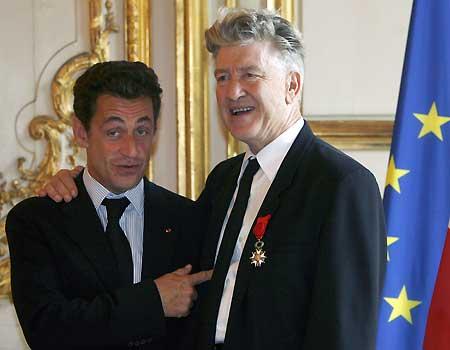 |
David Lynch Tours UK October 2007 With Donovan
To Promote His Education For World Peace Fund
"In today’s world of fear and
uncertainty, every child should have one class period a day to dive within himself and
experience the field of silence – bliss – the enormous reservoir of energy and
intelligence that is deep within all of us. This is the way to save the coming
generation.... The stresses of today’s world are taking an enormous toll on our
children right now. There are hundreds of schools, with thousands of students, who are
eager to relieve this stress and bring out the full potential of every student by
providing this Consciousness-Based Education today.... Individual peace is the unit of
world peace. By offering Consciousness-Based Education to the coming generation, we can
promote a strong foundation for a healthy, harmonious, and peaceful world. For this,
the Foundation also supports the establishment of Universities of World Peace that will
train the coming generation in a new profession: that of professional peacemaker.... And
please remember that Consciousness-Based Education is not a luxury. For our children who
are growing up in a stressful, often frightening, crisis-ridden world, it is a
necessity.”
David
Lynch
"David Lynch (Elephant Man,
Blue Velvet, Twin Peaks, Mulholland Drive, INLAND EMPIRE), and songwriter/poet Donovan Leitch (Sunshine
Superman, Mellow Yellow, Jennifer Juniper, Hurdy Gurdy Man), are visiting Dublin, Belfast,
London, Glasgow, and Edinburgh from 20 to 27 October, following a highly successful tour
of several other European countries. Lynch will speak on the topic of his US best seller,
Catching the Big Fish: Meditation, Consciousness, and Creativity (Tarcher/Penguin). He
will answer questions on his films, his creative processes, and his new Foundation...
Donovan will celebrate his collaboration with David’s Foundation with a 30-minute
live concert showcasing his greatest songs from the 1960s and ‘70s. Rising star
Astrella Celeste, Donovan's daughter, will join him for part of the performance...
Lynch’s visit to the UK is part of a European tour to highlight the successes of the David Lynch Foundation...
David and Donovan are available for interview by appointment."
David
Lynch Foundation, October 2007
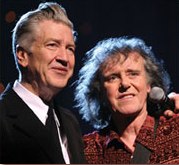
Lynch And Donovan
Listen To Lynch And Donovan
On BBC Radio 4 Today Programme, 23 October
Click
Here
(Go to 20 mins into recording) |
DAVID LYNCH & DONOVAN SPECIAL PRESENTATIONS AND CONCERTS
David Lynch & Donovan Consciousness-Based Education Tour
UK And Ireland, October 2007
http://www.consciousnessbasededucation.org.uk/LynchDonovan.shtml
SATURDAY, 20 OCTOBER – DUBLIN
19.00 Trinity College –
Edmund Burke Theatre
SUNDAY, 21 OCTOBER – BELFAST
14.00 Launch of Belfast Festival at
Queen’s (Northern Ireland’s premier arts festival)
Sir William Whitelaw Hall
Queen’s University
25
College Gardens, Belfast BT9 6BS
Tel:
028 9027 3075
Tickets: http://www.belfastfestival.com/Events/Talks/?id=77184
MONDAY, 22 OCTOBER – LONDON
David Lynch and Donovan appearance on ITV’s “LONDON
TONIGHT”
TUESDAY, 23 OCTOBER – LONDON
21.00 The Times BFI 51st London Film
Festival
British Film Institute
South
Bank
London SE1 8XT
Tickets:
http://www.bfi.org.uk/whatson/lff/events_programme/awards_other_special_events/catching_big_fish
WEDNESDAY, 24 OCTOBER – LONDON
19.30 Institute of Education, University
of London
Logan
Hall
20
Bedford Way
London WC1H 0AL
Reserve your free E-TICKET now: http://uk.davidlynchfoundation.org/
THURSDAY, 25 OCTOBER – GLASGOW
20.00 Glasgow Film Theatre
Cinema 1, 12 Rose Street
Glasgow
Tel:
0141 332 6535
www.gft.org.uk/
FRIDAY, 26 OCTOBER – EDINBURGH
20.00 The Queen’s Hall
Clerk
Street
Edinburgh EH8 9JG
Enquiries: 0131 668 3456
Booking Hotline: 0131 668 2019
Online booking available by tomorrow at:
http://www.thequeenshall.net/tickets/
SATURDAY, 27 OCTOBER – LONDON
19.00 British Association of Film and
Television Arts (BAFTA)
David Lynch presents the annual David Lean Lecture, and Donovan performs
The
“David Lean Lecture” is presented each year by one of the world’s top film
directors.
VIP
audience by invitation only, but possibly to be broadcast on television and/or
Internet.
http://www.bafta.org/site/page5.html
All enquiries, email: CatchingtheBigFish@gmail.com
David Lynch
Foundation for Consciousness-Based Education and World Peace |
Interviews With David
Lynch During Tour
Contact: Charles Cunningham, London Coordinator
Phone: +44 (0)20 8894 9229 Mobile: +44 (0)7852 279 176 |
Links
Biography of Dr David Lynch: www.lynchbigfish.org/david_lynch.html
Biography of Dr Donovan Leitch: www.lynchbigfish.org/donovan.html
David Lynch Foundation for Consciousness-Based Education and World Peace: www.DavidLynchFoundation.org
Consciousness-Based Education in the UK: www.consciousnessbasededucation.org.uk |
It's Time To Put An End To All This
War, Criminality, And Ignorance
"The Iraq conflict has wreaked
'terrible damage' on the region - far more than has been acknowledged, the Archbishop of
Canterbury has said.... A survey published in September 2007 suggested that up to 1.2m people might have died because of the Iraq conflict. Speaking following his visit, Dr Williams also said he regards any
further 'deliberate destabilisation' of the region - such as action against Syria and Iran
- as 'criminal, ignorant...and
potentially murderous folly'. Referring to US
political advisers, he added that 'we do hear talk from some quarters of action against
Syria, or against Iran'."
Archbishop speaks of Iraq damage
BBC Online, 5 October 2007
"Director David
Lynch (Twin Peaks, Blue Velvet, Mulholland Dr.) appeared on the Dutch TV program
'Wereldgasten' Sunday, December 3, 2006 to discuss his
questions regarding 9/11.... The Dutch host asked if
Lynch believed the U.S. Government carried out 9/11. He responded, 'It's too big for
people to think about. It's too big.' The host then asked for further clarification and a
somewhat hesitant Lynch clarified, 'It's-- you know-- something no one wants to think
about.'"
Hollywood Making a Move on 9/11 Truth
Jones Report, 6
December 2006
"Auteur
film director David
Lynch has recently gone public with 9/11 questions on Danish TV.... He has
also designated part of his website as the 'Interesting Questions' art gallery,
giving users a space to reflect on 9/11 and submit works of art that range in style and
depth. ..... Though Lynch
expressed in his TV interview that 9/11 was not something that changed his
life, it is clear from his reaction that he wants an answer to these disturbing variations
from the government Official Story. His interesting website allows users to browse through
a virtual gallery in and glance at the submissions on the wall, or take a closer look.
(Choose Floor 'A' in the elevator to find your way to the gallery, which may take a moment
to load). The gallery is in interesting blend of art from all different
perspectives."
David Lynch Website Gallery Focuses on 9/11 Truth Art
Jones Report, 3
January 2006 |
 |
A Picture Depicting The
Blinding Effect Of 9/11
From David Lynch's 9/11 'Interesting Questions' Online Art Gallery |