 |
The Perennial Battle For Iraq's Oil
www.nlpwessex.org/docs/iraqoil.htm
And That Of Its Gulf Neighbours
Why They
Really Hate Us |
A Century Of Chasing Iraqi Oil
"It is the need to protect the oil of
northern Iraq that drew the US into war with Isis [in 2014]. And so the more rational
jihadist commanders will now be realising this particular part of the battlefront cannot
be won. The US has a fundamental strategic interest
in the flow of cheap oil."
Tumbling oil price hits Putin where it hurts
London Times, 15 October 2014, Print Edition, P28
Before 9/11
"The Bush Administration began
making plans for an invasion of Iraq, including the use of American troops, within days of President Bush's inauguration in January
of 2001 -- not eight months later after the
9/11 attacks, as has been previously reported. That's what former Treasury Secretary Paul
O'Neill says in his first interview about his time as a White House insider.... In the
book, O'Neill is quoted as saying he was surprised that no one in a National Security
Council meeting questioned why Iraq should be invaded. 'It was all about finding a way to
do it. That was the tone of it. The president saying 'Go
find me a way to do this,' says O'Neill in
the book.... "
Saddam Ouster Planned Early '01?
CBS News,
10 January 2004
"I want to thank you all for coming today. I've assembled a team
within my administration, in particular, the Secretary of Energy, as well as the Deputy
Secretary of Defense [Paul Wolfowitz], to discuss energy. As the country knows, we're in
the process of developing a comprehensive energy plan that will work to increase supplies,
as well as encourage conservation. This is a long-run solution to the energy problems we
now face.....I think we ought to ask all agencies to review energy policy. We're focused
right now on California because that's a state that's going to suffer blackouts. But we've
always got to be mindful of being energy efficient.... I think [energy] conservation has
got to be an integral part of making sure we've got a reasonable energy policy. But what the Vice President was saying is we can't conserve our way to energy
independence; nor can we conserve our way to having enough energy
available. So we've got to do both. We must conserve, but we've also got to find new
sources of energy. I haven't seen the final report yet, but I suspect the American people
will find a balanced approach. But what people need to hear,
loud and clear, is that we're running out of energy in America. And it is
so important for this nation to improve its infrastructure so we can not only deliver
supplies, but we need to go find new supply.....what
the Vice President and I understand is that you cannot
conserve your way to energy independence. We can do a better job in
conservation, but we darn sure have to do a better job of
finding more supply. It is naive for the American people and its -- and
those who purport to speak for the American people, some of those, to say that we can be
okay from an energy perspective by only focusing on conservation. We've got to find additional supplies of energy."
President George W. Bush
Remarks by the President, Secretary of Energy Abraham and
Deputy Secretary of Defense Wolfowitz After Energy Advisors Meeting
Office Of The Press Secretary, White House, 3 May 2001
After 9/11
"Rupert
Murdoch was the only figure powerful enough to be able to state explicitly, without
consequence, that he was backing war on Iraq to bring down the price of oil. So his 'free press' all cheer-led for said war, and began commodifying
their version of it, even confecting their own military award ceremonies as though the
medal system were inadequate. The whitewashing report into the death of a scientist who
questioned the basis for that war was mysteriously leaked to Murdoch's papers –
another WORLD EXCLUSIVE – while others in his pay hacked the phones and emails of
those casualties of war being repatriated in bodybags, to be monetised as stories all over
again. Any complaint about this must be taken before an industry court presided over not
by the kangaroo of Rupert's native Australia, but an even less engaged selection of
backscratching editors, including his own."
Murdoch and politicians: a special relationship that has only ever worked one way
Guardian,
8 July 2011
"Alan
Greenspan, former chair of the Federal Reserve, has
declared that '...the Iraq war is largely about oil' in his recently released memoirs. 'People
say we're not fighting for oil. Of course we are,' said
the Republican Senator from Nebraska Chuck Hagel to law students of Catholic University last September. 'They talk about America's national interest. What the hell do you
think they're talking about? We're not there for figs.'"
The Costs of War for Oil
Foreign Policy In Focus,
19 October 2007
"We
hope Iraq will be the first
domino and that Libya and Iran will follow. We don't like being kept out of [oil] markets because it gives our
competitors an unfair advantage."
John Gibson, chief executive of Halliburton's Energy Service Group
Halliburton Eager for Work Across the Mideast
International
Oil Daily, 7 May 2003
| On This Page |
| Overview The West's Long Oily Obsession With Iraq |
| Why They Hate Us In
The Post 9/11 Era Evidence That London 7/7 Attacks Were Due To Occupations Of Iraq And Afghanistan |
| Transporting Iraqi Oil
And The Strait Of Hormuz Why Iran, Somalia, Syria And Other States Are Also Part Of The Equation |
| Gulf Oil Post Berlin War Era |
| Gulf Oil Cold War Era |
| Gulf Oil Early 20th Century Era |
| How Britain, Not
Saddam, Was The First To Gas The Kurds |
Overview
The West's Long Oily Obsession With Iraq
“I am saddened that it is politically
inconvenient to acknowledge what everyone knows: the
Iraq war is largely about oil.”
Alan Greenspan, Chairman Of The US Federal Reserve 1987 - 2006
Sunday Times, 16 September 2007
"MI6
told Tony Blair’s adviser there was no convincing intelligence that Iraq was involved
in terrorism but removing Saddam Hussain could secure oil supplies, a top secret memo
reveals. The briefing note from the Chief of
MI6’s private secretary to Sir David Manning, Tony Blair’s foreign policy
adviser three months after the September 11 attacks, said there was 'no convincing
intelligence (or common sense) case' that Iraq supported Islamic extremists. But it said the 'removal of Saddam remains a prize because it could give new
security to oil supplies' as well as 'engage a
powerful and secular state in the fight against Sunni extremist terror.' It also said
there could be 'climatic change in the psychology of regimes in the region' and that the
'problem of WMD [weapons of mass destruction] is an element in driving for action against
Iraq.' The risks, it said, included 'anger on the
Arab Street' and an 'increase in radical Islamist extremism, particularly in Egypt' that could threaten tourists. The memo, written
on December 3 2001 as Osama bin Laden prepared his getaway from his hide-out at Tora Bora
in Afghanistan, has been released by the Iraq Inquiry."
Iraq: MI6 said invading Iraq could secure oil supplies
Telegraph,
12 May 2011
"The United States military spends about $81 billion a year to protect
oil supplies around the world and keep fossil fuels flowing into
American gas stations, according to new analysis. Securing America's Future Energy, a
think tank that advocates for reducing U.S. dependence on oil, released
the study the same day President Donald Trump
claimed that some Middle Eastern countries are pushing up crude prices
while benefiting from U.S. military protection. The $81 billion price
tag is likely "very conservative" and doesn't
include the full cost of the 15-year war in Iraq, according to SAFE,
whose CEO Robbie Diamond also leads the pro-electric car group the
Electrification Coalition. The estimate pencils out
to 16-20 percent of the Defense Department's annual base budget, showing
the nation's oil habit has a direct military cost, SAFE said. It also
means the government subsidizes the cost of oil to the tune of $11.25
per barrel and the price of transportation fuels like gasoline and
diesel by 28 cents a gallon. Americans "spend somewhere around $3 per
gallon, but we're really paying
a lot more because of all the operations in the Middle East," said
retired General Charles Wald, vice chairman and senior adviser at
consulting firm Deloitte and a member of SAFE's Energy Security
Leadership Council. U.S. crude oil production is poised to reach 11
million barrels a day
and eclipse output from top producer Russia, but the United States
still imports roughly 8 million barrels a day. On Thursday, Trump renewed his call for the 15-nation oil producer group OPEC
to tamp down crude prices, which are near four-year highs. Trump
suggested that OPEC members like Saudi Arabia, Iraq and Kuwait owe the
United States, saying "We protect the countries of the Middle East, they
would not be safe for very long without us....Defending Persian Gulf oil is a "major distraction" from "existential
defense issues," said John Lehman, former Secretary of the Navy under
President Ronald Reagan and another member of SAFE's council. "Our existential threats
are what we should be concentrating on. We should concentrate on East
Asia and an increasingly revanchist Russia," he said. Factoring in in the cost of the Iraq War, the price of protecting oil
is closer to $30 per barrel, or 70 cents a gallon, over a 20-year
period, a separate analysis found. SAFE said that cost is largely
separate from the ongoing cost of $81 billion a year. "The wars in the Middle
East have been related to the balance of power in that region and
control over oil states," Lehman said. "You don't want to fall into the
trap of the left and say that we only went into Iraq for their oil but
depending how you phrase it, the costs can be attributed to the
strategic dependence we have on Gulf oil.""
US spends $81 billion a year to protect global oil supplies, report estimates
CNBC, 21 September 2018
"....the Persian Gulf, [is] the
critical oil and natural gas producing region that we
fought so many wars to try and protect our economy from the adverse impact of losing that
supply or having it available only at very high prices..." "From
2003 onward, when the United States destroyed the balance of power between Iraq and Iran,
Iran has been an ascendant power. With the
U.S. withdrawal from Iraq, Iran became the most influential foreign power there. But
Iran has overreached and is itself in crisis. The overreach took place in Syria. As the
regime of Syrian President Bashar al Assad came under attack, the Iranians
threw their resources and prestige behind the effort to save it. That effort has
failed in the sense that while al Assad retains a great deal of power in Syria, it is as a
warlord, not the government. He no longer governs but uses his forces to compete with
other forces. Syria has started to look like Lebanon, with a weak and sometimes invisible
government and armed, competing factions. Iran simply didn't have the resources to
stabilize the al Assad regime. For the United States, an Iranian success in Syria would
have created a sphere of influence stretching from Iran to the Mediterranean. The
Iranian failure, undoubtedly aided by U.S. and others' covert assistance
to al Assad's enemies, ended this threat. Had the
sphere of influence materialized, it would have brought pressure to the northern border of
Saudi Arabia. The United States, whose primary
interest was the flow of oil
from the Persian Gulf as part of the global economic system, would have faced the decision
of intervening to protect the Saudis.... energy has been the essence of geopolitics since the industrial revolution....." |
"The
Iraq war was just the first of this century's 'resource wars', in which powerful countries
use force to secure valuable commodities, according to the UK government's former chief
scientific adviser. Sir David King predicts that with population growth, natural resources dwindling, and
seas rising due to climate change, the squeeze on the planet will lead to more conflict.
'Future historians might look back on our particular recent past and see the Iraq war as the first of the conflicts of this kind - the first of the resource wars,' he told an audience of 400 in London
as he delivered the British Humanist Association's Darwin Day lecture. Implicitly
rejecting the US and British governments' claim they went to war to remove Saddam Hussein
and search for weapons of mass destruction, he said
the US had in reality been very concerned about energy security and supply, because of its reliance on foreign oil from unstable states. 'Casting
its eye around the world - there was Iraq,' he said....Commenting on the idea of 'resource
wars', Alex Evans, of the Centre for International Co-operation at New York University,
who last month wrote a report on food security for the Chatham House thinktank, said he
believed King was right...King summed up by saying that with growing population and
dwindling resources, fundamental changes to the global economy and society were necessary.
'Consumerism has been a wonderful model for growing up economies in the 20th century. Is
that model fit for purpose in the 21st century, when resource shortage is our biggest
challenge?'"
UK's ex-science chief predicts century of 'resource' wars
Guardian,
13 February 2009
20th Century
"Iraq
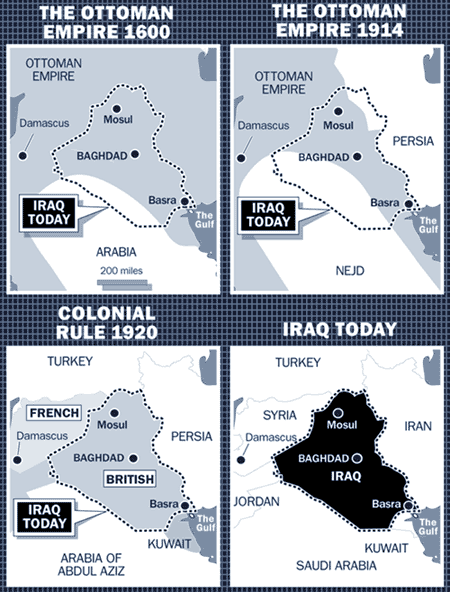
may have been a British creation, from the ruins of the Ottoman empire, but Churchill remembered all too well how Britain's involvement had
begun with a disaster. Over the 43 years of British influence, from that first invasion in
1915 to the revolution of 1958, a remarkable array of Britons had a hand in running the
country. Churchill installed the first King of Iraq and his advisers drew up its borders.
Gertrude Bell, the archaeologist and traveller, who founded the country's antiquities
department, became known as the 'uncrowned Queen of Iraq'. T
E Lawrence took part in the invasion and advised
Churchill on Iraq policy while Arthur 'Bomber' Harris tried out his theories of aerial
bombardment.... By the close of 1918, Britain had occupied all three Mesopotamian
provinces - Basra in the south, Mosul in the north and Baghdad in between.....Britain gave
Iraq notional independence in 1932. By then, the country's oilfields had become of vital strategic importance and the British remained dominant until King Faisal II and his family
were butchered in a 1958 revolution. After that, a bewildering succession of coups and
counter-coups bedevilled Iraq. Alternately America, France and the Soviet Union displaced
Britain as the power behind the scenes."
Meddling in Mesopotamia was always risky
Daily
Telegraph, 18 March 2003
"One cable by U.S. Secretary of State
Hillary Clinton in December 2009 notes that 'donors in Saudi Arabia constitute the most
significant source of funding to Sunni terrorist groups worldwide.' Despite this, 'Riyadh
has taken only limited action to disrupt fundraising for the UN 1267-listed Taliban and
LeT [Lashkar e-Tayyiba] groups that are also aligned with al-Qaeda.' Clinton raises
similar concerns about other states in the Gulf and Central Asia. Kuwait remains reluctant
'to take action against Kuwait-based financiers and facilitators plotting attacks outside
of Kuwait.' The United Arab Emirates is 'vulnerable to abuse by terrorist financiers and
facilitation networks' due to lack of regulatory oversight. Qatar’s cooperation with
U.S. counter-terrorism is the 'worst in the region,' and authorities are 'hesitant to act
against known terrorists.' Pakistani military intelligence officials 'continue to maintain
ties with a wide array of extremist organizations, in particular the Taliban [and the]
LeT.' Despite such extensive knowledge of these
terrorism financing activities, successive U.S. administrations have not only failed to
exert military or economic pressure on these countries, but in fact have actively
protected them, funnelling billions of dollars of military and economic assistance. The reason is oil. Oil has always been an overwhelming Western interest in
the region, beginning with Britain’s discovery of it in Persia in 1908. Britain
controlled most Middle East oil until the end of World War II, after which the United
States secured its sphere of influence in Saudi Arabia. After some pushback, Britain
eventually accepted the United States as the lead player in the region. 'US-UK agreement
upon the broad, forward-looking pattern for the development and utilisation of petroleum
resources under the control of nationals of the two countries is of the highest strategic
and commercial importance', reads a 1945 memo from the chief of the State
Department’s Petroleum Division. Anglo-U.S. geo-strategy exerted this control through
alliances with the region’s most authoritarian regimes to ensure a cheap and stable
supply of petroleum to Western markets. Recently declassified
secret British Foreign Office files from the 1940s and 1950s confirm that the Gulf
sheikhdoms were largely created to retain British influence in the Middle East. Britain pledged to protect them from external attack and to 'counter
hostile influence and propaganda within the countries themselves.' Police and military
training would help in 'maintaining internal security.' Similarly, in 1958 a U.S.
State Department official noted that the Gulf sheikhdoms should be modernized without
undermining 'the fundamental authority of the ruling groups.' The protection of some of
the world’s most virulent authoritarian regimes thus became integral to maintaining
Anglo-U.S. geopolitical control of the world’s strategic hydrocarbon energy reserves. Our governments have willingly paid a high price for this access –
the price of national security."
Oil or Terrorism: Which Motivates U.S. Policy More?
Foreign
Policy In Focus, 15 December 2010
"Lawrence [of Arabia] was a young officer who had spent the first two years of the
First World War in the intelligence department in Cairo. On a diplomatic mission to the
Hijaz region of western-central Arabia in 1916, he had formed a personal relationship with
Prince Faisal, a commander now ranged in revolt against Ottoman rule. Faisal asked that
Lawrence be attached to his service as a British liaison officer. Lawrence's superiors agreed. The Ottoman Empire, though much reduced,
still controlled a vast territory from south-eastern Europe to the Caucasus, the Tigris,
the Yemen, and the Suez Canal. Plunging into the world war, this ramshackle traditional
empire, though fighting a war on four fronts, against the Russians in the Caucasus and the
British in Gallipoli, Sinai, and Mesopotamia, proved a tougher opponent than its enemies
predicted.... Lawrence's ideas on guerrilla warfare were touched upon in his 'Twenty-seven
Articles', which appeared in an internal British intelligence bulletin in 1917. They were
then developed in three post-war treatises. Reading closely, one can identify 15 distinct
principles of guerrilla warfare (see box). They are extraordinary. They invert many
principles of conventional military theory, such as concentration of force, and the
centrality of pitched battle to destroy the enemy's main forces and will to fight. In this
sense, they are the work of a brilliant maverick – an unconventional intellectual who
had not even undergone the military training given to volunteer wartime officers (though
he probably learnt something as a member of the Oxford University Officers' Training
Corps)."
Guerrilla of Arabia: How one of Britain's most brilliant military tacticians created the
Taliban's battle strategy
Independent,
17 September 2010
"It was the wartime petroleum shortage
of 1917 and 1918 that really drove home the necessity of oil to British interests and
pushed Mesopotamia [Iraq] back to center stage. Prospects for oil development within the
empire were bleak, which made supplies from the Middle East of paramount importance. Sir Maurice Hankey, the extremely powerful secretary of the War Cabinet,
wrote to Foreign Secretary Arthur Balfour that, 'oil in the next war will occupy the place
of coal in the present war, or at least a parallel place to coal. The only big potential supply that we can get under British
Control is the Persian [Iranian] and Mesopotamian [Iraqi] supply.' Therefore, Hankey said,
'control over these oil supplies becomes a first-class British war aim.' But the newly born 'public diplomacy' had to be considered..... Foreign
Secretary Balflour worried that explicitly pronouncing Mesopotamia a war aim would seem
too old-fashionably imperialistic. Instead, in August 1918, he told the Prime Ministers of
the Dominions that Britain must be the 'guiding spirit' in Mesopotamia, as it would
provide the one natural resource the British empire lacked. 'I do not care under what
system we keep the oil,' he said, 'but I am quite clear it is all-important for us that
this oil should be available.' To help make sure this would happen, British forces,
already elsewhere in Mesopotamia, captured Mosul after the armistice was signed with
Turkey."
Daniel Yergin - The Prize, 1991
First
published in Great Britain by Simon and Schuster Ltd, 1991
"Plans to include the Iraq war in a
new GCSE history syllabus have been criticised as 'crazy' by a leading historian. The new
course from the Oxford Cambridge and Royal Society of Arts examinations board (OCR) will
give pupils the chance to assess the rights and wrongs of the Iraq war, to study the
terror attack of 9/11 and to consider why people become terrorists. The course, which has
been submitted to the exams regulator Ofqual for approval, covers the debate on weapons of
mass destruction, Saddam Hussein’s human rights record, claims about his links to
al-Qaeda, the oil industry and the roles of
George Bush and Tony Blair in the conflict. Tristram Hunt, a history lecturer at Queen
Mary, University of London, said that too little time had elapsed since the conflict began
for it to be included on the curriculum for 14-year-olds..... As pupils would be unlikely
to know about the British imperial presence in Iraq
in the early 20th century, they would not understand
the historical context of the war, he added. Dr Hunt said the only context in which it
would make sense to teach the Iraq war to GCSE history students would be as an appendix to
oil wars that began in the 1970s."
Iraq war and IRA terror included on syllabus in major GCSE review
London
Times, 19 April 2008
21st Century
"A top-level United States policy
document has emerged that explicitly confirms the
Defence Department's readiness to fight an oil war.
According to the report, Strategic Assessment 1999, prepared for the US Joint Chiefs of
Staff and the Secretary of Defence, 'energy and resource issues will continue to shape
international security'. Oil conflicts over
production facilities and transport routes, particularly in the Persian Gulf and Caspian
regions, are specifically envisaged. Although the
policy does not forecast imminent US military conflict, it vividly highlights how the
highest levels of the US Defence community accepted the waging of an oil war as a
legitimate military option. Strategic Assessment also forecasts that if an oil 'problem'
arises, 'US forces might be used to ensure adequate supplies'.... Strategic Assessment was
prepared by the Institute for National Strategic Studies, part of the US Department of
Defence's National Defence University. The institute lists its primary mission as policy
research and analysis for the Joint Chiefs, the Defence Secretary, and a variety of
government security and defence bodies. According to the report, national security depends
on successful engagement in the global economy, so national defence no longer means
protecting the nation from military threats alone, but economic challenges, too. The fall
of the Soviet Union in the early 1990s brought an end to the US's ideological basis for
potential conflict. In 1992 Bill Clinton urged that 'our economic strength must become a
central defining element of our national security policy'. Since then, members of the Bush
Administration have promoted the need for the consolidation of the Cold War victory. In
what many may see as an apparent parallel to present events, Strategic Assessment 1999
drew attention to pre-World War II Britain's pursuit of an approach where control over
territory was seen as essential to ensuring resource supplies."
Oil wars Pentagon's policy since 1999
Syndey Morning
Herald, 20 May 2003
"The
global market will need increasing volumes of oil from members of the Organisation of
Petroleum Exporting Countries after non-OPEC
production reaches a maximum of about 50 million b/d between 2007 and 2011... A question crucial to future oil supply, therefore is: Can
OPEC's old fields deliver.... Most of the supergiant oil fields have had water or
gas injection installed to maintain pressure for 20-30 years. Handling produced injection
fluids is a growing problem in Iran, Saudi Arabia, the UAE, and in older fields in Iraq
(Kirkuk, Zubair, and Rumailah).... The oil fields of Iraq are the least depleted and least
developed of any of the Persian Gulf oil producing countries, and Iraq has the potential
to rapidly increase oil output.... Combined with earlier results, these predictions for
OPEC yield an estimate of the world's ultimate recoverable oil reserves of 2.5-2.9
trillion bbl, with 1.29-1.66 trillion bbl remaining (1.224 trillion bbl produced to end
2003)..... It seems unlikely that OPEC can increase production at the rate that was
possible in the 1960s and 1970s, when the fields were fresh and initial well production
rates were higher... Only Iraq has
undeveloped supergiant oil fields (West Qurna, Majnoon, and East Baghdad) and the
potential to rapidly increase production to 8-10 million b/d...... The five Persian Gulf countries (Saudi Arabia, Iraq, Iran,
Kuwait and the UAE) are crucial to raising OPEC production. The political situation in
Iraq is unlikely to be conducive to major investment in new oil production capacity for
some years. Saudi Arabia has serious internal problems, which threaten to destabilize the
ruling royal family. Iran remains under unilateral US sanctions. US military intervention
in the Gulf and its failure to effectively and fairly engage in resolving the
Palestinian-Israeli conflict conspire to provide a hostile backdrop to western interests
in the Middle East. The combination of burgeoning future oil revenues and growing
hostility to the US in the region is not conducive to major capacity expansion and will
not provide a stable investment environment or offer easy opportunities to the major
international oil companies to assist in any capacity expansion projects. Based on
these considerations and the maturity of OPEC’s major fields, it seems more likely
that OPEC’s considerable reserves will be expressed as a long plateau rather than a
sharp peak. It is quite possible that the Persian Gulf countries will not raise production
capacity high enough or quickly enough, either for political reasons, the slowness of
internal decision-making, or the hostile security environment. The consequences of this for world oil supply are immense, with the likelihood of further military interventions and
conflicts within the Middle East .... a series of crises in oil supply is likely over the
coming decades. The first, related
to the peak and decline of non-OPEC production, is practically upon us and underpins the
currently high oil prices...... The
imminent inability of non-OPEC production to meet incremental demand and its decline after
2010 precipitates the second crisis as OPEC’s diminishing spare capacity (even with Iraq’s
production back to preinvasion levels) becomes less and less able to accommodate
short-term fluctuations.....The third crisis, due to OPEC’s incremental supply being unable to meet
incremental demand, follows in the first half of the next decade. This assumes that
OPEC’s reserves are as published. .....These
crises will have global economic and geopolitical significance: The oil price will be high
and volatile, and demand growth will have to be curtailed..."
Oil Supply Challenges - 2: What Can OPEC Deliver?
Oil and Gas Journal, 7 March 2005
"Shortly after the Marines rolled into
Baghdad and tore down a statue of Saddam Hussein, I visited the Ministry of Oil. American
troops surrounded the sand-colored building, protecting it like a strategic jewel. But not
far away, looters were relieving the National Museum of its actual jewels. Baghdad had
become a carnival of looting. A few dozen Iraqis who worked at the Oil Ministry were
gathered outside the American cordon, and one of them, noting the protection afforded his
workplace and the lack of protection everywhere else, remarked to me, 'It is all about
oil.'...Donald Rumsfeld, the former defense secretary, insisted the invasion of Iraq had 'nothing to do with oil.' But even Alan Greenspan, the former Federal
Reserve chairman, rejected that line. 'It is politically inconvenient to acknowledge what
everyone knows,' Greenspan wrote in his memoir. 'The Iraq war is largely about oil.' If it is even partly true
that we invade for oil and maintain a navy and army for oil, how much is that costing? This is one of the tricky things about oil, the hidden costs, and one of
the reasons we are addicted to the substance -- we don't acknowledge its full price. If we
wish to know, we can. An innovative approach comes from Roger Stern, an economic
geographer at Princeton University who in April published a peer-reviewed study on the cost of keeping aircraft carriers in the
Persian Gulf from 1976 to 2007. Because carriers patrol the
gulf for the explicit mission of securing oil shipments, Stern was on solid ground in
attributing that cost to oil. He had found an excellent metric. He combed through the
Defense Department's data -- which is not easy to do because the Pentagon does not
disaggregate its expenditures by region or mission -- and came up with a total, over three
decades, of $7.3 trillion. Yes, trillion."
The Ministry of Oil Defense
Foreign
Policy, 5 August 2010
"The U.S. needs energy — lots and
lots of energy — and 37.1% of it is currently supplied by oil. As the population
expands and the policy decisions and technological innovations needed to make the switch
to green, renewable energy sources lag, thirst for the stuff is only going to grow. Critics have long lamented that when it comes to energy policy,
9/11 was an opportunity for the country to have an honest debate about the choices it
needs to make if it's ever going to break its addiction to oil. 'We need to address the underlying
issue,' says Lisa Margonelli, director of the New America Foundation's Energy Policy
Initiative, 'and that's our dependence on oil.'
Having a national conversation now — an adult one — is the only way
forward."
The Far-Ranging Costs of the Mess in the Gulf
TIME, 6 May 2010
Guardian -
Comment Is Free [extracts]The rape of Iraq's oilThe Baghdad government has caved in to a damaging plan that will enrich western companies. March 22, 2007 1:30 PM | Printable version The recent cabinet agreement in Baghdad on the new draft oil law was hailed as a landmark deal bringing together the warring factions in the allocation of the country's oil wealth. What was concealed was that this is being forced through by relentless pressure from the US and will sow the seeds of intense future conflict, with serious knock-on impacts on the world economy. The draft law, now before the Iraqi parliament, sets up "production sharing partnerships" to allow the US and British oil majors to extract Iraqi oil for up to 30 years. While Iraq would retain legal ownership of its oil, companies like Exxon, Chevron, Shell and BP that invest in the infrastructure and refineries would get a large share of the profits. No other Middle Eastern oil producer has ever offered such a hugely lucrative concession to the big oil companies, since Opec has always run its oil business through tightly-controlled state companies. Only Iraq in its present dire condition, dependent on US troops for the survival of the government, lacks the bargaining capacity to resist. This is not a new plan. According to documents obtained from the US State Department by BBC Newsnight under the US Freedom of Information Act, the US oil industry plan drafted early in 2001 for takeover of the Iraqi oilfields (after the removal of Saddam) was pushed aside by a secret plan, drafted just before the invasion in 2003, calling for the sell-off of all of Iraq's oilfields. This secret plan was crafted by neo-conservatives intent on using Iraq's oil to destroy the Opec cartel through massive increases in production above Opec quotas. However, Philip Carroll, the former CEO of Shell Oil USA, who took control of Iraq's oil production for the US government a month after the invasion, stalled the sell-off scheme. As Ariel Cohen of the neo-conservative Heritage Foundation later told Newsnight, an opportunity had been missed to privatise Iraq's oilfields. Now the plan is being revisited, or as much of it as can be salvaged after the fading of American power on the battlefield made enforced sell-off impossible. This revision of the original plan has been drafted by BearingPoint, a US consultancy firm, at the request of the US government. Significantly, it was checked first with Big Oil and the IMF and is only now being presented to the Iraqi parliament. But if accepted by the Iraqis under intense pressure, it will lock the country into weakness and dependence for decades. The neo-cons may have lost the war, but they are still manipulating to win the most substantial chunk of the peace when and if it ever comes.... ....in neo-conservative eyes Iraq was also required as an alternative to Saudi Arabia to provide a military base for the US to police the whole of Gulf oil. It was no longer possible for the US to maintain troops in Saudi Arabia for that purpose without risking the collapse of the dictatorial Saudi regime and its giant oil assets falling into the hands of Islamic extremists. The removal of US troops from Saudi Arabia was the principal demand contained in Osama bin Laden's fatwa of 1996. This was why, shortly after invading Iraq, the US announced that it was pulling its combat troops out of Saudi Arabia, thereby meeting Bin Laden's principal pre-9/11 political demand. But unfortunately for the US, al-Qaida is now seeking the removal of US troops from Iraq as well. Above all, the policy is flawed by its extreme short-sightedness. Even if the US were to win its war in Iraq, which now looks virtually impossible, its incremental gain before the oil runs out would be short-term, while its exposure to intensified and unending insurgency because of perceived US seizure of Iraqi oil rights, especially if extended to Iran, would be disproportionately enormous both in the Middle East and maybe also at home. It is diametrically the opposite of the policy to which the whole world will be forced ineluctably by the accelerating onset of climate change. Perhaps the single greatest gain of the west learning this lesson of weaning itself off its oil addiction is that it would end this interference in the internal affairs of Muslim countries simply because they happen to have oil - the central cause of world conflict today. |
"Oil ruled the 20th century; the shortage of oil will rule the
21st.... Last Tuesday the lead story in The Financial Times was the
latest report from the International Energy Agency. The FT quoted the IEA as saying: 'Oil
looks extremely tight in five years’ time,' and that there are 'prospects of even
tighter natural gas markets at the turn of the decade'. For an international agency, that
is inflammatory language.... 27 of the 51 oil-producing nations listed in BP’s
Statistical Review of World Energy reported output
declines in 2006. One projection of world crude oil
production actually forecasts a 10 per cent reduction in total world output between 2005
and 2015. That would be a revolution..... Some analysts think that the peak oil moment has already
been reached; some still think that it will not come until 2020 – which is itself
only 12 years away. Market trends and the statistics both support the IEA’s view that
consumption is accelerating and supplies falling
faster than expected. Of course, if the 'crunch' point is only five years’ away for oil, and
closer for natural gas, it has, for practical purposes, already arrived....The shortage of oil and natural gas, relative to demand, had already
changed the balance of world power. Historians may
well conclude that the US decision to invade Iraq was primarily motivated by the desire to
gain physical control of Iraq’s oil and to provide
defence support to other Middle Eastern oil powers.
Political motivations are always mixed, but oil is an essential national interest of the
United States. If the US is now deciding to withdraw from Iraq, the price will have to be
paid in terms of loss of access to oil.... The world
is coming to the end of the age of oil, which
produced its own technology, its balance of power, its own economy, its pattern of
society. It does not greatly matter whether the oil supply has peaked already or is going
to peak in five or 12 years’ time. There is a
huge adjustment to be made. There will be some
benefits, including higher efficiencies and perhaps a better approach to global warming.
But nothing will take us back towards the innocent expectation of indefinite expansion of
the first months of the new millennium."
Lord William Rees-Mogg
Are these the last days of the Oil Age?
London
Times, 16 July 2007
"I fear we're going to be at war for
decades, not years ..... one major component of that war is oil."
James Woolsey, Former Director of The
CIA
Report On The Annual Policy
Forum Of The American Council On Renewable Energy (ACORE)
Washington, 6-7 December 2004
RenewableEnergyAccess.com, 14 December
2004
"Iraq can be seen as the first battle
of the fourth world war. After two hot world wars and one cold one that all began and were
centered in Europe, the fourth world war is going to be for the Middle East."
Former Director of the CIA, James
Woolsey
NATO conference, Prague, November 2002
"[BP's] Lord Browne's said that most exploration for new supplies
had halted [in Iraq] when the Iraqis nationalised their industry.... he believed there was
a plenty of oil and gas waiting to be discovered in Iraq and that BP should be in prime
position to capitalise [after a war with Iraq] because it had found most of the country's
oil before being thrown out in the 1970s....
Lord Browne will be listened to carefully in Downing Street because the BP executive team
has such close links with the UK government that it was once dubbed Blair Petroleum."
BP chief fears US will carve up Iraqi oil riches
Guardian, 30 October 2002
"Plans
to exploit Iraq's oil reserves were discussed by government ministers and the world's
largest oil companies the year before Britain took a leading role in invading Iraq,
government documents show. The papers, revealed here for the first time, raise new
questions over Britain's involvement in the war, which had divided Tony Blair's cabinet
and was voted through only after his claims that Saddam Hussein had weapons of mass
destruction. The minutes of a series of meetings between ministers and senior oil
executives are at odds with the public denials of self-interest from oil companies and
Western governments at the time. The documents were
not offered as evidence in the ongoing Chilcot Inquiry into the UK's involvement in the
Iraq war. In March 2003, just before Britain went to war, Shell denounced reports that it
had held talks with Downing Street about Iraqi oil as 'highly inaccurate'. BP denied that
it had any 'strategic interest' in Iraq, while Tony Blair described 'the oil conspiracy
theory' as 'the most absurd'. But documents from October and November the previous year
paint a very different picture. Five months before the March 2003 invasion, Baroness
Symons, then the Trade Minister, told BP that the Government believed British energy firms
should be given a share of Iraq's enormous oil and gas reserves as a reward for Tony
Blair's military commitment to US plans for regime change. The papers show that Lady
Symons agreed to lobby the Bush administration on BP's behalf because the oil giant feared
it was being 'locked out' of deals that Washington was quietly striking with US, French
and Russian governments and their energy firms. Minutes of a meeting with BP, Shell and BG
(formerly British Gas) on 31 October 2002 read: 'Baroness Symons agreed that it would be
difficult to justify British companies losing out in Iraq in that way if the UK had itself
been a conspicuous supporter of the US government throughout the crisis.' The minister
then promised to 'report back to the companies before Christmas' on her lobbying efforts.
The Foreign Office invited BP in on 6 November 2002 to talk about opportunities in Iraq
'post regime change'. Its minutes state: 'Iraq is the big oil prospect. BP is desperate to
get in there and anxious that political deals should not deny them the opportunity.' After
another meeting, this one in October 2002, the Foreign Office's Middle East director at
the time, Edward Chaplin, noted: 'Shell and BP could not afford not to have a stake in
[Iraq] for the sake of their long-term future... We were determined to get a fair slice of
the action for UK companies in a post-Saddam Iraq.' Whereas BP was insisting in public
that it had 'no strategic interest' in Iraq, in private it told the Foreign Office that
Iraq was 'more important than anything we've seen for a long time'. BP was concerned that
if Washington allowed TotalFinaElf's existing contact with Saddam Hussein to stand after
the invasion it would make the French conglomerate the world's leading oil company. BP
told the Government it was willing to take 'big risks' to get a share of the Iraqi
reserves, the second largest in the world. Over 1,000 documents were obtained under
Freedom of Information over five years by the oil campaigner Greg Muttitt. They reveal
that at least five meetings were held between civil servants, ministers and BP and Shell
in late 2002. The 20-year contracts signed in the wake of the invasion were the largest in
the history of the oil industry. They covered half of Iraq's reserves – 60 billion
barrels of oil, bought up by companies such as BP and CNPC (China National Petroleum
Company), whose joint consortium alone stands to make £403m ($658m) profit per year from
the Rumaila field in southern Iraq."
Secret memos expose link between oil firms and invasion of Iraq
Independent,
19 April 2011
"Saddam Hussein sits and smiles as the price
of his oil - as well as that of his neighbors' (which, he doubtless believes, he may again
be able to seize) -- skyrockets, giving him more to spend on his military forces,
including longer range ballistic missiles and weapons of mass destruction. He can be
confident that within the next decade or two - the period during which most independent
assessments of reserves suggest that world petroleum production will begin to decline - the world's sharply increasing demand for petroleum will
increasingly have to be satisfied by him and his neighbors, to their great profit.... Although all these serious [economic,
environmental and social] problems may at first seem unconnected, Mr. Chairman, they in
fact all have essentially the same cause - over-dependence by the rest of the world on
petroleum-derived products that will increasingly have to come from the very troubled and
unstable Middle East."
James Woolsey, former Director of the CIA
Statement
to Committee on Agriculture, Nutrition and Forestry, Unites States Senate, 11 April 2000
"... the mideast will increasingly
become the source of the world's oil, and this is a strategic problem for us and for many other
countries."
James Woolsey, Former Director of the CIA
Interview with the Council on Foreign Relations and the Washington Post: June 7,
2000
"In one of his longer ruminations,
in May 2004, Rumsfeld considered whether to redefine the terrorism fight as a 'worldwide
insurgency.' The goal of the enemy, he wrote, is to 'end the state system, using
terrorism, to drive the non-radicals from the world.' He then advised aides 'to test what
the results could be' if the war on terrorism were renamed. Neither Europe nor the United
Nations understands the threat or the bigger picture, Rumsfeld complained in the same
memo. He also lamented that oil wealth has at times detached Muslims 'from the reality of
the work, effort and investment that leads to wealth for the rest of the world. Too often
Muslims are against physical labor, so they bring in Koreans and Pakistanis while their
young people remain unemployed,' he wrote. 'An unemployed population is easy to recruit to
radicalism.' If radicals 'get a hold of' oil-rich
Saudi Arabia, he added, the United States will have 'an enormous national security
problem.'"
From the Desk of Donald Rumsfeld
Washington
Post, 1 November 2007
"At the time of the US invasion,
Vice-President Dick Cheney and other senior US officials boldly predicted that production would
exceed three million barrels a day within eight months, generating more than enough money
to rebuild Iraq. They underestimated the desperate state of Iraq’s oil infrastructure
after 23 years of war, sanctions and postinvasion looting. 'It was held together with bits
of string and chewing gum,' said one US official. Even now the facilities that The Times
visited in Kirkuk this week were shockingly corroded and dilapidated. The Bush
Administration also failed to foresee the virulence of the insurgency. The website Iraq
Pipeline Watch records 466 attacks on oil infrastructure or employees since 2003, and that
is probably a fraction of the real total. US officials reckon as many as half the
industry’s most skilled workers fled Iraq, or were killed, as Iraq descended into
mayhem. The insurgents have used the oil that was supposed to finance the country’s
reconstruction to fund their efforts to destroy it. They and other criminals have
routinely tapped into the pipelines to steal oil, hijacked tankers and diverted huge
amounts of oil from production facilities with the help of corrupt employees.... The Oil
Ministry will soon invite bids from international oil companies to increase output from
Iraq’s half-dozen poorly-managed, investment-starved 'super-giant' fields from early
next year. That would more than double production to
six million barrels a day within three or four years,
Hussain al-Sharistani, the Oil Minister, told The Times. Thereafter,
multinationals will be invited to develop new fields.
Competition will be intense, with no guarantee that Western companies will prevail.
'Everybody in the world, more than 45 companies, have approached us . . . the Chinese,
Russians, Indians, Brazilians,' Mr al-Sharistani said. "
Beneath the desert sands flows lifeblood of economic recovery
London
Times, 1 February 2008
"The Bush
Administration began making plans for an invasion of Iraq, including the use of
American troops, within days of President
Bush's inauguration in January of 2001 --
not eight months later after the 9/11 attacks, as has been previously reported. That's
what former Treasury Secretary Paul O'Neill says in his first interview about his time as
a White House insider.... In the book, O'Neill is quoted as saying he was surprised that
no one in a National Security Council meeting questioned why Iraq should be invaded. 'It
was all about finding a way to do it. That was the tone of it. The president saying 'Go find me a way to do this,' says O'Neill in the book.... " "President
Bush acknowledged for the first time yesterday that he was mapping preparations to topple
Iraqi dictator Saddam Hussein as soon as he took office. Bush's comments came in response
to former Treasury Secretary Paul O'Neill's contention in a new book that the chief
executive was gunning for Saddam nine months before the Sept. 11 terrorist attacks and two
years before the U.S. invasion of Iraq. Bush's
comments appeared likely to stoke campaign claims by Democratic rivals for the White House
that the president was planning to attack Iraq, possibly in retaliation for Saddam's
attempted 1993 assassination of his father, former President Bush. 'The stated policy of
my administration toward Saddam Hussein was very clear -- like the previous
administration, we were for regime change,' Bush told a joint news conference in
Monterrey, Mexico, with Mexican President Vicente Fox. 'And in the initial stages of the
administration, as you might remember, we were dealing with (enforcing a no-fly zone over
Iraq) and so we were fashioning policy along those lines.'....Asked about O'Neill's
contention that the first National Security Council meeting of the Bush administration in
January 2001 discussed ousting Saddam, White House Press Secretary Scott McClellan didn't
deny that account. McClellan tried to focus attention on Bush's claims of success in Iraq
rather than preparations to oust Saddam. Bush 'exhausted all possible means to resolve the
situation in Iraq peacefully' before launching the invasion in March, McClellan said.
Saddam defied a 'final opportunity to comply' with U.N. demands to disarm, prompting Bush
to take action 'in the aftermath of Sept. 11th (because) it's important to confront
threats before it's too late.' Bush, who fired O'Neill as treasury secretary in December
2002, said he 'appreciated' O'Neill's nearly two years of service in the
administration." |
Bush
Treasury Secretary Paul O'Neill |
"In a world of looming shortage, Iraq
represented a unique opportunity. With 115bn barrels, it had the world's third biggest
reserves, and after years of war and sanctions they were the most underexploited. In the
late 1990s, production averaged about 2m barrels, but with the necessary investment its
reserves could support three times that..... Cheney knew, fretting about global oil
depletion in a speech in London the following year, where he noted that 'the Middle East with two thirds of the world's oil and lowest
cost is still where the prize ultimately lies'. Blair too had reason to be
anxious: British North Sea output had peaked in 1999, while the petrol protests of 2000
had made the importance of maintaining the fuel supply excruciatingly obvious. Britain's
and the US's fears were secretly formalised during the planning for Iraq. It is widely
accepted that Blair's commitment to support the attack dates back to his summit with Bush in Texas in April 2002. What is less well known is that at the same summit, Blair proposed
and Bush agreed to set up the US-UK Energy Dialogue, a permanent liaison dedicated to
'energy security and diversity'. Its existence
was only later exposed through a freedom of information inquiry. Both governments refuse
to release minutes of Dialogue meetings, but one paper dated February 2003 notes that to
meet projected demand, oil production in the Middle East would have to double by 2030 to
more than 50m barrels a day. So on the eve of the invasion, UK and US officials were
discussing how to raise production from the region - and we are invited to believe this is
coincidence. The bitterest irony is, of course, that the invasion has created conditions
that guarantee oil production will remain hobbled for years to come, bringing the global
oil peak that much closer. So if that was plan A, what on earth is plan B?"
The real casus belli: peak oil
Guardian, 26 June
2007
"Fuel is our economic lifeblood.
The price of oil can be the difference between recession and recovery. The western world
is import dependent. ....So: who develops oil and gas, what the new potential sources of
supply are, is a vital strategic question...The
Middle East, we focus on naturally." "I would say there are four reasons
why the Middle East remains of central importance and cannot be relegated to the second
order. First and most obviously, it is still where a
large part of the world’s energy supplies are generated, and whatever the long term
implications of the USA energy revolution, the world’s dependence on the Middle East
is not going to disappear any time soon. In any event, it has a determining effect on the
price of oil; and thus on the stability and working of the global economy." |
AFTER THE INVASION OF IRAQ
"The UK is a net
exporter of oil, so we have no need of the Iraqi oil."
British Prime Minister, House of Commons, 14 April 2003
BEFORE THE INVASION OF IRAQ
".... our
energy system faces new challenges.... Our energy supplies will increasingly depend on
imported gas and oil..... we need access to a wide range of energy sources."
British Prime Minister, Foreword to DTI Energy White Paper,
February 2003
"Plans
to exploit Iraq's oil reserves were discussed by government ministers and the world's
largest oil companies the year before Britain took a leading role in invading Iraq,
government documents show. The papers, revealed here
for the first time, raise new questions over Britain's involvement in the war, which had
divided Tony Blair's cabinet and was voted through only after his claims that Saddam
Hussein had weapons of mass destruction. The minutes
of a series of meetings between ministers and senior oil executives are at odds with the
public denials of self-interest from oil companies and Western governments at the time. The documents were not offered as evidence in the ongoing Chilcot Inquiry
into the UK's involvement in the Iraq war. In March 2003, just before Britain went to war,
Shell denounced reports that it had held talks with Downing Street about Iraqi oil as
'highly inaccurate'. BP denied that it had any 'strategic interest' in Iraq, while Tony
Blair described 'the oil conspiracy theory' as 'the most absurd'. But documents from
October and November the previous year paint a very different picture. Five months before the March 2003 invasion, Baroness Symons, then
the Trade Minister, told BP that the Government believed British energy firms should be
given a share of Iraq's enormous oil and gas reserves as a reward for Tony Blair's
military commitment to US plans for regime change. The papers show that Lady Symons agreed
to lobby the Bush administration on BP's behalf because the oil giant feared it was being
'locked out' of deals that Washington was quietly striking with US, French and Russian
governments and their energy firms. Minutes of a meeting with BP, Shell and BG (formerly
British Gas) on 31 October 2002 read: 'Baroness Symons agreed that it would be difficult
to justify British companies losing out in Iraq in that way if the UK had itself been a
conspicuous supporter of the US government throughout the crisis.' The minister then promised to 'report back to the companies before
Christmas' on her lobbying efforts. The Foreign Office invited BP in on 6 November 2002 to
talk about opportunities in Iraq 'post regime change'. Its minutes state: 'Iraq is the big oil prospect. BP is desperate to get in there and
anxious that political deals should not deny them the opportunity.' After another meeting, this one in October 2002, the Foreign Office's
Middle East director at the time, Edward Chaplin, noted: 'Shell and BP could not afford not to have a stake in [Iraq] for the sake
of their long-term future... We were determined to get a fair slice of the action for UK
companies in a post-Saddam Iraq.' Whereas BP was insisting in public that it had 'no
strategic interest' in Iraq, in private it told the Foreign Office that Iraq was 'more
important than anything we've seen for a long time'. BP was concerned that if
Washington allowed TotalFinaElf's existing contact with Saddam Hussein to stand after the
invasion it would make the French conglomerate the world's leading oil company. BP told
the Government it was willing to take 'big risks' to get a share of the Iraqi reserves,
the second largest in the world. Over 1,000 documents were obtained under Freedom of
Information over five years by the oil campaigner Greg Muttitt. They reveal that at least
five meetings were held between civil servants, ministers and BP and Shell in late 2002.
The 20-year contracts signed in the wake of the invasion were the largest in the history
of the oil industry. They covered half of Iraq's
reserves – 60 billion barrels of oil, bought up by companies such as BP and CNPC
(China National Petroleum Company), whose joint consortium alone stands to make £403m
($658m) profit per year from the Rumaila field in southern Iraq.' Mr Muttitt, whose book
Fuel on Fire is published next week, said: 'Before the war, the Government went to great
lengths to insist it had no interest in Iraq's oil. These documents provide the evidence
that give the lie to those claims. We see that oil was in fact one of the Government's
most important strategic considerations, and it secretly colluded with oil companies to
give them access to that huge prize.' Lady Symons, 59, later took up an advisory post with
a UK merchant bank that cashed in on post-war Iraq reconstruction contracts. Last month
she severed links as an unpaid adviser to Libya's National Economic Development Board
after Colonel Gaddafi started firing on protesters. Last night, BP and Shell declined to
comment." "Iraq is the big oil
prospect. BP are desperate to get in there and anxious that political deals should not
deny them the opportunity to compete. The long-term potential is enormous..." "Let me just deal
with the oil thing because... the oil conspiracy theory is honestly one of the most absurd
when you analyse it. The fact is that, if the oil that Iraq has were our concern, I mean
we could probably cut a deal with Saddam tomorrow in relation to the oil. It's not the oil
that is the issue, it is the weapons..." "We have no
strategic interest in Iraq. If whoever comes to power wants Western involvement post the
war, if there is a war, all we have ever said is that it should be on a level playing
field. We are certainly not pushing for involvement." "It is not in my or
BP's opinion, a war about oil. Iraq is an important producer, but it must decide what to
do with its patrimony and oil." "We have neither
sought nor attended meetings with officials in the UK Government on the subject of Iraq.
The subject has only come up during conversations during normal meetings we attend from
time to time with officials... We have never asked for 'contracts'." |
"... in 2002, in the absence of
evidence of an imminent threat, 'an ultimatum…in terms Saddam would reject' was
delivered through the UNSC to produce a legal justification for military action that would
simultaneously mollify public opinion. Indeed,
according to a leaked policy options paper produced by the Cabinet Office, the primary
objectives of UK policy were 'ensuring energy security' and 'preserving peace and stability in the Gulf,' a region containing
over half of the world’s oil, and much of its natural gas. The picture that emerges
from this analysis is disturbing. It demonstrates the fundamental politicisation of
British intelligence in the run-up to the 2003 invasion; its subservience to US
geostrategic ambitions and assumptions which were rarely questioned at Cabinet-level; and
the overarching background of a looming energy crisis which drove the development of a
joint US-UK strategy focused on opening up Middle East resources. All these factors
interplayed to disfigure Britain’s capacity to produce objective intelligence on
Iraq, to the extent that political ideology hopelessly impaired the government’s
understanding of the facts on the ground. All this played an instrumental role in paving
the way for the justification of a policy of regime-change which both US and UK planners
had often candidly discussed as being pre-eminent over the issue of weapons of mass
destruction.... Iraq is one of the most energy rich countries in the world. According to
the National Energy Policy Development Group, the energy task force headed by Dick Cheney
while Vice President of the US, Iraq held 11% of the world’s proven oil reserves in
2001.137 The International Energy Administration estimated that Iraq’s proven and
probable unproven reserves totalled 220 billion barrels. Production costs are amongst the
lowest in the world (from $1.20 per barrel in Southern Iraq).138 In addition, Iraq is
incredibly rich in natural gas, and its reserves of approximately 110 trillion cubic feet
are 'virtually totally unexploited.'139 Additionally, Stephen Pelletiere, a former CIA
analyst during the Iran-Iraq war identifies Iraq’s water wealth as a central
facilitating factor in US 'control' of the Middle East.140 Documents obtained from the
National Energy Policy Development Group by Judicial Watch under the Freedom of
Information Act, entitled Foreign Suitors For Iraqi Oil Field Contracts,141 show that
international oil companies (IOCs) had successfully sought agreements to develop Iraqi
oilfields with the Iraqi government, at a value estimated at $1.1 trillion by the
International Energy Agency’s World Energy Outlook 2001.142 Russia-based Lukoil and the China-based National Petroleum Company
signed active production sharing agreements (PSA’s) with Iraq in 1997, through which
they were permitted to commence oilfield development.143 Most of the agreements however,
depended on the cessation of the sanctions regime to become active. French companies Elf
Aquitaine and Total SA, now part of TotalFinaElf, secured memoranda of understanding to
develop fields holding 16-36 billion barrels,144 and CanOxy and the Malaysian company,
Petronas, had also secured significant concessions. As Tony Blair noted at the Iraq
Inquiry, a general consensus was emerging in the international community that sanctions
should be lifted. However, major British and American oil companies had been excluded from
negotiations, although it was reported in 1997 that nine US firms had sought agreements
unsuccessfully,145 perhaps due to their continued support of sanctions and lead roles in
enacting Operation Desert Storm.... Evidence
suggests that a key strategic policy objective of military action in Iraq was to secure
access to Middle Eastern oil and gas. 'Ensuring peace
and stability in the Gulf, and ensuring energy security' was defined as the overarching objective of UK policy159 in the
aforementioned leaked policy options paper, published on 8th
March 2002 by the Cabinet Office [see: Danner, Mark. (2006)
The Secret Way to War - The Downing Street Memo and the Iraq War’s Buried History,
New York Review Books: New York], which established the viability of large-scale military
action.160 This fit into longstanding recognition
that the Gulf region contains over 60 per cent of the world’s proven oil reserves,161
and that, in the words of a UK Ministry of Defense White Paper, Modern Forces for the
Modern World: 'Oil supplies from the Gulf are crucial to the world economy.'162 Contrary
to Alistair Campbell’s assertion at the Iraq Inquiry that one of two main policy
objectives was to uphold the standing of the UN, in fact 'maintaining the credibility and
authority of the Security Council' was placed last on a list of six 'subsidiary
objectives.' 163 On 6-7th April 2002, Prime Minister Tony Blair and President Bush
established a bilateral initiative – the US-UK Energy Dialogue – at the summit
in Crawford, Texas. The stated aim of the Dialogue was to 'enhance coordination and
cooperation on energy issues.' As discussed earlier, trans-Atlantic foreign policy in
relation to Iraq appears to have been aligned at the meeting. A report on the Dialogue in
the form of a memorandum for the President produced by the US Department of Commerce,
shows that Middle Eastern oil particularly from Gulf producers was seen as playing a
primary role in meeting forecasted energy needs: 'Current forecasts for the oil sector put
global demand by 2030 at about 120 million barrels per day (mbd)… roughly 45 mbd
higher than today… a large proportion of the world’s additional demand will
likely be met by the Middle East (mainly Middle East Gulf) producers. They hold over half
of current proven reserves, exploration costs are the lowest in the world, and production
in many fields in the OECD areas is likely to fall…the current installed capacity in
the Gulf may need to rise by as much as 52 mbd by 2030.' Nine months later, Foreign
Secretary Jack Straw identified 'bolstering the security of British and global energy
supplies' as one of seven foreign policy objectives.164'.... How, then, did this
intelligence become translated into a concerted policy of regimechange? The evidence
suggests that the British intelligence analysis process had become deeply politicised as a
consequence of the Anglo-American special relationship. US strategic priorities were
agreed at Prime Ministerial level and communicated to the Cabinet, establishing the policy
framework in which discussions about UK foreign policy toward Iraq were conducted. Yet the Cabinet office was also well aware that Iraq posed no threat to
its neighbours, and that no legal basis for an invasion existed. Yet regime change through
military action was defined as policy at least a year prior to the invasion. By 8th March
2002, it had been decided that the only feasible British foreign policy option in Iraq was
regime change via military action, in order to 'ensure energy
security.' Without a
legal justification, the ‘UN Route’ was suggested to develop the appearance of
one. As Saddam Hussein would 'continue to play hardball,' the purportedly inevitable
failure of this diplomatic process would open the road to war."
Executive Decisions How British Intelligence was Hijacked for the Iraq War
Institute for Policy Research & Development,
October 2012
"In 2011, after nearly nine years of
war and occupation, US troops finally left Iraq. In their place, Big Oil is now present in
force and the country's oil output, crippled for decades, is growing again. Iraq recently reclaimed the number two position in the
Organization of the Petroleum Exporting Countries (OPEC), overtaking oil-sanctioned Iran. Now, there's talk of a new world petroleum glut. So is this finally
mission accomplished? .... In the period before and around the invasion, the Bush
administration barely mentioned Iraqi oil, describing it reverently only as that country's
'patrimony'. As for the reasons for war, the administration insisted that it had barely
noticed Iraq had one-tenth of the world's oil reserves. But
my new book reveals documents I received, marked SECRET/NOFORN, that laid out for the
first time pre-war oil plans hatched in the Pentagon by arch-neoconservative Douglas
Feith's Energy Infrastructure Planning Group (EIPG). In November 2002, four months
before the invasion, that planning group came up with a novel idea: it proposed that any
American occupation authority not repair war damage to the country's oil infrastructure,
as doing so 'could discourage private sector involvement'. In other words, it suggested
that the landscape should be cleared of Iraq's homegrown oil industry to make room for Big
Oil. When the administration worried that this might
disrupt oil markets, EIPG came up with a new strategy under which initial repairs would be
carried out by KBR, a subsidiary of Halliburton. Long-term contracts with multinational
companies, awarded by the US occupation authority, would follow. International law
notwithstanding, the EIPG documents noted cheerily that such an approach would put 'long-term downward pressure on [the oil] price' and force 'questions about Iraq's future relations with OPEC' - the
Organization of the Oil Exporting Countries. At the same time, the Pentagon planning group
recommended that Washington state that its policy was 'not to prejudice Iraq's future
decisions regarding its oil development policies'. Here, in writing, was the approach
adopted in the years to come by the George W Bush administration and the occupation
authorities: lie to the public while secretly planning to hand Iraq over to Big Oil. There
turned out, however, to be a small kink in the plan: the oil companies declined the
American-awarded contracts, fearing that they would not stand up in international courts
and so prove illegitimate. They wanted Iraq first to have an elected permanent government
that would arrive at the same results. The question then became how to get the required
results with the Iraqis nominally in charge. The answer: install a friendly government and
destroy the Iraqi oil industry. In July 2003, the US occupation established the Iraqi
Governing Council, a quasi-governmental body led by friendly Iraqi exiles who had been out
of the country for the previous few decades. They would be housed in an area of Baghdad
isolated from the Iraqi population by concrete blast walls and machine gun towers, and
dubbed the Green Zone. There, the politicians would feast, oblivious to and unconcerned
with the suffering of the rest of the population. The first post-invasion oil
minister was Ibrahim Bahr al-Uloum, a man who held the country's homegrown oil expertise
in open contempt. He quickly set about sacking the technicians and managers who had built
the industry following nationalization in the 1970s and had kept it running through wars
and sanctions. He replaced them with friends and fellow party members. One typical
replacement was a former pizza chef. The resulting damage to the oil industry
exceeded anything caused by missiles and tanks. As a result the country found itself - as
Washington had hoped - dependent on the expertise of foreign companies. Meanwhile, not
only did the Coalition Provisional Authority (CPA) that oversaw the occupation lose US$6.6
billion of Iraqi money, it effectively suggested corruption wasn't something to worry
about. A December 2003 CPA policy document recommended that Iraq follow the lead of
Azerbaijan, where the government had attracted oil multinationals despite an atmosphere of
staggering corruption ('less attractive governance') simply by offering highly profitable
deals. Now, so many years later, the corruption is all-pervasive and the
multinationals continue to operate without oversight, since the country's ministry is run
by the equivalent of pizza chefs. The first permanent government was formed under
Prime Minister Maliki in May 2006. In the preceding months, the American and British
governments made sure the candidates for prime minister knew what their first priority had
to be: to pass a law legalizing the return of the
foreign multinationals - tossed out of the country in the 1970s - to run the oil sector.
The law was drafted within weeks, dutifully shown to US officials within days, and
to oil multinationals not long after. Members of the Iraqi parliament, however, had to
wait seven months to see the text. The trouble was: getting it through that parliament
proved far more difficult than Washington or its officials in Iraq had anticipated..... On this issue, the Democrats, by then increasingly against the
Iraq War but still pro-Big Oil, lent a helping hand to a Republican administration. Having
failed to end the war, the newly Democrat-controlled congress passed an appropriations
bill that would cut off reconstruction funds to Iraq if the oil law weren't passed.
Generals warned that without an oil law Prime Minister Maliki would lose their support,
which he knew well would mean losing his job. To ramp up the pressure further, the US set
a deadline of September 2007 to pass the law or face the consequences. It was then
that things started going really wrong for Bush and company. In December 2006, I was at a
meeting where leaders of Iraq's trade unions decided to fight the oil law. One of them
summed up the general sentiment this way: 'We do not need thieves to take us back to the
Middle Ages.' So they began organizing. They printed pamphlets, held public meetings and
conferences, staged protests, and watched support for their movement grow. Most
Iraqis feel strongly that the country's oil reserves belong in the public sector, to be
developed to benefit them, not foreign energy companies. And so word spread fast - and
with it, popular anger. Iraq's oil professionals and various civil society groups
denounced the law. Preachers railed against it in Friday sermons. Demonstrations were held
in Baghdad and elsewhere, and as Washington ratcheted up the pressure, members of the
Iraqi parliament started to see political opportunity in aligning themselves with this
ever-more popular cause. Even some US allies in parliament confided in diplomats at the
American embassy that it would be political suicide to vote for the law. By the
September deadline, a majority of the parliament was against the law and - a remarkable
victory for the trade unions - it was not passed. It's still not passed today. Given the
political capital the Bush administration had invested in the passage of the oil law, its
failure offered Iraqis a glimpse of the limits of US power, and from that moment on,
Washington's influence began to wane. Things changed again in 2009 when the Maliki
government, eager for oil revenues, began awarding contracts to them even without an oil
law in place. As a result, however, the victory of Big Oil is likely to be a temporary
one: the present contracts are illegal, and so they will last only as long as there's a
government in Baghdad that supports them. This helps explain why the government's
repression of trade unions increased once the contracts were signed. Now, Iraq is showing
signs of a more general return to authoritarianism (as well as internecine violence and
possibly renewed sectarian conflict)."
Mission accomplished for Big Oil?
Asia Times, 30 August
2012
"The
super-giant fields of southeastern Iraq are the largest concentration of super-giants to
be found anywhere in the world....unlike neighbor Saudi Arabia, Iraq has been unable to
deploy the latest technology, such as 3-D seismic, to find its reserves. Present reserve
estimates of Iraq's oil are based on 2-D seismic technology from the 1980s. Still, the
estimated success rate in Iraq ranges from one in two in the Mesopotamian Basin to one in
four in the western and northwestern stable platform, with the overall success rate
exceeding 72 percent - perhaps the highest success rate achievable anywhere in the world. Oil exploration costs are among the
cheapest globally, with the current cost estimated at around 50 cents per barrel....To
date, petroleum geologists have delineated and mapped over 526 prospects - drilling 131
prospects to discover 73 major fields. They have identified some 239 as having a high
degree of certainty, but those prospects remain undrilled. Thirty fields have been
partially developed and only 12 fields are actually onstream. Undrilled structures and undeveloped
fields could represent the largest untapped hydrocarbon resource anywhere in the world.....Clearly, large parts of Iraq are
still virgin - its large hydrocarbon reserves are still waiting to be developed to their
full potential, while most
other Middle East countries are fully exploiting their reserves. The main challenges facing the new Iraqi
authority are to establish law and order as well as security. Once these issues are resolved, Iraq will
perhaps be the most exciting place on Earth with regard to oil development and exploration....International oil companies are
looking forward with great anticipation to the opening of Iraq, as they have been waiting
for the past 40 years. Hopefully, Iraq will soon be able to offer them acreage, thereby
allowing proper development of its huge potential. Open and fair competition will enable
oil companies to apply the latest technologies in the search for, and development of, the
country's hydrocarbon resources - thus helping Iraq realize its full hydrocarbon
potential."
Assessing Iraq’s Oil
Potential
Geotimes, October 2003
"When Tony Blair became Leader of the Opposition in 1994, he
— like Margaret Thatcher — knew little about foreign policy. What he did have
was a series of instincts about how the Major Government and the international community
had handled affairs in Bosnia, and he wasn’t impressed. Ever the anti-fatalist, once
in office he was inclined to see such problems as requiring a solution. And passing across
his desk in autumn 1997 were a series of
intelligence reports concerning the dictator of Iraq, Saddam Hussein, and his weapons of
mass destruction. 'We cannot let him get away with it,' he told Paddy Ashdown that November..... As the Kosovo crisis developed, Blair
had delivered a major foreign policy speech in Chicago that
spring. This address outlined a doctrine of liberal interventionism,
arguing that there were circumstances when, though its interests were not directly
threatened, the international community might intervene in the domestic affairs of
sovereign states. The speech singled out two major villains:
Milosevic and Saddam..... By Christmas 2001 the Taleban were defeated and
Bin Laden was on the run. Now, the question was, what came next? The American answer, by
early 2002, was Saddam. Our man at the UN, Sir Jeremy Greenstock, was, he told me, very
surprised because he couldn’t see the relevance of Iraq to 9/11. What had changed,
Greenstock thought, was the calculus of opportunity —
Bush could now get support for action against Iraq that would previously have been opposed
by the American people. In London, Tony Blair was thinking about Iraq in a
slightly different way. To him, according to Sir David Manning, his foreign policy
adviser, it was the calculus of risk that had altered with the attack on America. The
nightmare was the confluence of WMD with terrorism; nuclear programmes were believed to be
up and running in Libya, Iran and North Korea, and Saddam’s continued defiance of UN
resolutions seemed to confirm intelligence reports of continuing WMD capacity. Worse, the existing sanctions regime against Iraq was crumbling.
'What you could get away with before 9/11,' explained David Manning, 'was no longer
acceptable.'.... When war came it was the 'coalition of the willing'.
Bush had phoned Blair two days earlier to tell him that Britain could stand aside
if it meant saving Blair’s premiership. 'I said rather than lose your Government,'
Bush told me, 'be passive, you know we’ll go without you if need be.' Blair refused.
I asked him why. His answer was impassioned. 'Because I think this is the most fundamental
struggle of our time and there is only one place to be which is in the thick of it and
trying to sort it out.' Some, including Colin Powell, have subsequently criticised Blair
for never really facing Bush down. I put Powell’s words to Blair. 'It wasn’t a
bargaining chip for me,' he replied. 'I wasn’t in a
position where I was negotiating with him (Bush) in order to get him to do something
different. In my view if it wasn’t clear that the whole nature of the
way Saddam was dealing with this issue had changed I was in favour of military action.
And, I am afraid, in one sense it is worse than people think in so far as my position is
concerned. I believed in it. I believed in it then, I
believe in it now.'”
Tony Blair: The war? I believed in it, I believed in it then, I believe in it now
London
Times, 17 November 2007
"Tony Blair has admitted for the first time that he ignored
the pleas of his aides and ministers to deter President Bush from waging war on Iraq
because he believed that America was doing the right thing. And he has acknowledged that
he turned down a last-ditch offer from Mr Bush to pull Britain out of the conflict. He has also revealed that he wishes he had published the full reports from
the Joint Intelligence Committee (JIC) instead of the infamous September dossier
about Saddam Hussein’s alleged weapons of mass destruction that so damaged him, and
was almost certainly one of the factors that contributed to him leaving office sooner than
he wanted. In frank remarks in a BBC documentary, Mr Blair confirmed openly the belief of
many of his closest supporters that he never used his
position as America’s strongest ally to try to force Mr Bush down the diplomatic
rather than the military route....In return for promising Mr Blair that he
would try to help get a second resolution at the UN, he also won Mr Blair’s pledge
that if he got 'stuck' in the UN, war would be the only way out. Mr Blair later suggested
that Mr Bush tried for a second resolution as a 'favour' to him."
Tony Blair: ‘I wanted war – it was the right thing to do’
London
Times, 17 November 2007
"The
senior intelligence official responsible for Tony Blair's notorious dossier on Iraq's
weapons of mass destruction proposed using the document to mislead the public about the
significance of Iraq's banned weapons. Sir John Scarlett, who as head of the Joint
Intelligence Committee was placed 'in charge' of writing the September 2002 dossier, sent
a memo to Blair's foreign affairs adviser referring to 'the
benefit of obscuring the fact that in terms of WMD Iraq is not that exceptional'. The memo, released under the
Freedom of Information Act, has been described as one of the most significant documents on
the dossier yet published. The disclosure supports the evidence of the former intelligence
official Michael Laurie, who told the Chilcot inquiry into the Iraq war that it was widely
understood that the dossier was intended to make a case for war and misrepresented
intelligence to this particular end..... Scarlett's memo was sent to Sir David Manning,
Blair's chief foreign policy adviser, in March 2002 after an early draft of the dossier
had been drawn up covering four countries with 'WMD programmes of concern': Iraq, Iran,
Libya and North Korea. Jack Straw, then foreign secretary, had commented that the paper
'has to show why there is an exceptional threat from Iraq. It does not quite do this yet.'
In response, Scarlett suggested that the dossier could make more impact if it only covered
Iraq. 'This would have the benefit of obscuring the fact that in terms of WMD Iraq is not
that exceptional,' he wrote. Clare Short, the Labour
cabinet minister who resigned after the war had started, said: 'Those words show that John Scarlett was in on the deception from the
beginning and was being duplicitous deliberately.' Elfyn Llwyd, parliamentary leader of Plaid Cymru, said: 'It is clear to me
that John Scarlett was not an objective player in all of this.' Llwyd asked why Chilcot
had neither published the Scarlett memo nor questioned Scarlett about it. 'It again calls
into question the credibility of the inquiry,' he said. Following Scarlett's memo, the
dossier was limited to Iraq but a week later it was put on hold for six months. Laurie
told Chilcot that the dossier had at this time been 'rejected because it did not make a
strong enough case'. Significantly, Scarlett's memo was copied to Sir Joe French, Laurie's
boss at the Defence Intelligence Staff. In his evidence to Chilcot, Laurie attributed his
belief that the dossier was intended to make a case for war to what he had been told by
French."
Memo reveals intelligence chief's bid to fuel fears of Iraqi WMDs
Observer,
26 June 2011
"Former House Speaker [and Republican] Newt Gingrich said Thursday
the Bush administration is waging a 'phony war' on
terrorism, warning that the country is losing ground
against the kind of Islamic radicals who attacked the country on Sept. 11, 2001. A more effective approach,
said Gingrich, would begin with a national energy
strategy aimed at weaning
the country from its reliance on imported oil...."
Gingrich says war on terror 'phony'
The Atlanta Journal-Constitution, 3 August
2007
"For the world as a whole, oil companies are expected to keep
finding and developing enough oil to offset our seventy one million plus barrel a day of
oil depletion, but also to meet new demand. By some estimates there will be an average of
two per cent annual growth in global oil demand over the years ahead along with
conservatively a three per
cent natural decline in production from existing reserves. That means by 2010 we will need on the order of
an additional fifty million barrels a day. So where is the oil going to come from? Governments and the national oil companies are
obviously in control of about ninety per cent of the assets. Oil remains fundamentally a
government business. While many regions of the world offer great oil opportunities, the Middle East with two thirds of the
world's oil and the lowest cost, is still where the prize ultimately lies, even though companies are anxious for greater
access there, progress continues to be slow."
Dick Cheney, Chief Executive of Halliburton,
later US Vice President to George W Bush
Speech at London
Institute of Petroleum, Autumn Lunch 1999
"We
hope Iraq will be the first domino and that Libya and Iran will follow. We don't like being kept out of [oil] markets because it gives our
competitors an unfair advantage."
John Gibson, chief executive of Halliburton's Energy Service Group
Halliburton Eager for Work Across the Mideast
International
Oil Daily, 7 May 2003
"Now most Americans accept seven
damning facts: (1) President Bush did little or nothing about terrorism before 9/11, (2)
there was no Iraqi threat to the United States, (3) the Bush
administration began plotting to invade Iraq early in their term, well before 9/11, (4) there is no evidence of an Iraqi hand in 9/11, or of any
significant support to al Qaeda, (5) there were no weapons of mass destruction and the
White House and Pentagon justified their claims about WMD by citing phony evidence from
Iraqi exiles to whom they paid millions of dollars, (6) the Bush administration had no
real plan to administer Iraq after the invasion, and (7) Secretary of Defense Donald
Rumsfeld ignored professional military advice and sent too few troops to Iraq to protect
our forces.... There is at least one momentous error that is
inescapable: President Bush has sowed the
seeds of current and future terrorism against the
United States by his needless, counterproductive, deceitful invasion of Iraq.... It pains me that so much of what I wrote in this book is
coming to pass.... It is a war we are losing,
as more and more of the Islamic world develops antipathy toward the United States and some
even develop a respect for the jihadist movement."
Richard Clarke - White House Head Of Counterterrorism 1992 - 2003
Foreword To The Paperback Edition
'Against All Enemies' -
Edition first published in Great Britain by The Free Press in 2004
"On the morning of the 12th [September
2001], DOD's [Department of Defense] focus was already beginning to shift from al Qaeda.
CIA was explicit now that al Qaeda was guilty of the attacks, but Paul Wolfowitz, Rumsfeld's
deputy, was not persuaded. It was too sophisticated and complicated an operation, he said,
for a terrorist group to have pulled off by itself, with out a state sponsor - Iraq must
have been helping them. I had a flashback to Wolfowitz saying the very same thing in April
when the administration had finally held its first deputy secretary-level meeting on
terrorism. When I had urged action on al Qaeda then, Wolfowitz had harked back to the 1993
attack on the World Trade Center, saying al Qaeda could not have done that alone and must
have had help from Iraq. The focus on al Qaeda was wrong, he had said in April, we must go
after Iraqi-sponsored terrorism. He had rejected my assertion and CIA's that there had
been no Iraqi-sponsored terrorism since 1993. Now this line of thinking was coming back.
By the afternoon on Wednesday, Secretary Rumsfeld was talking about broadening the
objectives of our response and 'getting Iraq.'... Later in the day, Secretary Rumsfeld complained that there were
no decent targets for bombing in Afghanistan and that we should consider bombing Iraq, which, he
said, had better targets. At first I thought he was joking. But he was serious and the
President did not reject out of hand the idea of attacking Iraq. Instead, he noted that
what we needed to do with Iraq was to change the government, not just hit it with more
cruise missiles, as Rumsfeld had implied."
Richard Clarke - White House Head Of Counterterrorism 1992
- 2003
Chapter 1, Evacuate The White House
'Against All Enemies' -
Edition first published in Great Britain by The Free Press in 2004
"Later, on the evening of the 12th, I
left the Video Conferencing Center and there, wandering alone around the Situation Room,
was the President. He looked like he wanted something to do. He grabbed a few of us and
closed the door to the conference room. 'Look', he told us, 'I know you have a lot to do
and all .... but I want you, as soon as you can, to go back over everything, everything.
See if Saddam did this. See if he's linked in any way....' 'Look into Iraq, Saddam,' the
President said testily and left us. Lisa Gordon-Hagerty stared after him with her mouth
hanging open. Paul Kurtz walked in, passing the President on the way out. Seeing our
expressions, he asked, 'Geez, what happened here.' 'Wolfowitz got to him, ' Lisa said shaking her head."
Richard Clarke - White House Head Of
Counterterrorism 1992 - 2003
Chapter 1, Evacuate The White House
'Against All Enemies' -
Edition first published in Great Britain by The Free Press in 2004
"The
super-giant fields of southeastern Iraq are the largest concentration of super-giants to
be found anywhere in the world....unlike neighbor Saudi Arabia, Iraq has been unable to
deploy the latest technology, such as 3-D seismic, to find its reserves. Present reserve
estimates of Iraq's oil are based on 2-D seismic technology from the 1980s. Still, the
estimated success rate in Iraq ranges from one in two in the Mesopotamian Basin to one in
four in the western and northwestern stable platform, with the overall success rate
exceeding 72 percent - perhaps the highest success rate achievable anywhere in the world. Oil exploration costs are among the
cheapest globally, with the current cost estimated at around 50 cents per barrel....To
date, petroleum geologists have delineated and mapped over 526 prospects - drilling 131
prospects to discover 73 major fields. They have identified some 239 as having a high
degree of certainty, but those prospects remain undrilled. Thirty fields have been
partially developed and only 12 fields are actually onstream. Undrilled structures and undeveloped
fields could represent the largest untapped hydrocarbon resource anywhere in the world.....Clearly, large parts of Iraq are
still virgin - its large hydrocarbon reserves are still waiting to be developed to their
full potential, while most
other Middle East countries are fully exploiting their reserves. The main challenges facing the new Iraqi
authority are to establish law and order as well as security. Once these issues are resolved, Iraq will
perhaps be the most exciting place on Earth with regard to oil development and exploration....International oil companies are
looking forward with great anticipation to the opening of Iraq, as they have been waiting
for the past 40 years. Hopefully, Iraq will soon be able to offer them acreage, thereby
allowing proper development of its huge potential. Open and fair competition will enable
oil companies to apply the latest technologies in the search for, and development of, the
country's hydrocarbon resources - thus helping Iraq realize its full hydrocarbon
potential."
Assessing Iraq’s Oil
Potential
Geotimes, October 2003
"Brigadier-General James Ellery CBE,
the Foreign Office’s Senior Adviser to the Coalition Provisional Authority in Baghdad
since 2003, confirmed the critical role of Iraqi oil reserves in potentially alleviating a
'world shortage' of conventional oil. The Iraq War has helped to head off what Brigadier
Ellery described as 'the tide of Easternisation' – a shift in global political and
economic power toward China and India, to whom goes 'two thirds of the Middle East’s
oil'. After the 2004 transfer of authority to an interim Iraqi civilian administration,
Brigadier Ellery set up and ran the 700-strong security framework operation in support of
the US-funded Reconstruction of Iraq. His remarks were made as part of a presentation at
the School of Oriental & African Studies (SOAS), University of London, sponsored by
the Iraqi Youth Foundation, on 22nd April.... 'The reason that oil reached $117 a barrel
last week', he said, 'was less to do with security of supply… than World shortage.'
He went on to emphasise the strategic significance of Iraqi petroleum fields in relation
to the danger of production peaks being breached in major oil reserves around the world.
'Russia’s production has peaked at 10 million barrels per day; Africa has proved slow
to yield affordable extra supplies – from Sudan and Angola for example. Thus the only near-term potential increase will be from Iraq,' he said. Whether Iraq began 'favouring East or West' could therefore be
'de-stabilizing' not only 'within the region but to nations far beyond which have an
interest.'.... Brigadier Ellery’s career in the British Army has involved stints in
the Middle East, Africa, Bosnia, Germany and Northern Ireland. 'Iraq holds the key to
stability in the region,' he said, 'unless that is you believe the tide of
‘Easternisation’ is such that the USA and the West are in such decline, relative
to the emerging China and India, that it is the East – not the West – which is
more likely to guarantee stability. Incidentally, I do not.' Iraq’s pivotal
importance in the Middle East, he explained, is because of its 'relatively large,
consuming population' at 24 million, its being home to 'the second largest reserve of oil
– under exploited', and finally its geostrategic location 'on the routes between
Asia, Europe, Arabia and North Africa - hence the Silk Road.'.... Brigadier-General James
Ellery is currently Director of Operations at AEGIS Defence Services Ltd., a private
British security firm and US defence contractor since June 2004. In April this year, the
same month as Ellery’s SOAS lecture, AEGIS won the renewal of its US defence
department (DoD) contract for two more years, which at $475 million is the single largest
security contract brokered by the DoD. The contract is to provide security services for
reconstruction projects in Iraq conducted by mostly American companies..... During his
April presentation at SOAS, AEGIS director Ellery declared, 'Iraq promises a degree of
prosperity in the region as it embarks on massive Iraqi-funded reconstruction, a part of which will raise Iraqi’s oil
production from 2.5 million bpd today to 3 million by next year and maybe ultimately 6
million barrels per day.'”
Ex-British Army Chief Confirms Peak Oil Motive for War; Praises Fraudulent Reconstruction
Programs
Atlantic Free Press, 18 June
2008
"The invasion of Iraq by Britain and
the US has trebled the price of oil, according to a leading expert, costing the world a
staggering $6 trillion in higher energy prices alone. The oil economist Dr Mamdouh
Salameh, who advises both the World Bank and the UN Industrial Development Organisation
(Unido), told The Independent on Sunday that the price of oil would now be no more than
$40 a barrel, less than a third of the record $135 a barrel reached last week, if it had
not been for the Iraq war.... Dr Salameh, director of the UK-based Oil Market Consultancy
Service, and an authority on Iraq's oil, said it is
the only one of the world's biggest producing countries with enough reserves substantially
to increase its flow. Production in eight of the others – the US, Canada, Iran,
Indonesia, Russia, Britain, Norway and Mexico – has peaked, he says, while China and
Saudia Arabia, the remaining two, are nearing the point at of decline. Before the war, Saddam Hussein's regime pumped some 3.5 million barrels
of oil a day, but this had now fallen to just two million barrels. Dr Salameh told the
all-party parliamentary group on peak oil last month that Iraq had offered the United
States a deal, three years before the war, that would have opened up 10 new giant oil
fields on 'generous' terms in return for the lifting of sanctions. 'This would certainly
have prevented the steep rise of the oil price,' he said. 'But
the US had a different idea. It planned to occupy Iraq and annex its oil.'"
Oil: A global crisis
Independent
On Sunday, 25 May 2008
"... we've been in the Middle East
more than 50 years. We've been in the Middle East ever since the -- however you would like
to call the dependency upon oil has developed. And our forces have been there either as naval, air or
land forces in one way or another for an awful long time. And once the British pulled out
the Arabian gulf, it became more and more necessary for us to provide more and more force
in the region..... And ultimately, it comes down to the free flow of goods and resources on which the prosperity of our own
nation and everybody else's depends upon.... We need to maintain a presence that protects
the small nations and ensures the continued stability of the region and the flow of those resources that are essential to our well-being."
General John Abizaid, Commander of the United States
Central Command overseeing US operations in Iraq, confirming to a US
Congressional Committee that the United States needs permanent military bases in Iraq
in order to maintain access to Gulf oil
Why They Hate Us In The Post 9/11
Era
Evidence That London 7/7 Attacks
Were Due To Occupations Of Iraq And Afghanistan
"The US justice department is
investigating the soaring building costs for a huge American embassy in Baghdad.
Postponing its scheduled opening last month, the state department said it didn't 'have an
answer' as to when it would be finished. The embassy was supposed to have opened by now
but has suffered from repeated postponements because work has either been judged to be
below standard or because of design changes. The original budget for the embassy, the biggest US one in the world, was $592m (£296m) but this has jumped by a further $144m. The size and cost of the embassy is a signal of US intentions to
stay in Iraq. The embassy, in Baghdad's
heavily-fortified Green Zone, will be hidden behind blast walls and have 27 separate
buildings, housing 615 people."
Inquiry begins into soaring cost of US embassy in Iraq
Guardian, 16 November 2007
Since the attacks of 9/11 the western world has been fighting a so-called 'war on terror' which has included removing civil liberties in its own countries as a supposedly self-defensive move in response. However, the move is essentially an exercise in self-defeating futility as it does not tackle the source of the conflict. Moreover, such moves demonstrate how successful terrorism can be in creating damaging results in western countries in the form of reduced personal freedoms, further incentivising the conduct of such attacks. Islamic terrorism has spread substantially beyond the central Arab-Israeli dispute in the Middle East largely as a result of actual or perceived western occupations of other Muslim lands such as Saudi Arabia (until 2003), Iraq (from 2003) and Afghanistan (from 2001). Those occupations have taken place largely as a result of the western need to protect access to oil and gas resources in the Middle East and Caspian Sea regions. This simple expediency is the principal underlying cause of the ongoing conflict between the west and the Muslim world. From the very outset of the 2003 war the United States showed every sign of wishing to maintain a permanent occupation of Iraq. Consequently until the west develops a coherent energy strategy whereby energy supplies are no longer critically dependent on oil and gas continuing to flow from those territories, particularly with the rise of Asia as a major rival energy consumer, the 'war on terror' is likely to remain unresolved and civil liberties are likely to continue to be removed in the 'free world'. nlpwessex.org |
'It's The Occupations Stupid'
"I rarely
speak in public. I prefer to avoid the limelight
and get on with my job. I speak not as a politician, nor as a pundit, but as someone who
has been an intelligence professional for 32 years..... There has been much speculation
about what motivates young men and women to carry out acts of terrorism in the UK. My service needs to understand the motivations behind terrorism to succeed in countering it, as far as that is possible. Al-Qaeda has
developed an ideology which claims that Islam is under attack, and needs to be
defended. This is a powerful narrative that weaves together conflicts from across
the globe, presenting the West's response to varied and complex issues, from long-standing
disputes such as Israel/Palestine and Kashmir to more recent events as evidence of an
across-the-board determination to undermine and humiliate Islam worldwide. The video wills of British suicide bombers make
it clear that they are motivated by perceived worldwide and
long-standing injustices against Muslims - an
extreme and minority interpretation of Islam promoted by some preachers and people of
influence. And their interpretation as anti-Muslim of
UK foreign policy, in particular the UK's involvement in Iraq and Afghanistan.”
Speech by Dame Eliza Manningham-Buller, Head Of Britains Interior Intelligence
Service MI5
BBC Online, 10 November 2006
"Robert Baer, a former CIA spy who presents a
television documentary on the history of suicide bombing, says he knew the practice
would come to the UK. And it’s not the West’s values, but its foreign policies,
that are to blame.... 'The other one thing is, ‘they hate us’, which is just
total bullsh**.' [he says] Is it? 'Yes,' he says, 'it is.' In a school run by Hezbollah, he asked a class
dominated by the daughters of 'martyrs' if they watched US television. 'Everybody raised
their hand. And what did they watch? Oprah. I said, ‘How can you watch this
cr**?’ And they said, ‘No, she’s great. We love Oprah.’..... So, it
wasn’t our values. It wasn’t Western values. It’s Western presence. They
want us to get out.'..... There is, however, a
three-letter reason why the US will not impose a peace plan on Israel and leave the
region. Baer, the author of Sleeping
With The Devil: How Washington Sold Our Soul for Saudi
Crude, well knows what it is. 'I don’t
think any American politician, however at fault we are in Iraq or anywhere else, can say,
‘All right, let the crazies have the oil fields’, because oil at $200 a barrel would put us into a
depression.' So because the American economy is at
stake, we can’t get out even to save our skins? 'That, I believe, is your classic
paradox.' " |
"Britain
faced no threat from Iraq when Tony Blair decided to take the country to war, the head of
MI5 at the time of the invasion has declared. Baroness Manningham-Buller disclosed that
she had warned the then Labour Prime Minister that the UK would be at greater risk of
terrorist attacks if he pursued military action against Saddam Hussein’s regime. The former director general of the domestic security service, who retired
in 2007, described the Iraq conflict as a “distraction” from efforts to tackle
al Qaida and warned that more terrorist attacks on British soil seemed likely. Her
comments, in an interview to mark the start of her three Reith Lectures, which will be
broadcast on BBC Radio 4 this week, represent the most outspoken criticisms to date of the
2003 conflict by such a senior figure in the intelligence services. Mr Blair, and his
former communications director, Alastair Campbell, have faced repeated criticism over the
Labour government’s public case for military action. Downing Street infamously
claimed that Iraq could deploy weapons of mass destruction (WMD) within 45 minutes of an
order to do so, although no evidence of such a WMD programme was ever found. In an
interview with the Radio Times, Lady Manningham-Buller suggested that she argued at the
time that the Government should focus on defeating al Qaida and winning the war in
Afghanistan instead of attacking Saddam Hussein. 'Iraq did not present a threat to the
UK,' she said. 'The service advised that it was likely to increase the domestic threat and
that it was a distraction from the pursuit of al Qaida. I understood the need to focus on
Afghanistan. Iraq was a distraction.'... Last year, Lady Manningham-Buller warned that the
invasion of Iraq had led to the radicalisation of some young British Muslims. She told the
official inquiry into the war, chaired by Sir John Chilcot, that the security services
became “overwhelmed” by the upsurge in activity from home-grown extremists
convinced that the West was anti-Muslim after the war began."
MI5 told Blair Iraq was no threat to UK
Telegraph,
29 August 2011
"Iraq posed no threat to the UK when then prime minister Tony Blair
took Britain to war there, former MI5 boss Dame Eliza Manningham Buller has said. The one-time security service boss has spoken out about the conflict
previously, revealing the reservations she had about it at the time. But in a new
interview, she told the Radio Times: 'Iraq did not present a threat to the UK. The service
advised that it was likely to increase the domestic threat and that it was a distraction
from the pursuit of al Qaida. I understood the need to focus on Afghanistan. Iraq was a
distraction.'"
Pre-war Iraq 'was no threat to UK'
Press Association, 29 August
2011
"Lady Eliza Manningham-Buller, the
former head of MI5, delivered a withering attack on the
invasion of Iraq, decried the term 'war on terror',
and held out the prospect of talks with al-Qaida.Recording her first BBC Reith lecture on
the theme, Securing Freedom, she made clear she believed the UK and US governments had not
sufficiently understood the resentment that had been building up among Arab people, which
was only compounded by the war against Iraq. Before an audience which included Theresa
May, the home secretary, she also said the 9/11 attacks were 'a crime, not an act of war'.
'So I never felt it helpful to refer to a war on terror'. Young Arabs, she said, had no
opportunity to choose their own rulers. 'For them an external enemy was a unifying way to
address some of their frustrations.' They were also
united by the plight of Palestinians, a view that the west was exploiting their oil and
supporting dictators. 'It was wrong to say all terrorists belonged to al-Qaida,' added
Manningham-Buller. Pursuing a theme which some in
the audience may have been astounded to hear from a former boss of MI5, she said terrorist
campaigns – she mentioned Northern Ireland as an example – could not be solved
militarily. She described the invasion of Iraq as a 'distraction in the pursuit of
al-Qaida'. She added: 'Saddam Hussein was a ruthless dictator but neither he nor his
regime had anything to do with 9/11.' The invasion, she said, 'provided an arena for
jihad', spurring on UK citizens to resort to terror."
MI5 former chief decries 'war on terror'
Guardian, 2
September 2011
"A study of
public opinion in predominantly Muslim countries reveals that very large majorities
continue to renounce the use of attacks on civilians as a means of pursuing political
goals. At the same time large majorities agree with
al Qaeda's goal of pushing the United States to remove its military forces from all Muslim
countries and substantial numbers, in some cases
majorities, approve of attacks on US troops in Muslim countries. People in majority-Muslim
countries express mixed feelings about al Qaeda and other Islamist groups that use
violence, perhaps due to this combination of support for al Qaeda's goals and disapproval
of its terrorist methods. However large majorities support allowing Islamist groups to
organize parties and participate in democratic elections. In some majority-Muslim
countries, Islamist groups, such as the Muslim Brotherhood, are forbidden from
participating in elections. Steven Kull, director of WorldPublicOpinion.org, comments, 'The US faces a conundrum. US efforts to fight terrorism with an
expanded military presence in Muslim countries appear to have elicited a backlash and to
have bred some sympathy for al Qaeda, even as most reject its terrorist methods.' The survey is part of an ongoing study of Egypt, Pakistan, and Indonesia,
with additional polling in Turkey, Jordan, the Palestinian territories, Azerbaijan and
Nigeria. It was conducted by WorldPublicOpinion.org with support from the START Consortium
at the University of Maryland. In nearly all nations
polled more than seven in 10 say they disapprove of attacks on American civilians. At the
same time large majorities endorse the goal of al Qaeda to 'push the US to remove its
bases and its military forces from all Islamic countries,' including 87 percent of
Egyptians, 64 percent of Indonesians, and 60 percent of Pakistanis. Asked specifically
about the US naval forces based in the Persian Gulf, there is widespread opposition across
the Muslim world....Significant numbers approve of
attacks on US troops based in Muslim countries, presumably as a means to apply pressure
for their removal. Opposition to US military presence appears to be related to largely
negative views of US goals in relation to the Muslim world. A key belief is that the US
has goals hostile to Islam itself. Large majorities ranging from 62 percent in Indonesia
to 87 percent in Egypt say they believe that the United States seeks 'to weaken and divide
the Islamic world.' Many also perceive the US having
goals of economic domination. Large majorities say that it is a US goal to 'maintain
control over the oil resources of the Middle East' ranging from 62 percent in Pakistan to
nine in 10 in Egypt, Turkey, Azerbaijan, and Jordan, and the Palestinian territories....In all Muslim publics polled, majorities see US support for democracy
in Muslim countries as conditional at best. Only very small minorities say 'the US favors
democracy in Muslim countries whether or not the government is cooperative with the US.'
The most common response is that the US favors democracy only if the government is
cooperative, while nearly as many say that the US simply opposes democracy in the Muslim
countries....The surveys were conducted July through September 2008. As part of an ongoing
study, in-depth surveys were conducted in Egypt (1,101 interviews), Indonesia (1,120
interviews), and Pakistan (1,200 interviews). This research was supported by the National
Consortium for the Study of Terrorism and Responses to Terrorism (START) at the University
of Maryland." |
"Nigel Inkster, who was
an SIS [MI6] officer from 1975 to 2006 and rose to be Assistant
Chief and Director of Operations and Intelligence,
was speaking this morning at a counterterrorism conference in London.... Inkster said that
there was definitely a need for police and sometimes military action in fighting
terrorism, but suggested that it was now widely
acknowledged in the spook community that the Iraq invasion - and now the Israeli assault
on Gaza - were definite factors in radicalisation of British domestic terrorists."
Top MI6 spy: Terrorism less serious than bird flu
The
Register, 11 February 2009
|
Journalist Hellen Thomas, puting questions to White House counter-terrorism official, John Brennan, in January 2010, two weeks after Umar Farouk Abdulmutallab, the 'underpants bomber,' tried to down an airliner over Detroit |
"Tony Blair faced
criticism for attempting to play down the role of the Iraq war in the London bombings
after it emerged that the Foreign Office warned more than a year ago that the invasion was
fuelling Muslim extremism. Opposition parties attacked Mr Blair's handling of the
aftermath of the war after a leaked letter showed
Michael Jay, permanent secretary at the Foreign Office, warned that the invasion was a 'key driver of recruitment to extremist organisations'. Mr Blair and Jack Straw, the
Foreign Secretary, have repeatedly sought to play down the role of the war in motivating
the July attacks on London, insisting that attacks inspired by al-Qa'ida took place years
before the invasion. But the letter from Mr Jay to the Cabinet Secretary, Sir Andrew
Turnbull, leaked to The Observer, shows Downing Street was warned of the link between Iraq
and Islamic extremism more than a year before the London attacks. Mr Jay warned that
British policy in the Middle East and Iraq was a ' recurring theme' in the underlying
causes of extremism. The letter, dated 18 May 2004,
warned: 'British foreign policy and the perception of its negative effect on Muslims
globally plays a significant role in creating a feeling of anger and impotence among
especially the younger generation of British Muslims. This seems to be a key driver behind recruitment by extremist
organisations.' An attached document warned that
Britain was now viewed as a 'Crusader state' and warned of Muslim resentment against the
West. It said: 'This was previously focused on the US, but the war in Iraq has
meant that the UK is now seen in similar terms. Liam Fox, the shadow Foreign Secretary,
said that the Government had been 'inept' by claiming there was no link between terrorism
and the war. Sir Menzies Campbell, the Liberal Democrat foreign affairs spokesman, said
the letter undermined Mr Blair's claims that terrorist attacks were not linked to the
war....Sir Menzies said: 'When a figure of such experience and authority as Michael Jay
highlights the relationship between our foreign policy and disaffection amongst Muslims,
the immediate question for the Government must be, what weight did they attach to his
advice and what was their response? The continuing political and constitutional crisis in
Iraq offers no antidote to Michael Jay's prescription.'"
FO warned Blair that war was fuelling Muslim anger
Independent,
29 August 2005
"Now most Americans accept seven
damning facts: (1) President Bush did little or nothing about terrorism before 9/11, (2)
there was no Iraqi threat to the United States, (3) the Bush
administration began plotting to invade Iraq early in their term, well before 9/11, (4) there is no evidence of an Iraqi hand in 9/11, or of any
significant support to al Qaeda, (5) there were no weapons of mass destruction and the
White House and Pentagon justified their claims about WMD by citing phony evidence from
Iraqi exiles to whom they paid millions of dollars, (6) the Bush administration had no
real plan to administer Iraq after the invasion, and (7) Secretary of Defense Donald
Rumsfeld ignored professional military advice and sent too few troops to Iraq to protect
our forces.... There is at least one momentous error that is
inescapable: President Bush has sowed the
seeds of current and future terrorism against the
United States by his needless, counterproductive, deceitful invasion of Iraq.... It pains me that so much of what I wrote in this book is
coming to pass.... It is a war we are losing,
as more and more of the Islamic world develops antipathy toward the United States and some
even develop a respect for the jihadist movement." |
"Labour's
foreign policy has aided radicalisation among Muslims, the security minister, Lord West,
has admitted. 'Tony Blair, I'm afraid, would never
accept that our foreign policy actually had any impact on radicalisation,' Lord West told
a conference in London. 'That's clearly rubbish. Gordon Brown is much clearer. 'The causes
are so diverse. We didn't understand it, we still don't totally understand it but we
actually have a far, far better understanding than we did in the past. 'To pretend what
happens abroad has no impact is nonsense,' the former first sea lord added. The minister
also suggested that Israel's action in Gaza earlier this month would also hinder the
Government's efforts to prevent the radicalisation of British Muslims."
Labour foreign policy has aided radicalisation, Lord West admits
Daily
Telegraph, 28 January 2009
"Government efforts to prevent the
radicalisation of British Muslims have been set back by Israel's assault on Gaza, the security and counter-terrorism
minister, Lord West of Spithead, announced yesterday. In an outspoken assessment of the
terror risk facing Britain, Gordon Brown's security adviser was scathing about the
assertion, made by Tony Blair when prime minister, that foreign policy did not alter the
UK's risk of a terror attack. 'We never used to accept that our foreign policy ever had
any effect on terrorism,' he said. 'Well, that was
clearly bollocks.' He added: 'They [the Blair
administration] were very unwilling to have any debate about how our foreign policy
impacted on radicalisation.'....Earlier this month, the head of MI5, Jonathan Evans, said
the Israeli action gave extremist groups in the UK more ideological ammunition. Community
groups working with young Muslims have also said that the action has set back their
efforts by years."
Minister for terror: Gaza will fuel UK extremism
Guardian, 28
January 2009
"David Cameron is to devote his
energies to the by-election in Henley on June 26 rather than the unwanted contest in
Yorkshire forced by [the resignation over the 'war on terror' erosion
of civil liberties by Conservative shadow Home Secretary] David Davis, it emerged
yesterday.... Mr Davis's successor was embroiled in controversy last night when Labour
raised comments that he made after the London suicide attacks in 2005. Dominic Grieve,
then the Shadow Attorney-General, said that the
attacks were 'totally explicable' because of the deep anger felt by many British Muslims
over Iraq."
David Davis, Kelvin MacKenzie and a Raving Loony prepare for battle
London Times,
14 June 2008
"Waheed
Zaman stared fixedly into the camera lens and told anyone who might one day watch his
'martyrdom video' that he had not been brainwashed. Dressed in a black shirt, wearing a
Palestinian-style scarf tied around his forehead and sitting in front of a black flag
bearing Arabic script, he declared that he knew exactly what he was doing. 'I have not
been brainwashed, I am educated to a very high standard. I am old enough to make my own
decision,' Mr Zaman, who studied biomedical science, said. Then the former president of
the Islamic Society at London Metropolitan University warned the Western world that death
and destruction would sweep through it like a tornado. He said: 'You will not feel any
peace or security in your lands until you stop interfering
in our lands . . . As you kill us you will be killed. As you bomb us you
will be bombed.' Extracts from the film of Mr Zaman
were among seven alleged martyrdom videos played or read to a jury at Woolwich Crown Court
yesterday. The videos were found by police in August 2006 after the arrests of Mr Zaman
and seven other men who are on trial accused of plotting to carry out suicide attacks on
transatlantic airliners....The films were found in
an unedited state, and in a number of them someone off-camera asks the men how they feel
about claiming innocent lives. Each replies that no one in the West is innocent as long as its armies are in Muslim countries....In his
videoclip, Mr Islam said: 'We will not leave this path until
you leave our lands, until you feel what we are feeling. This is revenge
for the actions of the USA in the Muslim lands
and their accomplices such as the British and the Jews. '... In another clip, Mr Ali said:
'I’m doing this . . . to punish and to humiliate the kuffar [unbeliever], to
teach them a lesson that they will never forget. It’s to tell them that we Muslim
people have pride, our people of Allah, the people of Islam, we are brave. We are not
cowards. Enough is enough.' He added: 'Sheikh Osama [bin
Laden] warned you many times to leave our lands or you will be destroyed
and now the time has come for you to be destroyed.'” "The leader of an alleged terrorist
gang accused of planning mid-air carnage dismissed a plot to set off a bomb at Westminster
as a 'publicity stunt'. Abdulla Ahmed Ali, 27, admitted conspiring to explode a bomb at
the Houses of Parliament as a political protest, but he told Woolwich Crown Court that
neither he nor two other men involved in the plan wanted to kill or hurt anyone. He said
that martyrdom videos found by police, in which he and others threatened violent attacks
on the West, were propaganda for an anti-government documentary. Giving evidence in his
defence, Mr Ali said that the wars in Iraq and
Afghanistan had driven him to act.... He said: 'The
root problem we thought was to try and change foreign
policy. We thought we are not American so forget
America, we should deal with being a British citizen.'.... Mr Ali, who said that he and Mr
Sarwar also considered power stations and Canary Wharf as targets, added: 'It is nothing
to do with Islamic funda-mentalism or radical Islam, it is purely
down to foreign policy.' ” "The arrests of three men over terror
offences are linked to an investigation into threats to kill Prime Minister Gordon Brown,
the BBC has learned. The threats, also against former prime minister Tony Blair, were made
in January on a recognised jihadi website. The group posting the statement called itself
'Al Qaeda in Britain' and demanded the withdrawal of
British forces from Iraq and Afghanistan." "The NHS doctor who tried to murder
thousands of people in the London and Glasgow car bombings had been part of a terrorist
cell in Iraq, counter-terrorism sources have told The Times. Bilal Abdulla came to
Britain to open a 'new front' in the Islamist jihad after he had been refused permission
to carry out a suicide attack in Baghdad.... Abdulla, a 29-year-old Iraqi born in
Aylesbury, showed no emotion as he was convicted yesterday at Woolwich Crown Court of
conspiracy to murder and cause explosions. He faces life imprisonment and will be
sentenced today....Abdulla, the son of respected physicians who had trained in Britain
before returning to Iraq with their five-year old son, had
witnessed both the first and second invasions of his home country by allied forces....A senior police source said that Abdulla was an 'intelligent,
self-motivated individual' who possessed a burning hatred of both Americans and Shia
Muslims. He dedicated a section of his will to Abu Musab al-Zarqawi, the self-proclaimed
leader of al-Qaeda in Iraq who was killed before Abdulla’s attacks. Jim Sturman, QC, for Abdulla, said that his client wanted it to be known
that his crimes were motivated by politics and his anger at
what he saw as an 'unjust war', not religion." |
"The West is losing the wars in Iraq
and Afghanistan because it does not understand the true motives of terrorists and is thus
taking wrong strategies against them, a former analyst of U.S. Central Intelligence Agency
(CIA) said Sunday. The reason for Osama bin Laden and his followers to fight the West is
not because of their different values, or because they hate freedom, democracy or gender
equality, but rather lies in Western countries' policies in the Middle East, Michael Scheuer, a retired
22-year CIA veteran told Canadian Television during an interview. American and the West's unqualified support for Israel, support
for tyrannical regimes in the Middle East, and dependence on oil in the region are the
real factors behind the terrorist acts of Islamic fundamentalist, he pointed out. Western countries so far have not realized or
acknowledged these true reasons for terrorism, and so 'we're fighting an enemy that
doesn't exist,' he said, adding 'if you don't fight the enemy in the way that he's
motivated, you're going to lose.' "
CIA analyst says West losing in Iraq, Afghanistan
Xinhua, 17
September 2007
| "A
former head of MI5 today describes the response to
the September 11 2001 attacks on the US as a 'huge overreaction' and says the invasion of
Iraq influenced young men in Britain who turned to terrorism. In an interview with the
Guardian, Stella Rimington calls al-Qaida's attack on the US 'another terrorist incident' but not
qualitatively different from any others. 'That's not how it struck me. I suppose I'd lived
with terrorist events for a good part of my working life and this was as far as I was
concerned another one,' she says. In common with Dame Eliza Manningham-Buller, who retired
as MI5's director general last year, Rimington, who left 12 years ago, has already made it
clear she abhorred 'war on terror' rhetoric and the government's abandoned plans to hold
terrorism suspects for 42 days without charge. Today, she goes further by criticising
politicians including Jacqui Smith, the home secretary, for trying to outbid each other in
their opposition to terrorism and making national security a partisan issue. It all began,
she suggests, with September 11. 'National security has become much more of a political
issue than it ever was in my day,' she says. 'Parties are tending to use it as a way of
trying to get at the other side. You know, 'We're more tough on terrorism than you are.' I
think that's a bad move, quite frankly.' Rimington mentions Guantánamo Bay, the practice
of extraordinary rendition, and the invasion of Iraq - three issues which the majority in
Britain's security and intelligence establishment opposed privately at the time. She challenges claims, notably made by Tony Blair, that the war in
Iraq was not related to the radicalisation of Muslim youth in Britain. Asked what impact the war had on the terrorist threat, she replies:
'Well, I think all one can do is look at what those people who've been arrested or have
left suicide videos say about their motivation. And most of them, as far as I'm aware, say
that the war in Iraq played a significant part in persuading them that this is the right
course of action to take.'" Response to 9/11 was 'huge overreaction' - ex-MI5 chief Guardian, 18 October 2008 |
"American
military intervention in Muslim countries has bred a generation of 'angry young men'
vulnerable to al-Qa'eda recruitment, a report from a leading security analysis group has
said. A survey conducted in Iraq last month found
that 46% of young men said they were 'angry all the time'. Similar levels of
discontent have been detected in Afghanistan, where America has led the Nato coalition for
six years and Somalia, which has not recovered from the chaos that led to a brief US
intervention in 1991.... Norine MacDonald, the lead Senlis reseacher, said the resentment
of the Muslim young had exposed a 'structural weakness' in the American-led campaign to
quash Islamic-based terrorism."
US wars have helped al-Qa'eda, says report
Daily
Telegraph, 6 June 2008
"If
someone hates us so much that he is prepared to sacrifice his own life in order to commit
mass murder, then we want to find a rational explanation in his personality or his
background to separate him from the rest of us. He would ideally have grown up in
deprivation, with a dysfunctional family, few friends, minimal education, a poverty of
expectation and a world view that can be easily moulded by the Islamist zealots whose
nihilistic creed offers a simple, deadly solution to all of life’s problems. The reality, disturbingly, is very different. A
study of 172 al-Qaeda terrorists conducted four years ago by Marc Sageman, a forensic
psychiatrist and former CIA case officer in Pakistan, found that 90 per cent came from a
relatively stable, secure background. Three quarters
were from middle-class or upper-class families, two thirds went to college and two thirds
were professionals or semi-professionals, often engineers, physicians, architects or
scientists.....Because the West is seen as engaged in a global war against Islam, jihad in
the name of Allah is seen as the duty of every Muslim. That jihadist terrorism is
abhorrent to the vast majority of Muslims, and Muslim doctors, living in Britain was
emphasised yesterday when a coalition of groups calling itself Muslims United took out
advertisements in national newspapers to condemn the car bomb attacks. 'Not in our name,'
they said, quoting a verse from the Koran: 'Whoever kills an innocent soul, it is as if he
killed the whole of mankind. And whoever saves one, it is as if he saved the whole of
mankind.' Your educated, middle-class jihadist will point out that the full verse actually
prohibits the killing of another human being 'except as a punishment for murder and other
villainy in the land'. The Koran’s fifth chapter continues: 'Those that make war
against God and his apostle and spread disorder in the land shall be slain . . .' For some
Muslims, especially those who have lived in or near
Iraq, it does not demand a great leap of faith,
whatever their profession, to include the United States and Britain among those 'that make
war against God'."
The unexpected profile of the modern terrorist: 26, from a caring family, married, with
children, graduate
London Times,
7 July 2007
"The Gallup poll (which surveyed
10,000 Muslims in 10 different countries) also revealed that the
wealthier and better-educated Muslims are, the more likely they are to be politically
radical. So if you ever believed that anti-Western sentiment was an expression of poverty
and deprivation, think again. Even more
perplexingly, Islamists are more supportive of democracy than Muslim moderates. Those who
imagined that the Middle East could be stabilised with a mixture of economic and political
reform could not have been more wrong. The richer these people get, the more they favour
radical Islamism. And they see democracy as a way of putting the radicals into
power."
Hatred of America unites the world
Sunday
Telegraph, 25 February 2007
"In Leaderless
Jihad, the latest book by the author of 2004's Understanding
Terror Networks, forensic psychiatrist Marc Sageman attempts to unravel the
psychological profile of Islamist terrorists. Like his earlier book, Leaderless Jihad discredits conventional wisdom about
terrorists by eschewing anecdotes and conjecture in favor of hard data and statistics. And
statistically, the enemy is us. 'It is easy to view terrorists as alien creatures who
exist outside normal patterns of social interaction,' he writes. But the sobering reality
is that they don't. Sociopaths do not make capable terrorists — they seldom take
orders and are rarely willing to sacrifice their lives for a larger goal. Many terrorists
on the other hand, share qualities with ordinary, law-abiding people: they can be
cooperative, goal-orientated and intelligent, even if emotionally wrought. Often, the
start of their radicalization can be traced to a scrupulously moral outrage — not an irrational hatred or base
prejudice. Radical Muslims become bombers, Sageman argues, when the causes of their anger
— the Israeli occupation of Palestine, the U.S.
invasion of Iraq — come to be perceived as part
of a general war against Islam. The feeling of being under attack may be amplified by
personal experience of discrimination, and then validated by exchanges with like-minded
friends, family members and Internet users, before being converted into action by
'al-Qaeda.' Not, as Sageman puts it, 'al-Qaeda Central' (made up of those who have sworn
an oath of loyalty to Osama bin Laden), but al-Qaeda the informal network, mobilizing
radicalized Islamists around the world without any contact with bin Laden at all....The
solution to Islamic terrorism, as the author sees it, is genuine peace in Palestine and an
immediate U.S. withdrawal from Iraq, depriving jihadis of their ability to wage a moral
war. 'The presence of even one American soldier ... will trump any goodwill policy the
United States attempts to carry out in the Middle East.' He also recommends an end to the
offering of rewards, publication of 'most wanted' lists and staging of press conferences
to proclaim the capture of top terrorists, since jihadis regard all these as badges of
honor. It would be better, Sageman says, to treat terrorists like common criminals."
The Jihadi Next Door
TIME, 31 March
2008
"Many Muslims have been alienated from
British society by the Iraq war and by public hostility based on the fear that they may be sympathetic to
Islamic terrorists. But there are also many Muslims who think terrorism is evil, who are
not fundamentalists, who want to create a satisfactory life here. They may well be
reluctant to report the nice young man down the road who may, or may not, have joined a
terrorist group, but they would be horrified to think that one of their own children could
become a bomber.....Many Muslims resent what they
regard as injustices to Islam, but few of them support the massacre of the innocent; most
of them want to enjoy the pluralist opportunities of modern Britain."
Lord Rees-Mogg
This time we were lucky. This time . . .
London
Times, 2 July 2007
"For years, suicide bombings in the
Middle East have caused death, destruction and chaos. In turn, they have generated news
headlines and analyses that often frame the attacks, like those perpetrated by
Palestinians or Iraqi insurgents, as weapons in a holy war. But Pape, author of the
provocative new book 'Dying to Win: The Strategic
Logic of Suicide Terrorism,' contends those reports
fuel significant misperceptions about the bombers, their motivations and specifically the
role religion plays in their actions. 'There is little connection between suicide
terrorism and Islamic fundamentalism, or any one of the world's religions,' he says.
Before September 11, Pape's main academic focus was the impact of air power in military
conflicts. After the attacks, he shifted his attention to suicide terrorism. Finding out
what motivated these bombers and their groups proved challenging, as he discovered little
in the way of comprehensive data. So Pape began building a database and then mined it for
details. After studying 315 suicide attacks from 1981-2004, the University of Chicago
political science professor concludes that suicide bombers' actions stem from logical
military strategies, not their religion -- and especially not Islam. While American
news-watchers may hear more about Israel and Iraq, Pape calls the Tamil
Tigers the leading purveyors of suicide attacks over the last two decades -- until
now. An adamantly secular group with Hindu roots, the Tamil Tigers are engaged in a
struggle for independence and power with the Sri Lankan government. So what is the suicide
bomber's main rationale? It is that the attacks work, Pape found. 'What nearly all suicide terrorist attacks have in common is a specific secular and strategic goal: to
compel modern democracies to withdraw military forces from territory that the terrorists
consider to be their homeland.' Which means, in the case of al Qaeda and like-minded groups,
getting the United States out of the Arabian Peninsula and Iraq.... Indiana Sen. Richard Lugar, chairman of the Senate Foreign Relations
Committee, was 'very impressed and very interested' after reading Pape's book and being
briefed by him, according to a Lugar aide."
Suicide bombings as military strategy
CNN, 30 June 2005
"Almost every month for the past two
years, Chechen suicide bombers have struck. Their targets can be anything from Russian soldiers to
Chechen police officers to the innocent civilians who were killed on the subway in Moscow
this week. We all know the horror that people willing to kill themselves can inflict. But
do we really understand what drives young women and men to strap explosives on their
bodies and deliberately kill themselves in order to murder dozens of people going about
their daily lives? Chechen suicide attackers do not fit popular stereotypes, contrary to
the Russian government’s efforts to pigeonhole them. For years, Moscow has routinely
portrayed Chechen bombers as Islamic extremists, many of them foreign, who want to make
Islam the world’s dominant religion. Yet however much Russia may want to convince the
West that this battle is part of a global war on terrorism, the facts about who becomes a
Chechen suicide attacker — male or female — reveal otherwise. The three of us,
in our work for the Chicago Project on Security and Terrorism, have
analyzed every Chechen suicide attack since they began in 2000, 42 separate incidents
involving 63 people who killed themselves. Many Chechen separatists are Muslim, but few of the suicide bombers profess religious motives. The majority are male, but a huge fraction — over 40 percent —
are women. Although foreign suicide attackers are not unheard of in Chechnya, of the 42
for whom we can determine place of birth, 38 were from the Caucasus. Something is driving
Chechen suicide bombers, but it is hardly global jihad. As
we have discovered in our research on Lebanon, the West Bank, Iraq, Afghanistan, Sri Lanka
and elsewhere, suicide terrorist campaigns are almost always a last resort against foreign
military occupation. Chechnya is a powerful
demonstration of this phenomenon at work. In the 1990s, the rebels kicked out tens of
thousands of Russian troops who had been sent to the region to prevent Chechnya, a
republic within the Russian Federation, from declaring independence. In 1999, the Russians
came back — this time with more than 90,000 troops — and waged a well-documented
scorched-earth campaign, killing an estimated 30,000 to 40,000 civilians out of a
population of about 1 million. Ordinary guerrilla tactics and hostage-taking — the
keys to ousting the Russians the first time — now got the rebels nowhere. New tactics
were employed and women were central from the start. On
June 7, 2000, two Chechen women, Khava Barayeva and
Luiza Magomadova, drove a truck laden with explosives into a Russian special forces
building in Alkhan-Yurt, Chechnya; while the Russians insist only two soldiers were
killed, the Chechen rebel claim of more than two dozen fatalities seems more likely. This was the first Chechen suicide attack and showed the many advantages of female suicide bombers. They were
deadly, as Chechen female attackers generally are, killing an average of 21 people per
attack compared to 13 for males. Perhaps far more important, they could inspire others to
follow in their footsteps, women and men alike. Ms. Barayeva made a martyr video, as many
suicide bombers do before their attacks. While warning Russia that she was attacking for
Chechen independence, she also directed a powerful message clearly meant to provoke men to
make similar sacrifices out of a sense of honor. She pleaded for Chechen men to 'not take
the woman’s role by staying at home'; so far, 32 men have answered her call. Just as
important, Ms. Barayeva is considered responsible for inspiring a movement of 'black
widows' — women who have lost a husband, child or close relative to the 'occupation'
and killed themselves on missions to even the score. In total, 24 Chechen females ranging
in age from 15 to 37 have carried out suicide attacks, including the most deadly —
the coordinated
bombings of two passenger flights in August 2004 that caused 90 deaths and (according
to Russian authorities) the subway
blasts on Monday that killed nearly 40. The bombers’ motives spring directly from
their experiences with Russian troops, according to Abu al-Walid, a rebel leader who was
killed in 2004. 'These women, particularly the wives of the mujahedeen who were martyred,
are being threatened in their homes, their honor [is] being threatened,' he explained in a
video that appeared on Al Jazeera. 'They do not accept being humiliated and living under
occupation.'... Chechen suicide terrorism is strongly motivated by both direct military
occupation by Russia and by indirect military occupation by pro-Russia Chechen security
forces.”
ROBERT A. PAPE, LINDSEY O'ROURKE and JENNA McDERMIT
What Makes Chechen Women So Dangerous?
New
York Times, 31 March 2010
"At a time when
Islamist terrorism seems to have returned to the centre of London, it is easy to
forget that during the 20th century terror was used on a vast scale by secular regimes.
Today suicide attacks are automatically linked with a belief in martyrdom followed by
paradise in the afterlife. Yet suicide bombing of the kind we now confront is a terrorist
technique that was developed by people with no such beliefs. Though they claim to reject
all things modern and Western, Islamist terrorists are continuing a modern Western
tradition of using systematic violence to transform society. The roots of contemporary
terrorism are in radical Western ideology – especially Leninism – far more than
religion..... It might be thought that with the rise of Islamism, secular terrorism has
died out. This is far from the truth. Suicide bombing
may now be the Islamist technique of choice, but it was the Tamil Tigers – a
Marxist-Leninist group that recruits mostly from Hindus in Sri Lanka, but which is
militantly hostile to all forms of religion – that devised it. It was the Tamil
Tigers that developed the explosive belt worn by Hamas and Islamic Jihad suicide bombers,
and up to the Iraq war the Tigers had committed more such attacks than any other
organisation. The first wave of suicide attacks in Lebanon in the Eighties was also mainly
the work of secular groups. Of 41 attacks between
1982 and 1986, including the attack in 1983 that killed more than 100 US Marines, 27 were
carried out by members of leftist groups such as the Lebanese communist party and the Arab
Socialist Union. Only eight were Islamists, and three were Christians (including a woman
high school teacher)."
A trail of terror stretching 200 years
London
Times, 30 June 2007
"The War on Terror has radicalised
Muslims around the world to unprecedented levels of anti-American feeling, according to
the largest survey of Muslims ever to be conducted.....Gallup’s Centre for Muslim
Studies in New York carried out surveys of 10,000 Muslims in ten predominantly Muslim
countries. One finding was that the wealthier and better-educated the Muslim was, the more
likely he was to be radicalised. The surveys were carried out in 2005 and 2006. Along with
an earlier Gallup survey in nine other countries in 2001, they
represent the views of more than 90 per cent of the world’s Muslims. A further 1,500 Muslims in London, Paris and Berlin are involved in a
separate poll to be published in April.... The Gallup
findings indicate that, in terms of spiritual values and the emphasis on the family and
the future, Americans have more in common with Muslims than they do with their Western
counterparts in Europe. A large number of Muslims supported the Western ideal of
democratic government. Fifty per cent of radicals supported democracy, compared with 35
per cent of moderates. Religion was found to have little to do with radicalisation or
antipathy towards Western culture. Muslims were
condemnatory of promiscuity and a sense of moral decay. What they admired most was
liberty, its democratic system, technology and freedom of speech.... Researchers set out
to examine the truth behind the stock response in the West to the question of when it will
know it is winning the war on terror. Foreign policy experts tend to believe that victory
will come when the Islamic world rejects radicalism. 'Every
politician has a theory: radicals are religious fundamentalists; they are poor; they are
full of hopeless-ness and hate. But those theories are wrong,' the researchers reported. 'We find that Muslim radicals have more in
common with their moderate brethren than is often assumed. If the West wants to reach the
extremists, and empower the moderate majority, it must first recognise who it’s up
against.' Gallup says that because terrorists often hijack Islamic precepts for their own
ends, pundits and politicians in the West sometimes portray Islam as a religion of
terrorism. 'They often charge that religious fervour triggers radical and violent views,'
said John Esposito, a religion professor, and Dalia Mogahed, Gallup’s Muslim studies
director, in one analysis. 'But the data say otherwise. There is no significant difference
in religiosity between moderates and radicals. In fact, radicals are no more likely to
attend religious services regularly than are moderates.' They continue: 'It’s no secret that many in the Muslim world suffer from
crippling poverty and lack of education. But are radicals any poorer than their fellow
Muslims? We found the opposite: there is indeed a key difference between radicals and
moderates when it comes to income and education, but it is the radicals who earn more and
stay in school longer.' In fact, the surveys found that the radicals were more satisfied
with their finances and quality of life than moderates."
Anti-American feelings soar among Muslims, study finds
London
Times, 21 February 2007
The Occupation Of Saudi Arabia
"....[After the 1990 Iraqi invasion of
Kuwait] President Bush was hesitant about how America should respond. His foreign policy
alter ego, Secretary of State Jim Baker, and his Defense Secretary, Dick Cheney, were
reluctant to act. National Security Advisor Brent Scowcroft, however, thought that Iraq
had just changed the strategic equation in a way that could not be permitted. So did
British Prime Minister Margaret Thatcher. The two
argued that nothing stood between the advance of units of the Iraqi army in Kuwait and the
immense Saudi oil fields. If we did nothing in response to Iraq's seizing Kuwait, Saddam
Hussein would think that he could get away with seizing the Saudis' eastern oil fields. If
that happened, Baghdad would control most of the world's readily available oil. They could
dictate to America. Reluctantly, Bush and his team decided that they needed to
defend the Saudi oil fields, and do so quickly. They
needed Saudi permission for the defensive deployment, but there were some in the Pentagon
and White House who thought U.S. forces needed to
protect the Saudi oil with or without Saudi
approval. The mission to persuade the Saudi King to accept U.S forces was given to Defense
Secretary Dick Cheney. He assembled a small team, including Under Secretary of Defense
Paul Wolfowitz, Central Command head Norman Schwarzkopf, Sandy Charles of the NSC, and me,
then the Assistant Secretary of State for Politico-Military Affairs... Cheney concluded
the presentation, promising that U.S forces would come only to defend the Kingdom.
President Bush wanted the King to know that he had the President's word that the U.S.
forces would leave as soon as the threat was over, or whenever ordered to do so by the
King. ..... Unknown to the Americans at the time, the intelligence chief, Prince Turki,
had been approached by the Saudi who had recruited Arabs to fight in the Afghan War
against the Soviets, Usama Bin Laden........ When Kuwait was invaded, he offered to make
them available to the King to defend Saudi Arabia, to drive Saddam out of Kuwait. After we
left the palace, perhaps bin Laden was told of the King's decision. His help would not be
required. He could not believe it; letting
nonbelievers into the Kingdom of the Two Holy Mosques was against the beliefs of the
Wahhabist branch of Islam. Large numbers of American military in the Kingdom would violate
Islam, the construction magnate's son thought. They would
never leave."
Richard Clarke - White House Head Of Counterterrorism 1992 - 2003
Chapter 3, Unfinished Mission, Unintended Consequences
'Against All Enemies' - Edition first published in Great
Britain by The Free Press in 2004
How
The Arab-Israeli Conflict Became Enmeshed |
"About
ten days after 9/11, I went through the Pentagon and I saw Secretary Rumsfeld and Deputy
Secretary Wolfowitz. I went downstairs just to say hello to some of the people on the
Joint Staff who used to work for me, and one of the generals called me in. He said, 'Sir,
you’ve got to come in and talk to me a second.' I said, 'Well, you’re too busy.'
He said, 'No, no.' He says, 'We’ve made the
decision we’re going to war with Iraq.' This
was on or about the 20th of September. I said, 'We’re going to war with Iraq? Why?'
He said, 'I don’t know.' ...So I came back to see him a few weeks later, and by that
time we were bombing in Afghanistan. I said, 'Are we still going to war with Iraq?' And he
said, 'Oh, it’s worse than that.' He reached over on his desk. He picked up a piece
of paper. And he said, 'I just got this down from upstairs'—meaning the Secretary of
Defense’s office—'today.' And he said, 'This is a memo that describes how
we’re going to take out seven countries in five years, starting with Iraq, and then Syria, Lebanon, Libya, Somalia, Sudan and,
finishing off, Iran.' I said, 'Is it classified?' He
said, 'Yes, sir.' I said, 'Well, don’t show it to me.' And I saw him a year or so
ago, and I said, 'You remember that?' He said, 'Sir, I didn’t show you that memo! I
didn’t show it to you!'.... The truth is, about
the Middle East is, had there been no oil there, it would be like Africa. Nobody is threatening to intervene in Africa. The problem is the
opposite. We keep asking for people to intervene and stop it. There’s no question
that the presence of petroleum throughout the region has sparked great power
involvement." "As I went back through the Pentagon
in November 2001, one of the senior military staff officers had time for a chat. Yes, we
were still on track for going against Iraq, he said. But there was more. This was being
discussed as part of a five-year campaign plan, he said, and there were a total of seven
countries, beginning with Iraq, then Syria, Lebanon,
Libya, Iran, Somalia and Sudan....He said it with
reproach--with disbelief, almost--at the breadth of the vision. I moved the conversation
away, for this was not something I wanted to hear. And it was not something I wanted to
see moving forward, either. ...I left the Pentagon that afternoon deeply concerned." |
"[Condoleeza] Rice will not leave
Washington until later today, and it was clear from her pronounced lack of urgency that
President George W Bush had torn up previous manuals for Middle East crisis intervention.
The White House played down the seriousness of the Lebanon crisis, characterising the
death and destruction as the 'birth pangs of a new
Middle East'. Officials argued that it was pointless
to negotiate with Hezbollah and that only its eradication could create the necessary
conditions for a durable political settlement. The crisis was 'an opportunity, not a setback',
insisted one senior US official."
Hell in the Holy Lands
Sunday Times, 23
July 2006
Persian Gulf Oil and Gas Exports Fact Sheet Strait of Hormuz Bab al-Mandab Suez/Sumed Complex Other Export Routes |
The Importance Of Syria As A Transit Route For Iraqi Oil
"Iraqi and Syrian oil ministers agreed
on Wednesday to repair and subsequently reopen a key
pipeline between their two countries that connects Iraq's oil-rich Kirkuk region and a
Syrian port. The agreement between Iraqi Oil
Minister Hussain al-Shahristani and his Syrian counterpart Sufian Allaw came at the end of
a three-day visit here by a top Iraqi delegation, headed by Prime Minister Nouri
al-Maliki. The 880-kilometer (550 mile) pipeline links Iraq's northern oil fields to the
Syrian port of Baniyas, and reopening it would allow Iraq to use a second export terminal
on the Mediterranean Sea. Currently, Iraq exports nearly all its oil through the Persian
Gulf. The main export pipeline from Kirkuk to the Turkish Mediterranean port of Ceyhan has
been mostly closed due to sabotage. The pipeline to
Baniyas was built in the 1950s but was bombed by U.S. forces during the 2003 invasion that toppled Saddam Hussein."
Iraqi, Syrian oil ministers agree to reopen key pipeline
Associated
Press, 22 August 2007
| <<<---- To USA and Europe |
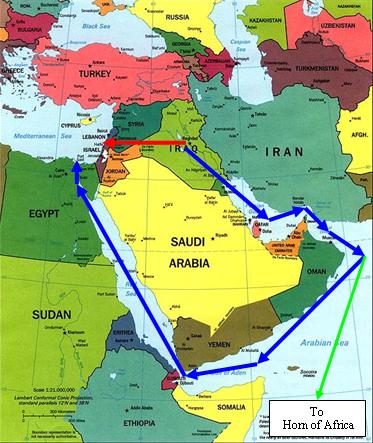 |
Blue = Pre-War Iraqi Oil Transit Route To Meditteranian Via Arabian Peninsula And Suez Canal (Suez Cannot Take Largest Tankers) |
Oman
"Veterans of the SAS have launched a
campaign to win posthumous Victoria Crosses for two unsung heroes who died fighting a
forgotten battle against overwhelming odds during a secret war. Prince William, acting in
an unofficial capacity, has unveiled a statue to one of the heroes inside the SAS’s
camp at Hereford. But the life-size bronze figure was paid for by an American
multi-millionaire, the public cannot see it and there have been no medals for the two men
who died in a conflict at the height of the cold war. The survivors of the battle of Mirbat in Oman in July 1972 have dubbed it the SAS’s Rorke’s Drift, a reference to
the stand by British soldiers against the Zulus in 1879.... The SAS had been invited to Oman by the sultan to help his small
army put down the insurgency. They operated under the pseudonym of the British Army
Training Team. If the guerrillas had won that day, they
would have gone on to take control of the Strait of Hormuz through which 90% of the
world’s oil flowed. It would have given the
Soviet Union a strategic stranglehold on the region.... Richard Belfield, an award-winning documentary film-maker who is his
co-author, said: 'There was a rationing of medals. The
regiment has been angry ever since over who got the medals and who didn’t. An anonymous donor gave the regiment some money and said why
don’t you erect a statue to one soldier who absolutely epitomises the regiment. They
didn’t give it to Paddy Mayne or David Stirling, who founded the regiment. It went to
Laba. But he only got mentioned in dispatches and Tobin got absolutely nothing. Part of the argument was that this was a secret war and people would wonder
what was happening in Oman if the medals were announced. But there is a real anger in the regiment that these great
heroes have never been properly recognised.”
SAS seeks VCs for heroes of its Rorke’s Drift
Sunday
Times, 14 August 2011, Print Edition, P9
Yemen
"Britain
has quietly deployed its most advanced warship off the coast of Yemen to protect a crucial
shipping lane from the threat of Iranian-backed
missile attacks, The Times has learnt. HMS Daring, a Type 45 destroyer, has been diverted
from joining a mission in the Gulf to patrol the Bab al-Mandeb strait after three US
warships and a United Arab Emirates vessel were targeted in the area. The Royal Navy
operation, which has yet to be made public, was described by one analyst as the most
important task being undertaken by the Royal Navy’s surface fleet. Much of Britain’s oil and gas supplies passes through the
strait, which leads to the Suez Canal...."
Britain secretly sends warship to hold oil route
London
Times, 9 November 2016
"Yemen is key to the stability of the
Gulf and the security of global oil supplies."
Colonel Richard Kemp - Accusing the Saudis of war crimes just helps the terrorists
London Times, 9 February 2016, Print Edition, P22
"Imam Yahya, ruler of north Yemen from
1918 to 1948, once confided to a Dutch explorer that an American mining company had
offered him $2 million for the right to prospect for oil. When the explorer asked if he
had accepted such an advantageous offer, Imam Yahya’s negative was couched in a
rhetorical question: 'Can you tell me how many millions it would cost me to be rid of them
again?' A strong and confident leader, Imam Yahya loudly and constantly reiterated his
claim to be the rightful ruler of a Greater Yemen
that included Aden, a clammy, desolate but
cosmopolitan port that had been a British Crown colony since 1839. He dispensed free
rifles and cash to any protectorate tribesman willing to betray the British infidel who
still occupied the southern territory. This was the 1940s, and the Age of Empires was
ending. Far from loosening her grip on Aden, however, Britain had begun tightening it
after the end of the First World War. As early as 1928, a refusal to do the British
bidding by tribesmen in the protectorates around Aden was liable to bring down the
destructive wrath of an RAF bombing raid on their villages and crops. Resort to this
controversial, if economical, means of control was one that successive administrators of
Aden were at pains to justify: 'The Arabs are a proud race and rate personal bravery
highly, as highly as they do prestige,' explained a 1950s governor of Aden. 'And frankly,
that is far too high. They will not give in to an inferior force, but will shoot it out to
the end. They are unlikely to give in to a slightly superior force — but they will
give in to an overwhelming force and often be secretly glad to do so.' Aden remained a
jewel in the British crown, one worth making concessions to keep. Strategically situated,
from the point of view of British oil interests in
the Gulf, its Khormaksar airfield was soon handling
more traffic than any other RAF base in the world and its harbour more ships than any
other, except New York and Liverpool."
End of empire: the brutal and bloody last days of British colonial power in Yemen
London
Times, 4 March 2010
"If
you ever wonder why seemingly obscure countries like Yemen, Qatar and Bahrain get so much
attention, just look at these two narrow straits, and know that nearly 50% of the world's
seaborne oil passes through them daily. Then think
about the global economic meltdown that would result if the straits were disrupted. So
when unrest in Yemen sends its injured (and U.S.-friendly) despot packing, or when Iran
helps foster Shiite unrest in Bahrain, or when Saudi Arabia struggles with its own
leadership transition... you need know what's really going on and how it could end up
affecting you."
Middle East: Strait Shooting
Stratfor,
8 June 2011
"...backed by Iran Houthis are seizing
control of Yemen; threatening the strategic straights at the mouth of the Red Sea. Along
with the Straight of Hormuz, that would give Iran a
second choke point on the world’s oil supply.'
Benjamin Netanyahu, Israeli Prime Minister
Speech
to the US Congress, 3 March 2015
"If [Iranian] Houthi proxies take over control of Yemen's side of
the strait of Bab-el-Mandeb they will be in control of a strategic link between the
Mediterranian and the Indian Ocean. Four million
barrels of crude oil a day travel through the strait; it is one of the great choke points
of global trade."
Iran's masters of disorder threaten the West
London Times, 1 April 2015, Print Edition, P28
Somalia
"The shimmering blue water washes
gently on to golden sands that stretch past the crumbling, whitewashed villas lining the
shore. Dolphins leap from the gentle swell of the Indian Ocean....In another age this was
known as 'beautiful Mogadishu', a destination for package tourists from Europe. Today it
stands beside the most dangerous shipping lane in the world. Pirates armed with
rocket-propelled grenades and AK47s control the waters far out to sea; close to shore, the
threat of Islamist suicide boats keeps captains watchful. About 30,000 ships use the route as they pass in and out of the Suez Canal, making it a vital artery for
global trade. A US-led naval taskforce, set up as
part of Operation Enduring Freedom to tackle terrorism, has been given responsibility for
trying to keep the sea lanes open. They have established a series of waypoints marking a
safe corridor through the Gulf of Aden patrolled by warships and coalition aircraft overhead."
Somalia: Only guns can get aid past the pirates into the gates of Hell
London
Times, 20 September 2008
"Islamist extremists prepared last
night to unload rocket-propelled grenades and anti-aircraft guns from a Ukrainian
freighter seized by Somali pirates even as foreign warships surrounded the vessel. A US destroyer and
submarine from an international taskforce set up to patrol the
Gulf of Aden and Indian Ocean and two
European-flagged ships were reported to be tracking the freighter that had anchored off
the southern Somali coast. The ship's captain contacted media outlets by satellite phone to
say that one of his crew had died during the hostage drama....Piracy has flourished around
Somalia's
lawless coast since the mid-1990s. It was briefly stamped out by the Union of Islamic
Courts which took control of the country in 2006. The trade returned when the Islamists
were defeated by an Ethiopian assault. In the past the trade was directed at earning hard
currency. However, this year the pirates have acquired an ideological dimension. Bruno
Schiemsky, a Somali analyst based in Kenya, said that Somalia's al-Shabaab militia — the youth wing of the Islamist movement —
had joined forces with the pirates, offering weapons training in return for lessons in
plundering at sea. 'This has now gone beyond money. The Shabaab are now at sea looking for
Israelis, Americans and other Westerners,' he said. 'This is getting very nasty
now.'”
Islamists plunder weapons from hijacked ship in Somalia
London
Times, 29 September 2008
"If I were a Somali I would thank
Allah for the pirates. For more than 20
years the world has stood by while successive civil wars destroyed Somalia, killing
hundreds of thousands of people by bullets, disease and starvation and reducing what was
once a prosperous land to a war zone. But the seizure of more than 200 ships by kids with
guns in small craft has changed all that. Britain, for which shipping and trade around the
Red Sea and the Gulf are vital national interests, has decided to take action. Pirates, the UK Government has realised, cannot be stopped as
long as their land bases are not ruled by a government. With Somalia’s Government
under attack from Islamic militants who are recruiting and training terrorists, a
political solution must now be found for Somalia. So declared William Hague, the Foreign
Secretary, clad in flak jacket and helmet, in Mogadishu on Thursday. The search will begin
at a conference in London on February 23. At last. And what a conference it will be. Some
40 heads of government have been invited to Lancaster House to discuss the takeover of
Somalia. At least that is what the Italians, the former rulers of southern Somalia, want.
But we have invited the wrong Somalis. ... The so-called Government lives in luxury hotels
and apartments in Nairobi. According to a recent audit of the Somali Government in
2009-2010, 96 per cent — yes, ninety-six per cent! — of direct bilateral
assistance disappeared, presumably stolen by corrupt politicians and officials. An
official report by the UN Monitoring Group said: 'The endemic corruption of the leadership
of the transitional federal institutions ... is the greatest impediment to the emergence
of a cohesive transitional authority and effective state institutions.' But it is these
people who will be coming to Lancaster House on February 23. We know that in much of
Somalia there are very strong civil society organisations led by highly respected men and
women. They, however, will not be invited. So perhaps the first thing this great
conference should do is apologise to the people of Somalia for ignoring their plight for
so long. The second is to usher Somalia’s professional politicians into the garden or
off to smart hotels and bring in some Somalis who really represent the interests of the
country and its long-suffering people."
Richard Dowden, Director of the Royal African Society
By robbing the rich, Somali pirates have helped the poor
London Times, 4 February 2012, Print Edition P24
"Britain
is involved in a secret high-stakes dash for oil in Somalia,
with the government offering humanitarian aid and security assistance in the hope of a
stake in the beleaguered country's future energy industry. Riven by two decades of conflict that have seen the emergence of a
dangerous Islamic insurgency, Somalia is routinely described as the world's most
comprehensively 'failed' state, as well as one of its poorest. Its coastline has become a
haven for pirates preying on international shipping in the Indian Ocean. David Cameron
last week hosted an international conference on Somalia, pledging more aid, financial help
and measures to tackle terrorism. The summit followed a surprise visit by the foreign
secretary, William Hague, to Mogadishu, the Somali capital, where he talked about 'the
beginnings of an opportunity'' to rebuild the country. The Observer can reveal that, away
from the public focus of last week's summit, talks are going on between British officials
and Somali counterparts over exploiting oil reserves that have been explored in the arid
north-eastern region of the country. Abdulkadir Abdi Hashi, minister for international
cooperation in Puntland, north-east Somalia – where the first oil is expected to be
extracted next month – said: 'We have spoken to a number of UK officials, some have
offered to help us with the future management of oil revenues. They will help us build our
capacity to maximise future earnings from the oil industry.' British involvement in the
future Somali oil industry would be a boon for the UK economy and comes at a time when the world is increasingly concerned about the actions of Iran, the
second-biggest oil producer in Opec. Hashi, in
charge of brokering deals for the region's oil reserves, also said Somalia was looking to
BP as the partner they wanted to 'help us explore and build our oil capacity'. He added:
'We need those with the necessary technical knowhow, we plan to talk to BP at the right
time.' Somali prime minister Abdiweli Mohamed Ali said his government had little choice
but to entice western companies to Somalia by offering a slice of the country's natural
resources, which include oil, gas and large reserves of uranium. 'The only way we can pay
[western companies] is to pay them in kind, we can pay with natural resources at the fair
market value.' Britain is not the only country looking to develop Somalia's vast natural
resources. Last month oil exploration began in Puntland by the Canadian company Africa
Oil, the first drilling in Somalia for 21 years. Hashi, who sealed the Africa Oil deal,
said the first oil was expected to be extracted within the next '20 to 30 days'..... Yet it is the extent of oil deposits beneath the Indian Ocean that
is most exciting Somali officials. One said the potential was comparable to that of
Kuwait, which has more than 100bn barrels of proven oil reserves. If true, the deposits
would eclipse Nigeria's reserves – 37.2bn barrels – and make Somalia the seventh
largest oil-rich nation. The state-owned China
National Offshore Oil Corporation has tried to acquire an interest in Somalia's reserves.
Senior officials from the Somali transitional government are adamant that the imminent
extraction of oil in Puntland next month would kickstart a scramble from the
multinationals. On Thursday, the last day of the London conference, BP and Shell unveiled
an initiative to support job-creation projects in the coastal regions of Somalia. A
subsidiary of Shell was thought to have acquired exploration concessions in Puntland
before the descent into lawlessness in 1991."
Britain leads dash to explore for oil in war-torn Somalia
Observer,
25 February 2012
"Somali
pirates occupy a unique position, which is right along highly strategic global shipping
lanes yet outside the reach of any national power.
For international actors, it is politically and militarily easier to try to contain the
Somali piracy threat than to eliminate it. ... Several dozen foreign naval ships are
deployed to secure the waters for commercial shipping at any given time. Their focus is
escorting ships through the Gulf of Aden, but the area of pirate
activity is much larger than that, reaching across the Arabian Sea to India and
Madagascar."
The Expensive, Diminishing Threat of Somali Piracy
Stratfor,
8 November 2012
"The
intrusion of European imperial powers into the region compounded Iran's difficulties in
the 19th century, along with the lodging of British power to
Iran's west in Iraq and the Arabian Peninsula following the end of World War I. This
coincided with a transformation of the global economy to an oil-based system. Then as now, the region was a major source of global oil. Where the British once had interests in the region, the emergence
of oil as the foundation of industrial and military power made these interests urgent."
Iran's Strategy
Stratfor, 10 April 2012
"Q: And what are the stakes
here? The diplomatic effort has been going on for a long time and it has not worked. In
fact, Iran has gone in the other direction. So what are the stakes here? |
"The
most important facts about Iran go unstated because they are so obvious. Any glance at a
map would tell us what they are. And these facts explain how regime change or evolution in
Tehran -- when, not if, it comes -- will dramatically alter geopolitics from the
Mediterranean to the Indian subcontinent and beyond. Virtually all of the Greater Middle
East's oil and natural gas lies either in the Persian Gulf or the Caspian Sea regions.
Just as shipping lanes radiate from the Persian Gulf, pipelines will increasingly radiate
from the Caspian region to the Mediterranean, the Black Sea, China and the Indian Ocean.
The only country that straddles both energy-producing areas is Iran, stretching as it does
from the Caspian to the Persian Gulf. In a raw materials' sense, Iran is the Greater
Middle East's universal joint.... just as Iran
straddles the rich energy fields of both the Persian Gulf and the Caspian Sea, it also
straddles the Middle East proper and Central Asia. No Arab country can make that claim
(just as no Arab country sits astride two energy-producing areas).... as its nuclear
program attests, is one of the most technologically advanced countries in the Middle East
(in keeping with its culture and politics), and as such has built hydroelectric projects
and roads and railroads in these Central Asian countries that will one day link them all
to Iran -- either directly or through Afghanistan. Moreover, a natural gas pipeline now
connects southeastern Turkmenistan with northeastern Iran, bringing Turkmen natural gas to
Iran's Caspian region, and thus freeing up Tehran's own natural gas production in southern
Iran for export via the Persian Gulf. (This goes along with a rail link built in the 1990s
connecting the two countries.) Turkmenistan has the world's fourth-largest natural gas
reserves and has committed its entire natural gas exports to Iran, China and Russia.
Hence, the possibility arises of a Eurasian energy axis united by the crucial geography of
three continental powers all for the time being opposed to Western democracy.14 Iran and
Kazakhstan have built an oil pipeline connecting the two countries, with Kazakh oil being
pumped to Iran's north, even as an equivalent amount of oil is shipped from Iran's south
out through the Persian Gulf. Kazakhstan and Iran will also be linked by rail, providing
Kazakhstan with direct access to the Gulf. A rail line may also connect mountainous
Tajikistan to Iran, via Afghanistan. Iran constitutes the shortest route for all these
natural resource-rich countries to reach international markets. So imagine an Iran athwart
the pipeline routes of Central Asia.... "
The Geography of Iranian Power by Robert D. Kaplan
Stratfor,
29 August 2012
"... what's happened is that the
United States looks at the Middle East through Israel. And the Arabs and the Persians look
at Israel as an outpost of the United States of the
West. We've lost this anti-colonial game and the
Iranians have won it. They've simply portrayed themselves as not as religious fanatics,
but as an anti-colonial power. And everybody in the Middle East, you look at the polls
across the board, even countries like Morocco, which are entirely Sunni, look to Tehran as
the great anti-imperial power. We've lost the ideological war."
Robert Baer, former CIA agent
Australian Broadcasting
Organisation, 26 February 2009
Israel
"Israel stands to benefit greatly
from the US led war on Iraq, primarily by getting rid of an implacable foe in President
Saddam Hussein and the threat from the weapons of mass destruction he was alleged to
possess. But it seems the Israelis have
other things in mind. An intriguing pointer
to one potentially significant benefit was a report by Haaretz on 31 March that minister
for national infrastructures Joseph Paritzky was considering the possibility of reopening
the long-defunct oil pipeline from Mosul to the
Mediterranean port of Haifa. With Israel lacking energy
resources of its own and depending on highly expensive oil from Russia, reopening the
pipeline would transform its economy....
All of this lends weight to the theory that Bush's war is part of a masterplan to reshape
the Middle East to serve Israel's interests. Haaretz quoted Paritzky as saying that the
pipeline project is economically justifiable because it would dramatically reduce Israel's
energy bill. US efforts to get Iraqi oil to Israel are not surprising. Under a 1975
Memorandum of Understanding (MoU), the US guaranteed all Israel's oil needs in the event
of a crisis. The MoU, which has been quietly renewed every five years, also committed the
USA to construct and stock a supplementary strategic reserve for Israel, equivalent to
some US$3bn in 2002. Special legislation was enacted to exempt Israel from restrictions on
oil exports from the USA. Moreover, the USA agreed to divert oil from its home market,
even if that entailed domestic shortages, and guaranteed delivery of the promised oil in
its own tankers if commercial shippers were unwilling or not available to carry the crude
to Israel. All of this adds up to a potentially massive financial commitment. The USA has another reason for supporting Paritzky's
project: a land route for Iraqi oil direct to the Mediterranean would lessen US dependence
on Gulf oil supplies. Direct access to the world's second-largest oil reserves (with the
possibility of expansion through so-far untapped deposits) is an important strategic
objective."
Oil from Iraq : An Israeli pipedream?
Jane's
Foreign Report, 16 April 2003
"The
United States has asked Israel to check the possibility of pumping oil from Iraq to the
oil refineries in Haifa. The request came in a
telegram last week from a senior Pentagon official to a top Foreign Ministry official in
Jerusalem. The Prime Minister's Office, which views the pipeline to Haifa as a 'bonus' the
U.S. could give to Israel in return for its unequivocal support for the American-led
campaign in Iraq, had asked the Americans for the official telegram. The new pipeline
would take oil from the Kirkuk area, where some 40 percent of Iraqi oil is produced, and
transport it via Mosul, and then across Jordan to Israel. The U.S. telegram included a
request for a cost estimate for repairing the Mosul-Haifa pipeline that was in use prior
to 1948. During the War of Independence, the Iraqis stopped the flow of oil to Haifa and
the pipeline fell into disrepair over the years. The National Infrastructure Ministry has
recently conducted research indicating that construction of a 42-inch diameter pipeline
between Kirkuk and Haifa would cost about $400,000 per kilometer. The old Mosul-Haifa
pipeline was only 8 inches in diameter. National Infrastructure Minister Yosef Paritzky
said yesterday that the port of Haifa is an attractive destination for Iraqi oil and that
he plans to discuss this matter with the U.S. secretary of energy during his planned visit
to Washington next month. Paritzky added that the plan depends on Jordan's consent and
that Jordan would receive a transit fee for allowing the oil to piped through its
territory. The minister noted, however, that 'due to pan-Arab concerns, it will be hard
for the Jordanians to agree to the flow of Iraqi oil via Jordan and Israel.' Sources in
Jerusalem confirmed yesterday that the Americans are looking into the possibility of
laying a new pipeline via Jordan and Israel. (There is also a pipeline running via Syria
that has not been used in some three decades.) Iraqi oil is now being transported via
Turkey to a small Mediterranean port near the Syrian border."
U.S. checking possibility of pumping oil from northern Iraq to Haifa, via Jordan
Haaretz,
1 August 2007
"The United States is planning a
significant military presence of 13,500 troops in Kuwait to give it the flexibility to
respond to sudden conflicts in the region as Iraq adjusts to the withdrawal of American
combat forces and the world nervously eyes Iran, according to a congressional report. The
study by the Senate Foreign Relations Committee examined the U.S. relationship with the
six nations of the Gulf Cooperation Council - Saudi Arabia, Kuwait, Bahrain, Qatar, the
United Arab Emirates and Oman - against a fast-moving backdrop. In just the last two days,
Saudi Arabia's ruler named Defense Minister Prince Salman bin Abdul-Aziz as the country's
new crown prince after last week's death of Prince Nayef, and Kuwait's government
suspended parliament for a month over an internal political feud. The latest developments
inject even more uncertainty as the Middle East deals with the demands of the Arab Spring,
the end to U.S. combat operations in Iraq at the end of 2011 and fears of Iran's nuclear
program. 'Home to more than half of the world's oil
reserves and over a third of its natural gas, the stability of the Persian Gulf is
critical to the global economy,' the report said.
'However, the region faces a myriad of political and security challenges, from the Iranian
nuclear program to the threat of terrorism to the political crisis in Bahrain.'.... As it
recalibrates its national security strategy, the United States is drawing down forces in
Europe while focusing on other regions, such as the Middle East and Asia. Defense
Secretary Leon Panetta has said he envisions about 40,000 troops stationed in the Middle
East region after the withdrawal from Iraq. By comparison, a cut of two Army combat
brigades and the withdrawal of two other smaller units will leave about 68,000 troops in
Europe."
US plans significant military presence in Kuwait
Associated Press, 19
June 2012
BBC, March 2005 |
| "The Bush administration made plans for war and for Iraq's oil before
the 9/11 attacks, sparking a policy battle between neo-cons and Big Oil, BBC's
Newsnight has revealed..... Two years ago today - when
President George Bush announced US, British and Allied forces would begin to bomb
Baghdad - protesters claimed the US had a secret plan for Iraq's oil once Saddam had been
conquered. In fact there were two conflicting plans, setting off a hidden policy war
between neo-conservatives at the Pentagon, on one side, versus a combination of 'Big Oil'
executives and US State Department 'pragmatists'. 'Big Oil' appears to have won. The
latest plan, obtained by Newsnight from the US State Department was, we learned, drafted
with the help of American oil industry consultants. Insiders told Newsnight that planning began
'within weeks' of Bush's first taking office in 2001, long before the September 11th
attack on the US....The industry-favoured
plan was pushed aside by a secret plan, drafted just before the invasion in 2003, which
called for the sell-off of all of Iraq's oil fields. The
new plan was crafted by neo-conservatives intent on using Iraq's oil to destroy the Opec
cartel through massive increases in production above Opec quotas. The sell-off was given the green light in a secret meeting in
London headed by Ahmed Chalabi shortly after the US entered Baghdad, according to
Robert Ebel. Mr Ebel, a former Energy and CIA oil analyst, now a fellow at the Center for
Strategic and International Studies in Washington, told Newsnight he flew to the London
meeting at the request of the State Department.....Philip Carroll, the former CEO of Shell
Oil USA who took control of Iraq's oil production for the US Government a month after the
invasion, stalled the sell-off scheme.... Ariel Cohen, of the neo-conservative Heritage Foundation, told Newsnight that an opportunity had been missed to privatise Iraq's oil
fields..... New plans, obtained from the State Department by Newsnight and Harper's
Magazine under the US Freedom of Information Act, called for creation of a state-owned oil
company favoured by the US oil industry. It was completed in January 2004 under the
guidance of Amy Jaffe of the James Baker
Institute in Texas. Formerly US Secretary
of State, Baker is now an attorney representing Exxon-Mobil and the Saudi Arabian
government.... " Secret US plans for Iraq's oil BBC News, 17 March 2005 |
The Energy Task Force Led By Edward
Morse And Amy Jaffe Of The Baker Institute
That Reported In April 2001
"President Bush's Cabinet agreed in April 2001 that 'Iraq remains a destabilizing influence to the flow of oil to
international markets from the Middle East' and
because this is an unacceptable risk to the US 'military
intervention' is necessary. Vice-president Dick Cheney,
who chairs the White House Energy Policy Development Group, commissioned a report on
'energy security' from the Baker Institute for Public
Policy, a think-tank set up by James Baker, the
former US secretary of state under George Bush Sr. The report, Strategic Energy Policy
Challenges For The 21st Century, concludes: 'The
United States remains a prisoner of its energy dilemma. Iraq remains a de- stabilizing
influence to ... the flow of oil to international markets from the Middle East. Saddam
Hussein has also demonstrated a willingness to threaten to use the oil weapon and to use
his own export program to manipulate oil markets.
Therefore the US should conduct an immediate policy review toward Iraq including military,
energy, economic and political/ diplomatic assessments. 'The United States should then
develop an integrated strategy with key allies in Europe and Asia, and with key countries
in the Middle East, to restate goals with respect to Iraqi policy and to restore a
cohesive coalition of key allies.' Baker who
delivered the recommendations to Cheney, the former chief executive of Texas oil firm
Halliburton, was advised by Kenneth Lay, the disgraced former chief executive of Enron,
the US energy giant which went bankrupt after carrying out massive accountancy fraud. The
other advisers to Baker were: Luis Giusti, a Shell non-executive director; John Manzoni,
regional president of BP and David O'Reilly, chief executive of ChevronTexaco. Another name linked to the document is Sheikh Saud Al Nasser Al Sabah,
the former Kuwaiti oil minister and a fellow of the Baker Institute. President Bush also
has strong connections to the US oil industry and once owned the oil company Spectrum 7. The Baker report highlights massive shortages in world oil
supplies which now leave the US facing 'unprecedented energy price volatility' and has led to recurring electricity black-outs in areas such as
California. The report refers to the impact of fuel shortages on voters. It recommends a
'new and viable US energy policy central to America's domestic economy and to [the]
nation's security and foreign policy'. Iraq, the report says, 'turns its taps on and off
when it has felt such action was in its strategic interest to do so', adding that there is a 'possibility that
Saddam Hussein may remove Iraqi oil from the market for an extended period of time' in order to damage prices. The
report also says that Cheney should integrate energy and security to stop 'manipulations
of markets by any state', and suggests that Cheney's Energy Policy Group includes
'representation from the Department of Defense'. 'Unless the United States assumes a
leadership role in the formation of new rules of the game,' the report says, 'US firms, US
consumers and the US government [will be left] in a weaker position.'"
Official: US Oil at the Heart of Iraq Crisis
The Herald (Scotland), 6
October 2002
"For many decades now, the United
States has been without an energy policy. Now, the consequences of not having an energy
policy that can satisfy our energy requirements on a sustainable basis have revealed
themselves in California. Now, there could be more Californias in America’s future. President George W. Bush and his administration need to tell these
agonizing truths to the American people and thereby lay the basis for a new and viable
U.S. energy policy. That Americans face long-term energy delivery challenges and volatile
energy prices is the failure of both, Democrats and Republicans to fashion a workable
energy policy. Energy policy was allowed to drift by
both political parties despite its centrality to America’s domestic economy and to
our nation’s security. It was permitted to drift despite the fact that virtually every American recession since the late 1940s has been
preceded by spikes in oil prices. The American people need to know about this situation
and be told as well that there are no easy or quick solutions to today’s energy
problems. The President has to begin educating the public about this reality and start
building a broad base of popular support for the hard policy choices ahead. This recommendation sits at the core of an Independent Task Force Report
sponsored by our two organizations. The Task Force was chaired by Edward L. Morse, a widely
recognized authority on energy, and ably assisted by Amy
Myers Jaffe of the James
A. Baker III Institute of Rice University. Their
Task Force included experts from every segment of the world of energy—producers,
consumers, environmentalists, national security experts, and others.... the world is currently precariously close to
utilizing all of its available global oil production capacity,
raising the chances of an oil-supply crisis with more substantial consequences than seen in three decades. These
limits mean that America can no longer assume that oil-producing states will provide more
oil. Nor is it strategically and politically
desirable to remedy our present tenuous situation by simply increasing dependence on a few
foreign sources. So, we come to the report’s
central dilemma: the American people continue to demand
plentiful and cheap energy without sacrifice or inconvenience. But emerging technologies are not yet commercially viable to fill
shortages and will not be for some time. Nor is surplus energy capacity available at this
time to meet such demands. Indeed, the situation is
worse than the oil shocks of the past because in the present energy situation, the tight
oil market condition is coupled with shortages of natural gas in the United States,
heating fuels for the winter, and electricity supplies in certain localities. This Independent Task Force Report outlines some of the hard choices that
should be considered and recommends specific policy approaches to secure the energy future
of the United States. These choices will affect other
U.S. policy objectives: U.S. policy toward the Middle East; U.S. policy toward the former Soviet Union
and China; the fight
against international terrorism, environmental policy and international trade policy,
including our position on the European Union (E.U.) energy charter, economic sanctions,
North American Free Trade Agreement (NAFTA), and foreign trade credits and aid. The Bush administration is in a unique position to articulate these
tradeoffs in a non-partisan manner and to rally the support of the American public. U.S.
strategic energy policy must prioritize and coordinate domestic and foreign policy choices and objectives, where
possible. ....For
the most part, U.S. international oil policy has relied on maintenance of free access to
Middle East Gulf oil and free access for Gulf exports to world markets. The United States has forged a special relationship with certain key
Middle East exporters, which had an expressed interest in stable oil prices and, we
assumed, would adjust their oil output to keep prices at levels that would neither
discourage global economic growth nor fuel inflation. Taking
this dependence a step further, the U.S. government has operated under the assumption that
the national oil companies of these countries would make the investments needed to
maintain enough surplus capacity to form a cushion against disruptions elsewhere. For
several years, these assumptions appeared justified. But recently, things have changed.
These Gulf allies are finding their domestic and foreign policy interests increasingly at
odds with U.S. strategic considerations, especially as Arab-Israeli tensions flare. They
have become less inclined to lower oil prices in exchange for security of markets, and evidence suggests that investment is not being made in a timely enough
manner to increase production capacity in line with growing global needs. A trend toward anti-Americanism
could affect regional leaders’ ability to cooperate with the United States in the
energy area. The resulting tight markets have
increased U.S. and global vulnerability to disruption and provided adversaries undue
potential influence over the price of oil. Iraq has become a
key 'swing' producer, posing a difficult situation for the U.S. government......Consumers have the prospect of the market assisting them yet again in
achieving low energy costs. Some of the real costs, such as the high-cost U.S. military presence in the
Middle East, are already accepted and forgotten by the public. But the problem is that
there is overwhelming evidence that there will be no 'free lunch' for taxpayers. A
disruption might well occur at a time when the mechanisms for dealing with it have become
outmoded, too narrowly confined to too narrow a segment of the world community to make a
difference. And meanwhile, the market volatility of
the past few years may be a precursor of much worse to come—a roller coaster of
prices confusing the investment climate and impeding the marshaling of capital required to
overcome supply obstacles whose emergence triggered the new critical state to begin with.
Under this scenario, the United States remains a prisoner of
its energy dilemma, suffering on a recurring basis from the
negative consequences of sporadic energy shortages. These consequences can include
recession, social dislocation of the poorest Americans, and at the extremes, a need for military intervention. Moreover, this
approach leaves festering the conflict between rising energy demand and its potentially
devastating impact on the global environment..... The recommendations of the Task Force are divided into two
sections: The first comprises actions to be considered in the very short term to assure
that appropriate mechanisms are in place to deal with potential supply disruptions and to
buffer the economy from adverse impacts of price volatility. ... Recent oil market-price volatility has been driven by a number of
complex factors. However, three key drivers continue to fuel upward pressure on prices: OPEC policy and the organization’s lack of spare productive capacity;
the policies of Iraq and concerns about the reliability of
its U.N.-monitored oil exports; and fears of a
possible flare-up in the Arab-Israeli conflict. These factors have created uncertainty in
markets that has at various times outweighed considerations of immediate market supply
availability, fueling speculation and pushing prices
above $30––$35 a barrel at various times in recent months.... Over the past year, Iraq has
effectively become a swing producer, turning its taps on and off when it has felt such
action was in its strategic interest to do so. Saudi
Arabia has proven willing to provide replacement supplies to the market when Iraqi exports have been
reduced. This role has been extremely important in avoiding greater market volatility and
in countering Iraq’s efforts to take advantage
of the oil market’s structure. Saudi
Arabia’s role in this needs to be preserved, and should not be taken for granted.
There is domestic pressure on the GCC leaders to reject cooperation to cool oil markets
during times of a shortfall in Iraqi oil production. These populations are dissatisfied with the 'no-fly zone' bombing and
the sanctions regime against Iraq, perceived U.S. bias in the Arab-Israeli peace process, and lack of
domestic economic pressures. ... Some European
country positions on economic sanctions against Iraq differ from the U.S. position, most notably France but also some other
IEA countries including Japan. Still, the IEA must be assured of efficient joint
decision-making in the event of a supply disruption under tight market conditions. This
includes any possibility that Saddam Hussein may remove Iraqi
oil from the market for an extended period of time and that
Saudi Arabia will not or cannot replace all of the barrels. (This is a contingency that hangs over the market given the ability of
Baghdad to continue to earn revenues through smuggling and other uncontrolled oil exports,
even if it officially cuts off exports that are permitted through U.N. procedures.) ....
The bombing of Iraq by the United States led coalition in February 2001 spurred anti-U.S.
demonstrations in support of Iraq in traditional U.S. allies such as Egypt. Moreover, Saddam Hussein is trying to
recast himself as the champion of the Palestinian cause to some success among young
Palestinians. Any severe violence on the West Bank, Gaza, or Southern Lebanon will give Iraq more leverage in its
efforts to discredit the United States and U.S. intentions. A focus on the anti-Israeli
sympathies of some Arab oil-producing countries diverts attention from the repressive
nature of the Iraqi regime. Instead it rewards Iraq in its claim to Arab leadership for 'standing up to the United States for
ten years.' ... Iraq remains a destabilizing influence to U.S. allies in the Middle East, as
well as to regional and global order, and to the flow of oil
to international markets from the Middle East. Saddam Hussein has also demonstrated a willingness to threaten to use the oil weapon and to use his own export
program to manipulate oil markets. This would display his
personal power, enhance his image as a 'Pan Arab' leader supporting the Palestinians
against Israel, and pressure others for a lifting of economic sanctions against his
regime. The United States should conduct an immediate policy review toward Iraq,
including military, energy,
economic, and political/diplomatic assessments. The
United States should then develop an integrated strategy with key allies in Europe and
Asia and with key countries in the Middle East to restate the goals with respect to Iraqi policy and to restore
a cohesive coalition of key allies.... Once an
arms-control program is in place, the United States could consider reducing restrictions
on oil investments inside Iraq.
Like it or not, Iraqi reserves represent a major asset that
can quickly add capacity to world oil markets and inject a
more competitive tenor to oil trade. However, such a
policy will be quite costly as this trade-off will encourage Saddam Hussein to boast of
his 'victory' against the United States, fuel his ambitions, and potentially strengthen
his regime. Once so encouraged and if his access to oil revenues were to be increased by
adjustments in oil sanctions, Saddam Hussein could be a greater security threat to U.S.
allies in the region if weapons of mass destruction
(WMD) sanctions, weapons regimes, and the coalition
against him are not strengthened. Still, the
maintenance of continued oil sanctions is becoming increasingly difficult to implement. Moreover, Saddam Hussein has many means of gaining revenues, and the
sanctions regime helps perpetuate his lock on the country’s economy. Another problem
with easing restrictions on the Iraqi oil industry to allow greater investment is that GCC allies of the United States will
not like to see Iraq gain larger market share in international oil markets. In fact, even
Russia could lose from having sanctions eased on Iraq, because Russian companies now benefit from exclusive contracts and Iraqi export capacity is restrained, supporting the price of oil and raising the value of Russian oil
exports. If sanctions covering Iraq’s oil sector were eased and Iraq benefited from infrastructure improvements, Russia might lose its
competitive position inside Iraq, and also oil prices might fall over time, hurting the Russian economy.
These issues will have to be discussed in bilateral exchanges.....There are few options
available to United States to expand supply in the short run whether or not there are
energy supply shortfalls. There are even fewer options available to reduce short-term
demand. Fortunately, in the area of petroleum, the government has a fairly robust
strategic reserve. But beyond petroleum, the options are severely limited. It is in this
context that the Task Force recommends that the government consider all possible means of
de-bottlenecking supplies and removing obstacles to delivery of supplies, both
domestically and internationally. Options need to be considered that are unilateral as
well as those that are bilateral, regional, and international or multinational by nature.
In addition, the government needs to establish permanent machinery for integrating energy
policy with economic, environmental, and foreign policy on a sustained basis. Virtually
all domestically available raw-material energy resources are being produced that can be.
In fact, there are virtually no actions that can be taken in the short term to increase
these home-grown supplies. ....Generally speaking,
all oil-producing countries outside of OPEC are producing at maximum rates. There are a few exceptions where political problems block immediate
shipments, such as pipeline problems in Colombia, where guerrilla warfare against the
government extends to attacks on oil installations..... For energy policy to be integrated
with overall economic policy, environmental policy, and foreign policy, it needs to be
vetted and articulated through a 'permanent' interagency process that brings those
responsible for these areas together. The Bush
administration has moved rapidly in this direction through the creation of the White House
Energy Policy Development Group headed by Vice President Dick
Cheney. That group
appropriately includes representations from the Departments of Energy, Interior, Commerce,
Treasury, and State as well as representation from the Environmental Protection Agency and
the FEMA (Federal Emergency Management Agency). As this process unfolds, the
administration should find ways to establish a permanent framework for articulating energy
policy, perhaps including representation from the
Department of Defense as well.... Middle East Gulf crude oil currently makes up around 25 percent of world
oil supply, but could rise to 30–40 percent during the next decade as the
region’s key producers pursue higher investments to capture expanding demand for oil
in Asia and the developing world. If political factors were
to block the development of new oil fields in the Gulf, the
ramifications for world oil markets could be quite severe.... it is clear that unless the United States assumes a leadership role
in the formation of new rules of the game, it will not simply forfeit such a role, which
others will assume. It will rather become reactive to initiatives put forth by other
governments which, if agreed by others, could leave U.S. firms, U.S. consumers, and the
U.S. government in a weaker position than is warranted. This could be already happening,
for example, with respect to the establishment of a new information base for energy, given
the commitment of the Saudi government to house such a base within its borders. It could
also be happening with respect to the European Energy Charter, if Moscow agrees to ratify
the Energy Charter treaty. In addition, such an
effort would assist in preventing the emergence of international groupings of countries
that could be antithetical to U.S. interests—for example an effort by Venezuela, Iraq, and Russia to align their
interests against the United States on a host of international energy and non-energy
issues....Almost every American recession in the
past sixty years was preceded by spikes in energy prices. Now, the United States faces the
prospect of unprecedented energy price volatility and recurrent shortages of electricity
and other energy supplies. The U.S. government needs to make it clear to the American
people that there are no short-term bandaids available and that the situation requires
long-term solutions. A comprehensive national energy security policy is needed now to
assure continued improvement in our standard of living in the twentyfirst century. In almost every energy source—including electricity, natural gas, and
petroleum—we have used up
the cushions of surplus capacity on which we have traditionally depended. With virtually no surplus in world oil-production capacity
to cushion the blow of an accident or unexpected event, the United States and other
oil-importing countries face unacceptable risks from a future market disruption or
potential manipulation by adversaries. In the United
States, rising international oil prices are compounded with severe energy production
constraints, as well as inadequate domestic electricity and natural gas delivery
infrastructures. All these factors will raise domestic energy costs."
STRATEGIC ENERGY POLICY CHALLENGES FOR THE 21ST CENTURY
Report of an Independent Task Force Sponsored by the
James
A. Baker III Institute for Public Policy of Rice University and the Council on Foreign
Relations - April 2001
2001 Edward L. Morse, Chair |
"For the world
as a whole, oil companies are expected to keep finding and developing enough oil to offset
our seventy one million plus barrel a day of oil depletion, but also to meet new demand.
By some estimates there will be an average of two per cent annual growth in global oil
demand over the years ahead along with conservatively a three per cent natural decline in
production from existing reserves. That means by 2010 we will need on the order of an
additional fifty million barrels a day. So where is the oil going to come from?
Governments and the national oil companies are obviously in control of about ninety per
cent of the assets. Oil remains fundamentally a government business. While many regions of
the world offer great oil opportunities, the Middle East with two thirds of the world's oil and the lowest cost, is
still where the prize ultimately lies, even though companies are anxious for greater access there, progress
continues to be slow."
Dick Cheney, Chief Executive of Halliburton,
now Vice President of the United States
Speech at London
Institute of Petroleum, Autumn Lunch 1999
"Optimists about
world oil reserves, such as the Department of Energy, are getting increasingly lonely. The
International Energy Agency now says that world production outside the Middle Eastern
Organization of Petroleum Exporting Countries (opec) will
peak in 1999 and world production overall will peak between 2010 and 2020. This projection is supported by influential
recent articles in Science and Scientific American. Some knowledgeable academic and
industry voices put the date that world production will peak even sooner—within the
next five or six years. The optimists who project large reserve quantities of over one
trillion barrels tend to base their numbers on one of three things: inclusion of heavy oil
and tar sands, the exploitation of which will entail huge economic and environmental
costs; puffery by opec nations lobbying for higher production quotas within the cartel; or
assumptions about new drilling technologies that may accelerate production but are
unlikely to expand reserves. Once production peaks, even though exhaustion of world
reserves will still be many years away, prices will begin to rise sharply. This trend will
be exacerbated by increased demand in the developing world....." |
"The United
States cannot afford to wait for the next energy
crisis to marshal its intellectual and industrial
resources.... Our growing dependence on increasingly scarce Middle Eastern oil is a fool's
game—there is no way for the rest of the world to win. Our losses may come suddenly
through war, steadily through price increases, agonizingly through developing-nation
poverty, relentlessly through climate change—or through all of the above."
Richard G. Lugar and R. James Woolsey (Former Director
of the CIA)
The New Petroleum - Foreign Affairs January/February 1999
"Years before George W.
Bush entered the White House, and years before the Sept. 11 attacks set the direction of
his presidency, a group of influential neo-conservatives hatched a plan to get Saddam
Hussein out of power... The group was never secret
about its aims. In its 1998 open letter to Clinton, the group openly advocated unilateral
U.S. action against Iraq.... Of the 18 people who signed the letter, 10 are now in the
Bush administration. As well as Rumsfeld and Wolfowitz, they include Deputy Secretary of
State Richard Armitage ... "
Were Neo-Conservatives’ 1998 Memos a Blueprint for Iraq
War?
ABC News, 10
March 2003
"We are writing you because we are convinced that current American
policy toward Iraq is not succeeding..... It hardly needs to be added that if Saddam does
acquire the capability to deliver weapons of mass destruction, as he is almost certain to
do if we continue along the present course, the safety of American troops in the region,
of our friends and allies like Israel and the moderate Arab states, and a significant portion of the world’s
supply of oil will all be put at hazard....Given the magnitude of the threat, the current policy, which depends
for its success upon the steadfastness of our coalition partners and upon the cooperation
of Saddam Hussein, is dangerously inadequate. The only acceptable strategy is one that
eliminates the possibility that Iraq will be able to use or threaten to use weapons of
mass destruction. In the near term, this means a
willingness to undertake military action as diplomacy is clearly failing. In the long term, it means removing Saddam Hussein and his regime from power. That now needs to become the aim of American foreign policy."
Open Letter To President Bill Clinton, 26 January 1998
Signed by: Elliott Abrams, Richard L. Armitage, William J. Bennett, Jeffrey
Bergner, John Bolton, Paula Dobriansky, Francis Fukuyama, Robert Kagan Zalmay Khalilzad,
William Kristol, Richard Perle, Peter W. Rodman, Donald Rumsfeld, William Schneider, Jr.,
Vin Weber., Paul Wolfowitz, R. James Woolsey, Robert B. Zoellick
"I think this is a very hard
choice, but the price - we think the price is worth it." |
View Albright
Interview On YouTube |
The Occupation Of Saudi Arabia
"....[After the 1990 Iraqi invasion of
Kuwait] President Bush was hesitant about how America should respond. His foreign policy
alter ego, Secretary of State Jim Baker, and his Defense Secretary, Dick Cheney, were
reluctant to act. National Security Advisor Brent Scowcroft, however, thought that Iraq
had just changed the strategic equation in a way that could not be permitted. So did
British Prime Minister Margaret Thatcher. The two
argued that nothing stood between the advance of units of the Iraqi army in Kuwait and the
immense Saudi oil fields. If we did nothing in response to Iraq's seizing Kuwait, Saddam
Hussein would think that he could get away with seizing the Saudis' eastern oil fields. If
that happened, Baghdad would control most of the world's readily available oil. They could
dictate to America. Reluctantly, Bush and his team decided that they needed to
defend the Saudi oil fields, and do so quickly. They
needed Saudi permission for the defensive deployment, but there were some in the Pentagon
and White House who thought U.S. forces needed to
protect the Saudi oil with or without Saudi
approval. The mission to persuade the Saudi King to accept U.S forces was given to Defense
Secretary Dick Cheney. He assembled a small team, including Under Secretary of Defense
Paul Wolfowitz, Central Command head Norman Schwarzkopf, Sandy Charles of the NSC, and me,
then the Assistant Secretary of State for Politico-Military Affairs... Cheney concluded
the presentation, promising that U.S forces would come only to defend the Kingdom.
President Bush wanted the King to know that he had the President's word that the U.S.
forces would leave as soon as the threat was over, or whenever ordered to do so by the
King. ..... Unknown to the Americans at the time, the intelligence chief, Prince Turki,
had been approached by the Saudi who had recruited Arabs to fight in the Afghan War
against the Soviets, Usama Bin Laden........ When Kuwait was invaded, he offered to make
them available to the King to defend Saudi Arabia, to drive Saddam out of Kuwait. After we
left the palace, perhaps bin Laden was told of the King's decision. His help would not be
required. He could not believe it; letting
nonbelievers into the Kingdom of the Two Holy Mosques was against the beliefs of the
Wahhabist branch of Islam. Large numbers of American military in the Kingdom would violate
Islam, the construction magnate's son thought. They would
never leave."
Richard Clarke - White House Head Of Counterterrorism 1992 - 2003
Chapter 3, Unfinished Mission, Unintended Consequences
'Against All Enemies' - Edition first published in Great
Britain by The Free Press in 2004
"For just so long Kuwait, a small
country at the head of the Persian Gulf, had been set free and independent from its
long-time British protector. And during that time Kuwait had developed its oil fields and
become immensely rich. Saddam Hussein claimed that Kuwait was part of Iraq. To have and to
hold it would put him on the way to achieving something that the Soviets had yearned for
right after the Second War and been denied by the intervention of the United Nations,
which was to be sovereign of the Gulf - and so, as Churchill foresaw and warned about,
soon to be able to conquer Europe without a war by possessing 60% of the oil Western
Europe lived by and so be able to dictate to countries like Britain, France, Germany, that
they should abandon their precious democratic ways and get themselves governments friendly
to Iraq.....[Following Saddam's invasion of Kuwait] President Bush - the first that is -
called a dawn meeting of the National Security Council at which the likely commander of
any military action, one General Schwarzkopf, expressed the general feeling that the
United States might fight for Saudi Arabia but hardly for Kuwait. President Bush told the
press there was no thought of American intervention. The United Nations anyway had voted
to impose a total embargo on Iraq. Two days after the invasion President Bush took a half
day out to keep a promise to the British prime minister who was addressing a conference in
Aspen, Colorado, a resort town in the Rockies. He found Mrs Thatcher in finer fighting
fettle than all but one of his own advisers. She stressed that fighting for Kuwait now
might be a necessary step to saving Saudi Arabia from invasion later on. ..... What so
swiftly transformed the views and policy of the United States and the onlooking
allies-to-be was the recognition, first pressed on President Bush by Mrs Thatcher and then
rather late in the day realised by the King of Saudi Arabia, that once he held Kuwait
there was nothing to stop Saddam from seizing the Saudi oil fields."
Alistair Cooke's Letter From America
BBC
Online, 24 June 2002
"If one episode sums up Margaret
Thatcher's instinctive, no-nonsense approach to international affairs, it was her
appearance in Aspen, Colorado, in August 1990. Staying at the country home of the then US
ambassador to London, Henry Catto, Thatcher was informed that Saddam Hussein had invaded
Kuwait. According
to her memoirs, Thatcher went for a short walk to sort out her ideas and then, within
hours, was laying down the law in person to a slightly bemused President George Bush (the
elder). First, she said, Britain and the US were not in the business of appeasing
dictators – an obvious reference to her successful stand against Argentina's junta in
the Falklands crisis, as well as Winston Churchill's defiance of Hitler. Second, she warned that if Saddam were not stopped, Saudi Arabia
and most of the west's oil reserves in the Gulf could soon be under his control. Bush agreed, but was initially reluctant to contemplate sending troops to
the Middle East to expel Iraq from Kuwait. Growing exasperated, Thatcher told the
president during a subsequent phone conversation that 'this is no time to go wobbly'.
There were other mutterings about backbone and the like. Bush got the message eventually,
announcing that he was "drawing
a line in the sand". Despite entreaties from Egypt's president, Hosni Mubarak,
and others to allow an Arab solution, Bush told Saddam to get out or face military action.
In the event, Saddam was evicted in 1991 in Operation Desert Storm – the first Gulf
war."
No-nonsense Iron Lady punched above UK's weight on world stage
Guardian,
8 April 2013
"Energy is vital to a country's
security and material well-being. A state unable to provide its people with adequate
energy supplies or desiring added leverage over other people often resorts to force.
Consider Saddam Hussein's 1990 invasion of Kuwait, driven by his desire to control more of
the world's oil reserves, and the international response to this threat. The underlying goal of the U.N. force [in the 1991 Gulf
war], which included 500,000 American troops, was to ensure continued and unfettered
access to petroleum...."
Richard G. Lugar and R. James Woolsey (Former Director
of the CIA)
The New Petroleum - Foreign Affairs January/February 1999
"We're there because the fact of the matter is that part of the world
controls the world supply of oil, and
whoever controls the supply of oil, especially if it were a man like Saddam Hussein, with
a large army and sophisticated weapons, would have a stranglehold on the American economy
and on — indeed on the world economy."
Dick Cheney, US Secretary of Defense 1990
New
York Times, 24 February 2006
"Worry about the supply and
price of oil is one reason the United States dispatched more than half a million troops to
fight in the first Gulf War in 1990 when Iraq seized Kuwait right next to Saudi Arabia. "
Rising US Oil Production May Cut Saudi Influence In Washington
VOA
News, 25 October 2013
"America
began a historic reshaping of its presence in the Middle East yesterday, announcing a
halt to active military operations in Saudi Arabia and the removal of almost all of
its forces from the kingdom within weeks. The withdrawal ends a contentious 12-year-old
presence in Saudi Arabia and marks the most dramatic in a set of sweeping changes in the
deployment of American forces after the war in Iraq. Withdrawal of 'infidel' American forces from Saudi Arabia has been one of the demands of Osama bin Laden, although a senior US military official said that this was
'irrelevant'.... Behind the dry talk of rearranging America's military 'footprint' in the
Gulf, the great imponderables were bin Laden and Muslim radicals' complaints about the
presence of 'infidels' in the birthplace of Islam. That presence was cited as one of the
main justifications for the September 11 attacks. Despite American insistence that the
withdrawal had not been 'dictated' by al-Qa'eda and that bin Laden was 'irrelevant', there
can be little doubt that undercutting a central plank of al-Qa'eda's platform is one of
several advantages offered by withdrawal from Saudi Arabia."
America to withdraw troops from Saudi Arabia
Daily
Telegraph, 30 April 2003
"America's
announcement of its intention to withdraw its military bases from Saudi Arabia
[following the moving of US troops into Iraq] answers Osama
bin Laden's most persistent demand. More than any other cause it was the presence of
'crusader' forces in the land of Islam's holiest sites - Mecca
and Medina - that turned bin Laden from Afghan jihadi [and US
ally] into an international terrorist [and US opponent]. A wealthy Saudi with royal connections, bin Laden fell out with the House of Saud largely because it permitted US
bases in the country. When Saddam Hussein invaded Kuwait in
1990, bin Laden offered his own forces to the Saudi regime to help expel the Iraqis from
the Gulf. He was enraged when the Saudi royal family turned instead to Washington and more
than 500,000 US troops were sent. The same year the
Americans arrived, bin Laden fled Saudi - where he faced house arrest - and established
his base in Sudan. He and his al-Qa'eda forces moved to Afghanistan in 1996, issuing the
first of his international fatwas through the London-based Al Quds Al Arabi newspaper.
After railing against the persecution of Muslims around the world, bin Laden stated: 'The
latest and greatest of these aggressions incurred by Muslims since the death of the
Prophet … is the occupation of the land of the two Holy Places - the foundation of
the House of Islam, the place of the revelation, the source of the message and the place
of the noble Ka'ba, the Qiblah of Muslims, by the armies of the American Crusaders and
their allies. We bemoan this and can only say 'No power and power acquiring except through
Allah'. '.... The US withdrawal from Saudi will not be enough to satisfy bin Laden or his
followers. It may, however, make life easier for the Saudi regime, which has been
struggling to quell growing dissent within the kingdom over the presence of 'infidel'
soldiers."
Bin Laden's main demand is met
Daily
Telegraph, 30 April 2003
"A defector from Osama bin Laden's
terrorist army has given an American court rare details of how the group works. A secret
informant said the Saudi multi-millionaire's organisation was helped by the Hizbollah
guerrillas in Lebanon and the Sudanese government. Giving evidence at the trial of
four men accused of the bombing
of the American embassies in Kenya and Tanzania in 1998, Jamal Ahmed Fadl said he had
been one of the earliest members of al Qaeda - 'The Base'.Fadl, whose identity was kept
secret until he went into the witness box, has been working with American intelligence as
an informer since 1996. The 38-year-old Sudanese former militant told the court in New
York that he joined bin Laden in 1989 when he decided to set up al Qaeda following the
defeat of Soviet forces by Islamic militants in Afghanistan. Fadl quoted bin Laden's vow
to end the presence of American troops in his Saudi homeland, quoting the fugitive
terrorist as saying: 'We have to cut the head off the snake and stop them.' Fadl told the
jury.'The snake is America.' He described the political structure of al Qaeda, which he
said was involved in operations from Chechnya to Yemen. He said bin Laden moved his
headquarters to Sudan in 1989 and in 1991 declared
war on America after it established bases in Saudi Arabia. He was incensed by the presence of 'infidels' on territory sacred to
Muslims. Fadl told the court: 'He said, 'They can't let the American army stay in the
Gulf, taking our oil, taking our money. We have to do something to take them out. We have
to fight them'."
Bin Laden 'wanted to behead the US snake'
Daily
Telegraph, 8 February 2001
"The London cell had a vital part to
play. Allegedly led by Fawwaz, its primary role was to spread bin Laden's message around
the world, usually through Arab media outlets, a large number of which are based in
London. In 1996 he received and distributed bin
Laden's 'declaration of jihad against the Americans occupying the land of the two holy
mosques'. In February 1998, following a flurry of
calls from bin Laden's satellite phone, Fawwaz arranged for the publication of a fatwa on
all Americans, issued in the name of the International Islamic Front for Jihad on the Jews
and Crusaders."
Worldwide trail of bloodshed that leads to suburban London
Daily
Telegraph, 19 September 2001
"During the 1980s,
resistance fighters in Afghanistan developed a
world-wide recruitment and support network with
the aid of the USA, Saudi Arabia
and other states. After the 1989 Soviet withdrawal,
this network, which equipped, trained and funded thousands of Muslim fighters, came under
the control of Osama bin Laden..... After graduation, Bin Laden became deeply religious.
His exact date of arrival in Pakistan or Afghanistan remains disputed but some Western
intelligence agencies place it in the early 1980s. Azzam
and Prince Turki bin Faisal bin Abdelaziz, chief of security
of Saudi Arabia, were his early mentors, and later Dr Ayman Zawahiri, became his religious mentor. In 1982-1984
Azzam founded Maktab al Khidmatlil-mujahidin al-Arab (MaK), known commonly as the Afghan
bureau. As MaK's principal financier, Bin Laden was considered the deputy to Azzam, the
leader of MaK. Other leaders included Abdul Muizz, Abu Ayman, Abu Sayyaf, Samir Abdul
Motaleb and Mohammad Yusuff Abass. At the height of
the foreign Arab and Muslim influx into Pakistan-Afghanistan from 1984-1986, Bin Laden
spent time traveling widely and raising funds in the Arab world. He recruited several
thousand Arab and Muslim youths to fight the Soviet Union, and MaK channeled several billion dollars' worth of Western governmental
financial and material resources for the Afghan jihad. MaK worked closely with Pakistan, especially the Inter Services Intelligence
(ISI), the Saudi government and Egyptian governments, and the vast Muslim Brotherhood network.....At the end of the campaign Bin Laden returned to Saudi Arabia where
he helped Saudi Arabia to create the first jihad group in South Yemen under the leadership
of Tariq al Fadli. After Iraq's 1990 invasion of
Kuwait, the failure of Saudi rulers to honor their pledge to expel foreign troops when the
Iraqi threat diminished led Bin Laden to start a campaign against the Saudi royal house.
He claimed the Saudi rulers were false Muslims and it was necessary to install a true
Islamic state in Saudi Arabia. The Saudi regime
deported him in 1992 and revoked his citizenship in 1994. Meanwhile, the National Islamic
Front, led by Hasan al Turabi, came to power in Sudan and sent a delegation to Pakistan.
Bin Laden had moved his infrastructure of well-trained and experienced fighters from
Pakistan to Sudan beginning in 1989 and remained there until international pressure forced
him to return to Afghanistan."
'Blowback'
Jane's
Intelligence Review, 1 August 2001
The Carter Doctrine
"Twenty-nine years
ago, President Jimmy Carter adopted the radical and dangerous policy of using military force to
ensure U.S. access to Middle Eastern oil. 'Let our position be absolutely he clear,' he said in his
State of the Union address on January 23, 1980. 'An attempt by any outside force to
gain control of the Persian Gulf region [and thereby endanger the flow of oil] will be
regarded as an assault on the vital interests of the United States of America, and such an
assault will be repelled by any means necessary, including military force.' This principle
— known ever since as the Carter Doctrine — led to U.S. involvement in three major wars and now risks further
military entanglement in the greater Gulf area. It's time to repudiate this
doctrine and satisfy U.S. energy needs without reliance on military intervention."
Repudiate the Carter Doctrine
Foreign Policy In
Focus, 23 January 2009
Oil And Iraq
"In light of the subsequent history of
Iraq, it seems almost unthinkable that 30 years ago Britain sold millions of pounds of
military equipment to the country's Baathist government. Foreign Office papers, just
released by the National Archives in London, show that defence sales to Iraq in 1976
amounted to an estimated £70m. At this time, Saddam Hussein was the de facto leader of
Iraq - taking on a more prominent role than the ageing president, Gen Ahmad Hassan al-Bakr
- before formally taking power in 1979. ....in April
1976 - a month after the Memorandum of Understanding
was signed - a note from the British foreign and defence secretaries seems to contradict
the idea of restricting the supply of defence equipment to Iraq. Their memo to other
ministers reads: 'The confidence engendered by a more comprehensive supply of defence
equipment is likely to have a favourable effect upon general commercial relations between
the two countries.' Their note continues with a statement sure to interest critics of the
current conflict who suggest that the UK and US intervention was motivated by oil in Iraq.
'We could lose the goodwill we have been slowly and painfully trying to build up since the resumption of diplomatic relations aimed at gaining access to
large projects and the Iraqis' huge oil wealth.' It
adds: 'In light of the above considerations, it is recommended that we should tell the
Iraqis that we would be prepared to supply the optical version of Rapier [surface-to-air
missile], the Scorpion family of armoured vehicles and the 105mm Light Gun.'"
UK arms sales to 'respectable' Iraq
BBC Online, 28 December 2007
"The National Security Archive at
George Washington University today published on the Web a series of declassified U.S. documents detailing the U.S. embrace of Saddam
Hussein in the early 1980's, including the
renewal of diplomatic relations that had been suspended since 1967. The documents show
that during this period of renewed U.S. support for Saddam, he had invaded his neighbor
(Iran), had long-range nuclear aspirations that would 'probably' include 'an eventual
nuclear weapon capability,' harbored known terrorists in Baghdad, abused the human rights
of his citizens, and possessed and used chemical weapons on Iranians and his own people.
The U.S. response was to renew ties, to provide intelligence and aid to ensure Iraq would
not be defeated by Iran, and to send a high-level presidential envoy named Donald Rumsfeld
to shake hands with Saddam (20 December 1983). The declassified documents posted today
include the briefing materials and diplomatic reporting on two Rumsfeld trips to Baghdad,
reports on Iraqi chemical weapons use concurrent with the Reagan administration's decision
to support Iraq, and decision directives signed by President Reagan that reveal the
specific U.S. priorities for the region [which included] preserving access to oil...."
U.S. DOCUMENTS SHOW EMBRACE OF SADDAM HUSSEIN IN EARLY 1980s
DESPITE CHEMICAL WEAPONS, EXTERNAL AGGRESSION, HUMAN RIGHTS ABUSES
US National Security
Archive, George Washington University, Press Release 25 February 2003
"An
investigation of US corporate sales to Iraq, headed by Republican Congressman Donald
Riegle and published in May 1994, listed
some of the biological agents exported by US corporations with George Bush's approval as
head of the CIA and later as vice-president under Ronald Reagan. The Iraqis are reported to have acquired stocks of anthrax,
brucellosis, gas gangrene, E. coli and salmonella bacteria from US companies."
Who Armed Iraq?
Janes Defence News,
17 March 2003
"In the 1980s, a Virginia company
called American Type Culture Collection kept samples of Ames anthrax and sent them to labs around the world - including
ones in Iraq, which the United States was helping at the time."
DNA is just anthrax clue, not clincher
Philadelphia
Inquirer, 10 August 2008
"Iraq's 11,000-page report to the UN
Security Council lists 150 foreign companies, including some from America, Britain,
Germany and France, that supported Saddam Hussein's weapons of mass destruction program, a
German newspaper said yesterday. Berlin's left-wing Die Tageszeitung newspaper said it had
seen a copy of the original Iraqi dossier which was vetted for sensitive information by US officials before being
handed to the five permanent Security Council members two weeks ago. An edited
version was passed to the remaining 10 members of the Security Council last night. British officials said the list of companies appeared to be accurate. Eighty German firms and 24 US companies are reported to have
supplied Iraq with equipment and know-how for its weapons programs from 1975 onwards and in some cases support for Baghdad's conventional arms program had
continued until last year. It is not known who leaked the report, but it could have come
from Iraq. Baghdad is keen to embarrass the US and its allies by showing the close involvement of US, German, British and French firms in
helping Iraq develop its weapons of mass destruction when the country was a bulwark
against the much feared spread of Iranian revolutionary fervor to the Arab world. The list contained the names of
long-established German firms such as Siemens as well as US multinationals. With government approval, Siemens exported machines used to eliminate
kidney stones which have a 'dual use' high precision switch used to detonate nuclear
bombs. Ten French companies were also named along with a number of Swiss and Chinese
firms. The newspaper said a number of British companies were cited, but did not name them.
'From about 1975 onwards, these companies are shown
to have supplied entire complexes, building elements, basic materials and technical
know-how for Saddam Hussein's program to develop nuclear, chemical and biological weapons
of mass destruction,' the newspaper said. 'They also
supplied rockets and complete conventional weapons systems,' it added. The five permanent members of the Security Council – the
United States, Britain, Russia, France and China – have repeatedly opposed revealing
the extent of foreign companies' involvement,
although a mass of relevant information was collected by UN weapons inspectors who visited
the country between 1991 and 1998. The UN claims that publishing the extent of the
companies' involvement in Iraq would jeopardize necessary co-operation with such firms.
German involvement outstripped that of all the other countries put together, the paper
said. During the period to 1991, the German authorities permitted weapons cooperation with
Iraq and in some cases 'actively encouraged' it, according to the newspaper which cited German assistance allegedly given to Iraq for the
development of poison gas used in the 1988 massacre of Kurds in northern Iraq. "
Leaked Report Says German and US Firms Supplied Arms to Saddam
Independent, 18 December
2002
"Iraq started the war [with Iran]
with a large Soviet-supplied arsenal, but needed additional weaponry as the conflict wore
on. Initially, Iraq advanced far into Iranian territory, but was driven back within
months. By mid-1982, Iraq was on the defensive against Iranian human-wave attacks. The
U.S., having decided that an Iranian victory would not serve its interests, began
supporting Iraq... The U.S., which followed developments in the Iran-Iraq war with
extraordinary intensity, had intelligence confirming Iran's accusations, and describing
Iraq's 'almost daily' use of chemical weapons, concurrent with its policy review and
decision to support Iraq in the war... Following further high-level policy review, Ronald
Reagan issued National Security Decision Directive (NSDD) 114, dated November 26, 1983,
concerned specifically with U.S. policy toward the Iran-Iraq war.... It states, 'Because of the real and psychological impact of a
curtailment in the flow of oil from the Persian Gulf on the international economic system,
we must assure our readiness to deal promptly with actions aimed at disrupting that
traffic.' It does not mention
chemical weapons.... Soon thereafter, Donald Rumsfeld .... was dispatched to the Middle
East as a presidential envoy. His December 1983 tour of regional capitals included
Baghdad, where he was to establish 'direct contact between an envoy of President Reagan
and President Saddam Hussein,'..."
Shaking Hands with Saddam
Hussein: The U.S. Tilts toward Iraq, 1980-1984
US National Security
Archive, George Washington University, 25 February 2003
"A victory by Tehran [in the
Iran-Iraq war], which seemed imminent, would pose a major threat to US interests in the
Gulf, such as access to the region's oil.... For the next
five years, Washington would quietly ensure that Saddam received all the military
equipment he needed to stave off defeat, even precursor
chemicals that could be used against Iranian
soldiers and Kurdish civilians.... How much
more of this intimate relationship Saddam will recall when he gets a public forum is
undoubtedly a concern of many current and past administration figures.... the CIA was
tasked to ensure that its former charge not run short of either weapons or vitally needed
intelligence on the disposition of Iranian forces, a task, according to a 1995 affidavit
by Teicher, that then CIA director William Casey took to with abandon. Casey, for example,
used a Chilean arms company, Cardoen, to supply Iraq with cluster bombs that he thought
would be particularly effective against Iranian 'human wave' tactics. In addition to
the credit, equipment and covert military assistance, Saddam also received diplomatic help from Washington at the United
Nations and elsewhere in fending off condemnations of his use of banned weapons during the
war, as well as efforts in Congress to cut off US help. The CIA was still providing
intelligence and other help when Saddam used poison gas that killed some 5,000 Kurdish
non-combatants in Halabja in March 1988."
Rumsfeld and his 'old friend' Saddam
Inter Press Service, 17
December 2003
"United Press International has
interviewed almost a dozen former U.S. diplomats, British scholars and former U.S.
intelligence officials to piece together the following account. The CIA declined to
comment on the report. While many have thought that Saddam first became involved with U.S.
intelligence agencies at the start of the September 1980 Iran-Iraq war, his first contacts
with U.S. officials date back to 1959, when he was part of a [failed] CIA-authorized
six-man squad tasked with assassinating then Iraqi Prime Minister Gen. Abd al-Karim
Qasim.... According to current and former U.S. officials, who spoke on condition of
anonymity, Iraq was then regarded as a key buffer and strategic asset in the Cold War with
the Soviet Union.... Washington watched in marked dismay as Qasim began to buy arms from
the Soviet Union and put his own domestic communists into ministry positions of 'real
power,' according to this official.... In the mid-1980s, Miles Copeland, a veteran CIA
operative, told UPI the CIA had enjoyed 'close ties' with Qasim's ruling Baath Party, just
as it had close connections with the intelligence service of Egyptian leader Gamel Abd
Nassar. In a recent public statement, Roger Morris, a former National Security Council
staffer in the 1970s, confirmed this claim, saying that the CIA had chosen the
authoritarian and anti-communist Baath Party 'as its instrument.' According to another
former senior State Department official, Saddam, while only in his early 20s, became a
part of a [failed] U.S. plot to get rid of Qasim.... during this time Saddam was making
frequent visits to the American Embassy where CIA specialists such as Miles Copeland and
CIA station chief Jim Eichelberger were in residence and knew Saddam, former U.S.
intelligence officials said.... In February 1963 Qasim was killed in a Baath Party
coup.... Noting that the Baath Party was hunting down Iraq's communist, the CIA provided
the submachine gun-toting Iraqi National Guardsmen with lists of suspected communists who
were then jailed, interrogated, and summarily gunned down, according to former U.S.
intelligence officials with intimate knowledge of the executions. Many suspected
communists were killed outright, these sources said. Darwish told UPI that the mass
killings, presided over by Saddam, took place at Qasr al-Nehayat, literally, the Palace of
the End....The CIA/Defense Intelligence
Agency relation with Saddam intensified after the start of the Iran-Iraq war in September
of 1980."
Saddam Key in Early CIA Plot
United Press International, 11 April 2003
"Iraq's story is
the tragic tale of a country conceived and baptized by an imperialist power for its own
aggrandizement that now may come to a crashing end because of the imperialist lust and
hubris of another. The inability of Iraq's current parliament, under American military
occupation, to hammer out a constitution that would satisfy the aspirations of all of its
major ethnic and sectarian segments — Shiites, Sunnis and Kurds — is a
reflection of its artificial and perennially tenuous common identity. It was a castle
built on sand dunes that was bound to collapse one day. Britain carved Iraq out of three
Mesopotamian vilayets (provinces) of the vanquished Ottoman Empire at the end of World War
I for its own political and economic convenience. Oil, the 20th-century's most prized
natural resource, had been discovered at Kirkuk, in the then vilayet of Mosul, before
World War I broke out, just as it had been struck, earlier, at Masjid-e-Suleiman in
Persia, today's Iran. Britain had to have its hands on the newly discovered black gold, necessitating its complete political mastery of the region surrounding
the Persian Gulf. Hence the three vilayets of Mosul in the north, Baghdad in the centre
and Basra in the southern part of Mesopotamia were cobbled together to midwife the birth
of Iraq. Knowing they couldn't get the disparate constituents of their artificial national
entity to agree on a local ruler, the British imperialists imported a king for the new
country from the Hejaz, the western end of today's Saudi Arabia, where earlier they had
bribed and cajoled its Ottoman-appointed sharif (vassal) to throw in his lot with them
against his paymasters. The ruling family of Iraq was transplanted from the Hejaz and one
of the sons of the sharif was proclaimed King of Iraq. The British didn't fancy democracy
for Iraq in the way their spiritual progeny, George W. Bush, does. They opted instead for
strongman rule in Iraq in order to give themselves unhindered access to its fabulous
riches for full exploitation. The Iraqis, themselves, experimented off and on with
parliamentary democracy — but not federalism — without much success. Iraq was
stalked and enthralled by one strongman after another, both during the monarchical and
post-monarchical periods. The rise of Saddam Hussein
in 1979 brought this process to its zenith. Of
course Iraq's ersatz unity came at the cost of wanton disregard, and at times brutal
suppression, of the rights of its Shiite majority over a span of eight long decades.
Surprisingly, nobody in the outside world ever felt a pang of sorrow for the wilful
disenfranchisement of Iraq's majority population the way voices of concern have been
raised in world capitals about the rights of its Sunni minority, now deemed threatened.
Bush and his neo-cons were the first to pay lip service to the rights of the Iraqi Shiites
in order to swing the majority behind their plans for the newly conquered country. But the
neo-cons were either too ignorant or too naive not to realize that the majority would want
to have its own way, and dictate its own agenda, which is quite a fundamental norm of
democracy throughout the world. The Iraqi Shiites have the bitter lesson of history on
their side not to put their faith in the unalloyed concept of a unitary Iraq that treated
them as second-class citizens and grew powerful at the expense of their resources, while
they grovelled in misery and penury. By the same token, the Shiites have the example of
the Kurdish areas of northern Iraq during the years since the end of the 1991 Gulf War as
a powerful magnet to attract them. The Kurdish areas thrived and prospered in virtual
isolation from Baghdad because of the American canopy over their heads. Hence the Shiite
insistence that a democratic Iraq must be pegged on a federal system, giving its three
constituent units the right to safeguard and promote their own economic and political
destiny. There is every reason to fear that the Oct. 15 referendum mandated by the
American-imposed interim constitution may well see the Sunnis reject the new draft
constitution. Ironically, the Bush neo-cons had woven the veto provision into the interim
constitution to conjure up a shield for their Kurdish proteges. Now the Sunnis may wield
it to torch the Bush dream of a united and democratic Iraq. The biggest losers would be
none other than the Americans, who thought of turning Iraq into the launch pad of Pax
Americana in that part of the world."
Karamatullah K. Ghori is a
former Pakistani diplomat who served as ambassador to Iraq from 1996 to 1999
Iraq: A nation built on sand
Toronto
Star, 1 September 2005
"Iraq has the second largest oil
reserves in the world, it is right in the midst of the major energy reserves in the world.
Its been a primary goal of US policy since World War II (like Britain before it) to
control what the State Department called 'a
stupendous source of strategic power' and one of the
greatest material prizes in history. Establishing a client state in Iraq would
significantly enhance that strategic power, a matter of great significance for the future.
As Zbigniew Brzezinski observed, it would provide the US with 'critical leverage' of its
European and Asian rivals, a conception with roots in early post-war planning. These are substantial reasons for aggression -- not unlike those
of the British when they invaded and occupied Iraq over 80 years earlier, at the dawn of
the oil age."
Noam Chomsky
Washington
Post, 24 March 2006
Oil And Suez
"Britain
and France have charged that Nasser's lone handed control of the canal imperils Western
Europe's lifelines, particularly the flow of Middle
East oil."
Nasser's OK On Suex Bid Talks Is Seen
The
Miami News, 27 August 1956
"The Suez Crisis, which occurred 50
years ago, was the full stop at the end of the British Empire. In 1945, at the close of
the Second World War, Britain still governed the world’s largest Empire, with an
independent Commonwealth of the Old Dominions. The Raj ruled India. Britain enjoyed a
strong influence in the oil-rich Middle East and was still a genuine world power, behind
the United States and the Soviet Union.... If one had to pick a day for the end of the
British Empire, it might be July 26, 1956, the day that President Nasser of Egypt
nationalised the Suez Canal.... In 1956 I was writing leaders for The Financial Times. I
had been commissioned to write a brief life of the Prime Minister, Anthony Eden, a man
whom I liked and admired. I had also become involved as an assistant speech writer to
Eden, specialising in economic policy..... In July to November 1956 I was a convinced
advocate of Eden’s Suez policy.....Middle
Eastern oil was as essential, in 1956 as now, to the economy and security of the United
States, Europe and world trade. So long as Britain
had influence in the Middle East, Britain would remain a real world power. Yet Britain
could not maintain that influence without American support. Nasser’s nationalisation
of the canal was a direct challenge to the West. Eden believed that the challenge had to
be met. Eisenhower and Dulles, his Secretary of State, were not prepared to meet it; at
the Suez Canal Users Conference held in London it became apparent that American policy
could not be trusted. Dulles promised action, which he failed to take. The shift of
Western power in the Middle East should have been a relay race, in which Britain would
transfer the baton to the United States. Eden was willing to transfer the baton in August
1956 but Eisenhower, with his re-election campaign much in mind, was not ready to take the
transfer. Only in October did Eden adopt the joint Anglo-French-Israeli plan that was
indeed a disaster. Eisenhower had made the mistake of leaving Eden with no better option.
The world community had an essential interest in the free flow of oil through the canal.
That could have been secured only by joint Anglo-American action. Eisenhower decided
against such action; Dulles’s conduct convinced Eden that he personally was hostile
and untrustworthy. The Suez Crisis was indeed the end of the Empire, but it was a blunder of American policy, for which the United States
is still paying a very high price."
Lord William Rees-Mogg
Suez: why I blame it on Ike
London Times, 24 July
2006
How Britain Conspired With Israel And France To Create And Incident That Would Allow The Invasion Of Suez - Click Here
"[Former British Foreign Secretary]
Douglas Hurd has done the impossible. Together with his co-author, Edward Young, he has
produced a page-turning book about the history of British foreign policy....Labour's
Ernest Bevin can lay claim to be the greatest 20th century foreign secretary, as he shaped
Nato, the Marshall Plan, the Council of Europe and its human rights court, the OECD, as
well as granting India and Pakistan statehood. But he failed to get in on the ground floor
of European construction in 1950. His Tory successor
Anthony Eden's two main foreign policy decisions were to collude in the overthrow of the elected Iranian government
and to invade Suez in 1956. We are still living with the consequences of these blunders."
Choose Your Weapons, By Douglas Hurd
Independent,
26 February 2010
"The early years of the Anglo-Persian Oil Co Ltd
were full of problems, not least the inability to find markets in an already
well-established and competitive business. By 31 March 1913 the Company had still not
begun to trade. Fortunes changed when Winston
Churchill persuaded Parliament on 17 June 1914 to confirm a Government Agreement of 20 May
1914 to buy a controlling shareholding in the Company in
order to secure fuel oil supplies for the Navy. Churchill’s
signature can be seen on this Admiralty Fuel Oil Supply Contract, also of 20 May 1914."
Spotlight on… BP And the Admiralty
BP Document
Archive, 20 August 2012
'Operation Ajax' In 1954 a CIA officer wrote a classified official account of the Anglo-American orchestrated coup d'etat in Iran in 1953 known as 'Operation Ajax'. Nearly fifty years later classified CIA documentation on this episode was leaked to the New York Times which published it in 2000. One document is entitled 'Appendix B' and details proposed American and British planning for the operation. (It is available on the web site of the National Security Archive at George Washington University. Also available is a general narrative explaining these matters on the web site of the New York Times). Amongst other measures, these proposals included provision for the funding of opposition groups in Iran, the mustering of thousands of street activists, the bribery of Iranian members of parliament, the publication of fabricated documents and of anti-government propaganda, and the conducting of staged attacks on Iranians to be falsely blamed on the incumbent government in order to turn the population against it. An extract from the Appendix follows below. Although his regime is not comparable to Mossadeq's democratic government (Iran's first), some of these methods are also likely to have been deployed against President Assad during the Syrian crisis of 2011/12. In both cases (one aimed at toppling a democracy, the other a dictatorship) the aim was 'regime change'. What both had in common was the goal of replacing an existing Middle Eastern government that was not compliant with western economic interests. Though they can be dressed up in the clothes of other claimed concerns (e.g. 'humanitarian') those interests continue to centre around oil, and in that respect particularly around Iran. In the early 21st century Syria has been targeted because of its alliance with Iran, which controls fully one half of the shoreline of the Persian Gulf. As demonstrated by simultaneous western support for the (anti-Iranian Sunni) dictatorship in Bahrain, which suppressed a popular uprising with assistance from western armed Saudi Arabia in 2011, it is compliant governments in general (whether democracies or dictatorships) in the Middle East that NATO is seeking, rather than democratic ones in particular. This struggle has being going on, since the original Operation Ajax in 1953, for well over over half a century. It arises because of the failure of the western world to develop alternative energy technology to reduce its economic dependence on oil as the primary basis of its transport systems. |
Appendix
B |
"Phase 2 - A massive propaganda campaign against Mossadeq and his government but with Mossadeq as the principle target. This will begin only a week or two before the climax of Situation A so as not to offer too much time for a sharp reaction by Mossadeq and so that the impact will not be dispersed by being long drawn out. ... Phase 3. Phase 3 - This is Situation A which is described in full in a following paragraph.... At Headquarters and at the [CIA] field station US personnel will draft and put into Persian the texts for articles, broadsheets and pamphlets, some pro-Shah and some anti-Mossadeq. The material designed to discredit Mossadeq will hammer the following themes.... [including] Mossadeq is an enemy of Islam ..... the British group can muster up to approximately 3,000 street activists to be committed to Situation A.... It is our belief that nearly all the important religious leaders with large followings are firmly opposed to Mossadeq. Both the US field station and the British group have firm contacts with such leaders. These leaders include... ***** [name redacted] and his terrorist gang......The terrorist group [is] to threaten that they are ready to take direct action against pro-Mossadeq deputies and members of Mossadeq's entourage and government... [They will ensure] full participation of themselves and followers in Situation A.... the pre-coup activities of the organization as described above will be primarily for the purpose of creating Situation A which is described below. (1) On the appointed day, staged attacks will be made against respected religious leaders in Tehran. (2) Other religious leaders will at once say that these attacks were ordered by Mossadeq as his reaction to the disfavor in which his government is held by the religious leaders of the entire country. (3) A number of the more important leaders will at once take sanctuary in the Majlis [i.e. Iranian parliament] grounds.(4) At this time, these religious leaders will release statements through their followers denouncing in the strongest terms the anti-religious attitude and behavior of Mossadeq. (5) At the same time as 2.b.(4) 9 (d) above, the fullest publicity will be given to the US station fabricated documents which prove and record in detail a secret agreement between Mossadeq and the Tudeh, with the latter promising to use all their force in support of Mossadeq and against the religious leaders, the Army, and the police. (6) Simultaneously, these leaders will call on their followers to take sanctuary all over Tehran in mosques, telegraph and post offices, banks, etc. The British group and the US station will supply all the demonstrators they can to swell their ranks...." |
"There's nothing like being surrounded
by a crowd chanting 'Death to America' on the day of the most historic U.S. presidential
Inauguration in memory to make an American foreign correspondent feel homesick....Anti-Americanism is a potent political trope here because it is
rooted in grievances. Just down the road from the
Khomeini shrine is the Behesht-e Zahra martyrs' cemetery--one of many such scattered plots
that contain the remains of more than 200,000 Iranian soldiers who died in the 1980-88
Iran-Iraq war. The widows and mothers who come here on Thursdays--the beginning of the
weekend in Iran--to wash graves and pass out sweets and fruit to strangers remember that
the rockets, jets and chemical weapons used to kill their sons and husbands were provided
to Saddam Hussein by the U.S. and Europe. 'Every strike against our country has come from
the United States,' says Azam Omrani, 63, whose son Amir died in the war. From the CIA-led coup in 1953
that reinstalled the Shah to the millions of dollars Washington spends on covert
operations and propaganda against their government today, Iranians believe the U.S. has
interfered in Iran's internal affairs. The effect has been to create a siege mentality even among those Iranians who don't support the government."
Talking and Listening to Iran
TIME, 12 Februay 2009
"Fifty years ago this week, the CIA
and the British SIS orchestrated a coup d'etat that toppled the democratically elected
government of Mohammad Mossadegh. The prime minister and his nationalist supporters in
parliament roused Britain's ire when they nationalised the oil industry in 1951,
which had previously been exclusively controlled by the Anglo-Iranian Oil Company [later
renamed as BP]. Mossadegh argued that Iran should begin profiting from its vast oil reserves.
The British government tried to enlist the Americans
in planning a coup... The crushing of Iran's first democratic government ushered in more than two
decades of dictatorship under the Shah... The author of All the Shah's Men, New
York Times reporter Stephen Kinzer, argues that
the coup planted the seeds of resentment against the US in the Middle East, ultimately
leading to the events of September 11.... The coup and the culture of covert interference
it created forever changed how the world viewed the US, especially in poor, oppressive
countries. For many Iranians, the coup was a tragedy from which their country has never
recovered. Perhaps because Mossadegh represents a future denied, his memory has approached
myth."
The spectre of Operation Ajax
Guardian, 20 August 2003
"[Iranian Supreme Leader Ayatullah]
Khamenei was born in the north-eastern Iranian shrine city of Mashhad. The second of eight
children, he followed in the footsteps of his father, a religious scholar, and studied in
the holy Shi'ite city of Qum... It was there that he met his predecessor and mentor,
Ayatullah Ruhollah Khomeini, the leader of Iran's Islamic revolution, and the first man to
hold the title of Supreme leader. It was Khomeini who branded America 'the Great Satan'
and instilled a hatred for the West among his followers. Khamenei didn't need persuading.
By the time of the revolution, he had already been jailed six times by Iran's pro-American
monarch, Shah Reza Pahlavi. While the Shah had a
glamorous image in the West, he was a thug at home, reinstalled in a 1953 CIA-led coup and protected by a
U.S.-trained secret police with a record of brutal torture - torture that Khamenei
experienced firsthand. Visitors to a former
interrogation center at a prison where he was held in solitary confinement - now an
anti-Shah museum - can see a portrait of a young Khamenei with a black beard, shortly
cropped hair and thick glasses, and a video in which he describes how an interrogator for
the secret police, known as SAVAK, one poured alcohol on his beard and set in on fire. A
plaque indicating Khamenei's old cell now bears a telling quote from him: 'Unless you are
faced with such brutal and vicious circumstances, you will not have any true and deep
understanding of those hardships and difficulties.' Khamenei likely holds the U.S. at
least party responsible for this misery, says the Iranian-American journalist Hooman Majd.
'He saw the U.S. support someone he considered a vicious dictator in whose jails he spent
time.' Almost every speech Khamenei delivers is shot through with that animosity. His
rhetoric suggests a man who doubts that the U.S. could ever strike a deal in good faith.
'America,' he said in a 2009 address, 'appears with a deceitful smile but has a dagger
behind its back ... That is its true nature.' Even ostensible allies cannot trust
Washington, he warned an audience recently. 'When America has the opportunity,' he said,
'it will stab them in the back and tear their hearts open.'"
The deal breaker
TIME, 13 October 2014, Print Edition, P35
"If the 15 British sailors currently
held by Iran's revolutionary guards are shocked by the hostility to Britain shown by their
captors, it will be less surprising to British diplomats engaged in the delicate process
of securing their release. Hostility to all things British is, as every foreign office
mandarin knows, the default mode of Iran's staunchly anti-western political leadership.
From its perspective, Britain - along with America - is in the vanguard of 'global
arrogance', Iranian political shorthand for the contemporary western interventionism whose alleged goal is to dominate and control the resources of developing nations such as Iran.... But this is not just President Ahmadinejad. The antipathy goes back
to colonial times, and the long and tortured history of British intervention in Iran. This
anti-British sentiment is shared by ordinary Iranians. Its resonance defies boundaries of
age, education, social class or political affiliation. In the eyes of a broad
cross-section of the population, Britain - as much,
or even more than, the US - is the real enemy. Four
decades after the sun set on its imperial might, the Machiavellian instincts of the 'old
coloniser' are believed to be alive, well and still acting against the interests of Iran.
For every mishap - whether a bombing, rising living costs or simply the advent of an
unpopular government - a hidden British hand is often thought to be at work..... In 1901,
William Knox D'Arcy, a London-based lawyer and businessman, was granted exploration rights
in most of Iran's oil fields for the princely sum of £20,000. It took several years for
D'Arcy's investment to bear fruit but when it did - after he struck oil in Masjid-e
Suleiman in 1908 - its effect was enduring and fateful. It turned out to be the world's
largest oil field to date and a year later, D'Arcy's concession was merged into the Anglo-Persian Oil Company (APOC). In 1913, with war clouds gathering in Europe, the British admiralty -
under Winston Churchill - discarded coal in favour of oil to power its battleships. To
safeguard the decision, the government bought a 51% stake in APOC. The importance of oil -
and Iran - in British imperial expansion was now explicit. It was a priority of which
Churchill, for one, would never lose sight.... anger over the arrogant behaviour of the
now-renamed Anglo-Iranian Oil Company - it later became BP - was leading inevitably to a
fateful confrontation between Britain and Iran. Resentment over Iran's paltry share of
company profits had festered for years. In 1947, out of an annual profit of £40m, Iran
received just £7m. Iranian anger was further fuelled by the treatment of oil-company
workers who were restricted to low-paid menial jobs and kept in squalid living conditions,
in contrast to the luxury in which their British masters lived. Attempts at persuading the
oil company to give Iran a bigger share of the profits and its workers a fairer deal
proved fruitless. The result was a standoff that created conditions ripe for a nationalist
revolt. Into this ferment walked Mohammad Mossadegh, a lawyer and leftwing secular nationalist
politician fated to go down as perhaps Iranian history's biggest martyr before British perfidy. Mossadegh
was elected prime minister in 1951 advocating a straightforward solution to the oil
question - nationalisation. It was a goal he carried out with single-minded zeal while
lambasting the British imperialists in tones redolent of a later Iranian leader, Mahmoud
Ahmadinejad. Within months, he had ordered the Iranian state to take over the oil company and expelled its
British management and workers. The company and the British government reacted furiously.
The Labour government of Clement Attlee imposed a naval blockade in the Gulf and asked the
UN security council to condemn Iran. Instead, the council embarrassingly came out in
Iran's favour. Meanwhile, Mossadegh - who often did business in his pyjamas - embarked on
an American tour in the naive belief that the US would back him against the British
'colonisers'. It was a serious misjudgment. The oil
company's executives were clamouring for a coup to overthrow Mossadegh. Attlee rebuffed the idea but when a Conservative government took office
in October 1951, led by Churchill, it fell on more sympathetic ears. With British power in
decline, however, Churchill was unable to mount such a venture alone. American help would
be needed. The result was Operation Ajax, a CIA-MI6 putsch that co-opted a loose coalition of monarchists, nationalist generals,
conservative mullahs and street thugs to overthrow Mossadegh. With the economy teetering
in the face of the British blockade, Mossadegh was ousted after several days of violent
street clashes. The shah, at that time a weak figure, had fled to Rome
fearing the coup would fail. When he heard the news of Mossadegh's demise, he responded:
'I knew they loved me.' He subsequently returned to install a brutally repressive regime -
maintained in power by the notorious Savak secret police -backed to the hilt by both
America and Britain for the next 25 years.... After the revolution, the
Islamic authorities continued to draw on national resentment at more than a century of
British interference, damning Britain as the 'little Satan' (the US was the 'Great
Satan'). Such feelings were further fed by London's support for Saddam Hussein during the
1980-88 Iran-Iraq war, despite Baghdad having started the war and subsequently resorting
to chemical weapons. London and Tehran were at loggerheads again in 1989 after the
revolution's spiritual leader, Ayatollah Ruhollah Khomeini, issued a fatwa (religious
edict) sentencing the British author, Salman Rushdie, to death for blasphemy over his
novel, The Satanic Verses. The antipathy resurfaced most recently in June 2004 in an
incident with uncanny parallels to the current stand-off. Then, eight British sailors were
seized and paraded blindfold on state TV after allegedly straying into Iranian waters in
the Shatt al-Arab waterway, where the 15 currently in detention were intercepted and
arrested last Friday. On the previous occasion, the Britons were released following an
apology from the foreign secretary at the time, Jack Straw.... The British
RAF personnel and marines in Iran's captivity may well be oblivious to the
long-accumulated resentments that have provided the backdrop to their detentions. Perhaps
they are learning something of this tortured history from their captors."
A bitter legacy
Guardian, 30 March 2007
"After the Shah of Iran consolidated
his power with CIA help in 1953 in what is known as Operation
Ajax, the country became America’s most
important ally in the Middle East after Israel. In
return for access to Iran’s bountiful oil fields,
Washington sold the Shah an arsenal of modern weapons. With state-of-the-art fighter jets,
new rockets and powerful tanks, Iran became a leading military power in the Persian Gulf.
Some 40,000 US military advisors taught Iranians how to use the weapons. After the Islamic
fundamentalist regime led by Ayatollah Khomeini toppled the Shah in 1979 and sparked a
crisis by taking 52 Americans hostage, it became painfully clear to Washington that its
weapons were now in the wrong hands. And so the US government quickly turned to the
biggest enemy of the religious fundamentalists -- Iraqi dictator Saddam Hussein. For eight
years -- until 1988 -- Hussein waged a brutal war with his eastern neighbors, supported
with weapons and know-how from American sources. Even Donald Rumsfeld, who would go on to
plan the current war in Iraq as defense secretary under US President George W. Bush,
visited Hussein in 1983. As a sweetener, the Americans offered Baghdad classified aerial
photographs that allowed Hussein’s generals to inflict great damage on Iranian forces
-- sometimes using chemical weapons. Only a few years later, of course, US soldiers would
wage a war with the very Iraqi military that Washington had so meticulously helped
build."
The Checkered History of American Weapons Deals
Der Spiegel, 8
June 2007
"Regional security issues,
particularly in the Middle East, will not move one iota until you sit around the table and
discuss the grievances that have accumulated over the last 56 years between Iran and the
international community - from 1953, when the CIA and
MI6 removed Mohammed Mossadegh, the first nationally
elected government, to the hostage crisis in 1979. This is the past, but the present is
fundamentally a competition of power in the Middle East between Iran, which has its own
specific ideology, and the United States and some of Iran's neighbors."
Director general of the International Atomic Energy Agency (IAEA), Mohamed ElBaradei
Washington
Post, 1 February 2009
Secrets of History: The
CIA in Iran |
More Details |
"As millions of Iranians prepared for
revolution, and tension mounted on the streets of Tehran, the British Ambassador had a
more urgent matter in mind: Margaret Thatcher’s hair. Secret correspondence from 1978
released by the National Archives shows that Sir Anthony Parsons was desperate to reassure
the British Government that its interests would be safe under the weakening rule of the
Shah. He was distracted, however, by Mrs Thatcher, the Leader of the Opposition, who was
due to visit Iran in the spring of 1978 and wrote in advance to request a 'good local
hairdresser' who 'should bring Carmen rollers' to prepare her trademark bouffant. Sir
Anthony’s priorities should, perhaps, have been elsewhere. Months after receiving
assurances from Sir Anthony that the Shah would not be overthrown, the British Government
looked on aghast as revolution swept through Iran in early 1979, deposing the Shah and
leaving hundreds of millions of pounds of British investment at risk. Millions of Iranians
will take to the streets today to celebrate the 30th anniversary of those tumultuous
events. A series of encrypted telegrams sent to Britain by Sir Anthony show that his faith
in – and personal friendship with – the Shah may have blinded him to the civil
unrest on the streets around him. In 1977 Britain made £600 million of exports to Iran
and, in 1978, Iran supplied 14 per cent of
Britain’s oil. More than £1 billion of
military projects had either begun or were due to start in cooperation with Iran in 1978
when the Government sought assurances from Sir Anthony that British investments were
safe."
Ambassador in Iran dealt with Margaret Thatcher’s hair as revolution began
London Times,
10 February 2009
"Nowruz, the Persian new year, begins
with a televised message from the Supreme Leader, Ayatollah Khamenei. Yesterday’s
alternative message from Barack Obama may have reached a smaller audience at first but it
is unlikely to take long for word of the speech to filter all the way through this nation
of 68 million. Mr Obama’s speech was broadcast with Farsi subtitles on Middle Eastern
satellite channels beamed illegally into four million Iranian homes....Mr Obama’s
remarks were welcomed by reformists as they gear up for a battle to unseat Mr Ahmadinejad
in June’s presidential elections. They seized on the regime’s intransigence as
evidence that rapprochement would be better conducted under their more moderate
government. 'Things cannot continue the way they are,' Mehdi Karoubi, a prominent
political reformist, told The Times. 'We can never
forget what the Americans did in the Fifties when they overthrew Mossadegh’s
Government but it doesn’t justify the
continuation of hostilities between us.'”
Behind the story: Barack Obama’s message will seep through
London
Times, 21 March 2009
"Iran cautiously welcomed Barack
Obama’s videotaped message for a 'new beginning' between the US and Tehran yesterday,
but said that the new Administration needed a change in attitude for relations between
them to improve. Aliakbar Javanfekr, an aide to President Ahmadinejad of Iran, reacted to
the appeal by saying: 'The Iranian nation has shown that it can forget hasty behaviour.'
Iran, he said, would 'not show its back' to Mr Obama if the US put its words into
practice, but the new Administration needed 'a fundamental change in attitude'....The
opaque nature of the Iranian leadership is one of those complications. The ultimate
authority over its nuclear programme is Mr Khamenei, not Mr Ahmadinejad. There also
indications that time is against Mr Obama. Admiral Mike Mullen, America’s top
military officer, said recently that Iran already had sufficient nuclear material for one
bomb. The level of mistrust is also profound. Mr Javanfekr blamed America’s 'hostile
policy towards Iran' for the tensions and said that the
country 'will never forget' the 1953 US-backed coup that overthrew the democratically
elected Prime Minister Mohamed Mossadegh."
Barack Obama tells Iran to choose between terror and peace
London
Times, 21 March 2009
"US President Barack Obama made a
major gesture of conciliation to Iran today when he admitted US involvement in the 1953
coup which overthrew the government of Prime Minister Mohammad Mossadegh. 'In the middle
of the Cold War, the United States played a role in the overthrow of a democratically
elected Iranian government,' Mr Obama said during his keynote speech to the Muslim world in Cairo. It is the first time a serving US president has publicly admitted American involvement in the coup.
The CIA, with British backing, masterminded the coup after Mossadegh nationalised the oil
industry, run until then in by the British-owned Anglo-Iranian Oil Company. For many
Iranians, the coup demonstrated duplicity by the United States, which presented itself as
a defender of freedom but did not hesitate to use underhand methods to get rid of a
democratically elected government to suit its own economic and strategic interests. Mr
Obama also said: 'For many years, Iran has defined itself in part by its opposition to my
country, and there is in fact a tumultuous history between us. 'Since the Islamic
Revolution, Iran has played a role in acts of hostage-taking and violence against US
troops and civilians. This history is well known. 'Rather than remain trapped in the past,
I've made it clear to Iran's leaders and people that my country is prepared to move
forward. The question now is not what Iran is against, but rather what future it wants to
build.' Shortly after Mr Obama's inauguration on January 20, Iranian President Mahmoud
Ahmadinejad demanded apologies for 'crimes' he said the United States had committed
against Iran, starting with the 1953 coup."
Obama admits involvement in Iran coup
Agence
France Presse, 5 June 2009
"With his black Porsche, his playboy
good looks and a £1.3m Massachusetts home, Prince Ali Reza Pahlavi of Iran was scarcely
short of comfort or money three decades after his family was forced to flee Tehran. Yet
the gilded life of the younger son of Iran’s last shah came to a melancholic halt
last week, plunging his formerly regal family into a familiar cycle of grief, loss and
regret. Pahlavi’s suicide aged 44 — he shot himself — marked another
self-inflicted disaster for a disintegrating dynasty that has never come to terms with the
theocratic revolution that ended its rule in 1979.... As the younger brother of Crown
Prince Reza Cyrus Pahlavi, Ali Reza had seemed destined for a life of unimaginable riches.
Then the Peacock throne turned to ashes and millions of Iranians took to the streets to
celebrate the departure of the tyrant most had come to hate.... When his father died of
cancer in Egypt a year after fleeing Tehran, Reza publicly declared himself the shah, but
over the next 30 years his ambitions were steadily diminished by the grim realisation that
few Iranians were clamouring for his return.
Nor has the growing popular opposition to Islamic rule produced nostalgia for the shah.....For some of the former shah’s critics, the
post-revolutionary miseries of his family amount to some kind of cosmic retribution for
the bloodspattered evils that the Pahlavi dynasty inflicted on dissenters from the moment Reza’s grandfather — also named Reza —
seized power in a coup in December 1925. From his Parisian exile, Khomeini had famously
complained that 'the crimes of the kings of Iran have blackened the pages of history ...
it is the kings of Iran that have constantly ordered massacres of their own people'. Yet
even those familiar with the violent record of the shah’s Savak secret police —
trained with the help of America’s CIA and Britain’s MI6 — might feel that the Pahlavi children have paid a terrible
price for their past."
Empress bewails the family curse
Sunday
Times, 9 January 2011
"Oil is Iran’s defining commodity, a source of wealth and pride;
Britain’s control of that oil for most of the 20th century has left a well of
aggressive nationalism and paranoia that is virtually inexhaustible. In 1901 a millionaire London socialite named William Knox
D’Arcy negotiated the first oil concession in Iran. More than a century later Britain
is still, in Iranian eyes, an oil-thirsty bully.... For Tehran nuclear development is the
means to restore Iran’s status as a great Asian power alongside India and China. Half
a millennium before Christ, the great Persian kings Cyrus, Darius and Xerxes forged a
mighty superpower. When Western Europeans were still living in caves, Persian poets wrote
verse of distilled beauty and Persian scientists and mathematicians flourished..... History matters in Iran in a profound way and
understanding Iran’s current posture is impossible without appreciating its sense of
its own past and Britain’s perceived role in it. As early as 1872 a British company had won a 'concession' to run
Persian industry, exploit its resources and print its money, an arrangement that the
Viceroy of India, Lord Curzon, described as 'the
most complete and extraordinary surrender of the entire industrial resources of a kingdom
into foreign hands'. Iran was never part of
the British Empire but was treated like a colony. What British entrepreneurs saw as
investment, many Iranians regarded as economic pillage. By 1913 all Iranian oil was British property. Under the Anglo-Persian
Agreement of 1919 Britain took control of Iran’s treasury, military and transport
system. The Anglo-Persian (later
Anglo-Iranian) Oil Company became the largest overseas asset owned by Britain, the very
life-blood of empire, powering the British economy and improving British living standards.
Reza Pahlevi was crowned Shah with British approval but when he leant too close to the
Nazis in 1941 the Allies marched in and replaced him with his 21-year-old son, Mohammed
Reza. A decade later the highly educated and profoundly nationalist Mohammed Mossadeq was
elected Prime Minister. He nationalised the Anglo-Iranian Oil Company, insisting that 'our
greatest national resource is oil'. Outraged, Britain
first imposed sanctions and then helped the CIA to engineer a coup to oust Mossadeq, who
was arrested, imprisoned and sentenced to life under house arrest.... At the height of the Iranian hostage crisis in 1980 Jimmy
Carter was asked at a press conference: 'Mr President, do you think it was proper for the
United States to restore the Shah to the throne in 1953 against the popular will within Iran?' He replied: 'That’s ancient history.' But in Iran ancient history defines
today — and tomorrow."
Oil and history fuel Iran’s extreme paranoia
London
Times, 21 February 2012, Print Edition, P23
"British
diplomats tried to convince their US counterparts to suppress 'very embarrassing' details
of MI6’s role in the 1953 coup in Iran, new documents reveal. Foreign Office records
from 35 years ago show elaborate efforts by the British embassy in Washington to keep
secret Britain’s part in the overthrow of Iran’s democratically-elected
Mosaddegh government. The US academic behind the disclosures told told The Daily
Telegraph that even today, 60 years after the coup, Britain may still be working behind
the scenes to hide details of the secret mission known as 'Operation
Boot'. Malcolm Byrne,
deputy director of the National Security Archive at George Washington University, said he
believed British diplomats were still working to conceal MI6’s activities from more
than half a century ago. 'Sixty years after the coup we are still not able to get a full
picture of the role played by British and American intelligence,' he said. 'It appears the
reason is that history and current politics are intersecting and the British are still
reluctant to have their role acknowledged.' The covert action in 1953 by MI6 and the CIA
toppled Mohammad Mosaddegh, Iran’s prime minister, in retaliation for his decision to
nationalize British oil assets in the country. Mr Mossaddegh was replaced by autocratic
rule by the Shah of Iran. But by 1978 the Shah’s government was tottering on the
verge of collapse as Iranians protested on the streets. Watching from afar, the Foreign
Office grew concerned that its own role in installing the Shah would become public and
further in flame anti-Western sentiments. Chief among their worries was a plan by
historians at the US State Department to release documents related to the 1953 coup,
according to records found by researchers at National Security Archive. In a confidential memo from October 1978, one diplomat wrote
warned that 'if released, there would be some very embarrassing things about the British
in them'. By December a second diplomat had written to London saying that a
friendly State Department official had promised 'to sit on the papers'. The document shows
the embassy approached the historians’ office directly, inquiring how they could keep
the files from being made public. The embassy’s efforts appear to have succeeded
because the documents were never officially released. ... A spokesman for the Foreign
Office said it was department policy to neither confirm nor deny British involvement in
the coup."
British diplomats tried to suppress details of MI6 role in Iran coup
Telegraph,
19 August 2013
"As
the Iranian revolution crested in 1978-1979, the CIA approved a memoir by Kermit
Roosevelt, one of the architects of the 1953 coup against Iran's nationalist prime
minister, Mohammad Mosaddeq. After first balking at the potential exposure of numerous
'secrets,' the CIA relented when Roosevelt agreed to delete all mention of MI6 and made
over 150 other changes that rendered the book 'essentially a work of fiction,' according
to recently declassified CIA files posted today by the National Security Archive. The
internal CIA deliberations over Roosevelt's Countercoup: The Struggle for the Control of
Iran (McGraw-Hill, 1979 [sic]) were released through the Freedom of Information Act (FOIA)
and provided to the National Security Archive by the original requester, researcher Faisal
A. Qureshi. They are posted here for the first time. Missing from the documents is what
happened when British Petroleum discovered that Countercoup (falsely) identified its
predecessor, the Anglo-Iranian Oil Company (AIOC), as the instigator of the operation. In fact, MI6 originated the plan.
The oil concern threatened to file suit, which prompted publisher McGraw-Hill to pull
virtually the entire print run of 7,500 copies in 1979. 400 copies had already made it out
to reviewers and bookstores, but most of those were returned. In a final twist, the
revised version of the book hit the streets in August 1980 (retaining the 1979 date on the
copyright page), but with the reinsertion of numerous
references to 'British intelligence' as the key player on the British side (replacing 'AIOC'), even though disguising MI6's role had been one of the
principal reasons for censoring the volume in the first place.[2]
No official explanation has ever surfaced for this decision, which has directly undermined
continuing claims by both U.S. and British intelligence that any acknowledgement of
London's part in planning the coup would present a grave threat to the national security.
... The back story to the publication of Countercoup has long been a puzzling subplot to
the troubled historiography of the 1953 events in Iran. How could the CIA permit a former
operative to publish a 217-page personal account about a major covert operation, yet for
decades rebuff virtually every public request to declassify the underlying documentation?
One of those requests led to a National Security Archive FOIA lawsuit in the
late 1990s. The Archive sought the release of a well-known CIA internal history of the
operation but obtained only a single sentence out of the 200-page document. The New York
Times, which obtained a leaked version of the classified history, subsequently published
it on its Web site in April 2000.... Running through several of the documents posted today
is the theme of preferred treatment for favored individuals on the matter of what they are
authorized to publish. Prior to the early 1970s, senior officials who wanted to write
about intelligence activities or their own experiences typically met little resistance, if
not outright encouragement. That changed substantially with United States v. Marchetti, a
1972 court case involving former CIA operative Victor Marchetti who, with ex-State
Department official John Marks, eventually published a groundbreaking, but censored,
exposé of the agency, The CIA and the Cult of Intelligence (Alfred A. Knopf, 1974). After
the courts in the case mainly sided with the intelligence community, the CIA instituted a
formal mechanism for clearing works by current and prior officials, the early experience
with which is reflected in today's posting. Still, Roosevelt had certain expectations
about his freedom to write about his clandestine exploits and he enjoyed a level of
responsiveness from former agency colleagues that would be unimaginable to the average
FOIA requester.... Since leaving the intelligence world in the late 1950s, Roosevelt had
become a consultant specializing in the Middle East, and maintained lucrative ties to the
Shah, lobbying for him and encouraging him to buy U.S. military equipment from other
Roosevelt clients.... Before the book can be published, another hurdle arises when crowds
overrun the U.S. Embassy in Tehran on November 4, 1979, and take its American occupants
hostage. In this memo to Secretary of State Cyrus Vance six weeks into the crisis, DCI
Stansfield Turner reports that Roosevelt has agreed to hold off publication until six
weeks after the hostages' release. In fact,
McGraw-Hill eventually goes forward with publication of the revised version —
complete with reinstated references to British intelligence — in September 1980, four months before the end of the crisis."
Iran 1953: The Strange Odyssey of Kermit Roosevelt's Countercoup
National Security Archive,
George Washington University, 12 May 2014
"Well, Iran has
made little secret of its desire to gain hegemony in the region of the Persian Gulf, the critical
oil and natural gas producing region that we fought
so many wars to try and protect our economy from the adverse impact of losing that supply
or having it available only at very high prices..." |
"In
1901, an Australian-British mining magnate named William Knox D'Arcy won a concession from
Persia (now Iran) to explore for oil in the country's rugged, arid southwest. Seven years later, after almost giving up, D'Arcy's surveyors struck it
rich atop a sulfurous patch near where the armies of Alexander the Great had supposedly
once seen the lights of black liquid fires burning upon the earth. The Anglo-Persian Oil
Company emerged from this discovery and stood in command of what was the greatest oil find
of its time. The British government became the company's major stakeholder on the eve of
World War I thanks to the vociferous prodding of Winston Churchill — then the chief
of the British navy — who saw in Persia's wells a bottomless source of fuel for
Britain's modernizing fleet. By the Great War's end, says BP's own website, 'war without
oil would be unimaginable.' The company made handsome profits through the 1920s and 30s as
much of Western society moved toward a world sped along in petroleum-burning automobiles
and illuminated by petroleum-burning power plants. The company — renamed the
Anglo-Iranian Oil Company (AIOC) in 1935 when new leadership in Tehran opted to shift the
nation's name away from the archaic 'Persia' — operated what was then the world's
largest refinery near the city of Abadan. Over 200,000 workers toiled in scorching heat
and often desperate conditions. Observers recounted the inequities between the Iranian
workers housed in a rickety slum known as Kaghazabad, or 'Paper City,' and the British
officials who oversaw them from air-conditioned offices and lawn-fringed villas. Water
fountains were marked 'Not for Iranians.' During World War II, the refinery continued to
feed the Allied war machine despite food shortages and a cholera epidemic among workers.
Manucher Farmanfarmaian, then director of Iran's Petroleum Institute, wrote grimly in 1949
of the misery of life there: 'In winter the earth flooded and became a flat, perspiring
lake. The mud in town was knee-deep and canoes ran alongside the roadways for transport.
When the rains subsided, clouds of nipping, small-winged flies rose from the stagnant
waters to fill the nostrils, collecting in black mounds along the rims of cooking pots and
jamming the fans at the refinery with an unctuous glue.' Needless to say, many Iranians
were not happy with AIOC's presence. In 1951, the
country's democratically elected premier, Mohammed Mossadegh, decided to nationalize its
holdings. The takeover plunged the world into crisis — an essential pipeline was shut
off as the U.K. and the U.S. boycotted Iran and blocked other European technicians from
replacing the British ones who had been fired. TIME made Mossadegh Man of the Year in
1951, depicting him, somewhat uncharitably, as a 'strange old wizard' leading a hapless,
faraway nation into the clutches of Communists. Ultimately, U.S. fears of Soviet influence
— and the British desire to regain their oil — led to a joint CIA and British
intelligence operation known as 'Operation Ajax.' It toppled Mossadegh in a carefully
orchestrated 1953 coup and eventually handed the country back to the pro-Western Shah, who
assumed autocratic powers. In 1954, in an attempt
perhaps to move beyond its image as a quasi-colonial enterprise, the company rebranded
itself the British Petroleum Company. But the template was already set in the Middle East:
future generations of Iranians would remember a meddling West, self-serving and thirsty
for oil. BP's controversial legacy played no small part in the political rhetoric of the
1979 Iranian Revolution, which ousted the Shah and paved the way for the Islamic Republic.
BP's oil interests elsewhere in the Middle East were also curtailed by the nationalization
schemes of Arab states — in 1975, it transported 140 million tons of oil from the
region, but only 500,000 in 1983."
A Brief History of BP
TIME, 2 June
2010
"It would have been unthinkable only a
few years ago, but one of Ireland’s most republican counties is celebrating the life
of the founder of Britain’s intelligence agencies. William
Melville was born in the Kerry village of Sneem to a
publican’s family and fled his roots to forge a stellar career in London as a
detective fighting terrorism. When he 'retired' in 1903 from the Metropolitan Police at
the height of his fame, he went on to establish the forerunner of MI5, providing the
inspiration for James Bond’s boss in Ian Fleming’s books.... In 1903 Melville
announced that he was retiring to spend more time with his family and garden. Instead he
moved into offices in Victoria Street, adjacent to Scotland Yard, and under the nameplate
William Morgan, General Agent, created a cover story that allowed him to gather
intelligence for the War Office. He reported under the alias 'M'. In that year the War
Office set up a Directorate of Military Operations and Melville was head-hunted for the
role of field operative to act as a controller for agents abroad as well as to undertake
missions himself. One of his first was to help to
secure British access to Persian oil. In this he succeeded by derailing French
negotiations and allowing a British syndicate to seal the deal. The company that emerged
from the machinations became BP. In 1909 the Secret
Service Bureau was set up to coordinate intelligence work under two sections, home and
foreign, which became, respectively, MI5 and MI6. As the bureau’s chief detective, Melville set up a register of
aliens to track suspicious foreigners."
M: Britain's first spymaster was an Irishman who played patriot game
London
Times, 2 July 2007
"At the beginning of the 20 Century
King Edward VII ruled over a vast empire with interests in every part of the world. India
became increasingly important because it was the second pillar of British power in the
world. Moving the Indian army about was extremely important in extending British interests
and British influence across the globe and the Suez canal was of course the quick way to
do that. It's very important for the British geopolicital position to ensure
the Suez canal remains safe and secure. With this aim in mind Britain had become the only
European power to establish a major foothold in the Middle East, in the principalities
around the Persian Gulf, in Aden, and in Egypt.... Pouring over a map of the Levant, Sykes and Picot personally drew in
the areas they wished to see under their control. Their secret deal amounted to the
virtual carve up of the Middle East.... [France was to have Greater Syria and] ... the area... known as Iraq with its strategic ports,
railways, and oil... was to be under British rule. ... Palestine.... was envisaged
as an international zone, except for Haiffa. What the British wanted was the oil of Iraq
and they concentrated on getting Iraq and getting a way from Iraq to the Meditteranian in
order to transport this oil. So they got Haiffa on the Palestinian coast and they got most
of Iraq. ... Unaware of these secret dealings
behind their backs Hussein and Feisal proclaimed independence and in June 1916 attacked
the Turkish troops... The Turkish garrason at Mecca was soon overun and the sea port at
Jiddha seized... In a pincer movement Britain had launched a campaign from the south west to ensure control of the Suez canal and the Levant, and from the South East it was
fighting to secure the oil wells of Iraq... In the east the Ottoman area of Messoptamia, which included the oil
fields of Mossul, was given to Britain as the mandate for Iraq. ... this was
basically the importance of the Sykes-Picot agreement, to divide what was called the
fertile crescent between Iraq and Syria, and let Britain get access to the oil of the area
and be able to exploit it in the future...."
Promises & Betrayals
The History Channel & Gulf Research Center
Content Productions 2002
Broadcast Monday 14th March 2005 on History
Channel - 53 Minutes
"This lucid film [Promises
& Betrayals] recounts the complicated history that led to the ongoing
conflict between Israel and the Palestinians. In the words of the former British
Ambassador to Egypt, it is a story of intrigue among rival empires and of misguided
strategies. It is often claimed that the crisis originated with Jewish emigration to
Palestine and the foundation of the State of Israel. Yet the roots of the conflict are to
be found earlier. In 1915, when the Allies were besieged on the Western front, the British
wanted to create a second front against Germany, Italy and the Ottoman Empire. Turkish
nationalism had spread to the rest of the Ottoman Empire and the British exploited this
feeling. They promised Arab groups their own independent states, including Palestine.
Secretly, the Allies planned to carve up the Ottoman Empire: France would get 'Greater
Syria;' Britain would get Iraq for its oil and ports,
and Haifa, to distribute the oil; Palestine would be
an international zone; Russia would get Constantinople. The next British government
under Lloyd George believed that 'worldwide Jewry' was a powerful force, and that the Jews
in the new Bolshevik government could prevent the Russian army from deserting the Allied
side. This mistaken strategy, along with other factors including the persuasiveness of
Chaim Weitzman, led to the Balfour Declaration in 1917, which endorsed a national home for
the Jews in Palestine. At the same time, the Arab leader Shariff Hussein was promised that
Palestine would be part of a new Arab state. This contradiction has contributed to the
ongoing struggle for control in the Holy Land."
(With Prof. Lieven, London School of Economics; Prof. Choueiri, University of Exeter, and
other academics)
Britain and the Struggle for the Holy Land
Film Makers Library, Middle East Studies
"[Gertrude Bell] was one of the
world's most powerful women at the beginning of the 20th century, a key shaper of the
version of the Middle East over which our soldiers are killing and dying, for us, right
now.....In 1914, the British indeed brought war to Mesopotamia. From their long-held
(since the 17th century) base in Basra, they sent an army north along the Euphrates River
toward Baghdad. But here's where things stop looking like an old Imperial expedition and
more like the nightmare battlefield of the 20th century. Over three months, the British
lost 25,000 men during a siege at Kut. It was, at the height of British power, the
nation's biggest military disaster to that time. Iraq was a battleground in the First
World War for one reason. As Wallach describes the British position at the beginning of
the war, their 'unrivaled navy delivered goods around the world and brought home
three-quarters of (the country's) food supply. To
maintain its superiority, in 1911 the First Lord of the Admiralty, Winston Churchill, had
ordered a major change, switching the nation's battleships from coal-burning engines to
oil. Far superior to the traditional ships, these
new oil-burning vessels could travel faster, cover a greater range, and be refueled at
sea; what's more, their crews would not be exhausted by having to refuel, and would
require less manpower.' Wallach continues, 'Britain
had been the world's leading provider of coal, but she had no oil of her own. In 1912, Churchill signed an
agreement for a major share in the Anglo-Persian oil company, with its oil wells in
southern Persia and refineries at Abadan, close to Basra. It was essential for Britain to
protect that vital area...the British either
wouldn't or couldn't put together an Iraqi government. In truth, they weren't totally
convinced they wanted to sponsor an Iraqi state at all. Churchill favored letting most of
Iraq go, fortifying only the oil fields near Basra.... Many officials wanted to pull out of Mesopotamia altogether, except for the Persian Gulf.
Bell and a few others, like T.E. Lawrence, argued for making and backing an Arab kingdom
in Iraq. Bell's party eventually persuaded Churchill that Arab monarchies with British
power behind them would make for a more stable region, cheaper
in the long run as a provider of oil.... Carefully
drawing a red line across the face of it, [Sir Percy Cox] assigned a chunk of the Nejd to
Iraq; then to placate Ibn Saud, he took almost two thirds of the territory of Kuwait and
gave it to Arabia. Last, drawing two zones, and declaring that they should be neutral, he
called one the Kuwait neutral zone and the other the Iraq neutral zone. When a
representative of Ibn Saud pressed Cox not to make a Kuwait neutral zone, Sir Percy asked
him why. 'Quite candidly,' the man answered, 'because we think oil exists there.' 'That,'
replied the High Commissioner, 'is exactly why I have made it a neutral zone. Each side
shall have a half-share.' The agreement, signed by all three sides at the beginning of
December 1922, confirmed the boundary lines drawn so carefully by Gertrude Bell. But for
seventy years, up until and including the 1990 Gulf War involving Iraq and Kuwait, the
dispute over the borders would continue.' With the creation of Saudi Arabia, Jordan and
Iraq, the map of the modern Middle East was complete. The British managed to keep their
royal surrogates in Iraq until 1958, when military officers shot the young king (Faisal's
grandson), his regent and prime minister."
Gertrude Bell and the Birth of Iraq
Anderson Valley Advertiser, 26
May 2004
"The
oil supplies of the world were in the hands of vast oil trusts under foreign control. To
commit the navy irrevocably to oil was indeed to take arms against a sea of troubles.... If we overcame the difficulties and surmounted the risks, we should
be able to raise the whole power and efficiency of the navy to a definitely higher level;
better ships, better crews, higher economies, more intense forms of war power--in a word,
mastery itself was the prize of the venture." |
"Less than a year ago it seemed that
Indian soldiers might actually be sent off to support the military occupation of Iraq by
the United States. Elections have set aside that discussion, and I hope it has been buried
forever. Once before during World War I, India's manpower had been used with profligacy to
extend another superpowers' quest for oil and influence in Iraq — then made up of the
three Ottoman vilayets of Basra, Mosul and Baghdad. Of the roughly 1.3 million Indian
combatants and non-combatants sent overseas to fight for the British empire, the largest
chunk were routed to Mesopotamia. The refineries of
the Anglo-Persian Oil Company in Abadan provided a crucial reason for seizing Basra. In 1911, recognising the vital
importance of oil for the British navy, Winston Churchill had acquired 90 per cent stake
for the British government in this corporation. Easy
victories at the outset encouraged the idea that the Indian Expeditionary Force could
march right up to Baghdad."
Iraq: on duty once again?
The
Hindu, 21 May 2004
"...beyond the
ranks of petroleum-industry historians, Churchill’s outsize role in the history of
energy is insufficiently appreciated. Winston Leonard
Spencer Churchill was appointed First Lord of the Admiralty in 1911. With characteristic vigor and verve, he set about modernizing the Royal
Navy, jewel of the empire. The revamped fleet, he proclaimed, should be fueled with oil,
rather than coal—a decision that continues to reverberate in the present. Burning a
pound of fuel oil produces about twice as much energy as burning a pound of coal. Because
of this greater energy density, oil could push ships faster and farther than coal could.
Churchill’s proposal led to emphatic dispute. The United Kingdom had lots of coal but
next to no oil. At the time, the United States produced almost two-thirds of the
world’s petroleum; Russia produced another fifth. Both were allies of Great Britain.
Nonetheless, Whitehall was uneasy about the prospect of the Navy’s falling under the
thumb of foreign entities, even if friendly. The
solution, Churchill told Parliament in 1913, was for Britons to become 'the owners, or at
any rate, the controllers at the source of at least a proportion of the supply of natural
oil which we require.' Spurred by the Admiralty, the U.K. soon bought 51 percent of what
is now British Petroleum, which had rights to oil 'at the source': Iran (then known as
Persia). The concessions’ terms were so unpopular in Iran that they helped spark a
revolution. London worked to suppress it. Then, to prevent further disruptions, Britain
enmeshed itself ever more deeply in the Middle East, working to install new shahs in Iran
and carve Iraq out of the collapsing Ottoman Empire. Churchill fired the starting gun, but
all of the Western powers joined the race to control Middle Eastern oil. Britain clawed past France, Germany, and the Netherlands, only to be
overtaken by the United States, which secured oil concessions in Turkey, Iraq, Bahrain,
Kuwait, and Saudi Arabia. The struggle created a long-lasting intercontinental snarl of
need and resentment. Even as oil-consuming nations intervened in the affairs of
oil-producing nations, they seethed at their powerlessness; oil producers exacted huge
sums from oil consumers but chafed at having to submit to them. Decades of
turmoil—oil shocks in 1973 and 1979, failed programs for 'energy independence,' two
wars in Iraq—have left unchanged this fundamental, Churchillian dynamic, a toxic mash
of anger and dependence that often seems as basic to global relations as the rotation of
the sun." |
"In late 1915 and early 1916, a
British official and a Frenchman hammered out an understanding for the postwar order in
Mesopotamia. Known by their names as the Sykes-Picot agreement, it rather casually
assigned Mosul in northeatern Mesopotamia, one of the most promising potential oil
regions, to a future French sphere of influence. This 'surrender' of Mosul immediately
outraged many officials in the British government, and strenuous effort was thereafter
directed towards undermining it. The issue became more urgent in 1917 when British forces
captured Baghdad. For four centuries, Mesopotamia had been part of the Ottoman Empire.
That Empire which had once stretched from the Balkans to the Persian Gulf, was now over, a
casualty of war. A host of independent and semi-independent nations, many of them rather
arbitrarily drawn on the map, would eventually take its place in the Middle East. But, at
the moment, in Mesopotamia, Britain had the controlling hand. It was the wartime petroleum
shortage of 1917 and 1918 that really drove home the necessity of oil to British interests
and pushed Mesopotamia [Iraq] back to center stage. Prospects for oil development within
the empire were bleak, which made supplies from the Middle East of paramount importance. Sir Maurice Hankey, the extremely powerful secretary of the War Cabinet,
wrote to Foreign Secretary Arthur Balfour that, 'oil in the next war will occupy the place
of coal in the present war, or at least a parallel place to coal. The only big potential supply that we can get under British
Control is the Persian [Iranian] and Mesopotamian [Iraqi] supply.' Therefore, Hankey said,
'control over these oil supplies becomes a first-class British war aim.' But the newly born 'public diplomacy' had to be considered..... Foreign
Secretary Balflour worried that explicitly pronouncing Mesopotamia a war aim would seem
too old-fashionably imperialistic. Instead, in August 1918, he told the Prime Ministers of
the Dominions that Britain must be the 'guiding spirit' in Mesopotamia, as it would
provide the one natural resource the British empire lacked. 'I do not care under what
system we keep the oil,' he said, 'but I am quite clear it is all-important for us that
this oil should be available.' To help make sure this would happen, British forces,
already elsewhere in Mesopotamia, captured Mosul after the armistice was signed with
Turkey."
Daniel Yergin - The Prize, 1991
First
published in Great Britain by Simon and Schuster Ltd, 1991
"In 'Imperial Quest for Oil: Iraq
1910-1918,' the German historian Helmut Mejcher detailed the policy debate that took place
within the British government. 'There is no military
advantage in pushing forward in Mesopotamia,' Sir Maurice Hankey, the Secretary of the War
Cabinet, wrote to Lloyd George. However, Hankey went on, 'would it not be an advantage,
before the end of the war, to secure the valuable oil wells in Mesopotamia?' Arthur
Balfour, the Foreign Secretary, derided Hankey’s 'purely Imperialist War Aim,' but
Lloyd George followed Hankey’s advice, and in the fall of 1918 British troops marched
into Mosul. Under the San Remo Agreement, which was
completed in 1920, the northern province became part of Iraq, a League of Nations
protectorate under British control. Faisal, the third son of Hussein, the Sharif of Mecca,
was installed as king of the new country. The French, who considered Mosul to be within
their colonial sphere of influence, demanded compensation for the British démarche, and
they obtained a promise that Paris would receive a quarter of any future Iraqi oil
revenues. Meanwhile, Walter Teagle, the formidable head of Standard Oil of New Jersey,
America’s largest oil company (and the precursor of ExxonMobil), headed for London to
stake his firm’s claim. 'It should be borne in mind that the Standard Oil Company is
very anxious to take over Iraq,' Sir Arthur Hirtzel, a British colonial officer, warned
his colleagues. Before the war, an Armenian entrepreneur named Calouste Gulbenkian had
established the Turkish Petroleum Company, with the backing of Royal Dutch/Shell and
Anglo-Persian (later renamed British Petroleum), to explore for commercial deposits of oil
in Mesopotamia. In 1925, King Faisal granted the Turkish Petroleum Company a monopoly on
oil exploration in Iraq for seventy-five years, along with the sole authority to determine
how much oil would be pumped and at what price it would be sold. In return, the government
in Baghdad would get a small royalty on each barrel produced. This one-sided arrangement
became the model for subsequent deals between Western oil companies and Arab governments
in the nineteen-thirties and forties. The Turkish Petroleum Company quickly struck oil. In
October, 1927, a team of geologists was drilling near Kirkuk, a hundred and fifty miles
north of Baghdad. One morning, a roar was heard in the drilling area, and a great gusher
burst from the ground, carrying rocks fifty feet above the derrick. 'The countryside was
drenched with oil, the hollows filled with poisonous gas,' the energy expert Daniel Yergin
recounts in 'The Prize,' his panoramic history of the oil industry. 'Whole villages in the
area were threatened, and the town of Kirkuk itself was in danger. Some seven hundred
tribesmen were quickly recruited to build dikes and walls to try to contain the flood of
oil.' Intensive discussions followed about how to restructure the now immensely valuable
Turkish Petroleum Company. In July, 1928, the interested parties agreed to divide the
business between its founder, Gulbenkian, who got five per cent of the equity, and four
Western companies: Royal Dutch/Shell, Anglo-Persian, Compagnie Française des Pétroles, and an American consortium led by
Teagle’s Standard Oil. In 1929, three years before Iraq gained independence, the
Turkish Petroleum Company was renamed the Iraq Petroleum Company, but the Westerners
remained in control—a situation that prevailed for decades. As the twentieth century
progressed, the United States gradually usurped Britain’s role as the dominant
military power in the Middle East. Economic self-interest drove this strategic shift. In
1940, the United States produced two-thirds of the entire world’s oil supply. During
the Second World War, however, fears arose that American reserves might eventually be
depleted, and Harold Ickes, the Secretary of the Interior, published an article entitled
'We’re Running Out of Oil!' When American officials began to look covetously at
Britain’s Middle East reserves, Winston Churchill was moved to write to Franklin D.
Roosevelt and point out that some people in London feel 'that we are being hustled.' In
one of a series of cables, Roosevelt tried to reassure Churchill: 'Please do accept my
assurances that we are not making sheep’s eyes at your oil fields in Iraq or
Iran.'”
Beneath The Sand
New Yorker, 14
July 2003
"Iraq is the product of a lying
empire. The British carved it duplicitously from ancient history, thwarted Arab hopes,
Ottoman loss, the dunes of Mesopotamia and the mountains of Kurdistan at the end of the
first world war. Unsurprisingly, anarchy and insurrection were there from the start. The
British responded with gas attacks by the army in the south, bombing by the fledgling RAF
in both north and south. When Iraqi tribes stood up for themselves, we unleashed the
flying dogs of war to 'police' them. Terror bombing, night bombing, heavy bombers, delayed
action bombs (particularly lethal against children) were all developed during raids on
mud, stone and reed villages during Britain's League of Nations' mandate. The mandate
ended in 1932; the semi-colonial monarchy in 1958. But during the period of direct British
rule, Iraq proved a useful testing ground for newly forged weapons of both limited and
mass destruction, as well as new techniques for controlling imperial outposts and vassal
states. The RAF was first ordered to Iraq to quell Arab and Kurdish and Arab uprisings, to
protect recently discovered oil reserves, to guard Jewish settlers in Palestine and to
keep Turkey at bay. Some mission, yet it had already proved itself an effective imperial
police force in both Afghanistan and Somaliland (today's Somalia) in 1919-20. British and
US forces have been back regularly to bomb these hubs of recalcitrance ever since. Winston
Churchill, secretary of state for war and air, estimated that without the RAF, somewhere
between 25,000 British and 80,000 Indian troops would be needed to control Iraq. Reliance
on the airforce promised to cut these numbers to just 4,000 and 10,000. Churchill's
confidence was soon repaid. An uprising of more than 100,000 armed tribesmen against the
British occupation swept through Iraq in the summer of 1920. In went the RAF. It flew
missions totalling 4,008 hours, dropped 97 tons of bombs and fired 183,861 rounds for the
loss of nine men killed, seven wounded and 11 aircraft destroyed behind rebel lines. The
rebellion was thwarted, with nearly 9,000 Iraqis killed. Even so, concern was expressed in
Westminster: the operation had cost more than the entire British-funded Arab rising
against the Ottoman Empire in 1917-18. The RAF was vindicated as British military
expenditure in Iraq fell from £23m in 1921 to less than £4m five years later. This was
despite the fact that the number of bombing raids increased after 1923 when Squadron
Leader Arthur Harris - the future hammer of Hamburg and Dresden, whose statue stands in
Fleet Street in London today - took command of 45 Squadron. Adding bomb-racks to Vickers
Vernon troop car riers, Harris more or less invented the heavy bomber as well as night
'terror' raids. Harris did not use gas himself - though the RAF had employed mustard gas
against Bolshevik troops in 1919, while the army had
gassed Iraqi rebels in 1920 'with excellent moral effect'. Churchill was particularly keen
on chemical weapons, suggesting they be used 'against recalcitrant Arabs as an
experiment'. He dismissed
objections as 'unreasonable'. 'I am strongly in favour of using poisoned gas against
uncivilised tribes [to] spread a lively terror ' In
today's terms, 'the Arab' needed to be shocked and awed. A good gassing might well do the
job."
Our last occupation
Guardian, 19 April
2003
"The most important news from Iraq last week was not the
much ballyhooed constitutional pact by Shias and Kurds, nor the tragic stampede deaths of
nearly 1,000 pilgrims in Baghdad. The U.S. Air Force's senior officer, Gen. John Jumper,
stated U.S. warplanes would remain in Iraq to fight resistance forces and protect the
American-installed regime 'more or less indefinitely.' Jumper's bombshell went largely
unnoticed due to Hurricane Katrina. Gen. Jumper let the cat out of the bag. While
President George Bush hints at eventual troop withdrawals, the Pentagon is busy building
four major, permanent air bases in Iraq that will require heavy infantry protection.
Jumper's revelation confirms what this column has long said: The Pentagon plans to copy
Imperial Britain's method of ruling oil-rich Iraq. In the 1920s, the British cobbled
together Iraq from three disparate Ottoman provinces to control newly-found oil fields in
Kurdistan and along the Iranian border. London installed a puppet king and built an
army of sepoy (native) troops to keep order and put down minor uprisings. Government minister Winston Churchill authorized use of poisonous
mustard gas against Kurdish tribesmen in Iraq and Pushtuns in Afghanistan (today's
Taliban). The RAF crushed all revolts. It seems this is what Jumper has in mind. Mobile
U.S. ground intervention forces will remain at the four major 'Fort Apache' bases guarding
Iraq's major oil fields. These bases will be 'ceded'
to the U.S. by a compliant Iraqi regime. The U.S. Air Force will police the Pax Americana
with its precision-guided munitions and armed drones. The USAF has developed an extremely
effective new technique of wide area control. Small numbers of strike aircraft are kept in
the air around the clock. When U.S. ground forces come under attack or foes are sighted,
these aircraft deliver precision-guided bombs. This tactic has led Iraqi resistance
fighters to favour roadside bombs over ambushes against U.S. convoys. The USAF uses
the same combat air patrol tactic in Afghanistan, with even more success. The U.S. is also
developing three major air bases in Pakistan, and others across Central Asia, to support
its plans to dominate the region's oil and gas reserves."
U.S. the New Saddam
Toronto Sun, 4 September 2005
"During
World War I (1914-18), strategists for all the major powers increasingly perceived oil as
a key military asset, due to the adoption of oil-powered naval ships, new horseless army
vehicles such as trucks and tanks, and even military airplanes. Use of oil during the war
increased so rapidly that a severe shortage developed in 1917-18. The strategists also
understood that oil would assume a rapidly-growing importance in the civilian economy,
making it a vital element in national and imperial economic strength and a source of
untold wealth to those who controlled it. Already in the United States, John D.
Rockefeller, founder of Standard Oil Company, was the world’s richest person. The
British government, ruling over the largest colonial empire, already controlled
newly-discovered oil in Persia (now Iran) through the Anglo-Persian Oil Company. Since
Britain lacked oil in the home islands, British strategists wanted still more reserves to
assure the future needs of their empire. An area of the Ottoman Empire called Mesopotamia
(now Iraq), shared the same geology as neighboring Persia, so it appeared especially
promising. Just before war broke out in 1914,
British and German companies had negotiated joint participation in the newly-founded
Turkish Petroleum Company that held prospecting rights in Mesopotamia. The war ended the
Anglo-German oil partnership and it exposed the territories of the German-allied Ottoman
Empire to direct British attack. As war continued, oil seemed ever more important and
shortages ever more menacing to the imperial planners. ...... To this end, British forces
raced to capture the key northern city of Mosul several days after the armistice was
signed. Britain thus outmaneuvered the French,
establishing a military fait accompli in the oil zone of Northern Mesopotamia. The French
were furious. France, too, lacked oil fields in its home terriorites, and its politicians
and imperial strategists saw Mesopotamia as a key resource for France’s future
industrial and military might. In the months after the armistice, nothing caused greater
friction between the two allies than the oil question. During the Versailles Peace
Conference, British Prime Minister David Lloyd George and his French counterpart Georges
Clemenceau nearly came to blows over Mesopotamian (Iraqi) oil, according to eyewitness
accounts. US President Wooddrow Wilson apparently intervened and only barely restrained
them.... Finally,
in the secret San Remo Agreement of 1920, the two rivals agreed to give Britain political
control over all Mespoltamia, in return for France taking over the German quarter share in
the Turkish Petroleum Company. All this before a drop of oil had been discovered in the
disputed territory! The French government was not satisfied with its secondary role in
world oil, fearing the might of the big British and US companies. In an effort to
strengthen and 'liberate' France, the government in Paris set up the Compagnie Francaise
des Pétroles in 1924 to take up the French share in Mesopotamia – now a British
colony renamed Iraq . Further French legislation in 1928 referred to the company as an
instrument to curtail 'the Anglo Saxon oil trusts' and to develop Mesopotamian oil as a
strategic resource of the French empire. The uneasy settlement between the British and the
French did not end the great power dispute over Iraq’s oil, however. The United States government and US oil companies were furious at the
Anglo-French agreement, which left nothing for them! Before the end of 1920, following the
companies’ strategic prompting, the US press began to denounce the Anglo-French
accord as 'old-fashioned imperialism.' In Washington, some talked of sanctions and other
measures against these ungrateful recent allies. Relations between Washington and London
cooled swiftly and a young State Department legal advisor named Allen Dulles drew up a
memorandum insisting that the Turkish Petroleum Company (TPC) concession agreement with
the dismembered Ottoman Empire was now legally invalid and would no longer be recognized
by the United States. Soon London bowed to this transatlantic pressure and signaled that
it was ready for a deal that would give the US a 'fair' share. In response, Washington
told its major oil companies that they should act as a consortium in future negotiations.
Walter Teagle, Chairman of Jersey Standard (later Exxon), the biggest US company, took the
lead role as negotiator for the consortium. Thus began lengthy secret talks in London. No
oil had yet been found, but prospects had brightened. In October 1927, the British
exploration team under D’Arcy hit a gusher, proving oil reserves in large quantities
near Kirkuk in northern Iraq. In July 1928, the quarreling parties finally reached a
famous accord, known as the 'Red Line Agreement,' which brought the US consortium into the
picture with just under a quarter of the shares and an agreement to jointly develop fields
in many other Middle East countries falling within the red line marked on the map by the
negotiators. Throughout this phase, as in all later
phases of Iraq’s oil history, major international powers combined national military
force, government pressure and private corporate might to win and hold concessions for
Iraq’s oil. The defeated and dismembered Ottoman Empire and its defeated ally Germany
lost all oil rights they might otherwise have claimed. At the same time, the three victors
of the war – Britain, France and the United States – shared out Iraqi oil among
themselves on a basis of relative power. The dominant colonial power, Britain, came out
with nearly a half share, while the two lesser powers on the regional stage – the US
and France – each won close to a quarter share."
Great Power Conflict over Iraqi Oil: the World War I Era
Global Policy
Forum, October 2002
"The U.S. is playing today roughly the
same role with respect to Iraq’s oil riches that Britain did early last century.
History has a habit of repeating itself, albeit with different nuances and different
actors. In this two-part series, we shall review the intricacies of oil-related events in
Iraq .... Discovery of oil in 1908 at Masjid-i Suleiman in Iran – an event that
changed the fate of the Middle East – gave impetus to quest for oil in Mesopotamia.
Oil pursuits in Mesopotamia were concentrated in Mosul, one of three provinces or
'vilayets' constituting Iraq under the Ottoman rule. Mosul was the northern province, the
other two being Baghdad (in the middle) and Basra (in the south) provinces. Foreign
geologists visited the area under the disguise of archeologists. For a good part of the
last century, interests of national governments were closely linked with the interests of
oil companies, so much so that oil companies were de facto extensions of foreign-office
establishments of the governments. The latter actively lobbied on behalf of the oil
companies owned by their respective nationals. The oil companies, in return, would
guarantee oil supply to respective governments – preferably at a substantial
discount..... Among the foreign powers the British, seeing Iraq as a gateway to their
Indian colony and oil as lifeblood for their Imperial Navy, were most aggressive in their
pursuits in Mesopotamia, aspiring to gain physical control of the oil region. Winston
Churchill, soon after he became First Lord of the Admiralty in 1911, declared oil to be of
paramount importance for the supremacy of the Imperial Navy. Churchill was educated about
the virtues of oil by none other than Marcus Samuel, the founder of Shell. During the war,
Sir Maurice Hankey, secretary of the War Cabinet, advised Foreign Secretary Arthur Belfour
in writing that control of the Persian and Mesopotamian oil was a 'first-class British war
aim.' Britain captured the towns of Basra, Baghdad and Mosul, capitals of the provinces
bearing the same names, in November 1914, March 1917 and November 1918, respectively.
Mosul was captured 15 days after Britain and Turkey signed the Mudros Armistice ending
hostilities at the end of the war, an event that drew protests from the Turkish delegation
at the Lausanne Peace Conference four years later. In
1913 Churchill sent an expeditionary team to the Persian Gulf headed by Admiral Slade to
investigate oil possibilities in the region. More or
less coincident with Admiral Slade expedition, Britain signed a secret agreement with the
sheikh of Kuwait who, while ostensibly pledging allegiance to the Ottoman Sultan in
Istanbul, promised exclusive oil rights to the British. Kuwait became a British
protectorate in November 1914. The British were so concerned about the security of their
oil supply prior to the war that they wanted to have guaranteed British dominance in any
oil company exploiting Mesopotamian oil. The government favored Anglo-Persian Oil Company
(APOC, predecessor of BP) over Royal Dutch/Shell (RDS) in TPC. APOC, already holding oil
concession in Iran but not one of the original participants in TPC, was 100 percent
British while RDS, an original participant, was 40 percent British....World War I augured
another fundamental change in the oil scene in Mesopotamia: assertiveness on the part of
the American government for an 'open-door policy' on oil concessions. Forcefully advanced
by President Wilson, the policy meant equal access for American capital and interests. The
policy was in response to reluctance of European oil companies to welcome American
companies to the Mesopotamian oil scene....A rising demand for oil, fuel shortages and
price increases during the war, and rumors of depleting domestic resources soon after the
war rallied the American administration to give active support to American oil companies
in search of foreign oil. Mesopotamia would not be a preserve for the European oil
interests, Washington decided. The British initially tried to foil the American efforts by
stonewalling American requests and by refusing access to American geologists who wanted to
survey oil potential in the region. Britain’s tactics drew strong protest from
Washington. The American government withheld its recognition of the Draft Mandate for Iraq
on the grounds that it sanctioned discrimination against nationals of other countries. The
San Remo agreement, in particular, caused consternation in Washington and catapulted the
State Department and American oil companies into action. Walter Teagle, the head of Jersey
(later Exxon), became the spokesperson for American corporate oil interests.....The
Lausanne Peace Conference held in November 1922-February 1923 (1st session) in Switzerland
marked the height of political brinkmanship and skullduggery in oil politics. The 'Mosul
question,' i.e. whether Mosul belonged to Turkey or whether it would be included within
the borders of a newly created Iraq, was taken up by a special Council dealing with
territorial issues. The Turkish delegation, headed by Foreign Minister Ismet Pasha, came
to the Conference with explicit instructions from Ankara to keep Mosul within Turkey, in
accord with the National Pact ('Misak-i Milli') adopted by the last Ottoman parliament in
January 1920. The British had a totally different agenda..... Lord Curzon argued that the
policy of His Majesty’s Government on Mosul was not in any way related to oil, that
instead it was guided by the desire to protect interests of Iraqi people consistent with
its mandatory obligations, that he had never spoken to an oil magnate or an oil
concessionaire regarding Mosul oil, but that a company called TPC had obtained a
concession from the Ottoman government [in June 1914] before the war that his government
had concluded was valid, that his government and TPC had no monopolistic designs on Iraqi
oil, and that the Iraqis would be the chief beneficiaries of oil exploitation in Iraq.
He added that Turkey would benefit as well. Considering British
governments past knee-deep involvement in Mesopotamian oil, and TPC’s monopolistic
charter (see below) and exclusionary tactics, it was almost surreal that Lord Curzon would
make such statements, including the intimation that he was unaware of oil-related
developments surrounding Mosul. At the time of the Lausanne Conference the British, Dutch,
French and American oil companies were negotiating the future of TPC in London, and Lord
Curzon was kept fully informed on the progress of these negotiations. The American
observer at the Conference was bemused at Lord Curzon’s high-principled claims. In a
vague, convoluted language, he remarked that the character of TPC concession should be
evaluated by an impartial tribunal and that his government had not given up on the
'open-door' policy. In a subsequent diplomatic note to Britain, the State Department
expressed its discomfort on some of the claims made by Lord Curzon at the Conference.
Lord Curzon also misled and appeased a war-weary British
public by making similar statements in British press. The British public was longing for peace and did not want a new military
conflict for the sake of oil. Similar attempts by
the government at the Parliament were less successful. Some members of the Parliament
expressed deep skepticism on Britain’s motivations on Mosul, including one MP who
complained about the 'vein of hypocrisy' running through Britain’s policy on Mosul.
The government repeatedly ignored requests from MPs to produce the so-called oil
concession agreement, or state clearly its terms.... in 1921, when Lord Curzon was already
the Foreign Minister, Whitehall was forced to admit that the TPC concession was on shaky
legal grounds. That did not deter Lord Curzon from making his preposterous claims a year
later at Lausanne. With no solution in sight, and after receiving veiled threats from Lord
Curzon on renewed hostilities in Iraq (which prompted a worried France to urge Turkey not
to turn down the British proposal), Ankara reluctantly agreed in March 1923 to British
proposal to refer the Mosul question to the League Nations for arbitration if direct
negotiations with Britain failed. These talks, indeed, bore no fruit, and Britain took the
Mosul question to the League of Nations. When the Lausanne Conference (2nd session) ended
in July 24, 1923, the communiqué issued officially recognized these developments. The
British, however, failed in their efforts to have inserted into the treaty a clause
indicating Ankara’s acceptance of the so-called TPC concession. In January 1923,
Britain, as the mandatory power, pressured Iraq to forego its right to 20 percent
participation in TPC, voiding the provision that was included in the 1920 San Remo
Agreement signed with France....In March 1925, TPC concluded an oil concession agreement
with Iraq. The agreement, to be in effect for 75 years, stipulated that TPC would be and
remain a British company registered in Great Britain....Discovery of the Kirkuk field was
the second major oil-related event in the Middle East history after Masjid-i Suleiman in
Iran. The event marked the fulfillment of a long-hoped dream for the TPC partners and
shaped the destiny of Iraq, in fact the Middle East, until our times. The field, with
reserves of 16 billion barrels, or 2150 million tons, lived up to expectations as to its
immense size. In June 1929 TPC changed its name to Iraq Petroleum Company (IPC)."
Oil in Iraq: The Byzantine Beginnings
Global
Policy Forum April 25, 2003
"In April 1932, a British-dominated
international consortium, British Oil Development Company (BODC), obtained a 75-year oil
concession for territory lying west of Tigris and north of 33rd parallel. The consortium
was intended to be a competitor to IPC in Iraq. Ten years later, before it would start
production, BODC was bought out by Mosul Petroleum Company (MPC), a fully owned subsidiary
of IPC. Likewise, in December 1938, Basra Petroleum Company (BPC), another subsidiary of
IPC, obtained a 75-year concession for the rest of Iraq. Thus all of Iraq, with the
exception of the 'transferred territory,' came under IPC’s control. Competition was
entirely eliminated. IPC was not meant to be a profit-making enterprise. It operated as a
production and transport company that delivered oil to its shareholders at export
terminals (initially Haifa in Palestine and Tripoli in Lebanon) in proportion to
participation interest. The partners were charged a nominal fee for the oil. Real profits
were made by the partners which shipped, refined and sold the oil in foreign markets.
(Until 1948 some of the crude was refined in Haifa). Until 1940 or so, IPC maintained a
strategy to delay production in Iraq. The strategy was aimed at protecting the interests
of the British, American and Dutch partners, who had crude production of their own in
areas outside Iraq and wanted to shield such production from competition. CFP and
Gulbenkian, who had production interests only in Iraq, opposed the delay strategy; but
with their minority shareholding, they had limited success. For good reason, the policy of
retarding production irritated the Iraqi government as well. During its operation IPC was
frequently at loggerheads with the Iraqi government on a number of issues. The oil revenue
structure, the pace of oil development, building refineries, participation in
shareholding, and representation at company’s board, were the chief areas of dispute.
The disputes led to nationalization of Iraq’s oil industry in 1972.... As destiny
would have it, Iraq’s oil development was affected not so much by internal conflicts
but by external factors. Iraq significantly benefited from the Iran oil crisis in the
early 1950’s, but suffered during the Suez crisis. The biggest setbacks were during
the Iraq-Iran war and the Gulf War. And now, the American-led Iraq War has brought a new
era of destruction and uncertainty. The players in the big Mesopotamian oil game included
an assortment of foreign countries and nationalistic oil companies that had a symbiotic
and at times incestuous relationship with each other. What lip service was paid to free
trade and competition, both in word and on paper, was soon discarded and forgotten when
rhetoric clashed with self-interest. In many ways, these were not glorious days for the
oil companies. Nor were the governments that knowingly supported the monopolistic designs
and sometimes clandestine undertakings of these companies without blame..... Judging the
players, the British played big poker and won. For Britain, oil was an instrument of
imperial ambitions, and at times blood was the sacrifice that had to be accepted –
e.g., 2500 British lives lost during the internal uprising in Iraq in 1920. The British
camouflaged their true intentions on oil through pretexts, e.g., their righteous claim of
being the trustees of Iraqi people’s rights on oil. The Americans were more open in
their intentions, although their tacit acceptance of the self-denial clause left them cold
and dry on charges of hypocrisy. Lacking the colonial over-drive of the British, and
having relinquished Mosul to British control in San Remo in return for the German share in
TPC, the French were relegated to play second fiddle in the big Anglo-American grab for
oil in the Middle East. The French never trusted the British, and later the Americans, but
were reconciled to their dominance on matters of oil. As for the Dutch, they were the
easiest winners. Thanks to 40 percent British share in RD Shell, the Dutch virtually got a
free ride on the back of the British. At the beginning of WWI, RD Shell acquiesced to
British control in order to operate freely on the high seas.....The Turks were the big
losers in the oil game. The major reason for that, of course, was defeat during WWI and
the headaches that the defeat brought. But Turks, the Ottoman Turks in particular, trailed
the West in science and technology, which put them behind in appreciating the strategic
value of oil. It is a poignant historical irony that
at the time Admiral Slade expedition was surveying the Persian Gulf region for oil on
instructions from Winston Churchill in 1913, Grand
Vizier (Chief Minister) Mahmut Sevket Pasha, in blissful ignorance, was telling his
cabinet in Istanbul that Qatar and Kuwait were 'unimportant desert' sheikdoms that were
not worth creating conflict with Britain."
Oil in Iraq: The Byzantine Beginnings
Global Policy
Forum, 26 April 2003
How Britain, Not Saddam,
Was The First To Gas The Kurds
It Began With Gasing The Turks In 1917
"Yup, chemical weapons are bad news,
folks. That’s why the US supplied Saddam with the components for them, along with
Germany (of course). That’s why, when Saddam first used gas on Halabja, the UMIS told
CIA officers to blame Iran.... And by the way, which was the first army to use gas in the
Middle East? Saddam? Nope. The Brits, of course,
under General Allenby, against the Turks in Sinai in 1917."
Robert Fisk - Bashar al-Assad, Syria, and the truth about chemical weapons
Independent,
8 December 2012
The Kurds Got Their Turn In 1920
"Winston Churchill's finest hour may,
yet again, be upon us. More than 50 years after he won the war and lost the election,
Churchill is the man of the moment. On the night of September 11 his biography was on the
bedside table of the then New York mayor, Rudolph Giuliani; now his bust sits on the Oval
office desk of George Bush....There is a certain irony in the timing of this transatlantic
adulation. As Tony Blair and Bush trot the globe warning of the evils of chemical weapons,
Churchill hardly stands out as a role model. As president of the air council in 1919, he
wrote: 'I do not understand the squeamishness about the use of gas. I am strongly in favour of using poisonous gas against uncivilised
tribes.' A few
years later mustard gas was used against the Kurds."
Churchill - the truth
Guardian, 30
September 2002
"Who was the
first high government official to authorize use of mustard gas against rebellious Kurdish
tribesmen in Iraq? If your answer was Saddam Hussein's cousin, the notorious 'Chemical
Ali' -- aka Ali Hassan al-Majid -- you're wrong. The correct answer: Sainted Winston
Churchill. As colonial secretary and secretary for war and air, he authorized the RAF in
the 1920s to routinely use mustard gas against rebellious Kurdish tribesmen in Iraq and against Pashtun tribes on British
India's northwest frontier. Iraq's U.S.-installed regime has just announced al-Majid, one
of Saddam's most brutal henchmen, will stand trial next week for war crimes. Al-Majid is
accused of ordering the 1988 gassing of Kurds at Halabja that killed over 5,000 civilians.
He led the bloody suppression of Iraq's Shias, killing tens of thousands. These were the
same Shias whom former U.S. president George Bush called to rebel against Saddam's regime,
then sat back and did nothing while they were crushed. The Halabja atrocity remains murky.
The CIA's former Iraq
desk chief claims Kurds who died at Halabja were killed by cyanide gas, not nerve gas, as
is generally believed. At the time, Iraq and Iran were locked in the ferocious last
battles of their eight-year war. Halabja was caught between the two armies that were
exchanging salvos of regular and chemical munitions. Only Iran had cyanide gas. If the CIA
official is correct, the Kurds were accidentally killed by Iran, not Iraq. But it's also possible al-Majid ordered
an attack. Kurds in that region had rebelled against Iraq and opened the way for invading
Iranian forces. What's the difference between the U.S. destroying the rebellious Iraqi
city of Fallujah and Saddam destroying rebellious Halabja? What difference does it make if
you're killed by poison gas, artillery or 2,000-pound bombs? 'Chemical Ali' was a brute of
the worst kind in a regime filled with sadists. I personally experienced the terror of
Saddam's sinister regime over 25 years, culminating in threats to hang me as a spy. Saddam
Hussein and his entourage should face justice. But not in political show trials just
before U.S.-'guided' Iraqi elections nor in Iraqi kangaroo courts. They should be sent to
the UN's war crimes tribunal in The Hague, where Saddam should be charged with the
greatest crime he committed -- the invasion of Iran, which caused one million casualties.
Britain, the U.S., Kuwait and Saudi Arabia convinced Iraq to invade Iran, then covertly
supplied Saddam with money, arms, intelligence, and advisers. Meanwhile, Israel secretly
supplied Iran with $5 billion US in American arms and spare parts while publicly
denouncing Iran for terrorism. Who supplied 'Chemical Ali' with his mustard and nerve gas? Why, the West, of
course. In late 1990, I discovered four British technicians in Baghdad who told me they
had been 'seconded' to Iraq by Britain's ministry of defence and MI6 intelligence to make
chemical and biological weapons, including anthrax, Q-fever and plague, at a secret
laboratory at Salman Pak. The Reagan administration and Thatcher government were up to
their ears in backing Iraq's aggression, apparently with the intention to overthrow Iran's
Islamic government and seize its oil. Italy, Germany, France, South Africa, Belgium, Yugoslavia,
Brazil, Chile and the USSR all aided Saddam's war effort against Iran, which was even more
a victim of naked aggression than was Kuwait in 1991. I'd argue senior officials of those
nations that abetted Saddam's aggression against Iran and supplied him with chemicals and
gas should also stand trial with Ali and Saddam. What an irony it is to see U.S. forces in
Iraq now behaving with much the same punitive ferocity as Saddam's army and police --
bombing rebellious cities, arresting thousands, terrorizing innocent civilians, torturing
captives and sending in tanks to crush resistance. In other words, Saddamism without
Saddam. A decade ago, this column predicted that when the U.S. finally overthrew Saddam,
it would need to find a new Saddam. Finally, let's not forget that when Saddam's regime committed many of its
worst atrocities against rebellious Kurds and Shiites, it was still a close ally of
Washington and London. The West paid for and supplied Saddam's bullets, tanks, gas and
germs. He was our regional SOB. Our hands are very far from clean."
Eric Margolis - West Has Bloodied Hands
Toronto Sun, 19 December 2004
"Speaking of biochemical war in
Mesopotamia/Iraq, [T.E] Lawrence wrote several newspaper editorials on the subject. In a
letter to the Sunday Times of London, Lawrence, using a sharp and twisted wit, spelled out
to the British public what Churchill had been privately considering. At this writing, Lawrence had no foreknowledge of the plans of the
Colonial Office for biochemical war to be waged on Mesopotamia. 'How long will we permit millions of pounds, thousands of Imperial
troops and tens of thousands of Arabs to be sacrificed on behalf of a form of Colonial
administration which can benefit nobody but its administrators?' Lawrence asked. 'It is
odd we do not use poison gas on these occasions. By gas attacks, the whole population of offending
districts [in Iraq] could be wiped out neatly; and as a method of government it would be
no more immoral than the present system.'"
A long history of conflict
WorldNetDaily, 31
August 2000
"Britain bears some responsibility
for the Kurdish problem. It ignored the 1920 Treaty of Sèvres, which promised Kurds their
independence, and surplanted it with the 1923 Treaty of Lausanne with Turkey, leading to
the division and subjugation of the Kurdish people. Restive Kurds in Iraq subsequently
were bombed and gassed into acquiescence by the RAF and British Army. Mr Talabani now
looks to the British to make amends by safeguarding the rights of Iraq’s Kurdish
minority. 'When I met Tony Blair once, I told him that as a student I had taken part in
many demonstrations saying ‘British go home’,' he said."
Kurd who will seal Saddam's fate
London
Times, 24 February 2005
"Even in the darkest days of 1940,
working in the government bunkers beneath central London with German bombs raining down on
the city above, Wendy Maxwell had no doubt the Allies would win World War Two. The source
of her optimism was the man her boss worked with day and night, British Prime Minister
Winston Churchill. 'Even through the evacuation from Dunkirk, the Battle of Britain, the
blitz, the fall of Singapore we never, never thought we wouldn't win,' she told Reuters on
Wednesday at the opening of the first museum in Britain dedicated to Churchill. He
insisted that the museum did not gloss over Churchill's multiple mistakes in his long
career – including the disastrous Dardanelles Campaign in 1915 during World War One
and using gas against Kurds in 1920 during
the British occupation of Iraq."
Britain opens museum of Winston Churchill's life
Reuters,
9 February 2005
"Citing Churchill to support
Bush’s war to rid Iraq of alleged weapons of mass destruction was particularly ironic
in light of Churchill’s own record with respect to WMDs in Iraq. As colonial
secretary in 1919, Churchill wanted to use gas against the ‘unco-operative Arabs’ in Iraq. He explained, in
terms that Saddam might have used to justify his gassing of Iraqi Kurds, ‘I do not
understand the squeamishness about the use of gas. I am strongly in favour of using poison
gas against uncivilised tribes.’"
Churchill for dummies
The Spectator, 24 April 2004
"Laid waste, a chaotic post-invasion
Iraq may now well be policed by old and new imperial masters promising liberty, democracy
and unwanted exiled leaders, in return for oil, trade and submission. Only the last of
these promises is certain. The peoples of Iraq, even those who have cheered passing
troops, have every reason to mistrust foreign invaders. They have been lied to far too
often, bombed and slaughtered promiscuously. Iraq is the product of a lying empire. The
British carved it duplicitously from ancient history, thwarted Arab hopes, Ottoman loss,
the dunes of Mesopotamia and the mountains of Kurdistan at the end of the first world war.
Unsurprisingly, anarchy and insurrection were there from the start. The British responded
with gas attacks
by the army in the south, bombing by the fledgling RAF in both north and south....Adding
bomb-racks to Vickers Vernon troop car riers, Harris more or less invented the heavy
bomber as well as night 'terror' raids. Harris did not use gas himself - though the RAF
had employed mustard gas against Bolshevik troops in 1919, while the army had gassed Iraqi
rebels in 1920 'with excellent moral effect'. Churchill was particularly keen on chemical
weapons, suggesting they be used 'against recalcitrant Arabs as an experiment'. He
dismissed objections as 'unreasonable'. 'I am strongly in favour of using poisoned gas against
uncivilised tribes _ [to] spread a lively terror _' In today's terms, 'the Arab' needed to be shocked and awed. A good
gassing might well do the job."
Our last occupation: Gas, chemicals, bombs: Britain has used them all before in Iraq
Guardian,
19 April 2003
"Recently, Winston Churchill's
grandson published an article in the Wall Street Journal titled: 'My grandfather invented
Iraq.' In the article he mentions: 'My grandfather's experience has lessons for us'. What
he failed to disclose was that this so-called 'invention' was connected with treachery and
betrayal. Britain which built an empire through cruel, greedy and dishonest schemes now
behaves self-righteous, making every attempt to conceal the toxic passages of history. It
is therefore worthwhile to scrutinize historical facts to understand today's crisis in
Iraq, because history ignored will lead to history repeated. Forces and events that
contributed to the creation of Iraq are highly controversial. The Sykes-Picot Agreement,
Paris Peace Conference, and Cairo conference are genres of political dominance of the
imperial powers, which shifted borders and annexed territories inventing conceptions of
dependency through mandates and protectorates. When
the British first entered Basra in 1914, their real intentions were to protect the
potential oil fields and secure communications routes to India... Britain merged the provinces Baghdad, Basra and Mosul into a new
entity, the state of Iraq, inhabited by three different groups of people: Shias, Sunnis
and Kurds. Problems appeared as the British administration did not give administrative
posts to the local people. Soon imperial order penetrated at all levels. Under the British
rule the Iraqis were subjected to pay more taxes than to the Ottomans. They armed
themselves and revolted against the British rulers in 1920. To
crush the rebellion Churchill, at that time the Secretary of State for War, introduced new
tactics - bombing as means of shock and awe. He encouraged the usage of mustard gas
stating: 'I do not understand the squeamishness
about the use of gas, I am strongly in favour of using poison gas against uncivilised
tribes'. He argued that gas fired from ground-based guns or dropped from aircraft, would
cause only discomfort or illness but not death. Others protested saying gas would
permanently damage eyesight and kill sickly persons and children who are most vulnerable
to such a situation. Churchill remained unimpressed arguing that the usage of gas is a
'scientific expedient' and it 'should not be prevented by the prejudices of those who do
not think clearly'.... In 1920, the Times published an article from the English diplomat,
T. E. Lawrence, known as Lawrence of Arabia, who gave a full account of the circumstances
in Iraq: 'We said we went to Mesopotamia to defeat Turkey. We said we stayed to deliver
Arabs from the oppression of the Turkish government, and to
make available for the world its resources of corn and oil....We keep 90,000 men with aeroplanes, armoured cars, gunboats and
armoured trains... Our government is worse than the old Turkish system... We have killed
about 10,000 Arabs in this rising summer... How long will we permit millions of pounds,
thousands of imperial troops, tens of thousands of Arabs to be sacrificed on behalf of
colonial administration which can benefit nobody but its administrators?.'.... The parameter for Iraq's future was set at the Cairo Conference.
Churchill's main ambition was to preserve the route to India, protect potential oil
resources and control Iraq politically through the British mandate."
The origins of shock and awe
Sunday Observer (Sri Lanka),
23 April 2003
Britain Ignored Saddam's Gassing Of The Kurds
"Richard Beeston was one of the finest
and most corrageous foreign correspondents of his generation.... Iraq is the country where
Beeston's fearlessness and dogged investigation won him early acclaim. He was one of the
first reporters to make his way to Halabja, the Kurdish village in northern Iraq where
Saddam Hussein, in an act of unspeakable cruelty, ordered the bombing of the civilian
population with chemical weapons in March 1988, killing 5,000 people - mostly women and
children - with a combination of mustard gas and nerve agents..... As he later
recalled.... 'Even by Saddam's ruthless standards the
massacre broke new boundaries. Yet what was more shocking was was the cynical response of
the West. The US attempted to blame this crime on Iran. Britain carried on business as
usual with the regime in Baghdad. Saddam was shielded from any meaningful punishment.'"
Richard Beeston, Obituary
London Times, 20 May 2013, Print Edition, P43
Before And After The Invention Of The Oil Driven Internal Combustion Engine
Imperial
History Of The Middle East |
NLPWESSEX,
natural law publishing |

