'The Special
Relationship' With Militant Islam
NATO Backed Islamic Terrorism In The Balkans
The West's Secret Islamic Jihad In Former
Yugoslavia
www.nlpwessex.org/docs/balkansusbackterrorism.htm
PRESS REPORTS
"You're
either with us or against us in the fight against terror."
US President George W. Bush
CNN, 6 November 2001 |
“We condemn very strongly terrorist
actions in Kosovo. The UCK [KLA] is, without any question, a
terrorist group.”
United States special envoy to the Balkans, Robert Gelbard, speaking about
the Kosovo Liberation Army (KLA) 1998
Agence France Presse, 23 February
1998
"While covering the CIA for the Los Angeles Times and later the New York
Times, I found that patiently listening to my sources paid off in
unexpected ways. During one interview, a source was droning on about a
minor bureaucratic battle inside the CIA when he briefly referred to how
then-President Bill Clinton had secretly given the green light to Iran
to covertly ship arms to Bosnian Muslims during the Balkan wars. The man
had already resumed talking about his bureaucratic turf war when I
realized what he had just said and interrupted him, demanding that he go
back to Iran. That led me to write a series of stories
that prompted the House of Representatives to create a special select
committee to investigate the covert Iran-Bosnia arms pipeline."
James Risen - The Biggest Secret
The Intercept, 3 September 2018
Pursuing 'Regime Change' In The Balkans With The Terrorists
Linking Up In Kosovo In 1999 |
 |
 |
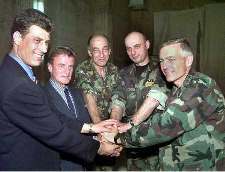
Above Far Left: Hashim Thaci, Head
of the Kosovo Liberation Army (KLA), a previously State Department listed
terrorist organisation, closely linked to Osama bin Laden's Al Qaeda
Above Far Right: US General Wesley Clark,
NATO Supreme Allied Commander, Europe (1997 - 2000) |
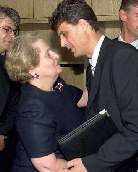
Above: Madeleine
Albright, US Secretary of State, greets the KLA's Hashim Thaci |
"I know a terrorist when I see one and
these men are terrorists."
United States special envoy to the Balkans, Robert
Gelbard, speaking about the Kosovo Liberation Army (KLA) 1998
BBC Online, 28 June 1998
The NATO Backed Islamic Jihad ('Djihad') In Kosovo
"Albanian
separatism in Kosovo and
Metohija was formally characterized as a 'jihad' in October 1998 at an annual international Islamic conference in
Pakistan. Nonetheless, the 25,000 strong KLA
continued to receive official NATO/U.S. arms and training support and, at the talks in Rambouillet, France, then Secretary of State
Madeleine Albright shook hands with 'freedom fighter' Hashim Thaci, a KLA leader. As this
was taking place, Europol (the European Police Organization based in The Hague) was
preparing a scathing report on the connection between the KLA and international drug
gangs. Even Robert Gelbard, America´s special envoy
to Bosnia, officially described the KLA as Islamic
terrorists. With the future status of Kosovo still
in question, the only real development that may be said to be taking place there is the
rise of Wahhabi Islam -- the puritanical Saudi variety favored by bin Laden -- and the fastest growing variety of Islam
in the Balkans."
Al Qaeda´s Balkan Links
Wall St Journal, 1
November 2001
"In 1998, the U.S. State Department listed the KLA as a terrorist organization, indicating that it was financing its operations with money from
the international heroin trade and loans from Islamic countries and individuals, among
them allegedly Usama bin Laden. Another link to bin
Laden is the fact that the brother of a
leader in an Egyptian Djihad organization and also a military commander of Usama bin Laden, was leading an elite KLA unit during the Kosovo conflict. In 1998, the KLA was
described as a key player in the drugs for arms business in 1998, 'helping to transport 2
billion USD worth of drugs annually into Western Europe'. The KLA and other
Albanian groups seem to utilize a sophisticated network of accounts and companies to
process funds. In 1998, Germany froze two bank accounts belonging to the 'United Kosova'
organization after it had been discovered that several hundred thousand dollars had been
deposited into those accounts by a convicted Kosovar Albanian drug trafficker."
'The Threat Posed by the Convergence of Organized
Crime, Drugs Trafficking and Terrorism'
Ralf Mutschke, Assistant Director Of Interpol's Criminal
Intelligence Division, Testimony Given To The House Judicial Committee, US Congress, 13
December 2000
"American
intelligence agents have admitted they helped to train the Kosovo
Liberation Army [KLA] before Nato's bombing of Yugoslavia. The disclosure angered some European diplomats, who said this had
undermined moves for a political solution to the conflict between Serbs and Albanians... Several KLA leaders had the mobile phone number of General Wesley Clark, the Nato commander..."
CIA aided Kosovo guerrilla army
Sunday
Times , 12 March 2000
"British
and American special forces teams are working undercover in Kosovo with the rebel Kosovo Liberation Army to identify
Serbian targets for Nato bombing raids.....It is the latest
evidence of the growing co-operation between Nato and the KLA, a
movement once denounced by the West's leaders as 'terrorists'...... The alliance is now quietly drafting the KLA into its war against
Slobodan Milosevic, the Serbian leader. It is even considering plans to train them and
ease the arms embargo on Yugoslavia to supply them with weapons such as mortars and
rocket-propelled grenades.... They are negotiating for a long-term training deal with
Military and Professional Resources International, a mercenary company run by former
American officers who operate with semi-official approval from the Pentagon and played a
key role in building up Croatia's armed forces..."
SAS teams move in to help KLA 'rise from the ashes'
Sunday
Telegraph, 18 April 1999
NATO's Islamic Jihad In Bosnia
"The Central Intelligence Agency has
its own argot for describing the hallucinatory world within which its employees move. None
of its esoteric terms are more euphemistic than 'blowback', the term coined to describe
operations which end up rebounding against their creators. But as the Americans slowly
unravel the international network surrounding Osama
bin Laden, the man they blame for the embassy
bombings in Nairobi and Dar es Salaam, 'blowback' is exactly what they are finding.
Last week, it was revealed that one of those under arrest is a former Egyptian soldier
named Ali Mohamed, who is alleged to have provided training and assistance to Mr bin Laden's operatives. Yet
Mr Mohamed, it is clear from his record, was working for the US government at the time he
provided the training: he was a Green Beret, part of
America's Special Forces.... It had already
been known that in those days, the US and Mr bin
Laden were on the same side, but it now appears that
America may actually have aided Mr bin Laden's organisation and even trained some of those who it now contends are 'terrorists'. Mr Ali may be
the missing link. It had already been known that in 1989, Mr Ali came to the New York area to train mujahedin on their way to Afghanistan. Those
visits have put him in the spotlight once before: among those he trained was El Sayyid
Nosair, who was jailed in 1995 for killing Rabbi Meir Kahane, leader of the Jewish Defence
League, and, along with several others, with plotting to blow up several New York
landmarks. At his trial, Mr Nosair claimed that the reason he had military manuals was that he was being trained by the US, not because he was intent on terrorism. It is uncertain whether Mr
Mohamed came to New York on official business, but for some of the trips, he was a serving US Special Forces' sergeant. Mr Mohamed met the men at the Al-Kifah
Refugee Centre in Brooklyn's Atlantic Avenue, a
place of pivotal importance to Operation Cyclone, the American effort to support the mujahedin. The Al-Kifah Centre and the
associated Afghan Refugee Services Inc were raising funds and, crucially, providing
recruits for the struggle, with active American assistance.... In December 1992, a US army official met one of the Afghan veterans from Al-Kifah and offered
help with a covert operation to support the Muslims in
Bosnia, funded with Saudi money, according to one of those
jailed for assisting with the New York bombings."
Terror 'blowback' burns CIA
Independent,
1 November 1998
"Many writers and reporters have
traced al-Qa'eda and other terror groups' origins back to the Afghan war of
1979-1992, that last gasp of the Cold War when US-backed
mujahedin forces fought against the
invading Soviet army. It is well documented that America played a major role in creating
and sustaining the mujahedin, which included Osama bin Laden's Office of Services set up
to recruit volunteers from overseas ... Yet
America's role in backing the mujahedin a second time in the early and mid-1990s is seldom
mentioned - largely because very few people know
about it, and those who do find it prudent to pretend that it never happened.... From 1992 to 1995, the Pentagon assisted with the movement
of thousands of mujahedin and other Islamic elements from Central Asia into Europe, to
fight alongside Bosnian Muslims against the Serbs. The Bosnia venture appears to have been very important to the rise of mujahedin
forces, to the emergence of today's cross-border Islamic terrorists who think nothing of
moving from state to state in the search of outlets for their jihadist mission. In moving to Bosnia, Islamic fighters were transported from the
ghettos of Afghanistan and the Middle East into Europe; from an outdated battleground of
the Cold War to the major world conflict of the day; from being yesterday's men to
fighting alongside the West's favoured side in the clash of the Balkans. If Western intervention in Afghanistan created the mujahedin,
Western intervention in Bosnia appears to have globalised it.... The Pentagon's
secret alliance with Islamic elements allowed mujahedin fighters to be 'flown in', though they were initially reserved as shock troops for
particularly hazardous operations against Serb forces. According to a report in the Los
Angeles Times in October 2001, from 1992 as many as 4,000 volunteers from the Middle East,
North Africa and Europe, 'known as the mujahedin', arrived in Bosnia to fight with the
Muslims. Richard Holbrooke, America's former chief Balkans peace negotiator, has said that
the Bosnian Muslims 'wouldn't have survived' without the help of the mujahedin, though he
later admitted that the arrival of the mujahedin was a 'pact with the devil' from which
Bosnia is still recovering. By the end of
the 1990s State Department officials were increasingly worried about the consequences of
this pact. Under the terms of the 1995 Dayton peace accord, the foreign mujahedin units
were required to disband and leave the Balkans. Yet in 2000, the State Department raised
concerns about the 'hundreds of foreign Islamic extremists' who became Bosnian citizens
after fighting against the Serbs, and who pose a potential terror threat to Europe and the
United States. US officials claimed that one
of bin Laden's top lieutenants had sent operatives to Bosnia, and that during the 1990s
Bosnia had served as a 'staging area and safe haven' for al-Qa'eda and others. The Clinton
administration had discovered that it is one thing to permit the movement of Islamic
groups across territories; it is quite another to rein them back in again. Indeed, for all
the Clinton officials' concern about Islamic extremists in the Balkans, they continued to
allow the growth and movement of mujahedin forces in Europe through the 1990s. In the late
1990s, in the run-up to Clinton's and Blair's Kosovo war of 1999, the USA backed the Kosovo Liberation Army
against Serbia. According to a report in
the Jerusalem Post in 1998, KLA members, like the Bosnian Muslims before them, had been
'provided with financial and military support from Islamic countries', and had been
'bolstered by hundreds of Iranian fighters or mujahedin ...[some of whom] were trained in Osama bin Laden's terrorist camps in Afghanistan'. It seems that, for all its handwringing, the
USA just couldn't break the pact with the devil... It would appear that when it comes to
Bosnia, many in the West have a moral blind spot..... Western intervention in Bosnia, it
would appear, has become an unquestionably positive thing, something that is beyond
interrogation and debate."
How we trained al-Qa'eda
Spectator, 13 September 2003
"The Clinton administration followed
up by providing strong support to the KLA, even
though it was known that the KLA
supported the Muslim mujahadeen. Despite that
knowledge, then Secretary of State Madeleine Albright had the KLA removed from the State
Department list of terrorists. This action paved the
way for the United States to provide the KLA with needed logistical support. At the same time, the KLA also received support from Iran and Usama bin Laden, along with
'Islamic holy warriors' who were jihad veterans from Bosnia,
Chechnya and Afghanistan. Swiss journalist Richard
Labeviere, in his book, 'Dollars for Terror,' said that the international Islamic networks
linked to bin Laden received help from U.S. intelligence community. Indeed, Chechen
sources claim that U.S. intelligence also aided them in their opposition to Russia. Given
that U.S. policy in the post-Cold War period has not only been anti-Russian but
anti-Iranian, the United States worked closely with
Pakistan's predominantly Sunni Inter-Services Intelligence organization. Through ISI, the United States
recruited Sunni mujahadeen by staging them in Chechnya to fight in Bosnia and later in Kosovo."
F.Michael Maloof, former senior
Pentagon Counterterrorism Adviser
Iran subversion in Balkans
G2 Bulletin, 25 September 2006
The Same Model Continued Into The Next Century
NATO's Secret Islamic Jihad In Syria More Than A Decade After The
Balkans Wars
"Lord Ashdown, the
former Liberal Democrat leader [and High
Representative for Bosnia and Herzegovina 2002 - 2006], spoke out against arming
Syria's rebels and called for pressure to be put on Qatar and Saudi Arabia to cut off
funding for arms. 'They do not need arms. It is an
unchallenged figure that 3,500 tons of arms have been shipped in by way of Croatia with the assistance
of the CIA, funded by the Saudis, funded by the Qataris,
going almost exclusively to the more jihadist groups,' the former international high representative for Bosnia said in a
debate. 'I know where those weapons are coming from.
They are the weapons left over from the Bosnian war. They are being shipped out in large measure through Croatian ports
and airports and I can tell you they are making vast sums for corrupt forces in the
Balkans.' Lord Ashdown described the rebels as 'not a fit and proper collection of people
for us to be providing arms to'. Britain and France
favour arming the rebels, while in a change of policy Washington recently announed it
would supply direct
miltiary aid to opponents of President Bashar
al-Assad. Officials have said they would select 'moderate rebels' for assistance.' Lord Ashdown said he knew of 'no occasion' when a route to peace was to
provide more weapons. He said Syria was the 'front line in a wider conflict' involving an
attempt to build up a radicalised jihadist Sunni population to fight a war against the Shia. 'This is about the preparations
some are deliberately making to have a wider religious conflict,' he said....'If it is the case that Saudi Arabia and Qatar are today funding
the very jihadists against which we are fighting, why are we not using international
pressure, the United States, the European Union, to persuade Saudi Arabia and Qatar to
stop, to prevent this?' he said."
Syria: 3,500 tons of weapons already sent to rebels, says Lord Ashdown
Telegraph,
1 July 2012 |
NATO
Covertly Uses Saudis Post 9/11 To Run Arms From Bosnian War To Jihadists In Syria
Secretly Using The Same 'Black Flight's Model Illegally Used By Bill
Clinton In The 1990s Bosnian War
Click
Here |
Overview
'Our Terrorists' - NATO's Terrorism Activities In The Balkans
"The
conflict between Serbs and Muslims in Bosnia and Herzegovina, while provoking little more
than official condemnation and appeals for increased United Nations intervention by Arab
governments, has been adopted by Islamic fundamentalists as
the newest holy war against Christian infidels bent on the destruction of Islam. In the last few weeks the conflict has lured several hundred militants, many of them veterans of the war in Afghanistan, to volunteer for the Bosnian forces. ... Arab newspapers and television stations increasingly focus on the
conflict, and private Islamic charity groups have collected tens of millions of dollars
for the Bosnians, as they once did for the Palestinians. Arab government officials, under
pressure from the groundswell of support for the Bosnians, are trying to wrest the popular
cause from the fundamentalists. The 47-member Islamic Conference Organization ended a
two-day meeting in Jidda on Wednesday with a call for the lifting of a United Nations arms
embargo so the Bosnian Muslims they can defend themselves. The embargo now applies to all
sides of the conflict, though arms smuggling is said to be widespread. ... There are an estimated 400 Saudi volunteers, many
veterans of Afghanistan, along with Arabs from Egypt,
Pakistan, the Sudan and Algeria fighting with the Muslim forces. They see in the fight a pure, good battle against the forces of darkness.
... Many of these volunteers come from comfortable middle- and upper-class homes. They
fight for one or two months and then return to Saudi Arabia. More than two dozen Saudis
have been killed in Bosnia. For those who die, the militant clerics have promised shahada,
the direct ascent to heaven granted to anyone who falls defending the faith. In the last
few weeks the pictures of young Saudi men killed by Serbian forces have appeared in local
newspapers, although the names below the bearded fighters are usually their noms de
guerre. In videos that circulate throughout the country, parents who lost sons often thank
God for the sacrifice. The volunteers are sponsored
by a variety of militant religious organizations and often have their expenses and plane
fare covered. ... The Islamic institutions,
especially those in Saudi Arabia, are well financed. Saudi
officials say that the Government has donated $100 million to the Islamic institutions for
Bosnia relief efforts and that private donations, which according to a new law must be
funneled through the Government, have added $50 million. Despite
formal denials from the relief organizations, Saudi officials say an increasing amount of
the charity on behalf of the Bosnians is now used to provide arms and logistical support
for Arab volunteers. 'Since August most of the money
raised for relief has been turned over to the Bosnians for weapons,' a Saudi official
said. 'And most contributors probably support this.' ... Reports from the Balkans suggest
that the Arab assistance has significantly improved the firepower of the Muslim-dominated
Bosnian Government forces, providing assault rifles, mortars, rockets and other weapons to
troops who had been equipped largely with hunting rifles and shotguns at the beginning of
the war. The Saudi-based Islamic Relief Organization,
one of the largest charity organizations, funnels money, relief workers and supplies to
Bosnia, although its officials strenuously deny that they provide any backing for the
military effort....The authorities forbid any public acknowledgement that any Saudi
citizens are involved directly in the Balkan conflict. But
Government officials say men who volunteer for the relief work often end up as soldiers."
Muslims From Afar Joining 'Holy War' in Bosnia
New
York Times, 5 December 1992
"The Bosnian war was the first major
test of the West's resolve in the post-Cold War era, and one that it unambiguously
failed.... Into this already complicated situation came the ultimate 'wild card', the
United States of America, the world's only superpower. A small group at the head of
America's foreign policy elite intervened covertly in what it had previously called
'Europe's problem'.... Its easy answer for Bosnia's ills was 'lift and strike' - re-arm
the Bosniaks (mostly Bosnian Muslims) and Croats and bomb the Serbs. At first arms were sent to Bosnia via Croatia, but the Croats were
reluctant to arm the Bosnian army with sophisticated weapons, so America took it upon
itself to deliver arms directly to the Bosnian Muslim Army - the ABiH. These covert air drops ['Black Flights'] began at the start of 1995. The most well-documented were the drops at Tuzla in the north of Bosnia, where they were observed by members of the UN
Nordic Battalion stationed close to the dropping zone.... Nato had been manipulated to allow the US to conduct its own unilateral policy
in the Balkans. The air drops were only the tip of the iceberg. A team of retired US
officers planned the bloody Croatian 'liberation' of the Kraijina and the subsequent
invasion of western Bosnia by the Croatian Army in the summer of 1995. .... Senior European
negotiators believe that with US backing the war could have ended two years earlier, but
US desire to see the Serbs punished meant that they instead encouraged the Bosnian
Government to continue fighting. The price in human terms? Over 15,000 dead and nearly
600,000 refugees."
Allies and lies
BBC
Online, 22 June 2001
"The British journalist Nik Gowing
tracked down several Norwegian witnesses to the Black
Flights [used to arm the Bosnian Muslims]... one of
the most important Norwegian witnesses, [Oivind] Moldestad [a Norwegian Air Force Captain
who later gave a dramatic interview disclosing many details on the subject for a BBC
documentary which is available as
video on the BBC web site], would be taken aside by three American officers. They took
him to a balcony on the fifth floor of a hotel in Zagreb, and made clear to him that if he
stuck to his account and said any more on the subject, things could get messy for him.
After reports on British television and articles in the press, journalists were also put
under pressure by the American embassy in London. They
heard all manner of threats. The embassy was said to have been acting on the instructions of
the State Department."
Srebrenica - A Safe Area?
Appendix II - Intelligence and the war in
Bosnia 1992 – 1995: The role of the intelligence and security services
Chapter 4, Secret arms supplies and other covert actions
Report Published on Behalf of The Dutch
Government, 10 April 2002
How The Clinton Administration
Wanted The Fighting To Continue In Bosnia"In your article on Bosnia (November 25th), you say that in February
1992, before the war had started, Lord Carrington and I 'drafted a constitution that would
have turned the country into a confederation of Swiss-style cantons. The Muslims refused
to accept what they considered to be the disintegration of Bosnia.' Not quite. After several rounds of talks our 'principles for future constitutional
arrangements for Bosnia and Hercegovina' were agreed by all
three parties (Muslim, Serb and Croat) in Sarajevo on March
18th 1992 as the basis for future negotiations. These
continued, maps and all, until the summer, when the mulims reneged on the agreement. Had
they not done so, the Bosnian question might have been settled earlier, with less loss of
(mainly Muslim) life and land. To be fair, President
Izetbegovic and his aides were encouraged to scupper that deal and to fight for a unitary
Bosnian state by well-meaning outsiders who thought they knew better".
Letter - Jose Cutileiro, Secretary-General of the Western
European Union
Economist 9-15, September 1995
The Srebrenica Massacre
A Catastrophe Precipitated From The USA
"Some 8,000 Bosnian Muslim men and boys were murdered
by Bosnian Serb forces in the UN safe haven of Srebrenica in 1995. A five-year
investigation into the role of Dutch peacekeepers in the massacre was published earlier
this month and quickly triggered the resignation of the entire Dutch government. A major
component of the Dutch report focusing on the role of Western intelligence in the Bosnian
war has, however, gone relatively unnoticed. Among
other findings, the inquiry reveals U.S. involvement in an illegal weapons-smuggling pipeline to Bosnian Muslims..."
Yugoslavia: Dutch Srebrenica Report Reveals Role Of Western Intelligence Services
In Bosnian War
Radio
Free Europe / Radio Liberty, 22 April 2002
"...the [Srebrenica] enclave
increasingly acquired the status of a 'protected area' for the ABiH [Muslim army], from
which the ABiH could carry out hit and run operations against, often civilian, targets.
These operations probably contributed to the fact that at the end of June the VRS [Serbian
Army] was prepared to take no more, after which they decided to intervene: the VRS decided
shortly after to capture the enclave. In this
respect, the [illegal US sponsored] Black Flights to Tuzla and the sustained arms supplies
to the ABiH in the eastern enclaves did perhaps contribute to the ultimate decision to
attack the enclave. In this connection it is not
surprising that Mladic and other Bosnian Serbs constantly complained about this, but
usually received no response to their complaints..."
Srebrenica - A Safe Area?
Appendix II - Intelligence and the war in
Bosnia 1992 – 1995: The role of the intelligence and security services
Chapter 4, Secret arms supplies and other covert actions
Report Published on Behalf of The Dutch
Government, 10 April 2002
"Defence analyst Tim Ripley believes that the US
plot to [secretly] train and equip the Bosnian Muslims directly led to the terrible death-toll at Srebrenica later in 1995."
Allies and Lies
BBC, Correspondent,
June 2001 |
"U.S.
support for the Muslims in Bosnia also came from the person who is the new head of the
Central Intelligence Agency, General Michael V. Hayden. At the time, he was director of
the U.S. European Command Intelligence Directorate, based in Stuttgart, Germany. According
to a Dutch government report, Hayden 'had access to virtually all intelligence' from the
United States, United Nations and NATO. As a result, Hayden
used his intelligence unit to allow so-called 'black flights' of arms to Muslim forces
during the Bosnian campaign in 1995. General Hayden
was aware that these arms were assisting many of the foreign mujahadeen, which also were
receiving support from Iran and bin Laden. According to a Dutch intelligence report at the time, the shipments
included 'weapons, ammunition, uniforms, helmets, new anti-tank weapons and Stingers.'
These arms were said to have been dropped in Tuzla, shipped by land or air into Bosnia for the Bosnian Muslim army which
included the al-Qaida-linked mujahadeen. After becoming the head of the National Security
Agency in March 1999, Hayden then refused to clear the use of intelligence to halt
continuing illegal shipments of arms to mujahadeen militants in the Balkans. Often, these arms were brought in discreetly by Muslim countries
that were part of the United Nations peacekeeping forces sent in to prevent further
violence."
F.Michael Maloof, former senior
Pentagon Counterterrorism Adviser
Iran subversion in Balkans
G2 Bulletin, 25 September 2006
"The official Dutch inquiry into the
1995 Srebrenica massacre, released last week, contains one of the most sensational reports
on western intelligence ever published. Officials have been staggered by its findings ....
Now we have the full story of the secret
alliance between the Pentagon and radical Islamist groups from the Middle East designed to
assist the Bosnian Muslims... in flagrant
violation of the UN security
council arms embargo against all combatants in the former Yugoslavia. The result was a
vast secret conduit of weapons smuggling though Croatia. This was arranged by the clandestine agencies of the US, Turkey and Iran,
together with a range of radical Islamist groups, including Afghan mojahedin and the pro-Iranian Hizbullah...."
America used Islamists to arm the Bosnian Muslims
Guardian, 22 April
2002
"... it was the covert arming and training of the Bosnians by the US, in breach
of the UN arms embargo resolution, that was responsible for prolonging the suffering of
the people of Bosnia. For Izetbegovic's government
was thereby persuaded to abandon the UN peace process and not to sign up to various
UN-brokered peace proposals on offer, such as those I helped broker in 1994. The correct
lesson to draw from the war in Bosnia with regards to Syria is that arming any of the
warring parties, however just may seem their cause, inevitably increases the intensity of
conflict."
General Sir Michael Rose, Commander, UN Forces, Bosnia 1994
Letter - London Times, 16 April 2013, Print Edition, P29
"During the Soviet occupation of Afghanistan in the 1980s, the US
funded large numbers of jihadists through Pakistan's secret intelligence service, the ISI.
Later the US wanted to raise another jihadi corps, again using proxies, to help Bosnian
Muslims fight to weaken the Serb government's hold on Yugoslavia. Those they turned to
included Pakistanis in Britain. According to a recent report by the Delhi-based Observer
Research Foundation, a contingent was also sent by the Pakistani government, then led by
Benazir Bhutto, at the request of the Clinton administration. This contingent was formed
from the Harkat-ul- Ansar (HUA) terrorist group and trained by the ISI. The report
estimates that about 200 Pakistani Muslims living in the UK went to Pakistan, trained in
HUA camps and joined the HUA's contingent in Bosnia. Most
significantly, this was 'with the full knowledge and complicity of the British and
American intelligence agencies'. As the 2002 Dutch
government report on Bosnia makes clear, the US provided a green light to groups on the
state department list of terrorist organisations, including the Lebanese-based Hizbullah,
to operate in Bosnia - an episode that calls into question the credibility of the
subsequent 'war on terror'. For nearly a decade the
US helped Islamist insurgents linked to Chechnya, Iran and Saudi Arabia destabilise the
former Yugoslavia. The insurgents were also allowed
to move further east to Kosovo. By the end of the fighting in Bosnia there were tens of
thousands of Islamist insurgents in Bosnia, Croatia
and Kosovo; many then moved west to Austria, Germany
and Switzerland. Less well known is evidence of the British government's
relationship with a wider Islamist terrorist network. During
an interview on Fox TV this summer, the former US federal prosecutor John Loftus reported that British intelligence had used the
al-Muhajiroun group in London to recruit Islamist militants with British passports for the
war against the Serbs in Kosovo. Since July Scotland
Yard has been interested in an alleged member of al-Muhajiroun, Haroon Rashid Aswat, who
some sources have suggested could have been behind the London bombings. According to
Loftus, Aswat was detained in Pakistan after leaving Britain, but was released after 24
hours. He was subsequently returned to Britain from Zambia, but has been detained solely
for extradition to the US, not for questioning about the London bombings. Loftus claimed
that Aswat is a British-backed double agent, pursued by the police but protected by MI6.
One British Muslim of Pakistani origin radicalised by the civil war in Yugoslavia was
LSE-educated Omar Saeed Sheikh..... This is all the more remarkable when this is the same Omar Sheikh
who, at the behest of General Mahmood Ahmed, head of the ISI,
wired $100,000 to Mohammed Atta, the leading 9/11 hijacker, before the New York
attacks, as confirmed by Dennis Lormel, director of FBI's financial crimes unit. Yet
neither Ahmed nor Omar appears to have been sought for questioning by the US about
9/11."
Michael Meacher, former UK Environment Minister
Britain now faces its own blowback
Guardian, 10
September 2005 |
"The UK Defence Intelligence Staff (DIS) was also aware of the
American secret arms supplies to the ABiH [the Bosnian Muslim Army]. According to a British intelligence official, the DIS never made an
issue of them, so as not to further damage the
sensitive relationship with the US services. An
internal DIS analysis concluded that the arms were delivered via 'a different network',
and that the entire operation was probably led by the NSC [National Security
Council]..... the DIS received a direct order
from the British government not to investigate this affair. This was not permitted for the simple reason that the matter was too
sensitive in the framework of American-British
relations. The DIS also obtained intelligence on the
secret supplies to the ABiH from the German military intelligence service and the
Bundesnachrichtendienst, because some of the flights departed from Frankfurt. However, no
American-German alliance existed in the matter of clandestine
support to the ABiH."
Srebrenica - A Safe Area?
Appendix II - Intelligence and the war in Bosnia 1992 –
1995: The role of the intelligence and security services
Chapter 4, Secret arms supplies and other covert actions
Report Published on Behalf of The Dutch Government, 10 April
2002
"So 'brave'
Muammar Gadafy has agreed on the importance of combating terrorism. A handshake with Tony
Blair has sealed his re-entry into the international community, with contracts worth
several hundred million pounds for Shell and BAE to follow.... Nor is this rapid shift
from terrorist to statesman confined to Libya. The US backing of Islamic terrorism in the
Balkans provides another example. As the official
Dutch inquiry into the 1995 Srebrenica massacre has now revealed, a secret alliance was
formed between the Pentagon and radical Islamist groups to assist the Bosnian Muslims in
violation of the UN arms embargo. A vast secret
conduit of weapons smuggling through Croatia was organised by US, Turkish and Iranian
clandestine agencies, together with Afghan mojahedin and pro-Iranian Hizbullah. Aircraft
from Iran Air were used, joined by a US-sponsored fleet of C-130 Hercules.....The 78-day
bombing of Yugoslavia in the spring of 1999, directed by the US general Wesley Clark, was
said to be stopping an alleged 'genocide' by the Serbs in Kosovo (some 2,000 bodies were later exhumed, a horrifying number but far short of the 100,000 the US predicted). The US goal
was to assist the Kosovo Liberation Army (KLA). Yet the year before, the US state department had
branded the KLA a terrorist organisation, financing its operations from the heroin trade
and funds from Islamic countries and individuals, including Osama bin Laden. As James
Bissett, the former Canadian ambassador to Yugoslavia, has subsequently reported: 'This
did not stop the US from arming and training KLA members in Albania and sending them back
into Kosovo to
assassinate Serbian mayors, ambush Serbian policemen and intimidate hesitant Kosovo
Albanians ... Despite a UN arms embargo, and with the support of the US, arms, ammunition
and thousands of fighters were smuggled into Bosnia to help the Muslims ... Bin Laden and his network were also active in Kosovo, and KLA members
trained in his camps in Afghanistan and Albania.' According to reports in April 1999, assistance was also provided by Britain's SAS. Through much of the 1990s, US support for Islamic militants in former
Yugoslavia was backed up by covert US airdrops of arms,
especially at Tuzla in northern Bosnia. These took place in the face of Operation Deny Flight, the UN-imposed
and Nato-policed no-fly zone over Bosnia. The US House of Representatives also failed to authorise the war under
the War Powers Act, making it illegal (shades of Iraq). But the airdrops were only the tip
of the iceberg. Retired US officers heading Military Professional
Resources Inc, a private paramilitary firm based in Virginia, planned the bloody Croatian
'liberation' of the Serb-held Krajina enclave, which resulted in the ethnic cleansing of
200,000 Serbs. US goals in the use of the
KLA as a proxy force, similar to the funding of the Contras against the leftwing
Sandinista government in Nicaragua in the 1980s, were partly to remove Milosevic and break
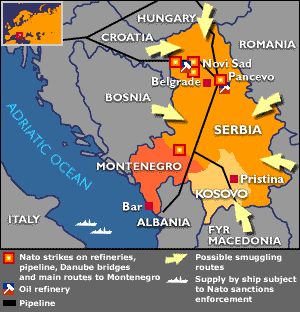
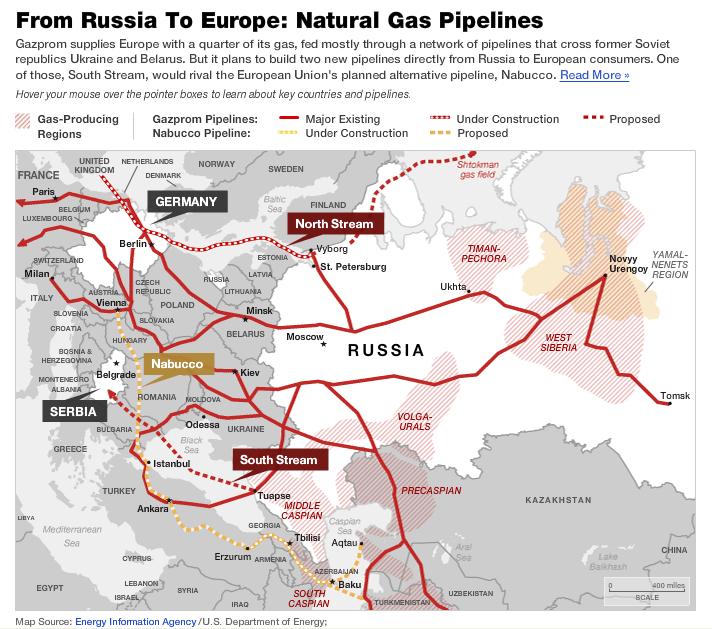
up Yugoslavia as one of the remaining Communist regimes. But related motives were to break
Russia's monopoly over oil and gas transport routes and secure pro-western governments in
the strategic Black Sea-Caspian Sea oil-rich basin. A crucial oil corridor, called the
Trans-Balkan pipeline, designed to become the main route to the west for oil and gas
extracted in central Asia, was to run from the Black Sea to the Adriatic via Bulgaria,
Macedonia near the border with Kosovo, and Albania. Another
was to run across Serbia to Adriatic ports in Croatia and Italy, fed by a pipeline running
from a Black Sea port in Romania. The implications
of this are stark."
Michael Meacher, former UK Environment Minister
The path to friendship goes via the oil and gas fields
Guardian, 27 March
2004 |
NATO Fraud - There Was No Genocide In Kosovo - Click Here
"President Clinton is depicting his
decision to send 20,000 troops into Bosnia as a natural outgrowth of America's European
alliance. But instead of seeing Bosnia as the eastern frontier of NATO, we should view the Balkans as the the western frontier of
America's rapidly expanding sphere of influence in the Middle East. Until World War II, it should be recalled, the Balkans were considered
not a part of Europe but of 'the Near East.' The fact that the United States is more
enthusiastic than its European allies about a Bosnian Muslim state reflects, among other
things, the new American role as the leader of an informal collection of Muslim nations
from the Persian Gulf to the Balkans. The regions
once ruled by the Ottoman Turks show signs of becoming the heart of a third American
empire. Since the late 19th century, the United
States has had three empires (the term refers to voluntary groupings of client states as
well as traditional colonies). In each case America has steadily expanded its global
influence by imposing control over the former empires of defeated great powers. The first
American empire was created in the aftermath of the Spanish-American War in 1898 when the
United States gobbled up Cuba, Puerto Rico, the Philippines and much of the Caribbean. It
lasted until the end of the World War II. The second American empire, from 1945 to 1989,
centered on Western Europe and Asia. Now, in the
years after the cold war, the United States is again establishing suzerainty over the
empire of a former foe. The disintegration of the Soviet Union has prompted the United
States to expand its zone of military hegemony into Eastern Europe (through NATO) and into
formerly neutral Yugoslavia. And -- most important of all -- the end of the cold war has
permitted America to deepen its involvement the Middle East. Even before the war against
Iraq transformed the United States into the dominant power of the Persian Gulf, America
was laying the groundwork for the third empire by steadily building up its military
commitments in the Middle East....The main purpose of NATO countries, for the foreseeable
future, will be to serve as staging areas for American wars in the Balkans, the
Mediterranean and the Persian Gulf..... Reducing the
American military presence there [in East Asia] would free resources needed to bolster the
new commitments in the Middle East and the Balkans -- commitments
that are likely to endure for a generation, if not longer. Unlike the first two American
empires, the third empire cannot be justified as a means of spreading democracy or
self-determination. American leaders will always pay lip service to those ideals, as they did in liberating Kuwait from Saddam Hussein. But most of
America's clients in the Middle East are authoritarian states like Saudi Arabia, or
democracies like Turkey, troubled by the prospect of self-determination to their ethnic
minorities.... President Clinton's high-stakes gamble in the Balkans means that the United
States can no longer afford to preside over a lax Americana rather than a pax Americana.
The challenge of consolidating a new European-Middle Eastern sphere of influence while
drawing back from Asia will require the United States to develop new NATO-like
institutions and alliances to deal with the various protectorates that it has collected
since 1990. Whatever its ultimate contours, our newest empire must be backed up by
adequate force if it is to be a going concern. Protectorates must be protected."
Jacob Heilbrunn and Michael Lind
The Third American Empire
New
York Times, 2 January 1996
"There were certain forces in the U.S.
government who worked with the Turkish paramilitary
groups, including Abdullah Çatli’s group, Fethullah
Gülen.... ... these [intercepted] conversations,
between 1997 and 2001, had to do with a Central Asia operation that involved bin Laden.
Not once did anybody use the word 'al-Qaeda.' It was always 'mujahideen,' always 'bin
Laden' and, in fact, not 'bin Laden' but 'bin Ladens' plural. There were several bin
Ladens who were going on private jets to Azerbaijan and Tajikistan. The Turkish ambassador in Azerbaijan worked with them. There were
bin Ladens, with the help of Pakistanis or Saudis, under our management.... bringing people from East Turkestan into Kyrgyzstan, from Kyrgyzstan
to Azerbaijan, from Azerbaijan some of them were
being channeled to Chechnya, some of them were being channeled to Bosnia.
From Turkey, they were putting all these bin Ladens on NATO planes. People and weapons went
one way, drugs came back.... A lot of the drugs were going to Belgium with NATO planes. After that,
they went to the UK, and a lot came to the U.S. via military planes to distribution
centers in Chicago and Paterson, New Jersey. Turkish diplomats who would never be searched
were coming with suitcases of heroin."
Sibel Edmonds, former Turkish translator at the FBI on the
intercepts she discovered
Who’s Afraid of Sibel Edmonds?
The American Conservative,
November 2009
"For
years, Saudi Arabia flatly denied it had provided money and logistical support for
Islamist militant groups that attacked Western targets. But that assertion is disputed by
a former al-Qaeda commander who testified in a United Nations war-crimes trial that his
unit was funded by the Saudi High Commission for Relief of Bosnia and Herzegovina. Ali Ahmed Ali Hamad, the former al-Qaeda fighter, gave the same account to The Inquirer in an interview in this struggling
city in the central Balkans. 'Because it was the biggest charity, [the commission] helped
the mujaheddin
the most,' Hamad said, adding that it had provided 'everything a person needed to exist.'
Hamad, 37, is expected to be called as a witness in a lawsuit filed by Cozen O'Connor
alleging that Saudi Arabia and affiliated charities financed al-Qaeda and other groups as they
geared up for the 9/11 attacks. As a convicted
terrorist, Hamad is an imperfect witness. During the
Balkans war, from 1992 to 1995, jihadists from North Africa
and the Middle East were accused of atrocities against
indigenous Serbs and Croatians. Hamad admits having
done 'bad things' as an al-Qaeda fighter, and he is serving a 10-year sentence in a
Bosnian jail for his role in a 1997 Mostar bombing. Yet Hamad's account of his time in the
Balkans went largely uncontroverted during the U.N. trial, where he was a prosecution
witness. He contends that the Saudi High Commission,
an agency of the Saudi government, and other Islamist charities supported al-Qaeda-led units that committed
atrocities. Mujaheddin units, he said, recruited fighters, prepared for battle, and
financed their operations in the Balkans. He said the Saudi High Commission had poured
tens of millions of dollars into mujaheddin units led by
al-Qaeda operatives who fought with Osama bin Laden in Afghanistan. Money intended for humanitarian
relief bought weapons and other military supplies.The charities also provided false
identification, employment papers, diplomatic plates and vehicles that permitted Islamist
fighters to enter the country and pass easily through military checkpoints, Hamad said.
Several charity offices, including those of the Saudi High Commission, were led by former
mujaheddin or al-Qaeda members, at least one of whom trained with Hamad in an al-Qaeda
camp in Afghanistan, he said. Like other al-Qaeda fighters, Hamad said, he was an employee
of the Saudi High Commission for a time and traveled through the war zone in commission
vehicles with diplomatic plates."
A former al-Qaeda fighter accuses a Saudi charity
Philadelphia
Inquirer, 31 May 2008
"The Balkans´ uncharacteristically
silent exit from the world stage as the most prominent international hot spot of the last
decade belies its status as a major recruiting and training center of Osama bin Laden´s al Qaeda network. By feeding off the region´s impoverished republics and taking root in
the unsettled diplomatic aftermath of the Bosnia and Kosovo conflicts, al Qaeda, along
with Iranian Revolutionary Guard-sponsored terrorists, have burrowed their way into
Europe´s backyard. For the past 10 years, the most
senior leaders of al Qaeda have visited the Balkans, including bin Laden himself on three
occasions between 1994 and 1996. The Egyptian
surgeon turned terrorist leader Ayman Al-Zawahiri has operated terrorist training camps,
weapons of mass destruction factories and money-laundering
and drug-trading networks throughout Albania, Kosovo, Macedonia, Bulgaria, Turkey and
Bosnia. This has gone on for a decade. Many recruits
to the Balkan wars came originally from Chechnya, a jihad in which Al Qaeda has also played a part. These activities have
been exhaustively researched by Yossef Bodansky, the former director of the U.S. House of
Representatives´ Task Force on Terrorism and Unconventional Warfare.... The overnight rise of heroin trafficking through Kosovo -- now the most important Balkan route between Southeast Asia and Europe
after Turkey -- helped also to fund terrorist activity directly associated with al Qaeda
and the Iranian Revolutionary Guard. Opium poppies, which barely existed in the Balkans
before 1995, have become the No. 1 drug cultivated in the Balkans after marijuana.
Operatives of two al Qaeda-sponsored Islamist cells who were arrested in Bosnia on Oct. 23
were linked to the heroin trade, underscoring the narco-jihad culture of today´s post-war
Balkans.... By early 1998 the U.S. had already
entered into its controversial relationship with the KLA to help fight off Serbian oppression of that province. While in February the U.S. gave into KLA demands to remove it from the State Department´s terrorism list, the gesture amounted to little. That summer the CIA and CIA-modernized
Albanian intelligence (SHIK) were engaged in one of the largest seizures of Islamic Jihad
cells operating in Kosovo. Fearing terrorist reprisal from al Qaeda, the U.S. temporarily
closed its embassy in Tirana and a trip to Albania by then Defense Secretary William Cohen
was canceled out of fear of an assassination attempt. Meanwhile, Albanian separatism in Kosovo and Metohija was formally
characterized as a 'jihad' in October 1998 at an annual international Islamic conference
in Pakistan. Nonetheless,
the 25,000 strong KLA continued to receive official NATO/U.S. arms and training support
and, at the talks in Rambouillet, France, then Secretary of State Madeleine Albright shook
hands with 'freedom fighter' Hashim Thaci, a KLA leader. As this was taking place, Europol
(the European Police Organization based in The Hague) was preparing a scathing report on
the connection between the KLA and international drug gangs. Even Robert Gelbard, America´s special envoy to Bosnia, officially described the KLA as Islamic terrorists. With the future status of Kosovo still in question, the only real
development that may be said to be taking place there is the rise of Wahhabi Islam -- the
puritanical Saudi variety favored by bin Laden -- and the fastest growing variety of Islam
in the Balkans."
Al Qaeda´s Balkan Links
Wall St Journal, 1
November 2001
(European
Edition)
"... the Albanian
security situation reflects the volatility of the clan-based rivalries and the related
narco-trafficking and criminal activities which are linked with global terrorism. But by
admitting this as the basis for the need to move [US] facilities out of Albania, the US
would then have to admit that this terrorism-related criminal activity, and particularly
narco-trafficking, is intrinsically linked into the al-Qaida and Iranian-backed terrorist
infrastructure of the region, and into the Kosovo Liberation Army (KLA), which now, under
new names, controls the Serbian province of Kosovo.... no-one
in the State Department or Defense Department is willing to admit that US support for this
terrorist and narco-trafficking base of Albanians in 1999 -- when the US led NATO into
attacks on Serbia in order to assist the KLA -- was wrong. This is part of the distortion of US foreign and strategic policy: no-one
will admit that they made a mistake. There are many Congressmen on Capitol Hill who
understand that this distortion exists with regard to Balkan policy. But equally,
there are politicians in both major parties who supported the KLA during the 1990s, so
that today it is impossible for a Republican-controlled Bush White House and Congress to
attack the logic and merit of the 1999 war, waged against Serbia by the then-Democratic
Party-controlled Clinton White House. It is difficult for the White House, for example, to
criticize the 1990s support by the Clinton
Administration for the al-Qaida -linked KLA without
also opening up to criticism some senior members of the Republican Party..... The fact
that the US has been forced to remove its assets from Albania, despite the quiet manner in
which this has been undertaken, is just one indication of the ongoing degradation of the
situation there. And yet the US still refuses to acknowledge that this is integrally
linked with the Albanian-based terrorism underway in the former Yugoslav republic of
Macedonia, or that it is at the very heart of the creation of what is already a criminal sub-state in Kosovo, which is directly under the
control of the KLA...."
Special Report; US Policy in the Balkans and the Eastern Mediterranean: Time to Stop
Choosing Sides, and to Start Choosing Strategic Interests
Defense & Foreign
Affairs Special Analysis, 13 April 2005
"... the KLA is closely involved with
Terrorist organizations motivated by the ideology of radical Islam, including assets of
Iran and of the notorious Osama bin-Ladin".
The Kosovo Liberation Army: Does Clinton Policy Support Group with Terror,
Drug Ties?
Republican Policy Committee of the US Senate 31 March 1999
"Sky News has obtained evidence of hundreds of radical Islamic Holy warriors hiding in Bosnia, a
decade after the end of the war. Tim Marshall went
to Zenica in search of answers. He found a growing
radicalisation, and a new base for Al Qaeda."
The Hidden Army Of Radical Islam in Bosnia
Sky News, 28 February 2006 |
"If Senator Kennedy wants to talk
about fraud [in relation to the Bush administration's invasion of Iraq], he ought to
talk..... about what he and President Clinton told us in 1999 when they told us to bomb
innocent Serbs, we'd find 100 thousand mass graves. Those
mass graves were never found. They lied to the America people to justify the aerial
bombardment campaign."
Congressman Curt Weldon (R) Pennsylvania on 'Hardball with Chris
Matthews'
NBC News, 19 September 2003
Press Reports On False Claims Of
Genocide By Serbs In Kosovo - Click Here
"General
Sir Michael Rose, the former United Nations military
commander in Bosnia.... said false facts about the
war in Bosnia were being fed to Congress.... he was
visited by General John Galvin, former Supreme Allied Commander Europe who had been
appointed by President Clinton to advise on a new structure for the Bosnian Army. General
Rose said: 'We were escorted by a woman from the US Embassy who, in my view, was the most
hostile American I met during all my time in Bosnia.' As they flew by helicopter towards
Tuzla in the north, she pointed at all the destroyed villages high in the Zvijezda
mountains and 'exclaimed excitedly' to General Galvin: 'Look at what the criminal Serbs
have done.' In fact, General Rose said, they were Bosnian Croat villages ethnically
cleansed by the Muslim forces. Later when they visited Mostar in the south where the
Croats had virtually destroyed the Muslim sector in the eastern part of the town, the US
official 'planted her hands on her ample hips' and cried: 'Well, at least this was done by
the criminal Serbs.' General Rose said the woman burst into tears when it was pointed out
that the Croats had been to blame. 'The fact was not lost on Galvin,' he said."
US bugged me in Bosnia, says General Rose
London Times, 10 November 1998
"American
intelligence agents have admitted they helped to train the Kosovo Liberation Army [KLA]
before Nato's bombing of Yugoslavia. The disclosure
angered some European diplomats, who said this had undermined moves for a political
solution to the conflict between Serbs and Albanians... Several KLA leaders had the mobile phone number of General Wesley Clark, the Nato commander..."
CIA aided Kosovo guerrilla army
Sunday
Times , 12 March 2000
"General Wesley Clark, the
former Nato commander and presidential hopeful, will testify next month at the war crimes
trial of Slobodan Milosevic under conditions of strict
censorship and confidentiality imposed by the United
States. Washington is believed to be fearful of potentially damaging
revelations about its Balkan realpolitik during the 1990s and in the Bosnian War. General Clark, who is seeking the Democratic Party nomination
for President, will be one of the highest-profile witnesses to take the stand. The former
Nato commander directed the alliance's 78-day bombing campaign in Kosovo in 1999, after
Serbian forces had launched an onslaught against ethnic Albanian separatists. General
Clark will testify on December 15 and 16. Public
galleries will be closed and the broadcast system that transmits the proceedings on the
internet and on closed-circuit television will be shut down. The conditions of General
Clark's testimony include a 48-hour delay to enable the US Government to review the
transcript and seek the court's consent to censor parts on the ground of national security. Two US representatives will attend the sessions. The
three-judge panel hearing Mr Milosevic's case agreed to the conditions, which are unique,
because they decided that they were justified by the potential importance of General
Clark's testimony, Jim Landale, the tribunal spokesman, said. In his cross-examination of
General Clark, Mr Milosevic could reveal sensitive information about the West's diplomatic
and military strategy for dealing with the crisis in the Balkans."
General Clark to testify against Milosevic
London
Times, 20 November 2003
"The retired General who had been
refusing to declare himself a Democrat or Republican is now declaring himself a Democratic
presidential candidate. But more important than his party affiliation is Wesley Clark's
bizarre view on how to fight terrorism. The media refer to Clark's impressive military
credentials but they fail to note that his main accomplishment under President Clinton was
presiding over the establishment of a base for radical Islamic terrorism, including Osama
bin Laden, in Kosovo... Clark, who has been making headlines by claiming that the U.S.
decision to go to war in Iraq was a misjudgment based on scanty evidence, ran Clinton's
NATO war against Yugoslavia on behalf of the Kosovo Liberation Army (KLA). The House of
Representatives failed to authorize the war under the War Powers Act, making it illegal.
Thousands of innocent people in Serbia, Yugoslavia's main province, were killed to stop an
alleged 'genocide' by Yugoslavia that was not in fact taking place. Investigations
determined that a couple thousand had died in the civil war there.... The 1998 State
Department human rights report had described the KLA as a group that tortured and abducted
people and made others 'disappear.' Yet a photograph was taken of
Clark and [KLA leader] Thaki with their hands together in a gesture of solidarity. The KLA's ties to Osama bin Laden were also well-known and
reported.... Another Democratic presidential candidate, Rep. Dennis Kucinich, has tried to
prohibit funding for the Kosovo Protection Corps (KPC), the successor to the KLA now being
protected by U.N. troops as a result of the outcome of the conflict. Kucinich said an
internal United Nations Report found the KPC responsible for violence, extortion, murder
and torture.... Clark's presidential decision suggests that he believes the media will not
ask him about supporting the same extremist Muslim forces in Kosovo that militarily
attacked us on 9/11. He's right: during interviews on ABC's Good Morning America and the
NBC Today show on September 17, the subject didn't come up. "
Wesley Clark's Ties To Muslim Terrorists
Accuracy in Media, 17 September 2003
"I read the latest reports
concerning a recent Executive Order that hands the CIA a black bag in the Balkans for
engineering a military coup in Serbia, for interrupting communications, for tampering with
bank accounts, freezing assets abroad and training the Kosovo Liberation Army in terrorist
tactics, such as how to blow up buildings. How this is intended to help establish a
democracy in Serbia or Kosovo hasn't been explained. Nor has the failure to substantially
demilitarize the KLA been explained. Nor has the reverse ethnic
cleansing taking place in Kosovo by the KLA while NATO
rules the province been explained."
Democrat Congressman Dennis Kucinich, Ohio
The Progressive, Vol 63, No.8, August 1999
"...the Albanian security situation reflects the volatility of the
clan-based rivalries and the related narco-trafficking and criminal activities which are
linked with global terrorism. But by admitting this as the basis for the need to move
facilities out of Albania, the US would then have to admit that this terrorism-related
criminal activity, and particularly narco-trafficking, is intrinsically linked into the
al-Qaida and Iranian-backed terrorist infrastructure of the region, and into the Kosovo
Liberation Army (KLA), which now, under new names, controls the Serbian province of
Kosovo. Significantly part of the trade-off which
Washington made with Skopje was that Skopje backed-off from its vociferous claims about
the ethnic-Albanian National Liberation Army (NLA) which has been attempting to break up
the former Yugoslav area of Macedonia The NLA is a re-emerged part of the KLA; it is
linked with al-Qaida, and with the Iranian terrorist infrastructure in Bosnia-Herzegovina,
Raska in Southern Serbia, and in Serbia'S Kosovo area. The irony of this begins to emerge.
The US rewards Skopje for stopping expressions of concern about Albanian terrorism which
is also the cause of the US having to move its assets out of Albania itself. Why is this?
Because no-one in the State Department or Defense
Department is willing to admit that US support for this terrorist and narcotrafficking
base of Albanians in 1999 - when the US led NATO into attacks on Serbia in order to assist
the KLA - was wrong. This is part of the distortion
of US foreign and strategic policy: no-one will admit that they made a mistake. There are
many Congressmen on Capitol Hill who understand that this distortion exists with regard to
Balkan policy. But equally, there are politicians in both major parties who supported the
KLA during the 1990s, so that today it is impossible for a Republican controlled Bush
White House and Congress to attack the logic and merit of the 1999 war, waged against
Serbia by the then-Democratic Party-controlled Clinton White House. It is difficult for
the White House, for example, to criticize the 1990s support by the Clinton Administration
for the al-Qaida-linked KLA without also opening up to criticism some senior members of
the Republican Party..... The State and Defense departments, and the CIA, have been
constantly warned about the narco-trafficking and terrorism links in the Balkans, but have
swept this aside. The State Department, despite having been presented with concrete
intelligence about the activities of narcotraffickers and terrorists in
Bosnia-Herzegovina, and in southern Serbia, Macedonia, and the like, has, nonetheless
decided to say that there is no terrorism activity related to these areas.... by falling
to acknowledge the changed strategic contextual realities and the changes and cracks
within the Turkish system, the US reliance n Turkey, and its support for Turkey, become
meaningless. and have damaging regional effects, including sustaining
the logistical framework of the Islamist terrorist movements, even those which are against Turkey's own long-term interests. There has been strong Turkish involvement in supporting Balkan
narcotraffickers and terrorist groups, perhaps
unofficially, but certainly with considerable effect. There has been no re-evaluation
despite an of this, and despite the proven links
between Bosnian terrorism cells and the 9111 attackers and even to the Madrid bombers. It would. be a mistake to think that this problem will go away, or that
the war on terrorism has successfully moved the tide against the terrorism and
narco-trafficking infrastructure in the Balkans. The fact that the US has been forced to
remove its assets from Albania, despite the quiet manner in which this has been
undertaken, is just one indication of the ongoing degradation of the situation there. And
yet the US still refuses to acknowledge that this is
integrally linked with the Albanian-based terrorism underway in the former Yugoslav
republic of Macedonia, or that it is at the very heart of the creation of what is already
a criminal sub-state in Kosovo, which is directly under the control of the KLA. The fact
that the KLA leader and. until March 8, 2005, Prime Minister of Kosovo, Ramush (Hilmi)
Haradinaj, was indicted for war crimes and taken to The Hague for trial still has not
penetrated the consciousness of what is transpiring. Moreover, in order to somewhat ease
the embarrassment of having backed the wrong side - the side of alQaida the
narco-traffickers, the true genocidal xenophobists, and the criminal gangs in Kosovo, the
US is in some ways actively working to let Mr Haradinaj out of prison, so that he can '
fight his legal battle from a position of freedom'. This is a man charged with having
directly and personally killed many innocent people, not a politician who allegedly
allowed things to happen by default. The scandal of
this particular case has yet to break, but suffice it to say that Albanian mafia linked 10
the KLA have worked through former US Assistant Secretary of State Richard Holbrooke - a
close associate of the KLA and a beneficiary of its support - to approach the US President
of the International Criminal Tribunal on the former Yugoslavia ({CTY), Theodore Meron to
see Haradinai released. There are reports from within the ICTY that the State Department
would approve the release of Haradinaj, and had, in fact, agreed with. Haradinaj in
advance of his surrender to the ICTY, that a deal would be struck to ensure that he did
not serve prison time for the charges be faced.... So in order to refuse to correct
mistakes, or even acknowledge them, there are many officials within the US bureaucracy who
have allowed themselves to be drawn into what has become almost a circus of foreign policy
juggling which - even by the kindest interpretation - fails to help the US, the region in
question, or the cause of US ethical leadership and credibility. This will result in more war, more instability, more narcotics on
European and US streets, more instability in South-Eastern Europe and the Eastern
Mediterranean. And ultimately it will cost the US the respect and loyalty of those allies
it has in the region and elsewhere. But dearly
that's more important than admitting that mistakes were made, and need correction."
Gregory .R. Copley, President, the international Strategic Studies
Association
US Policy in the Balkans and the Eastern Mediterranean: Time to Stop Choosing Sides, and
to Start Choosing Strategic Interests
Presented at the
Capitol Hill Conference on FYROM: The Need for Reassessment of us Policy in the Balkans,
14 April 2005
"In the hours before the release of
the three German spies from Kosovo on November 28, nerves in Berlin were taught. That day,
security circles hardly believed anymore that the BND agents would be released by evening.
... According to information obtained by the Welt am Sonntag, the German government has
since Friday been seriously considering freezing aid it has already promised to Kosovo. A
final decision has not been made. Nonetheless, concrete speculations have been made about
cutting aid in specific areas, according to the information. The main area under
consideration is defense. Such a step would certainly hurt Kosovo, given that Germany is
the second largest bilateral donor country after the United States. Since 1999, Germany
has given 280 million euros to the Kosovo authorities. Given his actions in the BND
affair, Prime Minister Thaci will have to deal with such consequences. But why did he
choose to pick this fight with Germany in the first place? In security circles one hears
various answers to this question. The most common one is that the action was taken as
revenge. The reason is a 67-page long, hard-hitting
analysis by the BND about organized crime in Kosovo and a confidential report contracted
by the German military, the Bundeswehr. In contrast to the CIA and MI6, both German
intelligence reports accuse Thaci as well as former Prime Minister Ramush Haradinaj and
Xhavit Haliti of the parliamentary leadership of far-reaching involvement in organized
crime. The BND writes: 'The key players (including Haliti, Haradinaj, and Thaci) are
intimately involved in inter-linkages between politics, business, and organized crime
structures in Kosovo.' At the end of the 1990s, the report
accuses Thaci of leading a 'criminal network operating throughout Kosovo.' At that time he was a co-founder of the Kosovo
Liberation Army, and led the Albanian delegation at the 1999
conference at Rambouillet that
preceded the Kosovo war. The BND report also accuses Thaci of contacts to the Czech and
Albanian mafias. In addition, it accuses him, together with Haliti, of ordering killings
through the professional hit man 'Afrimi’, who is allegedly responsible for at least
11 contract murders. Concerning Haradinaj, like Thaci seen as
a protégé of the United States, the BND report says he was involved 'in the full
spectrum of criminal, political and military activities.'”
German spy affair might have been revenge
Die
Welt, 30 November 2008
Visas for Al Qaeda: CIA
Handouts That Rocked The World - Michael Springmann
Daena Publications LLC; 1
edition (February 6, 2015)
[Excerpt] |
| "Throughout Visas for Al Qaeda: CIA
Handouts That Rocked The World, we’ve seen how the US government, which
increasingly resembles a terrorist organization, worked with extremists, including its
then–asset Osama bin Laden, to destabilize and
then destroy Serbia. According to John Schindler,
professor of strategy at the US Naval War College, the American Department of State and
President Clinton sought to bomb the Serbs to help the Muslims, “following the lead
of progressive opinion on Bosnia.” Thousands of
Arab-Afghans (Saudis, Yemenis, Algerians, Egyptians, Tunisians, Iraqis, Libyans,
Jordanians, and others), with extensive combat experience gained fighting the Soviets in
Afghanistan on behalf of the Americans, opened a new front in the Balkans. They had
weapons procured with help from the US government, as well as money from the Saudis and
Americans, including that passed through the al-Farooq mosque in Brooklyn. They had the
assistance of the Maktab al-Khidamat (Services Office), set up to recruit, train, and aid
fighters for the Afghan war. Richard Holbrooke, Assistant Secretary of State for European
Affairs, wanted a repeat of the Afghanistan model in the Balkans, using Saudi Arabia,
Turkey, and Pakistan to send arms to the combatants. Front companies, secret arms drops,
and Clinton’s National Security Council all played a role. The result was the creation of a larger and more capable cadre of
murderers, war criminals, and human rights violators. They
enabled the United States to topple a socialist opponent of its policies in Yugoslavia,
tap the natural resources of the region, and control the routes from and access to oil and
natural gas in Central Asia.
American propaganda that flooded the media about Serbian
murderers, war criminals, and human rights violators (but not its own recruits) was
particularly effective in gaining support in the United States and abroad.
Like actions against the USSR, the United States trained
fighters, supplied arms, and provided financial aid to rebels seeking to overthrow their
government. Washington and NATO applied economic sanctions to Yugoslavia, hastening the
country’s collapse. The KLA, directly supported
and politically empowered by NATO in 1998, had been listed by the US State Department as a
terrorist organization supported in part by loans from Islamic individuals, among them
allegedly Osama bin Laden.
According to Yossef Bodansky, an Israeli American, “Bin Laden’s ‘Arab-Afghans’ also assumed a
dominant role in training the Kosovo Liberation Army.” The former Canadian Ambassador to Yugoslavia James Bissett once stated: “Many members of the Kosovo Liberation Army were sent for
training in terrorist camps in Afghanistan. There is no question of their [Al
Qaeda’s] participation in conflicts in the Balkans…” John R. Schindler, professor of strategy at the US Naval War College,
asserted that the United States backed Osama bin Laden and al-Qaeda members in the Bosnia
conflict, 1992–1995.
Richard Holbrooke, Assistant Secretary of State for
European Affairs (1994–1996), believed that secret American support for the Afghans
was an ideal pattern for sending arms to Bosnia through Saudi Arabia, Turkey, and
Pakistan. The American Ambassador to Croatia, Peter W. Galbraith, contacted leaders in
Croatia and Bosnia about supplying them with arms, with the help of Iranian Boeing 747s as
transport. President Clinton’s National Security
Council oversaw this operation, without informing Congress, not unlike what Ronald Reagan
had done during the Iran-Contra operation.
Yet, years later, no one in official Washington
acknowledged that it had been US policy to allow al-Qaeda into the Balkans and to provide
unofficial American diplomatic and military support. How Osama bin Laden’s boys got
to the region “were questions no one in Washington seemed eager to ask or have
answered.”
The US Army helped provide fighters to destroy
Washington’s “enemies” in the Balkans. Ft. Belvoir, Virginia, (roughly 20
miles from D.C. and headquarters for the United States Army’s Intelligence and
Security Command), supplied a list of soldiers who were ending their tours of duty and who
would be suitable for recruitment as fighters in the Balkans.
The Americans and their Bosnian operation were
linked to the September 11, 2001, attacks on New York’s World Trade Center and the
Pentagon in that some of the same players appeared in both places. Khalid Sheikh Muhammad,
alleged mastermind behind those events, had fought in Afghanistan (after studying in the
United States) and then went on to the Bosnian war in 1992. In addition, two more of the
September 11, 2001, hijackers, Khalid al-Mihdhar and Nawaf al-Hazmi, both Saudis, had
gained combat experience in Bosnia. Still more connections came from Mohammed Haydar
Zammar, who supposedly helped Mohammed Atta with planning the attacks. He had served with
Bosnian army mujahideen units. Ramzi Binalshibh, friends with Atta and Zammar, had also
fought in Bosnia." |
"After the failure of the Vietnam War,
U.S foreign policy avoided direct intervention and instead opted for the funding of
contras or the imposition of market reforms and ‘shock therapy’ via U.S
dominated institutions such as the World Bank or IMF. Fortunately for the US,
Yugoslavia’s ‘non-aligned’ stance in the Cold War meant it had been taking
on IMF loans since the end of WWII, and by 1981 the SFRY had racked up nearly $20 billion
in foreign debt..... Growth in industrial production shrank from 7% to negative 10% by
1990 as foreign capital and imports flooded the republics, smothering domestic production.
In 1989-1990 alone the World Bank created 600,000 layoffs; an additional hundreds of
thousands of Yugoslavs worked without pay for months at a time.[12] The IMF froze
wages as inflation skyrocketed and by early 1990 real wages had dropped
41%.[13] Overall the IMF and World Bank programs greatly undermined the federation
and fuelled ethnic tensions and secessionist movements which would tear Yugoslavia apart,
namely by freezing transfer payments from Belgrade to the republics.[14] [15] As the IMF took control of the Central Bank and rendered the
federal government almost completely powerless, secessionist movements began gaining
traction in the republics. Germany, a NATO member, backed these secessionist movements in
Slovenia and Croatia.[16] This included arms shipments and training. [17] ...In 1992 Macedonia also declared
‘independence’ and accepted occupation by US troops. In the same year fighting
broke out in Bosnia-Herzegovina, where the situation was more complicated – no single
nationality held a majority. Nonetheless, the United
States and Germany backed the Croatian and Bosnian separatists, providing training and
arms, and thus fanning the flames of the conflict.[20].... In 1992, the
Carrington–Cutileiro plan proposed a degree of autonomy to the Bosnian Serbs in order
to prevent war. After a meeting with US ambassador Warren
Zimmerman, Izetbegovic was convinced to withdraw his
signature, and the Bosnian war broke out.....
Radovan Karadžic, president of the Serb Republic, who still opposed secession, was
forced out of power. A right-wing monarchist took his place and promptly purged the army,
police, and government of any anti-NATO or leftist Serbs. Dissident radio stations were
shut down and protests were suppressed with NATO armour.[34] With all dissent crushed and
the state purged of any officials not approved by the West, the transformation of Bosnia
into a NATO colony was complete. A similar fate awaited the autonomous Serbian province of
Kosovo. The ‘Kosovo Liberation Army’, which
was recognized by the US State Department as a terrorist organization, received British
and CIA training and arms.[35] The group received the majority of its funding –
and many members – from the Albanian diaspora, Islamist fundamentalist groups, and
the international drug trade. The KLA relied on drug trade, assassination, intimidation
(of not only Serbs but also ethnic Albanians who opposed them), destruction of Serbian
property (namely homes and churches), and other acts of ethnic cleansing of non-Albanians.
The Milosevic government was provoked and cracked down the KLA terror, in turn it was
portrayed as genocidal against Kosovar Albanians. At this point, the Yugoslav federation
was still suffering from economic collapse and had no interest whatsoever in another war,
let alone more NATO bombs. Allegations of mass expulsions of the Albanian population by
‘Serbian’ (Yugoslav forces) began to surface, but a OSCE monitor reported no
international refugees and only a couple thousand internally displaced before NATO
bombing. Hundreds of thousands of Albanians would be
displaced by NATO bombs, as were 100,000 Serbs (who were supposed to be the perpetrators
of the genocidal ethnic cleansing).[36] One
Albanian woman crossing into Macedonia put it bluntly and told a news crew “There
were no Serbs. We were frightened of the bombs.”[37] Allegations
of systematic, mass rapes and ‘possible sites of mass graves’ were made. One
NATO spokesperson alleged that the 200,000 Albanian women in refugee camps amazingly gave
birth to 100,000 babies in the span of 60 days, apparently due to ‘Serbian mass
rapes’. Genocide allegations were popular; vastly different figures of 100,000,
500,000, 225,000, and 10,000 dead or missing were made by the U.S, NATO, UN, Kosovo and
various NGOs. The FBI carried out an investigation
across the “largest crime scene in the FBI’s… history” in June 1999.
They found not hundreds of thousands of bodies, but 200 total across 30 sites.[38] Of
course, the Yugoslav army, and especially Serbian paramilitary groups did carry out
massacres and rapes – but nothing on the level of the systematic and genocidal
allegations that were made to justify bombing. In
fact, NATO committed a slew of war crimes in the 1999 bombing campaign – the bombing
was illegal from the very beginning and was launched without the approval of the UN
Security Council. The 1995 and 1999 NATO bombings aided ethnic cleansing of Serbs in
Croatia, Bosnia, and Kosovo. Cluster bombs were dropped on highly populated urban areas.
NATO estimated 350 would be killed in the bombing of an office building in Belgrade
housing TV and radio stations, and political parties – the bombs were dropped anyway.
NATO insisted afterwards that the civilian deaths were ‘unintended’. NATO jets
bombed a refugee convoy, killing dozens of non combatants, first trying to pin the attack
on Yugoslav forces before retreating and claiming it was an ‘accident’. When a
hospital was bombed, the only excuse NATO could muster was that it was actually a military
barracks. Journalists who visited immediately after found only the remains of civilians
and a hospital in ruins.[39] State owned and only state owned firms and factories
were bombed, as were state owned housing projects, water supplies, railroads, bridges,
hospitals and schools. This amounted to “privatization by bombing.”[40]A Spanish
NATO pilot confirmed that NATO jets were “destroying the country, bombing it with
novel weapons, toxic nerve gases, surface mines dropped with parachute, bombs containing
uranium, black napalm, sterilization chemicals, sprayings to poison the crops and
[more]”, going on to call it “one of the biggest barbarities that can be
committed against humanity.”[41] The situation in the former Yugoslavia has not
improved since the NATO’s ‘democracy’ bombs were dropped. The FRY finally
collapsed in 2006 and the Balkans have been Balkanized once again.
‘Yugonostalgia’ has swept across the Balkans – many remember the days of
the SFRY as ones where they lived better.[42] [43] [44] As many as 81% of
Serbians believe they lived best in the age of socialism.[45] Similar trends
exist in Slovenia, Bosnia, and Macedonia. [46] [47] [48] "
NATO & the Humanitarian Dismemberment of Yugoslavia
Counterpunch,
17 May 2016
'As You Sow So Shall You Reap'
NATO Sided With Jihadists In Yugoslavia Who Later Conducted 9/11 And 7/7 Attacks
"The
War on Terror suffered a major blow three years before it was ever announced. It happened
when the people of this democracy [in America] were misled into attacking the sovereign,
emerging post-Communist democracy of Yugoslavia - over rumors of genocide and ethnic
cleansing that proved false. In so doing, we put the final touch on delivering the
Balkans to al Qaeda. Today we are being asked to seal that historical blunder, whose
repercussions seven years later are only escalating as those we 'rescued' turn their
weapons against UN and NATO forces.
While NATO spends most of its time rooting
out terror cells in Kosovo and Bosnia—which served as the logistics bases for
the London and Madrid
bombings--the 2006 deadline to complete our eagerly forgotten debacle and determine
the province’s final status is fast approaching.... [Deputy commander of the
Kosovo Liberation Army Niam Behljulji, known as Hulji],
according to the December issue of the Defense & Foreign
Affairs Strategic Policy journal, is the man who supplied the Semtex-like
explosives used in the London and Madrid attacks. But to perpetuate the
version of events we were sold from the beginning, all these connections have
gone purposefully unmade by our nation’s 'journalists,' who were gung-ho
supporters of our 1999 offensive against a historical ally and
the culmination of our pro-terror policies in 1990s Yugoslavia.... Only
Britain's Sky News has caught on, in December airing a segment
entitled 'The Hidden Army of Radical Islam,' about Bosnia, where there
is 'growing radicalization' and a base for Al Qaeda: 'In the
heart of Europe, thousands of Arab fighters. Zenica [Bosnia], 1995. They come to wage holy
war in support of the Bosnian Army. [Bosnian President Alija Izetbegovic shown
welcoming the mujahadeen.] ...They committed many atrocities; the tapes Sky News has
obtained include beheadings and signs of torture. …This isn’t just about
history; it's about now. Western intelligence agencies are now pressing the Bosnians
to look into exactly where these people are and what they are doing, and
asking have any of these men been in contact with the three young Bosnian
Muslims arrested last month on terrorism charges. ...In Sarajevo now
the influence of Saudi ideas can be found all over the city. ...Radical
Islam is attempting to plant deep roots in the community. …The seeds for change
were planted back in 1995.'... The narration continues: 'There were some serious players sent to Bosnia, among them the man who planned 9/11, Khalid Sheikh Mohamed...' A similar picture began to emerge in Kosovo, where the
late Wall St. Journal reporter Daniel Pearl was uncovering that
'Ethnic-Albanian militants, humanitarian organizations, NATO and the news media fed off
each other to give genocide rumors credibility.' The anti-Serb propaganda which misled
Americans throughout the 90s and which Daniel Pearl was debunking continues to guide
our perceptions and foreign policy in the Balkans today. But
despite the media’s blackout on the subject of Balkans terror--including by Pearl's
own Wall St. Journal--more and more Americans have been scratching their heads, wondering
why we forcibly precluded the Serbs from doing in their own backyard what we’ve gone
halfway around the globe to do.... For the
past four years, the Hague's International Criminal Tribunal for the Former
Yugoslavia has been finding what multiple international forensic teams have
found--that claims of Serb 'atrocities' were exaggerated and
often invented. It turns out we confused an attempt to create an Islamic 'Greater Albania' with one to create a 'Greater
Serbia.' Surely if the latter were Slobodan Milosevic’s goal,
he would have started by ethnically cleansing the nearly 300,000 Muslims of
Serbia. Though he built his career in whatever dirty ways Tito's Yugoslavia allowed,
he was the least of the Balkans' villains. For most Serbs, he was not a
hero until he was called upon to defend an entire nation at the Hague. Now
that Milosevic is dead, we are spared the worldwide riots that would have ensued
had the tribunal mustered the courage to issue a verdict based on the evidence. And
we can all sleep comfortably as the disproved charges are accepted as history.... In
early 2001, German TV broadcast a report titled 'It Began with a Lie,' which
publicized the findings of the observer force Organization for Security and Cooperation in
Europe (OSCE) that no genocide had taken place in Kosovo. The revelations set off a huge public debate in Germany, a
member of the NATO coalition, after the
public realized their country had been party to a hoax, and they held the responsible politicians’ feet to the
fire. It’s long past time that we also set the record straight on what
we 'achieved' in the Balkans -- and change course. As the world closes in on
the Serbs again this year, we must stop bin Laden from establishing a terror
state in Europe. We know from Madrid and London that we’ll pay for it with our
own blood. In fact, we already have."
A Balkan Base For Al Qaeda?
FrontPageMagazine,
20 March 2006
"During
an interview on Fox TV this summer, the former US federal prosecutor John Loftus reported that British intelligence had used the
al-Muhajiroun group in London to recruit Islamist militants with British passports for the
war against the Serbs in Kosovo. Since July Scotland
Yard has been interested in an alleged member of al-Muhajiroun, Haroon Rashid Aswat, who
some sources have suggested could have been behind the London
bombings [7/7]. According to Loftus, Aswat was
detained in Pakistan after leaving Britain, but was released after 24 hours. He was
subsequently returned to Britain from Zambia, but has been detained solely for extradition
to the US, not for questioning about the London bombings. Loftus claimed that Aswat is a
British-backed double agent, pursued by the police but protected by MI6. One British
Muslim of Pakistani origin radicalised by the civil war in Yugoslavia was LSE-educated Omar Saeed Sheikh..... This is all the more remarkable when this is the same Omar Sheikh
who, at the behest of General Mahmood Ahmed, head of the ISI,
wired $100,000 to Mohammed Atta, the leading 9/11 hijacker, before the New York
attacks, as confirmed by Dennis Lormel, director of FBI's financial crimes unit. Yet
neither Ahmed nor Omar appears to have been sought for questioning by the US about
9/11."
Michael Meacher, former UK Environment Minister
Britain now faces its own blowback
Guardian, 10
September 2005
Omar Sheikh And
British Covert Terrorist Operations In The Balkans
"The
London School of Economics, known for its far-Left radicalism in the 1960s, has been
host to at least three al-Qa'eda-linked terrorists, The Telegraph has been told. The three
- including one man called Ahmed Omar Sheikh - have been revealed as having links with the
LSE in an intelligence file seen by this newspaper and now being studied by
police.... Omar Sheikh... has... been named as one of the key financiers of Mohammed
Atta, the pilot of one of the jets that hit the World Trade Centre on September 11."
Al-Qa'eda terror trio linked to London School of
'Extremists'
Daily
Telegraph, 27 January 2002
"Pakistani intelligence chiefs are
concerned that General Musharraf may jeopardise their relationship with British
intelligence agencies after claiming that a convicted terrorist was once an MI6 informer. The President
outlines the role played by a former London public schoolboy, Omar
Sheikh, in the kidnap and murder of Daniel Pearl, the Wall
Street Journal reporter, in February 2002. General
Musharraf says that Sheikh, who orchestrated the abduction, was recruited by MI6 while he
was studying at the London School of Economics and sent to the Balkans to take part in
jihad operations there. He alleges that Sheikh later
double-crossed British intelligence. 'At some point he probably became a rogue or double
agent,' General Musharraf says."
'America paid us to hand over al-Qaeda suspects'
London
Times, 25 September 2006
"Omar
Sheikh is a British national born to Pakistani
parents in London on December 23, 1973. His early education was in the United Kingdom,
although he also spent four years at Lahore’s prestigious Aitchison College. He then
went to the London School of Economics (LSE) but dropped out before graduation. It is
believed in some quarters that while Omar Sheikh was at the LSE he was recruited by the British intelligence agency MI6. It is said that MI6 persuaded him to take an active part in demonstrations against Serbian
aggression in Bosnia and even sent him to Kosovo to join
the jihad. At some point he probably became a rogue
or double agent."
President Purvez Musharraf of Pakistan
How we found Pearl buried in ten pieces
London Times,
26 September 2006 |
Omar
Sheikh, 9/11, And The Balkans - Click Here |
"Italian
police broke up an alleged jihadist cell in Venice who had
celebrated last week’s terrorist attack in London and planned to
blow up
the city’s famous Rialto Bridge in the hope of killing hundreds of
tourists. In a series of overnight raids, anti-terrorism police arrested
three suspects, all of them Kosovars who were living in Italy. Fisnik
Bekaj, 24, Dake Haziraj, 25, and Arian Babaj, 27, were
allegedly admirers of the Islamic State of Iraq and the Levant (Isil)
and were secretly recorded discussing how they were ready to die for the
sake of jihad. A fourth person, an unnamed minor also originally from
Kosovo, was detained....Around
300 Kosovars have gone to fight with Islamist groups in Syria and Iraq,
including Isil and al-Nusra Front. Kosovo once had the dubious
distinction of producing the highest
number, per capita, of “foreign fighters” of any country in
Europe. The
number of Kosovars joining extremist groups has waned in the last year,
partly as a result of the government cracking down on recruitment by
radical imams and partly because of an education campaign. In
November, Italy expelled a 24-year-old Kosovar with alleged links to
terrorism. Gaffur Dibrani had lived near the town of Brescia for a
decade and had alleged ties to a Moroccan extremist who joined Isil.
Also in November, Kosovan authorities arrested 19 people with
alleged
links to Isil who were suspected of plotting attacks in Kosovo and
against the Israeli football team in a World Cup qualifier against
Albania. In December, German authorities arrested two brothers from
Kosovo on
suspicion of planning an attack on a shopping centre in the city of
Oberhausen near the Dutch border. The arrests came a few days after the
Berlin terrorist attack, in which Anis Amri, a Tunisian, drove a truck
into a Christmas market. He was later shot dead by police in Italy."
Italian police break up alleged jihadist cell that planned to attack Venice's Rialto Bridge
Telegraph, 30 March 2017
Full Archive Of Press And Other
Reports
NATO Backed Islamic Terrorism In The Balkans
NATO Backed Islamic Terrorism in the Balkans
Press Reports |
1. Oil and US Geopolitical Objectives in the Balkans |
Click here |
2. US backed terrorism in Croatia |
Click here |
3. US backed terrorism in Bosnia |
Click here |
4. US backed terrorism in Kosovo |
Click here |
5. US backed terrorism in Macedonia |
Click here |
6. The human cost of US
backed terrorism in the Balkans |
Click here |
American Sponsored Islamic Jihad In Yugoslavia
Article by former British government Minister, Michael Meacher - Click Here |
Post 911 - Some Habits Die Hard
"The Pentagon is considering a massive
covert action program to overthrow Iran's ruling ayatollahs... The proposal, sources say,
includes ... backing armed Iranian dissidents and employing the services of the Mujahedeen
e Khalq, a group currently branded as terrorist by the United States..."
The Iran Debate
ABC News, 29
May 2003"The People’s
Mujahidin is seen by Washington as a possible instrument for 'regime change' in
Tehran....The Marxist movement, which initially supported the Islamic revolution and then
broke with the fundamentalist regime, was formally designated last year as 'terrorist' by
the State Department
and the EU but it is known to have links with the CIA and other US agencies."
France rounds up US-linked Iranian exiles
London
Times, 16 June 2003 |
"The UK Defence
Intelligence Staff (DIS) was also aware of the American secret arms supplies to the ABiH
[the Bosnian Muslim Army]. According to a British intelligence official, the DIS never
made an issue of them, so as not to further damage the sensitive relationship with the US
services. An internal DIS analysis concluded that the arms were delivered via 'a different
network', and that the entire operation was probably led by the NSC [National Security
Council]..... the DIS received a direct order from the British government not to
investigate this affair. This was not permitted for the simple reason that the matter was
too sensitive in the framework of American-British relations. The DIS also obtained
intelligence on the secret supplies to the ABiH from the German military intelligence
service and the Bundesnachrichtendienst, because some of the flights departed from
Frankfurt. However, no American-German alliance existed in the matter of clandestine
support to the ABiH."
Srebrenica - A Safe Area?
Appendix II - Intelligence and the war in Bosnia 1992 –
1995: The role of the intelligence and security services
Chapter 4, Secret arms supplies and other covert actions
Report Published on Behalf of The Dutch Government, 10 April
2002
"The
goal in Kosovo was to limit Serbia's geographic influence and to ignite a chain of events that would lead to Milosevic's ouster. Those goals were achieved: Milosevic was forced from power in the fall
of 2000, largely because of a chain of events stemming from that war. His ouster, as I wrote in The New York Times on Oct. 6, 2000,
meant the de facto death of the last ruling Communist Party in Europe, even if in its
final years it had adopted national-fascism as a tactic."
Robert D. Kaplan - Syria and the Limits of Comparison
Stratfor, 28 August
2013
"Twenty years ago, the United States
had little interest in relations with Russia, and certainly not with resetting them. The
Soviet Union had collapsed, the Russian Federation was in ruins and it was not taken
seriously by the United States -- or anywhere else for that matter. The Russians recall this period with bitterness. In their view,
under the guise of teaching the Russians how to create a constitutional democracy and
fostering human rights, the United States and Europe had engaged in exploitative business
practices and supported non-governmental organizations that wanted to destabilize Russia. The breaking point came during the Kosovo crisis. Slobodan Milosevic, leader of what was left of Yugoslavia, was a
Russian ally. Russia had a historic relationship with Serbia, and it did not want to see
Serbia dismembered, with Kosovo made independent. There were three reasons for this. First, the Russians denied that there was a massacre of Albanians
in Kosovo. There had been a massacre by Serbians in Bosnia; the evidence of a massacre in
Kosovo was not clear and is still far from clear. Second, the Russians did not want European borders to change. There had
been a general agreement that forced changes in borders should not happen in Europe, given
its history, and the Russians were concerned that restive parts of the Russian Federation,
from Chechnya to Karelia to Pacific Russia, might use the forced separation of Serbia and Kosovo as a precedent for dismembering
Russia. In fact, they suspected that was the point of Kosovo. Third, and most important, they
felt that an attack without U.N. approval and without Russian support should not be
undertaken both under international law and out of respect for Russia. President Bill
Clinton and some NATO allies went to war nevertheless.... When
many former Soviet countries experienced revolutions in the 1990s that created governments
that were somewhat more democratic but certainly more pro-Western and pro-American, Russia
saw the West closing in. The turning point came in Ukraine, where the Orange Revolution generated what seemed to Putin a pro-Western government in 2004. Ukraine
was the one country that, if it joined NATO, would make Russia indefensible and would control many of its pipelines to Europe. In Putin's view, the
non-governmental organizations helped engineer this, and he claimed that U.S. and British
intelligence services funded those organizations. To
Putin, the actions in Ukraine indicated that the United States in particular was committed to extending
the collapse of the Soviet Union to a collapse of the Russian Federation. Kosovo was an insult from
his point of view. The Orange Revolution was an attack on basic
Russian interests."
Syria, America and Putin's Bluff
Stratfor, 10
September 2013
"Last month, the German ARD television
network broadcast a report entitled, 'It All Began
With a Lie.' The main thesis of the program, which
was first aired on February 8 and then rebroadcast on February 19, was that high officials
of the German ruling SPD-Green coalition used fabrications and manipulation of facts in
order to counter the growing public opposition of the NATO bombing of Yugoslavia in 1999.
The report was damning enough to be the subject of a German Bundestag debate on February
16, and current Defense Minister Rudolf Scharping and Foreign Minister Joschka Fischer
were especially taken to task for having misled the German public into believing that
Yugoslav forces were committing 'genocide' against the Kosovo Albanians and that the only
reason that NATO was intervening was out of 'humanitarian' grounds. Perhaps even
more fascinating than the said ministers’ exposed falsehoods was a statement made by
a German political figure during a live debate following the report’s second airing. Willy Wimmer, a defense policy official with the opposition Christian
Democratic Union recalled a defense policy conference he had attended in Bratislava after
the bombing and the strikingly direct explanation for NATO’s intervention given by an
American defense spokesman at the conference. The spokesman said: 'We waged that war because we have to undo the strategic mistake
Eisenhower made in 1943-44.' What was that mistake? During this critical period, the Allies made the
fatal-for-the-Balkans decision to withdraw their support from the only truly
Western-oriented military resistance movement on the territory of German-occupied
Yugoslavia, the overwhelmingly Serb Yugoslav Army in the Homeland, led by General Draza
Mihailovic, who had made the cover of Time magazine in 1941 as 'Europe’s First
Guerilla.' Instead, the Allies threw their support (and arms and propaganda aid) to the
communist Partisan movement, led by subsequent Yugoslav dictator, Josip Broz, better known
as Tito. Years later, it turned out that the Allies had been misled by Soviet intelligence
moles within their own ranks (specifically, within British Intelligence), including the
infamous Kim Philby, into thinking that the Partisans were doing the fighting against the
Germans, while Mihailovic’s forces were 'collaborating.' Actually, it had been the
other way around, but the disinformation accomplished its task. The well-armed communist
forces combined with the oncoming Red Army and Yugoslavia was lost for the West.
Mihailovic was hunted down by Tito’s forces and, after a show-trial proving his
'treason,' executed in July 1946, despite strong objections from many Western governments.
The fact that President Truman awarded him a posthumous medal was little consolation both
for Mihailovic and the Serb nation that, despite being the first to rise in the name of
freedom, had fallen under communist slavery. All this
is very important for understanding the dynamic of U.S. actions in the Balkans in the
1990s and the implications of those actions today. During the post-World War II period,
while Yugoslavia was lost to the West as a democratic country, it did come to serve a
useful purpose as a buffer between the Iron Curtain and Western Europe, thanks to
Tito’s subsequent rupture with Stalin. This was all very useful until the arrival of
Gorbachev and the crumbling of the Berlin Wall that soon followed. Yugoslavia had lost its
purpose and could be done away with, at least as a communist entity. Thus, then-U.S. Ambassador to Yugoslavia, Warren Zimmerman, could openly state in a January 1992 interview given to the Croatian
newspaper Danas: 'We are aiming for a dissolution of
Yugoslavia into independent states peacefully.' Nine years of
bloody war later, we have seen just how 'peaceful' this dissolution has been. And, of course, it is to be wondered just how such a statement has
escaped the attention of all the newfangled globalist international law 'experts' who are
currently howling for the arrest of 'war crimes' suspects and their extradition to the
Hague Tribunal. For the Ambassador’s statement
was a call for a direct violation of the 1975 Helsinki Accords, which guaranteed the
integrity of international borders.... Now, it is
fair to say that the U.S. did not lead the process of Yugoslavia’s dissolution. The main actor in this process was the newly reunified Germany —
which practically blackmailed the rest of Western Europe into recognizing the breakaway
republics of Slovenia and Croatia — in return for accepting the Maastricht Treaty
that has led the looser European Community into becoming the ever-more tightly knit
European Union. Still, Germany was hoping to extend its influence by forming new client
states. However, the EU was unable to extinguish the fire the Germans had started and the
wars of succession dragged on and took more and more lives. The U.S. stepped fully into
the picture, bombed the Bosnian Serbs in 1994 and 1995 in order to strike some sort of a
balance in Bosnia, and forged the Dayton Accords of December 1995, which were supposed to
end the Yugoslav conflict. The U.S. has been in the
driver’s seat in the Balkans ever since, but peace has
not arrived. Five-and-a-half years after the Dayton
'peace,' under the noses of a 40,000+ NATO force in Kosovo, a new war is threatening to
break out. As for Bosnia, it is a clinically dead state held together only by the
almost-dictatorial powers of its High Commissioner and the NATO forces on the
ground."
Lies and mysteries revealed
WorldNetDaily, 10 March 2001
"A blizzard of platitudes has
been unleashed by Europe's leaders this week as Serbia formally
applies for EU membership. No opportunity to declare the occasion 'historic' or to
assert that Serbia has a European 'vocation' is being passed up. Yet once these asinine
buzzwords have been uttered, there will be no reason to rejoice. Belgrade's treatment by
some EU governments has long been characterised by a brazen hypocrisy. Until the beginning
of this month, the Netherlands was blocking
Serbia's efforts to strengthen its relations with the union over suspicions it was not
co-operating fully with the war crimes tribunal in the Hague. The zeal of Maxime Verhagen,
the Dutch foreign minister, in insisting on accountability for offences against humanity
would be praiseworthy if it was consistent with his approach to other conflicts. How odd
it is, then, that Verhagen has vigorously opposed
efforts to probe (never mind prosecute) alleged Israeli war crimes in Gaza. With just two of the men
on its wanted list – Ratko Mladic and Goran Hadzic – still at large, isn't it
time that the Hague tribunal was given a fresh mandate, or even better that an entirely
new investigative body is set up? This body should be tasked
with finally unearthing the truth about why Nato bombed Serbia in 1999. None of the
alliance's personnel has yet been charged by an international tribunal with crimes
relating to that war, even though it was conducted with the use of cluster
bombs, weapons that literally slice the limbs of their victims. Nor should it be
forgotten that the war lacked UN approval and helped usher in the dubious concept of 'humanitarian intervention', under
which military action can be taken on the flimsiest of pretexts. I'm sure that I will soon hear or read some federalist (or should I say
fantasist?) trying to wax lyrical about the significance of Serbia embracing countries
that were attacking it little over a decade ago. What the fantasists won't acknowledge,
though, is that Slobodan
Milosevic, Serbia's then president, didn't earn his status as a favourite bogeyman of
the west purely because he did dreadful things to the ethnic Albanians of Kosovo, as the
official narrative would have us believe. The west could
probably have tolerated his autocratic streak if he was more favourable to its pervading
ideology. But Milosevic's refusal to accept the neoliberal
precepts on which the global economy is being run seem to offer a more plausible
explanation as to why Bill Clinton and his then cronies in Europe insisted he must go.
Such a conclusion seems to me inescapable when you examine the fine print of what the EU
and America have been pressing Serbia to do over the past 10 years. Privatising
state-owned industry is now a standard condition of EU accession, as many countries in
central and eastern Europe have discovered, often at enormous social cost. But what makes
Serbia unique is that many of the facilities it has been required to sell off were first
damaged by Nato bombs, with the result that western firms could snatch some of them up at
bargain basement prices. More than 1,800 privatisations have occurred since Milosevic was
ousted; much of the country's metal industry is now in the hands of US Steel, which has
been busy shedding jobs, while the
national car company Zastava has been bought by Fiat."
David Cronin - Grim reality of Serbia's EU 'dream'
Guardian,
'Comment Is Free', 22 December 2009
"The terms of the Rambouillet Accords
demonstrated a reluctance to achieve a negotiated peace settlement acceptable to all
sides. As ex-secretary of state Henry Kissinger insisted,
'the Rambouillet text, which called on Serbia to admit Nato troops throughout Yugoslavia,
was a provocation, an excuse to start bombing'....Though
justified by apparently humanitarian considerations, Nato's bombing of Serbia succeeded
only in escalating the Kosovo crisis into a full-scale humanitarian catastrophe. It is now
widely acknowledged that the bulk of the ethnic cleansing and war crimes occurred after
the start of Nato's campaign, with an OSCE inquiry highlighting 'the patterns of the
expulsions and the vast increase in lootings, killings, rape, kidnappings and pillage once
the Nato air war began on March 24'.....though these much-vaunted humanitarian objectives
were used to build widespread public support for Nato's intervention, Strobe Talbott, the former US deputy secretary of state, has
written how 'it was Yugoslavia's resistance to the broader trends of political and
economic reform – not the plight of the Kosovar Albanians – that best explains
Nato's war'. Placing outwardly humanitarian or
security-related motives at the service of political and economic objectives has done much
to undermine the emerging notion of the 'responsibility
to protect' by breeding scepticism about the ultimate goal of such
intervention....Pre-intervention portrayals of the conflict in Kosovo were not, however, a
failure of intelligence, but an act of willing deceit; designed to reduce the conflict to
terms that betrayed the complexity of a situation involving a previously designated
terrorist organisation, the Kosovo Liberation Army (KLA), and a heavy-handed state
security infrastructure which had been for decades contending with ethnically-motivated crimes
in Kosovo. Detailed reports by Amnesty International
suggesting that the death toll was in the hundreds did little to deter talk of an on-going
genocide. The media and NGOs, meanwhile, did little to
challenge Tony Blair's portrayal of the war
as 'a battle between good and evil; between civilisation and barbarity; between democracy
and dictatorship'....In bypassing the United Nations, engaging in disingenuous
negotiations that precluded diplomatic solutions and manipulating the public case for war,
Nato's intervention over Kosovo in 1999 was an important precursor to the invasion of Iraq
in 2003."
Serbia's anniversary is a timely reminder
Guardian,
Comment Is Free, 24 March 2009
"The trigger for the US-led
bombing of Yugoslavia in 1999 was, according to the standard western version of history,
the failure of the Serbian delegation to sign up to the Rambouillet peace agreement. But
that holds little more water than the tale that has Iraq responsible for last year's
invasion by not cooperating with weapons inspectors. The
secret annexe B of the Rambouillet accord - which provided for the military occupation of
the whole of Yugoslavia - was, as the Foreign Office minister Lord Gilbert later conceded
to the defence select committee, deliberately inserted to provoke rejection by Belgrade. But equally revealing about the west's wider motives is chapter four,
which dealt exclusively with the Kosovan economy. Article I (1) called for a 'free-market
economy', and article II (1) for privatisation of all government-owned assets. At the
time, the rump Yugoslavia - then not a member of the IMF, the World Bank, the WTO or
European Bank for Reconstruction and Development - was the last economy in
central-southern Europe to be uncolonised by western capital. 'Socially owned
enterprises', the form of worker self-management pioneered under Tito, still predominated.
Yugoslavia had publicly owned petroleum, mining, car and tobacco industries, and 75% of
industry was state or socially owned. In 1997, a
privatisation law had stipulated that in sell-offs, at least 60% of shares had to be
allocated to a company's workers. The high priests of
neo-liberalism were not happy. At the Davos summit early in 1999, Tony Blair berated
Belgrade, not for its handling of Kosovo, but for its failure to embark on a programme of
'economic reform' - new-world-order speak for selling state assets and running the economy
in the interests of multinationals. In the 1999 Nato bombing
campaign, it was state-owned companies - rather than military sites - that were
specifically targeted by the world's richest nations. Nato only destroyed 14 tanks, but
372 industrial facilities were hit - including the Zastava car plant at Kragujevac,
leaving hundreds of thousands jobless. Not one foreign or privately owned factory was
bombed. After the removal of Slobodan Milosevic, the west got
the 'fast-track' reforming government in Belgrade it had long desired. One of the first steps of the new administration was to repeal the 1997
privatisation law and allow 70% of a company to be sold to foreign investors - with just
15% reserved for workers. The government then signed up to
the World Bank's programmes - effectively ending the country's financial
independence."
The Spoils of Another War
Guardian, 21 September 2004
"The US goal was to assist the
Kosovo Liberation Army (KLA). Yet the year before, the US state department had branded the
KLA a terrorist organisation, financing its operations from the heroin trade and funds
from Islamic countries and individuals, including Osama bin Laden. As James Bissett, the
former Canadian ambassador to Yugoslavia, has subsequently reported: 'This did not stop
the US from arming and training KLA members in Albania and sending them back into Kosovo
to assassinate Serbian mayors, ambush Serbian policemen and intimidate hesitant Kosovo
Albanians ... Despite a UN arms embargo, and with the support of the US, arms, ammunition
and thousands of fighters were smuggled into Bosnia to help the Muslims ... Bin Laden and
his network were also active in Kosovo, and KLA members trained in his camps in
Afghanistan and Albania.' According to reports in April 1999, assistance
was also provided by Britain's SAS. Through much of the
1990s, US support for Islamic militants in former Yugoslavia was backed up by covert US airdrops of arms, especially at Tuzla
in northern Bosnia. These took place in the face of Operation Deny Flight, the
UN-imposed and Nato-policed no-fly zone over Bosnia. The US House of Representatives also
failed to authorise the war under the War Powers Act, making it illegal (shades of Iraq).
But the airdrops were only the tip of the iceberg. Retired US officers
heading Military Professional Resources Inc, a private paramilitary firm based in
Virginia, planned the bloody Croatian 'liberation' of the Serb-held Krajina enclave, which
resulted in the ethnic cleansing of 200,000 Serbs. US
goals in the use of the KLA as a proxy force, similar to the funding of the Contras
against the leftwing Sandinista government in Nicaragua in the 1980s, were partly to
remove Milosevic and break up Yugoslavia as one of the remaining Communist regimes. But
related motives were to break Russia's monopoly over oil and gas transport routes and
secure pro-western governments in the strategic Black Sea-Caspian Sea oil-rich basin. A
crucial oil corridor, called the Trans-Balkan pipeline, designed to become the main route
to the west for oil and gas extracted in central Asia, was to run from the Black Sea to
the Adriatic via Bulgaria, Macedonia near the border with Kosovo, and Albania. Another was to run across Serbia to
Adriatic ports in Croatia and Italy, fed by a pipeline running from a Black Sea port in
Romania. The implications of this are stark."
Michael Meacher, former UK Environment Minister
The path to friendship goes via the oil and gas fields
Guardian, 27 March
2004
"A new and potentially explosive
Great Game is being set up and few in Britain are aware of it. There are many players: far
more than the two - Russia and Britain - who were engaged a century ago in imperial
rivalry in central Asia and the north-west frontier. And the object this time is not so
much control of territory. It is the large reserves of oil and gas in the Caucasus,
notably the Caspian basin. Pipelines are the counters in this new Great Game. There are
plans for pipe-lines through Azerbaijan, Georgia, Turkey, Iran, Bulgaria, Macedonia - and
Albania. Traditional rivalries between east and west are complicated by other threats -
from Chechen separatists, Kurds, Albanian guerrilla groups, the dispute between Azerbaijan and Armenia over Nagorno-Karabakh and,
throughout the region, Islamic groups whose activities are causing deep concern to Moscow,
Tehran and Washington alike. 'In addition to instability and conflict in the Caucasus and
parts of central Asia, there is a longer-term fear that Russia may rebuild its military
capabilities, perhaps under a strongly nationalist regime,' notes Paul Rogers, professor
of peace studies at Bradford University, in his recent book, Losing Control. Such a fear
he adds, 'rarely recognises the significance of a near-endemic Russian perception that
Nato expansion and US commercial interests in the Caspian basin are part of a strategic
encroachment into Russia's historic sphere of influence'. This is the region both west and
east have their eyes on. It is rich in untapped oil and gas while US reserves are running
down, China is desperate for more oil, and no one outside the Gulf wants to rely on Saudi
Arabia, Kuwait or Iraq - which have the biggest oil reserves. Oil is the bait as the US,
Russia, Turkey, Iran - and Nato - jockey for alliances, power and influence in this highly
combustible but, for most people, little-known, region. The EU is now getting in on the
act. 'The European Union cannot afford to neglect the southern Caucasus. Georgia, Armenia
and Azerbaijan form a strategic corridor linking southern Europe with central Asia,' Chris
Patten, the European external relations commissioner, and Anna Lindh, the Swedish foreign
minister, told Financial Times readers last month before the first high-level EU visit to
the region. 'There is perhaps as much oil under the Caspian sea as under the North sea and
a huge amount of gas there and in central Asia - good news for energy-hungry Europe,' they
said. Soon after the EU visit, Georgia's president, Eduard Shevardnadze, welcomed European
and US support for the 'Great Silk Road idea'. The plan, backed by Washington and American
oil companies, including Chevron, is for a pipeline taking Turkmenistan and Kazakh oil to
Baku, the Azerbaijani capital, through Tbilisi, the Georgian capital, and through eastern
Turkey to the Mediterranean port of Ceyhan. Russia is desperate to maintain oil flows
through its territory. Iran wants a pipeline running from the Caspian due south. China
wants one going due east. There is also a plan, backed by the US, for a pipeline running
from the Bulgarian Black sea port of Burgas through Macedonia to the Albanian Adriatic
port of Vlore. The idea is for Caspian oil to be shipped to Burgas by tanker from the
Black sea ports of Novorossiysk in Russia and Supsa in Georgia.... While the US and Nato -
and now the EU - hold out the prospect of untold wealth for the Caucasian states of the
former Soviet Union, the west will also have an important economic stake in Albania and
Macedonia. The US already seems to take the view that all
Serbs are bad and all Albanians good. The implications for Kosovo, a Serbian province with
an overwhelming ethnic Albanian population, and for Macedonia, with armed groups from
Kosovo stirring up trouble among the ethnic Albanian population, are potentially immense....Watch this space."
The new Great Game - East and west are jockeying for influence in the Caucasus. The prize
is oil and gas
Guardian, 5 March
2001
“How much should we
spend on the armed services? ... My view is we don’t spend on you, we invest in you.
The men and women in the armed services are not a drain on our economic strength. Indeed you safeguard it.
You’re not a burden on our economy, you are the critical
foundation for growth.”
US Defence Secretary Donald
Rumsfeld
addressing US troops at Camp Bondsteel in Kosovo, 5 June 2001
US Defense Department Press Release
"This
is about America's energy security. It's also about preventing strategic inroads by those
who don't share our values. We're trying to move these newly independent countries toward
the west. We would like to see them reliant on western commercial and political interests
rather than going another way. We've made a substantial political investment in the
Caspian, and it's very important to us that both the
pipeline map and the politics come out right."
Bill Richardson 1998, US energy
secretary, on US policy on the extraction and transport of Caspian oil
'A discreet deal in the pipeline - Nato mocked those who claimed there was a plan for
Caspian oil'
Guardian,
15 February 2001
"During the 1999 Balkans
war, some of the critics of Nato's intervention alleged that the western powers were
seeking to secure a passage for oil from the Caspian sea. This claim was widely mocked....
[However] For the past few weeks, a freelance researcher called Keith Fisher has been
doggedly documenting a project which has, as far as I can discover, has been
little-reported in any British, European or American newspaper. It is called the
Trans-Balkan pipeline, and it's due for approval at the end of next month. Its purpose is
to secure a passage for oil from the Caspian sea. The line will run from the Black sea
port of Burgas to the Adriatic at Vlore, passing through Bulgaria, Macedonia and Albania.
It is likely to become the main route to the west for the oil and gas now being extracted
in central Asia. It will carry 750,000 barrels a day: a throughput, at current prices, of
some $600m a month. The project is necessary, according to a paper published by the US
Trade and Development Agency last May, because the oil coming from the Caspian sea 'will
quickly surpass the safe capacity
of the Bosphorus as a shipping lane'. The scheme, the agency
notes, will 'provide a consistent source of crude oil to American refineries', 'provide
American companies with a key role in developing the vital east-west corridor', 'advance
the privatisation aspirations of the US government in the region' and 'facilitate rapid
integration' of the Balkans 'with western Europe'...."
George Monbiot - 'A discreet deal in the pipeline - Nato
mocked those who claimed there was a plan for Caspian oil'
Guardian,
15 February 2001
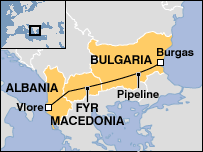
"Albania, Bulgaria and
Macedonia have given the go ahead for the construction of a $1.2bn oil pipeline that will
pass through the Balkan peninsula. The project aims to allow alternative ports for the
shipping of Russian and Caspian oil, that normally goes through the Bosphorus straits.
It aims to transport 750,000 daily barrels of oil. The pipeline will be built by
the US-registered Albanian Macedonian Bulgarian Oil Corporation (AMBO). The pipeline will
run for nearly 900 kilometres from the Bulgarian port of Burgas, over the Black Sea to the
Albanian city of Vlore on the Adriatic coast, crossing Macedonia.... According to AMBO
president Edward Ferguson, work on the pipeline will begin in 2005 and it is expected to
be ready in three or four years. He added that the company had already raised about $900m
from the Overseas Private Investment Corporation (OPIC) - a US development agency - the
Eximbank and Credit Suisse First Boston, among others."
Go-ahead for Balkan oil pipeline
BBC Online, 28 December 2004
"On June 2, the U.S. Trade and
Development Agency announced it had awarded the $588,000 grant to Bulgaria to carry out a
feasibility study for the pipeline. Under the proposed plan, Caspian oil would be shipped
by tanker from the Black Sea ports of Novorossiysk in Russia and from Supsa in former
Soviet Georgia and then pumped by overland pipeline across Bulgaria, Macedonia and Albania
to waiting European consumers. 'The continuing conflicts in Yugoslavia have made [the
proposed trans-Balkan line] appear impractical in past years. But the prospect that the
U.S. government would guarantee security in the region ... now makes it a much more
attractive proposition. This grant represents a significant step forward for this policy
(of multiple pipeline routes) and for U.S. business interests in the Caspian region,' said
TDA Director J. Joseph Grandmaison. The decision came shortly before NATO and Russia
reached agreement on how to force an end to the Kosovo conflict. The decision has raised
speculation among regional experts that it may be part of a larger economic development
plan envisioned by the Clinton administration to stabilize the southern Balkans after the
massive dislocations and infrastructure damage caused by the Serbian repression in Kosovo
and the U.S.-led NATO bombing of Serbia. The new strategic importance of the trans-Balkans
region to U.S. policy makers could now justify its designation as a Main Export Pipeline
for Caspian oil. The continuing conflicts in Yugoslavia have made it appear impractical in
past years. But the prospect that the U.S. government would guarantee security in the
region and also provide financial guarantees now makes it a much more attractive
proposition... The Bulgaria-Macedonia-Albania route has already won support in Moscow and
from the Chevron-led Caspian Pipeline Consortium that is developing the Caspian-Kazakhstan
oil deposits. The main export line for Caspian crude will run through Russian territory to
the Black Sea deposit at Novorossiysk and then by oil tankers to consumers."
Looking at Balkans route for Caspian crude
United Press
International, 23 June 1999
"The
`AMBO' Corporation (Pound Ridge, NY) has announced, on 17th January 1997, that Mr. E.L.
(Ted) Ferguson - formerly Director of Oil & Gas Development for Europe and Africa for
`Brown & Root Energy Services' has joined `AMBO' as President & CEO.... The `AMBO'
Corporation (an acronym for the `Albanian- Macedonian-Bulgarian Oil Corporation') is the
project developer of the 826 million $ Trans-Balkan Oil Pipeline which will carry crude
oil from the Bulgarian Black Sea port of Bourgas to the Albanian Adriatic Sea port of
Vlor....The feasibility study for `AMBO's ` Trans-Balkan Oil Pipeline, conducted by the
international engineering company of `Brown & Root Ltd.' in London.... The resulting
pipeline will become a part of the region's critical East-West corridor infrastructure
which includes highway, railway, gas and fiber optic telecommunications lines. This
pipeline will bring oil directly to the European market by eliminating tanker traffic
through the ecologically sensitive waters of the Aegean and Mediterranean Seas."
M I L S N E W S
Skopje, 23 January, 1997
"Mediterranean
refiners are suffering shortages of crude oil as Turkish security restrictions and bad
weather cause a traffic jam of tankers carrying Russian oil through the straits of the
Bosporus and Dardanelles... The congestion threatens a supply crunch similar to that
experienced by European refiners during the Gulf war of 1991.... The jam has forced
Russian producers to halt one pipeline sending oil to the Black Sea because storage tanks
are full and tanker loadings are delayed. 'The Bosporus problem is hitting very hard,'
said one refiner in Spain. The transit route of the Bosporus and Dardanelles straits, one
of the most important export points for Russia, Europe's biggest supplier, is known for
problems and delays. But the delays this year are compounded by the fact that refiners can
no longer rely on the Iraqi substitute for Russian oil. Kirkuk oil, from Iraq's northern
oilfields, resembles Russia's Urals oil. But Kirkuk, which is transported by pipeline to
the Turkish port of Ceyhan, has not been available since March because of the sabotage of
Iraq's section of the pipeline."
Bosporus tanker jam threatens shortage of oil
Financial
Times, 11 January 2004
"As Alvaro
González, captain of the Bosco Tapias, waited three weeks for a 30-vessel traffic jam to
clear so he could begin the treacherous journey through the Bosporus and Dardanelles
straits, he used the time to get his 274-meter oil tanker shipshape.... The reason for the
delays, of up to 25 days since the start of the gridlock in the Turkish straits in
December, is a mix of environmental, security and geopolitical factors which few
industries other than oil face to such a degree....Collisions and groundings are the most
frequent accidents for a waterway that at its narrowest point could not fit a tanker
lengthwise. The doubling of oil exports from Russia in eight years, and the rush of oil
expected from the Caspian have worried Turkish authorities and international oil
companies, whose reputations ride on their safety record...This battle over control of the
Caspian's oil and natural gas riches has raged since the early 1990s, with the US backing
a system of pipelines that would bypass Iran as well as reduce Moscow's grip over
countries such as Azerbaijan, Tajikistan and Kazakhstan."
Geopolitics slows tankers' passage in busy Bosporus
Financial
Times, 11 January 2004
"As the region stabilizes, the
Balkans may play an important role as a transit center for Russian and Caspian Sea region
oil exports... the region is becoming more important as a transit center for Russian and Caspian Sea region oil exports to Western
consumers."
US
Energy Information Administration - Statement on Balkans October 2002
"Today, the
circumstances which we have created here have changed. Today, it is absolutely necessary
to guarantee the stability of Macedonia and its entry into NATO. But we will certainly remain here a long time so that
we can also guarantee the security of the energy
corridors which traverse this country."
General Michael Jackson, commander of KFOR in
Macedonia
Italian daily, Sole 24 Ore, 13
April 1999
"The routes of potential trans-Balkan oil pipelines were laid down according to the interests of
their future [EU and US] users....The territory of Yugoslavia (both former and present
federation) is significant, therefore, because of its geographic position. Influential
American analysts insist on the claim that Yugoslavia is in the immediate neighborhood of
a zone of vital US interests - Black Sea/Caspian Sea region. And wherever there are vital
US interests, there are NATO troops to protect them. European interests, claim our
interlocutors, are even greater, because it is definitely not in the interest of the
European Union countries that the key to their supplies is held by someone else....The
project SEEL (South East European Line), initiated by the Italian company ENI is actually
the corridor for transportation of Caspian oil from Constanta to Trieste, which passes through Serbia and uses the existing system of
the Adriatic oil pipeline, all the way to Omisalj... Because of the political situation in
Serbia this project was delayed for some better times... Until
the fall of Slobodan Milosevic's regime Croatia insisted that the connection with
Constanta bypass Serbia by going through Hungary [a less economic route]. However, after October 5 and the political
changes in Yugoslavia, the meeting of this same group held in Brussels on October 26 and
27, 2000, expressed support for the transport of Caspian oil following the route from
Black Sea, Romania, Yugoslavia and Croatia, respectively from Romanian port Constanta, through Pitesti, and Pancevo to
Delnice in Croatia, from where the new pipeline would go towards Trieste and the old one
continue to Omisalj on the island of Krk."
Underground Games in Kosovo
Reporter, Banja Luka, Srpska, B-H, February 27, 2001
"The project envisages
construction of a new spur from Delnice to Trieste, 100 kilometers long, and conversion of
the Omisalj port into the leading spot-market
for resale of oil in the Mediterranean [Adriatic]..... One should recall that Milosevic
did not end up in the Hague only as a war criminal, but above all because with his
policies he stood in the way of a new network of Euro-Asian
oil pipelines. His political
fate was sealed in Zagreb, where two years ago a large ministerial-business conference of
the EU INOGATE program was held. A hundred
days later, Milosevic was not in power anymore, and at the time of the signing of a new oil pipeline from
Constanta to Trieste he was already on the way to the Hague,
supposedly by chance."
Mega Pipeline Becomes Reality
Novi List (Croatian Newspaper), 23 July 2002
"As to pipeline construction, one
of the most significant of the EE/FSU projects is the $2.9 billion Baku-Tbilisi-Ceyhan
(BTC) crude oil export pipeline being built for the Baku-Tbilisi-Ceyhan Company. The
1,097-mile 42/46-inch line will transport crude from Azerbaijan and the Caspian region via
Georgia to the Turkish Mediterranean port of Ceyhan. From Ceyhan, the crude will be
transported to European and world markets. The political significance of this project has
been recognized by Washington, which advocates expanding export routes even further from
the region. BP, as operator of the development, expects to begin carrying crude from the
first phase of the Azeri-Chirag-Gunashli development in the Caspian in the first quarter
of 2005. Also significant is the 745-mile Constanta-Omisalj
Pipeline proposal to link Romania, Yugoslavia and Croatia. If constructed, the pipeline
could open up lucrative trade routes from Central Asia to Western Europe. All three states
have signed on to construct the pipeline that has a proposed route from Costanta, Romania,
through Yugoslavia to an Adriatic oil terminal near Omisalj, Croatia. There is also
potential for the pipeline to be extended to Trieste, Italy, and beyond. Although financing the $1 billion project may pose a challenge in today's
soft economy, the U.S. is reported to be a key supporter of the project and willing to
provide $200,000 to fund a study into pipeline routes. Funding is also expected from
Interstate Oil and Gas Transport to Europe, (INOGATE) a ten-nation consortium funded by
the European Union to develop a pipeline network stretching form Central Asia to
Europe."
Pipeline & Gas Journal's 2003 International Pipeline Construction Report
Pipeline and
Gas Journal, August 2003
"..the Balkans are
becoming an important transit center for energy supplies from the Black Sea area and
beyond to Europe"
US Energy Information Administration - Previous
statement on Balkans now updated with statement of October 2002 (see top)
"The Honorable U.S. Ambassador to
Croatia Lawrence Rossin and the Croatian Minister of Economy Hrvoje Vojkovic signed a US$
202,000 Trade and Development Agency (TDA) grant to fund a feasibility study for an
international oil pipeline in Southeast Europe. The Serbian Minister of Mining and Energy,
Ms. Kori Udovicki ....took part in the signing ceremony in Zagreb. The oil pipeline would
originate in Constanta, Romania
go through Serbia and Croatia and end in Trieste, Italy."
Southeastern Europe Business Brief
Volume 7.26, July 26, 2002
"On April 8 [1999] the Party of
Democratic Socialism in Germany [PDS],
an opponent of the war, issued
a report describing an alleged CIA covert operation
named 'Operation Roots' aimed at sowing ethnic divisions in
Yugoslavia to encourage its breakup. The report claimed that this operation has been going
on 'since the beginning of Clinton's presidency.' It was supposedly a joint operation with
the German secret service, which also sought to destabilize Yugoslavia. The final
objective 'is the separation of Kosovo, with the aim of it becoming part of Albania; the
separation of Montenegro, as the last means of access to the Mediterranean; and the
separation of the Vojvodina, which produces most of the food for Yugoslavia. This would
lead to the total collapse of Yugoslavia as a viable independent state.' The report also
asserts that the KLA was founded by the CIA with funding was funneled through drug-smuggling operations in Europe."
Fun Facts About Our New Allies
The Progressive
Review (Washington), 22 June 1999
"War in the former Yugoslav
republics is being fuelled by a massive and complex pattern of weapons shipments to Croatia and
Bosnia-Herzegovina, funded and organized by Germany. Defense & Foreign Affairs
Strategic Policy has uncovered a widespread pattern of arms shipments which have been
allowed to cross into Croatia and
Bosnia with the tacit approval (and sometimes, apparently, direct support) of the
governments of Germany and Austria, and possibly other states. As well, Germany has
pointedly ignored the movement of German nationals into Croatia and Bosnia to fight against the Serbian
residents of those two former Yugoslav states. All of the activity is in direct violation
of German and Austrian law as well as being in violation of international embargoes
against the supply of weapons to the conflict zone. All of the actions support Germany's
traditional ally, Croatia,
against the Serbian populations still resident in what is now Croatia and Bosnia-Herzegovina, and against the
rump of the Yugoslav Federation. The wide collection of information came to Defense &
Foreign Affairs from diverse sources, including Defense & Foreign Affairs
correspondents. Some, from other sources, came in written form in a variety of languages,
without elaboration, often with only partial identification of some of the transactions,
companies and weapons involved."
Illegal German Weapons to Croatia and Bosnia Fuel the Balkan Conflict
Defense and Foreign
Affairs, Strategic Policy 31 October 1992
"General Sir Michael Rose, the
former United Nations military commander in Bosnia.... said false facts about the war in
Bosnia were being fed to Congress.... he was visited by General John Galvin, former
Supreme Allied Commander Europe who had been appointed by President Clinton to advise on a
new structure for the Bosnian Army. General Rose said: 'We were escorted by a woman from
the US Embassy who, in my view, was the most hostile American I met during all my time in
Bosnia.' As they flew by helicopter towards Tuzla in the north, she pointed at all the
destroyed villages high in the Zvijezda mountains and 'exclaimed excitedly' to General
Galvin: 'Look at what the criminal Serbs have done.' In fact, General Rose said, they were
Bosnian Croat villages ethnically cleansed by the Muslim forces. Later when they visited
Mostar in the south where the Croats had virtually destroyed the Muslim sector in the
eastern part of the town, the US official 'planted her hands on her ample hips' and cried:
'Well, at least this was done by the criminal Serbs.' General Rose said the woman burst
into tears when it was pointed out that the Croats had been to blame. 'The fact was not
lost on Galvin,' he said."
US bugged me in Bosnia, says General Rose
London Times, 10 November 1998
"A
more revealing report was released April 8 by Jurgen Reents,
press spokes person for the Party of Democratic Socialism in Germany. The PDS received
almost as many votes as the Green Party, which is part of Germany's ruling coalition. The
PDS has actively opposed the NATO war on Yugoslavia. Reents said the report came from
someone who holds a 'strictly confidential and high position in the offices of the German
government.' The report came through a
Catholic priest who has kept the individual's identity secret but has verified the
person's authenticity. The report asserts that top NATO, U.S., British and German
officials are 'utterly lying in public concerning almost all the facts in regard to the
Balkan War.' ...The report says that
the German government knows NATO consciously created the refugee crisis. For example, the
report says, NATO has targeted and destroyed nearly every fresh-water facility in Kosovo.
It also asserts that there are KLA units in Kosovo--one is entirely U.S. mercenaries, the
other German mercenaries--who report to the military commands of those countries. Perhaps
most revealing is the report's description of a CIA covert operation cynically named
'Operation Roots.' It is aimed at sowing ethnic divisions in Yugoslavia to encourage its
breakup. The report says that this operation has
been going on 'since the beginning of Clinton's presidency.' It is a joint operation with
the German secret service, which has also sought to
destabilize Yugoslavia. .. The report asserts that the KLA was founded by the CIA. And
the funding was funneled through drug-smuggling operations in Europe. The authenticity of
this report cannot be independently verified at this time. But much of it is consistent
with what is already known. It helps to expose the real forces behind the war on
Yugoslavia and shows who are the true aggressors."
Who's The KLA? - German document reveals secret CIA
role
Workers World
Service, April 29, 1999
"I mean Kosovo is just one of the points of destabilization of
Yugoslavia... I want people to know the truth about what happened here.... The United
States, for its own geopolitical reasons, deliberately encouraged the secessionist
tendency among Albanians, used
them against the Yugoslav government in order to destabilize
the Balkans.... One book has a great hold over Kosovo Albanians. It's called the 'Canon of Leke
Dukagjiniis'. It's a 15th century text that spells out codes of behavior. It goes into
great detail on how to carry out blood feuds, when and whom it is proper to kill. It lays
out the proper methods to use when killing, rules and regulations and so on. And this Canon is alive among
Albanians today, especially since the fall of communism. This is an intensely
tradition-oriented culture. Blood feud is a constant threat for Albanians.... By
methodically killing those who refused to support them, the KLA was striking a deep fear
among Albanians: the refusal of one Clan member to obey could lead to revenge against his
entire clan. And now the KLA had NATO bombers to enforce blood feud. ... [the KLA] knew their own people, their fears, their
traditions. They knew that if they could prove they were deadly, the clan leaders would fall in line. Now they live in a society dominated by gangsters. None of this
would have happened were it not for years of effort by the United States."
Cedomir Prlincevic, President of the Jewish Community
in Pristina, and Chief Archivist of Kosovo
Interview with 'Emperors
Clothes', 3 December 2000
"Albania ... offered NATO and the
U.S. an important military outpost in the turbulent southern Balkans (in the 1990-96
period Albania opened its ports and airstrips for U.S. military use and housed CIA spy
planes for flights over Bosnia).... The U.S. played a major role in the DP’s 1992
electoral victory, and it then provided the new government with military, economic, and
political support. In the 1991-96 period Washington directly provided Albania $236 million
in economic aid, making the U.S. the second largest bilateral economic donor (following
Italy).....Following Berisha’s visit to the U.S. in March 1991, Washington began
supplying direct assistance to the DP, including donations of computers and cars for the
1992 electoral campaign. William Ryerson, the first U.S. ambassador, stood next to Berisha
on the podium at election rallies. The U.S. failed to criticize, and at times encouraged,
the new president as he purged critics of his policies within the judicial system, police,
and the DP—often through illegal means. By 1993 DP loyalists and family members held
most of the prominent positions in Albania’s ministries, institutes, universities,
and state media. Citing the threat of communism’s return, Berisha successfully
instilled fear in the population and discredited his rivals. The U.S. embassy in Albania
contributed to the polarization of Albanian politics by refusing to meet most of the
opposition parties (former communists as well as others) for the first two years of DP
rule. This one-sided view of democratization helped Berisha dismantle most political
alternatives, some of which were moderate and truly democratic. Albania had become a
strategic outpost in the region, and the U.S. did not want to jeopardize its new control
and political influence in the country. In 1992 Washington deployed a Military Liaison
Team to the country and started outfitting the Albanian military with nonlethal equipment,
technical expertise, and training. Albania was the first East European state to request
NATO membership, and in February 1994 it became a member of the NATO-associated
Partnership for Peace. Albania has participated in numerous military training operations
with the U.S. and other NATO powers, and the CIA has used Albania as a base for air
reconnaissance missions over Bosnia. In January 1995, the U.S. Army finished building a
radar station in northern Albania for use by the Albanian military. In addition, Albania
opened its land, marine, and airport facilities to NATO operations in the former
Yugoslavia....In the volatile Balkans, the U.S. is faced with a serious crisis that it
helped fuel. The raging anarchy in Albania is both a serious setback for Albania’s
democratic development and a threat to regional security. In this regard, the
disintegration of police and military forces has resulted in the widespread availability
of weapons. These are easily purchased or stolen not only by Berisha’s opponents but
also by criminal gangs and terrorist elements both inside and outside Albania. "
Albania
Foreign Policy In Focus, Volume 2, Number 33 May 1997
"For amid the
present furore over the no-show of Iraqi WMDs, let us remember that in Kosovo our
humanitarian Prime Minister dragged this country into an illegal, US-sponsored war on
grounds which later proved to be fraudulent. In 2003 Tony's Big Whopper was that Saddam's
WMDs 'could be activated within 45 minutes'. In 1999 it was that Slobodan Milosevic's
Yugoslavia was 'set on a Hitler-style genocide equivalent to the extermination of the Jews
during World War Two'..... In fact, the Yugoslavs had by February 1999 already agreed to
most of the autonomy proposals and had assented to a UN (but not Nato) peacekeeping team
entering Kosovo..... It was the unwelcome prospect of Milosevic signing up to a peace deal
and thereby depriving the US of its casus belli that caused Secretary of State Albright,
with the connivance of Cook, to insert new terms into the Rambouillet accord purposely
designed to be rejected by Belgrade. Appendix B to
chapter seven of the document provided not only for the Nato occupation of Kosovo, but
also for 'unrestricted access' for Nato aircraft, tanks and troops throughout Yugoslavia.
The full text of the Rambouillet document was kept secret from the public and came to
light only when published in Le Monde Diplomatique on 17 April. By this time, the war was
almost a month old...The Kosovan war was, we were repeatedly told, fought 'to stop a
humanitarian catastrophe'. 'It is no exaggeration to say that what is happening is racial
genocide' - claimed the British Prime Minister - 'something we had hoped we would never
again experience in Europe. Thousands have been murdered, 100,000 men are missing and
hundreds forced to flee their homes and the country.' The Serbs were, according to the US
State Department, 'conducting a campaign of forced population movement not seen in Europe
since WW2'....With public support for war faltering, and a Downing Street spokesman
talking of a 'public-relations meltdown', it was time for the Lie Machine to go into
overdrive.... To date, the total body count of civilians killed in Kosovo in the period
1997-99 is still fewer than 3,000, a figure that includes not only those killed in open
fighting and during Nato air strikes, but also an unidentified number of Serbs. Clearly it
was an exaggeration - of Munchausenian proportions - for the Prime Minister to describe
what happened in Kosovo as 'racial genocide'. In both Kosovo and Iraq, the government's
war strategy seems to have been threefold:
1. In
order to whip up public support for war, tell lies so outrageous that most people will
believe that no one would have dared to make them up.
2. When
the conflict is over, dismiss questions about the continued lack of evidence as
'irrelevant' and stress alternative 'benefits' from the military action, e.g.,
'liberation' of the people.
3. Much
later on, when the truth is finally revealed, rely on the fact that most people have lost
interest and are now concentrating on the threat posed by the next new Hitler.
An admission of the government's culpability for the Kosovan war only slipped out in July
2000, when Lord Gilbert, the ex-defence minister, told the House of Commons that the
Rambouillet terms offered to the Yugoslav delegation had been 'absolutely intolerable' and
expressly designed to provoke war. Gilbert's bombshell warranted scarcely a line in the
mainstream British media, which had been so keen to label the Yugoslavs the guilty party a
year before."
How the battle lies were drawn
Spectator, 14 June 2003
"Almost before the Berlin Wall
came down in 1989, then Secretary of Defense Dick Cheney called together a group of players to chart out a strategy for the
post-Cold War world. The names should be familiar, because they run the present
administration: Secretary of Defense Donald Rumsfeld, Deputy Secretary of Defense Paul
Wolfowitz, Secretary of State Colin Powell, and Lewis 'Scooter' Libby, Cheney's chief of staff. The goal was to
'shape' the world in order to, in the words of another team member, Zalmay Khalizad (now
special envoy to Afghanistan), 'preclude the rise of another global rival for the
indefinite future.' In his book 'From Containment to Global Leadership?' Khalizad argues
that it is 'vital' to prevent such a rival from developing and 'to be willing to use force
if necessary.'.."
Are we on the road to war?
The San Francisco Examiner, 19
April 2002
"The greatest untapped oil reserves in the
world are located in the former Soviet republics bordering the Caspian Sea (Azerbaijan,
Kazakhstan, Turkmenistan)...... This is the fuel that is feeding renewed militarism and
must lead to new wars of conquest .... This is the key to understanding the bellicosity of
US foreign policy over the past decade. The bombardment of Yugoslavia is the latest in a
series of wars of aggression that have spanned the globe. Though they had certain regional
motivations, these wars have been the US response to the opportunities and challenges
opened by the demise of the USSR. Washington sees its military might as a trump card that
can be employed to prevail over all its rivals in the coming struggle for resources....
For reasons both of world strategy and control over natural resources, the US is
determined to secure for itself a dominant role in the former Soviet sphere.... The US
House Committee on International Relations has begun holding hearings on the strategic
importance of the Caspian region. At one meeting in February 1998, Doug Bereuter [said]
Stated US policy goals regarding energy resources in this region,' he continued, 'include
fostering the independence of the States and their ties to the West; breaking Russia's
monopoly over oil and gas transport routes; promoting Western energy security through
diversified suppliers; encouraging the construction of east-west pipelines that do not
transit Iran; and denying Iran dangerous leverage over the Central Asian economies.'....
This is the significance of the present military action against Yugoslavia and the growth
of militarism generally. Kosovo is a testing ground for wars that will follow in the
former Soviet region.... The United States for its part gives the impression of a society
on the verge of a nervous breakdown. Public life is punctuated by outbreaks of violence by
schoolchildren that have left the country in a state of semi-shock. No explanation, beyond
the most banal, has been offered by officials or experts for these explosions of violent
anti-social behavior. In their own way, however, they testify to the brutality of
contemporary American life and the suppressed antagonisms that lie just under the
surface.... The country will continue to be remade as a high-tech garrison, where the bulk
of public expenditure will be devoted towards military purposes abroad. Social programs
will increasingly be replaced by naked domestic repression."
Why is NATO at war with Yugoslavia? World power, oil and gold
World Socialist
Web Site, 24 May 1999
"General
Wesley Clark, the former Nato commander and presidential hopeful, will testify next month
at the war crimes trial of Slobodan Milosevic under conditions of strict censorship and
confidentiality imposed by the United States. Washington is believed to be fearful of
potentially damaging revelations about its Balkan realpolitik during the 1990s and in the
Bosnian War. General Clark, who is seeking the Democratic Party nomination for President,
will be one of the highest-profile witnesses to take the stand. The former Nato commander
directed the alliance's 78-day bombing campaign in Kosovo in 1999, after Serbian forces
had launched an onslaught against ethnic Albanian separatists. General Clark will testify
on December 15 and 16. Public galleries will be closed and the broadcast system that
transmits the proceedings on the internet and on closed-circuit television will be shut
down. The conditions of General Clark's testimony include a 48-hour delay to enable the US
Government to review the transcript and seek the court's consent to censor parts on the
ground of national security. Two US representatives will attend the sessions. The
three-judge panel hearing Mr Milosevic's case agreed to the conditions, which are unique,
because they decided that they were justified by the potential importance of General
Clark's testimony, Jim Landale, the tribunal spokesman, said. In his cross-examination of
General Clark, Mr Milosevic could reveal sensitive information about the West's diplomatic
and military strategy for dealing with the crisis in the Balkans."
General Clark to testify against Milosevic
London
Times, 20 November 2003
"The final toll of civilians confirmed massacred by Yugoslav forces in Kosovo is
likely to be under 3,000, far short of the numbers claimed by Nato governments during last
year's controversial air strikes on Yugoslavia. When Yugoslav
forces withdrew from Kosovo in June last year, Nato spokesmen estimated that the Serbs had
killed at least 10,000 civilians. While the bombing was under way William Cohen, the US
defence secretary, announced that 100,000 Kosovo Albanian men of military age were missing
after being taken from columns of families being deported to Albania and Macedonia. 'They
may have been murdered,' he said....The exhumation of less than 3,000 bodies is sure to
add fuel to those who say Nato's intervention against Yugoslavia was not 'humanitarian' and that it had other motives ..."
Serb killings 'exaggerated' by west
Guardian, 18
August 2000
"President
Clinton has authorised an all-out campaign to topple Slobodan Milosevic, according to
sources close to the US Government. Earlier this spring, Mr Clinton signed a secret
presidential 'finding' giving the Central Intelligence Agency (CIA) the green light to try to
bring down the Yugoslav president, said sources quoted in the US news-magazine Time. The
reported campaign has two tracks, overt and covert....Now, six new radio transmitters
outside Serbian territory will beam a 24-hour diet of pro-Western broadcasts to bolster
dissident elements. "
'CIA ordered to topple Milosevic': US report
BBC Online, 6 July
1999
"The last
time [before Iraq] American bombers were sent over the horizon to rain democracy on a
reluctant constituency was in the spring of 1999, when the NATO alliance engaged the
hearts and minds of the Serbian government. The regime to be changed was that of Slobodan
Milosevic. For 78 days, NATO
-- but mostly American bombers -- attacked military and civilian
targets throughout Serbia and Montenegro.... The bombings killed almost as many Serbs as
the number of Americans who later died in the World Trade Center.... During the week
before Djindjic's March 12 assassination, I traveled extensively in the former Yugoslavia,
now called the State Union of Serbia and Montenegro.... Djindjic had come to power
courtesy of the oddest of bed fellows: the U.S. government and local gangsters, who
flourished in the 1990s because American sanctions had put legitimate business to the
wall. In the beginning, both the United States and the gangsters thought that their
interests would best be served with a new government in Serbia, and both agreed to
sacrifice Milosevic on the altar of war guilt in The Hague. But more recently, this
coalition found itself with conflicting agendas. The gangsters thought that support for
Djindjic would exempt them from a summons to the International Criminal Tribunal, but the
U.S. made
further aid to Serbia conditional on Serbia's serving up more
suspects to that court."
Bombing down to Belgrade - An unholy alliance with Serb gangsters
US's Providence
Journal, Rhode Island, 4 April 2003
"...there is evidence that
underworld groups, controlled by Zoran Djindjic and linked to US intelligence, carried out
a series of assassinations of key supporters of the Milosevic regime, including Defence
Minister Pavle Bulatovic and Zika Petrovic, head of Yugoslav Airlines.... Despite the
opposition of most of its citizens, [Djindjic] the 'heralder of democracy' followed the requirements of the
'international community' and after 74 years the name of Yugoslavia disappeared off the
political map. The strategic goal of its replacement with a series of weak and divided
protectorates had finally been achieved....The lesson from Serbia for today's serial
regime changers is a simple one. You can try to subjugate a people by sanctions,
subversion and bombs. You can, if you wish, overthrow governments you dislike and seek to
impose your will by installing a Hamid Karzai, General Tommy Franks or a Zoran
Djindjic to act as imperial consul. But do not imagine
that you can then force a humiliated people to pay homage to them."
The quisling of Belgrade
The murdered Serbian prime minister was a reviled
western stooge whose economic reforms brought misery
Guardian, 14 March
2003
"The political stakes are high
and the financial risks many but the spoils are huge for investors seeking a way to pipe
Russian and Caspian oil around the treacherous Turkish straits to the energy-hungry West.
Oil producers lost at least $700 million last winter as bad weather and heavy seas kept
their tankers stuck for as long as two weeks at the Bosphorus and Dardanelles
straits —- the only way for sea-bound crude to exit the Black Sea. Delayed for
years by political wrangling and environmental fears, several billion-dollar pipeline
projects are finally inching toward start dates, with countries and investors around the
vast Black Sea vying for pole position. 'An exit-Black Sea pipeline is a necessity,
because the oil market requires diversified supplies,' said Max Shein, chief equity
strategist at Moscow-based Broker Credit Service..... 'One day the ships will carry the
oil to us,' said Nikolov, whose company, the Albanian Macedonian Bulgarian Oil Corporation
(AMBO), aims to link the Bulgarian Black Sea port of Bourgas with Vlore, on Albania’s
Adriatic coast. The need is clear: already booming oil production in the Urals and the
Caspian Sea regions is expected to double crude traffic through the Turkish straits
through 2015. Russia has increased exports by 50 percent since 2001 to become the
world’s second largest oil exporter behind Saudi Arabia, and Kazakhstan expects to
more than double its output of 1.3 billion tonnes of crude in the next decade. AMBO hopes
to build a 912-km (567-mile) pipeline from Bourgas through Macedonia to Vlore, a deep port
accessible to huge tankers. Analysts warn the pipeline’s length and political risks
in the region continue to hinder the plan, which originally surfaced in 1994, but Nikolov
said a deal could be imminent. 'I expect the final political accord on the pipeline to be
endorsed next year,' he said. 'No pipeline will ever lose money. But a pipeline is as much
economics as it is politics.'.... Alongside the AMBO plan is a project to run a link
between Romania’s Black Sea port of Constanta to Italy’s Trieste......"
Black Sea Pipelines Look to Bypass Straits
Reuters, 28 November 2005
"Five countries are expected to
sign in January an agreement to build an oil pipeline from Romania to Italy. The project,
which includes rehabilitating Romania's Black Sea port
Constanta, would cost at least $2.4bn (€2bn, £1.4bn), a feasibility study has
found. People close to the project said two key oil companies, one international energy
group and one state-owned energy company, had expressed interest. Henry Owen, a financial
adviser to the project, said the pipeline would feed refineries in south-eastern Europe,
Italy, Austria and Bavaria and would send oil to tankers via an existing pipeline from
Trieste to the deepwater port at Genoa. It would reduce European dependence on Middle
Eastern oil, would be outside Russian control and would help to alleviate some of the
congestion in the Bosphorus and Dardanelles straits, analysts said. But they warned that
the pipeline faced several competitors and that an agreement could still be scuttled by
one of the five states. If the signing ceremony proceeds, the next big hurdle will be
reaching agreement on the pipeline tariffs. Ian Woollen, senior analyst at Wood Mackenzie,
the UK-based consultants, said: 'It is a step forward, but there is still a long way to
go. There are a lot of competing options that make more sense logistically and
commercially.' Two pipelines that would originate in Burgas, Bulgaria, compete with the
so-called Pan-European Pipeline from Constanta to Trieste. One would send oil to Alexandroupolis in Greece, the other to
Vlore on Albania's Adriatic coast. Politics plays as much of a role as money. Russia's
interest in controlling the region's oil flow, and the US opposing objective in
diversifying the power away from Moscow, mix with the broader tug between Asia and Europe,
both large markets keen to receive the oil. Meanwhile, Turkey wants to reduce the strain
of shipping almost all the region's oil through the dangerously busy Bosphorus and
Dardanelles straits, but does not want to lose control of the power and the income that
comes with being such an important trading gateway. Altogether a dozen pipelines are
proposed for the region. The most significant new pipeline is the BP-led Baku to Ceyhan
line, expected to open this spring."
Five countries to build joint oil pipeline
Financial
Times, 20 December 2005
"The defence lawyers assigned to
ex-Yugoslav president Slobodan Milosevic have asked for the former NATO commander General
Wesley Clark to be recalled to the witness stand for further questioning.... In their
latest submission, filed on February 10, defence lawyers Steven Kay and Gillian Higgins,
whose assistance is imposed on Milosevic against his will, objected to the fact that
questioning of Clark at the time was restricted to the contents of a statement he had
given to prosecutors. By pressing for such restrictions, they argued, 'The prosecution and
the [United States] government structured the appearance of General Clark in the trial in
such a way that only issues in support of the prosecution’s case could be
adduced.'... The US embassy in The Hague has since written to the court, reminding judges
of Washington's desire to protect 'sensitive information and legitimate national
interests' and seeking leave to file a lengthier written submission on the matter.'"
Milosevic Lawyers Seek Recall of General Clark
Instituted
For War And Peace Reporting, 17 February 2006
"A deal to supply the EU with
10bn cubic metres of Turkmen gas per year from 2009 has been hailed by officials as 'an
important step'. The agreement will boost the EU-backed Nabucco pipeline - planned
to reduce reliance on Russian gas, which accounts for a quarter of EU supplies. The
Turkmen gas will only make up a small percentage of EU demands and it is not clear how it
will reach Europe. Nabucco is due to be built in 2010 and the first gas will flow in
2013."
EU secures Turkmenistan gas deal
BBC Online, 14 April 2008
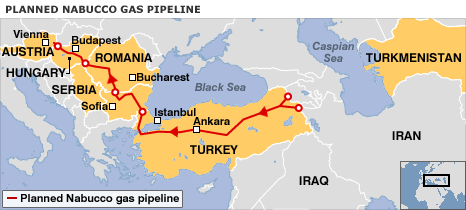
|
Post Milosevic, the west's
relations with Serbia have remained
uncertain, particularly connected to the long-standing dispute over the territorial
status of Kosovo. Announced in April 2008, the Nabucco pipeline project proposals for
bringing gas from Turkmenistan in the Caspian Sea region to western Europe has carefully
avoided the territory of the former Yugoslavia. Nonetheless its path illustrates the
strategic importance of the Balkans for energy supplies into western Europe. Unlike
several oil pipeline projects in the Balkans, this project does not require access to
international shipping terminals on the Aegean sea coast, and the territory of former
Yugoslavia (with its outstanding issues of instability and slow progress
towards membership of the EU) can therefore be avoided. |
"Russian President Dmitry
Medvedev had reason to look pleased when he met Serbian President Boris Tadic in Moscow on
Christmas Eve. The two leaders finalized an agreement for Gazprom, Russia's behemoth state
gas monopoly, to buy a controlling interest in Serbia's state oil and gas industry —
and a plan for Russia to construct a gas pipeline through the country. Former Serbian Prime Minister Vojislav Kostunica, whose government
negotiated the deal, says it will end his country's crippling energy shortages by
guaranteeing gas supplies and using Russian capital to rebuild Serbia's decaying
infrastructure. 'We are in front of a very good solution,' he says. 'First of all, from
the point of view of the interests of Serbia, for its independence, it is very important
that the capitals of different countries are involved.' But critics say Gapzrom is
exploiting Serbia's weak economy in its push to boost control over the European energy
market. Many Serbians welcomed sacrificing control of their energy industry — for
political reasons as much as economic ones. Both Russia and Serbia are Slavic countries
that consider each other traditional allies. Moscow supported Belgrade during its bombing
by NATO in 1999, memories of which are still raw here..... There's
much more at stake than simply the Serbian energy market. Belgrade is part of a fierce
struggle between Russia and the West over the future of energy supplies to Europe. A number of European companies had hoped to buy into Serbia's energy
industry but withdrew because of the cost. But despite the recent economic turmoil,
Gazprom found the money because it wants to make Serbia the European hub of its planned
new South Stream pipeline from Russia. The project is meant
to compete with a planned European Union pipeline from the Caspian Sea that would cut out
Russia by delivering Central Asian gas through Georgia. The Georgians say energy was a
major factor behind Russia's invasion of their country last year. The United States champions the European Union's Nabucco pipeline. U.S.
Deputy Assistant Secretary of State Matthew Bryza, who has led the effort, says Russia's
plan is part of a strategy to win control over the European gas market."
Serbia Plays Key Role In Russian Gas Pipeline Plans
NPR, 7 January
2009
"If one were to ask Serbs about
what they needed more - General Ratko Mladic, who was delivered to the international
detention center of The Hague war crimes tribunal on Tuesday, or membership in the
European Union (EU) - the majority would certainly vote for the latter. The economy and
living conditions in Serbia are in such bad shape that EU membership is viewed as almost
the only cure for all of its ills. This is partly true. Brussels has announced more than
once that the EU would lift all obstacles to Serbia's entry after the extradition of
General Ratko Mladic, the former commander of Bosnian Serb troops during the 1992-1995
war, to The Hague. So, it was made abundantly clear that Mladic was Serbia's ticket into
the EU. On June 1, he was transferred to a cell in The Hague....While Mladic was in hiding, obvious attempts were being made to distance
Serbia further away from Russia. In the early 2000s, the
Americans spread rumors that he took refuge in Russia and was settled quite comfortably
there. This is clear from the U.S. State Department cables that were released by
WikiLeaks. The reasoning was simple - if Mladic, an international criminal, lives in
Moscow, then Russia must be blocking Serbia's progress, its entry to the EU and accession
to Western civilization. It was a shameless tactic, but it was effective. However,
Serbia's alienation from Russia began even earlier - when Moscow did nothing serious to
stop NATO bombings in 1999. The then Prime Minister Yevgeny Primakov only made the empty
gesture of ordering his plane to turn around mid-air as he was on his way to the United
States. Now it is clear that the historical ties between Russia and Serbia have been
severed and that Serbia has opted to join the EU. Slovenia is
already in the EU. Croatia, Macedonia and Montenegro are official candidates. Albania,
Bosnia and Herzegovina, and now Serbia are potential candidates. It seems that the Balkan
issue, which has tormented the world so much since the 19th century, will soon become a
thing of the past. We'll still be friends with Serbia, but
now on the basis of the South Stream project. But this will be an entirely different sort
of relationship - one based on hydrocarbons rather than on Slavic friendship."
Ratko Mladic - the high price of EU integration for Serbia
RIA Novosti, 2 June 2011
"A
U.S. army official in Romania says an American military base near the Black Sea port of Constanta will become a permanent facility in
the spring and be jointly used with Romanian forces. Lt. Col.
Daniel Herrigstad says the U.S. government invested $48 million to modernize the base.
Herrigstad told the news agency Agerpres on Friday that the base would initially host up
to 1,700 U.S. and Romanian soldiers."
US military base in Romania to become permanent
Associated
Press, 23 October 2009
Serbia
- Four Periods Of American Espionage
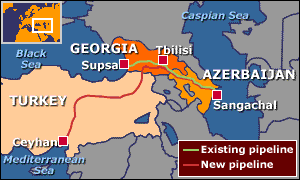
Find Out How Similar Dirty Games Are Being Played In The
Caucacus
As The Oil Makes Its Way From The Caspian To The Coast Of Yugoslavia
Via The Black Sea Region
Click Here |
The Key To The Covert Western-Sought Break Up Of Moscow
Allied Former Yugoslavia Was The Spread Of Civil War In Which The CIA
Is Known To Have Secretly Participated
The Question Now Arises As To Whether The CIA May Also Have Had Its Own Highly Placed
Agent Provocateur In Belgrade For This Purpose
Since The Embarrassment Of His Outing As A CIA Double-Agent Jovica Stanisic Has
Been Described As Having Secretly Worked For Peace
However Whilst Milosevic's Government Was Found Not Guilty By The International Court of Justice Of
Alleged Involvement In The Srebrenica Atrocities
Jovica Stanisic Still Faces Allegations Of Sending Scorpion Death Squads To
Srebrenica
"President Milosevic's secret
police chief and organiser of Serb death squads during the genocidal ethnic cleansing of disintegrating Yugoslavia was the United States' top CIA agent in Belgrade,
according to the independent Belgrade Radio B92. The claim that from 1992 until the end of the decade, Jovica Stanisic, head of Serbia's
murderous DB Secret Police, was regularly informing his CIA
handlers of the thinking in Milosevic's inner circle has shocked the region. Stanisic is said to have loyally served his two masters for eight years. He is facing war crimes charges at the International Criminal Court at
The Hague. In the terrifying years of Yugoslavia's
internecine wars, he acted as the willing 'muscle' behind
Milosevic's genocidal campaigns in Croatia, Kosovo and Bosnia, including Sebrenica....
Like in a Cold War spy thriller, Serbia's secret police chief met his CIA handlers in safe houses, parks and
boats on the river Sava to betray his master's action plans. He provided, it is claimed,
information on the whereabouts of Nato hostages, aided CIA operatives in their search for
Muslim mass graves and helped the US set up secret bases in
Bosnia to monitor the implementation of the 1995 Dayton peace
accord....Thus the judges at The Hague are having to judge a man who allegedly sent the
Scorpion death squads to Srebrenica to 'deal' with men and boys fleeing the UN-protected
Muslim enclave, while working with the CIA trying to end Milosevic's ethnic wars."
Death squad leader ‘was top CIA agent’
Sunday
Herald, 22 March 2009
Western Sponsorship Of The Opposition - How Milosevic Was
Eventually Toppled
"[In order to
topple Milosevic] Approximately $30 million, predominantly from America, were channeled
into the country [Serbia] via an office in Budapest, in order to equip the opposition for
the election campaign with computers, telephones and office materials. Hundreds of
election helpers were trained abroad for these tasks."
Helping the Revolution
Der Spiegel, 9 October 2000
"Belgrade, Serbia and
Montenegro--Serbian television viewers were cheerfully amused during the Georgian crisis
that led to President Eduard Shevardnadze's overthrow. Otpor! was founded in early 2000, and
quickly spread from Belgrade to every corner of Serbia. The breaking-news footage from
Tbilisi, beamed into their living-room TVs, showed symbols and political iconography they
had grown deeply familiar with. The posters of a clenched fist, plastered everywhere, were
identical to those used by Serbia's Otpor! (Resistance!) movement in 2000, during the
campaign to oust Slobodan Milosevic. Even the slogans on billboards were familiar: 'Gotov
je!' ('He's finished'), the Latin-script letters proclaimed--in Serbian. Clearly, young
Georgian protesters didn't have time to translate the propaganda material they'd borrowed
from their Serbian friends.... And yes: Otpor! militants have confirmed that they were
consulted by Georgian opposition--and that they provided advice, material, and help. ... [in Serbia] The European Union, the United States, and many
non-governmental organizations provided training in political marketing and resistance
tactics, advice--and yes, money too.... The campaign was massive, the expenses high, and
the funding was foreign--smuggled across the border and carefully concealed."
A Revolution Brought to You
By
TDL, 1 December 2003
"Tony Blair’s top diplomat
in Baghdad was ignored when he urged the Americans not to sack 25,000 Baathist officials,
the Iraq inquiry was told yesterday. Sir John Sawers, Special Representative in Baghdad at
the time, now the head of MI6, testified to the chaos he saw in post-invasion Iraq on
arriving in the capital in early May 2003.... Sir John was asked whether the change of
regime in Baghdad had come up in early discussions between Mr Blair and Mr Bush in 2001.
He replied: 'I think there are lots of countries where we would like to see a change in
regime but that doesn’t mean that one actively pursues policies in that direction.'
When Mr Blair and Mr Bush had their first meeting — at Camp David in February 2001
— 'aggressive regime change [in Iraq] was never given serious consideration'. He said
that the approach adopted with Saddam was based on methods
that had led to the ousting of Slobodan Milosevic in Serbia the previous year. Among the
proposals considered was support for opposition groups..."
Iraq fell into chaos after US ignored Blair envoy’s advice not to sack all Baathists
London
Times, 11 December 2009
"For 10 years Serbia had
successfully resisted the war against Yugoslavia, which began in the early 1990s. After NATO’s war of aggression against our country ended in 1999
without a clear victory, London and Washington carried out a vast special operation to
overthrow Milosevic; it was the mother of all subsequent 'color revolutions.' Through a
presidential decree, Bill Clinton gave the CIA carte blanche to carry out a coup in
Yugoslavia. Enormous sums were invested in political parties, NGOs [non-governmental
organizations] and media. The fragmented opposition [to Milosevic and the Socialist Party
of Serbia] was unified under foreign guidance. A coalition of 18 parties under the
umbrella called the 'Democratic opposition,' or DOS, formed with one goal: overthrow
Milosevic. William Montgomery, the person later named as U.S. ambassador to Belgrade, set
up a specially equipped office in Budapest [in neighboring Hungary]. Opposition activists attended courses that were
run by CIA agents. The so-called student group known as 'Otpor' (Resistance) used the
slogan 'Gotov je' (He is finished) to conduct the election — this was all a project
of Western intelligence agencies. In the Yugoslav
presidential election on Sept. 24 the incumbent Milosevic obtained 15 percent fewer votes
than Western-backed candidate Vojislav Kostunica. However, since neither of these two
leading candidates won an absolute majority, it should have come to a run-off ballot. The
DOS parties claimed that Milosevic had falsified the elections and Kostunica was
victorious in the first round of voting. Otpor led violent street protests. DOS wanted to
prevent the runoff, although they would have won for sure. Milosevic refused to accept a
resignation without a second round of voting. At the height of the dispute, the Supreme
Court issued a strange decision: Because of rumors of irregularities in the first ballot,
all votes from the southern Serbian province of Kosovo were simply canceled. Of course,
the vote in those districts would have to be repeated. With Kosovo’s votes cancelled,
Kostunica’s vote share increased to more than 50 percent. Milosevic acknowledged the
decision and on Oct. 5 congratulated Kostunica’s victory. This step, which had barely
been reported, was buried in what was a media-constructed 'popular uprising.' As Otpor set
the Parliament on fire, the Kostunica forces immediately and completely seized the
government apparatus. With this coup they avoided a controlled handover of power. The
years-long image of Milosevic as a 'dictator' in the Western media would have appeared
absurd if he were simply removed by a Democratic vote. The West didn’t want to risk
this loss of credibility. Mainly though, the 'revolution' needed to be carried out
violently to shorten the time until the new regime could allow far-reaching Western
interventions in the state and economy, thus making the transformation irreversible....
But beyond the Western propaganda, there was in reality a great discontent among the
population [in 2000]. ... Under the guidance of and in close collaboration with their
foreign sponsors, the opposition understood how to blame on Milosevic the suffering caused
by Western sanctions and NATO’s war and how to make big promises should they win the
elections. The bombs had destroyed the economy and infrastructure, which aggravated the
social discontent. When the government used up the remaining government funds for
repairing the main road and rail links, the voters felt even more pain and were
susceptible to opposition propaganda that claimed voting out Milosevic would stop the
foreign pressure and increase the standard of living. It is
in this sense that one should understand White House spokesperson Ari Fleischer’s
comments that the war was part of the 'regime change' strategy of NATO and the United
States, because it weakened Milosevic and led to his fall. Since the early 1990s there
have been not many different wars in Yugoslavia — in Slovenia, Croatia, Bosnia,
Kosovo — it was all one war: that of the West against Yugoslavia. In this statement I fully agree with Milosevic. Former U.S. President
George Bush Sr., while speaking during the celebration of German reunification, discussed
the elimination of the consequences of the Versailles Treaty in Europe. A key point
regarding Versailles at the beginning of the 20th century was to weaken Germany in favor
of the Eastern European countries, which Germany had considered as satellites within the
'Central Europe' doctrine. Thus, those in Versailles for the first time recognized
Yugoslavia as a state. Until Yugoslavia’s breakup,
Catholic and Muslim groups in Yugoslavia were used by Western powers to counteract Russian
influence, which was based on historical closeness with Serbs. In the 1990s, however, a
resurgent Germany’s role was to serve as a NATO member to weaken Russia and Eastern
Europe, which was to be transformed into a 'Euro-Atlantic region' — but of course
only as a colony. In line with the long-cherished desire of the British, Serbia especially
should be weakened as a potential ally of Russia. With Milosevic it could never happen.
Kosovo is now home to Camp Bondsteel, the largest U.S. military base in Europe, in the
area of the proposed major oil and gas pipelines from the
Caspian Sea."
Former Milosevic Aide Vladimir Krsljanin
Interview with Krsljanin: ‘Serbia is an occupied country’
Junge Welt, (Germany) 6 October
2010
"The book [I have written -
'Struggling with Democratic Transition: After the cheering stops'] deals with the period
after I left the embassy in Croatia in 2001 and left for Budapest where I opened up the
Yugoslav affairs office, then when I came to Belgrade after Miloševic’s fall.
Therefore, it is about the period from 2000 until 2004 and those are my personal
experiences from that time, but I was focusing on what we from the embassy did......[A] chapter of the book is dedicated to the time in Budapest and the office I opened there. It
was supposed to be the U.S. embassy for Serbia in-exile, the reason for placing the office
in Budapest was for the most part because people from Serbia could simply travel to
Hungary, without visas. The book describes in detail the ways in which we were helping the
democratic alternative to Miloševic’s regime win.... [Our goal was] To bring
down Slobodan Miloševic’s regime. When I arrived in Budapest, which was in June
of 2000, I had to find a place for my new office, employees. We wanted to be completely
separate from the U.S. embassy in Budapest, we assumed we were going to be there at least
three years. Everything changed when Miloševic decided to call early elections. At
that point, we realized that it was an opportunity we could miss and that we needed to
help the democratic opposition in Serbia in every way to defeat Miloševic.... [RTS (Serbian state broadcaster) aired a documentary in October 2010
called The Final Clash, about the events on October 5, 2000. In that documentary
Montgomery said that he helped bring in more than USD 100mn into Serbia in order to topple
Miloševic] I don’t want to comment on the amount of
money. I actually don’t know how much money was really spent. I can only say that the
U.S. thought that Miloševic had to fall, that he was a big source of instability in
the entire region. One of the ways to achieve that was to
develop the civil society, especially independent media and associations such as GONG. A
democratic alternative to Miloševic’s regime needed to be strengthened by all
means. For example, we gave special cell phones to key political leaders of the opposition
which were working during the protests independently from the Serbian telecommunications
network.... During the 1990's the U.S. was involved in many international events in which
we had a key role and which we considered great successes. At the end of each event we had
a scene that could have been a typical American movie happy ending – for example,
crowds of citizens in front of the Serbian parliament and Miloševic's fall. In
reality, it was not the end of the movie but only the end of a chapter in the history of a
region or a country, and a beginning of a new chapter, full of new challenges and perhaps
even more difficult."
Former U.S. Ambassador to Croatia and Serbia William Montgomery
Ex-U.S. ambassador talks Miloševic fall
B92 (Serbia), 29
October 2010
'Great Powers Meddling'
"A UN court ruled Kosovo's claim
of independence as legal, intensifying a global debate about sovereignty and
self-determination. But the conflict in Georgia reveals great
powers - not courts - decide the fate of nations....During
the Kosovo conflict, Russia viewed itself as the historic guardian of Serbian interests
against an expansionist West. However, once NATO mobilized militarily against Belgrade,
there was very little Russia could do to stop a Western-backed secession of Kosovo from
Serbia. Moscow felt sidelined and not taken seriously as a great power. So after
Kosovo declared its independence in 2008, Russia adopted the case as a precedent. And it
applied this precedent in Georgia under the pretence of maintaining stability in the South
Caucasus, as the West had done in Kosovo nearly 10 years prior. 'From the Russian
perspective they will tell you that their position was not contradictory,' Alexandros
Petersen, an expert on Eurasian politics at the Atlantic Council, told Deutsche Welle.
'They were initially saying Kosovo should not be independent. They were also initially
saying Abkhazia should not be independent either. Their position after the break up of
USSR supported Georgian sovereignty up until the conflict in 2008. They will tell you
their position only changed when the position of the West on Kosovo changed.' While the
Russians try to equate their role in the Caucasus with the Western role in the Balkans,
Petersen draws a distinction between the positions of the two powers....'The broader lesson is that we have not gotten past the great powers meddling, the great powers
carving up borders in the sense that we thought we had,' Petersen said. 'What it
underscores in both cases is that it's larger powers with geopolitical
interests that determine the outcome of these states.'"
Great powers playing politics with Kosovo and Georgia
Deutsche Welle, 10
September 2010
"Former Croatian General Ante
Gotovina stands accused of war crimes in connection with a 1995 military offensive. Some
150 civilians were killed in the advance. Now, it looks like he may have had help from the
United States. His trial may not get started before the end of 2006 or the spring of 2007,
but already the case against former Croatian general Ante Gotovina promises some
surprises. Gotovina, who is accused of being responsible for the murder of at least 150
Serbian civilians and the eviction of some 150,000 Serbs from the Krajina region in August
1995, may have had some American help. Croatian military sources told SPIEGEL that
Gotovina had direct though secret support from both the Pentagon and the Central
Intelligence Agency in planning and carrying out the 'Storm' offensive, which was designed
to retake the Krajina region from the Serbs. The International Criminal Tribunal for the
Former Yugoslavia (ICTY) behind chief prosecutor Carla del Ponte has charged Gotovina and
the late Croatian leader Franco Tudjman with committing a 'joint criminal undertaking'
with the goal of ethnically cleansing the Serbs from Croatia. In preparing for the
offensive, Croatian soldiers were allegedly trained at Fort Irwin in California and the
Pentagon purportedly aided in planning the operation. Additional training assistance is
said to have come from the American firm Military Professional Resources Incorporated.
Immediately prior to the offensive, then-Deputy CIA Director
George Tenet allegedly met with Gotovina and Tudjman's son --
then in charge of Croatian intelligence -- for last minute consultations. During the
operation, a US aircraft is said to have destroyed Serbian communication and anti-aircraft
centers and the Pentagon allegedly passed on information gathered by satellite to
Gotovina. Earlier this month, the Zagreb weekly Globus, claiming sources within Gotovina's
defense team, alleged that then US President Bill Clinton knew all about the planned
offensive. Clinton, the paper alleged, was angry at the Serbs for having overrun the UN
protected Bosnian 'safe area' of Srebrenica the previous month and wanted them punished.
Gotovina was arrested in early December after having been in hiding for years. The
European Union had made his arrest a
precondition to resuming accession negotiations with Croatia. Gotovina has pled
not guilty to the war crimes charges levied by the Hague tribunal. News reports have
indicated that Gotovina's lawyers may be planning to rest his defense on the American
participation in the offensive. A recent addition to the Gotovina defense team, though,
may alter that strategy. At the insistence of the Pentagon, the American lawyer Greg Kehoe
will help defend Gotovina at his trial. If convicted, the former general who many in
Croatia still consider a hero could face life in prison."
US Links to Croatian War Crime?
Der Spiegel,
23 January 2006
"The trial could prove
embarrassing for Western intelligence services and regional governments if General
Gotovina reveals how much support the Croatian military and intelligence services received
from the West, especially the United States and the CIA. According to Hrvoje Sarinic, former chief of staff to President Tudjman,
who also acted as his secret envoy to Milosevic, the CIA cooperated with General Gotovina and supplied intelligence-gathering
equipment before Operation Storm."
Croat general Ante Gotovina stands trial for war crimes
London
Times, 11 March 2008
"A Croatian general went into the
dock at the war crimes tribunal for Yugoslavia in The Hague yesterday in a keenly awaited
case that is effectively putting the Zagreb regime of the 1990s on trial for crimes
against humanity in its war against the Serbs.In what is arguably the most important trial
staged at the tribunal since Slobodan Milosevic died in custody in The Hague two years
ago, General Ante Gotovina faces nine counts of war crimes and crimes against humanity.
More than six years after Gotovina was secretly indicted, and four years after he went on
the run from international justice, the trial of the 52-year-old former French legionnaire
will open a window on the murky and ugly politics of the Balkans in the 1990s, as well as
on the roles of the CIA, MI6,
and the Pentagon....For the Croats the 72-hour blitz, named Operation
Storm, was well-planned military brilliance that routed the
Serb forces. Gotovina was a key commander of the operation that led to the Croatian
victory. The US was closely involved in it; the CIA used spy planes to expose Serbian plans."
Croat general on trial for war crimes
Guardian, 12 March
2008
What Did The CIA's George Tenet
Know About The US Covert Operations In Yugoslavia? - Click
Here
CIA Uses Belgian Arms Dealer To
Supply Iranian Weapons To
Anti-Serb Forces In Croatia
"U.S. authorities say Jacques
Monsieur, a swashbuckling 56-year-old known as 'the Fox' and 'the Field Marshal,'
conspired with an undercover agent to buy engines and parts for F-5 fighter planes for
Iran. Monsieur faces a six-count federal indictment, unsealed Wednesday, that includes
charges of money laundering, smuggling and violating laws against exporting arms to
Iran....In the last two years, U.S. investigators have gone after elusive kingpins of the
arms trade who allegedly benefited for years from the
protection of spy agencies. He has not yet been arraigned. Investigators arrested Monsieur last week
while he was in New York on his way to France, where he lives, officials said. He becomes
the latest in a string of high-rollers to fall victim to global undercover
arms-trafficking operations by U.S. agents.... Monsieur, a suave veteran of Belgian
military intelligence who breeds horses on a French estate, spent two decades doing
business in war zones from the Balkans to Africa. His specialties are said to be light to medium arms and
military aviation parts. He has run afoul of the law in Belgium, France and Iran,
according to news reports. Many arms traffickers cultivate relationships with spy
agencies, exchanging information for protection. In a rare
interview with Radio France International in 2004, Monsieur insisted that his career was a
cover for longtime work for Western intelligence services. He claimed in the interview
that he had CIA approval when he ran guns to Croatia during the 1990s conflicts in the
Balkans. He figured into a French scandal in which top
officials were accused of arming African factions in deals involving kickbacks and oil.
Since the 1980s, when his name came up in the Iran-Contra affair, he has specialized in supplying Iran, according to Alain
Lallemand, a Belgian journalist who wrote an extensive report on Monsieur in 2002 for the
International Consortium of Investigative Journalists, a branch of the nonprofit Center
for Public Integrity....U.S. officials would not comment on
Monsieur's past, including his alleged ties to the CIA or role in the Iran-Contra scandal."
Belgian arms trader jailed in Alabama
Los
Angeles Times, 4 September 2009
"It has been reported in
the Iranian capital, Tehran, that a Belgian citizen arrested on spying charges is a well
known international arms dealer. .... informed sources have now confirmed press
reports circulating in France and Belgium that the arrested man is a well known Belgian
arms dealer, Jacques Monsieur.... Mr Monsieur was apparently no stranger to Iran - he is
reported to have played a big role in exporting Iranian arms
to Bosnia in the early 1990s as well as to other countries in
Africa and elsewhere."
Belgian arms dealer held in Iran
BBC Online, 24 January 2001
"A certain company from
Bratislava, Joy Slovakia, was Cappiau's main long-time connection, and it also served as a
cover for a Belgian arms dealer, Jacques Monsieur. Monsieur, who is claimed by foreign
news media to having smuggled over 650 tons of various
weapons at the height of the war in the former Yugoslavia, on his part had numerous
contacts with the Belgian, French, American and Israeli intelligence services, and his name was linked to many illegal arms deals with Iran,
Congo-Brazzaville and Croatia."
Links between Organized Crime and Croatia's Top Brass
AIM,
16 April 2001
"48 years old, this former
officer of the Belgian army [Jacques Monsieur] was of all the wars and all the traffics of
weapons of these twenty last years. Before [his] arrest in Iran in November 2000, [he] was
the subject of a judicial enquiry on behalf of French justice for deliveries of weapons in
Croatia between 1991 and 1995 after the bursting of Yugoslavia. But to the French judge
who questioned [him], [he] answered that [he] had the support of the French secret service
in this business.... after the end of the war Iran-Iraq (1988) and the bursting of the
USSR and Yugoslavia, [he] started to deliver weapons, in particular Iranian, with the
Croats and later with the Bosnians. In 1991, the United Nations issued an embargo on the
sales of weapons to the belligerents of ex-Yugoslavia. 'I was
contacted in Brussels by an agent of the CIA to organize this operation and to deliver
weapons to the anti-Serb forces', [he] declared."
[Google Translation From Original French]
Jacques Monsieur condemned in Iran
RFI
Actualite, [Date not indicated - Dec 2001?]
"After 18 months spent behind the
bars of an Iranian prison, the merchant of weapons Jacques Mister left Teheran.
Destination: Brussels.... In Brussels, Jacques Mister was already judged with the last
autumn for related facts with his activity. A judgment by default (imprisoned in Teheran,
[he] could not answer the convocation of the court) which opens the way with a new
lawsuit, in front of the same jurisdiction..... This man impassioned by the horses
Lusitanians could then tell the lower parts and the springs of the traffic of weapons.
… How [he] settled in France, in 1992, to organize the
deliveries of Iranian weapons to the Bosnian soldiers and Croatian during the conflict of
Balkans… "
[Google Translation From Original French]
Jacques Monsieur judged soon in Europe
RFI
Actualite, 18 May 2002
"Believed to be among the biggest
arms traffickers in Europe, [Jacques] Monsieur had violated a United Nations embargo by
shipping arms to Bosnia and Croatia during the long bloody conflict in those countries,
with the approval, he later claimed, of both the U.S. Central Intelligence Agency and the
Direction de Surveillance de Territoire (DST), the French domestic intelligence
service.... In September 2000, Monsieur told a French judge
of having been contacted in 1991 in Brussels by the CIA, and, with the blessing of the
French DST, of having sent tens of millions of dollars of weapons to Croatia. From 1991 to
1995, he found his best markets in Croatia and Bosnia, even though the two countries were
under a United Nations embargo..... Another French
magistrate, who is well versed in the Croatian trafficking case, said it was a political
operation. 'A decision from on high led, in 1995, to the cancellation of a fourth wave of
weapons deliveries to former Yugoslavia,' implying that French authorities had tacitly
approved the prior three 'waves' of weapons shipments."
The Field Marshal
The Centre For Public
Integrity, 15 November 2002
"Belgian arms trafficker Jacques
Monsieur appeared in a Brussels court on 12 November, Brussels' 'Le Soir' reported two
days later. A long-time supplier of Iran's who held an Iranian diplomatic passport, he was
arrested in Tehran in November 2000 (see 'RFE/RL Iran Report,' 27 September 1999 and 14
May 2001). The hearing in Brussels confirmed Tehran's provision to Croatia and Bosnia of artillery shells, white
phosphorous, and other military goods via Monsieur..."
Belgian Arms Trial Reveals Iranian Connection
RFE/RL
Newsline, 15 November 2002
"I
had relationships to certain American [intelligence] services. But I prefer not to specify
it..... The mandate of the soldiers of UNO and NATO sent was
very restrictive. They had just a mandate of observation, even not a mandate of response.
Therefore, it was decided to help them. [I] was thus organized an appointment with
president Tudjman, whom I did not know. We made a review of the military situation,
equipment of which laid out the adversary, the Serb ones, and of all the lacks of the new
Croatian army. Afterwards, I submitted my reports/ratios, I transmitted to the appropriate
authority and then one studied what one could do. I organized a series of military
deliveries of materials, in Croatia initially, then in Bosnia. There was of all:
equipment, ammunition, armament..... In Croatia, the supplies
were done mainly by sea, therefore it was consequent, yes. For Bosnia, the deliveries were
done by air.... First, at the time where the war burst only
in Croatia, UNO had issued a naval blockade in all the Adriatic Sea. Thus it was
practically impossible to have access to a Croatian or Yugoslav port without passing by
this blockade with all that that implied: controls at sea Adriatic, monitoring in the
Yugoslav ports… Therefore, indeed, without a certain 'green
light' it was impossible to convey these materials over there
on the spot."
[Google Translation From Original French]
Confessions of a merchant of weapons (Interview with Jacques Monsieur)
RFI
Actualite, 6 December 2004
"In the Eighties, Jacques
Monsieur affirms to have accomplished many voyages in the Eastern European countries....
At the time of the conflict in ex-Yugoslavia, 1992 to 1995, [he] is again that which
implements the double game of the policy of the Western allies, while equipping with the
belligerents normally subjected to an embargo of UNO.... [His] Team [includes]
Jean-Bernard Lasnaud: correspondent of Jacques Monsieur installed close to Miami in
Florida. This French, very known on the market of the armament, seems to profit from a direct protection of the CIA.... James Marty
Cappiau: former Belgian parachutist, reconverted into private safety, after having been
useful in the rows of the Croatian army."
[Google Translation From Original French]
The device of Jacques Mister
RFI
Actualite, 6 December 2004
"At 51 years, Jacques Monsieur
leaves his silence and speaks about his activity about merchant about weapons. French
justice with [his]cases, the man lives in Belgium where it benefits from a bail. For [his]
defense [he] ensures that the traffic of weapons was only one cover for activities of
espionage to the profit of Western services of information [i.e. western intelligence]
..... Refined and polyglot, the agent Monsieur would have initially worked for the SGR,
the military secret service Belgian, while being supervised by the American services on
which [he] refuses to be more precise. The nature even of the operations of which [he]
participle lets think that the CIA is not foreign with [his] activities. In particular at
the time of Irangate (supply of weapons in Iran by the Americans in full Iran-Iraq war and
whereas Washington and Teheran are with drawn knives). In this context, the pecuniary
motivation of the services is not to exclude, because the values of the tenders concerned
are colossal. Certain services of information could engage these operations to finance
their own clandestine activities or to weaken the enemy....Beyond the principles, the way
in which the intermediary circumvents the embargoes or the devices legal into force shows
that such an activity cannot be considered without the active complicity of the military
authorities. The supply of weapons and ammunition in Croatia
and Bosnia is the example more completed. Whereas UNO and the forces of NATO impose a
naval blockade Adriatique at sea, several cargo liners deliver their goods directly in
Croatian ports. For Bosnia, the deliveries are carried out by Iliouchine cargo aircrafts
being posed on airports theoretically controlled by the blue helmets! Consequently, difficult not to give a certain credit to the assumption of
the 'amber light' (semi-official agreement) granted by the secret service."
[Google Translation From Original French]
Jacques Monsieur says 'the Fox': merchant of weapons and spy?
RFI
Actualite, 6 December 2004
"A
retired U.S. Air Force colonel charged in the 1980s in an Iran-Contra related weapons
smuggling case has been indicted in a U.S. federal court in Miami with conspiring with an
Israeli aeronautics engineer to illegally export 2,000 AK-47s to Somalia [from Bosnia]....
O’Toole , then described as a Santa Ana-based aviation
consultant, was charged in 1989 with conspiring with a controversial Israeli
self-described former Mossad agent, Ari Ben-Menashe, and a Connecticut resident Richard
St. Francis, with trying to sell three U.S. C-130 air cargo planes to Iran. But the
charges against O’Toole were
dropped in 1991 during the first Gulf War. Beginning in
April, according to the indictment, Miller and O’Toole conspired to obtain and
transport hundreds of AK-47s from Bosnia to the northern Somalian city of Banderal, using false end user
certificates of Chad, in violation of U.S. arms export control laws. Somalia is under a U.N. arms embargo. But the transport services source
they contacted turned out to be an informant for the U.S. Customs and Immigrations
Enforcement (ICE) agency, the indictment describes. 'On April 15, 2010, O’Toole sent
an email to an Immigrations and Customs Enforcement confidential informant (hereafter CI)
and asked if CI had Antonov 12 or similar line [aircraft] available for two charter
flights from Bosnia to Africa to lift 12 tons on each flight for two round trips, landing
in Africa 'to unload mil equipments' and return to Bosnia for a second trip,' the
indictment reads. 'On April 21, 2010, O’Toole sent an email to the CI and advised the
CI that the cargo would be Boxed AK-47s, 6 to 7.6 tons, and that the CI could choose to
use AN26 or AN12 aircraft from Tuzla Bosnia to Banderal, Northern Somalia and that payment
would be made by wire transfer or cash before departure.' 'On April 21, 2010, O’Toole
sent an email to the CI and advised that he has enough cargo for 100 flights if the first
flight is successful.'”
Iran-Contra colonel in gun-run case
Politico, 28 June 2010
"In view of the US
covert support to the Croats it will be interesting to see if the International War Crimes
Tribunal for the Former Yugoslavia in the Hague will seriously investigate this
matter."
Srebrenica - A Safe Area?
Report Published on Behalf of The Dutch
Government, 10 April 2002
"British and American special
forces teams are working undercover in Kosovo with the rebel Kosovo Liberation Army to
identify Serbian targets for Nato bombing raids.....It is the latest evidence of the
growing co-operation between Nato and the KLA, a movement once denounced by the West's
leaders as 'terrorists'...... The alliance is now
quietly drafting the KLA into its war against Slobodan Milosevic, the Serbian leader. It
is even considering plans to train them and ease the arms embargo on Yugoslavia to supply
them with weapons such as mortars and rocket-propelled grenades.... They are negotiating
for a long-term training deal with Military and Professional Resources International, a
mercenary company run by former American officers who operate with semi-official approval
from the Pentagon and played a key role in building up Croatia's armed forces..."
SAS teams move in to help KLA 'rise from the ashes'
Sunday
Telegraph, 18 April 1999
"The US government’s
favourite private security service has trained both sides in the latest ethnic flare-up in
the Balkans. Only two years ago the rag-tag Kosovar Albanian rebels were taken in hand by
the Virginia-based company of professional soldiers, Military Professional Resources
Incorporated. An outfit of former US marines, helicopter pilots and special forces teams,
MPRI’s missions for the US government have run from flying Colombian helicopter
gunships to supplying weapons to the Croatian army...."
Private US firm training both sides in Balkans
The Scotsman, March 02, 2001
"Ceku officially remained in the
Croatian army, in which he has been decorated, until the beginning of this year. As an
ethnic Albanian, he has long had links to the KLA, however. Last month he was appointed
head of the Kosovo Protection Corps (TMK), a lightly armed civilian force of 5,000 members
created from the KLA, with the blessing of the
Lieutenant-General Sir Mike Jackson.... Sources familiar with
the investigation into Ceku said the most serious crimes with which he had been linked
were committed in the so-called Medak pocket of Krajina in 1993..... American diplomats,
who have been the most supportive of the creation of the TMK, have suggested any
indictment of Ceku would most likely be 'sealed' and thereby kept
out of the public domain.... Another diplomat said he believed Kfor, the Nato-led
peacekeeping force, could not contemplate a public relations disaster with the Albanians
by arresting Ceku."
Kosovo defence chief accused of war
crimes
Sunday Times, 10 October
1999
"... Now we have the
full story of the secret alliance between the Pentagon and radical Islamist groups from
the Middle East designed to assist the Bosnian Muslims... in flagrant violation of the UN security council arms
embargo against all combatants in the former Yugoslavia. The result was a vast secret
conduit of weapons smuggling though Croatia. This was arranged by the clandestine agencies of the US, Turkey
and Iran, together with a range of radical Islamist groups, including Afghan mojahedin and the
pro-Iranian Hizbullah...."
America used Islamists to arm the Bosnian Muslims
Guardian, 22 April
2002
"Ceku is the former Military
Chief of Staff of the Kosovo Liberation Army (KLA) and the man handpicked by the US to
head the KPC [Kosovo Protection Corps] .... Ceku [is] one of
the top 'ethnic cleansers' in the Balkans, alongside Bosnian
Serb leaders Radovan Karadzic and Ratko Mladic. Ceku refined his brutality as a general in
the US-backed Croatian Army
during the Balkan war and was trained by Military Professional Resources Inc., a private
paramilitary firm founded in 1987 and based in Alexandria, Virginia with former
high-ranking US generals and NATO officials on its board. These officers include the
former Commanders in Chief of the US Army in Europe and US Central Command, the Supreme
Allied Commander-Atlantic and the former US Representative to the NATO Military Committee.
In 1994, armed with a contract authorized by the Clinton Administration, MPRI officially
began to train Croatian forces. Just months after MPRI arrived on the scene, Croatian
forces carried out the notorious Operation Storm. In a
brutal four-day blitzkrieg in 1995, these forces expelled some 200,000 Serbs from the
Krajina region of Croatia after their villages were mercilessly shelled. Jane's Defense
Weekly reported that Ceku was 'one of the key planners' of the operation that the New York
Times called 'the largest single 'ethnic cleansing' of the war'..."
Washington's Men In Kosovo
Common Dreams, 19 July 2000
"When the Croatian military, in a
highly effective offensive called Operation Storm, captured
the Serb-held Krajina enclave later that year, there were suspicions that MPRI instructors
must have been directly involved. The operation played a key role in reversing the tide of
war against the Serbs and, consistent with American policy, in bringing both sides to the
negotiating table. But the same Croatian military was subsequently implicated in uprooting
more than 150,000 Serbs from their homes.... critics charge that the help MPRI provided
the Croatians may have allowed the U. S. to secretly influence events in the war while
maintaining its neutral posture and without sending U. S. troops, advisors or trainers.
'MPRI had all these different meetings with top Croatian defense officials right before
the offensive. It's inconceivable that they did not have some kind of impact,' said one
military analyst who has followed the company's involvement in the Balkans. 'It was
followed by massive ethnic cleansing. Now, had American troops been on the ground, we
would have been held accountable for that. The fact that it was a private company made the
connection a lot less clear.'..."
U.S. Companies Hired to Train Foreign Armies
Los Angeles Times, 14
April 2002
"The clandestine arms supplies were therefore of greater importance to
the Croats and the Bosnian Muslims. The training and the supplying of arms, for example,
simplified the Croatian operations in the Krajina in mid 1995. Alongside secret arms
supplies, the company MPRI provided training.... By engaging this company, Washington at
the same time also reduced the danger of 'direct' involvement. The operation resulted in
the killing of more than 500 civilians and the exodus of more than 150.000 ethic Serbs
from the Krajina. In view of the US covert support to the Croats it will be interesting to
see if the International War Crimes Tribunal for the Former Yugoslavia in The Hague will
seriously investigate this matter."
Srebrenica - A Safe Area?
Appendix II - Intelligence and the war in Bosnia 1992 –
1995: The role of the intelligence and security services
Chapter 4, Secret arms supplies and other covert actions
Report Published on Behalf of The Dutch
Government, 10 April 2002
"In 1995, Gen.Ceku was a player
in Operation Storm, a
covert Clinton-backed and
MPRI-trained Croatian military operation that ethnically cleansed 200,000 Serbs from their
homes in Croatia, killing thousands of civilians. Since taking over the KLA, Ceku has
purged all of its moderates."
Defang the KLA
WorldNetDaily, 11 June
1999
"United Nations sources have
already revealed that Agim Ceku, the guerrillas' former commander, may be the subject of a
secret 'sealed' indictment for his activities while fighting for the Croatian army against
the Serbs.... The investigation could radically alter the international perception of the
conflict, in which Albanians were seen as the largely innocent victims of Serbian
aggression. After a year of growing concern about hundreds of revenge killings of Serbs by
Albanians in the province, there are signs that the public relations pendulum may begin to
swing the Serbs' way. The investigations by the International War Crimes Tribunal for the
former Yugoslavia are among its most secretive, with officials fearing retaliation by the
Albanians. 'The operations of the KLA clearly involved many activities we should
scrutinise,' said one Hague official."
KLA faces trials for war crimes on Serbs
Sunday Times, 3 September 2000
"Americans in military
uniform, operating from a cream-colored trailer near the runway, directed the GNAT-750
drone to photograph Serb troop positions and weapons emplacements. The images were
transmitted back to base, analyzed and then passed on to the Pentagon. According to top
Croat intelligence officials, copies were also sent to the headquarters of the Croatian
general in command of 'Operation Storm.'... Now the successful CIA operation is about to become defense
exhibit A in a war-crimes case at The Hague tribunal. Last month prosecutors announced the
indictment of General Gotovina for atrocities committed during and after Operation Storm,
including the murder of 150 Krajina Serbs, the forced displacement of as many as 200,000
others and the torching of thousands of homes.... Now a NEWSWEEK investigation has shown
that U.S. intelligence cooperation with Croatia went far deeper than Washington has ever
acknowledged. According to Miro Tudjman, son of the late president Franjo Tudjman
and head of the Croatian counterpart to the CIA in the mid-1990s, the United States
provided encryption gear to each of Croatia's regular Army brigades. He says the CIA also spent at least $10 million on
Croatian listening posts to intercept telephone calls in Bosnia and Serbia. 'All our
[electronic] intelligence in Croatia went online in real time to the National Security
Agency in Washington,' says Tudjman. 'We had a de facto partnership.' American officials
familiar with intelligence issues confirm that the CIA operated drones from a base near Zadar on the Adriatic coast, during and
after Operation Storm...
And the country's former intelligence chiefs have decided to speak out about their ties to
the United States as a way of vouching for Gotovina's innocence. 'I always said that the
only people in Croatia who know everything are the Americans,' says Markica Rebic, the
former head of military intelligence. When Gotovina stands trial, some of those Americans
may be asked to testify about their country's role in an ugly conflict."
What Did the CIA Know?
NEWSWEEK, 21 August 2001
"The
Croatian World Congress sent a letter last week
demanding that Carla Del Ponte, the chief prosecutor of the International Criminal
Tribunal for the former Yugoslavia (ICTY), open a criminal investigation into Mr. Clinton
and other top officials of his administration [including current
Director of the CIA George Tenet] for 'aiding and abetting
indicted Croatian Gen. Ante Gotovina in a 1995 Croatian military operation known as
´Operation Storm.´... Secretly supported by the Clinton administration, Croatian forces
launched a massive three-day military offensive - known as 'Operation Storm' - on Aug. 4,
1995, in which Croatia recovered territories occupied by rebel Serbs following Zagreb´s
drive for independence from Yugoslavia in 1991.... The Croatian World Congress said the
U.S. administration gave the green light for the operation and provided diplomatic and
political support for it."
Balkans tribunal turns to Clinton
Washington Times, 8 July 2002
"Croatia said yesterday that it
had frozen the assets of General Ante Gotovina, No 3 on the most-wanted list of the
International Criminal Tribunal for the Former Yugoslavia. His case threatens to derail
the country’s attempt to join the EU. The move apparently came in response to
widespread anger over the repeated and deliberate sabotaging by Croatian officials of
efforts by Western intelligence services to find General Gotovina. Information has been
leaked from the Croatian Government, helping the general to remain at large.... General
Gotovina, 49, commanded Operation
Storm in August 1995, when Croatian forces, newly armed and trained by American
advisers and private military contractors, recaptured almost all of Serb-occupied
territory in three days. Tens of thousands of civilians fled their homes, at least 150
were killed and hundreds more disappeared, while Croatian forces plundered and looted at
will. The Croatians say that the West’s tough stand smacks of hypocrisy. Operation Storm had the support of the United
States and Europe."
Croatia acts against fugitive 'hero'
London
Times, 15 March 2005
What Did The CIA's George Tenet
Know About The US Covert Operations In Yugoslavia? - Click
Here
"The complaint
filed today [by the Croatian World
Congress] alleges that the US officials aided Gen. Gotovina
and the Croatian Army ('HV') in Operation Storm by violating a UN arms embargo and allowing Croatia to obtain weapons...US
officials established a CIA base
inside of Gen. Gotovina's military base which provided the US
officials with real-time video footage of events transpiring on the ground during
Operation Storm (and thus imputing to them knowledge of events on the ground), but also
from which they could provide such intelligence data to General Gotovina
to assist him in conducting Operation Storm. If
General Gotovina carried out a pre-planned campaign to deport
150,000 to 200,000 Croatian Serb civilians, then the CIA base was not only used to provide knowledge to US officials of such a
plan and course of conduct on the part of General Gotovina,
but was also used to assist General Gotovina in achieving the
goals of his alleged plan. The US officials
gave the green light for the Operation and provided diplomatic and political support for
it. The US officials at all times had the
ability to halt the military operation. Accordingly,
the US officials named in the complaint should be indicted for having aided and abetted
General Gotovina."
CROATIAN WORLD CONGRESS FILES COMPLAINT WITH
HAGUE PROSECUTOR DEL PONTE TO INVESTIGATE US OFFICIALS, INCLUDING WILLIAM JEFFERSON
CLINTON
Croatian World Congress, Press Release, 4 July 2002
"The battle in question--Operation Storm--was vetted
and approved by US leaders up to Clinton himself, according to a complaint submitted by
the Croatian World Congress to Carla del Ponte, the tribunal's chief prosecutor. US forces
even provided secret military aid, charged the CWC. Thus 'evenhanded justice' requires
that Clinton stand in the dock shoulder to shoulder with Gotovina, said the group's
complaint. It's unlikely that UN security troops will be marching a handcuffed
ex-President out of his Harlem offices any time soon. The Hague prosecutor's office simply
filed the complaint without comment."
Disorder in the Court
Air Force Magazine Online (US), October 2002, Vol 85, No 10
"President
Mesic of Croatia is promising that his Government will co-operate fully in trials of
Croatians accused of atrocities during its independence war.... The country’s
relations with Europe have also become stronger in recent years, as evidence of alleged American involvement in the ruthless campaign
to drive Serbs from the region has begun to emerge.... 200,000 Serbs [were] driven from
the Krajina region during the 1995 Croatian offensive.... Croatia, however, cannot arrest
the most wanted Croatian, General Ante Gotovina, because he is hiding in neighbouring
Bosnia.... Another major obstacle is American concern that if General Gotovina is arrested
he may carry out a threat to disclose
the previously unknown extent of US covert involvement in
the Krajina offensive...."
Croatia in pledge to help war crime
trials
London Times,
14 June 2003
"Mr. Dujic hasn't
set foot in the small two-story home in this railroad town since he and thousands of other
ethnic Serbs fled a Croatian army onslaught called 'Operation
Storm' in 1995. A city document confirms that he owns the
building, but the ethnic Croatians occupying it won't budge, and Croatian officials refuse
to evict them. 'I have no country except this one, and it doesn't want me,' says Mr.
Dujic, a 69-year-old former hotel manager, breaking into tears at a sidewalk cafe near his
house. 'I was a manager. I always had some money,' he says. 'Now I have to crawl around
here like a dog.' Former co-worker Tatjana Grgic, an ethnic Croatian who works in the Red
Cross office here, says Mr. Dujic was no Serb nationalist. 'He was a good man,' she says.
'But the war has done what it has done. It's a normal thing.' Normal in the Balkans,
perhaps. To Western countries, banishing ethnic minorities from a region is officially
abhorrent. The North Atlantic Treaty Organization has responded to Serbia's 'ethnic
cleansing' of Albanian minorities in the Serbian province of Kosovo with a punishing,
four-week bombing campaign. The U.S. vows to return an estimated 600,000 Kosovo refugees
to their homes. The experience of Croatia, Serbia's next-door neighbor, suggests that a
massive return is a pipe dream. Croatia, which split from the Federal Republic of
Yugoslavia in 1991, has welcomed back fewer than 20% of its 350,000 departed Serbs. Almost
all the returnees are elderly people wanting to claim pensions or be buried with their
parents. Serbs are 'free to come,' says Croatia's assistant foreign minister, Josip Paro.
But while proclaiming that policy, Croatia encouraged ethnic Croatians to occupy Serb
homes and stalled thousands of Serbs trying to get Croatian citizenship or reclaim their
property. Now, it is helping Serbs unload their homes at a steep discount, and is building
houses for ethnic Croat refugees in formerly Serb villages. 'It's
a slow, bureaucratic ethnic cleansing,' charges Ivan Zvonimir Cicak, a Croatian opposition
figure and humanrights activist. Ethnic cleansing tends to
stick, and not only because of government policy. Younger Serbs have made new lives in
Yugoslavia or in the Serbian-run section of Bosnia, another former Yugoslav republic.
Others have emigrated to richer Western countries, or hope to keep their chances of
emigration alive by preserving their refugee status. By some estimates, half of those who
fled Croatia will never try to return. Many Croatians, convinced that 'war criminals' are
coming back, predict trouble from returning Serbs. 'I think they should be eliminated,'
says a Croatian soldier and Operation Storm participant who identifies himself only as Ante, drinking a beer during a
rock concert in Knin to benefit war widows. Human-rights activists say several returning
Serbs in a nearby village have been killed by fresh mines planted in haystacks. Even some
liberals wonder if separation is best. 'We tried one way and it didn't work,' says Zagreb
architect Nikola Oreskovic, in a bus rolling past Croat villages destroyed by Serbs and
Serb villages destroyed by Croats. 'Maybe we should try another way.' Ethnic cleansing,
horrible as it is, can be effective. Republika Srpska, an almost completely Serb ministate
within Bosnia, has enjoyed relative tranquillity and growing international acceptance,
while tensions are rising between Muslims and Croats who live side by side in Bosnia. Croatia is poor but secure, and when it opened its airspace to NATO for
the current bombing raids, the U.S. lifted an arms embargo, despite lingering concerns
about Operation Storm. That operation was 'the most efficient ethnic cleansing we've seen
in the Balkans,' says Carl Bildt, former European Community mediator in the Balkans.
'There was a blinking yellow light given to it in 1995, and there hasn't really been any
sustained international pressure to reverse it.' One of the
few critics of the operation, he says acquiescing to ethnic separation would be
'horrifying' because the Balkans' ethnic patchwork is so complex. Croatia denies any
ethnic cleansing, noting that it urged Serbs to stay put during Operation Storm. But soldiers also shelled
residential areas, killed civilians and let Croats burn and plunder Serb homes, according
to a United Nations report. Many intact homes in Knin still bear the painted words
'Croat-Don't Touch.' Serbs came here to the Krajina region in
the 14th century, when the Turks routed them from Kosovo. The
Austro-Hungarian empire gave the Serbs of Krajina (the name means 'frontier') free land in
exchange for defending the empire's eastern border from the Turks. Serbs became the city
dwellers, and the majority in their region, despite Croatian fascists' attempts to
exterminate Serbs during World War II. Krajina Serbs broke into armed rebellion in 1991 as
Yugoslavia collapsed, and Knin, with its ancient hilltop fortress, became the capital of
the Republic of Serbian Krajina. The republic lasted four years and fell in four days.
Knin's Serbs had just minutes to pack on Aug. 5, 1995, when their army warned them to
leave. Many thought they would be back within a few days. Mr. Dujic says he was at his
cousin's house at a nearby village. He had no time to drive back to Knin to grab the
family jewelry. Instead, he and his relatives took his son's car, which had the most gas,
and drove to Belgrade, capital of Yugoslavia in the Republic of Serbia. The flight of about 200,000 Krajina Serbs set off an ethnic chain
reaction. Many refugees pushed east into Serb-held territory
in Bosnia. In the city of Banja Luka, Josipu Guroljevski, an ethnic Croat, says Serbs
pounded on his door Aug. 16 and told him to leave the following morning or die. He and his
wife, Stazji, spent a month as refugees before hearing of empty houses in Knin. Croatia
gave citizenship to any ethnic Croatian, and eventually 6,000 Croatians from Bosnia would
settle in and around Knin. The Guroljevskis say they went to City Hall and got a list of
available houses. Mr. Dujic's house was in the best repair, with room for relatives
upstairs. The furniture was overturned, the rooms looted and humid; but after painting and
repair, the house became the Guroljevski's home, with an official occupancy permit. A
Virgin Mary hangs on the wall. Potted plants sit outside the door....The Krajina region seems in little danger of going Serb. Before the war,
11% of the citizens in the Knin municipality were Croats. Now Knin is half the size, and
71% Croat. Streets have new Croatian names. At the police
station, where a dozen elderly Serbs line up each morning to get documents signed, all the
officers are Croats. Serbian staff members were cleared from the hospital and schools as
well, and replaced with Croats from Bosnia, says Knin economist and activist Nevena
Zunjic."
Daniel Pearl - Few Serbs Chased From
Croatia In 1995 Have Made It Back Home
Wall St
Journal, 22 April 1999
"For
years, Saudi Arabia flatly denied it had provided money and logistical support for
Islamist militant groups that attacked Western targets. But that assertion is disputed by
a former al-Qaeda commander who testified in a United Nations war-crimes trial that his unit was funded by the Saudi High Commission for Relief of Bosnia and
Herzegovina. Ali Ahmed Ali Hamad, the former al-Qaeda fighter, gave the same account to The Inquirer in an interview in this struggling
city in the central Balkans. 'Because it was the biggest charity, [the commission]
helped the mujaheddin the most,' Hamad said, adding that it had provided 'everything a
person needed to exist.' Hamad, 37, is expected to be
called as a witness in a lawsuit filed by Cozen O'Connor alleging that Saudi Arabia and
affiliated charities financed al-Qaeda and other groups as they geared up for the 9/11 attacks. As a convicted terrorist, Hamad is an imperfect witness. During the
Balkans war, from 1992 to 1995, jihadists from North Africa and the Middle East were
accused of atrocities against indigenous Serbs and Croatians. Hamad admits having done
'bad things' as an al-Qaeda fighter, and he is serving a 10-year sentence in a Bosnian
jail for his role in a 1997 Mostar bombing. Yet Hamad's account of his time in the Balkans
went largely uncontroverted during the U.N. trial, where he was a prosecution witness. He
contends that the Saudi High Commission, an agency of the Saudi government, and other
Islamist charities supported al-Qaeda-led units that committed atrocities. Mujaheddin
units, he said, recruited fighters, prepared for battle, and financed their operations in
the Balkans. He said the Saudi High Commission had
poured tens of millions of dollars into mujaheddin units led by al-Qaeda operatives who
fought with Osama bin Laden in Afghanistan. Money intended for humanitarian relief bought
weapons and other military supplies. The charities also provided false identification,
employment papers, diplomatic plates and vehicles that permitted Islamist fighters to
enter the country and pass easily through military checkpoints, Hamad said. Several
charity offices, including those of the Saudi High Commission, were led by former
mujaheddin or al-Qaeda members, at least one of whom trained with Hamad in an al-Qaeda
camp in Afghanistan, he said. Like other al-Qaeda fighters, Hamad said, he was an employee
of the Saudi High Commission for a time and traveled through the war zone in commission
vehicles with diplomatic plates."
A former al-Qaeda fighter accuses a Saudi charity
Philadelphia
Inquirer, 31 May 2008
"A former Al-Qaeda member and Bosnian
mujahedin is seeking asylum in Serbia after being
released from jail in Bosnia-Herzegovina, RFE/RL's South Slavic and Albanian Languages
Service reports. Ali Ahmed Ali Hamad, a native of Bahrain, was recently released from a Bosnian prison where
he served a 12-year term for robbery and terrorism. A veteran of the 1992-95 Bosnian war,
Ali Hamad has promised to tell Serbian officials about crimes that were committed against
Serbs and Croats by mujahedin units in exchange for asylum. Serbian war crimes unit
spokesman Bruno Vekaric says that he is interested in listening to Ali Hamad. Ali Hamad
has told local media that he is a reformed terrorist who is ready to help 'fight
terrorism.' He is waiting in Lukavica, Serbia, for a decision on whether he will be
extradited to Bahrain or given asylum."
Former Al-Qaeda Member, Bosnian Fighter Seeks Asylum In Serbia
Radio
Free Europe, 14 January 2009
"Since the beginning of
the war in the spring of 1992, Bosnian Serbs, supported by Serbia, bombarded the town [of
Mostar] from the mountains overlooking it. A year
later, in May 1993, the Croatian
militias of the separatist 'Herzeg-Bosna' movement, supported by Croatia, turned against
their Muslim allies, chased them out of the western part of the town and forced them into
a small area of a few square kilometers. Thus was
created an enclave squeezed between the Serbian and Croatian fronts."
20 Years Later: The Bosnian Conflict in Photographs
TIME, 5 April 2012
"The Central Intelligence Agency
has its own argot for describing the hallucinatory world within which its employees move.
None of its esoteric terms are more euphemistic than 'blowback', the term coined to
describe operations which end up rebounding against their creators. But as the Americans
slowly unravel the international network surrounding Osama
bin Laden, the man they blame for the embassy bombings in
Nairobi and Dar es Salaam, 'blowback' is exactly what they are finding. Last week,
it was revealed that one of those under arrest is a former Egyptian soldier named Ali
Mohamed, who is alleged to have provided training and assistance to Mr bin Laden's operatives. Yet Mr Mohamed, it is clear from his record, was working
for the US government at the time he provided the training: he
was a Green Beret, part of America's Special Forces....
It had already been known that in those days, the US
and Mr bin Laden were on the same side, but it now appears
that America may actually have aided Mr bin Laden's organisation and even trained some of those who it now contends are 'terrorists'. Mr Ali may be the missing link.
It had already been known that in 1989, Mr Ali came to the New York area to train mujahedin on their way to Afghanistan. Those visits have put him in the spotlight once before: among those he
trained was El Sayyid Nosair, who was jailed in 1995 for killing Rabbi Meir Kahane, leader
of the Jewish Defence League, and, along with several others, with plotting to blow up
several New York landmarks. At his trial, Mr Nosair claimed that the reason he had military manuals was that he was being trained by the US, not because
he was intent on terrorism. It is uncertain whether Mr Mohamed came to New York on
official business, but for some of the trips, he was a
serving US Special Forces' sergeant. Mr Mohamed met the men
at the Al-Kifah Refugee Centre in Brooklyn's Atlantic Avenue, a place of pivotal importance to Operation
Cyclone, the American effort to support the mujahedin. The
Al-Kifah Centre and the associated Afghan Refugee Services Inc were raising funds and,
crucially, providing recruits for the struggle, with active American assistance.... In December 1992, a US army official met one of the Afghan veterans from Al-Kifah and offered
help with a covert operation to support the Muslims in
Bosnia, funded with Saudi money, according to one of those
jailed for assisting with the New York bombings."
Terror 'blowback' burns CIA
Independent,
1 November 1998
"... it
was the covert arming and training of the Bosnians by the US, in breach of the UN arms
embargo resolution, that was responsible for prolonging the suffering of the people of
Bosnia. For Izetbegovic's government was thereby persuaded to
abandon the UN peace process and not to sign up to various UN-brokered peace proposals on
offer, such as those I helped broker in 1994. The correct lesson to draw from the war in
Bosnia with regards to Syria is that arming any of the warring parties, however just may
seem their cause, inevitably increases the intensity of conflict. "
General Sir Michael Rose, Commander, UN Forces, Bosnia
1994
Letter - London Times, 16 April 2013, Print Edition, P29
CIA Uses Belgian Arms Dealer To
Supply Iranian Weapons To
Islamic Militants In Bosnia
"It has been reported in
the Iranian capital, Tehran, that a Belgian citizen arrested on spying charges is a well
known international arms dealer. .... informed sources have now confirmed press
reports circulating in France and Belgium that the arrested man is a well known Belgian
arms dealer, Jacques Monsieur.... Mr Monsieur was apparently no stranger to Iran - he is
reported to have played a big role in exporting Iranian arms
to Bosnia in the early 1990s as well as to other countries in
Africa and elsewhere."
Belgian arms dealer held in Iran
BBC Online, 24 January 2001
"A certain company from
Bratislava, Joy Slovakia, was Cappiau's main long-time connection, and it also served as a
cover for a Belgian arms dealer, Jacques Monsieur. Monsieur, who is claimed by foreign
news media to having smuggled over 650 tons of various
weapons at the height of the war in the former Yugoslavia, on his part had numerous
contacts with the Belgian, French, American and Israeli intelligence services, and his name was linked to many illegal arms deals with Iran,
Congo-Brazzaville and Croatia."
Links between Organized Crime and Croatia's Top Brass
AIM,
16 April 2001
"48 years old, this former
officer of the Belgian army [Jacques Monsieur] was of all the wars and all the traffics of
weapons of these twenty last years. Before [his] arrest in Iran in November 2000, [he] was
the subject of a judicial enquiry on behalf of French justice for deliveries of weapons in
Croatia between 1991 and 1995 after the bursting of Yugoslavia. But to the French judge
who questioned [him], [he] answered that [he] had the support of the French secret service
in this business.... after the end of the war Iran-Iraq (1988) and the bursting of the
USSR and Yugoslavia, [he] started to deliver weapons, in particular Iranian, with the
Croats and later with the Bosnians. In 1991, the United Nations issued an embargo on the
sales of weapons to the belligerents of ex-Yugoslavia. 'I was
contacted in Brussels by an agent of the CIA to organize this operation and to deliver
weapons to the anti-Serb forces', [he] declared."
[Google Translation From Original French]
Jacques Monsieur condemned in Iran
RFI
Actualite, [Date not indicated - Dec 2001?]
"After 18 months spent behind the
bars of an Iranian prison, the merchant of weapons Jacques Mister left Teheran.
Destination: Brussels.... In Brussels, Jacques Mister was already judged with the last
autumn for related facts with his activity. A judgment by default (imprisoned in Teheran,
[he] could not answer the convocation of the court) which opens the way with a new
lawsuit, in front of the same jurisdiction..... This man impassioned by the horses
Lusitanians could then tell the lower parts and the springs of the traffic of weapons.
… How [he] settled in France, in 1992, to organize the
deliveries of Iranian weapons to the Bosnian soldiers and Croatian during the conflict of
Balkans… "
[Google Translation From Original French]
Jacques Monsieur judged soon in Europe
RFI
Actualite, 18 May 2002
"Believed to be among the biggest
arms traffickers in Europe, [Jacques] Monsieur had violated a United Nations embargo by
shipping arms to Bosnia and Croatia during the long bloody conflict in those countries,
with the approval, he later claimed, of both the U.S. Central Intelligence Agency and the
Direction de Surveillance de Territoire (DST), the French domestic intelligence
service.... In September 2000, Monsieur told a French judge
of having been contacted in 1991 in Brussels by the CIA, and, with the blessing of the
French DST, of having sent tens of millions of dollars of weapons to Croatia. From 1991 to
1995, he found his best markets in Croatia and Bosnia, even though the two countries were
under a United Nations embargo..... Another French
magistrate, who is well versed in the Croatian trafficking case, said it was a political
operation. 'A decision from on high led, in 1995, to the cancellation of a fourth wave of
weapons deliveries to former Yugoslavia,' implying that French authorities had tacitly
approved the prior three 'waves' of weapons shipments."
The Field Marshal
The Centre For Public
Integrity, 15 November 2002
"Belgian arms trafficker Jacques
Monsieur appeared in a Brussels court on 12 November, Brussels' 'Le Soir' reported two
days later. A long-time supplier of Iran's who held an Iranian diplomatic passport, he was
arrested in Tehran in November 2000 (see 'RFE/RL Iran Report,' 27 September 1999 and 14
May 2001). The hearing in Brussels confirmed Tehran's provision to Croatia and Bosnia of artillery shells, white
phosphorous, and other military goods via Monsieur..."
Belgian Arms Trial Reveals Iranian Connection
RFE/RL
Newsline, 15 November 2002
"I
had relationships to certain American [intelligence] services. But I prefer not to specify
it..... The mandate of the soldiers of UNO and NATO sent was
very restrictive. They had just a mandate of observation, even not a mandate of response.
Therefore, it was decided to help them. [I] was thus organized an appointment with
president Tudjman, whom I did not know. We made a review of the military situation,
equipment of which laid out the adversary, the Serb ones, and of all the lacks of the new
Croatian army. Afterwards, I submitted my reports/ratios, I transmitted to the appropriate
authority and then one studied what one could do. I organized a series of military
deliveries of materials, in Croatia initially, then in Bosnia. There was of all:
equipment, ammunition, armament..... In Croatia, the supplies
were done mainly by sea, therefore it was consequent, yes. For Bosnia, the deliveries were
done by air.... First, at the time where the war burst only
in Croatia, UNO had issued a naval blockade in all the Adriatic Sea. Thus it was
practically impossible to have access to a Croatian or Yugoslav port without passing by
this blockade with all that that implied: controls at sea Adriatic, monitoring in the
Yugoslav ports… Therefore, indeed, without a certain 'green
light' it was impossible to convey these materials over there
on the spot."
[Google Translation From Original French]
Confessions of a merchant of weapons (Interview with Jacques Monsieur)
RFI
Actualite, 6 December 2004
"In the Eighties, Jacques
Monsieur affirms to have accomplished many voyages in the Eastern European countries....
At the time of the conflict in ex-Yugoslavia, 1992 to 1995, [he] is again that which
implements the double game of the policy of the Western allies, while equipping with the
belligerents normally subjected to an embargo of UNO.... [His] Team [includes]
Jean-Bernard Lasnaud: correspondent of Jacques Monsieur installed close to Miami in
Florida. This French, very known on the market of the armament, seems to profit from a direct protection of the CIA.... James Marty
Cappiau: former Belgian parachutist, reconverted into private safety, after having been
useful in the rows of the Croatian army."
[Google Translation From Original French]
The device of Jacques Mister
RFI
Actualite, 6 December 2004
"At 51 years, Jacques Monsieur
leaves his silence and speaks about his activity about merchant about weapons. French
justice with [his]cases, the man lives in Belgium where it benefits from a bail. For [his]
defense [he] ensures that the traffic of weapons was only one cover for activities of
espionage to the profit of Western services of information [i.e. western intelligence]
..... Refined and polyglot, the agent Monsieur would have initially worked for the SGR,
the military secret service Belgian, while being supervised by the American services on
which [he] refuses to be more precise. The nature even of the operations of which [he]
participle lets think that the CIA is not foreign with [his] activities. In particular at
the time of Irangate (supply of weapons in Iran by the Americans in full Iran-Iraq war and
whereas Washington and Teheran are with drawn knives). In this context, the pecuniary
motivation of the services is not to exclude, because the values of the tenders concerned
are colossal. Certain services of information could engage these operations to finance
their own clandestine activities or to weaken the enemy....Beyond the principles, the way
in which the intermediary circumvents the embargoes or the devices legal into force shows
that such an activity cannot be considered without the active complicity of the military
authorities. The supply of weapons and ammunition in Croatia
and Bosnia is the example more completed. Whereas UNO and the forces of NATO impose a
naval blockade Adriatique at sea, several cargo liners deliver their goods directly in
Croatian ports. For Bosnia, the deliveries are carried out by Iliouchine cargo aircrafts
being posed on airports theoretically controlled by the blue helmets! Consequently, difficult not to give a certain credit to the assumption of
the 'amber light' (semi-official agreement) granted by the secret service."
[Google Translation From Original French]
Jacques Monsieur says 'the Fox': merchant of weapons and spy?
RFI
Actualite, 6 December 2004
"Fourteen nations, including the
US, support a $400 million 'Bosnian Defense Fund,' which reportedly collects cash and
equipment contributions for a 'train and equip' program that is operated by the US. [Arms Trade News, 10/1997] According to investigative journalist
Wayne Madsen, a former Naval Officer who has worked with the NSA: 'Via something called
the Bosnia Defense Fund, these countries [Saudi Arabia, Iran, Malaysia, Brunei, Jordan,
and Egypt] deposited millions of dollars into US coffers to buy weapons for the
Bosnians…. According to Washington K Street sources, the
law firm that established the Bosnia Defense Fund was none other than Feith and Zell, the
firm of current Pentagon official and leading neo-con Douglas Feith. Feith’s
operation at Feith and Zell was assisted by his one-time boss and current member of
Rumsfeld’s Defense Policy Board, Richard Perle.' [CounterPunch, 9/18/2003]"
Before October 1997: $400 Million Bosnian Defense Fund Fuels Balkan Conflict
Cooperative
Research, The use of Islamist militants by American and Israeli militarists
"The U.S. Congress has documented
in detail, the links of Al Qaeda to agencies of the U.S. government during the civil war
in Bosnia-Herzegovina, as well
as in Kosovo"
Political Deception: The Missing Link behind 9-11
Centre for Research on
Globalisation, Global Outlook, No. 2. Summer 2002
"A desperate Bosniak-dominated
Bosnian government, facing an international arms embargo and outgunned by breakaway
Bosnian Serb forces, accepted the help of Iran, as well as several thousand Islamic
radicals, mercenaries, and others. The 1995 Dayton Peace Accords, which ended the
conflict, required all foreign forces to leave Bosnia. Most did, but some Islamic radicals
remained behind. It is estimated that several hundred former fighters stayed behind in
Bosnia after the war and became Bosnian citizens by marrying Bosnian women. Others
reportedly received citizenship through bribing Bosnian officials. Some Al Qaeda
operatives in Bosniareportedly had connections to members of Bosnia’s intelligence
service, another legacy of Bosniak wartime cooperation with Islamic militants. The
experience of the Bosnia conflict has also had an impact on terrorist groups worldwide.
Bin Laden and other Al Qaeda figures mention the Bosnian war as a place where Al Qaeda was
active, and as an important militant Islamic cause. Terrorist recruiting videos often
include footage of combat in Bosnia. In addition to fighters, Bosniaks also received
assistance during and after the war from Islamic charities and humanitarian organizations,
many of them from Saudi Arabia. Some of these groups served
as fronts for Al Qaeda, which used them for planning attacks in Bosnia and elsewhere."
Islamic Terrorism and the Balkans
Congressional Research Service, 26
July 2005
"For
years, Saudi Arabia flatly denied it had provided money and logistical support for
Islamist militant groups that attacked Western targets. But that assertion is disputed by
a former al-Qaeda commander who testified in a United Nations war-crimes trial that his
unit was funded by the Saudi High Commission for Relief of Bosnia and Herzegovina. Ali Ahmed Ali Hamad, the former al-Qaeda fighter, gave the same account to The Inquirer in an interview in this struggling
city in the central Balkans. 'Because it was the biggest charity, [the commission] helped
the mujaheddin the most,' Hamad
said, adding that it had provided 'everything a person needed to exist.' Hamad, 37, is
expected to be called as a witness in a lawsuit filed by Cozen O'Connor alleging that Saudi Arabia and affiliated charities financed
al-Qaeda and other groups as they geared up for the 9/11
attacks. As a convicted terrorist, Hamad is an imperfect
witness. During the Balkans war, from 1992 to 1995, jihadists from North Africa and the Middle East were accused of atrocities against indigenous Serbs and Croatians. Hamad admits having done 'bad things' as an al-Qaeda fighter, and he is
serving a 10-year sentence in a Bosnian jail for his role in a 1997 Mostar bombing. Yet
Hamad's account of his time in the Balkans went largely uncontroverted during the U.N.
trial, where he was a prosecution witness. He contends that
the Saudi High Commission, an agency of the Saudi government, and other Islamist charities
supported al-Qaeda-led units
that committed atrocities. Mujaheddin units, he said, recruited fighters, prepared for
battle, and financed their operations in the Balkans. He said the Saudi High Commission
had poured tens of millions of dollars into mujaheddin units
led by al-Qaeda operatives who fought with Osama bin Laden in Afghanistan. Money intended for humanitarian relief
bought weapons and other military supplies.The charities also provided false
identification, employment papers, diplomatic plates and vehicles that permitted Islamist
fighters to enter the country and pass easily through military checkpoints, Hamad said.
Several charity offices, including those of the Saudi High Commission, were led by former
mujaheddin or al-Qaeda members, at least one of whom trained with Hamad in an al-Qaeda
camp in Afghanistan, he said. Like other al-Qaeda fighters, Hamad said, he was an employee
of the Saudi High Commission for a time and traveled through the war zone in commission
vehicles with diplomatic plates."
A former al-Qaeda fighter accuses a Saudi charity
Philadelphia
Inquirer, 31 May 2008
"Intelligence
services of the Nordic-Polish SFOR Brigade suspect that a
center for training terrorists from Islamic countries is
located in the Bocina Donja village near Maglaj in Bosnia, Warsaw daily Rzecspospolita writes on Tuesday. The author of the
article, Marek Popowsky, who used to be in both SFOR and its predecessor IFOR in Bosnia,
writes that mujahideen had first come to Bosnia in 1992, and numbered over 3,000 in the
summer of 1995. Besides mujahideen from Egypt, Saudi Arabia, Iran and Pakistan, there were
several hundred Muslim extremists who had come from Italy, France, Germany and Britain, he
notes. Deserters from the Turkish, Malaysian and French UNPROFOR battalions also
volunteered as mujahideen, Popowsky writes. In addition to dangerous military actions, the
mujahideen also carried out a religious and ideological mission, enforcing abidance by the
Koran and recruiting young soldiers to die for Allah, Popowsky writes. Noting that Bosniac (Muslim) troops respected their allies but feared
them at the same time as Allahs' warriors used to carry out high-risk actions and were
cruel fighters, Popowsky quotes Serb officers as saying that the mujahideen never took
prisoners. Wounded enemy soldiers were usually decapitated or slaughtered by mujahideen,
Popowsky writes. The Dayton Agreement committed
(Bosnian Muslim leader) Alija Izetbegovic to remove all foreign fighters from Bosnia, but
about one thousand mujahideen who obtained Bosnian citizenship in the meantime remain in
Sarajevo, Tuzla, Zenica and about ten villages, the daily writes. The largest group of
mujahideen is now in Bocina Donja, a formerly Serb village near Maglaj, the daily writes,
adding that the Nordic-Polish intelligence service G-5 is following the activities of such
unusual 'settlers', as it suspects that a camp for training terrorists is located in the
village following reports from Serb and Croat forces' commanders. Noting that Islamic states had allocated to the Muslim part of
Bosnia military and humanitarian aid to the value of over one billion dollars and that
decisions to this effect had been taken not only by governments but also by various
extremist Muslim groups and informal institutions, the daily writes that the activities of
mujahideen in Bocina Donja would continue to be monitored by international special
services to prevent the village from being transformed into a base for launching terrorist
operations."
Polish Press Reports on Training of Mujahideen in Bosnia
Tanjung, 21 December 1997
"The
most wanted terrorist in the world, [Osama] Bin Laden, was issued a Bosnia-Hercegovina passport, Sarajevo weekly `Dani'says in the
issue which hit the news stands on Thursday [24th September]. Laden was issued a Bosnian
passport by the Bosnian embassy in Vienna in 1993, the source maintains.According to
`Dani', the Bosnian Foreign Ministry was seized by panic when Mehrez Aodouni, another
Bosnian passport bearer, was arrested in Istanbul on 9th September. What ensued was the
destruction of all documents which might connect Bosnian Muslim authorities with the
outlawed Saudi millionaire.Bin Laden allegedly obtained the Bosnian passport when the
Bosnian Muslim side was making desperate attempts to collect financial assistance from
Western and Arabic countries for the defence of the country. During the Bosnian war,
Vienna was considered the most important Western destination where to obtain logistic
support necessary for the defence of the country."
The most wanted terrorist in the world, Osama
Bin Laden, was issued a Bosnia-Hercegovina passport
HINA News Agency, Croatia, 24
September 1999
"Al Qaeda was present in
Bosnia-Herzegovina during the last war and its members are still in that country, a
prisoner of the Zenica Penal Institution, who has admitted that he is a former officer of
this terrorist organisation he walked out of after the September 11 attack on the United
States, has said in a letter. The Mostar daily Dnevni List reported on the letter, which
the Zenica prisoner's lawyer Dusko Tomic claimed to be as authentic."
BOSNIA AND HERZEGOVINA: New Claims on al Qaeda's Presence
SEEurope.net,
1 July 2004
"Today the Senate Select
Committee on Intelligence questioned former Assistant Secretary of State Richard
Holbrooke, who said the U.S. policy towards the arms shipments was already in place when
he became the State Department's point man on Bosnia in September 1994."
Arms to Bosnia
PBS, 21 May 1996
"The Administration's efforts to
keep even senior US officials from seeing its 'fingerprints' ... repeatedly deceived the
American people about its Iranian green light policy."
House Select Subcommittee to
Investigate the United States Role
in Iranian Arms Transfers to Croatia and Bosnia
8 October 1996
"...the
Clinton Administration's policy of facilitating the delivery of arms to the Bosnian
Muslims made it the de facto partner of an ongoing international network of governments
and organizations pursuing their own agenda in Bosnia: the promotion of Islamic revolution
in Europe. That network involves not only Iran but Brunei, Malaysia, Pakistan, Saudi
Arabia, Sudan (a key ally of Iran), and Turkey, together with front groups supposedly
pursuing humanitarian and cultural activities.... [one group] is believed to be connected
with such fixtures of the Islamic terror network as Sheik Omar Abdel Rahman (the convicted
mastermind behind the 1993 World Trade Center bombing) and Osama Binladen, a wealthy Saudi
emigre believed to bankroll numerous militant groups."
Clinton-Approved Iranian Arms Transfers Help Turn Bosnia into
Militant Islamic Base
Congressional Press Release,
US Congress, 16 January 1997
"The Dutch government has
released a report that details the alliance between the United States and the Islamic
effort to help Bosnian Muslims. The report determined that the United States provided a
green light to groups on the State Department list of terrorist organizations to operate
in Bosnia. This included the Lebanese-based Hezbollah. For the European Union, the U.S. effort marks a stain that calls into
question Washington's war on terrorism. For nearly a decade,
the Clinton administration helped Islamic insurgents aligned with Chechnya, Iran and Saudi
Arabia destabilize the former Yugoslavia. The insurgents were allowed to bring weapons and
explosives to Bosnia-Herzegovina and fight Serbs and their allies. The insurgents also
were allowed to move further east to Kosovo. The United States was helped by a range of
Muslim countries – from Iran and Saudi Arabia to Turkey. In short, the Clinton
administration thought that the stronger the Muslims in Bosnia, the weaker the Serbian
hold over Yugoslavia. Today, there are tens of thousands of Islamic insurgents throughout
such countries as Bosnia, Croatia and Kosovo, and many of them are moving west to Austria,
Hungary, Germany and Switzerland. "
U.S. gave green light to terrorists in Bosnia
WorldNetDaily, 24 April 2002
"The arrest
in Serbia of a top terrorist fugitive has raised fresh concerns of an al-Qaida presence in
the volatile Balkans, where thousands of U.S. and other international troops are stationed
as peacekeepers. Abdelmajid Bouchar, a 22-year-old Moroccan, sought for involvement in
last year’s train bombings in the Spanish capital Madrid, that killed nearly 200
people, was caught at the Belgrade railway station in June. The arrest, revealed earlier
this month, revived concerns that the Balkans — with its porous borders,
unsophisticated security systems, rampant corruption and organized crime — could
serve as a haven for al-Qaida-linked terrorist groups.... Zoran Dragisic, a terrorism
expert from Belgrade’s Faculty of Defense, warned that the Balkans could be more than
just a transit station. 'The Balkans is the springboard for
Europe-bound terrorism,' he told AP. 'We should all be extremely careful.' Dragisic
claimed that al-Qaida put down roots in the Balkans in the early 1990s, when the region
exploded in a series of ethnic conflicts. The political turmoil and ensuing instability
led to the collapse of the security network, allowing organized crime to flourish. News
reports during the conflict in Bosnia suggested that outsiders joined Bosnia’s
Muslims in their conflict with the region’s Serbs and Croats...."
Concerns of al-Qaida link in Balkans renewed
Associated Press, 29 August 2005
"Sky News
has obtained evidence of hundreds of radical Islamic Holy warriors hiding in Bosnia, a
decade after the end of the war. Tim Marshall went to Zenica in search of answers. He
found a growing radicalisation, and a new base for Al Qaeda."
The Hidden Army Of Radical Islam in Bosnia
Sky News, 28 February 2006
"The official Dutch
inquiry into the 1995 Srebrenica massacre, released last week, contains one of the most
sensational reports on western intelligence ever published. Officials have been staggered
by its findings .... Now we have the full story of the secret alliance between the
Pentagon and radical Islamist groups from the Middle East designed to assist the Bosnian
Muslims... in flagrant violation of the UN security council arms
embargo against all combatants in the former Yugoslavia. The result was a vast secret
conduit of weapons smuggling though Croatia. This was arranged by the clandestine agencies
of the US, Turkey and Iran, together with a range of radical Islamist groups, including
Afghan mojahedin and the pro-Iranian Hizbullah...."
America used Islamists to arm the Bosnian Muslims
Guardian, 22 April
2002
"The greatest tension was caused
by the participation of Muslims from Western Europe and the Middle East in the ABiH.
'Approximately 4000 Mujahedin, supported by Iranian special operations forces, have been
continually intensifying their activities in central Bosnia for more than two years',
according to the American Lieutenant Colonel John Sray, who was an intelligence officer in
Sarajevo from April to August 1994. There are no reliable figures on the number of
mercenaries or volunteers in Bosnia, Srpska and Croatia. Neither is anything known about
their effectiveness. According to Bosnian-Serb sources, in the Muslim-Croat Federation
there were more than 1300 fighters, including those of Kurdish, Algerian and other Arab
origin. This group was said to be centred around Zenica. The MIS considered the number
mentioned to be exaggerated. Like the author Ripley points out, there was no joint Muslim
command and the rival Iranian, Saudi, Turkish and Malaysian-back groups all operated
according to their own agendas. Mercenaries of non-Yugoslav origin were involved from the
outbreak of the armed conflict. An active group was the Mujahedin. These were non-Bosnian,
Islamic-fundamentalist fighters from Turkey, Iran, Pakistan, Sudan, Afghanistan, Jordan,
Lebanon, Algeria and Saudi Arabia. Furthermore, the names of Jihad, Fis, Hamas and
Hezbollah were linked with the Mujahedin in Bosnia. Sray estimated the number of Mujahedin
fighters at 4000; in April 1994, the CIA arrived at the conclusion that there were
approximately 400 fighters. In 1994, the UN put the number at 450 to 500, and in
1995 at approximately 600. American estimates, however, spoke of 1200 to 1400. A BVD
report from late 1995 likewise gave an estimate of only 200. This group withdrew from the
control of the Bosnian authorities, both politically and militarily. There were
unconfirmed reports of control by authorities of the countries of origin, by
Islamic-fundamentalist terrorist organizations and by criminal organizations. The
Mujahedin formed part of the 4th, 7th and 8th Muslimski brigade, stationed around Zenica
in central Bosnia, and took part in the activities of several paramilitary units, such as
the Black Swans. They fell under the responsibility of the ABiH 3rd and 7th Corps."
Srebrenica - A Safe Area?
Appendix II - Intelligence and the war in Bosnia 1992 –
1995: The role of the intelligence and security services
Chapter 4, Secret arms supplies and other covert actions
Report Published on Behalf of The Dutch
Government, 10 April 2002
"The UK Defence Intelligence
Staff (DIS) was also aware of the American secret arms supplies to the ABiH. According to
a British intelligence official, the DIS never made an issue of them, so as not to further
damage the sensitive relationship with the US services. An internal DIS analysis concluded
that the arms were delivered via 'a different network', and that the entire operation was
probably led by the NSC.... the DIS received a direct order from the British government
not to investigate this affair. This was not permitted for the simple reason that the
matter was too sensitive in the framework of American-British relations. The DIS also
obtained intelligence on the secret supplies to the ABiH from the German military
intelligence service and the Bundesnachrichtendienst, because some of the flights departed
from Frankfurt. However, no American-German alliance existed in the matter of clandestine
support to the ABiH."
Srebrenica - A Safe Area?
Appendix II - Intelligence and the war in Bosnia 1992 –
1995: The role of the intelligence and security services
Chapter 4, Secret arms supplies and other covert actions
Report Published on Behalf of The Dutch Government, 10 April
2002
Britain's
Involvement Was More Than Just Keeping Its Mouth Shut
"Pakistani intelligence chiefs are
concerned that General Musharraf may jeopardise their relationship with British
intelligence agencies after claiming that a convicted terrorist was once an MI6 informer. The President
outlines the role played by a former London public schoolboy, Omar
Sheikh, in the kidnap and murder of Daniel Pearl, the Wall Street Journal
reporter, in February 2002. General Musharraf says
that Sheikh, who orchestrated the abduction, was recruited by MI6 while he was studying at
the London School of Economics and sent to the Balkans to take part in jihad operations
there. He alleges that Sheikh later double-crossed
British intelligence. 'At some point he probably became a rogue or double agent,' General
Musharraf says."
'America paid us to hand over al-Qaeda suspects'
London
Times, 25 September 2006
"Omar
Sheikh is a British national born to Pakistani
parents in London on December 23, 1973. His early education was in the United Kingdom,
although he also spent four years at Lahore’s prestigious Aitchison College. He then
went to the London School of Economics (LSE) but dropped out before graduation. It is
believed in some quarters that while Omar Sheikh was at the LSE he was recruited by the British intelligence agency MI6. It is said that MI6 persuaded him to take an active part in demonstrations against Serbian
aggression in Bosnia and even sent him to Kosovo to join
the jihad. At some point he probably became a rogue
or double agent."
President Purvez Musharraf of Pakistan
How we found Pearl buried in ten pieces
London Times,
26 September 2006 |
"...the
Clinton Administration's [illegal] policy of facilitating the delivery of arms to the
Bosnian Muslims made it the de facto partner of an ongoing international network of
governments and organizations pursuing their own agenda in Bosnia: the promotion of Islamic revolution in Europe. That network involves not only Iran but Brunei, Malaysia, Pakistan, Saudi Arabia, Sudan (a key ally of
Iran), and Turkey, together with front groups supposedly pursuing humanitarian and
cultural activities.... [one group] is believed to be connected with such fixtures of the
Islamic terror network as Sheik Omar Abdel Rahman (the convicted mastermind behind the 1993 World Trade Center bombing) and Osama Binladen, a wealthy Saudi emigre
believed to bankroll numerous militant groups."
Clinton-Approved Iranian Arms Transfers Help Turn Bosnia into
Militant Islamic Base
Congressional Press Release,
US Congress, 16 January 1997
"[Bosnian
Muslim leader] Izetbegovic travels to Pakistan to rally Muslim support for Bosnia....Izetbegovic, in Pakistan, appeals for aid from world’s
Muslims.... the first three countries Izetbegovic visited after being inaugurated as
president were Libya, Iran and Turkey. During a trip to Pakistan, Saudi Arabia and Turkey in July 1991, he conveyed the impression that he
was looking to conclude an Islamic alliance... From June 1992 so-called mujahedin or
‘holy warriors’ from Iran, Afghanistan, Pakistan, Algeria, Turkey, Bahrein and Qatar fought on the Muslim side in the war
in Bosnia. There were only a few hundred of them fighting in the war but, more
importantly, their involvement had the blessing of Izetbegovic... the supply of weapons
from particularly Pakistan and
Iran to Bosnia was not by sea, but mainly by air..... The so-called Air Operations
Coordination Center in Sarajevo was manned by personnel from NATO.... Requests for Close
Air Support .....went to the Operational section ... in Tuzla. This section consisted almost entirely of
Pakistanis.... the officer in charge
of operations (the G-3) of Sector North East, [was] the Pakistani Lieutenant-Colonel Rachid Sadiki... As Sarajevo was very much aware of
its dependence on Croatia, Izetbegovic visited Teheran again on 14 September 1993 to
deepen the defence relationship.... eanwhile Holbrooke was becoming increasingly
frustrated that the [illegal arms] Croatian pipeline [to Bosnia] was not progressing well.
.... Holbrooke therefore proposed to deliver
arms and ammunition to the ABiH [Bosnian Muslim army] via third party countries. Lake, who
had always welcomed such covert operations, nonetheless found the plan 'too risky'. The
Secretary of State, Christopher, shared this view. They did support ‘lift and
strike’ but not ‘lift, arm and strike’. Holbrooke's proposals did lead to a
debate within the administration. Clinton and State Department officials considered
supplies via Saudi Arabia, Turkey and Pakistan. This was not new: in the 1980s, Saudi Arabia had already supplied arms
worth $ 500 million via the CIA to the Mujahedin fighters in Afghanistan..... A number of
countries are candidates for having supplied directly to Bosnia. Pakistan delivered equipment, as did the
Sultan of Brunei, who paid for anti-tank missiles from Malaysia. In January 1993 already,
a Pakistani vessel with ten
containers of arms, which were destined for the ABiH, was intercepted in the Adriatic Sea.
Pakistan definitely defied the United Nations ban on
supply of arms to the Bosnian Muslims and sophisticated
anti-tank guided missiles were air lifted by the Pakistani intelligence agency, ISI, to help Bosnians fight the Serbs, an ex-ISI
Chief has officially admitted in a written petition submitted before a court in Lahore.
The document was submitted by Lt. General (Retd) Javed Nasir, who was head of the ISI from
March 1992 to May 1993, in a case he filed against the owner and editors of the largest
newspaper and TV group of Pakistan, in an anti Terrorism Court. It remains unclear how the missiles were
transported to Bosnia and who did it.... As early as 1992 Iran had opened a smuggling
route to Bosnia with the assistance of Turkey; this was two years before the Clinton
administration gave 'permission' for creating the [illegal arms] Croatian pipeline.
Bosnian government officials acknowledged that in 1993 a Turkish pipeline also existed,
through which the above-mentioned arms from Saudi Arabia, Malaysia, Brunei and Pakistan were smuggled..... NATO officers
stated in a British daily newspaper that if the American intelligence services used a
cover, 'Turkey would be the obvious choice'. The Turkish air force had C-130s that could
reach Tuzla. This was otherwise
also true of the Iranian and Pakistani air forces, which were also mentioned as possible third-party countries
for supplies via Turkey to Tuzla.
The UK Defence Intelligence Staff (DIS) was also aware of the American secret arms
supplies to the ABiH. According to a British intelligence official, the DIS never made an
issue of them, so as not to further damage the sensitive relationship with the US
services. An internal DIS analysis concluded that the arms were delivered via 'a different
network', and that the entire operation was probably led by the NSC [the US President's
National Security Council]. It was stressed that the CIA and DIA were not involved in the
Black Flights to Tuzla.
Incidentally, the DIS received a direct order from the
British government not to investigate this affair. This was not permitted for the simple reason that the matter was too
sensitive in the framework of American-British relations....
The Pentagon had likewise identified Cengic as the main link between the supplies from
Islamic countries, such as Iran, Turkey and Pakistan.... The conclusion must be that the United States 'turned a blind eye' to
the Croatian pipeline, but in the case of the Black Flights to Tuzla Air Base, they deliberately closed
their 'eyes' (of the AWAC aircraft) for the direct Turkish flights. US aircraft did not
themselves fly to Tuzla, because
their discovery would have seriously embarrassed the US government and put transatlantic
relations under even greater pressure. Supplies via a third party country were a simpler
solution for the United States."
Srebrenica - A Safe Area?
Report Published on Behalf of The Dutch Government, 10 April
2002
"U.S.
support for the Muslims in Bosnia also came from the person who is the new head of the
Central Intelligence Agency, General Michael V. Hayden. At the time, he was director of the U.S.
European Command Intelligence Directorate, based in Stuttgart, Germany. According to a
Dutch government report, Hayden 'had access to virtually all intelligence' from the United
States, United Nations and NATO. As a result, Hayden used his intelligence unit to allow
so-called 'black flights' of arms to Muslim forces during the Bosnian campaign in 1995.
General Hayden was aware that these arms were assisting many of the foreign mujahadeen,
which also were receiving support from Iran and bin Laden. According to a Dutch
intelligence report at the time, the shipments included 'weapons, ammunition, uniforms,
helmets, new anti-tank weapons and Stingers.' These arms were said to have been dropped in
Tuzla, shipped by land or air into Bosnia for the Bosnian Muslim army which included the
al-Qaida-linked mujahadeen. After becoming the head of the National Security Agency in
March 1999, Hayden then refused to clear the use of intelligence to halt continuing
illegal shipments of arms to mujahadeen militants in the Balkans. Often, these arms were brought in discreetly by Muslim countries that were
part of the United Nations peacekeeping forces sent in to prevent further violence."
F.Michael Maloof, former Pentagon Counterterrorism Adviser
Iran subversion in Balkans
G2 Bulletin, 25 September 2006
(Who is Michael Maloof? - Click Here)
"The Clinton administration followed up by providing strong support
to the KLA, even though it was known that the KLA supported the Muslim mujahadeen. Despite
that knowledge, then Secretary of State Madeleine Albright had the KLA removed from the
State Department list of terrorists. This action paved the way for the United States to
provide the KLA with needed logistical support. At the same time, the KLA also received
support from Iran and Usama bin Laden, along with 'Islamic holy warriors' who were jihad
veterans from Bosnia, Chechnya and Afghanistan. Swiss journalist Richard Labeviere, in his
book, 'Dollars for Terror,' said that the international Islamic networks linked to bin
Laden received help from U.S. intelligence community. Indeed, Chechen sources claim that
U.S. intelligence also aided them in their opposition to Russia. Given that U.S. policy in
the post-Cold War period has not only been anti-Russian but anti-Iranian, the United States worked closely with
Pakistan's predominantly Sunni Inter-Services Intelligence organization. Through ISI, the
United States recruited Sunni mujahadeen by staging them in Chechnya to fight in Bosnia
and later in Kosovo."
F.Michael Maloof, former Pentagon Counterterrorism Adviser
Iran subversion in Balkans
G2 Bulletin, 25 September 2006
(Who is Michael Maloof? - Click Here)
"Not having learnt any lessons
from the sequel to its policy of encouraging fanaticism and pan-Islamism in Afghanistan
and despite the humiliation inflicted on the US troops in Somalia by the HUM in 1993, the CIA asked the ISI to divert part of the dregs of the HUM and the HUJI
to Bosnia to assist the Muslims there in their fight against the Serbs. The transfer to Bosnia was funded by the Saudi Intelligence, the arms and
ammunition were given by the Iranian Intelligence and the leadership and motivation were
provided by serving and retired officers of the ISI and the Turkish intelligence. Omar Sheikh, who masterminded the
kidnapping of Daniel Pearl of the 'Wall Street Journal', had his jihadi inoculation
in Bosnia just as bin Laden had his in Afghanistan. From
Bosnia, they were diverted to Kosovo by the CIA and
thereafter again left in the lurch after they had done the USA's hatchet job in the
Balkans."
Punishment Terrorism
South Asia Analysis Group, 31 March
2003
"Rejected by the West, the
Bosniaks turned east. Into the gap stepped Iran and Saudi Arabia, pushing a hardline Islam
quite unsympathetic to Bosnia’s Ottoman traditions. During the war we saw bearded
Arab fighters, known as Mujahidin, in the narrow lanes of the Ottoman-era city of Travnik.
They were hard men, hostile to Westerners and angry at the presence of Bosniak women
soldiers. In nearby Zenica, Bosniak soldiers formed the all-Muslim 7th Mountain Brigade,
which fought with the Mujahidin. Despite the culture clash, the foreign fighters were
welcome. 'Some of them might be motivated by the possibility of fighting a jihad, but I
only wish there were more of them. Their presence shames Europe,' one army commander
said.... Radical Islam has taken root not just in Bosnia, but across the Balkans. When I
asked a young Bosniak soldier about Serb claims that his people wanted an Islamic regime,
he replied: 'Europe will bring about here the very thing it fears.'”
How Omarska drove Bosnians to radical Islam
London Times, 18
November 2005
"During Senate hearings, [head of
the National Security Council] Lake was forced to admit that the U.S. knew of the Iranian
arms flights [into former Yugoslavia] and did nothing to stop them. Lake, who was then up
for the newly vacated CIA Directorship, admitted the misdeeds and resigned in disgrace.
The sudden admission of a U.S./Iranian plot to arm the Muslims strained relations [with
European allies]....."
How Clinton created Serb war
WorldNetDaily 6 April 1999
"These
covert air drops began at the start of 1995.... former
UN Commander in Bosnia General Sir Michael Rose was aware that the Americans were secretly
bugging his office.....Europe feels it can no longer rely on
the US in times of crisis.... there can be no doubt that its origins can be traced back to
the results of American mendacity and covert operations during the conflict in
Bosnia."
Allies and lies
BBC
Online, 22 June 2001
HOT
- READ FULL TRANSCRIPT OF 'ALLIES AND LIES' - CLICK HERE
- HOT
"This is a story of
espionage, bugging, covert military
operation, political double dealing. In an investigation across six countries
Correspondent has uncovered a series of incidents which has tested the western alliance to
breaking point.... This is a story about Americans behaving badly, about thousands of
unnecessary deaths [in the Balkans]...."
Allies and lies
BBC Online,
22 June 2001
"The
Bosnian war was the first major test of the West's resolve in the post-Cold War era, and
one that it unambiguously failed.... Into this already complicated situation came the
ultimate 'wild card', the United States of America, the world's only superpower. A small
group at the head of America's foreign policy elite intervened covertly in what it had
previously called 'Europe's problem'.... Its easy answer for Bosnia's ills was 'lift and
strike' - re-arm the Bosniaks (mostly Bosnian Muslims) and Croats and bomb the Serbs. At
first arms were sent to Bosnia via Croatia, but the Croats were reluctant to arm the
Bosnian army with sophisticated weapons, so America took it upon itself to deliver arms
directly to the Bosnian Muslim Army - the ABiH. These covert air drops began at the start
of 1995. The most well-documented were the drops at Tuzla in the north of Bosnia, where
they were observed by members of the UN Nordic Battalion stationed close to the dropping
zone.... Nato had been manipulated to allow the US to conduct its own unilateral policy in
the Balkans. The air drops were only the tip of the iceberg. A team of retired US officers
planned the bloody Croatian 'liberation' of the Kraijina and the subsequent invasion of
western Bosnia by the Croatian Army in the summer of 1995. The US also provided
intelligence to the Croats, flying unmanned reconnaissance drones off the Adriatic island
of Brac. More significantly the US launched a huge signals and electronic intelligence
gathering operation in Croatia to provide targeting information not for Nato or the UN,
but for Croatia alone. American intelligence-gathering in the region was conducted on a
huge scale. At any one time over 100 operators from across the spectrum of US intelligence
agencies were on the ground in Bosnia. They were deployed not only in non-governmental
organisations (NGOs) but in UN civilian and military agencies as well. This
intelligence-gathering was aimed as much at the UN as the Serbs, and intelligence was
passed directly on to the Bosnian Government. This information was often used to ratchet
up the pressure on UN commanders to launch punitive air strikes on the Serbs.... The scope
of these activities included bugging UN Commanders and diplomats. Former UN Commander in
Bosnia General Sir Michael Rose was aware that the Americans were secretly bugging his
office.. All of this intelligence-gathering activity was supposed to be concealed from
America's allies in the UN and NATO..... Senior European negotiators believe that with US backing
the war could have ended two years earlier, but US desire to see the Serbs punished meant
that they instead encouraged the Bosnian Government to continue fighting. The price in
human terms? Over 15,000 dead and nearly 600,000 refugees."
Allies and lies
BBC
Online, 22 June 2001
"He ordered me not to talk to
anybody about this. He said it's a very serious incident and, if anybody had any queries
about it, they were to contact him personally."
UNPROFOR Norwegian Air Force
Captain Oivind Moldestad (1995)
describing the response from British Army General Sir Rupert Smith when he
reported his discovery of the US backed covert air drops to Islamic fighters in Bosnia
Allies and lies
BBC
2, 24 June 2001
(Full Programme
Transcript - Click Here)
To listen
to description of covert air drop witnessed by Moldestad 10 February 2005 - Click here
"The British
journalist Nik Gowing tracked down several Norwegian witnesses to the Black Flights... one
of the most important Norwegian witnesses, Moldestad, would be taken aside by three
American officers. They took him to a balcony on the fifth floor of a hotel in Zagreb, and
made clear to him that if he stuck to his account and said any more on the subject, things
could get messy for him. After reports on British television and articles in the press,
journalists were also put under pressure by the American embassy in London. They heard all
manner of threats. The embassy was said to have been acting on the instructions of the
State Department."
Srebrenica - A Safe Area?
Appendix II - Intelligence and the war in Bosnia 1992 –
1995: The role of the intelligence and security services
Chapter 4, Secret arms supplies and other covert actions
Report Published on Behalf of The Dutch
Government, 10 April 2002
"The scale of America's
espionage operations cannot be understated. Hundreds of personnel from the Central
Intelligence Agency, the Defense Intelligence Agency and the National Security Agency were
deployed in Bosnia during 1994 and 95. The US contributed far more spies than infantry -
but what UNPROFOR needed was infantry. Washington wanted it both ways. It had no players
on the pitch, but that wasn't going to stop it trying to dictate the outcome of the
'game'.... Senior officials in the State Department, the CIA and the National Security
Council believed that the only solution possible was what they called 'lift and strike'.
They wanted to re-arm and train the Croats and the Muslims and then encourage them to
fight an all-out war against the Bosnian Serb Army. 'Lift and strike' was totally contrary
to the UN mandate and in
breach of the Arms Embargo. It was Washington's secret agenda. Correspondent can
reveal that part of the American administration went so far as to manipulate NATO
resources in order to re-arm the Bosnian Army -- BiH Army.... NATO's primary
involvement in the Balkans was Operation Deny Flight - the total ban on all unauthorised
flying over Bosnia.... But this vital operation was manipulated by the Americans in order
to do exactly what it was designed to stop - make covert, embargo-busting flights over
Bosnia."
Allies and lies - Full Program
Transcript
BBC, Correspondent, June 2001
For Full Transcript of BBC Documentary
'Allies and Lies' - Click Here - Essential Reading
"Defence analyst Tim
Ripley believes that the US plot to [secretly] train and equip the Bosnian Muslims
directly led to the terrible death-toll at Srebrenica later in 1995."
Allies and Lies
BBC, Correspondent,
June 2001
"...the
[Srebrenica] enclave increasingly acquired the status of a 'protected area' for the ABiH,
from which the ABiH could carry out hit and run operations against, often civilian,
targets. These operations probably contributed to the fact that at the end of June the VRS
was prepared to take no more, after which they decided to intervene: the VRS decided
shortly after to capture the enclave. In this respect, the [illegal US sponsored] Black
Flights to Tuzla and the sustained arms supplies to the ABiH in the eastern enclaves did
perhaps contribute to the ultimate decision to attack the enclave. In this connection it
is not surprising that Mladic and other Bosnian Serbs constantly complained about this,
but usually received no response to their complaints..."
Srebrenica - A Safe Area?
Appendix II - Intelligence and the war in
Bosnia 1992 – 1995: The role of the intelligence and security services
Chapter 4, Secret arms supplies and other covert actions
Report Published on Behalf of The Dutch
Government, 10 April 2002
"The U.S. government needs to release crucial imagery and signals
intelligence information it collected during the capture of Srebrenica and the several
days afterward, during which Serb forces committed the massacre. Intelligence experts such
as Cees Wiebes of the Netherlands, who spent years investigating the fall of Srebrenica
for a Dutch government-sponsored report, believe
that the United States has such information. If it
is not forthcoming, Congress should order an investigation of what our country knew about
the massacre and when. Failure to do so would suggest that the leaders of the world's only
superpower in the 1990s fear being held accountable for failing to act to stop the
genocide. Indeed, Srebrenica survivors this week announced plans for a lawsuit seeking
compensation of nearly $850 million from the United Nations and the Netherlands, whose
peacekeepers failed to protect the enclave the U.N. Security Council had declared a 'safe
area.' 'States won't cooperate,' Del Ponte [chief prosecutor at the Hague] said recently.
'They don't want the real truth to come out. It's politically disturbing.'.."
Truth In The Balkans
Washington Post, 12 November 2003
"The theory that this genocide
was a result of an unforeseeable last-minute decision was originally initiated years ago
by some Western governments, which used this argument to explain to their constituencies
that the Srebrenica genocide was something unforeseeable to them. .... the Prosecution
lacks access to some crucial evidence in the possession of
the U.S., which prior to, during and after the Srebrenica
tragedy was intercepting phone
conversations between the Bosnian Serb and the Serbian leaderships...."
Florence Hartmann, former ICTY spokesperson
Srebrenica through ICTY eyes
The
European Courier (USA), 13 December 2009
"Some 8,000 Bosnian Muslim men and boys were
murdered by Bosnian Serb forces in the UN safe haven of Srebrenica in 1995. A five-year
investigation into the role of Dutch peacekeepers in the massacre was published earlier
this month and quickly triggered the resignation of the entire Dutch government. A major
component of the Dutch report focusing on the role of Western intelligence in the Bosnian
war has, however, gone relatively unnoticed. Among other findings, the inquiry reveals
U.S. involvement in an illegal weapons-smuggling pipeline to Bosnian Muslims..."
Yugoslavia: Dutch Srebrenica Report Reveals Role Of Western Intelligence Services
In Bosnian War
Radio
Free Europe / Radio Liberty, 22 April 2002
"Former US President Bill
Clinton has paid tribute to victims of the 1995 Srebrenica massacre in Bosnia - Europe's
worst atrocity since World War II. Mr Clinton, who was US president when the Bosnian war
finally ended in 1995, was unveiling a memorial cemetery for more than 7,000 Muslim men
and boys who died in Srebrenica.... The BBC's Nick Hawton says many locals have mixed
feelings about Mr Clinton's presence ..... many ask why Washington did not take action
sooner".
Clinton unveils Bosnia memorial
BBC
report 20 September, 2003
"[The Americans] were
concerned that their allies would learn about the covert operations and mis-use of NATO
resources. So they shut down the supply of all satellite reconnaissance photography and
signals intelligence....."
Allies and Lies
BBC Correspondent, 22
June 2001
"It was very
provoking because intelligence is one of the main assets that the Americans bring to
NATO. […] Europe has depended on, and chosen to depend on, America for supplying this
data… so it was an incredible provoking act to stop it."
Ståle Ulriksen, deputy director of
Norway's Foreign Policy Institute
Allies and Lies
BBC Correspondent, 22
June 2001
"In an interview with Sweden's leading news-wire TT, retired Brigadier Bo Pellnas
claims that the US 'faked evidence [in the Balkans] to suit their own interests.'.....Pellnas says he witnessed this
first-hand when he led an international force which safeguarded the borders between Serbia
and Bosnia in the mid-1990s, where he gained a very good insight and understanding of US
operations.... Pellnas
served in Yugoslavia during a time when US efforts, led by then Secretary of State
Madeline Albright, presented evidence to the UN Security Council that Milosevic's Belgrade
government ran unmonitored arms shipments. Pellnas claims that Albright's staff presented
manipulated satellite photos to document false allegations, leading the Security Council
to act in accordance with the US hard line against Milosevic..."
Don't trust the American proclamations
Swedish daily newspaper 'Aftonbladet', 24 December 2002
"The President assured
not only Congress, but the American people and allies, like Britain and France, that he
was staunchly opposed to lifting the arms embargo. And without telling even our own Joint
Chiefs of Staff, it now develops the President secretly let it be known in Iran that the
United States would not oppose huge, illegal arms shipments to the Bosnian Moslems. Huge
quantities of weapons, accompanied by Iranian intelligence agents and mujahedin rebels,
were thus shipped into Bosnia, by a regime that the Clinton administration publicly was
branding as the financier, the armorer, the trainer, the safe haven, and inspiration for
terrorists. These are the people that the secret Clinton policy, that Bill Clinton
himself, secretly was introducing to Europe. As the U.S. Assistant Secretary of Defense
was using those exact words I just quoted, the financier, armorer, trainer, safe haven,
and inspiration for terrorists, the description of Iran, he was using those exact same
words in his testimony to Congress. His boss in the White House, Bill Clinton, knew that
up to eight cargo jets each month were taking off with Iranian arms bound for Bosnia."
ARMS EMBARGO IN BOSNIA
Congressman Chris Cox, California - (House of Representatives - April 25, 1996)
Congressional
Record [Page: H4044]
"Many writers and
reporters have traced al-Qa'eda and other terror groups' origins back to the Afghan war of
1979-1992, that last gasp of the Cold War when US-backed mujahedin forces fought against
the invading Soviet army. It is well documented that America played a major role in
creating and sustaining the mujahedin, which included Osama bin Laden's Office of Services
set up to recruit volunteers from overseas ... Yet America's role in backing the mujahedin
a second time in the early and mid-1990s is seldom mentioned - largely because very few
people know about it, and those who do find it prudent to pretend that it never
happened.... From 1992 to 1995, the Pentagon assisted with the movement of thousands of
mujahedin and other Islamic elements from Central Asia into Europe, to fight alongside
Bosnian Muslims against the Serbs. The Bosnia venture appears to have been very important
to the rise of mujahedin forces, to the emergence of today's cross-border Islamic
terrorists who think nothing of moving from state to state in the search of outlets for
their jihadist mission. In moving to Bosnia, Islamic fighters were transported from the
ghettos of Afghanistan and the Middle East into Europe; from an outdated battleground of
the Cold War to the major world conflict of the day; from being yesterday's men to
fighting alongside the West's favoured side in the clash of the Balkans. If Western
intervention in Afghanistan created the mujahedin, Western intervention in Bosnia appears
to have globalised it.... The Pentagon's secret alliance with Islamic elements allowed
mujahedin fighters to be 'flown in', though they were initially reserved as shock troops
for particularly hazardous operations against Serb forces. According to a report in the
Los Angeles Times in October 2001, from 1992 as many as 4,000 volunteers from the Middle
East, North Africa and Europe, 'known as the mujahedin', arrived in Bosnia to fight with
the Muslims. Richard Holbrooke, America's former chief Balkans peace negotiator, has said
that the Bosnian Muslims 'wouldn't have survived' without the help of the mujahedin,
though he later admitted that the arrival of the mujahedin was a 'pact with the devil'
from which Bosnia is still recovering. By the end of the 1990s State Department officials
were increasingly worried about the consequences of this pact. Under the terms of the 1995
Dayton peace accord, the foreign mujahedin units were required to disband and leave the
Balkans. Yet in 2000, the State Department raised concerns about the 'hundreds of foreign
Islamic extremists' who became Bosnian citizens after fighting against the Serbs, and who
pose a potential terror threat to Europe and the United States. US officials claimed that
one of bin Laden's top lieutenants had sent operatives to Bosnia, and that during the
1990s Bosnia had served as a 'staging area and safe haven' for al-Qa'eda and others. The
Clinton administration had discovered that it is one thing to permit the movement of
Islamic groups across territories; it is quite another to rein them back in again. Indeed,
for all the Clinton officials' concern about Islamic extremists in the Balkans, they
continued to allow the growth and movement of mujahedin forces in Europe through the
1990s. In the late 1990s, in the run-up to Clinton's and Blair's Kosovo war of 1999, the
USA backed the Kosovo Liberation Army against Serbia. According to a report in the
Jerusalem Post in 1998, KLA members, like the Bosnian Muslims before them, had been
'provided with financial and military support from Islamic countries', and had been
'bolstered by hundreds of Iranian fighters or mujahedin ...[some of whom] were trained in
Osama bin Laden's terrorist camps in Afghanistan'. It seems that, for all its
handwringing, the USA just couldn't break the pact with the devil... It would appear that
when it comes to Bosnia, many in the West have a moral blind spot..... Western
intervention in Bosnia, it would appear, has become an unquestionably positive thing,
something that is beyond interrogation and debate."
How we trained al-Qa'eda
Spectator, 13 September 2003
"In your article on Bosnia
(November 25th), you say that in February 1992, before the war had started, Lord
Carrington and I 'drafted a constitution that would have turned the country into a
confederation of Swiss-style cantons. The Muslims refused to accept what they considered
to be the disintegration of Bosnia.' Not quite. After several rounds of talks our
'principles for future constitutional arrangements for Bosnia and Hercegovina' were agreed
by all three parties (Muslim, Serb and Croat) in Sarajevo on March 18th 1992 as the basis
for future negotiations. These continued, maps and all, until the summer, when the mulims
reneged on the agreement. Had they not done so, the Bosnian question might have been
settled earlier, with less loss of (mainly Muslim) life and land. To be fair, President
Izetbegovic and his aides were encouraged to scupper that deal and to fight for a unitary
Bosnian state by well-meaning outsiders who thought they knew better".
Letter - Jose Cutileiro, Secretary-General of the Western
European Union
Economist 9-15, September 1995
"One former European negotiator
commented...'If the United States had supported a settlement instead of quietly urging the
Bosnian government to fight on, we could have had peace a long time ago".
New York Times, 23 November 1995
"Diplomats in the region
say Bosnia was the first bastion of Islamic power. The autonomous Yugoslav region of
Kosovo promises to be the second.... [Ethinic Albanians] are being bolstered by hundreds
of Iranian fighters, or Mujahadeen, who infiltrate from nearby Albania and call themselves
the Kosovo Liberation Army... Yugoslav officials and, privately, many foreign diplomats
link the Iranian-backed Bosnian regime to the current rebellion in Kosovo. They say the
Iranian success in maintaining a presence and influence in Sarajevo led Teheran to quickly
adopt the KLA... The crisis in Albania led Iran to quickly move in to fill the vacuum.
Iranian Revolutionary Guards began to train KLA members.... But much of the training of
the KLA remains based in Bosnia....The trainers and fighters in the KLA include many of
the Iranians who fought in Bosnia in the early 1990s.... A US congressional analyst said much of the Iranian training and arms
smuggling in Bosnia takes place near the contingent of US peacekeeping troops."
Kosovo seen as new Islamic bastion
Jerusalem Post, 14
September 1998
"More recently, Feith and Perle teamed up to represent
another foreign entity, the government of Bosnia. According to Richard Holbrooke, the
principal U.S. negotiator at the Dayton peace talks, Perle and Feith worked for and advised the Bosnians during the talks. This time,
however, they did not register with the Department of Justice, as foreign agents are
required to do."
New Questions About Feith
Washington Watch, 13 May 2001
"Nato
peacekeepers in Bosnia have discovered a cache of Islamic terrorist-related material at
the offices of one of Saudi Arabia's leading aid agencies with links to the royal family,
it emerged yesterday. The raid on the Sarajevo offices of the
Saudi High Commission for Aid to Bosnia took place last September, but officials have not
revealed what was found until now.The new evidence will be hugely embarrassing to the
Saudi royal family, which has consistently shrugged off reports that Saudi-backed
charities have been used as a front for al-Qaida operatives. A few weeks after the raid
six men, including an administrator at the commission, were arrested by the Bosnian
authorities for suspected links to al-Qaida. They were believed to be plotting to blow up
the US embassy in Sarajevo. In January, after being
released by a federal court for lack of evidence, the six men - five Algerians and a
Yemeni - were handed over to US officials and transferred to Kandahar. They were then
flown to the US terrorist holding centre, Camp X-Ray, in Guantanamo Bay, Cuba. The raid netted computer files on the use of crop duster aircraft,
instructions on how to fake US state department identification badges, and photographs and
maps of Washington marking government buildings. About
£70,000 worth of local currency was found in a safe, as well as anti-Semitic and anti-US
computer material for children. A spokesman for S-For, Nato's stabilisation force in
Sarajevo, yesterday confirmed to the Guardian that the files and safe were seized, but
declined to give details. He said they were now in the hands of the Bosnian government. The Saudi aid initiative to Bosnia was founded in 1993 by Prince Salman,
the governor of Riyadh province, and supported by King Fahd. Hailed as the largest
fundraising effort in the Arab and Muslim world, it has delivered more than $600m (£375m)
in aid for mosques, cultural centres, schools and orphanages. Since
September 11, Saudi-funded charities in half a dozen countries have been linked to
al-Qaida. Mercy International Relief Agency, registered as a
company in Dublin in 1992 by six Saudi dissident academics, was used by the cell which
bombed the US embassy in Kenya in 1998. Nato suspicions about the presence of an al-Qaida
cell in Bosnia were triggered when US intelligence discovered that one of the six men
arrested, Bensayah Belkacem, had been making telephone calls to Bin Laden's operations
chief in Afghanistan, Abu Zubayah. Numerous blank
western passports were found at Belkacem's house in the central town of Zenica. Among
those arrested was Sabar Lamar, an administrator at the commission's $9m complex, which
includes a mosque that can accommodate 5,000 people. The others all worked for Muslim
charities. After their extradition, Fahd Al-Zakari, the high commission's director, told
the Associated Press: 'Nobody here supports terrorism.' Although the Saudi aid effort in
Bosnia has been generous, it has been widely criticised by aid agencies and Bosnian
intellectuals for importing the extreme form of Saudi
Islam, Wahhabism, which
is alien to the more moderate, secular form found in Bosnia."
Terrorist material found in Sarajevo charity raid
Guardian, 23
February 2002
"More dispositive than these
speculations, however, are the very real connections
between Washington and Islamic jihadists in the Balkans throughout the 1990s. The report hints at this relationship by mentioning the presence of
charity fronts of bin Laden's 'network' in Zagreb and Sarajevo. In fact, the U.S.
government engaged in a massive covert operation to infiltrate Islamic fighters, many of
them veterans of the Afghan war, into the Balkans for the purpose of undermining the
Milosevic government. The 'arms embargo,' enforced by the U.S. military, was a cover for
this activity (i.e., using military force to keep prying eyes from seeing what was going
on). A key Washington fixer for the Muslim government of Bosnia was the law firm of Feith
and Zell. Yes, Douglas Feith, one of the principal conspirators involved in launching the Iraq war
under the banner of opposing Islamic terrorism, was a proponent of introducing Islamic
terrorists into South Eastern Europe. Do the 'Islamofascists' of pseudo-conservative
demonology accordingly seem less like satanic enemies and more like puppets dangling from
an unseen hand? Or perhaps the analogy is incorrect: more like a Frankenstein's Monster
that has slipped the control of its creator."
A Half-Dozen Questions About 9/11 They Don't Want You to Ask
Counter Punch, 18 February 2006
"Bosnia's wartime president, the late Alija
Izetbegovic received money from a Saudi businessman, Yassin al-Kadi - who has been designated by the United States, the United Nations, and
the European Union as a financier of al-Qaeda - Sarajevo weekly Slobodna Bosna (Free Bosnia) has reported, quoting
local and foreign sources. Izetbegovic, a Muslim, who died in 2003, received 195,000
dollars in 1996 from al-Kadi, Slobodna Bosna alleges. Al-Kadi's
bank accounts were frozen in 2001 by the United States authorities for money laundering
and financing al-Qaeda. The weekly said that Bosnian authorities obtained the information
on this transaction from a British bank in the process of investigation of activities of
al-Kadi’s humanitarian organisation, Mufavak, which was outlawed four years ago and
which began operating in Bosnia under the name 'Blessed relief’. Under the guise of humanitarian aid, Mufavak channelled 15-20 million
dollars to various organisations, which at least three million dollars went straight into
the bank accounts of al-Qaeda leader Osama bin Laden, Slobodna Bosna said, quoting unnamed Saudi sources. Izetbegovic led
Bosnia to independence from the former Yugoslavia, and thousands
of foreign fighters or 'mujahadeen' from Islamic countries came to Bosnia to fight on the
side of local Muslims in bloody 1992-1995 civil war. The war effort was partly financed under the cover of 'humanitarian'
organisations from Islamic countries, according to intelligence sources. Many mujahadeen remained in Bosnia after the war, and some have been
operating terrorist training camps and indoctrinating local
youths with radical Islam, intelligence reports have claimed. The Bosnian authorities are currently reviewing the citizenship
Izetbegovic’s government granted to 1,500 individuals from Islamic countries. So far,
50 people have been stripped of their Bosnian citenship as a result."
TERRORISM: WEEKLY CLAIMS WARTIME BOSNIAN PRESIDENT LINKED TO AL-QAEDA
AKI, 8 September 2006
"There
are strong Wahhabi cells of Saudi Arabian origin in the Kosovo villages of Planjane and
Racane in the Sredacka zupa area, says a statement issued today by the press office of the
Rasko-Prizrenska Eparchy. The statement says that there are training camps in
northern Kosovo, where trainers are experienced terrorists who were active in Afghanistan
and Bosnia-Hercegovina (B-H). The statement
recalls that recently UNMIK [UN Mission in Kosovo] police uncovered in the village of
Talinovac near Urosevac, in a 'Shqiptar [Albanian] terrorist cell' liquid explosives,
identical to the explosive used in terror operations in London. These centres and camps
for training of terrorists have at their disposal arms and explosives which 'are going to
be used in future attacks against Christians, their churches, cemeteries, and other holy
places' says the statement. Over the last seven
years, since the arrival of the international community, around 400 new mosques have been
constructed in Kosovo, while 150 churches have been demolished, the statement says."
Strong Wahhabi cells of Saudi Arabian origin in the Kosovo villages
BBC Monitoring Service, 15 November
2006
"The
discovery of a mountain cave packed with plastic explosives, masks and machine guns - and
the recent arrests of men devoted to radical Islam - have fueled fears that extremists are
trying to carve out a stronghold in this remote corner of Europe. Police in southern
Serbia's Sandzak region last month arrested six local Muslims and accused them of
belonging to a fundamentalist Wahhabi sect - an austere brand of Sunni Islam promoted by
extremists, including the Taliban, Osama bin Laden and his
al-Qaida fighters. Recently leaked Western intelligence
reports allege that the tense, impoverished area, along with Muslim-dominated regions in
neighboring Bosnia, are rich ground for recruiting so-called 'white al-Qaida' - Muslims
with Western features who could easily blend into European or U.S. cities and carry out
attacks. Al-Qaida and other radical Islamic groups,
the reports warn, may be trying to increase their influence in the Muslim-populated
regions in the southern Europe to penetrate deeper into the continent. The presence of
radical Muslims in Sandzak, the poorest region of Serbia, is linked to the advent of
mujahedeen foreign fighters who joined Bosnian Muslims in their battle against the Serbs
in Bosnia's 1992-95 independence war. Sandzak's Muslims like to be called Bosniaks because
they believe they ethnically belong to Bosnia, not Serbia. A
March 16 police raid on what authorities said was a mountain terrorist camp just south of
Novi Pazar unveiled a large cache of weapons, ammunition, hand grenades, plastic
explosives and face masks. Authorities captured four
of the suspected Wahhabi Muslims in the raid, and two others four days later. TV footage
of the cave broadcast in Serbia also showed a black flag with a Quran inscription in
Arabic, and propaganda material that investigators said praised bin Laden and al-Qaida... A
recent report by the U.S. Bureau of International Narcotics and Law Enforcement Affairs
identified Sandzak as 'the center point'' on a Balkan drug smuggling route that leads from
Afghanistan via Turkey to Western Europe."
Muslim Radicals Strengthen in Serbia
Guardian, 3 April 2007
"The six foreign-born Muslims accused
of planning a shooting attack at the U.S. military base included four ethnic Albanians,
and U.S. officials say their arrests highlight how Islamist groups are using the Balkans
region to help in recruiting and financing terrorism. Prosecutors
described the men as 'radical Islamists,' with four coming from the province of Kosovo in
the former Yugoslavia, where the ethnic Albanian population of Muslims fought one of the
several wars that grew out of the breakup of Yugoslavia in the 1990s. Suspect Agron
Abdullahu, who faces only weapons violations in the case, was described in court papers as
a 'sniper in Kosovo.' U.S. officials said the Islamists were motivated by al Qaeda
sympathies and that ringleader Mohamad Ibrahim Shnewer, who was born in Jordan, had copies
of the wills of two September 11 terrorists on his laptop computer. The other suspect in the group -- accused of seeking to kill hundreds of
soldiers at Fort Dix, N.J. -- was born in Turkey. U.S. officials said intelligence reports
from the Balkans have identified a support structure for several terrorist groups,
including al Qaeda, among the Muslim communities in Albania and in the former Yugoslavia,
including Bosnia-Herzegovina, Kosovo and Macedonia. 'When
it comes to extremists, we're talking about very, very small pockets in Albania, as well
as among the ethnic Albanian populations in Kosovo, Bosnia-Herzegovina, Macedonia and
other parts of the Balkans,' said one official with access to intelligence reports. The official pointed out that the Albanian government has been supportive
of U.S. efforts to counter Islamic terrorist activities, including curbing logistics and
financial aid, and working to prevent terrorists from receiving training and weapons. But
a Congressional Research Service report produced in 2005 said instability in Albania
during the 1990s gave al Qaeda a 'foothold' there. 'Poor internal security, lax border
controls, and high rates of crime produced an environment conducive to terrorist
activity,' said the report by CRS specialist Steven Woehrel. 'Some foreign Islamic
extremists used Albania as a safe haven and gained Albanian citizenship.' Balkan Muslims
also have been targets of al Qaeda recruitment efforts because they have an easier time
blending in or evading U.S. and European security measures and border controls, which
often are geared to identifying Middle Eastern extremists. The State Department's latest
annual report on international terrorism said the Albanian government has taken steps to
stop terrorism financing but noted that 'government and police forces faced substantial
challenges to fully enforce border security and combat organized crime and corruption.'
The Albanian government identified seven financial holdings by terrorist groups last year
that were frozen. Israeli government sources have
said that agents for the Palestinian militant group Hamas, as well as the Shi'ite
Hezbollah, have been actively buying weapons from organized-crime groups in the Balkans.
Bosnia also has a large Muslim community that in the past has provided a base of support
for al Qaeda and other
terrorists. After the 1995 Dayton Peace Accords, most Islamic radicals, who were helping
Bosnia's Muslims fend off the Orthodox Christian Serbs, left the Balkans, but some
remained behind. 'It is estimated that several hundred former fighters stayed behind in
Bosnia after the war and became Bosnian citizens by marrying Bosnian women,' the CRS
report said. 'Some al Qaeda
operatives in Bosnia reportedly had connections to members of Bosnia's intelligence
service.' European intelligence agencies estimate that as many as 750 Muslim former
fighters remain hidden in Bosnia and have acted as a supply network to send guns, money
and documents to terrorists passing through the region. Al Qaeda leader Osama bin Laden and other al Qaeda leaders often mention Bosnia as an
important example of jihad, or holy war."
Plot illustrates Balkans' role as Islamist foothold
Washington Times, 9 May 2007
"September
2001, George W. Bush admonished the world, 'Either you are with us, or you are with the
terrorists.' But how will the world know where to stand when America itself is with the
terrorists? Such is the America that operates in the Balkans, and such is the question
underlying Christopher Deliso's new book, 'The Coming Balkan Caliphate', which tells the
most terrifying story never told in the War on Terror. . . . Deliso's main focus is
Kosovo, which saw the Clinton administration repeat its deadly Bosnian mistake rather than
admit it. Regarding Kosovo and the surrounding areas that, like clockwork after our
intervention, curiously fell victim to near carbon-copy conflicts of Kosovo (Macedonia,
Montenegro and southern Serbia), Deliso again makes quick work of the principal objection
one encounters when pointing to how NATO directly Islamicized the Balkans: << Albanians, whether from Albania, Kosovo, or Macedonia, have
scoffed at the idea of a major religious fundamentalist incursion in their midst. So have
their Western yes-men. The West heavily backed the Kosovo Liberation Army during the NATO
bombing, despite the presence of mujahedin in its ranks, and for Western publics to
suspect that this cause has been muddled up with an Islamist one would amount to a public
relations disaster for both Clinton-era political veterans and for the Albanians
themselves. Indeed, it would call into question the
entire rationale for Western intervention in Kosovo. >>
The Islamist cause that Deliso refers to is the prevalence of Saudi Arabia, UAE and others
who have been active in the Balkans since even before Western interventions there but for
whom the interventions were a major boon and downright coup. Wahhabi groups and
'charities' entice Albanians in Kosovo and Macedonia with hundreds of dollars per month
for every family member who adopts the strictest form of fundamentalist Islam. To that end, the Balkan landscape has been changing, not only with
the new, Saudi-style mosques now dotting the formerly Christian lands, always taller than
the nearest (and usually vandalized) church, but also with the increasing prevalence of
Wahhabi dress and worship. . . . From Caliphate, a
reader begins to understand that Kosovo, which is already infecting surrounding areas, is
run by systematic chaos, everyone alternating roles between gangster and hostage: Albanian
leaders/gangsters threaten the Islamists should they target the internationals; al Qaeda
threatens Albanians with cutting off their heroin supply if they touch the Islamists; and
the internationals are threatened with the understanding that the well-armed Albanians
have a virtual gun pointed at our NATO troops should we embark on any unwelcome law
enforcement. One begins to understand why the State Department has been repeating the
mantra that there are no options other than unconditional independence for Kosovo, as per
Albanian demands."
The coming Balkan caliphate
Jewish World Review, 1 November 2007
"It appears to many American observers
that Moscow has been gravitating toward Cold War behavior without any rationale. This
would certainly be puzzling behavior, given that, as some astute observers have pointed
out, this is a Russia that recalled the Red Army from everywhere outside Russian borders,
a Russia that allowed its satellite states to be thrown out of power, a Russia that
recently embraced freedom and capitalism and let us show them how to do it. But soon after, the U.S. did something to sabotage, and ultimately
reverse, this progress, making Russia legitimately wary of U.S. 'interests' and leading it
— and other nations — to conclude America is capable of being as mischievous as
Russia. We bombed Europe. Specifically Serbia, for the crime of launching a
counteroffensive against a terrorist insurgency in Kosovo whose aim was to snatch 15
percent of the country's land. And now the United States supports severing Kosovo from
Serbia via a precedent-setting unilateral declaration of independence next month by the
province's terrorist masters — over Moscow's logical objections. One of those
terrorist masters, Agim Ceku — the province's 'prime minister' — made the
terrorist case in last week's Wall Street Journal. To this day, almost no one grasps the
significance of the damage the 1999 intervention single-handedly did to American standing
and American credibility, when the United States turned NATO into an aggressive body,
attacking a sovereign nation fighting none other than Islamic-financed separatists within
its borders.... Despite al Qaeda and Iran
considering it their greatest recent victory, the Balkans remain the most aggressively
ignored region in the context of the war on terror — by media, by the blogosphere
that is supposed to police the media, and by our politicians — busily feeding off the
spoils of our suicidal machinations there. It is popularly thought that this forgotten and
convoluted region is insignificant. Most people hardly remember the word 'Kosovo' and even
members of the conservative (and liberal) intelligentsia furrow their brows when someone
is odd enough to bring it up. And yet 'insignificant'
Kosovo has so far managed to restart the Cold War; to lay the foundation for Europe's next
Muslim state; to foist a terrorist neighbor onto Macedonia, Greece, Montenegro and Serbia;
to break international law; to set a precedent for secessionist movements the world over;
to reverse the American imperative in the War on Terror and the War on Drugs; and to
expand al Qaeda's long-sought European base. In short, it has managed to turn America into
a traitor to itself and the Free World it once led."
Jihad can't break our Cold War addiction
Washington Times, 22 November 2007
Bosnia - 'I was put on trial by Al
Qaeda' |
"Back in the early 1990s Allan Little was reporting
the war in Bosnia, a war which became identified with the concept of ethnic cleansing. During the conflict large numbers of foreign Muslim men arrived in
Bosnia. At first information about them was hard to
come by until one day Allan Little and his camera crew found them by accident as he
explains in part
one. In part two, Allan tells us more about what he learnt about the group of men who
came to Bosnia seeking martyrdoom. He begins by describing an incident which may have been
the first example of British troops exchanging fire with the jihadists."
'I was put on trial by Al Qaeda - Westminster Hour
BBC
Online, 15 February 2009
From Part I
"[In November 1993] A year into the
[Bosnian] war, hundreds of men from other parts of the Muslim world had arrived in Bosnia.
Many had come to train. Some - though we did not know it at the time - had already fought in Afghanistan. We Western reporters knew they were there. What we did not know is that
they were already part of a nascent global jihad led by a group whose name was not yet
familiar to us: al-Qaeda. We thought them a sideshow - irrelevant to the much more compelling
dynamic of the war between actual Bosnians. One bright cold morning a camera crew and I
drove from our house in the Lashva Valley to the town of Zenica accompanied by our
translator, a brave and formidable young woman called Vera Kordic. We made our way quietly
through deserted outskirts. We turned into the main thoroughfare. And then we saw them: a column of men hundreds strong marching
towards us in ordered ranks. They wore green uniforms, and bandanas, and carried banners
with slogans written not in Serbo-Croatian but in Arabic script. Some wore turbans and heavy beards. We saw the green shimmer of the Saudi national flag, and the red and
green bands of the Iranian. They were highly charged, pumped up with a raw, aggressive energy,
chanting, brandishing weapons above their heads."
'I was put on trial by al-Qaeda' - Part 1
BBC Online, 7 February 2009
From Part II
"Summer 1993. A
young British Army lieutenant is on a routine patrol in the hills of Central Bosnia....He
enters a village called Guca Gora. At its heart is a twelfth century Franciscan monastery.
This has been a Roman Catholic village – that is to say its population have been
ethnic Croats – for at least a millennium.....There, this is what the people tell
him: that their village has been surrounded by Muslim warriors; not Bosnian Muslims, not
their former neighbours, but men whose language they don’t understand. The foreign
fighters have taken up positions so close to the village that their voices can be heard.
What do they say? We don’t know. They speak in Arabic. They shout Allahu akbar, God
is Great.........The British were coming, sending a fleet of vehicles to evacuate the
villagers before the foreign mujahedeen arrived.....And now I wonder: was this the first exchange of fire between
British troops and warriors of the global jihad? Was I present at the opening shots of a conflict that would reach into
the twenty-first century, re-shape our world and – after 9/11 – come to define
our times? In the battle now raging the deserts of Helmand in Afghanistan were the
opening shots fired on that verdant hillside in Bosnia all those years ago? Was I present
at the opening volley?....What we know now, as we write that history in retrospect, is
that those men began arriving in Bosnia in the summer of 1992, a few weeks into what was
to be the three and a half year conflict. We know now that within a year there were
between two and five thousand of them and that by the summer of 1993 they had organised
themselves into fighting units over which the local Bosnian commanders had no control. We know now that most of them had come through training camps in
Afghanistan, Pakistan and Sudan, and that many were veterans of the war against the Soviet
Union in Afghanistan. We know now that most were
fugitives from their native countries. They had come
from Algeria, Saudi Arabia, Egypt, Yemen, Jordan, Iraq, Kuwait. And we know now that many were agents of Al Qaeda, answerable
directly to Osama Bin Laden; that Bin Laden’s deputy Ayman al- Zawahiri took personal charge of exporting the
Afghan jihad to Bosnia........In those six months between the capture of Guca Gora in June
1993, and the murder of Paul Goodall in January 1994, the foreign mujahedeen – the
Arab-Afghans as local Bosnians came to know them – opened, in the Balkan peninsular,
a European front in the nascent global jihad.....In August 1993 – two months before
my own encounter with them – the shura formally asked the Bosnian government to
recognise them as an independent fighting force. This, they argued, was the only way they
could avoid, in future, being betrayed by the cowardice of the Bosnian fighters who sought
not martyrdom but life. President Alija Izetbegovic agreed and the fighting unit which
would style itself Kateebat al-Mujahadeen – the Battalion of Holy Warriors – was born. Even at the time,
Bosnian army commanders were worried. General Rasim Delic, who commanded Bosnian forces in
Central Bosnia at that time, was alarmed by reports of atrocities they were committing
against Serb and Croat prisoners. 'They are perpetrating senseless massacres', he said.
'They are kamikaze, desperate people'. General Delic is now serving three years in prison,
indicted by the Hague tribunal for command responsibility for crimes committed by the
foreign Mujahadeen on territory ostensibly under his control. At his trial the court heard
of summary mass executions of unarmed Serbs and Croats. In July 1995, soldiers from the
Bosnian Serb Army were captured and taken to a Mujahadeen camp at a place called Kamenica. There, one soldier was decapitated and
the others were forced to kiss the head, before themselves being further tortured. General
Delic’s defence team told the court that the Mujahadeen units took their orders not from local commanders but directly from the
Islamic Cultural Institute in Milan. They identified an Al
Qaeda operative called Sheik Anwar Shaaban as the
real commander of the foreign fighters. “Sheik Anwar Shaaban” the defence
counsel said “was the real authority in the Mujahadeen detachment. Combat reports were sent to him. Shaaban was a veteran of the
Afghan war who had been granted asylum in Italy in 1991. He would later find himself
identified by the CIA as a senior leader of a banned Egyptian organisation called Al
Gama’at al-Islamiyah. Evidence would later emerge that Shaaban had been in regular
contact with Al Qaeda second in command Ayman al-Zawahiri. Osama
bin Laden himself is said to have been
issued with a Bosnian passport at the Bosnian embassy in Vienna."
Allan Little - 'I was put on trial by Al Qaeda' - Part II
BBC
Online, 15 February 2009 |
"Radovan Karadzic insisted yesterday
that the Bosnian Serbs fought a 'just and holy' war to block the creation of an Islamic
state.... He insisted that the plan for a Muslim state was supported by 'various actors',
including the United States and Germany. He quoted George
Kenney, a former Yugoslav desk officer for the US State Department, urging Alija
Izetbegovic, the Bosnian President, to block negotiations and 'hold out for a unitary
Bosnian state'. Dr Karadzic concluded: 'This kind of
American intervention guaranteed severe war in Bosnia and the deaths of thousands of
people.'”
Radovan Karadzic defends 'just and holy' war against Muslims
London
Times, 2 March 2010
"In
a shock to Croatia
over its conduct of Balkan warfare in the 1990s, a United
Nations court on Friday found a Croatian general, Ante Gotovina, guilty of war crimes
and crimes against humanity in a campaign he led to regain Croatian land and drive Serbs
out of the Krajina region in 1995. General Gotovina, who was arrested in the Canary
Islands in 2005 after four years on the run, was sentenced to 24 years in prison because
troops under his command shelled towns, looted, killed and persecuted civilians. The court sentenced Mladen Markac, another general in the
campaign, to 18 years, but acquitted a third, Ivan Cermak, of all charges and ordered his
release. The decisions by a three-judge panel of the Yugoslav war crimes tribunal in The
Hague were in effect an indirect verdict on the late president of Croatia, Franjo
Tudjman, who died in 1999 as prosecutors at The Hague were planning to have him
indicted. The court said Mr. Tudjman was the leader
of a 'joint criminal enterprise' to drive Serbs from Krajina, a hilly region they had long
inhabited in central and southern Croatia, and to repopulate the area with Croats only.
In 1991 Serbian rebels, backed by Belgrade, broke away and
created a separate statelet there. The verdicts also
raised fresh questions about the role Croatia says American advisers played in the
campaign, a turning point in the Balkan wars of 1991-95. During and after the operation to
drive Serbian military and police forces from Krajina, about 300 civilians were killed,
many in their homes, and some 90,000 Serbs fled Croatia. Thousands of their abandoned
homes were looted and burned. The campaign was planned by Mr. Tudjman and Croatian
commanders, who have said they were helped by active and
retired American military personnel..... The question of what role the United
States played during the Krajina campaign has remained a matter of intense intrigue in
Croatia and Serbia.... Croatian officials have said that United States military advisers
and a Virginia-based contractor, Military Professional Resources, trained Croatian forces
and assisted in planning, and that American drone
aircraft supplied intelligence about Serbian movements. The trial revealed no new details about those assertions, and lawyers on
both sides said the issue was not relevant to the case of the three generals. The United
States is not implicated in any of the criminal charges related to the operation. But
lawyers following the proceedings said American intelligence information could or should
have warned Croatian forces if war crimes were being committed. Lawyers close to the case, speaking on the condition of anonymity,
said that Croatian officials claim privately that the C.I.A.
and Pentagon helped plan the operation. Lt. Col.
Richard C. Herrick, who was the American military attaché in Zagreb at the time,
testified for the defense at the trial, saying that American training for Croatian forces
involved teaching the laws of war. Colonel Herrick said he knew little about the
consequences of the operation because he was recalled two days before it began. On Friday
in Zagreb, President Ivo Josipovic of Croatia said he was particularly disturbed by the
judges’ ruling that the Krajina campaign was a 'joint criminal enterprise' that
included the country’s top leadership."
U.N. Court Convicts Two Croatian Generals of War Crimes and Frees a Third
New
York Times, 15 April 2010
"General Ratko Mladic described in his
diaries in details how he was meeting during the war from October of 1992 until February
of 1994 with Croatian generals from Herceg-Bosnia and agreed with them about mutual fight
against the Muslims, how he requested millions of German Marks and delivery of naphtha for
‘certain services’ and agreed deliveries of weapons and exchange of prisoners.
It can be seen in the diaries that Slobodan Milosevic requested in July of 1993 that the
war should be over as soon as possible and that ‘too large support’ should not
be given to Croats in Herceg-Bosnia. It also can be read that the police and army
leadership had huge problems regarding discipline of staff leaders. The Hague Tribunal’s Prosecution has publicized parts of Ratko
Mladic’s diaries confiscated by Serbian police
in February this year during search of his family house in Belgrade..... The notes from
meeting in Hungary are especially interesting. A Croatian representative Praljak says to
Mladic: ‘Bosnia/Herzegovina cannot be made without the Serbs but it cannot be made
without the Muslims and us either. Since the last
time we had not let the Mujahedins in. Their number is increasing, several thousands are ready waiting in Iran.
The goal is Banovina 1939, if not, we continue the war. It
is not our goal to fight against you and then have the Mujahedins here’. He further
assures Mladic that Tudjman-Izetbegovic agreement is only formal and made ‘at the
insisting by the Americans who want to be viewed better by the Muslim world’."
Mladic used to sell weapons to Croats
Blic
(Serbia), 28 May 2010
"Interviewed by TIME in August 1995,
weeks after his troops had slaughtered more than 7,000 Muslim men and boys near the town
of Srebrenica, Bosnian Serb General Ratko Mladic, now on trial for war crimes at the
International Criminal Tribunal for the Former Yugoslavia at The Hague, declared he was
acting out of fear of a new Islamic push through the Balkans to Europe. 'By this
demographic explosion Muslims are overflowing not only the cradle of Christianity in the
Balkans but have left their tracks even in the Pyrenees,' Mladic said.... As the slaughter
unfolded in Bosnia, and Europe and the U.S. belatedly mustered the will to stop it,
Western attitudes towards the post-Cold War world took shape, as well. Neoconservatives
and hawkish Democrats found common cause in humanitarian intervention. The media and the
public learned from the NATO action in August and September 1995 and the Dayton peace
agreement in November that American military might could impose stability—for a time.
But 20 years later, with international military and
police forces still keeping the peace in Bosnia, we have found there—and at much
greater cost elsewhere—that an initially successful intervention by America’s
unmatched armed forces cannot impose sectarian comity."
20 Years Later: The Bosnian Conflict in Photographs
TIME, 5 April 2012
"Muslims in Britain, America and
across the Middle East were radicalised not by western sloth on Bosnia, but rather by the
west's transformation of that dirty civil war into a simplistic battle between good and
evil. Simms is guilty of some sins of omission, too. He fails to mention, for example,
that between 1,800 and 3,000 mujahideen fought in
Bosnia on the side of the Bosnian Muslim army. These holy warriors came from the Middle
East, north Africa and western Europe (notably France and the UK). And their path to holy
war in Bosnia was facilitated by western intervention. The mujahideen moved to Bosnia as
part of a process of 'Islamicisation' of the conflict, which took place under the watchful
and approving eye of the Clinton administration. In 1993 and 1994, the Clintonites gave a green
light to Iran, Saudi Arabia and various highly dubious radical Islamic charities to
arm the Bosnian Muslims. Despite having denounced Iran as 'the worst
sponsor of terrorism in the world', the Clinton administration told both Croat and Bosnian
Muslim leaders that they should accept shipments of weapons, ammunition, anti-tank
rockets, communications equipment and uniforms and helmets from Iran. Washington also allowed 'Islamic charities', which really were radical
mujahideen-based organisations, to supply money and arms to the Bosnian Muslims. As the
Washington Post reported in September 1996, US officials on the ground in Bosnia, who were
motivated by 'sympathy for the Muslim government and ambivalence about maintaining the
arms embargo', instructed other western officials to 'back off' and 'not interfere' with
these shipments from radical Islamists. This US-supported supply line between the Middle
East and Bosnia, through which both Iranian elements and radicals sent money and weapons,
also encouraged mujahideen to make their way into the Balkans. Along with the flow of
radical Islamist weaponry into Bosnia, there followed the movement of radical Islamist
warriors. Once inside Bosnia, the mujahideen fought with the Bosnian Muslim army, at a
time when it was being supported politically and militarily by Washington. In 1994 and
1995, Washington surreptitiously supplied the Bosnian Muslim army with weapons and
training, even though it had hundreds of mujahideen in its ranks. The mujahideen formed a
battalion of holy warriors which was, according to Evan Kohlmann, directly answerable
to then Bosnian Muslim leader Alija Izetbegovic. In other
words, America armed and trained a military machine that was using mujahideen as 'shock
troops'. As the United Nations said in 1995, the period of America's secretive arming, the
mujahideen were 'directly dependent on [the Bosnian Muslim army] for supplies'.Perhaps
most strikingly, many mujahideen were encouraged to venture to Bosnia by shrill media
coverage of the conflict. .... Many of the mujahideen who fought in Bosnia went on to
become al-Qaida operatives. They learned their trade of simplistic moral fury and brutal
violence on the battlefields of Bosnia, where they were enticed and inflamed to execute
holy war against the Serbs by western meddling and western media coverage. They were the
armed wing of western liberal opinion, the shock troops for the western liberal prejudice
of their age: Serb-baiting."
The Bosnian connection
Guardian,
Comment Is Free, 6 July 2012
"It
is true that it was impossible for Milosevic to control the Bosnian Serbs – it resembled a monster which he had created and couldn’t
control any more."
Sir Ivor Roberts, British ambassador to Belgrade 1994 - 1997
Evidence Given at trial of Jovica Stanisic, head of Serbian State Security 1991 - 1998
Bosnian Institute, 9
July 2012
"The
young man wore a long beard and pants that stopped above his ankles. He sprayed the U.S.
embassy in Bosnia with machine gun fire. Friday's incident in Sarajevo, in which the
gunman and a police officer were wounded but no one died, was the latest in a series of
incidents in eastern Europe involving Wahhabis — followers of an austere brand of
Sunni Islam promoted by radicals, including the Taliban and al-Qaida fighters. The recent
rise of militant Wahhabis and other Islamic radicals across the Balkans — including
in Bosnia, Serbia, Kosovo, Macedonia, Albania, Montenegro and even European Union member
Bulgaria — has triggered concerns that the region could become a breeding ground for
terrorists with easy access to Western Europe or the U.S. The shooter in Friday's incident, 23-year-old Mevlid Jasarevic, came from
Serbia — the southern region of Sandzak, a Wahhabi stronghold — but also had
strong links with a conservative Bosnian Muslim village that has attracted police
attention in the past. Authorities across the Balkans say that not all Wahhabis are
militants, and not all militants are Wahhabis. But they say the radical anti-Western
Islamic teaching has the potential for creating terrorist cells that support the sect's
militants rooted in Saudi Arabia, Afghanistan and Pakistan. Many fear that militant
Wahhabis and other extremist Muslims from the Balkans could slip across borders and blend
into Western societies before conducting terrorist attacks. There have already been
incidents. In March, a Kosovo Albanian acting alone
fatally shot two American airmen in Frankfurt. In 2008, three ethnic Albanian brothers
originally from Macedonia were implicated in a plot to attack the U.S. Army's Fort Dix
military base in New Jersey. In March 2007, a police
raid on what Serbian authorities said was a mountain terrorist camp unveiled a large cache
of weapons, ammunition, hand grenades and plastic explosives. Twelve Wahhabis were later
sentenced to lengthy prison terms, including on convictions that they planned terrorist
attacks against the U.S. embassy in Belgrade. 'At this moment, the radicals cannot topple
governments or trigger wars,' said Dragan Simeunovic, a political science professor at
Belgrade University and terrorism expert. 'What they can do are sporadic terrorist
attacks.' But, if they grow in numbers because of financial support from some Muslim
countries, 'we could expect bigger problems in the Balkans,' he said. The presence of radical Muslims in the war-ravaged Balkans is
linked to mujahedeen foreign fighters who joined Bosniak Muslims in their battle against
the Serbs in Bosnia's 1992-95 war for independence. The
Islamic fighters in Bosnia were largely tolerated by the U.S. and the West because of
their opposition to former Serbian strongman Slobodan Milosevic's quest to create a
'Greater Serbia' out of the former Yugoslav republics. The issue of radical Islamic
influence is particularly politically charged in Bosnia, a country divided between Bosniak
Muslims, Catholic Croats and Orthodox Serbs. The Serbs maintain there is a huge presence
of Wahhabis in the country, while Bosniaks downplay the problem and at times claim it does
not exist."
Embassy attack highlights Balkan Islamists
Associated Press, 31 October 2012
"It
is time to consider the extent to which American secret agencies have developed a
symbiotic relationship with the forces they are supposed to be fighting – and have
even on occasion intervened to let al-Qaeda terrorists proceed with their plots..... Consider the FBI’s instruction
in 1993 to the Canadian RCMP [Royal Canadian Mounted Police] to release the al-Qaeda
organizer Mohamed Ali, who then proceeded to Nairobi in the same year to begin planning
the U.S. Embassy bombing of 1998.... the best insider's book about the FBI and Ali Mohamed, [is] The
Black Banners, by former FBI
agent Ali Soufan (a book that was itself heavily and inexcusably censored by the CIA,
after being cleared for publication by the FBI).... by 1996 bin Laden was
'supporting Islamists in Lebanon, Bosnia, Kashmir, Tajikistan, and Chechnya.' 72 And in step with bin Laden, the al-Kifah Center [in New York]
was also supporting jihad after 1992 'in Afghanistan, Bosnia, the
Philippines, Egypt, Algeria, Kashmir, Palestine, and elsewhere.' 73 But bin Laden and
Al-Kifah were not acting on their own, they were supporting projects, especially in
Tajikistan (1993-95) and then Chechnya (after 1995), where their principal ally, Ibn
al-Khattab (Thamir Saleh Abdullah Al-Suwailem) also enjoyed high-level support in Saudi
Arabia.74 'Khattab enjoyed a certain amount of logistical and financial support from Saudi
Arabia. Saudi sheikhs declared the Chechen resistance a legitimate jihad, and private
Saudi donors sent money to Khattab and his Chechen colleagues. As late as 1996, mujahidin
wounded in Chechnya were sent to Saudi Arabia for medical treatment, a practice paid for
by charities and tolerated by the state.' 75 Ali
Soufan adds that America also supported this jihad: by 1996, 'the United States had been
on the side of Muslims in Afghanistan, Bosnia, and Chechnya.' 76 By protecting the Al-Kifah Center [in New
York] and its associates (including Mohamed) and not prosecuting them for their crimes
(including murder), the U.S. Government was in effect keeping open a channel whereby those
in America who wished to wage jihad were helped to wage jihad in other countries, not
here."
Peter Dale Scott - US Government Protection of Al-Qaeda Terrorists and the
US-Saudi Black Hole
The
Asia-Pacific Journal, Vol. 11, Issue 29, No. 1, July 29, 2013
"The International Criminal Tribunal
for the Former Yugoslavia (ICTY) in The Hague has determined that the late Serbian
president Slobodan Milosevic was not responsible for war crimes committed during the
1992-95 Bosnian war. In a stunning ruling, the trial chamber that convicted former
Bosnian-Serb president Radovan Karadzic of war crimes and sentenced him to 40 years in
prison, unanimously concluded that Slobodan Milosevic was not part of a 'joint
criminal enterprise' to victimize Muslims and Croats during the Bosnian war. The
March 24th Karadzic judgment states that 'the Chamber is not satisfied that
there was sufficient evidence presented in this case to find that Slobodan Milosevic
agreed with the common plan' to permanently remove Bosnian Muslims and Bosnian Croats
from Bosnian Serb claimed territory.[1]...
The trial chamber notes that 'In private meetings, Milosevic was extremely angry at
the Bosnian Serb leadership for rejecting the Vance-Owen Plan and he cursed the
Accused.'[10] They also found that 'Milosevic tried to reason with
the Bosnian Serbs saying that he understood their concerns, but that it was most important
to end the war.'[11]
The judgment states that 'Milosevic also questioned whether the world would
accept that the Bosnian Serbs who represented only one third of the population of BiH
would get more than 50% of the territory and he encouraged a political agreement.'[12]
At a meeting of the Supreme Defense Council the judgment says that 'Milosevic
told the Bosnian Serb leadership that they were not entitled to have more than half the
territory in BiH, stating that: ‘there is no way that more than that could belong to
us! Because, we represent one third of the population. […] We are not entitled to in
excess of half of the territory – you must not snatch away something that belongs to
someone else! […] How can you imagine two thirds of the population being crammed into
30% of the territory, while 50% is too little for you?! Is it humane, is it
fair?!’ '[13]
In other meetings with Serb and Bosnian Serb officials, the judgment notes that
Milosevic 'declared that the war must end and that the Bosnian Serbs’ biggest
mistake was to want a complete defeat of the Bosnian Muslims.'[14] Because
of the rift between Milosevic and the Bosnian-Serbs, the judges note that 'the FRY
reduced its support for the RS and encouraged the Bosnian Serbs to accept peace
proposals.'[15] The Tribunal’s determination that Slobodan Milosevic was
not part of a joint criminal enterprise, and that on the contrary he 'condemned
ethnic cleansing'[16] is
of tremendous significance because he got blamed for all of the bloodshed in Bosnia, and
harsh economic sanctions were imposed on Serbia as a result. Wrongfully accusing Milosevic
ranks right up there with invading Iraq only to find that there weren’t any weapons
of mass destruction after all."
The Exoneration of Milosevic: the ICTY’s Surprise Ruling
Counter Punch,
1 August 2016
"Earlier this year, in a decision that
received minimal media attention, the International Criminal Tribunal for the Former
Yugoslavia (ICTY) ...[ruled that] Milosevic... wanted to prevent the breakup of
Yugoslavia, and while he initially supported Bosnian Serb leaders to that end, there is no
evidence he was part of a 'joint criminal enterprise' to victimize Muslims and Croats.....
'Based on the evidence before the Chamber regarding the diverging interests
that emerged between the Bosnian Serb and Serbian leaderships during the conflict and in
particular, Milosevic’s repeated criticism and disapproval of the policies and
decisions made by … the Bosnian Serb leadership, the Chamber is not satisfied that
there was sufficient evidence presented in this case to find that Slobodan Milosevic
agreed with the common plan' to forcibly remove Muslims and Croats from territory
claimed by Bosnian Serbs. Indeed, Milosevic 'openly criticised Bosnian Serb leaders …
(for) committing ‘crimes against humanity’ and ‘ethnic cleansing.’...
'The idea that he started (the war) is completely false,' says James Bissett, who served
as Canada’s ambassador to Yugoslavia in the early 1990s and testified on
Milosevic’s behalf. 'I don’t think he was guilty of wanting a ‘Greater
Serbia’ or genocide.'”
Shedding new light on Slobodan Milosevic
Ottowa
Citizen, 15 August 2016
"In 1999, four years after taking up jihad, the man now known as Aimen
Dean had seen enough. What had begun as saving Muslims from persecution
in Bosnia had morphed into being part of a cell that had bombed two US
embassies, killing 224 people, in Kenya and Tanzania. Heart-thumping
with one eye on the door, Dean watched the files of al Qaeda's A to Z of
bombs and poisons slowly copy to another hard disk. He knew that this
disk would grant him protection if he could reach the authorities—but if
he was apprehended, it was a ticket to certain beheading. Once
his get-out-of-jail disk was secured, Dean flew to Qatar, where he was
arrested by Qatari officials. The people who arrested him gave him a
choice: become an asset for UK security or the French. Dean chose the UK
and soon became MI6's prized asset, providing a level of access to a
part of Afghanistan largely cut off from internet and radar. At one
point, he was the only "in" on al Qaeda's WMD regime, helping expose
campaigns to gas the New York subway, as well as the recruitment and
funding of terror campaigns by UK imams like Abu Hamza and Abu Qatada. Dean's
cover was blown in 2006, when an excerpt of The One Percent Doctrine—a
book about America's counter-terrorism efforts—was published in TIME
magazine. Sources quoted in the book provided enough details about a
spy known as "Ali" that al Qaeda command could have conceivably worked
out that the mole was the man who'd spent a decade making their
bombs.... Dean's journey into jihad was accelerated by personal tragedy.
Growing up in Saudi Arabia, his father was killed in a road accident
when he was four years old, and his mother died suddenly when he was 14.
By 16, a bereft Dean needed little encouragement to follow his high
school teacher and older friends, who by this point, were fighting
Serbian militia alongside Bosnian Muslims. 'Jihad
didn't need me; I needed jihad,' he says. 'On TV, I watched Bosnian
Muslims get shot by Serbian snipers or blown up whilst going to buy
bread. I wanted to become a martyr for this cause.'... When the
Bosnian War ended, Dean's desperation to become a martyr
took him to Afghanistan and al Qaeda's hideout in Darunta. Here, doubts
over the group's actions that had trickled into his mind in Bosnia
suddenly became a flood. Within three years of leaving his Saudi
home, he had witnessed comrades kill Serbian prisoners and was now
tasked with making poisons and weapons for killing civilians, testing
botulinum toxins on hutches of rabbits. Talk had veered from building
weapons to protect vulnerable Muslims to targeting the West with suicide
attacks and devices to detonate in cinemas, city squares, and
nightclubs. 'Al Qaeda was about killing innocent people,' he says....
During his time in the Darunta camp, six other spies were captured and
beheaded. The only one who evaded capture was him. 'I could never watch
the trial or executions of spies. My own sanity wouldn't allow it,' he
says."
I Was MI6's Top Spy Inside Al Qaeda
Vice, 6 August 2018
"While covering the CIA for the Los Angeles Times and later the New York
Times, I found that patiently listening to my sources paid off in
unexpected ways. During one interview, a source was droning on about a
minor bureaucratic battle inside the CIA when he briefly referred to how
then-President Bill Clinton had secretly given the green light to Iran
to covertly ship arms to Bosnian Muslims during the Balkan wars. The man
had already resumed talking about his bureaucratic turf war when I
realized what he had just said and interrupted him, demanding that he go
back to Iran. That led me to write a series of stories
that prompted the House of Representatives to create a special select
committee to investigate the covert Iran-Bosnia arms pipeline."
James Risen - The Biggest Secret
The Intercept, 3 September 2018
Press Reports On False Claims Of
Genocide By Serbs In Kosovo - click here
"Iranian
Revolutionary Guards have joined forces with a Saudi millionaire to support the Albanian
underground movement in Kosovo. They hope to turn the region into their main base for
Islamic armed activity in Europe. According to a senior Egyptian security source, an
agreement was signed in Tehran on February 16 with the Saudi
Osama Bin Laden who also has links with Afghanistan's
fundamentalist Taliban militia. Bin Laden, 44, described by
the US State Department as 'one of the most significant sponsors of Islamic extremist
activities', has begun extending his operations to eastern Europe. He has supported
Muslims in Bosnia and Kosovo, the source said. Iran is keen to strengthen its presence in
the region. Bin Laden's activities appear to have been
concentrated so far mainly in the Bosnian town of Zenica.
Five Egyptian members of the al-Gamaa al-Islamiya movement, which killed 58 tourists in
Luxor last November, have now moved to Kosovo."
Iranians move in
Sunday Times, 22 March 1998
"The
Kosovo Liberation Army (KLA) has claimed responsibility for more than 50 attacks on Serbs
and Albanians loyal to the Belgrade government, but little is known about the separatist
group. . . . Details of the KLA, which the United States calls a terrorist organization, are sketchy at
best. Western intelligence sources believe there are no more
than several hundred members under arms with military training. Serbian police estimate
there are at least 2,000 well-armed men. The KLA is said to rely heavily on a huge network
of informers and sympathizers, enabling it to blend easily among the population. The
Western sources also believe the core of the organization consists of Albanians who fled
into exile in the 1970s and based their operation in Switzerland, where its funding is
gathered from all over the world. 'If the West wants to nip the KLA in the bud, all it has
to do is crack down on its financial nerve center in Switzerland,' one source said. Part of the funding, this source believes, comes from the powerful
Albanian mafia organizations that deal in narcotics, prostitution and arms smuggling
across Europe. The KLA has admitted having training bases in northern Albania, which the
Albanian government does not condone but is powerless to stop."
Speculation Plentiful, Facts Few About Kosovo Separatist Group
Baltimore Sun, 6 June
1998
"Diplomats in the region say
Bosnia was the first bastion of Islamic power. The autonomous
Yugoslav region of Kosovo promises to be the second. During the current rebellion against
the Yugoslav army, the ethnic Albanians in the province, most of whom are Moslem, have
been provided with financial and military support from Islamic countries. They are being
bolstered by hundreds of Iranian fighters, or Mujahadeen, who infiltrate from nearby
Albania and call themselves the Kosovo Liberation Army. US defense officials say the
support includes that of Osama Bin Laden, the Saudi terrorist accused of masterminding the bombings of the US
embassies in Nairobi and Dar es Salaam. A Defense Department statement on August 20 said Bin Laden's Al Qa'ida
organization supports Moslem fighters in both Bosnia and Kosovo. The growing Islamic fundamentalist presence
is an issue rarely voiced in public. The Arab and Islamic
world form a huge part of the current and potential market for many of the countries in
Central Europe, and highlighting their involvement in the violence in Kosovo is simply bad
business. But the growing support of Iran in Central Europe and the Balkans is regarded as
the biggest threat to the region, with the possibility that it can spill over into Western
Europe. 'If we isolate the Moslems in Bosnia, then they themselves can be a threat neither
to the Federal Republic of Yugoslavia nor to the wider region,' Yugoslav Defense Minister
Pavle Bulatovic said in an interview. 'They could be a threat if they gain support from
other Moslem national movements or Moslem states.' Yugoslav
officials and, privately, many foreign diplomats link the Iranian-backed Bosnian regime to
the current rebellion in Kosovo. They say the Iranian success in maintaining a presence
and influence in Sarajevo led Teheran to quickly adopt the KLA. The KLA strength was not
the southern Kosovo region, which over the centuries turned from a majority of Serbs to
ethnic Albanians. The KLA, however, was strong in neighboring Albania, which today has
virtually no central government. The crisis in Albania led Iran to quickly move in to fill
the vacuum. Iranian Revolutionary Guards began to train KLA members. Iranian and Saudi
representatives opened foundations to provide patronage. An Islamic bank was launched in
the Albanian capital of Tirana. In Skadar, Iranian agents opened the Society of Ayatollah
Khomeini. In the Kosovo town of Prizren, Islamic fundamentalists formed a society funded
by the Iranian Culture Center in Belgrade. Selected groups of Albanians were sent to Iran
to study that country's version of militant Islam. So far, Yugoslav officials and Western
diplomats agree that millions of dollars have been funnelled through Bosnia and Albania to
buy arms for the KLA. The money is raised from both Islamic governments and from Islamic
communities in Western Europe, particularly Germany. Since
April, Yugoslav officials say, the KLA has smuggled arms and ammunition in from Albania.
They say attempts to smuggle several cannon - meant to launch large- scale strikes against
Yugoslav forces - were unsuccessful. The ramifications of the Iranian campaign has been
felt throughout the Middle East. Both Israel and Turkey, for
example, have been alarmed by its success in gaining influence in both Bosnia and Albania
and have been busy trading intelligence on developments in the region. 'Iran has been
active in helping out the Kosovo rebels,' Ephraim Kam, deputy director of Tel Aviv
University's Jaffee Center for Strategic Studies, said. 'Iran sees Kosovo and Albania as
containing Moslem communities that require help and Teheran is willing to do it.' But much of the training of the KLA remains based in Bosnia. Intelligence sources say mercenaries and
volunteers for the separatist movement have been recruited and paid handsome salaries of
DM 3,000-DM 5,000 (NIS 6,800-NIS 11,400) a month. The
trainers and fighters in the KLA include many of the Iranians who fought in Bosnia in the
early 1990s. Intelligence sources place their number at 7,000, many of whom have married
Bosnian women. There are also Afghans, Algerians, Chechens, and Egyptians. A US
congressional analyst said much of the Iranian training and arms smuggling in Bosnia takes
place near the contingent of US peacekeeping troops. He said the Clinton administration is fully
aware of Iranian activities in Bosnia and Kosovo, but has looked the other way to maintain
the 1995 Dayton Accords. 'The administration wants to keep the lid on the pot at all
costs,' the analyst said. 'And if that means that Iran benefits and operates freely in the
region, so be it. Needless to say, the Europeans have been quite upset by this.'"
Kosovo Seen as New Islamic Bastion
Jerusalem Post, 14
September 1998
"The
man accused of orchestrating the U.S. Embassy bombings in Africa operates a terrorist
network out of Albania that has infiltrated other parts of Europe, The Sunday Times
reported. The newspaper quoted Fatos Klosi, the head of the Albanian intelligence service,
as saying a network run by Saudi exile Osama Bin Laden sent units to fight in the Serbian province of Kosovo. Bin Laden is
believed to have established an Albanian operation in 1994 after telling the government he
headed a wealthy Saudi humanitarian agency wanting to help Albania, the newspaper
reported. Klosi said he believed terrorists had already
infiltrated other parts of Europe from bases in Albania. Interpol believes more than
100,000 blank Albanian passports were stolen in riots last year, providing ample
opportunity for terrorists to acquire false papers, the newspaper said. Apparent
confirmation of Bin Laden's activities came earlier this month during the murder trial of
Claude Kader, 27, a French national who said he was a member of Bin Laden's Albanian
network, the newspaper ssid. Kader claimed during the trial he had visited Albania to
recruit and arm fighters for Kosovo. U.S. authorities believe bin Laden, a Saudi exile and
militant Muslim, masterminded the bombings of U.S. Embassies in Kenya and Tanzania in
August that killed 224 people, including 12 Americans. Three alleged co-conspirators are
already jailed in New York."
Bin Laden operated terrorist network based in Albania
Associated Press, 29 November 1998
"Mujahidin
fighters have joined the Kosovo Liberation Army, dimming prospects of a peaceful solution
to the conflict and fuelling fears of heightened violence next spring.. . . . Their
arrival in Kosovo may force Washington to review its policy in the Serbian province and
will deepen Western dismay with the KLA and its tactics. . .
. 'Captain Dula', the local KLA commander, was clearly embarrassed at the unexpected
presence of foreign journalists and said that he had little idea who was sending the
Mujahidin or where they came from; only that it was neither Kosovo nor Albania. 'I've got
no information about them,' Captain Dula said. 'We don't talk about it.' . . . American diplomats in the region, especially Robert Gelbard, the special
envoy, have often expressed fears of an Islamic hardline infiltration into the Kosovo
independence movement. . . . American intelligence has raised the possibility of a link
between Osama bin Laden, the
Saudi expatriate blamed for the bombing in August of US embassies in Nairobi and Dar es
Salaam, and the KLA. Several of Bin Laden's supporters were
arrested in Tirana, the Albanian capital, and deported this summer, and the chaotic
conditions in the country have allowed Muslim extremists to settle there, often under the
guise of humanitarian workers. . . . 'I interviewed one guy from Saudi Arabia who said
that it was his eighth jihad,' a Dutch journalist said."
U.S. Alarmed as Mujahidin Join Kosovo Rebels
London Times, 26
November 1998
"The
Kosovo Liberation Army, which has won the support of the West for its guerrilla struggle
against the heavy armour of the Serbs, is a Marxist-led force funded by dubious sources,
including drug money. That is the judgment of senior police officers across Europe. An
investigation by The Times has established that police forces in three Western European
countries, together with Europol, the European police authority, are separately
investigating growing evidence that drug money is funding the KLA's leap from obscurity to
power. The financing of the Kosovo guerrilla war poses critical questions and it sorely
tests claims to an 'ethical' foreign policy. Should the West back a guerrilla army that
appears to be partly financed by organised crime? Could the KLA's need for funds be
fuelling the heroin trade across Europe? . . . As well as
diverting charitable donations from exiled Kosovans, some of the KLA money is thought to
come from drug dealing. Sweden is investigating suspicions of a KLA drug connection. 'We
have intelligence leading us to believe that there could be a connection between drug
money and the Kosovo Liberation Army,' said Walter Kege, head of the drug enforcement unit
in the Swedish police intelligence service. Supporting intelligence has come from other
states. 'We have yet to find direct evidence, but our experience tells us that the
channels for trading hard drugs are also used for weapons,' said one Swiss police
commander. . . . One Western intelligence report quoted by
Berliner Zeitung says that DM900 million has reached Kosovo since the guerrillas began
operations and half the sum is said to be illegal drug money. In particular, European
countries are investigating the Albanian connection: whether Kosovan Albanians living
primarily in Germany and Switzerland are creaming off the profits from inner-city heroin
dealing and sending the cash to the KLA. Albania -- which
plays a key role in channelling money to the Kosovans -- is at the hub of Europe's drug
trade. An intelligence report which was prepared by Germany's Federal Criminal Agency
concluded: 'Ethnic Albanians are now the most prominent group in the distribution of
heroin in Western consumer countries.' Europol, which is
based in The Hague, is preparing a report for European interior and justice ministers on a
connection between the KLA and Albanian drug gangs. Police in the Czech Republic recently
tracked down a Kosovo Albanian drug dealer named Doboshi who had escaped from a Norwegian
prison where he was serving 12 years for heroin trading. A raid on Doboshi's apartment
turned up documents linking him with arms purchases for the KLA."
'Drugs Money Linked to the Kosovo Rebels
London Times, 24 March
1999
"...populated with
an ethnic Muslim Albanian majority, Kosovo is fast becoming the new 'darling' of the US
Clinton Administration’s Balkans policy... Moreover, the White House’s recent
discovery of the Kosovo issue as a political priority comes at the time when terrorism and
subversion inspired by Islamists are spreading and escalating among Albanians in Kosovo,
Macedonia (FYROM), and Albania itself. This recent escalation is the most visible
component of the first phase of Tehran’s long-term plan, currently being implemented.
This plan includes intense preparations for the eruption of hostilities in Kosovo... The
current escalation of sectarian violence in Kosovo is not a sudden event, but a result of
thorough preparations in Albania and Bosnia-Herzegovina.... Meanwhile, by late 1997, the
Tehran-sponsored training and preparations of the Liberation Army of Kosovo (UCK —
Ushtria Clirimtare e Kosoves — in Albanian, OVK in Serbian), as well as the transfer
of weapons and experts via Albania, were being increased.... by early December 1997,
Iranian intelligence had already delivered the first shipments of hand grenades,
machine-guns, assault rifles, night vision equipment, and communications gear from
stockpiles in Albania into Kosovo.... The force planning of Berisha and Dragaj envisages
that their forces will be supplied with these weapons by the Muslim world and the West
through Albania, very much along the same principles of weapons supplies to
Bosnia-Herzegovina in the early 1990s."
Yossef Bodansky, Director of the
Congressional
Task Force
on Terrorism and Unconventional Warfare of the US House of
Representatives
Italy Becomes
Iran’s New Base For Terrorist Operations
Defence and Foreign Affairs Strategic Policy, February 1998
"In
Bosnia-Herzegovina, goaded by a zealous and activist Clinton Administration, the West and
the UN actively supported and facilitated the rise of the Bosnian Muslim Administration.
Officially, the Clinton Administration decided to 'look the other way' as Iran and its
Islamist allies delivered weapons and volunteers to the Bosnian Muslim forces in violation
of the UN embargo..... If in B-H, the Clinton Administration could claim that faced with
the plight of the Bosnian Muslim civilian population (in itself a fallacy) the US had no
alternative but to tacitly permit the flow of Iran-dominated Islamist aid to B-H, there
are no comparable circumstances concerning Kosovo. Yet, with the ramifications of Iran's
lingering hold over Sarajevo clear, the Clinton White House is actively encouraging the
surge of a 'Kosovo crisis' while knowing full well that the main local Muslim forces are
dominated by Islamist terrorist forces and sponsored by Iran. There is neither a
humanitarian crisis in progress, nor a reason for not knowing the outcome of the rise of
militant Islamism, to warrant such a policy."
Yossef Bodansky, Director of the
Congressional
Task Force
on Terrorism and Unconventional Warfare of the US House of
Representatives
Italy Becomes
Iran’s New Base For Terrorist Operations
Defence and Foreign Affairs Strategic Policy, February 1998
"The spate of UCK [KLA] terrorism during the Fall of 1997 . . . should be considered
intentional provocations against the Serbian police aimed to elicit a massive retaliation
that would in turn lead to a popular uprising. Thus, the ongoing terrorism campaign in
Kosovo should be considered the initial phases in implementing the call for an uprising.
Iran-sponsored activists have already spread the word through Kosovo that the liberation
war has already broken out. If current trends prevail, the increasingly Islamist UCK will
soon become the main factor in overturning the long-term status quo in the region.
Concurrently, the terrorist activities have become part of everyday life throughout
Kosovo. Given the extent of the propaganda campaign and the assistance provided by Iran,
the spread of terrorism should indeed be considered the beginning of an armed rebellion
that threatens a major escalation.... there are
indications that the UCK’s radical wing is considering the assassination of both Rugova and Fehmi Agani, the LDK deputy chairman, and blaming Belgrade for the
killings. The assassination of Rugova would also be bound to push a large segment of the
Albanian population in Kosovo into active participation in an armed struggle.....by late
November [1997], the armed struggle, that is, terrorism and subversion, had become the
primary instrument in the Kosovo-Albanian struggle for the liberation of Kosovo....
Adopting IRA-style tactics, masked and armed representatives of the UCK have begun showing
up at funerals...."
Yossef Bodansky, Director of the
Congressional
Task Force
on Terrorism and Unconventional Warfare of the US House of
Representatives
Italy Becomes
Iran’s New Base For Terrorist Operations
Defence and Foreign Affairs Strategic Policy, February 1998
"Washington’s
growing interest in the Kosovo problem should be examined in view of Kosovo’s
seemingly inevitable slide to an armed conflict led and dominated by the Iran-sponsored
UCK. For the Clinton Administration, Kosovo is the next point of pressure on Belgrade, as
demonstrated in the sudden and unwarranted inclusion of the subject in the Dayton II conference on B-H. Given the concurrent Iranian
dominance over the rising Islamist subversive and terrorist movement in Kosovo and
Albania, is this a mere coincidence or is there another round of tacit cooperation between
Washington and Tehran?"
Yossef Bodansky, Director of the
Congressional
Task Force
on Terrorism and Unconventional Warfare of the US House of
Representatives
Italy Becomes
Iran’s New Base For Terrorist Operations
Defence and Foreign Affairs Strategic Policy, February 1998
"I know a terrorist when I see
one and these men are terrorists."
United States special envoy to the Balkans, Robert
Gelbard, speaking about the Kosovo Liberation Army (KLA) 1998
BBC Online, 28 June 1998
"The Kosovo Liberation Army
'began on the radical fringe of Kosovar Albanian politics, originally made up of diehard
Marxist-Leninists (who were bankrolled in the old days by the Stalinist dictatorship next
door in Albania) as well as by descendants of the fascist militias raised by the Italians
in World War II' ['Fog of War -- Coping With the Truth About Friend and Foe: Victims Not
Quite Innocent,' New York Times, 3/28/99]. The KLA made its
military debut in February 1996 with the bombing of several camps housing Serbian refugees
from wars in Croatia and Bosnia [Jane's Intelligence Review, 10/1/96]. The KLA (again according to the highly regarded Jane's,) 'does not take
into consideration the political or economic importance of its victims, nor does it seem
at all capable of seriously hurting its enemy, the Serbian police and army. Instead, the group has attacked Serbian police and civilians arbitrarily at their weakest points. It has
not come close to challenging the region's balance of military power' [Jane's, 10/1/96]. The group expanded its operations with numerous attacks through 1996 but
was given a major boost with the collapse into chaos of neighboring Albania in 1997, which
afforded unlimited opportunities for the introduction of arms into Kosovo from adjoining
areas of northern Albania, which are effectively out of the control of the Albanian
government in Tirana. From its inception, the KLA has targeted not only Serbian security
forces, who may be seen as legitimate targets for a guerrilla insurgency, but Serbian and Albanian civilians as well. In view of such tactics, the Clinton Administration's then-special envoy
for Kosovo, Robert Gelbard, had little difficulty in condemning the KLA (also known by its
Albanian initials, UCK) in terms comparable to those he used for Serbian police
repression: ' 'The violence we have seen growing is incredibly dangerous,' Gelbard said.
He criticized violence 'promulgated by the (Serb) police' and condemned the actions of an
ethnic Albanian underground group Kosovo Liberation Army (UCK) which has claimed
responsibility for a series of attacks on Serb targets. 'We
condemn very strongly terrorist actions in Kosovo. The UCK
is, without any questions, a terrorist group,' Gelbard said.' [Agence France Presse, 2/23/98] Mr. Gelbard's remarks came
just before a KLA attack on a Serbian police station led to a retaliation that left dozens
of Albanians dead, leading in turn to a rapid escalation of the cycle of violence.
Responding to criticism that his earlier remarks might have been seen as Washington's
'green light' to Belgrade that a crack-down on the KLA would be acceptable, Mr. Gelbard
offered to clarify to the House Committee on International Relations: 'Questioned by
lawmakers today on whether he still considered the group a terrorist organization, Mr.
Gelbard said that while it has committed 'terrorist acts,' it has 'not been classified
legally by the U.S. Government as a terrorist organization.' ' [New York Times, 3/13/98]
The situation in Kosovo has since been transformed: what were once sporadic cases of KLA
attacks and often heavy-handed and indiscriminate Serbian responses has now become a
full-scale guerrilla war. That development appeared to be a vindication of what may have
been the KLA's strategy of escalating the level of violence
to the point where outside intervention would become a distinct possibility. Given the military imbalance, there is
reason to believe the KLA -- which is now calling for the introduction of NATO ground
troops into Kosovo [Associated Press, 3/27/99] -- may have always expected to achieve its
goals less because of the group's own prospects for military success than because of a
hoped-for outside intervention: As one fighter put it, 'We
hope that NATO will intervene, like it did in Bosnia, to save us' ['Both Sides in the
Kosovo Conflict Seem Determined to Ignore Reality,' New York Times, 6/22/98]."
The Kosovo Liberation Army: Does Clinton Policy Support Group with Terror, Drug Ties?
Republican Policy Committee,
United States Senate, 31 March 1999
"...'Moral Combat - Nato at War'
shows how the United States, which had described the KLA as 'terrorist', now sought to
form a relationship with it [in Kosovo]..."
Behind the Kosovo crisis
BBC Online, 12 March 2000
"I read the latest reports
concerning a recent Executive Order that hands the CIA a black bag in the Balkans for
engineering a military coup in Serbia, for interrupting communications, for tampering with
bank accounts, freezing assets abroad and training the Kosovo Liberation Army in terrorist
tactics, such as how to blow up buildings. How this is intended to help establish a
democracy in Serbia or Kosovo hasn't been explained. Nor has the failure to substantially
demilitarize the KLA been explained. Nor has the reverse ethnic cleansing taking place in
Kosovo by the KLA while NATO rules the province been explained."
Congressman Dennis Kucinich
'What I Learned from the War,'
The Progressive, Vol 63,
No.8, August 1999
"American intelligence agents
have admitted they helped to train the Kosovo Liberation Army [KLA] before Nato's bombing
of Yugoslavia. The disclosure angered some European diplomats, who said this had
undermined moves for a political solution to the conflict between Serbs and Albanians...
Several KLA leaders had the mobile phone number of General Wesley Clark, the Nato
commander....European diplomats then working for the OSCE claim it was betrayed by an
American policy that made airstrikes inevitable. Some have questioned the motives and loyalties of William Walker, the American OSCE head of
mission....Some European diplomats in Pristina, Kosovo's capital, concluded from Walker's
background that he was inextricably linked with the CIA."
CIA aided Kosovo guerrilla army
Sunday
Times , 12 March 2000
"Ambassador Walker was not just working for the OSCE. He
was part of the American diplomatic policy that was occurring which had vilified Slobodan
Milosevic, demonised the Serbian Administration and generally was providing diplomatic
support to the UCK or the KLA leadership."
Moral Combat - NATO at War
BBC 2, 12 March 2000
"Narcotics smuggling has become a
prime source of financing for civil wars already under way -- or rapidly brewing -- in
southern Europe and the eastern Mediterranean, according to a report issued here this
week. The report, by the Paris-based Observatoire Geopolitique des Drogues, or
Geopolitical Observatory of Drugs, identifies belligerents in the former Yugoslav
republics and Turkey as key players in the region's accelerating drugs-for-arms traffic. Albanian nationalists in ethnically tense Macedonia and the Serbian
province of Kosovo have built a vast heroin network, leading from the opium fields of Pakistan to black-market arms dealers
in Switzerland, which transports up to $2 billion worth of the drug annually into the
heart of Europe, the report says. More than 500 Kosovo or Macedonian Albanians are in
prison in Switzerland for drug- or arms-trafficking offenses, and more than 1,000 others
are under indictment. The arms are reportedly stockpiled in Kosovo for eventual use
against the Serbian government in Belgrade, which imposed a violent crackdown on Albanian
autonomy advocates in the province five years ago."
Separatists Supporting Themselves with Traffic in Narcotics
San Francisco Chronicle,
10 June 1994
"Some members of the Kosovo
Liberation Army, which has financed its war effort through the sale of heroin, were trained in
terrorist camps run by international fugitive Osama bin Laden - who is wanted in the 1998 bombing of two U.S. embassies in Africa that
killed 224 persons, including 12 Americans. The KLA members, embraced by the Clinton
administration in NATO's 41-day bombing campaign to bring Yugoslav President Slobodan
Milosevic to the bargaining table, were trained in secret camps in Afghanistan,
Bosnia-Herzegovina and elsewhere, according to newly obtained intelligence reports. The
reports also show that the KLA has enlisted Islamic terrorists -- members of the Mujahideen -- as soldiers in its ongoing conflict
against Serbia, and that many already have been smuggled into Kosovo to join the fight...
The intelligence reports document what is described as a 'link' between bin Laden, the fugitive Saudi millionaire,
and the KLA -- including a common staging area in Tropoje, Albania, a center for Islamic
terrorists. The reports said bin Laden's organization, known as al-Qaeda, has both trained and financially supported the KLA. Jane's International
Defense Review, a highly respected British Journal, reported in February that documents
found last year on the body of a KLA member showed that he had escorted several volunteers
into Kosovo, including more than a dozen Saudi Arabians. Each volunteer carried a passport
identifying him as a Macedonian Albanian.... Last year, while State Department officials
labeled the KLA a terrorist organization, saying it bankrolled its operations with proceeds from the heroin trade and from loans from known
terrorists like bin Laden, the
department listed the group as an 'insurgency' organization in its official reports. The
officials charged that the KLA used terrorist tactics to assault Serbian and ethnic Albanian civilians in a campaign to
achieve independence. The KLA's involvement in drug
smuggling as a means of raising funds for weapons is
long-standing. Intelligence documents show it has aligned itself with an extensive
organized crime network in Albania that smuggles heroin to buyers throughout Western Europe and the United States. Drug agents in
five countries believe the cartel is one of the most powerful heroin
smuggling organizations in the world."
KLA rebels train in terrorist camps
Washington Times, 4 May
1999
"In Milosevic's trial, German
reporter Franz Josef Hutsch testified that ethnic Albanian rebels in Kosovo had been
harassing Serb troops to provoke an 'excessive reaction' against Kosovo civilians and
hasten international intervention. Milosevic is accused of unleashing Serb troops who
committed atrocities while quashing a rebellion in Kosovo, a southern province of Serbia
dominated by ethnic Albanians. Eventually NATO launched a 78-day bombing campaign to force
the Serbs to end the crackdown. Milosevic has described the Kosovo war as a defensive
action against terrorists. Hutsch said he spent months with the Kosovo Liberation Army,
the KLA, beginning in September 1998. He described it as a well-organized force, assisted
by officers from Algeria, Egypt, Saudi Arabia and Morocco who had trained somewhere in
Turkey. To finance the purchase of increasingly sophisticated weapons, he said, the KLA
ran smuggling operations of drugs and women who were being forced into prostitution in
Europe. Hutsch testified that the KLA's tactics during the cease-fire in late 1998
included staging hit-and-run attacks on Serb patrols designed to ''force them into a trap
and try to provoke an excessive reaction.' He said they also tried to lure the Serbs into
attacking civilians in early 1999 so the images would be shown during peace negotiations
taking place in Rambouillet, France."
Milosevic returns to court, again seeking right to represent himself
Associated
Press, 12 October 2004
"Backing
the KLA is simply insane. My contacts within the DEA are quite frankly terrified, but
there’s not much they can say without risking their jobs. These guys [the KLA] have a
network that’s active on the streets of this country [US]. The Albanian mob is a scary operation.
In fact, the Mafia relied on Albanian hitmen to carry out a lot of their contracts.
They’re the worst elements of society that you can imagine, and now, according to my
sources in drug enforcement, they’re politically protected. It’s the same old
story. Ten years ago we were arming and equipping the worst elements of the Mujahadeen in
Afghanistan — drug traffickers, arms smugglers, anti-American terrorists. We later
paid the price when the World Trade Center was bombed, and we learned that some of those
responsible had been trained by us. Now we’re doing the same thing with the KLA,
which is tied in with every known middle and far eastern drug cartel. Interpol, Europol,
and nearly every European intelligence and counter-narcotics agency has files open on drug
syndicates that lead right to the KLA, and right to Albanian gangs in this country."
Michael Levine, former US Drug Enforcement
Administration counter-narcotics officer
New
American, Vol. 15, No. 11, May 24, 1999
"America has started secret
negotiations with the Kosovo Liberation Army about supplying it with specialist weapons to
attack Serb ground forces in Kosovo...The strategy...has echoes of earlier covert
operations by Washington to supply arms to the Contras or the Bosnian Muslims... the State
Department, which last year was willing to accept descriptions of the KLA as terrorist
criminals but now appears to view it as an organisation it can do business with."
US opens secret talks on arming KLA
Daily Telegraph, 12 April 1999
"British and American special
forces teams are working undercover in Kosovo with the rebel Kosovo Liberation Army to
identify Serbian targets for Nato bombing raids....The SAS is also advising the rebels at their strongholds in northern Albania,
where the KLA has launched a major recruitment and training operation. According to
high-ranking KLA officials, the SAS is using two camps near Tirana, the Albanian capital,
and another on the Kosovan border to teach KLA officers how to conduct
intelligence-gathering operations on Serbian positions....It is the latest evidence of the
growing co-operation between Nato and the KLA, a movement once denounced by the West's
leaders as 'terrorists'...alliance spokesman James
Shea enthusiastically predicted that the KLA would 'rise from the ashes' and play an
increasingly important role in the current campaign... The alliance is now quietly
drafting the KLA into its war against Slobodan Milosevic, the Serbian leader. It is even
considering plans to train them and ease the arms embargo on Yugoslavia to supply them
with weapons such as mortars and rocket-propelled grenades.... They are negotiating for a
long-term training deal with Military and Professional Resources International, a
mercenary company run by former American officers who operate with semi-official approval
from the Pentagon and played a key role in building up Croatia's armed forces... From
their remaining enclaves within Kosovo and reconnaissance missions staged from Albania,
the rebels already use satellite and cellular telephones to provide Nato with details on
Serbian targets."
SAS teams move in to help KLA 'rise from the ashes'
Sunday
Telegraph, 18 April 1999
Britain's
Involvement
"Pakistani intelligence chiefs are
concerned that General Musharraf may jeopardise their relationship with British
intelligence agencies after claiming that a convicted terrorist was once an MI6 informer. The President
outlines the role played by a former London public schoolboy, Omar
Sheikh, in the kidnap and murder of Daniel Pearl, the Wall Street Journal
reporter, in February 2002. General Musharraf says
that Sheikh, who orchestrated the abduction, was recruited by MI6 while he was studying at
the London School of Economics and sent to the Balkans to take part in jihad operations
there. He alleges that Sheikh later double-crossed
British intelligence. 'At some point he probably became a rogue or double agent,' General
Musharraf says."
'America paid us to hand over al-Qaeda suspects'
London
Times, 25 September 2006
"Omar
Sheikh is a British national born to Pakistani
parents in London on December 23, 1973. His early education was in the United Kingdom,
although he also spent four years at Lahore’s prestigious Aitchison College. He then
went to the London School of Economics (LSE) but dropped out before graduation. It is
believed in some quarters that while Omar Sheikh was at the LSE he was recruited by the British intelligence agency MI6. It is said that MI6 persuaded him to take an active part in demonstrations against Serbian
aggression in Bosnia and even sent him to Kosovo to join
the jihad. At some point he probably became a rogue
or double agent."
President Purvez Musharraf of Pakistan
How we found Pearl buried in ten pieces
London Times,
26 September 2006 |
"The US government’s
favourite private security service has trained both sides in the latest ethnic flare-up in
the Balkans. Only two years ago the rag-tag Kosovar Albanian rebels were taken in hand by
the Virginia-based company of professional soldiers, Military Professional Resources
Incorporated. An outfit of former US marines, helicopter pilots and special forces teams,
MPRI’s missions for the US government have run from flying Colombian helicopter
gunships to supplying weapons to the Croatian army. Among its most recent tasks - training
the Macedonian army, now shooting it out with the Albania guerrillas in and around the
farming village of Tanusevce, just across the border from Kosovo...in 1998 and 1999 MPRI
was tasked with training and assisting the ethnic Albanians of the Kosovo Liberation Army
in their struggle against the oppressive regime of the then-president, Slobodan Milosevic.
MPRI sub-contracted some of the training programme to two British private security
companies, ensuring that between 1998 and June 1999 the KLA was being armed, trained and
assisted in Italy, Turkey, Kosovo and Germany by the Americans, the German external
intelligence service and former and serving members of Britain’s 22 SAS Regiment...
Two years later, and a wave of ethnic cleansing of Kosovo’s remaining Serbs at the
hands of ethnic Albanians has left nearly 1,000 people murdered in 18 months."
Private US firm training both sides in Balkans
The Scotsman, March 02, 2001
"KLA members were trained by the
[British] SAS before it was disbanded after the Kosovan war..."
Albanians held for massacre of Serbs
Guardian,
29 March 2001
"Serbia’s prime minister has
called on the international community to react to a photo published in a Belgrade
newspaper today showing a group of people dressed in uniforms of the outlawed Kosovo
Liberation Army [KLA] holding a number of severed heads. Zoran Zivkovic used the
continuation of a no confidence debate in his government today to appeal to the United
Nations mission in Kosovo, the multinational peacekeeping force and the international
community as a whole to identify the people in the photo in Vecernje
Novosti, arrest and convict them. 'We kept being told in The
Hague [war crimes tribunal] that there’s no evidence of war crimes committed in
Kosovo by the Albanian side', said Zivkovic. 'Now we have a document and it takes just a
little effort to identify the people in the photo and convict them'..”.
PM calls for action on KLA photo
B92,
3 November 2003
"The
bombing of Yugoslavia in the spring of 1999 [was] allegedly to stop ethnic cleansing...
The Balkans, since the end of the bombing, have been in constant turmoil caused by the KLA
terrorist activities.... As early as 1998, the
U.S. State Department listed the KLA as a terrorist
organization financing its operations with money from the
international heroin trade and funds supplied from Islamic countries and individuals,
including Osama bin Laden. This did not stop the United States from arming and training KLA members in Albania and in the summer of 1998
sending them back into Kosovo to assassinate Serbian mayors, ambush Serbian policemen and
intimidate hesitant Kosovo Albanians. Bin Laden and radical
Muslim groups have been deeply involved in the Balkans since the civil wars in Bosnia from
1992 to 1995. Despite a UN arms embargo and with the knowledge and support of the United
States, arms, ammunition and thousands of Mujahideen fighters were smuggled into Bosnia to
help the Muslims.... He and his al-Qaeda network were also active in Kosovo, and KLA
members trained in his camps in Afghanistan and Albania...."
James Bissett, former Canadian ambassador
to Yugoslavia
War on Terrorism Skipped the KLA
National Post (Canada), 13
November 2001
"The
U.S. State Department listed the KLA as a terrorist organization, indicating that it was
financing its operations with money from the international heroin trade and loans from
Islamic countries and individuals, among them allegedly Usama bin Laden. Another link to
bin Laden is the fact that the brother of a leader in an Egyptian Jihad organization and
also a military commander of Usama bin Laden, was leading an elite KLA unit during the
Kosovo conflict."
US Congress, Testimony of
Ralf Mutschke of Interpol's Criminal Intelligence Division,
to the House Judicial Committee, 13 December 2000
"The BBC's Nik Gowing in Davos
has been shown evidence by foreign diplomatic sources that the guerrillas [i.e the KLA]
now have several hundred fighters in the 5km-deep military exclusion zone on the boundary
between Kosovo and the rest of Serbia. The sources said that:
- Certain Nato-led K-For forces were not preventing the guerrillas taking mortars
and other weapons into the exclusion zone
- The guerrilla units had been able to hold exercises there, including live-firing
of weapons, despite the fact that K-For patrols the zone
- Western special forces were still training the
guerrillas, as a result of decisions taken before the change
of government in Yugoslavia
- Guerrilla leaders had now taken over from political leaders in many Albanian
villages within the zone
- They now controlled the heights overlooking the villages of Presevo and Bujanovac
..."
Kostunica warns of fresh fighting
BBC Online, 29 January 2001
"The Balkans´
uncharacteristically silent exit from the world stage as the most prominent international
hot spot of the last decade belies its status as a major recruiting and training center of
Osama bin Laden´s al Qaeda network. By feeding off the region´s impoverished republics
and taking root in the unsettled diplomatic aftermath of the Bosnia and Kosovo conflicts,
al Qaeda, along with Iranian Revolutionary Guard-sponsored terrorists, have burrowed their
way into Europe´s backyard. For the past 10 years, the most senior leaders of al Qaeda
have visited the Balkans, including bin Laden himself on three occasions between 1994 and
1996. The Egyptian surgeon turned terrorist leader Ayman Al-Zawahiri has operated
terrorist training camps, weapons of mass destruction factories and money-laundering and drug-trading networks throughout Albania, Kosovo,
Macedonia, Bulgaria, Turkey and Bosnia. This has gone on for
a decade. Many recruits to the Balkan wars came originally from Chechnya, a jihad in which
Al Qaeda has also played a part. These activities have been exhaustively researched by
Yossef Bodansky, the former director of the U.S. House of Representatives´ Task Force on
Terrorism and Unconventional Warfare.... The overnight rise
of heroin trafficking through Kosovo -- now the most
important Balkan route between Southeast Asia and Europe after Turkey -- helped also to
fund terrorist activity directly associated with al Qaeda and the Iranian Revolutionary
Guard. Opium poppies, which barely existed in the Balkans before 1995, have become the No.
1 drug cultivated in the Balkans after marijuana. Operatives of two al Qaeda-sponsored
Islamist cells who were arrested in Bosnia on Oct. 23 were linked to the heroin trade,
underscoring the narco-jihad culture of today´s post-war Balkans.... By early 1998 the U.S. had already entered into its controversial
relationship with the KLA to help fight off Serbian
oppression of that province. While in February the U.S. gave into KLA demands to remove it
from the State Department´s terrorism list, the gesture amounted to little. That summer
the CIA and CIA-modernized Albanian intelligence (SHIK) were engaged in one of the largest
seizures of Islamic Jihad cells operating in Kosovo. Fearing terrorist reprisal from al
Qaeda, the U.S. temporarily closed its embassy in Tirana and a trip to Albania by then
Defense Secretary William Cohen was canceled out of fear of an assassination attempt.
Meanwhile, Albanian separatism in Kosovo and Metohija was formally characterized as a
'jihad' in October 1998 at an annual international Islamic conference in Pakistan. Nonetheless, the 25,000 strong KLA continued to receive official NATO/U.S.
arms and training support and, at the talks in Rambouillet, France, then Secretary of
State Madeleine Albright shook hands with 'freedom fighter' Hashim Thaci, a KLA leader. As
this was taking place, Europol (the European Police Organization based in The Hague) was
preparing a scathing report on the connection between the KLA and international drug
gangs. Even Robert Gelbard, America´s special envoy to
Bosnia, officially described the KLA as Islamic terrorists. With the future status of
Kosovo still in question, the only real development that may be said to be taking place
there is the rise of Wahhabi Islam -- the puritanical Saudi variety favored by bin Laden
-- and the fastest growing variety of Islam in the Balkans."
Al Qaeda´s Balkan Links
Wall St
Journal, 11 January 2001
"An interesting comparison can be
made with the bombing of Yugoslavia eight years later. On 23
February 1998, the US special envoy to the Balkans, Robert Gelbard, described the Kosovo
Liberation Army (KLA) as 'without question a terrorist organization', thus giving overt moral and political support to th Yugoslav leader,
Milosevic, to intensify his actions against the group. Gelbard was then given 'French
leave'. Yet only four months later, the new envoy, Richard Holbrooke - who, perhaps
ominously, has also been involved in Cyprus - was photographed, smiling, with a
Kalashnikov-toting KLA terrorist. US policy had transmogrified, and the bombing began,
following Yugoslavia's refusal to accept a clause in the so-called Rambouillet agreement -
NATO's attempt to draft a peace document acceptable to the Serbs and those of Albanian
stock in Kosovo. That clause, as Lord Carrington, former
British foreign secretary and NATO secretary general later observed, would have allowed
NATO to use Serbia as a part of the NATO organisation, a loss of sovereignty that was
clearly unacceptable. In fact, the USA was clearly
'determined to prevent the emergence of an alternative Europe-wide security structure that
could challenge its authority', and used NATO's fiftieth anniversary - when the NATO
treaty was due to expire - as the occasion to re-assert NATO's influence over and above
that of the UN."
Cyprus: A Modern History - William Mallinson
I.B.Tauris
(27 May 2005)
"US
Embassy to Pristina has reacted to initiative
of Kosovo main leaders – President Hashim Thaci, Prime Minister Ramush
Haradinaj, and Speaker Kadri Veseli, warning them not to repeat efforts
to abrogate the Law on Specailist Chambers and Specialist Prosecution
Office, which will deal with alleged crimes committed by Kosovo
Liberation Army (KLA). The US Embassy also condemned threats of violence
of the KLA veterans and MP Daut Haradinaj, who mentioned “reactivation
of the KLA.” The US Embassy called on Haradinaj’s Government to reject
threats of violence. Following
repeated reactions of the US Ambassador to Kosovo, Greg Delawie,
against the Kosovo Assembly's initiative to repeal the war crimes
court,
the US Embassy has on Friday issued a fresh warning calling on
Kosovo
leaders to stop these efforts. Read US Embassy statement in full: '
Kosovo’s leaders have made repeated public statements this week that
an initiative in the Kosovo Assembly regarding the Special Court won’t
damage Kosovo’s international relationships. They are
mistaken. Any
such renewed efforts would have profound negative consequences for
Kosovo’s European future and its relationship with the United States.
Furthermore, threats of violence are wholly unacceptable and should be
clearly and unequivocally rejected by the Government. We are extremely
disappointed at those who would sacrifice their
country’s future and the unwavering support of the United States, in
favor of their personal interests.'"
US Embassy fierce reaction to Kosovo leaders decision to repeal war crimes court law
Gazetta Express (Kosovo), 29 December 2017
Press Reports On False Claims Of
Genocide By Serbs In Kosovo - click here
"The United States special envoy to
the Balkans, Robert Gelbard, held talks on Friday with two men who claim they are
political leaders of the Kosovo Liberation Army (KLA). But only a few months ago
Ambassador Gelbard described the KLA as a terrorist organisation. 'I know a terrorist when
I see one and these men are terrorists,' he said earlier this year....Mr Gelbard's words
were interpreted in the Yugoslav capital, Belgrade, as a green light for a security forces
operation against the KLA and the special police conducted two raids in the Benitsar
region in March....The Kosovo Liberation Army have become freedom fighters and national
heroes for most ethnic Albanians. It is too early to say if the contacts between the US
government and the KLA represent a shift in Washington's policies. But it is certainly a
political earthquake in Kosovo and Serbia and will probably also irritate Moscow which is
describing the KLA as terrorists. The KLA advocate not just a secession of Kosovo but the
unification of all Albanians and the forming of the greater Albania, which would also include a part of Macedonia."
The KLA - terrorists or freedom fighters?
BBC Online, 28 June 1999
"Yugoslav President Vojislav
Kostunica has warned that 'fresh fighting' could soon break out again between Serb and
ethnic Albanian forces. Mr Kostunica, who was attending the World Economic Forum in Davos
over the weekend, cancelled a major speech and rushed back to Belgrade because of what he
described as a 'new threat to stability' in southern Serbia. The past week has seen
the most serious violence in the region since last November, when four Serb policemen were
killed by suspected Albanian guerrillas fighting for the independence of three
Albanian-populated towns near the Kosovo border. ...The BBC's
Nik Gowing in Davos has been shown evidence by foreign diplomatic sources that the
guerrillas now have several hundred fighters in the 5km-deep military exclusion zone on
the boundary between Kosovo and the rest of Serbia. The sources said that: * Certain
Nato-led K-For forces were not preventing the guerrillas taking mortars and other weapons
into the exclusion zone * The guerrilla units had been able to hold exercises there,
including live-firing of weapons, despite the fact that K-For patrols the zone * Western special forces were still training the guerrillas, as a result of decisions taken before the change of government in
Yugoslavia * Guerrilla leaders had now taken over from
political leaders in many Albanian villages within the zone * They now controlled the
heights overlooking the villages of Presevo and Bujanovac."
Kostunica warns of fresh fighting
BBC Online, 29 January 2001
"The United States
secretly supported the ethnic Albanian extremists now behind insurgencies in Macedonia and
southern Serbia. The CIA encouraged former Kosovo Liberation Army fighters to launch a
rebellion in southern Serbia in an effort to undermine the then Yugoslav President
Slobodan Milosevic, according to senior European officers who served with the
international peace-keeping force in Kosovo (K-For), as well as leading Macedonian and US
sources. They accuse American forces with K-For of deliberately ignoring the massive
smuggling of men and arms across Kosovo's borders.... European officers are furious
that the Americans have allowed guerrilla armies in its sector to train, smuggle arms and
launch attacks across two international borders. ...One European K-For battalion commander
told The Observer yesterday: 'The CIA has been allowed to run riot in Kosovo with a
private army designed to overthrow Slobodan Milosevic...."
'CIA's bastard army ran riot in Balkans'
backed extremists'
Observer,
11 March 2001
"The hidden agenda
also consists in the mobilization of ethnic Albanians in Macedonia to support or become
part of the KLA'S structure. In other words, Washington is 'financing ethnic warfare' as a
means to achieving broad geopolitical, strategic and economic objectives using the KLA as
proxy force."
Washington Finances Ethnic Warfare In
The Balkans
Michel Chossudovsky Professor of Economics, University of Ottawa, 3 April 2001
"Evans & Novak column
reported in February that 'PresidentBush's plan to roll back U.S. involvement in Kosovo
could be undermined by CIA Director George Tenet.' They noted that Tenet was a cheerleader
for Bill Clinton's war against Yugoslavia and that his role included 'downplaying the
truth about the Kosovo Liberation Army, which was in fact a terrorist organization.' With
tensions high in the region, they said Tenet's role as chief intelligence gatherer made
him an influential player in Balkans policy. Clinton's policy, implemented by Tenet,
is responsible for the war that has now spread into Macedonia, a small nation next to
Yugoslavia. Jeffrey Smith of the Washington Post has written an article describing how KLA
guerrillas had plotted the war in Macedonia as far back as December 1999. They formed a
new terrorist group, the National Liberation Army, but it was comprised largely of the
KLA. Officially, the KLA is now supposed to be disbanded. Smith said that some of the
weapons they have recently been using came from old KLA caches in Kosovo 'that NATO
peacekeepers have not confiscated.' The bizarre situation has seen NATO peacekeepers
depending on their old enemies, the Serb Army, to keep the new KLA contained in Kosovo.
Evening news programs have shown NATO peacekeepers watching KLA fighters move through the
mountains smuggling weapons. But Smith describes a fight between the guerrillas and U.S.
Army Special Forces in Kosovo that resulted in one of the terrorists being wounded. It may
be just a matter of time before U.S. military personnel come home in body bags. This
doesn't seem to bother the Post. It ran a separate story arguing that the Bush
Administration needs to expand its military involvement in Macedonia. It said our European
allies were frustrated that the U.S. under President Bush seems to want to avoid taking
casualties. Before the U.S. gets more deeply involved in a quagmire, it would be wise
for the U.S. media to assume the stance of an adversary press and get to the bottom of how
all of this happened. Jeffrey Smith's article was an excellent first step. But are we to
believe this wasn't known to George Tenet of the CIA? When the CIA supported the KLA, we
have to assume that the agency was aware that Kosovo wasn't the only objective of the KLA.
Perhaps President Clinton didn't care about the terrorist organization's objectives for
the entire region, but we have a new president in the White House who is supposed to have
a different foreign policy. Yet he still has the same CIA director. President Bush
has been maneuvered into continuing some aspects of the Clinton policy on Yugoslavia. He
is now demanding that the new democratic government of Yugoslavia turn Slobodan Milosevic
over to a U.N. criminal tribunal for a trial on war crimes charges. But some of the
charges, such as involvement in the so-called Racak massacre, are so phony that some
observers think Milosevic could beat the rap. The trial could make him into a martyr in
Yugoslavia and destabilize the country's democratic government. Then we would have even
more of a mess."
Another War in Yugoslavia
Media Monitor, 13
April 2001
"In the words of James Bissett,
former Canadian Ambassador to Yugoslavia, the NATO campaign in Kosovo had the dual aim of
first toppling Milosevic.... This also explains the reason why UN Resolution 1244 to
disarm the Albanians has been blatantly disregarded by NATO. This would also explain the
reason why the sealed indictment against the Albanian war criminal Agim Ceku has never
been acted upon, even though it is in the Hague Court in the possession of Carla del
Ponte. Ceku controls events in Southern Kosovo, from where he launches his operations
in Macedonia over the border. He is not indicted because this would embarrass his NATO
mentors. This would also explain why recently NATO intervened in Macedonia to secure the
release of KLA extremists surrounded by the Macedonian army because 17 of their number
were US advisors."
KOSOVO. THE TRUTH
Pravda, 14 August
2001
" At the diplomatic level, the provision of
military aid to the UCK is vehemently denounced, but on the ground in Macedonia, there is
no denying the massive amount of materiel and expertise supplied by NATO to the
guerrillas.... An abundant stock of sophisticated night vision goggles provides the UCK
with a tremendous tactical advantage over the Macedonian security forces. By nightfall,
the Macedonians are compelled to hole-up in their bunkers while the UCK roam with impunity
throughout the Tetovo streets. 'Snake' Arifaj, a 22-year-old platoon commander with the
UCK, proudly displayed his unit's impressive arsenal and said, 'Thanks to Uncle Sam, the
Macedonians are no match for us.' Two weeks ago, there was a flurry of diplomatic protests
filed by the Macedonian government when two US helicopters were observed delivering
supplies to an Albanian village in the mountains above Tetovo. Officially, the US claimed
their aircraft were only transporting vital 'humanitarian aid.' However, the local UCK
commander 'Commandant Mouse' contradicted this statement and confirmed that the Americans
had in fact delivered 'heavy mortars and ammunition' to the UCK. As proof of 'Mouse's'
claim, Thursday, 16 August, the UCK began bombarding Tetovo with 120mm and 82mm mortars.
Judging from the duration and intensity of the bombardment, which I witnessed, ammunition
supply is not a problem for the UCK fighters.... Given such interference, it is little
wonder that the Macedonian majority have staged violent anti-NATO riots, attacking
embassies and McDonald's restaurants over the past several weeks."
Macedonia's Civil War: 'Made in the USA'
Canadian journalist Scott Taylor's
report from Tetovo, 20 August, 2001
Antiwar.com,
August 21, 2001
See also Scott Taylor's book - "Diary
of an Uncivil War: The Violent Aftermath of the Kosovo Conflict" published
February 2002
"The US also frequently used
their tactical helicopters to gather intelligence inside Macedonia, without authorization
from the Macedonian government. The sight of the US choppers prompted the ethnic Albanian
villagers to cheer wildly, waving their arms to encourage 'their' airforce. Further
illustration of this Albanian sentiment toward US aircraft can be found at the UCK brigade
headquarters, just outside Tetovo. Here the security platoon wear T-shirts emblazoned with
a Nike logo and the phrase, 'NATO Air, Just do it!'"
SCOTT TAYLOR: MACEDONIA'S CIVIL WAR: 'MADE IN THE USA'
Pravda, 21 August
2001
"A
Canadian journalist has evidence that NATO is arming and equipping the ethnic Albanian
guerillas who have waged a five-month long insurgency against the Macedonian government in
Skopje. Scott Taylor, editor of Espirit de Corps magazine, says that on a visit to
guerilla bunkers overlooking the besieged Macedonian city of Tetovo he was welcomed with
shouts of, 'God bless America and Canada too for all they have provided to us.' Canada is
a member of the US-led NATO coalition. Taylor says guerrilla commanders showed off their
arsenal, which included side arms, sniper rifles and grenade launchers, all marked 'Made
in the USA.' Says Taylor, one commander remarked that, 'thanks to Uncle Sam, the
Macedonians are no match for us.'... Taylor, who served in the Canadian Armed
Forces, says NATO's support of the guerillas is so blatant "it is little wonder that
the Macedonian majority have staged violent anti-NATO riots."
More signs NATO is behind ethnic Albanian attacks on
Macedonia
Media Monitors Network, 23 August
2001
"The US Embassy in Belarus has
admitted that it is pursuing a policy similar to that in 1980s Nicaragua, in which
anti-government Contra rebels were funded and supported.... In an unusual admission,
Michael Kozak, the US Ambassador to Belarus, said in a letter to a British newspaper that
America's 'objective and to some degree methodology are the same' in Belarus as in
Nicaragua, where the US backed the Contras against the left-wing Sandinista Government in
a war that claimed at least 30,000 lives. Mr Kozak was not available for comment.....
The ambassador's disclosure has coincided with moves by the Bush
Administration to gain increased political influence in Eastern Europe and the Balkans and
with reports in several European newspapers, which said that former US servicemen believed
to be working for the CIA were escorted with Albanian guerrillas from a village in the
Former Yugoslav Republic of Macedonia earlier this year."
US adopts 'Contras policy' in communist Belarus
London Times, 3 September
2001
"Senior ranking officials within
Macedonia´s security department claim they have circumstantial evidence linking Osama bin
Laden´s mujahedeen with the Albanian (UCK) guerrillas operating in Macedonia. 'We have
already provided a substantial dossier to the CIA, and obtaining further proof of this
terrorist connection is our ministry´s No. 1 priority,' confirmed a deputy director of
the security department, Macedonia´s intelligence service. Since March of this
year, the Albanian UCK guerrillas have mounted a successful military offensive against a
poorly equipped Macedonian security force. Following a number of violent clashes in July
and August, the UCK has gained complete control of over 30 per cent of Macedonian
territory.... From the outset of hostilities, the Macedonian military has said that
mujahedeen troops, veterans of Bosnia, Kosovo and Chechnya, were in the ranks of the UCK.
During a major guerrilla offensive in May, the Macedonian forces were briefly able to
contain the Albanian insurrection through the use of modern helicopter gunships, acquired
from the Ukraine. 'Shortly after that, our helicopter pilots reported being targeted by
sophisticated (U.S.-made) Stinger (anti-aircraft) missiles,' said the Macedonian security
department official. 'It is our information that the UCK received these Stingers from
their mujahedeen connections in Afghanistan.' The information forwarded to the CIA
includes eyewitness statements from Macedonian civilians who had been detained by the
Albanian guerrillas, along with photographs, and even some video footage captured from the
UCK. From its initial assessment, the security department estimates that as many as
120 mujahedeen fighters entered northern Macedonia from Kosovo between March and
September. It is also believed that these extremist units were responsible for one of the
worst atrocities committed by the UCK during the seven-month conflict. Last April, eight
Macedonian soldiers were killed in the village of Vejce and their corpses were brutally
mutilated, allegedly to provide 'trophies' for the mujahedeen. The Macedonian intelligence
dossier supports earlier U.S. media reports that one of the Sept. 11 hijackers had been
active in both Kosovo and Macedonia. Yugoslavian officials have made further links
to Balkan mujahedeen activity..... According to Macedonian intelligence operatives, the
biggest obstacle to their investigative efforts is political pressure from NATO -
including direct interference from the United States...since the police operations began
on Oct. 4, NATO officials have been pressuring the Macedonian government to suspend their
offensive. This apparent double standard by the U.S. and NATO has been heavily criticized
in the Macedonian media. 'President George Bush claims he wants the world to unite in the
war against terror,' said Slavko Manovske, the editor of Sun, a Macedonian weekly
newsmagazine. 'However, it appears that the U.S. is being selective in defining which
Muslim terrorists they intend to target.' Despite repeated requests for an interview,
James Pardew, the U.S. special envoy to Macedonia, could not be reached for comment."
Signs point to a bin Laden-Balkan link
The
Halifax Herald, 29 October 2001
"According to a report last week in the Halifax
Herald the key to unraveling the bin Laden network may not be in Afghanistan at all
– but in the Balkans. In July and August, just before the terror attack on the U.S.,
Albanian guerrillas tied to bin Laden gained control over 30 percent of Macedonia. The
Macedonian military said the guerrillas include veterans of Bosnia, Kosovo and Chechnya.
During a major guerrilla offensive, the Macedonians were able to contain the uprising with
helicopter gunships acquired from Ukraine. But shortly after that, the helicopters came
under attack from U.S.-made Stinger missiles.... But, listen to this from the Halifax
Herald report: 'According to Macedonian intelligence operatives, the biggest obstacle to
their investigative efforts is political pressure from NATO – including direct
interference from the United States.'"
Our 'friends' in the Balkans
WorldNet
Daily, 6 November 2001
"Macedonia, with its large Albanian minority, was the KLA's next target. In
February 2001], its forces moved against this small and newly independent democracy.....
[In May 2001 Bush Administration] U.S. diplomat Robert Fenwick, ostensibly the head of the
Organization for Security and Co-operation in Europe, in Macedonia, met secretly in
Prizren, Kosovo, with the leaders of the Albanian political parties and KLA
representatives. Macedonian officials were not invited. It was clear the United States was
backing the Albanian terrorist cause. This was confirmed a month later, when a force of
400 KLA fighters was surrounded in the town of Aracinovo near the capital, Skopje. As
Macedonian security forces moved in, they were halted on NATO orders. U.S. army buses
from Camp Bondsteel in Kosovo arrived to remove all the heavily armed terrorists to a
safer area of Macedonia. German reporters later revealed that 17
U.S. military advisors were accompanying the KLA
terrorists in Aracinovo. In August, fearing the Macedonian forces might be able to defeat
the KLA, U.S. Security Advisor Condoleeza Rice flew to Kiev and ordered the Ukrainian
government to stop sending further military equipment to Macedonia. Since Ukraine was
the only country supplying Macedonia with military
assistance, the Macedonians realized continued resistance against the KLA terrorists, the
EU and NATO was futile.
Macedonia was forced to concede defeat and obliged to accept all the terrorist demands.”
James
Bisset, former Candian Ambassador to Yugoslavia
War on terrorism skipped KLA
National Post (Canada), 13
November 2001
"Terrorism, including the latest
terrorist act in Moscow, did not break out last September when the United States was
under attack, it started much earlier in Bosnia, Albania and Kosovo, said the former Czech
Minister of Foreign Affairs Jiri Dientsbier, who was also the U.N. human rights special
envoy. In Friday's interview with the Prague newspaper Pravo, Dientsbier said not only the
media but also the politicians, who divided the terrorists into 'good ones' and 'bad
ones', were doing service to terrorism. This is the case with the Chechens and the Kosovo
Liberation Army (KLA) as well. '....The KLA engagement during the NATO-led air strikes on
Yugoslavia enabled this organization to rule in Kosovo and mastermind and carry out
attacks in Macedonia, southern Serbia and Montenegro', Dientsbier said.... Dientsbier says
the Albanian extremists had also killed thousands of Albanians, adding that ongoing
efforts to arrest those responsible turned inconsequent."
Dientsbier says terrorism is with international blessing
Makfax [Czech Republic], 30 October 2002
"Islamist
infiltration of the Albanian-speaking areas in the Balkans began even before the U.S.-led
Kosovo intervention of 1999.... The upsurge of armed struggle
for Kosovo independence in 1998 was accompanied by the unexpected emergence of
Saudi-financed radicalism in the Albanian-majority zone of western Macedonia.
The syndrome is too widespread to be coincidental. Wherever local Muslim-majority
communities resist post-Communist abuses – including Kosovo and Macedonia – Islamist radicals
show up (beards, short pants, and all), allegedly in emulation of the Prophet
Muhammad. The religious extremists assault moderate Muslims and Christians, dividing the
forces of national freedom. The worst example has been that
of Chechnya, where Saudi agents diverted a legitimate movement for autonomy within the
Russian Federation in a jihadist direction, associating the cause of the Caucasian Muslims
with al Qaeda. Chechens have not consistently demanded complete separation....Macedonia,
Kosovo’s southern neighbor, has also had to recognize its Wahhabi problem. A major
daily in that country, Vecer (Evening) has reported that the three most
prominent and historic mosques in the capital, Skopje, have been taken over by Wahhabi
clerics. The paper disclosed that Wahhabis are active throughout Skopje. As previously
noted, such foreign penetration has been visible in Macedonia since 1998, and while the
Kosovar Albanians have resisted such infiltration, Macedonian leaders have allowed it to
grow."
Kosovo Sees Continued Infiltration by Islamists
Weekly
Standard (Blog), 2 February 2010
What Did The CIA's George Tenet
Know About The US Covert Operations In Yugoslavia? - Click
Here
"America took it upon itself to
deliver arms directly to the Bosnian Muslim Army - the ABiH. These covert air drops began
at the start of 1995. The most well-documented were the drops at Tuzla in the north
of Bosnia, where they were observed by members of the UN Nordic Battalion stationed close
to the dropping zone.... these air drops took place in the face of Operation Deny Flight,
the UN-imposed and Nato-policed no-fly zone over Bosnia.... The air drops were only the
tip of the iceberg. A team of retired US officers planned the bloody Croatian 'liberation'
of the Kraijina [which
resulted in the ethnic cleansing of 200,000 Serbs] and the subsequent invasion of western Bosnia by the Croatian Army in the
summer of 1995.... The scope of these activities included bugging UN Commanders and
diplomats.... Senior European negotiators believe that with US backing the war could have
ended two years earlier, but US desire to see the Serbs punished meant that they instead
encouraged the Bosnian Government to continue fighting. The price in human terms? Over 15,000 dead and nearly 600,000 refugees."
Allies and lies
BBC
Correspondent, 22 June 2001
"Defence analyst
Tim Ripley believes that the US plot to [secretly] train and equip the Bosnian Muslims
directly led to the terrible death-toll at Srebrenica later in 1995."
Allies and Lies
BBC Correspondent, 22
June 2001
HOT
- READ FULL TRANSCRIPT OF 'ALLIES AND LIES' - CLICK HERE
- HOT
"In 1995, Gen.Ceku was a player
in Operation Storm, a
covert Clinton-backed and
MPRI-trained Croatian military operation that ethnically cleansed 200,000 Serbs from their
homes in Croatia, killing thousands of civilians. Since taking over the KLA, Ceku has
purged all of its moderates."
Defang the KLA
WorldNetDaily, 11 June
1999
"I mean Kosovo is just one of the points of destabilization of
Yugoslavia... I want people to know the truth about what happened here.... The United
States, for its own geopolitical reasons, deliberately encouraged the secessionist
tendency among Albanians, used
them against the Yugoslav government in order to destabilize the Balkans.... One book has a great hold over
Kosovo Albanians. It's called the 'Canon of Leke
Dukagjiniis'. It's a 15th century text that spells out codes of behavior. It goes into
great detail on how to carry out blood feuds, when and whom it is proper to kill. It lays
out the proper methods to use when killing, rules and regulations and so on. And this Canon is alive among
Albanians today, especially since the fall of communism. This is an intensely
tradition-oriented culture. Blood feud is a constant threat for Albanians.... By
methodically killing those who refused to support them, the KLA was striking a deep fear
among Albanians: the refusal of one Clan member to obey could lead to revenge against his
entire clan. And now the KLA had NATO bombers to enforce blood feud. ... [the KLA] knew their own people, their fears, their
traditions. They knew that if they could prove they were deadly, the clan leaders would fall in line. Now they live in a society dominated by gangsters. None of this
would have happened were it not for years of effort by the United States."
Cedomir Prlincevic, President of the Jewish Community
in Pristina, and Chief Archivist of Kosovo
Interview with 'Emperors
Clothes', 3 December 2000
"....former Ottawa policeman
Derek Chappell and his partner, Barry Fletcher, an ex-New Orleans cop, told me about their
frustration [in 2003] in trying to control the ongoing inter-ethnic violence in this
war-ravaged Balkan province [Kosovo].... Since NATO forces first entered Kosovo and
Serbian security forces withdrew in June 1999, the majority of the terror attacks have
been committed by Albanian extremists against Serbs and other ethnic minorities. The
result has been the expulsion of nearly 240,000 non-Albanians from Kosovo.... In
accordance with the 1999 peace agreement, the KLA was to be demilitarized and converted
into a humanitarian assistance organization known as the Kosovo Protection Corps (KPC).
The wartime leader of the KLA, General Agim Ceku, remains employed under UN direction as
the head of the 'new' KPC. Of course, the KLA never did turn in its
arsenal of heavy weapons and, under the guidance of Ceku, has remained a military
formation numbering 2,000 regular forces and 3,000 reservists.... Despite public denials,
the UN police are also aware of the fact that Ceku's KPC are directly involved with the
acts of terrorism being conducted throughout the region.... When asked why the UN, to
date, has not removed Ceku from his post and sent him to The Hague for his previous war
crimes, the American police officer just shrugs and says 'politics.' This double standard
no doubt will not sit well with Canadian soldiers who witnessed the atrocities committed
by Ceku."
Extremist on UN's payroll
Halifax Herald
(Canada), 2 June 2003
"As President Clinton prepares to
visit to Kosovo, it is common to see and hear things here that don't fit with the tidy
fictions proffered by NATO and White House officials....'The whole thing is a very bad
joke,' explains a candid intelligence officer with the UN Mission in Kosovo (UNMIK).
..Although NATO and UNMIK have been careful to avoid any public insinuation that the KLA
may be prevaricating and holding back a significant stockpile of weapons, a spokesman for
NATO estimates that peacekeepers confiscate about 100 illegal weapons, explosives and
magazines of ammunition each day...Yet 'anyone who thinks that the violence will end once
the last Serb has been driven out of Kosovo is living an illusion,' recently warned Veton
Surroi, publisher of the main Albanian-language newspaper in Kosovo, Koha Ditore. 'The
violence will simply be redirected against other Albanians.' Already, the senior officials
of the KLA, who signed the disarmament agreement with NATO, have carried out
assassinations, arrests and purges within their own ranks and of potential rivals. One
campaign, in which as many as six KLA commanders were murdered, was reportedly directed by
the KLA's top man, Hashim Thaci, and two of his lieutenants, Azem Syla and Xhavit
Haliti....It still lurks everywhere in Kosovo. Ethnic Albanians complain that KLA henchmen
regularly demand that shopkeepers pay 'liberation taxes' to finance the KLA's continued,
and often illicit, activities. Even more worrisome, according to a soon-to-be-released
report by the International Crisis Group, there are as many killings right now in Kosovo
as there were before NATO intervened, when Yugoslav authorities were trying to smash the
KLA....[the] goal of creating a multi-ethnic society in Kosovo is being undermined by the
KLA in a multitude of ways, especially with the ethnic cleansing of not only Serbs but
Gorans, Romas, Jews, Croats and even Albanians who are not strenuous enough in their
intolerance of non-Albanians..."
The Real Kosovo
The Washington Times, November 23, 1999
"Jiri Dienstbier, UN
Special Rapporteur on Human Rights for former Yugoslavia,
has officially accused the disbanded Kosovo Liberation Army of ethnically cleansing Kosovo
and working for the creation of Greater Albania, reported Zëri on page six. 'What the KLA
is doing in Kosovo has nothing to do with retaliation for what Serb authorities did. It is
about the realization of a plan of ethnic cleansing, for destabilization of the entire
region and creation of a Great Albania,' said Dienstbier in a press briefing in Geneva....
In the report that he delivered to the UN Commission for Human Rights Wednesday,
Dienstbier said that KFOR and UNMIK had reached none of their objectives in Kosovo. 'The
only existing administration is the KLA which leads in different ways. One of those is the
transfer of KLA fighters to the Kosovo Protection Corps under the auspices of UNMIK, and
the other is to turn Kosovo into a European base for heroin,' said Dienstbier, adding that
five tons of heroin per month go through Kosovo heading for Western Europe. He also said
that there were no functioning courts and an insufficient number of international police
officers, but that all KLA members who applied for the KPC were given uniforms
automatically. According to Dienstbier, NATO SACEUR General Wesley Clark blames the UN for
the situation in Kosovo, while the UN is saying that there would be a completely different
situation in Kosovo if NATO hadn't officially recognized the KLA. The UN Special
Rapporteur also said that it would be a big mistake if Kosovo would become independent,
adding that already it is ethnically cleansed. Dienstbier warned the West not to support
Hashim Thaçi and his associates, saying that in Kosovo there were enough normal and
clever people who are against extremist solutions. According to Dienstbier, the only way
to solve the Kosovo problem is to respect the UN Security Council resolution 1244. He also
accused NATO of bombing innocent people and destroying industry, which was not producing
weapons."
United Nations Interim Administration in Kosovo
Division of Public
Information, Local Media Monitoring, 31 March 2000
"Each day brings new reports of
atrocities against Serbs... The rebels are governing the way Al Capone ran Chicago. Not
just Serbs, but Albanian shopkeepers are looted.... Baton Haxhui, the editor of an
Albanian newspaper, charges, 'Each day it is becoming more dangerous to think and speak
independently'.... Terrorists with ties to Osama bin Laden running around with AK-47s and
anti-tank weapons is bad enough. Worse, Thaci's boys aren't just killers and kleptos, but
mafioso who are neck-deep in the drug trade.... More than 40 percent of the heroin
reaching Western Europe moves through the province, which sits astride the major
distribution route from Turkey to the West.... Belgrade had contained the problem. But
under KLA management, Kosovo has become a drug lord's paradise.... Is it for this that we
rained death and devastation on Yugoslavia for 11 weeks -- not for democracy or human
rights or to end ethnic cleansing, but so Kosovo could be cleansed of non-Albanians and
turned into a narcotics superstore under the benevolent direction of Hashim (aka, 'Snake')
Thaci?"
Serbs suffer under western eyes
Jewish World Review Aug. 2,
1999 /20 Av 5759
".... the political war for
Kosovo's future has only just started. And in the meantime, absolutely nobody here is
getting any happier. The worst of it is, we don't know who to blame any more."
Kosovan Albanian student
Guardian, 29
May 2003
"Western pro-intervention forces
are growing increasingly frustrated with The Hague, which they consider to be a weak
tribunal. Prosecutor Carla Del Ponte's failure to win a total victory over Slobodan
Milosevic -- the inquisition's big prize -- remains a sore spot.... UNMIK and Western
governments are trying to avoid a perceived failure in Kosovo. The widely criticized
mission has overlooked the elimination of non-Albanian minorities by vengeful militias,
the destruction of priceless cultural relics (for example, over 110 Serbian Orthodox
churches), and the explosive increase in the drug, weapon and cigarette business, as well
as in human trafficking and prostitution.... Macedonia's civil war of 2001 was sustained
and led by Albanian Kosovo Liberation Army (KLA) veterans in Kosovo. Kosovo-based
extremists from the Albanian National Army (ANA) have committed several deadly attacks
this year, and have explicitly announced their desire to cleanse northern and western
Macedonia of its 'Slav colonizers,' as they call Macedonians. In the end, while granting
Kosovo independence might cause future regional upheaval and mafia rule in an economically
unviable territory, the West views this as the least dangerous outcome. This is not the
result of some grand and sagacious strategy. Rather, UNMIK is primarily looking out for
its own safety. While Serbian and Macedonian concerns can be and have been ignored safely,
the Albanians are different. Only the unexpected can be expected from them. Their long
memories and long history of militancy are clearly intimidating the Western interim
government. Appeasing them is thus essential for the safety of the current local
administration -- but also for those Western leaders who believed that the NATO bombing
campaign was a wise enterprise."
The Return of The Hague Tribunal and the West's
Dilemma in Kosovo
The
Power and Interest News Report, 1 November 2003
"Four
years after it was 'liberated' by a NATO bombing campaign, Kosovo has deteriorated into a
hotbed of organized crime, anti-Serb violence and al-Qaeda sympathizers, say security
officials and Balkan experts. Though nominally still under UN control, the southern
province of Serbia is today dominated by a triumvirate of Albanian paramilitaries, mafiosi
and terrorists. They control a host of smuggling operations
and are implementing what many observers call their own brutal ethnic cleansing of
minority groups, such as Serbs, Roma and Jews. In recent
weeks, UN officials ordered the construction of a fortified concrete barrier around the UN
compound on the outskirts of the provincial capital Pristina. This is to protect against
terrorist strikes by Muslim extremists who have set up bases of operation in what has
become a largely outlaw province. Minority Serbs, who were
supposed to have been guaranteed protection by the international community after the
78-day NATO bombing campaign ended in the spring of 1999, have abandoned the province en
masse. The last straw for many was the recent round of attacks by ethnic Albanian
paramilitaries bent on gaining independence through violence. Attacks on Serbs in Kosovo,
a province of two million people, have risen sharply. According to statistics collected by
the UN criminal tribunal for the former Yugoslavia at The Hague, 1,192 Serbs have been
killed, 1,303 kidnapped and 1,305 wounded in Kosovo this year. In June, 1999, just after
the NATO bombing, 547 Serbs were killed and 932 were kidnapped.... Serbs, who now make up
5% of the population of Kosovo, down from 10% before the NATO campaign, are the main
targets of the paramilitary groups. Last week, Harri Holkeri, the province's UN leader,
suspended two generals and 10 other officers, all members of an ethnic Albanian offshoot
of the Kosovo Liberation Army, an insurgent group that emerged in the late 1980s to fight
Serb security forces. Mr. Holkeri made his decision -- the strongest UN response to
violence in the province so far -- after a UN inquiry into the Kosovo Protection Corps
(KPC). Although the civilian defence organization is supposed to help local residents,
over the past four years, its mostly ethnic Albanian military officials have been involved
in violent confrontations with Serbs.The inquiry found last April's bomb attack on a
Kosovo railway was the work of the KPC... Moreover, Kosovo
has turned into one of Europe's biggest hubs for drug trafficking and terrorism. Al-Qaeda
has set up bases in the province, which has become an important centre for heroin,
cigarette, gasoline and people smuggling. The Albanian mafia and paramilitary groups, which security officials say
are closely tied to al-Qaeda militants in the region, also oversee smuggling. More than
80% of Western Europe's heroin comes through Kosovo, where several drug laboratories have
been set up, Interpol officials say."
Crime, terror flourish in 'liberated' Kosovo
National
Post (Canada), 10 December 2003
"Though Gen. Clark is
right to say the Albanians of Kosovo were liberated from Serb oppression, he says nothing
about the Kosovo Serbs, 180,000 of whom had to run for their lives as the Albanians took
their revenge. Far from ending ethnic cleansing in Kosovo, Gen. Clark's war only set off
another round. The result has been to establish a new, ethnically cleansed, fiercely
nationalistic mini-state in the Balkans -- and a pretty unpleasant one at that. Despite
hundreds of millions of dollars in aid, and a NATO garrison of more than 12,000 troops,
Kosovo today is still a poor, dangerous, unstable place. The remaining Serbs live in fear.
Last summer, in a sign of the times, someone opened up with a machine gun on a group of
Serb boys swimming in a stream, killing two and wounding four."
General Clark's Kosovo is a mess
Globe and Mail, 2 January 2004
"Kosovo continued its plunge into
chaos yesterday as organised gangs of armed ethnic Albanians attacked Serb houses and
churches across the province. Nato scrambled to deploy up to 1,000 additional troops to
boost the 17,000-strong Nato-led Kfor peacekeeping force in an attempt to clamp down on
renewed ethnic violence. Serbian Orthodox churches were burnt down in Kosovska Mitrovica
and Vucitrn, while the UN police headquarters in the town of Prizren was also attacked.
Smoke billowed from Serb houses set ablaze in the mixed town of Kosovo Polje, and
burnt-out cars littered the streets of Pristina. UN troops and police came under sustained
gunfire as they attempted to rescue beseiged Serbs. At least 22 people have been killed,
and more than 500 injured in the worst outbreak of fighting since the Nato air-strikes in
spring and summer 1999. All the deaths came in gunbattles, riots and street fighting on
Wednesday.... Speaking from Pristina, Derek Chappell, a UN police spokesman, said: 'We
have seen many acts of violence in the last four years. We have not seen a co-ordinated
action, with this level of violence, when thousands of people from all regions of Kosovo
attack Serbs, Serb property and Serb symbols such as churches, all on the same day. The
targets are very specific.' Mr Chappell said: 'It is difficult to think that all this is
spontaneous, although there is no evidence to link these events to any organisation.' The
violence triggered fears that Kosovo could once again descend into war, possibly dragging
in Serbia and destabilising the whole of the southern Balkans."
Ethnic killings send Kosovo towards war
London
Times, 19 March 2004
"Nato's bombing campaign of 1999 has been
held up as a successful humanitarian intervention. But the renewed unrest raises more
awkward questions about the value of military force as a response to conflicts and
crises".
Kosovo riots renew old debates
BBC Online, 19 March 2004
"A decade after hundreds of Arab
fighters arrived in Bosnia to help local Muslims fight Serb and Croat forces, al-Qaeda may
be building a Balkan launch pad for attacks on US allies in the region and targets in
western Europe. So say many security experts and US officials, who are urging governments
and peacekeeping forces in the region to focus more money and effort on neutralising what
they call a growing terror threat on Europe's south-east flank. The chief of Bulgaria's
secret service, Gen Kircho Kirov, this week became the latest senior official to warn of
mounting danger to countries like Poland, Hungary, Romania and Bulgaria itself, whose
deployment of troops to serve alongside US forces in Iraq have made them potential targets
for attack by Islamic extremists.... Mr Yossef Bodansky, director of the Task Force on
Terrorism and Unconventional Warfare in the US Congress, recently said: 'There is a
terrorist network in Bosnia, composed of several well-trained and connected groups, which
are directly or indirectly responsible to . . . Osama Bin Laden.' He claimed that men
trained in Bosnia took part in suicide attacks in Baghdad last August, including the
bombing of UN headquarters which killed 22 people.... Mr Bodansky and others say Bosnia
has played a key role in boosting the international dimension of radical Islam. Foreign
mujahedeen descended on the country in the early 1990s, after the withdrawal of Soviet
troops from Afghanistan left them looking for a new enemy and just as Bosnia's Muslims
became embroiled in bitter fighting with Serb and Croat forces."
Warning on Balkan bases for al-Qaeda
Irish Times, 16
January 2005
"A UN court in Kosovo has
sentenced twelve ethnic Albanians to up to 30 years imprisonment for a revenge murder of
five-member family in 2001 in one of the biggest trials in the province since the end of
1998-99 war. After 115 sessions and interrogation of some 50 witnesses during a 17-month
long trial, a three-member UN panel in the district court in the eastern town Gnjilane
sentenced the group to a total of 185 years imprisonment for the murder of ethnic Albanian
Hamez Hajra, his wife and their three children.... The murder, believed to be a revenge
against the victim -- allegedly considered as a collaborator with the Serb regime of
former strongman Slobodan Milosevic -- shocked the province in 2001. The non-governmental
group, the Humanitarian Law Center -- which monitors the trials in Kosovo -- has said it
had evidence that Hajra had been supposed to testify in an unidentified war crimes case a
day after he and his family were murdered brutally. However, this was not officially
confirmed."
Kosovo court sentences 12 ethnic Albanians to 30-year imprisonment for revenge
murder
AFP,
7 April 2005
"Sources within the NATO force
command in the Serbian province of Kosovo have indicated that there is concern with the
organization that the murder of four Serbs in Kosovo at the beginning of September 2005
was part of a greater plan by KLA (Kosovo Liberation Army) Albanians to begin to
exacerbate disorder as part of the agitation for the interdependence of the area from
Serbia. The riots in March and June 2004 resulted in 19 Serbian deaths, 900 injured and
more than 4,000 people displaced from their homes. Many Serbian villages were destroyed.
NATO fears have been strengthened by intelligence derived by Western countries on the
existence of a strong Islamist network in Kosovo and Bosnia. Specifically, the German
Federal Intelligence Service (BND) confirmed that the terrorist attacks in Madrid and
London were organized by Islamic cells in Bosnia and Kosovo. The
German press agency DDP (Das Deutschland-Portal) reported that the BND forewarned about
the new terrorist attacks in London, which were carefully organized in Kosovo. The secret service of a Balkan country, which works actively in the
area, reported to GIS that one of the most dangerous Islamist terrorists in the world, who
was involved in the bombing attack against US and German soldiers in the beginning of 1990
in Germany, has returned to the area from Pakistan in early September 2005."
Jihadist Terrorist Leader Returns to the Balkans as Actions Intensify to Promote Kosovo
Independence
Defense &
Foreign Affairs Daily, 25 Ocotober 2005
"The
War on Terror suffered a major blow three years before it was ever announced. It happened
when the people of this democracy were misled into attacking the sovereign, emerging
post-Communist democracy of Yugoslavia - over rumors of genocide and ethnic cleansing that
proved false. In so doing, we put the final touch on delivering the
Balkans to al Qaeda. Today we are being asked to seal that historical blunder, whose
repercussions seven years later are only escalating as those we 'rescued' turn their
weapons against UN and NATO forces.
While NATO spends most of its time rooting
out terror cells in Kosovo and Bosnia—which served as the logistics bases for
the London and Madrid
bombings--the 2006 deadline to complete our eagerly forgotten debacle and determine
the province’s final status is fast approaching. To persuade the
international community that only one final status will be acceptable, our
Albanian "rescuees" have been stepping up the violence, a
message to
the West that it has only one possible exit strategy:
grant unconditional independence--without border compromises with Serbia and without
protection guarantees for what’s left of the non-Albanian minorities. If we
allow this to happen, the peacekeepers will have to leave, and with them our eyes and ears
in this terror haven and thruway. Still, congressional, State Department and UN
sentiment seems to be tilting toward self-determination and the logic that if you’ve
dug yourself into a hole, keep digging. Here is the size of that hole so far: In
November, 2001, what should have been an explosive article appeared in
the European edition of the Wall St. Journal. Headlined 'Al Qaeda’s Balkan Links,' it
read: 'For the past 10 years…Ayman al-Zawahiri [bin Laden’s second in command]
has operated terrorist training camps [and] weapons of mass destruction factories
throughout Albania, Kosovo, Macedonia, Bulgaria, Turkey and Bosnia…Though the Clinton
administration had been briefed extensively by the State Department in 1993 on the growing
Islamist threat in former Yugoslavia, little was done to follow through….'. Nor did a
December 2003 article
in Britain’s Sunday Mirror register a blip: 'Posing as members of the Real IRA,
we…made our deal in Kosovo, a breeding ground for fanatics with al-Qaeda links. Our
contact was the deputy commander of the Kosovo Liberation Army Niam Behljulji, known as
Hulji…Hulji is said to supply terrorists across Europe and has been accused of
massacring Serbian women and children during the war. He even posed grinning for a
photograph, holding the severed head of one of his victims…Hulji said: ‘The
plastics (Semtex) is the old type. No metal strips inside. It cannot be detected at
airports.’ Hulji, according to the December
issue of the Defense & Foreign Affairs Strategic Policy
journal, is the man who supplied the Semtex-like explosives used in
the London and Madrid attacks. But to
perpetuate the version of events we were sold from the beginning, all these connections
have gone purposefully unmade by our nation’s 'journalists,' who were gung-ho
supporters of our 1999 offensive against a historical ally and
the culmination of our pro-terror policies in 1990s Yugoslavia. How many
Americans know that the terrorists who carried out a spate of suicide attacks in Iraq
in August 2004 were trained in
Bosnia, or that al Qaeda’s top Balkans operative, al-Zawahiri’s brother Mohammed,
had a high position with our terrorist KLA 'allies'? And who wants to bring up what former Canadian ambassador to Yugoslavia
James Bissett has - that in Bosnia we'd fought alongside at least two of the 9/11
hijackers. The American public certainly won't hear that
Bosnian charities have been raided for
funding terrorism or that in 1992 Bosnia issued passports to Osama bin Laden and
al-Zawahiri. We’ll never know that Bosnia
today is the European 'one-stop shop' for all the terrorism needs - weapons, money,
shelter, documents - of Chechen and Afghani fighters passing through Europe before heading
to Iraq. Only Britain's Sky News has caught on, in December
airing a segment
entitled 'The Hidden Army of Radical Islam,' about Bosnia, where there
is 'growing radicalization' and a base for Al Qaeda: 'In the
heart of Europe, thousands of Arab fighters. Zenica [Bosnia], 1995. They come to wage holy
war in support of the Bosnian Army. [Bosnian President Alija Izetbegovic shown
welcoming the mujahadeen.] ...They committed many atrocities; the tapes Sky News has
obtained include beheadings and signs of torture. …This isn’t just about
history; it's about now. Western intelligence agencies are now pressing the Bosnians
to look into exactly where these people are and what they are doing, and
asking have any of these men been in contact with the three young Bosnian
Muslims arrested last month on terrorism charges. ...In Sarajevo now
the influence of Saudi ideas can be found all over the city. ...Radical
Islam is attempting to plant deep roots in the community. …The seeds for change
were planted back in 1995.'... The narration continues: 'There
were some serious players sent to Bosnia, among them the man who planned 9/11, Khalid
Sheikh Mohamed... The mujahadeen video shows their flag
planted in Bosnia and speaks of spreading their jihad. ...Bosnia is a useful place to
hide, plan and move. It's why some stay on.' The segment opens with the sentence,
'Hundreds of radical Islamic holy warriors [are] hiding in Bosnia, a decade after the
end of the war. That statement underscores the West's big miscalculaton in the
Balkans--that Bosnia was a self-contained war that had an end, rather than an early
front in a war that was just unfolding. A similar picture began to emerge in Kosovo,
where the late Wall St. Journal reporter Daniel Pearl was uncovering that
'Ethnic-Albanian militants, humanitarian organizations, NATO and the news media fed off
each other to give genocide rumors credibility.' The anti-Serb propaganda which misled
Americans throughout the 90s and which Daniel Pearl was debunking continues to guide
our perceptions and foreign policy in the Balkans today. But
despite the media’s blackout on the subject of Balkans terror--including by Pearl's
own Wall St. Journal--more and more Americans have been scratching their heads, wondering
why we forcibly precluded the Serbs from doing in their own backyard what we’ve gone
halfway around the globe to do.... For the past four
years, the Hague's International Criminal Tribunal for the Former Yugoslavia has
been finding what multiple international forensic teams have found--that claims
of Serb 'atrocities' were exaggerated and
often invented. It turns out we confused an attempt to create an Islamic 'Greater Albania' with one to create a 'Greater
Serbia.' Surely if the latter were Slobodan Milosevic’s goal,
he would have started by ethnically cleansing the nearly 300,000 Muslims of
Serbia. Though he built his career in whatever dirty ways Tito's Yugoslavia allowed,
he was the least of the Balkans' villains. For most Serbs, he was not a
hero until he was called upon to defend an entire nation at the Hague. Now that Milosevic is dead, we are spared the worldwide riots
that would have ensued had the tribunal mustered the courage to issue a verdict based on
the evidence. And we can all sleep comfortably as the disproved charges are
accepted as history.... In early 2001, German TV
broadcast a report titled 'It Began with a Lie,' which publicized the findings of the
observer force Organization for Security and Cooperation in Europe (OSCE) that no
genocide had taken place in Kosovo. The revelations set off a huge public debate in
Germany, a member of the NATO coalition, after the public
realized their country had been party to a hoax, and they held the
responsible politicians’ feet to the fire.It’s long past time that we
also set the record straight on what we 'achieved' in the Balkans -- and change
course. As the world closes in on the Serbs again this year, we must
stop bin Laden from establishing a terror state in Europe. We know from Madrid
and London that we’ll pay for it with our own blood. In fact, we already have."
A Balkan Base For Al Qaeda?
FrontPageMagazine,
20 March 2006
"While the U.S. fights Muslim
terrorists in Afghanistan and Iraq, the U.S. and the United Nations are helping allies of
Muslim terrorists come to power in Kosovo, a province of Serbia. This is a foreign policy
disaster in the making that you should hope and pray gets some immediate attention from
the media. To illustrate the dimensions of the problem, Father Keith Roderick of Christian Solidarity International has testified that
Albanian Muslims in Kosovo have been systematically destroying Christian churches and
other sites in Kosovo and the Serbian Christian population in the province is being
'squeezed down to oblivion.' The evidence is on display in a new DVD, 'Days Made Of Fear,'
directed, produced and distributed by Ninoslav Randjelovic. At the same time, Father
Roderick also says that hundreds of new Mosques have been built in Kosovo over the last
several years, financed mostly by Gulf Arab money. The excellent DVD consists of 8
different films, but the most explosive is 'Notes About the Rock,' on the destroyed and
vandalized churches and monasteries in Kosovo. Many of the scenes captured on film are
considered the only video documentation on this subject available. There is no question
about the reason for the destruction. The churches were targeted by the Kosovo Liberation
Army (KLA), also known by the acronym UCK. These initials are visible on the ruins, like a
calling card. They openly advertise their anti-Christian
Jihad, but our media pay no attention. Writing for the
Byzantine Cultural Project and reviewing the DVD, Theodoros Georgiou Karakostas comments,
'The footage of ravaged and destroyed Serbian Churches and Monasteries is appalling. The
DVD is a shocking affirmation that the American television Networks such as CNN, FOX, ABC,
CBS, NBC, and the others are all lined up with the foreign policy establishment and are
active practitioners of official censorship. I cannot recall seeing any of the horrifying
footage on this DVD on American television.' He adds, 'The same U.S. media which continues
to attack the Bush administration for lying about the Iraq war, continues to give Bill
Clinton, Madeleine Albright, Richard Holbrooke, Wesley Clark, and Samuel Berger a pass for
their destructive war on Yugoslavia. We should remember also that at the last Democratic
National Convention in Boston two years ago, one of the top KLA men was an honored guest
of John Kerry. 'The same U.S. media which was appalled by the Taliban's destruction of the
2,000-year-old Buddhist statues has nothing to say about the remarkable Serbian Orthodox
churches and monasteries which have stood since the period preceding the Ottoman
conquests, and which are being systematically destroyed.' Why are the media ignoring what
is happening in Kosovo? One reason, as explained in the book, Media Cleansing: Dirty Reporting,
is that the media reported the war wrong and now refuse to report who has really been
victimized by it. Another factor is that the much-vilified neoconservatives got Kosovo
wrong, too. As I noted in a Media Monitor, 'In 1999 the neocons supported the NATO war on
Yugoslavia launched by President Clinton. That benefited a Muslim terrorist group, the
Kosovo Liberation Army (KLA), with links to Osama bin Laden.' The neocons thought they were supporting a tougher and a new NATO. To
compound this tragedy, the Bush Administration has continued the misguided Clinton policy
on Kosovo. Let's remember that Clinton ordered U.S. military intervention in the Balkans
against the Christian Serbs on the grounds that 'ethnic cleansing' and even 'genocide'
were being waged against Serbia's neighbors. Most of that was hokum. Serbia, a U.S. ally
in World War II, was being ruled by the communist Slobodan Milosevic, who was desperate to
hold on to power in the former Yugoslavia, which included Serbia. While Milosevic was a
problem, the Clinton 'solution' made the problem worse. Clinton
gave the green light to military aggression against the Serbs and even ordered the CIA to
provide support to the Kosovo Liberation Army, which was allied with Osama bin Laden and radical Islamists. The U.S. bombed Serbia and forced Milosevic, who was later turned over
to a U.N. court, to capitulate. Milosevic recently died in a U.N. prison."
Christians Under Siege in Kosovo
Media Monitor, 1 June 2006
"Former Kosovo guerrilla leader Hashim Thaci, whose party favours speedy
independence, claimed victory Sunday after crucial parliamentary elections in the disputed
Serbian province. 'I thank all of those who helped our victory and the victory of Kosovo,'
Thaci told a celebration of his Democratic Party of Kosovo (PDK), which an unofficial
tally showed had won 35 percent of Saturday's vote.... Hailing from Drenica, a central
hotbed of separatism, Thaci became a student activist during the years of passive
resistance to Belgrade's rule in the 1990s. Thaci walked away from the pacifist approach
of late president Ibrahim Rugova and joined the KLA. At the end of the war, he helped to
establish the PDK and has since sought to reshape his image as a more moderate leader. He
would replace Agim Ceku, a former KLA commander who did not stand in the elections. The
elections were massively boycotted by Serbs fiercely opposed to independence. Braving icy
weather and fears of renewed violence, Albanians turned out with optimism for independence
following years in limbo under the management of the UN mission in Kosovo (UNMIK). Legally
still a Serbian province, Kosovo has been run by the UN since NATO's 1999 air war ended a
months-long conflict that killed an estimated 10,000 Albanians and displaced hundreds of
thousands. Fearing reprisal attacks, around two-thirds of its pre-war Serb population has
since fled into Serbia proper. Most of the 100,000 Serbs who have remained in Kosovo
heeded Belgrade's call for them to boycott the polls. Belgrade and Serb nationalists
fiercely oppose independence for Kosovo, which they consider the cradle of their nation's
history, culture and religion. 'Serbs are not voting in order to avoid giving legitimacy
to elections organised by the provisional institutions in Kosovo,' the party of Serbian
Prime Minister Vojislav Kostunica told Beta news agency in reference to Kosovo's
parliament. NATO's 16,000 peacekeepers were bolstered by hundreds of reinforcements before
the polls involving 1.5 million voters."
Ex-guerrilla claims Kosovo vote victory as independence looms
Agence France
Presse, 16 November 2007
"As in Afghanistan and Iraq,
Britain is, like the US, inclined to shoot first and plan afterwards. In Kosovo the
outcome was to reward 'terrorist' separatists with a country of their own, albeit smaller
than Wales. Men who, were they Serbs, would be hauled before a war crimes tribunal are now
hailed in the west as heroes. For eight years Kosovo has enjoyed de facto autonomy under
the protection of 17,000 Nato troops. These have allowed the regime to 'reverse-cleanse'
the province of half its Serbs, including virtually all the 40,000 who once lived in the
capital, Pristina. There are barely 200,000 left, just 10% of the population. Although the
new prime minister, the former guerrilla Hashim Thaci, declares that "Kosovo is ready
for independence", he cannot mean it. Kosovo is a Nato protectorate under UN
administration, with more aid per head than any state in Asia or Africa. What Thaci wants
is not independence but the luxuriant post-intervention dependency enjoyed by Bosnia,
Sierra Leone and the embattled regimes in Baghdad and Kabul....Already guerrillas of the
shadowy Albanian National Army are reportedly roaming the Serbia/Kosovo border, partly
financed by a massive heroin trade. Already Serbian militias are arming against them,
preparing to defend their compatriots under siege inside Kosovo. At best, resumed
hostilities would mean further savage ethnic cleansing and a repartition of Kosovo. At
worst, it would mean a long-running border war, with western troops sucked into defending
Kosovan irregulars and Russia into defending Serbia's sovereignty. It is hard to imagine a worse outcome to Britain's glorious 'mission
accomplished'."
It's hard to imagine a worse outcome for the Balkans
Guardian, 21 November
2007
"In total the country [Bosnia]
has 1,600km of border, with 89 official crossings and 350 illegal ones. Figures show that
50 tonnes of heroin were smuggled from Afghanistan to the West through Sarajevo in 2006,
but officials seized only 72 grams. Officials from the European Police Mission (EUPM) say
this is shameful and describe Sarajevo as the shop window for smugglers. Drugs are
smuggled from Afghanistan through Turkey, Serbia, Bosnia Herzegovina, Croatia, Slovenia
and then into Italy, Germany and on to France and England. Hundreds of Eastern European
women and children are also trafficked through Bosnia... The handful of organised criminal
bosses who control parts of the region have been allowed to do so with immunity since they
helped to defend Sarajevo during the ethnic conflict of the 1990s, bringing in guns and
goods when the city was beseiged for three years. Treated as heroes by many, they have
been allowed to build up power bases unchecked and are making millions trafficking people,
drugs, cigarettes, guns and even explosives into Western Europe."
Outnumbered and in the dark: on patrol in badlands of the Balkans
London
Times, 20 November 2007
"Money laundering, drug
trafficking, and illegal weapons purchases are closely aligned and form an international
trinity. In the Balkans this started with the criminalization of the Albanian Republic
(Republika e Shqipërisë) and later Kosovo (Kosovo i Metohija in Serbo-Croatian /Kosovë
in Albanian). Kosovo and Albania play an important role in the Eurasian Drug Corridor. The
virtually independent Serbian province of Kosovo, primarily inhabited by ethnic Albanians,
has a strong link with NATO-garrisoned Afghanistan. Kosovo is where part of the opium and
heroin is forwarded from Afghanistan for entry into European markets and North America.
Both Afghanistan and Kosovo are under Anglo-American domination, 'democratization,'
undergoing 'the process of nation-building,' with US military bases on their respective
territories and in the orbit of NATO. The Former Yugoslavian Republic of Macedonia and
Albania which are saturated with illicit drugs and weapons are also part of the Eurasian
Drug Corridor. The Eurasian Drug Corridor is where the flow of drugs and arms are
facilitated. The drug and weapons streams also run in opposite directions. Weapons flow
inwards into the Eurasian Drug Corridor, while illicit drugs or narcotics flow outwards.
The Kosovo-centred illicit narcotics industry is worth billions of dollars a year in
transport and exchange fees. The Kosovo Liberation Army (KLA) and its affiliates or
extensions in Macedonia and Albania, and to some extent in Italy, Greece, and Turkey, play
an important role in drug trafficking and smuggling. The KLA are middlemen in the
narcotics industry. They in turn use part of the proceeds of the illegal narco-economy to
arm themselves and to cement their control over numerous aspects of commerce and life in
Kosovo, the Albanian-inhabited areas of western Macedonia, and Albania."
The legacy of the Opium Wars on Afghanistan
Daily Star (Bangladesh), 24
November 2007
"The threat of a new war in the
Balkans loomed yesterday after the collapse of talks between Serbs and Albanians over the
future of Kosovo. Three days of negotiations overseen by international mediators broke
down, with both sides refusing to budge over their claims to the breakaway province. The
Albanian majority of Kosovo has threatened to declare independence unilaterally. Serbia,
which regards Kosovo as the cradle of its civilisation, said that this could cause unrest
across the fragile Balkans, which still bear the scars of the conflict of the Nineties.
'The peace of the Balkans is very much at stake,' Frank Wisner, the United States envoy to
the talks, said. 'It is a volatile region.' The breakdown of the talks leaves Kosovo in
the same limbo that it has inhabited since the United Nations took over its administration
in 1998 after Nato drove out Serbian troops.Tensions have already spilled over into
violence several times this year. The United States, the European Union and Russia, who
make up the 'troika' of international mediators, now have until December 10 to give their
recommendations for a settlement to the United Nations Security Council..... Fatmir
Sejdiu, the President of Kosovo, promised that an independence declaration would come
'very quickly.' Boris Tadic, the Serbian President, vowed to 'annul' any such
announcement. 'Serbia will not accept the independence of Kosovo,' he said. Serbia has
cautioned that international recognition of the independence of Kosovo could cause the
Serb enclave of northern Kosovo to secede and spark a secession movement among the Serbs
of Bosnia. It has also threatened to mount an economic blockade. Both sides said that they
were committed to a non-violent outcome, but Albanian militia are said to be patrolling
the boundary between Kosovo and Serbia, while Serbian militia are said to be arming
themselves to defend their Kosovan compatriots. Mr Wisner warned that a settlement would
have to come soon. 'The status quo over Kosovo is not sustainable,' he said. With
independence all but inevitable, diplomatic efforts are now likely to focus on Hashim Thaci, the Prime Minister in waiting
for Kosovo, who will decide when such a declaration is made....Any declaration of
independence will force other states to decide whether to recognise Kosovo’s
independence. That dilemma raises the old Balkan ghosts surrounding the break-up of
Yugoslavia, in which domino-like independence declarations by Croatia, Slovenia and Bosnia
set the stage for the Bosnian War."
Kosovo deadlock puts Balkans on the brink
London
Times, 29 November 2007
"Kosovo’s Government adopted
its new constitution yesterday in a low-key ceremony intended to mark the handover of UN
administrative power to Pristina and the EU. The move was intended to cement the
country’s independence and to complete the break-up of the former Yugoslavia after
the conflicts of the 1990s. But Belgrade, backed by Moscow, insisted that it would never
recognise Kosovo’s breakaway status, heightening fears of partition between the
Serb-dominated north and the ethnic Albanians who make up about 95 per cent of the
population. In reality, a full handover of UN authority could take many months and it is
expected to remain a key player in the Serb half of the northern city of Mitrovica, where
the EU has struggled to establish a presence. President Tadic of Serbia said he viewed the
proclamation of the Kosovan constitution as illegal. 'Serbia views Kosovo as its southern
province,' he said. 'It will defend its integrity by peaceful means, using diplomacy,
without resorting to force.'”
Kosovo adopts new constitution with little fanfare
London
Times, 16 June 2008
"Saudi
Arabia is pouring hundreds of millions of pounds into Islamist groups in the Balkans, some of which spread hatred of the West and recruit fighters for jihad
in Afghanistan. According to officials in Macedonia, Islamic fundamentalism threatens to destabilise the Balkans. Strict
Wahhabi and Salafi factions funded by Saudi organisations are clashing with traditionally
moderate local Muslim communities. Fundamentalists have financed the construction of
scores of mosques and community centres as well as handing some followers up to £225 a
month. They are expected not only to grow beards but also to persuade their wives to wear
the niqab, or face veil, a custom virtually unknown in the liberal Islamic tradition of
the Balkans. Government sources in traditionally secular Macedonia (official title the Former Yugoslav Republic of Macedonia), said they
were monitoring up to 50 Al-Qaeda volunteers recruited to fight in Afghanistan. Classified
documents seen by The Sunday Times reveal that Macedonian officials are also investigating
a number of Islamic charities, some in Saudi Arabia, which are active throughout the
Balkans and are suspected of spreading extremism and laundering money for terrorist
organisations. One of the groups under scrutiny is the International Islamic Relief
Organisation from Saudi Arabia, which is on a United Nations blacklist of organisations
backing terrorism. It did not respond to inquiries, but has previously denied involvement
in terrorist activities, calling such claims 'totally unfounded'. According to its
website, it works in 32 countries to provide relief to the victims of natural disasters
and to carry out humanitarian, health and educational projects. 'Hundreds of millions have
been poured into Macedonia alone
in the past decade and most of it comes from Saudi Arabia,' said a government source. 'The
Saudis’ main export seems to be ideology, not oil.' Sulejman Rexhepi, leader of the
Islamic community in Macedonia, said a number of mosques had been forcibly taken over by
radical groups. Four in central Skopje are no longer under the control of the official
Islamic authorities. New imams claim they have been 'spontaneously' installed by the
'people'.... In some mosques believers are being told that Macedonia, which sent 200
soldiers to Iraq and Afghanistan, has been tricked into supporting a crusade against Islam
spearheaded by Britain and America. Radical clerics have shown footage from Afghanistan,
Iraq and the Palestinian territories to illustrate their claims that the West is waging
war on Islam.....Macedonia’s law enforcement agencies
warn that the European Union and America have failed to recognise the growing problem of
Islamic extremism in the Balkans. Baroness Ashton, the EU
foreign policy chief, has declared stability in the region to be her top priority, but
local politicians complain that the EU and Nato are reducing their presence in
troublespots such as Bosnia and Kosovo. Last month, Bosnian
security forces raided a village strongly influenced by Salafi extremists and found a
weapons cache. In raids elsewhere rifles, bombs and
rocket-propelled grenades have been uncovered. The West has put considerable political and
financial efforts into helping build democracy in Bosnia following its civil war in the
1990s. Saudi organisations have also asserted considerable influence, giving more than
£450m to build more than 150 mosques and Islamic centres."
Saudis fund Balkan Muslims spreading hate of the West
Sunday
Times, 28 March 2010
"A European Union prosecutor has
named seven suspects in connection with an international organ trafficking network, BETA,
EurActiv's partner in Serbia, reported today (12 November). According to press reports, at
least one of them held a high position in Kosovo's health ministry. According to EULEX, the EU's law enforcement mission in Kosovo, an
organised criminal group has been trafficking people into Kosovo for the purpose of using
their organs for transplants to other people. The indictment
was presented to the district court in Pristina, Karin Limdal, senior spokesperson for
EULEX, confirmed to EurActiv. Asked if the uncovered case was related to alleged organ
theft by the Kosovo Liberation Army (KLA) during the Kosovo war, Limdal did not
comment (see 'Background'). She explained that judges are expected to confirm the
indictment by the end of the month. This indictment would then be read out in court and
subsequently become public. Limdal said she would provide no further details until this
happens."
Kosovo official indicted for organ trafficking
EurActive,
12 November 2010
The Bogus War Against Terrorism - Click Here
Why They Are Really Doing It
Not For The People In the Middle East, The Caucasus
Or The Balkans
Not For Freedom And Democracy
THE STRUGGLE FOR CONTROL
OF THE WORLD'S ENERGY RESOURCES
The Road (Pipeline Route) To Baku
"At the end of the 19th century, half
of the oil in the world was produced in Azerbaijan, whose oil fields around the capital, Baku, were developed by the
Nobel brothers, famed for dynamite and prizes. This is where they made their fortune. I
had the pleasure of dining at their mansion a few years ago, a guest of government
officials. Whatever others might have thought in that elegant house, I thought of Hitler
urgently trying to reach Baku and its oil, and the fact that his disaster at Stalingrad was actually
part of his attempt to seize Azerbaijan's oil fields. Azerbaijan was once the prize of
empire. It is now independent in a very dangerous place. ... Since I continue to regard Azerbaijan as critical both in the struggle
emerging in the Caucasus and to the United States, I
continue to visit and continue to enjoy dinners that never end and rounds of toasts that
test my liver. But I never forget one thing: Hitler
risked everything to get to Baku
and its oil. He failed to reach it, and the history of our time turns on that fact..... My latest trip had to do with a conference on U.S.-Azerbaijani
relations. There are a small number of people in the United States who care about
Azerbaijan and most of them were there, along with some congressmen,
state representatives and a large numbers of Azeris.
Compared with my first encounter with Azerbaijan, the
number of people interested in the country has risen dramatically. Conferences on subjects
like this are global. You can be in Washington, Singapore or Baku and it all looks the same. When you
are in my business, you meet the same people several times a year.... In The Next 100
Years I forecast a number of events, beginning with the serious weakening
of the European Union and the increase in relative power of Russia. Russia had its own
problems, but between Europe's dependence on Russian energy and the fact that Russia had
cash available to buy assets in Europe, the decline of Europe meant a more powerful
Russia. The countries that would feel that power would be those bordering the former
Soviet Union -- a line from Poland to Turkey and then from Turkey to Azerbaijan, the
eastern anchor of Europe on the Caspian Sea. I wrote that the United States, withdrawing
from its wars in the Islamic world, would be increasingly cautious and uncertain. The
United States would continue to be the dominant power in the world, economically the most
viable and with the most powerful military, but an
adolescent power without foresight or balance in its actions.... The United States won the
Cold War because the Soviets knocked themselves out. But a win is a win and the United
States stood alone, really amazed to be where it was, talking about New World Orders, but
truly clueless as to what it would do later. First
it imagined that war had been abolished and that it was all about making money.... The
point is that the United States is the world's global power but is lurching from conflict
to conflict and from concept to concept. It takes awhile to understand how to use power.
The British had to lose America before they started to get the idea. The United States is
fortunate. It is rich and isolated, and even if terrorists kill some of us, we will not be
occupied like France or Poland. We have time to grow up. This makes the rest of the world
very uncomfortable. Sometimes the United States does inexplicable things. Sometimes it
fails to do necessary things. When the United States makes a mistake it is mostly other
countries that suffer or are placed at risk. So some of the world wishes the United States
would disappear. It won't. Other parts of the world wish the United States take
responsibility for their security. It won't.... This brings us back to Azerbaijan. It is a
country that borders both Russia and Iran. In Russia it borders Dagestan; in Iran it
borders the Iranian Azeri region. The bulk of Azeris live in Iran, where they are the
largest ethnic minority group in the country (Ayatollah Ali Khamenei is an Azeri).
Azerbaijan is a predominantly secular country. It feels threatened by Iranian Shiite
terrorism and by Sunni Islamic terrorism in the north.... Azerbaijan finds itself in a tough place, and the country's position
between Russia and Iran makes it critical. A secular Muslim state in this region hostile
to both Iran and Russia is not all that common. Azerbaijan has another strategic virtue
from the American point of view: energy. The Russian strategy has been to maintain and deepen European dependence
on Russian energy, on the theory that this would both increase Russian influence and
decrease the risk to Russian national security. The second phase of this strategy has been
to limit alternatives for the Europeans, including Turkey. The complex tension over oil and natural gas pipelines boils down to
the fact that the Russians do not want significant energy sources that are outside of
Russian control to be available to Europe. It is in
the American interest to try to limit Russian influence around its periphery in order to
stabilize the pro-Western states there at a time when Europe is weak and disorganized....
a country doesn't go from being a Soviet republic to having an economy without corruption
in a little more than 20 years.... Azerbaijan matters
to the United States not because of its moral character. It matters because it is a wedge
between Russia and Iran. Any regime that would
follow the current one would likely be much worse in a moral sense and might be hostile to
the United States. The loss of Azerbaijani oil to
either Russia or Iran would increase the pressure on Turkey and eliminate energy alternatives along the periphery of
Russia. The United States must adopt a strategy of
early and low-risk support for strategic partners rather than sudden, spasmodic military
responses to unanticipated crises. An independent Azerbaijan is a bone in Russia's and
Iran's throat and an energy source for Turkey. And Azerbaijan pays cash for weapons that
will be used by Azerbaijani troops and not by Americans... Both
Hitler and Stalin understood that control of Baku meant control of the Eurasian landmass.
The realities of energy have shifted but not to the extent that Baku doesn't remain
critical."
George Friedman, Chairman of Stratfor - Geopolitical Journey: Azerbaijan and America
Stratfor,
11 June 2013