'Surveillance
Society' - 10 June 2008
John Major Warns Of 'Total
Loss Of Privacy'
To Increasingly Scaremongering Authoritarian British State
Former British Prime Minister
Says War On Terror Measures Are 'Bogus'
www.nlpwessex.org/docs/ssmajor.htm
Ex-PM Denounces War On Terror Iraq
'Misinformation'
As MI6 Tries To Cover Its Jihadic Tracks
And Rumours Circulate Of Iran War 'October Surprise' To Sabotage Obama
"Well, for governments, the truth is what we tell you. That's simply
the way they operate. People don't understand the sheer power
of intelligence agencies."
Fred
Burton, answering a journalist's question about the culture of government lying on
intelligence-related matters. Burton is vice president for counterterrorism and corporate
security at Stratfor; formerly
deputy chief of the counterterrorism division of the U.S. State Department’s
Diplomatic Security Service; and one of the
official investigators of the 1993 World Trade Center Bombing and the assassination of
Israeli Prime Minister Yitzhak Rabin.
Ex-spy Fred Burton talks about 'Ghost'
AUSTIN
AMERICAN-STATESMAN, 8 June 2008
 |
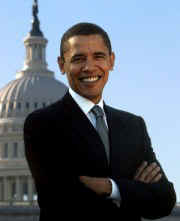 |
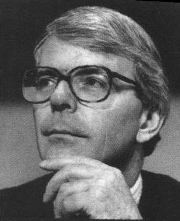
Former British
Prime Minister John Major (left) has lambasted the erosion of civil liberties in Britain
as a result of 'war on terror' measures based on bogus reasoning, including surveillance
without judicial authority. America is similarly
afflicted. Meanwhile some believe a 'war on terror' attack on Iran will be used by the
Bush administration to try and keep the American public compliantly nationalistic and
Barack Obama (right) out of the White House, according to the London
Times. The BBC
says talk of a strike on Iran before Bush leaves office is growing. The
Financial Times has also run a report entitled 'Israel ready to attack Iran' quoting
an Israeli deputy prime minister. |
"Such is the passion
of Mr McCain's anti-Iran rhetoric that some
informed observers in Washington believe a bombing campaign against Iran could be the 'October
surprise' that Republican strategists are planning to swing the election in their
favour if polling points to a Democrat victory. The
idea would be to present the war hero McCain as the best man to lead America at a time of
military danger. Mr Obama, if he was reluctant in his support of a pre-election bombing,
could be presented as a muddle-headed peacenik. And what if he denounced military action?
Mr Obama could then stand accused of insufficient patriotism or even outright treason. His
campaign would then come crashing down to a McGovern-style landslide defeat. That is the
nightmare scenario for what should be a dream election. But maybe my friends in America
who speculate along these lines are taking their cynicism too far."
Anatole Kaletsky - World problems for the White House
London
Times, 5 June 2008
"[James] Comey had been a loyal
political foot soldier of the Republican Party for many years. Yet in his testimony before
the Senate Judiciary Committee, he described how he had grown increasingly uneasy
reviewing the Bush administration's various domestic
surveillance and spying programs. Much of his
testimony centered on an operation so clandestine he wasn't allowed to name it or even
describe what it did. He did say, however, that he and Ashcroft had discussed the program
in March 2004, trying to decide whether it was legal under federal statutes....While
Comey, who left the Department of Justice in 2005, has steadfastly refused to comment
further on the matter, a number of former government employees and intelligence sources
with independent knowledge of domestic surveillance operations claim the program that
caused the flap between Comey and the White House was related to a database of Americans who might be considered potential threats
in the event of a national emergency.... In the wake
of 9/11, domestic surveillance programs of all sorts expanded dramatically. As one
well-placed source in the intelligence community puts it, 'The gloves seemed to come off.'
What is not yet clear is what sort of still-undisclosed programs may have been authorized
by the Bush White House."
The Last Roundup: Is the government compiling a secret list of citizens to detain under
martial law?
Radar Magazine,
May/June 2008
"Gordon Brown’s case for holding terrorism suspects without charge for 42 days is bogus and little more than
scaremongering, according to Sir John Major. The former Conservative Prime Minister, writing in The Times today, said that Mr Brown’s security measures
were more likely to encourage terrorist recruitment than defeat the extremist threat to
Britain.... Mr Brown is facing his most serious parliamentary test when the vote takes
place next Wednesday. It could be decided by the votes of the nine Democratic Unionists.
Yesterday’s criticisms will dent ministers’ confidence that amendments to the
Counter-Terrorism Bill had put them on track to win next week’s key vote. Sir
John’s attack is one of his strongest criticisms of Labour since he left office after
the general election defeat of 1997. He broadened his critique from the issue of 42 days
to wage an all-out attack on Labour’s conduct of
the War on Terror since 2001. Sir John said that
ancient British rights were under threat from a government that embellished the case for
going to war in Iraq, was complicit in the rendition of suspects to the American
internment camp at Guantanamo Bay and presented the public with a misleading case for
introducing compulsory ID cards....Sir John cautioned against the creation by Labour of 'an intrusive State with authoritarian tendencies'. He added: 'This is not a United Kingdom I recognise and Parliament
should not accept it.'”
42-day law will help terrorists, says Sir John Major
London Times,
6 June 2008
'Quick, Quick, Extradite, Extradite!'
42 Days Grace To Negotiate Foreign Extradition Charges And Avoid MI6 Dirty Linen
Surfacing In The British Courts
'Only For Use In Exceptionally Scandalous Circumstances'
"Gordon Brown's chances of avoiding a
humiliating defeat in the Commons this week dwindled after he effectively ruled out any
more significant changes to proposals to detain terror suspects for 42 days without
charge.... Although Mr Brown has made several concessions to the
rebels in recent weeks, he rejected giving further
ground in a letter that he sent to all Labour MPs on Saturday. Dismissing calls to make
the measure subject to judicial review, he said: 'I ... do not believe in this instance that this is the best
way forward.'”
Gordon Brown set to lose on 42-day detention
London Times,
9 June 2008
"Next week, when Parliament votes on
the proposal to detain terrorist suspects without charge for up to 42 days, hard choices
have to be made. Britain has lived with terrorist threats for decades. But I am under no
illusion that today's threats are different in their scale and nature from anything we
have faced before.... our first principle is that there should always be a maximum limit
on pre-charge detention.... Our second principle is that detention beyond 28 days can be
allowed only in truly exceptional circumstances."
42-day detention; a fair solution
London
Times, 2 June 2008
What Kind Of Circumstances For Example?
"Something
very odd is happening. The suspect wanted by the police for ‘masterminding’
the 7/7 and 21/7 bombings, Haroon Rashid Aswat, has now been detained in the UK for seven months, but apparently not even been questioned about
the bombings. Instead he is being held awaiting a decision by the Home Secretary to extradite him to the US on
the grounds of setting up a terrorist training base in Oregon. This may however be
explained by the
sensational statement made on the US Fox Television network by the American terrorism
expert, John Loftus, a former senior FBI prosecutor, that Aswat is in fact an agent of MI6 and has been under their protection for many years ...."
Michael Meacher, Former UK Minister of Environment
Axis of Lies is spun to hide the truth
Tribune, 12 May 2006
"Mr
Aswat is in custody fighting extradition to the US on terrorist charges."
Terror suspect who won court battle is named as a ‘top al-Qaeda agent’
London Times,
26 April 2008 |
"Aswat's cell phone received as many as 20 calls from several of the [7/7]
bombers, said intelligence and law enforcement officials, one of whom said the last call
was made in London the night before the July 7 bombings.... One intelligence official, who like others would discuss the
investigation only on condition of anonymity, said that the list of wanted suspects was
growing and that the inquiry had become far more complex in recent days.... Aswat was an aide then to Abu Hamza Masri, a fiery Muslim preacher who was arrested in April 2004 and charged with
a variety of terrorism-related offenses including involvement in the Oregon camp and a
role in a deadly hostage-taking in Yemen. Aswat's name does not appear in the August 2002 federal indictment of James
Ujaama, an American charged with planning to set up the camp, but law enforcement sources
said he was one of the unindicted co-conspirators referred to in the document."
Authorities Probe Pakistani Linked To Plot in Oregon
Washington
Post, 22 July 2005
"During the Soviet occupation of
Afghanistan in the 1980s, the US funded large numbers of jihadists through Pakistan's
secret intelligence service, the ISI. Later the US wanted to raise another jihadi corps,
again using proxies, to help Bosnian Muslims fight to
weaken the Serb government's hold on Yugoslavia. Those they turned to included
Pakistanis in Britain. According to a recent report by the Delhi-based Observer Research
Foundation, a contingent was also sent by the Pakistani government, then led by Benazir
Bhutto, at the request of the Clinton administration. This contingent was formed from the
Harkat-ul- Ansar (HUA) terrorist group and trained by the ISI. The report estimates that
about 200 Pakistani Muslims living in the UK went to Pakistan, trained in HUA camps and
joined the HUA's contingent in Bosnia. Most
significantly, this was 'with the full knowledge and complicity of the British and
American intelligence agencies'. As the 2002 Dutch
government report on Bosnia makes clear, the US provided a green light to groups on the
state department list of terrorist organisations, including the Lebanese-based Hizbullah,
to operate in Bosnia - an episode that calls into question the credibility of the
subsequent 'war on terror'. For nearly a decade the
US helped Islamist insurgents linked to Chechnya, Iran and Saudi Arabia destabilise the
former Yugoslavia. The insurgents were also allowed
to move further east to Kosovo. By the end of the fighting in Bosnia there were tens of
thousands of Islamist insurgents in Bosnia, Croatia
and Kosovo; many then moved west to Austria, Germany
and Switzerland. Less well known is evidence of the British government's
relationship with a wider Islamist terrorist network. During an interview
on Fox TV this summer, the former US federal prosecutor John Loftus reported that British intelligence had used the al-Muhajiroun group in London to recruit
Islamist militants with British passports for the war against the Serbs in Kosovo. Since July Scotland Yard has been interested in an alleged member of
al-Muhajiroun, Haroon Rashid Aswat, who some sources have suggested could have been behind the London
bombings. According to Loftus, Aswat was detained in Pakistan after leaving Britain, but was released after 24
hours. He was subsequently returned to Britain from Zambia, but has been detained solely for extradition to the US, not for questioning about the London bombings. Loftus claimed that Aswat is a British-backed
double agent, pursued by the police but protected by MI6. One British Muslim of Pakistani
origin radicalised by the civil war in Yugoslavia was LSE-educated Omar Saeed Sheikh..... This is all the more remarkable when
this is the same Omar Sheikh who, at the behest of
General Mahmood Ahmed, head of the ISI, wired $100,000 to Mohammed Atta, the leading 9/11
hijacker, before the New York attacks, as confirmed by Dennis Lormel, director of
FBI's financial crimes unit. Yet neither Ahmed nor Omar appears to have been sought for
questioning by the US about 9/11."
Michael Meacher, former UK Environment Minister
Britain now faces its own blowback
Guardian, 10
September 2005
'The Special
Relationship'
British And American Backed Islamic Terrorism In The Balkans - Click Here |
"The London School of Economics, known for its far-Left radicalism in the 1960s, has been host to at
least three al-Qa'eda-linked terrorists, The Telegraph has been told. The three -
including one man called Ahmed Omar Sheikh - have been revealed as having links with the LSE in an
intelligence file seen by this newspaper and now being studied by police.... Omar
Sheikh... has... been named as one of the key
financiers of Mohammed Atta, the pilot of
one of the jets that hit the World Trade Centre on September 11."
Al-Qa'eda terror trio linked to London School of
'Extremists'
Daily
Telegraph, 27 Jan 2002
"Omar
Sheikh is a British national born to Pakistani
parents in London on December 23, 1973. His early education was in the United Kingdom,
although he also spent four years at Lahore’s prestigious Aitchison College. He then
went to the London School of Economics (LSE) but dropped out before graduation. It is believed in some quarters
that while Omar Sheikh was at the LSE he was
recruited by the British intelligence agency MI6. It is said that MI6 persuaded him to take an active part in demonstrations against Serbian
aggression in Bosnia and even sent him to Kosovo to
join the jihad. At some point he probably became a
rogue or double agent."
President Purvez Musharraf of Pakistan
How we found Pearl buried in ten pieces
London Times,
26 September 2006
"According to the official
Whitehall-authored narrative, the four bombs, three on trains, the last on a bus, were the
work of a self-radicalised cell working alone on a budget of £8,000. The bombs were
home-made. There was no evidence of a mastermind nor of a network, other than a loose,
social nebula of radical Islamists.... Reassuring these reports may be, but they are
wrong, according to the respected terror analyst Nafeez Mosaddeq Ahmed, a tutor in
international relations and politics at the University of Sussex. His new book, The London Bombings: An Independent Inquiry, pulls apart the official narrative of 7/7, pointing out its gaps and
contradictions..... Evidence of al-Qa'ida involvement is suppressed, he says, to deflect
awkward questions about how a large terror network
flourished unchecked in Britain for 10 years....
there is the curious official reticence over proven links between the bombers' ringleader,
Mohammed Siddique Khan, and other terrorists, including senior al-Qa'ida lieutenants
abroad.... The official narrative baldly states: 'The extent to which others may have been
involved in indoctrinating the group, have known what they were planning, or been involved
in the planning, is unknown at this stage.' The ISC report goes a little further,
admitting that Khan and Tanweer probably received 'some form of operational training' in
Pakistan in the months before the attacks. But Mr
Ahmed is amazed that this ignores the telephone traffic between Khan and, among others, Haroon Rashid Aswat, an al-Qa'ida lieutenant
previously based in Pakistan, believed by US investigators to be the mastermind of 7/7. Mr Ahmed's
controversial inference is that MI5 is now trying to
cover up a tacit understanding with terror groups that operated until 9/11. They were allowed to operate as long as they did not bomb Britain or UK
targets abroad. There was, in effect, a 'covenant of
security', he says. Radicals
such as Omar Bakri and Abu Hamza, who did so much to foment violent Islamism in Britain,
were used by intelligence services..."
7/7 one year on: Why did it happen? The big questions still need answers
Independent On Sunday, 2 July 2006
MI6 Pet Jihadi Militants Bite Britain
As 'Covenant Of Security' Lifted Following British Participation In
The Occupation Of Iraq |
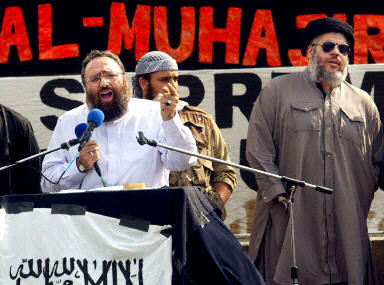 |
Omar Bakri Muhammed addresses an al-Muhajiroun rally in Trafalgar
Square, London (Abu-Hamza, right) |
"It is becoming clear that al-Muhajiroun (ALM), the group formed by Bakri in London less than a
decade ago, has played a pivotal role in radicalising young Britons who have gone on to
wreak terror in Britain and across the world.... Last November
Bakri announced that ALM was disbanding. Three months later he said the 'covenant of security' was no longer
in force. Experts note that the London bombings followed four months later."
Terror links of the Tottenham Ayatollah
London Times, 24 July 2005 |
"[Aswat] is from the area
around Leeds, close to where three of the other suspected bombers came from.....What
makes him of particular interest is he does seem to have very strong ties with al
Qaeda...... Aswat [is]
also linked with the radical cleric in London, Sheikh Abu
Hamza al-Mazri. Al-Mazri is in a British jail at this time. Aswat believed to be his right hand man. Sheikh Hamza al-Mazri believed to have
been involved in sending young Muslim men to al Qaeda training camps in Afghanistan and
Yemen.....There was wide speculation in the days
after the bombing that somebody high on a watch list, somebody that U.S. officials had
told British officials was high on their watch lists, arrived in Britain two weeks before
the bombing and that for some reason he wasn't closely followed while in Britain. It is
speculated, and it's not known. The police are very
tight-lipped on what they know about this investigation. It is speculated that this could have been Aswat, but he left just before the bombing happened, indeed, the morning that
the bombing happened. So it appears that he may well have come in the country, was on a
watch list, then left without being followed during that time in Britain."
More Blasts Hit London; British, Australian Leaders Denounce Terror
CNN, 21 July 2006
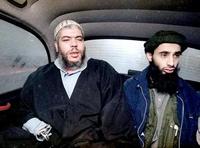 |
"Radical
cleric Abu Hamza al Masri, left, rides in a car in London on Jan. 20, 1999, with Haroon Aswat, a suspect in the London bombings. Abu Hamza has been described in a federal indictment as 'a terrorist
facilitator.' He lost both hands in an explosion."
Effort here to charge London suspect was blocked
Seattle Times,
24 July 2005 |
"Aswat is believed to be the
mastermind of all the bombings in London...
This is the guy, and what's really embarrassing is that the entire British police are out
chasing him, and one wing of the British
government, MI6 or the British Secret Service, has
been hiding him.... He's a double agent....
What ties all these cells together was, back in the
late 1990s, the leaders all worked for British
intelligence in Kosovo. Believe it or not, British intelligence actually hired some Al-Qaeda guys
to help defend the Muslim rights in Albania and in Kosovo. That's when Al-Muhajiroun got
started.....The CIA was funding the operation
to defend the Muslims, British intelligence was doing the hiring and recruiting. Now
we have a lot of detail on this because Captain Hook [Abu
Hamza], the head of Al-Muhajiroun, [his] sidekick was Bakri Mohammed, another cleric. And back on October 16, 2001, he gave a detailed
interview with al-Sharq al-Aswat, an Arabic newspaper in London, describing the relationship between British intelligence and the operations in Kosovo
and Al-Muhajiroun. So
that's how we get all these guys connected. It started in Kosovo...."
Interview with former US Federal Prosecutor John
Loftus
Fox TV, 29 July
2005
"British intelligence officials now
think that in the days and hours before the July 7 bombings, Aswat was in cellphone contact with at least two of the four suicide bombers,
according to The Times of London. Aswat was a highly public aide to Abu Hamza al
Masri, the militant cleric whose North London mosque
was a hotbed of radical Islamist preaching. In 1999, Aswat came to the attention of the FBI and federal prosecutors here as part of
the investigation into the Bly camp and its founder, former Seattle entrepreneur James
Ujaama....In May 2004, then-Attorney General John Ashcroft announced an 11-count
indictment by a federal grand jury in New York against Abu
Hamza, who allegedly sent Aswat to Oregon to scout out
the proposed training camp. A department news release said 'the indictment alleges that Abu Hamza was a terrorist
facilitator with global reach — from aiding hostage takers in Yemen, to attempting to
set up a jihad training camp in Oregon.' At the time,
however, federal prosecutors chose not to indict Aswat for reasons that are not clear.
Asked why Aswat
wasn't indicted, a federal official in Seattle replied, 'That's
a great question.'"
Effort here to charge London suspect was blocked
Seattle
Times, 24 July 2005
'We Are Dealing Here With Highly
Dangerous Terrorists Intelligence
Services'
"Both
MI5 and MI6 intelligence agencies want the extension [from 28 days to 42 days for the pre-charge detention of suspected
terrorists].... John Scarlett, head of MI6, and his
opposite number at MI5, Jonathan Evans, have made no secret of their concern over Lord
Goldsmith's decision to publicly oppose the 42-day extension. 'We are dealing here with highly
dangerous terrorists who have been trained to
withstand lengthy interrogations. We need every day to question them. Those extra 14 days
could be invaluable and give us time to legally expand our investigations,' said a senior
counter-intelligence officer."
Detention of jihad suspects at risk
WorldNetDaily,
7 June 2008
"Malcolm Muggeridge (former intelligence officer and journalist)
maintained that
'intelligence agents, in my
experience, are even bigger liars than journalists'."
Go to work on an ego: why spies need the last word
London Times, 1
December 2006
"Fred Burton, a Maryland police
officer who was interested in the broader field of law enforcement, was one of those fresh
recruits. For 10 years as a DSS officer, he debriefed released kidnap victims from Beirut
(which is how he briefly intersected Oliver North's covert arms for hostages enterprise),
investigated numerous airline downings and helped run to earth Ramzi Yousef, the
mastermind of the 1993 World Trade Center bombing. When Burton left the DSS in 1995, he
joined Stratfor, an intelligence consulting agency in Austin. His memoir of his time in
the DSS – 'Ghost: Confessions of a Counterterrorism Agent,' tells the story of his
biggest cases.... Austin American-Statesman: You did a field investigation of the (1988) airplane crash that killed
Pakistan President Muhammad Zia-ul-Haq and American Ambassador Arnold Raphel. Officially,
the American view is that this crash was caused by a malfunction. Do you buy that? Fred Burton: No. I was
there. The crash site was in a pretty remote area, and we went through it fairly well.
There was no logical explanation of how that plane went down except sabotage. Austin American-Statesman:
However, officially the U.S. government doesn't believe this. Austin
American-Statesman: Do you think the CIA believes
this? Fred Burton: Let me say this carefully. I think that the CIA thinks what I think about
that crash. Austin American-Statesman: Which leads me to a broader question. Though it might be true that, in
the short term, the government might think it should lie or obfuscate about this or that
intelligence-related matter, in the long term, hasn't this done incomparably more damage
to the trust the American people have in their own government? Fred Burton: Well, for governments, the truth is what we tell you. That's simply the
way they operate. People don't understand the sheer power of intelligence agencies."
Fred
Burton, answering a journalist's question about the culture of government lying on
intelligence matters. Burton is vice president for counterterrorism and corporate security
at Stratfor; formerly deputy
chief of the counterterrorism division of the U.S. State Department’s Diplomatic
Security Service; and one of the official
investigators of the 1993 World Trade Center Bombing and the assassination of Israeli
Prime Minister Yitzhak Rabin.
Ex-spy Fred Burton talks about 'Ghost'
AUSTIN
AMERICAN-STATESMAN, 8 June 2008
"One of al-Qaeda’s most dangerous
figures has been revealed as a double agent working
for MI5, raising criticism from European
governments, which repeatedly called for his arrest. Britain ignored warnings — which
began before the September 11 attacks — from half a dozen friendly governments about Abu Qatada’s links with
terrorist groups and refused to arrest him.... while
all along he was setting up a haven for his terror organisation in Britain... He pledged to MI5 that he would
not 'bite the hand that fed him'. ..... he was recruiting for
al-Qaeda training camps.... Indignant French officials accused MI5 of helping the cleric to
abscond. "
Al-Qaeda cleric exposed as an MI5 double agent
London Times,
25 March 2004
"The London-based Islamic cleric Abu Qatada, accused by
America of being a key member of Osama bin Laden's network, claims British security
services offered him a chance to escape to
Afghanistan. Abu Qatada, whose Bolton bank account
was frozen last week when he was named on a US list of suspected terrorists, told The
Observer that MI5 approached intermediaries to offer
him a passport and an Iranian visa so he could leave the country.... Intelligence sources in Pakistan claim.... to have proof that Abu
Qatada is consulted by al-Qaeda. They allege that a pamphlet he wrote on 'holy war' was
commissioned by them to help resolve a dispute with another extreme terror group,
Takfir-wal-Hirja."
MI5 wanted me to escape, claims cleric
Observer,
21 October 2001
"Over the years, some dissidents
suspected by foreign governments of involvement in terrorist acts have been protected by the British government for one reason or another from deportation or extradition.... In the past, terrorism experts say,
Britain benefited significantly from its willingness to extend at least conditional
hospitality to a wide range of Arab dissidents and opposition figures .... Mustafa Alani,
a terrorism expert at the Royal United Services Institute for Defense Studies, a London
think tank, said [Anas] al-Liby was probably left in legal limbo by the
British government, allowing him to be used or discarded as circumstances permitted.... According to a renegade officer for the British intelligence service
MI5, David Shayler, British intelligence plotted with
Islamic extremists [including al-Liby] to assassinate Gaddafi
in early 1996..."
Britain a Refuge for Mideast Dissidents
- Some With Suspected Ties to Bin Laden Resist Extradition
Washington
Post, 7 October 2001
It's The Dirty Linen Stupid!
"Abu Qatada is one of the ten men that the Government is now struggling to deport. If he reveals as part of his appeal that MI5 tried to recruit him, the
service will be highly embarrassed. And he may not be the only one to do so. The whispers are that several of these characters have as much on the intelligence services as they have on them. In the 1990s Britain made a fatal
decision, against the advice of other governments, to try to use these people rather than shut them down."
Lack-of-intelligence services
London Times, 18
August 2005 |
John Major's 'Total Loss Of
Privacy'
And The Bogus 'War On Terror'
"The Government's legislation to
permit 42 days pre-charge detention brings to the fore the wider question of civil
liberties. In their response to the security threat ministers have dragged us ever closer
to a society in which ancient rights are seriously damaged. I doubt this is the
Government's intention, but it is the effect. It began with Iraq. The invasion of Iraq was
justified by overegging the threat of Saddam Hussein's non-existent weapons of mass
destruction - perhaps that error was genuine. But the case for war was embellished by linking
the Iraqi regime to the 9/11 attacks on New York - for which there is not one shred of
evidence. As we moved towards war, that misinformation was compounded by the implication that Saddam's Iraq was a clear and
present danger to the United Kingdom, which plainly it was not. These actions damaged our reputation overseas. And, at home - on the back of the threat of terror and two serious
incidents in London - they foreshadowed a political climate in which civil liberties are slowly being sacrificed..... The Government has introduced measures to protect against terrorism.
These go beyond anything contemplated when Britain faced far more regular - and no less
violent - assaults from the IRA. The justification of
these has sometimes come close to scaremongering....
pre-charge detention in Canada is 24 hours; South
Africa, Germany, New Zealand and America 48 hours; Russia 5 days; and Turkey 7½ days..... But it is not only the case for 42 days
detention that is bogus. So is the case for identity cards. They were to be voluntary. Now it is
clear that they will be compulsory. Yet the Government has admitted that such cards would
not have stopped the London bombers. Nor will they cut illegal immigration, since
asylum-seekers have been obliged to carry ID cards for nearly eight years. Nor will they
have any real impact on benefits fraud, as this is typically caused by misrepresentation
of financial resources rather than by identity. The Government has been saying, in a
catchy, misleading piece of spin: 'If you have nothing to hide, you have nothing to fear.'
This is a demagogue's trick. We do have something to fear - the total loss of privacy to an intrusive
state with authoritarian tendencies. This is not a United Kingdom that I recognise and
Parliament should not accept it.... Nor do I believe that anyone can defend another
government innovation: a national identity register containing the DNA of tens of
thousands of people who have never been charged with an offence. Under present
legislation, DNA can be retained permanently for even minor misdemeanours, such as being
drunk. A total of more than four million samples are already on the UK database - far more
than in any other country. This includes tens of thousands of children, and a
disproportionate number of black men. If this is
accepted, it will one day go farther. This cannot be right: for me, it
is all uncomfortably authoritarian. So is a society in which the right to personal
privacy is downgraded. These days a police
superintendent can authorise bugging in public places. A chief constable can authorise
bugging our homes or cars. The Home Secretary can approve telephone tapping and the
interception of our letters and e-mails. All of this is legal under an Act passed by the
Labour Government. None of this requires - as it
should - the sanction of a High Court Judge."
42-day detention: the threat to our liberty
London
Times, 6 June 2008
From Meacher To Major
The Bogus 'War On Terror'
Nearly five years ago former British Environment Minister Michael Meacher wrote
an article in the British Guardian newspaper entitled 'This War On Terror
Is Bogus'.
Meacher claimed the United States was using the 'war on
terror' as cover for executing a hidden foreign policy agenda driven in large part by an emerging global energy crisis. He said the Iraq war had
been planned well before 9/11. Having been sacked by Tony Blair only a few months earlier
Meacher's claims caused an unprecedented stir, including open condemnation from Downing St
and the American Embassy in London.
Yet that article has since stood the test of time, not least because of the later revelation from Paul O'Neill (US Treasury
Secretary 2001-2002 who had attended the National Security Council meetings concerned) as
to how George Bush had instructed the Pentagon to begin examining military options against
Iraq within 10 days of his inauguration as US President in January 2001. This was more
than seven months before 9/11.
Now former British Prime Minster John Major has claimed in
an article written for the London Times that 'misinformation' was used to link the
Iraqi regime to the terror of 9/11. Whilst this is hardly news for most observant people,
'misinformation' is a powerfully acerbic term when used by a man who once led the country
that is today America's principle accomplice in the 'war on terror'.
Such was the import of these two 'pull-few-punches' articles (from the left and
the right) that both the
Guardian and the Times
also ran simultaneous front page news items concerning them on the days of their
publication.
The new piece from Major all but accuses New Labour of using the fear of
terrorism to scaremonger Britain into sacrificing its civil liberties - or, in effect,
(although Major does not say so in so many words) accusing the current government of
delivering the goals of the terrorists for them.
Having survived an
IRA mortar attack on himself and his cabinet in 1991, the former British Prime
Minister is clearly made of stronger, or less disingenuous, stuff than the current (and
immediately preceding) incumbent at Downing St, and he is well placed to take a stand on
such issues given his own direct personal exposure to terrorism.
This, of course, is to say nothing of the more successful IRA bomb attack on Mrs
Thatcher's cabinet at
the Grand Hotel in Brighton in 1984, after which a defiant and non-hysterical Britain
largely carried on as normal. Thatcher responded with the words, "All
attempts to destroy democracy by terrorism will fail."
But things are very different today.
Major rails at the principle of lengthy detention without charge, the compulsory
introduction of ID cards, and the ever expanding British government's powers of
surveillance over its own citizens.
These measures, says Major, "go beyond anything contemplated
when Britain faced more regular - and no less violent - assaults from the IRA."
He accuses the current government of demagoguery and expresses concern about "the
total loss of privacy to an intrusive state with authoritarian tendencies."
The Times describes his criticism as "an all-out attack on
Labour's conduct of the War on Terror since 2001."
And where does all this terror come from in the fist place? How many Islamic
terrorist attacks were there in Britain before it joined the invasions of Afghanistan and
Iraq?
During the 1990s the British authorities developed a 'Covenant
of Security' with British Islamic jihadis whereby, in return for an undertaking not to
commit acts of terrorism in the UK, they were allowed to go and fight in conflicts
overseas, sometimes with the involvement of MI6 (no less) where it suited British foreign
policy, such as in former Yugoslavia and North Africa prior to 9/11.
But this 'covenant' was rescinded in 2005 following British participation in the
invasion of Iraq, and after demands from the radical Islamic cleric Omar Bakri Muhammed for all foreign troops to be withdrawn were
not met. Four months after the termination of the covenant the suicide bombings on
London's transport system took place.
Bakri was the leader of Al-Muhajiroun, the radical Muslim group that MI6 is
reported to have used to secretly recruit jihadis for the fight against Serbia in the
Yugoslav civil war. Bakri is a well-known associate of Finsbury Park
Mosque firebrand preacher Abu Hamza in London. It is Hamza's close aide, Haroon Rashid
Aswat, who is alleged to have later become the mastermind of the 7/7
London bombings, having previously been recruited as an MI6 jihadi agent during the
fighting in Yugoslavia (as reportedly was, Omar Sheikh,
another British jihadi who is accused of being involved in organising the 9/11 attacks -
if so, then both the 9/11 and 7/7 attacks sprouted, at least in part, from seeds fed in
earlier years by MI6).
In these circumstances the 'dirt' such people have on MI6 can reasonably be
expected to have been a key motivator lying behind the intelligence services
interest in extending the detention without charge period to 42 days (and more if
they could get it).
It would appear from an account provided by former US federal
prosecutor, John Loftus, that some degree of panic broke out at MI6 when it surfaced
in the press that Aswat was the suspected mastermind of 7/7.
However, although eventually detained, Aswat has never been charged in
connection with the London bombings, and is now fighting extradition to the United States
on other charges.
From this perspective, were there to be a repeat of another ex-MI6 jihadi
carrying out a terrorist attack in Britain, the 42 day provision could be used to provide
more space within which to work out how to deal with the situation - i.e. before the
suspect becomes committed to entering British judicial processes where more than a few
embarrassing bogus 'war on terror' beans might be spilled.
Organising extradition to another country on other charges, as appears to have
happened in the Aswat case, might be one such 'solution'.
For American citizens in the US the equivalent detention without charge period
is only forty eight hours, according to John Major, so the current British proposal for 42
days would seem to have more than a feint whiff of a hidden agenda about it. And not
without justifiable suspicion.
Resident in Britain, Abu Qatada, a jihadi recruiter and fundraiser for Islamic
separatists in the
civil war in Chechnya (where Britain and America are accused by both Russia and a former senior Pentagon
insider of secretly fighting a post cold war proxy
mission against Moscow), claims that shortly after 9/11 "MI5 approached
intermediaries to offer him a passport and an Iranian visa so he could leave the
country" (according to
the Observer in an article entitled "MI5 wanted me to escape"),
rather than risk facing arrest (French
intelligence later accused the British of helping him to abscond within the UK).
However, Qatada turned them down, and the British government has seemingly done
everything in its power ever since to ensure that he is not prosecuted in an open British
civilian court.
Intelligence services in
other EU Countries claim Qatada has been under secret protection at various points.
The British government has ultimately resorted to trying to bury the problem by deporting
him (a 'solution' inconveniently stymied by the courts, as Qatada has successfully
pleaded that he would be likely to face torture if extradited to Jordan where he is wanted
on previous terrorism charges).
As the
London Times put it in August 2005, "Abu Qatada is one of the ten men
that the Government is now struggling to deport. If he reveals as part of his appeal that
MI5 tried to recruit him, the service will be highly embarrassed. And he may not be the
only one to do so. The whispers are that several of these characters have as much on the
intelligence services as they have on them. In the 1990s Britain made a fatal
decision, against the advice of other governments, to try to use these people rather than
shut them down."
What is the probability, therefore, that as part of a 'jihadi embarrassment
damage limitation exercise' MI6 will have exaggerated the severity of the national
security situation in
order to scare Gordon Brown into embarking on the 42 day saga, even if MI6 may not be
sure of being able to control any 'safeguards' that emerge during the course of the
legislative process?
Meanwhile, pre-suicide 'video will' recordings have made it absolutely clear, as acknowledged even
by the head of MI5, that the London 7/7 bombers took their action directly as a result
of the post 9/11 Anglo-American led occupations of Afghanistan and Iraq.
Exactly the same motivation would seem to apply to those currently on trial in
another prominent terrorism case in Britain, according to a
report in the London Times last week. Admitting to planning a bomb attack on the
British parliament building, the leader of the accused group said in court, "It
is nothing to do with Islamic fundamentalism or radical Islam, it is purely down to
foreign policy."
Citing research by Gallup's Center for Muslim Studies in
New York, the London Times reported in February 2007 that
"The War on Terror has radicalised Muslims around the world to unprecedented levels
of anti-American feeling... [Yet, surprisingly] Americans have more in common with Muslims
than they do with their Western counterparts in Europe. A large number of Muslims
supported the Western ideal of democratic government. Fifty per cent of radicals supported
democracy, compared with 35 per cent of moderates. Religion was found to have little to do
with radicalisation or antipathy towards Western culture. "
There is little reason to believe that the position is any
different in relation to Britain.
In parallel to this John Major claims that the false case made against Iraq "damaged
our reputation overseas."
But if Britain's reputation is damaged, America's seems to be in ruins.
Certainly this is the case if yet another opinion article in the
London Times, published the day before John Major's, is anything to go by.
Penned by the paper's much respected Associate
Editor Antole Kaletsky, this additional piece went so far as to consider the
possibility of the Bush administration planning a strike on Iran this autumn as an
'October Surprise' ploy to place Barack Obama in an unpatriotic light (assuming he failed
to endorse such an attack) as part of a calculated attempt to crush his bid for the
Whitehouse.
Whilst such a scenario is hopefully mere speculation (although Kaletsky says it
comes from 'informed observers in Washington') the very fact that it is possible to
publish such thoughts in a sober media outlet of this kind, illustrates just how low the
reputation of the current regime in Washington has sunk.
Yet, lest we forget, it was also Iran which became the pivot in the Republican
party's previous 'October Surprise' scheming in 1980 which took Ronald Reagan into the
White House, and laid the foundations for the ensuing, and similarly criminal, Iran-Contra
affair.
NLPWESSEX, natural law publishing
nlpwessex.org |
'October Surprise'
"Suspicions about a deal between the
Reagan campaign and Iran over the hostages have circulated since the day of President
Reagan's inaugural, when Iran agreed to release the 52 American hostages exactly five
minutes after Mr. Reagan took the oath of office. Later, as it became known that arms
started to flow to Iran via Israel only a few days after the inauguration, suspicions
deepened that a secret arms-for-hostages deal had been concluded. Five years later, when
the Iran-contra affair revealed what seemed to be a similar swap of hostages for arms
delivered through Israel, questions were revived about the 1980 election. In a nice,
ironic twist, the phrase 'October surprise,' which Vice Presidential candidate George Bush had coined to warn of
possible political manipulation of the hostages by Jimmy Carter, began to be applied to
the suspected secret activities of the 1980 Reagan-Bush campaign... In a Madrid hotel in
late July 1980, an important Iranian cleric, Mehdi Karrubi, who is now the speaker of the
Iranian Parliament, allegedly met with Mr. Casey [Reagan's campaign manager and later his
Director of the CIA] and a U.S. intelligence officer who was operating outside
authority. The same group met again several weeks later.... From Oct. 15 to Oct. 20,
events came to a head in a series of meetings in several hotels in Paris, involving
members of the Reagan-Bush campaign and high-level Iranian and Israeli representatives.
Accounts of these meetings and the exact number of participants vary considerably among
the more than 15 sources who claim direct or indirect knowledge of some aspect of them.
There is, however, widespread agreement on three points: William Casey was a key
participant: the Iranian representatives agreed that the hostages would not be released
prior to the Presidential election on Nov. 4; in return, Israel would serve as a conduit
for arms and spare parts to Iran. At least five of the sources who say they were in Paris
in connection with these meetings insist that George Bush was present for at least one
meeting. Three of the sources say that they saw him there... Immediately after the Paris
meetings, things began to happen. On Oct. 21, Iran publicly shifted its position in the
negotiations with the Carter Administration, disclaiming any further interest in receiving
military equipment.... Between Oct. 21 and Oct. 23, Israel sent a planeload of F-4 fighter
aircraft tires to Iran in contravention of the U.S. boycott and without informing
Washington. Cyrus Hashemi, using his own contacts began privately organizing military
shipments to Iran. On Oct. 22, the hostages were suddenly dispersed to different
locations. And a series of delaying tactics in late October by the Iranian Parliament
stymied all attempts by the Carter Administration to act on the hostage question until
only hours before Election Day... On Jan. 15, Iran did an about-face, offering a series of
startling concessions that reignited the talks and resulted in a final agreement in the
last few hours of Jimmy Carter's Presidency. The hostages were released on Jan. 21, 1981,
minutes after Ronald Reagan was sworn in as President. Almost immediately thereafter,
according to Israeli and American former officials, arms began to flow to Iran in
substantial quantities... Moshe Arens, the Israeli Ambassador to Washington in 1982, told
The Boston Globe in October 1982 that Israeli's arms shipments to Iran at this time were
coordinated with the U.S. Government 'at almost the highest of levels.' ... The
allegations of these individuals have many disturbing implications for the U.S. political
system. One is the tampering with foreign policy for partisan benefit. That has, of
course, happened before and it may well happen again, but it assumes special poignancy in
this case since it would have involved tampering with the lives and freedom of 52
Americans. Another implication is that leaders of the U.S. exposed themselves to the
possibility of blackmail by Iran or Israel. Third, the events suggest that the
arms-for-hostage deal that in the twilight of the Reagan Presidency became known as the Iran-contra
affair, instead of being an aberration, was in fact the re-emergence of a policy that
began even before the Reagan-Bush Administration took office."
Gary Sick - The Election Story of the
Decade
New York
Times, 15 April 1991
It's The Dirty Linen
Stupid!
42 Days Would Give More Space To Negotiate With Foreign Governments To Extradite
Suspects
Rather Than Have Bean-Spilling Ex-MI6 Jihadi Assets Pass Through The British Courts
'Quick, Quick, Extradite, Extradite!'
42 Days Grace To Negotiate Foreign Extradition Charges And Avoid MI6 Dirty Linen
Surfacing In The British Courts
'Only For Use In Exceptionally Scandalous Circumstances'
"Gordon Brown today made a defiant
stand in defence of his plan to detain terror suspects for up to 42 days without charge,
insisting he had balanced the need to protect civil liberties against the interests of
national security.....Brown rang some potential rebels at the weekend. But his hopes of
crafting a consensus will be undermined by the Council of Europe, and by the parliamentary
joint select committee on human rights, which is expected to reject the compromise being
touted by ministers. They have been privately suggesting that the detention powers would
be triggered only in defined 'grave exceptional
circumstances'...."
Brown remains defiant on 42 days
Guardian,
2 June 2008
What Kind Of Circumstances For Example?
"Something
very odd is happening. The suspect wanted by the police for ‘masterminding’
the 7/7 and 21/7 bombings, Haroon Rashid Aswat, has now been detained in the UK for seven months, but apparently not even been questioned about
the bombings. Instead he is being held awaiting a decision by the Home Secretary to extradite him to the US on
the grounds of setting up a terrorist training base in Oregon. This may however be
explained by the
sensational statement made on the US Fox Television network by the American terrorism
expert, John Loftus, a former senior FBI prosecutor, that Aswat is in fact an agent of MI6 and has been under their protection for many years ...."
Michael Meacher, Former UK Minister of Environment
Axis of Lies is spun to hide the truth
Tribune, 12 May 2006
"Mr
Aswat is in custody fighting extradition to the US on terrorist charges."
Terror suspect who won court battle is named as a ‘top al-Qaeda agent’
London Times,
26 April 2008 |
"Britain's most controversial top
lawyer, Lord Goldsmith, who was the Blair government attorney
general (2001-2007) and advised Blair legally could go to war against Iraq, now has
delivered a devastating blow to Blair's successor, Prime Minister Gordon Brown, according to a report in Joseph Farah's G2 Bulletin. Lord
Goldsmith has said he cannot support Brown's proposal to extend from 28 days to 42 days
the pre-trial detention of suspected terrorists. Both
MI5 and MI6 intelligence agencies want the extension.... John Scarlett, head of MI6, and
his opposite number at MI5, Jonathan Evans, have made no secret of their concern over Lord
Goldsmith's decision to publicly oppose the 42-day extension. 'We are dealing here with highly dangerous terrorists who have been
trained to withstand lengthy interrogations. We need every day to question them. Those
extra 14 days could be invaluable and give us time to legally expand our investigations,'
said a senior counter-intelligence officer."
Detention of jihad suspects at risk
WorldNetDaily,
7 June 2008
"A senior al-Qaeda leader is
reportedly being looked after by British intelligence at a safe house in northern England
- but security sources are denying the claim. Abu Qatada is accused by the United States,
Spain, France and Algeria of being a key influence in the 11 September attacks on the
US.... senior European intelligence officials have
reportedly told Time Magazine that Mr Qatada and his family are being lodged, fed and
clothed by British intelligence services. 'The deal is that Abu Qatada is
deprived of contact with extremists in London and Europe but can't be arrested or expelled
because no one officially knows where he is,' says the source, whose claims were
corroborated by French authorities according to the magazine.... Baltasar Garzon, a
Spanish National High Court judge charged with leading Spain's al-Qaeda crackdown, called
the Muslim cleric the 'spiritual head of the
mujahideen in Britain'. Judge Garzon, who questioned
al-Qaeda suspects in Madrid last year, said Mr Qatada was the most important British
contact of Spain-based terror suspect Abu Dahdah. Dahdah, whose real name is Imad Eddin
Barakat Yarbas, was one of eight suspected members of a group charged with preparing and
carrying out the 11 September attacks. Judge Garzon added that Mr Qatada had links with
terror suspects in Germany, France, Italy, Belgium, Britain and Spain. Following the
judge's comments, Mr Qatada told BBC Radio 4's Today programme Bin Laden 'had a point' in
his desire to rid his home country, Saudi Arabia, of any American influence. 'I believe in
Jihad,' he said. 'And I believe in the necessity of liberating our nation and freeing it
from bondage.'"
Britain 'sheltering al-Qaeda leader'
BBC Online, 8 July 2002
"Over the years, some dissidents
suspected by foreign governments of involvement in terrorist acts have been protected by the British government for one reason or
another from deportation or extradition.... In the
past, terrorism experts say, Britain benefited significantly from its willingness to
extend at least conditional hospitality to a wide range of Arab dissidents and opposition
figures .... Mustafa Alani, a terrorism expert at the Royal United Services Institute for
Defense Studies, a London think tank, said [Anas] al-Liby
was probably left in legal limbo by the British government, allowing him to
be used or discarded as circumstances permitted....
According to a renegade officer for the British intelligence service MI5, David Shayler, British intelligence plotted with Islamic extremists [including al-Liby] to assassinate Gaddafi in early 1996..."
Britain a Refuge for Mideast Dissidents
- Some With Suspected Ties to Bin Laden Resist Extradition
Washington
Post, 7 October 2001
"One of al-Qaeda’s most dangerous
figures has been revealed as a double agent working
for MI5, raising criticism from European
governments, which repeatedly called for his arrest. Britain ignored warnings — which
began before the September 11 attacks — from half a dozen friendly governments about
Abu Qatada’s links with terrorist groups and refused to arrest him.... while all along he was setting up a haven for his terror
organisation in Britain... He pledged to MI5 that he would not 'bite the hand that fed him'. ..... he was recruiting for
al-Qaeda training camps.... Indignant French officials accused MI5 of helping the cleric to
abscond. "
Al-Qaeda cleric exposed as an MI5 double agent
London Times,
25 March 2004
"The London-based Islamic cleric Abu
Qatada, accused by America of being a key member of Osama bin Laden's network, claims
British security services offered him a chance to escape to Afghanistan. Abu Qatada, whose
Bolton bank account was frozen last week when he was named on a US list of suspected
terrorists, told The Observer that MI5 approached
intermediaries to offer him a passport and an Iranian visa so he could leave the country.... Intelligence sources in Pakistan claim.... to have proof that Abu
Qatada is consulted by al-Qaeda. They allege that a pamphlet he wrote on 'holy war' was
commissioned by them to help resolve a dispute with another extreme terror group,
Takfir-wal-Hirja."
MI5 wanted me to escape, claims cleric
Observer,
21 October 2001
"Abu Qatada is one of the ten men that the Government
is now struggling to deport. If he reveals as part of his appeal that MI5 tried to recruit
him, the service will be highly embarrassed. And he may not be the only one to do so. The whispers are that several of
these characters have as much on the intelligence services as they have on them. In the 1990s Britain made a fatal
decision, against the advice of other governments, to try to use these people rather than
shut them down."
Lack-of-intelligence services
London Times, 18
August 2005
"....all these guys
should be going back to an organization called Al-Muhajiroun, which means The Emigrants. It was the recruiting arm of
Al-Qaeda in London; they specialized in recruiting kids whose families had emigrated to
Britain but who had British passports. And they would use them for terrorist work.... the
first group of course were primarily Pakistani. But what they had in common was they were
all emigrant groups in Britain, recruited by this Al-Muhajiroun group. They were headed by
the, Captain Hook, the imam in London the Finsbury Mosque, without the arm. He was the
head of that organization. Now his assistant was a guy named Aswat, Haroon Rashid Aswat. Aswat is believed to be the mastermind of all the bombings in London... This is the guy, and what's really embarrassing is that the
entire British police are out chasing him, and one wing of the British government, MI6 or the British Secret Service, has been
hiding him.... He's a double agent....
Now we knew about this guy Aswat. Back in 1999 he came to America. The Justice Department
wanted to indict him in Seattle because him and his buddy were trying to set up a
terrorist training school in Oregon..... Well it comes out, we've just learned that the headquarters of the US Justice Department
ordered the Seattle prosecutors not to touch Aswat..... apparently Aswat was working for British intelligence.... Some people say
that the British intelligence fibbed to us. They told us that Aswat was dead, and that's
why the New York group dropped the case. That's not what most of the Justice Department
thinks. They think that it was just again covering up for this very publicly affiliated
guy with Al-Muhajiroun. He was a British intelligence plant.... Now at this point, two
weeks ago, the Brits know that the CIA wants to get a hold of Haroon. So what happens? He
takes off again, goes right to London. He isn't arrested when he lands, he isn't arrested
when he leaves. ... He's on the watch list. The only reason he could get away with that
was if he was working for British intelligence. He was a wanted man.... And [he] goes to Pakistan.... The Pakistanis
arrest him. They jail him. He's released within 24 hours. Back to Southern Africa, goes to
Zimbabwe and is arrested in Zambia.... What ties all these cells together
was, back in the late 1990s, the leaders all worked for British intelligence in Kosovo.
Believe it or not, British intelligence actually
hired some Al-Qaeda guys to help defend the Muslim rights in Albania and in Kosovo.
That's when Al-Muhajiroun got started.....The CIA was
funding the operation to defend the Muslims, British intelligence was doing the hiring and
recruiting. Now we have a lot of detail on this because Captain Hook, the head of
Al-Muhajiroun, [his] sidekick was Bakri Mohammed, another cleric. And back on October 16,
2001, he gave a detailed interview with al-Sharq al-Aswat, an Arabic newspaper in London,
describing the relationship between British
intelligence and the operations in Kosovo and Al-Muhajiroun. So that's how we get all these guys connected. It started in Kosovo...."
Interview with former US Federal Prosecutor John
Loftus
Fox TV, 29 July
2005
"According to the official
Whitehall-authored narrative, the four bombs, three on trains, the last on a bus, were the
work of a self-radicalised cell working alone on a budget of £8,000. The bombs were
home-made. There was no evidence of a mastermind nor of a network, other than a loose,
social nebula of radical Islamists.... Reassuring these reports may be, but they are
wrong, according to the respected terror analyst Nafeez Mosaddeq Ahmed, a tutor in
international relations and politics at the University of Sussex. His new book, The London Bombings: An Independent Inquiry, pulls apart the official narrative of 7/7, pointing out its gaps and
contradictions..... Evidence of al-Qa'ida involvement is suppressed, he says, to deflect
awkward questions about how a large terror network
flourished unchecked in Britain for 10 years....
there is the curious official reticence over proven links between the bombers' ringleader,
Mohammed Siddique Khan, and other terrorists, including senior al-Qa'ida lieutenants
abroad.... The official narrative baldly states: 'The extent to which others may have been
involved in indoctrinating the group, have known what they were planning, or been involved
in the planning, is unknown at this stage.' The ISC report goes a little further,
admitting that Khan and Tanweer probably received 'some form of operational training' in
Pakistan in the months before the attacks. But Mr
Ahmed is amazed that this ignores the telephone traffic between Khan and, among others, Haroon Rashid Aswat, an al-Qa'ida lieutenant
previously based in Pakistan, believed by US investigators to be the mastermind of 7/7. Mr Ahmed's
controversial inference is that MI5 is now trying to
cover up a tacit understanding with terror groups that operated until 9/11. They were allowed to operate as long as they did not bomb Britain or UK
targets abroad. There was, in effect, a 'covenant of
security', he says. Radicals
such as Omar Bakri and Abu Hamza, who did so much to foment violent Islamism in Britain,
were used by intelligence services..."
7/7 one year on: Why did it happen? The big questions still need answers
Independent On Sunday, 2 July 2006
Invasion Of Iraq Precipitates
End Of 'Covenant Of Security'
And 7/7 Bombings Followed
"On Thursday evening,
at a tennis center community hall in Slough, west of London, their leader, Sheik Omar Bakri Mohammad,
spoke of his adherence to Osama bin Laden. If Europe fails to heed Mr. bin Laden's offer
of a truce — provided that all foreign troops
are withdrawn from Iraq in three months —
Muslims will no longer be restrained from attacking the Western countries that play host
to them [i.e. the 'coventant of security' will be brought to an end], the sheik said....
'Iraq dramatically strengthened their recruitment efforts,' one counterterrorism official
said."
Chorus of Muslim radicalism rising in Europe
New York
Times, 27 April 2004
"Britain on Friday barred radical
Muslim cleric Omar Bakri from returning to the country that was his home [Britain] for the past 20 years, saying
his presence was no longer 'conducive to the public good.' The decision came as the country’s
top legal official defended plans to deport another radical Muslim cleric and nine other foreigners suspected of
posing a threat to national security. The moves are an indication of the dramatic impact
of last month’s transit bombings [7/7] in a
country until recently regarded as something of a safe haven for radicals. Jordan said Friday it
would ask Britain next week to extradite one of those detained, cleric Omar Mahmoud Othman Abu Omar, also known as
Abu Qatada.
Spanish officials have described him as Osama bin Laden’s 'spiritual ambassador in
Europe.' Bakri, 45, left Britain on Saturday, one day after Prime Minister Tony Blair
proposed tough new anti-terrorism measures including the deportation of extremist Islamic clerics who preach hate. Bakri was arrested in
Lebanon on Thursday. Bakri, who has dual Syrian and Lebanese citizenship, had come under
increasing pressure from the British government for his hard-line rhetoric after last month’s [London] bombings. He had insisted that he planned to return to north London, where his
wife and children live. Home Secretary Charles Clarke had written to Bakri to inform him
he would not be allowed back into Britain. The cleric has 14 days to appeal.... Bakri
founded the now-disbanded radical Islamic group al-Muhajiroun, which came under scrutiny in Britain, particularly after some of its
members praised the Sept. 11, 2001, attacks on the United States.”
Britain bars radical Muslim cleric's reentry
MSNBC, 12 August 2005
"Dr Mohammed al-Masari, a Saudi
extremist who has permission to remain here indefinitely, claims Britain's tolerance
towards Islamic radicals helps keep it free from attack.... Masari, who helped Fawwaz
establish bin Laden's London office, is now in close and open alliance with two other
leading British Islamic extremists: Sheikh Abu Hamza
al Masri and Sheikh Omar Bakri Mohammed. Bakri is
the leader of al-Muhajiroun, a highly vocal group which apes fringe Left-wing groups in trying to
recruit impressionable young members at universities and mosques. During the fighting in
Afghanistan, some al-Muhajiroun spokesmen claimed that hundreds of young Muslims were
leaving British cities to fight for the Taliban... While Bakri's activities are thought to
be largely propagandist, Hamza is regarded as a more sinister figure. Born Mustafa Kamel in Egypt in
1958 he holds British citizenship and is imam of the North London Central Mosque in
Finsbury Park - a base for radical politics. Among those who frequented the mosque are
Richard Reid, the shoe bomber, and Zacarias Moussaoui, a former student in London now in
jail in America accused of being the '20th hijacker'.... Others who passed through
Finsbury Park included Djamel Beghal and Kamel Daoudi, both in custody in France accused
in connection with a plot to blow up the US embassy in Paris... Hamza is wanted by the
authorities in Yemen for alleged terrorist activities and is at the centre of an FBI
investigation into attempts to establish a jihad training camp in Oregon. After Hamza the most radical and
dangerous cleric is considered to be Abu Qatada. He was named by a Spanish judge as bin Laden's 'spiritual ambassador' in
Europe. Some sources claim that he was taken by MI5
to a safe house."
Britain a perfect haven for Islamic radicals looking for recruits
Daily
Telegraph, 11 September 2002
MI6 Pet Jihadi Militants Bite Britain
As 'Covenant Of Security' Lifted Following British Participation In
The Occupation Of Iraq |
|
Omar Bakri Muhammed addresses an al-Muhajiroun rally in Trafalgar
Square, London (Abu-Hamza, right) |
"It is becoming clear that al-Muhajiroun
(ALM), the group formed by Bakri in London less than a decade ago, has played a pivotal role in
radicalising young Britons who have gone on to wreak terror in Britain and across the
world.... Last November Bakri announced that ALM was disbanding.
Three months later he said the 'covenant of security'
was no longer in force. Experts note that the London
bombings followed four months later."
Terror links of the Tottenham Ayatollah
London Times, 24 July 2005 |
"During the Soviet occupation of
Afghanistan in the 1980s, the US funded large numbers of jihadists through Pakistan's
secret intelligence service, the ISI. Later the US wanted to raise another jihadi corps,
again using proxies, to help Bosnian Muslims fight to weaken the Serb government's hold on
Yugoslavia. Those they turned to included Pakistanis in Britain. According to a recent
report by the Delhi-based Observer Research Foundation, a contingent was also sent by the
Pakistani government, then led by Benazir Bhutto, at the request of the Clinton
administration. This contingent was formed from the Harkat-ul- Ansar (HUA) terrorist group
and trained by the ISI. The report estimates that about 200 Pakistani Muslims living in
the UK went to Pakistan, trained in HUA camps and joined the HUA's contingent in Bosnia. Most significantly, this was 'with the full knowledge and
complicity of the British and American intelligence agencies'. As the 2002 Dutch government report on Bosnia makes clear, the US provided
a green light to groups on the state department list of terrorist organisations, including
the Lebanese-based Hizbullah, to operate in Bosnia - an episode that calls into question
the credibility of the subsequent 'war on terror'. For
nearly a decade the US helped Islamist insurgents linked to Chechnya, Iran and Saudi
Arabia destabilise the former Yugoslavia. The
insurgents were also allowed to move further east to Kosovo. By the end of the fighting in
Bosnia there were tens of thousands of Islamist insurgents in Bosnia,
Croatia and Kosovo; many then moved west to Austria,
Germany and Switzerland. Less well known is evidence of the British government's
relationship with a wider Islamist terrorist network. During an interview
on Fox TV this summer, the former US federal prosecutor John Loftus reported that British intelligence had used the al-Muhajiroun group in London to recruit
Islamist militants with British passports for the war against the Serbs in Kosovo. Since July Scotland Yard has been interested in an alleged member of
al-Muhajiroun, Haroon Rashid Aswat, who some sources have suggested could have been behind
the London bombings. According to Loftus, Aswat was detained in Pakistan after leaving
Britain, but was released after 24 hours. He was subsequently returned to Britain from
Zambia, but has been detained solely for extradition to the US, not for questioning about
the London bombings. Loftus claimed that Aswat is a British-backed double agent, pursued
by the police but protected by MI6. One British Muslim of Pakistani origin radicalised by
the civil war in Yugoslavia was LSE-educated Omar Saeed
Sheikh..... This is all the more remarkable when this is the same Omar Sheikh who, at the behest of
General Mahmood Ahmed, head of the ISI, wired $100,000 to Mohammed Atta, the leading 9/11
hijacker, before the New York attacks, as confirmed by Dennis Lormel, director of
FBI's financial crimes unit. Yet neither Ahmed nor Omar appears to have been sought for
questioning by the US about 9/11."
Michael Meacher, former UK Environment Minister
Britain now faces its own blowback
Guardian, 10
September 2005
"The London School of Economics, known for its far-Left radicalism in the 1960s, has been host to at
least three al-Qa'eda-linked terrorists, The Telegraph has been told. The three -
including one man called Ahmed Omar Sheikh - have been revealed as having links with the LSE in an
intelligence file seen by this newspaper and now being studied by police.... Omar
Sheikh... has... been named as one of the key
financiers of Mohammed Atta, the pilot of
one of the jets that hit the World Trade Centre on September 11."
Al-Qa'eda terror trio linked to London School of
'Extremists'
Daily
Telegraph, 27 Jan 2002
"Omar
Sheikh is a British national born to Pakistani
parents in London on December 23, 1973. His early education was in the United Kingdom,
although he also spent four years at Lahore’s prestigious Aitchison College. He then
went to the London School of Economics (LSE) but dropped out before graduation. It is
believed in some quarters that while Omar Sheikh was at the LSE he was recruited by the British intelligence agency MI6. It is said that MI6 persuaded him to take an
active part in demonstrations against Serbian aggression in Bosnia and even sent him to Kosovo to join the jihad. At some point he probably became a rogue or double agent."
President Purvez Musharraf of Pakistan
How we found Pearl buried in ten pieces
London Times,
26 September 2006
Why Isn't Aswat Being Tried In The UK For
7/7?
"A suspected terrorist who scored a
legal victory against the Government this week is a senior al-Qaeda operative living
openly in London, security agencies say. The man, who can be identified only as G, is one
of five people who challenged the Treasury’s powers to freeze terrorist
suspects’ bank accounts in a successful High Court action....While in Pakistan, G is
said to have met Haroon Rashid Aswat, another Briton who is suspected of involvement in terrorism, and who was
arrested in southern Africa in 2005. Mr Aswat is in
custody fighting extradition to
the US on terrorist charges."
Terror suspect who won court battle is named as a ‘top al-Qaeda agent’
London Times,
26 April 2008
"Aswat's cell phone received as many as 20 calls from several of the [7/7]
bombers, said intelligence and law enforcement officials, one of whom said the last call
was made in London the night before the July 7 bombings.... One intelligence official, who like others would discuss the
investigation only on condition of anonymity, said that the list of wanted suspects was
growing and that the inquiry had become far more complex in recent days.... Aswat was an aide then to Abu Hamza Masri, a fiery Muslim preacher who was arrested in April 2004 and charged with
a variety of terrorism-related offenses including involvement in the Oregon camp and a
role in a deadly hostage-taking in Yemen. Aswat's name does not appear in the August 2002
federal indictment of James Ujaama, an American charged with planning to set up the camp,
but law enforcement sources said he was one of the unindicted co-conspirators referred to
in the document."
Authorities Probe Pakistani Linked To Plot in Oregon
Washington
Post, 22 July 2005
"[Aswat] is from the area
around Leeds, close to where three of the other suspected bombers came from.....What
makes him of particular interest is he does seem to have very strong ties with al
Qaeda...... Aswat [is]
also linked with the radical cleric in London, Sheikh Abu
Hamza al-Mazri. Al-Mazri is in a British jail at
this time. Aswat
believed to be his right hand man. Sheikh Hamza al-Mazri believed to have been involved in
sending young Muslim men to al Qaeda training camps in Afghanistan and Yemen.....There was wide speculation in the days after the bombing that
somebody high on a watch list, somebody that U.S. officials had told British officials was
high on their watch lists, arrived in Britain two weeks before the bombing and that for
some reason he wasn't closely followed while in Britain. It is speculated, and it's not
known. The police are very tight-lipped on what they
know about this investigation. It is speculated that
this could have been Aswat, but he left just before the bombing happened, indeed, the morning that
the bombing happened. So it appears that he may well have come in the country, was on a
watch list, then left without being followed during that time in Britain."
More Blasts Hit London; British, Australian Leaders Denounce Terror
CNN, 21 July 2006
'The
War On Terror'
How Downing St Is Destroying Our Way Of Life Faster Than The Terrorists
"The failure of Messrs Bush and Blair and the neo-cons to
understand Arab grievances has been translated into a 'clash of civilisations' and a
threat to Western values 'by people determined to destroy our way of life', as the Prime
Minister put it. But there is no clash of civilisations unless we are determined to create
one. We are not going to live under a universal caliphate.
Osama bin Laden and his gangsters have not the faintest chance of
destroying our way of life, unless we do so ourselves..... The misconceived 'war on terror' has made the world a much more
dangerous place.... America and Britain should leave Iraq as soon as possible. There are
no other options. .... it is the American occupation of Iraq, like the Russian occupation
of Afghanistan, that has become the magnet for the international jihadis....."
Lord Norman Lamont, British Chancellor
of the Exchequer, 1990-93
America and Britain should quit Iraq as soon as possible
Daily
Telegraph, 10 November 2006
"Almost 450,000
requests were made to monitor people’s telephone calls, e-mails and post by secret agencies and other
authorised bodies in just over a year, the spying watchdog said yesterday. In the first
report of its kind from the Interceptions of
Communications Commissioner, it was also revealed
that nearly 4,000 errors were reported in a 15-month period from 2005 to 2006. .....
He said it was time to lift a ban on tapping the phones of
MPs and peers....."
Privacy row as checks on phones and e-mails hit 439,000
London
Times, 20 February 2007
"The huge Commons majority he [Blair] enjoyed, the craven
pusillanimity of his party, the implosion of the Conservatives and the consequent absence
of opposition, other than in the Lords – and, to an extent, in the courts –
conspired with a genuine, though
irrational,
fear of terrorism and rising street crime
to let the State take greater control over the citizen than it has enjoyed before
in modern peacetime..... Maya Evans found this out when she stood by the Cenotaph to
recite the names of Britain’s Iraqi war dead. For this she was arrested, arraigned
and left with a criminal record. It is hard to conceive of a police officer a generation
ago taking any notice of her since she was causing no public order problem at all. But Ms
Evans had fallen foul of a clause in the Serious and Organised Crime and Police Act
which established a one kilometre zone around the Palace of Westminster, within whose
boundaries political criticism can be voiced
only on application to the Commissioner of the Metropolitan Police.... recent research has uncovered 266 separate powers under which the police and other state agents can
enter your home, often using force to do so....
As Peter Lilley, the former minister who led the Cabinet revolt that resulted in the
abandonment of the last ID scheme, observed: 'There is no policy that has been hawked,
unsold, around Whitehall for longer than identity cards. It was always brought to us as a
solution looking for problems.' September 11
and the threat from international terrorism was the problem it had most been looking for.... There are people who remember carrying the old wartime ID
cards, scrapped in 1952, and cannot see what all the fuss is about. It is about the database, not the card. This is not about protecting our identities but
about placing them at the disposal of the
state and sundry other organisations that
will have access to them. .... this extension of state control through the
unfettered and unthinking deployment of modern
surveillance technology and databases for
which the Blair years (and those of his successor, unless he does something dramatic to
change course) will most be remembered. Our children, and theirs, will be perplexed as to
why their forebears came so easily, and with so little public debate, to allow the State to manipulate their lives."
Philip Johnston, home affairs editor and assistant
editor of The Daily Telegraph
The Charles Douglas-Home Essay, 2007 - 'Are we a free country any more?'
London Times, 20 July 2007
"The multibillion-pound identity card
scheme could be used to carry out surveillance on millions of people, a Commons select
committee said yesterday. MPs added that they were seriously concerned at the way that
local councils and other agencies were using spying powers to deal with low-level crimes
such as dropping litter. In a 117-page report on surveillance, the Commons Home Affairs
Select Committee urged the Government to make it easier for the public to challenge
decisions to keep their DNA on the national database. Keith Vaz, its chairman, said: 'What
we are calling for is an overall principle of ‘least data, for least time'. We have
all seen over the past year extraordinary examples of how badly things can go wrong when
data is mis-handled, with potentially disastrous consequences.' He added: 'The public
don't have much choice over the data held on them by public bodies so they must be
confident about how it is being collected, stored and used, otherwise we are in danger of
becoming a surveillance society.' The report, entitled A Surveillance Society?, said that it accepted
assurances from ministers that surveillance was not part of the current plans for the ID
card scheme, but it sought guarantees that no expansion would take place without MPs'
approval. The committee expressed alarm at the extent to which surveillance operations
under the Regulation of Investigatory Powers Act are being used for minor offending.
Recent figures show that local councils have been using the Act to conduct surveillance to
deal with flytipping, littering, dog fouling and the sale of alcohol to those aged under
18. Yesterday's report said that at the end of last year 656,000 of the 4.2 million
samples on the DNA database were replicas and that thousands more were samples taken from
people who were arrested but not charged subsequently with an offence."
MPs fear ID cards could be used for spying
London Times, 9 June
2009
Why 'The War On
Terror'?
It's The Foreign Occupations Stupid
"....[After the 1990 Iraqi invasion of
Kuwait] President Bush was hesitant about how America should respond. His foreign policy
alter ego, Secretary of State Jim Baker, and his Defense Secretary, Dick Cheney, were
reluctant to act. National Security Advisor Brent Scowcroft, however, thought that Iraq
had just changed the strategic equation in a way that could not be permitted. So did
British Prime Minister Margaret Thatcher. The two
argued that nothing stood between the advance of units of the Iraqi army in Kuwait and the
immense Saudi oil fields. If we did nothing in response to Iraq's seizing Kuwait, Saddam
Hussein would think that he could get away with seizing the Saudis' eastern oil fields. If
that happened, Baghdad would control most of the world's readily available oil. They could
dictate to America. Reluctantly, Bush and his team decided that they needed to
defend the Saudi oil fields, and do so quickly. They
needed Saudi permission for the defensive deployment, but there were some in the Pentagon
and White House who thought U.S. forces needed to protect the Saudi oil with or without
Saudi approval. The mission to persuade the Saudi King to accept U.S forces was given to
Defense Secretary Dick Cheney. He assembled a small team, including Under Secretary of
Defense Paul Wolfowitz, Central Command head Norman Schwarzkopf, Sandy Charles of the NSC,
and me, then the Assistant Secretary of State for Politico-Military Affairs... Cheney
concluded the presentation, promising that U.S forces would come only to defend the
Kingdom. President Bush wanted the King to know that he had the President's word that the
U.S. forces would leave as soon as the threat was over, or whenever ordered to do so by
the King. ..... Unknown to the Americans at the time, the intelligence chief, Prince
Turki, had been approached by the Saudi who had recruited Arabs to fight in the Afghan War
against the Soviets, Usama Bin Laden........ When Kuwait was invaded, he offered to make
them available to the King to defend Saudi Arabia, to drive Saddam out of Kuwait. After we
left the palace, perhaps bin Laden was told of the King's decision. His help would not be
required. He could not believe it; letting
nonbelievers into the Kingdom of the Two Holy Mosques was against the beliefs of the
Wahhabist branch of Islam. Large numbers of American military in the Kingdom would violate
Islam, the construction magnate's son thought. They would
never leave."
Richard Clarke - White House Head Of Counterterrorism 1992 - 2003
Chapter 3, Unfinished Mission, Unintended Consequences
'Against All Enemies' - Edition first published in Great
Britain by The Free Press in 2004
"America
began a historic reshaping of its presence in the Middle East yesterday, announcing a
halt to active military operations in Saudi Arabia and the removal of almost all of
its forces from the kingdom within weeks. The withdrawal ends a contentious 12-year-old
presence in Saudi Arabia and marks the most dramatic in a set of sweeping changes in the
deployment of American forces after the war in Iraq. Withdrawal of 'infidel' American forces from Saudi Arabia has been one of the demands of Osama bin Laden, although a senior US military official said that this was
'irrelevant'.... Behind the dry talk of rearranging America's military 'footprint' in the
Gulf, the great imponderables were bin Laden and Muslim radicals' complaints about the
presence of 'infidels' in the birthplace of Islam. That presence was cited as one of the
main justifications for the September 11 attacks. Despite American insistence that the
withdrawal had not been 'dictated' by al-Qa'eda and that bin Laden was 'irrelevant', there
can be little doubt that undercutting a central plank of al-Qa'eda's platform is one of
several advantages offered by withdrawal from Saudi Arabia."
America to withdraw troops from Saudi Arabia
Daily
Telegraph, 30 April 2003
"America's
announcement of its intention to withdraw its military bases from Saudi Arabia
[following the moving of US troops into Iraq] answers Osama
bin Laden's most persistent demand. More than any other cause it was the presence of
'crusader' forces in the land of Islam's holiest sites - Mecca
and Medina - that turned bin Laden from Afghan jihadi [and US
ally] into an international terrorist [and US opponent]. A wealthy Saudi with royal connections, bin Laden fell out with the House of Saud largely because it permitted US
bases in the country. When Saddam Hussein invaded Kuwait in
1990, bin Laden offered his own forces to the Saudi regime to help expel the Iraqis from
the Gulf. He was enraged when the Saudi royal family turned instead to Washington and more
than 500,000 US troops were sent. The same year the
Americans arrived, bin Laden fled Saudi - where he faced house arrest - and established
his base in Sudan. He and his al-Qa'eda forces moved to Afghanistan in 1996, issuing the
first of his international fatwas through the London-based Al Quds Al Arabi newspaper.
After railing against the persecution of Muslims around the world, bin Laden stated: 'The
latest and greatest of these aggressions incurred by Muslims since the death of the
Prophet … is the occupation of the land of the two Holy Places - the foundation of
the House of Islam, the place of the revelation, the source of the message and the place
of the noble Ka'ba, the Qiblah of Muslims, by the armies of the American Crusaders and
their allies. We bemoan this and can only say 'No power and power acquiring except through
Allah'. '.... The US withdrawal from Saudi will not be enough to satisfy bin Laden or his
followers. It may, however, make life easier for the Saudi regime, which has been
struggling to quell growing dissent within the kingdom over the presence of 'infidel'
soldiers."
Bin Laden's main demand is met
Daily
Telegraph, 30 April 2003
The Anger Over Western Military Presence In Saudi
Arabia
Has Been Replaced By Anger Over Western Military Presence In Iraq
"I rarely speak in public. I prefer to avoid the limelight and get on with my job. I speak not as a
politician, nor as a pundit, but as someone who has been an intelligence professional for
32 years..... There has been much speculation about what motivates young men and women to
carry out acts of terrorism in the UK. My service
needs to understand the motivations behind terrorism
to succeed in countering it, as far as that is possible. Al-Qaeda has developed an
ideology which claims that Islam is under attack, and needs to be defended.
This is a powerful narrative that weaves together conflicts from across the globe,
presenting the West's response to varied and complex issues, from long-standing disputes
such as Israel/Palestine and Kashmir to more recent events as evidence of an
across-the-board determination to undermine and humiliate Islam worldwide. The video wills of British suicide bombers make
it clear that they are motivated by perceived worldwide and
long-standing injustices against Muslims - an
extreme and minority interpretation of Islam promoted by some preachers and people of
influence. And their interpretation as anti-Muslim of
UK foreign policy, in particular
the UK's involvement in Iraq and
Afghanistan.”
Speech by Dame Eliza Manningham-Buller, Head Of Britains Interior Intelligence
Service MI5
BBC Online, 10
November 2006
"Many Muslims have been alienated from
British society by the Iraq war and by public hostility based on the fear that they may be sympathetic to
Islamic terrorists. But there are also many Muslims who think terrorism is evil, who are
not fundamentalists, who want to create a satisfactory life here. They may well be
reluctant to report the nice young man down the road who may, or may not, have joined a
terrorist group, but they would be horrified to think that one of their own children could
become a bomber.....Many Muslims resent what they
regard as injustices to Islam, but few of them support the massacre of the innocent; most
of them want to enjoy the pluralist opportunities of modern Britain."
Lord Rees-Mogg
This time we were lucky. This time . . .
London
Times, 2 July 2007
The Motivation Of Such Terrorists Is Political Not
Relgious
Want To Stop Islamic Terrorism? Then Change Foreign Policy
"The research, carried out by MI5's
behavioural science unit, is based on in-depth case studies on 'several hundred
individuals known to be involved in, or closely associated with, violent extremist
activity' ranging from fundraising to planning suicide bombings in Britain. The main
findings include:....Far from being religious
zealots, a large number of those involved in terrorism do not practise their faith
regularly. Many lack religious literacy and could actually be regarded as religious
novices. Very few have been brought up in strongly religious households.... Far from being lone individuals with no ties, the majority of those
over 30 have steady relationships, and most have children.....The
researchers conclude that the results of their work 'challenge many of the stereotypes
that are held about who becomes a terrorist and why'.
Crucially, the research has revealed that those who become terrorists 'are a
diverse collection of individuals, fitting no single demographic profile, nor do they all
follow a typical pathway to violent extremism'. The security service believes the
terrorist groups operating in Britain today are different in many important respects both
from Islamist extremist activity in other parts of the world and from historical terrorist
movements such as the IRA or the Red Army Faction. The 'UK restricted' MI5 'operational
briefing note', circulated within the security services in June, warns that, unless they understand the varied backgrounds of those drawn to
terrorism in Britain, the security services will fail to counter their activities in the
short term and fail to prevent violent radicalisation continuing in the long term."
MI5 report challenges views on terrorism in Britain
Guardian, 20
August 2008
"The leader of
an alleged terrorist gang accused of planning mid-air carnage dismissed a plot to set
off a bomb at Westminster as a 'publicity stunt'. Abdulla Ahmed Ali, 27, admitted
conspiring to explode a bomb at the Houses of Parliament as a political protest, but he
told Woolwich Crown Court that neither he nor two other men involved in the plan wanted to
kill or hurt anyone. He said that martyrdom videos found by police, in which he and others
threatened violent attacks on the West, were propaganda for an anti-government
documentary. Giving evidence in his defence, Mr Ali
said that the wars in Iraq and Afghanistan had driven him to act.... He said: 'The root problem we thought was to try and change foreign policy. We thought
we are not American so forget America, we should deal with being a British citizen.'....
Mr Ali, who said that he and Mr Sarwar also considered power stations and Canary Wharf as
targets, added: 'It is nothing to do with Islamic funda-mentalism or radical Islam, it is purely down to foreign policy.'
”
Terror suspect: we wanted to bomb Parliament for the publicity, not to kill
London Times,
3 June 2008
"If someone hates us so much that he
is prepared to sacrifice his own life in order to commit mass murder, then we want to find
a rational explanation in his personality or his background to separate him from the rest
of us. He would ideally have grown up in deprivation, with a dysfunctional family, few
friends, minimal education, a poverty of expectation and a world view that can be easily
moulded by the Islamist zealots whose nihilistic creed offers a simple, deadly solution to
all of life’s problems. The reality,
disturbingly, is very different. A study of 172
al-Qaeda terrorists conducted four years ago by Marc Sageman, a forensic psychiatrist and
former CIA case officer in Pakistan, found that 90 per cent came from a relatively stable,
secure background. Three quarters were from middle-class or upper-class families, two
thirds went to college and two thirds were professionals or semi-professionals, often
engineers, physicians, architects or scientists.....Because the West is seen as engaged in
a global war against Islam, jihad in the name of Allah is seen as the duty of every
Muslim. That jihadist terrorism is abhorrent to the vast majority of Muslims, and Muslim
doctors, living in Britain was emphasised yesterday when a coalition of groups calling
itself Muslims United took out advertisements in national newspapers to condemn the car
bomb attacks. 'Not in our name,' they said, quoting a verse from the Koran: 'Whoever kills
an innocent soul, it is as if he killed the whole of mankind. And whoever saves one, it is
as if he saved the whole of mankind.' Your educated, middle-class jihadist will point out
that the full verse actually prohibits the killing of another human being 'except as a
punishment for murder and other villainy in the land'. The Koran’s fifth chapter
continues: 'Those that make war against God and his apostle and spread disorder in the
land shall be slain . . .' For some Muslims, especially
those who have lived in or near Iraq, it does not
demand a great leap of faith, whatever their profession, to include the United States and
Britain among those 'that make war against God'."
The unexpected profile of the modern terrorist: 26, from a caring family, married, with
children, graduate
London Times,
7 July 2007
"The War on Terror
has radicalised Muslims around the world to unprecedented levels of anti-American feeling,
according to the largest survey of Muslims ever to be conducted.....Gallup’s Centre
for Muslim Studies in New York carried out surveys of 10,000 Muslims in ten predominantly
Muslim countries. One finding was that the wealthier and better-educated the Muslim was,
the more likely he was to be radicalised. The surveys were carried out in 2005 and 2006.
Along with an earlier Gallup survey in nine other countries in 2001, they represent the views of more than 90 per cent of the
world’s Muslims. A further 1,500 Muslims in
London, Paris and Berlin are involved in a separate poll to be published in April.... The Gallup findings indicate that, in terms of spiritual values
and the emphasis on the family and the future, Americans have more in common with Muslims
than they do with their Western counterparts in Europe. A large number of Muslims
supported the Western ideal of democratic government. Fifty per cent of radicals supported
democracy, compared with 35 per cent of moderates. Religion was found to have little to do
with radicalisation or antipathy towards Western culture. Muslims were condemnatory of promiscuity and a sense of moral decay. What
they admired most was liberty, its democratic system, technology and freedom of speech....
Researchers set out to examine the truth behind the stock response in the West to the
question of when it will know it is winning the war on terror. Foreign policy experts tend
to believe that victory will come when the Islamic world rejects radicalism. 'Every politician has a theory: radicals are religious
fundamentalists; they are poor; they are full of hopeless-ness and hate. But those
theories are wrong,' the researchers reported. 'We
find that Muslim radicals have more in common with their moderate brethren than is often
assumed. If the West wants to reach the extremists, and empower the moderate majority, it
must first recognise who it’s up against.' Gallup says that because terrorists often
hijack Islamic precepts for their own ends, pundits and politicians in the West sometimes
portray Islam as a religion of terrorism. 'They often charge that religious fervour
triggers radical and violent views,' said John Esposito, a religion professor, and Dalia
Mogahed, Gallup’s Muslim studies director, in one analysis. 'But the data say
otherwise. There is no significant difference in religiosity between moderates and
radicals. In fact, radicals are no more likely to attend religious services regularly than
are moderates.' They continue: 'It’s no secret
that many in the Muslim world suffer from crippling poverty and lack of education. But are
radicals any poorer than their fellow Muslims? We found the opposite: there is indeed a
key difference between radicals and moderates when it comes to income and education, but
it is the radicals who earn more and stay in school longer.' In fact, the surveys found
that the radicals were more satisfied with their finances and quality of life than
moderates."
Anti-American feelings soar among Muslims, study finds
London
Times, 21 February 2007
"In Leaderless
Jihad, the latest book by the author of 2004's Understanding
Terror Networks, forensic psychiatrist Marc Sageman attempts to unravel the
psychological profile of Islamist terrorists. Like his earlier book, Leaderless Jihad discredits conventional wisdom about
terrorists by eschewing anecdotes and conjecture in favor of hard data and statistics. And
statistically, the enemy is us. 'It is easy to view terrorists as alien creatures who
exist outside normal patterns of social interaction,' he writes. But the sobering reality
is that they don't. Sociopaths do not make capable terrorists — they seldom take
orders and are rarely willing to sacrifice their lives for a larger goal. Many terrorists
on the other hand, share qualities with ordinary, law-abiding people: they can be
cooperative, goal-orientated and intelligent, even if emotionally wrought. Often, the
start of their radicalization can be traced to a scrupulously moral outrage — not an irrational hatred or base
prejudice. Radical Muslims become bombers, Sageman argues, when the causes of their anger
— the Israeli occupation of Palestine, the U.S.
invasion of Iraq — come to be perceived as part
of a general war against Islam. The feeling of being under attack may be amplified by
personal experience of discrimination, and then validated by exchanges with like-minded
friends, family members and Internet users, before being converted into action by
'al-Qaeda.' Not, as Sageman puts it, 'al-Qaeda Central' (made up of those who have sworn
an oath of loyalty to Osama bin Laden), but al-Qaeda the informal network, mobilizing
radicalized Islamists around the world without any contact with bin Laden at all....The
solution to Islamic terrorism, as the author sees it, is genuine peace in Palestine and an
immediate U.S. withdrawal from Iraq, depriving jihadis of their ability to wage a moral
war. 'The presence of even one American soldier ... will trump any goodwill policy the
United States attempts to carry out in the Middle East.' He also recommends an end to the
offering of rewards, publication of 'most wanted' lists and staging of press conferences
to proclaim the capture of top terrorists, since jihadis regard all these as badges of
honor. It would be better, Sageman says, to treat terrorists like common criminals."
The Jihadi Next Door
TIME, 31 March
2008
"For years, suicide bombings in the
Middle East have caused death, destruction and chaos. In turn, they have generated news
headlines and analyses that often frame the attacks, like those perpetrated by
Palestinians or Iraqi insurgents, as weapons in a holy war. But Pape, author of the
provocative new book 'Dying to Win: The Strategic Logic of Suicide Terrorism,' contends
those reports fuel significant misperceptions about the bombers, their motivations and
specifically the role religion plays in their actions. 'There is little connection between
suicide terrorism and Islamic fundamentalism, or any one of the world's religions,' he
says. Before September 11, Pape's main academic focus was the impact of air power in
military conflicts. After the attacks, he shifted his attention to suicide terrorism.
Finding out what motivated these bombers and their groups proved challenging, as he
discovered little in the way of comprehensive data. So Pape began building a database and
then mined it for details. After studying 315 suicide attacks from 1981-2004, the
University of Chicago political science professor concludes that suicide bombers' actions
stem from logical military strategies, not their religion -- and especially not Islam.
While American news-watchers may hear more about Israel and Iraq, Pape calls the Tamil Tigers the leading purveyors of suicide attacks over the last two
decades -- until now. An adamantly secular group with Hindu roots, the Tamil Tigers are
engaged in a struggle for independence and power with the Sri Lankan government. So what
is the suicide bomber's main rationale? It is that the attacks work, Pape found. 'What nearly all suicide terrorist attacks have in common is a
specific secular and strategic goal: to compel modern democracies to withdraw military
forces from territory that the terrorists consider to be their homeland.' Which means, in the case of al Qaeda
and like-minded groups, getting the United States out of the Arabian Peninsula and Iraq.... Indiana Sen. Richard Lugar, chairman of the Senate Foreign Relations
Committee, was 'very impressed and very interested' after reading Pape's book and being
briefed by him, according to a Lugar aide."
Suicide bombings as military strategy
CNN, 30 June 2005
"Now most Americans accept seven damning facts: (1) President Bush
did little or nothing about terrorism before 9/11, (2) there was no Iraqi threat to the
United States, (3) the Bush administration began plotting to
invade Iraq early in their term, well before 9/11, (4) there is no
evidence of an Iraqi hand in 9/11, or of any significant support to al Qaeda, (5) there
were no weapons of mass destruction and the White House and Pentagon justified their
claims about WMD by citing phony evidence from Iraqi exiles to whom they paid millions of
dollars, (6) the Bush administration had no real plan to administer Iraq after the
invasion, and (7) Secretary of Defense Donald Rumsfeld ignored professional military
advice and sent too few troops to Iraq to protect our forces.... There is at least one momentous error that is inescapable: President Bush
has sowed the seeds of current and future terrorism against the United States by his
needless, counterproductive, deceitful invasion of Iraq.... It pains me
that so much of what I wrote in this book is coming to pass.... It is a war we are losing, as more and more of the Islamic
world develops antipathy toward the United States and some even develop a respect for the
jihadist movement."
Richard Clarke - White House Head Of Counterterrorism 1992 - 2003
Foreword To The Paperback Edition
'Against All Enemies' - Edition first published in Great
Britain by The Free Press in 2004
"
Much that is still
classified as secret by the U.S. government is omitted in this book."
Richard Clarke - White House Head Of
Counterterrorism 1992 - 2003
Preface To The Paperback Edition
'Against All Enemies' - Edition first published in Great
Britain by The Free Press in 2004
"The West is losing the wars in Iraq
and Afghanistan because it does not understand the true motives of terrorists and is thus
taking wrong strategies against them, a former analyst of U.S. Central Intelligence Agency
(CIA) said Sunday. The reason for Osama bin Laden and his followers to fight the West is
not because of their different values, or because they hate freedom, democracy or gender
equality, but rather lies in Western countries' policies in the Middle East, Michael
Scheuer, a retired 22-year CIA veteran told Canadian Television during an interview. American and the West's unqualified support for Israel, support for
tyrannical regimes in the Middle East, and dependence on oil
in the region are the real factors behind the terrorist acts
of Islamic fundamentalist, he pointed out. Western
countries so far have not realized or acknowledged these true reasons for terrorism, and
so 'we're fighting an enemy that doesn't exist,' he said, adding 'if you don't fight the
enemy in the way that he's motivated, you're going to lose.' "
CIA analyst says West losing in Iraq, Afghanistan
Xinhua, 17
September 2007
Why The Foreign Occupations?
It's The Oil And Gas Stupid
"Donald Rumsfeld, the US defense secretary, and his deputy Paul
Wolfowitz
wrote to
President Bill Clinton in 1998 urging war against Iraq and the removal of Saddam Hussein because he is a
'hazard' to 'a
significant portion of the world's supply of oil'. In the letter,
Rumsfeld also calls for America to go to war alone, attacks the United Nations and says
the US should not be 'crippled by a misguided insistence on unanimity in the UN Security
Council'. Those who signed the letter,
dated January 26, 1998, include Bush's current Pentagon adviser, Richard Perle; Richard
Armitage, the number two at the State Department; John Bolton and Paula Dobriansky,
under-secretaries of state; Elliott Abrams, the presidential adviser for the Middle East
and a member of the National Security Council; and Peter W Rodman, assistant secretary of
defense for international security affairs. It reads: 'We urge you to seize [the]
opportunity and to enunciate a new strategy that would secure the interests of the US and
our friends and allies around the world. 'That strategy should aim, above all, at the
removal of Saddam Hussein's regime from power..... If Saddam does acquire the capability
to deliver weapons of mass destruction, as he is almost certain to do if we continue along
the present course, the safety of American troops in the region, of our friends and allies
like Israel and the moderate Arab states, and a significant portion of the world's supply of oil, will
all be put at hazard."
Rumsfeld Urged Clinton to Attack Iraq
Sunday
Herald, 16 March 2006
"We are writing you because we are convinced that current American
policy toward Iraq is not succeeding..... It hardly
needs to be added that if Saddam does acquire the capability to deliver weapons of mass
destruction, as he is almost certain to do if we continue along the present course, the
safety of American troops in the region, of our friends and allies like Israel and the
moderate Arab states,
and a significant portion of
the world’s supply of oil will all be put at hazard."
Open Letter To President Bill Clinton, 26 January 1998
Signed by: Elliott Abrams, Richard L. Armitage, William J. Bennett, Jeffrey
Bergner, John Bolton, Paula Dobriansky, Francis Fukuyama, Robert Kagan Zalmay Khalilzad,
William Kristol, Richard Perle, Peter W. Rodman, Donald Rumsfeld, William Schneider, Jr.,
Vin Weber., Paul Wolfowitz, R. James Woolsey, Robert B. Zoellick
"I fear
we're going to be at war for decades, not years ..... one major component of that war is
oil."
James Woolsey, Former Director of The CIA
Report On The Annual Policy Forum Of The American
Council On Renewable Energy (ACORE)
Washington, 6-7 December 2004
RenewableEnergyAccess.com, 14 December 2004
"A year ago, Paul O'Neill was fired from
his job as George Bush's Treasury Secretary for disagreeing too many times with the
president's policy on tax cuts. Now, O'Neill - who is known for speaking his mind - talks
for the first time about his two years inside the Bush administration. His story is the
centerpiece of a new book being published this week
about the way the Bush White House is run. Entitled 'The
Price of Loyalty,' the book by a former Wall Street
Journal reporter draws on interviews with high-level officials who gave the author their
personal accounts of meetings with the president, their notes and documents. But the main
source of the book was Paul O'Neill.... he is going public because he thinks the Bush
Administration has been too secretive about how decisions have been made.... Suskind
says he interviewed hundreds of people for the book – including several cabinet
members. O'Neill is the only one who spoke on the record, but Suskind says that someone
high up in the administration – Donald Rumsfeld - warned O’Neill not to do this
book.... Not only did O'Neill give Suskind his time, he gave him 19,000 internal
documents.... And what happened at President Bush's very first National Security Council
meeting is one of O'Neill's most startling revelations. 'From the very beginning, there
was a conviction, that Saddam Hussein was a bad person and that he needed to go,' says
O’Neill, who adds that going after Saddam was topic 'A' 10 days after the
inauguration - eight months before Sept. 11.....'It
was all about finding a way to do it. That was the tone of it. The president saying ‘Go find me a way to do this,’' says O’Neill."
Bush Sought ‘Way’ To Invade Iraq?
CBS News,
11 January 2003
"We now know that
a blueprint for the creation of a global Pax Americana was drawn up for Dick Cheney
(now vice-president), Donald Rumsfeld (defence secretary), Paul Wolfowitz (Rumsfeld's
deputy), Jeb Bush (George Bush's younger brother) and Lewis Libby (Cheney's chief of
staff). The document, entitled Rebuilding America's Defences, was written in September
2000 by the neoconservative think tank, Project for the New
American Century (PNAC). The plan shows
Bush's cabinet intended to take military control of the Gulf region whether or not Saddam
Hussein was in power. It says 'while the
unresolved conflict with Iraq provides the immediate justification, the need for a
substantial American force presence in the Gulf transcends the issue of the regime of
Saddam Hussein.'... . it seems that the so-called
'war on terrorism' is being used largely as bogus cover for achieving wider US strategic geopolitical objectives. Indeed Tony Blair himself hinted at this when he said to the Commons
liaison committee: 'To be truthful about it, there was no way we could have got the public
consent to have suddenly launched a campaign on Afghanistan but for what happened on
September 11' (Times, July 17 2002). Similarly Rumsfeld was so determined to obtain a
rationale for an attack on Iraq that on 10 separate occasions he asked the CIA to find
evidence linking Iraq to 9/11; the CIA repeatedly came back empty-handed (Time Magazine,
May 13 2002).... In fact, 9/11 offered an extremely convenient pretext to put the PNAC
plan into action. The evidence again is quite clear
that plans for military action against Afghanistan and Iraq were in hand well before 9/11. A report prepared for the US government from the Baker Institute of
Public Policy stated in April 2001 that 'the US remains a prisoner of its energy dilemma.
Iraq remains a destabilising influence to... the flow of oil to international markets from
the Middle East'. Submitted to Vice-President Cheney's energy task group, the report
recommended that because this was an unacceptable risk to the US, 'military intervention'
was necessary (Sunday Herald, October 6 2002). Similar evidence exists in regard to
Afghanistan. The BBC reported (September 18 2001) that Niaz Niak, a former Pakistan
foreign secretary, was told by senior American officials at a meeting in Berlin in
mid-July 2001 that 'military action against Afghanistan would go ahead by the middle of
October'. Until July 2001 the US government saw the Taliban regime as a source of
stability in Central Asia that would enable the construction of hydrocarbon pipelines from
the oil and gas fields in Turkmenistan, Uzbekistan, Kazakhstan, through Afghanistan and
Pakistan, to the Indian Ocean. But, confronted with the Taliban's refusal to accept US
conditions, the US representatives told them 'either you accept our offer of a carpet of
gold, or we bury you under a carpet of bombs' (Inter Press Service, November 15 2001).
Given this background, it is not surprising that some have seen the US failure to avert
the 9/11 attacks as creating an invaluable pretext for attacking Afghanistan in a war that
had clearly already been well planned in advance. There is a possible precedent for this. The US national
archives reveal that President Roosevelt used exactly this approach in relation to Pearl
Harbor on December 7 1941. Some advance warning of the attacks was received, but the
information never reached the US fleet. The ensuing national outrage persuaded a reluctant
US public to join the second world war. Similarly the PNAC blueprint of September 2000
states that the process of transforming the US into 'tomorrow's dominant force' is likely
to be a long one in the absence of 'some catastrophic and catalyzing event - like a new
Pearl Harbor'. The 9/11 attacks allowed the US to press the 'go' button for a strategy in
accordance with the PNAC agenda which it would otherwise have been politically impossible
to implement. The overriding
motivation for this political smokescreen is that the US and the UK are beginning to run out of secure hydrocarbon energy supplies. By 2010 the Muslim world will control as much as 60% of the
world's oil production and, even more importantly, 95% of remaining global oil export
capacity. As demand is increasing, so supply is decreasing, continually since the 1960s.
This is leading to increasing dependence on foreign oil supplies for both the US and the
UK. The US, which in 1990 produced domestically 57% of its total energy demand, is
predicted to produce only 39% of its needs by 2010. A DTI minister has admitted that the
UK could be facing 'severe' gas shortages by 2005. The UK government has confirmed that
70% of our electricity will come from gas by 2020, and 90% of that will be imported. In
that context it should be noted that Iraq has 110 trillion cubic feet of gas reserves in
addition to its oil. A report from the commission on America's national interests in July
2000 noted that the most promising new source of world supplies was the Caspian region,
and this would relieve US dependence on Saudi Arabia. To diversify supply routes from the
Caspian, one pipeline would run westward via Azerbaijan and Georgia to the Turkish port of
Ceyhan. Another would extend eastwards through Afghanistan and Pakistan and terminate near
the Indian border. This would rescue
Enron's beleaguered power plant at Dabhol on India's west coast, in which Enron had
sunk $3bn investment and whose economic survival was dependent on access to cheap gas....The conclusion of all this analysis must surely be that the
'global war on terrorism' has the hallmarks of a political myth propagated to pave the way
for a wholly different agenda - the US goal of world hegemony, built around securing by force command over the oil supplies required to drive the whole project. Is collusion in this
myth and junior participation in this project really a proper aspiration for British
foreign policy? If there was ever need to justify a more objective British stance, driven
by our own independent goals, this whole depressing saga surely provides all the evidence
needed for a radical change of course."
Michael Meacher, former Blair government
Minister - 'This war on terrorism is bogus'
Guardian, 6
September 2003
"We now know that a blueprint for the creation of a global Pax
Americana was drawn up for Dick Cheney (now vice-president), Donald Rumsfeld (defence
secretary), Paul Wolfowitz (Rumsfeld's deputy), Jeb Bush (George Bush's younger brother)
and Lewis Libby (Cheney's chief of staff). The document, entitled Rebuilding America's
Defences, was written in September 2000 by the neoconservative think tank, Project for the
New American Century (PNAC). The plan shows Bush's cabinet intended to take military
control of the Gulf region whether or not Saddam Hussein was in power. It says 'while the
unresolved conflict with Iraq provides the immediate justification, the need for a
substantial American force presence in the Gulf transcends the issue of the regime of
Saddam Hussein.'... In late September and early October 2001, leaders of Pakistan's two
Islamist parties negotiated Bin Laden's extradition to Pakistan to stand trial for 9/11.
However, a US official said, significantly, that 'casting our objectives too narrowly'
risked 'a premature collapse of the international effort if by some lucky chance Mr Bin
Laden was captured'.... The whistleblowing FBI agent Robert Wright told ABC News that FBI
headquarters wanted no arrests.... The evidence again is quite clear that plans for
military action against Afghanistan and Iraq were in hand well before 9/11. A report
prepared for the US government from the Baker Institute of Public Policy stated in April
2001 that 'the US remains a prisoner of its energy dilemma. Iraq remains a destabilising
influence to...
the flow of oil to international markets
from the Middle East'. Submitted to Vice-President Cheney's energy task group, the report
recommended that because this was an unacceptable risk to the US, 'military intervention'
was necessary. Similar evidence exists in regard to Afghanistan. The BBC reported that
Niaz Niak, a former Pakistan foreign secretary, was told by senior American officials at a
meeting in Berlin in mid-July 2001 that 'military action against Afghanistan would go
ahead by the middle of October'. Until July 2001 the US government saw the Taliban regime
as a source of stability in Central Asia that would enable the construction of hydrocarbon
pipelines from the oil and gas fields in Turkmenistan, Uzbekistan, Kazakhstan, through
Afghanistan and Pakistan, to the Indian Ocean. But, confronted with the Taliban's refusal
to accept US conditions, the US representatives told them 'either you accept our offer of
a carpet of gold, or we bury you under a carpet of bombs' .... The 9/11 attacks allowed
the US to press the 'go' button for a strategy in accordance with the PNAC agenda which it
would otherwise have been politically impossible to implement. The overriding motivation for this political smokescreen is that
the US and the UK are beginning to run out of secure hydrocarbon energy supplies.... A report from the commission on America's national interests
in July 2000 noted that the most promising new source of world supplies was the Caspian
region, and this would relieve US dependence on Saudi Arabia. To diversify supply routes
from the Caspian, one pipeline would run westward via Azerbaijan and Georgia to the
Turkish port of Ceyhan. Another would extend eastwards through Afghanistan and Pakistan
and terminate near the Indian border. This would rescue Enron's beleaguered power plant at Dabhol on India's west coast, in
which Enron had sunk $3bn
investment and whose economic survival was dependent on access to cheap gas... The
conclusion of all this analysis must surely be that the 'global war on terrorism' has the
hallmarks of a political myth propagated to pave the way for a wholly different agenda -
the US goal of world hegemony, built around
securing by force command over the oil supplies required to drive the whole project. Is collusion in this myth and junior
participation in this project really a proper aspiration for British foreign policy? If
there was ever need to justify a more objective British stance, driven by our own
independent goals, this whole depressing saga surely provides all the evidence needed for
a radical change of course."
Michael Meacher, former Blair government
Minister - 'This war on terrorism is bogus'
The Guardian, 6 September 2003
"Robert Baer, a former CIA spy who presents a
television documentary on the history of suicide bombing, says he knew the practice
would come to the UK. And it’s not the West’s values, but its foreign policies,
that are to blame.... 'The other one thing is, ‘they hate us’, which is just
total bullsh**.' [he says] Is it? 'Yes,' he says, 'it is.' In a school run by Hezbollah, he asked a class
dominated by the daughters of 'martyrs' if they watched US television. 'Everybody raised
their hand. And what did they watch? Oprah. I said, ‘How can you watch this
cr**?’ And they said, ‘No, she’s great. We love Oprah.’..... So, it
wasn’t our values. It wasn’t Western values. It’s Western presence. They
want us to get out.'..... There is, however, a
three-letter reason why the US will not impose a peace plan on Israel and leave the
region. Baer, the author of Sleeping
With The Devil: How Washington Sold Our Soul for Saudi
Crude, well knows what it is. 'I don’t
think any American politician, however at fault we are in Iraq or anywhere else, can say,
‘All right, let the crazies have the oil fields’, because oil at $200 a barrel would put us into a
depression.' So because the American economy is at
stake, we can’t get out even to save our skins? 'That, I believe, is your classic
paradox.' "
Suicide bombing is a virus that’s here to stay
London Times,
2 August 2005
"Oil ruled the 20th century; the shortage of oil will rule the
21st.... Last Tuesday the lead story in The Financial Times was the
latest report from the International Energy Agency. The FT quoted the IEA as saying: 'Oil
looks extremely tight in five years’ time,' and that there are 'prospects of even
tighter natural gas markets at the turn of the decade'. For an international agency, that
is inflammatory language.... 27 of the 51 oil-producing nations listed in BP’s
Statistical Review of World Energy reported
output
declines in 2006. One projection of world crude oil
production actually forecasts a 10 per cent reduction in total world output between 2005
and 2015. That would be a revolution..... Some analysts think that the peak oil moment has already
been reached; some still think that it will not come until 2020 – which is itself
only 12 years away. Market trends and the statistics both support the IEA’s view that
consumption is accelerating and supplies falling
faster than expected. Of course, if the 'crunch' point is only five years’ away for oil, and
closer for natural gas, it has, for practical purposes, already arrived....The shortage of oil and natural gas, relative to demand, had already
changed the balance of world power. Historians may
well conclude that the US decision to invade Iraq was primarily motivated by the desire to
gain physical control of Iraq’s oil and to provide defence support to other Middle
Eastern oil powers. Political motivations are always
mixed, but oil is an essential national interest of the United States. If the US is now
deciding to withdraw from Iraq, the price will have to be paid in terms of loss of access
to oil.... The world is coming to the end of the age
of oil, which produced its own technology, its
balance of power, its own economy, its pattern of society. It does not greatly matter
whether the oil supply has peaked already or is going to peak in five or 12 years’
time. There is a huge adjustment to be made. There will be some benefits, including higher efficiencies and perhaps a
better approach to global warming. But nothing will take us back towards the innocent
expectation of indefinite expansion of the first months of the new millennium."
Lord William Rees-Mogg
Are these the last days of the Oil Age?
London
Times, 16 July 2007
“I am saddened that it is politically
inconvenient to acknowledge
what everyone knows: the Iraq war is largely about
oil.”
Alan Greenspan, Chairman Of The US Federal Reserve 1987 - 2006
Sunday Times,
16 September 2007
The Perennial Battle For Iraq's Oil
www.nlpwessex.org/docs/iraqoil.htm
(And That Of Its Neighbours)
Why They Really Hate Us
Anglo-American Access To Middle East Oil
Is What It Has Always Been About Since At Least 1913
'Democratic' Britain, Not Saddam Hussein, Was The
First To Gas The Kurds
As Favoured By Winston Churchill |
Why The Oil?
It's The Lack Of Coherent Energy Policy Stupid
"Optimists about world oil reserves, such as the Department of
Energy, are getting increasingly lonely. The International Energy Agency now says that
world production outside the Middle Eastern Organization of Petroleum Exporting Countries
(opec) will peak in 1999 and
world
production overall will peak between 2010 and 2020. This projection is supported by influential recent articles in Science and
Scientific American. Some knowledgeable academic and industry voices put the date that
world production will peak even sooner—within the next five or six years. The
optimists who project large reserve quantities of over one trillion barrels tend to base
their numbers on one of three things: inclusion of heavy oil and tar sands, the
exploitation of which will entail huge economic and environmental costs; puffery by opec
nations lobbying for higher production quotas within the cartel; or assumptions about new
drilling technologies that may accelerate production but are unlikely to expand reserves.
Once production peaks, even though exhaustion of world reserves will still be many years
away, prices will begin to rise sharply. This
trend will be exacerbated by increased demand in the developing world..... The recent report by the President's Committee of Advisers
on Science and Technology... concluded 'A plausible argument can be made that the
security of the United States is at least as likely to be imperiled in the first half of
the next century by the consequences of inadequacies in the energy options available to
the world as by inadequacies in the capabilities of U.S. weapons systems. It is
striking that the Federal government spends about 20 times more R&D money on the
latter problem than on the former.'... The nearly $70 billion spent annually for imported
oil represents about 40 percent of the current U.S. trade deficit.... Research is
essential to produce the innovations and technical improvements that will lower the
production costs of ethanol and other renewable fuels and let them compete directly with
gasoline. At present, the United States is not funding a vigorous program in renewable
technologies.... The United States cannot afford to wait for the next energy crisis to
marshal its intellectual and industrial resources....Our growing dependence on
increasingly scarce Middle Eastern oil is a fool's game—there is no way for the rest
of the world to win. Our losses may come suddenly through war, steadily through price
increases, agonizingly through developing-nation poverty, relentlessly through climate
change—or through all of the above."
Richard G. Lugar and R. James Woolsey (Former Director of the CIA)
The New Petroleum - Foreign Affairs
January/February 1999
"[One] reason for the Middle
East's excessive economic power is the assumption that oil must remain the world's
dominant energy source for at least the next 20 or 30 years. But there is nothing inevitable about the dominance of oil. Car engines that can run on liquified natural gas and fuel cells have
already been developed by several motor manufacturers. Vast amounts of electricity can be
generated from wind, nuclear, solar, biomass and other non-oil sources, all of which have
the additional advantage of eliminating carbon dioxide and the greenhouse effect. Why are these new technologies not already in use, or at least built into long-term energy planning, which still rests
overwhelmingly on oil? The global energy and motor industries believe it is in their
interests to delay for as long as possible the transition from oil."
The West must break its addiction to oil
London Times, 18
October 2001
"The fact is that, despite all the public ballyhoo about global
warming, both governments and private businesses, have been drastically reducing their
investment in energy research over the past 20 years. The US Federal Government, for
example, has halved its energy research and development spending and now spends $5 billion
a year on energy research and development. The rest of the world’s governments
between them spend about the same amount. This is one-fourteenth of the US
Government’s military research spending and one sixth of its spending on medical
R&D. The disparity is even greater in the private sector. Power generation companies
on average spend just 0.5 per cent of turnover on R&D, compared with 3 per cent in the
motor industry, 8 per cent in electronics and 15 per cent in pharmaceuticals. The British
Government has proudly announced the creation of a new Energy Technology Institute, funded
with £50 million a year of public money, but this is a tiny figure, given the importance
of global warming and the vastly greater amounts spent by both public and private sectors
in other fields of research.
What these
disparities suggest is a monumental case of market failure: markets are simply not sending the right price signals to
motivate economic activity, investment and innovation in energy technology on the scale now required. The reasons for this market failure were presented in the Stern
report: very long lead times in power generation projects; the collapse of oil prices in
the mid-1980s; and the fickleness of political fashions on nuclear power. But whatever the
causes of these market failures the implication is clear. Research, development and
deployment of new non-polluting energy sources require and deserve far greater levels of
public support."
Give us non-polluting energy — starting now
London Times, 23
November 2006
Too Little, Too Late?
"Nations should fight rising oil
prices by cutting subsidies and vastly increasing investment in energy, while
oil-producing countries need to ramp up output and divulge more information about how much
they produce, the U.S. energy secretary said Saturday. Samuel Bodman, attending two days
of meetings in northern Japan among energy chiefs from Group of Eight industrialized
countries and other top economies, said the surge in
world oil prices was largely a simple problem of supply and demand. Production has stalled
since 2005 at 85 million barrels a day, while
economic growth — particularly in China and India — has pushed demand ever
higher, Bodman said before a meeting of ministers from the U.S., Japan, South Korea, India
and China. 'We're in a difficult position where we
have a lid on production and we have increasing demand in the world,' he told a small group of reporters, dismissing the effects of speculation
and unclear inventory levels and other factors on oil prices. 'I would devoutly hope we
... see a reduction of the use of oil in the world on the one hand, and an increase in the
supply so we can see some mitigation in the pressure on price,' Bodman said. Oil prices
made their biggest single-day surge on Friday, soaring $11 to $138.54 on the New York
Mercantile Exchange, an 8 percent increase. That followed a $5.50 increase the day before,
taking oil futures more than 13 percent higher in just two days. While demand has
increased as supply has stalled, analysts have also cited the decline of the U.S. dollar,
fears about the long-term supply of oil, and aggressive speculation as factors in rising
prices. Bodman said he would likely urge China and other countries at the Japan meeting to
slash fuel subsidies, which make gasoline cheaper for consumers — thereby giving them
no reason to reduce consumption and allow prices to level off or drop. The International
Energy Agency has estimated that oil subsidies in China, India and the Middle East in 2007
totaled some $55 billion. At the same time, he urged nations to pay heed to an IEA report
that the world needs $22 trillion investment in energy supply infrastructure by 2030 to
meet rising demand, while developing alternative energy sources. 'We have a situation
where we have these high prices and the only solution
is to diversify your resources, diversify your sources of fuel,' he said, listing nuclear
energy, natural gas and renewable sources such as wind and hydropower....Rising prices were having a negative effect on world economies. The
U.S. government, for instance, reported on Friday the nation's unemployment rate rose to
5.5 percent in May, a monthly rise of half a percentage point, the biggest in 22
years."
Energy chief: Flat production behind oil prices
Associated
Press, 7 June 2008