NATO Fraud
There Was No Genocide In Kosovo
UN Court And Western Military Witnesses Confirm
NATO Claims Of Genocide By Serbs In Kosovo Were False
www.nlpwessex.org/docs/kosovofalsehoods.htm
How NATO's Hugely Successful Anti-Serb Propaganda Efforts In
The 1990s
Became A Model For The Bogus 'Public Relations' Campaign For The 2003 Invasion Of
Iraq
"It was Yugoslavia's resistance to the
broader trends of political and economic reform--not
the plight of the Kosovar Albanians--that best
explains NATO's war. Milosevic had been a burr in the side of the transatlantic community
for so long that the United States felt that he would only respond to military pressure.
Slobodan Milosevice's repeated transgressions ran directly counter to the vision of a
Europe 'whole and free,' and challenged the very
value of NATO's continued existence.... NATO went to
war in Kosovo because its political and diplomatic leaders had enough of Milosevic and saw
his actions disrupting plans to bring a wider stable of nations into the transatlantic community."
John Norris, Director of Communications to US Deputy Secretary of State Stobe Talbott
during the Kosovo war
Collision Course:
NATO, Russia, and Kosovo, Praeger 2005
"A United
Nations court has ruled that Serbian troops did not carry out
genocide against ethnic Albanians during Slobodan Milosevic's campaign of aggression in
Kosovo from 1998 to 1999... The court, which is comprised of
two international judges and one Albanian, was ruling on the case of a Serb, Miroslav
Vuckovic, convicted of genocide by a district court in Mitrovica".
Kosovo assault 'was not genocide'
BBC Online, 7
September 2001 |
".... it was impossible for Milosevic to accept the Rambouillet
[peace] agreement because what it asked him to do was allow Nato to use Serbia as a part of the Nato organisation. Sovereignty would have
been lost over it. He couldn’t accept that.
I think what Nato did by bombing Serbia actually precipitated the exodus of the Kosovo
Albanians into Macedonia and Montenegro. I think the bombing did cause the ethnic
cleansing. I’m not sticking up for the Serbs because I think they behaved badly
and extremely stupidly by removing the autonomy of Kosovo, given them by Tito, in the
first place. But I think what we did made things very
much worse and what we are now faced with is a sort
of ethnic cleansing in reverse. The Serbs are now
being cleared out [of Kosovo by the Albanians]. I
think it’s a great mistake to intervene in a civil war. I don’t think [Milosevic] is any more a war criminal than President
Tudjman of Croatia who ethnically cleansed 200,000 Serbs out of Kyrenia [with the secret help of the CIA]. Nobody
kicked up a fuss about that. I think we are a little bit selective about our condemnation of ethnic cleansing, in Africa as well as in
Europe."
Lord Peter Carrington - British Defence Secretary (1970/74),
British Foreign Secretary (1979/1982), Secretary General Of NATO (1984/1988)
Saga Magazine, September 1999
"The
goal in Kosovo was to limit Serbia's geographic influence and to ignite a chain of events that would lead to Milosevic's ouster. Those goals were achieved: Milosevic was forced from power in the fall
of 2000, largely because of a chain of events stemming from that war. His ouster, as I wrote in The New York Times on Oct. 6, 2000,
meant the de facto death of the last ruling Communist Party in Europe, even if in its
final years it had adopted national-fascism as a tactic."
Robert D. Kaplan - Syria and the Limits of Comparison
Stratfor, 28 August
2013
There
Was No Genocide In Kosovo |
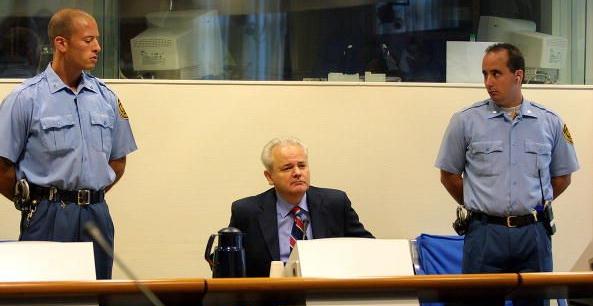
|
Above, the late
former Serbian President Slobodan Milosevic on trial at the Hague
There were bad actors on all sides in the
Yugoslav civil wars of the 1990s, but Serbian President Slobodan Milosevic was by no means the worst of them. Some of these 'players' were even covertly
assisted by western countries, including active participation in anti-Serb 'ethnic
cleansing' by the CIA behind the scenes.
So why did the West go to such lengths to
selectively demonise Serbia above the other nations involved in the conflicts?
The core justification for the 78 day NATO
bombardment of Serbia in 1999 was the accusation of Serbian conducted 'genocide' against
Albanians in the Serbian province of Kosovo. Yet those 'casus belli' allegations were not
subsequently pursued at the war crimes tribunal at the Hague
due to lack of evidence. Indeed, in September 2001 a UN court in Kosovo ultimately ruled that the allegations
were untrue.
Those claims were in fact no more real than
the later claims, used to justify a further illegal attack on another nation in 2003, that
Iraq had weapons of mass destruction. Today most of the public now understand the fraud of
the Iraq war, even it it seems they are powerless to hold anyone to account for it (the
British Chilcot inquiry into the war has no powers of sanction, for example).
However, most people still remain unaware of
the earlier fraud conducted against Serbia by NATO , thanks in large part to Milosevic's
untimely death at the Hague, a sudden development which prevented his trial reaching
a conclusion. Yet, the whole Kosovo episode faced the prospect of being reborn as a new
major media story once the judgement had been issued, had Milosevic lived to the end of
the trial.
The re-ignition of the story would have been
an eventuality loaded with embarrassment for the western powers. For at that point of
'denouement' it would have been impossible to prevent the broader general public from
realising that the original claims of genocide used to justify the war against Serbia had
been dropped.
Previously the abandonment of those charges
was something only scantily reported on by the international media community, most of
which had subscribed to, and relayed, the original bogus narrative which the actual trial
process of Milosevic had failed to verify. In this awkward situation media reporting from
the trial itself became largely notable by virtue of its general absence.
The falsely genocide-justified bombardment of
Serbia by NATO in 1999 was illegal. No NATO member country had been attacked by Serbia
(nor could Serbia have conceivably been regarded as a threat to any NATO member state),
and there was no United Nations approval for the bombardment.
Seven years later, with the prospect of a
less than 'helpful' outcome to his trial, the death of Milosevic at the Hague was greeted
by a hypocritical mixture of crocodile tears (over the trial being prevented from reaching
a conclusion), and muffled sighs of relief (for the same reason) in western corridors of
power.
Milosevic's death in custody meant that much
residual shame and embarrassment could now finally be buried.
Dr David Kelly was the leading expert adviser
to the British government on chemical weapons and the related situation in Iraq after
9/11. After the ensuing invasion of that country the steadily 'leaking' Dr Kelly died in
controversial circumstances on 17 July 2003.
The day before his death he had appeared
before a parliamentary committee which met in closed session. He disclosed that
although he had been sure before the invasion that Iraq had a development programme, he
thought it was only 30% likely that Saddam Hussein actually had chemical weapons. He said,
"The 30% probability is what I have been saying all the way through ... I
said that to many people ... it was a statement I would have probably made for the last
six months."
This expert opinion stood in strong contrast
to the chemical and biological weapons threat asserted to be 'serious and current',
'beyond doubt', and deployable 'within 45 minutes of a decision to do so', in the pre-war
official position of the British government that Dr Kelly himself had been advising. Had
he lived long enough, we may well have learned more about this, particularly if he had
appeared in public at the subsequent Chilcot inquiry.
Just days before his death at the Hague
Milosevic himself had asserted
in a letter to the Russian government (the text of which was released by Associated Press)
his concern that he was being wilfully poisoned through the administration to him of an
inappropriate drug for his health problems. Whether true or not, one thing is clear.
Milosevic's premature demise before the conclusion of his trial was a great piece of luck
for British Prime Minister Tony Blair, or those who had steered
him, on a scale rivalling the death of Dr Kelly (who was later reported
to have been writing a book on the Iraq affair at the time of his demise).
For unlike Clinton or Bush, whose terms did
not span the full period, Blair had the unique distinction of being a leading advocate for
both conflicts, Kosovo and Iraq, during his time as leader of the United Kingdom.
nlpwessex.org |
"Years
from now, when the war in Serbia is over and the dust has settled, historians will point
to January 15, 1999 as the day the American Death Star became fully operational. That was
the date on which an American diplomat named William Walker brought his Organization for
Security and Cooperation in Europe (OSCE) war crimes verification team to a tiny Kosovar
village called Racak to investigate an alleged Serb massacre of ethnic Albanian peasants.
After a brief review of the town's 40-odd bullet-ridden corpses, Walker searched out the
nearest television camera and essentially fired the starting gun for the war. ... There is a widespread belief not only in Russia, but also in other
countries, that Walker's role in Racak was to assist the KLA in fabricating a Serb
massacre that could be used as an excuse for military action. Already, two major
mainstream French newspapers--Le Monde and Le Figaro--as well as French national
television have run exposes on the Racak incident. These stories cited a number of
inconsistencies in Walker's version of events, including an absence of shell casings and
blood in the trench where the bodies were found, and the absence of eyewitnesses despite
the presence of journalists and observers in the town during the KLA-Serb fighting.
Eventually, even the Los Angeles Times joined in, running a story entitled 'Racak Massacre
Questions: Were Atrocities Faked?' The theory behind all these exposes was that the KLA
had gathered their own dead after the battle, removed their uniforms, put them in civilian
clothes, and then called in the observers. Walker, significantly, did not see the bodies
until 12 hours after Serb police had left the town. As Walker knows, not only can 'anybody
have uniforms,' but anyone can have them taken off, too. The story of William Walker's
involvement in the was is just one of a rapidly-growing family of tales cataloguing the
incompetence and arrogance of the United States and its allies throughout the Kosovo
conflict. Even if it isn't proof of some
as-yet-unreleased sinister plan to secure a permanent military presence in the Balkans,
the fact that the US didn't even care to avoid the appearance of impropriety in its search
for Serb atrocities says a lot about our approach to international relations. It says, 'Go
ahead and think the worst about us. We don't care. We've got more bombs than you do.'"
Death squads' flack in El Salvador, Clinton's man in Kosovo
Counterpunch, Volume
6, #10, 16 May 1999
Victor's
Justice
"General Wesley Clark, the
former Nato commander and presidential hopeful, will testify next month at the war crimes
trial of Slobodan Milosevic under conditions of strict
censorship and confidentiality imposed by the United
States. Washington is believed to be fearful of potentially damaging
revelations about its Balkan realpolitik during the 1990s and in the Bosnian War. General Clark, who is seeking the Democratic Party nomination
for President, will be one of the highest-profile witnesses to take the stand. The former
Nato commander directed the alliance's 78-day bombing campaign in Kosovo in 1999, after
Serbian forces had launched an onslaught against ethnic Albanian separatists. General
Clark will testify on December 15 and 16. Public
galleries will be closed and the broadcast system that transmits the proceedings on the
internet and on closed-circuit television will be shut down. The conditions of General
Clark's testimony include a 48-hour delay to enable the US Government to review the
transcript and seek the court's consent to censor
parts on the ground of national security. Two US representatives will attend the sessions. The
three-judge panel hearing Mr Milosevic's case agreed to the conditions, which are unique,
because they decided that they were justified by the potential importance of General
Clark's testimony, Jim Landale, the tribunal spokesman, said. In his cross-examination of General Clark, Mr Milosevic could
reveal sensitive information about the West's diplomatic and military strategy for dealing
with the crisis in the Balkans."
General Clark to testify against Milosevic
London
Times, 20 November 2003
"The presence
in his [Milosovic's] blood of a tuberculosis medicine known
to counteract other drugs that he had been taking
for heart problems created suspicions
on all sides that somehow his death was deliberate."
Q&A: arrest of Radovan Karadzic
London
Times, 23 July 2008
Why The Press Mostly Skipped
Reporting On The Trial Of Milosevic
"The people of the world can breathe a
collective sigh of relief; now for sure they'll never be asked to understand what actually
happened in the Balkans. No doubt this is only the second or third time you're hearing
anything about the all-important 'Second Nuremberg' trial in the four years it has been
proceeding. That's because it wasn't going too well — for the prosecution, which
Milosevic embarrassed on a daily basis. The UN's
kangaroo court even had journalists snickering at the prosecution's flimsy evidence and
performance. Journalists--those people who built their careers in the 1990s as
co-belligerents against the Serbs in the avoidable
but media-ensured Balkan wars. Though Milosevic's conviction was a
foregone conclusion (we wouldn't want any more rampaging Muslims than there need to be),
he was creaming the Court (the Court and the prosecution are essentially one), such that
six months ago prosecutor Geoffrey Nice admitted
(transcript) he
was no longer sure what, exactly, the case against the former strongman was. Everyone
wondered why a trial would be taking four years for someone who was the undisputed
'Butcher of Belgrade.' The answer is that there's been an unintended benefit to the
otherwise bad idea of an international court: the historical record was being set
straight..... to sum up, here is all that Americans need to know about that confounding,
dreaded subject that we so aggressively ignore, the Balkans: The
Serbs have admitted to not being innocents in those civil wars. Problem is, they were less
guilty than their enemies — the Croats (a
people Germanized since the 1500s and nostalgic for the 1930s), the Bosnian Muslims, and
the Albanian Kosovo Muslims. Funny that none of these others have admitted to anything at
all, despite their much more dastardly roles in sparking the Balkan wars--most relevantly
that last group. As Canadian former UN Commander
Major General Lewis MacKenzie wrote in a National Post article titled 'We
Bombed the Wrong Side?': 'The Kosovo-Albanians have played us like a Stradivarius. We have
subsidized their violent campaign for an ethnically pure and independent Kosovo. We have
never blamed them for being the perpetrators of the violence in the early '90s and we
continue to portray them as the designated victim today in spite of evidence to the
contrary. When they achieve independence with the help of our tax dollars combined with
those of bin Laden and al-Qaeda, just consider the message of encouragement this sends to
other terrorist-supported independence movements around the world.' ..... now Milosevic has died before he could get through his list of defense witnesses, many of whom threatened to further expose the hoax
that started a war. In case you've been obliging both the mainstream and alternative
media by not following the Milosevic trial as the accused debunked one charge after
another, catching 'witness' after 'witness' in a lie, here's
what you missed..."
Milosevic Dead. Now We'll Never Have to Know the Truth
Jewish World Review, 13
March 2006
"In 1999, the western powers used
military might to drive out Serb forces from Kosovo after Serbia had attempted to maintain
its domination in the disputed region, committing in the process what were widely
condemned as atrocities. The Serbs’ eviction
from Kosovo was hailed as a victory for justice and humanity. But there has been news in
the past week which casts a very different light on the passions of more than 10 years
ago. We have been reminded of old truths, about
unintended consequences, the vanity of human wishes, the way that best-laid plans go
wrong, and the danger of taking sides in conflicts
about which we may know little, or not enough. If one leader made the case for armed intervention in Kosovo it
was the British prime minister, Tony Blair. He gave
famous expression to this doctrine in his Chicago speech of April 1999. 'This is a just
war, based not on any territorial ambitions but on values,' he said of the Nato action in
Kosovo. 'We cannot let the evil of ethnic cleansing stand.' Only last July Mr Blair
visited Kosovo, to be greeted by several children who had been named after him, as well as
by Hashim Thaci, former leader of the Kosovo Liberation Army and now prime minister. He
has lamented that 'Blair’s own extraordinary energy and considerable achievements are
now being undervalued at home'. But his 'role in Kosovo’s history will be recognised
as an important example in a great legacy,' said Mr Thaci. Another enthusiastic partisan
at that time was US senator Joseph Lieberman, who would be Al Gore’s running mate the
following year. He went even further than Mr Blair. The
US 'and the Kosovo Liberation Army stand for the same human values and principles', Mr
Lieberman said. 'Fighting for the KLA is fighting for human rights and American values.' Well, not quite those rights and values, if the findings of a Council of
Europe investigation into organised crime in Kosovo are correct. The investigators charge that Mr Thaci runs a 'mafia-like' criminal
network. He stands accused not only of 'violent control over
the heroin and narcotics trade' but of trafficking in human organs. In a particularly gruesome claim, it is said that
his forces killed Serbs and then sold their body parts. Back in the 1990s, the Balkans
seemed so easy, at least to Mr Blair, if not to everyone. The late Roy Jenkins, a sometime
Labour cabinet minister who then served as a European commissioner, had admired Mr Blair,
but came to regret what he called his Manichean tendency to view everything in black and
white. Anyone who has read A Journey, Mr Blair’s memoir, will see what Lord Jenkins
meant. The former premier does interpret events in bald terms of right and wrong, with no
shades between. So did others who took sides in those Balkan conflicts,
among them correspondents who
covered the fighting, with what one of them later described ruefully as his
colleagues’ 'angry partisanship'. Of course it
was true that Milosevic was a tyrant, and that Serb forces at times acted with horrible
cruelty. But they were not alone, and ardent spirits such as Mr Blair and Mr Lieberman, in
their desire for moral clarity, forgot what an Oscar Wilde character says when asked for
'the truth plain and simple': the truth is rarely plain, and never simple. If anyone
should have known that it was Richard Holbrooke, the architect of the 1995 peace deal in
Bosnia, who died on
Monday after a lifetime as an American diplomatic trouble-shooter. In his memory, the
New York Times reprinted an article Mr Holbrooke had written in 1999 about the Balkans.
That piece reminds us of an infamous episode in the former Yugoslavia in 1993, when
Mostar’s ancient, world-famous bridge 'was brutally destroyed simply for sport'. So
it was – and who destroyed the bridge? The Croats. Although Mr Holbrooke acknowledged
that, what he did not mention was that the Croats were later backed by his own country. Washington even turned a blind eye in 1995 when more than 200,000
ordinary Serbs were driven out of Krajina by Croat forces [assisted by the CIA], in the largest single
act of ethnic cleansing that the whole dismal series of internecine wars would witness."
The perils of moral fervour in the Balkans
Financial
Times, 16 December 2010
"The ‘Kosovo Liberation
Army’, which was recognized by the US State Department as a terrorist organization,
received British and CIA training and arms.[35] The group received the majority of
its funding – and many members – from the Albanian diaspora, Islamist
fundamentalist groups, and the international drug trade. The KLA relied on drug trade,
assassination, intimidation (of not only Serbs but also ethnic Albanians who opposed
them), destruction of Serbian property (namely homes and churches), and other acts of
ethnic cleansing of non-Albanians. The Milosevic government was provoked and cracked down
the KLA terror, in turn it was portrayed as genocidal against Kosovar Albanians. At this
point, the Yugoslav federation was still suffering from economic collapse and had no
interest whatsoever in another war, let alone more NATO bombs. Allegations of mass
expulsions of the Albanian population by ‘Serbian’ (Yugoslav forces) began to
surface, but a OSCE monitor reported no international refugees and only a couple thousand
internally displaced before NATO bombing. Hundreds
of thousands of Albanians would be displaced by NATO bombs, as were 100,000 Serbs (who
were supposed to be the perpetrators of the genocidal ethnic cleansing).[36] One Albanian woman crossing into Macedonia put it bluntly and told
a news crew “There were no Serbs. We were frightened of the bombs.”[37] Allegations of systematic, mass rapes and ‘possible sites
of mass graves’ were made. One NATO spokesperson alleged that the 200,000 Albanian
women in refugee camps amazingly gave birth to 100,000 babies in the span of 60 days,
apparently due to ‘Serbian mass rapes’. Genocide allegations were popular;
vastly different figures of 100,000, 500,000, 225,000, and 10,000 dead or missing were
made by the U.S, NATO, UN, Kosovo and various NGOs. The
FBI carried out an investigation across the “largest crime scene in the
FBI’s… history” in June 1999. They found not hundreds of thousands of
bodies, but 200 total across 30 sites.[38] Of course, the Yugoslav army, and
especially Serbian paramilitary groups did carry out massacres and rapes – but
nothing on the level of the systematic and genocidal allegations that were made to justify
bombing. In fact, NATO committed a slew of war
crimes in the 1999 bombing campaign – the bombing was illegal from the very beginning
and was launched without the approval of the UN Security Council. The 1995 and 1999 NATO
bombings aided ethnic cleansing of Serbs in Croatia, Bosnia, and Kosovo. Cluster bombs
were dropped on highly populated urban areas. NATO estimated 350 would be killed in the
bombing of an office building in Belgrade housing TV and radio stations, and political
parties – the bombs were dropped anyway. NATO insisted afterwards that the civilian
deaths were ‘unintended’. NATO jets bombed a refugee convoy, killing dozens of
non combatants, first trying to pin the attack on Yugoslav forces before retreating and
claiming it was an ‘accident’. When a hospital was bombed, the only excuse NATO
could muster was that it was actually a military barracks. Journalists who visited
immediately after found only the remains of civilians and a hospital in
ruins.[39] State owned and only state owned firms and factories were bombed, as were
state owned housing projects, water supplies, railroads, bridges, hospitals and schools.
This amounted to “privatization by bombing.”[40]A Spanish NATO pilot confirmed
that NATO jets were “destroying the country, bombing it with novel weapons, toxic
nerve gases, surface mines dropped with parachute, bombs containing uranium, black napalm,
sterilization chemicals, sprayings to poison the crops and [more]”, going on to call
it “one of the biggest barbarities that can be committed against humanity.”[41]
The situation in the former Yugoslavia has not improved since the NATO’s
‘democracy’ bombs were dropped. The FRY finally collapsed in 2006 and the
Balkans have been Balkanized once again. ‘Yugonostalgia’ has swept across the
Balkans – many remember the days of the SFRY as ones where they lived
better.[42] [43] [44] As many as 81% of Serbians believe they lived best in
the age of socialism.[45] Similar trends exist in Slovenia, Bosnia, and
Macedonia. [46] [47] [48] "
NATO & the Humanitarian Dismemberment of Yugoslavia
Counterpunch,
17 May 2016
The Bombing Of
Serbia Was An Illegal Act Of Aggression
There Was No Genocide In Kosovo
"The
question of legality arises both in respect of Kosovo and Iraq. Like Lord Goldsmith, Mr Blair regards the lawfulness of the Iraq action
as turning on the absence of a second UN resolution, and the reliance on Resolution 1441.
Broad questions of international law are also involved. They concern the monopoly of the
use of force given to the United Nations in the UN Charter. Since 1945, the conventions on
torture and genocide have opened a wider right to use force; there is a general right to
arrest those responsible for torture or to intervene to prevent genocide. That was the justification for the Nato intervention in Kosovo."
Lord Rees-Mogg - Blair the dictator bulldozed us into war
London
Times, 1 Feburary 2010
".... everyone knows that those claims of genocide bore as much relation to reality as did the claim made in 2002-2003 that
there were weapons of mass destruction in Iraq. Indeed, the charge of genocide
turned out to be so unsustainable that it was never even included in the indictment against
Miloševic."
Kosovo’s Independence Will Stir Up Trouble. Who Will Benefit?
The Brussels Journal, 12 December 2007
" ... the failed Rambouillet negotiation with
Serbia in February-March 1999 was, in Henry Kissinger's words, 'merely an excuse to start
the bombing'. This view was vindicated by the Organisation for Security and Cooperation in
Europe's (OSCE) report on human rights violations in
Kosovo, published in December 1999. The report showed that the level of violence fell
markedly when OSCE monitors were placed in Kosovo following the Holbrooke-Milosevic
agreement of September 23 1998; and that it was only after the monitors were withdrawn on
March 20 1999, in preparation for the bombing, that general and systematic violation of
human rights began. Between March and June 1999 - the
period of Nato bombing - the number of deaths and expulsions in Kosovo shot up. The
'humanitarian disaster' was in fact precipitated by the war itself.....The Iraq invasion was justified by the same use of fraudulent evidence as was
displayed in Kosovo
[i.e. there was no genocide in Kosovo]."
The Kosovo effect
Guardian,
Comment Is Free, 21 April 2008
"NATO’s
obsession with its strategy of hope was tried once before in 1999, with the bombing of
Serbia and the breakaway province of Kosovo. A myth that the 78-day bombing campaign
persuaded Serbian leader Slobodan Milosevic to withdraw his forces from Kosovo continues
to grow despite overwhelming facts to the contrary. Before that war – and
contributing to its start – the international community gathered in Rambouillet,
France, and, on March 18, 1999, produced an accord that spelled out a peace plan to deal
with the armed insurrection by the Kosovo Liberation Army (designated at the time by the
CIA as a terrorist organization). Unfortunately – but intentionally – the accord contained two poison pills that Mr. Milosevic could
never accept, making war or at least the allied bombing of a sovereign state inevitable.
The first pill demanded that NATO have freedom of movement throughout the entire land, sea
and airspace of the former Federal Republic of Yugoslavia. In other words, NATO would have
the right to park its tanks around Mr. Milosevic’s downtown office in Belgrade. The
other pill required that a referendum be held within three years to determine the will of
those citizens living in Kosovo regarding independence. The fact that Kosovo’s
population was overwhelmingly Albanian Muslim guaranteed that the outcome of any such
referendum would be a vote for independence and the loss of the Serbian nation’s
historic heart. Mr. Milosevic refused to sign the accord, and
NATO began bombing Serbia on March 24, 1999, without a Security Council resolution, citing
a 'humanitarian emergency' – a decision still widely challenged by many international
legal scholars. NATO said it would take only a few
days of bombing to persuade Mr. Milosevic to withdraw his forces from Kosovo. As the weeks
dragged on, NATO’s strategy of hope appeared to be in serious trouble. Its aircraft,
incapable of destroying to any significant degree the Serbian military’s personnel
and equipment, had turned to bombing fixed infrastructure: bridges, roads, factories,
refineries, TV stations. As in all wars conducted from thousands of feet above the target,
mistakes were made and civilians were killed. In one town I visited during the campaign, a
medical clinic and a 10-storey apartment building had been demolished, with no
'legitimate' targets anywhere to be seen. With no indication that Mr. Milosevic was going
to give in, diplomacy was given a long overdue chance. Led by Russian envoy Vitaly Churkin, Mr. Milosevic was told that, if he
withdrew from Kosovo, the two poison pills would be removed from the Rambouillet accord.
Within days, Mr. Milosevic agreed. Myth buster: Diplomacy,
not bombing, played the key role in bringing a punitive bombing campaign based on hope to
an end."
Major-general Lewis MacKenzie, the first commander of UN
peacekeeping forces in Sarajevo
NATO’s Libya 'hope' strategy is bombing
Globe
and Mail (Canada), 10 June 2011
"For five hours in
mid-August 2004, I met with Slobodan
Milosevic in a cramped, improvised office, cluttered with papers and books, in a UN
detention area within the huge Dutch prison at Scheveningen, a seaside suburb of the
Hague.... to chase after Milosevic for pre-Dayton activities seems to me illogical and
would, in some substantive way, make all the negotiating partners complicit in the alleged
crimes. Moreover, if the ICTY wanted to go after Milosevic in such a manner then fairness
dictates that leaders from the top echalons on all sides should be indicted for similar
'command responsibility' for identical crimes. They were not. Milosevic asked me, 'Why did
the US and Nato
do this to us?' He was genuinely puzzled. I have
thought a lot about the 'whys' and ventured that in post-Cold War Europe no place remained
for a large, independent-minded, socialist state that resisted
globalization. He'd had
such ideas too, and fell silent, slowly nodding his head with a wry smile. 'We were too
good,' he said, and after a pause, 'and too independent.' I offered one further insight:
How could it be that western elites coalesced so early, so easily, upon a narrative for Yugoslavia's civil war so at variance with known
facts, and so impermeable to correction? ... Ex post
facto justice never makes sense. Milosevic may have been guilty of something—indeed,
he probably was—but it wasn't genocide, crimes against humanity or war crimes."
George Kenney, former US State Department desk officer for
Yugoslavia
A Premature Death
Epolitics, 11 March 2006
"....a growing weight of evidence
indicates that the 1999 war had little to do with Milosevic, and everything to do with the US’s economic and military hegemonic ambitions in the Balkans..... Lord Gilbert, the UK’s
defence minister in 1999, has admitted that 'the
terms put to Milosevic at Rambouillet [the international conference preceding the war] were absolutely
intolerable . . . it was quite deliberate'. In an affidavit to the International Criminal Tribunal for the former
Yugoslavia, Colonel John Crosland, the UK’s
military attaché in Belgrade from 1996-99, stated
that the US had decided on regime change in Serbia and had decided to use the terrorist Kosovo Liberation Army to achieve
that end."
Don't mention the war
New
Statesman, 2 April 2009
"No one should be surprised that Hashim Thaçi, the Prime Minister of
Kosovo, has been described as 'the Boss'of a criminal network that dealt in heroin and
human organs. In 1999 I saw how he and
other Kosovo Liberation Army leaders ran Pristina as their personal fiefdom. As the
commanding officer of 1 Para, which was charged by Nato with bringing order to Pristina, I
witnessed elements of the KLA rampaging like a victorious mob intent on retribution
against the beleaguered and evidently defenceless Serbian minority. The violence meted out
by the KLA shocked even the most hardened of paratroopers. The systematic murder of Serbs,
who were often shot in front of their families, was commonplace. After nightfall, gangs of
KLA thugs wielding AK47s, knuckledusters and knives terrified residents of Serbian
apartment blocks. Many Serbs fled and their homes were taken by the KLA. In the early days
of the operation, we were authorised to be firm; we arrested KLA men and confiscated their
weapons. But this was stopped by Nato leaders who were
ignorant of the ethnic dynamics of the region and who preferred to see the civil war in
black and white, not shades of grey. The Blair
Government’s spin machine wanted moral simplicity. We were, after all, a 'liberating force'; the Serbs were the 'bad guys', so that must make the Kosovo
Albanians the 'good guys'. The tough line
was dropped and the KLA commanders and their numerous bodyguards were allowed to re-arm. Prostitution and drug and people trafficking increased as
the KLA’s grip on Pristina tightened....
In June 1999, just before he fled with his family to Belgrade, a Serbian professor at
Pristina University told me: 'You must understand that for us the KLA is like the IRA is
to you.' That Kosovo is an impoverished,
corrupt and ethnically polarised backwater is testament to Nato’s unwillingness to control KLA gangsters."
Brigadier Paul Gibson - Commander of 1 Para on Nato operations in
Kosovo
Nato stopped us from controlling Kosovo's gangsters
London Times, 16 December 2010, Print Edition P28
'Ruder Finn'
Syndrome
How To Play And Win Propaganda Wars
How Ruder Finn Duped The American Jewish Community Into
Backing The Mujahadeen In Yugoslavia
"There is at present widespread
support in American public opinion for the policies of the U.S. government in the Balkans.
It is a striking and dark paradox that Jewish opinion has played an important role in
helping to mobilize that support.... in Washington the public relations firm of Ruder/Finn mounted a campaign to get American Jews to associate the civil war in Bosnia-Herzegovina with the Holocaust. This campaign, according to
Justice Department documents, was paid for by the governments of Croatia and
Bosnia-Herzegovina, although the head of Ruder/Finn later explained these governments had not paid for all the costs of the campaign. What other governments were passing money to Ruder/Finn? Was the C.I.A. helping to subsidize the campaign
through traditional means, the usual kinds of 'front' companies, or 'proprietaries,' as
insiders like to call them?"
U.S. Jews and the Balkan Situation
Jewish Currents, April
1996
Painting The
Serbs As 'Nazis' - How It Was Done |
"For 18 months, we have been working for the Republics of Croatia and Bosnia-Herzegovina, as well as for the
opposition in Kosovo. Throughout this period, we had many successes, giving us a formidable
international image. We intend to make advantage of this and develop commercial agreements
with these countries. Speed is vital, because items
favourable to us must be settled in public opinion. The first
statement counts. The retractions have no effect..... The essential tools in our work are a card file, a computer, and a
fax. The card file contains a few hundred names of journalists, politicians, academicians,
and representatives of humanitarian organizations. The computer goes through the card
files according to correlated subjects, coming up with very effective targets. The
computer is tied into a fax. In this way, we can disseminate information in a few minutes
to those we think will react (positively). Our job is
to assure that the arguments for our side will be the first to be expressed..... This was a sensitive matter, as the dossier was dangerous looked
from this angle. President Tidjman was very careless in his book 'Wastelands of Historical
Reality'. Reading this writtings, one could accuse him of of anti- semitism. In Bosnia, the situation was no better: President Izetbegovic
strongly supported the creation of a fundamentalist Islamic state in his book 'The Islamic
Declaration'. Besides, the Croatian and Bosnian past was marked by a real and cruel
anti-semitism. Tens of thousands of Jews perished in Croatian camps. So there was every
reason for intellectuals and Jewish organizations to be hostile towards the Croats and
Bosnians. Our chalenge was to reverse this attitude. And we succeded masterfully. At the beginning of August 1992, the New York Newsday came out with
the affair of (Serb) concentration camps. We jumped at the opportunity immediately. We
outwitted three big Jewish organizations - B'Nai Brith Anti-Defamation League, the Jewish
Committee, and the American Jewish Congress. We suggested to them to publish an
advertisement in the New York Times and to organize demonstrations outside the U.N. This
was a tremendous coup. When the Jewish organizations
entered the game on the side of the (Muslim) Bosnians, we could promptly equate the Serbs
with the Nazis in the public mind. Nobody understood what was happening in Yugoslavia. The
great majority of Americans were probably asking themselves in which African country
Bosnia was situated. But, by a single move, we were able to
present a simple story of good guys and bad guys, which would hereafter play itself. We won by targeting Jewish audience. Almost immediately there was a clear
change of language in the press, with the use of words with high emotional content, such
as 'ethnic cleansing', 'concentration camps', etc. which evoked images of Nazi Germany and
the gas chambers of Auschwitz. The emotional charge was so
powerful that nobody could go against it.... Our work is not
to verify information. We are not equipped for that. Our work is to accelerate the
circulation of information favorable to us, to aim at judiciously chosen targets. We did
not confirm the existence of death camps in Bosnia, we just made it known that Newsday
affirmed it....We are professionals. We had a job to do and we did it. We are not paid to
be moral."
Mr. James Harff, director of Ruder Finn
Global Public Affairs, public relations firm
Interview with
Jacques Merlino, associate director
of TV chain France 2, Paris in October 1993
Jacques Merlino: 'Les verites Yougoslaves ne sont pas toutes bonnes a dire' ('Yugoslav
truths are not all good for telling')
Published
by: Albin Michel, Paris, 1993, pp. 127-129 ISBN 2-226-06663-2 |
"James
Harff, director of the Washington-based PR firm, Ruder Finn
Global Public Affairs, boasted to French TV of how his firm
scored a PR coup for its clients, the breakaway Yugoslav republics of Croatia and
Bosnia-Herzegovina. He'd turned Serbs into the new Nazis, he crowed, and he'd done it by
targeting the Jewish community..... Would the
information favorable to NATO, and unfavorable to Serbs, be circulated in the Kosovo
crisis? With the press corps willingly letting itself be spoon-fed by Washington, the
answer was straightforward. Investigative journalism is expensive. Playing back what
politicians, generals and PR firms say, all of whom had an interest in portraying the
Serbs as butchers, isn't. So the press passed along what it was told, looked where it was
told to look, didn't see what official sources never mentioned."
Truth is the first casualty of war: Often uttered, rarely learned
Media Monitors Network, 19 June 2001
"'Fingerprints'
in the media war could be traced to public relations specialists, including several
high-powered and highly financed U.S. firms, and their clients in government information
ministries. The Washington public relations firms of Ruder
Finn and Hill & Knowlton, Inc. were the premier agents at
work behind the lines, launching media and political salvos and raking in hundreds of
thousands and perhaps millions of dollars while representing the hostile republics,
sometimes two at a time, in the Yugoslav war. Hill
& Knowlton had for several years represented agencies in the previous Federal Republic
of Yugoslavia before it disintegrated (the firm is best remembered for producing the phony
witness who testified before a Congressional committee about the alleged slaughter of
Kuwait infants after the Iraqi invasion of Kuwait). Ruder Finn, having simultaneously
represented the governments of Croatia and Bosnia until mid-1993, when both stepped up
ethnic cleansing of each other's civilians in Bosnia, with its liberal donations from
Islamic countries. Soon after, Ruder Finn scored a public relations homerun in helping its
Bosnian muslim clients dominate the June 1993 Conference on Human Rights in Vienna,
virtual hijacking the two-week agents that climaxed with 88-to-1 vote deploring the
failure of the U.N. to stop the war and demanding that the arms embargo on Bosnia be
lifted. Especially in the early days of the war in Croatia, few journalists were able to
step back to take a clearer look at the images being manipulated to shape their stories. Many rookie Balkan reporters at first could do nothing but obediently attend nonstop press
conferences. As Steve Crawshaw reported in the London 'Independent': 'One thing is
certain; nobody can complain that the Croatian publicity machine is overcautious about
unsubstantiated allegations. If it is colorful tales that you are looking for, then
Croatia can always oblige... if sometimes seems the ministers who turn up to the press
conferences live in a rhetoric-rich, fact-free fairyland.' The London 'Times' noted on
November 18, 1991, that 'clarity was an early victim of the war in Yugoslavia and reality
has become progressively enveloped in a blanket of fog... as the desperate attempts to win
the hearts and minds of Europe grow, the claims become wilder, the proof simpler. But the
(government-controlled) Croatian media are convinced that officials in London and
Washington can be outraged into submission, so the assault continues unabated.'"
Massacred Serbs shown as Bosnian Muslim victims
FOREIGN POLICY Number 93 | Winter 1993-94 |
"The Clinton administration followed
up by providing strong support to the KLA, even
though it was known that the KLA supported the Muslim mujahadeen. Despite that knowledge, then Secretary of State Madeleine Albright had
the KLA removed from the State Department list of terrorists. This action paved the way
for the United States to provide the KLA with needed logistical support. At the same time, the KLA also received support from Iran and Usama bin
Laden, along with 'Islamic holy warriors' who were jihad veterans from Bosnia, Chechnya and Afghanistan. Swiss journalist Richard Labeviere, in his book, 'Dollars for Terror,' said that the international Islamic networks linked to bin Laden received help from U.S. intelligence community. Indeed, Chechen sources claim that U.S. intelligence also aided them in
their opposition to Russia. Given that U.S. policy in the post-Cold War period has not
only been anti-Russian but anti-Iranian, the United
States worked closely with Pakistan's predominantly Sunni Inter-Services Intelligence
organization. Through ISI, the United States recruited Sunni mujahadeen by staging them in Chechnya to fight in Bosnia and later in Kosovo."
F. Michael Maloof, former senior official at the Department
of Defense during the
Clinton and Bush administrations
Iran subversion in Balkans
G2 Bulletin,
25 September 2006
(Who is Michael Maloof? - Click Here)
"... these [intercepted]
conversations, between 1997 and 2001, had to do with a Central Asia operation that
involved bin Laden. Not once did anybody use the word 'al-Qaeda.' It was always 'mujahideen,' always 'bin
Laden' and, in fact, not 'bin Laden' but 'bin Ladens' plural. There were several bin
Ladens who were going on private jets to Azerbaijan and Tajikistan. The Turkish ambassador in Azerbaijan worked with them. There were bin
Ladens, with the help of Pakistanis or Saudis, under our
management.... bringing people from East Turkestan
into Kyrgyzstan, from Kyrgyzstan to Azerbaijan, from Azerbaijan some of them were being channeled to Chechnya, some of them were being
channeled to Bosnia. From Turkey, they were putting all these bin Ladens on NATO planes. People and weapons went
one way, drugs came back.... A lot of the drugs were going to Belgium with NATO planes. After that,
they went to the UK, and a lot came to the U.S. via military planes to distribution
centers in Chicago and Paterson, New Jersey. Turkish diplomats who would never be searched
were coming with suitcases of heroin."
Sibel Edmonds, former Turkish translator at the FBI on the
intercepts she discovered
Who’s Afraid of Sibel Edmonds?
The American Conservative,
November 2009
(Who is Sibel Edmonds? - Click Here)
Covert
US (And UK) Backed Islamic Terrorism In The Balkans
Click Here |
The Reality Of The Jewish Experience In Former Yugoslavia
"In the seven years since they
first took power, the Islamist AKP party has successfully transformed Turkey from a
staunch ally of the US and Israel and a member of NATO into a staunch ally of Iran and a
member of NATO. And that’s not all. .... NATO has stood at a distance as Turkey has undermined its mission in Kosovo and transformed it into a virtual Turkish colony. So too, NATO has had no
comment as Turkey has worked consistently to disenfranchise Bosnia’s non-Muslim minorities and intimidate the Serbian government. At this late date, it would have been shocking if NATO had a comment of
any kind on the AKP’s consolidation of its Islamist thugocracy."
Our world: Who lost Turkey?
Jerusalem Post,
20 September 2010
"Four
years after it was 'liberated' by a NATO bombing campaign, Kosovo has deteriorated into a
hotbed of organized crime, anti-Serb violence and al-Qaeda sympathizers, say security
officials and Balkan experts. Though nominally still under UN control, the southern
province of Serbia is today dominated by a triumvirate of Albanian paramilitaries, mafiosi
and terrorists. They control a host of smuggling operations and are
implementing what many observers call their own brutal ethnic cleansing of minority
groups, such as Serbs, Roma and Jews. In recent
weeks, UN officials ordered the construction of a fortified concrete barrier around the UN
compound on the outskirts of the provincial capital Pristina. This is to protect against
terrorist strikes by Muslim extremists who have set up bases of operation in what has
become a largely outlaw province. Minority Serbs,
who were supposed to have been guaranteed protection by the international community after
the 78-day NATO bombing campaign ended in the spring of 1999, have abandoned the province
en masse. The last straw for many was the recent round of attacks by ethnic Albanian
paramilitaries bent on gaining independence through violence. Attacks on Serbs in Kosovo,
a province of two million people, have risen sharply. According to statistics collected by
the UN criminal tribunal for the former Yugoslavia at The Hague, 1,192 Serbs have been
killed, 1,303 kidnapped and 1,305 wounded in Kosovo this year. In June, 1999, just after
the NATO bombing, 547 Serbs were killed and 932 were kidnapped.... Serbs, who now make up
5% of the population of Kosovo, down from 10% before the NATO campaign, are the main
targets of the paramilitary groups. Last week, Harri Holkeri, the province's UN leader,
suspended two generals and 10 other officers, all members of an ethnic Albanian offshoot
of the Kosovo Liberation Army, an insurgent group that emerged in the late 1980s to fight
Serb security forces. Mr. Holkeri made his decision -- the strongest UN response to
violence in the province so far -- after a UN inquiry into the Kosovo Protection Corps
(KPC). Although the civilian defence organization is supposed to help local residents,
over the past four years, its mostly ethnic Albanian military officials have been involved
in violent confrontations with Serbs.The inquiry found last April's bomb attack on a
Kosovo railway was the work of the KPC... Moreover, Kosovo
has turned into one of Europe's biggest hubs for drug trafficking and terrorism. Al-Qaeda
has set up bases in the province, which has become an important centre for heroin,
cigarette, gasoline and people smuggling. The Albanian mafia and paramilitary groups, which security officials say
are closely tied to al-Qaeda militants in the region, also oversee smuggling. More than
80% of Western Europe's heroin comes through Kosovo, where several drug laboratories have
been set up, Interpol officials say."
Crime, terror flourish in 'liberated' Kosovo
National
Post (Canada), 10 December 2003
"I mean Kosovo
is just one of the points of destabilization of Yugoslavia... I
want people to know the truth about what happened here.... The United States, for its own geopolitical reasons, deliberately
encouraged the secessionist tendency among Albanians,
used them against the Yugoslav government in order to destabilize the Balkans.... One book has a great hold over
Kosovo Albanians. It's called the 'Canon of Leke
Dukagjiniis'. It's a 15th century text that spells out codes of behavior. It goes into
great detail on how to carry out blood feuds, when and whom it is proper to kill. It lays
out the proper methods to use when killing, rules and regulations and so on. And this Canon is alive among
Albanians today, especially since the fall of communism. This is an intensely
tradition-oriented culture. Blood feud is a constant threat for Albanians.... By methodically killing those who refused to support them, the KLA was
striking a deep fear among Albanians: the refusal of one Clan member to obey could lead to
revenge against his entire clan. And now the KLA had NATO
bombers to enforce blood feud. ...
[the KLA] knew their own people, their fears, their traditions. They knew that if they
could prove they were deadly, the clan leaders
would fall in line. Now they live in a society dominated by gangsters. None of this
would have happened were it not for years of effort by the United States."
Cedomir Prlincevic, President
of the Jewish Community in Pristina, and Chief Archivist of Kosovo
Interview with 'Emperors
Clothes', 3 December 2000
"As President Clinton prepares to
visit to Kosovo, it is common to see and hear things here that don't fit with the tidy
fictions proffered by NATO and White House officials....'The whole thing is a very bad
joke,' explains a candid intelligence officer with the UN Mission in Kosovo (UNMIK).
..Although NATO and UNMIK have been careful to avoid any public insinuation that the KLA
may be prevaricating and holding back a significant stockpile of weapons, a spokesman for
NATO estimates that peacekeepers confiscate about 100 illegal weapons, explosives and
magazines of ammunition each day...Yet 'anyone who thinks that the violence will end once
the last Serb has been driven out of Kosovo is living an illusion,' recently warned Veton
Surroi, publisher of the main Albanian-language newspaper in Kosovo, Koha Ditore. 'The
violence will simply be redirected against other Albanians.' Already, the senior officials
of the KLA, who signed the disarmament agreement with NATO, have carried out
assassinations, arrests and purges within their own ranks and of potential rivals. One
campaign, in which as many as six KLA commanders were murdered, was reportedly directed by
the KLA's top man, Hashim Thaci, and two of his lieutenants, Azem Syla and Xhavit
Haliti....It still lurks everywhere in Kosovo. Ethnic Albanians complain that KLA henchmen
regularly demand that shopkeepers pay 'liberation taxes' to finance the KLA's continued,
and often illicit, activities. Even more worrisome, according to a soon-to-be-released
report by the International Crisis Group, there are as many killings right now in Kosovo
as there were before NATO intervened, when Yugoslav authorities were trying to smash the
KLA....[the] goal of creating a multi-ethnic society
in Kosovo is being undermined by the KLA in a multitude of ways, especially with the
ethnic cleansing of not only Serbs but Gorans, Romas, Jews, Croats and even Albanians who are not strenuous enough in their
intolerance of non-Albanians..."
The Real Kosovo
The Washington Times, November 23, 1999
"Each day brings new reports of
atrocities against Serbs... The rebels are governing the way Al Capone ran Chicago. Not
just Serbs, but Albanian shopkeepers are looted.... Baton Haxhui, the editor of an
Albanian newspaper, charges, 'Each day it is becoming more dangerous to think and speak
independently'.... Terrorists with ties to Osama bin
Laden running around with AK-47s and anti-tank
weapons is bad enough. Worse, Thaci's boys aren't just killers and kleptos, but mafioso
who are neck-deep in the drug trade.... More than 40 percent of the heroin reaching
Western Europe moves through the province, which sits astride the major distribution route
from Turkey to the West.... Belgrade had contained the problem. But under KLA management,
Kosovo has become a drug lord's paradise.... Is it for this that we rained death and
devastation on Yugoslavia for 11 weeks -- not for democracy or human rights or to end
ethnic cleansing, but so Kosovo could be cleansed of non-Albanians and turned into a
narcotics superstore under the benevolent direction of Hashim (aka, 'Snake') Thaci?"
Serbs suffer under western eyes
Jewish World Review Aug.
2, 1999 /20 Av 5759
Why The Press Mostly Skipped
Reporting On The Trial Of Milosevic
"The people of the world can breathe a
collective sigh of relief; now for sure they'll never be asked to understand what actually
happened in the Balkans. No doubt this is only the second or third time you're hearing
anything about the all-important 'Second Nuremberg' trial in the four years it has been
proceeding. That's because it wasn't going too well — for the prosecution, which
Milosevic embarrassed on a daily basis. The UN's
kangaroo court even had journalists snickering at the prosecution's flimsy evidence and
performance. Journalists--those people who built their careers in the 1990s as
co-belligerents against the Serbs in the avoidable
but media-ensured Balkan wars. Though Milosevic's conviction was a
foregone conclusion (we wouldn't want any more rampaging Muslims than there need to be),
he was creaming the Court (the Court and the prosecution are essentially one), such that
six months ago prosecutor Geoffrey Nice admitted
(transcript) he
was no longer sure what, exactly, the case against the former strongman was. Everyone
wondered why a trial would be taking four years for someone who was the undisputed
'Butcher of Belgrade.' The answer is that there's been an unintended benefit to the
otherwise bad idea of an international court: the historical record was being set
straight..... to sum up, here is all that Americans need to know about that confounding,
dreaded subject that we so aggressively ignore, the Balkans: The
Serbs have admitted to not being innocents in those civil wars. Problem is, they were less
guilty than their enemies — the Croats (a
people Germanized since the 1500s and nostalgic for the 1930s), the Bosnian Muslims, and
the Albanian Kosovo Muslims. Funny that none of these others have admitted to anything at
all, despite their much more dastardly roles in sparking the Balkan wars--most relevantly
that last group. As Canadian former UN Commander
Major General Lewis MacKenzie wrote in a National Post article titled 'We
Bombed the Wrong Side?': 'The Kosovo-Albanians have played us like a Stradivarius. We have
subsidized their violent campaign for an ethnically pure and independent Kosovo. We have
never blamed them for being the perpetrators of the violence in the early '90s and we
continue to portray them as the designated victim today in spite of evidence to the
contrary. When they achieve independence with the help of our tax dollars combined with
those of bin Laden and al-Qaeda, just consider the message of encouragement this sends to
other terrorist-supported independence movements around the world.' ..... now Milosevic has died before he could get through his list of
defense witnesses, many of whom threatened to further expose the hoax
that started a war. In case you've been obliging both the mainstream and alternative
media by not following the Milosevic trial as the accused debunked one charge after
another, catching 'witness' after 'witness' in a lie, here's
what you missed..."
Milosevic Dead. Now We'll Never Have to Know the Truth
Jewish World Review, 13
March 2006
'Our Terrorists'
The Criminals The West Backed In Kosovo
And How They Opted For Image Laundering By Saatchi & Saatchi
"For Hashim Thaci, the prime minister [of
Kosovo], there is no question of Kosovo, which is 90% Albanian [after the ethnic cleansing
of Serbs and others], becoming part of Serbia again.... In a dark suit and pink tie,
Thaci, 42, is evocative more of a corporate executive than the rugged former guerrilla
leader who helped to conduct the insurrection against Serbia under the nom de guerre of Snake. He was suspected of directing a purge of rivals in the Kosovo
Liberation Army [a US State Department listed Muslim terrorist
organisation] in which half a dozen commanders were executed, but this did not stop him
emerging as the West’s favoured post-war partner in Kosovo.... The latest to get involved in Kosovo’s future is Saatchi & Saatchi, the advertising agency, which has been hired to improve the
country’s image. This is no easy task, as Kosovo is often described as a virtual
criminal state, a pipeline for smuggling drugs, people and weapons."
‘Tonibler’ land finds new life tough
Sunday
Times, 11 July 2010
This Ignorant Man Was Pre-Eminent In Leading The
Ilegal Wars Against Serbia And Iraq
Both Were Based On Frauds - But Which Civil Servants Lead Him By The Nose Into Them?
"Shortly after the
1997 general election, a senior civil servant pressed the new Prime Minister to have developments in Kosovo included in his
weekly round-up of political issues.
'Fine,' replied Tony Blair. 'You’d
better give me a full note on it. Starting with: where is it?' Many prime ministers begin their term of office with little
knowledge of foreign affairs, and less interest. It does not take long for this to change. By 1999 Mr Blair was the leading
Western voice on Kosovo.”
The Grand Tour
London Times,
30 July 2010
'The Secret
State' And The Steering Of A Prime Minister |
"The sweeping victory of New
Labour in the election of May 1997 had led to corrosive rumors within MI6. Some of them were
damaging, suggesting that John Reid, a future home secretary and an admitted former member
of the Communist Party, still had ties to Moscow. Files on other Labour politicians were
dusted off and the contents circulated among MI6 managers. Jack Straw, a future British foreign secretary who had
expressed misgiviings about going to war with Iraq, and Peter Mandelson, who became a
European Commissioner, each had a file, along with Cherie Booth, the wife of Tony Blair (a
fact Blair later insisted he was not told by Scarlett). In all there were a hundred files
on celebrities, leading trade unionists, politicians, and human rights lawyers.
Long-serving MI6
officers rememembered that when Labour held power under Harold Wilson there had been deep
distruct of Downing St because of the fear that Wilson, too, had links with Moscow.... Scarlett believed Tony Blair would be a different political master
than Wilson. For him, the new prime minister was 'refreshingly open, ready to listen and,
though he had no real knowledge of how intelligence operated, he was ready to learn.' When
Scarlett saw an opportunity to
brief Blair on the work of MI6, Richard Dearlove [then head of MI6]
readily acceded. In no time Scarlett was a regular visitor to Downing Street. Cherie Blair often cooked supper for him, dishing up
her favourite Lancashire hot pot (similar to a Crock-Pot stew), and the Blairs became guests in the Scarlett home, eating off their walnut dining
table. In June 2001, Labour was reelected with a majority of 179 seats, and the Scarletts were among their friends who danced
the night away."
Gordon Thomas - ‘Inside British
Intelligence – 100 Years of MI5 and MI6’
JR
Books, 2009
"Weapons inspector David Kelly was writing a book exposing highly damaging
government secrets before his mysterious death. He was intending to reveal that he warned
Prime Minister Tony Blair there were no weapons of mass destruction anywhere in Iraq weeks
before the British and American invasion. He had
several discussions with a publisher in Oxford and was seeking advice on how far he could
go without breaking the law on secrets. Following his death, his computers were seized and
it is still not known if any rough draft was discovered by investigators and, if so, what
happened to the material.... British author Gordon
Thomas said last night: 'I knew David Kelly very
well and he called me because he was working on a book. He
told me he had warned Tony Blair there were no weapons of mass destruction. I advised him that as he had signed the Official Secrets Act life could
get difficult for him. I gained the impression that he was prepared to take the flak as he
wanted his story to come out.'”
Kelly's Book Of Secrets
Express, 5 July 2009
"Omar
Sheikh is a British national born to Pakistani
parents in London on December 23, 1973. His early education was in the United Kingdom,
although he also spent four years at Lahore’s prestigious Aitchison College. He then
went to the London School of Economics (LSE) but dropped out before graduation. It is
believed in some quarters that while Omar Sheikh was at the LSE he was recruited by the British intelligence agency MI6. It is said that MI6 persuaded
him to take an active part in demonstrations against Serbian aggression in Bosnia and even
sent him to Kosovo to join the jihad. At some point he
probably became a rogue or double agent."
President Purvez Musharraf of Pakistan
How we found Pearl buried in ten pieces
London Times,
26 September 2006 |
Who Is Omar
Sheikh And What Was His Involvement With Kosovo, MI6, And 9/11?
Click Here |
Covert US
(And UK) Backed Islamic Terrorism in the Balkans
Click Here |
Kosovo Was An Illegal War In Which
NATO Bombed Civilian Targets
"Air raid sirens have sounded and
church bells have rung across Serbia as the country marks 10 years since the start of
Nato's bombing campaign. Serbs have been gathering at sites where people were killed and
government ministers were expected to lay wreaths. Nato
bombed Serbia for 11 weeks in an effort to push Serbian forces out of the province of
Kosovo, accusing them of atrocities against ethnic Albanians. Hundreds of Serbs were
killed as bombs struck military and civilian targets. Damaged buildings can still be
seen in the capital, Belgrade, and in Pristina, capital of the self-declared independent
state of Kosovo. The strikes were the largest
military operation ever undertaken by Nato, and the first time it had used force against a
sovereign state without UN approval. At a special cabinet meeting,
Serbian Prime Minister Mirko Cvetkovic said that 2,500 civilians, including 89 children,
along with 1,002 soldiers and policemen had been killed during the Nato offensive. Human
Rights Watch puts the civilian death toll at about 500. 'The
attack on our country was illegal, contrary to international law, without a decision by
the United Nations,' Mr Cvetkovic said. 'Serbia
cannot forget those tragic days.' He added: 'The air strikes have not solved problems in
Kosovo, and did not help to bring peace and the rule of law. 'On the contrary, they
resulted in ethnic cleansing and gross violations of human rights, international standards
and fresh tensions.'"
Serbia marks bombing anniversary
BBC Online, 24 March 2009
"Perhaps the most important, though
largely forgotten, recent failure of air power to win a war on its own was in Yugoslavia
in 1999, when the Anglo-Americans led by Bill Clinton
and Tony Blair illegally intervened (ie, without UN sanction) in a domestic conflict between the Yugoslav
Government and the insurgents of the so-called Kosovo Liberation Army. Mr Clinton and Mr Blair believed that three days of massive airstrikes
against the Yugoslav army in Kosovo would break the nerve of Slobodan Milosevic and his
colleagues. In fact, the air onslaught went on for 78 days, and yet was still barren of
decisive result - even though extended to targets throughout Yugoslavia, many of them purely civilian, such as bridges, power stations, and
even the main TV studios in Belgrade. Why did the
Anglo-Americans resort to such extreme means? It was because of the total failure of the
initial tactical bombing in Kosovo itself, and the consequent allied desperation. But even
the 'total war' bombing of Belgrade and other cities failed to break the nerve of the
Yugoslav (really the Serb) people....In the case of Kosovo in 1999, the Anglo-Americans
had no land forces available in the Balkans capable of evicting the Yugoslav army. Clinton's and Blair's adventure was on the verge of catastrophic
failure. It was only the Russians, by telling Milosevic that they would not back him in an
all-out war, that compelled him to order the Yugoslav army to evacuate Kosovo. And it was
only this Russian intervention that got Clinton and Blair off the hook - and saved Blair's
premiership."
Correlli Barnett, Fellow Churchill College, Cambridge
London
Times, 8 January 2009
"An international human rights group
demanded Thursday that NATO be held accountable for
civilian casualties in the bombing of Serbia's state television headquarters a decade ago, calling the attack a 'war crime.' Sixteen civilians were
killed and 16 others injured during the attack on April 23, 1999, on the headquarters and
studios of Radio Television Serbia in central Belgrade. Amnesty
International called on NATO and its member states
to ensure independent investigations, full accountability and redress for victims and
their families.....The bombing was a part of a 78-day air-raid campaign against
then-President Slobodan Milosevic to halt his onslaught against Kosovo Albanian
separatists in the former Serbian province. 'The
bombing of the headquarters of Serbian state radio and television was a deliberate attack
on a civilian object and as such constitutes a war crime,' Sian Jones, Amnesty International's Balkans expert, said in a
statement....Amnesty International said in the statement that NATO officials confirmed
that no specific warning of the attack was given, even though they knew many civilians
would be in the RTS building."
Amnesty: NATO bombing of Serbian TV 'war crime'
Associated
Press, 23 April 2009
"American atrocities, and those of its
allies, are covered up, minimized, rationalized, explained away, not only officially, but
by human rights organizations, too. Human Rights Watch, shot through with links to the US
foreign policy establishment, absolved NATO of war crimes in the alliance's 78-day air war
against Yugoslavia, despite the bombing of civilian
bridges, radio-television buildings, refugee convoys, trains, and factories. There were some very serious violations of humanitarian law, Human
Rights Watch acknowledged, but only that. No war crimes. And yet evidence that NATO was
gunning for civilians -- the defining feature of a war crime -- was staring everyone in
the face. There were the civilian deaths. Unfortunate collateral damage, the same phrase
Timothy McVeigh used to describe the 168 killed in the bombing of the Oklahoma federal
building. But the issue was, Did NATO strike at civilian targets deliberately? Human
Rights Watch said no. US Air Force Lt. General
Michael Short, who had something do with the bombing, had another view. Interviewed in the
Washington Post, Short explained what the bombing of Yugoslavia was all about, 'If you wake up in the morning and you have no power to your house and no
gas to your stove and the bridge you take to work is down and will be lying in the Danube
for the next 20 years, I think you begin to ask, 'Hey, Slobo, what's this all about? How
much more of this do we have to withstand?' 'This was the deliberate use of terror to induce a civilian population to
pressure a government for political change. But terror employed by governments, official
terror, somehow escapes the ignominy of being labeled what it is -- terrorism. It's just good
tactics, foreign policy, in the words of historian Howard Zinn, or boldly, humanitarian
intervention. And when NATO started bombing bridges, and automobile and cigarette
factories, when it sent cruise missiles hurtling towards petrochemical plants and oil
depots, when it disrupted the civilian electrical power grid, it was plain that NATO was
cranking up the misery factor, terrorizing the civilian population, and doing a reprise of
what the US-led coalition had done in Iraq [before 9/11]: cripple a country's civilian
infrastructure."
Truth is the first casualty of war: Often uttered, rarely learned
Media Monitors Network, 19 June 2001
"In 1995 and 1999, President Bill Clinton ordered air strikes against
Bosnian Serb and Serbian forces to prevent ethnic cleansing in Bosnia and Kosovo, respectively. None of these operations were authorized by Congress."
Jordan Tama. assistant professor of International Relations at the American University School of International Service.
The Oregonian, 8 April 2017
And The Duped
Public Didn't Even Notice
"For amid the present furore over
the no-show of Iraqi WMDs, let us remember that in Kosovo our humanitarian Prime Minister
dragged this country into an illegal, US-sponsored war on grounds which later proved to be
fraudulent. In 2003 Tony's Big Whopper was that Saddam's WMDs 'could be activated within
45 minutes'. In 1999 it was that Slobodan Milosevic's Yugoslavia was 'set on a
Hitler-style genocide equivalent to the extermination of the Jews during World War
Two'..... In fact, the Yugoslavs had by February 1999 already agreed to most of the
autonomy proposals and had assented to a UN (but not Nato) peacekeeping team entering
Kosovo..... It was the unwelcome prospect of
Milosevic signing up to a peace deal and thereby depriving the US of its casus belli that
caused Secretary of State Albright, with the connivance of Cook, to insert new terms into the Rambouillet accord
purposely designed to be rejected by Belgrade. Appendix
B to chapter seven of the document provided not only for the Nato occupation of
Kosovo, but also for 'ounrestricted access' for Nato aircraft, tanks and troops throughout
Yugoslavia. The full text of the Rambouillet document was kept secret from the public and
came to light only when published in Le Monde Diplomatique on 17 April. By this time, the
war was almost a month old...The Kosovan war was, we were repeatedly told, fought 'to stop
a humanitarian catastrophe'. 'It is no
exaggeration to say that what is happening is racial genocide' - claimed the British Prime
Minister - 'something we had hoped we would
never again experience in Europe. Thousands have been murdered, 100,000 men are missing
and hundreds forced to flee their homes and the country.' The Serbs were, according to the
US State Department, 'conducting a campaign of forced population movement not seen in
Europe since WW2'....With public support for war faltering, and a Downing Street spokesman
talking of a 'public-relations meltdown', it was time for the Lie Machine to go into
overdrive.... To date, the total body count of civilians killed in Kosovo in the period
1997-99 is still fewer than 3,000, a figure that includes not only those killed in open
fighting and during Nato air strikes, but also an unidentified number of Serbs. Clearly it
was an exaggeration - of Munchausenian proportions - for the Prime Minister to describe
what happened in Kosovo as 'racial genocide'. In both Kosovo and Iraq, the government's
war strategy seems to have been threefold:
1. In order to whip up public support for war, tell lies so
outrageous that most people will believe that no one would have dared to make them up.
2. When the conflict is over, dismiss questions about the continued
lack of evidence as 'irrelevant' and stress alternative 'benefits' from the military
action, e.g., 'liberation' of the people.
3. Much later on, when the truth is finally revealed, rely on the
fact that most people have lost interest and are now concentrating on the threat posed by
the next new Hitler.
An admission of the government's culpability for the Kosovan war only slipped out in July
2000, when Lord Gilbert, the ex-defence minister, told the House of Commons that the
Rambouillet terms offered to the Yugoslav delegation had been 'absolutely intolerable' and
expressly designed to provoke war. Gilbert's bombshell warranted scarcely a line in the
mainstream British media, which had been so keen to label the Yugoslavs the guilty party a
year before."
How the battle lies were drawn
Spectator, 14 June 2003
Army Generals Acknowledge Serbia
Was Wrongly Portrayed In Balkans Conflict
As NATO Backed KLA Muslim Terrorist Group In Kosovo
"I think it is fair to say that Milosevic honoured the commitment which he had made to General Clark and myself on 25 October 1998. He
withdrew the forces and he withdrew the police ... more or less ... Then the UCK or KLA filled the void
the withdrawn Serb forces had left and they escalated ... In
most cases, the escalation came from the Kosovar side, not from the Serb side. What the Serbs got wrong was that they reacted in an indiscriminate way
... through this stupid way of answering an illegitimate act of the Kosovars he escalated and then the conflict went out of control..... I remember
some of the reports of the Kosovo verification mission and later the OSCE mission. They
suggested that most of the commitments Milosevic had entered into were initially honoured
when the KLA then took action. The KLA took some
action. Again, we
reported this on a daily basis, either orally or
written, to the NATO Council. He reacted in the way I described earlier on. I never belonged to those who portrayed the Serbs exclusively as the bad guys in this conflict. They both are not qualified to play in the league of angels. The only
difference is that, at this point in time of which we are talking now, the Serbs had the
upper hand and now the other side has the upper hand."
NATO General Klaus Naumann
Evidence
to the House of Commons Select Committe on Defence, 7 June 2000 |
"....a growing weight of evidence
indicates that the 1999 war had little to do with Milosevic, and everything to do with the
US’s economic and military hegemonic ambitions in the Balkans..... Lord Gilbert, the UK’s defence minister in 1999, has admitted that 'the terms put to Milosevic at Rambouillet [the
international conference preceding the war] were absolutely intolerable . . . it was quite
deliberate'. In
an affidavit to the International Criminal Tribunal for the former Yugoslavia, Colonel John Crosland, the UK’s military attaché in Belgrade
from 1996-99, stated that the US had decided on
regime change in Serbia and had decided to use the
terrorist Kosovo Liberation Army to achieve that
end."
Don't mention the war
New
Statesman, 2 April 2009
"My boss told me that I had seen every
single piece of paper on Kosovo that he had. I am not at all sure that was the case. I am
not accusing him of falsifying events, his memory may have been faulty, he may not have
known what I saw and what he saw, but still he assured me of that. I did also see the
reports, for example, on all the conversations between the Prime Minister and President
Clinton and Mr Chirac and Mr Schroder—bar only one weekend when things got a little
rocky between Downing Street and the White House and there were telephone calls which, of
course, were not circulated.... I think certain people were spoiling for a fight in
NATO at that time..... If you ask my personal view, I think the
terms put to Milosevic at Rambouillet were absolutely intolerable; how could he
possibly accept them; it was quite deliberate. That does not excuse an awful lot of other things, but we were at a
point when some people felt that something had to be done, so you just provoked a
fight....The use of the word 'genocide', which came up very often, I thought was quite
misplaced because I do not think Mr Milosevic, whatever else
he was doing, was engaged in genocide...."
THE RT HON LORD GILBERT, British Junior Defence Minister During The
Kosovo Conflict
Evidence To House of Commons Select Committee On Defense, 20 June 2000
"The second point is about the KLA. Various things have
come to us in this evidence we have taken so far. My impression is that a relatively well
armed uniformed force came from virtually nowhere
and all the questions we have
asked about that in the past people have put a block on, it is as though 'we do not talk about that'...."
Mr Mike Gapes MP, Defence Select Committee Member
Minutes Of Evidence To House of Commons Select
Committee On Defense, 20 June 2000
"A report purporting to show that Belgrade planned the
systematic ethnic cleansing of Kosovo's entire Albanian population was faked, a German general has
claimed. The plan, known as Operation
Horseshoe, was revealed by Joschka Fischer, the German
foreign minister, on April 6 last year, almost two weeks after Nato started bombing
Serbia. German public opinion about the Luftwaffe's participation in the airstrikes was
divided at the time. Horseshoe - or 'Potkova', as the Germans said it was known in
Belgrade - became a staple of Nato
briefings. It was
presented as proof that President Slobodan Milosevic of Yugoslavia had long planned the
expulsion of Albanians. James Rubin, the American state department spokesman, cited it
only last week to justify Nato's bombardment. Heinz
Loquai, a retired brigadier general, has claimed in a new book on the war that the plan
was fabricated from run-of-the-mill Bulgarian intelligence reports. Loquai, who now works
for the Organisation for Security and Co-operation in Europe (OSCE), has accused Rudolf
Scharping, the German defence minister, of obscuring the origins of
Operation Horseshoe.... Loquai has claimed that the German defence ministry turned a
vague report from Sofia into a 'plan', and even coined the name Horseshoe. Die Woche has
reported that maps broadcast around the world as proof of Nato's information were drawn up
at the German defence headquarters in Hardthöhe.... The Bulgarian report concluded that
the goal of the Serbian military was to destroy the Kosovo Liberation Army, and not to
expel the entire Albanian population, as was later argued by Scharping and the Nato
leadership."
Serbian ethnic cleansing scare was a fake
Sunday Times, 2
April 2000
"Remember also the reports of
Serbian atrocities in Kosovo that Washington and Germany used to justify NATO and US
bombing of Serbian civilians, including the Chinese consulate, dismissed as another
collateral damage. Now 13 years later, a prominent German TV program [see below] has
revealed that the photographs that ignited the atrocity campaign were grossly
misrepresented and were not photographs of atrocities committed by Serbs, but of Albanian
separatists killed in a firefight between armed Albanians and Serbians. Serbian casualties
were not shown."
Paul Craig Roberts,
Former Assistant Secretary of the Treasury for Economic Policy and associate editor
of the Wall Street Journal
Foreign
Policy Journal, 20 February 2012 |
"The then
[German] Minister of Defence Rudolf Scharping used the photos [from Rugovo 29.1.1999] as
evidence that the Serbs had committed a massacre against the innocent unarmed Kosovo
Albanians....Three months after the event, Rudolf Scharping unveiled the photos as
evidence that a massacre had been carried out on civilians....The pictures from Rugovo
purported to show what the German public desperately needed - a proof that NATO air
strikes against Serbia were necessary.....These are the photos that Rudolf Scharping
didn't show. He didn't show the Albanians' weapons,
their UCK badges and membership cards and their ammunition. He didn't show the clear
evidence of fighting."
German Television programme 'Time
Travel' broadcast in January 2012
Free Nations, 19 February
2012 |
"Five years ago our television screens
were dominated by pictures of Kosovo-Albanian refugees escaping across Kosovo's borders to
the sanctuaries of Macedonia and Albania. Shrill
reports indicated that Slobodan Milosevic's security forces were conducting a campaign of
genocide and that at least 100,000 Kosovo-Albanians had been exterminated and buried in
mass graves throughout the Serbian province. NATO sprung into action and, in spite of the fact no member nation of the
alliance was threatened, commenced bombing not only Kosovo, but the infrastructure and
population of Serbia itself -- without the authorizing United Nations resolution so
revered by Canadian leadership, past and present. Those of us who warned that the West was
being sucked in on the side of an extremist, militant, Kosovo-Albanian independence
movement were dismissed as appeasers. The fact that the lead organization spearheading the
fight for independence, the Kosovo Liberation Army (KLA), was universally designated a terrorist
organization and known to be receiving support from Osama bin Laden's al-Qaeda was conveniently
ignored. The recent dearth of news in the North
American media regarding the increase in violence in Kosovo compared to the comprehensive
coverage in the European press strongly suggests that we Canadians don't like to admit it
when we are wrong. On the contrary, selected news clips on this side of the ocean continue
to reinforce the popular spin that those dastardly Serbs are at it again. A case in point was the latest crisis that exploded on March 15. The media
reported that four Albanian boys had been chased into the river Ibar in Mitrovica by at
least two Serbs and a dog (the dog's ethnic affiliation was not reported). Three of the
boys drowned and one escaped to the other side. Immediately, thousands of Albanians
mobilized and concentrated in the area of the divided city. Attacks on Serbs took place
throughout the province resulting in an estimated 30 killed and 600 wounded. Thirty
Serbian Christian Orthodox churches and monasteries were destroyed, more than 300 homes
were burnt to the ground and six Serbian villages cleansed of their occupants. One hundred
and fifty international peacekeepers were injured. Totally ignored in North America were
the numerous statements from impartial sources that said there was no incident between the
Serbs, the dog and the Albanian boys. NATO Police spokesman Derek Chappell stated on March 16 that it was
'definitely not true' that the boys had been chased into the river by Serbs. Chappell went
on to say that the surviving boy had told his parents that they had entered the river
alone and that three of his friends had been swept away by the current. Admiral Gregory
Johnson, the overall NATO
commander, further stated that the ensuing clashes were 'orchestrated and well-planned
ethnic cleansing' by the Kosovo-Albanians. Those Serbs forced
to leave joined the 200,000 who had been cleansed from the province since NATO's
'humanitarian' bombing in 1999. The 'cleansees' have become
very effective 'cleansers.' In the same week a number of individuals posing as Serbs
ambushed and killed a UN policeman and his local police partner. During the firefight one
of them was wounded which caused an immediate switch from Serbian to Albanian as he
screamed, 'I've been hit'! The UN pursued the attackers and tracked them to an
Albanian-run farm where they discovered weapons and the wounded Albanian who had died from
his wounds. Four Albanians were arrested. Once again, the ambush had been reported in the
United States but not the follow-up which clearly indicated yet another orchestrated
provocation by the Albanian terrorists. ....Since
the NATO/UN
intervention in 1999, Kosovo has become the crime capital of Europe. The sex slave trade is flourishing. The province has become an
invaluable transit point for drugs en route to Europe and North America. Ironically, the
majority of the drugs come from another state 'liberated' by the West, Afghanistan.
Members of the demobilized, but not eliminated, KLA are intimately involved in organized
crime and the government. The UN police arrest a
small percentage of those involved in criminal activities and turn them over to a
judiciary with a revolving door that responds to bribes and coercion. The objective of the
Albanians is to purge all non-Albanians, including the international community's
representatives, from Kosovo and ultimately link up with mother Albania thereby achieving
the goal of 'Greater Albania.' The campaign started
with their attacks on Serbian security forces in the early 1990s and they were successful
in turning Milosevic's heavy-handed response into worldwide sympathy for their cause.
There was no genocide as claimed by the West -- the 100,000 allegedly buried in mass
graves turned out to be around 2,000, of all ethnic origins, including those killed in
combat during the war itself. The Kosovo-Albanians have played us like a Stradivarius. We have subsidized and indirectly supported their violent campaign for an
ethnically pure and independent Kosovo.We have never
blamed them for being the perpetrators of the violence in the early '90s and we continue
to portray them as the designated victim today in spite of evidence to the contrary. When
they achieve independence with the help of our tax dollars combined with those of bin Laden and al-Qaeda, just consider the
message of encouragement this sends to other terrorist-supported independence movements
around the world."
Maj-Gen. Lewis MacKenzie, retired, commanded UN troops during
the Bosnian civil war of 1992
We bombed the wrong side?
National Post (Canada), 7
April 2004
"Like the war in Iraq, the
neocon-inspired war against Yugoslavia in 1999 - which Hari still defends - had nothing to
do with 'humanitarian concerns' or 'spreading democracy' (Yugoslavia under Milosevic was a
multi-party democracy, with a well-financed opposition media) but was purely and simply
about extending Pax Americana and, to use Hari's own words the imposition of
mass privatisations. In order to achieve their goal, the empire builders in Washington
had to resort to deceit: in 2003, the Big Lie
was that Iraq possessed WMDs, four years earlier, it was that Yugoslav forces were committing genocide in Kosovo. Sadly, large sections of the liberal left believed the official version,
and in 1999 backed the illegal war. Messrs Perle, Wolfitowitz and Rumsfeld - all members
of the executive of the the Balkan Action
Committee (which lobbied for US involvement on the side of the separatist leader
Izetbegovic in Bosnia, and then for full scale war against Milosevic's rump Yugoslavia in
1999) would never have got the level of public support they did for their wars without the
propagandising done for their cause by liberal-left writers like Nick Cohen, David
Aaronovitch and Johann Hari - and of course, Christopher Hitchens. Once the liberal-left wakes up to the fact that in Yugoslavia, as
in Iraq, they were sold a pack of lies, it really is game over for the serial warmongers."
Seeing the light?
Guardian,
Comment Is Free, 25 July 2007
The Extent Of The Conflict In Kosovo
War Crimes On Both Sides But No Genocide
The Bogus Genocide Claims |
"It is no exaggeration to say what is happening in Kosovo is racial genocide...
Thousands murdered. One hundred thousand men missing... These atrocities cannot be seen,
of course, because the Serbs will not allow journalists or TV crews to report what is
happening behind Kosovo's closed borders for themselves...."
British Prime Minister, Tony Blair
BBC Online, 14 May 1999
"As
frightened Kosovars continued their exodus by the thousands Monday, some international
leaders said that Serb actions against ethnic Albanians in Yugoslavia amount to genocide.
We are confronting a regime which is intent on genocide, said British Defense Secretary
George Robertson. NATO said it is gathering evidence of genocide to present to the
international war crimes tribunal for possible prosecution. More than 500,000 ethnic Albanians have fled what NATO calls a scorched
earth policy by Yugoslav forces in Kosovo. Many have reported witnessing executions,
including the killings of parents or children. In some cases, refugees said whole
neighborhoods were wiped out, and homes were torched.... However,
the reports of atrocities could not be independently verified. Yugoslavian officials denied that
war crimes were taking place, and attributed the flow of displaced people to NATO
airstrikes, saying Kosovars were fleeing the NATO attacks......'Whether we like it or not, we have to admit that we are on the
brink of a major humanitarian disaster in Kosovo, the likes of which have not been seen in
Europe since the closing stages of World War II, said NATO spokesman Jamie Shea. Shea
expressed concern that the majority of refugees are women and children. What happened to
the males between the ages of l6 and 60 he asked."
NATO, British leaders allege genocide in Kosovo
CNN,
29 March 1999
"If Senator Kennedy wants to
talk about fraud [in relation to the Bush administration's invasion of Iraq], he ought to
talk..... about what he and President Clinton told us
in 1999 when they told us to bomb innocent Serbs, we'd find 100 thousand mass graves.
Those mass graves were never found. They lied to the America people to justify the aerial bombardment campaign."
Congressman Curt Weldon (R) Pennsylvania on 'Hardball with Chris
Matthews'
NBC News, 19 September 2003 |
“Some media reports have quoted a
senior Belgrade official as stating that there are 198 mass graves in Kosovo. The Office
on Missing Persons and Forensics (OMPF) would like to categorically state that no evidence has been provided to OMPF regarding existence of any
mass graves in Kosovo. Such unfounded statements
reflect a lack of sensitivity to an issue that is extremely emotive and causes
considerable anguish for all affected families.”
UNMIK Disputes Belgrade Report on Mass Graves
United Nations Mission In
Kosovo (UNMIK) Press Release, 23 January 2004
No Mass Graves Were Discovered In
Kosovo Until 2005
The Graves Discovered Were Of Serbian Dead
Whilst Albanian Bodies Had Been Disposed Of In Serbia
"...About 3,000 people are still missing
from the 1998-99 conflict. Most are ethnic Albanians but some 500 Serbs are also missing,
believed to have been killed by the rebels. Two mass graves with the bodies of Serb civilians were
unearthed in Kosovo earlier this month."
Serbia to return Kosovo corpses found in
mass grave
Reuters,
26 May 2005
"The recent discovery [in 2005] of a second mass grave containing bodies of Serb civilians in Kosovo has stoked tensions in the run-up to expected final status talks this
autumn. UNMIK investigators discovered the bodies of 13 Serbs in a mass grave in
Malisheva/Malisevo, in central Kosovo in mid-May. Forensic experts said all were dressed
in civilian clothes and had their hands tied behind their backs. The year of their
execution is believed to have been 1998, during the height of the armed conflict between
the Kosovo Liberation Army, KLA, and Serb government forces. The finding in
Malisheva follows the discovery of the first mass grave containing Serb bodies in Kosovo
at Volljaka, some 60 kilometres west of Pristina, in April 2005. Nine of the 24 bodies in
Volljaka have been identified as missing Serbs, but UNMIK forensic experts said they
suspected all were local Serbs who went missing in 1998. The discovery has boosted fears
this highly emotional issue may add to the tension between Pristina and Belgrade during
the run-up to final status talks. Outside observers point out that the issue of missing
persons has been manipulated, or used as a bargaining point, before. At the core of the
dispute is the unresolved fate of thousands of Albanians, Serbs and others who disappeared
at the height of the Kosovo conflict in the late Nineties. Nothing is known of around
2,900. According to the Red Cross, ICRC, some 2,400
of these are Albanians and 700 non-Albanians, including 500 Serbs... More recently, the Serbian media
revealed that large numbers of Albanian bodies were also incinerated at the Mackatica
aluminium factory, in southern Serbia. Without
faster progress on the return all of these bodies, Albanian missing persons groups say the
Kosovo government should slow down the return of Serb bodies.... Kosovo Serb leaders, on
the other hand, say the discovery of Serb mass graves in Volljaka and Malisheva alters the
whole dynamic of the discussion about atrocities. Serb representative Rada Trajkovic told
IWPR the discoveries showed the West had been wrong to intervene in Kosovo in the first
place. 'The international community made a mistake with its intervention in Kosovo in
1999, bringing us to where we are now,' she said. 'The KLA killed Serb civilians in the
territory it controlled.'"
Kosovo: Tussle Over Mass Graves
Balkans
Crisis Report, 2 June 2005
"Where are the bodies? Was the other
big war of the last decade, Kosovo in 1999, triggered by bogus allegations as well?
Another case of mass deception? In Iraq, it's the missing mass weapons of
destruction. In Kosovo, it's the missing mass graves. In alleged ethnic cleansing exercises by Serbian leader Slobodan
Milosevic, as many as 100,000 to 200,000 civilians were said to have gone missing or been
killed in Kosovo, many of them buried in mass graves. Members
of a Canadian forensic team to the Serbian province have come forward to label the numbers
nonsense. No mass graves, they say, and, on both the Albanian and Serb sides, only a few
thousand dead. A mockery of the numbers used to justify the war..... The Kosovo story has etchings of Iraq all over it. The United States
(the Democrats this time) and Britain (Tony Blair again) demonize an enemy with fraudulent
accusations. They play the gullible media, Canada's included, like a violin. The
latest person to debunk the genocide numbers is retired Vancouver homicide detective Brian
Honeybourn, a member of the forensic team. He told The Ottawa Citizen this week that his
nine-member group found mainly single graves, with a couple of exceptions being one of 20
bodies and another 11. He wonders how genocide charges against Mr. Milosevic can stand up.
'It seems as though The Hague is beginning to panic.' But having everybody in the wagon
doesn't excuse what happened. If the forensic teams' stories are correct, the missing dead
in Kosovo is indeed a scandal comparable to the absence of WMD in Iraq. In a five-year
period, political leaders twice duped their populations into going to war."
Another Case of Mass Deception?
Globe and Mail (Canada), 2
September 2004
"Pre-intervention portrayals of the
conflict in Kosovo were not, however, a failure of intelligence, but an act of willing
deceit; designed to reduce the conflict to terms that betrayed the complexity of a
situation involving a previously designated terrorist organisation, the Kosovo Liberation
Army (KLA), and a heavy-handed state security infrastructure which had been for decades contending with ethnically-motivated crimes
in Kosovo. Detailed reports by Amnesty International
suggesting that the death toll was in the hundreds did little to deter talk of an on-going
genocide. The media and NGOs, meanwhile, did little
to challenge Tony Blair's portrayal of the war
as 'a battle between good and evil; between civilisation and barbarity; between democracy
and dictatorship'....In bypassing the United Nations, engaging in disingenuous
negotiations that precluded diplomatic solutions and manipulating the public case for war,
Nato's intervention over Kosovo in 1999 was an important precursor to the invasion of Iraq
in 2003."
Serbia's anniversary is a timely reminder
Guardian,
Comment Is Free, 24 March 2009
"The
War on Terror suffered a major blow three years before it was ever announced. It happened
when the people of this democracy [in America] were misled into attacking the sovereign,
emerging post-Communist democracy of Yugoslavia - over rumors of genocide and ethnic
cleansing that proved false. In so doing, we put the final touch on delivering the
Balkans to al Qaeda. Today we are being asked to seal that historical blunder, whose
repercussions seven years later are only escalating as those we 'rescued' turn their
weapons against UN and NATO forces.
While NATO spends most of its time rooting
out terror cells in Kosovo and Bosnia—which served as the logistics bases for
the London and Madrid
bombings--the 2006 deadline to complete our eagerly forgotten debacle and determine
the province’s final status is fast approaching.... [Deputy commander of the
Kosovo Liberation Army Niam Behljulji, known as Hulji],
according to the December issue of the Defense & Foreign
Affairs Strategic Policy journal, is the man who supplied the Semtex-like
explosives used in the London and Madrid attacks. But to perpetuate the version of events we were sold from the
beginning, all these connections have gone purposefully unmade by our nation’s
'journalists,' who were gung-ho supporters of our 1999 offensive against a historical ally and
the culmination of our pro-terror policies in 1990s Yugoslavia.... Only
Britain's Sky News has caught on, in December airing a segment
entitled 'The Hidden Army of Radical Islam,' about Bosnia, where there
is 'growing radicalization' and a base for Al Qaeda: 'In the
heart of Europe, thousands of Arab fighters. Zenica [Bosnia], 1995. They come to wage holy
war in support of the Bosnian Army. [Bosnian President Alija Izetbegovic shown
welcoming the mujahadeen.] ...They committed many atrocities; the tapes Sky News has
obtained include beheadings and signs of torture. …This isn’t just about
history; it's about now. Western intelligence agencies are now pressing the Bosnians
to look into exactly where these people are and what they are doing, and
asking have any of these men been in contact with the three young Bosnian
Muslims arrested last month on terrorism charges. ...In Sarajevo now
the influence of Saudi ideas can be found all over the city. ...Radical
Islam is attempting to plant deep roots in the community. …The seeds for change
were planted back in 1995.'... The narration continues: 'There
were some serious players sent to Bosnia, among them the man who planned 9/11, Khalid
Sheikh Mohamed...' A similar picture began to
emerge in Kosovo, where the late Wall St. Journal reporter Daniel
Pearl was uncovering that
'Ethnic-Albanian militants, humanitarian organizations, NATO and the news media fed off
each other to give genocide rumors credibility.' The anti-Serb propaganda which misled
Americans throughout the 90s and which Daniel Pearl was debunking continues to guide
our perceptions and foreign policy in the Balkans today. But
despite the media’s blackout on the subject of Balkans terror--including by Pearl's
own Wall St. Journal--more and more Americans have been scratching their heads, wondering
why we forcibly precluded the Serbs from doing in their own backyard what we’ve gone
halfway around the globe to do.... For the
past four years, the Hague's International Criminal Tribunal for the Former
Yugoslavia has been finding what multiple international forensic teams have
found--that claims of Serb 'atrocities' were exaggerated and
often invented. It turns out we confused an attempt to create an Islamic 'Greater Albania' with one to create a 'Greater
Serbia.' Surely if the latter were Slobodan Milosevic’s goal,
he would have started by ethnically cleansing the nearly 300,000 Muslims of
Serbia. Though he built his career in whatever dirty ways Tito's Yugoslavia allowed,
he was the least of the Balkans' villains. For most Serbs, he was not a
hero until he was called upon to defend an entire nation at the Hague. Now that Milosevic is dead, we are spared the worldwide
riots that would have ensued had the tribunal mustered the courage to issue a verdict
based on the evidence. And we can all sleep comfortably as the disproved charges
are accepted as history.... In early 2001, German TV broadcast a report titled 'It Began
with a Lie,' which publicized the findings of the observer force Organization for Security
and Cooperation in Europe (OSCE) that no genocide had taken place in Kosovo. The revelations set off a huge public debate in Germany, a
member of the NATO coalition, after the
public realized their country had been party to a hoax, and they held the responsible politicians’ feet to the
fire. It’s long past time that we also set the record straight on what
we 'achieved' in the Balkans -- and change course. As the world closes in on
the Serbs again this year, we must stop bin Laden from establishing a terror
state in Europe. We know from Madrid and London that we’ll pay for it with our
own blood. In fact, we already have."
A Balkan Base For Al Qaeda?
FrontPageMagazine,
20 March 2006
"On its part, the Kosovo Liberation Army has
committed more breaches of the ceasefire, and until this weekend was responsible for more deaths
than the [Yugoslav] security forces."
Robin Cook, British Foreign Secretary
House
Of Commons, 18 January 1999, c 567
"In a report published to mark the
tenth anniversary of the end of the war in Kosovo, Amnesty International highlights the
continued failure of the authorities in Serbia and Kosovo to investigate and prosecute
enforced disappearances and abductions and bring the perpetrators to justice. A decade
after the war ended, around 1,900 families across Kosovo and Serbia still have no details
about the fate or whereabouts of their missing relatives. Amnesty International
interviewed relatives of the missing on both sides of the conflict, in the aftermath of
the war and again in 2009 when researchers returned to gather further testimony. The
report is based on many first-hand accounts from those affected and describes a history of
undocumented exhumations, lost documentation, political interference in the justice
system, aborted investigations and a massive duplication of effort by different agencies,
all of which have combined to deny access to justice for the relatives of the missing.
Sian Jones, Amnesty International's Balkans expert, said: 'Over
the past 10 years there has been a consistent failure by the authorities in Serbia and in
Kosovo to address the legacy of war crimes which took place in Kosovo in 1999. 'Their
failure to initiate prompt, thorough and impartial investigations in either Serbia or
Kosovo has created a culture of impunity, and has failed to deliver justice to the
relatives of ethnic Albanians 'disappeared' by Serb forces and relatives of Serbs abducted
by the KLA'. More than 3,000 ethnic Albanians were
the victims of enforced disappearances by Serbian police, paramilitary and military forces
during the war in Kosovo. An estimated 800 Serbs,
Roma and members of other minority groups were also abducted, reportedly by members of the
Kosovo Liberation Army, mostly under the eyes of the NATO-led peacekeeping Kosovo force
after the international armed conflict ended in June 1999. ... Amnesty International believes that there are serious institutional
barriers to ending impunity for enforced disappearances and abductions. In the absence of
effective witness protection programmes, many people are reluctant to come forward to
provide investigators with evidence for prosecution. In Serbia for example, investigations
into allegations that in May 1999 the bodies of ethnic Albanian civilians were incinerated
in a smelter at the Maèkatica aluminium complex near Surdulica in Serbia, were abandoned
after witnesses were intimidated by local and state security police. The alleged
incinerations had been part of a massive cover-up operation, in which the bodies of more
than 900 ethnic Albanian were transferred and buried in mass graves in Serbia proper in
April and May 1999. Sian Jones said: 'The influence
of individuals who were powerful during the war, including some former KLA leaders and
Serbian police officials, still extends throughout the Serbian and Kosovo Albanian
government and society, and in the case of Kosovo, even into UNMIK.' In Kosovo,
there have been few prosecutions of ethnic Albanians responsible for the abduction of
Serbs. UNMIK investigators failed to promptly conduct a thorough and impartial
investigations into allegations, subsequently published by Carla del Ponte, former Chief
Prosecutor to the International Criminal Tribunal for the former Yugoslavia, that up to
300 Serbs had been abducted by members of the KLA in 1999, and taken across the border to
the 'Yellow House' near the village of Burrel in Albania."
Serbia/Kosovo: New report reveals impunity for abuses 10 years after end of Kosovo
Amnesty International, 8
June 2009
"Far
more Yugoslav civilians died from NATO bombing than did Kosovar Albanian civilians from
Serb forces prior to the onset of the bombing. A
number of human rights groups that condemned Serbian actions in Kosovo also criticized
NATO attacks that, in addition to the more immediate civilian casualties, endangered the
health and safety of millions of people by disrupting water supplies, sewage treatment,
and medical services.... There are serious questions
regarding what actually prompted the United States and NATO to make war on Yugoslavia. While the Serbian nationalism espoused by Milosevic had fascistic
elements, and his government and allied militias certainly engaged in serious war crimes
throughout the Balkans that decade, comparisons to Hitler were hyperbolic, certainly in
terms of the ability to threaten any nation beyond the borders of the old
Yugoslavia. As today, there was civil strife in a number of African countries during
this period, resulting in far more deaths and refugees than Serbia's repression in Kosovo.
As a result, some have questioned U.S. double standards towards intervention such as why
the United States didn't intervene in far more serious humanitarian crises, particularly
in Rwanda in 1994, where there clearly was an actual genocide in progress. But a more
salient question is why the United States has never been held accountable for when it has
intervened - in support of the oppressors. In recent decades, the U.S. government provided
military, economic, and diplomatic support of Indonesia's slaughter of hundreds of
thousands of East Timorese, and of Guatemala's slaughter of many tens of thousands of its
indigenous people. While Clinton tried to
justify the war by declaring that repression and ethnic cleansing must not be allowed to
happen 'on NATO's doorstep,' he was not only quite willing to allow for comparable
repression to take place within NATO itself, but actively supported it: During the 1990s,
Turkey's denial of the Kurds' linguistic and cultural rights, rejection of their demands
of autonomy, destruction of thousands of villages, killing of thousands of civilians and
forced removal of hundreds of thousands bore
striking resemblance to Serbia's repression in Kosovo. Yet
the Clinton administration, with bipartisan congressional support, continued to arm the
Turkish military and defended its repression....the
U.S.-led NATO war on Yugoslavia helped undermine the United Nations Charter and thereby
paved the way for the U.S. invasion of Iraq, perhaps the most flagrant violation of the
international legal order by a major power since World War II. The occupation by NATO
troops of Serbia's autonomous Kosovo region, and the subsequent recognition of Kosovar
independence by the United States and a number of Western European powers, helped provide
Russia with an excuse to maintain its large military presence in Georgia's autonomous
South Ossetia and Abkhazia regions, and to recognize their unilateral declarations of
independence. This, in turn, led to last summer's war between Russia and Georgia. Indeed,
much of the tense relations between the United States and Russia over the past decade can
be traced to the 1999 war on Yugoslavia. Russia was quite critical of Serbian actions in
Kosovo and supported the non-military aspects of the Rambouillet proposals, yet was deeply
disturbed by this first military action waged by NATO. Indeed, the war resulted in
unprecedented Russian anger towards the United States, less out of some vague sense of
pan-Slavic solidarity, but more because it was seen as an act of aggression against a
sovereign nation. The Russians had assumed NATO would dissolve at the end of the Cold War.
Instead, not only has NATO expanded, it went to war over an internal dispute in a Slavic
Eastern European country....This tragic conflict should further prove that, moral and
legal arguments aside, military force is a very blunt and not very effective instrument to
promote human rights, and that bloated military budgets and archaic military alliances
aren't the way to bring peace and security."
Professor Stephen Zunes - The War on Yugoslavia, 10 Years Later
Foreign Policy In Focus, 6 April 2009
Why Did NATO Take
Sides In This European Civil War
When There Were Atrocities On Both Sides And No Evidence Of Genocide?
Oil and US
Geopolitical Objectives in the Balkans - Click
Here |
Rambouillet
How The War Against Serbia Over Kosovo Was Contrived By The West
"Nato's intervention over Kosovo in
1999 represented a collective failure of both diplomatic will and conception. The terms of
the Rambouillet Accords
demonstrated a reluctance to achieve a negotiated peace settlement acceptable to all
sides. As ex-secretary of state Henry Kissinger
insisted, 'the Rambouillet text, which called on Serbia to admit Nato troops throughout
Yugoslavia, was a provocation, an excuse to start bombing'."
Serbia's anniversary is a timely reminder
Guardian
(Comment Is Free), 24 March 2009
"I
think the terms put to Milosevic at Rambouillet were absolutely intolerable; how could he possibly accept them; it was quite deliberate."
THE RT HON LORD GILBERT, British Junior Defence Minister During The
Kosovo Conflict
Evidence To House of Commons Select Committee On Defense, 20 June 2000
"....it was impossible for Milosevic to accept the Rambouillet
agreement because what it asked him to do was allow Nato to use Serbia as a part of
the Nato organisation. Sovereignty would have been lost over it. He couldn’t accept
that. I think what Nato did by bombing Serbia
actually precipitated the exodus of the Kosovo Albanians into Macedonia and Montenegro. I
think the bombing did cause the ethnic cleansing. I’m not sticking up for the
Serbs because I think they behaved badly and extremely stupidly by removing the autonomy
of Kosovo, given them by Tito, in the first place. But I think what we did made things
very much worse and what we are now faced with is a sort of ethnic cleansing in reverse.
The Serbs are now being cleared out. I think it’s a great mistake to intervene in a
civil war. I don’t think [Milosevic] is any more a war criminal than President
Tudjman of Croatia who ethnically cleansed 200,000 Serbs out of Kyrenia [Krajina]. Nobody
kicked up a fuss about that. I think we are a little bit selective about our condemnation
of ethnic cleansing, in Africa as well as in Europe"
Interview with Lord Carrington, Former British Foreign Secretary
Saga Magazine, September 1999
"For amid the present furore over
the no-show of Iraqi WMDs, let us remember that in Kosovo our humanitarian Prime Minister
dragged this country into an illegal, US-sponsored war on grounds which later proved to be
fraudulent. In 2003 Tony's Big Whopper was that Saddam's WMDs 'could be activated within
45 minutes'. In 1999 it was that Slobodan Milosevic's Yugoslavia was 'set on a
Hitler-style genocide equivalent to the extermination of the Jews during World War
Two'..... In fact, the Yugoslavs had by February 1999 already agreed to most of the
autonomy proposals and had assented to a UN (but not Nato) peacekeeping team entering
Kosovo..... It was the unwelcome prospect of
Milosevic signing up to a peace deal and thereby depriving the US of its casus belli that
caused Secretary of State Albright, with the connivance of Cook, to insert new terms into the Rambouillet accord
purposely designed to be rejected by Belgrade. Appendix
B to chapter seven of the document provided not only for the Nato occupation of
Kosovo, but also for 'ounrestricted access' for Nato aircraft, tanks and troops throughout
Yugoslavia. The full text of the Rambouillet document was kept secret from the public and
came to light only when published in Le Monde Diplomatique on 17 April. By this time, the
war was almost a month old...The Kosovan war was, we were repeatedly told, fought 'to stop
a humanitarian catastrophe'. 'It is no exaggeration to say that what is happening is
racial genocide' - claimed the British Prime Minister - 'something we had hoped we would
never again experience in Europe. Thousands have been murdered, 100,000 men are missing
and hundreds forced to flee their homes and the country.' The Serbs were, according to the
US State Department, 'conducting a campaign of forced population movement not seen in
Europe since WW2'....With public support for war faltering, and a Downing Street spokesman
talking of a 'public-relations meltdown', it was time for the Lie Machine to go into
overdrive.... To date, the total body count of civilians killed in Kosovo in the period
1997-99 is still fewer than 3,000, a figure that includes not only those killed in open
fighting and during Nato air strikes, but also an unidentified number of Serbs. Clearly it
was an exaggeration - of Munchausenian proportions - for the Prime Minister to describe
what happened in Kosovo as 'racial genocide'. In both Kosovo and Iraq, the government's
war strategy seems to have been threefold:
1. In order to whip up public support for war, tell lies so
outrageous that most people will believe that no one would have dared to make them up.
2. When the conflict is over, dismiss questions about the continued
lack of evidence as 'irrelevant' and stress alternative 'benefits' from the military
action, e.g., 'liberation' of the people.
3. Much later on, when the truth is finally revealed, rely on the
fact that most people have lost interest and are now concentrating on the threat posed by
the next new Hitler.
An admission of the government's culpability for the Kosovan war only slipped out in July
2000, when Lord Gilbert, the ex-defence minister, told the House of Commons that the
Rambouillet terms offered to the Yugoslav delegation had been 'absolutely intolerable' and
expressly designed to provoke war. Gilbert's bombshell warranted scarcely a line in the
mainstream British media, which had been so keen to label the Yugoslavs the guilty party a
year before."
How the battle lies were drawn
Spectator, 14 June 2003
"The trigger for the US-led bombing of
Yugoslavia in 1999 was, according to the standard western version of history, the failure
of the Serbian delegation to sign up to the Rambouillet peace agreement. But that holds little more water than the tale that has
Iraq responsible for last year's invasion by not cooperating with weapons inspectors. The secret annexe B of the Rambouillet accord - which provided for the military occupation of the whole of
Yugoslavia - was, as the Foreign Office minister Lord Gilbert later conceded to the
defence select committee, deliberately inserted to provoke rejection by Belgrade. But equally revealing about the west's wider motives is chapter four,
which dealt exclusively with the Kosovan economy. Article I (1) called for a 'free-market
economy', and article II (1) for privatisation of all government-owned assets. At the
time, the rump Yugoslavia - then not a member of the IMF, the World Bank, the WTO or
European Bank for Reconstruction and Development - was the last economy in
central-southern Europe to be uncolonised by western capital. 'Socially owned
enterprises', the form of worker self-management pioneered under Tito, still predominated.
Yugoslavia had publicly owned petroleum, mining, car and tobacco industries, and 75% of
industry was state or socially owned. In 1997, a
privatisation law had stipulated that in sell-offs, at least 60% of shares had to be
allocated to a company's workers. The high priests
of neo-liberalism were not happy. At the Davos summit early in 1999, Tony Blair berated
Belgrade, not for its handling of Kosovo, but for its failure to embark on a programme of
'economic reform' - new-world-order speak for selling state assets and running the economy
in the interests of multinationals. In the 1999 Nato
bombing campaign, it was state-owned companies - rather than military sites - that were
specifically targeted by the world's richest nations. Nato only destroyed 14 tanks, but
372 industrial facilities were hit - including the Zastava car plant at Kragujevac,
leaving hundreds of thousands jobless. Not one foreign or privately owned factory was
bombed. After the removal of Slobodan Milosevic, the
west got the 'fast-track' reforming government in Belgrade it had long desired. One of the first steps of the new administration was to repeal the
1997 privatisation law and allow 70% of a company to be sold to foreign investors - with
just 15% reserved for workers. The government then
signed up to the World Bank's programmes - effectively ending the country's financial
independence."
The Spoils of Another War
Guardian, 21 September 2004
"Just as we are escaping the last and
bloodiest of Tony Blair's wars, so the consequences of the first of his wars may be coming
back to haunt us. I mean Kosovo. On March 24, 1999, Nato started dropping bombs on Serbia,
which it blamed for a series of atrocities in Kosovo in which thousands of Albanians had
supposedly died.... After 11 weeks and 23,614 bombs and the deaths of about 500 of its
civilians, Serbia withdrew. Tony Blair was triumphant. Much more than Iraq three years
later, this had been his war, not the Americans'. He had made the running, and now he
received the plaudits....For nine years Nato forces in Kosovo have managed to keep the lid
on the ethnic cleansing of Serbs by Kosovar Albanians, though there have been nasty
periodic outbreaks. Much worse is likely to follow as a result of the emergence in last
month's elections of Hashim Thaci as the leader of Kosovo's largest political party.
Thaci, a former Kosovar Albanian guerrilla leader who is lucky not to be on trial for war
crimes, has declared that Kosovo will unilaterally declare independence from Serbia.
America backs him; the EU and Britain are in a flap; Russia and, of course, Serbia, are
adamantly opposed. Diplomatic efforts to persuade him to stay his hand failed last week.
We are on the verge of an independent Kosovo. Nearly nine years later, Mr Blair's victory
is looking distinctly tarnished. In fact, things began to go wrong in Kosovo immediately
after the end of the war....This was a war that could have probably been avoided. In February 1999, western diplomats nearly agreed a settlement with
Slobodan Milosevic's Serbia at Rambouillet near Paris that would have led to a semi-autonomous Kosovo. Only an
unreasonable insistence by the West that Nato troops should be allowed to roam about
Serbia at will, and that there should be a referendum on independence for Kosovo within
three years, scuppered a deal. It was almost as
though Nato, and Britain and America in particular, were spoiling for a fight. Tony Blair
was building up a head of righteous anger. In an article written for an American magazine shortly after the
beginning of the bombing, he called for a 'new internationalism' which would not tolerate
dictators who 'visit horrific punishments on their own people to stay in power'. He was
thinking of Slobodan Milosevic, whom he implicitly - and ridiculously - compared to
Hitler. Three years later it would be Saddam Hussein's turn. Milosevic was undoubtedly a
nasty dictator but largely of the tinpot variety and far less lethal than Saddam. Nor did he present any conceivable threat to the West. Mr Blair claimed Milosevic was guilty of killing at least 10,000 Kosovar
Albanians before the war, but human rights groups have
never been able to justify a number anywhere close to this.... If Mr Blair's division
of Kosovar Albanians and Serbs into goodies and baddies was simplistic before the war, it
has turned out to be wildly wrong since hostilities ended, with the Serb minority often
being the victims of ethnic cleansing by the Kosovar Albanians..... the outcome of the war
seems certain to lead to the Greater Albania which western policy makers always said they
did not want. Even now they insist that an independent Kosovo must not join forces with
their ethnic brothers in Albania to create one large state that might destabilise the
Balkans. How on earth can it be stopped? It does not seem very intelligent statecraft to
end up with the very thing - a Greater Albania - which the West has opposed. For Tony
Blair Kosovo was a dry run for Iraq. There was the
same messianic conviction, and the same slipperiness
with facts, so that the Serbs were portrayed as being more heinous then they were, and the
Kosovar Albanians as being more virtuous. There was also the same disregard for
practicalities. As Mr Blair gave very little thought to the consequences of invading Iraq
in terms of social disorder, so he evidently did not foresee that the Serbs would become
victims of ethnic cleansing, nor that western victory in the war would inevitably lead to
an independent Kosovo that would in turn probably form a Muslim Greater Albania at odds
with Christian Serbia. The apparent success of the
war against Serbia redoubled his absurdly inflated belief that he was a visionary leader
of world stature who could, and should, intervene with America at his side, to right every
wrong, regardless of the niceties of international law. And yet whereas he was opposed at every stage over Iraq and was
ultimately driven out of office because of it, the outcry over Kosovo was always much
less. Mr Blair was still in his halcyon days when he bombed Serbia, and many on the Left
and Right were inclined to trust him.....Kosovo is a mess, Iraq is a bigger mess, and, I
fear, Afghanistan will become a mess. Surely Gordon Brown and the Government have learned
the lesson that it is a dangerous business going around invading other people's
countries."
Just as we try to escape from Blair's last and bloodiest war, so his first one is coming
back to haunt us
Daily
Mail, 11 December 2007
"The terms of the Rambouillet Accords demonstrated a reluctance to achieve a negotiated peace
settlement acceptable to all sides. As ex-secretary
of state Henry Kissinger
insisted, 'the Rambouillet text,
which called on Serbia to admit Nato troops throughout Yugoslavia, was a provocation, an
excuse to start bombing'....Though justified by
apparently humanitarian considerations, Nato's bombing of Serbia succeeded only in
escalating the Kosovo crisis into a full-scale humanitarian catastrophe. It is now widely
acknowledged that the bulk of the ethnic cleansing and war crimes occurred after the start
of Nato's campaign, with an OSCE inquiry highlighting 'the patterns of the
expulsions and the vast increase in lootings, killings, rape, kidnappings and pillage once
the Nato air war began on March 24'.....though these much-vaunted humanitarian objectives
were used to build widespread public support for Nato's intervention, Strobe Talbott, the former US deputy secretary of state, has
written how 'it was Yugoslavia's resistance to the broader trends of political and
economic reform – not the plight of the Kosovar Albanians – that best explains
Nato's war'. Placing outwardly humanitarian or
security-related motives at the service of political and economic objectives has done much
to undermine the emerging notion of the 'responsibility
to protect' by breeding scepticism about the ultimate goal of such
intervention...."
Serbia's anniversary is a timely reminder
Guardian,
Comment Is Free, 24 March 2009
What Really Happened In Kosovo
Press Reports Contrary To The Standard Narrative
"...in Bonn, German Defense
Minister Rudolf Scharping cited growing evidence of 'concentration camps like there
were in Bosnia.'' A NATO spokesman continued to pass on unconfirmed reports that 20,000 to
100,000 people were being held in the sports stadium in Pristina, the Kosovo capital. However, reporters for Agence France-Press who visited the stadium
yesterday said it was empty."
Capture Of 3 U.s. Soldiers Feared All Were In Peace Unit; Hostilities Escalate
Philadelphia
Inquirer, 1 April 1999 |
"What may turn out to be good news
for the Kosovar Albanians would be bad news for NATO's p.r. credibility: On Monday NATO
reported that two leading moderate ethnic Albanian politicians, Fehmi Agani and Baton
Hadziu, had been executed the previous day by Serb forces; but the BBC reported Thursday that U.S. diplomats and Kosovar Albanian sources
believe both men are still alive. If the report proves true, it would open NATO to criticism that it relies too heavily
on partisan information from the Kosovo Liberation Army,
which appears to have been the source of the execution claims. 'Plainly, your credibility is dented if people you said were dead show up
alive three days later,' says TIME Pentagon correspondent Mark Thompson. 'Clearly there
have been a lot of false reports in the confusion of the first week's bombing.' For
example, KLA sources told German TV on Tuesday that
Pristina's football stadium had been turned into a concentration camp holding 100,000
people. 'Then a group of journalists went there and found that the stadium was not full of
people, either dead or alive,' says Thompson. But this is war, and the truth seldom makes
it through without at least a few flesh wounds."
Kosovo Leaders May Have Returned From the 'Dead'
TIME, 1 April
1999 |
"Consider some of the other 'news' to
come from the beleaguered province in recent weeks: that a sports stadium in Pristina had
been transformed into a makeshift concentration camp and 100,000 ethnic Albanians herded
inside; that Arkan, the Serb paramilitary leader and suspected war criminal, was at large
in Kosovo; that Fehmi Agani, the head of the ethnic Albanian delegation at Rambouillet,
had been executed; that Ibrahim Rugova, the moderate Albanian leader, had gone into hiding
after Serbs torched his house. In all these cases,
too, the only source was the second- and third-hand testimony of refugees, mostly relayed
through the Kosovo Liberation Army. But, repeated and given credibility by Nato, all were faithfully
reported in the western media, including by our own state-run (as others see it, at least)
broadcaster, the BBC. Only later were these stories exposed
as untrue: the Pristina sports stadium had been empty; Arkan had been in Belgrade all
along (giving press interviews, no less); reports of Agani's death were false; and Rugova,
far from being on the run, was giving interviews from outside his undamaged home in
Pristina and calling for an end to Nato air strikes.
Selective news judgement has been a notable feature of the coverage of the war. Where
Belgrade makes 'claims', statements by the political and military leadership of the Nato
bloc are treated as reliable facts. When George Robertson, the Defence Secretary,
proclaimed that while 'they tell lies about us, we will go on telling the truth about
them' there were no murmurs of dissent.... Whatever the constraints, much of the coverage of the war has been
complacent. When last week, for example, the BBC produced a
video of the 'first evidence of alleged atrocities', no one questioned what evidence Nato
had had to justify the previous ten days of bombing. For the
most part, the press has taken its lead from the politicians who, in the absence of any
clear political objectives, have focused their energies on creating a climate of moral
outrage to justify the bombings. The media have proved themselves willing and able allies,
blurring the complex political, cultural and historical intricacies of the Balkan conflict
and recasting it as a simplistic fight of 'good against evil'. Prior to the onset of the bombing campaign, for example, the British
press had been scrupulous in its references to the 'ethnic Albanians in Kosovo'. It was a
clumsy turn of phrase but one that accurately alluded to the province's ethnic and
cultural diversity. Within two days of the launch of the air campaign, however, they had
become simply 'the Kosovars', a misleading shorthand which cast them as the sole
indigenous people and, by implication, the Serbs as an occupying, colonial power.... The
Serb civilians, meanwhile, have become 'unpeople', as John Pilger points out on page 13.
Amid all the concern for the refugees, no mention has been made of the 200,000 Serbs who
lived in Kosovo before the air strikes started. They may well be a minority and many may
have been complicit in the killing of their Albanian neighbours, but how many innocent
civilians have been forced to flee their homes by Nato's 'humanitarian' bombing? Such
awkward questions about how and why we are fighting are quietly ignored, as they were at
the beginning of the first world war."
Which do we believe: Nato facts or Serb lies?
New
Statesman, 19 April 1999
"Last month, the German ARD television
network broadcast a report entitled, 'It All Began
With a Lie.' The main thesis of the program, which
was first aired on February 8 and then rebroadcast on February 19, was that high officials
of the German ruling SPD-Green coalition used fabrications and manipulation of facts in
order to counter the growing public opposition of the NATO bombing of Yugoslavia in 1999.
The report was damning enough to be the subject of a German Bundestag debate on February
16, and current Defense Minister Rudolf Scharping and Foreign Minister Joschka Fischer
were especially taken to task for having misled the German public into believing that
Yugoslav forces were committing 'genocide' against the Kosovo Albanians and that the only
reason that NATO was intervening was out of 'humanitarian' grounds. Perhaps even
more fascinating than the said ministers’ exposed falsehoods was a statement made by
a German political figure during a live debate following the report’s second airing. Willy Wimmer, a defense policy official with the opposition
Christian Democratic Union recalled a defense policy conference he had attended in
Bratislava after the bombing and the strikingly direct explanation for NATO’s
intervention given by an American defense spokesman at the conference. The spokesman said:
'We waged that war because we have to undo the strategic mistake Eisenhower made in
1943-44.' What was that mistake? During this
critical period, the Allies made the fatal-for-the-Balkans decision to withdraw their
support from the only truly Western-oriented military resistance movement on the territory
of German-occupied Yugoslavia, the overwhelmingly Serb Yugoslav Army in the Homeland, led
by General Draza Mihailovic, who had made the cover of Time magazine in 1941 as
'Europe’s First Guerilla.' Instead, the Allies threw their support (and arms and
propaganda aid) to the communist Partisan movement, led by subsequent Yugoslav dictator,
Josip Broz, better known as Tito. Years later, it turned out that the Allies had been
misled by Soviet intelligence moles within their own ranks (specifically, within British
Intelligence), including the infamous Kim Philby, into thinking that the Partisans were
doing the fighting against the Germans, while Mihailovic’s forces were
'collaborating.' Actually, it had been the other way around, but the disinformation
accomplished its task. The well-armed communist forces combined with the oncoming Red Army
and Yugoslavia was lost for the West. Mihailovic was hunted down by Tito’s forces
and, after a show-trial proving his 'treason,' executed in July 1946, despite strong
objections from many Western governments. The fact that President Truman awarded him a
posthumous medal was little consolation both for Mihailovic and the Serb nation that,
despite being the first to rise in the name of freedom, had fallen under communist
slavery. All this is very important for understanding
the dynamic of U.S. actions in the Balkans in the 1990s and the implications of those
actions today. During the post-World War II period, while Yugoslavia was lost to the West
as a democratic country, it did come to serve a useful purpose as a buffer between the
Iron Curtain and Western Europe, thanks to Tito’s subsequent rupture with Stalin.
This was all very useful until the arrival of Gorbachev and the crumbling of the Berlin
Wall that soon followed. Yugoslavia had lost its purpose and could be done away with, at
least as a communist entity. Thus, then-U.S. Ambassador to
Yugoslavia, Warren Zimmerman, could openly state in a January
1992 interview given to the Croatian newspaper Danas: 'We are
aiming for a dissolution of Yugoslavia into independent states
peacefully.' Nine years of bloody war later, we have seen just how 'peaceful' this
dissolution has been. And, of course, it is to be
wondered just how such a statement has escaped the attention of all the newfangled
globalist international law 'experts' who are currently howling for the arrest of 'war
crimes' suspects and their extradition to the Hague Tribunal. For
the Ambassador’s statement was a call for a direct violation of the 1975 Helsinki
Accords, which guaranteed the integrity of international borders.... Now, it is fair to say that the U.S. did not lead the process of
Yugoslavia’s dissolution. The main actor in this
process was the newly reunified Germany — which practically blackmailed the rest of
Western Europe into recognizing the breakaway republics of Slovenia and Croatia — in
return for accepting the Maastricht Treaty that has led the looser European Community into
becoming the ever-more tightly knit European Union. Still, Germany was hoping to extend
its influence by forming new client states. However, the EU was unable to extinguish the
fire the Germans had started and the wars of succession dragged on and took more and more
lives. The U.S. stepped fully into the picture, bombed the Bosnian Serbs in 1994 and 1995
in order to strike some sort of a balance in Bosnia, and forged the Dayton Accords of
December 1995, which were supposed to end the Yugoslav conflict. The U.S. has been in the
driver’s seat in the Balkans ever since, but peace has not arrived. Five-and-a-half years after the Dayton 'peace,' under the noses of a
40,000+ NATO force in Kosovo, a new war is threatening to break out. As for Bosnia, it is
a clinically dead state held together only by the almost-dictatorial powers of its High
Commissioner and the NATO forces on the ground."
Lies and mysteries revealed
WorldNetDaily, 10 March 2001
"The Kosovo Liberation Army killed two
Serb hostages yesterday morning after an American initiative to forge a cease-fire around
the guerrillas' former headquarters of Malisevo had been blown apart in a KLA rocket and
grenade assault on the town's police station. The hostages, both police reservists, were
apparently forced to kneel at the side of the road 200 yards from their besieged
colleagues in the station, before being raked with at least 24 bullets fired from a
machine pistol. Their bodies showed signs of torture as well as gunshot wounds. Yesterday
Serbian police said that they would step up patrols in the restive province within 48
hours unless international observers guaranteed safety on its roads. The hostages's deaths
represented a crushing reversal for the American's go-it-alone policy in Kosovo; only last
Friday, Christopher Hill, Washington's negotiator in the peace process, had visited
villages around Malisevo and pleaded with guerrillas to stop their often unprovoked
attacks on Serb security units. The hostages, who were attempting to deliver food to the
police station, were captured hours after he left, and the KLA has subsequently shown its
determination to push the Serbs out of Malisevo.... The incident provided the Serbs with a
graphic opportunity to reveal KLA brutality, and the media centre in Pristina took a
convoy of journalists to Malisevo to survey the scene..... A bizarre sideshow then
developed in which a Day-Glo orange American Humvee pulled up from the opposite direction,
only for its driver, a Contact Group observer, to be harangued by police officials who
accused him of removing a key witness from the scene. 'He won't come back now, whatever I
tell him to do,' protested the American. 'We were doing all we could.' Realising he was
within earshot of journalists, he changed tack and insisted he was in Malisevo because of
engine problems with his vehicle, and then beat a hasty retreat.... Another American
vehicle, a Chevrolet Suburban in a similar shade of orange and containing David Scheffer,
the State Department war crimes envoy, then passed on the other side of the crossroads
without stopping....."
Kosovo rebels deal blow to peace hopes
London Times, 10 November 1998
"Something strange is going on in
this Kosovo Albanian village in what was once a hard-line guerrilla stronghold, where NATO
accuses Serbs of committing genocide. An estimated 15,000 displaced ethnic Albanians live
in and around Svetlje, in northern Kosovo, and hundreds of young men are everywhere,
strolling along the dirt roads or lying on the grass on a spring day. So many fighting-age
men in a region where the Kosovo Liberation Army fought some of its fiercest battles
against Serbian forces are a challenge to the black-and-white versions of what is
happening here. By their own accounts, the men are not living in a concentration camp, nor
being forced to labor for the police or army, nor serving as human shields for Serbs.
Instead, they are waiting with their families for permission to follow thousands who have
risked going back home to nearby villages because they do not want to give up and leave
Kosovo, a province of Serbia, the main Yugoslav republic.... A foreign journalist spent
two hours in Svetlje over the weekend, his second visit in less than a week, without a
police or military escort or a Serbian official to monitor what was seen or said. The
closest Serbian security forces were two policemen sitting at a checkpoint half a mile up
the dirt road, who weren't pleased to see so many refugees moving back into the Podujevo
area. Just as NATO accuses Yugoslav forces of using ethnic Albanian refugees as 'human
shields,' the Serbs say KLA fighters hide among ethnic Albanian civilians to carry out
'terrorist attacks.' But Velia and other ethnic Albanians interviewed in Svetlje said they
haven't had any problems with Serbian police since the police allowed them to come back.
'For the month that we've been here, the police have come only to sell cigarettes, but
there hasn't been any harassment,' Velia said. That isn't what North Atlantic Treaty
Organization Secretary-General Javier Solana believes is happening in Kosovo. Solana told
BBC television Sunday that he expected much more evidence of 'ethnic cleansing' in the
province to emerge once the war is over. 'You don't see males in their 30s to 60s,' he
said. And on CBS-TV's 'Face the Nation' on Sunday, Defense Secretary William S. Cohen said
that as many as 100,000 ethnic Albanian men of fighting age have vanished in Kosovo and
may have been killed by Serbian forces.....The Kosovo Democratic Initiative, an ethnic
Albanian political party opposed to the KLA's fight for independence, is distributing
relief aid, offering membership cards and gathering the names of Serbs accused of
committing atrocities. ' As an Albanian, I am convinced that the Serbian government and
security forces are not committing any kind of genocide,' Fatmir Seholi, the party's
spokesman, said in an interview Sunday. 'But in a war, even innocent people die,' Seholi
said. 'In every war, there are those who want to profit. Here there is a minority of
people who wanted to steal, but that's not genocide. These are only crimes.' As an
Albanian, Seholi also knows the risks of questioning claims that Yugoslavia's leaders,
police and military are committing crimes against humanity in Kosovo. His father, Malic
Seholi, was killed Jan. 9, 1997, apparently for being too cooperative with Serbian
authorities. The KLA later claimed responsibility for the slaying in a statement published
in Bujku, a local Albanian-language newspaper, his son said."
In One Village, Albanian Men Are Everywhere
Los Angeles
Times, 17 May 1999
"What, however,
was the situation within Kosovo before March 20, and are we now being misled with biased
media information? Is this aggressive war really justified to counter alleged humanitarian
violations, or are there problematical premises being applied to justify the hostilities?...
As an OSCE Kosovo Verification Mission (KVM) monitor during February and
March of this year, I was assigned as the Director of the Kosovo Polje Field Office, just
west of the provincial capital of Pristina.... By the time I arrived, vehicles and other
resources along with the majority of international monitors were arriving, but the
cease-fire situation was deteriorating with an increasing incidence of Kosovo Liberation
Army (KLA) provocative attacks on the Yugoslavian security forces. In response the
security forces of the Ministry of Internal Security police supported by the army were
establishing random roadblocks that resulted in some harassment of movement of the
majority Albanian Kosovars. The general situation was, though, that the bulk of the
population had settled down after the previous year's hostilities, but the KLA was
building its strength and was attempting to reorganize in preparation for a military
solution, hopeful of NATO or western military support.....Consequently the October
Holbrooke-Milosevic agreement restraining the Internal Security police and army was not
strictly adhered to, as unauthorized forces were deployed to maintain security within the
major communities and internal lines of communication. In my estimation, however, the KLA
was left in control of much of the hinterland unchallenged, comprising at least some fifty
per cent of the province. In addition the parallel Albanian government of the Kosovo
Democratic League (KDL) continued to provide some leadership to the majority of the
Albanian Kosovars. This low intensity war since the end of 1998 had resulted
in a series of incidents against the security forces, which in turn led to some
heavy-handed security operations, one being the alleged 'massacre' at Racak of some 45
Albanian Kosovars in mid-January...Upon my arrival the war increasingly evolved into a mid
intensity conflict as ambushes, the encroachment of critical lines of communication and
the kidnapping of security forces resulted in a significant increase in government
casualties which in turn led to major Yugoslavian reprisal security operations that
included armour, mechanized forces and artillery to secure there same lines of
communication. By the beginning of March these terror and counter-terror operations led to
the inhabitants of numerous villages fleeing, or being dispersed to either other villages,
cities or the hills to seek refuge.... The situation was clearly that KLA provocations, as
personally witnessed in ambushes of security patrols which inflicted fatal and other
casualties, were clear violations of the previous October's agreement. The security forces
responded and the consequent security harassment and counter-operations led to an
intensified insurrectionary war, but as I have stated elsewhere, I did not witness, nor
did I have knowledge of any incidents of so-called 'ethnic cleansing' and there certainly
were no occurrences of 'genocidal policies' while I was with the KVM in Kosovo. What has
transpired since the OSCE monitors were evacuated on March 20, in order to deliver the
penultimate warning to force Yugoslavian compliance with the Rambouillet and subsequent
Paris documents and the commencement of the NATO air bombardment of March 24, obviously
has resulted in human rights abuses and a very significant humanitarian disaster as some
600,000 Albanian Kosovars have fled or been expelled from the province. This did not
occur, though, before March 20, so I would attribute the humanitarian disaster directly or
indirectly to the NATO air bombardment and resulting anti-terrorist campaign. "
Returning OSCE human rights monitor offers a view from the
ground in Kosovo
The Democrat, May 1999
"Back in March, Milosevic agreed to
grant autonomy -- but not independence -- to Kosovo and to allow a partly Russian UN
peacekeeping force to patrol the province. But NATO wanted more. An appendix of the
Rambouillet agreement required that NATO troops be granted 'free and unrestricted passage
and unimpeded access throughout FRY (Federal Republic of Yugoslavia).' NATO forces would
be free to use any Yugoslav street, airport or port without charge, and would have the
right to commandeer any land or facilities 'as required for support, training and
operations.' In short, NATO was demanding a military occupation of Yugoslavia. Milosevic
rejected this, along with NATO’s demand for international deliberations on Kosovar
independence. So Clinton started bombing. The peace agreement struck June 3 yields both
points to Milosevic: No Kosovar independence, no NATO troops in Serbia. 'Well, so what?'
defenders of the war will counter. Milosevic was committing genocide. We had to do
something. Even if the war ended in a stalemate, our decision to fight was still morally
sound. But was it? German government investigators have found no evidence of ethnic
cleansing in Kosovo before the onset of NATO bombing. 'Even in Kosovo an explicit
political persecution linked to Albanian ethnicity is not verifiable...' said one report,
quoted in the April 24, 1999 issue of the German newspaper Junge Welt. The report
concluded that Serb security forces were targeting KLA guerrillas and collaborators but
apparently not innocent civilians. What about the 100,000 - 500,000 Kosovar men allegedly
missing and feared killed? USA Today reported on July 1 that U.S. officials have now
lowered that figure to 10,000. Further reductions seem likely. Then there are the mass
graves. It was the discovery of one such grave in January that triggered NATO
intervention. When 45 bodies were found near the town of Racak, a U.S. media blitz accused
the Serbs of slaughtering innocent civilians. NATO commander Wesley Clark personally
confronted Milosevic with photos of the victims. 'This was not a massacre,' Milosevic
cried. 'This was staged.' The New York Times reported this exchange on April 18, 1999,
three months after it occurred, but unfortunately failed to explain to readers that
Milosevic was probably telling the truth. By the time that article was written, the Los
Angeles Times, Le Monde, Die Welt, the BBC, and others had already raised doubts about the
alleged massacre. Forensic investigators had concluded that the bodies were probably those
of KLA guerrillas killed in action. The bodies appear to have been dressed in civilian
clothes, then shot additional times and cut with knives several hours after death, in
order to simulate a brutal massacre. In view of the Racak hoax, it would seem wise to
reserve judgment about the flood of reports now pouring out of Kosovo concerning mass
graves. Many atrocities have undoubtedly occurred, on both sides. But there is little
evidence that Serbia has behaved more villainously than its adversary, the KLA. Since
1993, Clinton has presided over the systematic dismemberment of Yugoslavia, piece by
piece. He has armed and supported one rebel leader after another, including Franjo
Tudjman, the accused war criminal whose Croatian forces 'ethnically cleansed' 300,000
Serbs from Krajina in 1995. Clearly, there is a purpose behind Clinton’s policy, and
just as clearly it has nothing to do with defending human rights. But what that purpose is
we are not being told. Until we learn to question our leaders and probe their motivations,
we can only look forward to more and deadlier foreign adventures in the future."
More Kosovo Lies
NewsMax, 9 July 2009
"Nato strikes on Serbia caused, rather than prevented, ethnic
cleansing in the Balkans, says Nato's former Secretary-General and former UK Foreign
Secretary, Lord Carrington.... in the Saga interview,
published on Friday, Lord Carrington openly accuses Nato governments of creating the mass
exodus of Kosovo Albanians.... Lord Carrington also criticised Britain for being 'a little
bit selective' about its condemnation of ethnic cleansing ... "
Ex-Nato chief criticises Kosovo Campaign
BBC Online, 26 August 1999
"....it
was impossible for Milosevic to accept the Rambouillet
agreement because what it asked him to do was allow Nato to use
Serbia as a part of the Nato organisation. Sovereignty would have been lost over it. He
couldn’t accept that. I think what Nato did by bombing Serbia actually
precipitated the exodus of the Kosovo Albanians into Macedonia and Montenegro. I think the
bombing did cause the ethnic cleansing. I’m not sticking up for the Serbs
because I think they behaved badly and extremely stupidly by removing the autonomy of
Kosovo, given them by Tito, in the first place. But I think what we did made things very
much worse and what we are now faced with is a sort of ethnic cleansing in reverse. The
Serbs are now being cleared out. I think it’s a great mistake to intervene in a civil
war. I don’t think [Milosevic] is any more a war criminal than President Tudjman of
Croatia who ethnically cleansed 200,000 Serbs out of Kyrenia [Krajina]. Nobody kicked up a
fuss about that. I think we are a little bit selective about our condemnation of ethnic
cleansing, in Africa as well as in Europe"
Interview with Lord Carrington, Former British Foreign Secretary
Saga Magazine, September 1999
"...the estimate of a
Spanish forensic surgeon, Emilio Perez Pujol, who has just returned home, disillusioned
after investigating war crimes in Kosovo, is that as few as 2,500 civilians were killed.
In an outspoken interview, Pujol complained he had been sent to head a large investigation
team attached to the ICTY, consisting of pathologists and police specialists, to work in
the north of the country. But he found that what was publicised as a search for mass
graves was 'a semantic pirouette by the war propaganda machines, because we did not find
one -- not one -- mass grave'.... The gap between the hyperbole of the western
propaganda machine and the realities of Kosovo were wide throughout the air campaign and
led to the publication of wild, misleading and just plain untrue stories. Above all, there
was a tendency to claim there was a systematic campaign of genocide in Kosovo... The war
in Kosovo was Nato's first intervention in a sovereign country, so building a case to sway
public opinion was crucial for it and member governments.... War reporting is now
experiencing extraordinary changes. In the case of Kosovo, western military officers,
officials and ministers all conspired to push out the party line. There was spin-doctoring
on an unprecedented scale, which has damaged Nato's reputation for fairness and truth....
All this has left a dedicated forensic scientist such as Pujol, who had come to Kosovo to
help establish the truth, deeply irritated. In an interview with El Pais, he says: 'We had
been working with two parallel problems. One was the propaganda war. This allowed them to
lie, to fake photographs for the press, to publish pictures of mass graves, or whatever
they had to influence world opinion in favour or against Milosevic or in favour of the
Nato bombings....There never was a genocide in Kosovo. It was dishonest and wrong for
western leaders to adopt the term in the beginning to give moral authority to the
operation.'"
Lost in the Kosovo numbers game
Sunday Times, 31
October 1999
"When you consider that
1,500 civilians or more were killed during Nato bombing, you have to ask whether the
intervention was justified".
Alice Mahon, MP
Cook accused of misleading public on
Kosovo massacres
Sunday Times, 31 October 1999
"As the war dragged on... NATO saw a
fatigued press corps drifting toward the contrarian story: civilians killed by NATO's
bombs. NATO stepped up its claims about Serb 'killing fields.'"
Despite Tales, the War in Kosovo Was Savage, but Wasn't Genocide
Wall St Journal, 31
December 1999
"While U.S. journalist Daniel Pearl had in general
told people, who came into contact with him in the days prior to his abduction and murder,
that he was completing a story on shoe-bomb terrorist Richard Reid, there is now increased
evidence that he was also looking at far more sensitive matters.... One of his last major
stories for instance had focussed on the fact that some of the atrocities allegedly
committed in Kosovo may have been 'fabricated' with Western forces aware of this, even as
the international media was informed about the war crimes carried out."
Pearl was probing spy agencies' role
Gulf News, 23 March
2002
"... indiscriminate
mass murder, rape camps, crematoriums, mutilation of the dead -- haven't been borne out in
the six months since NATO troops entered Kosovo. Ethnic-Albanian militants,
humanitarian organizations, NATO and the news media fed off each other to give genocide
rumors credibility. Now, a different picture is emerging.... British and American
officials still maintain that 10,000 or more ethnic-Albanian civilians died at Serb hands
during the fighting in Kosovo. The U.N.'s International Criminal Tribunal for the former
Yugoslavia has accused Serbs of covering up war crimes by moving bodies. It has begun its
own military analysis of the Serb offensive. But the number of bodies discovered so far is
much lower -- 2,108 as of November, and not all of them necessarily war-crimes victims.
While more than 300 reported grave sites remain to be investigated, the tribunal has
checked the largest reported sites first, and found most to contain no more than five
bodies, suggesting intimate acts of barbarity rather than mass murder. The KLA helped form
the West's wartime image of Kosovo.... Even more closely connected to the KLA was Radio
Free Kosova, set up in January as outsiders were cut off from Kosovo hot spots. A former
correspondent for the radio, Qemail Aliu, says he and five other journalists holed up with
the KLA in the central Kosovo mountains, using satellite phones to take reports from KLA
regional commanders. The radio broadcasts were just strong enough to reach the provincial
capital, Pristina, where a correspondent translated the reports into English for the KLA's
Kosova Press Internet site.... Kosovo would be easier to investigate if it had the huge
killing fields some investigators were led to expect. Instead, the pattern is of scattered
killings."
Daniel Pearl - Despite Tales,
the War in Kosovo Was Savage, but Wasn't Genocide
Wall St Journal, 31
December 1999
"Walker, in
collaboration with the KLA, may have had a part to play in staging this incident [at
Racak]."
James Bisset, former Canadian Ambassador to Yugoslavia
Speech to the Canadian
Hellenic Federation of Ontario, May 2000
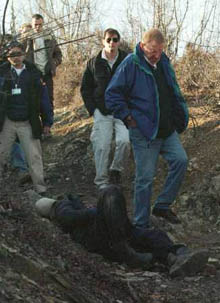
|
| US 'diplomat' William Walker,
above, inspects
Albanian bodies at the village of Racak. There are allegations that the corpses were dead
KLA fighters, killed in combat, who had been re-dressed in civilian clothes in order to
spread claims of war crimes against Serbia. Walker, an OSCE official, has been accused of
working to a hidden agenda set by the Clinton administration. There was no effort to
secure the alleged crime scene. |
"The scene of Albanian corpses in
civilian clothes lined up in a ditch which would shock the whole world was not discovered
until the next morning, around 9 a.m., by journalists soon followed by OSCE observers. At
that time, the village was once again taken over by armed UCK soldiers who led the foreign
visitors, as soon as they arrived, toward the supposed massacre site. Around noon, William
Walker in person arrived and expressed his indignation. All the Albanian witnesses gave
the same version: at midday, the policemen forced their way into homes and separated the
women from the men, whom they led to the hilltops to execute them without more ado. The
most disturbing fact is that the pictures filmed by the AP TV journalists -- which Le
Figaro was shown yesterday -- radically contradict that version. It was in fact an empty
village that the police entered in the morning, sticking close to the walls. The shooting
was intense, as they were fired on from UCK trenches dug into the hillside. The fighting
intensified sharply on the hilltops above the village. Watching from below, next to the
mosque, the AP journalists understood that the UCK guerrillas, encircled, were trying
desperately to break out. A score of them in fact succeeded, as the police themselves
admitted. What really happened? During the night, could the UCK have gathered the bodies,
in fact killed by Serb bullets, to set up a scene of cold-blooded massacre? A disturbing
fact: Saturday morning the journalists found only very few cartridges around the ditch
where the massacre supposedly took place."
Kosovo: Obscure Areas Of A Massacre
Le Figaro, 20
January 1999
"Even if they
don't remember the village's name, most Canadians will remember the pictures. The images of bodies piled in a ravine in the tiny Kosovo
village of Racak in January 1999. That massacre of Albanian civilians by Serbian
forces provoked immediate anger and international condemnation against Yugoslav leader
Slobodan Milosevic. It became the galvanizing event that led to NATO's armed intervention
against Yugoslavia. In the year that has passed since NATO's bombing campaign, there is
mounting evidence the Racak massacre was not as gruesomely simple as it first appeared.
There are suggestions the massacre was allowed to happen to fuel sympathy for Kosovo's
Albanians, while strengthening demands for NATO's bombs. Over the past three months, CBC
Radio has sought to unravel the mystery of the Racak massacre: was it a massacre or an act
of manipulation by those interested in bringing NATO to war?... If the Serbs had been planning a bloody massacre that day, why had they issued a
press release in Pristina that morning, inviting journalists to come to Racak to cover the
police operation? They said they would be carrying out an operation aimed at capturing
Kosovo Liberation Army soldiers in the area responsible for killing three Serb policemen
in ambushes the week before... Had the KLA manipulated the massacre scene to provoke
condemnation against the Serbs? Were the dead men in the ditch really innocent civilians,
or possibly dead KLA soldiers who'd been taken out of uniform?...The quest to determine
what was going on in the days before the massacre has unearthed disturbing new information
about the conduct of both the Kosovo Liberation Army and William Walker's observer
mission. Much of that new information comes from the people of Racak themselves. People
like Sadije Ramadani say the first hints of what was to come appeared on the weekend prior
to the Friday massacre. The Yugoslav Army had always maintained a small presence on the
large hill overlooking Racak. But suddenly a significant number of reinforcements arrived.
They showed up a day after the KLA ambushed and killed three Serb police officers.
Canadian General Michel Maisonneuve admits the KLA had to know how the Serbs were likely
to react to that ambush... Dugi Gorani, a prominent Kosovar Albanian, suggests the KLA was
very aware of the consequences of their actions.'The more civilians were killed,' he said,
'the chances of international intervention became bigger, and the KLA of course realized
that.'... Some KLA supporters have conceded that a key unit was based in the hills above
and around Racak. But, when the Serbs finally attacked on January 15, eyewitnesses say the
KLA fought back from high in the hills and made no real attempt to defend or protect the
village. By the next morning, however, KLA soldiers were all over Racak to lead
journalists into the ravine where the bodies were piled. Le Figaro's Renaud Girard
remembers asking the KLA where they'd been the day before. But the actions of KLA
commanders aren't the only actions that are now coming under scrutiny. For every question
being asked about their whereabouts on the day of the massacre, an equal number of
questions are being aimed at William Walker's observer mission. OSCE monitors knew
about the KLA's ambush on police and the arrival of Serb reinforcements near Racak the
very next day. Burim Osmani says his father Sadik had always been in frequent touch with
the OSCE monitors responsible for Racak. He says that two or three weeks before the
massacre, his father pleaded with the monitors to establish a permanent presence in the
village. The OSCE refused... The world may no longer care to remember the massacre that
sparked NATO's bombing campaign and the subsequent occupation of Kosovo by tens of
thousands of NATO soldiers. But the people of Racak have found a way to thank and remember
the man they believe made it all possible. They've renamed the Road to Racak, William
Walker Road."
The Road to Racak
CBC (Canadian
Broadcasting Corporation) Radio News, 2000
"European diplomats then working for
the OSCE claim it was betrayed by an American policy that made airstrikes inevitable. Some
have questioned the motives and loyalties of William Walker, the American OSCE head of
mission. 'The American agenda consisted of their diplomatic observers, aka the CIA,
operating on completely different terms to the rest of Europe and the OSCE,' said a
European envoy... Several Americans who were directly involved in CIA activities or close
to them have spoken to the makers of Moral Combat, a documentary to be broadcast on BBC2
tonight, and to The Sunday Times about their clandestine roles. Walker dismissed
suggestions that he had wanted war in Kosovo, but admitted the CIA was almost certainly
involved in the countdown to airstrikes.... Ten years
earlier he [Walker] was the American ambassador
to El Salvador when Washington was helping the government there to suppress leftist
rebels while supporting the contra guerrillas against the Sandinista government in
Nicaragua. Some European diplomats in Pristina, Kosovo's capital, concluded from Walker's
background that he was inextricably linked with the CIA. The picture was muddied by the
continued separation of American 'diplomatic observers' from the mission. The CIA sources
who have now broken their silence say the diplomatic observers were more closely connected
to the agency.... The KLA has admitted its long-standing links with American and European
intelligence organisations. Shaban Shala, a KLA commander now involved in attempts to
destabilise majority Albanian villages beyond Kosovo's border in Serbia proper, claimed he
had met British, American and Swiss agents in northern Albania in 1996.""
CIA aided Kosovo guerrilla army
Sunday Times, 12
March 2000
"Ambassador Walker was not just
working for the OSCE. He was part of the American diplomatic policy that was occurring
which had vilified Slobodan Milosevic, demonised the Serbian Administration and generally
was providing diplomatic support to the UCK or the KLA leadership."
Moral Combat - NATO at War
BBC 2, 12 March 2000
"A report
purporting to show that Belgrade planned the systematic ethnic cleansing of Kosovo's
entire Albanian population was faked, a German general has claimed. The plan, known as Operation
Horseshoe, was revealed by Joschka Fischer, the German
foreign minister, on April 6 last year, almost two weeks after Nato started bombing
Serbia. German public opinion about the Luftwaffe's participation in the airstrikes was
divided at the time. Horseshoe - or 'Potkova', as the Germans said it was known in
Belgrade - became a staple of Nato
briefings. It was presented as proof that President
Slobodan Milosevic of Yugoslavia had long planned the expulsion of Albanians. James Rubin,
the American state department spokesman, cited it only last week to justify Nato's
bombardment. Heinz Loquai, a retired brigadier general, has claimed in a new book on the
war that the plan was fabricated from run-of-the-mill Bulgarian intelligence reports.
Loquai, who now works for the Organisation for Security and Co-operation in Europe (OSCE),
has accused Rudolf Scharping, the German defence minister, of obscuring the origins of
Operation Horseshoe.... Loquai has claimed that the German defence ministry turned a
vague report from Sofia into a 'plan', and even coined the name Horseshoe. Die Woche has
reported that maps broadcast around the world as proof of Nato's information were drawn up
at the German defence headquarters in Hardthöhe.... The Bulgarian report concluded that
the goal of the Serbian military was to destroy the Kosovo Liberation Army, and not to
expel the entire Albanian population, as was later argued by Scharping and the Nato
leadership."
Serbian ethnic cleansing scare was a fake
Sunday Times, 2
April 2000
"I didn't
consult with anyone before [reporting the fact that I was holding a press conference on
the deaths at Racak]. I knew that it takes forever to get permission to do something like
that."
William Walker Interview
Public Broadcasting Service, USA, 2000
"The final toll of civilians confirmed
massacred by Yugoslav forces in Kosovo is likely to be under 3,000, far short of the
numbers claimed by Nato governments during last year's controversial air strikes on
Yugoslavia. When Yugoslav forces withdrew from Kosovo in
June last year, Nato spokesmen estimated that the Serbs had killed at least 10,000
civilians. While the bombing was under way William Cohen, the US defence secretary,
announced that 100,000 Kosovo Albanian men of military age were missing after being taken
from columns of families being deported to Albania and Macedonia. 'They may have been
murdered,' he said....The exhumation of less than 3,000 bodies is sure to add fuel to
those who say Nato's intervention against Yugoslavia was not 'humanitarian' and that it
had other motives ..."
Serb killings 'exaggerated' by west
Guardian, 18
August 2000
"In 1999, the discovery of bodies in
the Kosovo village of Racak helped push NATO into war. New evidence casting doubt on
claims that the bodies were civilian victims of a massacre has stirred debate in the
European media-- but there has been a virtual blackout on the news in the U.S. press. In
January of 1999, the American head of the Organization for Security and Cooperation in
Europe (OSCE) mission in Kosovo announced that 45 Kosovar Albanians from the village of
Racak had been massacred by Serb soldiers. U.S. diplomat William Walker condemned the
killings as a 'horrendous' massacre, stating that the dead were all civilians who had been
brutally executed, many of them mutilated after death. Once the massacre story was
reported in heart-wrenching detail by media across the globe, pressure for war intensified
and previously reluctant European allies took a major step toward authorizing airstrikes.
A Washington Post article (4/18/99) reconstructing the Kosovo decision-making process
found that 'Racak transformed the West's Balkan policy as singular events seldom do.'
Troubling questions soon emerged, however, about whether or not there had actually been a
massacre at Racak, or whether the incident had been manipulated to push NATO into war--
questions almost completely ignored by the U.S. media at the time. Front-page news
articles by veteran Yugoslavia correspondents questioning William Walker's account were
published in French newspapers like Le Figaro ('Dark Clouds Over a Massacre,' 1/20/99) and
Le Monde ('Were the Dead in Racak Really Massacred in Cold Blood?,' 1/21/99). The German
daily Berliner Zeitung reported in March (3/13/99) that several European governments,
including Germany and Italy, were pressing the OSCE to fire William Walker based on
information from OSCE monitors in Kosovo that the Racak bodies 'were not-- as Walker
declared-- victims of a Serbian massacre of civilians,' but were mostly KLA fighters
killed in battle. The Sunday Times of London (3/12/00) reported that Walker's team of
American observers was covertly working with the CIA, pursuing a policy intended to push
NATO into war. 'European diplomats then working for the OSCE claim it was betrayed by an
American policy that made airstrikes inevitable,' the Sunday Times reported. After the
massacre, the European Union hired a Finnish team of forensic pathologists to investigate
the deaths. Their report was kept secret until now, two years later. The U.S. media is
ignoring the story, despite the report's finding that although people did indeed die at
Racak, there is no evidence of a massacre. According to the Berliner Zeitung (1/16/01),
the Finnish investigators could not establish that the victims were civilians, whether
they were from Racak, or even exactly where they had been killed. Furthermore, the
investigators found only one body that showed traces of an execution-style killing, and no
evidence at all that the bodies had been mutilated. The Berliner Zeitung also reports that
these findings were completed as early as June 2000, but that their publication had been
blocked by the UN and the EU. Except for one brief wire story from United Press
International (1/18/01), not a single U.S. media outlet has run a story on the Finnish
team's findings. News outlets continue to refer to the Racak massacre without
qualification, despite the cloud of uncertainty hanging over the story."
Media Ignore Questions About Incident That Sparked Kosovo War
Update on Racak
Fairness and Accuracy in Reporting, 1
February 2001
"The tribunal might also hear the
observations of the French journalists who were among the first to arrive at the scene of
the killings. According to the Canadian Broadcasting Company documentary 'The Road to
Racak,' (The World at Six, 5/29/00), when reporter Renaud Girard of the French daily Le
Figaro arrived in the village, he was surprised to find that William Walker, the American
head of the Organization for Security and Cooperation in Europe observer mission in
Kosovo, had not sealed off the crime scene for war crimes investigators. Girard was
equally puzzled to find almost no bullet casings on the ground. 'It was weird,' he told
the CBC. 'Maybe somebody had picked them up.' Back in Pristina that day, he told his
colleague Christophe Chatelot of Le Monde about the apparent absence of bullet casings.
Chatelot asked one of Walker's observers, an American army captain, why there were none on
the ground. The captain replied, 'That's because I took them, I collected them.' The
captain 'confided to Chatelot that he'd picked up all the bullet casings once he'd arrived
at the scene.' Intrigued, Chatelot went to Racak the next day to investigate. When he
tried to find the American army captain again, he was 'suddenly nowhere to be found.' 'We
don't know him. He's never been here,' Chatelot says he was told by the OSCE mission. When
he asked to talk to the four monitors who had been in and around Racak the day of the
killings, he was told that their names had suddenly been made 'a classified secret.' 'It's
very strange,' Chatelot told the CBC. Later, it emerged that Walker's team of American
observers had been largely composed of undercover CIA operatives who, European diplomats
asserted, were carrying out 'an American policy that made [NATO] airstrikes inevitable'
(London Sunday Times, 3/12/00). International outrage over the Racak killings was
instrumental in pushing NATO to threaten Yugoslavia with airstrikes. The German magazine
Der Spiegel (3/19/01) recently obtained a secret dossier of evidence on the Racak killings
compiled by prosecutors at the war crimes tribunal in the Hague. According to Spiegel's
report, tribunal investigators found that the victims in Racak were probably unarmed at
the time they were killed; but the dossier 'also reveals manipulations, deceptions and
cover-ups-- on all sides.' 'U.N. investigators concede that perhaps half the victims were
aides to or sympathizers with the KLA,' the report says. Though 'defenseless civilians at
the time of their deaths,' these victims had also 'carried out attacks and assassinations
of Serbian officials and establishments or had approved of them.' Just 'a few days before
the massacre,' the report says, some of these victims 'fought against the advancing Serbs'
near Racak. (According to the Geneva conventions, it is a crime to deliberately kill
unarmed enemy sympathizers or prisoners of war.) The Spiegel report adds that the French
intelligence services in Kosovo monitored all KLA radio traffic and possess detailed logs
of these communications. According to Spiegel, these radio logs 'compromise' the KLA with
regard to its role in Racak. (According to Albanian witnesses, KLA fighters were present
in the hills surrounding Racak at the time of the killings.) But the French (who were more
sympathetic to the Serbian side in the Kosovo war than the United States) have released
only a fraction of these logs to anxious war crimes prosecutors trying to build a criminal
case. 'Now,' the Spiegel report concludes, 'the controversy over the radio logs begins:
Washington, Berlin and above all Belgrade are trying to gain possession of the explosive
material.'...In President Bill Clinton's March 19, 1999 address to the nation announcing
NATO's determination to launch airstrikes against Yugoslavia, he said: As we prepare to
act we need to remember the lessons we have learned in the Balkans.... We should remember
what happened in the village of Racak back in January -- innocent men, women and children
taken from their homes to a gully, forced to kneel in the dirt, sprayed with gunfire --
not because of anything they had done, but because of who they were. It is the
responsibility of U.S. journalists to try to find out whether or not this official account
is true."
Update on Racak
Fairness and Accuracy in Reporting, 18
July 2001
“Dick, you can kiss your Nobel Peace
Prize goodbye.”
William Walker to US special diplomatic envoy
to Bosnia and Kosovo, Richard Holbrooke, after Walker's visit to Racak
as reported by Walker's deputy, General Karol Drewienkiewicz
The Milosevic Trial: William Walker’s role as
provocateur
World Socialist
Web Site report, 20 July 2002
"The head of Belgrade’s Kosovo
Coordination Centre, Nebojsa Covic, said today that the 1999 NATO bombing of Yugoslavia
was prompted by the 'deception' of US diplomat William Walker. The state and its citizens
were bombed because of Walker and his trickery,' said Covic, in a reference to the
killings in the village of Racak, which Walker described as a massacre by Serb security
forces, a description which international investigators have since described as rash.
'If Milosevic must answer for all the things he did, then so should Walker answer
for his deception, instead of showing off in Kosovo,' he said."
Kosovo bombing prompted by US diplomat’s 'deception'
B92,
(Serbia) 25 January 2004
"In Milosevic's trial, German reporter
Franz Josef Hutsch testified that ethnic Albanian rebels in Kosovo had been harassing Serb
troops to provoke an 'excessive reaction' against Kosovo civilians and hasten
international intervention. Milosevic is accused of unleashing Serb troops who committed
atrocities while quashing a rebellion in Kosovo, a southern province of Serbia dominated
by ethnic Albanians. Eventually NATO launched a 78-day bombing campaign to force the Serbs
to end the crackdown. Milosevic has described the Kosovo war as a defensive action against
terrorists. Hutsch said he spent months with the Kosovo Liberation Army, the KLA,
beginning in September 1998. He described it as a well-organized force, assisted by
officers from Algeria, Egypt, Saudi Arabia and Morocco who had trained somewhere in
Turkey. To finance the purchase of increasingly sophisticated weapons, he said, the KLA
ran smuggling operations of drugs and women who were being forced into prostitution in
Europe. Hutsch testified that the KLA's tactics during the cease-fire in late 1998
included staging hit-and-run attacks on Serb patrols designed to 'force them into a trap
and try to provoke an excessive reaction.' He said they also tried to lure the Serbs into
attacking civilians in early 1999 so the images would be shown during peace negotiations
taking place in Rambouillet, France."
Milosevic returns to court, again seeking right to represent himself
Associated
Press, 12 October 2004
"Veterans of Kosovo’s 1998-99
guerrilla war said they were prepared to take up arms again if deadlock between the West
and Russia continued to block the province’s independence from Serbia. The ethnic
Albanian Kosovo Liberation Army veterans warned the international bodies running the
territory, primarily the United Nations, not to block the process. A statement said that
if their demand for independence was not met they would be 'forced to act as KLA soldiers
to fulfill the oath of our national heroes'. Talks between Serbs and Albanians ended in
stalemate in March."
KLA threaten fresh fighting in Kosovo
London Times, 9
July 2007
"....starting in 1992 with the
independence of Bosnia and Herzegovina I witnessed the beginning of international
anti-Serb bias based in no small part due to the efforts of professional North American
based public relations firms hired by two sides in a three sided civil war. The Bosnian
Serbs were slow off the mark, hired no one and have paid the price. This anti-Serb bias
and sympathy for their 'victims' was exploited by the Kosovo Liberation Army, (KLA), an
internationally recognized terrorist organization at the time when it commenced killing
Serbian security personnel in the late 90s. The KLA hired the same North American PR firms
employed by the Bosnian government and successfully won the PR war in spite of the fact
their organization initiated the armed conflict. No one could ever accuse the Serbs of
treating the Kosovar's with kid gloves; however, discrimination in civil service and
university hiring procedures is hardly justification for armed resistance with
independence and the creation of Greater Albania as a goal. Canadians should be concerned
regarding Kosovo's current leadership. The current Prime Minister Hashim Thaci was the
leader of the KLA. He has admitted that the KLA orchestrated the infamous Racak 'massacre'
dressing their KLA dead in civilian clothes, machine gunning them and dumping them in a
ditch and claiming it was a Serbian slaughter of civilians. NATO bought into the ruse and
on its 50th birthday looking for a role in the post cold war world the alliance became the
KLA's air force and bombed a sovereign nation from the safety of 10,000 ft. No one in NATO
was hurt. His predecessor as Prime Minister was Agim Cheku. He was in command of Croatian
Forces in the Medak Pocket where Serb families were burnt alive in their cellars
necessitating intervention by Canadian soldiers and he was also in charge in 1995 during
Operation Storm when the Croatian Army cowardly shelled and over- ran Canadian
peacekeeping positions. For both of those actions Canada called for the indictment of
Cheku for war crimes. Canada should remain united with the approximately 157 member
countries of the United Nations and with the leaders of the vast majority of the world's
population, India, China, the world's most populous Muslim nation, Indonesia, Russia,
Argentina, Greece, Cyprus and 149 others in not recognizing Kosovo's illegal unilateral
declaration of independence. Independence has to be earned by a group meeting specific
criteria and in accordance with legal protocol. Kosovo does not even come close to
qualifying for such recognition."
Major General (ret'd) Lewis MacKenzie, Canada
Statement to
The Lord Byron Foundation for Balkan Studies, The Rockford Institute Center for
International Affairs and the Montreal Rally against the Recognition of Kosovo
'Independence', 30 March 2008
"Kosovo's unilateral declaration of
independence [February 2008] should not be recognized by Canada. It has not been
authorized by the United Nations and is therefore in violation of international law, the
United Nations Charter and the Helsinki Final Accords. In addition, UN resolution 1244,
which ended the bombing of Serbia, reaffirms Serbia's sovereignty over Kosovo. The basic
principles of territorial integrity and state sovereignty have governed the relations
between states since the treaty of Westphalia in 1648. While they have been violated many
times in the intervening years, usually by acts of aggression by dictators, they remain
the essential components of international law.... The Helsinki Final Act of 1975
reinforced these principles by adding to them the principle of the inviolability of
borders. These are fundamental principles and they have universal application. They cannot
be set aside because of special cases or because they present an obstacle to the policy
objectives of a powerful nation. Their message is simple and clear --borders cannot be
changed without the consent of the state involved..... In the spring of 1999 the U.S.-led
NATO countries intervened militarily in Kosovo and, in violation of the UN Charter, bombed
Serbia. The bombing was justified on allegations that
genocide and ethnic cleansing were taking place in Kosovo. We now know these allegations
were completely unfounded. In the three years of
armed conflict in Kosovo leading up to the bombing by NATO the UN estimates there were a
total of 4,600 people killed during the fighting and this figure includes both Serbs and
Albanians. In fact, so far there have been only a little over 2,000 bodies discovered.
This in itself is a tragic figure, but it is not genocide. As for ethnic cleansing it is
now generally acknowledged that the mass expulsion of the Albanians took place after the
bombing started. While there were thousands of Albanians displaced within Kosovo as a
result of two years of armed conflict there was not a deliberate policy of ethnic
cleansing taking place. Although the western media continue to justify the independence of
Kosovo on the grounds of ethnic cleansing and atrocities committed by Slobodan Milosevic's
security forces the facts do not support these allegations. They do stand, however, as
testimony to the success of NATO's propaganda machine. The intervention in Kosovo had
nothing to do with humanitarian reasons but was deliberately designed to justify the
continued existence of NATO and to fundamentally change its role from a purely defensive
organization acting in accordance with the UN Charter into one that could intervene
wherever or whenever it decided to do so, and with or without UN approval. There have been
numerous reports that western security agencies trained, equipped and armed members of the
Kosovo Liberation Army (KLA) and sent them back into Kosovo to assassinate Serbian mayors,
police officials and Albanians who did not support their cause. It was a highly successful
operation and it fuelled the armed rebellion by the KLA. In August 1998 - seven months before the NATO bombing - the U.S. Senate
Republican Policy Committee reported that, 'planning for a U.S.-led NATO intervention in
Kosovo is largely in place. ... The only missing element seems to be an event with
suitably vivid media coverage that could make the intervention politically saleable. ... That the
administration is waiting for a 'trigger' is increasingly obvious.' That trigger was soon to be pulled. It was the highly suspicious 'Racak'
massacre that, as Madeleine Albright said, was the galvanizing incident that led to the
bombing. The bombing of Serbia by NATO without UN approval was a historical turning point.
The precedent had been set. The UN Charter could be subverted if the military intervention
could be cloaked and justified in terms of humanitarianism. The intervention in Iraq was
to follow but this time not all of the NATO countries went along with the American
initiative."
James Bissett (former Canadian Ambassador to Yugoslavia) - Canada And Kosovo
The
Ottawa Citizen, 19 February 2008
"Today is a decade since the armed
conflict in the village of Racak in Kosmet, which was the immediate reason for the NATO
bombing of FR Yugoslavia, reminds the POLITIKA daily. On January 15, 1999, the Serbian
security forces took the action against the members of the terrorist KLA organization and
killed 40 of them, and then OSCE Head in Kosmet William Walker described that as a
'massacre of civilians', which was the beginning of the media preparation for the NATO
intervention. Investigative judge in Pristina at the time, Danica Maksimovic, has once
again confirmed for the POLITIKA that at issue was an armed conflict, of which there has
been much evidence, and certainly not a civilian massacre. She was accompanied during the
entire time by three OSCE members, who had a clear understanding of the situation. Last
year, head of the international forensic team in the Racak case, Helena Renta from Finland, wrote in her autobiography that the
report was made under the pressure of William Walker and the Fin Ministry of Foreign
Affairs, and she was required to define the incident as the Serb crime. In a documentary film of Russian authors, she has also admitted that
terrorist bodies were found in Racak. At the trial of Slobodan Milosevic in The Hague, the
event in Racak was also described as a massacre, but such qualification was later excluded
from the indictment."
Ten years since the Racak case
Radio
Srbija, 15 January 2009
"Forensic dentist Helena Ranta says that officials of
the Ministry for Foreign Affairs had tried to influence the content of her reports in
2000, when Ranta was commissioned by the European Union to investigate the events of Racak
in Kosovo. Ranta put forward her allegations on Wednesday at the publication of her
biography in Helsinki. The book was written by Kaius Niemi, a managing editor at
Helsingin Sanomat. 'Three civil servants of the Ministry for Foreign Affairs expressed
wishes by e-mail for more far-reaching conclusions', Ranta said. 'I still have the
e-mails.' More than 40 Albanians were killed in the village of Racak in January 1999. The
investigation by Ranta’s working group was very charged from the beginning. It was
commonly assumed that Serb forces had perpetrated a massacre, which helped persuade NATO
to launch bombings of Yugoslavia in the spring of 1999. In her investigations, Ranta
focussed on forensic medicine; she did not want to take a stand, at that stage, on
politically and legally loaded terminology. In the summer of 2000 she submitted her report
to the War Crimes Tribunal in The Hague, and a summary of the report to the EU member
states. Ranta says that the head of the Foreign Ministry’s political section at the
time, Pertti Torstila,
who now holds the position of Secretary of State, asked her to remove a comment from the
report, that was 'very mildly critical' of the foreign affairs administration.
Officials at the Foreign Ministry had also hoped that Ranta would have drawn conclusions
on how many people fired shots and if any of the shots amounted to a coup de grace. 'I
feel that it was more a task for the war crimes tribunal', Ranta says in the book...
pressure was high, specifically in the investigation over Racak. That pressure also came
from the media. According to Ranta, in the winter of 1999 William Walker, the head of the OSCE Kosovo monitoring mission, broke a pencil in two
and threw the pieces at her when she was not willing to use sufficiently strong language
about the Serbs."
Helena Ranta: Foreign Ministry tried to influence Kosovo reports
Helsingin
Sanomat (Finland), 16 October 2008
"The Tuesday Op-Ed, 'A separate take
from Serbia'
by William Walker, deeply shocked me due to its lack of impartiality and its maliciousness
and/or ignorance. Claiming that basically nothing has changed in Serbia regarding Kosovo since
the era of the late Slobodan Milosevic
is not only simply false, but also represents an outrageous fabrication....In the
negotiations over the status of Kosovo, Serbia had offered Kosovo autonomy over and above
any similar arrangements that exist in multiethnic states throughout the world. That these
negotiations ended with a unilateral declaration of independence by Albanian leaders in
Kosovo, bypassing the U.N. Security Council in spite of the standing U.N. Resolution 1244,
is a travesty of international law and a dangerous precedent that will inflame
secessionist movements throughout the world....The impartiality of Mr. Walker has been
questioned over the years, not least because of what has been perceived as his rush to
judgement in the Racak case that led to the NATO bombing of Serbia in 1999. His op-ed can
only add support to doubts concerning his impartiality."
IVAN VUJACIC - Ambassador of Serbia to the United States
LETTER TO EDITOR: Truth about Serbia
Washington
Times, 2 March 2009
'The Hoax That Started A War'
The Toronto
Sun, April 02, 2001
The hoax that started a war
How the U.S., NATO and the western media were conned in Kosovo
By PETER WORTHINGTON - Toronto Sun
Back in March, 1999, what tipped the scales for then U.S. president Bill Clinton to launch
an air war against Serbia, were reports of a massacre of 45 Albanian civilians by Serb
security forces at the village of Racak, some 30 km from Pristina in southern Kosovo.
Clinton told the world on March 19, 1999: "We should remember what happened in Racak
... innocent men, women and children were taken from their homes to a gully, forced to
kneel in the dirt and sprayed with gunfire." Photos circled the world. NATO bombing
began March 24, and lasted 78 days.
White House press secretary Joe Lockhart said of Racak: "A strong message will be
brought to President (Slobodan) Milosevic about bringing those to justice who should be
punished for this ... "
U.S. Foreign Secretary Madeleine Albright, eager to make war against then-Yugoslavia and
speaking on CBS' Face the Nation, cited Racak where, she said, there were "dozens of
people with their throats slit." She called this the "galvanizing incident"
that meant peace talks at Rambouillet were pointless, "humanitarian bombing" the
only recourse.
Germany's Foreign Minister, Joschka Fischer, told the newspaper Berliner Zeitung that the
Racak massacre "became the turning point for me" and war was the only answer.
Canada's then foreign minister, Lloyd Axworthy, called the massacre "a disgusting
victimization of civilians."
Human Rights Watch (HRW) reported the dead had fingernails torn out - evidence of torture.
On Jan. 16, the day after the actual massacre, William Walker, the veteran American
diplomat who headed peace verifiers for the Organization for Security and Co-operation in
Europe (OSCE), was taken by Kosovo Liberation Army members to Racak to see the bodies in
the ditch. He declared that the dead "obviously were executed where they lay."
His OSCE report spoke of "arbitrary arrests, killings and mutilations of unarmed
civilians" at Racak.
Canada's Louise Arbour, then special prosecutor for the war crimes tribunal, (hand-picked
for the job by Albright) was prevented by Serb authorities from visiting Racak. She vowed
retribution for the massacre, urging that "international troops on the ground"
were the only way to effect arrests.
When Milosevic was indicted as a war criminal, the massacre at Racak was cited as
evidence. The London Times wrote that victims had their eyes gouged out, heads smashed in,
faces blown away at close range, all "farmers, workers, villagers, aged 12-74, men,
women, children."
Serbian and Belorussian forensic people investigated, but were suspect, so the European
Union authorized a forensic team from Finland, headed by Helena Ranta, a dental
pathologist, to investigate. The Finnish report was not made public.
Ranta gave a press conference at which she was vague, admitting there was no evidence of
mutilation or torture, and that Yugoslav authorities had co-operated. But she also called
the killings "a crime against humanity," widely interpreted to mean Racak was
indeed a cold-blooded massacre.
It has since turned out, through subsequent investigations by German, French and American
correspondents and by human rights and peace groups, including the anti-war International
Action Centre and the Liberty Foundation, that the Racak massacre seems an enormous,
albeit effective, hoax perpetrated by the Kosovo Liberation Army to persuade the U.S. and
NATO to attack the Serbs. The goal was independence for Kosovo, possibly leading to the
dream of a Greater Albania.
We now have a far better idea of what really happened at Racak - a pre-crisis town of
2,000 and a stronghold of KLA agitation. By January, 1999, most of its population had fled
to a nearby town, Stimlje, leaving perhaps 400 people behind. When four Serbian policemen
were ambushed and murdered in two separate incidents in a week, Serb security forces
surrounded Racak and attacked. The Serbs tipped off foreign journalists who came to see.
Fighting was savage and brief, not only in town but in the countryside.
Journalists found Racak had few people actually living there.
Some 20 bodies were counted. Serbs and journalists left at dusk. The next day, Jan. 16,
the KLA was again in control.
During the night, it seems that all the KLA killed fighting in the area - 45 of them -
were dumped in a gully at Racak and journalists and the OSCE investigators invited to see
what was described as the "massacre" of unarmed civilians.
Military insignia and/or badges had been removed from clothing, military gear replaced by
civilian clothing. No weapons were in sight. The hoax was on. William Walker was first on
the scene and believed what he saw and was told. The international press relayed his
outrage to the world.
Forensic evidence showed - as the Finnish team has since confirmed - that most of the 45
Racak dead had been shot at long range, not execution-style. Corpses tested positive with
residue of gunpowder on their hands, indicating they had been firing weapons. No
ammunition or shell casings were found near the bodies, where they had supposedly been
massacred, nor were there pools of blood. Pathologists also found the 45
dead men had all been shot in different parts of the body, from different directions,
indicating a battle somewhere else, the dead dumped together for effect.
Until recently, no one was interested in the truth. "Whether or not it's a massacre,
nobody wants to know any more," wrote Austria's Die Welt newspaper. Autopsy findings
were delayed while the thirst for war echoed in the halls of allied power.
The German newspaper Berliner Zeitung got access to the Finnish forensic findings, and
sent a team of reporters to investigate and concluded: "In all probability, there was
no Racak massacre at all ... "
French journalist Renaud Girard of Le Figaro was in Racak and was puzzled that reports
failed to mention it was a "fortified village with a lot of trenches" - a KLA
stronghold. Although he wrote an initial massacre story, he later had doubts: "I felt
something was wrong."
Christophe Chatelet of Le Monde was in Racak the day of the Serb attack, and found one
dead and four wounded when he left at dusk. The next day the KLA showed bodies from a
massacre that hadn't been there before. "I can't solve that mystery," he said.
(At the time, KLA commander-in-chief Hashim Thaci told the BBC: "We had a key unit in
the region and had a fierce fight. Regrettably, we had many casualties, but so did the
Serbs.")
Further investigation shows that two TV journalists for Associated Press and two teams of
OSCE observers also saw the fight for Racak from a hill, entered when Serb security forces
did and left when they left. The AP crew filmed a deserted village. It was overnight that
the KLA returned and gathered their dead from the fighting. Next day, Walker told the
world how adults and children had been "executed," some as they tried to flee.
CNN reporter Christiane Amanpour, wife of U.S. State Department spokesman James Rubin,
showed little skepticism in reporting on the "massacre of civilians."
It changes nothing, but Racak should make people wary of government propaganda
about areas where they have little knowledge, but strong feelings. Remember the emotions
generated about "ethnic cleansing" in Kosovo?
At the end of World War II, the population of Kosovo was 50-50 Serb and Albanian. By 1999
it was 90% Albanian. Today, it's close to 96%. Over 50 years, who's been "ethnically
cleansed"? Today, Albanians in Macedonia are using arguments similar to those used
against Serbs in Kosovo - prejudice, being frozen from jobs, discriminated against. Rarely
mentioned are maps produced in Albania that show not only Kosovo, but parts of Macedonia
and Montenegro as part of "Greater Albania."
It doesn't take an Einstein to realize that the U.S., NATO and western media have been
conned and manipulated into supporting an aggressive exercise in nation-building that is
not likely to be resolved peaceably. NATO's beleaguered soldiers are innocents caught in a
Balkan quagmire, thanks to a blundering, myopic, vainglorious political leader. |
"Years
from now, when the war in Serbia is over and the dust has settled, historians will point
to January 15, 1999 as the day the American Death Star became fully operational. That was
the date on which an American diplomat named William Walker brought his Organization for
Security and Cooperation in Europe (OSCE) war crimes verification team to a tiny Kosovar
village called Racak to investigate an alleged Serb massacre of ethnic Albanian peasants.
After a brief review of the town's 40-odd bullet-ridden corpses, Walker searched out the
nearest television camera and essentially fired the starting gun for the war. 'From what I saw, I do not hesitate to describe the crime as a massacre,
a crime against humanity,' he said. 'Nor do I hesitate to accuse the government security
forces of responsibility.' We all know how Washington responded to Walker's verdict; it
quickly set its military machine in motion, and started sending out menacing invitations
to its NATO friends to join the upcoming party.....According to various newspaper reports,
Walker began his diplomatic career in 1961 in Peru.
He then spent most of his long career in the foreign service in Central and South America,
including a highly controversial posting as deputy chief of mission in Honduras in the
early 1980s, exactly the time and place where the Contra rebel force was formed. The contra force was the cornerstone of then-CIA Director William Casey's
hard-line anti-Communist directive, and Honduras was considered, along with El Salvador,
the front line in the war with the Soviet Union. From there, Walker was promoted, in 1985,
to the post of deputy assistant secretary of state for Central America. This promotion
made him a special assistant to Assistant Secretary of State Elliot Abrams, a figure whose
name would soon be making its way into the headlines on a daily basis in connection with a
new scandal the press was calling the 'Iran-Contra' affair. Walker would soon briefly join
his boss under the public microscope. According to information contained in Independent
Counsel Lawrence Walsh's lengthy indictment of Abrams and Oliver North, Walker was responsible for setting up a phony humanitarian
operation at Ilopango airbase in El Salvador. This shell organization was used to funnel
guns, ammunition and supplies to the Contras in Nicaragua. Despite having been named in
Walsh's indictment (although he was never charged himself) and outed in the international
press as a gunrunner, Walker's diplomatic career did not, as one might have expected, take
a turn for the worse. Oddly enough, it kept on advancing. In 1988, he was named ambassador
to El Salvador, a state that at one time was still in the grip of US-sponsored state
terror. Walker's record as Ambassador to El Salvador
is startling upon review today, in light of his recent re-emergence into the world
spotlight as an outraged documenter of racist hate-crimes. His current posture of moral
disgust toward Serbian ethnic cleansing may seem convincing today, but it is hard to
square with the almost comically callous indifference he consistently exhibited toward
exactly the same kinds of hate crimes while serving in El Salvador. In late 1989 came one
of the most notorious and ghastly killings of the 1980s in Central America, when
Salvadoran soldiers executed six Jesuit priests, their housekeeper, and her 15-year old
daughter, blowing their heads off with shotguns. Walker scarcely batted an eyelid. When
asked at a press conference about evidence linking the killings to the Salvadoran High
Command, he went out of his way to apologize for chief of staff Rene Emilio Ponce,
dismissing the murders as a sort of forgivable corporate glitch, like running out of Xerox
toner. 'Management control problems can exist in these kinds of situations,' Walker
said.... in what may be the most amazing statement of all, given his current occupation,
Walker questioned the ability of any person or organization to assign blame in hate crime
cases. Shrugging off news of eyewitness reports that the Jesuit murders had been committed
by men in Salvadoran army uniforms, Walker told Massachusetts congressman Joe Moakley that
'anyone can get uniforms. The fact that they were dressed in military uniforms was not
proof that they were military.' Later Walker would
recommend to Secretary of State James Baker that the United States 'not jeopardize' its
relationship with El Salvador by investigating 'past deaths, however heinous.' This is
certainly an ironic comment, coming from a man who would later recommend that the United
States go to war over...heinous deaths. One final intriguing biographical note: Walker in 1996 hosted a
ceremony in Washington held in honor of 5,000 American soldiers who fought secretly in El
Salvador. While Walker was Ambassador to El Salvador, the US government's official story
was that there were only 50 military advisors in the country (Washington Post, May 6,
1996). With a background like this, it seems
implausible that Walker would be chosen by the United States to head the Kosovar
verification team on the basis on any established commitment to the cause of human rights.
What seems more likely, given Walker's background, is that he was chosen because of his
proven willingness to say whatever his government wants him to say, and to keep quiet when
he is told to keep quiet--about things like a gunrunning operation, or the presence of
4,950 undercover mercenaries (whose existence he regularly denied with a straight face) in
the banana republic where he was Ambassador.... There
is a widespread belief not only in Russia, but also in other countries, that Walker's role
in Racak was to assist the KLA in fabricating a Serb massacre that could be used as an
excuse for military action. Already, two major mainstream French newspapers--Le Monde and
Le Figaro--as well as French national television have run exposes on the Racak incident.
These stories cited a number of inconsistencies in Walker's version of events, including
an absence of shell casings and blood in the trench where the bodies were found, and the
absence of eyewitnesses despite the presence of journalists and observers in the town
during the KLA-Serb fighting. Eventually, even the Los Angeles Times joined in, running a
story entitled 'Racak Massacre Questions: Were Atrocities Faked?' The theory behind all
these exposes was that the KLA had gathered their own dead after the battle, removed their
uniforms, put them in civilian clothes, and then called in the observers. Walker,
significantly, did not see the bodies until 12 hours after Serb police had left the town.
As Walker knows, not only can 'anybody have uniforms,' but anyone can have them taken off,
too. The story of William Walker's involvement in
the was is just one of a rapidly-growing family of tales cataloguing the incompetence and
arrogance of the United States and its allies throughout the Kosovo conflict. Even if it isn't proof of some as-yet-unreleased sinister plan to
secure a permanent military presence in the Balkans, the fact that the US didn't even care
to avoid the appearance of impropriety in its search for Serb atrocities says a lot about
our approach to international relations. It says, 'Go ahead and think the worst about us.
We don't care. We've got more bombs than you do.'"
Death squads' flack in El Salvador, Clinton's man in Kosovo
Counterpunch, Volume
6, #10, 16 May 1999
"Five years ago our television screens
were dominated by pictures of Kosovo-Albanian refugees escaping across Kosovo's borders to
the sanctuaries of Macedonia and Albania. Shrill reports indicated that Slobodan
Milosevic's security forces were conducting a campaign of genocide and that at least
100,000 Kosovo-Albanians had been exterminated and buried in mass graves throughout the
Serbian province. NATO sprung into action and, in spite of the fact no member nation of
the alliance was threatened, commenced bombing not only Kosovo, but the infrastructure and
population of Serbia itself -- without the authorizing United Nations resolution so
revered by Canadian leadership, past and present. Those of us who warned that the West was
being sucked in on the side of an extremist, militant, Kosovo-Albanian independence
movement were dismissed as appeasers. The fact that the lead organization spearheading the
fight for independence, the Kosovo Liberation Army (KLA), was universally designated a
terrorist organization and known to be receiving
support from Osama bin Laden's al-Qaeda was
conveniently ignored. The recent dearth of news in
the North American media regarding the increase in violence in Kosovo compared to the
comprehensive coverage in the European press strongly suggests that we Canadians don't
like to admit it when we are wrong. On the contrary, selected news clips on this side of
the ocean continue to reinforce the popular spin that those dastardly Serbs are at it
again... Since the NATO/UN intervention in 1999,
Kosovo has become the crime capital of Europe. The sex slave trade is flourishing. The
province has become an invaluable transit point for drugs en route to Europe and North
America. Ironically, the majority of the drugs come from another state 'liberated' by the
West, Afghanistan. Members of the demobilized, but not eliminated, KLA are intimately
involved in organized crime and the government. The UN police arrest a small percentage of
those involved in criminal activities and turn them over to a judiciary with a revolving
door that responds to bribes and coercion. The objective of the Albanians is to purge all
non-Albanians, including the international community's representatives, from Kosovo and
ultimately link up with mother Albania thereby achieving the goal of "Greater
Albania." The campaign started with their attacks on Serbian security forces in the
early 1990s and they were successful in turning Milosevic's heavy-handed response into
worldwide sympathy for their cause. There was no
genocide as claimed by the West -- the 100,000
allegedly buried in mass graves turned out to be around 2,000, of all ethnic origins,
including those killed in combat during the war itself. The Kosovo-Albanians have played
us like a Stradivarius. We have subsidized and indirectly supported their violent campaign
for an ethnically pure and independent Kosovo.We have never blamed them for being the
perpetrators of the violence in the early '90s and we continue to portray them as the
designated victim today in spite of evidence to the contrary. When they achieve
independence with the help of our tax dollars combined with those of bin Laden and
al-Qaeda, just consider the message of encouragement this sends to other
terrorist-supported independence movements around the world."
Maj-Gen. Lewis MacKenzie (now retired, commanded UN troops during the Bosnian civil war of
1992)
National Post (Canada), 7
April 2004
"... starting in 1992 with the
independence of Bosnia and Herzegovina I witnessed the beginning of international
anti-Serb bias based in no small part due to the efforts of professional North American
based public relations firms hired by two sides in a three sided civil war. The Bosnian
Serbs were slow off the mark, hired no one and have paid the price. This anti-Serb bias
and sympathy for their 'victims' was exploited by the Kosovo Liberation Army, (KLA), an
internationally recognized terrorist organization at the time when it commenced killing
Serbian security personnel in the late 90s. The KLA hired the same North American PR firms
employed by the Bosnian government and successfully won the PR war in spite of the fact
their organization initiated the armed conflict. No one could ever accuse the Serbs of
treating the Kosovar’s with kid gloves; however, discrimination in civil service and
university hiring procedures is hardly justification for armed resistance with
independence and the creation of Greater Albania as a goal. Canadians should be concerned
regarding Kosovo’s current leadership. The
current Prime Minister Hashim Thaci was the leader of the KLA. He has admitted that the
KLA orchestrated the infamous Racak 'massacre' dressing their KLA dead in civilian
clothes, machine gunning them and dumping them in a ditch and claiming it was a Serbian
slaughter of civilians. NATO bought into the ruse
and on its 50th birthday looking for a role in the post cold war world the alliance became
the KLA’s air force and bombed a sovereign nation from the safety of 10,000 ft. No
one in NATO was hurt. His predecessor as Prime Minister was Agim Cheku. He was in command
of Croatian Forces in the Medak Pocket where Serb families were burnt alive in their
cellars necessitating intervention by Canadian soldiers and he was also in charge in 1995
during Operation Storm when the Croatian Army cowardly shelled and over- ran Canadian
peacekeeping positions. For both of those actions Canada called for the indictment of
Cheku for war crimes."
Major General (ret'd) Lewis MacKenzie
Statement To The Lord Byron
Foundation for Balkan Studies, 30 March 2008
The Role Of
Journalists
In Spreading NATO Falsehoods About Kosovo And Serbia
"For more than 40 years Dessa Trevisan
was the Times correspondent in Eastern Europe. From her base in Belgrade from 1953 to 1960
and then in Vienna until 1971 and finally back in Belgrade, she covered the big events of
the Cold War, from the Hungarian uprising of 1956 and the Soviet invasion of
Czechoslovakia in 1968, to the collapse of communism in Romania and the decline and fall
of Yugoslavia. While covering the disintegration in the 1990s of Yugoslavia, the land of
her birth, she was threatened, shot, jailed and expelled from the country. She remained
nonetheless a passionate, if frustrated, patriot, combining this with pride in being
British. Throughout these upheavals she provided an insight into the methods of communist
rule and a robust analysis of its oppressive excesses, and she was long regarded as the
most knowledgeable reporter covering Eastern Europe. Trevisan’s schooling in
politics, begun in Second World War Yugoslavia and continued under Tito’s rule, gave
her a pragmatic understanding of Central and East European affairs. She was always aware
of the force of nationalism behind all the political ideology in the region.... Few correspondents
had better contacts in the ruling communist parties of Poland, Czechoslovakia, Hungary,
Romania, Bulgaria and Yugoslavia.... On Yugoslavia Trevisan’s analysis was
particularly acute. Her insights into behind-the-scenes developments during Tito’s
rule and his edgy relationship with Moscow were much valued by diplomats and reporters. In
the late 1980s she was one of the first to warn of Milosevic’s attempts to reassert
Serbian authority over the other republics, and to anticipate the eventual breakup of the
country. She chronicled the political background of the departure from the federation of,
first, Slovenia and Croatia in 1991 and then Bosnia a year later.... Trevisan was even-handed in her acerbic assessments of the
negative characteristics of role players in the Balkan dramas, whatever their ethnic
origin. Indeed,
she came to believe that evils were committed on all sides and that the West was too quick to demonise
the Serbs and gloss over atrocities committed by Croats, Muslims and ethnic Albanians. Despite her own experience of the Belgrade authorities, she was sharply
critical of the operation of the international court at The Hague, including the conduct
of the trial of Milosevic. She was outraged by the
Nato bombing of Serbia in 1999, and by Western recognition of an independent Kosovo nine
years later. Kosovo, with its great Orthodox churches, was, for her, the cradle of Serb
culture and she could not forgive the way it was detached... Born Dessa Pavlovic, she was
the daughter of a Serb father and a Croat mother..... She began her journalistic career
with Reuters before joining The Times in 1953."
Dessa Trevisan
London Times, 21 February 2013, Print Edition, P57
Portraying The Serbs As Worse Than Everyone Else
How It Was Done - The Basic 'Public Relations' Model
| 'The First
Statement Counts - The Retractions Have No Effect' |
"For
18 months, we have been working for the Republics of Croatia and Bosnia-Herzegovina, as
well as for the opposition in Kosovo. Throughout
this period, we had many successes, giving us a formidable international image. We intend
to make advantage of this and develop commercial agreements with these countries. Speed is vital, because items favourable to us must be settled in public
opinion. The first statement counts. The retractions have no effect.....
The essential tools in our work are a card file, a computer, and a fax. The card file
contains a few hundred names of journalists, politicians, academicians, and
representatives of humanitarian organizations. The computer goes through the card files
according to correlated subjects, coming up with very effective targets. The computer is
tied into a fax. In this way, we can disseminate information in a few minutes to those we
think will react (positively). Our job is to assure
that the arguments for our side will be the first to be expressed..... This was a sensitive matter, as the dossier was dangerous looked
from this angle. President Tidjman was very careless in his book 'Wastelands of Historical
Reality'. Reading this writtings, one could accuse him of of anti- semitism. In Bosnia, the situation was no better: President Izetbegovic
strongly supported the creation of a fundamentalist Islamic state in his book 'The Islamic
Declaration'. Besides, the Croatian and Bosnian past was marked by a real and cruel
anti-semitism. Tens of thousands of Jews perished in Croatian camps. So there was every
reason for intellectuals and Jewish organizations to be hostile towards the Croats and
Bosnians. Our chalenge was to reverse this attitude. And we succeded masterfully. At the beginning of August 1992, the New York Newsday came out with
the affair of (Serb) concentration camps. We jumped at the opportunity immediately. We
outwitted three big Jewish organizations - B'Nai Brith Anti-Defamation League, the Jewish
Committee, and the American Jewish Congress. We suggested to them to publish an
advertisement in the New York Times and to organize demonstrations outside the U.N. This
was a tremendous coup. When the Jewish organizations
entered the game on the side of the (Muslim) Bosnians, we could promptly equate the Serbs
with the Nazis in the public mind. Nobody understood what was happening in Yugoslavia. The
great majority of Americans were probably asking themselves in which African country
Bosnia was situated. But, by a single move, we were able to present a simple story of good
guys and bad guys, which would hereafter play itself. We won by targeting Jewish audience.
Almost immediately there was a clear change of language in the press, with the use of
words with high emotional content, such as 'ethnic cleansing', 'concentration camps', etc.
which evoked images of Nazi Germany and the gas chambers of Auschwitz. The emotional
charge was so powerful that nobody could go against it.... Our work is not to verify
information. We are not equipped for that. Our work is to accelerate the circulation of
information favorable to us, to aim at judiciously chosen targets. We did not confirm the
existence of death camps in Bosnia, we just made it known that Newsday affirmed it....We
are professionals. We had a job to do and we did it. We are not paid to be moral."
Mr. James Harff (director of Ruder Finn
Global Public Affairs, public relations firm) - Interview with Jacques Merlino, associate director of
TV chain France 2, Paris in October 1993
Jacques Merlino: 'Les verites Yougoslaves ne sont pas toutes bonnes a dire'
('Yugoslav truths are not all good for telling')
Published
by: Albin Michel, Paris, 1993, pp. 127-129 ISBN 2-226-06663-2 |
There Was No
Genocide In Kosovo
French Language Television Debate On The Demonisation Of The Serbs
And NATO Support For Narco-Terrorist Mafia In Kosovo
(YouTube posting with sub-titles)
Click
Here |
How American PR Firms Duped America's Jewish Community
During Yugoslavia's Civil War
"In the six years since our bizarre
bombing of Belgrade to prevent a genocide that forensics turned up empty (a memo that
apparently made it only to European and Canadian presses, leaving a gaping hole in our
national dialogue), the sense of something not being said grows palpable. With every
explosive report coming from the Balkans--Islamic charities getting busted as
terror-funding fronts, terrorist cells being uncovered in Bosnia and Kosovo, explosions
on Pristina’s Bill Clinton Avenue, then last year’s coordinated Albanian
riots that injured 900, killed 19 Serbs and tried to drive out what was left of
Kosovo’s non-Albanian population--more and more people have started to think it, but
who has the poor taste to say it? After all, we were told that a genocide was in progress.
We were told of mass graves. A hundred thousand killed and 800,000 displaced, Bill Clinton
said. Soon after the U.S.-led NATO invasion, the 100,000 figure turned out to be closer to
2,000 and included armed Albanian and Serb fighters. 'No Bodies at Rumored Grave Site in
Kosovo,' read a Reuters headline as early as October ’99, above an article reporting
the results of an excavation by international war crimes investigators to check the rumors
that Serbs had hidden up to 700 Albanian bodies in a lead and zinc mine. Other 'mass
graves' turned up empty or hardly massive, and the Racak massacre, the feather that was
used to break the NATO camel’s back, turned out to have been staged, according to
three forensics teams sent in to investigate--but only after the first team, headed by
Finland’s Helena Ranta, initially gave a thumbs-up to 'massacre' so that the bombing
campaign could commence. (Two years and thousands of lives later, Ranta’s final
report confirmed the opposite conclusion.) Sold on a Holocaust scenario, the American
people couldn’t have known what sinister deal they’d signed on to. But my fellow
Jews should have smelled a rat. And to my profound disappointment, in the face of a
stunning parallel to the Palestinian propaganda war that Jews themselves struggle with,
for the most part they have been silent since. As journalists fanned the early flames of
Serb demonization in Bosnia, starting with a widely circulated 1992 photo of a Serb-run
'death camp' for Bosnian Muslims that turned out to have been taken from the inside of a
fenced storage area, and showed refugees who had escaped the fighting and were free to go
at any time, it should have raised some red flags among my tribe--even if only after the
fact.... A 1994 article in a monthly Jewish publication called 'Midstream,' which caught
on early, cites an interview between a French journalist named Jacques Merlino and James
Harff, of the D.C.-based PR firm Ruder & Finn, which was representing Croatia, Bosnia and the Kosovo Liberation Army.
After boasting about having set up meetings between Bosnian officials and Al Gore, George
Mitchell, Bob Dole and other politicians, Harff described the achievement he was most
proud of: 'To have managed to put Jewish opinion on our side…At the beginning of
August 1992, ‘New York Newsday’ came out with the affair of [Serb] concentration
camps. We jumped at the opportunity immediately. We outwitted three big Jewish
organizations--B'nai B'rith, Anti-Defamation League, the American Jewish Committee, and
the American Jewish Congress. We suggested to them to publish an advertisement in the
‘New York Times’ and to organize demonstrations outside the United Nations. That
was a tremendous coup. When the Jewish organizations
entered the game on the side of the Bosnians, we could promptly equate the Serbs with the
Nazis in the public mind.'... It’s all the more
tragic considering the historical relationship between Jews and Serbs, both of whom were
persecuted by the Nazis’ Croatian, Bosnian and Albanian brigades during WWII. In
1999, under pressure from the U.S. and amid protest from Israelis who knew better, Israel
joined NATO’s war against Yugoslavia, leaving Serbs stunned and angry in an era when
most of Europe was already being engulfed by a new wave anti-Semitism. Today, whatever
Jews remained in Kosovo before our intervention have been cleansed right along with the
Serbs..... Had we not been looking for mini Holocausts under every bed, had we not
responded like Pavlovian dogs when hearing that a modern-day Holocaust was under way in
Europe’s underbelly, we could have seen through the hoax, as well as what it
portended for Israel. Instead, cover articles ran in Jewish newspapers across
America, such as the one in the Jewish Journal of Greater Los Angeles that began, 'With
echoes of the Holocaust and pogroms haunting a collective conscience, the Jewish community
in Los Angeles has mobilized forces to come to the aid of Kosovar refugees left homeless
and hungry by Serbian President Slobodan Milosevic.'.... When, during Wesley Clark’s
clumsy yet merciless 78-day bombardment of the Orthodox Christian Serbs, which didn’t
break even for Easter (the way our other bombardments have for Ramadan), the possibility
of a precedent for Israel was made clear to then Foreign Minister Ariel Sharon by an
Italian ambassador, he asked American Jewish leaders to call for an end to the bombardment
against Yugoslavia, citing that the KLA was backed by Iran-backed terror outfits and that
an independent Kosovo would be a gateway for the spread of terror throughout Europe.....
Today, Serbia is the only remaining pocket of multi-ethnicity in the Balkans--where Serbs,
gypsies, Jews, Albanian and other Muslims, along with 22 other nationalities still
coexist. In fact, when trouble started, many Albanians fled to Belgrade--just as Bosnian
Muslims had before them."
Julia Gorin - A Jewish Albatross: The Serbs
FrontPage Magazine, 16 March 2005
"The trial of
Slobodan Milosevic at the Hague, meanwhile, was billed as no less than Nuremberg 2. Yet we
hear virtually nothing about it. Where are the day-to-day reports of this momentous
historical event, dispatches from which should have Americans lining up at the newsstands
and scouring their papers for the latest developments? And wouldn’t the biggest trial
since Nuremberg at least warrant some punditry? When one considers also that, more than a
year into the trial, the court finally relented from its own one-sidedness and decided it
would start trying non-Serbs for war crimes against Serbs as well, the Nuremberg analogy
falls apart like a bad joke. How many Jews do we recall being prosecuted at the Nuremberg
Trials? And as the Chicago Tribune pointed out on the first anniversary of
Milosevic’s trial, Nuremberg took only 11 months 'to try, convict, sentence and hang
10 of Adolf Hitler’s top lieutenants.' The Milosevic trial is now in its fourth year.
If, as we were told, there was systematic rape by Serbs, where are the resulting children?
Or evidence of mass abortions? Jewish women had Nazi babies, and at Nuremberg there was
plenty of testimony and plenty of evidence. So far at the Hague, there has been only
testimony (much of which falls apart under cross-examination), and virtually no evidence. Such that the court has had to redefine the very word 'genocide'--to at least make it fit what happened in Bosnia after it was unable to
make it fit Kosovo. ('War crimes case widens ‘genocide,’ ' BBC.com, April
19, 2004). Hence we arrive at a state of affairs wherein the UN declares 70,000 dead men,
women and children in Darfur to not be genocide, but 7,000 dead Bosnian males in the UN
'safe haven' Srebrenica--used as a staging ground for attacks on Serbs--is...."
Julia Gorin - A Jewish Albatross: The Serbs
FrontPage Magazine, 16 March 2005
"Without being
innocent, a people can still be scapegoated and a falsified history go down in the books.
Serbs have apologized repeatedly for the heavy hand that Belgrade wielded in responding to
the ethnic cleansing of Serbs in Kosovo and Bosnia. They have admitted they are not
innocent, while the instigators themselves admit nothing, continue crying out against past
Serb crimes, and kill with abandon. That the Serbs haven’t been innocent cannot
continue to be used to mischaracterize the Balkan conflicts and our actions there.
Starting with a mistaken premise and working backwards to prove it, then devolving into
moral equivalence when it doesn’t work must stop. A reevaluation must begin. Whether
it does or not, history’s reckoning will come, such that after an air war against a
fictitious enemy, we may have to fight a ground war against the real one. The world stood
by while one-third of its Jews were exterminated last century. This century, the Jews
stand by idly with the world as a people’s history is erased. Serbia is reviled, for
like Israel, it had the poor taste to not wait for 9/11 to start the resistance against a
common enemy. That’s why, in sounding the call for Serb rehabilitation, I apply a
double standard to my fellow Jews. They should be used to it. The Serbs are."
Julia Gorin - A Jewish Albatross: The Serbs
FrontPage Magazine, 16 March 2005
People 'Like' Hitler Stories Because They Offer Black And
White Moral Certainty In A World Of Grey
"I stayed in on my own the other
night. I put on some slightly ripe lounging clothes, got my feet on the coffee table and
began tantalisingly running my index finger up and down the television remote control.
Many British middle-aged men reading this will think they know what’s coming next. A
night in with complete control of the remote? They’d do what lots of other British
middle-aged men would do. They’d scour the satellite television channels for Adolf
Hitler documentaries. This is a bit like looking for hay in a haystack. It’s often
possible to plan the whole evening around the Führer.... There’s a general
fascination with bad guys. Just take a look at the amount of True Crime books there are in
the average bookshop. A bad man is like a bad relationship — intrinsically more
interesting than a good one. It’s why we look for the warts on our heroes: anything
to convince us that good doesn’t have to completely equate with dull. It’s why
the malevolent Richard III gets a whole play to himself but the squeaky-clean Henry VII
has to settle for a bit-part. But why don’t other iconic bad men get the coverage
Hitler does?... It’s a grim irony for the Germans that the darkest days of their
history just happened to coincide with the only time they’ve ever been regarded as
well dressed. It may seem horrible to think that people could overlook the horrors of
Nazism for the sake of what they perceive to be a cool look but I’d rather they were
drawn in by the style than the ideology — better the fashion than the fascism.
However, I like to believe that the fascination with
Hitler comes generally from a better place than all that. The difference between him and
Stalin or bin Laden is that Hitler was properly defeated. He’s a one-man morality play. He was evil in what seems to
be a clear-cut and uncomplicated way and he also got a proper comeuppance, dead on a concrete floor, in the arms of an Alsatian. Well, I suppose,
technically, in the legs of an Alsatian. Perhaps the
knowledge that he ultimately failed and was beaten in a war
that seems, at this distance, more obviously justifiable than most recent wars makes him a reassuring example of what happens to bad men in the end, or what we wish happened
to them. There’s a lot of True Crime stuff on
satellite, too. Inevitably, it also tends to be about bad men who got caught and punished.
I think people — admittedly, maybe
subconsciously — are tuning in for reassurance, not macabre titillation."
Frank Skinner - On the Führer channel: baddie gets just deserts
London
Times, 26 March 2010
"In times of war, there is always
intense pressure for media outlets to serve as propagandists rather than journalists. While the role of the
journalist is to present the world in all its complexity, giving the public as much
information as possible so as to facilitate a democratic debate, the propagandist
simplifies the world in order to mobilize the populace behind a common goal. One of
propaganda's most basic simplifications is to divide participants in a conflict into neat
categories of victim and villain, with no qualification allowed for either role. In the
real world, of course, responsibility cannot always be assigned so neatly. Both sides
often have legitimate grievances and plausible claims, and too often genuine atrocities
are used to justify a new round of abuses against the other side. In presenting the background to the Kosovo conflict, U.S. news
outlets have focused overwhelmingly on the very real crimes committed by Yugoslavian and
Serbian forces against ethnic Albanians. In the process, they have downplayed or ignored
the ways that Albanian nationalists have contributed to ethnic tensions in the region. These one-sided accounts have reduced a complex dynamic that calls for
careful mediation to a cartoon battle of good vs. evil, with bombing the bad guys as the
obvious solution....The revocation of [Kosovo's] autonomy [by Serbia] was a crucial
decision, one which greatly destabilized the multi-ethnic Yugoslavian system and
contributed to the country's breakup. The loss of autonomy was a grievance that helped
pave the way for the rise of an armed separatist movement, in the form of the Kosovo
Liberation Army. But the decision to end Kosovo's autonomous status did not come out of
nowhere, or out of a simple Serbian desire to oppress Albanians. To get a more complicated
picture of the situation in Kosovo in the '80s, Kaufman would only have had to look up his
own paper's coverage from the era. New York Times
correspondent David Binder filed a report in 1982 (11/28/82): 'In violence growing out of
the Pristina University riots of March 1981, a score of people have been killed and
hundreds injured. There have been almost weekly incidents of rape, arson, pillage and
industrial sabotage, most seemingly designed to drive Kosovo's remaining indigenous
Slavs--Serbs and Montenegrins--out of the province.' Describing an attempt to set fire to
a 12-year-old Serbian boy, Binder reported (11/9/82): 'Such incidents have prompted many
of Kosovo's Slavic inhabitants to flee the province, thereby helping to fulfill a
nationalist demand for an ethnically 'pure' Albanian Kosovo. The latest Belgrade estimate
is that 20,000 Serbs and Montenegrins have left Kosovo for good since the 1981 riots.'
'Ethnically pure,' of course, is another way to translate the phrase 'ethnically
clean'--as in 'ethnic cleansing.' The first use of this concept to appear in Nexis was in
relation to the Albanian nationalists' program for Kosovo: 'The nationalists have a
two-point platform,' the Times' Marvine Howe quotes a
Communist (and ethnically Albanian) official in Kosovo (7/12/82), 'first to establish what
they call an ethnically clean Albanian republic and then the merger with Albania to form a
greater Albania.' All of the half-dozen references in Nexis to 'ethnically clean' or
'ethnic cleansing' over the next seven years attribute the phrase to Albanian
nationalists...By 1987, the Times was portraying a dire
situation in Kosovo. David Binder reported (11/1/87): 'Ethnic Albanians
in the Government have manipulated public funds and regulations to take over land
belonging to Serbs.... Slavic Orthodox churches have been attacked, and flags have been
torn down. Wells have been poisoned and crops burned. Slavic boys have been knifed, and
some young ethnic Albanians have been told by their elders to rape Serbian girls.... As
Slavs flee the protracted violence, Kosovo is becoming what ethnic Albanian nationalists
have been demanding for years, and especially strongly since the bloody rioting by ethnic
Albanians in Pristina in 1981--an 'ethnically pure' Albanian region, a 'Republic of Kosovo
in all but name.' This is the situation--at least as perceived by Serbs--that led to
Milosevic's infamous 1987 speech promising protection of Serbs, and later resulted in the
revocation of Kosovo's autonomy. Despite being easily
available on Nexis, virtually none of this material has found its way into contemporary
coverage of Kosovo, in the New York Times or anywhere
else. It may be, of course, that some of the charges
levied against Albanian nationalists during the '80s were exaggerated or even fabricated
by politically motivated Serbs. Those who are tempted to dismiss these accounts based on
this possibility, however, should be careful to apply the same critical standards to media
coverage of anti-Albanian atrocities in the '90s. The current coverage of Serbian crimes,
if anything, should be viewed with even greater skepticism, since Yugoslavia has now
become an official enemy of the U.S., and establishment reporting generally shows a strong
bias against such countries. (See Manufacturing Consent, Herman and Chomsky.) And
if one suggests that the New York Times had a peculiar
anti-Albanian bias in the '80s, one still has to explain why similar reports of
proto-ethnic cleansing appeared in the Washington Post
(11/29/86) and the Financial Times (7/20/82,
7/22/86)....The question of historical responsibility is one that must be answered through
careful research and reporting. Overwhelmingly, the
U.S. media have failed to do that research, instead relying on a simplified, truncated
official history that serves NATO's propaganda purposes more than it serves the
citizenry's need for a complete and accurate context."
The Forgotten Background of the Serb/Albanian Conflict
Fairness and Accuracy in
Reporting, May/June 1999
"Jamie Shea, NATO spokesman during the
Kosovo war, recently gave a talk to business leaders, titled: 'Selling a Conflict - the Ultimate PR Challenge'. With unusual bluntness, Shea talked about the 78 days of his media success. One has to
win the public opinion, said Shea, and this isn't a simple task while violating the
sovereignity of a state. The 'collateral damages' endangered the public opinion in favor
of NATO, but the pictures of refugees on all TV channels restored the public opinion,
according to Shea. Shea said that the public loves
daily soap operas with good characters, and that's what he gave to the public. How well he did this job, is shown by the fact that people still
recognize him today wherever he goes. The media star Shea also boasted that he was
recently nominated as one of the '10 sexiest men in the world' by a magazine. The media had Jamie Shea, NATO
had the media.
On the other side was Milosevic, with no media briefings and ever-changing spokespersons -
giving a bad image in the media."
Selling a Conflict - the Ultimate PR Challenge
Neue Zurcher Zeitung (Switzerland), 31 March
2000
"Castigating the press for
'journalistic crimes' committed during its reporting on the Balkans wars of the 1990s,
retired New York Times reporter David Binder claims the 1993 Pulitzer Prize for
International Reporting awarded to both the Times and New York's Newsday 'should, in all
fairness and honesty, be revoked.' Binder was speaking at a press conference for the
release of a new book criticizing the war reporting. Binder wrote the foreword to the book
by Peter Brock, titled 'Media
Cleansing: Dirty Reporting, Journalism and Tragedy in Yugoslavia.' 'What we're looking
at here is a series catalogued by Peter Brock of journalistic crimes,' said Binder.....
During his recent appearance at the National Press Club in Washington, D.C., Binder said
it would take 'at least a decade' before historians 'clear
out that wretched underbrush of lies and concoctions' from 'despicable' politicians 'like Richard Holbrooke,' an international
negotiator during the administration of former President Bill Clinton and 'certainly the journalists'
criticized in Brock's book. The rise of blogs and media watchdog groups offers a
'corrective' for the public now, Binder contended."
Former NY Times Reporter: '93 Pulitzer Should Be Revoked
CNSNews,
22 March 2006
"Peter Brock's devastating portrayal
of the role played by western journalists in distorting the truth about what was really happening during the break
up of Yugoslavia is a major accomplishment. The book underlines the terrible power of the
media in influencing governments to make unwise policy decisions affecting the very course
of history. It also exposes the close affinity that exists between media and government.
Both are capable of telling lies and both are unwilling to admit mistakes. This is a 'must
read' book. It is a sad and shameful story but one that should be mandatory reading by
every politician and by every practicing and aspiring journalist."
James Bissett, former Canadian Ambassador to Yugoslavia (1990-1992)
On Peter Brock's Book 'Media
Cleansing: Dirty Reporting - Journalism and Tragedy In Yugoslavia'
"Peter Brock has done a masterful job
- through patient and unbiased documentation and cool, logical reporting - of highlighting
the great failure of the media in fairly and accurately covering the break-up of the
former Yugoslavia and the subsequent wars in its constituent parts. As someone intimately
involved in covering the wars of the 1990s in the Balkans, I can attest that Brock's
writing is restrained and, if anything, understated, and the indictment of the media for
its bias and the resultant contribution to the start and ongoing conduct of the war is
valid. That there were genuine initial misunderstandings on the part of the world's media
with regard to the Balkan situation is clear. But the fact that the media - on whose
judgments governments made policies - allowed itself
to be duped by propagandists, and that editors then
refused to recant when their errors became obvious: there lies the essence of Brock's
indictment. The free press of the world fought to be recognized as the guardian of truth
and as a pillar of good governance. It cannot now deny culpability and reject criticism,
or avoid the growing sentiment that it - as with all aspects of public life - requires
constant review, and reform. It is evident from Brock's vital and eminently readable book
that for freedom to perish, all it takes is for the media to exempt itself from its
ethical responsibility toward impartiality. If Watergate was the modern starting point for
agenda-based reporting, then the Balkan wars showed that, unchecked, the media could,
without accountability, bring about the downfall of nations. The
resultant emergence of terrorist coordinating centers in the Balkans, intimately involved
in the 9/11, Madrid, and London attacks, can be laid directly at the door of the editors
who allowed bias to rule their coverage of the Balkan wars. We have yet to see the full consequences of the media's shameful
unprofessionalism in the Balkan wars of the 1990s. But to start to remedy the problem it
is essential that Brock's Media
Cleansing: Dirty Reporting be widely read, and its message taken to heart.
Peter Brock's book should be the basis for both Congressional and independent media
enquiries."
Gregory R. Copley, President of the International Strategic Studies Association, and
Editor of Defense & Foreign
Affairs publications
On
Peter Brock's Book 'Media Cleansing: Dirty Reporting - Journalism and Tragedy In
Yugoslavia'
Audio
Interview with Peter Brock
Author of 'Media Cleansing: Dirty Reporting - Journalism and Tragedy in Yugoslavia'
Click Here |
"America's most widely-read newspaper today revealed painful
details of a seven-month probe into its star war reporter that led to his resignation for
lying to his editors. The USA Today journalist Jack Kelley, who enjoyed a stellar career
in which he hopped from war zone to war zone, came under suspicion after a fellow member
of staff accused him in an anonymous letter of inventing reports.... The paper said
they could not have confidence in any of his work after discovering that he had tried to
fool their probe into one of his stories, a 1999 front-page story on Serbian war crimes in
Kosovo.The investigators telephoned his supposed translator in Serbia as a witness to
prove that he had not invented the story. But when they analysed recordings of their
conversations they discovered the translator was not who she claimed. The investigation
found Mr Kelley had allowed another woman to impersonate the witness and gave him two days
to resign. Karen Jurgensen, USA Today Editor, accused her former employee of engaging in
an 'elaborate deception' during the investigation.... His editors caught him out by
calling the impersonator back and hiring private investigators to conduct expert voice
analysis of the conversation that proved she was not the original translator. A fellow
reporter, Mark Memmott, was despatched to Belgrade in a vain attempt to track down the
translator. Mr Kelley
was therefore unable to prove that he had seen a Yugoslav army notebook containing a
direct order to 'cleanse' a village of its ethnic Albanian residents during an encounter
with a human rights activist. An evangelical Christian who has said that he chose his profession
'because God has called me to proclaim truth,' Mr Kelley is now suspected by his former
bosses of a more serious deception."
USA Today says star reporter deceived paper
London Times, 13
January 2004
"A
Serbian human rights activist on Monday questioned whether USA Today reporter Jack Kelley,
who resigned under scrutiny for his reporting of the Kosovo conflict, actually saw a key
document he cited as a source. Kelley stepped down
earlier this month amid questions over his claims that he was shown an order by the army
of former Yugoslav President Slobodan Milosevic for a killing spree in a Kosovo village.
Kelley, according to news reports in the United States, claimed he saw a typed order from
army headquarters in Belgrade to 'cleanse' the village, printed on official stationery as
part of a black-bound notebook belonging to a Yugoslav officer. The order, according to
Kelley, was crucial evidence linking Milosevic to Kosovo atrocities. Kelley alleged he saw
the document during an interview with Natasa Kandic, of the Humanitarian Law Center in
Belgrade, after the fighting ended. The notebook was retrieved by U.N. tribunal
investigators in Kosovo. Kandic, however, said the notebook was only seen by herself, U.N.
investigators and ethnic Albanian rebels of the Kosovo Liberation Army who fought
Milosevic's troops and initially discovered the notebook. It was a handwritten notebook,
bound in red, not black, and contained no printed documents, Kandic said."
Serb soldier's notebook on horrific killings at
center of controversy surrounding U.S. reporter
Associated
Press, 26 January 2004
"While the U.S. fights Muslim
terrorists in Afghanistan and Iraq, the U.S. and the United Nations are helping allies of
Muslim terrorists come to power in Kosovo, a province of Serbia. This is a foreign policy
disaster in the making that you should hope and pray gets some immediate attention from
the media. To
illustrate the dimensions of the problem, Father Keith Roderick of Christian Solidarity International has testified that
Albanian Muslims in Kosovo have been systematically destroying Christian churches and
other sites in Kosovo and the Serbian Christian population in the province is being
'squeezed down to oblivion.' The evidence is on display in a new DVD, 'Days Made Of Fear,'
directed, produced and distributed by Ninoslav Randjelovic. At the same time, Father
Roderick also says that hundreds of new Mosques have been built in Kosovo over the last
several years, financed mostly by Gulf Arab money. The excellent DVD consists of 8
different films, but the most explosive is 'Notes About the Rock,' on the destroyed and
vandalized churches and monasteries in Kosovo. Many of the scenes captured on film are
considered the only video documentation on this subject available. There is no question
about the reason for the destruction. The churches were targeted by the Kosovo Liberation
Army (KLA), also known by the acronym UCK. These initials are visible on the ruins, like a
calling card. They openly advertise their
anti-Christian Jihad, but our media pay no attention. Writing for
the Byzantine Cultural Project and reviewing the DVD, Theodoros Georgiou Karakostas
comments, 'The footage of ravaged and destroyed Serbian Churches and Monasteries is
appalling. The DVD is a shocking affirmation that the American television Networks such as
CNN, FOX, ABC, CBS, NBC, and the others are all lined up with the foreign policy
establishment and are active practitioners of official censorship. I cannot recall seeing
any of the horrifying footage on this DVD on American television.' He adds, 'The same U.S.
media which
continues to attack the Bush administration for lying about the Iraq war, continues to
give Bill Clinton, Madeleine Albright, Richard Holbrooke, Wesley Clark, and Samuel Berger
a pass for their destructive war on Yugoslavia. We should remember also that at the last
Democratic National Convention in Boston two years ago, one of the top KLA men was an
honored guest of John Kerry. 'The same U.S. media which was appalled by the Taliban's destruction of the 2,000-year-old
Buddhist statues has nothing to say about the remarkable Serbian Orthodox churches and
monasteries which have stood since the period preceding the Ottoman conquests, and which
are being systematically destroyed.' Why are the media ignoring what is happening in Kosovo? One reason, as explained in the
book, Media Cleansing: Dirty
Reporting, is that the media reported the war
wrong and now refuse to report who has really been victimized by it. Another factor is that the much-vilified neoconservatives got Kosovo
wrong, too. As I noted in a Media Monitor, 'In 1999 the neocons supported the NATO war on
Yugoslavia launched by President Clinton. That benefited a Muslim terrorist group, the
Kosovo Liberation Army (KLA), with links to Osama bin Laden.' The neocons thought they
were supporting a tougher and a new NATO. To compound this tragedy, the Bush
Administration has continued the misguided Clinton policy on Kosovo. Let's remember that
Clinton ordered U.S. military intervention in the Balkans against the Christian Serbs on
the grounds that 'ethnic cleansing' and even 'genocide' were being waged against Serbia's
neighbors. Most of that was hokum. Serbia, a U.S. ally in World War II, was being ruled by the communist
Slobodan Milosevic, who was desperate to hold on to power in the former Yugoslavia, which
included Serbia. While Milosevic was a problem, the Clinton 'solution' made the problem
worse. Clinton gave the green light to military
aggression against the Serbs and even ordered the CIA to provide support to the Kosovo
Liberation Army, which was allied with Osama bin Laden and radical Islamists. The U.S. bombed Serbia and forced Milosevic, who was later turned over to
a U.N. court, to capitulate. Milosevic recently died in a U.N. prison."
Christians Under Siege in Kosovo
Media Monitor, 1 June 2006
"If 'The wages of sin is death', the
returns must seem altogether less bleak to Tony Blair. In November, Blair was reported to
have received £237,000 for a 20-minute speech before an audience of Chinese
entrepreneurs. While his salary as prime minister was £186,429 a year, it now takes him
two high-profile speeches to earn the same amount. Analysts estimate that he could earn
£3m simply by speaking 50 nights a year. Blair will also supplement his income as an
adviser to international investment bank JP Morgan - a job that could net him £500,000 a
year. This is all in addition to the £4.5m he is being paid for his memoirs. Blair also finds himself in a position to reward the journalists
who loyally supported him as he deceived the public and waged his wars. A notable example
is Times columnist David Aaronovitch who, last November, published an article in the Times
based on a three-part BBC TV interview with Blair, The Blair Years, shown later that
month. Last July, Peter Oborne commented in the
Daily Mail on the news that Aaronovitch had been chosen to interview Blair: 'This is
troubling, for over the past ten years Aaronovitch has never... ceased to extend a helping
hand to Tony Blair... Whatever his merits as a journalist, Aaronovitch cannot be regarded
as an independent figure who could be trusted to interrogate a former prime minister on
behalf of the British public.' (Oborne, ‘Forget the Queen fiasco, it's the BBC's love
affair with the Blairs that's so disquieting,’ Daily Mail, July 14, 2007) Evidence of Aaronovitch’s 'helping hand' is readily
available. Writing for the Independent in 1999, he described Serbian actions in Kosovo as
'the worst crime against humanity committed in Europe since the Second World War'. Speculating on whether the Kosovar Albanian cause was one for which he
would be prepared to fight, he answered his own question: 'I think so.' (Aaronovitch, 'My
country needs me,' The Independent, April 6, 1999) Compassion was the key: 'I could weep
for these poor academics [opposing the war], if the plight of the Kosovars weren't already
occupying all available tear-ducts.' (Aaronovitch, 'The reality is that war, tragedy and
incompetence go together,' The Independent, May 11, 1999) In fact NATO sources later
reported that 2,000 people had been killed in Kosovo on all sides in the year prior to the
start of NATO bombing. There had been no 'genocide',
as was so often claimed at the time (a claim that has since been quietly dropped). Blair and Clinton’s intervention to save the people of Kosovo turned
out to be the standard moral camouflage obscuring standard corporate priorities. John
Norris, director of communications for US deputy Secretary of State Strobe Talbott during
the Kosovo war, has written of how 'it was Yugoslavia's resistance to the broader trends
of political and economic reform - not the plight of Kosovar Albanians - that best
explains NATO's war'. (Norris, Collision Course: NATO, Russia, and Kosovo, Praeger, 2005,
p.xiii) .... The horrific reality is that writers like Aaronovitch use compassionate
arguments to support the policies of powerful interests seeking to subordinate human
welfare to power and profit. This is not to suggest that Aaronovitch is a liar or a
government stooge (we have no evidence to that effect), but it does accurately describe
the results of his actions."
David Aaronovitch - A Different Kind Of Comparison
Media Lens, 10
January 2008
....Pre-intervention portrayals of the
conflict in Kosovo were not, however, a failure of intelligence, but an act of willing
deceit; designed to reduce the conflict to terms that betrayed the complexity of a
situation involving a previously designated terrorist organisation, the Kosovo Liberation
Army (KLA), and a heavy-handed state security infrastructure which had been for decades contending with ethnically-motivated crimes
in Kosovo. Detailed reports by Amnesty International suggesting that the death toll was in
the hundreds did little to deter talk of an on-going genocide. The media and NGOs, meanwhile,
did little to challenge Tony Blair's portrayal of the war
as 'a battle between good and evil; between civilisation and barbarity; between democracy
and dictatorship'....In bypassing the United Nations, engaging in disingenuous
negotiations that precluded diplomatic solutions and manipulating the public case for war,
Nato's intervention over Kosovo in 1999 was an important precursor to the invasion of Iraq
in 2003."
Serbia's anniversary is a timely reminder
Guardian
(Comment Is Free), 24 March 2009
In 1999, the western powers used military
might to drive out Serb forces from Kosovo after Serbia had attempted to maintain its
domination in the disputed region, committing in the process what were widely condemned as
atrocities. The Serbs’ eviction from Kosovo was
hailed as a victory for justice and humanity. But there has been news in the past week
which casts a very different light on the passions of more than 10 years ago. We have been reminded of old truths, about unintended consequences, the
vanity of human wishes, the way that best-laid plans go wrong, and the danger of taking sides in conflicts about which we may know
little, or not enough. If
one leader made the case for armed intervention in Kosovo it was the British prime
minister, Tony Blair. He gave famous expression to
this doctrine in his Chicago speech of April 1999. 'This is a just war, based not on any
territorial ambitions but on values,' he said of the Nato action in Kosovo. 'We cannot let
the evil of ethnic cleansing stand.' Only last July Mr Blair visited Kosovo, to be greeted
by several children who had been named after him, as well as by Hashim Thaci, former
leader of the Kosovo Liberation Army and now prime minister. He has lamented that
'Blair’s own extraordinary energy and considerable achievements are now being
undervalued at home'. But his 'role in Kosovo’s history will be recognised as an
important example in a great legacy,' said Mr Thaci. Another enthusiastic partisan at that
time was US senator Joseph Lieberman, who would be Al Gore’s running mate the
following year. He went even further than Mr Blair. The
US 'and the Kosovo Liberation Army stand for the same human values and principles', Mr
Lieberman said. 'Fighting for the KLA is fighting for human rights and American values.' Well, not quite those rights and values, if the findings of a Council of
Europe investigation into organised crime in Kosovo are correct. The investigators charge that Mr Thaci runs a 'mafia-like'
criminal network. He stands accused not only of 'violent control over the heroin and
narcotics trade' but of trafficking in human organs.
In a particularly gruesome claim, it is said that
his forces killed Serbs and then sold their body parts. Back in the 1990s, the Balkans
seemed so easy, at least to Mr Blair, if not to everyone. The late Roy Jenkins, a sometime
Labour cabinet minister who then served as a European commissioner, had admired Mr Blair,
but came to regret what he called his Manichean tendency to view everything in black and
white. Anyone who has read A Journey, Mr Blair’s memoir, will see what Lord Jenkins
meant. The former premier does interpret events in bald terms of right and wrong, with no
shades between. So did others who took sides in those Balkan conflicts,
among them correspondents who
covered the fighting, with what one of them later described ruefully as his
colleagues’ 'angry partisanship'. Of course it
was true that Milosevic was a tyrant, and that Serb forces at times acted with horrible
cruelty. But they were not alone, and ardent spirits such as Mr Blair and Mr Lieberman, in
their desire for moral clarity, forgot what an Oscar Wilde character says when asked for
'the truth plain and simple': the truth is rarely plain, and never simple. If anyone
should have known that it was Richard Holbrooke, the architect of the 1995 peace deal in
Bosnia, who died on
Monday after a lifetime as an American diplomatic trouble-shooter. In his memory, the
New York Times reprinted an article Mr Holbrooke had written in 1999 about the Balkans.
That piece reminds us of an infamous episode in the former Yugoslavia in 1993, when
Mostar’s ancient, world-famous bridge 'was brutally destroyed simply for sport'. So
it was – and who destroyed the bridge? The Croats. Although Mr Holbrooke acknowledged
that, what he did not mention was that the Croats were later backed by his own country. Washington even turned a blind eye in 1995 when more than 200,000
ordinary Serbs were driven out of Krajina by Croat forces [assisted by the CIA], in the largest single
act of ethnic cleansing that the whole dismal series of internecine wars would witness."
The perils of moral fervour in the Balkans
Financial
Times, 16 December 2010
"No one should be surprised that Hashim Thaçi, the Prime Minister of
Kosovo, has been described as 'the Boss'of a criminal network that dealt in heroin and
human organs. In 1999 I saw how he and
other Kosovo Liberation Army leaders ran Pristina as their personal fiefdom. As the
commanding officer of 1 Para, which was charged by Nato with bringing order to Pristina, I
witnessed elements of the KLA rampaging like a victorious mob intent on retribution
against the beleaguered and evidently defenceless Serbian minority. The violence meted out
by the KLA shocked even the most hardened of paratroopers. The systematic murder of Serbs,
who were often shot in front of their families, was commonplace. After nightfall, gangs of
KLA thugs wielding AK47s, knuckledusters and knives terrified residents of Serbian
apartment blocks. Many Serbs fled and their homes were taken by the KLA. In the early days
of the operation, we were authorised to be firm; we arrested KLA men and confiscated their
weapons. But this was stopped by Nato
leaders who were ignorant of the ethnic dynamics of the region and who preferred to see
the civil war in black and white, not shades of grey. The Blair Government’s spin machine wanted moral simplicity. We were, after all, a 'liberating force'; the Serbs were the 'bad guys', so that must make the Kosovo
Albanians the 'good guys'. The tough line was dropped and the KLA commanders and their
numerous bodyguards were allowed to re-arm. Prostitution
and drug and people trafficking increased as the KLA’s grip on Pristina tightened.... In June 1999, just before he fled with his family to
Belgrade, a Serbian professor at Pristina University told me: 'You must understand that
for us the KLA is like the IRA is to you.' That
Kosovo is an impoverished, corrupt and ethnically polarised backwater is testament to Nato’s unwillingness to control KLA gangsters."
Brigadier Paul Gibson - Commander of 1 Para on Nato operations in
Kosovo
Nato stopped us from controlling Kosovo's gangsters
London Times, 16 December 2010, Print Edition P28
Bombing Serbia's Version Of The News
"An international
human rights group demanded Thursday that NATO be
held accountable for civilian casualties in the bombing of Serbia's state television
headquarters a decade ago, calling the attack a 'war
crime.' Sixteen civilians were killed and 16 others injured during the attack on April 23,
1999, on the headquarters and studios of Radio Television Serbia in central Belgrade. Amnesty International called
on NATO and its member states to ensure independent investigations, full accountability
and redress for victims and their families.....The bombing was a part of a 78-day air-raid
campaign against then-President Slobodan Milosevic to halt his onslaught against Kosovo
Albanian separatists in the former Serbian province. 'The
bombing of the headquarters of Serbian state radio and television was a deliberate attack
on a civilian object and as such constitutes a war crime,' Sian Jones, Amnesty International's Balkans expert, said in a
statement....Amnesty International said in the statement that NATO officials confirmed
that no specific warning of the attack was given, even though they knew many civilians
would be in the RTS building."
Amnesty: NATO bombing of Serbian TV 'war crime'
Associated
Press, 23 April 2009
"NATO's explanations
for the bombing [of the RTS TV building] have shifted over time, however, and the Tribunal
simply discounted the more incriminating rationales. Early NATO statements focused on the
need to 'degrade' the Milosevic regime’s 'ability
to transmit their version of the news' (NATO press
briefing, 4/23/00)."
Propaganda or Patriotism? - The media, the military and the ICTY
Fairness and Accuracy In Reporting,
September/October 2000
NATO's Spin Machine
"A chilling insight
into the military mindset -- as explained by Nato’s leading media strategist Jamie Shea -- provided an
unexpected but revealing talking point at UNESCO’s annual world press freedom day
debate on the international media’s role at times of war. Shea spoke in support
of a motion that 'governments at war are winning the battle of controlling the
international media' -- a motion that carried the day by a majority of more than two to
one.... what dominated the opening of the debate (at the Frontline Club, London) was
Shea’s brutally frank exposition of how Nato governments were becoming increasingly
successful in managing the flow of information from the military to the public. Shea, who
was Nato’s spokesman during the Kosovo conflict and is now director of policy
planning for the Nato secretary general, said that governments had proved 'quick learners'
after the damage inflicted on Nato partners during the war against Serbia. Developing
and maintaining a media strategy was now taken as seriously as fighting the conflict
itself. The objective was to create a story
line designed to keep journalists 'as busy as possible'. 'Keeping journalists
occupied is the priority; feeding them constant briefings so they don’t have much
time to go off and find out information for themselves'. Media handlers realised that embedded journalist liked to put on
battle fatigues suggesting they were 'part of the action'. Regular press tours to
theatre were another priority, coupled with access to privileged interviews but the military had to make sure the journalists were 'flown home
before they have time to look around' for themselves
in operations such as Iraq or Afghanistan. Academic experts were also invited on tours and
encouraged to write 'influential op-ed features and columns which are often sympathetic to
our case'. Shea was equally forthright in defending the
media network which Nato was developing which included Nato television, a Nato radio
station and Nato newspapers. Nato tv,
established two months ago, was a feed providing video material from locations to which
the media did not have not access themselves and which was free of charge.....Andrew
Gilligan, the former BBC defence correspondent, supported Shea’s thesis that the
military had the upper hand. Wars had created a sellers’ market in news.
Reporters sent out at huge cost to combat zones and embedded with the military had to
produce stories to justify their existence, giving governments extraordinary scope to
manipulate the story lines."
Nato strategist Jamie Shea gives chilling insight into military’s media control at
times of war
Spin
Watch, 1 May 2009
"On the morning of 9
February 2004, The New York Times carried an exclusive and alarming story. The paper's
Baghdad correspondent, Dexter Filkins, reported that US officials had obtained a 17-page
letter, believed to have been written by the notorious terrorist Abu Musab al Zarqawi to
the 'inner circle' of al-Qa'ida's leadership, urging them to accept that the best way to
beat US forces in Iraq was effectively to start a civil war....The letter argued that
al-Qa'ida, which is a Sunni network, should attack the Shia population of Iraq: 'It is the
only way to prolong the duration of the fight between the infidels and us. If we succeed
in dragging them into a sectarian war, this will awaken the sleepy Sunnis.' Later that
day, at a regular US press briefing in Baghdad, US General Mark Kimmitt dealt with a
string of questions about The New York Times report: 'We believe the report and the
document is credible, and we take the report seriously... It is clearly a plan on the part
of outsiders to come in to this country and spark civil war, create sectarian violence,
try to expose fissures in this society.' The story went on to news agency wires and,
within 24 hours, it was running around the world. There is very good reason to believe
that that letter was a fake – and a significant one because there is equally good
reason to believe that it was one product among many from a new machinery of propaganda
which has been created by the United States and its allies since the terrorist attacks of
September 2001. For the first time in human history, there is a concerted strategy
to manipulate global perception. And the mass media are operating as its compliant
assistants, failing both to resist it and to expose it. The sheer ease with which this
machinery has been able to do its work reflects a creeping structural weakness which now
afflicts the production of our news....The 'Zarqawi letter' which made it on to the front
page of The New York Times in February 2004 was one of a sequence of highly suspect
documents which were said to have been written either by or to Zarqawi and which were fed
into news media. This material is being generated, in part, by intelligence agencies who
continue to work without effective oversight; and also by a new and essentially benign
structure of 'strategic communications' which was originally designed by doves in the
Pentagon and Nato who wanted to use subtle and non-violent tactics to deal with Islamist
terrorism but whose efforts are poorly regulated and badly supervised with the result that
some of its practitioners are breaking loose and engaging in the black arts of propaganda.
So, who exactly is producing fiction for the media? Who wrote the Zarqawi letters? Who
created the fantasy story about Osama bin Laden using a network of subterranean bases in
Afghanistan, complete with offices, dormitories, arms depots, electricity and ventilation
systems? Who fed the media with tales of the Taliban leader, Mullah Omar, suffering brain
seizures and sitting in stationery cars turning the wheel and making a noise like an
engine? Who came up with the idea that Iranian ayatollahs have been encouraging sex with
animals and girls of only nine? Some of this comes from freelance political agitators. It
was an Iranian opposition group, for example, which was behind the story that President
Mahmoud Ahmadinejad was jailing people for texting each other jokes about him. And
notoriously it was Iraqi exiles who supplied the global media with a dirty stream of
disinformation about Saddam Hussein. But clearly a great deal of this carries the
fingerprints of officialdom. The Pentagon has now designated 'information operations' as
its fifth 'core competency' alongside land, sea, air and special forces. Since October
2006, every brigade, division and corps in the US military has had its own 'psyop' element
producing output for local media. This military activity is linked to the State
Department's campaign of 'public diplomacy' which includes funding radio stations and news
websites. In Britain, the Directorate of Targeting and Information Operations in the
Ministry of Defence works with specialists from 15 UK psyops, based at the Defence
Intelligence and Security School at Chicksands in Bedfordshire. In the case of British
intelligence, you can see this combination of reckless propaganda and failure of oversight
at work in the case of Operation Mass Appeal. This was exposed by the former UN arms
inspector Scott Ritter, who describes in his book, Iraq Confidential, how, in London in
June 1998, he was introduced to two 'black propaganda specialists' from MI6 who wanted him
to give them material which they could spread through 'editors and writers who work with
us from time to time'. In interviews for Flat Earth News, Ritter described how, between
December 1997 and June 1998, he had three meetings with MI6 officers who wanted him to
give them raw intelligence reports on Iraqi arms procurement. The significance of these
reports was that they were all unconfirmed and so none was being used in assessing Iraqi
activity. Yet MI6 was happy to use them to plant stories in the media. Beyond that, there
is worrying evidence that, when Lord Butler asked MI6 about this during his inquiry into
intelligence around the invasion of Iraq, MI6 lied to him."
How the spooks took over the news
Independent,
11 February 2008
"While it might be difficult to
identify precisely the impact of the spooks (variously represented in the press as
'intelligence', 'security', 'Whitehall' or 'Home Office' sources) on mainstream politics
and media, from the limited evidence it looks to be enormous. As Roy Greenslade, media
blogger at the Guardian, and editor of the Mirror at the time of the Gulf crisis in 1991,
commented: 'Most tabloid newspapers – or even newspapers in general – are
playthings of MI5'. Spy novelist John le Carré, who worked for MI6 between 1960 and 1964,
has even claimed that the British secret service then controlled large parts of the press
– just as they may do today. Investigative journalist David Leigh records a series of
instances in which the secret services manipulated prominent journalists. He says
reporters are routinely approached by intelligence agents: 'I think the cause of honest
journalism is best served by candour. We all ought to come clean about these approaches
and devise some ethics to deal with them. In our vanity, we imagine that we control these
sources. But the truth is that they are very deliberately seeking to control us.' John
Simpson, BBC world affairs editor, describes in his autobiography how he was once
approached by a 'man from MI5'. He said: 'At some point they might make me broadcast
something favourable to them. Or they might just ask me to carry a message to someone. You
never knew,' he said. But Simpson adds: 'It doesn’t do journalists any good to play
footsie with MI5 or the Secret Intelligence Service (SIS); they get a bad reputation.'
Observer foreign correspondent Mark Frankland talks in his autobiography of his time in
SIS in the late 1950s and comments: 'Journalists working abroad were natural candidates
for agents and particularly useful in places such as Africa where British intelligence was
hurrying to establish itself.' Jonathan Bloch and Patrick Fitzgerald, in their examination
of covert UK warfare, report the editor of 'one of Britain’s most distinguished
journals' as believing that more than half its foreign correspondents were on the MI6
payroll. And in 1991, Richard Norton-Taylor revealed in the Guardian that 500 prominent
Britons paid by the CIA and the now defunct Bank of Commerce and Credit International,
included 90 journalists....According to Richard Norton-Taylor, Guardian security
specialist, there is a category of people who are particularly attractive to intelligence
agencies: 'They may be informers, arms dealers, businessmen, even journalists. Their
common value is their special access to groups or targets which the agencies have in their
sights but cannot reach on their own. And if anything goes wrong, the agencies can always
resort to the well-worn defence of ‘plausible deniability’....Guardian
journalist Seumas Milne claimed that three quarters of Fleet Street’s industrial
correspondents were at that time agents for MI5 or for Scotland Yard’s Special
Branch....Since September 11 2001, all of Fleet Street has been awash in warnings by
anonymous intelligence sources of terrorist threats. The former UN arms inspector, Scott
Ritter, revealed in his book, Iraq Confidential, the existence of an MI6-run psychological
warfare effort, known as Operation Mass Appeal. According to Ritter: 'Mass Appeal served
as a focal point for passing MI6 intelligence on Iraq to the media, both in the UK and
around the world. The goal was to help shape public opinion about Iraq and the threat
posed by WMD.' MI6 propaganda specialists, at the time, claimed they could spread the
misinformation through 'editors and writers who work with us from time to time'. Thus from
this evidence alone it is clear there has been a long history of links between hacks and
spooks. But as the secret state grows in power, through massive resourcing, through a
whole raft of legislation – such as the Official Secrets Act, the anti-terrorism
legislation, the Regulation of Investigatory Powers Act and so on – and as
intelligence moves into the heart of ex-British leader Tony Blair and prime minister
Gordon Brown’s ruling clique so these links are even more significant."
Richard Lance Keeble, Professor of journalism at the University of
Lincoln
Uncovered: British journalists who are spooks
NowPublic,
2 July 2008
'Truth' In War Reporting
"The accusation that the Independent
journalist Johann Hari cut and pasted quotes from other sources into his interviews raises
ethical questions not only for his newspaper but for other news media too. The one I know
best, TV news, has a record of dodgy dealings going back many years.... Journalism, like
politics, attracts driven, ambitious characters with no qualms about succeeding at each
other’s expense. There are decent and honourable people in the profession, but
television news tends to recruit the most ruthless, who sometimes take risks with the
truth and get away with it. How common is malpractice? I used to think it rare — but
I thought the same of our MPs. I should have known better, for I had a frontline seat for
a while on the House of Commons Standards and Privileges Committee. Many offences in TV lie in the field of war reporting, where the witnesses
are few and the incentives greatest for the creative enhancement of a story. The prize
system plays to this weakness with devastating effect..... The most common dishonesty lies in fiddling soundtracks. A reporter in a
quiet corner of the battlefield may be tempted to incorporate sounds of gunfire from
elsewhere. I have a friend, a brave and gifted engineer, who was operating the satellite
feed from a war zone and knew that what he was transmitting, for an established TV news
reporter, was fundamentally false. He remonstrated with the man, who told him that he was
an 'oily rag' — reporter-speak for a mere technician — and it was none of his
business. Another sleight of hand is visual.... a dispatch from a Caribbean election was
enhanced by footage of riots — not from that election but from another, four years
earlier. In a third, a British reporter arrived late on the scene of a natural disaster
and acquired a tape from a US network of the dramatic rescue of a young boy. The footage
was real, but his story — names, details and circumstances — was a total
fabrication. And he won an industry prize for it..... The culture of TV news is such that overstatements and exaggerations come
naturally to correspondents competing fiercely for recognition, status and prizes. There is no award for the most accurate report of the year. I did try to blow the whistle once, but only and for obvious
reasons after I had left the BBC. I was told by executives of the networks concerned that
they didn’t want to know. It was too long ago, and the reporters had either retired
or become too senior to be challenged. But at least two of the characters I’ve used
as examples are still going strong and are respected figures in their networks."
Martin Bell - News too often puts the truth under siege
London Times, 5 July 2011, P20
Covert Operations From
Budapest
How America Toppled Milosevic By Pumping Millions Into Serb Opposition Groups
"[In order to topple Milosevic] Approximately $30 million, predominantly from America, were
channeled into the country [Serbia] via an office in Budapest, in order to equip the opposition for the election campaign with
computers, telephones and office materials. Hundreds of election helpers were trained
abroad for these tasks."
Helping the Revolution
Der Spiegel, 9 October 2000
"American assistance to Otpor and the 18 parties
that ultimately ousted Milosevic is still a highly sensitive subject. But Paul B.
McCarthy, an official with the Washington-based National Endowment for Democracy, is ready
to divulge some details... McCarthy says, 'from
August 1999 the dollars started to flow to Otpor pretty significantly.' Of the almost $3 million spent by his group in
Serbia since September 1998, he says, 'Otpor was certainly the largest recipient.' The money went into Otpor accounts outside Serbia. At the same
time, McCarthy held a series of meetings with the movement's leaders in Podgorica, the
capital of Montenegro, and in Szeged and Budapest in Hungary. Homen, at 28 one of Otpor's senior members, was one of McCarthy's interlocutors. 'We had a lot of
financial help from Western nongovernmental organizations,' Homen says. 'And also some
Western governmental organizations.' At a June meeting in Berlin, Homen heard Albright say, 'We want to
see Milosevic out of power, out of Serbia and in The Hague,' the site of the international
war crimes tribunal. The Otpor leader would also meet with William D. Montgomery, the former American
ambassador to Croatia, in the American Embassy in Budapest. (Washington had by then severed diplomatic relations with Belgrade.)
'Milosevic was personal for Madeleine Albright, a very high priority,' says Montgomery, who was yanked out of Croatia in
June to head a group of officials monitoring Serbia. 'She wanted him gone, and Otpor was ready to stand up
to the regime with a vigor and in a way that others were not. Seldom has so much fire,
energy, enthusiasm, money -- everything -- gone into anything as into Serbia in the months
before Milosevic went.' Just how much money backed
this objective is not clear. The United States Agency for International Development says
that $25 million was
appropriated just this year. Several hundred
thousand dollars were given directly to Otpor for 'demonstration-support material, like T-shirts and stickers,' says
Donald L. Pressley, the assistant administrator. Otpor leaders intimate they also received a lot of covert aid -- a subject on
which there is no comment in Washington. At the
International Republican Institute, another nongovernmental Washington group financed
partly by A.I.D., an official named Daniel Calingaert says he met Otpor leaders '7 to 10
times' in Hungary and Montenegro, beginning in October 1999. Some of the $1.8 million the
institute spent in Serbia in the last year was 'provided direct to Otpor,' he says. By this fall, Otpor was no ramshackle students' group; it was a well-oiled movement backed by
several million dollars from the United States. But other American help was as important
as money. Calingaert's organization arranged for a seminar at the luxurious Budapest
Hilton from March 31 to April 3. There a retired United States Army colonel, Robert
Helvey, instructed more than 20 Otpor leaders in techniques of nonviolent resistance. This session appears to
have been significant. It also suggests a link between the American-influenced opposition
base in Budapest and the events in Vladicin Han. It was Aca Radic, one of the students
tortured in Vladicin Han, who founded the Otpor branch there.... At the Otpor office there, he was closely questioned and then given flyers, leaflets,
sprays, posters, Otpor T-shirts
and $130 and a cell phone. 'I was happy,' Radic
said, 'I felt like a revolutionary going home to spread the word'. The man who gave him
this insurrectionary material was Srdja Popovic. Lean and trenchant, Srdja calls himself
-- half jokingly -- the 'ideological commissar' of Otpor. He combines a Leninist intensity with the skills of a Washington
lobbyist. (His favorite word is 'networking.') It was he who coordinated the training of Otpor's 70,000 members in
130 branches, including the one that opened in Vladicin Han. These training methods were
heavily influenced by Helvey. Gathered in a conference room of the Budapest Hilton ('We
thought it was stupid to organize a revolution in a luxury hotel,' Srdja says, 'but the
Americans chose that place'), the Otpor activists listened as Helvey dissected what he called the 'pillars of
support' of the regime. These naturally included the police, the army and the news media,
but also the more intangible force of Milosevic's 'authority.' That is, his capacity to
give orders and be obeyed. "
Who Really Brought Down Milosevic?
New York
Times Magazine, 26 November 2000
"Held
in a luxury hotel in Budapest, the Hungarian capital, in October 1999, the closed-door
briefing by Schoen, a Democrat, turned out to be a seminal event, pointing the way to the
electoral revolution that brought down Milosevic a year later. It also marked the start of
an extraordinary U.S. effort to unseat a foreign head of state, not through covert action
of the kind the CIA once employed in such places as Iran and Guatemala, but by modern
election campaign techniques. While the broad outlines of the $41 million U.S.
democracy-building campaign in Serbia are public knowledge, interviews with dozens of key
players, both here and in the United States, suggest it was much more extensive and
sophisticated than previously reported. In the 12
months following the strategy session, U.S.-funded consultants played a crucial role
behind the scenes in virtually every facet of the anti-Milosevic drive, running tracking
polls, training thousands of opposition activists and helping to organize a vitally
important parallel vote count. U.S. taxpayers paid
for 5,000 cans of spray paint used by student activists to scrawl anti-Milosevic graffiti
on walls across Serbia, and 2.5 million stickers with the slogan 'Hes Finished,' which
became the revolution's catchphrase. Regarded by many as Eastern Europe's last great
democratic upheaval, Milosevic's overthrow may also go down in history as the first
poll-driven, focus group-tested revolution. Behind the seeming spontaneity of the street
uprising that forced Milosevic to respect the results of a hotly contested presidential
election on Sept. 24 was a carefully researched strategy put together by Serbian democracy
activists with the active assistance of Western advisers and pollsters....The U.S. democracy-building effort in Serbia was a curious mixture of
secrecy and openness. In principle, it was an overt operation, funded by congressional
appropriations of around $10 million for fiscal 1999
and $31 million for 2000. Some Americans involved in the anti-Milosevic effort said they
were aware of CIA activity at the fringes of the campaign, but had trouble finding out
what the agency was up to. Whatever it was, they
concluded it was not particularly effective. The lead
role was taken by the State Department and the U.S. Agency for International Development,
the government's foreign assistance agency, which channeled the funds through commercial
contractors and nonprofit groups such as NDI and its Republican counterpart, the
International Republican Institute (IRI). While NDI worked closely with Serbian opposition
parties, IRI focused its attention on Otpor, which served as the revolution's ideological and organizational
backbone. In March, IRI paid for two dozen Otpor leaders to attend a seminar on nonviolent resistance at the Hilton Hotel
in Budapest, a few hundreds yards along the Danube from the NDI-favored Marriott. During the seminar, the Serbian students received training in such
matters as how to organize a strike, how to communicate with symbols, how to overcome fear
and how to undermine the authority of a dictatorial regime. The
principal lecturer was retired U.S. Army Col. Robert Helvey, who has made a study of nonviolent resistance methods around the world,
including those used in modern-day Burma and the civil rights struggle in the American
South.... An iron rule for both the coalition and
Otpor was never to talk about Western financial or logistical support. To have done so would have played straight into the hands of the
Milosevic propaganda machine, which routinely depicted opposition leaders as 'traitors' or
'NATO lackeys.''It was dangerous to be connected publicly with the American authorities,'
said Randjic, the Otpor activist, recalling a 12-hour police interrogation in which he was
grilled about his 'Washington controllers.' Even today, nearly two months after
Milosevic's fall, the topic is sensitive. Although the U.S. effort was clearly aimed at
Milosevic, the Clinton administration prefers to depict it as a neutral democracy-building
operation."
U.S. Advice Guided Milosevic Opposition
Washington
Post, 11 December 2000
Michael Dobbs
- U.S. Advice Guided Milosevic Opposition
Washington
Post, 11 December 2000
[Extract] |
| 'In a softly lit conference room,
American pollster Doug Schoen flashed the results of an in-depth opinion poll of 840
Serbian voters onto an overhead projection screen, sketching a strategy for toppling
Europe's last remaining communist-era ruler. His message, delivered to leaders of Serbia's traditionally fractious
opposition, was simple and powerful. Slobodan Milosevic--survivor of four lost wars, two
major street uprisings, 78 days of NATO bombing and a decade of international
sanctions--was 'completely vulnerable' to a well-organized electoral challenge. The key,
the poll results showed, was opposition unity.
Held in a luxury hotel in Budapest, the Hungarian capital,
in October 1999, the closed-door briefing by Schoen, a Democrat, turned out to be a
seminal event, pointing the way to the electoral revolution that brought down Milosevic a
year later. It also marked the start of an extraordinary U.S. effort to unseat a foreign
head of state, not through covert action of the kind the CIA once employed in such places
as Iran and Guatemala, but by modern election campaign techniques.
While the broad outlines of the $41 million U.S.
democracy-building campaign in Serbia are public knowledge, interviews with dozens of key
players, both here and in the United States, suggest it was much more extensive and
sophisticated than previously reported.
In the 12 months following the strategy session,
U.S.-funded consultants played a crucial role behind the scenes in virtually every facet
of the anti-Milosevic drive, running tracking polls, training thousands of opposition
activists and helping to organize a vitally important parallel vote count. U.S. taxpayers
paid for 5,000 cans of spray paint used by student activists to scrawl anti-Milosevic
graffiti on walls across Serbia, and 2.5 million stickers with the slogan 'He's Finished,'
which became the revolution's catchphrase.
Regarded by many as Eastern Europe's last great democratic
upheaval, Milosevic's overthrow may also go down in history as the first poll-driven,
focus group-tested revolution. Behind the seeming spontaneity of the street uprising that
forced Milosevic to respect the results of a hotly contested presidential election on
Sept. 24 was a carefully researched strategy put together by Serbian democracy activists
with the active assistance of Western advisers and pollsters.
In the long run, many people here say, Milosevic's
overthrow was inevitable, if only because of the economic and military disasters that
befell Serbia during his 13 years in power, first as head of Serbia, Yugoslavia's dominant
republic, and then as head of Yugoslavia itself. But there was nothing inevitable about
the timing or the manner of his departure.
'Without American support, it would have been much more
difficult,' said Slobodan Homen, a student leader who traveled to Budapest and other
European capitals dozens of times to meet with U.S. officials and private democracy
consultants. 'There would have been a revolution anyway, but the assistance helped us
avoid bloodshed.'
'The foreign support was critical,' agreed Milan
Stevanovic, who oversaw the marketing and message development campaign for the opposition
coalition, the Democratic Opposition of Serbia. 'In the past, we did what we intuitively
thought we should do. This was the first campaign where our strategy was based on real
scientific research.'
Had Yugoslavia been a totalitarian state like Iraq or
North Korea, the strategy would have stood little chance. But while Milosevic ran a
repressive police state, he was never a dictator in the style of Iraqi President Saddam
Hussein. His authority depended on a veil of popular legitimacy. It was this
constitutional facade that gave Serbian opposition leaders, and their Western backers, an
all-important opening....
Milosevic's strongest political card was the disarray and
ineffectiveness of his opponents. The opposition consisted of nearly two dozen political
parties, some of whose leaders were barely on speaking terms with one another. While the
opposition politicians recognized the need for unity in theory, in practice they were
deeply divided, both on the tactics to use against Milosevic and the question of who
should succeed him.
It was against this background that 20 opposition leaders
accepted an invitation from the Washington-based National Democratic Institute (NDI) in
October 1999 to a seminar at the Marriott Hotel in Budapest, overlooking the Danube River.
The key item on the agenda: an opinion poll commissioned by the U.S. polling firm Penn,
Schoen & Berland Associates....
Things moved into high gear in July, when Milosevic called
elections. For the first time in Serbian political history, Western advertising techniques
were used to test political messages. The messages were tested in a similar way to soft
drinks or chewing gum, according to Srdan Bogosavljevic, head of the Strategic Marketing
firm, which ran a series of focus groups on behalf of the opposition coalition and the Otpor student resistance
movement with financial support from Western democracy groups.
'We approached the process with a brand to sell and a
brand to beat,' said Bogosavljevic, one of Serbia's best known pollsters. 'The brand to
sell was Kostunica. The brand to beat was Milosevic.'
According to Stevanovic, the coalition marketing expert,
every word of the opposition's one-minute and five-minute core political messages used by
opposition spokesmen across the country was discussed with U.S. consultants and tested by
opinion poll. Coalition candidates running for the Yugoslav parliament and tens of
thousands of local government positions received extensive training on how to stay 'on
message,' answer journalists' questions and rebut the arguments of Milosevic supporters.
Visa restrictions imposed by the Milosevic government made
it impossible for the U.S. consultants to travel to Serbia, so they organized a series of
'train the trainers' sessions in Hungary and Montenegro. The trainers then went back to
Serbia to spread the word.....
....Part of Kostunica's appeal, the polls showed, was that
he was widely perceived as anti-American. Because he was an outspoken critic of the NATO
bombing of Serbia, it was difficult for the Milosevic government to label him a Western
stooge or a traitor to Serbian interests. Kostunica was also the one opposition leader
strongly opposed to accepting U.S. campaign assistance. 'I was against it, never got any
myself, and thought it was unnecessary,' he said in an interview.
To many opposition activists, Kostunica's denials ring a
little hollow. While it is true that his own party, the Democratic Party of Serbia,
rejected anything that smacked of U.S. aid, his presidential campaign benefited enormously
from the advice and financial support the opposition coalition received from abroad, and
particularly from the United States.
The U.S. democracy-building effort in Serbia was a curious
mixture of secrecy and openness. In principle, it was an overt operation, funded by
congressional appropriations of around $10 million for fiscal 1999 and $31 million for
2000.
Some Americans involved in the anti-Milosevic effort said
they were aware of CIA activity at the fringes of the campaign, but had trouble finding
out what the agency was up to. Whatever it was, they concluded it was not particularly
effective. The lead role was taken by the State Department and the U.S. Agency for
International Development, the government's foreign assistance agency, which channeled the
funds through commercial contractors and nonprofit groups such as NDI and its Republican
counterpart, the International Republican Institute (IRI).
While NDI worked closely with Serbian opposition parties,
IRI focused its attention on Otpor, which served as the revolution's ideological and organizational
backbone. In March, IRI paid for two dozen Otpor leaders to attend a seminar on nonviolent resistance at the Hilton Hotel
in Budapest, a few hundreds yards along the Danube from the NDI-favored Marriott.
During the seminar, the Serbian students received training
in such matters as how to organize a strike, how to communicate with symbols, how to
overcome fear and how to undermine the authority of a dictatorial regime. The principal
lecturer was retired U.S. Army Col. Robert Helvey, who has made a study of nonviolent
resistance methods around the world, including those used in modern-day Burma and the
civil rights struggle in the American South....
Back in Serbia, Otpor activists set about undermining Milosevic's authority by all means
available. Rather than simply daubing slogans on walls, they used a wide range of
sophisticated public relations techniques, including polling, leafleting and paid
advertising. 'The poll results were very important,' recalled Ivo Andric, a marketing
student at Belgrade University. 'At every moment, we knew what to say to the people.' ....
At a brainstorming session last July, Otpor activist Srdjan
Milivojevic murmured the words 'Gotov je,' or 'He's finished.'
'We realized immediately that it summed up our entire
campaign,' said Dejan Randjic, who ran the Otpor marketing operation. 'It was very simple, very powerful. It focused on
Milosevic, but did not even mention him by name.'
Over the next three months, millions of 'Gotov je'
stickers were printed on 80 tons of imported adhesive paper--paid for by USAID and
delivered by the Washington-based Ronco Consulting Corp.--and plastered all over Serbia on
walls, inside elevators and across Milosevic's campaign posters. Printed in black and
white and accompanied by Otpor's clenched-fist emblem, they became the symbol of the revolution.
Had Yugoslav border officials been paying attention last
summer, they would have observed an extraordinary increase in the number of Serbian
students visiting a revered Serbian shrine in southern Hungary. 'Making a pilgrimage to
Saint Andrija' became the favorite excuse for opposition activists en route to another
U.S.-funded program, this one in the Hungarian town of Szeged, just 10 minutes' drive from
the Serbian border.....
An iron rule for both the coalition and Otpor was never to talk
about Western financial or logistical support. To have done so would have played straight
into the hands of the Milosevic propaganda machine, which routinely depicted opposition
leaders as 'traitors' or 'NATO lackeys.'
'It was dangerous to be connected publicly with the
American authorities,' said Randjic, the Otpor activist, recalling a 12-hour police interrogation in which he was
grilled about his 'Washington controllers.'
Even today, nearly two months after Milosevic's fall, the
topic is sensitive. Although the U.S. effort was clearly aimed at Milosevic, the Clinton
administration prefers to depict it as a neutral democracy-building operation. 'Our job
was to level the playing field,' said Paul Rowland, head of the Democratic institute's
Serbia program. 'We worked with parties that wanted to make Serbia a genuine democracy.'
" |
"Belgrade, Serbia and
Montenegro--Serbian television viewers were cheerfully amused during the Georgian crisis
that led to President Eduard Shevardnadze's overthrow. Otpor! was founded in
early 2000, and quickly spread from Belgrade to every corner of Serbia. The breaking-news
footage from Tbilisi, beamed into their living-room TVs, showed symbols and political
iconography they had grown deeply familiar with. The posters of a clenched fist, plastered
everywhere, were identical to those used by Serbia's Otpor! (Resistance!) movement in 2000, during the campaign to oust
Slobodan Milosevic. Even the slogans on billboards were familiar: 'Gotov je!' ('He's
finished'), the Latin-script letters proclaimed--in Serbian. Clearly, young Georgian
protesters didn't have time to translate the propaganda material they'd borrowed from
their Serbian friends.... And yes: Otpor! militants have confirmed that they were consulted by Georgian
opposition--and that they provided advice, material, and help. ... [in Serbia] The European Union, the United States, and many
non-governmental organizations provided training in political marketing and resistance
tactics, advice--and yes, money too.... The campaign was massive, the expenses high, and
the funding was foreign--smuggled across the border and carefully concealed."
A Revolution Brought to You
By
TDL, 1 December 2003
"Tony Blair’s top diplomat in
Baghdad was ignored when he urged the Americans not to sack 25,000 Baathist officials, the
Iraq inquiry was told yesterday. Sir John Sawers, Special Representative in Baghdad at the
time, now the head of MI6, testified to the chaos he saw in post-invasion Iraq on arriving
in the capital in early May 2003.... Sir John was asked whether the change of regime in
Baghdad had come up in early discussions between Mr Blair and Mr Bush in 2001. He replied:
'I think there are lots of countries where we would like to see a change in regime but
that doesn’t mean that one actively pursues policies in that direction.' When Mr
Blair and Mr Bush had their first meeting — at Camp David in February 2001 —
'aggressive regime change [in Iraq] was never given serious consideration'. He said that
the approach adopted with Saddam was based on methods
that had led to the ousting of Slobodan Milosevic in Serbia the previous year. Among the
proposals considered was support for opposition groups..."
Iraq fell into chaos after US ignored Blair envoy’s advice not to sack all Baathists
London
Times, 11 December 2009
"For 10 years Serbia had successfully
resisted the war against Yugoslavia, which began in the early 1990s. After NATO’s war of aggression against our country ended in 1999
without a clear victory, London and Washington carried out a vast special operation to
overthrow Milosevic; it was the mother of all subsequent 'color revolutions.' Through a
presidential decree, Bill Clinton gave the CIA carte blanche to carry out a coup in
Yugoslavia. Enormous sums were invested in political parties, NGOs [non-governmental
organizations] and media. The fragmented opposition [to Milosevic and the Socialist Party
of Serbia] was unified under foreign guidance. A coalition of 18 parties under the
umbrella called the 'Democratic opposition,' or DOS, formed with one goal: overthrow
Milosevic. William Montgomery, the person later named as U.S. ambassador to Belgrade, set
up a specially equipped office in Budapest [in neighboring Hungary]. Opposition activists
attended courses that were run by CIA agents. The so-called student group known as 'Otpor' (Resistance) used the slogan 'Gotov
je' (He is finished) to conduct the election — this was all a project of Western
intelligence agencies. In the Yugoslav presidential
election on Sept. 24 the incumbent Milosevic obtained 15 percent fewer votes than
Western-backed candidate Vojislav Kostunica. However, since neither of these two leading
candidates won an absolute majority, it should have come to a run-off ballot. The DOS
parties claimed that Milosevic had falsified the elections and Kostunica was victorious in
the first round of voting. Otpor led violent street protests. DOS wanted to prevent the runoff, although
they would have won for sure. Milosevic refused to accept a resignation without a second
round of voting. At the height of the dispute, the Supreme Court issued a strange
decision: Because of rumors of irregularities in the first ballot, all votes from the
southern Serbian province of Kosovo were simply canceled. Of course, the vote in those
districts would have to be repeated. With Kosovo’s votes cancelled, Kostunica’s
vote share increased to more than 50 percent. Milosevic acknowledged the decision and on
Oct. 5 congratulated Kostunica’s victory. This step, which had barely been reported,
was buried in what was a media-constructed 'popular uprising.' As Otpor set the Parliament on
fire, the Kostunica forces immediately and completely seized the government apparatus.
With this coup they avoided a controlled handover of power. The years-long image of
Milosevic as a 'dictator' in the Western media would have appeared absurd if he were
simply removed by a Democratic vote. The West didn’t want to risk this loss of
credibility. Mainly though, the 'revolution' needed to be carried out violently to shorten
the time until the new regime could allow far-reaching Western interventions in the state
and economy, thus making the transformation irreversible.... But beyond the Western
propaganda, there was in reality a great discontent among the population [in 2000]. ...
Under the guidance of and in close collaboration with their foreign sponsors, the
opposition understood how to blame on Milosevic the suffering caused by Western sanctions
and NATO’s war and how to make big promises should they win the elections. The bombs
had destroyed the economy and infrastructure, which aggravated the social discontent. When
the government used up the remaining government funds for repairing the main road and rail
links, the voters felt even more pain and were susceptible to opposition propaganda that
claimed voting out Milosevic would stop the foreign pressure and increase the standard of
living. It is in this sense that one should
understand White House spokesperson Ari Fleischer’s comments that the war was part of
the 'regime change' strategy of NATO and the United States, because it weakened Milosevic
and led to his fall. Since the early 1990s there have been not many different wars in
Yugoslavia — in Slovenia, Croatia, Bosnia, Kosovo — it was all one war: that of
the West against Yugoslavia. In this statement I
fully agree with Milosevic. Former U.S. President George Bush Sr., while speaking during
the celebration of German reunification, discussed the elimination of the consequences of
the Versailles Treaty in Europe. A key point regarding Versailles at the beginning of the
20th century was to weaken Germany in favor of the Eastern European countries, which
Germany had considered as satellites within the 'Central Europe' doctrine. Thus, those in
Versailles for the first time recognized Yugoslavia as a state. Until Yugoslavia’s breakup, Catholic and Muslim groups in Yugoslavia
were used by Western powers to counteract Russian influence, which was based on historical
closeness with Serbs. In the 1990s, however, a resurgent Germany’s role was to serve
as a NATO member to weaken Russia and Eastern Europe, which was to be transformed into a
'Euro-Atlantic region' — but of course only as a colony. In line with the
long-cherished desire of the British, Serbia especially should be weakened as a potential
ally of Russia. With Milosevic it could never happen. Kosovo is now home to Camp
Bondsteel, the largest U.S. military base in Europe, in the area of the proposed major oil and gas pipelines from the Caspian Sea."
Former Milosevic Aide Vladimir Krsljanin
Interview with Krsljanin: ‘Serbia is an occupied country’
Junge Welt, (Germany) 6 October
2010
"The book [I
have written - 'Struggling with Democratic Transition: After the cheering stops'] deals
with the period after I left the embassy in Croatia in 2001 and left for Budapest where I
opened up the Yugoslav affairs office, then when I came to Belgrade after
Miloševic’s fall. Therefore, it is about the period from 2000 until 2004 and
those are my personal experiences from that time, but I was focusing on what we from the
embassy did......[A] chapter of the book is dedicated
to the time in Budapest and the
office I opened there. It was supposed to be the U.S. embassy for Serbia in-exile, the
reason for placing the office in Budapest was for the most part because people from Serbia
could simply travel to Hungary, without visas. The book describes in detail the ways in
which we were helping the democratic alternative to Miloševic’s regime win....
[Our goal was] To bring down Slobodan Miloševic’s regime. When I arrived in
Budapest, which was in June of 2000, I had to find a place for my new office, employees.
We wanted to be completely separate from the U.S. embassy in Budapest, we assumed we were
going to be there at least three years. Everything changed when Miloševic decided to
call early elections. At that point, we realized that it was an opportunity we could miss
and that we needed to help the democratic opposition in Serbia in every way to defeat
Miloševic.... [RTS (Serbian state broadcaster)
aired a documentary in October 2010 called The Final Clash, about the events on October 5,
2000. In that documentary Montgomery said that he helped bring in more than USD 100mn into
Serbia in order to topple Miloševic] I
don’t want to comment on the amount of money. I actually don’t know how much
money was really spent. I can only say that the U.S. thought that Miloševic had to
fall, that he was a big source of instability in the entire region. One of the ways to achieve that was to develop the civil
society, especially independent media and associations such as GONG. A democratic
alternative to Miloševic’s regime needed to be strengthened by all means. For
example, we gave special cell phones to key political leaders of the opposition which were
working during the protests independently from the Serbian telecommunications network....
During the 1990's the U.S. was involved in many international events in which we had a key
role and which we considered great successes. At the end of each event we had a scene that
could have been a typical American movie happy ending – for example, crowds of
citizens in front of the Serbian parliament and Miloševic's fall. In reality, it was
not the end of the movie but only the end of a chapter in the history of a region or a
country, and a beginning of a new chapter, full of new challenges and perhaps even more
difficult."
Former U.S. Ambassador to Croatia and Serbia William Montgomery
Ex-U.S. ambassador talks Miloševic fall
B92 (Serbia), 29
October 2010
Why Milosevic
Wanted To Speak For Himself At The Hague
How NATO Countries
Secretly Backed Islamic Terrorist Groups
In The Balkans In Wars Against Milosevic's Serbia
Click Here |
"Slobodan
Milosevic launched a blistering attack on Britain yesterday as the Hague war crimes
tribunal finalised arrangements for his historic trial, due to start next month. Checking
his watch to display contempt as the UN court discussed witnesses and evidence relating to
charges over Kosovo, the former Yugoslav president complained that the fact he was facing a British judge was evidence of bias.... Making his fifth
appearance since being handed over last year, Mr Milosevic also accused prosecutors of
following British intelligence reports about ethnic cleansing in Kosovo. 'Look at this
court,' he said. 'Courts should be impartial. The indictment has been raised according to
what the British intelligence service has said. The judge is an Englishman.'..."
Milosevic attacks Hague tribunal for British bias
Guardian, 10 January 2002
"Former Yugoslav President Slobodan
Milosevic says he will call ex-US leader Bill Clinton and other Western politicians to
testify at his trial for war crimes at The Hague.... Mr
Milosevic, who is conducting his own defence, said he also wanted to question UK Prime
Minister Tony Blair, Germany's former Chancellor Helmut Kohl, UN Secretary General Kofi
Annan, and former US Secretary of State Madeleine Albright among others."
Milosevic wants Clinton to testify
BBC Online, 15 February 2003
"Steven Kay, a British barrister who is
acting as a 'friend of the court' in Mr Milosevic’s interests, asked the judges to
consider whether he was fit enough to stand trial at all. Mr Milosevic made no such
request, saying that he was determined to present his
case. He would refuse any attempt to force him to accept defence counsel — a move requested by Geoffrey Nice, the British prosecutor in the
trial, as a way of sparing his blood pressure."
Health fears undermine Milosevic trial
London
Times, 6 July 2004
"July 1, 2004 Sir Richard May, the
presiding judge, dies. He is succeeded by Lord Bonomy, another
British judge."
Case History
London
Times, 6 July 2004
The
Aborted Milosevic Trial
Where Most Of The Charges Against Him Were Not Standing Up To Scrutiny
"The
trial of Slobodan Milosevic for war crimes in Kosovo is on the verge of collapse because
former aides have refused to testify against him. The case hinges on evidence collected by Western intelligence
officers rather than the UN´s own investigators,
and some of the 90 witnesses who provided testimony against the former Yugoslav president
have died. Three weeks before it is due to open, Europe´s most important war crimes trial
since Nuremberg is reported to be in such disarray that prosecutors travelled to Belgrade
earlier this week to try to shore up the case. But despite visiting several of Mr
Milosevic´s allies in their jail cells and homes, the team led by the British barrister
Geoffrey Nice came away empty-handed, according to sources in Belgrade."
Milosevic war crimes case faces collapse
Independent, 26
January 2002
"Two years' worth of
evidence has failed to produce the 'smoking gun' that directly proves Slobodan Milosevic
is guilty of genocide, the U.N.'s chief prosecutor says. Carla Del Ponte made the
statement yesterday after she abruptly rested her war crimes case against the former
president of Yugoslavia. She ended her case prematurely, dropping four
witnesses she had planned to call — hoping to reduce the lengthy delay likely to
result from the resignation, due to illness, of presiding judge 65-year-old Richard May.
'I know that I don't have the smoking gun on the count of genocide, and so we will see,
Del Ponte told a handful of journalists."
U.N. rests its
case against Milosevic
Toronto
Star, 26 February 2004
"There are few observers who have
written or commented on the Milosevic trial without trailing some baggage behind them.....
What is uncontentious is the assessment that the
prosecution has not delivered the spectacular knockout punch which it promised before the
trial began by promising insider evidence of Mr Milosevic's culpability. No former aide of Mr Milosevic has provided a 'smoking gun', not even
Rade Markovic, the former head of the Serbian security service, on whom many prosecution
hopes rested."
Prosecutors fail to deliver 'smoking gun'
BBC Online, 25
February 2004
"It is two years today that the trial of Slobodan Milosevic opened
at The Hague. The chief prosecutor, Carla Del Ponte,
was triumphant as she announced the 66 counts of war crimes and crimes against humanity
and genocide that the former Yugoslavian president was charged with. CNN was among those who called it 'the most important trial since
Nuremburg' as the prosecution outlined the 'crimes of medieval savagery' allegedly
committed by the 'butcher of Belgrade'. But since
those heady days, things have gone horribly wrong for Ms Del Ponte. The charges relating to the war in Kosovo were expected to be the
strongest part of her case. But not only has the prosecution signally failed to prove
Milosevic's personal responsibility for atrocities committed on the ground, the nature and
extent of the atrocities themselves has also been called into question. Numerous
prosecution witnesses have been exposed as liars - such as Bilall Avdiu, who claimed to
have seen 'around half a dozen mutilated bodies' at Racak, scene of the disputed killings
that triggered the US-led Kosovo war. Forensic evidence later confirmed that none of the
bodies had been mutilated. Insiders who we were told would finally spill the beans on
Milosevic turned out to be nothing of the kind. Rade Markovic, the former head of the
Yugoslavian secret service, ended up testifying in favour of his old boss, saying that he
had been subjected to a year and a half of 'pressure and torture' to sign a statement
prepared by the court. Ratomir Tanic, another 'insider', was shown to have been in the pay
of British intelligence. When it came to the indictments involving the wars in Bosnia and
Croatia, the prosecution fared little better. In the case of the worst massacre with which
Milosevic has been accused of complicity - of between 2,000 and 4,000 men and boys in
Srebrenica in 1995 - Del Ponte's team have produced nothing to challenge the verdict of
the five-year inquiry commissioned by the Dutch government - that there was 'no proof that orders for the slaughter came from Serb
political leaders in Belgrade'. T o bolster the
prosecution's flagging case, a succession of high-profile political witnesses has been
wheeled into court. The most recent, the US
presidential hopeful and former Nato commander Wesley Clark, was allowed, in violation of
the principle of an open trial, to give testimony in private, with Washington able to
apply for removal of any parts of his evidence from the public record they deemed to be
against US interests. For any impartial observer, it is difficult to escape the conclusion
that Del Ponte has been working backwards - making charges and then trying to find
evidence. Remarkably, in the light of such breaches of due process, only one western human
rights organisation, the British Helsinki Group, has voiced concerns..... Terrible crimes were committed in the Balkans during the 90s and it
is right that those responsible are held accountable in a court of law. But the Hague
tribunal, a blatantly political body set up and funded by the very Nato powers that waged
an illegal war against Milosevic's Yugoslavia four years ago - and that has refused to
consider the prima facie evidence that western leaders were guilty of war crimes in that
conflict - is clearly not the vehicle to do so. Far from being a dispenser of impartial
justice, as many progressives still believe, the
tribunal has demonstrated its bias in favour of the economic and military interests of the
planet's most powerful nations. Milosevic is in the dock for
getting in the way of those interests and, regardless of what
has gone on in court, political necessity dictates that he will be found guilty, if not of
all the charges, then enough for him to be incarcerated for life. The affront to justice at The Hague over the past two years provides a
sobering lesson for all those who pin so much hope on the newly established international
criminal court. The US has already ensured that it will not be subject to that court's
jurisdiction. Members of the UN security council will have the power to impede or suspend
its investigations. The goal of an international justice system in which the law would be
applied equally to all is a fine one. But in a world in which some states are clearly more
equal than others, its realisation looks further away than ever."
The Milosevic trial is a travesty
Guardian, 12
February 2004
"Since
the trial started in February 2002, the prosecution has wheeled out more than 100
witnesses, and it has produced 600,000 pages of evidence. Not a single person has
testified that Milosevic ordered war crimes. Whole swaths of the indictment on Kosovo have
been left unsubstantiated, even though Milosevic’s command responsibility here is
clearest. And when the prosecution did try to substantiate its charges, the result was
often farce. Highlights include the Serbian
‘insider’ who claimed to have worked in the presidential administration but who
did not know what floor Milosevic’s office was on; ‘Arkan’s
secretary’, who turned out to have worked only as a temp for a few months in the same
building as the notorious paramilitary; the testimony of the former federal prime
minister, Ante Markovic, dramatically rumbled by Milosevic, who produced Markovic’s
own diary for the days when he claimed to have had meetings with him; the Kosovo Albanian
peasant who said he had never heard of the KLA even though there is a monument to that
terrorist organisation in his own village; and the former head of the Yugoslav secret
services, Radomir Markovic, who not only claimed that he had been tortured by the new
democratic government in Belgrade to testify against his former boss, but who also agreed,
under cross-examination by Milosevic, that no orders had been given to expel the Kosovo
Albanians and that, on the contrary, Milosevic had instructed the police and army to
protect civilians. And these, note, were the
prosecution witnesses. Serious doubt has also been
cast on some of the most famous atrocity stories. Remember the refrigerator truck whose
discovery in the Danube in 1999, full of bodies, was gleefully reported as Milosevic was
transferred to The Hague in June 2001? The truck had allegedly been retrieved from the
river and then driven to the outskirts of Belgrade, where its contents were interred in a
mass grave. But cross-examination showed that there is no proof that the bodies exhumed
were the ones in the truck, nor that any of them came from Kosovo. Instead, it is quite
possible that the Batajnica mass grave dated from the second world war, while the
refrigerator truck may have contained Kurds being smuggled to Western Europe, the victims
of a grisly traffic accident. The realisation is now
dawning that lies were peddled to justify the Kosovo war just as earnestly as they were to
justify the attack on Iraq. The weakness of the prosecution case was underlined by the
fact that its triumphant conclusion in February was to broadcast a TV documentary made
several years ago. This suggests that its two-year marathon has not served to advance
knowledge of the truth beyond the tall stories peddled by telly hacks at the time. Even professional supporters of the ICTY now admit that the only
‘proof’ of Milosevic’s guilt has been General Sir Rupert Smith’s
stated ‘impression’ that Milosevic controlled the Bosnian Serbs, and Paddy
Ashdown’s statement that he ‘warned’ the former Yugoslav head of state that
war crimes were being committed in Kosovo. In
February, the chief prosecutor herself, Carla del Ponte, admitted that she did not have
enough evidence to convict Milosevic on the most serious charges. The supposedly impartial
judges have been deeply complicit in this prosecution bungling. The ICTY has long been
characterised by an unhealthy community of interests between the judges and the
prosecutors; I have myself heard the first president of the ICTY, Judge Antonio Cassese,
boast that he encouraged the prosecutor to issue indictments against the Bosnian Serb
leaders, a statement which should disqualify him from serving as a judge ever again. In the Milosevic trial, the judges have admitted a tawdry parade of
‘expert witnesses’ who are not, in fact, witnesses to anything. In Britain, the
role of experts is rightly under the spotlight after the convictions of some 250 parents
found guilty of killing their babies have been thrown into doubt precisely because they
relied on this kind of testimony; but in the ICTY you can be a ‘witness’ without
ever having set foot in Yugoslavia. Numerous other judicial abuses have been legitimised
by the ICTY. The use of hearsay evidence is now so out of control that people are often
allowed to testify that they heard someone say something about someone else. It is common for the ICTY to offer reduced sentences (five years
in one case) to men convicted of hideous crimes, mass murder for instance, if they agree
to testify against Milosevic. The use of anonymous witnesses is now very widespread, as is
the frequency of the ‘closed sessions’: a glance at the ICTY transcripts shows
pages and pages blanked out because sensitive issues have been discussed in court —
sensitive, that is, to the security interests of the Great Powers which control it, the
USA in first place. The ICTY’s nadir came last December, when the former supreme
commander of Nato, Wesley Clark, testified in the Milosevic trial; the court agreed to let
the Pentagon censor its proceedings, and the transcripts were not released until
Washington had given the green light. So much for the ICTY’s transparency and
independence. Ironically, Slobbo has one objective
ally: the British prime minister. The possibility is now real that a conviction of
Milosevic can be secured only on the widest possible interpretation of the doctrine of
command responsibility: for instance, that he knew about atrocities committed by the
Bosnian Serbs and did nothing to stop them. But if Milosevic can be convicted for
complicity in crimes committed by people in a foreign country, over whom he had no formal
control, how much greater is the complicity of the British government in crimes committed
by the US in Iraq, a country with which the UK is in an official coalition? This is not
just a cheap political jibe but a serious judicial conundrum: the UK is a signatory to the
new International Criminal Court, and so Tony Blair is subject to the jurisdiction of the
new Hague-based body whose jurisprudence will be modelled on that of the ICTY. So if
Slobbo goes down for ten years in Scheveningen jail because of abuses committed by his
policemen, then by rights his cell-mate should, in time, be Tony."
Let Slobbo speak for himself
The Spectator, 10 July 2004
"For the past four years, the
Hague's International Criminal Tribunal for the Former Yugoslavia has been
finding what multiple international forensic teams have found--that claims of
Serb 'atrocities' were exaggerated and
often invented. It turns out we confused an attempt to create an Islamic 'Greater Albania' with one to create a 'Greater
Serbia.' Surely if the latter were Slobodan Milosevic’s goal,
he would have started by ethnically cleansing the nearly 300,000 Muslims of
Serbia. Though he built his career in whatever dirty ways Tito's Yugoslavia allowed,
he was the least of the Balkans' villains. For most Serbs, he was not a
hero until he was called upon to defend an entire nation at the Hague. Now that Milosevic is dead, we are spared the worldwide
riots that would have ensued had the tribunal mustered the courage to issue a verdict
based on the evidence. And we can all sleep comfortably as the disproved charges
are accepted as history.... In early 2001, German TV broadcast a report titled 'It Began
with a Lie,' which publicized the findings of the observer force Organization for Security
and Cooperation in Europe (OSCE) that no genocide had taken place in Kosovo. The revelations set off a huge public debate in Germany, a
member of the NATO coalition, after the
public realized their country had been party to a hoax, and they held the responsible politicians’ feet to the
fire. It’s long past time that we also set the record straight on what
we 'achieved' in the Balkans -- and change course. As the world closes in on
the Serbs again this year, we must stop bin Laden from establishing a terror
state in Europe. We know from Madrid and London that we’ll pay for it with our
own blood. In fact, we already have."
A Balkan Base For Al Qaeda?
FrontPageMagazine,
20 March 2006
Milosevic's Timely Death Was A Boon To NATO
As It Would No Longer Be Faced With The Increasing Prospect Of An Unfavourable
Verdict At The End Of The Trial
"The chief prosecutor for war crimes
in former Yugoslavia yesterday voiced
admiration for and fascination with her most formidable opponent, Slobodan Milosevic.
Carla Del Ponte, whose mission is to bring the worst criminals from the Yugoslav wars to
justice and who spent more than four years trying Milosevic, paid tribute to the late
Serbian leader, declaring him superior to the dozens of other suspects who have been in
the dock at the tribunal in The Hague. 'The way he questioned certain witnesses was
fascinating,' she told Germany's Frankfurter Allgemeine Zeitung. 'He really knew how to
deal with people. I admired that. He was the only accused who mounted his own defence
alone ... Milosevic always spoke out. He had been the president of Yugoslavia. He was head
and shoulders above the rest'. Milosevic died in custody in his cell outside The Hague
earlier this year, almost five years after being flown there following his overthrow in
Belgrade. The death was a major blow to the tribunal, as it
deprived the former Yugoslavia of a verdict in the
biggest and longest trial before the court. The death spawned multiple conspiracy theories
and also triggered strong criticism of the manner in which the tribunal operates."
Del Ponte tells of admiration for Milosevic
Guardian, 29 July 2006
"The presence
in his [Milosovic's] blood of a tuberculosis medicine known to counteract other drugs that
he had been taking for heart problems created suspicions
on all sides that somehow his death was deliberate."
Q&A: arrest of Radovan Karadzic
London
Times, 23 July 2008
"One of Serbia's best-known and most respected lawyers, Zdenko Tomanovic, has spoken for the new issue of the magazine Nedeljnik, out this Thursday. Tomanovic talked about his experiences while working as Slobodan
Milosevic's legal adviser in The Hague. In the interview, the lawyer
revealed how their last encounter went. "The day before he was found dead in a cell, Milosevic
asked me to come a little earlier to him in prison, and to take his
hand-written letter to the Russian embassy, with the request that it be
handed to Russian Minister Sergei Lavrov. In the letter, he complained
that he was being poisoned in the Hague Tribunal and asked Russia to
protect him and save him. A day later, Milosevic was found dead,"
Tomanovic - who was also the only citizen of Serbia who saw Milosevic
dead in his cell - told the magazine."
'Milosevic wrote letter to Lavrov one day before his death'
B92, 9 August 2018
George Kenney Was Ready To Testify When Milosevic Died
Article By George Kenney - Former US State
Department Yugoslav Desk Officer Who Resigned Over US Policy In The Balkans In 1992 |
A Premature Death
Electric
Politics, 11 March 2006
[Extracts]
"For five hours in mid-August
2004, I met with Slobodan
Milosevic in a cramped, improvised office, cluttered with papers and books, in a UN
detention area within the huge Dutch prison at Scheveningen, a seaside suburb of the
Hague. Outside, spotless townhouses provide normality; cyclists blithely cruise the flats
past the prison's gates. Always known for posh mansions, a favorite of foreign diplomats,
today Scheveningen's boardwalk and casinos are its big draws, elbowing aside the
glittering sea.
I'd told you in the wrap-up of my March 9
podcast conversation with Linda Schade that I was
standing by to return to the Hague imminently, to be a witness for the defense in
Milosevic's trial at the International Criminal Tribunal for the Former Yugoslavia (ICTY).
With his death this morning in his cell that's not going to happen. ....
When Milosevic's team asked me to be
a defense witness I was of two minds. On the one hand I figured he should probably be in
jail in Serbia (and I told him so), on the other the prosecution at the ICTY had never
been able to provide a 'smoking gun' implicating Milosevic in any particular crime. Indeed, the prosecution saw ordinary grounds for dismissal as a plus: it
cleared away facts and gave the court a chance to convict on a theory of history, thereby
fulfilling its informal mandate to legitimize Nato's interventions in
Yugoslavia's collapse. The prosecution alleged
Milosevic had 'command responsibility' in a 'joint criminal enterprise' to start a civil
war, wreck the Yugoslav state, and create a 'greater Serbia' from the rubble. Conviction
would have applied in principle to Serbia as a whole, making its policy stance during the
civil war illegal after the fact.
At least up through 1995—whether we
liked him or not—Milosevic had been an indispensable partner in negotiating a
settlement and indeed was a signatory to the Dayton agreement that ended the war. Setting
the later Kosovo indictments aside (which I was not in a position to testify about), to
chase after Milosevic for pre-Dayton activities seems to me illogical and would, in some
substantive way, make all the negotiating partners complicit in the alleged crimes.
Moreover, if the ICTY wanted to go after Milosevic in
such a manner then fairness dictates that leaders from the top echalons on all sides
should be indicted for similar 'command responsibility' for identical crimes. They were
not.
Milosevic asked me, 'Why did the US
and Nato do this to us?' He was genuinely puzzled. I have thought a lot about the 'whys'
and ventured that in post-Cold War Europe no place remained
for a large, independent-minded, socialist state that resisted globalization. He'd had such ideas too, and fell silent, slowly nodding his head with a
wry smile. 'We were too good,' he said, and after a pause, 'and too independent.' I offered one further insight: How
could it be that western elites coalesced so early, so easily, upon a narrative for
Yugoslavia's civil war so at variance with known facts, and so impermeable to correction?....
Ex post facto justice never makes sense.
Milosevic may have been guilty of something—indeed, he probably was—but it wasn't genocide, crimes against humanity or war
crimes. Nor can any court determine the true history of a civil war, no matter its power.
With such intellectual fallacies we make a poor exchange, replacing rational human
relationships with arbitrary authority—something, in all its guises, genuinely to be
feared. The decent thing would have been to give Milosevic back to Serbia. The prudent
thing now would be to pull the plug on the ICTY, before its tainted processes do permanent
damage to our sense of justice." |
More From George Kenney
"I became a Yugoslav desk officer at
the State Department's headquarters in Washington in February 1992 where I worked until I
resigned over policy that August, calling for
American intervention. I had no background in the
Balkans or Eastern Europe; I hadn't been to
Yugoslavia: I didn't even speak Serbo-Croatian. I
was on the desk long enough to convince myself I knew what was going on and become certain
that missteps, delay and denial would produce a debacle for U.S foreign policy, but not
quite long enough to see the bigger picture. I 've been on a learning curve ever since. When I resigned I hoped to have more influence for intervention
outside government but over time I've changed my mind substantially on the issues. Because of that, I've been attacked in The New Republic and vilified by
American interventionists who now see me as a traitor to the cause though both, evolving
conditions and additional information left me no recourse but to alter my initial
conclusions. I was one of the original authors of 'lift and strike' (lifting the United
Nations arms embargo against the Bosnian government and backing it with NATO air strikes),
arguing for it until early 1993; then, until late 1993. I argued for forcibly disarming
all combatants; and after that for a variety of diplomatic plans backed by limited
force..... When prominent intellectuals consistently level charges of 'genocide,'
comparing events in Bosnia to the Holocaust, we must demand evidence. While any killing is
to be condemned, circumstantial evidence isn't enough, and while it's unreasonable to
expect absolute proof, there can be no disdain for facts. There has never been evidence
presented for the widely accepted claim that 250,000 people were butchered in Bosnia.
Throughout the war, we haven't known exactly what's happened, exactly how many have been
killed who they were or how they died. Mass graves on all sides could contain civilians
killed in cold blood or soldiers killed in battle who needed a rapid burial or, most
likely, both. No doubt thousands were slaughtered in cold blood. This doesn 't mean,
however, that Bosnia was a killing field on the order of Cambodia or Nazi Germany. ....
Last April 23 I published some of my research on fatalities in The New York Times
Magazine, in which I challenged allegations of 250,000 dead: my estimate was 25,000 to
60,000 deaths for civilian and military on all sides in Bosnia, from the start of the war
to the date of the article. One Pulitzer Prize winning correspondent harangued me for not
giving up my sources, but never bothered retracing my steps, which he could have easily
done. I have yet to see a written rebuttal, and I don't expect to, because a careful search through press reports shows unambiguously that
estimates for huge numbers of fatalities came originally from the Bosnian government
without documentation: journalists repeated them without corroboration, or even
attribution, until the charges stuck. Reporters
covering the Yugoslav war as NPR's Sylvia Poggioli put it (Nieman Reports. Fall 1993)
'have been better at pulling emotional strings than at analyzing facts. Much of the early
war was fought not on the battlefield but,through, high-powered (and high-priced) lobbying firms. Since late
1992 there has also been a splendidly effective volunteer army of journalists, think-tank
analysts, Capitol Hill staff and administration hawks pushing the Bosnian, and Secondarily
Croatian, causes. The mainstream establishment couldn't bring itself to say 'We don't
know.' To question Washington's bias is taboo, as William Maynes, the editor of 'Foreign
Policy' found out when he published such a critique. The
Serbs, unlike the Croats and Muslims, had little understanding of the propaganda war and,
without patrons to guide them, quickly lost it without firing a shot. The result is that
everywhere that counts in America. it is almost impossible to be too anti-Serb. And if you
accept the premise that the Serbs are wholly evil, two patently false corollaries emerge:
There can be no moral equivalence between Serb-perpetrated atrocities and others, and it's
all right to give superficial attention to Croat and Muslim crimes. While 'ethnic cleansing' deaths and atrocities are not equally distributed
among the three sides, each group rightly feels it has suffered enormously. Although the
Serbs started as the bloodier side and were responsible for the most atrocities they make
up the largest share of recent victims and may be the most vulnerable potential victims.
The Croats and Muslims have perpetrated equally horrific albeit fewer and less systematic,
atrocities. But if the United States gives the Croats and Muslims the wherewithal to exact
further tribal justice, they will. For proof look at the Croats' scorched-earth practices
regarding land they' re supposed to hand over to the Serbs under the Dayton agreement, or
their refusal to deliver indicted war criminals to the International War Crimes Tribunal
in the Hague. And the echelon of Muslim leaders,
deeply penetrated by radical Islamist elements from Iran, continues to talk to its
domestic constituency of prolonged warfare. Since
leaving government I've worked as a writer and consultant focusing on Balkan issues. I got
to know the senior leadership of Croatia and Bosnia fairly well, and as time went by I
found many were neither honest nor competent: and many others were driven by pathological
nationalism... I've often been asked at what point I changed my mind, But it wasn't ever
so simple - I had no conversion. Rather, it was a cumulative process. As mistrustful as I
was of the Serbs generally, and aware of their culpability for he war, nevertheless I
began to feel some sympathy for the political dilemma they faced in the former Yugoslavia.
Their search for elemental justice, however criminal their tactics, should have been
considered.... Slippery slope and tar baby arguments blinded George Bush's team to the
harm done by America in not exercising diplomatic leadership. They failed to admit until
the spring of 1992 that Europe couldn't pick up the slack; even so, the U.S. didn't
directly participate in international mediation efforts until the first London Conference
that August. By then, however, Bush and his Secretary
of Stale James Baker, had used such heated rhetoric about the principles at stake
(rhetoric I helped write) that it wasn't possible to seize pragmatic solutions and throw
the rhetoric overboard without damaging American prestige.... It's arrogant to assume Americans can resolve all others' conflicts
with a result that is guaranteed to be democratic. lf we tip the scales enough to make
them stop fighting - and we can - they'll continue with their own political evolution.
Recognition of Yugoslavia's successor states was the tap root of European and American
policy failure. We had not thought through principles of self-determination: instead,
Western governments recognized Bosnia as a way to punish the Serbs because we believed
they were guilty of aggression. In a vicious circle, recognition then put off-limits the
issues that caused the war in the first place because it automatically defined one side as
an international aggressor, subject to further punishment. It
also violated centuries of international legal tradition not to recognize separatist
bodies in a civil war until the dust clears."
George Kenney
- former US State Department Yugoslav desk officer who resigned over US policy in the
Balkans in 1992
STEERING CLEAR OF BALKAN SHOALS
The Nation, January 8/15, 1996
"Lying to the public is wrong, their
small, insistent voices of conscience tell them. Arbitrarily killing innocent people is
wrong. Hatemongering in an attempt to vilify an entire people (the Serbs) is wrong. When
reporters or analysts or government officials do these things, they also must work to
suppress their voice of conscience. Evil, in other words, doesn't need horns and a tail,
just a bureaucratically structured environment that helps convince people of their false
selves..... On March 18, the day the Rambouillet
talks broke down, David Scheffer, the State Department's ambassador at large for war
crimes issues, proclaimed that 'we have upwards to about 100,000 men that we cannot
account for' in Kosovo. Depending upon the sophistication of the press organ involved,
this statement was variously construed as a warning or, as the New York Daily News put it
in a headline the next day, 100,000 Kosovar Men Feared Dead. The specter of mass murder
critically supported public acceptance of NATO airstrikes, which began less than a week
later, on March 24. After two months of bombing, the Yugoslav regime was still, to the
Administration's deepening chagrin, in the fight. By this time there were increasing
murmurs of discontent in the press regarding the effect of NATO
airstrikes on unmistakably civilian targets. Ambassador Scheffer stepped to the plate again in mid-May, calling for
'speedy investigations' of war crimes (by Serbs) while now noting that 'as many as 225,000
ethnic Albanian men aged between 14 and 59 remain unaccounted for.' Several wire services
quoted him on different days as saying that 'with the exception of Rwanda in 1994 and
Cambodia in 1975, you would be hard-pressed to find a crime scene anywhere in the world
since World War II where a defenseless civilian population has been assaulted with such
ferocity and criminal intent, and suffered so many multiple violations of humanitarian law
in such a short period of time as in Kosovo since mid-March 1999.' It was a profoundly
ignorant remark, of course, but what's important is that the
Administration's laserlike focus on allegations and innuendoes of genocidal acts securely
established the legitimacy of continued bombing for an at-that-time unknown, perhaps
lengthy period. Helpfully sensing that
Washington--Scheffer and a battalion of like-minded flacks--had gone too far out on a
limb, in June and July the British started publicizing their reduced estimate that 10,000
Albanian Kosovars had been killed. For whatever reason that number stuck in establishment
circles. In fact, however, it appears to be still too many. The
actual number is probably somewhere in the low thousands. In mid-July sources from the
NATO-led peacekeeping force in Kosovo, known as KFOR, were telling the press that of 2,150
bodies found by peacekeepers only 850 were victims of massacres. Nevertheless, still eager to bolster the Serb=devil argument, National
Security Adviser Sandy Berger, in an address to the Council on Foreign Relations on July
26, poignantly mentioned 'the village of Ljubenic, the largest mass-grave site discovered
so far from this conflict, with as many as 350 bodies.' Berger may not have been aware
that the Italian in charge of the site, Brig. Gen. Mauro Del Vecchio, had told the press
several days earlier that the exhumation had been completed at the site and that seven
bodies had been found. All press mention of Ljubenic
ceases after that point. On September 23 El País, a mainstream Madrid paper, reported
that Spanish forensic investigators sent to Kosovo had found no proof of genocide. The team, which had experience in Rwanda, had been told to expect to
perform more than 2,000 autopsies in one of the areas worst hit by fighting, but it found
only 187 bodies to examine. No mass graves and, for the most part, no signs of torture.
And when on October 10 other investigators announced that no bodies had been found in the
Trepca mine complex, long rumored to contain as many as 700 corpses, skepticism burst into
the open. First out of the gate was a Web site called Stratfor.com, a sort of wannabe
Jane's Intelligence Review, which in a long article concluded that 'bodies numbering only
in the hundreds have been found,' while taking care not to judge the final outcome
prematurely. Though it raised the right questions, Stratfor's estimate was too low because
of sloppy research, something symptomatic of much of its work. It was, nevertheless,
widely cited. The debate raced around the Internet, popped up in Alexander Cockburn's
November 8 Nation column (which was recycled as an Op-Ed in the Los Angeles Times), found
space in another author's opinion column in the Amsterdam De Volkskrant and then emerged
as a very lengthy news story in the Sunday Times of London. The Sunday Times added an
interview with the head of the Spanish team, Emilio Perez Pujol, who was 'disillusioned'
by the 'war propaganda machine.' Pujol says the death toll may never exceed 2,500. Until
recently the International Criminal Tribunal for the former Yugoslavia kept out of the
debate, except indirectly in late August when it was quick to deny the figure of 11,000
dead that Kosovo's UN civilian administrator, Bernard Kouchner, was then touting. But on
November 10 Carla Del Ponte, chief prosecutor for the ICTY, reported to the UN Security
Council that its investigators had found 2,108 bodies at 195 sites, out of 529 reported
locales. Del Ponte cautioned that it was an interim figure and that evidence of grave
tampering did exist; Ljubenic and Trepca sites made notorious in press reports were found
not to contain masses of bodies. A State Department draft report still set the number of
likely Kosovar Albanian deaths at 'over 8,000.' Investigators have probably cherry-picked
the most likely large mass graves. Serbian forces probably did truck some bodies to Serbia
for disposal in, for example, smelters. But could that have been more than a couple of
thousand, without leaving a trail of evidence that has so far not appeared? The press has
reported on most of the larger graves that KFOR has found. And we know that several
thousand Albanian Kosovars were taken to Serbian prisons during the war, are still being
held and are gradually being accounted for. Given the
number of ICTY-identified sites and the tribunal's findings so far, a reasonable guess of
the Albanian dead lies somewhere between 2,000 and 4,000.... Largely in response to NATO
bombing, Serbs killed a few thousand Albanian civilians; to even the score NATO killed a
few thousand Serb civilians while, incidentally, clocking Yugoslavia's economic
infrastructure.....let's face it, most people who observed the Kosovo conflict didn't
suspect they might themselves be victims of a massive government and media disinformation
campaign."
George Kenney
- former US State Department Yugoslav desk officer who resigned over US policy in the
Balkans in 1992
Kosovo: On Ends and Means
The Nation, 9 December 1999
"In
early August, 1992, the Serbs decisively and permanently lost (.doc) the propaganda
war-within-a-war in the violent disintegration of the former Yugoslavia. Almost two decades later, conventional wisdom continues to blame the
Serbs for everything wrong in the Balkans. But there is a legitimate, thoughtful, contrary
view. I've taken it. So have many others, including people who were in senior positions in
the U.S. government (and in other governments) at the time and, indeed, up through the
present. Why this perspective doesn't get more attention remains an elusive question. In
any case, Dr. Steven E. Meyer
was formerly at the CIA and during the 1990s Deputy Director of the Interagency Balkan
Task Force. He's now at the National Defense University. It was a real pleasure to talk
with Steven and I hope we manage to convey a sense of place, events, and personality.
Total runtime an hour and twenty minutes."
George Kenney
- former US State Department Yugoslav desk officer who resigned over US policy in the
Balkans in 1992
Bosnia Redux
Electric
Politics, 2 April 2010
'Sensitive Matters' In The
Court Of Victor's Justice
"General Wesley Clark, the
former Nato commander and presidential hopeful, will testify next month at the war crimes
trial of Slobodan Milosevic under conditions of strict censorship and confidentiality
imposed by the United States. Washington is believed to be fearful of potentially damaging revelations about its Balkan realpolitik
during the 1990s and in the Bosnian War. General Clark, who is seeking the Democratic Party nomination for
President, will be one of the highest-profile witnesses to take the stand. The former Nato
commander directed the alliance's 78-day bombing campaign in Kosovo in 1999, after Serbian
forces had launched an onslaught against ethnic Albanian separatists. General Clark will
testify on December 15 and 16. Public
galleries will be closed and the broadcast system that transmits the proceedings on the
internet and on closed-circuit television will be shut down. The conditions of General
Clark's testimony include a 48-hour delay to enable the US Government to review the
transcript and seek the court's consent to censor parts on the ground of national
security. Two US representatives will
attend the sessions. The three-judge panel hearing Mr Milosevic's case agreed to the
conditions, which are unique, because they decided that they were justified by the
potential importance of General Clark's testimony, Jim
Landale, the tribunal spokesman, said. In his cross-examination of General Clark, Mr
Milosevic could reveal sensitive information about the West's diplomatic and military
strategy for dealing with the crisis in the Balkans."
General Clark to testify
against Milosevic
London
Times, 20 November 2003
"As
the official Dutch inquiry into the 1995 Srebrenica massacre has now revealed, a secret
alliance was formed between the Pentagon and radical Islamist groups to assist the Bosnian
Muslims in violation of the UN arms embargo. A vast
secret conduit of weapons smuggling through Croatia was organised by US, Turkish and
Iranian clandestine agencies, together with Afghan mojahedin and pro-Iranian Hizbullah.
Aircraft from Iran Air were used, joined by a US-sponsored fleet of C-130 Hercules. The 78-day bombing of Yugoslavia in the spring of 1999, directed by the US
general Wesley Clark,
was said to be stopping an alleged 'genocide' by the Serbs in Kosovo (some 2,000 bodies
were later exhumed, a horrifying number but far short of the 100,000 the US predicted). The US goal was to assist the Kosovo
Liberation Army (KLA). Yet the year before, the US state
department had branded the KLA a terrorist organisation, financing its operations from the
heroin trade and funds from Islamic countries and individuals, including Osama bin Laden. As James Bissett, the former Canadian ambassador to Yugoslavia, has
subsequently reported: 'This did not stop the US from arming and training KLA members in
Albania and sending them back into Kosovo to assassinate Serbian mayors, ambush Serbian
policemen and intimidate hesitant Kosovo Albanians ... Despite a UN arms embargo, and with
the support of the US, arms, ammunition and thousands of fighters were smuggled into
Bosnia to help the Muslims ... Bin Laden and his network were also active in Kosovo, and
KLA members trained in his camps in Afghanistan and Albania.' According
to reports in April 1999, assistance was also provided by Britain's SAS. Through much of
the 1990s, US support for Islamic militants in former Yugoslavia was backed up by covert
US airdrops of arms, especially at Tuzla in northern Bosnia. These took place in the face
of Operation Deny Flight, the UN-imposed and Nato-policed no-fly zone over Bosnia. The US
House of Representatives also failed to authorise the war under the War Powers Act, making
it illegal (shades of Iraq). But the airdrops were only the tip of the iceberg. Retired US
officers heading Military Professional Resources Inc, a private paramilitary firm based in
Virginia, planned the bloody Croatian 'liberation' of the Serb-held Krajina enclave, which
resulted in the ethnic cleansing of 200,000 Serbs [assisted by the CIA] . US goals in the use of the KLA as a proxy force, similar to the funding
of the Contras against the leftwing Sandinista government in Nicaragua in the 1980s, were
partly to remove Milosevic and break up Yugoslavia as one of the remaining Communist
regimes. But related motives were to break Russia's monopoly over oil and gas transport
routes and secure pro-western governments in the strategic Black Sea-Caspian Sea oil-rich
basin. A crucial oil corridor, called the Trans-Balkan pipeline, designed to become the
main route to the west for oil and gas extracted in central Asia, was to run from the
Black Sea to the Adriatic via Bulgaria, Macedonia near the border with Kosovo, and
Albania. Another was to run across Serbia to Adriatic ports in Croatia and Italy, fed by a
pipeline running from a Black Sea port in Romania. The
implications of this are stark. The US played a major role in creating and sustaining the
mojahedin to fight the invading Soviet army in the Afghan war of 1979-92. Then
from 1992-95 the Pentagon assisted the movement of thousands of Islamic fighters from
central Asia to fight alongside Bosnian Muslims and remove the Milosevic barrier, and so
extend US influence in a key area of oil
geopolitics - a 'pact with the devil', as Richard Holbrooke, America's former chief
Balkans peace negotiator put it...... Before
President Bush trumpets his dedication to his war on terror, he should reflect on his
country's links with terrorism over the past decade where it has suited US
interests."
Michael Meacher - Former Blair Government Minister
The path to friendship goes via the oil and
gas fields
Guardian, 27 March 2004
How NATO Countries
Secretly Backed Islamic Terrorist Groups
In The Balkans In Wars Against Milosevic's Serbia
Click Here |
Victor's Justice
And The Politics Of Genocide
"Like Gerald Caplan's hostile 'review'
of our book, The Politics of Genocide, Adam Jones's aggressive attack on our response to Caplan can be
explained in significant part by Jones's deep commitment to an establishment narrative on
the Rwandan genocide that we believe to be false -- one that misallocates the main
responsibility for that still ongoing disaster, but dominates by virtue of political
interests and intellectual conformity.1
Caplan devoted perhaps 5 percent of his 'review' to our book, and the remaining 95
percent to an attack on us for our treatment of Rwanda and the Democratic Republic of
Congo. ....There are further disagreements between Jones and us that might upset or anger
him: His and our moral priorities differ, with Jones's all too often fitting well with the
priorities of U.S. and other Western governments, while ours most assuredly do not. Another difference is Jones's closely related faith that Western-organized
and -dominated institutions such as the tribunals for the former Yugoslavia and for Rwanda
dispense something more than a victor's justice in which the enemies of these tribunals' sponsors are targeted with
punishment (i.e., ethnic Serbs
and Hutus), while they and their friends enjoy impunity.....As regards priorities, the
Western establishment has given minimal attention to the 'sanctions of mass destruction'
imposed on Iraq by the United
States and Britain via the UN Security Council (1990-2003), which resulted in the death of
as many as one million people.
In his 2006 textbook, Genocide: A Comprehensive Introduction, Jones does mention twice
that he believes these sanctions were a case of genocide, given the scale of suffering and loss of life they caused, and the
'awareness of that damage' by those in power -- the Genocide Convention's mens rea or
conscious intent to inflict such losses. But Jones qualifies this judgment, adding,
as if it were relevant, that he 'acknowledge[s] the despotic nature of the Iraqi regime'
during the sanctions era, and he lists the sanctions in a section of his textbook called
'Contested Cases,' rather than offering it as a case deserving extensive attention.2 Jones's 2006 textbook also fails
to mention the March 2003 U.S.-U.K. invasion-occupation of Iraq, although he surely knew
that vast numbers had died and been internally displaced or turned into refugees by the
time his book went to press.3
For a textbook designed to educate English-speaking youth, these are impressively large
zones of silence. In the same 2006 textbook, Jones devotes only a little more than one
full page to 'The US in Indochina' (Vietnam, Laos,
and Cambodia), even though he acknowledges that
'Somewhere between two million and five million
Indochinese died, mostly at the hands of the US and
its allies,' and were subjected to an 'historically unprecedented level of chemical
warfare' (especially against southern Vietnam), with an estimated '3.5 million landmines
and 300,000 tons of unexploded ordinance' left behind by the United States at the time of
its withdrawal in 1975. On the other hand, Jones devotes a full-length chapter to
'Cambodia and the Khmer Rouge.' But, curiously, although Jones observes that the
'US bombing of a defenseless population was also the most important factor in bringing the
genocidal Khmer Rouge to power,' and though Jones even calls this U.S. bombing war
'[p]robably genocidal in itself,'5 he
then quotes the Canadian pseudo-moralist Michael Ignatieff, whose words Jones uses to
frame the rest of the chapter: 'This is not to say that the Americans are responsible for
the genocide in Cambodia.'6 Even more
notable is the fact that Jones's chapter on Bosnia
and Kosovo also flies in the face of his claim that
he 'adopt[s] a comparative approach that does not elevate particular genocides over
others, except to the extent that scale and intensity warrant special attention.'10 Measured by 'scale and intensity,' the civil wars in Bosnia-Herzegovina and Kosovo were not
remotely in the same league as the U.S. assault on Vietnam, the killings in Indonesia (in
the mid-1960s, during and after the overthrow of Sukarno), the two phases of the
Iraq genocide (the sanctions era and then war of aggression-occupation), or the still
ongoing invasion-occupation of the Democratic Republic of Congo. Furthermore, his treatment of numbers in Bosnia is deceptive.
Jones asserts that 'a quarter of a million people died in Bosnia and Herzegovina' in the
years up to the Dayton accords in late 1995.11 But by the time Jones wrote this, two important
establishment studies had shown that the total number of war-related deaths on all sides,
soldiers as well as civilians, totaled approximately 100,000.12 Of these deaths, some 40,233 are now reported
as non-soldiers (39,199 civilians, and 1,035 policemen).13 So Jones suppresses information that would show the earlier
standard claim of 250,000 deaths to have been an inflation of wartime
propaganda. More important, and no doubt
contributing to Jones's failure to mention this dramatic downward revision in the numbers,
is the fact that these numbers are quite small relative to cases that Jones does not
feature in his 2006 textbook -- ones that do not comport well with friendly portrayals of
the role of the Western establishment in genocide. Based on Table 1 in our book The Politics of Genocide,14 we can estimate the ratio of the relative 'scale'
of Muslim deaths in Bosnia (1992-1995) to deaths in other theaters that Jones does not
feature in his 2006 textbook: Assuming Bosnian Muslim deaths = 1, then Iraqi deaths during
the sanctions era = 24, Iraqi deaths during the U.S.-U.K. war = 30, and deaths in the DRC
= 164.15 The scale of deaths
in Vietnam and Indonesia would yield similar levels that also dwarf deaths in Bosnia.
We may recall Jones's reference to Kosovo as Milosevic's 'final genocidal act' -- a
case where the final death toll among the Kosovo Albanians (through June 1999) was estimated to be 4,000 (or 0.1, on the
scale we're using here). Clearly, then, Jones's chapter on 'Bosnia and Kosovo' is not based on
considerations of 'scale and intensity,' but on political
considerations, plain and simple."
Adam Jones on Rwanda and Genocide: A Reply by Edward S. Herman and David Peterson
Monthly Review, 14 August
2010
Milosevic Exonerated In Bosnia
"Earlier this year, in a decision that
received minimal media attention, the International Criminal Tribunal for the Former
Yugoslavia (ICTY) ...[ruled that] Milosevic... wanted to prevent the breakup of
Yugoslavia, and while he initially supported Bosnian Serb leaders to that end, there is no
evidence he was part of a 'joint criminal enterprise' to victimize Muslims and Croats.....
'Based on the evidence before the Chamber regarding the diverging interests
that emerged between the Bosnian Serb and Serbian leaderships during the conflict and in
particular, Milosevic’s repeated criticism and disapproval of the policies and
decisions made by … the Bosnian Serb leadership, the Chamber is not satisfied that
there was sufficient evidence presented in this case to find that Slobodan Milosevic
agreed with the common plan' to forcibly remove Muslims and Croats from territory
claimed by Bosnian Serbs. Indeed, Milosevic 'openly criticised Bosnian Serb leaders …
(for) committing ‘crimes against humanity’ and ‘ethnic cleansing.’...
'The idea that he started (the war) is completely false,' says James Bissett, who served
as Canada’s ambassador to Yugoslavia in the early 1990s and testified on
Milosevic’s behalf. 'I don’t think he was guilty of wanting a ‘Greater
Serbia’ or genocide.'”
Shedding new light on Slobodan Milosevic
Ottowa
Citizen, 15 August 2016”
"The International Criminal Tribunal
for the Former Yugoslavia (ICTY) in The Hague has determined that the late Serbian
president Slobodan Milosevic was not responsible for war crimes committed during the
1992-95 Bosnian war. In a stunning ruling, the trial chamber that convicted former
Bosnian-Serb president Radovan Karadzic of war crimes and sentenced him to 40 years in
prison, unanimously concluded that Slobodan Milosevic was not part of a 'joint
criminal enterprise' to victimize Muslims and Croats during the Bosnian war. The
March 24th Karadzic judgment states that 'the Chamber is not satisfied that
there was sufficient evidence presented in this case to find that Slobodan Milosevic
agreed with the common plan' to permanently remove Bosnian Muslims and Bosnian Croats
from Bosnian Serb claimed territory.[1]...
The trial chamber notes that 'In private meetings, Milosevic was extremely angry at
the Bosnian Serb leadership for rejecting the Vance-Owen Plan and he cursed the
Accused.'[10] They also found that 'Milosevic tried to reason with
the Bosnian Serbs saying that he understood their concerns, but that it was most important
to end the war.'[11]
The judgment states that 'Milosevic also questioned whether the world would
accept that the Bosnian Serbs who represented only one third of the population of BiH
would get more than 50% of the territory and he encouraged a political agreement.'[12]
At a meeting of the Supreme Defense Council the judgment says that 'Milosevic
told the Bosnian Serb leadership that they were not entitled to have more than half the
territory in BiH, stating that: ‘there is no way that more than that could belong to
us! Because, we represent one third of the population. […] We are not entitled to in
excess of half of the territory – you must not snatch away something that belongs to
someone else! […] How can you imagine two thirds of the population being crammed into
30% of the territory, while 50% is too little for you?! Is it humane, is it
fair?!’ '[13]
In other meetings with Serb and Bosnian Serb officials, the judgment notes that
Milosevic 'declared that the war must end and that the Bosnian Serbs’ biggest
mistake was to want a complete defeat of the Bosnian Muslims.'[14] Because
of the rift between Milosevic and the Bosnian-Serbs, the judges note that 'the FRY
reduced its support for the RS and encouraged the Bosnian Serbs to accept peace
proposals.'[15] The Tribunal’s determination that Slobodan Milosevic was
not part of a joint criminal enterprise, and that on the contrary he 'condemned
ethnic cleansing'[16] is
of tremendous significance because he got blamed for all of the bloodshed in Bosnia, and
harsh economic sanctions were imposed on Serbia as a result. Wrongfully accusing Milosevic
ranks right up there with invading Iraq only to find that there weren’t any weapons
of mass destruction after all."
The Exoneration of Milosevic: the ICTY’s Surprise Ruling
Counter Punch,
1 August 2016
Double Standards Are The Price Of Losing A War
"What is Serbia prepared to give up
in order to join the European Union? ... They have given ground on Kosovo. They delivered Karadzic and other war crimes suspects.
And they ask why it is desirable for Kosovans to have an independent state and undesirable
for Bosnian Serbs. Well, there is no clear answer to this except to say that Bosnian Serbs were at the helm of one of
Europe’s most vicious wars since 1945. The
price of losing that war, as they did, is
that they should bind themselves to the Bosnian state and contribute to its future
prosperity and stability."
Roger Boyes - Serbia has to swallow its national pride for the greater good
London Times,
28 October 2010
"The Foreign Secretary says: 'You don’t need to be a student
of the crushing of the Prague Spring in 1968 to find the sight of Russian tanks rolling
into a neighbouring country chilling.' His emotive comparison overlooks the inconvenient
fact that Czechoslovakia would like to have escaped Russia’s orbit in 1968, whereas
today South Ossetia and Abkhazia are trying to join it. If he were willing to yield to such popular
separatist ambitions, as when supporting Kosovo’s departure from Serbia after a 78-day Nato bombardment not authorised by the United Nations (or even involving the
defence of a Nato member), Moscow could not now accuse the West of double standards. This is
just the latest episode in a longstanding struggle between Russia and Nato for control of oil and gas
supply routes out of the Caspian and into Western Europe. Which
local separatist groups they each favour is largely driven by that, as in the Balkans and
Chechnya. This dangerous contest is likely to
continue until Mr Miliband’s Cabinet and EU colleagues implement a coherent and
sustainable energy policy which is not dependent on the carbon-based fuels they claim to
be relinquishing in order to mitigate climate change."
Letter: Double standards in a dangerous world
London
Times, 21 August 2008
Covert US (And UK) Backed Islamic
Terrorism in the Balkans
Press Reports
US Backed
Islamic Terrorism in the Balkans
Press Reports
Click here for
access to sections below |
1. Oil and US Geopolitical Objectives in the Balkans |
2. US backed terrorism in Croatia |
3. US backed terrorism in Bosnia |
4. US backed terrorism in Kosovo |
5. US backed terrorism in Macedonia |
6. The human cost of US backed
terrorism in the Balkans |
"....a growing weight of evidence
indicates that the 1999 war had little to do with Milosevic,
and everything to do with the US’s economic and
military hegemonic ambitions in the
Balkans..."
Don't mention the war
New
Statesman, 2 April 2009
Why They Are Really Doing It
ENERGY WARS
Not For The People In The Middle East, The Caucasus Or The Balkans
Nor For Freedom And Democracy
US Troops Humanitarian Mission In Kosovo?
'It's The Economy Stupid' |
“How much should we spend on the
armed services? ... My view is we don’t spend on you, we invest in you. The men and
women in the armed services are not a drain on our economic strength. Indeed you safeguard it. You’re not a burden on
our economy, you are the critical foundation for growth.”
US Defence Secretary Donald
Rumsfeld
Addressing US troops at Camp Bondsteel in Kosovo, 5 June 2001
US Defense Department Press Release |
"Today,
the circumstances which we have created here have changed. Today, it is absolutely
necessary to guarantee the stability of Macedonia and its entry into NATO. But we will certainly remain here a long time so that we can
also guarantee the security of the energy
corridors which traverse this
country."
General Michael Jackson, commander of KFOR in
Macedonia
Sole 24 Ore (Italian Daily), 13
April 1999 |