'Fight Smart' - 22
July 2007
Don't
Take the Bait - Fight Smart
ANIMATED 911 SUMMARY -
CLICK HERE
Who is the enemy?
Rogue State Britain
MI6 As Agent For Big Oil
The Hidden Powers Behind British Foreign Policy
John Scarlett's Evil Empire
www.nlpwessex.org/docs/watscarlett.htm
New Allegations Emerge About Post Cold-War
MI6-BP Sponsored Coup D'Etat In Azerbaijan
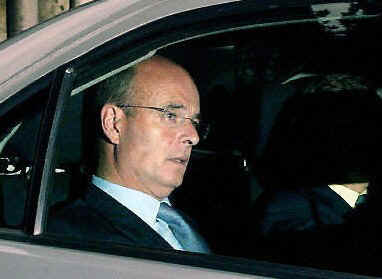
|
Sir John 'Freedom and
Democracy' Scarlett, Head Of MI6
A Top Contender For Title Of 'Most Dangerous Official In
Britain' |
"A Knighthood
for the MI6 chief behind the sexed-up 'dodgy dossier' that helped take Britain into the
Iraq war was branded an abuse of the honours system last night.... No reason for the award
is given except for his 'diplomatic service'.... At the time of the dodgy dossier Scarlett
was chairman of the Joint Intelligence Committee.... Scarlett
has spent more than 30 years working for MI6
..."
SIR SEX-UP
Daily
Mirror, 30 December 2006 |
Now New Allegations From A Former
BP Insider Reveal More Of Scarlett's Track Record
In Subversive 'Regime Change' Activities
"BP executives working for Lord Browne spent millions of pounds on
champagne-fuelled sex parties to help secure lucrative international oil contracts. The company also worked with MI6 to help bring about changes in foreign
governments, according to an astonishing account of life
inside the oil giant [...according to] Les Abrahams, who led BP's successful bid for a
multi-million-pound deal with one of the former Soviet republics [Azerbaijan] ... While employed by BP, Mr Abrahams
says he was persuaded to work for MI6 by John Scarlett
.... Some of Mr Abrahams' most intriguing claims surround the alleged co-operation
between BP and the British intelligence services to secure a more pro-Western, pro-business regime in
the country. He says the
operation, masterminded by Scarlett in Moscow, contributed to the coup in May 1992 which saw President Ayaz Mutalibov toppled by Abulfaz
Elchibey, and then to a second change a year later which saw Haydar
Aliyev take power. Just months
after Aliyev was installed, BP signed the so-called 'contract of the
century', a £5 billion deal which placed BP at the head of an oil exporting consortium. ..... 'BP supported both
coups, both through discreet
moves and open political support. Our progress on the oil contracts improved considerably
after the coups.' [said Abrahams]
Subsequently released Turkish secret service documents claimed BP had discussed an 'arms for oil' deal with the assistance of MI6, under which the company would use
intermediaries to supply weapons to Aliyev's supporters in return for the
contract... When the documents emerged in 2000, BP denied supplying arms - although sources
admitted its representatives had 'discussed the possibility'.... [T]he Foreign Office said
of Mr Abrahams' claims: 'We
neither confirm nor deny anyone's allegations in relation to intelligence matters.'"
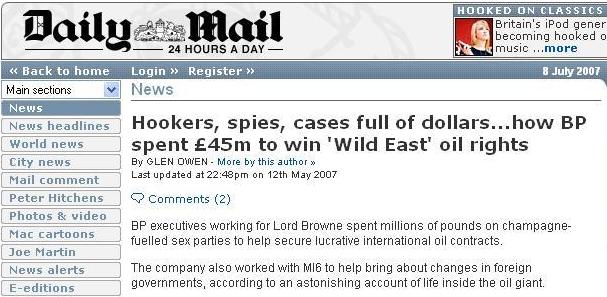
Hookers, spies, cases full of dollars... how BP spent £45m to
win 'Wild East' oil rights
Daily Mail, 12 May 2007
 |
Above -
The 12 May 2007 article which revealed new allegations of MI6's foreign-government regime change efforts on behalf of British oil
company BP in
Azerbaijan. The operation is reported to have been mastermined by then MI6 Moscow station chief John
Scarlett. Scarlett later became responsible for regime change in Iraq (another Islamic
country with important oil reserves which BP has ambitions to exploit), as a result of his
authorship of the infamous 'Dodgy Dossier' of September 2002. Including their
predecessors, MI6 and BP have been playing together at this ruthless values-free secret game for the best part of a century. The latest disclosures come from Les
Abrahams, a former BP manager in Azerbaijan. They follow less detailed allegations of BP's 'arms for oil' coup
activities in Azerbaijan previously reported by the Sunday Times. |
Click here to view
screen-save of above article published 12 May 2007 on Mail web site
Click here to view screen-save of
extended version of the article published 20 May 2007 on Mail web site
Html copies of the articles can be
also viewed at the following sites: |
| 12 May 2007 version - Click Here or
Here |
| 13 May 2007 version (same content as 12 May)
- Click Here
or Here
(bottom of page) |
| 20 May 2007 extended version - Click Here
(includes article photographs) or Here and Here and Here |
BP denies to Azeri-Press Agency the allegations made by Les
Abrahams - Click Here |
"Lord Browne, chief executive of BP and one of New Labour's favourite industrialists, has warned Washington
not to carve up Iraq for its own oil companies in
the aftermath of any future war. The
comments from the most senior European oil executive.... will ... serve to underline
concern that the US is primarily concerned with seizing control of Saddam Hussein's oil
and handing it over to companies such as ExxonMobil rather than destroying his weapons of
mass destruction..... Lord Browne's views will be
listened to carefully in Downing Street because the BP executive team has such close links with the UK government that it was
once dubbed Blair Petroleum."
BP chief fears US will carve up Iraqi oil riches
Guardian, 30 October
2002
"A representative for Hands Off Iraqi
Oil (HOIO) said that an Iraqi oil law could mean that international companies may receive full control of Iraqi
oil fields for more than two decades, Iraq Directory reported. It was also mentioned that
Shell Company has been working hand in hand with the United States and Britain to arrange
an international policy to permit multinational companies to receive solitary control of
Iraq's oil fields. A lobby has been set up who is represented by major energy companies
such as BP,
Shell, Exxon Mobil, Chevron, Total and ENI, and has been advised by the British government on
approaches for persuading the Iraqi regime."
International oil companies could receive sole control of Iraq's oil
Middle East North
Africa Financial Network, 21 May 2007
"Hassan Jumaa Awad al Assadi, the head
of the Iraqi oil workers' union, was in London last week campaigning against a new law
which, he says, will give the oil giants unprecedented
rights to his country's vast reserves.... 'One
of our criticisms is the way the law was proposed - under a
veil of secrecy.'... Al Assadi warned any
multinationals planning to invest in the country that they could face fierce opposition
from the Iraqi people. 'I have warned the oil companies before, there will be some
consequences,' he said."
Fight for control: Iraq oil under pressure
Observer, 15 July 2007
"An agreement on how to divide oil
profits among Shiite, Sunni and Kurdish areas is one of 18 key benchmarks of progress to
be reviewed by the U.S. in September. More than 90 percent of Iraq's revenue comes from
the export of oil. But the report, obtained by the Blotter on ABCNews.com, says the issues
the three sides are too far apart to agree on are the 'role of foreign companies in the
oil sector;' and the division of the oil profits. The report also includes a grim
assessment of the possibility of an increase of oil output in Iraq despite its huge
reserves. It concludes that security in Iraq is so unstable 'it is unlikely that any major
foreign oil company will be able to invest in Iraq during 2008 (unless they are heavily
underwritten by the U.S. government).' The report says the Kurds favor foreign oil
companies playing a larger role, but that is opposed by many Shi'a in the south 'because of a fear they will lose control of their assets to
outsiders.'"
Secret Report: No Iraq Oil Deal by September
ABC News, 20
July 2007 |
MI6 And
Big Business
"Duplicity and chicanery are their
stock-in-trade, so is it any surprise that spies sometimes break their own rules? More
surprising is the mess that [MI6] the Secret
Intelligence Service (SIS) has made of dealing with
Richard Tomlinson, a renegade spook whom it fired in 1995. Running a secret intelligence
organisation is a difficult business, now that the moral
discipline of the cold war has crumbled: when spying for your country is about making its big businesses
richer, rather than subverting totalitarianism,
patriotism may not be enough to keep a disgruntled ex-employee quiet."
Breach birth
The
Economist, 25 January 2001
"A
retired MI6 officer has been appointed to a top post at BP-Amoco, the British-based oil company..... John
Gerson was director of security and public affairs
at the agency and was embroiled in attempts to suppress disclosures by the former MI6 officer Richard
Tomlinson. Mr Gerson took early retirement from what was effectively the post of deputy head of MI6 at the
end of last year. Last month he became one of BP's vice-presidents for government and public affairs. His appointment was approved by the cabinet secretary, Sir Richard
Wilson. MI6 has close links with oil companies, the 'revolving door' syndrome, in the same way as armed forces officers
have close links with defence companies. Rolls-Royce has employed former MI6 officers to help win
contracts in the Middle East, and merchant banks have taken some on. During the first
reading of the intelligence services bill, Lord
Mackay, the conservative lord chancellor, told peers in 1994 that MI6 protected the
'economic wellbeing' of the country by keeping 'a particular eye on Britain's access to
key commodities, like oil...'"
Former MI6 officer gets top post at BP
Guardian, 8 May 2000
"The problem is that because
everything is so secret you don't know what's going on. Spies like my husband are asked to
do things but they might not be told why, and so very often they can't see the
bigger picture. This means that sometimes they don't
know whether their actions are noble and resulting in good things ... or whether they are creating hostilities. There's often a lot of tension for them then, and I never knew how Harry
would be when he returned from a job. My husband had to go off and do his job and I never
knew how he was going to be when he came back."
'Nicky', Wife Of An MI6 Agent - Interview
The spy who loved me
Guardian,
24 January 2007
With The Latest MI6 Azerbaijani 'Oil-For-Arms' Coup
Allegations From A Former BP Insider
How Much More Evidence Is Needed Before
This Ever-Present British Cancer Is Stopped From Spreading Its Corrosive Poison
Further Into Relationships Within The Global Family Of Nations
As 'Peak Oil' Looms?
"Humanity is approaching an
unprecedented crisis when not enough oil and gas will be produced to keep industrial
civilisation running, the world's top oilmen warned last week. The warning –
which is being hailed as a 'tipping point' on both sides of the Atlantic – marks the first time that the industry has accepted that it may
soon no longer be able to meet demand for its products. In Facing the Hard Truths about Energy, it gives authoritative support
to concern about impending shortages, following a similar alert by the International Energy Agency less than
two weeks ago. The 420-page report, the most comprehensive study ever carried out into the
industry, has been produced by the National Petroleum Council, a body of 175 authorities
that reports to the US government. It includes the heads of the world's big oil companies
including ExxonMobil, Chevron, ConocoPhillips,
Occidental Petroleum, Shell and BP. Oil and gas may run short by 2015, say industry experts.... It
says that 'many observers think that 80 per cent of existing oil production will
need to be replaced by 2030' to keep up present supplies 'in addition to volumes required
to meet existing demand.' But, it adds, there are 'accumulating risks to replacing
current production and increasing supplies'.... And the crunch could come sooner,
with oil production becoming 'a significant challenge
as early as 2015'. This chimes with the International
Energy Agency's prediction that oil supplies could become 'extremely tight' in five years. Chris
Skrebowski, editor of the Energy Institute's Petroleum Review, said the report's
publication showed the industry 'fessing up that it really has a problem on its hands'.
Until now, he said, 'companies, full of share options, have been terrified of frightening
the markets' by revealing the truth."
Oil and gas may run short by 2015, say industry experts
Independent
On Sunday, 22 July 2007
Scarlett And His Predecessors
Have Been At It For Decades
"You
find that people in MI6 were conducting quite separate policies..... quite regardless of what the Foreign Office view
was. I was astonished when somebody showed me some document written by an
acquaintance of mine in MI6. I wouldn't have recognised it at all as being anything like
British policy, but it was set out as being so. These
secret people, you see, they get so above themselves, if I might say so."
Evelyn Shuckburgh, Assistant Under Secretary of
State for Middle East Affairs at the Foreign Office during the 1956 Suez crisis,
interviewed decades later
Suez - The Missing Dimension
'Archive
Hour' Interview, BBC Radio 4, 28 October 2006
"MI6 asserted that it is now British
government view that western interests in the Middle East, particularly oil, must be preserved
from Egyptian-Soviet threat at all costs."
CIA Memorandum, 1April 1956, obtained by
Professor Scott Lucas under the Freedom of Information Act
Suez - The Missing Dimension
'Archive Hour' Interview, BBC Radio 4, 28 October 2006 |
'Our Values'
Oil, Arms, And Money
".....Tomlinson says that in 1993, MI6 helped British Aerospace [now BAE
Systems] win a £500m deal to sell Hawk jets to Indonesia by supplying them with details
of a competing bid from the French aircraft manufacturer, Dassault. Similar information
was allegedly passed to help BAe win Hawk sales to Malaysia. Such covert gathering of
economic and commercial information is nothing new. GCHQ and MI6 have being doing it for years."
Useless spies
Guardian, 23 March
2000
"At the heart of the Department of
Justice investigation into BAE Systems will be a secret account held by the
Bank of England on
behalf of the Saudi Arabian Government. This escrow account is the conduit through which
£43 billion has been passed to BAE over the past 22 years to pay for Tornado fighter jets and other military
equipment. It was set up as part of the 1985 al-Yamamah oil-for-arms agreement between Britain and Saudi Arabia. Over the years the account
has fallen into deficit but more recently has held a significant surplus. It is this
surplus that has sparked the recent allegations of corruption in BAE’s dealings with the Saudis.
Payments totalling more than £1 billion made to Prince Bandar bin Sultan, the former
Saudi Ambassador to the US, are believed to have come from this surplus at the request of
the Saudi Government. The money was signed off by the
Ministry of Defence, as
agreed under the al-Yamamah contract, and transferred through BAE to the projects identified by the Saudis. In the case of Prince Bandar,
the money is alleged to have been transferred to an account held by Riggs Bank in the US. The MoD claims that it is unaware of the existence of the account
but government officials have confirmed its use. The
account was set up because, in the1980s, Saudi Arabia paid for its arms with oil. It
transferred oil production to BP and Shell and they paid cash into the Bank of England account. The money was then forwarded to BAE to pay for arms. When the price of oil slumped in the early 1990s the
account fell into deficit, embarrassing the Saudis who were forced to make cash top-ups.
Since then the account has been kept in surplus. In distributing the surplus, the Saudis
have maintained the payment method agreed under al-Yamamah and that is why BAE has become embroiled. The DoJ investigation into BAE will therefore lead directly back to the MoD and a Bank of England account that the Government claims does not exist."
Secret account under spotlight
London
Times, 27 June 2007
'No Lie Too Big' If There's Enough
Oil At Stake
"It's a long way from Rothesay Academy
to the art deco HQ of MI6 on the banks of the Thames at Vauxhall Cross. But Andrew Fulton did it. In fact, this gentlemanly, erudite son of a
Scottish reverend rose so rapidly through the ranks of the Secret Intelligence Service
that he became the sixth most powerful spy in the United Kingdom. Today, Fulton faces losing his job as co-ordinator of Glasgow University's
Lockerbie Trial Briefing Unit
following investigations into his MI6 career. Revelations that he was one of the most glittering talents in MI6 have destroyed claims by the briefing
unit that its self- appointed task of briefing the world's press over Lockerbie was carried out with the highest
standards of impartiality and fairness... Fulton volunteered his services to the unit when he was asked by
the university to join as a visiting professor to the School of Law. The work of the unit is funded by the university, although the US Justice Department's
Office for the Victims of Crime and the Law Society of Scotland sponsored the production
of a trial hand-book co-written by Fulton. The unit has given hundreds of briefings to journalists and coached a
variety of news organisations, including the entire Washington press corps, on aspects of
the trial. So far its website has received 1.7 million hits. .... Fulton, who has never practised law, is not listed as a certified
lawyer in Scotland."
MI6 link to Lockerbie briefings
Sunday Herald, 21 May 2000
"A former Scottish police chief has
given lawyers a signed statement claiming that key
evidence in the Lockerbie bombing trial was fabricated. The retired officer - of assistant chief constable rank or higher - has
testified that the CIA planted the tiny fragment of
circuit board crucial in convicting a Libyan for the 1989 mass murder of 270 people.... The officer, who was a member of the Association of Chief Police
Officers Scotland, is supporting earlier claims by a
former CIA agent that his bosses 'wrote the script' to incriminate Libya.... A source close to Megrahi's defence said: 'Britain and the US were
telling the world it was Libya, but in their private communications they acknowledged that
they knew it was the PFLP-GC [Popular Front for the Liberation of Palestine - General
Command]'. 'The case is starting to unravel largely because when they wrote the script,
they never expected to have to act it out. Nobody expected agreement for a trial to be
reached, but it was, and in preparing a manufactured case, mistakes were made.'"
Police chief- Lockerbie evidence was faked
Scotsman, 28 August 2005
"It is more than 18 years since the
bombing of Pan Am flight 103 killed 270 people in Lockerbie. Yet serious questions remain
over who was behind the worst mass murder in British history..... Last week a Scottish
judicial body ruled that Abdelbaset al-Megrahi, who was sentenced to 27 years in a
Scottish prison for his role in the attack, might
have been wrongly convicted....In November 1991 the Americans and British jointly accused the
pair of the Lockerbie bombing ....last week, after a
three-year investigation, the Scottish Criminal Cases Review Commission announced that it
was referring his case to the Scottish Court of Appeal. It dismissed claims by lawyers for
Megrahi that vital evidence, including the circuit board from the Mebo timer, had been
planted among the debris by police..... But, crucially, the commission did say it had
identified six grounds where it believed a miscarriage of justice 'may have occurred'.
While the commission has inexplicably refrained from
publishing details of each of these grounds, it is
clear that doubts about Gauci’s testimony form the core of its concerns."
Unpicking the Lockerbie truth
London Times, 1 July
2007
Why They Did It
"From late 1989 to 1992 I was the Head
of the Maritime Section of the FCO and No 2 in the Aviation and Maritime Department (for
those into FCO arcana, the Maritime Section was headed by a Grade 5 First Secretary and
the Aviation Section by a Grade 6 First Secretary). This
was the period of the invasion of Kuwait and first Gulf War, in which the Maritime Section, including me, mostly got picked up and
deposited in an underground bunker as the FCO part of the Embargo Surveillance Centre. We
did intelligence analysis on Iraqi attempts at weapons procurement and organised
interdiction worldwide. In this period I mostly lived in my underground bunker, quite
literally, and didn't get back to the FCO much to keep an eye on the rest of my section.
On one occasion when I did, I was told something remarkable by a colleague in Aviation
section. At this time we suddenly switched from
blaming Iran and Syria for the Lockerbie bombing to blaming Libya. This was part of a diplomatic drive to isolate Iraq from its
neighbours in the run-up to the invasion. Aviation
section were seeing all the intelligence on Lockerbie, for obvious reasons. A colleague there told me, in a deeply worried way, that he/she
had the most extraordinary intelligence report which showed conclusively that it was
really Syria, not Libya, that bombed the Pan Am jet, and that the switch was pure
expediency. I asked if I could see the report, and
my colleague declined, saying this was too sensitive and dangerous; the report was marked
for named eyes only. That in itself was extremely unusual - normally we would pass
intelligence reports freely to each other, signing the register for them. That is all I
know. I never saw the report myself, and I do not know what it said, or why it was so
conclusive. I am sorry to say it was such an incredibly busy time, we never discussed it
again. I do not know, for instance, whether the intelligence contained an actual admission
the charge aganst Libya was fake, or merely evidence that proved Syria did it (a
communications intercept, for example). I suspect it will never be made public. But the
knowledge has remained with me ever since, and I was extremely sorry at the conviction of
al-Magrahi. I do hope his appeal is successful. I am particularly impressed at the upright
stand of Dr Swire and other victims' representatives on this issue."
Craig Murray, British Ambassador To Uzbekistan 2002 - 2004
Craig Murray Blog,
29 June 2007
It Was The Saudi Oil Stupid
"[Following Saddam's invasion of
Kuwait] President Bush - the first that is - called a dawn meeting of the National
Security Council at which the likely commander of any military action, one General
Schwarzkopf, expressed the general feeling that the United States might fight for Saudi
Arabia but hardly for Kuwait. President Bush told the press there was no thought of
American intervention. The United Nations anyway had voted to impose a total embargo on
Iraq. Two days after the invasion President Bush took a half day out to keep a promise to
the British prime minister who was addressing a conference in Aspen, Colorado, a resort
town in the Rockies. He found Mrs Thatcher in finer fighting fettle than all but one of his own advisers.
She stressed that fighting for Kuwait now might be a necessary step to saving Saudi Arabia
from invasion later on. ..... What so swiftly transformed the views and policy of the
United States and the onlooking allies-to-be was the recognition, first pressed on
President Bush by Mrs Thatcher and then rather late in the day realised by the King of Saudi
Arabia, that once he held Kuwait there was nothing to stop Saddam from seizing the Saudi oil fields."
Alistair Cooke's Letter From America
BBC
Online, 24 June 2002 |
Downing St, The City Of London, And British Foreign
Policy
"Police investigating the cash for
honours scandal seized evidence that Downing Street
had plotted to hand peerages to eight of the 12 businessmen who had bankrolled Labour’s 2005 election campaign. A draft honours list, drawn up in September 2005, showed that the plan to
offer peerages to businessmen who had loaned Labour millions of pounds had involved twice
as many lenders as previously disclosed.... The Sunday Times has also discovered that
there was a second key piece of evidence – a diary kept by [biotechnology
entrepreneur Sir Christopher] Evans that allegedly details a series of meetings at the
House of Lords in 2004 with Lord Levy, Blair’s chief fundraiser, to discuss a
peerage. One well-placed Crown Prosecution Service (CPS) source said the diary was
'dynamite' and provided 'spectacular' evidence of an alleged 'agreement' for Evans to be
ennobled in return for a £1m loan. Evans’s name was removed from the honours list
after Downing Street discovered that his company was the subject of an investigation by
the Serious Fraud Office. A CPS official said that these two pieces of evidence formed the
core of the 16-month police investigation, which the Yard believed until recently would
lead to charges against key Downing Street aides. However, the
investigation was effectively halted at a meeting on July 4 when a leading government barrister, David Perry QC, ruled that the diary
was not admissible as evidence....The CPS announced last week it would not be charging
anyone..... Government insiders revealed that
the police were shocked at the decision not to prosecute. An official said the police and the CPS had worked side by side on the
case for 18 months until there was a 'sudden change that pulled the plug'. The official
said: 'All those eight people gave massive loans,
then shortly after they all appeared on No 10’s peerages list. It looked pretty odd, to say the least. Were the Met right to investigate
it? Yes, they f****** were.'.... Government sources revealed Evans’s diaries were
central to the investigation. The Sunday Times has established that there are entries
apparently recording discussions between Evans and Levy in 2004. In these meetings, the
diaries allegedly explicitly link the offer of a loan to the promise of a peerage. Levy
told police he had never made any such offer. 'If those diaries ever get into the public
domain, the effect will be spectacular,' said one person who has read them.”
No 10 honours plot: four new names
London Times,
22 July 2007
"Sir Richard Branson, Virgin Group
founder, Arun Sarin, chief executive of Vodafone, and Tony
Hayward, John Browne’s replacement at BP, are among a string of high profile City
executives who have been recruited to advise Gordon Brown and his new
cabinet on business.The list of FTSE 100 chief executives who will serve on the newly
formed Business Council for Britain also includes and Jean-Paul Garnier, GlaxoSmithKline
chief, Stephen Green of HSBC and Tesco’s Sir Terry Leahy. The impressive list of
business leaders is central to the prime minister’s efforts to improve relations between the City and the government."
Brown leans on City for business advice
Financial
Times, 29 June 2007
"A lavish contributor to Labour's
coffers, Sir Ronnie [Cohen] has quietly secured a coveted place at [Gordon] Brown's side, and
appears to be lined up for something far surpassing the fundraiser-cum-fixer's job once
done by Lord Levy....The latest Sunday Times Rich List estimates his fortune at £260
million, making him the sixth wealthiest man in the
City.... after a decade on the
fringes of the Blairite court, he understands the size of the role Brown has in mind for
him. Just as the outgoing Prime Minister surrounded himself with advisers whose stature
and influence was equal to, if not greater than, members of the cabinet, so Sir Ronald and
a few other key Brownites are about to find themselves in similarly elevated positions.
While his first task will be to rebuild Labour's
depleted finances before the next election, his real
job is likely to be as a globetrotting uber-envoy, bypassing
the Foreign Office and reporting directly to the
prime minister, and with a particular focus on the Middle
East."
Mr Brown's smoothy
Sunday
Telegraph, 17 June 2007
"Tony Blair's controversial Middle
East envoy Lord Levy is leaving too and attention is turning to Ronnie Cohen, a man some
believe may play an equivalent role for Gordon Brown for the new Labour leader. He is
rich, secretive, and controversial - an important donor to the Labour party and man with a
key role in British diplomacy as it relates to the Middle East. Sir Ronald is an
Egyptian-born Jew and fluent in Arabic. He fled
persecution to Britain as a child. His career background is in finance, not politics. At
26 he set up Apax Partners, a Private Equity firm that is regarded as the grand-daddy of
an industry Cohen made hundreds of millions of pounds [from] until he started looking for
a change two years ago. It was his role at the Portland Trust that caught Gordon Brown's
attention. More4 News has learnt Sir Ronald will not have any official role under Brown in
the way that Levy was a formal 'envoy' to Blair, but that does not mean that he will not
be a hugely powerful figure. A source close to Cohen
told us Sir Ronald believes his power will be in inverse proportion to his profile, so he
could stay out of the public eye, while acting as a key policy adviser or maker behind the
scenes."
Gordon Brown's rich friend
Channel
4 News, 19 June 2007
"The financier Sir Ronald Cohen, who
has been one of the Chancellor's most trusted informal advisers for the past decade,
recently made the surprising decision to retire from active business life. This was an
extremely significant move: he will shortly emerge from the
shadows of the City to become one of the most senior
members of the inner circle of the next Prime Minister.... Initially, Sir Ronald
will be entrusted with the task of restoring Labour Party finances. The party is bankrupt
at the moment - a direct consequence of the cash for peerages affair. Sir Ronald will be
asked to help find the money to fight the next General Election, without leaving Labour
cripplingly dependent on union donations. He will also be brought into the heart of
government in other ways. Gordon Brown already employs Sir Ronald as a foreign policy adviser, just as Tony Blair used Lord Levy.... His stature will be far greater
than that of mere Cabinet ministers. The truth is that Sir
Ronald, Treasury Minister Ed Balls and just one or two other key Brownites will run the
country. Anyone who wishes to understand what Britain under Gordon Brown will be like has
no choice but to understand Sir Ronald Cohen, who he is and what he does... Sir Ronald is the founder of the private equity business, which makes
massive profits out of buying, restructuring and then selling on great chunks of British
business and which controls about a quarter of the country's private industry. This makes
him a businessman of enormous importance.....he is a
director of the International Institute for Strategic Studies - a very wellconnected think
tank specialising in political and military conflict.... Sir Ronald (who has personally given some £1.5 million to Labour
since 2001 alone) is one of a group of private equity moguls who have made very
substantial donations to the Labour Party.... the large donations to the Labour Party
[are] mainly from people who, like Sir Ronald, showed
no interest in Labour until it was on the verge of power..."
Worrying questions over Brown's private banker
Daily
Mail, 3 March 2007
'The Special Relationship'
'Our Values' - Anglo-American Partners Backing Of Oil Rich Dictatorships
"Foreign Secretary David Miliband has
insisted that the US will continue to be the UK's 'single most important bilateral partner
in the world'. Mr Miliband said: 'Nothing has changed. ......Our shared values give us
real strength.'"
Miliband defends UK-US relations
BBC Online, 14 July 2007
"In the control room of Azerbaijan's sprawling oil
terminal near the capital, Baku, Bala Mirza sits peering at a fuzzy map on a computer
monitor. The outline of Azerbaijan, Georgia and Turkey looks like little more than a jumble of hills and
farming towns. But for the engineer, 41, what lies underground has rocked his world: a new 1,100-mile oil pipeline, which in recent months has tied
this tiny country on the edge of the Caspian Sea to the huge Western market....This Muslim republic
[Azerbaijan], directly north of Iran and tucked into the southwest corner of the vast
former Soviet empire, is suddenly a central player in one of the West's most distressing
problems: how the U.S. and Europe will secure enough oil and
gas to power cities, factories, airplanes and cars--in short, how to keep our entire
modern lives afloat. Since last June, hundreds of
thousands of barrels of oil a day have surged through a pipeline running from Baku through
Georgia's capital, Tbilisi, to Turkey's Mediterranean port of Ceyhan. Named the
Baku-Tbilisi-Ceyhan (BTC), the $4 billion pipeline is one of the world's longest and is operated by the British-American oil company BP, with partners that include U.S. oil companies Chevron,
ConocoPhillips and Hess. By spring, about 1 million
bbl. a day will move down the pipe, and BP could increase that soon after to about 1.5 million bbl. a day. A
parallel BP
pipeline opened last month to send hundreds of billions of cubic feet of natural gas from
the Caspian to Western Europe, in order to break the Continent's overwhelming reliance on
Russia.... Fifteen years after the Soviet Union's collapse, it's tempting to think of the
cold war as history--until you land in Baku. This is
the front line of a new East-West contest, one that is as consequential as the
nuclear-weapons face-off of the past: the battle for energy supplies among countries
heavily dependent on imported oil and gas, which include the U.S. and the E.U., plus the
rocketing economies of China and India. That necessity is a powerful weapon in this new
battle.....Azerbaijan might be secular, but it is
hardly democratic. Local elections in 2005 and the presidential vote that brought Ilham
Aliyev to power in 2003 were both flawed, according to U.N. and American election
observers. A free press? Hardly. One afternoon in December, TIME's team was taken to a
police station near Baku and questioned for three hours about our activities.... Some
Azeris believe Western governments prefer energy security to political freedom, as was
sought in the 2004 revolution in Ukraine--a major transhipper of natural gas to Western
Europe. 'The U.S. will never support democrats in Azerbaijan because
of their oil interests,' says [Vafa] Guluzadeh
[former adviser to President Heydar Aliyev]."
Oil's Vital New Power
TIME, 12 January 2007
What Was Really At Stake In The Ukrainian
Elections Of 2004? - Click Here
"Those who dare
challenge the [Saudi] regime or its policies are punished severely. There is no
constitution, no political parties and no legislature. It was under such an environment of
repression that Osama Bin Laden and most of his followers first emerged. Long shielded by their willingness to supply the United States
with cheap oil, to subsidize the American arms
industry with major weapons purchases and to make lucrative deals with other major U.S.
corporate interests, the United States has allowed this family dictatorship to get away
with practices that would have been considered unacceptable for almost any other country..... Much of this comes down to the
fact that it is easier to manipulate
and make deals with unaccountable despots than it is with an unwieldy democratic system
that has to be responsive to the desires of the people.... In 1945, President
Franklin D. Roosevelt met with King Abel-Aziz ibn Saud, the founder of the modern
Arabian kingdom that now bears his family's name, and forged the alliance that remains to
this day: in return for open access to Saudi oil, the
United States would protect the royal family from its enemies, both external and internal....."
Time to Question the US Role in Saudi Arabia
Foreign Policy in Focus, 27 May
2003
Meanwhile The Battle For The World's Energy
As Peak Oil Looms Britain And America's Undeclared Struggle Against China And India
Rages On
"[UK Foreign Secretary] David Miliband gave a
rousing defence of Britain’s special relationship with America yesterday, vowing to
uphold what he called this country’s 'single most important' alliance. Days after
government ministers hinted that Gordon Brown may distance himself from Washington, the
Foreign Secretary used his first important foreign policy speech to defend staunchly
Britain’s support for President Bush. 'If we want Britain to be a global hub we need
a strong relationship with the leading global power,' he said in a speech at Chatham House, the foreign policy think-tank in London. 'The US is our single most important bilateral partnership, yes because
of shared values, but also because of political reality.'...The alliance with the US was
one that would grow and deepen over time. Mr Miliband predicted that over the next two
decades, with the growing strength of China and India, the bilateral relationship with America would become 'more, not less,
important'."
Miliband rallies support for Bush with a defence of vital alliance
London Times,
19 July 2007
"The first hard truth is that [energy] demand is accelerating.
Energy use in 2050 may be twice as high as it is today, or higher still. The main causes
are population growth, from six to more than nine billion people, and higher levels of
prosperity.
China and India are entering the energy-intensive phase of their development. This is the
point when people buy their first television or car, or board a plane for the first time,
and start to consume much more transport fuel and electricity. And most people in China and India have never
boarded a plane yet! The pace of change is startling. Last year, China enlarged its
electricity capacity by roughly the equivalent of Great Britain’s entire stock of
power stations.....The second hard truth is that the
growth rate of supplies of 'easy oil', conventional oil and natural gas that are
relatively easy to extract, will struggle to keep up with accelerating demand. Just when energy demand is surging, many
of the world’s conventional oilfields are going into decline.... The world now produces 135 million barrels oil equivalent a day of
oil and natural gas. We could still raise that number with new technologies, but only
gradually and certainly not indefinitely....The world’s energy system is
entering a turbulent phase, and the only question is: how turbulent? A cooperative world will respond more effectively than a fragmented
one... The alternative is a global market failure, and future generations would pay the
price."
Jeroen van der Veer, Chief executive of Royal Dutch Shell
High hopes and hard truths dictate future
London
Times, 25 June 2007
"This International Energy Strategy is
the product of cross-government work, particularly between the Foreign and Commonwealth
Office, the Department of Trade and Industry and the Department for the Environment, Food
and Rural Affairs. I'm glad to welcome Mike O'Brien back to the Foreign Office to launch
it with me. The Government's Energy White Paper last year identified a dual energy
challenge: to maintain Britain's access to secure and affordable energy supplies, while
mitigating the effects of climate change.Both issues are vital to our prosperity and
security. And both require not just domestic but international action. That is what this International Energy Strategy is about..... The second part of the energy challenge which this strategy
addresses is the need for secure and affordable energy supplies. Our economy, our public
services and our security rely on them. For the
United Kingdom, our growing need for energy over the next decades has to be seen in a
changing context – that of a probable fall in our own domestic production, as North
Sea reserves are run down. We are likely to become net importers of gas by 2006 and of oil
by 2010. By 2020, we will probably be importing three-quarters of our primary energy needs
– and we will need to adapt to that..... By 2020, around half of global oil demand
will probably be met by countries with significant risk of internal instability – and that will require more focus on policies which tackle the
potential causes of conflict, and spread the benefits of energy wealth.... Energy is one
of the eight international priorities which we identified in the FCO's Strategy last
December. On this and on all of those priorities, we can only meet our objectives by
working closely together, across government and outside. We are publishing this
International Energy Strategy – the first time that we have done so – to help us
to do that. I will be tasking our Ambassadors and High Commissioners in priority posts
overseas to take personal charge of implementing this Strategy and delivering its
objectives. We will be developing with them individual Country Action Plans on energy and
climate change. And we will be enhancing our posts' capacity on energy issues and making
better use of our network of energy attachés, with a particular focus on the large new consumers of energy such as
China and India, and producers such as Russia."
Jack Staw, Foreign Secretary,
Launch
of the UK International Energy Strategy, Foreign Office, 28 October 2004
Scarlett As Today's Manipulator In Chief For The City Of
London
As Peak Oil Looms
"When John Scarlett begins his new job
this morning as head of MI6 his first task will be to defend himself against yet another damaging
allegation about falsifying intelligence to help Tony Blair. This latest controversy has prompted many in the
intelligence community to question whether Mr Scarlett is too much of a liability to run
the Secret Intelligence Service. The growing view in Whitehall is that he is 'damaged
goods', dogged by scandal, who for the sake of the agency should stand down to allow MI6
the chance to restore its credibility. Mr Scarlett
faces claims that in March he clumsily tried to distort a crucial report by the Iraq
Survey Group, (ISG), the international body set up to hunt for Saddam Hussein’s
supposed arsenal of banned armaments. Just before the 1,400-strong team of inspectors were
due to report on how they had failed to turn up any trace of weapons of mass destruction
they were reportedly contacted by Mr Scarlett. He was still head of the Joint Intelligence
Committee and suggested that the ISG report should be cut from 200 pages of detailed
analysis to 20, and left sufficently vague to protect Mr Blair’s stand on Iraq’s
weapons menace. He wanted the report to keep alive the prospect that deadly weapons could
still be found. In a confidential e-mail sent to the ISG team in Baghdad, Mr Scarlett is
alleged to have asked them to add ten 'golden nuggets' to their report which prolonged the
idea that there were weapons of mass destruction. One of these alleged 'nuggets' was that
Iraq was developing smallpox weapons. He also wanted mention that Iraq had mobile
biological weapons laboratories and sophisticated equipment for use in nuclear weapons
research..... His growing army of critics inside
Whitehall argue it will be impossible to restore MI6’s credibility while he remains
in charge. One security expert decribed his reported intervention with the Iraq Survey
Group as 'staggering'..... His appointment was met by claims in some quarters of Whitehall that
it was a reward from Mr Blair as many had expected MI6’s deputy head, Nigel Inkster,
to succeed Sir Richard Dearlove as 'C'.... This damaging view was reinforced when Downing
Street took the unusual step of going on the record robustly to support Mr Scarlett’s
suitability for the job."
New MI6 chief walks into storm over 'ties to Downing Street'
London Times, 2 August
2004
"Oil ruled the 20th century; the
shortage of oil will rule the 21st.... Last Tuesday the lead story in The
Financial Times was the latest report from the International Energy Agency. The FT
quoted the IEA as saying: 'Oil looks extremely tight in five years’ time,' and that
there are 'prospects of even tighter natural gas markets at the turn of the decade'. For
an international agency, that is inflammatory language.... 27 of the 51
oil-producing nations listed in BP’s Statistical Review of World Energy reported
output declines in 2006. One projection of world crude oil production actually forecasts a
10 per cent reduction in total world output between 2005 and 2015. That would be a
revolution..... Some analysts think that the peak oil moment has already been reached; some still think that it will not come
until 2020 – which is itself only 12 years away. Market trends and the statistics
both support the IEA’s view that consumption is accelerating and supplies falling
faster than expected. Of course, if the 'crunch' point is only five years’ away for
oil, and closer for natural gas, it has, for practical purposes, already arrived....The
shortage of oil and natural gas, relative to demand, had already changed the balance of
world power. Historians may well conclude that the US
decision to invade Iraq was primarily motivated by the desire to gain physical control of
Iraq’s oil and to provide defence support to other Middle Eastern oil powers. Political motivations are always mixed, but oil is an essential national
interest of the United States. If the US is now deciding to withdraw from Iraq, the price
will have to be paid in terms of loss of access to oil.... The
world is coming to the end of the age of oil, which
produced its own technology, its balance of power, its own economy, its pattern of
society. It does not greatly matter whether the oil supply has peaked already or is going
to peak in five or 12 years’ time. There is a
huge adjustment to be made. There will be some
benefits, including higher efficiencies and perhaps a better approach to global warming.
But nothing will take us back towards the innocent expectation of indefinite expansion of
the first months of the new millennium."
Lord William Rees-Mogg
Are these the last days of the Oil Age?
London
Times, 16 July 2007
British
Intelligence Has Been Working
For BP For The Best Part Of A Century
"It would have been unthinkable only a
few years ago, but one of Ireland’s most republican counties is celebrating the life
of the founder of Britain’s intelligence agencies. William Melville was born in the
Kerry village of Sneem to a publican’s family and fled his roots to forge a stellar
career in London as a detective fighting terrorism. When he 'retired' in 1903 from the
Metropolitan Police at the height of his fame, he went on to establish the forerunner of
MI5, providing the inspiration for James Bond’s boss in Ian Fleming’s books....
In 1903
Melville announced that he was retiring to spend more time with his family and garden.
Instead he moved into offices in Victoria Street, adjacent to Scotland Yard, and under the
nameplate William Morgan, General Agent, created a cover story that allowed him to gather
intelligence for the War Office. He reported under the alias 'M'. In that year the War
Office set up a Directorate of Military Operations and Melville was head-hunted for the
role of field operative to act as a controller for agents abroad as well as to undertake
missions himself. One of his first was to help to
secure British access to Persian oil. In this he succeeded by derailing French negotiations and allowing a
British syndicate to seal the deal. The company that emerged from the machinations became BP. In
1909 the Secret Service Bureau was set up to coordinate intelligence work under two
sections, home and foreign, which became, respectively, MI5 and MI6."
M: Britain's first spymaster was an Irishman who played patriot game
London
Times, 2 July 2007
Iraq 'Dodgy Dossier' John Scarlett
Rogue State Britain's 'Regime Change' King
 |
 |
Back
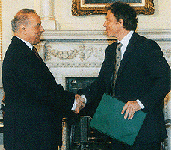
in March 2000 the Sunday Times reported on a Turkish
intelligence report which claimed that oil companies BP and Amoco were behind a coup d'etat in Azerbaijan in 1993 in order to
help install ruthless dictator Haydar Aliyev, shown above right meeting Tony Blair at
Downing St in 1998 to conclude an ensuing multi-billion $ BP oil
deal
Now, following the ignominious departure of BP's Chief Executive Lord Browne at
the beginning of May, one of his former managers has
revealed to a British newspaper more of the full scale of these 'regime change' plots
in Azerbaijan, including an earlier BP backed coup in 1992 and the central
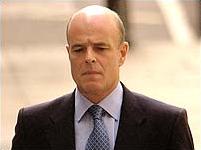
role played in both by MI6's John Scarlett, above left, who was later to become author of the most infamous of the
Downing St Iraq regime change 'Dodgy Dossiers' |
"It wasn’t supposed to be like
this. Tomorrow New Labour’s ethical policy will drown symbolically in a poisonous cocktail of blood and oil when the Queen
shakes hands with Azerbaijan’s President Aliev. Her Majesty may be forgiven for thinking this is one export-driven
photo-opportunity too many. The Queen has dutifully entertained tyrants of all stripes but
she has never had to shake hands with a SMERSH agent before.... Today, as President of Azerbaijan his
secret police regularly arrest scores of critics allegedly plotting against him and
thousands languish in his old haunts, the ex-KGB prisons. Others simply disappear. Yet
Aliev’s Azerbaijan is respectable. There is one
word to explain this bizarre fact: Oil.... Azeri democracy was uniquely Aliev-style.... oil decreed that Aliev had
won 98.9% of the votes - a modest 1% fall from his last Soviet-era total... A gaggle of ex-Tory MPs and former Foreign Office diplomats know the value of keeping in with Aliev. So does a
host of stars of George Bush’s Administration... [now] Tony Blair is wining and
dining Aliev..."
Aliev In Britain
Daily Mail, 20 July
1998
Governments Come And Governments Go
But For Decades Oil And MI6's Secret Influence Over British Foreign Policy
Has Been A Persistent If Largely Invisible Presence
Their Roles In Iran 1953,
Suez 1956, And Azerbaijan 1993, For Example,
Have Only Surfaced In Fuller Detail Since 2000
"He was the Sun King: the brightest
star in British business, a global power and an adored confidant of prime ministers. Then,
last week, he managed to lose both his job and his reputation....On Monday evening Lord Browne of Madingley,
then still chief executive of BP, gathered a few close friends for dinner at his home in Chelsea. The mood
was sombre; for John Browne, who had entertained Tony Blair and Gordon Brown at the same
table, this was a humble last supper.... Dapper, diminutive and urbane, Browne has always
seemed the antithesis of the Texan oilman portrayed in Hollywood films. But oil was in
Browne's blood: his father, a former Army officer, worked for the Anglo-Persian oil company, the forerunner of BP."
End of the affair
Daily
Telegraph, 5 May 2007
"Fifty years ago this week, the CIA and the British SIS [MI6] orchestrated a coup d'etat that toppled the democratically
elected government of Mohammad Mossadegh [in Iran]. The prime minister and his nationalist
supporters in parliament roused Britain's ire when
they nationalised the oil industry in 1951,
which had previously been exclusively controlled by the Anglo-Iranian Oil Company [or Anglo-Persian Oil Company later renamed as BP]. Mossadegh argued that
Iran should begin profiting from its vast
oil reserves. The British government tried to enlist the Americans in planning a coup... By the end of Operation
Ajax, some 300 people had died in
firefights in the streets of Tehran. The crushing of Iran's first democratic government
ushered in more than two decades of dictatorship under the Shah... The author of All the
Shah's Men, New York Times reporter Stephen Kinzer,
argues that the coup planted the seeds of
resentment against the US in the Middle East, ultimately leading to the events of
September 11.... The coup and the culture
of covert interference it created forever changed how the world viewed the US, especially
in poor, oppressive countries. For many Iranians, the coup was a tragedy from which their
country has never recovered. Perhaps because Mossadegh represents a future denied, his
memory has approached myth."
The spectre of Operation Ajax
Guardian, 20 August 2003
'Operation Ajax' - More Details
- Click
Here
"You
find that people in MI6 were conducting quite separate policies..... quite regardless of what the Foreign Office view
was. I was astonished when somebody showed me some document written by an
acquaintance of mine in MI6. I wouldn't have recognised it at all as being anything like
British policy, but it was set out as being so. These
secret people, you see, they get so above themselves, if I might say so."
Evelyn Shuckburgh, Assistant Under Secretary of
State for Middle East Affairs at the Foreign Office during the 1956 Suez crisis,
interviewed decades later
Suez - The Missing Dimension
'Archive
Hour' Interview, BBC Radio 4, 28 October 2006
"MI6 asserted that it is now British
government view that western interests in the Middle East, particularly oil, must be preserved
from Egyptian-Soviet threat at all costs."
CIA Memorandum, 1April 1956, obtained by
Professor Scott Lucas under the Freedom of Information Act
Suez - The Missing Dimension
'Archive Hour' Interview, BBC Radio 4, 28 October 2006 |
'Our Values'
And So It Goes On - British 'Oil-For-Arms' Deal With Saudi
Dictatorship
"At the heart of the Department of
Justice investigation into BAE Systems will be a secret account held by the
Bank of England on
behalf of the Saudi Arabian Government. This escrow account is the conduit through which
£43 billion has been passed to BAE over the past 22 years to pay for Tornado fighter jets and other military
equipment. It was set up as part of the 1985 al-Yamamah oil-for-arms agreement between Britain and Saudi Arabia. Over the years the account
has fallen into deficit but more recently has held a significant surplus. It is this
surplus that has sparked the recent allegations of corruption in BAE’s dealings with the Saudis.
Payments totalling more than £1 billion made to Prince Bandar bin Sultan, the former
Saudi Ambassador to the US, are believed to have come from this surplus at the request of
the Saudi Government. The money was signed off by the
Ministry of Defence, as
agreed under the al-Yamamah contract, and transferred through BAE to the projects identified by the Saudis. In the case of Prince Bandar,
the money is alleged to have been transferred to an account held by Riggs Bank in the US. The MoD claims that it is unaware of the existence of the account
but government officials have confirmed its use. The
account was set up because, in the1980s, Saudi Arabia paid for its arms with oil. It
transferred oil production to BP and Shell and they paid cash into the Bank of England account. The money was then forwarded to BAE to pay for arms. When the price of oil slumped in the early 1990s the
account fell into deficit, embarrassing the Saudis who were forced to make cash top-ups.
Since then the account has been kept in surplus. In distributing the surplus, the Saudis
have maintained the payment method agreed under al-Yamamah and that is why BAE has become embroiled. The DoJ investigation into BAE will therefore lead directly back to the MoD and a Bank of England account that the Government claims does not exist."
Secret account under spotlight
London
Times, 27 June 2007
Fighting Breaks Out Amongst Thieves - Why
The US Department Of Justice Is Gunning For BAE Systems - Click Here
"The Ministry of Defence is understood
to be seeking legal advice before deciding whether to provide unfettered help to the DoJ.
A government official said the MoD would need to 'advise and consult' on what would be
released. The Foreign Office could also be reluctant to see confidential information released."
BAE faces threat of fines in US probe
Financial
Times, 27 June 2007
"BAE, under Dick Evans'schairmanship, moved its whole worldwide system of
agent payments to Switzerland. What it did was not illegal, but the firm constructed what
might well be called a global money-laundering
machine. For a supposedly reputable public company,
the methods used were surprising. Britain's Serious Fraud Office later concluded: 'The
whole system is maintained in such conditions of secrecy that there is a legitimate
suspicion concerning the real purpose of the payments.' The system was run from a secure
block, Warwick House, at BAE's Farnborough premises. 'HQ Marketing Services' was headed by
Hugh Dickinson, who was also responsible for company liaison with MI6.....just before Britain
signed up to the OECD [anti-bribery] convention in 1997, the filing cabinets and safes
containing the agent details were loaded into a van and driven by trusted staff
from Farnborough to Geneva.... The purpose of these tortuous arrangements seems to have
been to ensure that nothing questionable involving the hiring of agents took place within
UK legal jurisdiction. But a further secret payment system was also needed for BAE to
transfer large sums in cash to those agents.... We have traced secret payments going to
agents in South America, Tanzania, Romania, South Africa, Qatar, Chile and the Czech
Republic.... BAE set up a second front company, purely to handle the Saudi commission
payments for al-Yamamah. 'Poseidon Trading Investments Ltd' was incorporated in the
British Virgin Islands on June 25 1999. Those close to it say more than £1bn has passed
through its accounts to Saudi agents, in transfers made by Lloyds TSB."
BAE's Secret Money Machine
Guardian, 'The BAE
Files' Web Archive
Of Course The British Foreign Office And MI6 Never Have
Anything Criminal To Hide Do They?
The British Sewer Runs Deep, Very Deep
"My company Astra gave rise to much of the circumstances which
created the [Arms to Iraq] Scott Inquiry, the Supergun revelations (we reported it first),
the Aitken affair, the murder of Gerald Bull in Brussels
in March 1990 and much else..... The story of Astra is too long to recount here but a summary is contained in my book, 'In the Public
Interest' published by Little Brown UK hardback 1995, Warner paperback 1996, London. Astra
became involved in covert weapons and ammunitions
operations organised by MI5 and MI6 and the CIA, the MOD,
DOD, FCO and the State Department and the DTI..... In
1989/90, following a reappraisal of Foreign Policy in the light of the demise of the Cold
War and changing circumstances in the Middle East, where it became apparent the US, UK and
EEC had transferred Nuclear, Biological, and Chemical weapons technology as well as
conventional weapons to countries like Iran and Iraq, and the discovery Pakistan had the
atomic bomb, the whole covert network was reorganised.... The
directors of Astra were to a large extent ignorant of the full range of covert activities
carried out in their name but aware of some of these activities and the likely destination
of their goods. As however all operations were
sanctioned by the DTI, MOD, FCO, and in the US by the DOD and the State Department and in
Belgium by the Belgian Government, not too many questions were raised initially. However, in late 1988 and 1989 it became clear to me as
Chairmen that the clandestine operations far exceeded anything remotely sanctioned by the
full Board and I set out to investigate in depth. I
became aware that certain plants were used to secretly store and ship goods; that monies
were being transferred to other operations without book records or board approval in
secret commission payments; that our paper work and parallel bank accounts were being used
to process arms shipments from major UK defence companies like British Aerospace, Royal
Ordnance, GEC Marconi, Thorn EMI etc.... [It] also became clear that all our main
operations were involved in covert operations in the USA Belgium and the UK, and that
Astra, when it acquired these companies, had inherited a hard core of MI6, MI5, DIA agents who
operated behind the back of the original directors and who treated them as 'useful
idiots'. All our main companies were involved with Space Research Corporation ('SRC') and
the late Dr Gerald Bull who was behind the Supergun and other secret projects which Astra
companies were also involved in. In 1989 I realised we had a hugely dangerous individual on our main Board
and the BMARC Board who was an MI6 agent. This individual, Stepahnus
Adolphus Kock had high level political connections to Thatcher, Hesletine, Younger,
Hanley, etc as well as MI5 and MI6 connections. It is now clear
to me that he was involved in the murder of Gerald Bull in Brussels on 22nd march 1990 and Jonathan
Moyle in Santiago, Chile on 31st March 1990....
Kock had a cover as a consultant in Midland Bank’s secret arms department, Midland
and Industrial Trade Services ('MITS'). This was staffed by ex service officers, MI5, MI6, agents and intelligence
affiliated bankers. Midland with the Bank of
Boston were Astra’s main bankers and dominated by MI6 CIA agents. Kock was also said
to be head of Group 13, the Government’s assassination and dirty tricks squad
according to Richard
John Rainey Unwin, a close associate of Knock himself who was a contract MI6 agent and Consultant to
Astra. Kock and Unwin, with Martin Laing
Construction, negotiated the £2bn Malaysian defence deal before George Younger, the
Defence Secretary even knew of it..... All these
cases and others and the Astra case involved the gross abuse of power by Government and
its agencies and servants, concealment of key evidence, intimidation, threats, false and
selective prosecutions, manipulation of evidence, perversion of the course of justice..... As Douglas Hurd told a Commons Select Committee
regarding nuclear proliferation they are but two tributaries of the main stream of
intelligence..... Each regularly circumvents
domestic laws for the benefit of the others under programmes like 'echelon'
and agreements between UK and USA. Politicians and civil servants and other leading figures who get
out of line can be surveyed or bugged and then threatened, blackmailed, framed up or worse."
My Experiences, the Scott Inquiry, the British Legal System
Gerald
Reaveley James, former Astra Holdings PLC Chairman from 1980-90
Extract
From Speech Given At The Environmental Law Centre, UK, 2000
(includes typographical transcript errors) |
'Arms To Iraq' - British Intelligence And
The Astra Scandal - Click
Here
"The problem is that because
everything is so secret you don't know what's going on. Spies like my husband are asked to
do things but they might not be told why, and so very often they can't see the
bigger picture. This means that sometimes they don't
know whether their actions are noble and resulting in good things ... or whether they are creating hostilities. There's often a lot of tension for them then, and I never knew how Harry
would be when he returned from a job. My husband had to go off and do his job and I never
knew how he was going to be when he came back."
'Nicky', Wife Of An MI6 Agent - Interview
The spy who loved me
Guardian,
24 January 2007
The Bigger Picture? - It's The Money Stupid
"A
retired MI6 officer has been appointed to a top post at BP-Amoco, the British-based oil company..... John
Gerson was director of security and public affairs
at the agency and was embroiled in attempts to suppress disclosures by the former MI6 officer Richard
Tomlinson. Mr Gerson took early retirement from what was effectively the post of deputy head of MI6 at the
end of last year. Last month he became one of BP's vice-presidents for government and public affairs. His appointment was approved by the cabinet secretary, Sir Richard
Wilson. MI6 has close links with oil companies, the 'revolving door' syndrome, in the same way as armed forces officers
have close links with defence companies. Rolls-Royce has employed former MI6 officers to help win
contracts in the Middle East, and merchant banks have taken some on. During the first
reading of the intelligence services bill, Lord
Mackay, the conservative lord chancellor, told peers in 1994 that MI6 protected the
'economic wellbeing' of the country by keeping 'a particular eye on Britain's access to
key commodities, like oil...'"
Former MI6 officer gets top post at BP
Guardian, 8 May 2000
"A private intelligence firm with
close links to MI6 spied on environmental campaign groups to collect information for oil companies, including
Shell and BP. MPs are to demand an inquiry by Jack Straw, the foreign secretary, into
whether the secret intelligence service used the firm
as a front to spy on green activists. The firm's
agent, who posed as a left-wing sympathizer and film maker, was asked to betray plans of
Greenpeace's activities against oil giants. He also tried to dupe Anita Roddick's Body
Shop group to pass on information about its opposition to Shell drilling for oil in a
Nigerian tribal land. The Sunday Times has seen documents which show that the spy,
German-born Manfred Schlickenrieder, was hired by Hakluyt, an agency that operates from offices in London's West End.
Schlickenrieder was hired by Mike Reynolds, a
director of Hakluyt and MI6's former head of station in Germany. His cover was blown by a female colleague who had worked with him. Last
night he refused to comment. Reynolds and other MI6
executives left the intelligence service after the cold war ended to form Hakluyt in 1995.
It was set up with the blessing of Sir David Spedding, the then chief of MI6, who died
last week. Christopher James, the managing director, had been head of the MI6 section that
liaised with British firms. The firm, which takes
its name from Richard Hakluyt, the Elizabethan geographer, assembled a foundation board of
directors from the Establishment to oversee its activities, including Sir Fitzroy Maclean,
Ian Fleming's model for James Bond. Baroness Smith, the widow of John Smith, the late
Labour leader, was a director until the end of last year. The
company has close links to the oil industry through Sir Peter Cazalet, the former deputy
chairman of BP, who helped to establish Hakluyt
before he retired, last year, and Sir Peter Holmes, former
chairman of Shell, who is president of its
foundation. MPs believe the affair poses serious
questions about the blurring of the divisions between the secret service, a private
intelligence company and the interests of big companies. Hakluyt refutes claims by some in the intelligence community that it was started by MI6 officers to carry out 'deniable'
operations.... Hakluyt was reluctant to discuss its
activities. Michael Maclay, one of the agency's directors and a former special adviser to
Douglas Hurd when he was Conservative foreign minister, said: 'We don't ever talk about
anything we do. We never go into any details of what we may or what we may not be
doing.'"
MI6 'Firm' Spied on Green Groups
Sunday
Times, 17 June 2001
"The Joint
Intelligence Committee agrees on the broad
intelligence requirements and tasking (National Intelligence Requirements) for SIS [MI6] and GCHQ and
oversees the activities of the Security Service's. It prepares summary assessments for
selected Ministers and circulates the weekly 'Red Books' to the Cabinet's Defence and
Overseas Committee, chaired by the PM. Traditionally it meets every Wednesday morning and
includes representatives from UKUSA and the COS secretariat. This is the 'key' committee
involved in the Intelligence Community. Originally formed as the Inter-Service
Intelligence Committee (ISIC) under the Chiefs of Staff in January 1936, renamed the Joint
Intelligence Committee (JIC) in July 1936. Moved to foreign Office control in July 1939.
In 1957 control moved to Cabinet Office and in 1968 the post of Intelligence
Co-Coordinator was created within the Cabinet Office to oversee its functions. In 1982
following the Falklands War the Foreign Office ceased to have any control and the JIC became a Cabinet Office organization with direct access to
the Prime Minister. The JIC is reported to have a
staff of 20 with a further 30 in the 'JIO' or ISG. Closely involved with the major City
institutions particularly Banking, the Economic Sub-Committee
of JIC also includes representatives of both the Treasury and the Bank of England
(which also an SLO to receive intelligence reports directly from the JIC)."
The Mechanisms of an Oppressive State - UK Intelligence And Security
Report
AFI Research, August
2003
"With the end of the Cold War, MI6's role
has fundamentally changed and it now has many more potential targets.
Terrorist groups, and so-called 'rogue' states, are now high profile targets.
Networks of new agents will be required as intelligence 'needs' constantly
shift. Industrial espionage, furthering British trade interests has moved into the area of national
interest. Gathering intelligence on friendly governments, obtaining advanced knowledge of
their negotiating positions or changes in alliances, are also now ever more
important targets for MI6. The Intelligence Services Act 1994 formerly acknowledged its
existence.... R6 Industrial, Commercial &
Financial. Worked closely with both the Treasury and the Bank of England, as well as
Merchant Bankers such as Hill Samuel; Hambro's; Kleinwort Benson; Morgan Grenfell;
Brandts; Cootes and the Midland. Solicitors firms such as Slaughter & May were also
part of the network of important contacts, along with Thomas Cook; ICI; BP; Shell; Lonrho and RTZ."
The Mechanisms of an Oppressive State - UK Intelligence And Security Report
AFI Research, August
2003
Who Are AFI Research? - Click Here
Where The Problem Resides
'Ceausescu Towers' And The Greedy Dolts In The City Of London
"... there needs to be proper
supervision and surveillance of the security services if trust in them is to be
maintained. The Government's record can fill no one with confidence. Look how it dealt
with John Scarlett, who as chairman of the Joint Intelligence Committee was responsible
for the dodgy dossier which took us to war in Iraq. Was
he disciplined or sacked? On the contrary, he was awarded a knighthood and made head of
MI6."
A question of trust, not just security
Daily
Mail, 4 May 2007
Scarlett's Lair -
Capital Of The Evil Empire |
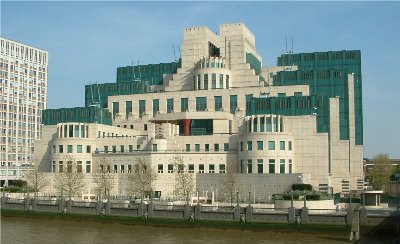 |
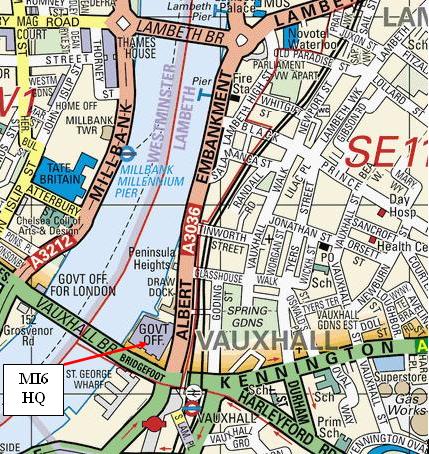
MI6 HQ Building Off
Vauxhall Bridge London
Otherwise Known As 'Ceausescu Towers' After The Architectural
Style Favoured By Former Romanian Dictator Nicolae Ceausescu |
"The MI6 building is known to some
staff at Vauxhall Cross as 'Ceausescu Towers', after the former Romanian dictator with a penchant for grandiose
and inhuman architecture. Designed by the Terry Farrell, who was unaware of the
intended tenants, it originally cost pounds 240m to build. But to accommodate its
occupants a further pounds 86m of public money needed to be spent to cope with the
service's needs. The building, which opened in 1994, includes a shooting range and
arsenal, a garage for adapting and maintaining MI6's fleet of special cars, secure areas
where eavesdropping is impossible, and a array of computer and radio communication rooms.
There are rooms for the development of specialist espionage equipment of the type made
famous by 'Q' the fictional boffin of the James Bond films, and a forgery section where
counterfeit documents are produced. Details of the building are covered by the Official
Secrets Act which every member of the staff is obliged to sign. The former MI6 officer
Richard Tomlinson, who now lives in Italy, visited the building many times before he left
the service in 1996. 'If I told you what was in the building I would be open to
prosecution,' he said yesterday.... For top secret meetings there is a special 'silent'
room.... According to the author Stephen Dorrill there is also a secure command and control room to run major operations... On a second floor is a powerful computer set-up in which all the data
sent in by MI6's officers and spies is collated. This is the information that enables MI6
to produce the CX reports - the weekly intelligence
briefings that go to the Prime Minister and Foreign Secretary."
MI6 MISSILE ATTACK: Hi-tech fortress where secrecy reigns supreme
Independent,
22 September 2000
Few People Are Likely To Have Read The Latest Azerbaijan
Revelations About MI6
But Now That Blair Has Gone
They Merit Mass Demonstrations Outside 'Ceausescu Towers'
Calling For Scarlett's Sacking And Prosecution
|
It's Time For Regime Change At MI6
So That An Ethical Foreign Policy (Linked To An Intelligent Energy Policy)
Can Be Brought In To Ensure
No More
Jihadi Terrorist Attacks In Britain |
Why
They Really Hate Us
Manipulation Of
The Islamic World At The Hands Of
Oil
Driven British Foreign Policy For The Best Part Of A Century
Click Here
"I rarely speak in public. I prefer to avoid the limelight and get on with my job. I speak not as a
politician, nor as a pundit, but as someone who has been an intelligence professional for
32 years..... There has been much speculation about what motivates young men and women to
carry out acts of terrorism in the UK. My service
needs to understand the motivations behind terrorism .....The video wills of British suicide bombers make
it clear that they are motivated by perceived worldwide and
long-standing injustices against Muslims - an
extreme and minority interpretation of Islam promoted by some preachers and people of
influence. And their interpretation as anti-Muslim of
UK foreign policy, in particular the UK's involvement in Iraq and Afghanistan.”
Speech by Dame Eliza Manningham-Buller, Head Of Britains Interior Intelligence
Service MI5, Shortly Before Her Retirement
BBC Online, 10 November 2006 |
Dolts In The City
After Blundering
Scarlett Opens Up Iraq As New Base For Al Qaeda
Ex-Head Of MI6 Tells City Of London UK Strategy Is A Failure
"The former head of MI6 called yesterday for a
complete rethink of the strategy to combat the Islamist terrorist threat. Sir Richard
Dearlove said despite setbacks, al-Qaida was thriving and the position of Britain and the
US was 'strategically weak' in Iraq and elsewhere. 'A strategic rethink is probably the
point that we have now reached,' he told business
leaders in the City of London. 'Al-Qaida is showing
an extraordinary ability to mutate in response to our successes.'..... Sir
Richard said the longer the current situation went on the more complex and dangerous the
threat would become. In the last two days he said the
national security adviser in Iraq had revealed there were now 12,000 foreign fighters in
the country... Sir Richard, who was talking at Lloyds of London to an audience of insurers, business leaders
and underwriters, said: 'The policy has to change.
It is time to reconsider, to move on. If you are fighting the war you have a strategy and
the worst thing to do is to keep it in the same place."
Anti-terrorism strategy needs overhaul, says ex-MI6 chief
Guardian, 16 May
2007
But Do Dearlove And The City Really 'Get It'?
The Only Strategic Rethink That Will Work Is To Wean
Britain Off Oil And Gas (Which The World Is Supposed To Be Doing For Climate Change
Reasons In Any Case) And To Drop The Attendant Obsession With Subversively Interfering In
The Internal Affairs Of Oil And Gas Rich/Transit Muslim Countries
And Likewise Our Relations With Russia (The World's Largest Producer Of Oil And
Gas)
And Its Former
Satellite States
If We Don't Want A
New Cold War On Top Of The So-Called 'War On Terror'
Because That's Where Former Moscow Station Chief Scarlett
And His Team Are Incompetently, Ignorantly, And Criminally Taking Us If They Are Not
Stopped
Disastrously The Oxymoron Of
British 'Intelligence' And Its Patrons In The City Of London Are Likely To Be Too Stupid
To Allow A Much Overdue Change Of Direction Despite All The Blatantly Obvious Signals
A Major Shake-up At 'Ceausescu Towers' Is What Is
Required But The New British Prime Minister Is Already Showing Signs Of Being Just As
Beholden To The Myopic City Of London As His Predecessor And Will Probably Never Dare
Touch Its MI6 Servant In Anything But Superficial Ways
Ultimately This Path Threatens To Be As Disastrous For
The City Of London ('Defence', 'Security', And 'Surveillance' Companies Excepted) As For
Everyone Else At Time When The Country's Wealth Needs To Be Urgently Invested In
Alternative Energy Systems Rather Than Futilely Chasing The Remnants Of An Economic Model
Built On An Energy Paradigm Which Has Begun To Groan Its Final Death Rattle
Without A Major Change In Thinking Expect More Resource Wars And Reciprocating
Terrorist Attacks As The Global Energy Crisis Deepens - As We Have Been Already Warned By
Such Diverse Figures As John Reid (former UK Defence Minister), Paddy Ashdown (former High Representative for Bosnia and Herzegovina), Bill Clinton (former US President), and Joe
Lieberman (Senator and
former Vice Presidential running mate to Al Gore) |
'We Need A New Way Of
Thinking' - Consciousness-Based Education |
ENERGY ARCHIVES
'ENERGY UPDATE' BULLETINS
PEAK OIL AND ENERGY CRISIS
NEWSBITES
SOLAR ENERGY NEWS |
Downing
St And Dolt City
"Labour's
biggest financial backer, Lord Sainsbury of
Turville, has resigned as Science minister after eight years in the job, saying he wanted
to devote more time to his business and charity work..... He suffered an embarrassment
this year when it emerged that he had failed to declare a £2m pre-election loan to
Labour, but escaped censure after he explained he had confused the loan with a gift for
the same amount he had made around the same time. He was awarded a seat in the House of
Lords by Mr Blair in 1997 [shortly after
giving the Labour Party its largest ever single donation], and appointed Science
minister in July 1998, which means he has served in the same job for longer than any other
minister apart from Mr Blair and Gordon Brown, the Chancellor.... The Chancellor, Gordon Brown, denied Lord
Sainsbury was 'leaving a sinking ship'. As a minister, Lord Sainsbury was one of the
biggest government champions of genetically modified
foods, but was not able to win over the British
public."
Lord Sainsbury resigns after eight years as Science minister
Independent, 11
November 2006
"The biotech entrepreneur [Sir
Christopher Evans] is a long-term Labour supporter. His links to Mr Blair go back to the
1990s, when he gave substantial donations to the party at a time when their size did not
have to be disclosed. However, it emerged earlier this year that he had lent the party £1
million prior to the 2005 election - a loan that is now being repaid."
Police target Blair's inner circle over cash for honours affair
Telegraph,
17 December 2006
"[Worth £260m] Sir Ronnie Cohen was
an early convert to New Labour and a financial backer
of the party. Arriving from Egpyt after Suez as a
near penniless 12-year-old refugee who could speak only a few words of English, Cohen has
risen to become the senior figure in the British private-equity industry."
Focus: Who's who in the £11bn City of London rich list
Sunday
Times, 3 June 2005
"A lavish contributor to Labour's
coffers, Sir Ronnie [Cohen] has quietly secured a coveted place at [Gordon] Brown's side,
and appears to be lined up for something far surpassing the fundraiser-cum-fixer's job
once done by Lord Levy....The latest Sunday Times Rich List estimates his fortune at £260
million, making him the sixth wealthiest man in the
City.... after a decade on the
fringes of the Blairite court, he understands the size of the role Brown has in mind for
him. Just as the outgoing Prime Minister surrounded himself with advisers whose stature
and influence was equal to, if not greater than, members of the cabinet, so Sir Ronald and
a few other key Brownites are about to find themselves in similarly elevated positions.
While his first task will be to rebuild Labour's
depleted finances before the next election, his real
job is likely to be as a globetrotting uber-envoy, bypassing
the Foreign Office and reporting directly to the
prime minister, and with a particular focus on the Middle East."
Mr Brown's smoothy
Sunday
Telegraph, 17 June 2007
"The High Court ruling
against [BP's]
Lord Browne yesterday revealed a tantalising glimpse into the high-powered world of
business and politics of Tony Blair's favourite
businessman. The documents are littered with the
names of the most senior players in the Blair Government who regularly socialised with the
man nicknamed the Sun King....One alludes to a discussion between Lord Browne, the Prime
Minister and Gordon Brown over the prospect of BP potentially taking an important strategic decision. The court documents
shed no further light on the discussion. But the reference might have been about Lord
Browne's wish to merge with Shell which would have resulted in the BP head office moving to the
Netherlands with the loss of hundreds of jobs in Britain. The BP board was opposed to such a move. The court documents disclose one dinner
organised by BP
executive [Anji
Hunter], who was previously the Prime Minister's
gatekeeper at Downing Street. At the dinner in June
2005, a relaxed Mr Blair discussed life after government and aspects of his character. Mr
Blair may have given some clue about the timing of his departure from No 10, which he has
still not clarified. The question of his successor is also thought to have arisen. At
another dinner, held in Lord Browne's Chelsea home, Peter Mandelson, the EU trade
commissioner, and his Brazilian boyfriend Reinaldo da Silva were present along with Ms
Hunter."
Court papers reveal businessman's secret love
Telegraph,
2 May 2007
"Sir Richard Branson, Virgin Group
founder, Arun Sarin, chief executive of Vodafone, and Tony
Hayward, John Browne’s replacement at BP, are among a string of high profile City executives who have been
recruited to advise Gordon Brown and his new cabinet on business.The list of FTSE 100 chief executives who
will serve on the newly formed Business Council for Britain also includes and Jean-Paul
Garnier, GlaxoSmithKline chief, Stephen Green of HSBC and Tesco’s Sir Terry Leahy.
The impressive list of business leaders is central to the prime minister’s efforts to
improve relations between the City and the
government."
Brown leans on City for business advice
Financial
Times, 29 June 2007
"Tony Blair held a private dinner with
Lord Browne one month after he was reelected in 2005, in which he discussed life after
Downing Street, it emerged yesterday. Despite pledging at the general election to serve
for a full third term, the Prime Minister was already talking to his closest City confidants about life
after politics. Earlier this year rumours surfaced in the City that Mr Blair may join BP after leaving Downing
Street or start a venture capital company with Lord Browne. Neither side has commented on
these suggestions."
BP was nicknamed ‘Blair Petroleum’
London Times,
2 May 2007 |
'You Ain't Seen Nothing Yet'
"The world is facing an oil supply 'crunch' within five years that will force up prices to record levels and increase the west’s
dependence on oil cartel Opec, the industrialised countries’ energy watchdog has
warned. In its starkest warning yet on the world’s fuel outlook, the International
Energy Agency said 'oil looks extremely tight in five years time' and there are 'prospects of even tighter natural gas markets at
the turn of the decade'....Oil demand will grow at an annual rate of 2.2 per cent during the next
five years, up from a previous estimate of 2 per cent, to reach 95.8m barrels a day in
2012. China, the Middle East and other emerging
countries will lead the increase. Rex Tillerson, the
chairman and chief executive of ExxonMobil, said recently that he thought non-Opec oil
production was close to levelling off. He told the
FT: 'We still see capacity for a little more growth, but pretty modest, and then in our
own energy outlook it begins to plateau. And that results then in this call on Opec.' UK
oil production is set to suffer a dramatic decline from today’s 1.7m barrels a day to
just 1.0m b/d in 2012, according to the IEA. The IEA estimates Opec would have to supply
about 36.2m b/d in 2012, up from today’s 31.3m b/d. That would reduce the oil
cartel’s spare capacity to a 'minimal level' of 1.6 per cent of global demand, down
from 2.9 per cent in 2007. The IEA said that supply
was falling faster than expected in mature areas, such as the North Sea or Mexico, while
projects in new provinces such as the Russian Far East, faced long delays. Meanwhile consumption is accelerating on strong economic growth in
emerging countries. The problem is exacerbated by the fact that supply from non-members of
the Organisation of the Petroleum Exporting Countries will increase at an annual pace of 1
per cent, or less than half the rate of the demand rise. The widening gap between rising
consumption and lagging non-Opec supply will force Opec to sharply increase its production
in the next five years."
World will face oil crunch ‘in five years’
Financial
Times, 9 July 2007
"Oil ruled the 20th century; the
shortage of oil will rule the 21st.... Last Tuesday the lead story in The
Financial Times was the latest report from the International Energy Agency. The FT
quoted the IEA as saying: 'Oil looks extremely tight in five years’ time,' and that
there are 'prospects of even tighter natural gas markets at the turn of the decade'. For
an international agency, that is inflammatory language.... 27 of the 51
oil-producing nations listed in BP’s Statistical Review of World Energy reported
output declines in 2006. One projection of world crude oil production actually forecasts a
10 per cent reduction in total world output between 2005 and 2015. That would be a
revolution..... Some analysts think that the peak oil moment has already been reached; some still think that it will not come
until 2020 – which is itself only 12 years away. Market trends and the statistics
both support the IEA’s view that consumption is accelerating and supplies falling
faster than expected. Of course, if the 'crunch' point is only five years’ away for
oil, and closer for natural gas, it has, for practical purposes, already arrived....The
shortage of oil and natural gas, relative to demand, had already changed the balance of
world power. Historians may well conclude that the US
decision to invade Iraq was primarily motivated by the desire to gain physical control of
Iraq’s oil and to provide defence support to other Middle Eastern oil powers. Political motivations are always mixed, but oil is an essential national
interest of the United States. If the US is now deciding to withdraw from Iraq, the price
will have to be paid in terms of loss of access to oil.... The
world is coming to the end of the age of oil, which
produced its own technology, its balance of power, its own economy, its pattern of
society. It does not greatly matter whether the oil supply has peaked already or is going
to peak in five or 12 years’ time. There is a
huge adjustment to be made. There will be some
benefits, including higher efficiencies and perhaps a better approach to global warming.
But nothing will take us back towards the innocent expectation of indefinite expansion of
the first months of the new millennium."
Lord William Rees-Mogg
Are these the last days of the Oil Age?
London
Times, 16 July 2007
And All The Time The CBI Are Running The Show In Order To
Keep Us Dependent On Fossil Fuels
You Can Expect More Jihadi Terrorist Attacks On Britain
"A
good source tells me that the British government is well aware that its target for cutting
carbon emissions - 60% by 2050 - is too little too late, but that it will go no further
for one reason: it fears losing the support of the Confederation of British Industry. Why this body is allowed to keep holding a gun to our heads has never
been explained, but Gordon Brown has just appointed Digby Jones, its former director-general, as a minister in the department responsible for energy policy. I don't remember voting for him. There could be no clearer signal that
the public interest is being drowned by corporate power. The government's energy
programme, partly as a result, is characterised by a complete absence of vision. You can
see this most clearly when you examine its plans for renewables.....Until recently I
guessed that the maximum contribution from renewables would be something like 50%: beyond
that point the difficulties of storing electricity and balancing the grid could become
overwhelming. But three papers now suggest that we could go much further. ....The
government must immediately commission studies to discover how much of our energy could be
produced without fossil fuels, set that as its target and then turn the economy round to
meet it. But a power shift like this cannot take place without a power shift of another
kind: we need a government which fears planetary
meltdown more than it fears the CBI."
George Monbiot - Stop doing the CBI's bidding, and we could be fossil fuel free in 20
years
Guardian, 3
July 2007
Before The Invasion Of 2003 There Was No Iraqi Terrorist Threat To The UK
But Things Are Different Now
"An
Iraqi doctor has become the first person to appear in court charged in connection with
the suspected car bomb plots in London and Glasgow.... The 27-year-old, who was arrested
after a flaming Jeep was driven into Glasgow Airport a week ago, is accused of conspiring
to cause explosions."
Iraqi doctor remanded over car bomb plot
Daily
Telegraph, 7 July 2007
"A ten-man MI5 team followed the ringleader of the 21/7 bombers on the night he left Britain for terrorist training in Pakistan, The
Times has learnt.....Counter-terrorist sources have told The Times that Ibrahim was driven
to Heathrow on December 11, 2004, by an Iraqi man who was a high-priority terrorist
suspect. Their car was being followed. The man, Rauf
Mohammed, has been named in Home Office documents as being 'actively engaged' in providing support to the insurgency in Iraq."
How MI5 left ringleader free to acquire recruits and explosives
London Times,
11 July 2007
Oil, Arms, And Money - 'Our
Values'
Forget 'Freedom And Democracy'
Rogue State Britain's Corrupt Support For Dictatorship In Azerbaijan
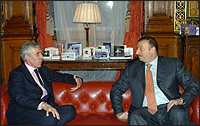 |
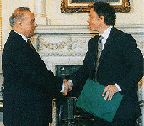 |
Jack Straw, Secretary of State for Foreign & Commonwealth
Affairs, meeting 'His Excellency' Mr Ilham Aliyev, the President of Azerbaijan, in London,
14
December 2004 (above right), and Prime Minister Tony Blair greeting Aliyev's father,
the previous dynastic president of Azerbaijan, during a UK visit to sign
a deal with BP in 1998
Mr Aliyev Jnr assumed the Presidency from
his father in 2003 after rigged elections to which the western world turned a blind eye
due to the importance of maintaining access to Azerbaijan's oil supplies via the ruling
regime |
"A secret intelligence report
accuses BP, Britain's biggest company, of backing a military coup which installed a
ruthless KGB hardman in the former Soviet state of Azerbaijan. An intelligence officer
says BP... later consolidated its position with the new regime when the middlemen
arranged to supply the incoming government with military equipment in an 'arms-for-oil'
deal.... Aliyev's arrival was welcomed by Britain and America, which have a strategic
interest in securing oil rights. BP
has close links to British intelligence and
employs several former MI6 officers...
The Turkish intelligence document, a report on the alleged role of BP and Amoco in the
events surrounding the 1993 uprising, claims the companies were 'behind the coup' in which
president Abulfaz Elchibey was overthrown and some 40 people died. The report says: 'As a
result of our intelligence efforts, it has been understood that two petrol giants BP and
Amoco, British and American respectively, which together forms the AIOC [Azerbaijan
International Oil Consortium], are behind the coup d'état carried out against Elchibey in
1993.... Lord Simon of Highbury, Tony Blair's former trade
minister... was BP's group chief executive at the time of the coup..."
BP accused of backing 'arms for oil' coup
Sunday Times, 26 March 2000
'Oil-For-Arms' In Azerbaijan
"A spy has been lurking around in
Baku, but his identity is no secret to movie fans. Britain's famous Agent 007, James
Bond-as portrayed by actor Pierce Brosnan-paid a visit to Azerbaijan this past spring to film the 19th installment of the Bond series: 'The World is Not Enough.'
Since the movie's plot revolves around the struggle
to control the world's oil supply, Azerbaijan proved
to be an ideal setting. The movie, which will premiere in November 1999, marks the 37th
year that Bond movies have been playing throughout the world."
Agent 007 Movie Scenes Shot in Baku
Azerbaijan
International, Autumn 1999
For John Scarlett 'The World Is Not
Enough'
The Name Is 'Oil Regime Change'
John 'Oil Regime Change'
"BP executives working for Lord
Browne spent millions of pounds on champagne-fuelled sex parties to help secure lucrative
international oil contracts. The company also worked with MI6
to help bring about changes in foreign governments, according
to an astonishing account of life inside the oil giant. Les Abrahams, who led BP's
successful bid for a multi-million-pound deal with one of the former Soviet republics,
today claims that Browne - who was forced to resign as chief executive last month after
the collapse of legal proceedings against The Mail on Sunday - presided over an 'anything
goes' regime of sexual licence, spying and financial sweeteners...... Mr Abrahams tells
how he spent £45 million in expenses over just four months of negotiations with
Azerbaijan's state oil company..... Mr Abrahams, an engineer by training, joined BP in
1991, just as the disintegration of the Soviet Union had triggered a 'new gold rush' by
oil multi-nationals seeking a share of the 200 billion barrels of oil reserves beneath the
Caspian Sea. While employed by BP, Mr Abrahams says he was
persuaded to work for MI6 by John Scarlett, now head of the service but then its head of station in Moscow. He says he was passing information to Scarlett in faxes and at one-to-one meetings in the Russian capital. He also
claims that BP was working closely with MI6 at the highest
levels to help it to win business in the region and influence the political complexion of governments. Mr Abrahams worked for BP's XFI unit - Exploring Frontiers International
- which specialises in opening new markets in often unstable parts of the world.....'I was given a hotline number which connected
to a desk in the Foreign Office. It meant visas could be
granted instantly for the Azerbaijanis and collected on arrival at the airport, rather
than taking the usual several weeks'..... All the entertaining paid off in September 1992
when BP signed a £300 million deal to exploit the Shah Deniz oilfields.....Among the
guests at a dinner and ceremony at Baku's Gulistan Palace to celebrate the Shah Deniz deal
were Lord Browne and Baroness Thatcher.....In 1993, Mr Abrahams played host to a
group of MPs who visited Baku as guests of BP, including Harold Elletson - then a Tory MP but now an adviser
to the Liberal Democrats - and Home Secretary John Reid, a Shadow Defence Minister at the time.....
Some of Mr Abrahams' most intriguing claims surround the alleged co-operation between BP and the British intelligence services to secure a
more pro-Western, pro-business regime in the country. He says
the operation, masterminded by Scarlett in Moscow, contributed to the coup in May 1992 which saw President Ayaz Mutalibov toppled by
Abulfaz Elchibey, and then to a second change a year later which saw Haydar Aliyev take
power. Just months after Aliyev was installed, BP signed the
so-called 'contract of the century', a £5 billion deal which placed BP at the head of an
oil exporting consortium. John Scarlett, says Mr Abrahams, 'approached me very subtly and asked me to help to
gather information for him. Because my daily route to the construction yard passed the
supply routes for Nagorno Karabakh, he asked me to report on troop and weapons movements.
And BP's deputy representative in Russia seemed very close to the embassy, too. BP supported both
coups, both through discreet moves and open political
support. Our progress on the oil contracts improved considerably after the coups.' Subsequently released Turkish secret service documents claimed BP had
discussed an 'arms for oil' deal with the assistance of MI6,
under which the company would use intermediaries to supply weapons to Aliyev's supporters
in return for the contract.... A spokeswoman for John Reid said she had no comment and the Foreign Office said of Mr Abrahams'
claims: 'We neither confirm nor deny anyone's allegations in relation to intelligence
matters.'"
Hookers, spies, cases full of dollars... how BP spent £45m to win 'Wild East' oil rights
Daily Mail, 12 May 2007
Full article click here
1993
Earlier Reporting Of Smoke
Emanating From This Particular BP-Scarlett Fire
"A
secret intelligence report accuses BP, Britain's biggest company, of backing a military coup which
installed a ruthless KGB hardman in the former Soviet state of Azerbaijan. An
intelligence officer says BP... later consolidated its position with the new regime when the
middlemen arranged to supply the incoming government with military equipment in an 'arms-for-oil' deal.... Aliyev's arrival was welcomed by Britain and America, which have a
strategic interest in securing oil rights. BP
has close links to British intelligence and
employs several former MI6 officers...
The Turkish intelligence document, a report on the alleged role of BP and Amoco in the
events surrounding the 1993 uprising, claims the companies were 'behind the coup' in which
president Abulfaz Elchibey was overthrown and some 40 people died. The report says: 'As a
result of our intelligence efforts, it has been understood that two petrol giants BP and Amoco, British and American
respectively, which together forms the AIOC [Azerbaijan International Oil Consortium], are
behind the coup d'état carried out against Elchibey in 1993.... The latest allegations will
embarrass Lord Simon of Highbury, Tony Blair's former trade
minister, who was BP's group chief executive at the time of the coup. Despite Labour's
ethical foreign policy and Aliyev's reputation as a hardline autocrat, Blair gave him the
red-carpet treatment when he visited London in 1998 to sign a friendship treaty and $13
billion (£9.5 billion) in contracts with BP and other British firms.."
BP accused of backing 'arms for oil' coup
Sunday Times, 26 March 2000
2003
Scarlett Was Central To The False Claims Made Against
Iraq Leading Up To The War Of 2003
If (As The Azerbaijan Story Explicitly Demonstrates)
Scarlett Has A History Of Working For Oil Driven Regime Change On Behalf Of BP
Then What Was The Driving Factor Behind The Iraq Invasion Of 2003
Given That Post Butler And Hutton It is Clear That Scarlett Knew He Had No
Corroborated Intelligence Of WMDs In Iraq?
"Last Tuesday the lead
story in The Financial Times was the latest report from the International Energy
Agency. The FT quoted the IEA as saying: 'Oil looks extremely tight in five years’
time,' and that there are 'prospects of even tighter natural gas markets at the turn of
the decade'. For an international agency, that is inflammatory language.... ...The
shortage of oil and natural gas, relative to demand, had already changed the balance of
world power. Historians may well conclude that the US
decision to invade Iraq was primarily motivated by the desire to gain physical control of
Iraq’s oil and to provide defence support to other Middle Eastern oil powers. "
Lord William Rees-Mogg
Are these the last days of the Oil Age?
London
Times, 16 July 2007 |
"In the control room of Azerbaijan's sprawling oil
terminal near the capital, Baku, Bala Mirza sits peering at a fuzzy map on a computer
monitor. The outline of Azerbaijan, Georgia and Turkey looks like little more than a jumble of hills and
farming towns. But for the engineer, 41, what lies underground has rocked his world: a new 1,100-mile oil pipeline, which in recent months has tied
this tiny country on the edge of the Caspian Sea to the huge Western market....This Muslim republic
[Azerbaijan], directly north of Iran and tucked into the southwest corner of the vast
former Soviet empire, is suddenly a central player in one of the West's most distressing
problems: how the U.S. and Europe will secure enough oil and
gas to power cities, factories, airplanes and cars--in short, how to keep our entire
modern lives afloat. Since last June, hundreds of
thousands of barrels of oil a day have surged through a pipeline running from Baku through
Georgia's capital, Tbilisi, to Turkey's Mediterranean port of Ceyhan. Named the
Baku-Tbilisi-Ceyhan (BTC), the $4 billion pipeline is one of the world's longest and is operated by the British-American oil company BP, with partners that include U.S.
oil companies Chevron, ConocoPhillips and Hess. By spring, about 1 million bbl. a day will
move down the pipe, and BP could increase that soon after to about 1.5 million bbl. a day. A
parallel BP
pipeline opened last month to send hundreds of billions of cubic feet of natural gas from
the Caspian to Western Europe, in order to break the Continent's overwhelming reliance on
Russia.... Fifteen years after the Soviet Union's collapse, it's tempting to think of the
cold war as history--until you land in Baku. This is
the front line of a new East-West contest, one that is as consequential as the
nuclear-weapons face-off of the past: the battle for energy supplies among countries
heavily dependent on imported oil and gas, which include the U.S. and the E.U., plus the
rocketing economies of China and India. That necessity is a powerful weapon in this new
battle.....Azerbaijan might be secular, but it is
hardly democratic. Local elections in 2005 and the presidential vote that brought Ilham
Aliyev to power in 2003 were both flawed, according to U.N. and American election
observers. A free press? Hardly. One afternoon in December, TIME's team was taken to a
police station near Baku and questioned for three hours about our activities.... Some
Azeris believe Western governments prefer energy security to political freedom, as was
sought in the 2004 revolution in Ukraine--a major transhipper of natural gas to Western
Europe. 'The U.S. will never support democrats in
Azerbaijan because of their oil interests,' says
[Vafa] Guluzadeh [former adviser to President Heydar Aliyev]."
Oil's Vital New Power
TIME, 12 January 2007
"In September 1992, BP pulled off a
coup that unnerved its competitors and appeared to put the British firm back on top.
Former British prime minister Margaret Thatcher arrived in Baku and handed the Azerbaijani
government two BP checks totaling $30 million. The money was a down payment for a proven
field called Chirag and for an unproven bloc called Shak-Deniz. To Azerbaijani officials,
a deal with BP was tantamount to a deal with the British government; not only did visiting British officials lobby relentlessly for the
company, but for months Britain's diplomatic mission to Azerbaijan had operated out of the BP offices."
A British 'Coup'
Washington
Post, 4 October 1998
"[Azerbaijani
dictator President] Aliyev's arrival was welcomed by Britain and America, which have a
strategic interest in securing oil rights.... Blair gave [Aliyev] red-carpet treatment when he visited London in
1998 to sign a friendship treaty and $13 billion (£9.5 billion) in
contracts with BP and other British firms...."
BP accused of backing 'arms for oil' coup
Sunday Times, 26 March 2000
"The elections allowed Ilham Aliyev to succeed his father, Heider Aliyev, longtime leader of the Soviet-era Communist Party, who returned to power in 1993 after a military coup. Senior
opposition figures are among 100 said still to be in jail after post-election riots. So is Ilgar Ibrahimogul, imam of a mosque in the capital, and founder of
Azerbaijan’s Centre for Religious Freedom, together with Rauf Arifoglu, editor of the biggest-circulation newspaper."
Bush's officers parade policy contradiction
London Times, 5
December 2003
"It wasn’t supposed to be like
this. Tomorrow New Labour’s ethical policy will drown symbolically in a poisonous cocktail of blood and oil when the Queen
shakes hands with Azerbaijan’s President Aliev. Her Majesty may be forgiven for thinking this is one export-driven
photo-opportunity too many. The Queen has dutifully entertained tyrants of all stripes but
she has never had to shake hands with a SMERSH agent before.... Today, as President of Azerbaijan his
secret police regularly arrest scores of critics allegedly plotting against him and
thousands languish in his old haunts, the ex-KGB prisons. Others simply disappear. Yet
Aliev’s Azerbaijan is respectable. There is one
word to explain this bizarre fact: Oil.... Azeri democracy was uniquely Aliev-style.... oil decreed that Aliev had
won 98.9% of the votes - a modest 1% fall from his last Soviet-era total... A gaggle of ex-Tory MPs and former Foreign Office diplomats know the value of keeping in with Aliev. So does a
host of stars of George Bush’s Administration... [now] Tony Blair is wining and
dining Aliev..."
Aliev In Britain
Daily Mail, 20 July
1998
"A Turkish secret service
intelligence report has revealed that the British oil giant BP was allegedly involved in
backing a military coup that overthrew the democratically elected government of Azerbaijan
in 1993. In testimony included in the report, a former intelligence officer accused BP of
trading arms for oil in an effort to secure a better deal on oil concessions in the
country. The intelligence report, leaked to the Sunday Times of London,
documents how BP, using bribes and a supply of military arms, systematically undermined
the government of Azerbaijan, and perpetuated the overthrow of President Abulfaz Elchibey.
The coup caused the death of 40 people, along with violence and repression of Azeri
citizens. 'As a result of our intelligence efforts, it has been understood that two petrol
giants, BP and Amoco, British and American respectively, which together form the AIOC [Azerbaijan International
Oil Consortium], are behind the coup d'etat carried out against Elchibey in 1993,'
said the report."
BP LINKED TO OVERTHROW OF AZERBAIJAN GOVERNMENT
Drillbits and
Tailings, Volume 5, Number 6, April 17, 2000
"Using his KGB methods [Aliyev]
has been oppressing and
persecuting all active opponents of his regime. Thousands of innocent people have been
arrested on fabricated charges of treason, coup d`etat and terror against the President...
The country is run by a police regime
created by this usurper... we must admit that the oil driven politics of western countries with respect to Azerbaijan
helped to create a tolerable and sometimes positive attitude towards Heidar Aliyev's
anti-people policies.... Many thousands have died who could be alive today."
Statement of Rasul Gouliev, Chairman, Azerbaijan Democratic Party
US Congressional Human Rights Caucus, 3 December 2002
"Azerbaijan President Heydar Aliyev is
in London for a state visit that will include talks with Prime Minister Tony Blair and
meetings with businessmen expected to focus on investment opportunities in his country. Azerbaijan is the location of large reserves of oil and gas that
are expected to play an important role in helping to meet the world's rising demand for
energy into the 21st century. The 75-year-old former
Soviet politburo member is expected to appeal for more British
investment in the oil and gas sector of the small
Caucasus country of some 7.5 million people. One of his key engagements is an address on
Wednesday to a conference in London on 'Doing Business in Azerbaijan'. Press reports say he is expected to sign three oil deals with
British firms (Ramco, British Petroleum and Monument Oil and Gas), expected to be worth
more than $5 billion to Azerbaijan. Aliyev will also
address the Royal Institute of International Affairs (Wednesday). He is expected to focus
on Azerbaijan's place in the world, and the
importance of its hydrocarbon reserves. He is also
due to meet with Foreign Secretary Robin Cook... Aliyev is also expected to discuss the
route of export pipelines to carry Caspian Sea oil and gas to western markets. Azerbaijan,
like other oil-rich countries in the region, lacks access to the open seas, meaning that
their energy exports will have go overland. Aliyev has declared in favor of a main export
pipeline on the Baku-Ceyhan route through Georgia and Turkey to
the Mediterranean. Aliyev's talks with Blair are scheduled for
tomorrow afternoon (15:30 CEST). He will then meet Defense Secretary George Robertson.
They are expected to discuss cooperation with NATO under the Partnership for Peace program. Aliyev first became leader of
Azerbaijan 29 years ago as Communist Party secretary. He spent five years in the Soviet
politburo in the 1980s before being sacked by Mikhail Gorbachev. He made a political comeback in Azerbaijan in 1993."
Azerbaijan: President Visits Britain To Talk Business
Radio Free Europe, 20 July 1998
"BP (British Petroleum) took the
initial step when, through intermediaries, it bought off key members of the government
just before the coup. The idea was to steal a march on the other western companies and the
Russians in the battle for Azerbaijan’s huge reserves of oil and gas, estimated at
200 billion barrels of top-quality crude.... Soon after the coup, BP’s middlemen
arranged to supply the new government with military equipment in what was described as an
'arms-for-oil' deal. The move was designed to 'consolidate BP’s position' with the
new regime, according to one secret service agent. Only a few months later, BP secured the
leadership of the consortium of western companies that dominate the oil scene in the
country. The £5 billion contract–– described as 'the contract of the century'
was signed by Hayder Aliyev. BP and Amoco merged in 1998 and now have a virtual monopoly
of rights to exploit Azerbaijan’s oil wealth....Both companies also have a reputation
for working closely with their country’s intelligence organizations. BP, for example,
now employs several former MI6 officers. It is therefore, understandable that company officials and Aliyev, a
former KGB senior officer, should find each other congenial company and plot together for
mutual gain. Aliyev had been warmly congratulated by both London and Washington on
becoming president, and was given red-carpet treatment during his state visits to the two
capitals. The Azeri president was warmly greeted by the British prime minister, Tony
Blair, when he visited London in 1998 to sign a friendship treaty and contracts worth $13
billion with BP and other British firms. Blair (whose
government claims to pursue an ethical foreign policy, and to support democratic regimes
in the ‘developing world’) apparently had no inhibitions about endorsing a
former KGB operative brought to power by a military coup."
BP and Amoco behind coup installing Aliyev as president of Azerbaijan
Crescent International,
16-31 May 2000
"One of the former Soviet Union's most tenacious leaders will
surrender his throne this week, passing it
to his son in what is widely seen as an attempt to keep the scale of corruption under
wraps. The presidential election in Azerbaijan on Wednesday is causing
concern, not just because it is rigged, but also because the West has invested billions in
the oil-rich republic... Billions of pounds in investment from BP and from American oil companies
mean that stability is critical. The
biggest project is the Baku-Ceyhan pipeline, which will cost almost £2 billion. The first
oil is scheduled to flow in 2005, carrying one million barrels a day from the Caspian Sea
to the Mediterranean...."
West seeks smooth handover as Azeri rule passes to son
London Times, 13 October 2003
"...oil executives say they have no problem with the younger Aliyev taking power [in Azerbaijan].... The United States,
despite declarations that it supports none of the candidates, has made only token protests
about the violent intimidation of opposition candidates during the election
campaign".
Oil angst
London Times, 13
October 2003
"Azerbaijan
is rated as one of the poorest and most corrupt countries in the region, with more than 40
per cent of its people living below the poverty line. It has been ruled most of the time
since its independence from Russia by Heydar Aliyev, a hardline former KGB chief who was
succeeded by his son, Ilham, in 2003. But this
secular Islamic state on the Caspian Sea is also a key element of the United States’s
strategy to contain Iran and secure access to the Caspian’s huge oil and gas
reserves. A staunch US ally, Azerbaijan was one of the few Muslim states that sent troops
to Iraq....Over the past few months the Government
has repeatedly used riot police to break up opposition rallies in the centre of Baku,
injuring dozens of people. It has also broken up
youth groups that tried to emulate movements in Serbia, Georgia and Ukraine. When Rasul
Guliyev, an exiled opposition leader, tried to return to Azerbaijan this month after nine
years of self-imposed exile in the US, the Government refused to let his plane land and
detained hundreds of opposition supporters. Two days later Mr Aliyev sacked a dozen senior
officials and had two of them, the economy and health ministers, arrested for allegedly
planning to stage a coup with Mr Guliyev. The European Union and the Organisation for
Security and Co-operation in Europe expressed concern. But
President Bush sent a letter to Mr Aliyev, welcoming his 'commitment to a free and fair
election'. He added: 'I look forward to working with you after these elections.' Under Western pressure, Mr Aliyev issued a decree this month allowing the
use of indelible ink to mark voters’ fingers and permitting foreign-funded NGOs to
monitor the vote. But critics dismiss that as too little, too late, and opposition
supporters are preparing for violent clashes with riot police after the results. Mr
Gassanly is likely to be in the thick of them. Earlier this month he was detained for six
hours after police broke up a rally. The British Embassy had to intervene to get him
released. It is a far cry from his political activity at home, where he worked on Frank
Dobson’s attempt to become mayor of London and campaigned for a hospital bus to be
reinstated in the constituency of Westminster. But he said that he was driven by fear that
Azerbaijan’s people may lose faith in the ideals of democracy and free markets and
embrace Islamic extremism. 'The West is making a mistake thinking that short-term
stability is more important than long-term democracy,' he said. 'Next time the flags
won’t be orange. They’ll be green.'”
West balks at backing revolution as elections loom in oil-rich
state
London
Times, 4 November 2005
"The Bush Administration put huge
effort yesterday into preaching two contradictory messages on democracy. On one side, we
had Colin Powell, the Secretary of State, in north Africa to champion the cause of
democracy and human rights. On the other, we had Donald Rumsfeld, the Secretary of
Defence, congratulating the President of Azerbaijan on his landslide October poll victory,
which even the State Department has said was tarnished by fraud, and which triggered
street riots. But the contradiction is not between Powell and Rumsfeld, notorious though
their different views of the world are. It lies at
the heart of the Administration’s foreign policy:
does it always want to promote democracy, when that would produce a government hostile to
its interests? That is the question the US faces in Iraq, above all — one it has
chosen so far to duck. First Rumsfeld, who stopped in Baku on his way from Brussels to
Kabul. The reason for the US’s interest is no
mystery. Azerbaijan’s Caspian oilfields are an attraction as the US looks for
alternatives to the Gulf.... Rumsfeld emphasised the closeness of those links yesterday: 'We have a
military-to-military relationship, as well as political and economic relationships. And
certainly we intend to continue that military-to-military relationship with the new
administration here in this country.' The problem is the nature of that
administration. The elections allowed Ilham Aliyev to
succeed his father, Heider Aliyev, longtime leader of the Soviet-era Communist Party, who
returned to power in 1993 after a military coup. Senior opposition figures are among 100
said still to be in jail after post-election riots. So is Ilgar Ibrahimogul, imam of a
mosque in the capital, and founder of Azerbaijan’s Centre for Religious Freedom,
together with Rauf Arifoglu, editor of the biggest-circulation newspaper. The State
Department has called for an investigation into intimidation and ballot-rigging. In that
light Rumsfeld’s remarks amount to a bald statement of the bargain that the US will
strike to pursue its strategic interest."
Bush's officers parade policy contradiction
London Times, 5
December 2003
"Washington's
support for [Georgia] Shevardnadze's overthrow certainly had nothing to do with its love
of democracy, which was not much in evidence when Azerbaijan, just east of Georgia and another pipeline country, held even more outrageously rigged
elections in October.
For the Bush administration, the goal is to freeze Russia out of the new oil bonanza in
the Caspian and Caucasus countries, all former Soviet fiefdoms, and Shevardnadze's crime
was to be too
accommodating to the Russians. ... when Shevardnadze signed a deal last year with the Russian gas giant
Gazprom, Washington went ballistic. Bush's energy adviser Steven Mann flew in to warn
Shevardnadze not to go ahead with the deal, Mikhail Saakashvili denounced it - and
Shevardnadze signed it anyway. So no illusions about America's motives for
opposing him ....."
The power to dismiss
Dawn (Pakistan), 12 January 2004
| For alternative URLs for this important news item no
longer available on the Mail's web sites click
here |
Hookers, spies, cases full of dollars...how BP spent £45m
to win 'Wild East' oil rights
By GLEN OWEN - More
by this author » Last updated at 22:48pm on 12th May
2007
Comments
BP executives working for Lord Browne spent millions of
pounds on champagne-fuelled sex parties to help secure lucrative international oil
contracts.
The company also worked with MI6 to help bring about changes
in foreign governments, according to an astonishing account of life inside the oil giant.
Les Abrahams, who led BP's successful bid for a
multi-million-pound deal with one of the former Soviet republics, today claims that Browne
- who was forced to resign as chief executive last month after the collapse of legal
proceedings against The Mail on Sunday - presided over an "anything goes" regime
of sexual licence, spying and financial sweeteners.
He also claims that Home Secretary John Reid was arrested at
gunpoint on a BP-funded foreign trip for being out on the streets after a military curfew
had been imposed.
Mr Abrahams tells how he spent £45 million in expenses over
just four months of negotiations with Azerbaijan's state oil company.
Armed with a no-limit company credit card, he ordered
supplies of champagne and caviar to be flown on company jets into the boomtown capital,
Baku, to be consumed at the "sex parties".
The hospitality continued in London, where prostitutes were
hired on the BP credit card to entertain visiting Azerbaijanis.
Mr Abrahams, an engineer by training, joined BP in 1991, just
as the disintegration of the Soviet Union had triggered a "new gold rush" by oil
multi-nationals seeking a share of the 200 billion barrels of oil reserves beneath the
Caspian Sea.
While employed by BP, Mr Abrahams says he was persuaded to
work for MI6 by John Scarlett, now head of the service but then its head of station in
Moscow.
He says he was passing information to Scarlett in faxes and
at one-to-one meetings in the Russian capital.
He also claims that BP was working closely with MI6 at the
highest levels to help it to win business in the region and influence the political
complexion of governments.
Mr Abrahams worked for BP's XFI unit - Exploring Frontiers
International - which specialises in opening new markets in often unstable parts of the
world.
He said Lord Browne, then BP's head of exploration, allocated
a budget of £45 million to cover the first year's costs of the Baku operation.
"The order came from Browne's aides to 'get them
anything they want'.
"By 'them', they meant local officials in
Azerbaijan," Mr Abrahams said.
"There were 20 or 30 people working on it at BP head
office, and we soon had a steady stream of executives coming over as negotiators. We got
through the money in just four months - after which it was simply increased without
question."
He described a Wild West world in which oil executives with
briefcases full of dollars rubbed shoulders with mafia members, prostitutes and fixers and
cut their deals in smoke-filled back rooms.
"The BP officials would come out to Baku in groups of
five or six, every week," he said.
"Sometimes I would charter an entire Boeing 757 to carry
as few as seven staff. Their main base was the hard currency bar of the old Intourist
hotel - so named because it accepted only dollars and was only open to foreigners.
"It was full of prostitutes and many of us, including
me, used them on a regular basis, although we quickly established they all worked for the
KGB.
"If we went back to the rooms, not only were they
bugged, but the girls would quiz us closely about what we were doing and where we were
going, and reported straight back to their handlers.
"Everywhere was bugged, and all the phones were tapped.
One of our executives was recorded saying unflattering things about the president, and his
comments were played back to us in a meeting with local state oil company officials.
"We were then told clearly that he was no longer welcome
in the country."
Mr Abrahams helped to forge links with the local officials by
throwing lavish parties. He said the Azerbaijani girls who worked in the BP office, which
occupied a floor of the Sovietskaya hotel, would attend the parties and routinely provide
"sexual favours".
They were also presumed to work for the local intelligence
services.
"There was one girl, called Natasha, assigned to teach
us Russian, but it usually ended up as more that that. She would use the intimate
opportunity to ask us questions about what we were up to.
"Caviar and champagne were consumed at the parties,
which would start in the bars but inevitably end with the girls in the rooms.
"We had a company American Express card with no name on
it which we could use to draw out $10,000 a time to pay for entertaining without ever
having to account for it.
"Our local fixer was called 'Zulfie', who would help
find girls, drink and occasionally hashish. We always suspected he worked for the KGB,
because he was so well connected.
"A lot of the BP men's marriages went wrong. Either they
ended up with the local girls, or the wives would find out - often because the girls would
ring their home numbers "by accident".
"I don't believe that Browne didn't know everything that
was going on. He came out to Baku on five or six occasions."
Mr Abrahams, who left BP in 1994, said his first marriage
buckled because of his work in Baku. He has since remarried and lives in West London with
his new wife Lana and six-year-old daughter Anastasia. He now works as an adviser to the
EU.
He said BP applied the same laissez-faire attitude to
hospitality when Azerbaijani officials came to the UK during the negotiations.
"I was given a hotline number which connected to a desk
in the Foreign Office. It meant visas could be granted instantly for the Azerbaijanis and
collected on arrival at the airport, rather than taking the usual several weeks.
"We had bundles of cash to spend on them when they got
here, and could again use the corporate card without restraint.
"We would typically have a dinner at which Lord Browne
would be present, then he would go home and we would head off to somewhere like the
Gaslight Club in Piccadilly - where girls would dance topless and you would get charged
£250 for your drink.
"Our guests would usually want girls to go back with
afterwards. Sometimes we could persuade the girls in the clubs, but more often we would
just phone up an escort agency.
"We could charge them straight to the BP Amex card. But
it sometimes became problematic. One group of Khazak Oil officials stripped their hotel
rooms in Aberdeen bare, including the sheets and pillowcases, and they would usually clear
out the minibars wherever they were staying."
All the entertaining paid off in September 1992 when BP
signed a £300 million deal to exploit the Shah Deniz oilfields.
Mr Abrahams says that a key factor in securing the deal was
an £8 million payment BP made that year to SOCAR, the state-owned oil company in
Azerbaijan, for the right to use a construction yard on the edge of the Caspian Sea.
"It was effectively a sweetener to help to secure the
deal - and it worked," he said.
Among the guests at a dinner and ceremony at Baku's Gulistan
Palace to celebrate the Shah Deniz deal were Lord Browne and Baroness Thatcher.
Mr Abrahams says he was told to ensure that everything ran
smoothly for the event, including meeting Browne's fastidious requirements.
"I had his favourite brand of water, Hildon, and his
preferred foods flown out in advance, and I made sure money was paid for police escorts
and to circumvent immigration procedures at the airport for Browne and his entourage.
"That evening, he personally handed me a briefcase
containing a cheque for $30 million (£15million), to close the deal.
"He was so keen to wear a particular shirt, which he had
left at the airport, that I persuaded the chief of police to close off the roads so his
cavalcade could go via the airport to collect it."
In 1993, Mr Abrahams played host to a group of MPs who
visited Baku as guests of BP, including Harold Elletson - then a Tory MP but now an
adviser to the Liberal Democrats - and Home Secretary John Reid, a Shadow Defence Minister
at the time.
"John flew out in the BP Gulfstream jet," he
recalls.
"After dinner, we went drinking in the hard currency
bar. He was drinking a lot - this was a year before he gave up for good - and I grew
worried as it got closer to the time of the curfew imposed because of the tense political
situation at the time.
"I said, 'Come on John, we have to get back to the
hotel.' But as we left, he was swaying around and being very noisy.
"I urged him not to draw attention to us because we
weren't meant to be still on the streets. But then a van load of police armed with
Kalashnikovs pulled up and asked us what we were doing.
"He said, 'I am a British politician...' I urged him to
be quiet, but then he said to one of the policemen, 'If you don't take that f***ing
Kalashnikov out of my face I'm going to stick it up your f***ing a***.'
"With that, we were arrested and shoved at gunpoint into
the back of the van.
"It was only after I persuaded the driver to go to the
hotel to speak to the intelligence officer there that they released us. John had only
about two hours' sleep, then was up at 5.30am to fly to the nearby war zone of Nagorno
Karabakh. He was completely hung over."
Some of Mr Abrahams' most intriguing claims surround the
alleged co-operation between BP and the British intelligence services to secure a more
pro-Western, pro-business regime in the country.
He says the operation, masterminded by Scarlett in Moscow,
contributed to the coup in May 1992 which saw President Ayaz Mutalibov toppled by Abulfaz
Elchibey, and then to a second change a year later which saw Haydar Aliyev take power.
Just months after Aliyev was installed, BP signed the
so-called 'contract of the century', a £5 billion deal which placed BP at the head of an
oil exporting consortium.
John Scarlett, says Mr Abrahams, "approached me very
subtly and asked me to help to gather information for him.
"Because my daily route to the construction yard passed
the supply routes for Nagorno Karabakh, he asked me to report on troop and weapons
movements. And BP's deputy representative in Russia seemed very close to the embassy, too.
"BP supported both coups, both through discreet moves
and open political support. Our progress on the oil contracts improved considerably after
the coups."
Subsequently released Turkish secret service documents
claimed BP had discussed an 'arms for oil' deal with the assistance of MI6, under which
the company would use intermediaries to supply weapons to Aliyev's supporters in return
for the contract.
When the documents emerged in 2000, BP denied supplying arms
- although sources admitted its representatives had "discussed the possibility".
A BP spokesman said last night of Mr Abrahams' claims:
"There are some facts in his account that are accurate, but we don't recognise most
of it. We regard it as fantasy."
A spokeswoman for John Reid said she had no comment and the
Foreign Office said of Mr Abrahams' claims: "We neither confirm nor deny anyone's
allegations in relation to intelligence matters." |
Peak Oil, BP, and Azerbaijan
"While
important to the oil market in the short term, the FSU [former Soviet Union] contributes only 10-15% to world
production.... Peak
production from the FSU is expected between 2008 and 2014... The most likely outcomes for non-OPEC
oil production can be obtained by combining the forecasts for the FSU and the rest of
non-OPEC. Non-OPEC oil production is predicted to reach a peak between 2007 and 2011...
The US Energy Information Administration forecasts non-OPEC oil production to rise
to about 54 million b/d (about 20 billion bbl/year) by 2025. Based on the analysis
presented here, non-OPEC oil production at this level in 2025 is highly unlikely..... This
analysis.... represents a shortfall to the EIA forecast of non-OPEC supply of 20 million
b/d in 2025. The failure of non-OPEC to meet a large part of incremental demand, as it has
done for more than 20 years, is likely to precipitate the first crisis in oil supply.
Depending on demand and FSU supply, this crisis is practically upon us and is expected to
be acute after 2005.... The rapid increase in the call on OPEC after 2010 is due to the
widening gap between non-OPEC supply and forecast demand. The world's spare oil production
capacity (essentially only OPEC maintains spare capacity) has declined steadily since the
mid-1980s as OPEC has curtailed investment in the face of rising non-OPEC production.
Surplus capacity has declined from 10 million b/d in 1987 to 3-4 million b/d in 2003 and
to probably less than 1.5 million b/d in 2004. Most analysts consider that spare capacity
of 2-3 million b/d is required to ensure smooth oil supply... Depending on the rate of
decline of OPEC's capacity (possibly as high as 4% /year), current spare capacity will be
fully utilized sometime in 2005 if demand remains high or by end 2007 if demand
moderates...Apart from political factors, the expansion of OPEC's production capacity will
be constrained by the maturity of OPEC's fields and the scale of effort, investment and
pace of decision-making required, primarily in Persian Gulf countries. At capacity costs
of $6,000-10,000/b/d, the investment required between now and 2020 to achieve the high
demand case is £300-500 billion - a rate of $20-30 billion per year. There is no
indication that the major OPEC countries are embarking on oil production capacity
investments on this scale. The lead time on major capacity expansion projects are 3-5
years. Unless the principal Persian Gulf producers initiate major capacity expansion
within the next few years, there will be a further supply crisis later in this decade
driven by the complete elimination of spare capacity...."
Oil supply challenges - 1: The non-OPEC decline
Oil
and Gas Journal, 21 February 2005
(The Author: Peter. R.A. Wells is managing
director of Neftex Petroleum Advisors Ltd. He spent 12 years with Shell International in
positions that included exploration manager for eastern Nigeria, followed by 4 years with BP PLC, where he was chief negotiator for Azerbaijan in 1992-3.)
"The
global market will need increasing volumes of oil from members of the Organisation of
Petroleum Exporting Countries after non-OPEC
production reaches a maximum of about 50 million b/d between 2007 and 2011... A question crucial to future oil supply, therefore is: Can
OPEC's old fields deliver.... Most of the supergiant oil fields have had water or
gas injection installed to maintain pressure for 20-30 years. Handling produced injection
fluids is a growing problem in Iran, Saudi Arabia, the UAE, and in older fields in Iraq
(Kirkuk, Zubair, and Rumailah).... The oil
fields of Iraq are the least depleted and least developed of any of the Persian Gulf
oil producing countries, and Iraq has the potential to rapidly increase oil output....
Combined with earlier results, these predictions for OPEC yield an estimate of the world's
ultimate recoverable oil reserves of 2.5-2.9 trillion bbl, with 1.29-1.66 trillion bbl
remaining (1.224 trillion bbl produced to end 2003)..... It seems unlikely that OPEC can
increase production at the rate that was possible in the 1960s and 1970s, when the fields
were fresh and initial well production rates were higher... Only Iraq has undeveloped
supergiant oil fields (West Qurna, Majnoon, and East Baghdad) and the potential to rapidly
increase production to 8-10 million b/d...... The five Persian Gulf countries (Saudi
Arabia, Iraq, Iran, Kuwait and the UAE) are crucial to raising OPEC production. The
political situation in Iraq is unlikely to be conducive to major investment in new oil
production capacity for some years. Saudi Arabia has serious internal problems, which
threaten to destabilize the ruling royal family. Iran remains under unilateral US
sanctions. US military intervention in the Gulf and its failure to effectively and fairly
engage in resolving the Palestinian-Israeli conflict conspire to provide a hostile
backdrop to western interests in the Middle East. The combination of burgeoning future oil
revenues and growing hostility to the US in the region is not conducive to major capacity
expansion and will not provide a stable investment environment or offer easy opportunities
to the major international oil companies to assist in any capacity expansion
projects. Based on these considerations and the maturity of OPEC’s major fields,
it seems more likely that OPEC’s considerable reserves will be expressed as a long
plateau rather than a sharp peak. It is quite possible that the Persian Gulf countries
will not raise production capacity high enough or quickly enough, either for political
reasons, the slowness of internal decision-making, or the hostile security environment.
The consequences of this for world oil supply are immense, with the likelihood of further
military interventions and conflicts within the Middle East ….. It is unlikely,
except in the high reserves case, that OPEC production will be able to meet the high
demand forecast of 121 million b/d for 2025 by the US Energy Information Administration.
OPEC is able to meet mid-demand growth (1.5%) until 2013-15 if OPEC’s oil reserves
are low or until 2017-20 if OPEC’s reserves are high. OPEC is able to meet low-demand
growth (about 1%/year) until 2020 under either reserves scenario. These forecasts suggest
world oil demand is likely to be dampened by a rising oil price due to supply constraints,
particularly after non-OPEC production peaks (2007-11), but also when OPEC production
increases start to tail off. This could occur in 2010-15 if OPEC’s reserves turn out
to be low or around 2015-20 if OPEC’s reserves are high. Oil supply will become
increasingly concentrated in the Middle East and the former Soviet Union. The proportion
of oil production from the main producers of the Persian Gulf (Iran, Iraq, Saudi Arabia,
Kuwait, and the UAE) is forecast to rise to 45% in 2025 from 25% in 2003. Just seven
countries – Russia, Iran, Iraq, Saudi Arabia, Kuwait, and the UAE and Venezuela
– are expected to make up more than 60% of world oil production in 2025. For the
range of oil reserves demand scenarios considered here, world oil supply is predicted to
peak at 90-105 million b/d between 2016 and 2028…Based on these results, the EIA
forecast of world demand of more than 120 million b/d in 2025 seems unlikely to be met by
production ….. Total world oil reserves are estimated at 2.5 – 2.9 trillion bbl.
The world has consumed 1.224 trillion bbl to the end of 2004, so remaining reserves are
estimated at 1.3-1.7 trillion bbl (Table 1).As the different components of supply reach
their maximum production rate, a series of crises in oil supply is likely over the coming
decades. The first, related to the peak and decline of non-OPEC production, is practically
upon us and underpins the currently high oil prices. Other factors are burgeoning world
oil demand, driven primarily by China and the USA, and restricted output from Iraq. The imminent inability of non-OPEC production to meet
incremental demand and its decline after 2010 precipitates the second crisis as OPEC’s diminishing spare capacity (even with Iraq’s
production back to preinvasion levels) becomes less and less able to accommodate
short-term fluctuations. The timing and depth of the crisis depend on world oil demand and
OPEC investment in new capacity. While OPEC countries will have every incentive to make
the necessary investments, the pace of past decision-making is not encouraging, and enough
spare capacity may not be available in time. The third crisis, due to OPEC’s
incremental supply being unable to meet incremental demand, follows in the first half of
the next decade. This assumes that OPEC’s reserves are as published. If OPEC’s
reserves are higher than published, this crisis may not occur until the latter half of the
next decade and may be muted, particularly if demand moderates. These crises will have
global economic and geopolitical significance: The oil price will be high and volatile,
and demand growth will have to be curtailed..."
Oil Supply Challenges - 2: What Can OPEC Deliver?
Oil
and Gas Journal, 7 March 2005
(The
Author: Peter. R.A. Wells is managing director of Neftex Petroleum Advisors Ltd. He spent
12 years with Shell International in positions that included exploration manager for
eastern Nigeria, followed by 4 years with BP PLC, where he was chief negotiator
for Azerbaijan in 1992-3.)
'The Special Relationship'
Anglo-American Dirty Oil Games In The Caucasus
'The Special Relationship'
Anglo-American
Dirty Oil Games In The Caucasus
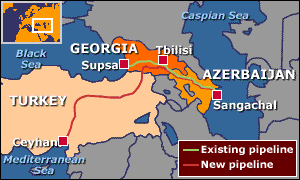
Find Out How Dirty Games Are Being Played In The Caucasus
As The Oil Makes Its Way From The Caspian To The
Coast Of Former Yugoslavia
Via The Black Sea Region
Click
Here
"Aliyev had been warmly congratulated by both London and Washington on becoming
president[of Azerbaijan], and was given red-carpet treatment during his state visits to
the two capitals. The Azeri president was warmly greeted by the British prime minister,
Tony Blair, when he visited London in 1998 to sign a friendship treaty and contracts worth
$13 billion with BP and other British firms.... But although the western consortium and
governments, and Aliyev, may have ample cause to celebrate, Azerbaijan is a land-locked
country and third parties will have to be dealt with to secure the shipment of the oil and
gas to the outside world. The only oil-route open to them was the pipeline from Baku to
the Russian Black Sea port of Novorossysk, which
previously passed through Chechenya. The war there
meant a prolonged suspension of oil shipments and considerable loss to the oil companies
as well as Azerbaijan. Now the Russians say that they have completed refurbishing the
pipeline, which now by-passes Chechnya, and Baku is preparing to resume oil exports."
BP and Amoco behind coup installing Aliyev as president of Azerbaijan
Crescent International,
16-31 May 2000
"The
Clinton administration followed up by providing strong support to the KLA, even though it
was known that the KLA supported the Muslim mujahadeen. Despite that knowledge, then
Secretary of State Madeleine Albright had the KLA removed from the State Department list
of terrorists. This action paved the way for the United States to provide the KLA with
needed logistical support. At the same time, the KLA also received support from Iran and
Usama bin Laden, along with 'Islamic holy warriors' who were jihad veterans from Bosnia, Chechnya and Afghanistan. Swiss journalist
Richard Labeviere, in his book, 'Dollars for Terror,' said that the international Islamic
networks linked to bin Laden received help from U.S. intelligence community. Indeed,
Chechen sources claim that U.S. intelligence also aided them in
their opposition to Russia. Given that U.S. policy in the
post-Cold War period has not only been anti-Russian but anti-Iranian, the United States worked
closely with Pakistan's predominantly Sunni Inter-Services Intelligence organization. Through ISI, the United States recruited Sunni mujahadeen by staging
them in Chechnya to fight in
Bosnia and later in Kosovo."
Michael
Maloof, Post 9/11 Pentagon Counterterrorism Adviser
Iran subversion in Balkans
G2 Bulletin, 25
September 2006 |
(Who is Michael Maloof? - Click Here)
OIL AND THE BATTLE FOR CHECHNYA
A Caucasian Republic
On An Oil Transit Corridor
Between The Caspian And Black Seas
Click Here |
"The American people have been
seriously misled about the origins of the al Qaeda movement blamed for the 9/11 attacks,
just as they have been seriously misled about the reasons for America’s invasion of
Iraq. The truth is that for at least two decades the United States has engaged in
energetic covert programs to secure U.S. control over
the Persian Gulf, and also to open up Central Asia for development by U.S. oil companies. Americans were eager to gain access to the petroleum reserves of the
Caspian Basin, which at that time were still estimated to be 'the largest known reserves
of unexploited fuel in the planet.' To this end, time after time, U.S. covert operations
in the region have used so-called 'Arab Afghan' warriors as assets, the jihadis whom we
loosely link with the name and leadership of al Qaeda. In country after country these
'Arab Afghans' have been involved in trafficking Afghan heroin. America’s
sponsorship of drug-trafficking Muslim warriors, including those now in Al Qaeda,
dates back to the Afghan War of 1979-89, sponsored in part by the CIA’s links to the
drug-laundering Bank of Credit and Commerce
International (BCCI). It was part of CIA Director
Casey’s strategy for launching covert operations over and above those approved and
financed by a Democratic-controlled Congress.... The most conspicuous example of this
alliance with drug-traffickers in the 1980s was the
Contra support operation. Here again foreign money and drug profits filled the gap
after Congress denied funds through the so-called Boland amendments; in this case
government funds were used to lie about the Contras to the American people. This was
followed by a massive cover-up, in which a dubious role was played by then-Congressman Lee
Hamilton, later of the 9/11 Commission... Repeatedly al Qaeda
terrorists were protected by FBI officials from investigation and prosecution.... In
part America’s limited covert assistance to al Qaeda after 1989 was in order not to
offend al Qaeda’s two primary supporters which America needed as allies: the
intelligence networks of Saudi Arabia and Pakistan. But unquestionably the entry of United
States oil companies into oil-rich Azerbaijan was achieved with the assistance
of a U.S.-organized covert program using 'Arab Afghan' operatives associated with bin
Laden. Oil was the driving force of U.S. involvement in Central and South Asia, and oil
led to U.S. coexistence with both al Qaeda and the world-dominating Afghan heroin
trade.... U.S.
support for al Qaeda elements, particularly in Azerbaijan and Kosovo, has increased dramatically
the flow of heroin to Western Europe and the United States.... In the former
Soviet Republic of Azerbaijan, Arab Afghans clearly assisted this effort of U.S. oil companies to
penetrate the region. In 1991-92, Richard Secord, Heinie Aderholt, and Ed Dearborn, three
veterans of U.S. operations in Laos and Iran-Contra,
turned up in Baku under the cover of an oil company, MEGA Oil. MEGA never did find oil,
but did contribute materially to the removal of Azerbaijan from the sphere of post-Soviet Russian influence. As MEGA operatives in Azerbaijan, Secord,
Aderholt, Dearborn, and their men engaged in military
training, passed 'brown bags filled with cash' to members of the government, and above all
set up an airline on the model of Air America which soon was picking
up hundreds of Mujahideen mercenaries in Afghanistan....
The triple pattern of drugs, oil, and al Qaeda was seen again in Kosovo in 1998, where the
Al-Qaeda-backed Islamist jihadis of the Kosovo
Liberation Army (KLA) received overt American assistance from the U.S. Government.
Though unmentioned in mainstream books on the war, both the al Qaeda and drug backgrounds
of the KLA are recognized by experts .... In short,
the al Qaeda terror network accused of the 9/11 attacks was supported and expanded by U.S.
intelligence programs and covert operations, both during and after the Soviet Afghan War. Congress should rethink their decision to grant still greater powers and
budget to the agencies responsible for fostering this enemy in the first place. "
9/11 in Historical Perspective: Flawed Assumptions
Deep Politics: Drugs, Oil, Covert Operations and Terrorism:
A briefing for Congressional staff, July 22, 2005
New
Criminologist, 6 August 2005
'Chechnya: The
Mujahideen Factor'
Joseph Bodansky, Director of the Task Force on Terrorism and Unconventional
Warfare of the U.S. Congress
Special Strategic Studies
Supplement, Freeman Centre For Strategic Studies, Houston, Texas, January 1998
[Extracts]
".... Islamabad became directly involved in the
active support for the Chechen Jihad already in the spring of 1994. At that time,
the ISI-sponsored Taliban offensive endangered the flow of Heroin from
Afghanistan which served to finance the Chechen revolt.............
Since late August, 1997, two trends have dominated events
in Chechnya: (1) Moscow is increasingly apprehensive
about a growing penetration of the US into the Caucasus, in quest for oil and challenging Russia's vital interests. Moreover, the
US is using conservative Arab regimes as conduits. (2) Official Grozny is demonstrating
unprecedented self-confidence and affluence, including Maskhadov's early September
declaration about the building of a new Capital city -- Dzhokar -- rather than attempting
to rebuild the devastated Grozny without explaining the source of the funds. Moscow
estimates that the money came from the Muslim World under US influence. These trends cast
a long shadow over the negotiations on a permanent settlement scheduled to begin in Moscow
in late September. Maskhadov was very optimistic about his ability to convince Yeltsin to
sign a treaty acceptable to Grozny -- that is, an inter-state treaty recognizing
Chechnya's independence......
Again, unfolding activities suggest confidence in the
Muslim World in the near term realization of this scenario. Even before the formal
political decision on the future of the region, several states have jointly embarked on
active economic maneuvering with outright political ramifications. Most important is the
effort, blessed by the US and the UK, to create a so-called Caucasian common market that
will concentrate on energy development while excluding Russia from its activities. This effort is developing since the Fall of 1997, and is supported
by all the states of the Transcaucasus region except Armenia, by major Western oil
corporations, and by organizations lobbying their interests, both in the United States and
Britain. Moscow is most alarmed by the establishment
of a Caucasian-American chamber of commerce because it is led by Khozh-Akhmed Nukhayev --
a leader of a Chechen criminal grouping in Moscow in the early 1990s and subsequently
First Deputy Prime Minister in Zelimkhan Yandarbiyev's Government in Chechnya.
Moscow also learned that back in October 1997, a group of prominent businessmen and politicians from Britain, Pakistan, and Hong Kong, signed a protocol of intent regarding the
establishment of a Transcaucasian energy company with Aslan Maskhadov as if he was the
President of a sovereign state. According to the agreement Chechnya would participate in
the project by providing the emerging consortium with a right to rent part of the
Baku-Grozny-Novorosiisk oil pipeline with attached enterprises and infrastructure.
Concurrently, aspirant regional powers are making moves in
the security and oil realm suggesting confidence in the imminent implementations of their
designs. Pakistan is reinforcing the ISI-controlled Afghan security detachments in Azerbaijan. Already in late
1993 and early 1994, the ISI deployed several hundreds strong Hizb-i-Islami
forces to Azerbaijan to help fight the Armenians and guard the oil
pipelines. Meanwhile, Turkey is planning on taking
over parts of the US Air Base at Incirlik that is being evacuated. The new Turkish forces
will provide the security of the Baku-Ceyhan oil pipeline through both stationary and
mobile forces.
Thus, Moscow believes, and not without reason, that all of
these activities and preparations make sense only in case Russian influence and presence
in the Caucasus is drastically reduced. A flare-up of Islamist terrorism and subversion is
a prime instrument to achieve this end.
And Moscow has very good reasons to be apprehensive. On
January 6, 1998, Pyotr Marchenko, a plenipotentiary representative of the Russian
President in Adygei, Dagestan, Kabardin-Balkaria and Karachai-Circassia and also in
Stavropol Territory, noted that the Russian security services have accumulated evidence
that 'the Northern Caucasus is a region of special
and enhanced interest for foreign secret services' as well as the terrorist organizations
they sponsor. He disclosed that the security
services 'had detained and were investigating cases of a number of citizens from the West
and the Middle East, who took part in reconnaissance and sabotage operations. These
operations are aimed at destabilising the situation and, in particular in Dagestan, at
kindling internecine strife.' The intelligence operatives exposed did not limit themselves
to collection of data about Russia or other regional activities. 'Overseas secret
services,' Marchenko stressed, 'all but openly organize, train and equip militants at
semi-clandestine centers, which is not always actively resisted in the localities.'
According to Marchenko, the late December 1997 terrorist strike in Buinaksk 'had been
provoked by precisely such militants.' .....
Meanwhile, Moscow is determined to resolutely fight the
escalation and intensification of Islamist terrorism in the Caucasus. Hence, resolving the
Chechen crisis thus becomes a major challenge and urgent necessity. Given the growing
economic and strategic importance of the Caucasus, the future of Chechnya is more than a
bilateral issue. Thus, a new struggle for the control of the Caucasus and their rich oil
reserves is escalating. And as the Moscow-Grozny negotiations over oil and political
issues become even more crucial, given their ramifications for Russia's own vital
interests, the expediency of using Islamist terrorism, violence and subversion in order to
exert additional pressure on Moscow will only increase. Determined to consolidate their
control over the strategically and economically crucial Caucasus, the Islamists and their
sponsoring states have already resolved to escalate their terroristic Jihad to
achieve what no negotiations can deliver. And herein lies the quintessence of the grim
prospects for the Caucasus."..... |
"The vast expanses of the former Soviet Union harbor oil and gas riches
which will be crucial in fueling the global economy in the next century. The huge oil
reserves, estimated at over 25 billion barrels, under the Caspian Sea and in the Central
Asian republics of Kazakhstan, Turkmenistan, and Uzbekistan are similar to those in Kuwait
and larger than those in Alaska's Northern Slope and the North Sea combined. Control over these
energy resources and export routes out of the Eurasian hinterland is quickly becoming one
of the central issues in post-Cold War politics. Like the
'Great Game' of the early 20th century, in which the geopolitical interests of the British
Empire and Russia clashed over the Caucasus region and Central Asia, today's struggle
between Russia and the West may turn on who controls the oil reserves in Eurasia. The
world now faces a choice between the cooperative exploitation by the East and West of
natural resources or a wasteful struggle that could cost a fortune in blood and treasure.
Regional conflicts in the Caucasus and Central Asia threaten to deny Western access to the
vital oil and gas reserves the world will need in the 21st century. .......The U.S. needs to ensure
free and fair access for all interested parties to the oil fields of the Caucasus and
Central Asia. These resources are crucial to ensuring prosperity
in the first half of the 21st century and beyond. Access to Eurasian energy reserves could
reduce the West's dependence on Middle East oil and ensure lower oil and gas prices for
decades to come..... the West has a paramount interest in assuring that the Caucasian and
Central Asian states maintain their independence and remain open to the West. Otherwise,
Moscow will capture almost monopolistic control over this vital energy resource, thus
increasing Western dependence upon Russian-dominated oil reserves and export routes....
The U.S. should support a pipeline route through the territory of Georgia and Turkey that
will bring oil from Eurasia to a Mediterranean port such as Ceyhan in Turkey..... One of the main goals of the Russian attack on Chechnya in
December of 1994 was to ensure control of the oil pipeline which runs from Baku, via
Grozny, the Chechen capital, to the Russian city of Tikhoretsk. The pipeline ends at the Russian Black Sea port of
Novorossiysk, designed by Russia to be the terminal for the proposed Kazakh and
Azerbaijani pipelines. In addition, Grozny boasts a large refinery with a processing
capacity of 12 million tons per year.... Russia launched a massive but covert military
action in the fall of 1994 to support opponents of Dudayev. In 1994, Dudayev
turned to radical Islamic elements in the Middle East and Central Asia for support. This exacerbated the religious aspect of the conflict between the
Muslim Chechens and Christian Orthodox Russians.... Another conflict affecting potential
oil routes is occuring in the Caucasus republic of Georgia. Russia wants to prevent oil
from Azerbaijan and Kazakhstan from going the 'Western' route through Georgia to Turkey.
Moscow's support of civil strife in Georgia is directly connected to its goal of
perpetuating conflict in the Caucasus.... Another dangerous conflict is smoldering
in Abkhazia, a breakaway region in Georgia. The bitter war in Abkhazia, which began in
1992, has claimed over 35,000 lives. It was precipitated by the Russian military backing
the Abkhaz separatist minority against the Georgian government in Tbilisi. One purpose of
the Russian intervention was to weaken Georgia and curb Turkish and Western influence in
the region. But more important was the Russian goal of controlling access to oil. By
acting as it did, Russia gained de facto control over the long Black Sea coastline
in Abkhazia. Moscow also was protecting the Russian Black Sea ports of Novorossiysk and
Tuapse and moving closer to the Georgian oil exporting ports in Poti, Supsa, and Batumi.
In August 1995, Georgia's beleaguered President Shevardnadze agreed to place four Russian
military bases on Georgian soil, thus assuring Russia's control of the oil exporting
routes via the Black Sea coast.....The conflict in Nagorno-Karabakh is important because
of the immense oil reserves controlled by Azerbaijan. Since the late 19th century, the oil
in Azerbaijan has played a key role in the economies of the Russian empire and the Soviet
Union, as well as in the global energy market. International business interests, such as
the Nobel and Rothschild families, and even conquerors like Adolf Hitler have all vied at
different times for control of Azerbaijan's oil. Even after 100 years of Russian imperial
and Soviet exploitation, Azerbaijan still has some of the largest reserves in the
world..... On October 9, 1995, the Azerbaijani International Oil Consortium (AIOC)
announced that 'early' oil (approximately 80,000 barrels a month) would be split between
two pipelines. The northern line would go to the Russian port of Novorossiysk (via
unstable Chechnya) and the western line to the Georgian port of Supsa in two separate
pipelines. This was a compromise decision supported by the Clinton Administration and
aimed at placating Moscow, but it failed to do so.... Moscow has gone beyond words to
establish its power in the Caucasus. The Russians are setting up military bases in the
region in order to gain exclusive control over all future pipelines. Georgia now has four
Russian bases and Armenia has three, while Azerbaijan is still holding out under severe
pressure from Moscow. In addition, members of the Commonwealth of Independent States are
required to police their borders jointly with Russian border guards, and thus are denied
effective control over their own territory..... The struggle to reestablish a
Russian sphere of influence in the Caucasus and Central Asia started in early 1992. While
not a full-scale war, this struggle employs a broad spectrum of military, covert,
diplomatic, and economic measures. The southern tier of the former Soviet Union is a zone
of feverish Russian activity aimed at tightening Moscow's grip in the aftermath of the
Soviet collapse. The entire southern rim of Russia is a turbulent frontier, a highly
unstable environment in which metropolitan civilian and military elites, local players,
and mid-level officers and bureaucrats drive the process of reintegration...... Much is at
stake in Eurasia for the U.S. and its allies. Attempts to restore its empire will doom
Russia's transition to a democracy and free-market economy. The ongoing war in Chechnya
alone has cost Russia $6 billion to date (equal to Russia's IMF and World Bank loans for
1995). Moreover, it has extracted a tremendous price from Russian society. The wars which
would be required to restore the Russian empire would prove much more costly not just for
Russia and the region, but for peace, world stability, and security..... Eurasian oil resources are pivotal to economic development in the
early 21st century. The supply of Middle Eastern oil would
become precarious if Saudi Arabia became unstable, or if Iran or Iraq provoked another
military conflict in the area.... The oil and gas reserves of the
Caucasus and Central Asia are vital to Western geostrategic and economic interests in the
21st century.....
A major campaign to assert influence in the Russian 'near abroad' would be a setback for
U.S. interests. In addition, control of the Caucasus and Central Asia would allow Russia
geographical proximity to, and closer cooperation with, the anti-Western regimes in Tehran
and Baghdad. Together, an anti-Western Russia, Iran, and Iraq, if they desired, could
pursue a common interest in driving up the price of oil...."
The New 'Great Game': Oil Politics in the Caucasus and Central Asia
The Heritage
Foundation, 25 January 1996
"As the intelligence newsletter Stratfor -- which Time magazine
ranked as the nation's top intelligence site in 2003, and which Barron's described as 'a
private quasi-CIA' -- pointed out a
few months ago, with Ukraine now firmly in the
West's orbit, America, with NATO and the EU, has managed to succeed exactly where Hitler
and Napoleon failed: it has dismantled the Russian empire, leaving the rump state exposed,
weakened and essentially at the West's mercy.... In the wake of the Beslan massacre
in September, 2004, in which hundreds of children were killed during a Chechen separatist
seizure of a school in southern Russia, President Putin went on television and blamed
certain foreign powers for supporting the terrorists with the aim of defanging Russia for
good, breaking it apart, and seizing its valuable resources. He did not name the United
States, but it was clear whom he meant. .....Stratfor,
whose politics could be described as something between patriotic-American and realpolitik,
agreed. According to its Kremlin sources, Putin specifically named
the U.S. and Great Britain during private meetings. And as Stratfor noted in its April report, there is plenty of evidence to
support the Kremlin's claim. In the first place, while Muslim separatist militants from
other conflict zones are shunned and even violently pursued by the U.S., the Chechen
separatist representatives are routinely given haven and official voice in both the U.K.
and America. ... As Stratfor notes, the British connection to the Chechen separatists goes
farther back. 'During the first Chechen war -- from 1994 to 1996 -- retired U.K. special forces officers trained British Muslim
recruits in British territory to fight in Chechnya,'
Stratfor claims, echoing reports out of Russia. 'Some militants who attended that training
and were later captured told the Russian government.' After Chechnya gained de facto
independence, a scandal apparently erupted in Russia-U.K. relations when de-mining
instructors from a private security firm, which included American ex-military personnel,
were caught 'training Chechen militants how to launch mine and bombing attacks against
Russian troops,' according to Stratfor.."
Dividing Russia
AlterNet, 29 June 2005
British And American Covert
Operations In Chechnya - Click
Here |
How British Intelligence Conned Geoff
Hoon
Over Regime Change In Iraq
Post Hutton and Butler Everyone Knows British
Intelligence Didn't Have Any Corroborated Evidence Of WMDs In Iraq
Defence Secretary Geoff Hoon May Not Have Lied About Iraq But MI6 Surely Lied To Him
(He Says The Intelligence Community Told Him They Were 'Absolutely Sure')
And It Appears Hoon Now Realises This
"But Geoff Hoon, who was defense
secretary in Prime Minister Tony Blair's government from 1999 until 2005, said
intelligence officials had believed Saddam was amassing weapons of mass destruction and
that the allies did not lie about why they went to war...Hoon defended the decision to go
to war on the basis of intelligence that believed Iraq was building up an arsenal of
weapons of mass destruction — intelligence he now accepts was wrong. 'I've been
present at a number of meetings where the intelligence
community was fixed, and looked in the eye and asked
are you absolutely sure about this? And the answer came back 'Yes, absolutely sure,' Hoon was
quoted as saying. Hoon said he felt no need to apologize."
Cheney Iraq role reviewed in Britain
Associated Press, 2
May 2007
"Mr Hoon also expressed regret over
the government's claim in the run-up to war that Saddam Hussein possessed weapons of mass
destruction, which, he now accepts, turned out to be false. He said he had 'gradually come
to the acceptance' the weapons did not exist. But he insisted the government had acted in
good faith. He still does not understand why the
intelligence proved to be false. 'I've been present
at a number of meetings where the intelligence community was fixed, and looked in the eye
and asked are you absolutely sure about this? And the answer came back 'Yes, absolutely
sure'. Mr Hoon added: 'I saw intelligence from the
first time I came into office, in May 1999 - week in, week out - that said Saddam had weapons of mass destruction ... I have real difficulty in understanding why it was, over such a
long period of time, we were told this and, moreover, why we acted upon it.... ' 'Whatever else I did, even if say people say it was
catastrophically wrong, I wouldn't agree with it, but I could live with it. But I can't
live with the idea that I was telling lies, because I wasn't."
Hoon admits fatal errors in planning for postwar Iraq
Guardian, 2 May 2007
"Britain ran a covert 'dirty tricks'
operation designed specifically to produce misleading intelligence that Saddam had weapons
of mass destruction to give the UK a justifiable excuse to wage war on Iraq. Operation Rockingham,
established by the Defence Intelligence Staff within the Ministry of Defence in 1991, was
set up to 'cherry-pick' intelligence proving an active Iraqi WMD programme and to ignore
and quash intelligence which indicated that Saddam's stockpiles had been destroyed or
wound down. The existence of Operation Rockingham has been confirmed by Scott Ritter, the
former UN chief weapons inspector, and a US military intelligence officer. He knew members
of the Operation Rockingham team and described the unit as 'dangerous', but insisted they
were not 'rogue agents' acting without government backing. 'This
policy was coming from the very highest levels,' he
added....Ritter and other intelligence sources say Operation
Rockingham and MI6 were supplying skewed information to the Joint Intelligence Committee
(JIC) which, Tony Blair has told the Commons, was behind the intelligence dossiers that
the government published to convince the parliament and the people of the necessity of war
against Iraq. Sources in both the British and US intelligence community are now equating
the JIC with the Office
of Special Plans (OSP) in the US Pentagon. The OSP was set up by Defence Secretary
Donald Rumsfeld to gather intelligence which would prove the case for war....Many in
British intelligence believe the planned parliamentary inquiry by MPs on the Intelligence
and Security Committee will pass the blame for the use of selective intelligence to the
JIC, which includes senior intelligence figures. Intelligence sources say this would be
unfair as they claim the JIC was following political instructions."
Revealed: the secret cabal which spun for Blair
Sunday
Herald, 8 June 2003
"Last September 24th, as Congress
prepared to vote on the resolution authorizing President George W. Bush to wage war in
Iraq, a group of senior intelligence officials, including George Tenet, the Director of
Central Intelligence, briefed the Senate Foreign Relations Committee on Iraq’s
weapons capability.....According to two of those present at the briefing.... this time the
argument that Iraq had a nuclear program under way was buttressed by a new and striking
fact: the C.I.A. had recently received intelligence
showing that, between 1999 and 2001, .....On the same day, in London, Tony Blair’s government made public a
dossier containing much of the information that the Senate committee was being given in
secret—that Iraq had sought to buy 'significant quantities of uranium' from an
unnamed African country... President Bush cited the
uranium deal, along with the aluminum tubes, in his State of the Union Message, on January
28th, while crediting Britain as the source of the information: The British government has
learned that Saddam Hussein recently sought 'significant quantities of uranium from
Africa.'....Then the story fell apart. On March 7th,
Mohamed ElBaradei, the director-general of the International Atomic Energy Agency, in
Vienna, told the U.N. Security Council that the documents involving the Niger-Iraq uranium
sale were fakes.... Some I.A.E.A. investigators....
speculated that MI6—the branch of British intelligence responsible for foreign
operations—had become involved, perhaps through contacts in Italy.... Forged documents and false accusations have been an element in U.S. and
British policy toward Iraq at least since the fall of 1997, after an impasse over U.N. inspections....A former Clinton
Administration official told me that London had resorted to, among other things, spreading
false information about Iraq. The British propaganda program—part of its Information
Operations, or I/Ops—was known to a few senior officials in Washington.... dozens of
unverified and unverifiable intelligence reports and tips—data known as inactionable
intelligence—[were] to be funnelled to MI6 operatives and quietly passed along to
newspapers in London and elsewhere. 'It was intelligence that was crap, and that
we couldn’t move on, but the Brits wanted to plant stories in England and around the
world,' the former officer said. There was a series of clandestine meetings with MI6, at
which documents were provided, as well as quiet meetings, usually at safe houses in the
Washington area..... None of the past and present officials I spoke with were able
to categorically state that the fake Niger documents were created or instigated by the
same propaganda office in MI6 that had been part of the anti-Iraq propaganda wars in the
late nineteen-nineties (An MI6 intelligence source declined to comment.)....[However] What is generally agreed upon, a congressional
intelligence-committee staff member told me, is that the Niger documents were initially
circulated by the British—President Bush said
as much in his State of the Union speech—and that 'the Brits placed more stock in
them than we did.' It is also clear, as the former high-level intelligence official told
me, that 'something as bizarre as Niger raises suspicions everywhere.'... "
WHO LIED TO WHOM?
New
Yorker, 24 March 2003
"The Secret Intelligence Service has
run an operation to gain public support for sanctions and the use of military force in
Iraq. The government yesterday confirmed that MI6 had organised Operation Mass Appeal, a campaign to plant
stories in the media about Saddam Hussein's weapons of mass destruction. The revelation
will create embarrassing questions for Tony Blair in the run-up to the publication of the
report by Lord Hutton into the circumstances surrounding the death of Dr David Kelly, the
government weapons expert. A senior official admitted that MI6 had been at the heart of a campaign launched in the late 1990s to spread
information about Saddam's development of nerve agents and other weapons, but denied that
it had planted misinformation. 'There were things about Saddam's regime and his weapons
that the public needed to know, said the official. The admission followed claims by Scott
Ritter, who led 14 inspection missions in Iraq, that MI6 had recruited him in 1997 to help with the propaganda effort. He described meetings where the
senior officer and at least two other MI6 staff had discussed ways to manipulate intelligence material. 'The aim
was to convince the public that Iraq was a far greater threat than it actually was,'
Ritter said last week. He said there was evidence that MI6 continued to use similar propaganda tactics up to the invasion of Iraq
earlier this year. 'Stories ran in the media about secret underground facilities in Iraq
and ongoing programmes (to produce weapons of mass destruction),' said Ritter. 'They were
sourced to western intelligence and all of them were garbage.' .....Blair justified his
backing for sanctions and for the invasion of Iraq on the grounds that intelligence
reports showed Saddam was working to acquire chemical, biological and nuclear weapons. The
use of MI6 as a
'back channel' for promoting the government's policies on Iraq was never discovered during
the Hutton inquiry and is likely to cause considerable disquiet among MPs. A key figure in
Operation Mass Appeal was Sir Derek Plumbly, then director of the Middle East department
at the Foreign Office and now Britain's ambassador to Egypt. Plumbly worked closely with MI6 to help to promote
Britain's Middle East policy. The campaign was judged to be having a successful effect on
public opinion. MI6 passed on intelligence that Iraq was hiding weapons of mass destruction
and rebuilding its arsenal. Poland, India and South Africa were initially chosen as
targets for the campaign because they were non-aligned UN countries not supporting the
British and US position on sanctions. At the time, in 1997, Poland was also a member of the UN security council. Ritter was a
willing accomplice to the alleged propaganda effort when first approached by MI6's station chief in New
York. He obtained approval to co-operate from Richard Butler, then executive chairman of
the UN Special Commission on Iraq Disarmament. Ritter met MI6 to discuss Operation Mass Appeal at a lunch in London in June 1998 at which two men and a
woman from MI6
were present. The Sunday Times is prevented by the Official Secrets Act from publishing
their names. Ritter had previously met the MI6 officer at Vauxhall Cross, the service's London headquarters. He asked
Ritter for information on Iraq that could be planted in newspapers in India, Poland and
South Africa from where it would 'feed back' to Britain and America. Ritter opposed the
Iraq war but this is the first time that he has named members of British intelligence as
being involved in a propaganda campaign. He said he had decided to 'name names' because he
was frustrated at 'an official cover-up' and the 'misuse of intelligence'. 'What MI6 was determined to do by
the selective use of intelligence was to give the impression that Saddam still had WMDs or
was making them and thereby legitimise sanctions and military action against Iraq,' he
said."
Revealed: how MI6 sold the Iraq war
Sunday
Times, 28 December 2003
So Why Did Blair Promote Scarlett After The Scandal Of
The Iraq Dossier Intelligence 'Failure' And Contrary To Established Protocol?
Either Blair Was Conned Too Or He Was In On The Scheme
Which Is It?
"A Knighthood
for the MI6
chief behind the sexed-up 'dodgy dossier' that helped take Britain into the Iraq war was
branded an abuse of the honours system last night.... No reason for the award is given
except for his 'diplomatic service'.... At the time of the dodgy dossier Scarlett was
chairman of the Joint Intelligence Committee.... Scarlett has spent more than 30 years
working for MI6
..."
SIR SEX-UP
Daily
Mirror, 30 December 2006
Why Did
Blair And Omand
Promote Scarlett After The Iraq Scandal
When He Should Have Been Demoted?
"... there needs to be proper
supervision and surveillance of the security services if trust in them is to be
maintained. The Government's record can fill no one with confidence. Look how it dealt
with John Scarlett, who as chairman of the Joint Intelligence Committee was responsible
for the dodgy dossier which took us to war in Iraq. Was
he disciplined or sacked? On the contrary, he was awarded a knighthood and made head of
MI6."
A question of trust, not just security
Daily
Mail, 4 May 2007
|
| John
Scarlett, head of the Joint Intelligence Committee responsible for the 'dodgy dossier' on
Iraq in September 2002, was inexplicably promoted to Head Of MI6 following his
leading role in the biggest British Foreign Policy disaster since Suez |
"John Scarlett, who took
responsibility for the error-ridden dossier that justified the war in Iraq, is knighted in today's New Year's Honours list.... Sir John, the head of MI6, played a key role in the Hutton Inquiry hearings into the death of the
weapons expert David Kelly, three years ago. He steadfastly defended the dossier, which
contained the notorious claim that Iraq could launch weapons of mass destruction in 45
minutes. And he dismissed accusations he had bowed to pressure to 'sex up' the document's
conclusions. As chairman of the Joint Intelligence Committee, he told the inquiry he had
'overall charge and responsibility' for the dossier."
Scarlett, author of the Iraq war dossier, is knighted
Independent, 30
December 2006
A Repeat Of Suez?
Was It Impossible For Downing St To Sack Scarlett
Because He Knew They Knew?
"To mark the 50th anniversary of the
Suez Crisis of 1956, Professor Scott Lucas examines the key
role played by the British intelligence services in
the ill-fated invasion of Egypt. He uses new evidence to uncover how MI6 planned for the
overthrow of the Egyptian President Nasser, how it shocked CIA colleagues with the
proposal to use Israel in the attempt, and how it eventually produced the unsuccessful
plan for psychological warfare, with catastrophic results for the Eden government."
Archive Hour: Suez - the Missing Dimension
Saturday 28 October 2006
20:02-21:00 (Radio 4 FM)
"With
hindsight it's clear that Eden was already committed to military action [against
Egypt in 1956]. Approaching the problem through the United Nations was
unlikely to work, since in international law Nasser
probably was within his rights to nationalise the Suez Canal Company. With the likelihood
of armed conflict in mind, in fact Eden would ultimately engage in an illegal secret pact with
France and Israel to provide a pretext to start it..... no one outside of a
very few close confidants knew of Eden's single minded commitment to a military solution,
and still less about the very secret plan hatched with the French and Israelis to provide
a pretext for that military action to start....
Government preparations for war went largely unreported in detail having been the subject
of two 'D' notices. That's the system by which press and broadcasters agree voluntarily to
restrict reporting of matters relating to national security. Meanwhile unknown to any but
his closest inner circle the plan for the Israelis to
invade Egypt, thus allowing Britain and France to
intervene on the pretext of keeping the waring sides apart, was ready to be put into action."
'A Comfort to the Enemy'
BBC Archive Hour, Saturday 4
November 2006 20:00-21:00 (Radio 4 FM)
"No MI6 official was punished for the Suez failure, although quietly the service was reorganised to prevent any
repetition of its Middle Eastern scheming.... Instead Anthony Eden was left to carry responsibilty alone
for one of Britain's greatest foreign misadventures ever ..... There's one final twist to
our tale, however. More than fifty years after Suez, Anthony Eden's call for action
against evil dictators is echoed by his successors. Britain is once again involved with
regime change in the Middle East, albeit one led by a different imperial power...."
Suez - The Missing Dimension
BBC Radio 4, 28 October 2006
"I expressed my concern about the
hard-line rightwingers around Bush and warned him [Blair] that many of them would regard
it as a bonus in the present crisis if we were driven from office and replaced by a
Conservative government. He laughed and said, 'Regime
change is for Baghdad. It is not for here.'"
Diary of Robin Cook, former British Foreign Secretary - 5 March 2003
London Times, 5 October
2003
"As the London Times 20 June
put it 'No 10 may have 'cherry-picked' the intelligence — Robin Cook’s colourful
phrase — but there had to be cherries for the picking. Who grew them?' ...Indeed,
there is little doubt now that somebody within the system 'sexed' things up in making the
case against Iraq, albeit often in ways that have not featured strongly in the current
debate. If the Prime Minister is really convinced of his own integrity, and by implication
the rest of Downing St, then why is he not demanding an investigation of the intelligence
services given all that we now know?"
Iraqgate 2003
'Fight Smart', Special Report, October 2003
"Cover-ups sometimes
succeed. Despite the recent death of the 130th British soldier in Iraq and the £5 billion
cost of the war, the public’s appetite to expose the full truth about the
Government’s distortions of intelligence to justify the invasion has evaporated. Tony
Blair can congratulate himself that his fierce resistance to a truly independent
investigation about the road to war has been successful. But gradually, the barriers to
the truth are crumbling. Drip by drip, witnesses in America are dishing the dirt about the
corruption of intelligence by George Bush to justify the war. Information has emerged
about conversations and briefings among intelligence chiefs and politicians about
Iraq’s alleged weapons of mass destruction. Some
of these snippets incriminate Sir Richard Dearlove, the former chief of MI6, and Sir John
Scarlett, the fomer chairman of the Joint Intelligence Committee. Until now, both men have escaped serious criticism. To protect himself,
Mr Blair allowed Sir Richard Dearlove to retire without censure and promoted Sir John to
become Sir Richard’s successor..... Among the recent crop of books is On the Brink
by Tyler
Drumheller, a former chief of the CIA’s clandestine operations in
Europe. Drumheller’s description of an agent
codenamed Curveball
contributes to the exposure of Britain’s intelligence fiasco. Curveball was an Iraqi informer for the BND, the German foreign
intelligence service. According to Curveball, Iraq was indisputably developing mobile
biological weapons laboratories. After the attack on the World Trade Centre, the CIA
repeatedly asked the BND for access to him. The Germans refused. The reason, Drumheller heard from the BND, was that Curveball was
an alcoholic and a fabricator. Independent checks on his supposedly witness evidence of
Iraqi WMDs proved that he was lying....... Sir
Richard knew that Mr Blair could only make the case for war by insisting that Iraq
possessed WMDs that could be 'deployed within 45 minutes'. The
charge against Sir Richard, which he denies, is that by September 2003 when the
Government’s first intelligence dossier was published, he was party to distorting
intelligence to suit Mr Blair’s ambitions. Drumheller’s description of the
BND’s assessment of Curveball undermines Sir Richard’s denials. Curveball’s
information had been submitted in 2000 by Sir Richard to the JIC. Its validity was reasserted by Sir Richard in 2002 with a significant
addition. The production time of the weapon was reduced by MI6 from 'weeks to days'. Yet according to BND sources, MI6 was given the same assessment of
Curveball’s unreliability as the CIA. The
BND’s doubts had been confirmed after the war by the failure to find WMD. Yet in 2004
Sir Richard told the Butler inquiry into the intelligence on WMD that MI6 'judged that it
is premature to conclude (that Curveball’s intelligence) must be discounted'. That equivocation should be noted alongside his failure to tell
Lord Hutton’s investigation into the death of David Kelly that an important SIS
source of intelligence had been withdrawn as unreliable before the invasion. That withdrawal had seriously undermined the credibility of the
Government’s first dossier and justified the allegation that the intelligence had
been 'sexed up'. Yet Lord Butler did not blame Sir Richard personally. Before Lord Butler
reported in July 2004, Mr Blair wobbled and, fearing severe censure, contemplated early
retirement. Lord Butler’s blame-free report relieved him of that pressure. Relying on
Lord Hutton’s and Lord Butler’s cosy reports, Mr Blair cocooned himself from any
informed cross-examination about the mechanics of
disinformation. The fog of official obfuscation had
become impenetrable. Now, thanks to America’s hunt for the truth, the foundations of
Mr Blair’s fortress is being eroded. The
cover-up is disintegrating. The question is whether
an irresistible appetite for the truth will arise in Britain and compel Gordon Brown to commission a genuine investigation."
Blair's defence over Iraq is crumbling
London Times, 3
February 2007
"In late January 2003, as Secretary of
State Colin Powell prepared to argue the Bush administration's case against Iraq at the
United Nations, veteran CIA officer Tyler Drumheller sat down with a classified draft of
Powell's speech to look for errors. He found a whopper: a claim about mobile biological
labs built by Iraq for germ warfare. Drumheller instantly recognized the source, an Iraqi
defector suspected of being mentally unstable and a liar. The CIA officer took his pen, he
recounted in an interview, and crossed out the whole paragraph. A few days later, the
lines were back in the speech. Powell stood before the U.N. Security Council on Feb. 5 and
said: 'We have first-hand descriptions of biological weapons factories on wheels and on
rails.'.... Drumheller, who
is writing a book about his experiences, described in extensive interviews repeated
attempts to alert top CIA officials to problems with the defector, code-named Curveball,
in the days before the Powell speech."
Warnings on WMD 'Fabricator' Were Ignored, Ex-CIA Aide Says
Washington
Post, 25 June 2006
"George Bush
asked for Tony Blair's backing to remove Saddam Hussein from power just nine days after
the 11 September attacks, over a private dinner at the White House, a US magazine reported
last night. Sir Christopher Meyer, the former British ambassador to Washington, was at the
dinner table as Mr Blair replied that he would rather concentrate on ousting the Taliban
and restoring peace in Afghanistan. In a 25,000-word article in this month's American
edition of Vanity Fair, Sir Christopher recounts Mr Bush as responding: 'I agree with you
Tony. We must deal with this first. But when we have dealt with Afghanistan, we must come
back to Iraq.' Mr
Blair, Sir Christopher writes, 'said nothing to demur' at the prospect. Sir Christopher's
account presents a new challenge to Mr Blair's assertion that no decision was taken on the
invasion of Iraq until just days before operations began, in March 2003. It implies regime
change in Iraq was US policy immediately after 11 September."
Blair Told US
Was Targeting Saddam 'Just Days After 9/11'
Independent, 4 April 2004 |
"When John Scarlett begins his new job
this morning as head of MI6 his first task will be to defend himself against yet another damaging
allegation about falsifying intelligence to help Tony Blair. This latest controversy has prompted many in the
intelligence community to question whether Mr Scarlett is too much of a liability to run
the Secret Intelligence Service.... Mr Scarlett faces claims that in March he clumsily
tried to distort a crucial report by the Iraq Survey Group, (ISG), the international body
set up to hunt for Saddam Hussein’s supposed arsenal of banned armaments. Just before
the 1,400-strong team of inspectors were due to report on how they had failed to turn up
any trace of weapons of mass destruction they were reportedly contacted by Mr Scarlett. He
was still head of the Joint Intelligence Committee and suggested that the ISG report
should be cut from 200 pages of detailed analysis to 20, and left sufficently vague to
protect Mr Blair’s stand on Iraq’s weapons menace. He wanted the report to keep
alive the prospect that deadly weapons could still be found. In
a confidential e-mail sent to the ISG team in Baghdad, Mr Scarlett is alleged to have
asked them to add ten 'golden nuggets' to their report which prolonged the idea that there
were weapons of mass destruction. One former
intelligence officer said last night: 'This is the worst possible start for him as he
begins his new job. He wanted a fresh start for the service but you get the sinking
feeling this is never going to end while he is around.'... His growing army of critics
inside Whitehall argue it will be impossible to restore MI6’s credibility while he
remains in charge. One security expert decribed his reported intervention with the Iraq
Survey Group as 'staggering'.... His appointment was met by claims in some quarters of
Whitehall that it was a reward from Mr Blair as many had expected MI6’s deputy head,
Nigel Inkster, to succeed Sir Richard Dearlove as 'C'. This damaging view was reinforced when Downing Street took the
unusual step of going on the record robustly to support Mr Scarlett’s suitability for
the job."
New MI6 chief walks into storm over 'ties to Downing Street'
London Times, 2 August
2004
Why Was There Special Treatment
For Scarlett
And On Whose Instructions?
"Tony Blair provoked an
unprecedented political storm last night by surprisingly appointing the man who helped to
clear him in the Hutton inquiry as Britain’s top spymaster. Risking charges of
cronyism, the Prime Minister made John Scarlett, whose high-profile evidence countered
charges that Downing Street had 'sexed up' the dossier on Iraqi weapons, the head of MI6. It was a break with tradition because deputies of
MI6 usually succeed to the top job and the current holder of that post, Nigel Inkster, had
been groomed to take over. Last night Mr
Inkster’s future was in doubt.... The Times has confirmed that Mr Blair
approved without question the recommendation of Mr Scarlett that came from a selection
panel chaired by Sir David Omand, the intelligence and security coordinator. The panel found that
Mr Scarlett was 'on merit' the top candidate. The only other candidate on the shortlist
was Mr Inkster, the current deputy to Sir Richard Dearlove. Sir Richard had appointed him to the No 2 slot with the
understanding that he was the chosen insider to take over. Previous assistant chiefs had
all moved up to become the head of MI6. This was the case with Sir Richard himself."
Cronyism row over new MI6 spymaster
London Times, 7 May
2004
"The tradition of incumbent chiefs
appointing deputies goes back to at least 1985, according to MI6 records,
although some sources said they believed it might have started 50 years ago. The deputies
did not always automatically become the chief, Foreign and Commonwealth Office sources
said. Whitehall insiders said that for Mr Blair a less controversial candidate would have
been Mr Inkster. It has been reported that Mr Inkster was Sir Richard’s chosen
successor but The Times has been told by an informed source that Sir Richard had
the 'highest possible opinion' of Mr Scarlett.... Whitehall sources insisted yesterday
that Mr Scarlett had been selected instead of the MI6 deputy chief partly because after
three years as chairman of the JIC and 30 years in MI6, he had broader experience and
excellent contacts with Washington as a result of his role as head of the intelligence
committee."
Cronyism row over new MI6 spymaster
London Times, 7 May
2004
Downing St And MI6 |
Profile: John Scarlett:
‘C’ is for suspected crony in spying HQ
Sunday
Times, 9 May 2004
According to his critics, Scarlett’s sins are legion. As chairman of the
joint intelligence committee (JIC) he broke cover in the Hutton inquiry to save
Blair’s bacon by deflecting claims that Downing Street had “sexed up” the
dossier on Iraqi weapons of mass destruction. Heretically he not only made intelligence
public but also allowed the JIC to provide a justification for war.
Press photographs of this hitherto shadowy figure showed a balding, bespectacled
and dapper man of 55 who, the public learnt, commuted home to his wife, teenage son and
three Roedean-educated daughters at their substantial Dulwich home in southeast London. In
addition to details of his spying operations, his nickname was revealed as
“Spats”, after his penchant for fancy shoes. No MI6 chief-in-waiting has ever
been so clearly identified.
Scarlett’s deft stonewalling persuaded Lord Hutton that he had complete
ownership of the dossier, despite drafts and e-mails showing that he was prompted by
Alastair Campbell, the prime minister’s director of communications, who regarded
Scarlett as a “mate”. Hutton merely noted the “possibility” that such
pressure may have “subconsciously influenced” the JIC chairman.
It is the mutual attraction of Scarlett and new Labour that is at the centre of
the present row. He adds fuel to a controversy about the independence of the civil
service, which the government is accused of politicising with spin doctors — an image
that Blair has sworn to dispel.
To add insult to injury, Scarlett’s appointment pre-empts Lord
Butler’s inquiry into the accuracy of the intelligence on Iraq’s weapons of mass
destruction. This will be published at the end of July, just as Scarlett takes over his
£155,000- a-year job.
“It is damaged goods coming back,” said a senior intelligence source,
who describes the selection committee as “barking bloody mad”. There is talk of
MI6 officers walking out. Noses are out of joint because Nigel Inkster, deputy director
and chosen heir of Sir Richard Dearlove, the present chief, has been passed over for an
“outsider”. Scarlett resigned from MI6 in 2001 to chair the JIC.
To these dissenters, some of whom have hitched their careers to Inkster’s
bandwagon, it is intolerable that Scarlett should wield the hallowed green ink with which
C traditionally signs off his reports. They insist that the honour should be
Inkster’s.
Another faction welcomes Scarlett as an effective, articulate and resolute
former agent who proved his mettle as head of the Moscow station. In their view, far from
damaging MI6’s reputation in the Hutton inquiry, he drew the flak on himself. His
mateyness with new Labour — Dearlove, too, has accompanied Blair on many overseas
trips — has helped to secure the service a big budget increase and a starring role in
the fight against terrorism...
.... At Oxford he had been recruited by the Special Intelligence Service (SIS),
as MI6 is known to insiders, and was only 23 years old when he was inducted into the
“Circus” at Century
House.....
His appointment as JIC chairman three years ago caused some surprise.
According to an intelligence source: “The chairman of the committee has very rarely
been a serving SIS officer. In the past the post has nearly always gone to a diplomat or
to someone else from Whitehall.”
JIC chairmen are usually public figures near the end of their careers,
so Scarlett’s return to the shadows is another upset for traditionalists.
Middle-ranking and younger members of the service may also feel unease, said the
intelligence source. “They’ve now got an example of someone who’s seen to
have been used as a blatant political tool and who has been rewarded for what some are
calling moral cowardice,” he added. Others argue that Scarlett’s enthusiasm for
action meant that he did not need to be suborned.
Now Blair has got his own Captain Scarlet to battle the Mysterons of
Al-Qaeda. But viewers of the Gerry Anderson television series were left in no doubt that
the intrepid hero was just a puppet. It is Scarlett’s challenge to convince his
service otherwise. |
"After the Commons staged its first
full debate on the Iraq war since 2004, the government defeated an opposition motion
calling for such an inquiry by 298 votes to 273 – a majority of 25. However, the
prime minister’s victory came on a night of confusion for the government when a
cabinet minister appeared to break with the Downing Street line by confirming a new
inquiry into the Iraq war would definitely be held at
some stage. Throughout the day, Downing Street had
sought to keep all discussion about a possible future inquiry somewhat vague, saying that
when British troops finally left, 'people will want to look back'. However, in a BBC TV
interview, Des Browne, the defence secretary, went a good deal further, firming up the
government’s commitment by saying: 'When the time is right, of course there will be
such a inquiry.' Mr Browne’s comment means the UK will almost certainly hold an
inquiry into the war, probably after Mr Blair leaves
office next year. But a government insider later
said Mr Browne’s comments had been 'a slip of the tongue' and that he fully supported
the government’s Iraq policy."
Blair survives parliamentary rebellion over Iraq
Financial
Times, 31 October 2006
New cover-up claims in
WMD dodgy dossier
Evening
Standard, 8 December 2006
Tony Blair faced fresh accusations of a "cover up" today over his
discredited claims about Saddam Hussein's weapons arsenal.
Brian Jones, a former nuclear and biological arms specialist at the Ministry of
Defence, reignited the row over the Government's "dodgy" dossier on Iraq with
new claims that Parliament was misled.
Dr Jones, the official at the Defence Intelligence Staff who was a key witness
at the Hutton Inquiry, revealed that senior intelligence experts had rejected one of the
most striking claims in the dossier.
While most attention has focused on the claim that Saddam could fire a WMD
within "45 minutes", another key claim about the Iraqi regime speeding up
production of biological and chemical agents was also deeply flawed, he said.
A highly secret MI6 report on the agents was included in the government report
in September 2002 even though analysts considered it was "crap" and it had been
rejected by them "within hours of seeing it", Dr Jones revealed in today's New
Statesman.
The key piece of intelligence, dubbed "Report X", was officially
rejected as coming from an unreliable source by July 2003, when MI6 formally withdrew it.
Mr Blair insists he did not know about the error until after the event, but Mr
Jones points out that "any one of a number of officials in various government
departments will have known and should have been alert to the danger of Parliament-being
misled".
Dr Jones emerged as the "star" witness of the Hutton inquiry when it
emerged he was the only official to formally object to intelligence caveats being left out
of the dossier in the rush to its publication in the run-up to war.
He alleges that MI6 chief John Scarlett, chairman of the Joint Intelligence
Committee at the time of the dossier's drafting, knew that defence intelligence experts
had not approved "Report X".
"I am more convinced than ever that Report X was welcomed in September
2002, not as a particularly valuable piece of new intelligence but as a way to finesse a
"sexed-up" dossier past the experts on WMD. The normal intelligence process of
sceptical scrutiny was subverted," he said.
"I believe there were experienced intelligence professionals on the JIC who
had seen Report X and understood it was not substantial. This means that the Government's
claims [after the Butler Report on the dossier], that the intelligence process needed to
be tightened.. .was part of a cover-up intended to blame intelligence rather than policy
for the mistake that led us to war."
The Butler Report into the intelligence on Iraq revealed that the source of the
last-minute report was discredited. The "sub source" who had allegedly passed on
the information denied later to MI6 that he had said any such thing.
Lord Butler also found that former MI6 chief Richard Dearlove briefed Mr Blair
personally on Report X. He told the Prime Minister that the source remained
"unproven". |
The Role Of Sir David Omand
"The
PMOS [Prime Minister's Official Spokesman] informed journalists that the Foreign Secretary
was confirming today the appointment of John
Scarlett as the next Chief of the Secret Intelligence Service (SIS). ..... Jack Straw said, 'John Scarlett has
the operational background, personal qualities and wide experience to be a worthy
successor to Richard Dearlove'.... In answer to further questions, the PMOS said that it was
normal procedure for the Foreign Secretary to make the appointment under Section 2(1) of
the Intelligence Services Act 1994 on the basis of recommendations from a selection panel following Civil Service Commission practice. In this case, the panel had been
chaired by Sir David Omand. Under this procedure, the
Prime Minister was consulted at the end of the process. Asked if people had been asked to apply for the job or if it
had been advertised, the PMOS said that he had no intention of getting drawn into a
detailed discussion of the process. Asked if there had been any other candidates for the
job, apart from John Scarlett, the PMOS repeated that the appointment had been made on the
recommendation of the selection panel. Asked who else had sat on the panel, apart from Sir David Omand, the PMOS said that it wasn't our policy to provide details of Civil Service
Commission practice."
John Scarlett
Downing St Press Briefing, 6 May
2004
"What has already emerged - but been
largely ignored - from the Hutton inquiry is the existence of a dark, almost Jacobean,
cabal at the core of the Blair administration. It is a group of powerful, unelected people
few would have heard of were it not for the evidence given to Hutton: Sir David Manning,
the prime minister's foreign policy adviser; Sir
David Omand, his security coordinator; and John
Scarlett, chairman of the joint intelligence committee. Until he resigned, the group also
included Alastair Campbell, Blair's communications director. Indeed, he was a prime mover
in establishing this inner circle. Manning was widely respected as a high-flying diplomat
and ambassador to Nato. Scarlett was MI6 station chief in Moscow responsible at one time
for handling the KGB defector, Oleg Gordievsky. Omand was praised as director of GCHQ and top civil servant at the Home Office. Then they were brought to the
centre of power in Downing Street to be seduced by the smell of high-octane politics, and
threw away their professional independence. Above all, they allowed themselves to be
embraced by Campbell and opened the door to the tainting of intelligence by politics. You
could hear it in their calculating treatment of Kelly who, in Scarlett's chilling words,
should have been subjected to a 'security style interview'....The 45-minute claim was
inserted at the last minute on the word, we now know, of an MI6
informant - whether a defector or not remains
unclear - talking to a senior Iraqi armed forces officer. MI6
allowed Scarlett to include that 'intelligence'
despite opposition in an intelligence community concerned - as much now as it was before
the war - about how its work was being abused. This is the most damaging episode for MI6
since the Falklands. But then it was about complacency. Now its integrity is in question.
As long as Scarlett remains in his post, that damage will not be repaired."
There is a dark cabal around Blair
Guardian, 11
September 2003
"Relations between Sir Richard
Dearlove, the present C [head of MI6] , and Mr Scarlett have not been good. Mr Scarlett,
it is said, has for long sought Sir Richard's job. It is no secret that Sir Richard was
grooming Nigel Inkster, appointed last year as deputy head of MI6, as his
successor."
The odd couple: the new chief of MI6 and his 'mate' from No 10
Guardian, 7 May
2004
"Nigel Inkster, the deputy at MI6,
poised by custom and practice to take over when Sir Richard Dearlove retired, wasn't
appointed on his 'merits'. John Scarlett was.... But come back to the newness - the
unrealised, process-transforming impact - of Omand's
own role. I quote the Downing Street notice
explaining his original appointment. 'John Scarlett CMG,' it explains, 'will continue to
chair the joint intelligence committee and will be the director for intelligence and
security matters in the Cabinet Office. He will be accountable to the security and
intelligence coordinator.' In short, for
day-to-day working within the office, Scarlett became Omand's own deputy..... He has worked close by Scarlett for nearly two years and
knows his strengths. He also knows whose judgment he trusts and can second to the prime
minister. He would want, too, a 'C' who can work easily with the Blair team."
The man who is always there
Guardian,
10 May 2004
"Mr Reid has proposed splitting up the
Home Office so that a ministry of interior takes charge of police, immigration, MI6,
community cohesion and anti-terrorism activities. Some of the security functions now with
the Cabinet Office, and not subject to direct
political accountability, would also go to the
interior ministry, or a department of national security.... The idea has met resistance from civil servants, especially senior
security figures in the Cabinet Office. It may not match plans being drawn
up by Gordon Brown but some ministers believe the resistance is coming from civil
servants, and not from senior Labour politicians. It is being argued that MI6 should
remain under the political purview of the Foreign Office since the foreign secretary is
best placed to sanction security operations in the knowledge of the potential diplomatic
damage if the operation goes wrong or is exposed."
MI6 poised to remain under control of Foreign Office
Guardian, 1
February 2007
Who Is Sir David Omand?
What Was His Role At The Cabinet Office In
The Preparation Of Scarlett's Iraq Dossier
And Later In The Handling Of The Subsequent
Kelly Affair?
When It Came To The Appointment Of The Head
Of MI6 Was Omand
An Interested Party In Wanting To Keep
Suppressed Internal Dissent Within MI6 Which Knew The Iraq Intelligence Had Been Massaged?
"Omand stands at the heart of this action. Sir David, appointed in the summer of
2002, is the first-ever 'permanent secretary at the Cabinet Office and security and
intelligence coordinator'. A totally new post after 9/11. He's not the top dog at No 10,
your actual cabinet secretary, but he is the Sir Humphrey of homeland security as well as
supreme office manager. The man who's always there. He chairs every important
cross-Whitehall security committee, vets every account and sits alongside every
intelligence chief. When the boss of GCHQ gets duffed up by the public accounts committee,
Omand's on
hand, batting for the defence. When Sir John Stevens runs one of his gloomy roadshows
warning of 'inevitable terrorist attack', Omand does the drums and whistles. He has a seat at the table when dossiers are
compiled. He started the hunt for Gilligan's mole. He is omnipresent in an invisible kind
of way. So how did John Scarlett get to be head of
MI6? Here's the official Downing Street spokesman in
lobby meeting minutes. It was the foreign secretary's appointment - as laid down in
Section 2 (1) of the Intelligence Services Act 1994 - based on the recommendation of a
selection panel, following Civil Service Commission practice, chaired 'in this case' by
Sir David Omand.
'The procedure used ... was the same as the one which had been followed for the
appointment of Eliza Manningham-Buller, director general of MI5, and David Pepper,
director of GCHQ,' he said. 'It was also the same process used for the appointment of
permanent secretaries.' Asked about concerns 'that Mr Scarlett was 'too close to Downing
Street' in as much as he would be too willing to do No 10's bidding, the spokesman
repeated that the appointment 'had been made using the usual procedures', only involving
the PM at the end. It had been based entirely on merit on the recommendation of a panel
chaired by Sir David Omand.' Asked for how long this process had been in use, he referred
journalists to the Cabinet Office for further detail ... Asked if there had been any other
candidates for the job, apart from John Scarlett, he repeated that the appointment had
been made on the recommendation of the selection panel. Asked who else had sat on the
panel, apart from Sir David Omand, he said 'that it wasn't our policy to provide details of Civil Service
Commission practice'. Very good. If there's one thing clear from all this, it is that Sir
David Omand was
a huge cheese here (and that Tony Blair played mini-mouse with barely a sliver of received
cheddar to munch on). Nigel Inkster, the deputy at MI6, poised by custom and practice to
take over when Sir Richard Dearlove retired, wasn't appointed on his 'merits'. John
Scarlett was. But come back to the newness - the unrealised, process-transforming impact -
of Omand's own
role. I quote the Downing Street notice explaining his original appointment. 'John
Scarlett CMG,' it explains, 'will continue to chair the joint intelligence committee and
will be the director for intelligence and security matters in the Cabinet Office. He will
be accountable to the security and intelligence coordinator.' In short, for
day-to-day working within the office, Scarlett became Omand's own deputy. He retained his 'personal responsibility' for putting JIC
judgments to ministers, but there was a new and very influential man on his block to be
accountable to. And now that chap, with barely a peep from the PM, has helped make him 'C
at 6'. Hot deputy dog."
The man who is always there
Guardian,
10 May 2004
"John Scarlett, the intelligence
chief accused of becoming too close to Downing Street in the approach to the Iraq war, was
under pressure last night to withdraw as the next head of MI6. The Telegraph has learned
that Sir Richard Dearlove, the outgoing
chief of MI6, the Secret Intelligence Service, opposed him as his successor. He backed Nigel Inkster, his vice-chief, instead. 'Dearlove was
not happy with Scarlett's appointment,' a Cabinet minister said.... Sir Richard, who
retires this month, told Cabinet ministers it would be wrong for Mr Scarlett to be made
the next 'C' after the row over his role in the writing of the September 2002 dossier on
WMD. He is said to be worried about the
closeness between the former head of the Joint Intelligence Committee - the co-ordinating
body that advises the Government on intelligence - and No 10. He is also concerned that Mr Scarlett has become too much of a
public figure to run a secret organisation.Tony Blair overruled Sir Richard's objections
and confirmed the appointment, which was recommended by a panel of permanent secretaries,
led by Sir David Omand, the security and intelligence co-ordinator and permanent
secretary at the Cabinet Office. The only previous occasion on which a government rejected
the advice of a head of MI6 was in the 1960s when George Brown, then foreign secretary,
appointed Sir John Rennie, a diplomat, with a brief to reform MI6.... During the Hutton
inquiry, Mr Scarlett took full responsibility for the dossier by insisting that he, rather
than No 10, had 'ownership' of it.... Iain Duncan Smith, who strongly supported the Iraq
war when he led the Conservative Party, said that Mr Scarlett should not become the new
head of MI6. His intervention is significant because he received security briefings as the
war loomed. He said the flaws in the dossier identified in Lord Butler's report made Mr
Scarlett's appointment untenable. The Joint Intelligence Committee was meant to be
independent and at 'arm's length' from the politicians, he said. But Mr Scarlett, as the
head of the committee, had 'taken ownership' of the dossier and therefore must take
responsibility for the fact that the intelligence service's qualifications had 'knowingly'
been left out of it."
Spymaster pressed to stand down
Daily
Telegraph, 16 July 2004
"Sir Rodric Braithwaite, one of his
successors at the JIC and former ambassador to Moscow, aimed a scathing attack at Mr
Scarlett. The JIC, he told the the Royal Institute for International Affairs at the end of
last year, had 'stepped outside its traditional role ... It entered the prime minister's
magic circle. It was engulfed in the atmosphere of excitement which surrounds
decision-making in a crisis'. One of those in the circle is Sir David Omand, Mr Blair's
security and intelligence coordinator whose main responsibility is domestic security. He
was chairman of the selection panel who recommended Mr Scarlett's appointment....Mr
Scarlett was saved by Lord Hutton, who concluded that he was only 'subconsciously
influenced' by the prime minister's pressure for a strongly worded weapons dossier. The
subsequent outburst of the former Tory leader, Iain Duncan Smith, who, according to the
Mail on Sunday, called Scarlett a 'lying s*** and did what Blair wanted', did him no harm.
Mr Scarlett, 55, will take over Sir Richard's seat in MI6's Terry Farrell-designed
headquarters at Vauxhall Cross on the banks of the Thames, where, he indicated yesterday,
he will return to the shadows, never to say anything again until he retires."
The odd couple: the new chief of MI6 and his 'mate' from No 10
Guardian, 7 May
2004
"Britain ran a covert 'dirty tricks'
operation designed specifically to produce misleading intelligence that Saddam had weapons
of mass destruction to give the UK a justifiable excuse to wage war on Iraq. Operation Rockingham,
established by the Defence Intelligence Staff within the Ministry of Defence in 1991, was
set up to 'cherry-pick' intelligence proving an active Iraqi WMD programme and to ignore
and quash intelligence which indicated that Saddam's stockpiles had been destroyed or
wound down. The existence of Operation Rockingham has been confirmed by Scott Ritter, the
former UN chief weapons inspector, and a US military intelligence officer. He knew members
of the Operation Rockingham team and described the unit as 'dangerous', but insisted they
were not 'rogue agents' acting without government backing. 'This
policy was coming from the very highest levels,' he
added....Ritter and other intelligence sources say Operation
Rockingham and MI6 were supplying skewed information to the Joint
Intelligence Committee (JIC) which, Tony Blair has told the Commons, was behind the
intelligence dossiers that the government published to convince the parliament and the
people of the necessity of war against Iraq. Sources in both the British and US
intelligence community are now equating the JIC with the Office of Special Plans
(OSP) in the US Pentagon. The OSP was set up by Defence Secretary Donald Rumsfeld to
gather intelligence which would prove the case for war....Many in British intelligence
believe the planned parliamentary inquiry by MPs on the Intelligence and Security
Committee will pass the blame for the use of selective intelligence to the JIC, which
includes senior intelligence figures. Intelligence sources say this would be unfair as
they claim the JIC was following political instructions."
Revealed: the secret cabal which spun for Blair
Sunday
Herald, 8 June 2003
"A report from the Hutton Inquiry by
the London
Times 16 September states 'Earlier, the two most senior
members of the Defence Intelligence Staff (DIS), the Ministry of Defence branch of the
intelligence service, explained why they decided not to pass on concerns of their own
staff about the draft dossier. Dr Brian Jones, a manager in the technical wing of the DIS,
said that he and some staff felt the 45-minute point was too strong and the dossier should
not imply that chemical weapons were in production. Air Marshal Sir Joe French, Chief of
Defence Intelligence, said the written concerns of Dr Jones and one of his staff were
counteracted by other intelligence information'. This is a description
uncomfortably close to Ritter's portrayal of Operation Rockingham as an intelligence
'cherry picking' exercise. The Times then continued with 'Tony Cragg, Sir Joe’s
deputy at the time of the dossier and a fellow member of the Joint Intelligence Committee,
said he received Dr Jones’s letter of concerns on September 19 but 'I took the view
that since all of the issues had either been discussed with the Cabinet Office or
were well within the general thrust of known intelligence, it was not necessary to raise
the issues with the JIC.' ' Now are we getting close to it? Was the situation being
manipulated from both ends given that Ritter claims Rockingham was operating on political
instructions from the highest level? What
was the role of the Cabinet Office mentioned here? Tucked away at the bottom of its report the Times also goes on
to say that 'An internal BBC note made by Gavyn Davies, the BBC Chairman,
states that he received a phone call from an MP who claimed that he had discussed the
September dossier with an MI6 official. 'The MI6 official said that the provisos which related to the 45-minute claim were
removed from the original intelligence reports before the September dossier was published.
He said that this had been done by Alastair Campbell,' says the memo'. Somehow
that claim didn't make it into a Times headline, although it did in the
Daily Telegraph the same day. However, it doesn't seem to have gone much further. It
would certainly be interesting to interview that MI6
official."
Iraqgate 2003
'Fight Smart', Special Report, October 2003
"Mr Tenet abruptly announced that he
had decided to step down as the head of the CIA..... Mr Tenet's decision to step down is in stark contrast to the fate of John Scarlett, the chairman of Whitehall's Joint Intelligence Committee, who
will succeed Sir Richard Dearlove as the head of MI6 next month. Mr Scarlett not only endorsed the claim that Saddam
had attempted to by uranium from Niger. He also backed the notion that Iraq could deploy
chemical or biological weapons within 45 minutes of an order to do so, a judgment that Mr
Tenet forced the White House to withdraw from its website. In Westminster, a powerful
lobby is emerging in favour of Mr Scarlett following Mr Tenet's example, even before the
Butler Commission on pre-war intelligence is due to report next month."
The first fall guy
Daily
Telegraph, 6 June 2004
Why Was Scarlett's Appointment Made Before Butler
Had Reported?
"In a dramatic break with past
practice the Conservatives criticised Mr Scarlett’s appointment, even though Michael
Howard would have to work closely with him if he defied the odds to become prime minister
next year. The Tory leader went as far as saying that it was 'a mistake' to choose Mr Scarlett while the Butler inquiry into
intelligence on weapons of mass destruction had still to report. 'It’s vital that the people of our country have confidence
in the Secret Intelligence Service,' he said. 'John Scarlett is clearly at the heart of
the investigation which is currently being carried out. In my view the appointment of John
Scarlett at this time is inappropriate.'”
Cronyism row over new MI6 spymaster
London Times, 7 May
2004
A Consummate Insider - 30 Years With MI6
What Else Has John Scarlett Been Doing During That Time?
"... his biography, those bits we are allowed to know about, is well documented."
Profile: John Scarlett
BBC Online, 26 August
2003
"After leaving Magdalen College,
Oxford, in 1970 with a first-class degree in modern history, Mr Scarlett spent the next 30
years in MI6, including a stint as head of its Moscow station, before joining
the JIC in September 2001, just as the al-Qaida attacks on the US were to place western
intelligence agencies under unprecedented public gaze."
The odd couple: the new chief of MI6 and his 'mate' from No 10
Guardian, 7 May
2004
Who Trusts The Official Story?
Blair Didn't Ask Scarlett About The Nature Of The Alleged Weapons?
And Scarlett Didn't Volunteer To Tell Him?
How Credible Is That?
"My briefing took place in February
at my residence at Carlton Gardens, where I was visited by John Scarlett,
chairman of the Joint Intelligence Committee. We spoke for almost an hour and - as always
- I found him professional, dispassionate and frank in his replies. When I put to him my
conclusion that Saddam had no long-range weapons of mass destruction but may have
battlefield chemical weapons, he readily agreed. When I asked him why we believed Saddam
would not use these weapons against our troops on the battlefields, he surprised me by
claiming that, in order to evade detection by the UN inspectors, Saddam had taken apart
the shells and dispersed them - with the result that it would be difficult to deploy them
under attack. Not only did Saddam have no
weapons of mass destruction in the real meaning of that phrase, neither did he have usable
battlefield weapons. I put these points to
the prime minister a couple of weeks later. The exchange is recorded in my diary on March
5 2003. Tony Blair gave me the same reply as John
Scarlett, that the battlefield weapons had
been disassembled and stored separately. I was therefore mystified a year later to hear
him say he had never understood that the intelligence agencies did not believe Saddam had
long-range weapons of mass destruction. I have been told that Tony Blair does not recall
me telling him that Saddam had no long-range weapons. But did nobody else tell him? How
often did he meet before the war with the chief of defence staff, who would certainly have
known the weapons the enemy was believed to possess? Why did Tony Blair himself never ask John Scarlett
whether he was talking about long-range or battlefield weapons? Given that the prime
minister was justifying war to the nation on the grounds that Saddam was a serious threat
to British interests, he showed a surprising lack of curiosity as to what that threat
actually was. We are asked to accept that
from September to March the prime minister was allowed to think that Saddam had long-range
chemical weapons, while the intelligence agencies assessed he had only battlefield
weapons, despite the Joint Intelligence Committee sending to Downing Street three separate
assessments on Saddam's weapons capacity. This must represent the most extraordinary
failure of communication in the history of the British intelligence agencies."
Robin Cook, Former British Foreign Secretary
Blair and Scarlett told me Iraq had no usable weapons
Guardian, 12 July
2004
"There was no discussion with the Prime Minister that I can recall about the 45 minutes point in connection with
battlefield or strategic systems. Indeed I
do not remember a discussion with the Prime Minister about the 45 minutes point at all."
Evidence Given By John Scarlett Concerning The Prime Minister's
September 2002 'Dodgy' Dossier On Iraq
Hutton
Inquiry, 23 September 2003
"Mr Scarlett was
exonerated of wrongdoing by Lord Hutton, but that alone should not suffice to damn him.
The simplest way of putting the matter is to say that the man responsible for a huge
failure of intelligence assessment has now been made responsible for the service which
bungled the original intelligence collection....Mr Blair takes refuge from criticism for
the appointment by saying that he merely endorsed the recommendation of a committee. Not
good enough. The obvious course when the intelligence service is close to crisis, and is
said to be short of talent, is to import an outsider. .... In reality, Mr Blair has
probably appointed Mr Scarlett, first, because loyalty to a good servant makes him anxious that
Scarlett's career should not suffer for his involvement in the Government's
dirty work: he owes Mr Scarlett one."
John Scarlett has failed the intelligence test
Daily
Telegraph, 9 May 2004
Dissent Even Within The Intelligence Services
"Tony Blair was under fire from all
sides last night after appointing John Scarlett, who approved the 'dodgy dossier on Iraq,
as the head of the Secret Intelligence Service, MI6. Senior Labour backbench MPs joined
Liberal Democrats and Tory leaders in accusing the Prime Minister of appointing
Mr Scarlett as 'the pay-off' for his support for the Government over the allegations
that No 10 had 'sexed up' the September 2002 dossier on weapons of mass destruction.
Mr Scarlett, the chairman of the Joint Intelligence Committee, who takes over as 'C'
from Sir Richard Dearlove, was a vital witness for the Government in the Hutton inquiry,
which cleared Mr Blair, senior ministers and officials of exaggerating the threat
from Saddam Hussein and his weapons of mass destruction. Alastair Campbell,
Mr Blair's former director of communications, who was also cleared by the Hutton
inquiry, called Mr Scarlett a 'mate'. There have been persistent reports of disquiet within MI6 at the prospect of Mr Scarlett taking over from the
outgoing chief, Sir Richard. It had been widely assumed that the deputy head of the
service, Nigel Inkster, would be the successor."
Blair accused of appointing Scarlett to head MI6 as 'pay-off for dodgy dossier'
Independent, 7
May 2004
"Whitehall officials admit that the
dossier fiasco has damaged the morale of MI6 officers. They say MI6 was divided over the quality and accuracy
of the original intelligence and how it was subsequently 'sexed up' in the dossier."
Another top MI6 officer quits
Guardian, 6 December
2004
"MI5 is facing an
internal revolt by officers alarmed about intelligence failures.... They believe ministers
have withheld information from the public about what the security services knew about the
suspects before the bombing of July 7 and the abortive attacks of July 21. The documents
include an admission by John Scarlett, head of SIS, the secret intelligence service (also known as
MI6), that one of the July 21 suspects was tracked on a trip to Pakistan just months
before the attempted bombings.... The Scarlett memo — marked top secret — was leaked by the dissident officers who want a public
inquiry similar to that undertaken in America after the 9/11 attacks."
MI5 rebels expose Tube bomb cover-up
Sunday Times, 26
February 2006
The
Relationship Between
Downing St, BP, And MI6
Did Scarlett Fool Blair On
Iraq
Or Was Blair A Willing Participant?
"'Blair
started talking about getting rid of Saddam Hussein way before September 11 ... in 1998. So I think that on Iraq he was
more ready than Bush, who only really came into this conversation after 9/11."
Lady Catherine Meyer, wife of former British US Ambassador, Christopher Meyer
Independent, 20
March 2007
"As far back as 1999, he had Iraq on his
mind. In a speech in Chicago at the height of the Kosovo crisis, Blair explicitly linked
Milosevic with Saddam Hussein: 'two dangerous and ruthless men.'"
Why You'll Miss Tony Blair
TIME, 3 May
2007
"Fuel is our economic lifeblood. The
price of oil can be the difference between recession and recovery. The western world is
import dependent. ....So: who develops oil and gas, what the new potential sources of
supply are, is a vital strategic question...The
Middle East, we focus on naturally."
Prime Minister's speech at the George Bush Senior Presidential
Library, Texas
10
Downing St, 7 April 2002
".... our
energy system faces new challenges.... Our energy supplies will increasingly depend on
imported gas and oil..... we need access to a wide range of energy sources."
British Prime Minister
Foreword to DTI Energy White
Paper, February 2003
"The super-giant fields of
southeastern Iraq are the largest concentration of super-giants to be found anywhere in
the world....unlike neighbor Saudi Arabia, Iraq has been unable to deploy the latest
technology, such as 3-D seismic, to find its reserves. Present reserve estimates of Iraq's
oil are based on 2-D seismic technology from the 1980s. Still, the estimated success rate
in Iraq ranges from one in two in the Mesopotamian Basin to one in four in the western and
northwestern stable platform, with the overall success rate exceeding 72 percent - perhaps the highest success rate achievable anywhere in the world. Oil exploration costs are among the cheapest globally, with the current
cost estimated at around 50 cents per barrel....To date, petroleum geologists have
delineated and mapped over 526 prospects - drilling 131 prospects to discover 73 major
fields. They have identified some 239 as having a high degree of certainty, but those
prospects remain undrilled. Thirty fields have been partially developed and only 12 fields
are actually onstream. Undrilled structures and
undeveloped fields could represent the largest untapped hydrocarbon resource anywhere in
the world.....Clearly, large parts of Iraq are still
virgin - its large hydrocarbon reserves are still waiting to be developed to their full
potential, while most other Middle East countries are
fully exploiting their reserves. The main challenges
facing the new Iraqi authority are to establish law and order as well as security. Once these issues are resolved, Iraq will perhaps be the most
exciting place on Earth with regard to oil development and exploration....International oil companies are looking forward with great
anticipation to the opening of Iraq, as they have been waiting for the past 40 years.
Hopefully, Iraq will soon be able to offer them acreage, thereby allowing proper
development of its huge potential. Open and fair competition will enable oil companies to
apply the latest technologies in the search for, and development of, the country's
hydrocarbon resources - thus helping Iraq realize its full hydrocarbon potential."
Assessing Iraq’s Oil Potential
Geotimes, October 2003
Downing St And BP
"Lord Browne took over at BP,
nicknamed 'Blair Petroleum' on account of its intense new Labour contacts, in 1995, one
year after Mr Blair became the opposition leader. [Lord
Browne] was knighted in 1998 and made a life peer by Mr Blair in 2001. The
friendship and cooperation has been close."
BP was nicknamed ‘Blair Petroleum’
London Times,
2 May 2007
"The woman seen as Prime Minister
Tony Blair's closest and most trusted aide is to leave the government for a job at oil giant BP.... [Anji Hunter] has been a permanent fixture at the prime
minister's side since he first became Labour leader in 1994 ...[and] is widely seen as the
prime minister's door keeper..."
Blair's closest aide resigns
BBC
Online, 8 November 2001
"Anji
Hunter will be among New Labour friends when she starts her new job as director of
communications at BP - nicknamed Blair Petroleum for
its close links with the government. The chief executive John Browne is close to the prime
minister and a grateful Mr Blair added a peerage to the oilman's knighthood after he
helped end the fuel protests of summer last year. Ms Hunter knows Lord Browne well from
his frequent trips to No 10 and she is on first name terms with Nick Butler, an unofficial Blairite adviser who is the oil giant's policy chief....Barely a month after Peter Mandelson was forced to quit as trade and
industry secretary over his secret £373,000 cheap home loan from Geoffrey Robinson, BP
paid his hotel and travel expenses to a conference in Paris, according to the register of
members' interests...BP and Labour point out the company also has close ties with some
leading Tories; both the former chancellor Lord Howe and the ex-foreign office minister
Lord Garel-Jones bank cheques as advisers. Nevertheless, BP
appears to have been embraced by the New Labour establishment and is thought to be the
government's favourite oil giant."
Among friends at 'Blair Petroleum'
Guardian, 9
November 2001
"Tony Blair yesterday appointed Sir
David Simon, one of the country's most pro-European industrialists, as a minister
responsible for promoting British business in Brussels. Sir David, the chairman of British Petroleum
and a strong advocate of the single currency, was made Minister for Trade and
Competitiveness in Europe. The new post is attached to the Department
of Trade and Industry and the Treasury. The Queen will give Sir David a peerage to allow him to carry out
his role. He resigned from BP yesterday to dedicate
himself to Government, but he will not draw the £31,125 salary. The Prime Minister said
the appointment of a top industrialist to a key Government post showed his determination
to build 'a modern and dynamic economy in partnership with business.'"
BP chairman to be EU Minister
Daily
Telegraph, 8 May 1997
"At the time it all seemed too much -
too plainly far-fetched - for Jeff Chevalier to take in. But here he was, a 25-year-old
once-penniless Canadian male prostitute, sitting down
to dinner with the Prime Minister of Great Britain.
And the two men were liberally helping themselves from a £3,000 bottle of claret. The
wine was the personal choice of Lord Browne of Madingley - the boss of British Petroleum,
Britain's most senior businessman and host of the dinner party in question. 'Mr Blair
didn't know what it was but he absolutely loved it,' Mr Chevalier recalls. 'It was a 1983
French claret.'... The cosy dinner for Tony Blair in
the summer of 2005 came amid a seemingly endless
merry-go-round of dinners, lunches, soirees and parties that Mr Chevalier was summoned to
by his tycoon lover, 34 years his senior..... Today, in an exclusive interview in The Mail
on Sunday, Jeff Chevalier gives a stunning account of the extravagance of life at the top
of BP. His testimony will raise important questions about Lord Browne's taste for the high
life - together with his eagerness to lavish company largesse on his young lover, and the access that Mr Chevalier was thereby granted to privileged
information.... The
Mail on Sunday is prohibited by court order from disclosing the details of Lord Browne's
dinner-table conversation with the Prime Minister.
This is a shame, since the encounter casts revealing light on the two men - and on the
overlap that exists between their business and their personal relationships. Both
pre-eminent in their fields, they made use of each
other for the benefit of their respective organisations - and then, perhaps, for the benefit of themselves. We can say, however,
that Mr Blair was in reflective mood, and mused on life after Downing Street. Lord Browne
listened sympathetically and offered suggestions. The dinner took place just a few days
before Mr Blair and his wife Cherie flew off to Singapore for some last-minute championing
for London to host the 2012 Olympic Games. Cherie did not attend the meal. But Anji Hunter, who had been Tony Blair's 'gatekeeper' before leaving
to work for Lord Browne at BP, was invited..... [On
another occasion] A dinner and lunch guest was Peter Mandelson, a former Cabinet member
and now a European Union Trade Commissioner. He arrived for dinner with his own long-time
partner, Brazilian Reinaldo da Silva. Mr Chevalier recalls: 'There were only the four of
us and I remember thinking the moment I met them what an odd couple they were. Peter was
very smooth and charming, appearing to hang on John's every word.' The non-stop
socialising was part of the corporate culture instilled at BP by Lord Browne. It seemed,
too, that the peer was not above using the prestige of BP to get privileged treatment for
himself.... According to Mr Chevalier, Lord Browne also saw his friendships in terms of
people he could derive mutual business benefit from."
The True story about Lord Browne - by ex-rent boy lover
Mail
On Sunday, 6 May 2007
"Tony
Blair held a private dinner with Lord Browne one month after he was reelected in 2005, in
which he discussed life after Downing Street, it emerged yesterday. Despite pledging at the general election to serve for a full third term,
the Prime Minister was already talking to his closest City confidants about life after
politics. Earlier this year rumours surfaced in the City that Mr Blair may join BP after
leaving Downing Street or start a venture capital company with Lord Browne. Neither side
has commented on these suggestions. Whether or not such plans were discussed, the meeting
underscores the connections between the Prime Minister and Lord Browne. Indeed it was organised by Anji Hunter, Mr Blair’s closest aide, who
left Downing Street to work for BP in late 2003.....
Lord Browne took over at BP, nicknamed 'Blair
Petroleum' on account of its intense new Labour
contacts, in 1995, one year after Mr Blair became the opposition leader. He was knighted in 1998 and made a life peer by Mr Blair in 2001. The friendship and cooperation has been close. In 1997 the Prime
Minister loaned Number 10 to Lord Browne for a deal-signing ceremony between BP and
Sidanco, a Russian oil company."
BP was nicknamed ‘Blair Petroleum’
London Times,
2 May 2007
"....the BP executive team has such close links with the UK
government that it was once dubbed Blair Petroleum."
BP chief fears US will carve up Iraqi oil riches
Guardian, 30 October 2002
"While the days of ownership have
long past, BP's ties with the British government are still so close that
rivals call it 'Blair Petroleum'...One Whitehall insider says there is a 'meeting of minds'
between Tony Blair and Browne, who is a regular visitor to Downing Street. Both men admire
the other's leadership... This rapport is reinforced by the presence on Browne's staff of
former New Labour officials still close to Number 10. Anji Hunter, Blair's childhood
friend and former special assistant, is Browne's director of communications. Nick Butler,
strategic policy adviser, is a former Labour candidate and friend of Jonathan Powell,
Blair's chief of staff... Browne has encouraged BP managers to make use of secondment programmes to ministries,
mostly the Department of Trade and Industry, but also the Foreign Office and Treasury.
There are four BP employees at the DTI. "
Oiling the political engine
Financial Times, 2 August 2002
"The prime minister, Tony Blair
and Russian president Vladimir Putin were closely involved in the signing of this week's
groundbreaking deal between BP and TNK. The successful conclusion of the merger helped to
heal memories of a dispute which opened up when Mr Blair personally intervened in a
wrangle BP was having in Russia. All of this
underlines the close links between Big Oil and politics, while confirming more particularly the way Mr Blair and BP have a
working arrangement that has led to the company being dubbed 'Blair
Petroleum'. A Downing Street spokesman confirmed
that Mr Blair had discussed the $6.75bn (£4.2bn) merger move by BP - the biggest foreign
investment in Russia's history. 'Since the first meeting between the two men in St
Petersburg in 2000 they have both been committed to forging closer and more successful
business links between Britain and Russia so it is not surprising that this deal was
discussed,' he said. More surprising to many observers was that Mr Blair wrote a personal
letter just over three years ago to Russian president Vladimir Putin arguing the case of
BP when it was mired in a legal battle over Sidanco with the same Alfa Group it now calls
a partner. Mr Blair, in the letter to Mr Putin, describes BP's assets as 'an important
British interest in Russia' and claims BP has a 'global reputation for integrity'. He
points out he is taking a 'close personal interest' in the dispute and ends the letter,
dated September 7 1999, warning: 'The case is being closely followed by other major
foreign investors in Russia and will be critical to future in-flows of foreign direct
investment, so vital to Russian economic revival.' BP declined to say whether it had asked
Mr Blair to intervene. 'You will have to ask Number 10 why they sent it,' said a company
spokesman."
Prime minister argues case for 'Blair Petroleum'
Guardian, 13
February 2003
"In the summer of 2003 Vladimir Putin
made the first state visit to Britain by a Russian leader since Tsar Alexander II came to
see Queen Victoria in 1874. Putin’s trip was as much about business as diplomacy. One
of the highlights was the signing – in the gilded splendour of Lancaster House, a
19th-century mansion in St James’s, London – of an $8 billion (£4 billion)
investment by BP in the Russian oil and gas industry. The deal had been brokered by Lord
Browne, then BP’s chief executive, with
extensive help from Tony Blair. Four years on,
Browne has gone, Blair is about to leave power and TNK-BP, the Anglo-Russian group the
pair laboured to create, is under attack from the Kremlin. TNK-BP’s licence to
exploit one of Russia’s largest gas fields is expected to be revoked – possibly
as soon as this week. The move may, the gloomiest analysts and Russophiles suggest, be the
precursor to the Russian state taking a major and perhaps, in effect, controlling stake in
the group. For western oil companies, BP’s Russian travails are a case of déjà vu.
The campaign against TNK-BP has uncanny parallels with what happened earlier this year to
Royal Dutch Shell, BP’s rival. A few months before Putin, Blair and Brown shook hands
on TNK-BP, Shell had signed a similar deal to develop Sakhalin 2, a huge gas field in
Siberia. But earlier this year, after a prolonged campaign involving threats of censure
from environmental watchdogs and tax authorities, Shell and its fellow foreign investors
decided to sell a stake in the project to Gazprom, the giant gas group controlled by the
Russian government. The Sakhalin deal, and the pressure now being exerted on TNK-BP, are
viewed as part of a deliberate plan to bring back under state control key
“strategic” oil and gas assets that had been sold to private individuals and
western groups during the hurly-burly privatisations of the postYeltsin years.... TNK-BP
is the only big oil and gas group in Russia that has no state involvement. It was created
after long negotiations between BP, the Russian and British governments and a group of
three Russian oligarchs: Mikhail Fridman, the boss of Alfa Group, Viktor Vekselberg,
reputedly the ninth-rich-est man in Russia, who hit the headlines three years ago when he
spent $75m buying the Forbes family collection of Fabergé eggs for the Russian nation,
and Leonard Blavat-nik, who together with Vekselberg controlled the Sual aluminium empire.
As The Sunday Times revealed in 2003 (see link on far right), TNK-BP was the end-result of
BP’s frustration with an earlier Russian investment that was going wrong. In the
1990s it had taken a 10% stake in Sidanco, a Russian oil group, but had then fallen foul
of the manoeuvrings of local businessmen, with assets appearing to be snatched from
Sidanco under BP’s nose. Rather than trying to intervene directly with Fridman –
whom BP then accused of being the arch asset-stripper through his company TNK –
Browne instead began a covert operation to put pressure on the Russian authorities through George Soros, Al Gore,
then American vice-president, the CIA and Blair. This campaign eventually led toa peace deal between Fridman, his fellow
oligarchs, and BP, and the formation of TNK-BP. The company is now the third-biggest
player in Russian oil and gas.... The suspicion is that the three oligarchs will
eventually be pressed into selling their stake to a government-controlled company."
Russia tries to burn BP
Sunday
Times, 27 May 2007
Downing St And Scarlett
“He’s impressed by wealth, he’s impressed
by uniforms and
he’s pretty impressed by intelligence officers..."
Lord Neil Kinnock, former Leader of the Labour Party on Tony Blair
Portrait of a posh Prime Minister
London Times,
20 February 2007
"In evidence to Hutton, they protested
too much that, in a well-rehearsed phrase, 'ownership' of the Iraqi dossier was in
Scarlett's hands. They distinguished between the 'content' of the dossier and its
'presentation'. Yet the two concepts became one as the the sole purpose of the
unprecedented exercise was to back up Blair's case against Saddam Hussein. So Campbell could describe Scarlett as a 'mate', and Scarlett allowed him to chair a meeting of intelligence officials.
Campbell was so impressed with the relationship that he recorded in his diary that
Scarlett had described him as the 'brutal political hatchet man' and himself as the 'dry
intelligence officer'. Scarlett 'owned' the dossier, sharing its contents with his number
two, Julian Miller, and with Campbell and his colleagues in Downing Street - but not with
the rest of the joint intelligence committee, including the heads of MI5, MI6, GCHQ and
senior Foreign Office officials...."
There is a dark cabal around Blair
Guardian, 11
September 2003
"... During its years in office, the
Government has gone to the most tortuous lengths to evade responsibility for all sorts of
faults. The appointment of a tame judge ensured the inquiry into the death of Dr David
Kelly shifted the blame for that tragedy on to the BBC rather than on to Labour's bullying
spin machine, where it properly belonged.... It is worrying that the relationship between the Government and the
intelligence services has become so close
and, on the part of the latter, so politicised, with Tony Blair's good and faithful
servant John Scarlett now running the JIC: there must be concerns about transparency
and accountability when all is quite so cosy. In principle, this newspaper is against
public inquiries. They tend to waste money, seldom get to the truth and are a trouble
disproportionate to the good they do. However, this administration's evasion of
accountability and sheer untrustworthiness make the case for an independent inquiry into
the London bombings unanswerable. Its victims, dead and living, deserve no less."
The victims of July 7 deserve better than
this
Daily
Telegraph, 12 May 2006
BP And MI6
"It would have been unthinkable only a
few years ago, but one of Ireland’s most republican counties is celebrating the life
of the founder of Britain’s intelligence agencies. William Melville was born in the
Kerry village of Sneem to a publican’s family and fled his roots to forge a stellar
career in London as a detective fighting terrorism. When he 'retired' in 1903 from the
Metropolitan Police at the height of his fame, he went on to establish the forerunner of
MI5, providing the inspiration for James Bond’s boss in Ian Fleming’s books....
In 1903
Melville announced that he was retiring to spend more time with his family and garden.
Instead he moved into offices in Victoria Street, adjacent to Scotland Yard, and under the
nameplate William Morgan, General Agent, created a cover story that allowed him to gather
intelligence for the War Office. He reported under the alias 'M'. In that year the War
Office set up a Directorate of Military Operations and Melville was head-hunted for the
role of field operative to act as a controller for agents abroad as well as to undertake
missions himself. One of his first was to help to
secure British access to Persian oil. In this he succeeded by derailing French negotiations and allowing a
British syndicate to seal the deal. The company that emerged from the machinations became BP. In
1909 the Secret Service Bureau was set up to coordinate intelligence work under two
sections, home and foreign, which became, respectively, MI5 and MI6."
M: Britain's first spymaster was an Irishman who played patriot game
London
Times, 2 July 2007
"A second senior MI6 officer is resigning in
a shake-up of the top ranks of Britain's secret intelligence service, the Guardian has
learned. MI6's director of operations, who cannot be named for reasons of personal
security, is to take up a job in the City. He follows Mark
Allen, the director responsible for anti-terrorism,
who left in the summer to join BP."
Another top MI6 officer quits
Guardian, 6 December
2004
"A
retired MI6 officer has been appointed to a top post at BP-Amoco, the British-based oil company..... John
Gerson was director of security and public affairs
at the agency and was embroiled in attempts to suppress disclosures by the former MI6 officer Richard
Tomlinson. Mr Gerson took early retirement from what was effectively the post of deputy head of MI6 at the
end of last year. Last month he became one of BP's vice-presidents for government and public affairs. His appointment was
approved by the cabinet secretary, Sir Richard Wilson. MI6 has close links with oil companies, the 'revolving door' syndrome, in the
same way as armed forces officers have close links with defence companies. Rolls-Royce has
employed former MI6 officers to help win contracts in the Middle East, and merchant banks
have taken some on. During the first reading of the intelligence services bill, Lord Mackay, the conservative lord chancellor, told peers in 1994 that MI6
protected the 'economic wellbeing' of the country by keeping 'a particular eye on
Britain's access to key commodities, like oil...'"
Former MI6 officer gets top post at BP
Guardian, 8 May 2000
"A private intelligence firm with
close links to MI6 spied on environmental campaign groups to collect information for oil companies, including
Shell and BP.
MPs are to demand an inquiry by Jack Straw, the foreign secretary, into whether the secret
intelligence service used the firm as a front to spy on green activists. The firm's agent,
who posed as a left-wing sympathizer and film maker, was asked to betray plans of
Greenpeace's activities against oil giants. He also tried to dupe Anita Roddick's Body
Shop group to pass on information about its opposition to Shell drilling for oil in a
Nigerian tribal land. The Sunday Times has seen documents which show that the spy,
German-born Manfred Schlickenrieder, was hired by Hakluyt, an agency that operates from offices in London's West End.
Schlickenrieder was hired by Mike Reynolds, a
director of Hakluyt and MI6's former head of station in Germany. His cover was blown by a female colleague who had worked with him. Last
night he refused to comment. Reynolds and other MI6
executives left the intelligence service after the cold war ended to form Hakluyt in 1995. It was set up with the blessing of Sir
David Spedding, the then chief of MI6, who died last week. Christopher James, the managing
director, had been head of the MI6 section that liaised with British firms. The firm, which takes its name from Richard Hakluyt, the Elizabethan
geographer, assembled a foundation board of directors from the Establishment to oversee
its activities, including Sir Fitzroy Maclean, Ian Fleming's model for James Bond.
Baroness Smith, the widow of John Smith, the late Labour leader, was a director until the
end of last year. The company has close links to the
oil industry through Sir Peter Cazalet, the former deputy
chairman of BP, who helped to establish Hakluyt before he
retired, last year, and Sir Peter Holmes, former chairman of Shell,
who is president of its foundation. MPs believe the
affair poses serious questions about the blurring of the divisions between the secret service, a private intelligence company and the
interests of big companies. Hakluyt refutes claims by some in the intelligence community that it was started by MI6 officers to carry out 'deniable' operations.... Hakluyt was reluctant to discuss its activities. Michael Maclay, one
of the agency's directors and a former special adviser to Douglas Hurd when he was
Conservative foreign minister, said: 'We don't ever talk about anything we do. We never go
into any details of what we may or what we may not be doing.'"
MI6 'Firm' Spied on Green Groups
Sunday
Times, 17 June 2001
"With the end of the Cold War, MI6's role
has fundamentally changed and it now has many more potential targets.
Terrorist groups, and so-called 'rogue' states, are now high profile targets.
Networks of new agents will be required as intelligence 'needs' constantly
shift. Industrial espionage, furthering British trade interests has moved into the area of national
interest. Gathering intelligence on friendly governments, obtaining advanced knowledge of
their negotiating positions or changes in alliances, are also now ever more
important targets for MI6. The Intelligence Services Act 1994 formerly acknowledged its
existence.... R6 Industrial, Commercial &
Financial. Worked closely with both the Treasury and the Bank of England, as well as
Merchant Bankers such as Hill Samuel; Hambro's; Kleinwort Benson; Morgan Grenfell;
Brandts; Cootes and the Midland. Solicitors firms such as Slaughter & May were also
part of the network of important contacts, along with Thomas Cook; ICI; BP; Shell; Lonrho and RTZ."
The Mechanisms of an Oppressive State - UK Intelligence And Security Report
AFI Research, August
2003
MI6 And Target Iraq
"Last September 24th, as Congress
prepared to vote on the resolution authorizing President George W. Bush to wage war in
Iraq, a group of senior intelligence officials, including George Tenet, the Director of
Central Intelligence, briefed the Senate Foreign Relations Committee on Iraq’s
weapons capability.....According to two of those present at the briefing.... this time the
argument that Iraq had a nuclear program under way was buttressed by a new and striking
fact: the C.I.A. had recently received intelligence
showing that, between 1999 and 2001, .....On the same day, in London, Tony Blair’s government made public a
dossier containing much of the information that the Senate committee was being given in
secret—that Iraq had sought to buy 'significant quantities of uranium' from an
unnamed African country... President Bush cited the
uranium deal, along with the aluminum tubes, in his State of the Union Message, on January
28th, while crediting Britain as the source of the information: The British government has
learned that Saddam Hussein recently sought 'significant quantities of uranium from
Africa.'....Then the story fell apart. On March 7th,
Mohamed ElBaradei, the director-general of the International Atomic Energy Agency, in
Vienna, told the U.N. Security Council that the documents involving the Niger-Iraq uranium
sale were fakes.... Some I.A.E.A. investigators....
speculated that MI6—the branch of British intelligence responsible for foreign
operations—had become involved, perhaps through contacts in Italy.... Forged documents and false accusations have been an element in U.S. and
British policy toward Iraq at least since the fall of 1997, after an impasse over U.N. inspections....A former Clinton
Administration official told me that London had resorted to, among other things, spreading
false information about Iraq. The British propaganda program—part of its Information
Operations, or I/Ops—was known to a few senior officials in Washington.... dozens of
unverified and unverifiable intelligence reports and tips—data known as inactionable
intelligence—[were] to be funnelled to MI6 operatives and quietly passed along to newspapers in London and
elsewhere. 'It was intelligence that was crap, and that
we couldn’t move on, but the Brits wanted to plant stories in England and around the
world,' the former officer said. There was a series of clandestine meetings with MI6, at which documents were provided, as well as quiet meetings,
usually at safe houses in the Washington area..... None of
the past and present officials I spoke with were able to categorically state that the fake
Niger documents were created or instigated by the same propaganda office in MI6 that had been part of
the anti-Iraq propaganda wars in the late nineteen-nineties (An MI6 intelligence source
declined to comment.)....[However] What is generally
agreed upon, a congressional intelligence-committee staff member told me, is that the
Niger documents were initially circulated by the British—President Bush said as much in his State of the Union
speech—and that 'the Brits placed more stock in them than we did.' It is also clear,
as the former high-level intelligence official told me, that 'something as bizarre as
Niger raises suspicions everywhere.'... "
WHO LIED TO WHOM?
New
Yorker, 24 March 2003
"The Secret Intelligence Service has
run an operation to gain public support for sanctions and the use of military force in
Iraq. The government yesterday confirmed that MI6 had organised Operation Mass Appeal, a campaign to plant
stories in the media about Saddam Hussein's weapons of mass destruction. The revelation
will create embarrassing questions for Tony Blair in the run-up to the publication of the
report by Lord Hutton into the circumstances surrounding the death of Dr David Kelly, the
government weapons expert. A senior official admitted that MI6 had been at the heart of a campaign launched in the late 1990s to spread
information about Saddam's development of nerve agents and other weapons, but denied that
it had planted misinformation. 'There were things about Saddam's regime and his weapons
that the public needed to know, said the official. The admission followed claims by Scott
Ritter, who led 14 inspection missions in Iraq, that MI6 had recruited him in 1997 to help with the propaganda effort. He described meetings where the
senior officer and at least two other MI6 staff had discussed ways to manipulate intelligence material. 'The aim
was to convince the public that Iraq was a far greater threat than it actually was,'
Ritter said last week. He said there was evidence that MI6 continued to use similar propaganda tactics up to the invasion of Iraq
earlier this year. 'Stories ran in the media about secret underground facilities in Iraq
and ongoing programmes (to produce weapons of mass destruction),' said Ritter. 'They were
sourced to western intelligence and all of them were garbage.' .....Blair justified his
backing for sanctions and for the invasion of Iraq on the grounds that intelligence
reports showed Saddam was working to acquire chemical, biological and nuclear weapons. The
use of MI6 as a
'back channel' for promoting the government's policies on Iraq was never discovered during
the Hutton inquiry and is likely to cause considerable disquiet among MPs. A key figure in
Operation Mass Appeal was Sir Derek Plumbly, then director of the Middle East department
at the Foreign Office and now Britain's ambassador to Egypt. Plumbly worked closely with MI6 to help to promote
Britain's Middle East policy. The campaign was judged to be having a successful effect on
public opinion. MI6 passed on intelligence that Iraq was hiding weapons of mass destruction
and rebuilding its arsenal. Poland, India and South Africa were initially chosen as
targets for the campaign because they were non-aligned UN countries not supporting the
British and US position on sanctions. At the time, in 1997, Poland was also a member of the UN security council. Ritter was a
willing accomplice to the alleged propaganda effort when first approached by MI6's station chief in New
York. He obtained approval to co-operate from Richard Butler, then executive chairman of
the UN Special Commission on Iraq Disarmament. Ritter met MI6 to discuss Operation Mass Appeal at a lunch in London in June 1998 at which two men and a
woman from MI6
were present. The Sunday Times is prevented by the Official Secrets Act from publishing
their names. Ritter had previously met the MI6 officer at Vauxhall Cross, the service's London headquarters. He asked
Ritter for information on Iraq that could be planted in newspapers in India, Poland and
South Africa from where it would 'feed back' to Britain and America. Ritter opposed the
Iraq war but this is the first time that he has named members of British intelligence as
being involved in a propaganda campaign. He said he had decided to 'name names' because he
was frustrated at 'an official cover-up' and the 'misuse of intelligence'. 'What MI6 was determined to do by
the selective use of intelligence was to give the impression that Saddam still had WMDs or
was making them and thereby legitimise sanctions and military action against Iraq,' he
said."
Revealed: how MI6 sold the Iraq war
Sunday
Times, 28 December 2003
"Britain ran a covert 'dirty tricks' operation designed
specifically to produce misleading intelligence that Saddam had weapons of mass
destruction to give the UK a justifiable excuse to wage war on Iraq.
Operation Rockingham,
established by the Defence Intelligence Staff within the Ministry of Defence in 1991, was
set up to 'cherry-pick' intelligence proving an active Iraqi WMD programme and to ignore
and quash intelligence which indicated that Saddam's stockpiles had been destroyed or
wound down. The existence of Operation Rockingham has been confirmed by Scott Ritter, the
former UN chief weapons inspector, and a US military intelligence officer. He knew members
of the Operation Rockingham team and described the unit as 'dangerous', but insisted they
were not 'rogue agents' acting without government backing. 'This
policy was coming from the very highest levels,' he
added....Ritter and other intelligence sources say Operation
Rockingham and MI6 were supplying skewed information to the Joint
Intelligence Committee (JIC) which, Tony Blair has told the Commons, was behind the
intelligence dossiers that the government published to convince the parliament and the
people of the necessity of war against Iraq. Sources in both the British and US
intelligence community are now equating the JIC with the Office of Special Plans
(OSP) in the US Pentagon. The OSP was set up by Defence Secretary Donald Rumsfeld to
gather intelligence which would prove the case for war....Many in British intelligence
believe the planned parliamentary inquiry by MPs on the Intelligence and Security
Committee will pass the blame for the use of selective intelligence to the JIC, which
includes senior intelligence figures. Intelligence sources say this would be unfair as
they claim the JIC was following political instructions."
Revealed: the secret cabal which spun for Blair
Sunday
Herald, 8 June 2003
"David Kelly, giving evidence to the prime minister's
intelligence and security committee in closed session on July 16 - the day before his
suicide - made a comment the significance of which has so far been missed. He said:
'Within the defence intelligence services I liaise with the Rockingham cell.' Unfortunately nobody on the committee followed up this lead, which is a
pity because the Rockingham reference may turn out to be very important indeed. What is the
role of the Rockingham cell? The evidence comes from a former chief weapons inspector in Iraq,
Scott Ritter, who had been a US military intelligence officer for eight years and served
on the staff of General Schwarzkopf, the US commander of allied forces in the first Gulf
war. He has described himself as a card-carrying Republican who voted for Bush, but he
distinguished himself in insisting before the Iraq war, and was almost alone in doing so,
that almost all of Iraq's WMD had been destroyed as a result of inspections, and the rest
either used or destroyed in the first Gulf war. In terms, therefore, of proven accuracy of
judgment and weight of experience of the workings of western military intelligence, he is
a highly reliable source. In an interview in the Scottish Sunday Herald in June,
Ritter said: 'Operation Rockingham [a unit set up by defence intelligence staff within the MoD in 1991]
cherry-picked intelligence. It received hard data, but had a preordained outcome in mind.
It only put forward a small percentage of the facts when most were ambiguous or noted no
WMD... It became part of an effort to maintain a public mindset that Iraq was not in
compliance with the inspections. They had to sustain the allegation that Iraq had WMD
[when] Unscom was showing the opposite.' Rockingham was, in fact, a clearing house for intelligence, but one with a
predetermined political purpose.... Only one other official reference to Operation Rockingham is on record, in
an aside by Brigadier Richard Holmes when giving evidence to the defence select committee
in 1998. He linked it to Unscom inspections, but it was clear that the Rockingham staff included
military officers and intelligence services representatives together with civilian MoD
personnel. Within, therefore, the UK intelligence establishment - MI6, MI5, GCHQ and
defence intelligence - Rockingham clearly had a central, though covert, role in seeking to prove an active
Iraqi WMD programme.... A parallel exercise was set up by Donald Rumsfeld in the US, named
the Office of Special Plans. The purpose of this intelligence agency was the provision of
selective intelligence which met the demands of its political masters. Similarly, in the
case of the UK, Ritter insists that Rockingham officers were acting on political orders 'from the very highest levels'.
Both Ritter and British intelligence sources have said that the selective
intelligence gathered by Operation Rockingham would have been passed to the joint intelligence committee (JIC), which
was behind the dossiers published by the UK government claiming Iraq had WMDs. ... The
other highly contentious item in the dossier was that Saddam tried to buy uranium
yellowcake from Africa. How did material that the International Atomic Energy Agency
concluded on February 4 was a blatant forgery come to be included in President Bush's
January 28 State of the Union address? And, since the British were named as the source,
why did MI6 not spot this outlandish forgery? In fact, they alleged that the Niger claim
came from another independent source, which has never been identified. Could this be
because this disinformation served the Rockingham purpose only too well? It is not only the massaging of intelligence that
seems to have gone on, but also the suppression of the most reliable assessment of the
facts. David Kelly, we now know, had been advising privately prior to the war about the
likelihood of Iraqi WMD. He told the foreign affairs select committee: 'I have no idea
whether there were weapons or not at that time [of the September 2002 dossier]'. And to
the intelligence and security committee the next day he added: 'The 30% probability is
what I have been saying all the way through ... I said that to many people ... it was a
statement I would have probably made for the last six months.' Yet this view from the
leading expert within government never saw the light of day. Why not?"
The very secret service
Guardian, 21
November 2003
"The choice of Iyad Allawi, closely
linked to the CIA and formerly to MI6, as the Prime Minister of Iraq from 30 June will make it difficult for
the US and Britain to persuade the rest of the world that he is capable of leading an
independent government. He is the person through whom the controversial claim was
channeled that Iraqi weapons of mass destruction could be operational in 45 minutes....
After the 1991 Gulf War, the Iraq National Accord (INA) party, which he helped to found,
became one of the building blocks for the Iraqi opposition in exile. The organization
attracted former Iraqi army officers and Baath party officials, particularly Sunni Arabs,
fleeing Iraq. In the mid-1990s the INA claimed to have extensive contacts in the Iraqi
officer corps. Dr Allawi began to move from the orbit of MI6 to the CIA. He persuaded his new masters that he was in a position to
organize a military coup in Baghdad."
Exiled Allawi was Responsible for 45-Minute WMD Claim
Independent, 29 May 2004
"As the foreign secretary, Jack Straw,
was once again forced to defend the justification for going to war, the Iraqi exile group
in London which claims to have supplied MI6 with the intelligence about Saddam's 45-minute capability admitted that
the information might have been completely untrue. Nick Theros, the Washington
representative of Iyad Allawi, who headed the Iraqi National Accord in exile, said it was
raw intelligence from a single source, part of a large amount of information passed on by the INA to MI6. He told the Guardian:
'We were passing it on in good faith. It was for the
intelligence services to verify it.'... The claim
that Saddam could deploy chemical or biological weapons within 45 minutes was highlighted
by Tony Blair's preface to the dossier issued by the government in September 2002 in the run-up
to the war..... But Mr Theros said the information now seemed to be a 'crock of sh**'.
'Clearly we have not found WMD,' he said. Mr Theros works with his father, a former US
ambassador, to promote the political affairs of Mr Allawi, who is now a member of the
Iraqi governing council in Baghdad. He said the Iraqi
officer who claims to have been the original source of the intelligence had in fact never
seen inside the purported chemical weapons crates upon which his 45-minute claim was based. The former INA spy, who calls himself Lieutenant Colonel al-Dabbagh,
although this is not his full name, is now said to be 'in hiding'. At the time, he says,
he commanded a frontline unit. He told the Sunday Telegraph and NBC television that before
the September 2002 dossier was published he smuggled out sketchy intelligence about WMD to
MI6 via a
general in Baghdad working for the INA...... Sir Richard Dearlove, head of MI6, did not deny in
evidence to the Hutton inquiry that the intelligence
for the 45-minute WMD claim came second-hand from a single source who was a senior Iraqi army officer."
Iraqi who gave MI6 45-minute claim says it was untrue
Guardian, 27 January
2004
BP And Target Iraq
"[BP's] Lord Browne's said that most
exploration for new supplies had halted [in Iraq] when the Iraqis nationalised their
industry.... he believed there was a plenty
of oil and gas waiting to be discovered in Iraq and that BP should be in prime position to
capitalise [after a war with Iraq] because
it had found most of the country's oil before being thrown out in the 1970s...."
BP chief fears US will carve up Iraqi oil riches
Guardian, 30 October 2002
"Lord Browne, chief executive of BP and one of New Labour's favourite industrialists, has warned Washington
not to carve up Iraq for its own oil companies in the aftermath of any future war.
The comments from the most senior European oil executive.... will ... serve to underline
concern that the US is primarily concerned with seizing control of Saddam Hussein's oil
and handing it over to companies such as ExxonMobil rather than destroying his weapons of
mass destruction..... Lord Browne's views will be
listened to carefully in Downing Street because the BP executive team has such close links with the UK government that it was
once dubbed Blair Petroleum. A number of former BP executives, such as Lord Simon, have been seconded into
Whitehall while one of Mr Blair's personal assistants, Anji Hunter, joined Lord Browne's
team. "
BP chief fears US will carve up Iraqi oil riches
Guardian, 30 October
2002
"British
oil company BP PLC has put a team to work on a strategy for its future in oil-rich Iraq,
people familiar with the situation said Tuesday. The news follows a meeting in London at
the weekend where Iraqi exiles and U.S. state department officials agreed that
international oil firms should take a leading postwar role in reviving Iraq's oil
industry. Oil companies and the U.S. and British governments have been unwilling to talk
openly about the future of the oil industry in Iraq.
They fear fueling accusations that the invasion of the country by U.S. and British troops
was motivated by a desire to get western hands on the world's second largest reserves of
crude. But concerns are already growing among European companies that a U.S.-dominated
postwar administration will give first bite of the Iraq oil cherry to its own companies.
In February this year, as war clouds gathered, BP Chief Executive John Browne voiced those
concerns, saying: 'The most important thing for us is that there remains a level playing
field when it comes to consideration for activity in Iraq.' And BP, the world's third
largest oil company whose links to Iraq oil date back to the 1920s, does not plan to be
caught off guard if oil contracts and concessions are to be handed out. 'There has been a team working on Iraq for some time now in BP,' said one source. Another said the team's activities were largely limited
to 'exchanges of information and keeping a watching brief on developments.'"
BP maps out Iraq strategy
Reuters, 9 April 2003
"BP's chief executive delivered a
serious setback to hopes of rebuilding Iraq when he said that the oil company has no
future there. John Browne, one of Tony Blair's favourite industrialists, indicated he had given up on Iraq because the political and security
situation in the country had deteriorated so much.
Yet only 18 months ago he was extremely enthusiastic about prospects, lobbying in
Washington and London to ensure American rivals did not cut him out of the action.... The
pessimistic view about the future in Iraq was expressed hours after Lord Browne had met
the prime minister at the launch of a new climate change organisation.The downbeat message
contrasts with the optimism expressed in the autumn of 2002 when the BP chief was
desperately worried that American firms would monopolise Iraq once Saddam Hussein was
overthrown. 'We have let it be known that the thing we would like to make sure, if Iraq
changes regime, is that there should be a level playing field,' Lord Browne had said. Western oil firms originally hoped there would be a bonanza as the country with the second biggest oil reserves in the world expanded
its production dramatically. But these aspirations have evaporated as the hopes of peace
following invasion by American and British forces have given way to ferocious guerrilla
attacks."
BP ready to quit in blow to rebuilding hopes
Guardian, 29 April
2004
"Activists from the Hands Off Iraqi
Oil campaign today delivered a warning to oil company BP that it will face massive public
outrage if it continues in its attempts to 'rip off' Iraqi oil. They were demonstrating at
the company's Annual General Meeting in London's Docklands against the role BP has played in lobbying for a controversial new oil law
in Iraq. The law would transfer control over the
majority of the country's huge oil reserves from the public sector to multinational
companies, for the first time in 35 years. BP has
been at the forefront of efforts to gain access to Iraq's oil since the invasion of Iraq
in 2003. - In 2003 and 2004, successive BP
executives left to work as oil advisers to the occupation authorities in Iraq, paid for by
the UK government. - One of these advisers wrote a 'Code of Practice' for the Iraqi Oil
Ministry, which called for multinational companies to play the major role in developing
Iraq's oil, and for the Ministry's policies to be compatible with those of BP. - Since
2003, BP has also been one of six major oil companies working through a lobbying
organisation called the International Tax and Investment Centre (ITIC) to push for the
handover of control of Iraq's oil to transnational oil companies. - Together with the
other major oil companies, and the British government, they have pushed the Iraqi
government to agree to allow companies to take control of Iraqi oil production through
controversial long-term contracts known as 'production
sharing agreements'."
BP warned against Iraq oil 'rip-off' at AGM
Platform,
12 April 2006
"Energy
giant BP is interested in working on a range of oil and gas projects in Iraq, but is
waiting for the country's parliament to pass an oil law and for security to improve before
increasing its role, a senior BP executive said on Monday. International companies have been jostling for position as they look for
a potentially lucrative stake in Iraq's oil future. The country holds the world's third
largest oil reserves and needs billions of dollars of investment to boost output and
overhaul ageing infrastructure. 'Eventually where we get involved will be up to Iraq,'
Steve Peacock, president of BP's Middle East and South Asia Exploration and Production
unit, told reporters at an energy conference in Dubai. 'But I think we can help in all
areas: enhanced oil recovery from existing fields, in discovered and not developed fields,
or in exploration.' A draft oil law that Iraq's cabinet endorsed in February is awaiting
parliament's ratification. Peacock said it would take some time after the law is passed
for contracts to be negotiated and for BP to send people to work in Iraq because of the security situation in the country. 'Physical security on the ground... may be the thing that takes the
longest,' he said. BP would also wait for assurance that any contracts would survive
changes in government, he said. BP has been providing assistance to Iraq's oil company in
the south around the Rumaila field, he said. The North and South Rumaila fields are
already partially developed and have combined potential output capacity of 500,000 barrels
per day. BP would not look at involvement in Iraq's Kurdish region in the north until the
oil law had been passed, even though security in the region is better than elsewhere in
the country, he said."
BP Eyes Role in Iraq, Awaits Oil Law, Security
Reuters, 16 April 2007
"A representative for Hands Off Iraqi
Oil (HOIO) said that an Iraqi oil law could mean that international companies may receive
full control of Iraqi oil fields for more than two decades, Iraq Directory reported. It
was also mentioned that Shell Company has been working hand in hand with the United States
and Britain to arrange an international policy to permit multinational companies to
receive solitary control of Iraq's oil fields. A lobby has been set up who is represented
by major energy companies such as BP, Shell, Exxon Mobil, Chevron, Total and ENI, and has
been advised by the British government on approaches for persuading the Iraqi regime."
International oil companies could receive sole control of Iraq's oil
Middle East North
Africa Financial Network, 21 May 2007
"Hassan Jumaa Awad al Assadi, the head
of the Iraqi oil workers' union, was in London last week campaigning against a new law
which, he says, will give the oil giants unprecedented
rights to his country's vast reserves.... Baghdad
has reacted angrily to the union's campaign, issuing arrest warrants for al Assadi and his
fellow leaders, and refusing to recognise the 26,000-strong confederation of workers. But
a mass protest is planned in Basra tomorrow. Al Assadi said that Washington and London had
put heavy pressure on the Iraqi government to persuade it to pass the new law. 'It's not
logical for the US to come out empty-handed: they want their hands to be full of Iraqi
oil,' he said. 'One of our criticisms is the way the law was proposed - under a veil of
secrecy.'...In Saudi Arabia, Kuwait and other Gulf producers, foreign investors are
brought in under 'service contracts', while the ownership of the reserves remains in state
hands. Under the new Iraqi law, however, contracts for up to 30 years would be signed,
giving foreign investors a share of the profits in new fields....Al Assadi warned any
multinationals planning to invest in the country that they could face fierce opposition
from the Iraqi people. 'I have warned the oil companies before, there will be some
consequences,' he said."
Fight for control: Iraq oil under pressure
Guardian, 15 July 2007
"An agreement on how to divide oil
profits among Shiite, Sunni and Kurdish areas is one of 18 key benchmarks of progress to
be reviewed by the U.S. in September. More than 90 percent of Iraq's revenue comes from
the export of oil. But the report, obtained by the Blotter on ABCNews.com, says the issues
the three sides are too far apart to agree on are the 'role of foreign companies in the
oil sector;' and the division of the oil profits. The report also includes a grim
assessment of the possibility of an increase of oil output in Iraq despite its huge
reserves. It concludes that security in Iraq is so unstable 'it is unlikely that any major
foreign oil company will be able to invest in Iraq during 2008 (unless they are heavily
underwritten by the U.S. government).' The report says the Kurds favor foreign oil
companies playing a larger role, but that is opposed by many Shi'a in the south 'because of a fear they will lose control of their assets to
outsiders.'"
Secret Report: No Iraq Oil Deal by September
ABC News, 20
July 2007
BP And Peak Oil
"BP employs a focused exploration
strategy in areas with the potential for large oil and natural gas fields as new profit centres..... We
also manage the decline of our existing profit centres in
Alaska, Egypt, Latin America, Middle East, North America gas and the North Sea."
Exploration and Production
BP
Annual Review 2006
"
A senior executive at
BP PLC (BP) thinks world oil production will peak in the next decade, earlier than most other forecasts, the Business reported Sunday. BP
exploration consultant Francis Harper estimated the amount of total usable oil reserves in
the world are 2.4 trillion barrels, and production
would peak between 2010 and 2020, the report said.
Harper said production would drop off outside the Organization of Petroleum Exporting
Countries first, concentrating power in the producer group. That forecast would mean
demand outstripping supply much earlier than other forecasts by ExxonMobil Corp. (XOM) or
Royal Dutch/Shell Group (RD SC), the report said."
World Oil Output To Peak Next Decade - BP Exec
DOW JONES
NEWSWIRES, November 7, 2004
"BP exploration consultant Francis Harper said he estimated the
world's total original usable oil resources - the amount of oil before drilling began - at
about 2.4 trillion barrels of oil. This is considerably less than the 3 trillion assumed
by bullish commentators such as the US government's Geological Survey.
This points to oil production peaking
between 2010 and 2020.... His
comments are a rare entry by a global oil company into the debate on the life of global
oil supplies.... He added that oil companies' public positions on the issue masked debate
within them. 'There are people in BP who happen to be economists and so happen to think
there's no problem, and there are people in BP who are geologists who are saying it's
getting hard to find.'... Seth Kleinman at PFC Energy said oil companies had held back
from such statements. 'There's a certain degree of hesitancy for oil companies to go on
the record and say, 'we are doing well with oil prices where they are now, but 10 years
down the road things actually look pretty dire'."
Oil supply to peak sooner than
we think, says BP scientist
The
Business, 7 November 2004
'No Lie Too Big' If
There's Enough Oil At Stake
How MI6 And The CIA Framed Libya For The Lockerbie Pan Am Bombing
"It is more than 18 years since the
bombing of Pan Am flight 103 killed 270 people in Lockerbie. Yet serious questions remain
over who was behind the worst mass murder in British history..... Last week a Scottish
judicial body ruled that Abdelbaset al-Megrahi, who was sentenced to 27 years in a
Scottish prison for his role in the attack, might
have been wrongly convicted....In November 1991 the Americans and British jointly accused the
pair of the Lockerbie bombing ....last week, after a
three-year investigation, the Scottish Criminal Cases Review Commission announced that it
was referring his case to the Scottish Court of Appeal. It dismissed claims by lawyers for
Megrahi that vital evidence, including the circuit board from the Mebo timer, had been
planted among the debris by police..... But, crucially, the commission did say it had
identified six grounds where it believed a miscarriage of justice 'may have occurred'.
While the commission has inexplicably refrained from publishing details of each of these
grounds, it is clear that doubts about Gauci’s testimony form the core of its
concerns."
Unpicking the Lockerbie truth
London Times, 1 July
2007
"It's a long way from Rothesay Academy
to the art deco HQ of MI6 on the banks of the Thames at Vauxhall Cross. But Andrew Fulton did it. In fact, this gentlemanly, erudite son of a
Scottish reverend rose so rapidly through the ranks of the Secret Intelligence Service
that he became the sixth most powerful spy in the United Kingdom. Today, Fulton faces losing his job as co-ordinator of Glasgow University's
Lockerbie Trial Briefing Unit following investigations into his MI6 career. Revelations that he was one of
the most glittering talents in MI6 have destroyed claims by the briefing unit that its self- appointed task
of briefing the world's press over Lockerbie was carried out with the highest standards of
impartiality and fairness. Fulton was recruited into
'6' while still an undergraduate at Glasgow University by a member of the academic staff.
He was posted to Siagon in 1969 where he worked as a junior but operational MI6 officer. In 1992, he
took one of the most senior jobs in the Secret Intelligence Service - the Security Officer
responsible for eastern European operations - codenamed SBO/T. He was one of the MI6 chiefs handed the plans
to kill Serb president Slobodan Milosevic. Fulton's last posting, which he held from
1995-99, saw him installed as head of station for MI6 in Washington - codenamed H/WAS. This is the sixth most powerful position
within MI6.
Only four MI6
directors and the service's chief, Sir David Spedding, were above him. Fulton officially
retired from the Foreign Office in 1999. When questioned by the Sunday Herald, Fulton
denied that he had any 'substantial' knowledge of Lockerbie prior to joining the
university's briefing unit. One MI6 source described this claim as 'rubbish', saying: 'At one time, Lockerbie
would have been right at the top of his agenda. He would have been up to his neck in
discussions with the CIA about the bombing, and would have massive inside knowledge about
the case. MI6 chiefs don't retire. They just step down, but they are in constant
contact with their former colleagues, passing them information. MI6 has a vested interest in
the outcome of this case. We act for Britain and Britain has taken this prosecution.
Everything British intelli-gence knew about Lockerbie is contained in Fulton's head.'... Fulton volunteered his services to the unit when he was asked by
the university to join as a visiting professor to the School of Law. The work of the unit is funded by the university, although the US Justice Department's
Office for the Victims of Crime and the Law Society of Scotland sponsored the production
of a trial hand-book co-written by Fulton. The unit has given hundreds of briefings to journalists and coached a
variety of news organisations, including the entire Washington press corps, on aspects of
the trial. So far its website has received 1.7 million hits. .... Fulton, who has never practised law, is not listed as a certified
lawyer in Scotland."
MI6 link to Lockerbie briefings
Sunday Herald, 21 May 2000
"From late 1989 to 1992 I was the
Head of the Maritime Section of the FCO and No 2 in the Aviation and Maritime Department
(for those into FCO arcana, the Maritime Section was headed by a Grade 5 First Secretary
and the Aviation Section by a Grade 6 First Secretary). This
was the period of the invasion of Kuwait and first Gulf War, in which the Maritime Section, including me, mostly got picked up and
deposited in an underground bunker as the FCO part of the Embargo Surveillance Centre. We
did intelligence analysis on Iraqi attempts at weapons procurement and organised
interdiction worldwide. In this period I mostly lived in my underground bunker, quite
literally, and didn't get back to the FCO much to keep an eye on the rest of my section.
On one occasion when I did, I was told something remarkable by a colleague in Aviation
section. At this time we suddenly switched from
blaming Iran and Syria for the Lockerbie bombing to blaming Libya. This was part of a diplomatic drive to isolate Iraq from its
neighbours in the run-up to the invasion. Aviation
section were seeing all the intelligence on Lockerbie, for obvious reasons. A colleague there told me, in a deeply worried way, that he/she
had the most extraordinary intelligence report which showed conclusively that it was
really Syria, not Libya, that bombed the Pan Am jet, and that the switch was pure
expediency. I asked if I could see the report, and
my colleague declined, saying this was too sensitive and dangerous; the report was marked
for named eyes only. That in itself was extremely unusual - normally we would pass
intelligence reports freely to each other, signing the register for them. That is all I
know. I never saw the report myself, and I do not know what it said, or why it was so
conclusive. I am sorry to say it was such an incredibly busy time, we never discussed it
again. I do not know, for instance, whether the intelligence contained an actual admission
the charge aganst Libya was fake, or merely evidence that proved Syria did it (a
communications intercept, for example). I suspect it will never be made public. But the
knowledge has remained with me ever since, and I was extremely sorry at the conviction of
al-Magrahi. I do hope his appeal is successful. I am particularly impressed at the upright
stand of Dr Swire and other victims' representatives on this issue."
Craig Murray, British Ambassador To Uzbekistan 2002 - 2004
Craig Murray Blog,
29 June 2007 |
It Was British Concern Over Saudi Oil Stupid
"[Following Saddam's invasion of
Kuwait] President Bush - the first that is - called a dawn meeting of the National
Security Council at which the likely commander of any military action, one General
Schwarzkopf, expressed the general feeling that the United States might fight for Saudi
Arabia but hardly for Kuwait. President Bush told the press there was no thought of
American intervention. The United Nations anyway had voted to impose a total embargo on
Iraq. Two days after the invasion President Bush took a half day out to keep a promise to
the British prime minister who was addressing a conference in Aspen, Colorado, a resort
town in the Rockies. He found Mrs Thatcher in finer
fighting fettle than all but one of his own advisers. She stressed that fighting for Kuwait now might be a necessary
step to saving Saudi Arabia from invasion later on. ..... What so swiftly transformed the views and policy of the United States and
the onlooking allies-to-be was the recognition, first pressed on President Bush by Mrs Thatcher and then rather late in the day realised by the King of Saudi
Arabia, that once he held Kuwait there was nothing to stop Saddam from seizing the Saudi oil fields."
Alistair Cooke's Letter From America
BBC
Online, 24 June 2002
'The Rapprochement'
It's Even More Oil Stupid - BP, MI6, And Libya
"Like his good friend Tony Blair,
there was mounting speculation over what one of the most successful chief executives of
his generation would do when he retired in 2008. But on January 5, the day before Lord
Browne was due to fly home, the intensely private 59-year-old’s worst nightmare had
come true. On taking a call from the BP press office, he discovered that his former
partner of four years, Jeff Chevalier, had contacted a tabloid newspaper offering to sell
the story of their relationship. He was Lord Browne’s first real boyfriend and he was
ready to lift the lid on Lord Browne’s innermost thoughts about BP, his colleagues,
trips to see Colonel Gaddafi in Libya and his relationship with No 10. BP had been dubbed
'Blair Petroleum' after hiring Anji Hunter, the Prime Minister’s former gatekeeper,
as its director of communications. Lord Browne had previously offered to help Mr Chevalier
with his 'transition' back to a normal life after a relationship spent sharing
multimillion pound homes, five-star hotels, private jets and visiting cocktail parties
hosted by London’s political and cultural elite. But finding himself out of work and
on the dole, Mr Chevalier’s patience ran out and he decided to spill the beans.
Within just 16 weeks, one of the most successful and powerful businessman of his
generation was reduced yesterday to carrying his private possessions out of BP’s St
James’s Square headquarters....Lord Browne
sought an injunction to ban the reporting of details of a number of key claims made by Mr
Chevalier, including.... that Lord Browne visted Colonel
Gadaffi in Libya accompanied by a serving or former secret service agent."
A little white lie that meant one of Britain’s top businessmen had to be shown the
door
London Times,
2 May 2007
"Libya has said it is willing in
principle to pay compensation for the Lockerbie bombing, which killed 270 people in 1988.
Speaking after talks between Libyan President Muammar Gaddafi and UK Foreign Office
Minister Mike O'Brien, Libya's foreign minister said the government also wanted to
formalise relations with the United States.....After three hours of talks at Sirte, a
coastal town about 320km (200 miles) east of Tripoli, Mr O'Brien was cautiously
optimistic.... Libya is keen to re-enter the world economy and the UK does not want to lose out to other European nations already
jostling for advantage when it comes to potentially lucrative oil contracts."
Libya hints at Lockerbie pay-out
BBC Online, 8 August 2002
"In a wood-paneled private room at the
exclusive Travelers Club on Pall Mall, four British officials and three Libyan
counterparts met Tuesday to put in writing Libya's commitment to dismantle its weapons of
mass destruction and end the North African country's isolation from the international
community.It took six hours to close the deal, British officials recalled Saturday. The
British team -- two senior Foreign Office diplomats and two officials from the MI6 intelligence agency --
was looking for a clear statement that, contrary to its previous claims, Libya had indeed
been pursuing nuclear, chemical and biological weapons and was now prepared to go through
a verifiable process in destroying those it had. The Libyans, led by intelligence chief
Musa Kusa, sought to ensure that the statement would be clear and accurate but not
humiliating."
'A Long Slog' Led to Libya's Decision
Washington
Post, 21 December 2003
| http://www.guardian.co.uk/comment/story/0,3604,1179206,00.html
The path to
friendship goes via the oil and gas fields
Colonel Gadafy is just the latest
beneficiary of a cynical strategy
Michael Meacher
Saturday March 27, 2004
The Guardian
So "brave" Muammar Gadafy has agreed on the importance of combating terrorism. A
handshake with Tony Blair has sealed his re-entry into the international community, with
contracts worth several hundred million pounds for Shell and BAE to follow. His compliance
in opening up Libya to nuclear weapons inspectors has been spun as a major triumph in the
"war on terror". The motives, however, are rather more cynical.
Negotiations for a rehabilitated public image for Colonel Gadafy, linked to improved
western access to Libyan oil, began to surface in August 2002 with the visit by the
Foreign Office minister, Mike O'Brien, to Sirte, near Tripoli. As the BBC said at the
time, Libya was keen to re-enter the world economy, and the UK did not want to lose out on
potentially lucrative oil contracts.
For both the UK and US, an energy crisis is looming. The latest BP statistical review
of world energy predicted that UK proven oil and gas reserves will last, respectively,
only 5.4 and 6.8 years at present rates of use. It has been estimated that by 2020 the UK
could be dependent on imported energy for 80% of its needs. The US energy department has
calculated that net imports of oil, already at 54%, will rise to 70% by 2025 because of
growing demand and declining domestic supply.
Libya produces high-quality, low-sulphur crude oil at very low cost (as low as $1 per
barrel in some fields), and holds 3% of world oil reserves. It also has vast proven
natural gas reserves of 46 trillion cubic feet, but actual gas reserves are largely
unexplored and estimated to total up to 70 trillion cubic feet.
The problem of access to Libyan hydrocarbons was Gadafy's record of running a state
terrorist machine - responsible for arming the IRA, the shooting of PC Yvonne Fletcher and
the bombing of Pan Am flight 103 over Lockerbie in 1988. Britain had even, according to
the former MI5 agent David Shayler, paid £100,000 to an al-Qaida cell in Libya to
assassinate Gadafy in 1996, and then granted asylum to a member of the cell named Anas
al-Liby, who lived in Manchester until 2000.
Moreover, just two months before Gadafy's pact with the west was announced on December
19 last year, Libya was caught trying to import nuclear technology from Malaysia. If it
had been Saddam Hussein, no doubt the deal would have been scotchedon the grounds of his
unreliability and bad faith. But it is remarkable how sometimes terrorists suddenly turn
into "statesmanlike and courageous" friends (to use Jack Straw's phrase).
None of the history of mutual hostility over the past two decades prevented a deal
along these simple lines: we accept your acknowledgement of guilt over flight 103, you
open up your WMD programmes to inspection, and then both of us can start benefiting from
trading your oil again. The weakness of this deal as presented, however, is that it
appears that Libya didn't have any WMD, other than chemical weapons no longer likely to be
useable. The International Atomic Energy Agency stated last December that "Libya was
not close to building a nuclear weapon". Indeed, Libya had itself nine months earlier
proposed inspections, so the west's triumphalism says more about the US-UK desire to
placate domestic critics than about forcing any fundamental policy change on a
recalcitrant Gadafy.
Nor is this rapid shift from terrorist to statesman confined
to Libya. The US backing of Islamic terrorism in the Balkans provides another example..... [continues] |
"When his reputation as the 'Sun King' who could do no wrong was
still intact, BP's chief executive, Lord Browne, signed a landmark deal to create TNK-BP,
a joint venture with Russian businessmen to extract their country's oil and natural gas.
Four years on, Lord Browne's reign at BP has come to a dramatic end - and one of the prize
assets of TNK-BP is on the brink of being snatched away. Russian authorities are expected
to revoke TNK-BP's licence to operate the huge Kovykta field, with an estimated 2 trillion
cubic metres of gas reserves, although a final decision was delayed on Friday for two
weeks. A bigger headache still for Lord Browne's successor, Tony Hayward, is the impending
sale by BP's Russian partners of their 50 per cent stake in the joint venture, which is
responsible for about a quarter of the group's reserves and total production. Gazprom, the
Russian state-controlled gas giant, is the likely buyer and could try to take over other
BP assets. With continuing uncertainty over TNK-BP, it must have been doubly galling for
Mr Hayward, who became chief executive on 1 May, to hear
Tony Blair announce his company's $900m (£450m) gas deal with Libya last week before it had been
signed. BP has not been dubbed 'Blair Petroleum' for nothing. The deal gives BP the right
to drill 17 wells in and off the coast of the north African state, a project in which it
could invest up to $2bn over the next decade. BP returns to the country more than three
decades after being thrown out - along with other foreign oil firms - when Libya's leader
Colonel Gaddafi nationalised the industry."
Gazprom v BP: Russian roulette - and next stop, Libya
Independent
On Sunday, 3 June 2007
"In the long run, we're not safer
because we're still operating on the assumption that we're hated because of our freedoms,
when in fact we're hated because of our actions in the Islamic world. There's our military
presence in Islamic countries, the perception that we control the Muslim world’s oil
production, our support for Israel and for countries that oppress Muslims such as China,
Russia, and India, and our own support for Arab tyrannies. The
deal we made with Qadaffi in Libya looks like hypocrisy: we'll make peace with a brutal
dictator if it gets us oil. President Bush is right
when he says all people aspire to freedom but he doesn't recognize that people have
different definitions of democracy. Publicly promoting democracy while supporting tyranny
may be the most damaging thing we do. From the standpoint of democracy, Saudi Arabia looks
much worse than Iran. We use the term 'Islamofascism'—but we're supporting it in
Saudi Arabia, with Mubarak in Egypt, and even Jordan is a police state. We don't have a
strategy because we don't have a clue about what motivates our enemies.... We need to
acknowledge that we are at war, not because of who we are, but because of what we do. We
are confronting a jihad that is inspired by the tangible and visible impact of our
policies. People are willing to die for that, and we're not going to win by killing them
off one by one. We have a dozen years of reliable polling in the Middle East, and it shows
overwhelming hostility to our policies—and at the same time it shows majorities that
admire the way we live, our ability to feed and clothe our children and find work. We need
to tell the truth to set the stage for a discussion of our foreign policy. At the core of
the debate is oil. As long as we and our allies are dependent on Gulf oil, we can't do
anything about the perception that we support Arab tyranny—the Saudis, the Kuwaitis,
and other regimes in the region. Without the problem of oil, who cares who rules Saudi
Arabia? If we solved the oil problem, we could back away from the contradiction of being
democracy promoters and tyranny protectors. We should have started on this back in 1973,
at the time of the first Arab oil embargo, but we've never moved away from our dependence.
As it stands, we are going to have to fight wars if anything endangers the oil supply in
the Middle East. What you want with foreign policy is options. Right now we don't have
options because our economy and our allies' economies are dependent on Middle East
oil."
Michael Scheuer, former chief of the CIA's Bin Laden unit
Six Questions for Michael Scheuer on National Security
Harper's Magazine,
23 August 2006
But Rapprochement Only Follows Failure Of The MI6
Assassination Option....
"Libyan leader Colonel Muammar
Gaddafi has called for British intelligence agents to be put on trial for plotting to kill
him. The UK Foreign Office quickly responded, dismissing the accusation as an 'old claim'
with 'no truth in it whatsoever'. In an interview with Libyan television, Colonel Gaddafi
said it was hypocritical of Britain to demand the trial of the two men accused of the
Lockerbie bombing while sheltering agents whom, he alleges, conspired to kill him.... His
statement comes after renegade MI5 officer David Shayler threatened to publish details of an alleged plot
funded by MI6 to kill Gaddafi in a bomb attack. Mr Shayler claimed he had been briefed
on the plot by his opposite number at MI6, the secret intelligence service. He was arrested in Paris earlier this
month hours after threatening to publish the allegations on the Internet. The former MI5
man also said MI6 funded a bomb attack on Gaddafi's motorcade in which several people were
killed. The Libyan leader himself escaped unharmed. In his TV interview, Colonel Gaddafi
threatened to raise the issue of alleged assassination plots with the UN Security Council.
'The British intelligence was involved in a plot to kill Gaddafi,' he said. 'This has been
confirmed and they cooperated with the American intelligence.' He claimed Libya had proof
of an assassination plot, and said Britain 'protects people who are terrorists and
murderers who admit to killing'. Earlier the Foreign Office said there would be no
negotiation over the Anglo-American proposal to bring the two Libyan suspects for the 1988
Lockerbie bombing to trial in The Hague under Scottish law."
Gaddafi calls for MI6 trial
BBC
Online, 29 August 1998
"....the real criminals in this affair are the British Government and the
intelligence services. The Government has a duty to
uphold the law. It cannot simply be ignored because crimes are carried out by friends of
the Government. In November 1999, I sent the Home Secretary Jack
Straw detailed evidence of involvement by MI6
officers in a plot to murder Libyan leader Colonel Gaddafi. Although the assassination
failed when attempted in 1996, innocent Libyan
civilians were killed. In a dossier I presented to Mr Straw, I included the names of
those who had also been briefed about the plot within MI5. .....When presented with this
compelling evidence these very senior Ministers should, of course, have called in the
police immediately. We would never countenance two police officers conspiring to murder a
criminal. Why should we accept that two MI6 officers could do the same to Colonel Gaddafi?
This week, I will be writing to both the police and the Crown Prosecution Service asking
them to investigate the role of the Government in this case.... I am left wondering why Sir Stephen did not perform his clear
public duty and call in Special Branch to investigate the Gadaffi plot as soon as he
realised that MI6 did not have Ministerial authorisation to plot to assassinate a foreign
head of state. In August 1998, I also pointed out publicly that MI5 had evidence of the
plot on its file SF754-0168. .... The Government's
failure to ensure that two MI6 officers are brought to justice for their part in planning
a murder is what I would expect of despots and dictators.... It is corruption. It is
sleaze. And sleaze was where New Labour came in as a supposed breath of fresh air after
the Conservatives had grown corrupt. ..... This
tragic episode is fast becoming British Watergate.....
If people want to live in a country where the intelligence services work in absolute
secrecy with no respect for the rule of law or basic human rights, they should go and live
in Libya, Iraq or Iran..... As the head of Britain's intelligence services, Tony Blair now
has a simple - and honourable - choice. To expose the truth."
David Shayler - Don't shoot the messenger
Observer, 27 August 2000
The Shaylergate MI6 Scandal - Click Here
... And The Framing Of Libya By MI6 And The CIA
"It's a long way from Rothesay Academy
to the art deco HQ of MI6 on the banks of the Thames
at Vauxhall Cross. But Andrew Fulton did it. In
fact, this gentlemanly, erudite son of a Scottish reverend rose so rapidly through the
ranks of the Secret Intelligence Service that he became the sixth most powerful spy in the
United Kingdom. Today, Fulton faces losing his
job as co-ordinator of Glasgow University's Lockerbie Trial Briefing Unit following
investigations into his MI6
career. Revelations that he was one of the most glittering talents in MI6 have destroyed
claims by the briefing unit that its self- appointed task of briefing the world's press
over Lockerbie was carried out with the highest standards of impartiality and fairness. Fulton was recruited into '6' while still an undergraduate at Glasgow
University by a member of the academic staff. He was posted to Siagon in 1969 where he
worked as a junior but operational MI6 officer. In 1992, he took one of the most senior
jobs in the Secret Intelligence Service - the Security Officer responsible for eastern
European operations - codenamed SBO/T. He was one of the MI6 chiefs handed the plans to
kill Serb president Slobodan Milosevic. Fulton's last posting, which he held from 1995-99,
saw him installed as head of station for MI6 in Washington - codenamed H/WAS. This is the
sixth most powerful position within MI6. Only four MI6 directors and the service's chief,
Sir David Spedding, were above him. Fulton officially retired from the Foreign Office in
1999. When questioned by the Sunday Herald, Fulton denied that he had any 'substantial'
knowledge of Lockerbie prior to joining the university's briefing unit. One MI6 source
described this claim as 'rubbish', saying: 'At one time, Lockerbie would have been right
at the top of his agenda. He would have been up to his neck in discussions with the CIA
about the bombing, and would have massive inside knowledge about the case. MI6
chiefs don't retire. They just step down, but they are in constant contact with their
former colleagues, passing them information. MI6 has a vested interest in the outcome of
this case. We act for Britain and Britain has taken this prosecution. Everything British
intelli-gence knew about Lockerbie is contained in Fulton's head.'... Fulton volunteered his services to the unit when he was asked by
the university to join as a visiting professor to the School of Law. The work of the unit is funded by the university, although the US Justice Department's
Office for the Victims of Crime and the Law Society of Scotland sponsored the production
of a trial hand-book co-written by Fulton. The unit has given hundreds of briefings to journalists and coached a
variety of news organisations, including the entire Washington press corps, on aspects of
the trial. So far its website has received 1.7 million hits. .... Fulton, who has never practised law, is not listed as a certified
lawyer in Scotland."
MI6 link to Lockerbie briefings
Sunday Herald, 21 May 2000
"A former Scottish police chief has
given lawyers a signed statement claiming that key
evidence in the Lockerbie bombing trial was fabricated. The retired officer - of assistant chief constable rank or higher - has
testified that the CIA planted the tiny fragment of
circuit board crucial in convicting a Libyan for the 1989 mass murder of 270 people.... The officer, who was a member of the Association of Chief Police
Officers Scotland, is supporting earlier claims by a
former CIA agent that his bosses 'wrote the script' to incriminate Libya.... A source close to Megrahi's defence said: 'Britain and the US were
telling the world it was Libya, but in their private communications they acknowledged that
they knew it was the PFLP-GC [Popular Front for the Liberation of Palestine - General
Command]'. 'The case is starting to unravel largely because when they wrote the script,
they never expected to have to act it out. Nobody expected agreement for a trial to be
reached, but it was, and in preparing a manufactured case, mistakes were made.'"
Police chief- Lockerbie evidence was faked
Scotsman, 28 August 2005
"Lord Fraser of Carmyllie, the former
lord advocate who issued the arrest warrant for the Libyan convicted of the Lockerbie
bombing, has cast doubt on the reliability of the main witness in the trial..... His
intervention is the most significant yet in a series of developments that have cast doubt
on the safety of the conviction against Megrahi..... Lawyers acting for the former
intelligence officer and head of security for Libyan Arab Airlines have since claimed to
have uncovered anomalies suggesting that vital evidence presented at the trial came from
tests conducted months after the terror attack. The new evidence is due to be presented in
an appeal to the Scottish Criminal Cases Review Commission next year. Earlier this month
it was reported that officials from Britain, America and Libya had met to discuss moving
Megrahi back to Libya on the condition that the
appeal is dropped. A key plank in the case against
Megrahi was provided by Gauci who claimed that he sold Megrahi clothes that were believed
to have been wrapped around the bomb. Fraser said that he believes Gauci was a 'weak
point' in the case and has expressed concern that he was a 'simple' man who might have
been 'easily led'.... Jim Swire, spokesman for the families
of victims and who lost his daughter Flora in the atrocity, said: “Lord Fraser had
detailed knowledge of events and I think we have to take seriously anything he says now
that is relevant to those who gave evidence at Zeist. It is significant that a man who has
been as close as he has to the investigation should be making comments like this.”
"
Fraser: my Lockerbie trial doubts
Sunday Times, 23
October 2005
"New doubts have been cast over the
testimony of Maltese shopkeeper Tony Gauci, whose testimony was a key factor in the
conviction of Lockerbie bomb suspect Abdelbasset Ali Mohmed al-Megrahi. In comments to the
Sunday Times of London, the former Lord Advocate who issued the arrest warrant for the
Libyan, Lord Fraser of Carmyllie, described Gauci as 'not quite the full shilling' and 'an
apple short of a picnic'. ... the admissions have clearly attracted grave reactions from
other parties, especially following a former Scottish police chief’s claims that key evidence in the bombing trial had been fabricated by the CIA. In a signed statement to Megrahi’s lawyers, the retired officer
said the CIA planted the tiny fragment of circuit board crucial in convicting the Libyan.
The evidence will be crucial for Megrahi who is attempting to get a retrial ordered by the
Scottish Criminal Cases Review Commission (SCCRC)."
Lockerbie returns to haunt 'tricky' Malta witness
Malta Today, 23 October 2005
"A senior Scottish police officer, now
retired, claims that American intelligence agents
planted one of the fragments of the cassette-player in order to implicate the Libyans. Doubts have been cast on the reliability of an expert forensic scientist
who gave evidence about the detonating of the bomb — three other convictions in which
he gave testimony have been quashed. And it now seems that tests on the suitcase may have
been misrepresented to the court. All this might easily be dismissed as the conspiracy fog
that tends to gather around cases of this kind. Except that last weekend Lord Fraser
himself, who was in charge of the Crown evidence, suggested that he too had begun to have
doubts. In an interview with The Sunday Times he said that the Maltese shopkeeper, Tony
Gauci, whose identification of the two Libyans was central to the prosecution case, might
not have been a reliable witness.... Gauci’s evidence was critical in linking
al-Megrahi to the attack. Without it, al-Megrahi would certainly have walked free. Lord
Fraser’s remarks have been described as 'an extraordinary development' by Tam
Dalyell, who was a key figure throughout the investigation. Senior legal experts in
Scotland have expressed amazement at his comments. And William Taylor QC,
al-Megrahi’s defence advocate, has called for a review of the case....Does any of
this matter now, so many years after the event? After all, there have been no noticeable
protests from the Libyan Government. So long as al-Megrahi is allowed to serve the rest of
his sentence in Libya, rather than in Scotland, it is unlikely to want to resurrect a case
that could undermine its newly established relationship with the West."
It's time to look again at Lockerbie
London Times, 26
October 2005
"Andrew Fulton, a former top M16 spy, has joined Armor
Group, the security personnel business that provides bodyguards in Iraq, in a role to
bring in new business. Mr Fulton, 62, is reckoned to have risen through the ranks of the
Secret Intelligence Services to become Britain's sixth most powerful spy. He was head of
station in Washington in his last posting, from 1995 to 1999. Mr Fulton was catapulted
involuntarily into the limelight in 2000 when, as a Glasgow university law professor, he was forced to step down as legal adviser to the Lockerbie
Commission into the 1998 bombing of an airliner, when his MI6 career was revealed....In 1999, he was among 116 MI6 agents and officers named on the internet by Mr Tomlinson.Mr Fulton was
appointed chairman of a leading firm of corporate investigators, GPW, earlier this
year.....Mr Fulton was appointed chairman of a leading firm of corporate investigators,
GPW, earlier this year. In his role at Armor Group, which is chaired
by Tory grandee Malcolm Rifkind, Mr Fulton will have
'a mandate to focus on developing new business opportunities in the security consulting
market'. In a press release, he is described by Armor simply as a 'former senior
diplomat'. In an unrelated spy connection, Armor's chief operating officer stepped down
earlier this year in order to return to the CIA to become its deputy director-general.
Steven Kappes had joined Armor just six months earlier from the CIA, where he had been
director of operations....Armor Group is based in London and employs over 9,000 personnel
in 45 countries, with operations across Europe, the Americas, Asia and Africa."
Former MI6 spy joins Armor Group to hunt down new business
Belfast Telegraph, 21
August 2006
"The UK Government has published
details of a deal struck with Libya on prisoner exchange, which it insists does not cover
the Lockerbie bomber's case. Scotland's First Minister Alex Salmond had voiced concern at
Holyrood that Abdelbaset Ali Mohmed al-Megrahi could be transferred back to a jail in
Libya. A spokesman for Prime Minister Tony Blair said no deal had been signed over the
future of al-Megrahi. The Libyan is serving life for killing 270 people in the 1988 Pan Am
bombing. He was convicted in 2001 of blowing up Pan Am flight 103 over the Scottish
town of Lockerbie. He was tried under Scottish law at a specially convened court at Camp
Zeist, in the Netherlands, and is currently held in Gateside Prison in Greenock, near
Glasgow.... Former Labour MP Tam Dalyell, who has believed throughout in al-Megrahi's
innocence, said: 'The prime minister may think he can draw a line under all this.
Surprisingly I am sympathetic to Mr Salmond. The only
way that Megrahi can prove his innocence is through the Scottish legal system.'"
'No deal' over Lockerbie bomber
BBC Online, 7 June 2007
"Evidence used against Abdelbaset Ali
Mohamed al-Megrahi, the Libyan convicted of the Lockerbie bombing, was subject to
deliberate destruction and manipulation for political reasons, according to leaked
documents from his defence team. The allegations suggest authorities on both sides of the
Atlantic attempted to mislead the original inquiry into the 1988 disaster to divert
attention away from the original Iranian-backed suspects to Libya, with evidence
apparently tampered with, destroyed and overlooked. In a decision that could send
shockwaves through the Scottish legal system, the Scottish Criminal Cases Review
Commission (SCCRC) is expected to conclude this week that the conviction of Megrahi -
jailed in 2001 for his part in the bombing of Pan Am flight 103 which killed 270 people -
is unsafe. Amid claims from his defence team of a 'co-ordinated effort to mislead the
court', tantamount to a perversion of the course of justice, the SCCRC is studying
hundreds of documents and photographs that suggest evidence was deliberately fabricated,
manipulated or ignored by police and CIA operatives. Should Megrahi's case be referred
back to the appeal court, his legal team intends to lodge an application for him to be
freed while the court decides whether to quash his conviction or order a retrial.
Megrahi's team believes the evidence was manipulated to avoid antagonising Iran at the
time of the first Gulf War. Tam Dalyell, a long-term Lockerbie campaigner, last night said
the SCCRC report should be made public, followed by a public inquiry."
Lockerbie evidence 'was tampered with, destroyed and overlooked'
Scotsman, 25 June 2007
"Scotland's High Court must hear a new
appeal by Libyan intelligence agent Abdel Basset al-Megrahi against his conviction for the
1988 Lockerbie airliner bombing, an independent review board said on Thursday. The
Scottish Criminal Cases Review Commission said it had 'identified six grounds where it
believes that a miscarriage of justice may have occurred and that it is in the interests
of justice to refer the matter to the court of appeal.' Megrahi was found guilty in 2001
of the bombing of a Pan Am flight over the Scottish town of Lockerbie, which killed 270
people. He is serving a life sentence in a prison near Glasgow and was told of Thursday's
decision three hours before the announcement. Nearly two-thirds of recent cases referred
to the High Court by the commission have ended with appeals being granted, suggesting
Megrahi has a reasonable chance of success. That would throw the case wide open after
nearly two decades and raise questions about how Libya would respond, after paying more
than $2 billion to victims' families on the basis that Megrahi was guilty.... Libya,
seeking international rehabilitation after Washington had long branded it a rogue state,
paid compensation to victims' relatives after telling the United Nations in a 2003 letter
it 'accepts responsibility for the actions of its officials.' Lawyers and analysts say
that careful wording could enable Libya to deny any role if Megrahi's conviction were
quashed. Some believe it may even demand compensation from the United States and Britain."
Libyan to get High Court appeal on Lockerbie
Reuters,
28 June 2007
"Crucial evidence that could have
cleared the Libyan convicted of the Lockerbie bombing was not presented at his trial, the
Sunday Herald can reveal. A senior airport baggage handler is believed to have made
statements which might have cast doubt on the prosecution's claim that Abdelbaset Ali
Mohmed al-Megrahi, 55, arranged for an unaccompanied case containing the bomb that blew up
Pan Am flight 103 to travel on an Air Malta flight from the island's Luqa airport. The
witness, understood to have been the airport's head baggage loader at that time, is
believed to have told the Maltese police investigating the disaster that there were no
unaccompanied items among the luggage that he counted on to flight KM180 to Frankfurt.
Prosecutors claimed the brown Samsonite case containing the bomb went through the German
hub's computerised baggage systems on to a feeder flight, Pan Am 103A to Heathrow. There,
the bomb inside a Toshiba BomBeat cassette player went on flight 103 to New York. It blew
up over Scotland with the loss of 270 lives on December 21, 1988. It is understood this evidence was not heard at the original trial
and the baggage loader was not called to give evidence. The Sunday Herald knows the identity of the baggage handler but has
agreed not to reveal it. It is understood his evidence was not presented at al-Megrahi's
nine-month trial at Camp Zeist, in the Netherlands, which ended in 2001. His detailed
statements, running into thousands of words, could cast renewed doubt over the Crown's
case after the Scottish Criminal Cases Review Commission (SCCRC) last Thursday referred
al-Megrahi's conviction to the high court for a second appeal."
Revealed: testimony that casts doubt on Lockerbie verdict
Sunday
Herald, 30th June 2007
'Don't Mention The Circuit Board'
Confining The Miscarriage Of Justice Row To Gauci
"Among the 400 pages of documents
submitted by lawyers for Abdul Baset Ali al-Megrahi to the Scottish Criminal Cases Review
Commission were claims of evidence tampering,
withholding of vital documents and a distortion of the truth to try to 'reverse-engineer'
the case against the Libyan – in short, to make
the evidence fit the proseuction case. However, in a statement, the commission said
yesterday that it had found 'no basis for concluding that evidence in the case was
fabricated by the police, the Crown, forensic scientists, or any other representatives of official bodies or government agencies'. Its findings are that the eight-month trial at Camp Zeist in the
Netherlands was potentially flawed, not because of a giant conspiracy or cover-up, but
because a single human witness was at fault. Key to the prosecution’s case was the
testimony of Tony Gauci, owner of a small shop in Sliema, Malta. It was here, according to
the Crown, that clothes were bought that were placed inside the Samsonite suitcase that
carried the bomb. Mr Gauci’s evidence linked the bomb timer directly to Megrahi via
an apparently random selection of clothes bought from his shop on a date – December
7, 1988 – when the Libyan was in Malta....In a 14-page summary of its 800-page
report, which will not be made public, the SCCRC said it had found six grounds where it believed that 'a
miscarriage of justice may have occurred and that it is in the interests of justice to
refer the matter to the Court of Appeal'. Although it
revealed just three of the six grounds, it said that
there was no 'reasonable basis' for the court’s conclusion that the clothes were
bought from Mr Gauci’s shop on December 7, 1988. It said that new evidence suggested
that the clothes were bought some time before December 6. The SCCRC’s four
investigators also raised questions about Mr Gauci’s reliability after discovering
that he was found with a photograph of Megrahi four days before an identification parade
in April 1999. It added that 'other evidence' in its possession may further undermine Mr
Gauci’s testimony, but did not elaborate. However, it is believed that at least some
of this evidence may be classified material from
intelligence sources..... Mr Gauci’s testimony
was crucial in securing Megrahi’s conviction, but the Libyan was also linked to the
bomb through a tiny fragment of circuit board, said to have come from the detonator, which was traced to a Swiss
electronics manufacturer with whom Megrahi had a known association. The precise circumstances surrounding the discovery of the
fragment – who found it and when – have long been shrouded in mystery. But the SCCRC insisted that the
circuit board had not been tampered with or fabricated, as some have suggested. It added
that there was no evidence to suggest there had been 'unofficial CIA involvement' at the
crash site or that items found at the scene had been 'spirited away'."
Flawed evidence casts doubt on bomb conviction
London Times, 29
June 2007
".... a
CIA 'supergrass' inside Libya named Megrahi and
Al-Amin Khalifah Fhimah, another Libyan, as the two agents involved in the attacks. The
supergrass – codenamed 'Puzzlepiece' – claimed he had discussed the bomb plot
with Megrahi and saw both men with explosives and the suitcase used for the bomb. In
November 1991 the Americans and British jointly accused the pair of the Lockerbie bombing.
At their 2001 trial before three Scottish judges in the Neth-erlands, Fhimah was
acquitted. But Megrahi was found guilty of the murder of 270 people. Gauci’s
identification evidence was the linchpin of their verdict. However last week, after a
three-year investigation, the Scottish Criminal Cases Review Commission announced that it
was referring his case to the Scottish Court of Appeal. It dismissed claims by lawyers for
Megrahi that vital evidence, including the circuit board from the Mebo timer, had been
planted among the debris by police. Some of the more excitable conspiracy theorists
suggested that was part of a plot by the security services to implicate Libya and
exonerate Iran and Syria at a time when their neutrality was required in the run-up to the
first Iraq war. But, crucially, the commission did say it had identified six grounds where
it believed a miscarriage of justice 'may have occurred'. While
the commission has inexplicably refrained from publishing details of each of these
grounds, it is clear that doubts about Gauci’s testimony form the core of its
concerns."
Unpicking the Lockerbie truth
Sunday Times, 1 July
2007
Murky Waters
If Not Libya Then Whom And Why?
| http://www.guardian.co.uk/Lockerbie/Story/0,2763,740115,00.html
[EXTRACTS ONLY]
What if they are innocent?
A decade after Lockerbie, the West has at last got its men: two Libyans who London and
Washington say planted the bomb that killed 270 people. But the case is not that
open-and-shut, says Russell Warren Howe. Look at the facts, and you enter a murky world of
espionage and double-bluff. Palestinian ‘terrorists', the Iranian government and
Israeli intelligence each had motives for blowing up Flight PA103. So who had the most to
gain?
Saturday April 17, 1999
Guardian Unlimited
More than ten years after the fatal crash of a Pan Am airliner on the Scottish village
of Lockerbie on December 21, 1988, two Libyan Air officials who ran the airline's office
in Valletta, Malta, are to go on trial before a Scottish court in Holland. They are
accused of putting, or allowing to be put, into possibly unaccompanied luggage a
barometrically-fused bomb that later exploded over Lockerbie. ......
More often than not, whenever police anywhere arrest a murder suspect, most people
assume he's guilty. And when prosecutors put him in court, a conviction is expected.
Certainly, in this instance, public opinion in the US and, to a lesser extent, in Britain
has been so conditioned by official statements that it is all but assumed that the Lord
Advocate - Andrew, Lord Hardie, who is Scotland's chief prosecutor - has an open-and-shut
case. Most relatives of the victims, especially those in the US, seem to expect the two
Libyans to be sentenced to lengthy imprisonment in Scotland. This outcome is, however, far
from sure: the three Scottish judges will certainly hear the theory that the suspects
acted out of revenge, but they will also hear of sophisticated disinformation operations
on the part of various intelligence agencies, and conflicting accounts of whether the bomb
was set on its way in Valletta or Frankfurt.
The Lockerbie saga is generally believed to have begun on July 3, 1988, when a
"missile-control specialist" aboard the US frigate Vincennes mistook an Iran Air
airliner on a routine flight to Saudi Arabia for a MiG-25 and shot it down over the
Persian Gulf, killing everyone on board. The Vincennes was escorting a Kuwaiti tanker
carrying Iraqi oil and flying the Stars and Stripes, because of the eight-year war between
Iran and Iraq.
President Ronald Reagan mishandled the resulting furore, hesitating to apologise for
the horrific mistake and even suggesting that the airliner should have identified itself -
not normal protocol. Weeks later, someone fired a shot at the wife of the Vincennes'
skipper as she left a Californian supermarket - she wasn't hit, and the gunman was never
found, but the incident won the attention of the Reagan administration, and compensation
for the loss of life and of the aircraft was paid, albeit at the minimum rates required by
international law. To add insult to injury, the Vincennes' captain received two
decorations for his escort work.
By then, however, it seemed to the outside world that Tehran had already taken matters
into its own hands: five-and-a-half months after the Iran Air catastrophe, Pan Am Flight
103 from Frankfurt to New York via London was blown out of the sky by a bomb, apparently
fused to explode at a specific altitude - most likely, cruising altitude, usually
28,000-40,000ft for airliners flying in the jet stream. PA103's bomb may have been fused
to explode at just over 28,000ft.
It may have gone off prematurely. Presumably to climb above foul weather, PA103
reached, or was approaching, its designated cruising altitude while still in the Prestwick
Air Traffic Control zone - the jump-off point for many trans-Atlantic flights from Europe
- and instead of conveniently disappearing without trace into the Atlantic, as an Air
India plane bombed by Sikh separatists had done a few years before, came down on
Lockerbie. British investigators, and specialists from the FBI and the US National
Transportation and Safety Board, analysed the remains of the plane and identified a
possibly unaccompanied suitcase bearing tags that, they later said, indicated that it had
been marked by Libyan Air to fly on Air Malta from Valletta to Frankfurt, and then to be
transferred to the Pan Am flight for London and the connecting flight to New York.
Suspicion that the two Libyan Air officials in Valletta at the time, Megrahi and F'hima,
were responsible was heightened by US intelligence reports that it had intercepted a radio
message from Tripoli to a Libyan government office in Berlin on December 22, 1988, that
said, in effect, "mission accomplished".
In 1991, armed with the details of this intercept and the results of the long
investigation at Lockerbie, the UN Security Council adopted a proposal by the UK and the
US that Libya allow either Scotland or the US to extradite the two officials, who had been
branded "intelligence agents" by the Western press. When Libya, denying its own
and the two men's involvement, declined to hand them over, the Security Council imposed
sanctions in 1992, the most important of these being a ban on air links to Libya and on
the sale to Libya of arms and certain oil-drilling equipment. Libya claims that the
sanctions have cost it some $31 billion over the past seven years.....
Now, as a trial looms, some basic questions remain, and various theories abound: Why
was Libya thought to have gone out on a limb to avenge a non-Arab country, Iran? Was Iran
"fingered" simply because it had a motive?
Why was the authenticity of US intelligence's Tripoli-Berlin intercept not challenged
by Washington and London, given the fact that a similar intercept had earlier been
mistakenly used by the Reagan regime to blame Libya for a bomb which exploded at a Berlin
club on April 5, 1986, and to justify the US bombing of Tripoli and Benghazi nine days
later, which killed Gadafy's infant adopted daughter in a brash attempt to kill the Libyan
leader himself? Although Britain had accepted the authenticity of the intercept concerning
the bombing of the La Belle disco - in which two American soldiers and a Turkish girl were
killed - and allowed the US Air Force to take off on the raid from Lakenheath, France and
Germany were unconvinced and concluded that the bomb had been the work of local Iranian
militants.
Victor Ostrovsky, a Canadian former intelligence colonel with Israel's Mossad secret
service and author of the bestseller By Way Of Deception (the title comes from the Mossad
motto), will testify that it was Mossad commandos who set up the transmitter in Tripoli
that generated a false signal about the "success" of the Berlin bomb - he has
already given a detailed description of this daring operation in his second book, The
Other Side Of Deception. Ostrovsky, who will testify by closed-circuit television from
somewhere in North America - he fears that, if he comes to Holland, he may be
"Vanunu-ed" (ie kidnapped and smuggled back to Israel) for breaking his secrets
oath - will state that the Lockerbie intercept so resembles the La Belle intercept as to
have probably the same provenance. This is what US lawyers call the "duck"
argument: "If it looks like a duck, quacks like a duck, and waddles, the
preponderance of evidence is that it is a duck."
Ostrovsky's evidence would then put the onus on the Lord Advocate to prove that the
Lockerbie intercept is genuine, not disinformation. Ostrovsky believes that, in both
bombings, Israel implicated Libya to shield Iran, thereby encouraging Iran not to
persecute its small Jewish community. For the defence, a key element will be: did Iran
play any role at all in the crime that "avenged" Iran Air? Or did Mossad delude
London, Washington and the Security Council not to divert suspicion from Iran but from
their own alleged "active measures" against the airliner?
Pan Am's insurers, in anticipation of lawsuits from victims' families (which were
eventually to contribute to the famous old airline's bankruptcy), carried out its own
investigation. This came up with revelations even more startling than Ostrovsky's. The
investigative agency retained by the airline was Interfor, a New York firm founded by
Yuval Aviv, a former Mossad staffer who emigrated to America in 1979. Aviv's task was to
prove that any blame for poor security was not Pan Am's, but Frankfurt airport's. In his
report, he cites, without identifying them, six broad intelligence sources whom he rates
as "good" or "very good", and one intelligence agency, that of a
"Western-oriented government", graded "excellent". The only other
"excellent" source is "the experienced director of airport security for the
most security-conscious airline". Clearly, the agency is Aviv's old shop, Mossad, and
the airline is Israel's El Al.
In his new book on Mossad, Gideon's Spies, Gordon Thomas says that - according to a
source at LAP, the psychological warfare wing of Mossad - "within hours of the crash,
staff at LAP were working the phones to their media contacts urging them to publicise that
here was ‘incontrovertible proof' that Libya, through its intelligence service,
Jamahirya, was culpable".
Yet Aviv proved fairly convincingly that the bomb was placed in Frankfurt, and he
implicated a Palestinian resistance movement. His Interfor report concludes that the
bombing was directed not at the US airliner per se, but at a small unit of US military
intelligence - members of the Defence Intelligence Agency (DIA) - that had uncovered a
drugs-smuggling ring in Lebanon.
The ring was run by a "rogue" CIA unit working in collusion with Hizbullah,
the resistance movement to Israeli occupation of south Lebanon. Some of the funds
generated were intended to buy the freedom of six US hostages held by Hizbullah (which was
bankrolled by Iran). DIA sources say that the CIA-Hizbullah drug ring was set up by Mossad
agents, who had penetrated Hizbullah and were the local Arabic-speaking traffic managers
for the CIA. At the same time, Israel would sell elderly US missiles, at ample profit, to
Iran; a skim from both drugs and arms profits would be used, as part of Irangate, to
subsidise the Contras, the right-wing terrorist movement in Nicaragua so favoured by
Reagan and the iniquitous Oliver North.
Aviv carefully doesn't mention Mossad's role in all this, but implies that his detailed
revelations come from his "excellent" (ie Mossad) source. It is certainly a
known fact that Washington, while tilting toward Iraq in the Iraq/Iran war (and escorting
its tankers), sent a delegation to Tehran to arrange the purchase of the Israeli missiles
- which would, of course, be used against Iraq.
The Interfor report affirms that the Samsonite suitcase containing the bomb, adorned
with luggage tags indicating that it originated from Valletta, actually began its journey
in Frankfurt, where it was substituted for a suitcase of a similar kind. Aviv claims that
German security has videotape of a Muslim luggage-handler taking the case into Frankfurt
airport, but says that this tape was "lost" and that the CIA refuses to produce
its own copy.
Without contradicting Aviv, Thomas and others believe the tagging and smuggling aboard
of the lethal suitcase can most easily be ascribed to a sayan or mabuah working for
Mossad, which had a motive for eliminating certain passengers. (A sayan is a Jew who puts
loyalty to Israel above loyalty to his own country and does services, usually unpaid, for
Mossad; according to Thomas, the most famous sayan working in the UK was Robert Maxwell. A
mabuah is a Gentile who fulfils the same role.)
The report says that the CIA-Hizbullah drugs habitually travelled to New York under CIA
protection, in baggage marked "inspected" by a Turkish baggage-handler at
Frankfurt and substituted for a legitimate piece of baggage, so that the number of luggage
items tallied with the airline's manifest. According to Aviv, a Palestinian group had
learned of the CIA-Hizbullah-Mossad drugs traffic, and had got a Syrian baggage-handler to
make a similar substitution to put the case with a bomb on board Flight PA103. Aviv still
believes this to be the explanation for the disaster; but he has no name for the Syrian,
or for the Turk involved in the drug shipments. How many Syrians could there possibly have
been on the airport's payroll?
(The Valletta-Frankfurt-London-New York baggage tags, and the "inspected"
label, if they bear the two Libyans' fingerprints, could have been transferred to the bomb
case at Valletta or Frankfurt. Air Malta won a libel case in Britain that established that
it had not put an "unaccompanied" bag on the plane.)
Many eventualities spring from Aviv's conclusions. Aviv thinks Ahmed Gibril of the
Popular Front for the Liberation of Palestine General Command learned that US intelligence
officers were on the flight and colluded with others to bomb it. The others were said to
be Monzer al-Kassar, a "major arms and drug smuggler" and brother-in-law to the
Syrian intelligence chief, and the notorious Abu Nidal. Aviv says that Gibril had meetings
with al-Kassar (a double if not triple agent) in Paris, with Abu Nidal in Warsaw and,
later, with Khalid Jafar, the drugs mule, and a Libyan bomb-maker in Bonn. He says that
the bomb components were assembled in Sofia, and transported to Paris by al-Kassar's
sister-in-law, whence al-Kassar drove them to Frankfurt. There, Aviv's Interfor report
says, they were handed over to a Palestinian group that included Marwan Khrisat, an
informant for the BKA (a branch of German intelligence).
Both the BKA and the CIA had previously given al-Kassar the green light for his
smuggling route to the US, says Aviv, in return for his help in "arranging the
release of the American hostages" (only one of whom was released).
Gordon Thomas, meanwhile, recounts how a Mossad officer from the London station turned
up in Lockerbie the morning after the crash, and arranged for the removal of a suitcase
belonging to a US intelligence captain in the DIA, Charles McKee, who had been in Lebanon
trying to procure the release of the hostages. When it was eventually returned to Scottish
investigators by British intelligence, says Thomas, the case was empty and undamaged. Why,
Thomas asks, would McKee put an empty suitcase aboard?
McKee's case was found after the crash by Jim Wilson of Tundergarth Mains farm, and
contained what looked to Wilson like cocaine samples. Within a day or so of the bombing,
two planeloads of what appeared to be US intelligence people had arrived at the site, and
a Scottish radio reporter, David Johnston, soon got wind of a rumour that the bomb's
target had been a group of US intelligence officials travelling back from Beirut.
Indeed, the most interesting passengers on the feeder flight from Frankfurt and the
main Pan Am flight from Heathrow were not the American students going home for the
holidays, but two antagonistic groups of US intelligence officers - McKee and three of his
DIA staff, and Matthew Gannon, the CIA's deputy stationmaster in Beirut, and three of his
men. The Gannon quartet took the Air Malta flight from Valletta to Frankfurt, and Thomas
believes it was probably Gannon's suitcase, being under CIA protection from inspection,
that was substituted, together with the Air Malta tags, by the suitcase containing the
bomb.
DIA sources say that when McKee boarded the flight in Frankfurt, having flown there
from Limassol, his case presumably contained his files on the CIA-Hizbullah-Mossad drugs
ring - he had been in Beirut negotiating for the hostages in a straightforward manner, but
had discovered the undercover CIA operation. It was not known whether he also had drug
samples as evidence, though these might conceivably have been "planted" at
Frankfurt. Was Gannon's CIA team returning home to explain why they were collaborating
with Mossad and Hizbullah in the drug scheme? If so, had they therefore become as
expendable to Mossad as McKee's group?
Defence sources in Washington agree with Aviv that McKee's group had been frustrated by
the cover-up of the CIA drugs scheme, and was returning home to insist that it be exposed.
Aviv claims that al-Kassar had warned his drugs-ring controller of what McKee planned to
do. The Interfor report states: "Two or three days before the disaster, a BKA
undercover agent reported to his controller a plan to bomb a Pan Am flight in the next few
days," but the CIA "did not want to… risk the al-Kassar hostage-release
operation." Soon after, a BKA informer reported that a "drug suitcase"
being carried into the airport, as shown on his videotape, was "different in make,
shape, material and colour" from the ones normally used. Interfor says that CIA
control, when informed, said: "Don't worry about it. Don't stop it." It
presumably assumed it was just a genuine drug shipment.
Since Gannon's CIA team, in its ignorance, joined Flight PA103, only two culprits for
the bombing would seem to remain, if Aviv's information is accurate: either Aviv's devious
conspiracy involving two rival Palestinian "terrorists", Ahmed Gibril and Abu
Nidal, running all over Europe, or alternatively Mossad itself, which would be reluctant
to tolerate McKee and Gannon exposing Israel's connection to Hizbullah drugs. ...
McKee's files in Washington remain unavailable to the defence. Officially, Gannon's
suitcase was never found, says Thomas. Aviv says he does not challenge anything in
Thomas's book. He will testify at the trial if invited to, although he says that,
"The defence already has all it needs to prove that Libya and the Libyans were not
involved." .....
Why a secular, even Marxist, Arab nationalist would want to avenge a regime of rather
bigoted Persian religious zealots was never explained. If the bombing really was revenge
for the US Navy's lethal recklessness, why would Iran, the biggest military power in the
Gulf, need the help of a Palestinian cell in Damascus? Alternatively, if Palestinian
nationalists were whacking one of Uncle Sam's 747s just to show the world that they
existed, why were they sheltering behind Iran's coat-tails and not claiming the credit?
Reagan made a contemptible mistake in sending an air armada to bomb Libya because of an
act of violence in Berlin that German intelligence had traced to local Iranian zealots. In
spite of that false intercept from the Tripoli transmitter, President Bush, who had been
vice-president under Reagan, made a political decision in 1991 to believe the
"mission accomplished" message about Lockerbie. Or did he? He is reliably
reported to have warned Margaret Thatcher to "low-key" any statements about
Libyan involvement in Lockerbie. ....
The fact is, the bombed plane was Pan Am, not Air Malta. Yuval Aviv is confident that
the bomb was "launched" in Frankfurt. Lord Hardie will seek to prove otherwise.
The high-level mediators with Gadafy say he is confident that, unless the court is
manipulated by false evidence, his two officials will be acquitted. Even if Megrahi and
F'hima are found guilty of the most serious charges, there would still be a need for a new
investigation: to decide what was Israel's possibly major role in mass murder and
deception of its main benefactor, the US, and of the Security Council, and/or whether it
was an Iranian "caper" after all.
It is easy to see why Washington, which is poised to restore relations with Tehran and
which tends to catch a cold if the Israeli lobby sneezes, would sleep better at night if
the Scottish judges find it was all a Libyan mission. After all, a French court, without
hearing defence evidence, recently found six Libyans guilty in absentia of bombing a
French airliner in equatorial Africa a decade ago.
Meanwhile, the story of who was behind the bomb on Flight PA103 reads more like Len
Deighton in his Cold-War prime than the establishment media may have led us to expect. n
Russell Warren Howe is the author of 17 books, including three on victims of miscarriages
of justice, and a prize-winning novel, False Flags. For the past decade, he has followed
the Lockerbie case for Al-Wasat, the Arab world's weekly news magazine. |
The Libya
Files - Click Here
Criminal Activity Beyond The Law
What Do MI6 And Their 'Friends' Really Do?
'It's The Money Stupid'
"The problem is that because
everything is so secret you don't know what's going on. Spies like my husband are asked to
do things but they might not be told why, and so very often they can't see the
bigger picture. This means that sometimes they don't
know whether their actions are noble and resulting in good things ... or whether they are creating hostilities. There's often a lot of tension for them then, and I never knew how Harry
would be when he returned from a job. My husband had to go off and do his job and I never
knew how he was going to be when he came back."
'Nicky', Wife Of An MI6 Agent - Interview
The spy who loved me
Guardian,
24 January 2007
The Bigger Picture?
The City Of London And British Foreign Policy
"The Russian government has been
playing fast and loose with foreign businesses on its soil. The oil producer BP has been bludgeoned into
accepting a less profitable new contract for its operations in Russia's far east....
[Previously] The 'oligarchs' exerted a powerful influence upon [Russian] government policy
and none was more boastful about his political authority than Berezovsky. When Putin, Yeltsin's successor, threw off Berezovsky's embrace in 2000
he won popular plaudits. Berezovsky decamped to London... Meanwhile, Russia's authorities are also annoyed by
the UK's criticism of their treatment of BP - and again they have their people on their side. BP is depicted in Moscow as
a rapacious international corporation which deserved a lesson in respect for Russian
national interests. Tony Blair reportedly felt let down by Putin's refusal to honour the
1990s' contract to drill in Eastern Siberia. Gentlemen's agreements ought to be sacrosanct
and the behaviour of the Russian leader was just not cricket. Blair also expressed horror
at the use of energy supplies as a weapon in geopolitics. Russians see things differently.
What has been done to BP is no different in principle from the action of President Hugo Chavez in
Venezuela in compelling foreign oil companies to sign the new contracts prescribed by his
government. Chavez has escaped censure in Europe. Why, Russians ask, are the Venezuelans
treated so warmly while they are demonised?....The
British government has collaborated with the City of London in offering a haven for
businessmen from Russia who need to expatriate their money. More circumspect, New York and Stuttgart have failed to compete in
pursuit of Russian capital. Britain asks few questions about the provenance of new Russian
wealth. Hence the hit men who keep on arriving on our shores to settle accounts by violent
means."
Robert Service, professor of Russian history at St Antony's College, Oxford
Putin, oil and
oligarchs don't add up to a new Cold War
"Mikhail Gorbachev has called on
Russian oligarchs to return their 'plundered' wealth to their homeland....'Some think $1 trillion has been hidden away by Russian businessmen. If they don't return that, our courts are likely to decide they acquired
it illegally. Then they couldn't use that money anywhere. One day it will be used for the
benefit of Russia.' Mr Gorbachev was giving his backing to a plan by President Vladimir
Putin to offer Russia's oligarchs an amnesty in return for the 'repatriation' of their
wealth. He accepted the plan was 'risky' but said the businessmen should be reassured that
they would not be heavily taxed in Russia. Last week Mikhail Khodorkovsky, the former head
of Yukos Oil, was jailed
for nine years for theft and tax evasion in what has been seen as a
politically-motivated case. 'With his talent for tax-dodging he would have been behind
bars in America long ago,' said Mr Gorbachev."
Gorbachev warns Chelsea boss
Daily
Telegraph, 6 June 2005
"Khodorkovsky snared Yukos, Russia's second-biggest oil
company. Berezovsky got Sibneft, another large oil company. Separately, over the next two years, the
moguls also gained control over most of Russia's mass media. In the run-up to the 1996
election, the tycoons contributed millions of dollars to Yeltsin's reelection campaign,
spurred on by Berezovsky, who later boasted that the seven members of the club controlled half of
Russia's economy.... "
Tycoons Take the Reins in Russia
Washington
Post, 28 August 1998
The Khodorkovsky Model At
Work In Britain
"If
we rank all the fields of man's activity by profitability, politics will be the most
lucrative business. When we see a critical situation
in the government, we draw lots in order to pick out a person from our milieu for work in
power."
Michael Kordukovsky, Owner Of The Yukos Oil
Company
On The Influence Of Oligarchs In Russia In The 1990s
Tycoons Take the Reins in Russia
Washington
Post, 28 August 1998
"Sir Richard Branson, Virgin Group
founder, Arun Sarin, chief executive of Vodafone, and Tony
Hayward, John Browne’s replacement at BP, are among a string of high profile City
executives who have been recruited to advise Gordon Brown and his new
cabinet on business.The list of FTSE 100 chief executives who will serve on the newly
formed Business Council for Britain also includes and Jean-Paul Garnier, GlaxoSmithKline
chief, Stephen Green of HSBC and Tesco’s Sir Terry Leahy. The impressive list of
business leaders is central to the prime minister’s efforts to improve relations between the City and the government."
Brown leans on City for business advice
Financial
Times, 29 June 2007
"A
good source tells me that the British government is well aware that its target for cutting
carbon emissions - 60% by 2050 - is too little too late, but that it will go no further
for one reason: it fears losing the support of the Confederation of British Industry. Why this body is allowed to keep holding a gun to our heads has never
been explained, but Gordon Brown has just appointed Digby Jones, its former director-general, as a minister in the department responsible for energy policy. I don't remember voting for him. There could be no clearer signal that
the public interest is being drowned by corporate power."
George Monbiot - Stop doing the CBI's bidding, and we could be fossil fuel free in 20
years
Guardian, 3
July 2007
"A lavish contributor to Labour's
coffers, Sir Ronnie [Cohen] has quietly secured a coveted place at [Gordon] Brown's side,
and appears to be lined up for something far surpassing the fundraiser-cum-fixer's job
once done by Lord Levy....The latest Sunday Times Rich List estimates his fortune at £260
million, making him the sixth wealthiest man in the
City.... after a decade on the
fringes of the Blairite court, he understands the size of the role Brown has in mind for
him. Just as the outgoing Prime Minister surrounded himself with advisers whose stature
and influence was equal to, if not greater than, members of the cabinet, so Sir Ronald and
a few other key Brownites are about to find themselves in similarly elevated positions.
While his first task will be to rebuild Labour's
depleted finances before the next election, his real
job is likely to be as a globetrotting uber-envoy, bypassing
the Foreign Office and reporting directly to the
prime minister, and with a particular focus on the Middle
East."
Mr Brown's smoothy
Sunday
Telegraph, 17 June 2007
"Tony Blair's controversial Middle
East envoy Lord Levy is leaving too and attention is turning to Ronnie Cohen, a man some
believe may play an equivalent role for Gordon Brown for the new Labour leader. He is rich, secretive, and controversial - an important donor to
the Labour party and man with a key role in British diplomacy as it relates to the Middle
East. Sir Ronald is an Egyptian-born Jew and fluent in Arabic. He fled persecution to Britain as a child. His career background is in
finance, not politics. At 26 he set up Apax Partners, a Private Equity firm that is
regarded as the grand-daddy of an industry Cohen made hundreds of millions of pounds
[from] until he started looking for a change two years ago. It was his role at the
Portland Trust that caught Gordon Brown's attention. More4 News has learnt Sir Ronald will
not have any official role under Brown in the way that Levy was a formal 'envoy' to Blair,
but that does not mean that he will not be a hugely powerful figure. A source close to Cohen told us Sir Ronald believes his power will
be in inverse proportion to his profile, so he could stay out of the public eye, while
acting as a key policy adviser or maker behind the scenes."
Gordon Brown's rich friend
Channel
4 News, 19 Jun 2007
"The financier Sir Ronald Cohen, who
has been one of the Chancellor's most trusted informal advisers for the past decade,
recently made the surprising decision to retire from active business life. This was an
extremely significant move: he will shortly emerge from the
shadows of the City to become one of the most senior
members of the inner circle of the next Prime Minister.... Initially, Sir Ronald
will be entrusted with the task of restoring Labour Party finances. The party is bankrupt
at the moment - a direct consequence of the cash for peerages affair. Sir Ronald will be
asked to help find the money to fight the next General Election, without leaving Labour
cripplingly dependent on union donations. He will also be brought into the heart of
government in other ways. Gordon Brown already
employs Sir Ronald as a foreign policy adviser, just
as Tony Blair used Lord Levy.... His stature will be far greater than that of mere Cabinet
ministers. The truth is that Sir Ronald, Treasury
Minister Ed Balls and just one or two other key Brownites will run the country. Anyone who
wishes to understand what Britain under Gordon Brown will be like has no choice but to
understand Sir Ronald Cohen, who he is and what he does... Sir Ronald is the founder of the private equity business, which makes
massive profits out of buying, restructuring and then selling on great chunks of British
business and which controls about a quarter of the country's private industry. This makes
him a businessman of enormous importance.....he is a
director of the International Institute for Strategic Studies - a very wellconnected think
tank specialising in political and military conflict.... Sir Ronald (who has personally given some £1.5 million to Labour
since 2001 alone) is one of a group of private equity moguls who have made very
substantial donations to the Labour Party.... the large donations to the Labour Party
[are] mainly from people who, like Sir Ronald, showed
no interest in Labour until it was on the verge of power..."
Worrying questions over Brown's private banker
Daily
Mail, 3 March 2007
Paid For By The Oblivious British Taxpayer
MI6 Is The Servant Of The City Of London
"Duplicity and chicanery are their
stock-in-trade, so is it any surprise that spies sometimes break their own rules? More
surprising is the mess that [MI6] the Secret
Intelligence Service (SIS) has made of dealing with
Richard Tomlinson, a renegade spook whom it fired in 1995. Running a secret intelligence
organisation is a difficult business, now that the moral
discipline of the cold war has crumbled: when spying for your country is about making its big businesses
richer, rather than subverting totalitarianism,
patriotism may not be enough to keep a disgruntled ex-employee quiet."
Breach birth
The
Economist, 25 January 2001
"[British arms manufacturer] BAE
Systems plc's corporate migration to America may be entering troubled waters. The UK-based
arms giant's latest plan is a £2.1bn acquisition of Armor Group, an American firm which
makes Humvees and other vehicles for the US forces. This would be a good buy for BAE....
The money to buy Armor Group is there: BAE made a tidy sum
last year by selling off its stake in Airbus (and with it the last of the serious British
civil-aircraft manufacturing industry, whose long-term survival must now be in doubt). The
Airbus stake didn't fetch as much as BAE was hoping, but a recent £750m issue of shares
was sold without difficulty to make up the difference. There may have been a feeling in the City that BAE was a good buy now that it
has managed to give the Serious Fraud Office the slip; the long-running investigation
into alleged BAE backhanders paid to Saudi royals was deep-sixed with the
approval of the outgoing Blair administration last year. The decision was given a
sprinkling of magic national-security pixie dust, but this has failed to really make it
fly away. Many observers have speculated that the dropping
of the probe had more to do with securing a Saudi order for 72 Eurofighters than with
the desert princes' help in tackling jihadi terrorism. Others have noted that BAE - in common with other large UK
firms like BP - is believed to
have a dedicated liaison channel with the Secret Intelligence Service* (SIS, the body
often known as MI6). It has been suggested that an ordinary company without such access might
have a bit more difficulty in getting fraud cases dropped on 'national security'
grounds."
BAE tries to polish corporate image ahead of Armor deal
The Register,
14 May 2007
"MI6's
director of operations, who cannot be named for
reasons of personal security, is to take up a job in the City. He follows Mark Allen, the director
responsible for anti-terrorism, who left in the summer to
join BP."
Another top MI6 officer quits
Guardian, 6 December
2004
"A
retired MI6 officer has been appointed to a top post at BP-Amoco, the British-based oil company..... John
Gerson was director of security and public affairs
at the agency and was embroiled in attempts to suppress disclosures by the former MI6 officer Richard
Tomlinson. Mr Gerson took early retirement from what was effectively the post of deputy head of MI6 at the
end of last year. Last month he became one of BP's vice-presidents for government and public affairs. His appointment was approved by the cabinet secretary, Sir Richard
Wilson. MI6 has close links with oil companies, the 'revolving door' syndrome, in the same way as armed forces officers
have close links with defence companies. Rolls-Royce has employed former MI6 officers to help win
contracts in the Middle East, and merchant banks have taken some on. During the first
reading of the intelligence services bill, Lord
Mackay, the conservative lord chancellor, told peers in 1994 that MI6 protected the
'economic wellbeing' of the country by keeping 'a particular eye on Britain's access to
key commodities, like oil...'"
Former MI6 officer gets top post at BP
Guardian, 8 May 2000
"There is certainly action and there
is a lot of adventure. It is also quite glamorous - you might find yourself on one day in
the middle of a tent talking to a whole load of tribal leaders in the middle of nowhere
and 24 hours later be in a different country talking to a
high-powered financier."
Anonymous MI6 Agent
MI6 agents give first interviews
BBC Online, 15 November 2006
"The Intelligence Services Act 1994,
states that the role of the MI6 is 'to obtain and provide information relating to the
actions or intentions of persons outside the British Islands,' and to act in the interests
of security, defence, foreign and economic policies within the framework set out by the Joint Intelligence Committee
(JIC) and approved by ministers."
MI6 – the Secret Intelligence Service
BBC Online, 12 February 2003
"Britain's Secret Intelligence Service
- popularly known as MI6 - has launched its first public recruitment campaign. A half-page advert
in the Times careers supplement offers jobs for 'operational officers', technology experts
and 'thoroughly efficient administrators'.... MI6 has been shrouded in secrecy for most of
its 97-year history. The organisation was not even officially acknowledged to exist until
just over a decade ago.... The advert is also due to run in the Economist magazine. It says
the agency operates around the world to make Britain 'safer and more prosperous'."
MI6 ad for 'operational officers'
BBC Online, 27 April 2006
"[Tomlinson] says that MI6 had a spy, code-named
Orcadia, in the German Bundesbank as part of an operation, called Jetstream, responsible
for economic espionage."
What's in that book
Guardian, 24 January
2001
"The Secret Intelligence Service,
sometimes known as MI6, originated in 1909 as the Foreign Section of the Secret Service Bureau,
under RNR Commander, later Captain, Sir Mansfield Cumming, which was responsible for
gathering intelligence overseas. By 1922 Cumming's section had become a separate Service
with the title SIS. Cumming signed himself 'C'; his successors have done so ever since.
The Special Operations Executive (SOE) was established in 1940, partly from the then
Section D of SIS. After the War it was disbanded and some of its members were reabsorbed
into SIS. With the passing of the Intelligence Services Act [1994], SIS was placed on a
statutory footing under the Foreign & Commonwealth Secretary to whom it is responsible
for all aspects of its work. The Act defines the functions of the Service and the
responsibilities of its Chief, as well as establishing control and oversight arrangements.
The Service's principal role is the production of secret intelligence in support of Her
Majesty's Government's security, defence, foreign and economic policies within the framework of requirements laid upon it by the JIC and
approved by Ministers. It meets these JIC requirements for intelligence gathering and
other tasks through a variety of sources, human and technical, and by liaison with a wide
range of foreign intelligence and security services. Specific operations are subject to
longstanding procedures for official and ministerial clearance. As the CIA is known as
'The Company,' SIS is known internally as 'The Firm' and to other agencies as 'The
Friends.' SIS is based at 85 Albert Embankment, Vauxhall Cross in London (known to those
who work there as 'Legoland'). MI6 also paid for a number of telephones located in a busy
street in south London (Borough High Street in Southwark, opposite the Police Station)
which has been identified as the spy training centre. The main training centre is Fort
Monckton, a Napoleonic fort on the south coast at Gosport in Hampshire. What is thought to
have been MI6's former City of London office is located in an office block in the Square
Mile."
Secret Intelligence Service MI6
Federation Of American
Scientists, 7 December 2005
"[The Secret
Intelligence Service (MI6) principle role is] '(a) to obtain and provide information
relating to the actions or intentions of persons outside the British Islands; and (b) to
perform other tasks relating to the actions or intentions of
such persons...[in relation to] the interests of national
security, with particular reference to defence and foreign policies...the interests of the economic well-being of the UK...or in support of the prevention or detection of serious crime."
The Intelligence Service Act 1994 (SW9311)
"For the first time since its creation
nearly 100 years ago, the Secret Intelligence Service is openly advertising for staff in
the British press today. Dubbing MI6, as the agency is more commonly known, as 'The
World's Intelligence', it says it is seeking administrators, officers, analysts,
linguists, and those with experience of information technology. Under photographs of
people in the shadows with an aircraft and palm trees providing a hint of the exotic, the
ad says the service operates 'around the world to make this country safer and more prosperous'".
MI6 comes in out of the cold with adverts for modern Bonds
Guardian, 27 April
2006
"When the
Cold War ended, MI6 turned its considerable skills to
collecting commercial intelligence, often from NATO
allies. MI6 was
discreet, although some operations were revealed. Such information is turned over to British corporations, or the
government, depending on who can do the most with it....."
Military Intelligence
Strategy Page,
17 December 2001
"The 1994 Intelligence Services Act
finally ended the myth that Britain did not indulge in such unsavoury pastimes as spying
abroad. The job of MI6, it says, is to 'obtain... information relating to the actions or
intentions of persons outside the British islands', particularly 'in the interests of the economic well-being of the UK'. Similarly, the task of GCHQ - the government's electronic eavesdropping
centre - is to 'interfere' with what it quaintly calls 'emissions' in the interests of the
'economic well-being of the UK'. MI5 too, is tasked by the 1989 Security Service Act to 'safeguard the economic well-being of the
UK against threats posed by the actions or intentions of persons outside the British
Islands'.....As the intelligence services act sailed through parliament, Lord Mackay, the
then lord chancellor, revealed that MI6 protected the country's 'economic
well-being' by keeping 'a particular eye on
Britain's access to key commodities, like oil or metals [and] the profits of
Britain's myriad of international business interests'....
We have also learnt, from the former MI6 officer, Richard Tomlinson, that Britain went so
far as to have a spy, code-named Orcada, in Germany's central bank, the Bundesbank. He was
apparently recruited after Black Wednesday in 1992 when the Conservative government was
forced to quit the European exchange-rate mechanism.... In a new book - MI6, Fifty Years
of Special Operations - Stephen Dorril says the agency set up a special unit for economic espionage,
code-named operation Jetstream, against Britain's Euro-partners. And Tomlinson says that
in 1993, MI6
helped British Aerospace win a £500m deal to sell Hawk jets to Indonesia by supplying them with
details of a competing bid from the French aircraft manufacturer, Dassault. Similar
information was allegedly passed to help BAe win Hawk sales to Malaysia. Such covert
gathering of economic and commercial information is nothing new. GCHQ and MI6 have being doing it for
years. Sir Maurice Oldfield, the legendary former C, or Chief, of MI6, was seen getting into
the lift of the European commission headquarters in Brussels shortly after Britain's entry
into the European Economic Community, as it was then called, in 1973."
Useless spies
Guardian, 23 March
2000
"A private intelligence firm with
close links to MI6 spied on environmental campaign groups to collect information for oil companies, including
Shell and BP. MPs are to demand an inquiry by Jack Straw, the foreign secretary, into
whether the secret intelligence service used the firm
as a front to spy on green activists. The firm's
agent, who posed as a left-wing sympathizer and film maker, was asked to betray plans of
Greenpeace's activities against oil giants. He also tried to dupe Anita Roddick's Body
Shop group to pass on information about its opposition to Shell drilling for oil in a
Nigerian tribal land. The Sunday Times has seen documents which show that the spy,
German-born Manfred Schlickenrieder, was hired by Hakluyt, an agency that operates from offices in London's West End.
Schlickenrieder was hired by Mike Reynolds, a
director of Hakluyt and MI6's former head of station in Germany. His cover was blown by a female colleague who had worked with him. Last
night he refused to comment. Reynolds and other MI6
executives left the intelligence service after the cold war ended to form Hakluyt in 1995.
It was set up with the blessing of Sir David Spedding, the then chief of MI6, who died
last week. Christopher James, the managing director, had been head of the MI6 section that
liaised with British firms. The firm, which takes
its name from Richard Hakluyt, the Elizabethan geographer, assembled a foundation board of
directors from the Establishment to oversee its activities, including Sir Fitzroy Maclean,
Ian Fleming's model for James Bond. Baroness Smith, the widow of John Smith, the late
Labour leader, was a director until the end of last year. The
company has close links to the oil industry through Sir Peter Cazalet, the former deputy
chairman of BP, who helped to establish Hakluyt
before he retired, last year, and Sir Peter Holmes, former
chairman of Shell, who is president of its
foundation. MPs believe the affair poses serious
questions about the blurring of the divisions between the secret service, a private
intelligence company and the interests of big companies. Hakluyt refutes claims by some in the intelligence community that it was started by MI6 officers to carry out 'deniable'
operations.... Hakluyt was reluctant to discuss its
activities. Michael Maclay, one of the agency's directors and a former special adviser to
Douglas Hurd when he was Conservative foreign minister, said: 'We don't ever talk about
anything we do. We never go into any details of what we may or what we may not be
doing.'"
MI6 'Firm' Spied on Green Groups
Sunday
Times, 17 June 2001
"It has all the ingredients of cold
war spy thriller - with a cast of characters including former Cabinet ministers,
diplomats, spies, a Scottish oil company, the widow of Labour leader John Smith, and
sensational allegations of murder and corruption in the Czech Republic. At its centre lies
a British-based private intelligence firm, with close links to MI6 - and a distaste for any
sort of publicity. But now Hakluyt is facing the spotlight as MPs called for its activities, and its
connection to MI6, to be investigated following the company’s role in the collapse of
a High Court libel trial. 'This is an extraordinary tale which appears to have
mushroomed because of the involvement of a secret company, Hakluyt,' said Norman Baker,
Liberal Democrat MP for Lewes. 'This is not the first time their fingerprints have
been on strange matters. It would be helpful if a spotlight could be shone on them to show
who they are, what their role was, what connection they have to MI6 and why they won’t
answer questions about these particular events.' Set up by former MI6 executives after the end
of the Cold War, Hakluyt has provided intelligence
for 26 FTSE 100 companies and a number of US and European clients. ‘Not first time they have been tied up to strange matters’.
Its latest Companies House returns reveal a high calibre of directors, including Mike
Reynolds, MI6’s former head of station in
Germany, and Michael MacLay, a former journalist,
diplomat and special adviser to former foreign secretary Douglas Hurd.... Little about the
company finds its way into the public domain, but in a rare interview given to the
Financial Times two years ago, managing director Christopher James, also ex-MI6, described his
firm’s main commodity as 'the truth'. 'We give focused, timely intelligence,' he
said. But following an extraordinary libel trial last month, in which former foreign
secretary Sir Malcolm Rifkind gave evidence, there were question marks over the quality of
the intelligence Hakluyt provides. In fact, a report produced by Hakluyt on Czech oil
tycoon Karel Komarek and his father, which contained allegations of corruption and murder,
led to Scottish oil company Ramco being sued for libel. Ramco employed Hakluyt in good
faith on the recommendation of one of its consultants, Mr Rifkind and Baroness Smith.
During the libel trial, brought against Ramco by Mr Komarek, the chairman of MND, a
Moravian oil mining company, it emerged that the company was responsible for allegations
of 'the gravest kind'. In a report produced by Hakluyt for Ramco, which cost £40,000, the
company even claimed the involvement of a Ukranian hit-man to murder a European
businessman.... Last year MPs called on Jack Straw, the Foreign Secretary, to investigate
the company following newspaper revelations that
Hakluyt spied on green pressure groups in order to pass information about them to oil
production companies Shell and BP. It emerged that
Hakluyt had employed a German spy, who posed as a left-wing sympathiser and film-maker, in
order to betray plans by Greenpeace against oil companies. The affair left MPs questioning
whether secret intelligence services used the firm as
a front to spy on green groups. Hakluyt has denied
claims by some in the intelligence community that it was started by MI6 officers to carry
out 'deniable' operations."
Intelligence firm with an air of mystery
The Scotsman, 20 January
2003
"Following the end of the war the
re-structuring of the intelligence community saw the Admiralty and War Office
code-breaking sections combined as the Government Code & Cipher School in 1919 still
under Admiralty control. However in 1922, GC & CS become a department of the
Foreign Office and placed under the overall control of the Chief of the SIS in
1923. SIS, a de facto part of the Foreign Office, had gained control of the
espionage services of both the Admiralty and the War Office in 1919 along with a new
Military cover-name of MI-6. In 1920 the Foreign Office also ceded its monopoly on
political intelligence to SIS which then formed its new Political Section in 1921. When
the RAF finally became a service branch in its own right an Air Intelligence Section
was almost immediately formed within SIS in 1929. An
Economic and Commercial Intelligence Section was formed in 1937 to work with the Special Liaison Section of the IIC/MEW Intelligence
Branch.... In 1973 under the new CSS or 'C' Sir Maurice Oldfield operations were to
strictly controlled and scrupulous in their adherence to the wishes of the Government.
Oldfield's unique style brought a refreshing blast of fresh air through the corridors of Century House, the
SIS multi-story glass and concrete headquarters in south London. SIS objectives were also
widened to take account of the increasing demand for
commercial intelligence, on the USA, Britain's
European partners, Japan and the Middle East oil
states in particular. A new Government organization,
the Overseas Economic Intelligence Committee (OEIC) became a major customer for both SIS
and its SIGINT partner GCHQ.... [MI6 front companies include] Hakluyt & Company/Hakluyt Foundation. Established 1995 by Sir Fitzroy Maclean to channel MI6
commercial intelligence to major companies and to
receive information from corporate sources. Set up by Christopher James (ex SIS) and Mike
Reynolds (ex SIS), directors included Sir Brian Cubbon (ex Home Office); Lord Laing
(Conservative Party Treasurer); Earl Jellicoe; Sir Peter Cazalet (P & O and BP) and Sir Peter Holmes (Shell Oil).... Facilities
regularly used by SIS include; Special Forces Club. 8 Herbert Street, Knightsbridge."
The Mechanisms of an Oppressive State - UK Intelligence And Security Report
AFI Research, August
2003
"The Joint Intelligence Committee
agrees on the broad intelligence requirements and tasking (National Intelligence
Requirements) for SIS and GCHQ and oversees the activities of the Security Service's.
It prepares summary assessments for selected Ministers and circulates the weekly 'Red
Books' to the Cabinet's Defence and Overseas Committee, chaired by the PM.
Traditionally it meets every Wednesday morning and includes representatives from UKUSA and
the COS secretariat. This is the 'key' committee involved in the Intelligence
Community. Originally formed as the Inter-Service Intelligence Committee (ISIC)
under the Chiefs of Staff in January 1936, renamed the Joint Intelligence Committee (JIC)
in July 1936. Moved to foreign Office control in July 1939. In 1957 control moved to
Cabinet Office and in 1968 the post of Intelligence Co-Coordinator was created within the
Cabinet Office to oversee its functions. In 1982 following the Falklands War the Foreign
Office ceased to have any control and the JIC became
a Cabinet Office organization with direct access to the Prime Minister. The JIC is reported to have a staff of 20 with a further 30 in the 'JIO'
or ISG. Closely involved with the major City institutions particularly Banking,
the Economic Sub-Committee of JIC also includes representatives of both the Treasury
and the Bank of England (which also an SLO to receive intelligence reports directly
from the JIC)."
The Mechanisms of an Oppressive State - UK Intelligence And Security
Report
AFI Research, August
2003
"With the end of the Cold War, MI6's role
has fundamentally changed and it now has many more potential targets.
Terrorist groups, and so-called 'rogue' states, are now high profile targets.
Networks of new agents will be required as intelligence 'needs' constantly
shift. Industrial espionage, furthering British trade interests has moved into the area of national
interest. Gathering intelligence on friendly governments, obtaining advanced knowledge of
their negotiating positions or changes in alliances, are also now ever more
important targets for MI6. The Intelligence Services Act 1994 formerly acknowledged its
existence.... R6 Industrial, Commercial &
Financial. Worked closely with both the Treasury and the Bank of England, as well as
Merchant Bankers such as Hill Samuel; Hambro's; Kleinwort Benson; Morgan Grenfell;
Brandts; Cootes and the Midland. Solicitors firms such as Slaughter & May were also
part of the network of important contacts, along with Thomas Cook; ICI; BP; Shell; Lonrho and RTZ."
The Mechanisms of an Oppressive State - UK Intelligence And Security Report
AFI Research, August
2003
Who Are AFI Research? - Click Here
Rogue State Britain
"Britain came under unprecedented pressure from its European partners
yesterday to reveal the extent of its involvement in a US-led spying network said to be
used for industrial espionage. Portugal, the current
holder of the European Union presidency, announced it would raise the issue at a
forthcoming meeting of interior ministers, despite formal insistence from London that
nothing illegal was taking place. Britain and the US both wrote to the EU's enterprise
commissioner, Erkki Liikanen of Finland, to say that they were doing no wrong, but a
heated European parliament debate on the Echelon electronic surveillance system left open the possibility that MEPs would
demand a formal investigation into the allegations. And Britain's letter, written by its
EU ambassador Sir Stephen Wall, fuelled speculation by referring to 'safeguarding the nation's economic well-being' as one of the reasons for which telecommunications could be legally
intercepted. But he denied that British facilities were used by other states to gain
commercial advantage. Echelon, established during the cold war and operated by the US,
Britain, Canada, Australia and New Zealand, is reportedly capable of intercepting millions
of telephone, fax and email messages. James Woolsey, who headed the CIA from 1993-95, has
already admitted what to many had long seemed obvious - that the US secretly collects
information on European firms.... Until yesterday, Echelon was a minor issue rumbling along almost unnoticed in the European
parliament. But Portugal's surprise decision to raise it in the council of ministers puts
it into a different league. It will alarm British ministers concerned about the image of
an either-or-choice between the US or Europe. It will
also boost interest in the intelligence services at a time when allegations about Libyan dirty
tricks and the loss of laptops by secret agents
is attracting unwelcome attention.... Duncan Campbell, the British investigative
journalist, has claimed that the US used Echelon to beat the European consortium Airbus to
a major plane deal with Saudi Arabia in 1994... Robert Evans, a Labour MEP, said British
MEPs would block calls for an investigation."
Britain accused of aiding industrial espionage by US
Guardian, 31
March 2000
John Scarlett Is Merely The Current 'Boys Own'
Standard Bearer
For The City Of London
"A few years after leaving MI6 I bumped into a young
woman who had worked with me on a particular mission. We had only a few moments of
snatched conversation on a crowded platform, but when I asked her how the job was going
she told me that she had left the service. I looked surprised because she had been very
good at the job, but she simply shrugged and said: 'Well,
it’s just a game for big
boys, really, isn’t it?' This is part of the
problem for the Intelligence Services in attracting female applicants today. There is a
sense of Boys’ Own adventure which first interests many men (including myself) in the idea of working
as a spy."
Harry Ferguson, ex-MI6 - Deadlier than the male
London
Times, 15 May 2007
"The BBC has broadcast an interview
with the former MI5 officier David Shayler in which he spoke about an alleged plot by the
UK's Secret Intelligence Service [MI6] to kill Libyan leader Colonel Gaddafi. The
interview with Panorama was recorded before his arrest in France at the request of the UK
Government. In it, he told how a £100,000 payment to an agent 'Tunworth' funded a
militant plot to murder Gaddafi. The film was not broadcast until Friday because the
government has an injunction designed, it says, to protect national security. The BBC
decided to go ahead with the transmission after parts of the script were submitted to
government solicitors, who gave authority to proceed. 'We are talking about tens of
thousand pounds of tax-payers' money being used to attempt to assassinate a foreign head
of state,' Mr Shayler said. He said he was told that authorisation for the plot by the SIS, the
UK's overseas spying service, had come from the very top of the Foreign Office. The
revelations, after investigations by BBC journalist Mark Urban, are among the most
damaging against the security services for decades and will put further pressure on the
government to examine allegations that it has dismissed as 'inconceivable'.... In February
1996 a bomb was planted under Gaddafi's motorcade, but it exploded under the wrong car.
Several bodyguards were killed and in the ensuing gunbattle three extremists were
reportedly killed. Mr Shayler spoke of his surprise when told of the alleged plot. He
said: 'I was absolutely astounded when I heard this was the case. My thinking up to then
on the SIS was that they were involved in a sort of Boys'
Own comic, and suddenly this was very real.' Mr
Shayler joined MI5 in 1994, as part of the G9 section dealing with Libya. At a joint
meeting on Libya with the SIS he heard of an agent known as Tunworth. Also at the meeting
was PT16B, who controlled Tunworth and detailed Tunworth's collaboration with an extremist group in Libya
trying to kill Colonel Gaddafi. However the CX Report, circulated to officals, GCHQ and
the Foreign Office, did not say that Tunworth was actively involved in the plot. Mr
Shayler later learned that as the assassination plot gathered pace, about £100,000 was
given to Tunworth. Mr Urban obtained evidence that meetings did take place with PT16B,
that Britian had advance knowledge of the attempt on Gaddafi's life and that Tunworth was
a go-between with Islamic militant groups in Libya. However, Foreign Office ministers at
the time of the affair said they had not given any authorisation for a murder attempt. Mr
Urban concluded that one answer was that security
services had acted without any political authority.
He said that the BBC had obtained other evidence of SIS activities, but these were
withheld for security reasons...."
BBC screens Shayler interview
BBC Online, 8 August 2007
How MI6 funded al Qaeda cell in Libya - Click Here
Fighting
Amongst 'Special Relationship' Thieves Breaks Out
As BAE Systems Tries To Muscle In On New US Arms Markets
US Department Of Justice Works To Rake Up Old 'Oil-For-Arms' British Skeletons
"Mrs Thatcher was delighted with the
deal when it was finally signed in 1985, having fought off competition from the French. But another influential Washington lobby, the one that represents
America's defence industry, was less than pleased that it had been denied a lucrative
commercial opportunity, and the rancour has continued to this day. Officials at the Justice Department insist that their decision this week
to launch a corruption investigation into claims that BAE paid millions of pounds' worth
of bribes to Saudi officials was not motivated by
political pressure or lobbying from the American defence industry. Under the 1977 Foreign Corrupt Practices Act, Justice officials have the
right to investigate any company with interests in America that is suspected of
wrongdoing. BAE Systems has been gradually developing
its commercial activity in the States, and only last week completed the £2 billion
purchase of Armor Holdings, which makes protective armour for the Humvee. But British and Saudi officials are convinced the American action has
been motivated by jealousy over the vast profits that BAE and the Government have derived
from the initial deal.... Just how dredging up details of a 20-year-old arms deal benefits
the long-term interests of the United States remains to be seen."
BAE is none of Washington's business
Daily
Telegraph, 29 June 2007
"The US Department of Justice wants to
interview people involved in signing the original al-Yamamah oil-for-arms deal between Britain and Saudi Arabia as part of its investigation into
BAE Systems, The Times has learnt. The DoJ has contacted individuals linked to the early
stages of al-Yamamah in an indication that the Americans plan to rake through the entire
25-year history of Britain’s largest export deal. The DoJ’s attempts to uncover
corruption in the deal could lead to requests to interview senior figures involved, such
as Baroness Thatcher and Lord Heseltine. Al-Yamamah, which has been worth more than £43
billion to BAE, was agreed between Britain and Saudi Arabia in 1985. A key architect of
the contract, which was initially to supply 48 British Aerospace-built Tornado fighter
jets, was Prince Bandar bin Sultan, the son of the Saudi Defence Minister. Prince Bandar has recently been accused of receiving payments from
BAE of more than £1 billion as part of al-Yamamah, which means 'dove of peace'. Prince Bandar and BAE deny wrongdoing but the allegations, as well as pressure from US politicians such as former presidential candidate Senator
John Kerry, are thought to have
triggered the DoJ investigation.... Defence analysts
had expected the DoJ investigation, which was announced two weeks ago, to focus on these
payments. However, it appears that the DoJ plans a much wider-reaching inquiry and it is
starting with the early negotiations, beginning in about 1983. Key figures involved in the
deal at that time include the then Prime Minister, Margaret
Thatcher, who personally lobbied the Saudi royal
family to buy British jets. Michael Heseltine was the Defence Secretary and the Defence
Export Services Organisation (DESO), which markets
British weapons abroad, was run by Lord [James]
Blythe and Sir Colin Chandler, who is now chairman of easyJet. The DoJ is understood to be
planning to send investigators to the UK to conduct interviews with those involved in
al-Yamamah. It may find it difficult to gather facts as the details are classified secret
by the UK Government. Officials involved in the early negotiations and subsequent
extensions to the deal have also all signed the Official Secrets Act."
BAE probe will target role of Thatcher Government
London
Times, 10 July 2007
"It emerged Wednesday that Democratic
Senator John Kerry, a member of the powerful Senate Foreign Relations Committee, had
weighed into the matter.Kerry sent a letter to US Attorney General Alberto Gonzales, dated
June 21, outlining his concern at reports that BAE may have 'violated US anti-bribery laws
in relation to its international arms deals.' 'Full disclosure of the facts is essential,'
Kerry wrote in his letter, a copy of which was obtained by AFP Wednesday. The senator
asked Gonzales if the Justice Department had been in contact with a regulatory panel that
has reviewed BAE's takeover bid for Armor Holdings, among other questions.... The
British group's takeover of Armor Holdings, which supplies armored vehicles to the US
military in Iraq among other equipment, was cleared last week by the Committee on Foreign
Investments in the United States. The Justice Department, however, is still reviewing the
proposed deal to see if it contravenes US antitrust protections. That review is now occuring alongside a probe into BAE's business
dealings. BAE is one of Europe's biggest arms manufacturers and it has been vying to boost its US business in the world's largest
defense market, particularly with the Pentagon. It
has recruited well-connected individuals to its American board of directors, such as Lee
Hamilton, a former chairman of the US House of Representatives Intelligence Committee;
retired Marine Corps General Anthony Zinni; ex-CIA deputy director Richard Kerr; and other
former Pentagon officials."
US probe, senator's concern put BAE under spotlight
Agence France
Presse, 27 June 2007
"At the heart of the Department of
Justice investigation into BAE Systems will be a secret account held by the
Bank of England on
behalf of the Saudi Arabian Government. This escrow account is the conduit through which
£43 billion has been passed to BAE over the past 22 years to pay for Tornado fighter jets and other military
equipment. It was set up as part of the 1985 al-Yamamah oil-for-arms agreement between Britain and Saudi Arabia. Over the years the account
has fallen into deficit but more recently has held a significant surplus. It is this
surplus that has sparked the recent allegations of corruption in BAE’s dealings with the Saudis.
Payments totalling more than £1 billion made to Prince Bandar bin Sultan, the former
Saudi Ambassador to the US, are believed to have come from this surplus at the request of
the Saudi Government. The money was signed off by the
Ministry of Defence, as
agreed under the al-Yamamah contract, and transferred through BAE to the projects identified by the Saudis. In the case of Prince Bandar,
the money is alleged to have been transferred to an account held by Riggs Bank in the US. The MoD claims that it is unaware of the existence of the account
but government officials have confirmed its use. The
account was set up because, in the1980s, Saudi Arabia paid for its arms with oil. It
transferred oil production to BP and Shell and they paid cash into the Bank of England account. The money was then forwarded to BAE to pay for arms. When the price of oil slumped in the early 1990s the
account fell into deficit, embarrassing the Saudis who were forced to make cash top-ups.
Since then the account has been kept in surplus. In distributing the surplus, the Saudis
have maintained the payment method agreed under al-Yamamah and that is why BAE has become embroiled. The DoJ investigation into BAE will therefore lead directly back to the MoD and a Bank of England account that the Government claims does not exist."
Secret account under spotlight
London
Times, 27 June 2007
".....Tomlinson says that in 1993, MI6 helped British Aerospace win a
£500m deal to sell Hawk jets to Indonesia by supplying them with details of a competing
bid from the French aircraft manufacturer, Dassault. Similar information was allegedly
passed to help BAe win Hawk sales to Malaysia. Such covert gathering of economic and
commercial information is nothing new. GCHQ and MI6 have being doing it for years. Sir Maurice Oldfield, the legendary former
C, or Chief, of MI6, was seen getting into the lift of the European commission headquarters
in Brussels shortly after Britain's entry into the European Economic Community, as it was
then called, in 1973."
Useless spies
Guardian, 23 March
2000
"BAE, under Dick Evans'schairmanship, moved its whole worldwide system of
agent payments to Switzerland. What it did was not illegal, but the firm constructed what
might well be called a global money-laundering machine. For a supposedly reputable public
company, the methods used were surprising. Britain's Serious Fraud Office later concluded:
'The whole system is maintained in such conditions of secrecy that there is a legitimate
suspicion concerning the real purpose of the payments.' The system was run from a secure
block, Warwick House, at BAE's Farnborough premises. 'HQ Marketing Services' was headed by
Hugh Dickinson, who was also responsible for company liaison with MI6.....just before Britain
signed up to the OECD [anti-bribery] convention in 1997, the filing cabinets and safes
containing the agent details were loaded into a van and driven by trusted staff
from Farnborough to Geneva.... The purpose of these tortuous arrangements seems to have
been to ensure that nothing questionable involving the hiring of agents took place within
UK legal jurisdiction. But a further secret payment system was also needed for BAE to
transfer large sums in cash to those agents.... We have traced secret payments going to
agents in South America, Tanzania, Romania, South Africa, Qatar, Chile and the Czech
Republic.... BAE set up a second front company, purely to handle the Saudi commission
payments for al-Yamamah. 'Poseidon Trading Investments Ltd' was incorporated in the
British Virgin Islands on June 25 1999. Those close to it say more than £1bn has passed
through its accounts to Saudi agents, in transfers made by Lloyds TSB."
BAE's Secret Money Machine
Guardian, 'The BAE
Files' Web Archive
"The Ministry of Defence is understood
to be seeking legal advice before deciding whether to provide unfettered help to the DoJ.
A government official said the MoD would need to 'advise and consult' on what would be
released. The Foreign Office could also be reluctant to see confidential information released."
BAE faces threat of fines in US probe
Financial
Times, 27 June 2007
The Usual Process - 'Beyond The Reach Of The Law'
Conducting Crimes Under Cover Of 'National Security'
"A Serious Fraud Office investigation
into BAE’s dealings with Saudi Arabia was halted by the Government last year amid
concerns that it would harm national security."
BAE probe will target role of Thatcher Government
London
Times, 10 July 2007
"At the heart of the Department of
Justice investigation into BAE Systems will be a
secret account held by the Bank of England on behalf
of the Saudi Arabian Government. This escrow account is the conduit through which £43
billion has been passed to BAE over the past 22 years to pay for Tornado fighter jets and
other military equipment. It was set up as part of the 1985 al-Yamamah oil-for-arms agreement
between Britain and Saudi Arabia. Over the years the account has fallen into deficit but
more recently has held a significant surplus. It is this surplus that has sparked the
recent allegations of corruption in BAE’s dealings with the Saudis. Payments
totalling more than £1 billion made to Prince Bandar bin Sultan, the former Saudi
Ambassador to the US, are believed to have come from this surplus at the request of the
Saudi Government. The money was signed off by the
Ministry of Defence, as agreed under the al-Yamamah
contract, and transferred through BAE to the projects identified by the Saudis. In the
case of Prince Bandar, the money is alleged to have been transferred to an account held by
Riggs Bank in the US. The MoD claims that it is
unaware of the existence of the account but government officials have confirmed its use. The account was set up because, in the1980s, Saudi
Arabia paid for its arms with oil. It transferred
oil production to BP and
Shell and they
paid cash into the Bank of England account. The
money was then forwarded to BAE to pay for arms. When the price of oil slumped in the
early 1990s the account fell into deficit, embarrassing the Saudis who were forced to make
cash top-ups. Since then the account has been kept in surplus. In distributing the
surplus, the Saudis have maintained the payment method agreed under al-Yamamah and that is
why BAE has become embroiled. The DoJ investigation
into BAE will therefore lead directly back to the MoD and a Bank of England account that
the Government claims does not exist."
Secret account under spotlight
London
Times, 27 June 2007
"The Ministry of Defence is understood
to be seeking legal advice before deciding whether to provide unfettered help to the DoJ.
A government official said the MoD would need to 'advise and consult' on what would be
released. The Foreign Office could also be reluctant to see confidential information released."
BAE faces threat of fines in US probe
Financial
Times, 27 June 2007
The British Sewer Runs Deep, Very Deep
"My company Astra gave rise to much of the circumstances which
created the [Arms to Iraq] Scott Inquiry, the Supergun revelations (we reported it first),
the Aitken affair, the murder of Gerald Bull in Brussels
in March 1990 and much else..... The story of Astra is too long to recount here but a summary is contained in my book, 'In the Public
Interest' published by Little Brown UK hardback 1995, Warner paperback 1996, London. Astra
became involved in covert weapons and ammunitions
operations organised by MI5 and MI6 and the CIA, the MOD,
DOD, FCO and the State Department and the DTI..... In
1989/90, following a reappraisal of Foreign Policy in the light of the demise of the Cold
War and changing circumstances in the Middle East, where it became apparent the US, UK and
EEC had transferred Nuclear, Biological, and Chemical weapons technology as well as
conventional weapons to countries like Iran and Iraq, and the discovery Pakistan had the
atomic bomb, the whole covert network was reorganised.... The
directors of Astra were to a large extent ignorant of the full range of covert activities
carried out in their name but aware of some of these activities and the likely destination
of their goods. As however all operations were
sanctioned by the DTI, MOD, FCO, and in the US by the DOD and the State Department and in
Belgium by the Belgian Government, not too many questions were raised initially. However, in late 1988 and 1989 it became clear to me as
Chairmen that the clandestine operations far exceeded anything remotely sanctioned by the
full Board and I set out to investigate in depth. I
became aware that certain plants were used to secretly store and ship goods; that monies
were being transferred to other operations without book records or board approval in
secret commission payments; that our paper work and parallel bank accounts were being used
to process arms shipments from major UK defence companies like British Aerospace, Royal
Ordnance, GEC Marconi, Thorn EMI etc.... [It] also became clear that all our main
operations were involved in covert operations in the USA Belgium and the UK, and that
Astra, when it acquired these companies, had inherited a hard core of MI6, MI5, DIA agents who
operated behind the back of the original directors and who treated them as 'useful
idiots'. All our main companies were involved with Space Research Corporation ('SRC') and
the late Dr Gerald Bull who was behind the Supergun and other secret projects which Astra
companies were also involved in. In 1989 I realised we had a hugely dangerous individual on our main Board
and the BMARC Board who was an MI6 agent. This individual, Stepahnus
Adolphus Kock had high level political connections to Thatcher, Hesletine, Younger,
Hanley, etc as well as MI5 and MI6 connections. It is now clear
to me that he was involved in the murder of Gerald Bull in Brussels on 22nd march 1990 and Jonathan
Moyle in Santiago, Chile on 31st March 1990....
Kock had a cover as a consultant in Midland Bank’s secret arms department, Midland
and Industrial Trade Services ('MITS'). This was staffed by ex service officers, MI5, MI6, agents and intelligence
affiliated bankers. Midland with the Bank of
Boston were Astra’s main bankers and dominated by MI6 CIA agents. Kock was also said
to be head of Group 13, the Government’s assassination and dirty tricks squad
according to Richard
John Rainey Unwin, a close associate of Knock himself who was a contract MI6 agent and Consultant to
Astra. Kock and Unwin, with Martin Laing
Construction, negotiated the £2bn Malaysian defence deal before George Younger, the
Defence Secretary even knew of it..... All these
cases and others and the Astra case involved the gross abuse of power by Government and
its agencies and servants, concealment of key evidence, intimidation, threats, false and
selective prosecutions, manipulation of evidence, perversion of the course of justice..... As Douglas Hurd told a Commons Select Committee
regarding nuclear proliferation they are but two tributaries of the main stream of
intelligence..... Each regularly circumvents
domestic laws for the benefit of the others under programmes like 'echelon'
and agreements between UK and USA. Politicians and civil servants and other leading figures who get
out of line can be surveyed or bugged and then threatened, blackmailed, framed up or worse."
My Experiences, the Scott Inquiry, the British Legal System
Gerald
Reaveley James, former Astra Holdings PLC Chairman from 1980-90
Extract
From Speech Given At The Environmental Law Centre, UK, 2000
(includes typographical transcript errors) |
'Arms To Iraq' - British Intelligence And
The Astra Scandal - Click
Here
'Beyond Accountability'
It's Time To Put An End To All This Criminality
John Scarlett As British Manipulator In Chief
"When John Scarlett begins his new job
this morning as head of MI6 his first task will be to defend himself against yet another damaging
allegation about falsifying intelligence to help Tony Blair. This latest controversy has prompted many in the
intelligence community to question whether Mr Scarlett is too much of a liability to run
the Secret Intelligence Service. The growing view in Whitehall is that he is 'damaged
goods', dogged by scandal, who for the sake of the agency should stand down to allow MI6
the chance to restore its credibility. Mr Scarlett
faces claims that in March he clumsily tried to distort a crucial report by the Iraq
Survey Group, (ISG), the international body set up to hunt for Saddam Hussein’s
supposed arsenal of banned armaments. Just before the 1,400-strong team of inspectors were
due to report on how they had failed to turn up any trace of weapons of mass destruction
they were reportedly contacted by Mr Scarlett. He was still head of the Joint Intelligence
Committee and suggested that the ISG report should be cut from 200 pages of detailed
analysis to 20, and left sufficently vague to protect Mr Blair’s stand on Iraq’s
weapons menace. He wanted the report to keep alive the prospect that deadly weapons could
still be found. In a confidential e-mail sent to the ISG team in Baghdad, Mr Scarlett is
alleged to have asked them to add ten 'golden nuggets' to their report which prolonged the
idea that there were weapons of mass destruction. One of these alleged 'nuggets' was that
Iraq was developing smallpox weapons. He also wanted mention that Iraq had mobile
biological weapons laboratories and sophisticated equipment for use in nuclear weapons
research..... His growing army of critics inside
Whitehall argue it will be impossible to restore MI6’s credibility while he remains
in charge. One security expert decribed his reported intervention with the Iraq Survey
Group as 'staggering'..... His appointment was met by claims in some quarters of Whitehall that
it was a reward from Mr Blair as many had expected MI6’s deputy head, Nigel Inkster,
to succeed Sir Richard Dearlove as 'C'.... This damaging view was reinforced when Downing
Street took the unusual step of going on the record robustly to support Mr Scarlett’s
suitability for the job."
New MI6 chief walks into storm over 'ties to Downing Street'
London Times, 2 August
2004
Those Who Have Promoted Scarlett After The Biggest
British Intelligence 'Failure' Since Suez
Have A Lot Of Explaining To Do
Clearly They Didn't See It As A 'Failure' - They Saw It As Merit Worthy
"Tony Blair provoked an
unprecedented political storm last night by surprisingly appointing the man who helped to
clear him in the Hutton inquiry as Britain’s top spymaster. Risking charges of
cronyism, the Prime Minister made John Scarlett, whose high-profile evidence countered
charges that Downing Street had 'sexed up' the dossier on Iraqi weapons, the head of MI6. It was a break with tradition because deputies of
MI6 usually succeed to the top job and the current holder of that post, Nigel Inkster, had
been groomed to take over. Last night Mr
Inkster’s future was in doubt.... The Times has confirmed that Mr Blair
approved without question the recommendation of Mr Scarlett that came from a selection
panel chaired by Sir David Omand, the intelligence and security coordinator. The panel found that
Mr Scarlett was 'on merit' the top candidate. The only other candidate on the shortlist was
Mr Inkster, the current deputy to Sir Richard Dearlove. Sir Richard had appointed him to the No 2 slot with the
understanding that he was the chosen insider to take over. Previous assistant chiefs had
all moved up to become the head of MI6. This was the case with Sir Richard himself."
Cronyism row over new MI6 spymaster
London Times, 7 May
2004
"A Knighthood
for the MI6 chief behind the sexed-up 'dodgy dossier' that helped take Britain into the
Iraq war was branded an abuse of the honours system last night.... No reason for the award
is given except for his 'diplomatic service'.... At the time of the dodgy dossier Scarlett
was chairman of the Joint Intelligence Committee.... Scarlett
has spent more than 30 years working for MI6
..."
SIR SEX-UP
Daily
Mirror, 30 December 2006
"Lord Hutton's journey into the heart
of Britain's secret government is about to resume.... This is the most damaging episode for MI6 since the Falklands. But
then it was about complacency. Now its integrity is in question. As long as Scarlett remains in his
post, that damage will not be repaired."
There is a dark cabal around Blair
Guardian, 11
September 2003
"After the Commons staged its first
full debate on the Iraq war since 2004, the government defeated an opposition motion
calling for such an inquiry by 298 votes to 273 – a majority of 25. However, the
prime minister’s victory came on a night of confusion for the government when a
cabinet minister appeared to break with the Downing Street line by confirming a new
inquiry into the Iraq war would definitely be held at
some stage. Throughout the day, Downing Street had
sought to keep all discussion about a possible future inquiry somewhat vague, saying that
when British troops finally left, 'people will want to look back'. However, in a BBC TV
interview, Des Browne, the defence secretary, went a good deal further, firming up the
government’s commitment by saying: 'When the time is right, of course there will be
such a inquiry.' Mr Browne’s comment means the UK will almost certainly hold an
inquiry into the war, probably after Mr Blair leaves
office next year. But a government insider later
said Mr Browne’s comments had been 'a slip of the tongue' and that he fully supported
the government’s Iraq policy."
Blair survives parliamentary rebellion over Iraq
Financial
Times, 31 October 2006
"Tony Blair faced fresh accusations of
a 'cover up' today over his discredited claims about Saddam Hussein's weapons arsenal.
Brian Jones, a former nuclear and biological arms specialist at the Ministry of Defence,
reignited the row over the Government's 'dodgy' dossier on Iraq with new claims that
Parliament was misled. Dr Jones, the official at the Defence Intelligence Staff who was a
key witness at the Hutton Inquiry, revealed that senior intelligence experts had rejected
one of the most striking claims in the dossier. While most attention has focused on the
claim that Saddam could fire a WMD within '45 minutes', another key claim about the Iraqi
regime speeding up production of biological and chemical agents was also deeply flawed, he
said. A highly secret MI6 report on the agents was
included in the government report in September 2002 even though analysts considered it was
'crap' and it had been rejected by them 'within hours of seeing it', Dr Jones revealed in today's New Statesman. The key piece of
intelligence, dubbed 'Report X', was officially rejected as coming from an unreliable
source by July 2003, when MI6 formally withdrew it. Mr Blair insists he did not know about
the error until after the event, but Mr Jones points out that 'any one of a number of
officials in various government departments will have known and should have been alert to
the danger of Parliament-being misled'. Dr Jones emerged as the 'star' witness of the
Hutton inquiry when it emerged he was the only official to formally object to intelligence
caveats being left out of the dossier in the rush to its publication in the run-up to war.
He alleges that MI6 chief John Scarlett, chairman of
the Joint Intelligence Committee at the time of the dossier's drafting, knew that defence
intelligence experts had not approved 'Report X'. 'I
am more convinced than ever that Report X was welcomed in September 2002, not as a
particularly valuable piece of new intelligence but as a way to finesse a 'sexed-up'
dossier past the experts on WMD. The normal intelligence process of sceptical scrutiny was
subverted,' he said."
New cover-up claims in WMD dodgy dossier
Evening
Standard, 8 December 2006
"Cover-ups sometimes succeed. Despite
the recent death of the 130th British soldier in Iraq and the £5 billion cost of the war,
the public’s appetite to expose the full truth about the Government’s
distortions of intelligence to justify the invasion has evaporated. Tony Blair can
congratulate himself that his fierce resistance to a truly independent investigation about
the road to war has been successful. But gradually, the
barriers to the truth are crumbling. Drip by drip,
witnesses in America are dishing the dirt about the corruption of intelligence by George
Bush to justify the war. Information has emerged about conversations and briefings among
intelligence chiefs and politicians about Iraq’s alleged weapons of mass destruction.
Some of these snippets incriminate Sir Richard
Dearlove, the former chief of MI6, and Sir John Scarlett, the fomer chairman of the Joint
Intelligence Committee. Until now, both men have
escaped serious criticism. To protect himself, Mr Blair allowed Sir Richard Dearlove to
retire without censure and promoted Sir John to become Sir Richard’s successor.....
Among the recent crop of books is On the Brink by Tyler
Drumheller, a former chief of the CIA’s clandestine operations in
Europe. Drumheller’s description of an agent
codenamed Curveball
contributes to the exposure of Britain’s intelligence fiasco. Curveball was an Iraqi informer for the BND, the German foreign
intelligence service. According to Curveball, Iraq was indisputably developing mobile
biological weapons laboratories. After the attack on the World Trade Centre, the CIA
repeatedly asked the BND for access to him. The Germans refused. The reason, Drumheller heard from the BND, was that Curveball was
an alcoholic and a fabricator. Independent checks on his supposedly witness evidence of
Iraqi WMDs proved that he was lying....... Sir
Richard knew that Mr Blair could only make the case for war by insisting that Iraq
possessed WMDs that could be 'deployed within 45 minutes'. The
charge against Sir Richard, which he denies, is that by September 2003 when the
Government’s first intelligence dossier was published, he was party to distorting
intelligence to suit Mr Blair’s ambitions. Drumheller’s description of the
BND’s assessment of Curveball undermines Sir Richard’s denials. Curveball’s
information had been submitted in 2000 by Sir Richard to the JIC. Its validity was reasserted by Sir Richard in 2002 with a significant
addition. The production time of the weapon was reduced
by MI6 from 'weeks to days'. Yet according to BND sources, MI6 was given the same assessment of
Curveball’s unreliability as the CIA. The
BND’s doubts had been confirmed after the war by the failure to find WMD. Yet in 2004
Sir Richard told the Butler inquiry into the intelligence on WMD that MI6 'judged that it is
premature to conclude (that Curveball’s intelligence) must be discounted'. That equivocation should be noted alongside his failure to tell
Lord Hutton’s investigation into the death of David Kelly that an important SIS
source of intelligence had been withdrawn as unreliable before the invasion. That withdrawal had seriously undermined the credibility of the
Government’s first dossier and justified the allegation that the intelligence had
been 'sexed up'. Yet Lord Butler did not blame Sir Richard personally. Before Lord Butler
reported in July 2004, Mr Blair wobbled and, fearing severe censure, contemplated early
retirement. Lord Butler’s blame-free report relieved him of that pressure. Relying on
Lord Hutton’s and Lord Butler’s cosy reports, Mr Blair cocooned himself from any
informed cross-examination about the mechanics of
disinformation. The fog of official obfuscation had
become impenetrable. Now, thanks to America’s hunt for the truth, the foundations of
Mr Blair’s fortress is being eroded. The
cover-up is disintegrating. The question is whether
an irresistible appetite for the truth will arise in Britain and compel Gordon Brown to commission a genuine investigation."
Blair's defence over Iraq is crumbling
London Times, 3
February 2007
"....since taking over as Chairman of
the House of Representatives’ Oversight Committee after the Democrats took control of
Capitol Hill in November, [Californian Congressman Henry Waxman] he has begun living up to
his billing as the 'scariest guy in town'.... And the scope of his investigations could
cast a shadow over the integrity of Britain’s
intelligence services. In an interview with The
Times, he says .... '.... We’re also looking at an issue that is very important to
me. I voted to authorise Bush to go to war in Iraq, based on claims that Saddam Hussein
was developing nuclear weapons. We found out that, before the war began, the CIA knew that
claim to be based on forgeries.' The claim was repeated by Mr Bush in his State of the
Union Address in 2003 when he used a notably odd form of words: 'The British Government
has learned that Saddam Hussein recently sought significant quantities of uranium from
Africa.' Mr Waxman is aware that in raking over the still-smouldering case for war in
Iraq, this particular hot coal — a claim that 'convinced me and most Americans' to
support the war — has a British flag painted on it. He says: 'I don’t know
whether we will find out what Britain itself said at this point — but I want to know
why it was said in that way.' By the time of Mr Bush’s speech, the CIA was warning
the Administration that it believed the Niger uranium claims were based on forged Italian
documents. 'For Bush to say that British intelligence provided the information was almost
a way of being technically accurate — but attempting to deceive,' says Mr Waxman. MI6
has always insisted it had different evidence for the Niger uranium link and, although it
has subsequently withdrawn the claim, Tony Blair’s Government has been cleared by
successive inquiries of deliberately falsifying intelligence.... Although anxious to avoid
direct criticism of other countries, he cannot help point out that the British
parliamentary system does not offer much opportunity for 'oversight' on Iraq or any other
issue."
'Scariest guy in town' stalks Bush over Iraq
London
Times, 14 May 2007
"This is not the first
time that information put into the public domain by the UK security services has turned
out to be distinctly dodgy..... Even when the true facts have been uncovered by
independent investigation, the security services may still try to spin a false line. When
the American-led Iraq Survey Group were due to report categorically after the war that
there were no WMD in Iraq, John Scarlett, head of the UK Joint Intelligence Committee, still tried to insert 9
‘nuggets’ into the report, reintroducing claims that the ISG had already found
to be false, to make it appear that maybe there were still WMD out there. Not
content with the ‘sexing up’ of the Government’s original dossier, he then
tried to do the same to the US report. The
implications of this catalogue of fabrications, distortions and lies are serious. Can the security services and the authorities be trusted? Two
reforms are clearly called for. One concerns the Commons Intelligence
and Security Committee which at present is appointed
by the Prime Minister and reports directly to him, and he can edit their report before
publication if he chooses. If intelligence briefings
are not to be selectively used or misrepresented for political purposes, the ISC should in
future be appointed by the House as a whole, should receive full intelligence briefings on
key issues, and should report directly to the House."
Michael Meacher - Axis Of Lies Is Spun To Hide The Truth
Tribune, 12
May 2006 |
"Britain has a complicated and rather
bureaucratic political control over its intelligence and security community and one that
tends to apply itself to long-term targets and strategic intelligence programs, but has little real influence on the behaviour and operations of SIS or
MI5. Not so much ‘oversight’ as
'blindsight'. Despite the cosmetic changes of recent years and their formal establishment
as legal Government organizations, there is still little
true accountability for their actions or a valid
test of their overall efficiency."
The Mechanisms of an Oppressive State - UK Intelligence And Security Report
AFI Research, August
2003