The Reagan-Bush Era
Iran Hostage Crisis Subterfuge
'October Surprise' And 'Iran-Contra'
www.nlpwessex.org/docs/irancontra.htm
"In 1984, when the Reagan
administration sought help with its secret plan to sell arms to Iran to finance the contra
rebels in Nicaragua, Robert C. McFarlane, the national security adviser, met with Prince Bandar, who was the
Saudi ambassador to Washington at the time. The White House made it clear that the Saudis
would 'gain a considerable amount of favor' by cooperating, Mr. McFarlane later recalled. Prince Bandar pledged $1 million per month to
help fund the contras, in recognition of the administration’s past support to the
Saudis. The contributions continued after Congress cut off funding to the contras. By the
end, the Saudis had contributed $32 million, paid through a Cayman Islands bank account.
When the Iran-contra scandal broke, and questions arose about the Saudi role, the kingdom
kept its secrets. Prince Bandar
refused to cooperate with the investigation led by Lawrence
E. Walsh, the independent counsel. In a letter,
the prince declined to testify, explaining that his country’s “confidences and
commitments, like our friendship, are given not just for the moment but the long
run.”
U.S. Relies Heavily on Saudi Money to Support Syrian Rebels
New
York Times, 23 January 2016
".... the Republican Party [is
willing] to go to extraordinary lengths to manipulate the popular vote.... The best-known
example was the Watergate break-in of 1972, designed to get illicit access to Democrat
plans for a presidential election that Richard Nixon feared he would lose. At the previous election in 1968, Nixon's aides were charged with
persuading the South Vietnamese to delay their participation in peace talks to deny
possible advantage to the Democrats, then in office. But that was only a precursor for 1980. In that year, when Ronald Reagan was the Republican candidate trying to stop the re-election of President Jimmy Carter, a potentially treasonable plot was
hatched, which came to be known as the 'October
surprise'. To stop Carter getting the credit for
securing the release of the 52 US embassy hostages
seized after the Iranian revolution, members of the
Reagan campaign flew to Paris to meet Iranian and Israeli representatives in October, less
than a month before the election on 4 November. Several sources, including the New York
Times (15 April 1991), confirm that not only did William
Casey, the [subsequent] CIA director [from 1981 to
1987], attend those meetings, but so did the vice-presidential candidate George Bush (father of
George W). It was agreed with the Iranians that the hostages would not be released before
the election. In return, the Reagan-Bush team promised to supply $40m of military equipment if elected. Military
equipment started to flow to Iran from Israel on 21 October, the proffered release of the
hostages was withdrawn, and Carter was defeated. The hostages were finally released on 21 January 1981, minutes after
Reagan was sworn in as president. The Iran-Contra affair followed in 1986-87. After the US Congress
had passed the Boland Amendment in 1982 forbidding direct military aid to the Contras in
Nicaragua, the Reagan administration again ferried arms secretly to Iran (then subject to
a US arms embargo), and then used the proceeds to fund weaponry for the Contras. Even when
this deal, illegal at both ends,
was later exposed, the administration's web of deceit managed to shield Reagan and Bush
from the consequences of their conspiracy."
Did Dubbya rig the election?
New Statesman, 29 November 2004
Why Was There An Iranian Hostage Crisis In The First
Place?
All Events Trace Back To A Successful Anglo-American Plot To Overthrow The
Democratically Elected Government Of Iran In 1953
"His revolutionary fervor diminished by the years that have also turned
his dark brown hair white, one of the Iranian student leaders of the
1979 U.S. Embassy takeover says he now regrets the seizure of the
diplomatic compound and the 444-day hostage crisis that followed.
Speaking to The Associated Press ahead of Monday's 40th anniversary of
the attack, Ebrahim Asgharzadeh acknowledged that the repercussions of
the crisis still reverberate as tensions remain high between the U.S.
and Iran over Tehran's collapsing nuclear deal with world powers..... At the time, what led to the 1979 takeover remained obscure to Americans
who for months could only watch in horror as TV newscasts showed
Iranian protests at the embassy. Popular anger against the U.S. was
rooted in the 1953 CIA-engineered coup that toppled Iran's elected prime
minister and cemented the power of Shah Mohammad Reza Pahlavi."
Iran student leader says he regrets 1979 U.S. Embassy attack
NBC News, 2 November 2019
"There's nothing like being surrounded
by a crowd chanting 'Death to America' on the day of the most historic U.S. presidential
Inauguration in memory to make an American foreign correspondent feel homesick....Anti-Americanism is a potent political trope here because it is
rooted in grievances. Just down the road from the
Khomeini shrine is the Behesht-e Zahra martyrs' cemetery--one of many such scattered plots
that contain the remains of more than 200,000 Iranian soldiers who died in the 1980-88
Iran-Iraq war. The widows and mothers who come here on Thursdays--the beginning of the
weekend in Iran--to wash graves and pass out sweets and fruit to strangers remember that
the rockets, jets and chemical weapons used to kill their sons and husbands were provided
to Saddam Hussein by the U.S. and Europe. 'Every strike against our country has come from
the United States,' says Azam Omrani, 63, whose son Amir died in the war. From the CIA-led coup in 1953
that reinstalled the Shah to the millions of dollars Washington spends on covert
operations and propaganda against their government today, Iranians believe the U.S. has
interfered in Iran's internal affairs. The effect has been to create a siege mentality even among those Iranians who don't support the government."
Talking and Listening to Iran
TIME, 12 Februay 2009
"Fifty years ago this week, the CIA and the British SIS orchestrated a coup
d'etat that toppled the democratically elected government of Mohammad Mossadegh. The prime minister and his nationalist supporters in parliament
roused Britain's ire when they nationalised the oil industry in 1951, which
had previously been exclusively controlled by the Anglo-Iranian Oil Company [later renamed as BP]. Mossadegh argued that
Iran should begin profiting from its vast
oil reserves. The British government tried to enlist the Americans in planning a coup... The crushing of Iran's first democratic government ushered in more
than two decades of dictatorship under the Shah... The author of All the Shah's Men, New
York Times reporter Stephen Kinzer, argues that the coup planted the seeds of resentment against the US
in the Middle East, ultimately leading to
the events of September 11.... The coup and the culture of covert interference it created
forever changed how the world viewed the US, especially in poor, oppressive countries. For
many Iranians, the coup was a tragedy from which their country has never recovered.
Perhaps because Mossadegh represents a future denied, his memory has approached
myth."
The spectre of Operation Ajax
Guardian, 20 August 2003
For
More Information On 'Operation Ajax' In 1953
Click Here |
Phase
I
'October Surprise'
Election
Campaign 1980
The Details Of The Alleged Republican Covert Arms Deal With The Iranians
|
"Former
National Security Council member Gary Sick
discussed his recent book October Surprise: America's Hostages in Iran
and the Election of Ronald Reagan. In his book, Mr. Sick explored the theory that the 1980
Reagan/Bush campaign negotiated with the Iranian government to delay the release of 52
American hostages until after Reagan's 1981 inauguration. He also examined the
implications of such an agreement, and its possible effect on the 1992 presidential
election."
C-SPAN
To Order Video Of Programme As Broadcast On C-SPAN
Click Here |
"Suspicions
about a deal between the Reagan campaign and Iran over the hostages have circulated since
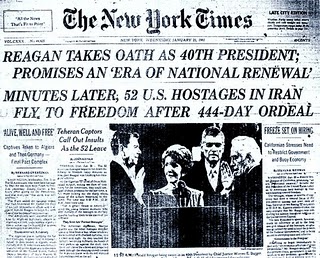
the day of President Reagan's inaugural, when Iran agreed to release the 52 American
hostages exactly five minutes after Mr. Reagan took the oath of office. Later, as it
became known that arms started to flow to Iran via Israel only a few days after the
inauguration, suspicions deepened that a secret arms-for-hostages deal had been concluded.
Five years later, when the Iran-contra affair revealed what seemed to be a similar swap of hostages for arms
delivered through Israel, questions were revived about the 1980 election. In a nice, ironic twist, the phrase 'October surprise,' which Vice Presidential
candidate George Bush had coined to warn of possible political manipulation of the
hostages by Jimmy Carter, began to be applied to the suspected secret activities of the
1980 Reagan-Bush campaign... In a Madrid hotel in
late July 1980, an important Iranian cleric, Mehdi Karrubi, who is now the speaker of the
Iranian Parliament, allegedly met with Mr. Casey [Reagan's campaign manager and later his
Director of the CIA] and a U.S. intelligence officer who was operating outside
authority. The same group met again several weeks later.... From Oct. 15 to Oct. 20,
events came to a head in a series of meetings in several hotels in Paris, involving
members of the Reagan-Bush campaign and high-level Iranian and Israeli representatives.
Accounts of these meetings and the exact number of participants vary considerably among
the more than 15 sources who claim direct or indirect knowledge of some aspect of them.
There is, however, widespread agreement on three points: William Casey was a key
participant: the Iranian representatives agreed that the hostages would not be released
prior to the Presidential election on Nov. 4; in return, Israel would serve as a conduit
for arms and spare parts to Iran. At least five of the sources who say they were in Paris
in connection with these meetings insist that George Bush was present for at least one
meeting. Three of the sources say that they saw him there... Immediately after the Paris
meetings, things began to happen. On Oct. 21, Iran publicly shifted its position in the
negotiations with the Carter Administration, disclaiming any further interest in receiving
military equipment.... Between Oct. 21 and Oct. 23, Israel sent a planeload of F-4 fighter
aircraft tires to Iran in contravention of the U.S. boycott and without informing
Washington. Cyrus Hashemi, using his own contacts began privately organizing military
shipments to Iran. On Oct. 22, the hostages were suddenly dispersed to different
locations. And a series of delaying tactics in late October by the Iranian Parliament
stymied all attempts by the Carter Administration to act on the hostage question until
only hours before Election Day... On Jan. 15, Iran did an about-face, offering a series of
startling concessions that reignited the talks and resulted in a final agreement in the
last few hours of Jimmy Carter's Presidency. The hostages were released on Jan. 21, 1981,
minutes after Ronald Reagan was sworn in as President. Almost immediately thereafter,
according to Israeli and American former officials, arms began to flow to Iran in
substantial quantities... Moshe Arens, the Israeli Ambassador to Washington in 1982, told
The Boston Globe in October 1982 that Israeli's arms shipments to Iran at this time were
coordinated with the U.S. Government `at almost the highest of levels.' ... The
allegations of these individuals have many disturbing implications for the U.S. political
system. One is the tampering with foreign policy for partisan benefit. That has, of
course, happened before and it may well happen again, but it assumes special poignancy in
this case since it would have involved tampering with the lives and freedom of 52
Americans. Another implication is that leaders of the U.S. exposed themselves to the
possibility of blackmail by Iran or Israel. Third, the
events suggest that the arms-for-hostage deal that in the twilight of the Reagan
Presidency became known as the Iran-contra affair, instead of
being an aberration, was in fact the re-emergence of a policy that began even before the
Reagan-Bush Administration took office."
Gary Sick - The Election Story of the
Decade
New York
Times, 15 April 1991
"Ex-Israeli intelligence officer Ari
Ben-Menashe says he narrowly survived a possible assassination attempt Sunday night when
his upscale home in Montreal was set ablaze in what Canadian
authorities are describing as suspected arson. .... Ben-Menashe said he believed the
fire was set with 'a Molotov cocktail' but he had no clear idea who might have tried to
kill him. He did acknowledge that he has a number of enemies around the world resulting
from his past as an Israeli intelligence officer and his more recent work as an
international consultant often working in global hotspots. Among Ben-Menashe’s
enemies are some of his former Israeli superiors who consider him a traitor for exposing
sensitive Israeli secrets and powerful Republicans, including former President George H.W.
Bush whom Ben-Menashe fingered as involved in national security scandals in the 1980s.... Ben-Menashe, who served in Israeli military intelligence in the
1970s and 1980s, was arrested in the United States in 1989 for his involvement in military
sales to Iran. He says the Israeli government then
urged him to plead guilty to the U.S. charges, but he refused and began disclosing Israeli
secrets to journalists, including me in early 1990 when I was a correspondent for Newsweek magazine. At first,
the Israeli government denounced Ben-Menashe as an 'impostor' but after I obtained
official Israeli letters
of reference describing his decade-long work within the External Relations Department
of the Israel Defence Forces, Israeli officials changed their story. They labeled him
simply 'a low-level translator.' But the letters described Ben-Menashe’s service in
'key positions' and said he handled 'complex and sensitive assignments.' ...
Ben-Menashe convinced a New York jury that he indeed had been working on official Israeli
business in his transactions with Iran. He was acquitted in fall 1990. Ben-Menashe also continued to give interviews and provide
testimony about the secret dealings involving Republicans and the Israeli government.... Perhaps Ben-Menashe’s most
controversial claim was that he and other Israeli intelligence officers assisted the
Republicans in brokering a deal with Iran’s Islamic regime of Ayatollah Ruhollah
Khomeini in 1980 to hold 52 American hostages until after the U.S. election to ensure
President Jimmy Carter’s defeat. As a result of this so-called October Surprise
caper, the hostages were not released until Jan. 20, 1981, immediately after Ronald Reagan
was sworn in as U.S. President, Ben-Menashe said. After leveling his October Surprise
accusations in 1990-1991 – and providing investigative journalist Seymour Hersh
information about Israel’s nuclear program for his book The Samson Option –
Ben-Menashe was essentially a man on the run from both the Israeli government and the U.S.
administration of George H.W. Bush. Ben-Menashe
sought refuge in Australia, arriving in spring 1991, still carrying his Israeli passport.
After obtaining Ben-Menashe’s Australian immigration records, journalist Marshall
Wilson reported that Ben-Menashe requested what amounted to political asylum. Dated May
15, 1991, Ben-Menashe’s
25-page declaration stated: 'My case is an unprecedented case of political persecution
by two governments. It was an attempt by Israel and the United States to cover up their
relations with Iran since 1979.' Ben-Menashe detailed the curious circumstances of his
1989 arrest while on a private visit to the U.S. and added: 'I was not willing to keep
quiet and be discredited by pleading guilty to the bogus charges. I did not accept my
government’s proposal to do so. Any arms sales to Iran that I was involved in was
solely in the capacity of being an employee of the Israeli government. Everything I did
was authorised by the appropriate authorities in the Israeli and United States
governments. Since I did not go along with the program and decided I would truthfully
defend myself in court, I was disowned by the Israeli Government and will be prosecuted
for breaking the Official Secrets Act if I return. … I will be prosecuted …
behind closed doors, ‘for national security reasons,’ and I will never again see
the light of day.' But Ben-Menashe said his
case had other implications. 'As an aftermath of my [1990] trial a new scandal has broken
directly involving the President of the United States [George
H.W. Bush],' Ben-Menashe wrote, 'about the President being
involved in an arms-for-hostage release delay deal [with Iran] in 1980. I am a central
witness on that issue. Democratic members of the US Congress are going to speak to me
about that and other issues involving US sales of unconventional weapon systems to Iraq,
all connected to the present [George H.W. Bush] administration of the US,' Ben-Menashe told Australian immigration.
'Paradoxically speaking I am now being punished for being acquitted.' Later in May 1991, Ben-Menashe faced an apparent plan by George H.W.
Bush’s administration to divert him from Los Angeles Airport to Israel when he was en
route to Washington to testify to Congress about his allegations. If he had been turned
over, his fate would likely have been similar to that of technician Mordechai Vanunu, who
disclosed Israel’s secret nuclear weapons program and then was kidnapped in Rome and
returned to Israel for trial and imprisonment.... Although substantial evidence has
emerged to support Ben-Menashe’s claims, Republicans and the Israeli government
continued to deny the October Surprise story and U.S. congressional investigations in the
early 1990s confronted a stonewall of Republican obstruction..... A Jew who was born in
Iran and who emigrated to Israel as a teenager, Ben-Menashe explained how his background
proved valuable to Israeli intelligence after the Shah of Iran, a close Israeli ally, was
overthrown in 1979. As Israel tried to rebuild some relationship with Iran, Ben-Menashe
was able to reconnect with some of his friends from his youth who were rising inside the
new revolutionary government. Ben-Menashe said those
contacts led him into a role as an intermediary on military sales to Iran during the
U.S.-Iranian hostage crisis in 1980 and placed him near the decision by Prime Minister
Menachem Begin to throw in Israel’s lot with Republican Ronald Reagan in his campaign
to unseat President Jimmy Carter. Over the next several years, Ben-Menashe remained a key
middleman in the arms transactions that were crucial to Iran in its long war with Iraq.... American journalist Craig Unger was told by a senior intelligence
official, Moshe Hebroni, that 'Ben-Menashe served directly under me. … He had access
to very, very sensitive material.' [Village Voice, July 7, 1992] In the Israeli daily,
Davar, reporter Pazit Ravina wrote, 'in talks with people who worked with Ben-Menashe, the
claim that he had access to highly sensitive intelligence information was confirmed again
and again.'”
Robert Parry - Arson Seen in Attack on Ex-Israeli Spy
Consortium
News, 3 December 2012
"... the evidence is now overwhelming that the Israeli government of
right-wing Prime Minister Menachem Begin played a key role in helping
Ronald Reagan’s campaign in 1980 strike a deal with Iran to frustrate
President Jimmy Carter’s efforts to free 52 American hostages before
Election Day. Begin despised Carter for the Camp David Accords that
forced Israel
to give back the Sinai to Egypt. Begin also believed that Carter was too
sympathetic to the Palestinians and – if he won a second term – would
conspire with Egyptian President Anwar Sadat to impose a two-state
solution on Israel. Begin’s contempt for Carter was not even a secret.
In a 1991 book, The Last Option,
senior Israeli intelligence and foreign policy official David Kimche
explained Begin’s motive for dreading Carter’s reelection. Kimche said
Israeli officials had gotten wind of 'collusion' between Carter and
Sadat 'to force Israel to abandon her refusal to withdraw from
territories occupied in 1967, including Jerusalem, and to agree to the
establishment of a Palestinian state.' Kimche continued, 'This plan
prepared behind Israel’s back and
without her knowledge must rank as a unique attempt in United States’s
diplomatic history of short-changing a friend and ally by deceit and
manipulation.' But Begin recognized that the scheme required Carter
winning a second
term in 1980 when, Kimche wrote, 'he would be free to compel Israel to
accept a settlement of the Palestinian problem on his and Egyptian
terms, without having to fear the backlash of the American Jewish
lobby' In a 1992 memoir, Profits of War, former Israeli intelligence
officer Ari Ben-Menashe also noted that Begin and other Likud leaders
held Carter in contempt. 'Begin loathed Carter for the peace agreement
forced upon him at Camp
David,' Ben-Menashe wrote. 'As Begin saw it, the agreement took away
Sinai from Israel, did not create a comprehensive peace, and left the
Palestinian issue hanging on Israel’s back.' So, in order to buy time
for Israel to 'change the facts on the
ground' by moving Jewish settlers into the West Bank, Begin felt
Carter’s reelection had to be prevented. A different president also
presumably would give Israel a freer hand to deal with problems on its
northern border with Lebanon. Ben-Menashe was among a couple of dozen
government officials and
intelligence operatives who described how Reagan’s campaign, mostly
through future CIA Director William Casey and past CIA Director George
H.W. Bush, struck a deal
in 1980 with senior Iranians who got promises of arms via Israel in
exchange for keeping the hostages through the election and thus
humiliating Carter. (The hostages were finally released on Jan. 20,
1981, after Reagan was sworn in as President.)"
Why Not a Probe of ‘Israel-gate’?
Consortium News, 20 April 2017
"When I joined the agency, the
headquarters had just been constructed. John Kennedy was president. Chiseled into the
marble foyer: “You shall know the truth, and the truth shall set you free.” ...I
thought, “This is going to be a good place to work.” And it was. My portfolio
was Soviet foreign policy toward China, the international communist movement, Vietnam.
Then it broadened out into other things when I became branch chief. I could tell it like
it was. Since the Soviet Union was high in priority, every month or so something I wrote
or something my branch people wrote would get before the president the next morning..... A
fellow worked for me, his name is Robert Gates [later C.I.A. director, 1991-93, and
defense secretary under George W. Bush and Barack Obama]. He was a young analyst and
pretty bright, not as bright as some of the other people in my Soviet foreign policy
branch, but he was so ambitious that you’d see him floating around two levels above
me and he was a very disruptive influence in the branch. Here I am, first branch, first
managerial position, and I figure at efficiency report time, this is the process where you
adjust that. So, I didn’t check with my fellow branch chiefs, who were giving
everybody outstanding appraisals, and I wrote what I thought about Bobby Gates. I said,
“Reasonably bright, good future, but he needs to stop being so transparent in his
ambition because he’s a disruptive influence in the branch.” He objected to
that, and 10 years later he becomes chief of all analysis. What happens then? Bill Casey
[William Casey, C.I.A. director 1981-87] is in; Ronald Reagan is in. Bill Casey sees a
communist under every rock in Nicaragua. Bobby Gates turns over the rocks and says, “I see two of them, Mr.
Casey. There are two of them there.” Everyone
who saw Russians under rocks in Nicaragua got promoted. I say this for an
important reason. We’re talking 1981, right? ..... I was very lucky because I was
briefing Vice President [George H.W.] Bush and all of Reagan’s chief
advisers—[Defense Secretary Caspar] Weinberger, [Secretary of State George] Shultz and the rest of them. It was
one-on-one and I could tell them the truth. This was when Bobby Gates was chief of
analysis. There were occasions years later when I
finally realized that Bush, for example, was well in on the
Iran-Contra stuff, but by and large I could tell the
truth on substantive matters—including on Nicaragua—and I did."
Ray McGovern, former CIA analyst
This is how the CIA botched Iraq post-9/11: Bob Gates, careerist sycophancy, and the real
history of the Deep State
Salon,
14 February 2016
"For his part, ex-President Carter
appeared more concerned about the danger of being accused of sour grapes than learning
anything new about how the Republicans sank his presidency. In
1996, while meeting with Palestine Liberation Organization leader Yasir Arafat, Carter
reportedly raised his hands into a physical stop position when Arafat tried to confess to
his role in the Republican maneuvering to block Carter’s Iran-hostage negotiations. 'There is something I want to tell you,' Arafat said, addressing Carter at
a meeting in Arafat’s bunker in Gaza City. 'You
should know that in 1980 the Republicans approached me with an arms deal [for the PLO] if
I could arrange to keep the hostages in Iran until after the [U.S. presidential]
election.' Arafat was apparently prepared to provide
additional details and evidence, but Carter raised his hands, indicating that he
didn’t want to hear anymore."
Method to Republican ‘Madness’
Consortium
News, 5 May 2012
"A top
aide to Palestinian leader Yasir Arafat has dropped a new clue about the original 'October
Surprise' mystery of 1980: the name of the Republican operative who sought the Palestine
Liberation Organization’s help to block President Jimmy Carter’s negotiations to
free 52 Americans then being held hostage in Iran. Longtime Arafat confidant Bassam Abu Sharif said
that in mid-1980, he met in Paris with John Shaheen, a friend to both Ronald Reagan and
Reagan’s campaign chief, William J. Casey. Abu Sharif told me that Shaheen, a former
U.S. intelligence officer of Lebanese origin, extended a Republican offer of improved U.S.
relations with the PLO if the Arafat-led organization would assist in persuading the
Iranians to delay the hostage release until after the November 1980 elections. Shaheen,
who died in 1985, has long been a central figure in the so-called 'October Surprise' case,
allegations that Republicans sabotaged Carter’s hostage negotiations as a way to
ensure the 1980 election of Reagan as president and George H.W. Bush as vice president. Though Abu Sharif
and Arafat have previously discussed the Republican overture, they had refused to identify
the Republican intermediary until now. The alleged secret deal between the
Reagan-Bush campaign and the Iranians popularized the idea of an 'October Surprise,' a
last-minute event that might alter the outcome of a U.S. presidential election. The phrase
was coined by then-vice presidential candidate Bush in the context that Carter’s
success in freeing the hostages might be his 'October Surprise,' though it later came to
refer to the alleged Republican scheming to derail Carter’s hostage talks. Republican
leaders have long denied that any deal with the Iranians was struck, although more than
two dozen witnesses – including Iranian officials, European intelligence officers and
international arms dealers – have described aspects of the 1980 Republican-Iranian
contacts carried out behind President Carter’s back. In 1992-93, a House Task Force
conducted a half-hearted investigation of the controversy and judged the allegations of a
Republican-Iranian deal to be false. But it was later discovered that the Task Force had
concealed evidence that pointed in the opposite direction, including a classified report
from the Russian government stating that Bush, Casey and CIA officers had met with
Iranians in Europe in 1980 to strike a deal. [For details, see Robert Parry’s new
book, Secrecy & Privilege: Rise of the Bush Dynasty from Watergate to Iraq.]"
Arafat & the Original
'October Surprise'
Consortium News, 2 November 2004
"It is here that the story of illegal dealings with Khomeini
intermediaries by Reagan campaign officials begins. Bob Woodward and Walter Pincus of The
Washington Post were the first to report that one such meeting took place in Washington, DC. It was held Oct. 2
at the L'Enfant Plaza Hotel... [after the election that Carter lost] at the Tehran airport, television
footage shows Iranian officials guarding the hostages listening on portable radios to
inauguration ceremonies. Exactly 15 minutes after
Ronald Reagan took the oath of office, the hostages were released and put on an airplane
to fly home. Clearly, it was a signal. At the time,
however, no one except perhaps some newly appointed Reagan officials, and some of their
Israeli equivalents, knew what it meant."
Reprise of the October Surprise: Is
the Worst Surprise Still to Come?
Washington Report on Middle East Affairs, May June 1991
"On April 15, former Carter
administration staffer Gary Sick gave added weight to the 'October Surprise' theory -- the
allegations that officials in the 1980 Reagan-Bush campaign cut a deal with Iranian
revolutionaries to delay the release of the fifty-two hostages until after Reagan's
inauguration -- with a 2,000-word op-ed piece in The New York Times.... The day Sick's piece appeared in the times, listing dates and
participants in suspected meetings between campaign staffers and Iranian clerics, none of
the network evening newscasts even mentioned the story... there were a number of newsworthy developments... [including] the
State Department considered blocking a visa for former
Iranian President Abolhassan Bani-Sadr, who came to the U.S. to promote his book My Turn To Speak, in
which he asserts that the Reagan campaign cut a deal with the Iranians at the height of
the hostage crisis; President Bush made his first
public denials of the allegations; and eight of the former hostages voiced suspicions
about the circumstances surrounding their release. But many of these developments, which
were reported by the wire services and picked up by alternative papers and even by the
Phil Donahue show, were missed altogether by the major media. And a story that could make
Deep Throat look shallow has yet to make the cover of Time or Newsweek. When the story
does appear, the key questions not only go unanswered, they go unasked."
WHO WILL UNWRAP THE OCTOBER SURPRISE?
Columbia
Journalism Review, Sept/Oct 1991
"On Dec. 17, 1992, former Iranian president Abolhassan Bani-Sadr
sent the [US congressional] task force a detailed letter describing the conflict within
the Iranian government over the secret hostage deal with the Republicans. Bani-Sadr said... 'Passendideh told me that if I do not accept
this proposal, they [the Republicans] would make the same offer to my [radical Iranian]
rivals. He further said that they [the
Republicans] have enormous influence in the CIA."
Russia's Prime Minister and October
Surprise
Consortium News, 15 May 1999
"Bush is functioning much like a
co-president. George is involved in all the national
security stuff because of his special background as CIA director."
White House press secretary
James Brady, March 1981
Chapter -XVII- The Attempted Coup D'Etat of March 30, 1981
Webster G. Tarpley & Anton Chaitkin - 'George Bush: The Unauthorized Biography'
"A memo from Richard Wirthlin to Casey
and Reagan initiated a discussion of how the Carter gang might exploit the advantages of
incumbency in order to influence the outcome of the election, perhaps by attempting to
stampede the public by some dramatic event at the last minute,such as the freeing of the
hostages in Teheran... During the convention, at a July 14 press conference, Casey told
reporters of his concern that Carter might spring an 'October
surprise' in foreign or domestic policy on the eve
of the November elections.... Although Casey and Meese had defined a broad range of
possibilities for the October surprise, the most prominent of these was certainly the liberation of the American
hostages in Iran. A poll showed that if the hostages were to be released during the period
between October 18 and October 25, Carter could receive a 10% increase in popular vote on
election day. ..... Barbara Honegger, then an official of the
Reagan-Bush campaign recalls that on October 24th or 25th, an assistant to Stephan
Halper's 'October Surprise' intelligence operation echoed William Casey's newfound confidence,
boasting to the author in the operations center where [Reagan-Bush Iran watcher Michel]
Smith worked that the campaign no longer needed to worry about an 'October surprise' because
'Dick [Allen] cut a deal.' .... Many sources agree that a conclusive series of meetings
between Reagan-Bush and the Khomeini forces took place in Paris during the October 15-20
period, and there is little doubt that William Casey was present for these meetings.
According to the account furnished by Richard Brenneke, there was a meeting at the Hotel
Raphael in Paris at about noon on October 19, attended by George Bush, William Casey, Don Gregg,
Manucher Gorbanifar and two unnamed Iranian officials..... According to Bani-Sadr, his
reports show that the meetings took polace, and were attended by Reagan-Bush
representatives, Iranians loyal to Behesthi and Rafsanjani, and arms merchants like Cyrus
Hashemi, Manucher Ghorbanifar, and Albert Hakim. Bani-Sadr's first reports from military
officials in Iran specified that 'Bush had met with a representative of Beheshti.'
Bani-Sadr later elaborated that his sources in Iran 'inform me that Bush was in the discussions in
Paris...that his name had been on the document. I have it in writing.'. According to Gary
Sick's collation of fifteen sources claiming knowledge of the Paris meeting, the Iranian
side agreed not to release the hostages before the November 4 US election, and the Reagan-Bush side promised to deliver spare
parts for military equipment through Israel.... Bush has heatedly denied that he was in Paris at this time, and has said that
he personally did not negotiate with Khomeini envoys. But he has generally avoided a
blanket denial that the campaign of which he was a principal engaged in surreptitious
dealings with the Khomeini mullahs. Bush's alibi
for October 18-October 19, 1980 has always appeared dubious. There is in fact a period of 21 or 22 hours in which his whereabouts
cannot be conclusively proven.... During the first week of December, Executive
Intelligence Review reported that Henry Kissinger 'held a series of meetings during the week of November 12 in Paris with
representatives of Ayatollah Beheshti, leader of the fundamentlist clergy in Iran.'
......According to EIR, 'it appears that the pattern of cooperation between the Khomeini
people and circles nominally in Reagan's camp began approximately six to eight weeks ago,
at the height of President Carter's efforts to secure an arms-for-hostages deal with
Teheran. Carter's failure to secure the deal, which a number of observers believe cost him
the November 4 election, apparently resulted from an intervention in Teheran by pro-Reagan
British circles
and the Kissinger faction.' These revelations from EIR
are the first mention in the public record of the scandal which has come over the years to
be known as the October surprise. The hostages were
not released before the November election, which Reagan won convincingly. That night,
according to Roland Perry, Bush said to Reagan, 'You're in like a
burglar.' Khomeini kept the hostages emprisoned
until January 20, the day of the Reagan-Bush inauguration, and let the hostage plane take off just as Reagan and Bush were taking their oaths of
office....quite apart from questions regarding George Bush's presence at this or that meeting, there can be no doubt that both the
Carter regime and the Reagan-Bush
campaign were actively involved in dealings with the Khomeini regime concerning the
hostages and concerning the timing of their possible release. In the case of the Reagan-Bush Iran connection, there is
reason to believe that federal crimes under the Logan Act and other applicable laws may
have taken place. George Bush had now grasped the
interim prize that had eluded him since 1968: after more than a dozen years of effort, he
had now become the Vice President of the United States."
Chapter -XVI- Campaign 1980
Webster G.
Tarpley & Anton Chaitkin - 'George Bush:
The Unauthorized Biography'
"In
1996, while meeting with Palestine Liberation Organization leader Yasir Arafat, Carter
reportedly raised his hands into a physical stop position when Arafat tried to confess his
role in the Republican maneuvering to block Carter’s Iran-hostage negotiations.
'There is something I want to tell you,' Arafat said, addressing Carter at a meeting in
Arafat’s bunker in Gaza City in the presence of historian Douglas Brinkley. 'You
should know that in 1980 the Republicans approached me with an arms deal [for the PLO] if
I could arrange to keep the hostages in Iran until after the [U.S. presidential]
election.' Arafat was apparently prepared to provide additional details and evidence, but
Carter raised his hands, indicating that he didn’t want to hear anymore....Just this past year, a 1993
congressional repudiation of the October Surprise allegations crumbled amid admissions that important evidence was hidden from
investigators and that internal
doubts were suppressed. The collapse of those 1993 findings by a House task force left
behind a troubling impression that disgruntled elements of the CIA and Israel’s Likud
hardliners may have teamed up with ambitious Republicans to remove a U.S. president from
office. ......As for the CIA Old Boys,
legendary CIA officer Miles Copeland told me in 1990 that 'the CIA within the CIA' –
the inner-most circle of powerful intelligence figures who felt they understood best the
strategic needs of the United States – believed Carter and his naïve faith in
American democratic ideals represented a grave threat to the nation. 'Carter really
believed in all the principles that we talk about in the West,' Copeland said, shaking his
mane of white hair. 'As smart as Carter is, he did believe in Mom, apple pie and the
corner drug store. And those things that are good in America are good everywhere else.
… 'Carter, I say, was not a stupid man,' Copeland said, adding that Carter had an
even worse flaw: 'He was a principled man.'.... One joke about Bush’s announcement of
his candidacy on May 1, 1979, was that 'half the audience was wearing raincoats.' Bill
Colby, Bush’s predecessor as CIA director, said Bush 'had a flood of people from the
CIA who joined his supporters. They were retirees devoted to him for what he had done' in
defending the spy agency in 1976 when the CIA came under heavy criticism for spying on
Americans, assassination plots and other abuses. Reagan’s foreign policy adviser
Richard Allen described the group working on the Bush campaign as a 'plane load of
disgruntled former CIA' officers who were 'playing cops and robbers.' All told, at least
two dozen former CIA officials went to work for Bush. Among them was the CIA’s
director of security, Robert Gambino, who joined the Bush campaign immediately after
leaving the CIA where he oversaw security investigations of senior Carter officials and
thus knew about potentially damaging personal information. Besides the ex-CIA personnel
who joined the Bush campaign, other pro-Bush intelligence officers remained inside the CIA
while making clear their political preference. 'The seventh floor of Langley was plastered
with ‘Bush for President’ signs,' said senior CIA analyst George Carver,
referring to the floor that housed top CIA officials .... In the 1990 interview, Copeland told me that 'the way we saw
Washington at that time was that the struggle was really not between the Left and the
Right, the liberals and the conservatives, as between the Utopians and the realists, the
pragmatists. Carter was a Utopian. He believed, honestly, that you must do the right thing
and take your chance on the consequences. He told me that. He literally believed that.' Copeland’s deep Southern accent spit out the words with a mixture of
amazement and disgust ..... In late February 1980, Seyeed Mehdi Kashani, an Iranian
emissary, arrived in Israel to discuss Iran’s growing desperation for spare parts for
its U.S.-supplied air force, Ben-Menashe wrote. Kashani, whom Ben-Menashe had known from
their school days in Tehran, also revealed that the Copeland initiative was making inroads
inside Iran and that approaches from some Republican emissaries had already been received,
Ben-Menashe wrote. 'Kashani said that the secret ex-CIA-Miles-Copeland group was aware
that any deal cut with the Iranians would have to include the Israelis because they would
have to be used as a third party to sell military equipment to Iran,' according to
Ben-Menashe. In March 1980, the following month, the Israelis made their first direct
military shipment to Iran, 300 tires for Iran’s F-4 fighter jets, Ben-Menashe wrote.
Ben-Menashe’s account of these early Israeli arms shipments was corroborated by
Carter’s press secretary Jody Powell and Israeli arms dealer William Northrop. In an
interview for a 1991 PBS 'Frontline' documentary, Jody Powell told me that 'there had been
a rather tense discussion between President Carter and Prime Minister Begin in the spring
of 1980 in which the President made clear that the Israelis had to stop that [arms
dealing], and that we knew that they were doing it, and that we would not allow it to
continue, at least not allow it to continue privately and without the knowledge of the
American people.' 'And it stopped,' Powell said. At least, it stopped temporarily. Meanwhile, Carter also was learning that Begin was siding with the
Republicans. Questioned by congressional investigators in 1992, Carter said he realized by
April 1980 that 'Israel cast their lot with Reagan,' according to notes I found among the
unpublished documents in the files of a House task force that had looked into the October Surprise case. Carter traced the
Israeli opposition to his reelection to a 'lingering concern [among] Jewish leaders that I
was too friendly with Arabs.'.... As the Iran crisis
dragged on, Copeland and his group of CIA Old Boys forwarded their own plan for freeing
the hostages. However, to Copeland’s chagrin, his plan fell on deaf ears inside the
Carter administration, which was developing its own rescue operation. So, Copeland told me
that he distributed his plan outside the administration, to leading Republicans, giving
sharper focus to their contempt for Carter’s bungled Iranian strategy. 'Officially,
the plan went only to people in the government and was top secret and all that,' Copeland
said. 'But as so often happens in government, one wants support, and when it was not being
handled by the Carter administration as though it was top secret, it was handled as though
it was nothing. … Yes, I sent copies to everybody who I thought would be a good ally.
… Now I’m not at liberty to say what reaction, if any, ex-President [Richard]
Nixon took, but he certainly had a copy of this. We sent one to Henry Kissinger. … So
we had these informal relationships where the little closed circle of people who were, a,
looking forward to a Republican President within a short while and who were absolutely
trustworthy and who understood all these inner
workings of the international game board.' Encircled
by a growing legion of enemies, the Carter administration put the finishing touches on its
hostage-rescue operation in April. Code-named 'Eagle Claw,' the assault involved a force
of U.S. helicopters that would swoop down on Tehran, coordinate with some agents on the
ground and extract the hostages. Carter ordered the operation to proceed on April 24, but
mechanical problems and the mysterious decision by one of the pilots to turn back forced
the operation to be terminated. At a staging area called Desert One, one of the
helicopters collided with a refueling plane, causing an explosion that killed eight
American crewmen. Their charred bodies were then displayed by the Iranian government,
adding to the fury and humiliation of the United States. After the Desert One fiasco, the
Iranians dispersed the hostages to a variety of locations, effectively shutting the door
on another rescue attempt. By summer 1980, Copeland told me, the Republicans in his circle
considered a second hostage-rescue attempt not only unfeasible, but unnecessary. They were
talking confidently about the hostages being freed after a Republican victory in November,
the old CIA man said. 'Nixon, like everybody else,
knew that all we had to do was wait until the election came, and they were going to get
out,' Copeland said. 'That was sort of an open secret among people in the intelligence
community, that that would happen. … The intelligence community certainly had some
understanding with somebody in Iran in authority, in a way that they would hardly confide
in me.' Copeland
said his CIA friends had been told by contacts in Iran that the mullahs would do nothing
to help Carter or his reelection. 'At that time, we had word back, because you always have
informed relations with the devil,' Copeland said. 'But we had word that, ‘Don’t
worry.’ As long as Carter wouldn’t get credit for getting these people out, as
soon as Reagan came in, the Iranians would be happy enough to wash their hands of this and
move into a new era of Iranian-American relations, whatever that turned out to be.' In the
interview, Copeland declined to give more details, beyond his assurance that 'the CIA
within the CIA,' his term for the true protectors of U.S. national security, had an
understanding with the Iranians about the hostages. (Copeland
died on Jan. 14, 1991.) .... Iranian President Abolhassan Bani-Sadr held a similar opinion
from his position in Tehran. In a 1992 letter to the House task force on the October Surprise case,
Bani-Sadr wrote that he learned of the Republican back-channel initiative in summer 1980
and received a message from an emissary of Ayatollah Khomeini: The Reagan campaign was in
league with pro-Republican elements of the CIA in an effort to undermine Carter and wanted
Iran’s help. Bani-Sadr said the emissary 'told me that if I do not accept this
proposal they [the Republicans] would make the same offer to my rivals.' The emissary
added that the Republicans 'have enormous influence in the CIA,' Bani-Sadr wrote. 'Lastly,
he told me my refusal of their offer would result in my elimination.'...One congressional
investigator who was involved in the Iran-Contra and the October Surprise inquiries told me years later that his conclusion was that the
Republicans were pursuing every avenue possible to reach the Iranian leadership to make
sure Carter’s hostage negotiations failed. Former
Israeli intelligence officer Ben-Menashe, in his book and in sworn testimony, said the
ultimately successful channel was one involving both former and current CIA officers,
working with French intelligence for the security of a final meeting in Paris — and
with Israelis who were given the task of delivering the payoff in weapons shipments and
money to Iran. The key meeting allegedly occurred on the weekend of Oct. 18-19, 1980,
between high-level representatives of the Republican team and the Iranians. Ben-Menashe
said he was part of a six-member Israeli support delegation for the meeting at the Ritz
Hotel in Paris. In his memoir, Ben-Menashe said he recognized several Americans, including
Republican congressional aide Robert McFarlane and CIA officers Robert Gates (who had
served on Carter’s NSC staff and was then CIA Director Turner’s executive
assistant), Donald Gregg (another CIA designee to Carter’s NSC) and George Cave (the
agency’s Iran expert). Ben-Menashe said Iranian cleric Mehdi Karrubi, then a top
foreign policy aide to Ayatollah Khomeini, arrived and walked into a conference room. 'A
few minutes later George Bush, with the wispy-haired William Casey in front of him,
stepped out of the elevator. He smiled, said hello to everyone, and, like Karrubi, hurried
into the conference room,' Ben-Menashe wrote. Ben-Menashe said the Paris meetings served
to finalize a previously outlined agreement calling for release of the 52 hostages in
exchange for $52 million, guarantees of arms sales for Iran, and unfreezing of Iranian
monies in U.S. banks. The timing, however, was changed, he said, to coincide with
Reagan’s expected Inauguration on Jan. 20, 1981. Though the alleged participants have
denied taking part in such a meeting, the alibis cited by the Americans have proved
porous.... A French arms dealer, Nicholas Ignatiew,
told me in 1990 that he had checked with his government contacts and was told that
Republicans did meet with Iranians in Paris in mid-October 1980.A well-connected French
investigative reporter Claude Angeli said his sources inside the French secret service
confirmed that the service provided 'cover' for a meeting between Republicans and Iranians
in France on the weekend of October 18-19. German journalist Martin Kilian had received a
similar account from a top aide to intelligence chief deMarenches. As early as 1987,
Iran’s ex-President Bani-Sadr had made similar claims about a Paris meeting. Finally,
a classified report from the Russian government regarding what its intelligence files
showed about the October Surprise issue stated matter-of-factly that Republicans held a series of meetings
with Iranians in Europe, including one in Paris in October 1980. 'William Casey, in 1980,
met three times with representatives of the Iranian leadership,' the Russian report said.
'The meetings took place in Madrid and Paris.' At the Paris meeting in October 1980,
'R[obert] Gates, at that time a staffer of the National Security Council in the
administration of Jimmy Carter, and former CIA Director George Bush also took part,' the
Russian report said. 'In Madrid and Paris, the representatives of Ronald Reagan and the
Iranian leadership discussed the question of possibly delaying the release of 52 hostages
from the staff of the U.S. Embassy in Teheran.' (The Russian report had been requested by
Rep. Lee Hamilton, D-Indiana, as part of the 1992 task force investigation of the October Surprise case. It
arrived on Jan. 11, 1993, just two days before the task force was to release its own
report rejecting the October Surprise suspicions..... On Inauguration Day, Jan. 20, 1981, just as Reagan was
beginning his inaugural address, word came from Iran that the hostages were freed. The
American people were overjoyed. Privately, some Reagan insiders laughed about their October Surprise success.
For instance, Charles Cogan, a high-ranking CIA officer, told the House task force in 1992
that he attended a 1981 meeting at CIA headquarters between Casey and one of David
Rockefeller’s top aides, Joseph V. Reed, who had just been appointed to be Ambassador
to Morocco. Cogan testified that Reed joked about having blocked Carter’s hostage
release..... In the mid-1980s, many of the same October Surprise actors became figures in the
Iran-Contra scandal, another
secret arms-for-hostages scheme with Iran that was revealed in late 1986, despite repeated
denials from Reagan’s White House. According to official Iran-Contra investigations, the plot to sell U.S. weapons to Iran in 1985-86 for its
help in freeing American hostages then held in Lebanon involved Cyrus Hashemi, John
Shaheen, Theodore Shackley, William Casey, Donald Gregg, Robert Gates, Robert McFarlane,
George Cave, Ronald Reagan and George H.W. Bush. Yet, even as the cover-up of the Iran-Contra operations crumbled, key figures
in Washington battled to keep the even more explosive October
Surprise suspicions relegated to the loony bin of conspiracy
theories, not to be taken seriously by the American people.... in fall 1991, as Congress was deliberating whether to conduct full
investigations of the October Surprise issue, Steven Emerson, a journalist with close ties to Likud, produced a
cover story for the neoconservative New Republic claiming to prove the allegations were a
'myth.' Almost simultaneously, Newsweek published its
own cover story also attacking the October Surprise allegations. The article, I was told, had been ordered up by executive
editor Maynard Parker who was a close associate of Henry Kissinger and was known inside
Newsweek as a big admirer of prominent neocon Elliott Abrams. The two articles were
influential in shaping Washington’s conventional wisdom, but they were both based on
a misreading of attendance documents at a London historical conference which William Casey
had gone to in July 1980. The two publications put Casey at the conference on one key date
– thus supposedly proving he could not have attended one of the Madrid meetings with
Iranian emissaries. However, after the two stories appeared, follow-up interviews with
conference participants, including historian Robert Dallek, conclusively showed that Casey
wasn’t there. Veteran journalist Craig Unger, who had worked on the Newsweek cover
story, said the magazine knew the Casey alibi was bogus but still used it. 'It was the
most dishonest thing that I’ve been through in my life in journalism,' Unger later
told me..... In
1993, I took part in an interview with former Israeli Prime Minister Yitzhak Shamir in Tel
Aviv during which he said he had read Gary Sick’s 1991 book, October Surprise, which made the
case for believing that the Republicans had intervened in the 1980 hostage negotiations to
disrupt Carter’s reelection. With the topic raised, one interviewer asked, 'What do
you think? Was there an October Surprise?' 'Of course, it was,' Shamir responded without hesitation. 'It was.'
Later in the interview, Shamir, who succeeded Begin as prime minister in the 1980s, seemed
to regret his frankness and tried to backpedal on his answer, but his confirmation
remained a startling moment..... The current knock
on the October Surprise story is that it’s now ancient history and that it’s wrong to
dig up unpleasant facts about the late President Ronald Reagan, who has become an icon on
the Right and whose 100th birthday was lavishly celebrated in February with hagiographic
documentaries and near-universal praise. Further, Jimmy Carter is now held in disdain by
many Washington insiders, considered a 'failed president.' In other words, the prevailing
view is that things worked out just fine in replacing Carter with Reagan no matter how it
was done and it makes no sense to rehash any of this unpleasantness. However, there is
another way to read the history: If Carter had freed the hostages and won a second term,
the United States might have continued on a path toward alternative energy, the federal
deficit would not have soared as it did under Reagan, and deregulation of corporations
would not have opened the environment and the financial sector to such dangers. Further,
the United States might not have embarked on a massive military buildup or engaged in the
aggressive intelligence operations that went with it. And, Israel might have been pushed
into an equitable peace with its Palestinian neighbors three decades ago, rather than
pursuing a settlement policy that now makes such an agreement close to impossible.
Possibly even more important, if the sabotaging of Carter’s reelection in 1980 had
failed or at least if it had been exposed in the 1990s, the United States might now enjoy
a much healthier democracy – based on hard truths, not comforting illusions.”
Robert Parry - Jimmy Carter’s October Surprise Doubts
Consortium
News, 12 May 2011
"Just
six months after Iran freed 52 Americans hostages in 1981, senior Reagan administration
officials secretly endorsed third-party weapons sales to Iran, a move to align U.S. policy
with Israeli desires to sell arms to the Islamic republic then at war with Iraq, according
to documents recently released by the National Archives. This Israeli arms pipeline to
Iran already was functioning at the time of the policy shift on July 21, 1981. Three days
earlier, on July 18, an Argentine plane strayed off course and crashed (or was shot down)
inside the Soviet Union exposing Israel’s secret arms shipments to Iran, which
apparently had been going on for months..... The
reason that the Israeli weapons shipments violated U.S. law was that no formal
notification had been given to Congress about the transshipment of U.S. military equipment
as required by the Arms Export Control Act. But the Reagan administration was in a bind
about notifying Congress and thus the American people about approving arms shipments to
Iran so soon after the hostage crisis. The news would have infuriated many Americans and
stoked suspicions that the Republicans had cut a deal with Iran to hold the hostages until
Carter was defeated.... Though this secret conduit
between the neocons and Israel may have originated before Election 1980, it continued,
with some fits and starts, for years finally merging with what became known as the Iran-Contra Affair of 1985-86. In that scandal, Reagan secretly authorized the sale of U.S. anti-tank
and anti-aircraft missiles to Iran through Israel. The
documents – declassified by National Archives personnel at the Reagan Presidential
Library in Simi Valley, California – suggest that the Iran-Contra machinations were an outgrowth of these earlier U.S. contacts with Israel
regarding arms sales to Iran dating back to 1980-81....
Through the latter half of 1981, Iraqi officials complained bitterly about what they
viewed as U.S. complicity in Israel’s arms shipments to Iran and about Iran’s
resulting capability to sustain its war effort.....U.S. policy on the Iran-Iraq War would
begin to move in the opposite direction as President Reagan grew worried that Iran was
gaining the upper hand in the war and might actually defeat Iraq. To prevent that
possibility, Reagan authorized a 'tilt' toward Iraq in June 1982, according to a sworn affidavit filed in a 1995
criminal case by a Reagan NSC aide, Howard Teicher. Teicher described a highly classified
National Security Decision Directive that called for providing intelligence assistance to
Iraq and directing the CIA to help Saddam Hussein’s army secure third-country
military supplies, a project that fell largely to CIA Director William Casey and his
deputy, Robert Gates.... Even after stepping down as
National Security Advisor in December 1985, McFarlane continued to participate in these
Iranian arms sales, as the operation also evolved into a scheme for enriching some of the
participants and generating profits that were diverted to the Nicaraguan Contra rebels, a
U.S. proxy force fighting to overthrow the leftist Sandinista government in that Central
American country. According to one of the declassified documents, the Reagan
administration’s expectation of Israeli cooperation in such paramilitary operations
extended to a request from NSC aide Oliver North to Israeli Defense Minister Yitzhak Rabin
to supply hundreds of AK-47s to the Contras in September 1986. 'North told Rabin that the
United States was out of funds to support the Contras,' according to a secret cable from U.S. Ambassador to
Israel Thomas Pickering. “North said he was aware of the fact that Israel had in its
possession some 400-600 AK-47 rifles which he, North, would like to see provided to the
Contras. Rabin asked if North was thinking of a gift and North replied that he was. … 'Later, it was decided in the affirmative and the weapons were
made available for shipment. Rabin insisted, however, that he would only provide the
weapons to the United States, not directly to any other recipient. What the United States
then did with the weapons was its own business. In October, the weapons were loaded on a
ship and the ship departed Israel. However, the story began to break and the ship was
returned to Israel and the weapons unloaded here. Rabin wanted us to know that the
conversation had taken place.' In November 1986, the convoluted Iran-Contra scandal exploded
into public view, forcing the dismissal of North and National Security Advisor John
Poindexter and prompting both criminal and congressional investigations. Embarrassed by
the catastrophe that he helped create, McFarlane attempted suicide by taking an overdose
of valium on Feb. 9, 1987, but survived. In 1988, McFarlane pleaded guilty to four
misdemeanor counts of concealing information from Congress, but he was pardoned –
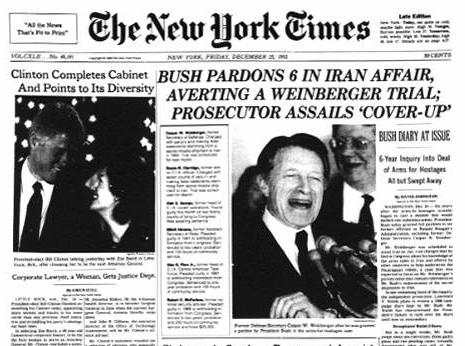
along with five other Iran-Contra defendants – on Christmas Eve 1992 by President George H.W. Bush,
who himself had come under investigation for his role in the secret operations and the
cover-up. Ultimately, the investigations into Iran-Contra and related scandals –
including the October Surprise
allegations of a secret Reagan-Iran deal in 1980, to stop Carter from resolving that
earlier hostage crisis, and Iraqgate, the secret arms sales to Iraq – failed to get
to the bottom of the secret policies. Republican cover-ups largely succeeded. The
long-term consequences of the Reagan administration’s secret dealing with Israel,
Iran and Iraq have resonated to the present day. With both Iran and Iraq bolstered by
outside arms deliveries, the Iran-Iraq War continued until 1988 – with a death toll
estimated at about one million. Over the next several years, the alliance of convenience
between Israel and Iran began to sour with the two countries drifting toward becoming the
bitter enemies that they are today. Meanwhile, Iraq – strapped by its war debts
– invaded Kuwait in 1990 in a dispute over money and oil. President George H.W. Bush
responded with the Persian Gulf War, driving Saddam Hussein’s army out of Kuwait and
putting the Iraqi dictator in the top tier of U.S. 'enemies.'”
How Neocons Messed Up the Mideast
Consortium
News, 15 February 2012
The Lee Hamilton
Cover-Up
"Congress
will not formally investigate charges that the Reagan campaign stole the election in 1980, in large part because Israel's supporters on Capitol Hill do not want to
put the spotlight on Israel's role, which during that period sold weapons to Iran in
blatant disregard of President Carter."
Prediction by Newsweek correspondent
Eleanor Clift
NBC television talk
show The McLaughlin Group, May 12, 1991
"The very fact that some Democrats are
reluctant to open an inquiry, for fear that it might backfire on them, is further reason
that it probably would not be a 'show trial.' A small, select committee with adequate
Republican representation could conduct a discreet investigation, without televised
hearings ... This is the second case, for example, in
which Republican campaigners have been accused of tampering with foreign policy for
political purposes. In 1968, Nixon aides were charged with persuading the South Vietnamese
to delay their participation in peace talks to deny possible advantage to Democrats in
that year's elections. Some allegations suggest, moreover, that the proven later dealings
of the Reagan Administration with Iran grew out of the alleged hostage deal in 1980. Mr. Bush, in denying that he knew of such a deal did not insist that it
never happened. Mr. Reagan, as usual, only said he knew of no such arrangement; but he
never knew much of what went on around him. The overriding reason for a Congressional
investigation is the possibility that the truth might be established. The death of [CIA
Director] Mr. Casey, who would have been the key witness, and the unavoidable political
aspects of an inquiry, may make that possibility remote."
A Necessary Inquiry
New York
Times, 26 June 1991
"[The
'October Surprise' sabotage] was a covert operation by
the Reagan-Bush campaign
that secretly forged a deal with the Iranian radicals
who, after overthrowing the US-backed Shah, were holding 52 Americans (including several
CIA agents) as hostages. In exchange for holding the hostages until after the [1980
Presidential] election, the Reagan-Bush
team offered the Iranians millions of dollars in arms,
material, and other considerations. Sure enough, the
hostages were held until minutes after Reagan's inauguration, then 'suddenly' released. Bush and Casey personally
participated in the secret negotiations. James Baker, who would be Reagan's chief of staff and Bush's Sec. of State, was also
involved. To this day, Bush et al. vehemently deny the plot, but their alibis don't hold up to
scrutiny and just such secret arms shipments undeniably took place. Most damning is the
fact that other participants, including senior Iranian government officials and
intelligence operatives from several countries, have publicly confirmed they were involved
in [the] secret deal.... Further confirmation came in 1993, in the form of a six-page
Russian intelligence report that corroborated much of the
story. The sensitive report was released by Russia's prime minister as a gesture of
post-Cold War cooperation, in response to a request for information from a US
Congressional task force [which reported in Jan 1993] investigating
the charges. 15
But the report was suppressed, task force
chairman Rep. Lee Hamilton (backed by Henry Hyde) sandbagged the rest of the inquiry, and the final
verdict was that there was 'no credible evidence' of a secret deal. The 'investigation'
was such a sham that Hamilton publicly exonerated Bush
(by then the president) before it even started. 16
By engaging in renegade 'foreign
policy,' the Reagan-Bush team undercut President Carter's own secret efforts to free the hostages
and thereby stole the White House. It was, in fact, a
coup d'etat."
COUP 2K by JOHN DEE
Lumpen,
January 2001
"Hamilton held a press conference to clear Bush before the investigation into the
deal between the Reagan-Bush candidates for presidential office and the Iranians, had even
started. Hamilton then admitted he had not interrogated witnesses or talked with his
special attorney hired to Investigate the matter."
SARAH MCCLENDON'S
WASHINGTON REPORT 20 Oct 1992
"Little did the Russians know that
not only did the [October Surprise] House task force
ignore the Stepashin
report, but actually stuck it in a box that
was piled unceremoniously on the floor of a former Ladies Room off a congressional parking
garage."
Russia's Prime Minister and October
Surprise
Online Journal 1999
"According to
Republican sources, former Democratic Congressman Lee Hamilton’s nomination as either Ambassador to the UN or as
CIA director is also being considered (by the new Bush Administration)"
Bush Announces
More Appointments
PTI, 21 December 2001
'Dead Attorney'
The Investigation By Paul Wilcher
"On or about May 21, 1993, Washington
attorney Paul Wilcher went to the Department of Justice and hand delivered a letter claiming
holdover DOJ employees from the Reagan-Bush era were responsible for a number of
government cover ups, unbeknownst to the Attorney General and President Clinton. The 100
page letter was addressed to Janet Reno. On or about June 11, Wilcher was interviewed regarding the contents of the letter. Later, after days
of not hearing from him, worried friends contacted the police, who went to Wilcher’s apartment on
June 23. His decomposing body was found [by police after pressure to ivestigate from White
House press corp member Sarah McClendon] propped on a
toilet....In January of 1996, PACC received an unsolicited copy of the Wilcher letter.... the section on the 'October Surprise' is detailed, specific, and attributed to a Wilcher client with first hand knowledge, according to the letter. PACC can
neither confirm nor deny the accuracy of the information below, excerpted verbatim from
the Wilcher
letter, with no changes in spelling, punctuation, or emphasis."
Paul Wilcher and the 'October Surprise'
Parents Against Corruption and Coverup, 18
June 2000
"[Paul Wilcher, the] Attorney investigating corruption at Mena Airport with Casolaro and the 1980
'October Surprise' was found dead on a toilet June
22, 1993 in his Washington, DC apartment. [He] Had delivered a report to [US Attorney
General] Janet Reno 3 weeks before his death."
Just A Few People Clinton Didn't Have
To Pardon
Afrocentric News,
2000
"McClendon
has been told that preliminary autopsy results have found no natural cause of death, and no other cause of death to explain Wilcher's demise. Given that Wilcher, in his 40s, was in apparent good health, this seems fairly astonishing.
A much larger issue is also implied here: if critics of our government are found dead in
their bathrooms from obscure causes, and the government itself doesn't take steps to find
out why, then our freedoms themselves are threatened--as well as the activities that
protect those freedoms. If individual investigation and criticism of government activities
is chilled or intimidated into silence, then democracy loses its most important
protection."
Letter To Attorney General Janet Reno
Dr Garby Leon, Columbia
Pictures, 14 July 1993
"Wilcher, who felt his family had been beaten out of their estate by corrupt
judicial processes in Chicago, came here to Washington, to find a new life. Then he heard
about a man whom he helieved to be a political
prisoner, Gunther
Russbacher, the man who says he is being persecuted
because he flew former President George Bush to Paris to meet, with leading Iranians
and make a deal to supply Iran with weapons in exchange for that government keeping the 52
American hostages until after the November election so that former President Jimmy Carter
would not get a boost by bringing home the American citizens held there. Instead the deal
was they were to be delivered to Candidate Ronald Reagan. That agreement was kept as soon
as Reagan inaugurated in 1981. Wilcher was working daily for Russbacher."
THE DEATH OF MY FRIEND PAUL WILCHER
Sarah
McClendon's Washington Report, 4 July 1993
"I have been writing about October Surprise since 1986
when Barbara
Honegger and I broke the first story on the telephone.
Some one listening, broke in, and interrupted our first broadcast. I have written numerous
articles about Russbacher in my Washington column and newsletter over the years. I do think that Vice President Candidate George Bush went to Paris
in 1980 to seal a deal between the Iranian government's top officials, the Republican
candidates, Ronald Reagan and George Bush, and the Republican Party; to keep 52 Americans
hostage 71 more days in Iran. At least eight of
these hostages have said they believe this to be true. A number of them do not talk as
they work now for the government...Paul Wilcher, investigative attorney, was found dead in his apartment about June 23.
He had been dead for several days. He was reported by Russbacher and others to have received a secret tape from the back seat camera of
the SR 71 which would have proved that Bush was on the plane. If Wilcher received this tape
it could have been the cause of death by unknown hands. The District of Columbia ruled
that the death was due to unknown causes or 'undetermined' causes. The DC examiner said
death was not from natural causes... Wilcher, with whom I kept in close contact, had not been ill.... The
congressional investigations of October Surprise have all been 'rigged' from the beginning..... There is a new book that
is probably one of the most credible of those written about October
Surprise. It is Robert Parry's 'Trick or Treason; the October Surprise Mystery,' in which Parry does not pin down the story of October Surprise, but raises
all the doubts about those who discredit it. Most journalists and U.S. newspapers
spent more time denying the story than reporting about it. The Democratic National
Committee, in 1993, started to investigate it by a team of amateurs and then backed off
for some unknown reasons."
SARAH MCCLENDON:
ON GUNTHER RUSSBACHER
Who
Is Paul Wilcher? - NameBase Report- Click Here; Who Is Gunther
Russbacher? - NameBase Report - Click Here ;
Who Is Sarah McClendon? - NameBase Report - Click Here
More On Sarah McClendon, The Long Serving
White House Correspondent - Click Here |
"White House reporter Sarah McClendon, who covered
every president since Franklin D. Roosevelt and was known for shouting questions at most
of them, died Tuesday at 92. McClendon wrote often about treatment of veterans, government
secrecy and other issues....For over half a century, presidents had found themselves
confronted by her questions — often shouted — about treatment of veterans, government secrecy and other
issues. 'She was one of the greatest newspaperwomen Washington ever saw,' said Helen
Thomas, who has covered the White House for decades and is currently a columnist for
Hearst newspapers. 'She walked in where angels fear to tread,' Thomas said. 'She had guts,
she asked the questions that should have been asked, and she asked questions for people
who had no voice.' She said McClendon 'made the veins stand out' on President Eisenhower's
forehead. President Clinton sometimes seemed amused by McClendon. 'All of us who called on
her in news conferences did so with a mixture of respect and fear, I suspect, because we
would never quite know what she might say,' Clinton said in a statement. 'I couldn't help
but admire her spirit.'... She told her story for the McClendon News Service, a biweekly
newsletter, which she founded, and a radio commentary which at one point was carried by
1,200 stations. Besides her 1996 book, McClendon also wrote about her experiences in My
Eight Presidents in 1977."
Veteran White House reporter Sarah McClendon dies
USA
Today, 8 January 2010
"McClendon is the true dean of the Washington
press corps....she cranks out a weekly syndicated
newspaper column, a biweekly newsletter, and a weekly radio commentary that airs on 1,200
stations across the nation. McClendon still doesn't miss a day in the White
House press room...'"
Sarah McClendon, longest serving White House correspondent
Mother
Jones, May/June 1996 |
"A BAC 111 aircraft, which had been
reconfigured to carry a sufficient amount of fuel to travel 3,600 miles, left Andrews Air
Force Base in the late afternoon of October 19, 1980. The aircraft's destination: Paris,
France. The Passengers aboard the aircraft included
the command pilot U.S. Navy Captain Gunther
Russbacher, Richard Brenneke and Heinrick Rupp, on the flight deck; and in the cabin
was William Casey, soon to be the Director of the Central Intelligence Agency; Donald
Greggs, soon to be the ambassador to South Korea; and George Bush, the future Vice
President and President of the United States and former director of the Central
Intelligence Agency. There were also Secret Service agents aboard the aircraft. This is the weekend - three weeks before the November 1980 Presidential
Election, that Bush has claimed he spent at Andrews Air Force Base. Testifying to this
flight is Russbacher, the pilot. The Navy pilot is currently at Terminal Island, a federal
prison, awaiting an appeal on a charge of misuse and misappropriation of government
properties, misuse of government jets, and misuse of government purchase orders for
purchase of fuel. He was also a member of the Office of Naval Intelligence and worked with
the Central Intelligence Agency. Russbacher's alias is Robert A. Walker. Russbacher now becomes the
second crew member of that flight to testify to this clandestine episode that may have
changed the politics of this nation and which has been labeled the 'October Surprise'. Brenneke
was upheld by a Federal jury when he testified about the flight. After his testimony he
was charged by the Federal Government with perjury, but a Federal jury acquitted him
upholding his testimony that the flight actually took place. The trial was held in
Portland, Oregon last year. Russbacher, in an exclusive interview, states that Bush stayed at the Hotel Crillion
in Paris. Russbacher has stated that more than one flight was involved, but that this was the
initial flight at which time an agreement was made between Bush and Casey and the
Government of Iran to delay the release of American hostages in Iran until after the
November 1980 election. Former President Jimmy Carter
and several Congressmen are now asking for an
investigation into the 'October Surprise'. According to Russbacher statements, Bush stayed only a couple of hours. He attended a meeting at
the Hotel Crillion and at the Hotel George V. Russbacher, Brenneke, and Rupp stayed
at the Hotel Florida. Bush did not return on the
same BAC 111 aircraft or return with some of the people he had flown with to Paris, but
instead Russbacher flew him back in the SR71. The aircraft was refueled about 1800 to 1900 nautical miles into the
Atlantic by a KCl35. The returning flight with Bush landed at McGuire Air Force base at
approximately 2 a.m. on October 20. Russbacher states that Bush, while in Paris,
met with Hashemi Rafsanjani, the
second in command to the Ayatollah and now the president of Iran, and Adnan Khashoggi, a Saudi Arabian businessman
who was extremely powerful. Arrangements were
apparently made to pay Iran $40 million to delay the release of hostages in order to
thwart President Jimmy Carter's re-election bid. The $40 million was the beginning of
terms that created the Iran-Contra scandal that is now being reopened by Congress."
BUSH MADE DEAL WITH IRANIANS, PILOT
SAYS
Napa Sentinel 1995
Russbacher and The Bank of Credit and Commerce International
(BCCI) - click here
"The badly decomposed body of Paul
David Wilcher,
age 46, was found today at his Washington, D.C. apartment. Mr. Wilcher was an attorney and
an investigative researcher who had been working with Gunther Russbacher, the deep cover CIA operative who claims to be the October Surprise pilot (to
be discussed later). Mr. Wilcher and Navy Captain Russbacher have been trying to expose the 1980 Reagan campaign deal to delay the
release of the 52 American Embassy hostages. Such a delay meant certain victory for
Reagan. Wilcher
had recently told friends and colleagues in Washington that he knew far more about the October Surprise and all the
related scandals, such as the Inslaw scandal, the BCCI scandal and other government
scandals and coverups, than did Danny
Casolaro. Mr. Casolaro was a reporter and writer who was
'suicided' in Martinsburg, West Virginia in 1990. 'Suicided' is a term applied to
assassinations which are made to APPEAR as a suicide. Many people believe Casolero was
murdered to keep him from revealing the pattern of related government scandals that
Casolero dubbed 'The Octopus.' ...Mr. Wilcher had been working on many different pieces of 'The Octopus' at the time he
was murdered. He had asked for a copy of the cockpit video of George Bush being flown home
from the treasonous Paris meeting in an SR71. Since Bush had been defeated, no one felt that it would be dangerous for
Wilcher to have
a copy. According to the operatives who arranged for its delivery to Wilcher, the drop was to
have occurred between June 10th and 19th. Verification of its delivery has not been
made. Mr. Wilcher was also in possession of documents showing the link between George Bush,
Saddam Hussein and Bill Clinton in the BCCI-BNL scandal."
OCTOBER SURPRISE INVESTIGATOR
FOUND DEAD
Article
By Rayelan Allan Russbacher [wife of Gunter Russbacher], 23 June 1993
"Investigative journalist Joseph
Trento will later report that in 1976, the Safari Club, a newly formed secret cabal of
intelligence agencies (see September 1, 1976-Early 1980s), decides it needs a network of
banks to help finance its intelligence operations. Saudi
Intelligence Minister Kamal Adham is given the task. “With the official blessing of
George H. W. Bush as the head of the CIA, Adham transformed a small Pakistani merchant
bank, the Bank of Credit and Commerce International (BCCI), into a world-wide
money-laundering machine, buying banks around the world to create the biggest clandestine
money network in history.” BCCI was founded in 1972 by a Pakistani named Agha Hasan
Abedi, who was an associate of Adham’s. Bush himself has an account at BCCI
established while still director of the CIA. French
customs will later raid the Paris BCCI branch and discover the account in Bush’s
name. [Trento, 2005, pp. 104] Bush, Adham, and other intelligence
heads work with Abedi to contrive “a plan that seemed too good to be true. The bank
would solicit the business of every major terrorist, rebel, and underground organization
in the world. The intelligence thus gained would be shared with ‘friends’ of
BCCI.” CIA operative Raymond Close works closely with Adham on this. BCCI taps
“into the CIA’s stockpile of misfits and malcontents to help man a 1,500-strong
group of assassins and enforcers.” [Trento, 2005, pp. 104] Soon, BCCI becomes the fastest growing
bank in the world. Time magazine will later describe BCCI as not just a bank, but also
“a global intelligence operation and a Mafia-like enforcement squad. Operating
primarily out of the bank’s offices in Karachi, Pakistan, the 1,500-employee black
network has used sophisticated spy equipment and techniques, along with bribery,
extortion, kidnapping and even, by some accounts, murder. The black network—so named
by its own members—stops at almost nothing to further the bank’s aims the world
over.” [Time, 7/22/1991]"
Profile: Safari Club
History Commons
(as at 28 April 2016)
Who Are Gunther and Rayelan
Russbacher? - Click
Here
Phase II
'Iran-Contra'
"There is no shortage of memoirs and books by former
intelligence officials. But when Graham Fuller retired from the Central
Intelligence Agency, leaving his post as national intelligence officer
for the Near East and South Asia, his first publication had nothing to
do with cloaks, daggers or nasty deeds in back alleys.Mr. Fuller's book, titled ''How to Learn a Foreign
Language,'' suggests a practical approach to a topic that has confounded
generations of American high school and college students.... Mr. Fuller's name came to public attention last year
when it was disclosed that he was the author of a 'think piece''
circulated in the intelligence community in May 1985 suggesting the
possiblity of pursuing openings in Iran. The study was instrumental in persuading some
top-ranking Reagan Administration policy makers to begin considering
covert contacts with Iranian leaders. It eventually led to the covert
sale of United States weapons to Teheran in what became the Iran-contra
affair. Mr. Fuller is now a senior political scientist with
the Rand Corporation, the research and consulting organization."
Washington Talk: Briefing; C.I.A. Secrets
New York Times, 15 February 1988
"A
new book on the Iran-Contra affair shows that President Ronald Reagan stood at the
epicenter of the scandal both in terms of his willingness to break the law in order to
free American hostages in Lebanon and his failure to take account of the costs and
consequences of his decisions, including the illicit conduct of numerous aides. In 448
pages, Iran-Contra: Reagan's Scandal and the Unchecked Abuse of Presidential Power details
the historical, political, and institutional background against which the affair played
out. Utilizing tens of thousands of pages of previously classified materials, the
narrative describes in detail all the administration's decisions and actions, and
discusses the rationales invoked at the time as well as after the fact (explanations that
sometimes differed widely). Looking beyond the U.S.
side, the volume explores — through documents and interviews — the views and
actions of Iranians, Israelis, Nicaraguans, and others who played parts in the affair. Many of these insights are published here for the first time. Iran-Contra is the first full-length
account of the affair to study and assess the various official investigations that were
convened — the Tower Commission, the joint congressional hearings, and the
independent counsel's inquiry. The limitations of each helped lead to an inconclusive end
to the affair, which has had implications for the unchecked
conduct of future presidents and their administrations. While the scandal had many contributors — including Congress, which
failed to avert either element of the affair or to pass meaningful legislation in its wake
— the role of the president and his top aides stands out. At the end of this text, a
series of recently declassified high-level records explores the president's thinking and
actions. .... Everything began to unravel on October
5, 1986, when a Nicaraguan soldier downed an American plane carrying arms to 'Contra'
guerrillas, exposing a tightly held U.S. clandestine program. A month later, reports
surfaced that Washington had been covertly selling arms to
Iran (America's sworn enemy and a state sponsor of
terrorism), in exchange for help freeing hostages in Beirut. The
profits, it turned out, were going to support the Contras,
despite an explicit ban by Congress. In the firestorm that erupted, shocking details
emerged, raising the prospect of impeachment, and the American public confronted a scandal
as momentous as it was confusing. At its center was President Ronald Reagan amid a swirl
of questions about illegal wars, consorting with terrorists, and the abuse of presidential
power. Yet, despite the enormity of the issues, the affair dropped from the public radar
due to media overkill, years of legal wrangling, and a vigorous campaign to forestall
another Watergate. As a result, many Americans
failed to grasp the scandal's full import. Through
exhaustive use of declassified documents, previously unavailable investigative materials,
and wide-ranging interviews, a new book by Malcolm Byrne places the events in their
historical and political context (notably the Cold War and a sharp partisan domestic
divide). In this account, Byrne explores what made
the affair possible and meticulously relates how it unfolded-including clarifying minor
myths about cakes, keys, bibles, diversion memos, and shredding parties. .... Iran-Contra concludes that the affair could not have occurred
without awareness and approval at the very top of the U.S. government. Byrne reveals an
unmistakable pattern of dubious behavior — including potentially illegal conduct by
the president, vice president, the secretaries of state and defense, the CIA director and
others — that formed the true core of the scandal. Given the lack of meaningful
consequences for those involved, the volume raises critical questions about the ability of
our current system of checks and balances to address presidential abuses of power, and
about the possibility of similar outbreaks in the future."
Iran-Contra Revisited
National Security Archive,
George Washington University, 5 September 2014
The Covert Arming The Contra Rebels In
Nicargua With The Proceeds Of Illegal Arms Sales To Iran
"The administration would sell arms to
Iran and divert the proceeds to the Contras. Since both ends of the operation were highly illegal - Iran was also
under a US arms embargo - it had to be secret.... But ... later the Nicaraguans shot down
a CIA supply plane. A month after that, a Lebanese newspaper reported Reagan's arms deals
with Iran. A frenzy of shredding and the destruction of emails broke out, and it took a
congressional investigation - during which
Poindexter, Elliott Abrams, Caspar Weinberger, Colin Powell (now [2003] secretary of
state) and Richard Armitage (now [2003] deputy
secretary of state) lied - and a specially appointed independent counsel to get the full
story. By then, though, as the independent counsel reported, the administration's web of
deceit had achieved its objectives - to protect Reagan, vice-president George Bush and the
rest from the consequences of their conspiracy. As the independent counsel put it,
Poindexter and North were made 'the scapegoats whose sacrifice would protect the Reagan
administration in its final two years'.... Poindexter, North and two others were indicted
on 23 counts of conspiracy to defraud the US and Poindexter was convicted on five felony
counts of conspiracy, false statements, destruction and removal of records and obstruction
of Congress. Elliott Abrams later pleaded guilty to withholding information from Congress.
George Bush senior pardoned him; and Bush junior appointed him director of the National
Security Council's office for democracy, human rights and international operations and
then to his current job as director of Middle East affairs in the White House. The wars
these men promoted had left 75,000 dead in El Salvador and 30,000-40,000 dead in
Nicaragua, not to mention many thousands dead in Guatemala and Honduras".
Masters of deceit-
Convicted felons responsible for thousands
of deaths are calling the shots at the White House
Guardian, 7 August 2003
"On Nov. 25, 1986, Attorney General
Edwin Meese announced at a White House press conference that tens
of millions of dollars from illegal sales of weapons to Iran had been siphoned to Contra
guerrillas in Nicaragua by a far-flung conspiracy
centered in the National Security Council. National Security Advisor John Poindexter
immediately resigned and NSC military aide Oliver North was fired."
Shipwrecked
Salon.com, 27 October 2005
".... the events [of 'October
Surprise'] suggest that the arms-for-hostage deal that in the twilight of the Reagan
Presidency became known as the Iran-contra affair, instead of being an aberration, was in fact the re-emergence of a
policy that began even before the Reagan-Bush Administration took office."
Gary Sick - The Election Story of the
Decade
New York
Times, 15 April 1991
"The Iran-Contra scandal can be traced to the October
Surprise during the 1980 Presidential election
between incumbent Jimmy Carter and Ronald Reagan"
Chapter 7, Iran-Contra [and October Surprise]
Silent Repression: The
CIA's Covert Operations
"B.C.C.I. was the largest criminal
enterprise in history, a bank whose principals stole an estimated $12 billion from their
depositors.... TIME reported in July that the Justice Department was understaffing FBI and
U.S. attorneys' teams assigned to the case. Morgenthau's complaints that Justice was
withholding potential witnesses and blocking access to critical records led then Attorney
General Richard Thornburgh to pledge greater cooperation. That promise has not been kept,
according to Morgenthau's investigators and Justice Department officials in the field, who
have declined to speak on the record for fear of retaliation......... long-standing grand
jury probes of B.C.C.I. in Miami and Washington have languished, some for as long as two
years without visible progress. The frustration has spread to the ranks of federal law
enforcement. In October a U.S. Customs officer wrote to Senator John Kerry of
Massachusetts, ( chairman of the Senate subcommittee on terrorism, narcotics and
international operations, and complained that 'tons of documents were not reviewed . . .
and the CIA put a halt to certain investigative leads' in a 1988 Florida inquiry that
eventually led to the indictment of five mid-level B.C.C.I. officers. 'We had drug
traffickers, money launderers, foreign government involvement, Noriega and allegations of
payoffs by B.C.C.I. to U.S. government political figures. I will not elaborate on who
these U.S. government figures were alleged to be, but I can advise you that you don't have
all of the documents. Some were destroyed or misplaced.' Similar reports, coupled with the
Justice Department's heavy censoring of B.C.C.I.-related documents subpoenaed by the
Senate, have angered [Senator] Kerry, who claims that the Justice Department is
stonewalling his investigation. Kerry, who has held several hearings into the B.C.C.I.
affair, is battling a Justice Department decision to prohibit him from taking testimony
from former U.S. Customs Service agent Robert Mazur. Mazur, who led the undercover sting
operation that produced the first indictments of B.C.C.I. in 1988, quit the agency to work
for the Drug Enforcement Administration. He reportedly was disgusted over the government's
failure to pursue leads concerning secret B.C.C.I. ownership of U.S. banks and alleged
payoffs to U.S. politicians. Although Kerry has declined to release correspondence from
Mazur, sources who have seen Mazur's allegations about a cover-up say they are political
dynamite..... Several federal attorneys and agents contend that they have been told by
Justice Department officials that B.C.C.I. is a 'political' case and that prosecutorial
and investigative decisions must be made in Washington. 'We are constantly flabbergasted
that the Justice Department says we should go forward and yet we never get the permission
from Washington,' says a senior investigator. Others complain that applications to
subpoena witnesses, suspects and records have backed up in Washington. Reporters on the
B.C.C.I. story find as they interview former officers of the bank who possess critical
knowledge that these people have never been contacted by law-enforcement officials. 'None
of us can figure out why the department has become a roadblock on B.C.C.I.,' says another
high-level investigator. 'Why hasn't there been a departmental priority on B.C.C.I.?' But
according to the Justice Department official who heads the B.C.C.I. investigation, such
bickering from the field is the result of Washington's efforts to centralize and
coordinate the far-flung investigation. 'The orders from the top are to aggressively
pursue this investigation and not to spare resources,' says Robert S. Mueller, head of the
Justice Department's criminal division. 'There may be people who are frustrated, but the
investigation is not being held up, it's being coordinated. We've got some blemishes, but
we have not covered up.' .....The question that has not been answered is why the Justice
Department has limited its inquiry and allowed the law-enforcement community to believe
the B.C.C.I. case is too sensitive to be handled in a routine manner. Former ; B.C.C.I.
officers have told investigators that they believe the bank's extensive U.S. intelligence
connections -- which figured importantly in such undertakings as the Pakistan-based supply
operation to the Afghan rebels, the bank's role in
the covert resupply of the Nicaraguan contras, and the sale
of arms to Iran -- help explain why the Justice
Department is treating the inquiry so gingerly.'"
B.C.C.I. Scandal: Too Many Questions
TIME, 11 November 1991
"In passing
references scattered through once-classified documents and cryptic public comments by
former intelligence officials, it is referred to as 'Midwest Depot,' but the bland code
name belies the role it has played in some of the C.I.A.’s most storied operations.
From the facility, located somewhere in the United States, the C.I.A. has stockpiled and
distributed untraceable weapons linked to preparations for the Bay of Pigs invasion and
the arming of rebels and resistance fighters from Angola to Nicaragua to Afghanistan. Yet
despite hints that 'Midwest' was not actually where it was located, the secrecy
surrounding the C.I.A. armory has survived generations of investigations. In a 2007 essay on
the 20th anniversary of the Iran-contra affair, for example, a congressional
investigator noted that the facility where the C.I.A. had handled missiles bound for Iran
remained classified even as other 'incredible things were unveiled during the hearings.'
But three years ago, it became public that the C.I.A. had some kind of secret location at
Camp Stanley, an Army weapons depot just north of San Antonio and the former Kelly Air
Force Base, though its purpose was unclear. And now, a retired C.I.A. analyst, Allen
Thomson, has assembled a mosaic of documentation suggesting that it is most likely the
home of Midwest Depot. In December, he quietly posted his research, which he has updated
several times with additional clues, on the website of the Federation of American
Scientists. In an email exchange, Mr. Thomson argued that the Midwest Depot’s
history should be scrutinized. 'I have worried about the extent to which the U.S. has
spread small arms around over the decades to various parties it supported,' he said. 'Such
weapons are pretty durable and, after the cause du jour passed, where did they go? To be a little dramatic about it, how many of those AK-47s and
RPG-7s we see Islamists waving around today passed through the Midwest Depot on their way
to freedom fighters in past decades?' Spokesmen for the Pentagon and the C.I.A. declined
to comment. A public affairs officer for Camp Stanley said its mission was to be a weapons
storage and testing facility for the military. There
is no outward indication of what would be one of the C.I.A.’s three known facilities
in the United States, along with its headquarters in Langley, Va., and Camp Peary, a
military base near Williamsburg, Va., known by its code name, 'The Farm,' that is believed
to be used for training. Camp Stanley has a
low-key gated entrance, and a few nondescript warehouses are visible from its
perimeter fence. Rows
of bunkers are nestled deeper into the base, according to satellite images.... The existence of a C.I.A.
facility at Camp Stanley first surfaced in 2011 because of lawsuits brought by Kevin
Shipp, a C.I.A. official who had lived with his family in a government-owned house there a
decade earlier. His family grew severely ill from exposure to a toxin, possibly from mold
in the house, though the base is environmentally contaminated. Their possessions were
destroyed. Mr. Shipp filed a lawsuit against the C.I.A., but the Justice Department
invoked the state-secrets privilege to block it, warning against disclosing to a
consultant his identity or any connection between his employer and the location. The
New York Times identified Camp Stanley as the C.I.A. site in 2011 based on the court
records from a related insurance lawsuit. Mr. Shipp also wrote a memoir,
but a C.I.A. pre-publication review board blacked out large parts about his family’s
experiences. His son, Joel Shipp, noting that he
signed no confidentiality agreement, said he was writing his own memoir and wanted to sell
the movie rights. He said he still suffered health problems from his teenage years,
confirming that the C.I.A. had sent his family to Camp Stanley, which he called 'a secret
base which had been used for illegal arms running and chemical weapons storage.' The 2011 Times article
caught the eye of Mr. Thomson, who worked for the
C.I.A. from 1972 to 1985 and now lives in San
Antonio. He searched through declassified documents and old articles, accumulating clues.
Several of the documents he found traced Midwest Depot’s role without identifying its
location, including a 1967 C.I.A.
memo linking it to paramilitary training of Cuban exiles before the 1961 Bay of Pigs
invasion, and a 1987 State
Department memo showing that equipment bound for the Nicaraguan
contras passed through it. The Times separately
identified a 1963
C.I.A. memo discussing 300 tons of C-4 plastic explosives that were available in the
'Midwest Depot stocks.' There were no restrictions on its use 'because
the items have world-wide distribution and are consequently deniable.' In a 2009 interview,
a former C.I.A. logistics officer said AK-47 rifles sent to the Northern Alliance after
the Sept. 11, 2001, attacks came from the C.I.A.’s Midwest Depot stockpiles. Arms
funneled to anti-Marxist fighters in the Angolan civil war in the 1970s did, too, another
former C.I.A. official said this month, while emphasizing that he was never told its
location. But Mr. Thomson, who said he had not been read into classified information about
Midwest Depot’s location when he worked at the C.I.A., identified a series of
references in old news accounts,
books
and interviews placing
a covert weapons depot near San Antonio. And he found
an explicit reference in a 1986 memo by Col. Oliver North, a chief figure in the Iran-contra affair. It said the C.I.A. would truck missiles bound for Iran from a military
arsenal 'to
Midwest Depot, Texas,' for preparation, then fly them out of Kelly
Air Force Base. Connecting Midwest Depot to yet
another historical episode, it added that some missiles would go to 'Afghan
resistance' fighters battling the Soviets. Camp
Stanley has recently undergone a building boom of new warehouses. A March
2010 solicitation for environmental cleanup emphasized that workers needed security
clearances. 'The installation stores large quantities of arms and ammunition and has
sensitive missions, thus access to the installation and security clearance requirements
for long-term personnel are much more restrictive than most military installations,' it
said. Just last July, according to another document
Mr. Thomson spotted, the Army sought to
purchase two million rounds of ammunition of the caliber that fits AK-47 rifles, which
American soldiers do not use. The delivery address: Camp Stanley."
Arms Cache Most Likely Kept in Texas by the C.I.A.
New
York Times, 4 May 2014
Cheney And
Hamilton (Again)
Help Cover The Iranian Tracks
"[November 13,
1987] The designated congressional
committees filed their joint report on the Iran-Contra affair. Wyoming Representative Richard Cheney,
the senior Republican member of the House Select Committee to Investigate Covert Arms Transactions with Iran, helped steer the joint committees to an impotent result.
George Bush was totally exonerated, and was hardly mentioned. George Bush, when President,
rewarded Dick Cheney by appointing him U.S. Secretary of Defense, after the Senate
refused to confirm John Tower."
Chapter -XVIII- Iran- Contra
'Webster G. Tarpley & Anton Chaitkin - 'George Bush: The Unauthorized Biography'
"......former Congressman Lee Hamilton, chairman of the House
select committee investigating the Iran-contra affair, was shown ample evidence against Ronald Reagan and George H. W.
Bush, but he did not probe their wrongdoing. Why did Hamilton choose not to
investigate? In a late 1980s interview aired on PBS 'Frontline,' Hamilton said that he did
not think it would have been 'good for the country' to put the public through another
impeachment trial. In Lee Hamilton's view, it was better to keep the public in the dark
than to bring to light another Watergate, with all the implied ramifications. When
Hamilton was chairman of the House committee investigating Iran-contra, he took the word of senior Reagan administration officials when they
claimed Bush and Reagan were 'out of the loop.' Independent counsel Lawrence Walsh and
White House records later proved that Reagan and Bush had been very much in the loop. If
Hamilton had looked into the matter instead of accepting the Reagan administration's word,
the congressional investigation would have shown the public the truth. Hamilton later said
he should not have believed the Reagan officials. However, today, George W. Bush is
considering appointing Hamilton UN ambassador."
Uncovering the Florida cover-up: The good fight
continues
A Past Look, 25 December,
2000
"When the [Iran-Contra] scandal broke,
in late 1986 and early 1987, George Bush maintained that he knew nothing about these
illegal activities; that other government officials involved in them had kept him in the
dark; that he had attended no important meetings where these subjects were under
discussion. Since that time, many once-classified documents have come to light, which
suggest that Bush organized and supervised many, or most, of the criminal aspects of the Iran-Contra adventures. The
most significant events relevant to George Bush's role are presented here in the format of
a chronology. At the end of the chronology, parts of the testimony of George Bush's loyal
assistant Donald Gregg will be provided, to allow for a comparison of the documented
events with the Bush camp's account of things. Over the time period covered, the reader
will observe the emergence of new structures in the U.S. government..."
Chapter -XVIII- Iran- Contra
'Webster G. Tarpley & Anton Chaitkin - 'George Bush: The Unauthorized Biography'
The Plame Game - Shades of Iran/Contra
[extract]
Counterpunch, 24 October 2005 |
| "...Back in
the Reagan administration, a scheme was hatched to illegally sell weapons to Iran, which
was in a long bloody war with none other than Iraq. Proceeds from the sales of weapons
were then diverted to the Contras, the US-backed gang of thugs who were fighting to topple the
democratically-elected Sandinista government of Nicaragua. Independent Prosecutor Lawrence Walsh
indicted several administration officials. Secretary of State for Inter-American Affairs
Elliott Abrams pleaded guilty to withholding information from Congress. He was pardoned by
President George H. W. Bush in 1992 and has now been appointed by President George W. Bush
to the National Security Council....
Poindexter was convicted of
conspiracy and obstruction of Congress and two counts of making false statements.
Poindexter later surfaced under Bush II as the official in charge of the Defense
Department's fascist Total Information Awareness scheme.
Though Walsh found that it was
likely that President Ronald Reagan, Vice-President George H.W. Bush and Defense Secretary
Caspar Weinberger knew entirely what was going on Bush I's lame-duck, pre-emptive pardon
of Weinberger's perjury charge before he ever was tried, prevented the entire story from
coming out.
The story of the overthrow of an
elected government and any attempt to mete out justice for the Nicaraguans was shunted
aside. And, the probe never got higher than the operatives convicted and pardoned.
Similarly, in the Plame case, the
real story is not who revealed a covert CIA operative's name (indeed, an heroic act in
some circles), but who provided the fake Niger documents that Bush II cited to justify
those famous "sixteen words." [about the uranium claims in his 2003 State of the
Union Address]. Tellingly, Poindexter's Iran/Contra conspiracy conviction was based on his efforts to falsify
documents.
In December 2001, Cheney and Bush
II senior advisor Karl Rove-connected neocons Michael Ledeen and Harold Rhodes,
accompanied by now-in-custody Israeli spy Larry Franklin, met in Rome with Italy's
intelligence agency SISMI chief Niccolo Pollari and Italian defense minister Antonio
Martino.
Shortly thereafter, a break-in
occurred at the Niger Embassy in Rome. The sole things taken were letterhead paper and
official seals. Then, forged papers bearing the letterhead and seal of Niger were leaked
to a magazine owned by Italy's rightist Prime Minister Silvio Berlusconi. The journal
promptly turned the papers over to the CIA, not the 'British Government' as Bush lied when
he used the forgeries as the basis for his State of the Union Address.
Even before Joe Wilson called out
this fraud, Rove et al. panicked. Embedded reporter Judith Miller's New York Times notes
show that the disclosure of Plame's CIA employment status started weeks before Wilson's
famous expose was published
. Stupidly, Rove thought that threatening Plame would get Wilson to back off; as such
heavy and under-handed tactics had worked so well at cowing the Democrats and the press.
Just eight days after Wilson's NYT's op-ed was published, administration mouthpiece Robert
Novak wrote the piece that first publicly revealed Plame's name and occupation.
How worried are the Bushites?
Already, the administration's echo chamber at Fox News howls repeatedly of 'prosecutorial
overzealousness.' With talk of some 22 indictments about to be handed down, this telling,
takes-one-to-know-one quote appeared in the Oct. 24th NY Daily News
: 'He's a vile, detestable, moralistic person with no heart and no conscience who believes
he's been tapped by God to do very important things,' one White House ally said, referring
to special counsel Patrick Fitzgerald.
Still, the real question remains;
will Fitzgerald get to the heart of it and charge all of those, even up to Bush II
himself, who engaged in the entire series of lies and forgeries that led us into war? Or,
like during Iran/Contra, will we see some underlings such as
Cheney chief of staff I. Lewis 'Scooter' Libby indicted for his leaks to Miller and other
reporters? And, will we see hush pardons all around?
The Truth is out here. The path
to finding it begins in Rome." |
Presidential Pardons Issued
By President George. H.W. Bush
"Clair
E. George, a widely respected veteran of the
CIA’s clandestine service who oversaw all global espionage activities for the agency
in the mid-1980s and was later convicted of lying to Congress during investigations into
the Iran-contra
scandal, died Aug. 11 at Suburban Hospital in Bethesda. He was 81 and died of cardiac
arrest, said his daughter Leslie George. Mr. George
was the highest-ranking CIA official to stand trial over the biggest White House scandal
since Watergate: a White House-led operation to covertly sell weapons to Iran and divert
the profits to right-wing Nicaraguan rebels known as the contras. The operation had been
engineered out of the White House by Marine Lt. Col. Oliver North, who served on the
National Security Council staff. North was then aided by CIA Director William Casey.
Aspects of the operation violated a congressionally-mandated restriction of overt U.S.
support of the contras. Mr. George initially told Congress the CIA was not involved in the
operation, and he later apologized for being evasive. He said he was trying to protect the
agency. He explained he had reservations about the
operation all along but said he did not push hard enough to stop it outright. 'At no time
— which maybe I should have — did I dash into the director’s office and
say, ‘Hey, Bill, we have got to stop all this stuff,’?' Mr. George testified
before Congress in 1987. He received a presidential pardon on Christmas Eve 1992, shortly
after his conviction by a federal jury.... In the early 1980s, Casey brought Mr. George
into the top management ranks, and he became unwillingly — some said unwittingly
— embroiled in the Iran-contra affair. As deputy director for
operations from 1984 until his retirement in 1987 — essentially the man who presided
over the agency’s multibillion-dollar cloak-and-dagger activities in every cranny of
the world — he became a target for congressional and independent investigators
looking into the imbroglio. The Iran-contra operation began to unravel after an American
cargo plane ferrying arms to Nicaraguan rebels was shot down in October 1986 by Sandinista
forces. Congress, which had prohibited military aid to the
contras, asked Mr. George and others at the CIA to explain what had happened. Mr. George
said he 'categorically' denied
the CIA’s involvement. This boomeranged on him as the extent of Iran-contra began to
unfold. Called back to Congress in 1987, Mr. George
said he’d been 'almost megalomaniacal in trying to prove one thing: that we were not
involved in that activity because it would have been illegal.' Motivated by loyalty to the
CIA, he said he had not answered as fully as he might have. He said he had 'perceived my
charter too small' when initially hauled before Congress, but he added, 'I don’t lie,
and I did not mean to lie.' Casey died in May 1987. FBI Director William Webster took over
the CIA with a mandate to clean house. That December, Mr. George was essentially asked to
retire. A federally appointed special prosecutor, Lawrence E. Walsh, spent years
investigating the Iran-contra affair. He found 'no credible evidence' that President Ronald Reagan
broke the law. But criminal charges were filed
against many top administration figures and some at the CIA. In September 1991, Mr. George
was indicted on 10 counts, including making false statements to Congress and obstruction.
After the first court case ended in a mistrial, a federal jury at a second trial convicted
Mr. George in December 1992 of two felony charges of perjury
and misleading Congress. Mr. George faced up to five years in prison and $250,000 in fines. But on
Christmas Eve, before sentencing could occur, President
George H.W. Bush pardoned Mr. George and several other former administration officials,
including former defense secretary Caspar W. Weinberger. Ultimately, no one went to jail."
Clair E. George, CIA officer who figured in Iran-contra scandal, dies at 81
Washington
Post, 13 August 2011
"In 1991, the retired George was indicted on 10
felony counts of perjury, giving false statements and obstruction in his 1986 testimony to
congressional panels and a federal grand jury investigating Iran-Contra. He pleaded not guilty. The indictment reportedly relied greatly on a
statement to prosecutors from Alan D. Fiers Jr., the former head of the CIA's Central
America task force, in which he said George directed
him in October 1986 not to disclose his knowledge of a secret arms pipeline to the
Nicaraguan rebels. The
secret supply network was being run by National Security Council aide Lt. Col. Oliver L.
North. The 1992 prosecution of George ended in a
mistrial that August. A retrial began that October. In December, he was found guilty of
two counts of lying to Congress, which made him the first high-ranking CIA official ever convicted of
felony offenses while carrying out official duties. Independent counsel Lawrence E. Walsh,
who had taken heat for continuing his investigation of Iran-Contra for six years, called the verdict 'a significant victory.' 'It will be an
important deterrent to protect the Congress and the public from cover-ups by high-level
national security officials,' Walsh said in a statement. George faced a maximum penalty of
five years in prison and $250,000 in fines on each count and was scheduled to be sentenced
on Feb. 18. But on Christmas Eve 1992, outgoing
President George H.W. Bush pardoned George — as well as former Defense Secretary Caspar W. Weinberger, former Reagan national
security advisor Robert C. McFarlane and three other Iran-Contra figures."
Clair E. George dies at 81; spy was pardoned for Iran-Contra lies
Los
Angles Times, 19 August 2011
George H.W. Bush
Spartacus Educational (as
at March 2016) |
| "In October, 1985, Congress agreed to vote 27
million dollars in non-lethal aid for the Contras in Nicaragua.
However, members of the Ronald Reagan administration, including Bush, decided to use this money
to provide weapons to the Contras and the Mujahideen in Afghanistan. Gene Wheaton was recruited to use National Air to transport these
weapons. He agreed but began to have second thoughts when he discovered that Richard Secord
was involved in the operation and in May 1986 Wheaton told William Casey,
director of the CIA,
about what he knew about this illegal operation. Casey refused to take any action,
claiming that the agency or the government were not involved in what later became known as
Irangate.
Wheaton now took his story to Daniel Sheehan,
a left-wing lawyer. Wheaton told him that Thomas G. Clines
and Ted Shackley
had been running a top-secret assassination unit since the early 1960s. According to
Wheaton, it had begun with an assassination training program for Cuban exiles and the
original target had been Fidel Castro.
Wheaton also contacted Newt Royce and Mike Acoca, two
journalists based in Washington. The first article on this scandal appeared in the San Francisco Examiner
on 27th July, 1986. As a result of this story, Congressman Dante Facell wrote a letter to the Secretary of Defense, Casper
Weinberger, asking him if it "true that foreign money, kickback money on
programs, was being used to fund foreign covert operations." Two months later,
Weinberger denied that the government knew about this illegal operation.
On 5th October, 1986, a Sandinista patrol in Nicaragua
shot down a C-123K cargo plane that was supplying the Contras. That night Felix Rodriguez
made a telephone call to the office of George H. W. Bush.
He told Bush aide, Samuel Watson, that the C-123k aircraft had gone missing.
Eugene Hasenfus, an Air America veteran, survived the
crash and told his captors that he thought the CIA was behind the
operation. He also provided information that several Cuban-Americans running the operation
in El Salvador. This resulted in journalists being able to identify Rafael Quintero,
Luis Posada
and Felix
Rodriguez as the Cuban-Americans mentioned by Hasenfus. It gradually emerged that Thomas Clines, Oliver
North, Edwin
Wilson and Richard
Secord were also involved in this conspiracy to provide arms to the Contras.
This story brought George Bush into what became known as
the Irangate.
Ramon Milian Rodriguez, a convicted financier for the Meddellin drug cartel, talked about
Rodriguez’s role in the CIA involvement in the drug trade: 'If Felix had come to me
and said I’m reporting to… Oliver North, I might have been more sceptical. I
didn’t know who Oliver North was and I didn’t know his background. But if you
have a CIA, or what you consider to be a CIA-man, coming to you saying, ‘I want to
fight the war, we’re out of funds, can you help us out? I’m reporting directly
to Bush on it,’ I mean it’s very real, very believable, have you have a CIA guy
reporting to his old boss.'
Donald P. Gregg, Bush’s National Security Adviser, was another
person who became involved in the scandal. In 1985, Gregg sent Felix Rodriguez
to El Salvador to aid the Contra re-supply effort. General Paul Gorman, the head of U.S.
military forces in Central America, wrote a memo to the U.S. ambassador in El Salvador. In
it he said: ''Rodriquez is operating as a private citizen but his acquaintanceship to the
VP (Bush) is real enough, going back to the latter days of DCI (Director of the CIA)'
Bush was eventually forced to admit that along with Donald P. Gregg
he had met with Felix Rodriguez three times. However, he argued that he had not
discussed Nicaragua with him. He also defended Gregg’s decision to deny these
meetings with Rodriguez had taken place. According to Bush, Gregg had not lied, he merely
'forgot' about these meetings. Bush’s story eventually became that Gregg was working
on his own initiative and that he was unaware of his role in the Iran-Contra
affair.
A handwritten note from George Bush to Oliver
North that thanked him for his 'dedication and tireless work with the hostage thing
with Central America' also became public. When asked about this note, Bush said 'he
didn’t recall why he sent it'.
In an article in the Washington Post
(11th October, 1986), the newspaper reported that George Bush and Donald P. Gregg
were linked to Felix
Rodriguez. It gradually emerged that Richard L. Armitage,
William Casey,
Thomas G. Clines,
Oliver
North, Edwin
Wilson and Richard
Secord were also involved in this conspiracy to provide arms to the Contras.
On 12th December, 1986, Daniel Sheehan
submitted to the court an affidavit detailing the Irangate scandal. He also claimed that Thomas G. Clines
and Ted Shackley
were running a private assassination program that had evolved from projects they ran while
working for the CIA. Others named as being part of this assassination team included Rafael Quintero,
Richard Secord,
Felix
Rodriguez and Albert
Hakim. It later emerged that Gene Wheaton and Carl E. Jenkins
were the two main sources for this affidavit.
Six days after the publication of Sheehan's affidavit, William Casey
underwent an operation for a "brain tumor". As a result of the operation, Casey
lost the power of speech and died, literally without ever talking. On 9th February, Robert
McFarlane, another person involved in the Iran-Contra Scandal, took an overdose of
drugs.
In November, 1986, Ronald Reagan
set-up a three man commission (President's Special Review Board). The three men were John Tower, Brent
Scowcroft and Edmund Muskie. Richard L. Armitage
was interviewed by the committee. He admitted that he had arranged a series of meetings
between Menachem Meron, the director general of Israel's Ministry of Defence, with Oliver
North and Richard
Secord. However, he denied that he discussed the replenishment of Israeli TOW missiles
with Meron.
Armitage also claimed that he first learned that Israel
had shipped missiles to Iran in 1985 when he heard William Casey
testify on 21st November, 1986 that the United States had replenished Israel's TOW missile
stocks. According to Lawrence E. Walsh, who carried out the official
investigation into the scandal (Iran-Contra: The Final Report), claims that
Armitage did not tell the truth to the President's
Special Review Board. 'Significant evidence from a variety of sources shows that
Armitage's knowledge predated Casey's testimony. For instance, a North notebook entry on
November 18, 1986, documents a discussion with Armitage about Israel's 1985 arms shipments
to Iran - three days before Armitage supposedly learned for the first time that such
shipments has occurred.'
Walsh also adds that 'classified evidence obtained from
the Government of Israel... and evidence from North and Secord show that during the period
Meron met with Armitage, Meron was discussing arms shipments to Iran and Israel's need for
replenishment. Secord and North, on separate occasions, directed Meron to discuss these
issues with Armitage.'
The report implicated Oliver
North, John Poindexter, Casper
Weinberger and several others but did not mention the role played by Bush. It also
claimed that Ronald
Reagan had no knowledge of what had been going on.
The House Select Committee to Investigate Covert Arms
Transactions with Iran was also established by Congress. The most important figure on
the committee was the senior Republican member, Richard
Cheney. As a result George Bush was totally exonerated when the report was published
on 18th November, 1987. The report did state that Reagan's administration exhibited
'secrecy, deception and disdain for the law.'
Oliver North and John
Poindexter were indicted on multiple charges on 16th March, 1988. North, indicted on
twelve counts, was found guilty by a jury of three minor counts. The convictions were
vacated on appeal on the grounds that North's Fifth Amendment rights may have been
violated by the indirect use of his testimony to Congress which had been given under a
grant of immunity. Poindexter was also convicted of lying to Congress, obstruction of
justice, conspiracy, and altering and destroying documents pertinent to the investigation.
His convictions were also overturned on appeal.
In 1988 Bush was elected as the 41st President of the
United States after defeating the representative of the Democratic Party,
the Governor of Massachusetts, Michael Dukakis....
A newly discovered FBI document ... places Bush working
with the now-famous CIA agent, Felix Rodriguez, recruiting right-wing Cuban exiles for the
invasion of Cuba. It was Bush's CIA job to organize the Cuban community in Miami for the
invasion. The Cubans were trained as marksmen by the CIA. Bush at that time lived in
Texas. Hopping from Houston to Miami weekly, Bush spent 1960 and '61 recruiting Cubans in
Miami for the invasion. That is how he met Felix Rodriguez.
You may remember Rodriguez as the Iran-contra CIA agent
who received the first phone call telling the world the CIA plane flown by Gene Hasenfus
had crashed in Nicaragua. As soon as Rodriguez heard that the plane crashed, he called his
long-time CIA supervisor, George Bush. Bush denied being in the contra loop, but
investigators recently obtained copies of Oliver North's diary, which documents Bush's
role as a CIA supervisor of the contra supply network.
In 1988 Bush told Congress he knew nothing about the
illegal supply flights until 1987, yet North's diary shows Bush at the first planning
meeting Aug. 6, 1985. Bush's "official" log placed him somewhere else. Such
double sets of logs are intended to hide Bush's real role in the CIA; to provide him with
"plausible deniability." The problem is, it fell apart because too many people,
like North and Rodriguez, have kept records that show Bush's CIA role back to the 1961
invasion of Cuba. (Source: The Washington Post, 7/10/90)." |
How George H.W. Bush Met Felix Rodriguex
(Before
It's News, 16 November 2015) |
The CIA Drugs/Iran- Contra
Connection
"In December
1985, when Brian Barger and I wrote a groundbreaking story for the Associated Press about
Nicaraguan Contra rebels smuggling cocaine into the United
States, one U.S. senator put his political career on the line to follow up on our
disturbing findings. His name was John Kerry. Yet, over the past
year, even as Kerry's heroism as a young Navy officer in Vietnam has become a point of
controversy, this act of political courage by a freshman senator has gone virtually
unmentioned, even though - or perhaps because - it marked Kerry's first challenge to the
Bush family. In early 1986, the 42-year-old Massachusetts Democrat stood almost alone in
the U.S. Senate demanding answers about the emerging evidence that CIA-backed Contras were filling their coffers by
collaborating with drug traffickers then flooding U.S. borders with cocaine from South
America. Kerry assigned members of his personal Senate staff to pursue the allegations. He
also persuaded the Republican majority on the Senate Foreign Relations Committee to
request information from the Reagan-Bush administration about the alleged Contra drug traffickers. In taking on the inquiry, Kerry
challenged President Ronald Reagan at the height of his power, at a time he was calling
the Contras the 'moral equals of the Founding
Fathers.' Kerry's questions represented a particular embarrassment to Vice President
George H.W. Bush, whose responsibilities included overseeing U.S. drug-interdiction
policies.... Kerry's probe infuriated Reagan's White House, which was pushing Congress to
restore military funding for the Contras. Some in the administration also saw Kerry's investigation as a
threat to the secrecy surrounding the Contra supply operation, which was being run illegally by White House
aide Oliver North and members of Bush's vice presidential staff. Through most of 1986,
Kerry's staff inquiry advanced against withering political fire. His investigators
interviewed witnesses in Washington, contacted Contra sources in Miami and Costa Rica, and tried to make sense of
sometimes convoluted stories of intrigue from the shadowy worlds of covert warfare and the
drug trade..... The Reagan administration did everything it could to thwart Kerry's
investigation, including attempting to discredit witnesses, stonewalling the Senate when
it requested evidence and assigning the CIA to monitor Kerry's probe. But it couldn't stop
Kerry and his investigators from discovering the explosive truth: that the Contra war was permeated with drug traffickers
who gave the Contras money, weapons and equipment in exchange
for help in smuggling cocaine into the United States. Even more damningly, Kerry found
that U.S. government agencies knew about the Contra-drug connection, but turned a blind eye to the evidence in order
to avoid undermining a top Reagan-Bush foreign policy initiative. The Reagan
administration's tolerance and protection of this dark underbelly of the Contra war represented one of the most sordid
scandals in the history of U.S. foreign policy. Yet when Kerry's bombshell findings were
released in 1989, they were greeted by the mainstream press with disdain and disinterest.
The New York Times, which had long denigrated the Contra-drug allegations, buried the story of Kerry's report on its inside
pages, as did the Washington Post and the Los Angeles Times. For his tireless efforts,
Kerry earned a reputation as a reckless investigator. Newsweek's Conventional Wisdom Watch
dubbed Kerry a 'randy conspiracy buff.' But almost a decade later, in 1998, Kerry's
trailblazing investigation was vindicated by the CIA's own inspector general, who found
that scores of Contra operatives were implicated in the cocaine
trade and that U.S. agencies had looked the other way rather than reveal information that
could have embarrassed the Reagan-Bush administration. Even after the CIA's admissions,
the national press corps never fully corrected its earlier dismissive treatment. That
would have meant the New York Times and other leading publications admitting they had
bungled their coverage of one of the worst scandals of the Reagan-Bush era. The warm and
fuzzy glow that surrounded Ronald Reagan after he left office also discouraged
clarification of the historical record. Taking a clear-eyed look at crimes inside Reagan's
Central American policies would have required a tough reassessment of the 40th president,
which to this day the media has been unwilling to do..... In private, Reagan referred to
the Contras as 'vandals,' according to Duane
Clarridge, the CIA officer in charge of the operation, in his memoir, 'A Spy for All
Seasons.' But in public, the Reagan administration attacked anyone who pointed out the Contras' corruption and brutality. The Contras also proved militarily inept, causing the
CIA to intervene directly and engage in warlike acts, such as mining Nicaragua's harbors.
In 1984, these controversies caused the Congress to forbid U.S. military assistance to the
Contras - the Boland Amendment - forcing the
rebels to search for new funding sources. Drug money became the easiest way to fill the
depleted Contra coffers. The documentary evidence is now
irrefutable that a number of Contra units both in Costa Rica and Honduras
opened or deepened ties to Colombian cartels and other regional drug traffickers. The
White House also scrambled to find other ways to keep the Contras afloat, turning to third countries, such
as Saudi Arabia, and eventually to profits from clandestine arms sales to Iran.
The secrets began to seep out in the mid-1980s. In June 1985, as a
reporter for the Associated Press, I wrote the first story mentioning Oliver North's
secret Contra supply operation. By that fall, my AP
colleague Brian Barger and I stumbled onto evidence that some of the Contras were supplementing their income by
helping traffickers transship cocaine through Central America. As we dug deeper, it became
clear that the drug connection implicated nearly all the major Contra organizations. The AP published our story
about the Contra-cocaine evidence on Dec. 20, 1985, describing Contra units 'engaged in cocaine smuggling,
using some of the profits to finance their war against Nicaragua's leftist government.'
The story provoked little coverage elsewhere in the U.S. national press corps. But it
pricked the interest of a newly elected U.S. senator, John Kerry..... Besides looking into
Contra drug
trafficking, Kerry
launched the first investigation into the allegations of weapons smuggling and
misappropriation of U.S. government funds that were later exposed as part of North's
illegal operation to supply the Contras. Kerry's staff soon took an interest in a federal probe in Miami
headed by assistant U.S. Attorney Jeffrey Feldman. Talking to some of the same Contra supporters whom we had interviewed for
the AP's Contra-cocaine story, Feldman had pieced together the
outlines of North's secret network..... Negative publicity about the Contras was particularly unwelcome to the
Reagan-Bush administration throughout the spring and summer 1986 as the White House
battled to restore U.S. government funding to the Contras. In the politically heated atmosphere, the administration sought
to smear anti-Contra witnesses cooperating with Kerry's
investigation.... Beyond intimidating some witnesses, the Reagan administration
systematically worked to frustrate Kerry's investigation. Years later, one of Kerry's
investigators, Jack Blum, complained publicly that the Justice Department had actively
obstructed the congressional probe. Blum said William Weld, who took over as assistant
attorney general in charge of the criminal division in September 1986, was an 'absolute
stonewall' blocking the Senate's access to evidence on Contra-cocaine smuggling. 'Weld put a very serious block on any
effort we made to get information,' Blum told the Senate Intelligence Committee a decade
after the events. 'There were stalls. There were refusals to talk to us, refusals to turn
over data.'.... On Sept. 26, 1986, Kerry tried to spur action by presenting Weld with an
11-page 'proffer' statement from a 31-year-old FBI informant who had worked with the
Medellin cartel and had become a witness on cartel activities. The woman, Wanda Palacio,
had approached Kerry with an account about Colombian cocaine kingpin Jorge Ochoa bragging
about payments he had made to the Nicaraguan Contras. As part of this Contra connection, Palacio said pilots for a CIA-connected airline,
Southern Air Transport, were flying cocaine out of Barranquilla, Colombia. She said she
had witnessed two such flights, one in 1983 and the other in October 1985, and quoted
Ochoa saying the flights were part of an arrangement to exchange 'drugs for guns.' ...
After Kerry left Weld's office, however, the Justice Department seemed to concentrate on
poking holes in Palacio's account, not trying to corroborate it. Though Palacio had been
considered credible in her earlier testimony to the FBI, she was judged to lack
credibility when she made accusations about the Contras and the CIA. On Oct. 3, 1986, Weld's office told Kerry that it was
rejecting Palacio as a witness on the grounds that there were some contradictions in her testimony. The
discrepancies apparently related to such minor points as which month she had first talked
with the FBI. Two days after Weld rejected Palacio's Contra-cocaine testimony, other secrets about the White
House's covert Contra support operations suddenly crashed
-literally - into view. On Oct. 5, a quiet Sunday morning, an aging C-123 cargo plane
rumbled over the skies of Nicaragua preparing to drop AK-47 rifles and other equipment to Contra units in the jungle below. Since the
Reagan administration had recently won congressional approval for renewed CIA military aid
to the Contras, the flight was to be one of the last by
Oliver North's ragtag air force. The plane, however, attracted the attention of a teenage
Sandinista soldier armed with a shoulder-fired surface-to-air missile. He aimed, pulled
the trigger and watched as the Soviet-made missile made a direct hit on the aircraft.
Inside, cargo handler Eugene Hasenfus, an American mercenary working with the Contras, was knocked to the floor, but managed to
crawl to an open door, push himself through, and parachute to the ground, where he was
captured by Sandinista forces. The pilot and other crew members died in the crash. As word
spread about the plane crash, Barger - who had left the AP and was working for a CBS News
show - persuaded me to join him on a trip to Nicaragua with the goal of getting an
interview with Hasenfus, who turned out to be an unemployed Wisconsin construction worker
and onetime CIA cargo handler. Hasenfus told a press conference in Managua that the Contra supply operation was run by CIA officers
working with the office of Vice President George Bush.... In fall 1986, Weld's criminal
division continued to withhold Contra-drug information requested by the Senate Foreign Relations Committee.
According to Justice Department records, Lugar and Pell - two of the Senate's most
gentlemanly members - wrote on Oct. 14 that they had been waiting more than two months for
information that the Justice Department had promised 'in an expeditious
manner.' 'To date, no information has been received and the investigation
of allegations by the committee, therefore, has not moved very far,' Lugar and Pell wrote
in a joint letter. 'We're disappointed that the Department has not responded in a timely
fashion and indeed has not provided any materials.' On Nov. 25, 1986, the Iran-Contra scandal was officially born when Attorney
General Edwin Meese announced that profits from secret U.S. arms sales to Iran had been
diverted to help fund the Nicaraguan Contras. The Washington press corps scrambled to get a handle on the
dramatic story of clandestine operations, but still resisted the allegations that the
administration's zeal had spilled over into sanctioning or tolerating Contra-connected drug trafficking. Though John
Kerry's early warnings about White House-aided Contra gunrunning had proved out, his accusations about Contra drug smuggling would continue to be rejected by much of
the press corps as going too far.... The joint Senate-House Iran-Contra committee averted its eyes from the Contra-cocaine allegations. The only time the issue was
raised publicly was when a demonstrator interrupted one hearing by shouting, 'Ask about
the cocaine.' Kerry was excluded from the investigation.... In a classified deposition to
the congressional Iran-Contra committees, senior CIA officer Alan Fiers
said, 'with respect to [drug trafficking by] the Resistance Forces [the Contras] it is not
a couple of people. It is a lot of people.' Despite official denials and press hostility,
Kerry and his investigators pressed ahead. In 1987, with the arrival of a Democratic
majority in the Senate, Kerry also became chairman of the Senate subcommittee on
terrorism, narcotics and international operations. He used that position to pry loose the
facts proving that the official denials were wrong and that Contra units were involved in the drug trade.
Kerry's report was issued two years later, on April 13, 1989. Its stunning conclusion: 'On
the basis of the evidence, it is clear that individuals who provided support for the Contras were involved in drug trafficking, the
supply network of the Contras was used by drug trafficking
organizations, and elements of the Contras themselves knowingly received financial and material assistance
from drug traffickers. In each case, one or another agency of the U.S. government had
information regarding the involvement either while it was occurring, or immediately
thereafter.' The report discovered that drug traffickers gave the Contras 'cash, weapons, planes, pilots, air
supply services and other materials.'.... Although Kerry's findings represented the first
time a congressional report explicitly accused federal agencies of willful collaboration
with drug traffickers, the major news organizations chose to bury the startling findings.
Instead of front-page treatment, the New York Times, the Washington Post and the Los
Angeles Times all wrote brief accounts and stuck them deep inside their papers. The New
York Times article, only 850 words long, landed on Page 8. The Post placed its story on
A20. The Los Angeles Times found space on Page 11.... Kerry's vindication in the Contra drug case did not come until 1998, when
inspectors general at the CIA and Justice Department reviewed their files in connection
with allegations published by the San Jose Mercury News that the Contra-cocaine pipeline had contributed to the crack
epidemic that ravaged inner-city neighborhoods in the 1980s. (Ironically, the major
national newspapers only saw fit to put the Contra-cocaine story on their front pages in criticizing the Mercury News and its
reporter Gary Webb for taking the allegations too far.) On Oct. 4, 1996, the Washington
Post published a front-page story, with two more pages inside, that was critical of the
Mercury News. But while accusing the Mercury News of exaggerating, the Post noted that Contra-connected drug smugglers had brought tons
of cocaine into the United States. 'Even CIA personnel testified to Congress they knew
that those covert operations involved drug traffickers,' the Post reported. A Post
editorial on Oct. 9, 1996, reprised the newspaper's assessment that the Mercury News had
overreached, but added that for 'CIA-connected characters to have played even a trivial
role in introducing Americans to crack would indicate an unconscionable breach by the
CIA.' In the months that followed, the major newspapers - including the New York Times and
the Los Angeles Times - joined the Post in criticizing the Mercury News while downplaying
their own inattention to the crimes that Kerry had illuminated a decade earlier. The Los
Angeles Times actually used Kerry's report to dismiss the Mercury News series as old news
because the Contra
cocaine trafficking
'has been well documented for years.'.... The government's decade-long Contra cocaine cover-up began to crumble when
CIA inspector general Frederick Hitz published the first of two volumes of his Contra cocaine investigation on Jan. 29, 1998,
followed by a Justice Department report and Hitz's second volume in October 1998. The CIA
inspector general and Justice Department reports confirmed that the Reagan administration
knew from almost the outset of the Contra war that cocaine traffickers permeated the CIA-backed army but the
administration did next to nothing to expose or stop these criminals. The reports revealed
example after example of leads not followed, witnesses disparaged and official
law-enforcement investigations sabotaged. The evidence indicated that Contra-connected smugglers included the Medellin
cartel, the Panamanian government of Manuel Noriega, the Honduran military, the
Honduran-Mexican smuggling ring of Ramon Matta Ballesteros, and Miami-based anti-Castro
Cubans. Reviewing evidence that existed in the 1980s, CIA inspector general Hitz found
that some Contra-connected drug traffickers worked
directly for Reagan's National Security Council staff and the CIA. In 1987, Cuban-American
Bay of Pigs veteran Moises Nunez told CIA investigators that 'it was difficult to answer
questions relating to his involvement in narcotics trafficking because of the specific
tasks he had performed at the direction of the NSC.' CIA task force chief Fiers said the
Nunez-NSC drug lead was not pursued then 'because of the NSC connection and the
possibility that this could be somehow connected to the Private Benefactor program [Oliver
North's fundraising]. A decision was made not to pursue this matter.'.... Hitz found that
a chief reason for the CIA's protective handling of Contra-drug evidence was Langley's 'one overriding priority: to oust the
Sandinista government ... [CIA officers] were determined that the various difficulties
they encountered not be allowed to prevent effective implementation of the Contra program.' This pattern of
obstruction occurred while Vice President Bush was in charge of stanching the flow of
drugs to the United States. Kerry made himself a pest by demanding answers to troubling
questions. 'He wanted to get to the bottom of something so dark,' former public defender
Mattes told me. 'Nobody could imagine it was so dark.'..."
How John Kerry Exposed the Contra-Cocaine
Scandal
Salon.com, 25 October 2004
"Gary
Webb, 49, the Pulitzer Prize winning reporter from the San Jose Mercury News made America
hold its breath in 1996 when he showed us proof of direct CIA involvement in drug
trafficking. For a few months many of us had hope..... Webb's August 1996 series Dark
Alliance for the San Jose Mercury News pulled deep covers away from US covert operations
and American denial about connections between the CIA and drugs..... In death the major
press is beating him almost as ruthlessly as they did in real life. No part of the major press has
acknowledged that Webb's work was subsequently vindicated by congressional investigations
and two CIA Inspector General's reports released in 1997 and 1998..... It was in Los Angeles where Webb dug
up and documented the direct connection between the CIA and cocaine smuggling/trafficking
as crack cocaine ravaged this city in the 1980s and the Contra war decimated Central America.... "
GARY WEBB - PULITZER PRIZE
WINNER, AUTHOR OF DARK ALLIANCE CIA-DRUG SERIES DEAD OF REPORTED SUICIDE
From The
Wilderness, 13 December 2004
"Webb's
tale is a sad one. He was on to something but botched part of how he handled it. He then
was blasted and ostracized. He was wrong on some important details but he was, in a way,
closer to the truth than many of his establishment media critics who neglected the story
of the real CIA-contra-cocaine
connection. In 1998,
a CIA inspector general's report acknowledged that the CIA had indeed worked with
suspected drugrunners while supporting the contras. A Senator named John Kerry had investigated these links
years earlier, and the media had mostly ignored his findings. After Webb published his
articles, the media spent more time crushing Webb than pursuing the full story. It is only
because of Webb's work--as flawed as it was--that the CIA IG inquiry happened. So, then,
it is only because of Webb that US citizens have confirmation from the CIA that it
partnered up with suspected drug traffickers in the just-say-no years and that the Reagan
Administration, consumed with a desire to overthrow the Sandinistas in Nicaragua, allied
itself with drug thugs."
Gary Webb Is Dead
The Nation,
December 2004
The Dirty Secrets of George Bush
Rolling
Stone, 3 November 1988
[Extracts] |
| "During the most violent years of the war in Nicaragua, a retired CIA
agent – a man of many talents and pseudonyms whose given name is Felix Rodriguez
– was the logistics officer for airlifts of weapons and supplies from the
Ilopango air base, in El Salvador, to the jungle hide-outs of the Nicaraguan rebels known
as contras. On October 5th, 1986, one of Rodriguez's cargo planes, a Southern Air
Transport C-123K, loaded with 10,000 pounds of ammunition, failed to return from a
scheduled drop in Nicaragua. Fearing the worst, Rodriguez made a series of phone calls to
Washington that evening. What was unusual was that Rodriguez did not notify anyone at the
Defense Department or the CIA but rather attempted to get word about the missing plane to
Donald Gregg, the national-security adviser for Vice President George Bush. When
Rodriguez failed to reach Gregg, he telephoned Gregg's deputy, army colonel Samuel Watson.
Watson relayed the information to the White House Situation Room, and an order was given
to send U.S. aircraft toward the Nicaraguan border on a search-and-rescue mission. The
following morning Rodriguez learned that Sandinista-government artillerymen had knocked
the Southern Air plane out of the sky, killing the pilot and copilot. The third crewman,
Eugene Hasenfus, had been captured. Again Rodriguez called Vice President Bush's office
with the news, and the search-and-rescue mission was called off.
The subsequent investigation of the downed cargo plane revealed for the first
rime a connection between the office of George Bush and a clandestine campaign to arm the
contras – during the 1984-86 period when the U.S. Congress had ordered a halt to
CIA and Pentagon aid. In response to reporters' queries, however, Bush's press officers
issued statements claiming that the phone calls from Rodriguez represented the only time
that the vice-president's office had played any role in the arms-supply campaign. Later
Gregg expanded on the official denials in a deposition to the joint select committee
investigating the Iran-contra affair. "We [Bush and Gregg] never discussed the
contras," Gregg testified. "We had no responsibility for it; we had no expertise
in it."
A ROLLING STONE investigation, however, has found that the denials of Bush and
Gregg are part of a continuing cover-up intended to hide their true role in the Reagan
administration's secret war against the Sandinista government of Nicaragua. Bush and Gregg
were, in fact, deeply involved in a previously undisclosed weapons-smuggling operation to
arm the contras that began in 1982, two years before the much publicized Iran-contra
operation run by marine lieutenant colonel Oliver North and financed by the sale of
missiles to Iran. This earlier operation, known as Black Eagle, went on for three years,
overlapping North's operation. The idea of both operations was to circumvent congressional
restrictions on the CIA and the Pentagon. Although conceived by William Casey, the late
CIA director, these operations were not sanctioned officially by the CIA or other
government agencies. They were the instruments of a secret U.S. foreign policy carried out
by men who constituted a kind of shadow government.
After meetings with Casey in the summer of 1982, Bush agreed to use the
vice-president's office as a cover for Black Eagle, according to a retired army covert
operative assigned to Black Eagle. Gregg, a veteran CIA official, was assigned to work out
of Bush's office as the Washington liaison to Black Eagle operatives in Central America,
coordinating financial and operational details. Gregg made regular status reports on Black
Eagle to Bush, who relayed them to Casey. "Bush and Gregg were the asbestos
wall," says the career military man, who used the code name Lew Archer. "You had
to burn through them to get to Casey."
Felix Rodriguez, a close friend of Gregg's since 1970, when they served together
in Vietnam, had a unique soldier-statesman role in the Black Eagle operation: he not only
handled airfield logistics for the arms airlifts to the contras but also traveled
throughout Central America as a special envoy, authorized to negotiate with military
commanders and even chiefs of state.
The ROLLING STONE investigation – based on congressional and
court documents and more than fifty interviews with government diplomats, career military
officers and intelligence agents, including key Black Eagle operatives – also
found that General Manuel Noriega, the Panamanian dictator indicted in the U.S. on drug
charges early this year, played an important part in Black Eagle, making available his
country's airfields and front companies to the American operatives. In exchange, Noriega
appropriated Black Eagle's fleet of cargo planes to smuggle cocaine and marijuana into the
U.S. on behalf of the notorious Medellín cartel of Colombia. Several of those involved
with the operation contend that Bush and Gregg knew about Noriega's use of Black Eagle for
drug running and that nothing was done to stop it.
Noriega had been brought into the Black Eagle operation by agents of the Mossad,
the Israeli intelligence service. It had been Casey's idea to use the Israelis to arrange
for the acquisition and shipping of weapons to the contras as a way of distancing American
officials and agents from the Black Eagle operation. The Mossad provided cover and gave
the American operatives plausible deniability.....
... During the first phase of Black Eagle, in late 1982 and early 1983, Mossad
agents – whose cooperation Casey had gained by bartering copies of coveted
satellite photographs – had been shipping weapons to the contras through San
Antonio, Texas....
Many of those familiar with the Black Eagle operation contend that Bush and
Gregg were well aware that Noriega was turning Black Eagle flights into drug-smuggling
flights. Jorge Krupnik, an Argenune arms dealer brought into the operation by Noriega,
told Blandon that everything in the operation had the full backing of Bush and Gregg.
According to Harari's description of the operation to Blandon, Gregg passed on plenty of
information about the drug flights to Bush. Richard Brenneke, an Oregon-based arms dealer
who brokered Black Eagle purchases in Czechoslovakia, says that he became disgusted after
copiloting two drug flights but was told by Gregg not to question his orders. "This
business with the dope was policy," says Kozen, "and George Bush was running the
covert policy decisions."
The war in Nicaragua continued to lose favor in Congress, and in October 1984 a
second Boland amendment went into effect. It ended all but humanitarian assistance to the
contras and left them more than ever dependent on Casey, Bush and their operatives....
In anticipation of the second Boland amendment, a slush fund for the contras had
already been created. NSC aide Oliver North had set up secret bank accounts whose assets
eventually totaled more than $30 million, which he and other administration officials
solicited from foreign governments. Bush, according to the Iran-contra report, was kept
informed of these fund-raising activities. In May 1984, Bush was the first person
notified, after the president, about a $1-million-a-month contribution promised by Saudi
Arabia. According to the report, on June 25th, Bush was briefed about the fund raising at
a meeting of the National Security Planning Group, and on September 18th, Gregg prepared a
memo about the fund raising – as requested by the vice-president.
This money now became critical, not only because of Boland II but because Black
Eagle was about to be shut down. A number of U.S. and Israeli field operatives had grown
nervous about Noriega's increasing use of Black Eagle planes and pilots for drug
trafficking. Noriega was indispensible to the operation, yet every flight ran the risk of
exposure. The situation was rife with dissension, each side holding the other responsible
for Noriega's corruption of Black Eagle. The Israeli agents were leery about being made
the scapegoats if the operation were to unravel. The U.S. operatives, for their part, felt
manipulated by Noriega's persistent efforts to pull them into his drug-trafficking
schemes. "He tried all the time to set up Uncle Sam," the agent Lew Archer says.
"He would get somebody to take a load to the U.S., and, presto, he's got you for
life. This is his modus operandi. Compromise somebody, and then blackmail him."....
As Black Eagle was disintegrating, Casey asked North to organize an alternative
operation, which became known as the Enterprise. By selling TOW missiles and missile parts
to Iran, this new operation raised $48 million, $16.5 million of which was diverted to
support the contras. But the Enterprise was slow to get going. The first Enterprise
shipment, purchased in China, took five months by boat to reach Central America, arriving
in April 1985.
In the interim an impatient Casey turned to a third weapons-smuggling operation.
Known as the Supermarket, this operation purchased Soviet-made weapons in Portugal,
shipping them first to warehouses in Honduras and then to the contra base camps. The
Supermarket's principal organizers were not members of the shadow government but instead
entrepreneurs who had learned about the contra slush fund and hoped to profit from it.
Two of them, Ronald Martin and Mario Delamico, were close friends of Felix
Rodriguez's....
Regardless of the motives of those behind the Supermarket, the operation was
welcomed by the contra leadership and by Miami's powerful community of contra supporters.
One of the best-known leaders of that community was John "Jeb" Bush, the
vice-president's thirty-five-year-old son. While serving as the Dade County
Republican-party chairman, Jeb Bush had been raising money privately to keep the contras
intact. "The word on the street was that Jeb was the man to see if you wanted to help
the contras," says John Mattes, a former assistant federal public defender. A 1985-86
U.S.-customs investigation of contra gunrunning implicated Jeb Bush, but he has denied any
wrongdoing. The investigation of him was not pursued....
Ever since the iran-contra scandal broke, in late 1986, the vice-president and
members of his office have vehemently denied their involvement. "There is this
insidious suggestion that I was conducting an operation," Bush has said. "It's
untrue, unfair and totally wrong." In response to repeated inquiries during this
year's presidential campaign, Bush has stuck to his basic story, insisting that he and his
staff were exonerated by the Iran-contra committee. That investigation, however, focused
on North's Enterprise operation and its Iranian connections. It made only oblique
reference to the Supermarket and no mention at all of Black Eagle. Bush considers the
whole issue to be "old news." He says, "You get sick and tired of saying,
'I've told the truth.'"
Now the presidential candidate is refusing to answer any more questions. Asked
to respond to the allegations in this article, Bush had his deputy press secretary,
Kristin Taylor, reply for him. "He will stand on the statements he's already
made," she said." |
YouTube - John Stockwell, Former CIA Station
Chief, On Iran-Contra
Click Here |
"Most Americans could not do the
political calculus to equate Afghan warlords and Sicilian mafia with the heroin in
their cities. But when the CIA used the same covert tactics, with similar compromises, to
fight the Contra war in Central
America, simple proximity sparked controversy and forced a succession of investigations -
first by the press, then Congress, and, ultimately, the agency's own inspector general.
After decades of denial, the CIA's investigation would document, in surprising detail, the
dynamics of its cold war alliances with drug lords...
The end of the cold war did not erase the bitter legacy of the CIA's Afghan adventure, nor
did it end the agency's alliances with drug lords..... During the 1990s, Afghanistan's
soaring opium harvest knitted Centra Asia, Russia, and Europe into a vast illicit market
of arms, drugs, and money laundering... Across these vast distances with poor
communications, ad hoc alliances within and among ethnic diasporas provided critical
criminal linkages [including] Kosovars scattered from Geneva to Macedonia... In 1990,
Swiss Federal Police launched Operation Benjamin, which uncovered an arms-heroin traffic
with Kosovo and, eight years later, reported that Albanians dominated heroin distribution
in all cantons. A Kosovar diaspora based in Skopje, Pristina, and Tirana smuggled heroin
across the Adriatic Sea. In Western Europe, Albanian exiles used drug profits to ship
Czech and Swiss arms back to Kosovo for the separatist guerrillas of the Kosovo Liberation
Army (KLA). In 1997-98, these Kosovar drug syndicates armed the KLA for a revolt against
Belgrade's army... Even after the 1999 Kumanovo agreement settled the Kosovo conflict, the
UN administration of the province, preoccupied with mediating ethnic conflict, allowed a
thriving heroin traffic along this northern route from Turkey. The former commanders of
the KLA, both local clans and aspiring national leaders, continued to dominate the transit
traffic through the Balkans, battling Serbian police for control of strategic smuggling
corridors. The most militant of these local commanders, Muhamed Xhemajli, had reportedly
been a major drug dealer in Switzerland before joining the KLA in 1998. In May 2001,
Italian peacekeepers in KFOR seized a truck-load of heavy weapons, including 52 rocket
launchers and five SAM-7 ground-to-air missiles, near the Kosovo border believed destined
for Albanian guerrillas inside southern Serbia. According to Croatina police sources,
Albanian syndicates had probably bartered heroin for these arms from Croatian criminals,
many of them former army officers."
The Politics of Heroin - CIA Complicity In The Global Drug Trade
Alfred
W. McCoy, Lawrence Hill Books, 2003
International Court Of Justice Rules
US Support For Contras Illegal
"The
International Court of Justice yesterday ruled that US support to the contras in Nicaragua
is illegal, and demanded that
the US pay reparations to the Sandinistas. Nicaragua
intends to sue the US for more than dollars 1 billion in damages in US domestic courts as
a result of yesterday's World Court ruling, a legal counsel for the Managua Government
said yesterday in Washington. In a 16-point ruling on a complaint lodged by Nicaragua ,
the judges rejected American claims of collective self-defence and found the US guilty of
breaches of international law and the 1956 treaty of friendship between the two countries.
Three judges submitted dissenting opinions: Judge Oda (Japan), Judge Schwebel (US) and Sir
Robert Jennings (Britain). The US rejected the judgment, claiming that the Managua regime
is a Soviet puppet. A Soviet judge did not take part in the case. One judge was withdrawn
last August and was only replaced in December - too late to join his 14 colleagues, plus
the ad hoc judge added to the court to represent Nicaragua. The Sandinistas had appealed
to the World Court in April, 1984, to condemn American intervention, but the US has always
maintained that the court's jurisdiction did not extend to ruling on this issue. The US
does recognise the jurisdiction of the court in many other cases, such as the 1984 ruling
on the Bay of Maine dispute with Canada. In its
verdict, the court stated that US acts and actions in training and financing the contras,
the attack on Puerto Sandino and interference with maritime commerce constituted breaches
of international law and the obligation not to violate national sovereignty. The court argued that the two parties should negotiate on the level and
type of reparations, but that if agreement could not be reached, the court would determine
compensation at a later date. The US benches were empty when the court announced its
decision. Among the Nicaraguan delegates was the Foreign Minister, Father Miguel d'Escoto,
who said he hoped that the verdict would help the Americans to re-evaluate their position
and stop defying the law and the court. Dutch legal
experts argue that the decision is legally binding on the US, despite the American refusal
to recognise the court's jurisdiction. One said:
'The USA has always recognised the ICJ. It should have changed its position earlier if it
wanted to duck the court in this case. It is a well-known principle of international law
that, if a country submits to the jurisdiction of a court, it cannot sidestep the court
after the judges have started their work,' a professor of international law at Amsterdam
University said."
US dismisses World Court ruling on contras
Guardian, 28 June 1986
Ultimately A Failure
"Obama went on to say that the belief
in the possibilities of projected toughness is rooted in “mythologies” about
Ronald Reagan’s foreign policy. “If you think about, let’s say, the Iran
hostage crisis, there is a narrative that has been promoted today by some of the
Republican candidates that the day Reagan was elected, because he looked tough, the
Iranians decided, ‘We better turn over these hostages,’?” he said. “In
fact what had happened was that there was a long negotiation with the Iranians and because
they so disliked Carter—even though the negotiations had been completed—they
held those hostages until the day Reagan got elected. Reagan’s posture, his rhetoric,
etc., had nothing to do with their release. When you think of the military actions that
Reagan took, you have Grenada—which is hard to argue helped our ability to shape
world events, although it was good politics for him back home. You have the Iran-Contra affair, in which we supported right-wing
paramilitaries and did nothing to enhance our image in Central America, and it wasn’t
successful at all.” He reminded me that Reagan’s great foe, Daniel Ortega, is
today the unrepentant president of Nicaragua."
The Obama Doctrine
The
Atlantic, April 2016
'Phase
III'
Trying To Bury Information On The Reagan-Bush Era
"The US president, George Bush, last night signed an executive
order that allows either a past or sitting president to block access to White House papers, a move that has angered historians, journalists and former
president Bill Clinton. The order amends - and some argue, reverses - a 1978 law that
allowed journalists, historians and other interested parties to read presidential papers
twelve years after the term of office finished. The law, known as the Presidential Records
Act, was the result of a lengthy legal battle over the papers of Watergate president
Richard Nixon. Under the terms of Mr Bush's order, any sitting or former president could
veto the release of presidential papers. The current president could not override a former
president's veto, nor could a former president override the decision of sitting
president....The immediate provocation for
last night's order is believed to be an outstanding request for 68,000 pages of former
president Ronald Reagan's papers, which should have
been opened to public scrutiny in January. The Bush administration has delayed that
release three times, and yesterday White House counsel Alberto Gonzales would not say when
or if the Reagan documents will be placed in the public domain. Some historians have voiced suspicions that the Bush
administration is worried about what the Reagan papers might reveal about officials now
working for Mr Bush....
the order would also mean that Mr Bush's personal papers detailing the decision-making
process in the current war on terrorism could remain secret in perpetuity."
Bush blocks public access to White House papers
London Guardian, 2
November, 2001
The Earlier 'Nixon' Model
The Election Of 1968
| Although the term 'October Surprise' is most closely
associated with the Republican Party's alleged secret deal with the Iranians in 1980 to
delay the release of American hostages in Iran in order to help prevent Democrat Jimmy
Carter from being re-elected American President, that was not their first covert
intervention in US foreign policy in order to try and influence the outcome of a US
Presidential election. Much less well known
is that in 1968 Repuplican Presidential candidate Richard Nixon had secretly sabotaged
Vietnamese peace talks so as to prevent the Democrats (under the outgoing President
Johnson) from claiming, in the run up to polling day, that they were bringing the Vietnam
war to an end.
On both occasions the Republicans won the election in
question.
nlpwessex.org |
"Twenty years ago, Charles Wheeler and
David Taylor, his Washington based producer, were told that Richard
Nixon had secretly sabotaged the Vietnamese peace talks in the autumn of 1968, to continue
the war and ultimately strengthen his chances of claiming the presidency. It was an act of
political espionage that cost thousands of American lives. Back in 1994, Wheeler and Taylor conducted their own investigation,
tracking down those involved to piece the story together. Then they waited for the
classified material to be released to confirm one of
the greatest acts of political subterfuge in American history. Charles Wheeler died in 2008, before the release of key White House
tapes relating to the affair. Now, using these newly released recordings, as well as many
of the interviews they recorded at the time, David Taylor pieces together this intriguing
story. On a White House tape, secretly recorded on November 2nd 1968, LBJ denounces
Richard Nixon as a traitor, a man with blood on his hands. His Secretary of Defence, Clark
Clifford, tells Johnson the candidate's actions threaten American democracy. Johnson fears
the country is too fragile to learn the truth about the Republican candidate's exploits
and remained silent about the affair until his death in 1973."
Archive On 4
BBC Radio 4, 16 March 2013
"This is the second case, for example,
in which Republican campaigners have been accused of tampering with foreign policy for
political purposes. In 1968, Nixon aides were charged with persuading the
South Vietnamese to delay their participation in peace talks to deny possible advantage to
Democrats in that year's elections. Some allegations
suggest, moreover, that the proven later dealings of the Reagan Administration with Iran
grew out of the alleged hostage deal in 1980. Mr. Bush, in denying that he knew of such a
deal did not insist that it never happened. Mr. Reagan, as usual, only said he knew of no
such arrangement; but he never knew much of what went on around him. The overriding reason
for a Congressional investigation is the possibility that the truth might be established.
The death of [CIA Director] Mr. Casey, who would have been the key witness, and the
unavoidable political aspects of an inquiry, may make that possibility remote."
A Necessary Inquiry
New York
Times, 26 June 1991