| 2008 |
"...some little-noticed rain has
fallen on the nuclear parade. It turns out that new plants would be not just extremely
expensive but spectacularly expensive. The first detailed cost estimate, filed by Florida
Power & Light (FPL) for a large plant off the Keys, came in at a shocking $12 billion
to $18 billion. Progress Energy announced a $17 billion plan for a similar Florida plant,
tripling its estimate in just a year. 'Completely mind-boggling,' says Charlie Beck, who
represents ratepayers for Florida's Office of Public Counsel. 'A real wake-up call,' says
Dale Klein, President Bush's chairman of the Nuclear Regulatory Commission (NRC). 'I'll
admit, the costs are daunting,' says Richard Myers, NEI's vice president for policy
development. The math gets ugly in a hurry. McCain called for 45 new plants by 2030; given
the nuclear industry's history of 250% cost overruns, that could rise to well over $1
trillion. Ratepayers would take the main hit, but
taxpayers could be on the hook for billions in loan guarantees, tax breaks, insurance
benefits and direct subsidies--not to mention the problem of storing radioactive waste, if
Congress can ever figure out where to put it. And those 45 new plants would barely replace
the existing plants scheduled for decommissioning before 2030. This sticker shock has unnerved Wall Street. A Warren
Buffett--owned company has scrapped plans for an Idaho nuclear plant; banks and
bond-rating agencies are skeptical as well. In fact, renewables attracted $71 billion
globally in private capital during 2007 while nukes got zero. The reactors under construction around the world are all
government-financed. 'I have to keep explaining: France and China are not capitalist
countries!' says Congressman Ed Markey, an antinuclear Massachusetts Democrat. 'Nobody
wants to put their own money into this so-called renaissance--just ours.'...Industry
officials argue that if you disregard capital costs, nuclear plants are the cheapest
source of power. But you can't disregard capital costs--they're out of control. The
world's only steelworks capable of forging containment vessels is in Japan, and it has a
three-year waiting list. The specialized workforce required for manufacturing reactors has
atrophied in the U.S., along with the industrial base. Steel, cement and other commodity
prices have stabilized, but the credit crunch has jacked up the cost of borrowing. FPL's
application concedes that new reactors present 'unique risks and uncertainties,' with
every six-month delay adding as much as $500 million in interest costs. Meanwhile,
radioactive waste languishes in temporary storage pools and casks at plants around the
country. Energy maven Amory Lovins has calculated
that, overall, new nuclear wattage would cost more than twice as much as coal or gas and
nearly three times as much as wind--and that calculation was made before
nuclear-construction costs exploded. So how should
we produce our juice? The answer may sound a bit unsatisfying: more wind, less coal but
mostly the same electricity sources we're using, until something better comes along. The
key will be reducing demand through energy efficiency and conservation. Most efficiency
improvements have been priced at 1¢ to 3¢ per kilowatt-hour, while new nuclear energy is
on track to cost 15¢ to 20¢ per kilowatt-hour. And no nuclear plant has ever been
completed on budget."
Going Nuclear
TIME, 31 December 2008 |
"Iraq, the holder of the world's third-largest oil reserves, has
opened nearly 90 percent of its reserves to international oil companies for development in
two major bidding rounds this year as the war-plagued country tries to raise money amid
falling oil prices. Iraq, with at least 115 billion
barrels in reserves, plans to add 4 million to 4.5 million barrels a day to its current
2.4 million barrels per day capacity over the next four to six years as it tries to
rebuild its infrastructure and develop its economy....Top
on the list are the giant Majnoon and West Qurna Phase 2 fields, which hold reserves of at
least 12 billion barrels each. The two fields currently produce far below their individual
output potential of 600,000 barrels per day. Al-Shahristani said only 15 of 78 known oil
and gas fields have been brought into production, and many desert areas in western and
southern Iraq have yet to be explored."
Iraq opens nearly 90 pct of its oil reserves
Associated
Press, 31 December 2008 |
"Russian Prime Minister Vladimir Putin says European consumers will
have to get used to surging natural gas prices. 'The expenses necessary for developing
fields are rising sharply,' the Russian government head told attendees at a meeting of
gas-exporting nations in Moscow on Tuesday. 'This means that despite the current problems
in finances the era of cheap energy resources, of cheap gas, is of course coming to an
end,' he added in his keynote speech. Russian energy giant Gazprom supplies about
one-quarter of all the natural gas consumed by European Union member states via
pipelines....Despite Putin's statements, energy experts in Germany anticipate that gas
prices will drop in the near future. Holger Krawinkel of the Federal of German Consumer
Organizations (VZVB) estimates that natural gas prices for the average German consumer
will fall in the next year by up to 25 percent. The drop in prices is connected to the
recent and precipitous decline in oil prices, which has seen the cost of a barrel of crude
fall to about $43—from a high in July of over $147. The
price of natural gas is pegged to that of oil, with a delay of about six months. Krawinkel
warned that the slide in prices would be temporary, offering consumers a moment to breath
again after record high prices. In the longer term, he said, gas prices would rise again
because of growing global energy demand."
Putin Hails End of 'Cheap Gas' Era
Spiegel,
23 December 2008 |
"Petroleos Mexicanos, the
state-owned oil company, said crude oil output fell 6.5 percent in November from the
year-earlier period as production at its Cantarell field declined at a
faster-than-expected rate. Production dropped to 2.711 million
barrels a day, from 2.901 million barrels a day a year earlier, the company known as Pemex
said today on its Web site. In an e-mail, Pemex cited Cantarell, its largest field, as the
reason for the drop. The Mexico City-based company in October lowered its 2008 output
forecast by 3.6 percent to as low as 2.7 million barrels a day after interruptions from
hurricanes. It was the third time Pemex reduced its forecast this year, after a
faster-than- expected decline at Cantarell, the world’s third-largest field. Cantarell’s output fell 33 percent, more than twice as fast
as government estimates, to 862,060 barrels a day from a year earlier. Declining pressure
at Cantarell has made it more expensive and harder to continue pumping oil from the
offshore deposit. Cantarell accounted for 32 percent
of Pemex’s total output, half of the 65 percent it once represented at its peak. Oil
exports fell 20 percent to 1.511 million barrels a day, according to a chart on
Pemex’s Web site. Mexico is the third-largest supplier of crude to the U.S. Canada
and Saudi Arabia are the first- and second-largest suppliers."
Pemex Oil Production Drops 6.5% on Cantarell Field
Bloomberg,
22 December 2008 |
"Britain was given a sharp reminder of the dangers to its energy
supplies today when Gazprom warned western Europe could be hit by gas shortages. The
Russian gas provider said a long-running row with Ukraine could disrupt supplies to
Europe this winter. The fears were raised just 24 hours before Russia hosts a
meeting of the world's major gas suppliers to set up an Opec-style production cartel that
could also push up the price of energy in the UK and elsewhere...Some 80% of Russian gas exports to Europe flow through Ukraine, which insisted it would ensure the transit of supplies to European Union
countries over 2009. 'Ukraine is ready to give guarantees of uninterrupted gas supplies in
2009 to European gas consumers,' said Oleksander Shlapak, chief economic aide to the
Ukrainian president, Viktor Yushchenko. The promise did little to reduce tensions. Andris
Piebalgs, EU energy commissioner, indicated he was ready to travel to Moscow early
in the new year foremergency talks with the Russians and said he was 'very worried.'
Meanwhile, a loose grouping of gas producers, known as the Gas Exporting Countries
Forum, is to meet in Moscow tomorrow to sign a charter to formalise the
organisation, officials at the Russian energy ministry said. More than a dozen
gas-exporting nations from around the world have been meeting since 2001, but the body has
no formal membership or management. Experts from member states met last month to discuss
the draft charter, and ministerial representatives are expected to sign it at the
meeting, which has been driven by Russia in cooperation with Iran and Qatar. The
three countries, which together account for nearly a third of the world's natural gas
exports, agreed this year to form a 'gas troika' for joint exploration and
production, in a move that sent shock waves through importing nations....David Clark, a
former UK government adviser and chairman of the Russia Foundation thinktank, said he was
concerned Russia and its energy allies were trying to carve up the market and further
develop the use of energy as a political weapon. 'Despite
the downward trend of oil and gas currently the long-term supply-demand picture
suggests that prices are going to rise and this is going to be a
continuing problem,' he said."
Russia warns Europe it could face gas shortages
Guardian,
22 December 2008 |
"Britain could face regular
blackouts within seven years if the Government does not intervene in the energy market to
ensure that more power stations are built, the head of National Grid says today. In an
interview with The Times, Steve Holliday, chief executive of the company that
operates the power and gas transmission network, said that Britain was facing an acute
shortage of generating capacity because a string of ageing nuclear and coal-fired plants
were due to be retired from service....Mr Holliday said that National Grid’s own
analysis indicated that, under a business-as-usual scenario, Britain would fail to attract
enough investment in new plants and would lack sufficient generating capacity to meet peak
demand around 2015. 'We are OK for a period of time . . . but when you go out to the
medium term you can begin to see there is not enough collective generation being built in
the UK. 'We will need to watch that very carefully over the next 18 months to ensure that
window gets shut,' Mr Holliday said. He said that
the Government would need to introduce fresh incentives to guarantee that £100 billion of
investment is made over the next decade to ensure the stability of the power grid. This
could include placing a floor on the price of carbon – a measure that would help to
boost investment in new nuclear reactors and offshore windfarms. 'What is happening that
people are not wanting to build enough power stations? The Government has an obligation to
make sure that the markets are delivering,' Mr Holliday said. 'You can’t afford for
it to fail.' Mr Holliday’s comments reflected similar remarks recently from Alistair
Buchanan, chief executive of Ofgem, and Ed Miliband, the Energy Secretary. Last week Mr
Buchanan said that the falling price of oil and carbon had dealt a 'punch in the stomach'
to Britain’s energy markets. On Friday, Ofgem revealed fresh details of a
consultation designed to boost investment in Britain’s renewable energy industry.
National Grid is investing £3 billion per year in the power and gas transmission network
to replace ageing wires and pipes and tie in new power plants and windfarms. Critics say
National Grid is being too slow in connecting many of these projects to the grid, as many
renewable projects face long delays in obtaining planning consent."
National Grid chief Steve Holliday: blackouts will be common in 7 years
London
Times, 22 December 2008 |
"From his office overlooking Trafalgar Square, Mr Holliday, a
52-year-old former rugby player, oversees Britain's biggest utility company — a £16
billion empire of pipes and wires that employs 17,500 people and distributes gas and
electricity to tens of millions of people across Britain and a great swath of the
northeastern United States. National Grid, Mr Holliday says, is doing fine. 'By its
nature, this is a very defensive business.'...By
2020, about 20 gigawatts of generating capacity, nearly a third of the present UK total,
will have been lost, according to Mr Holliday. To avoid a future of blackouts and huge
economic disruption, all of this will need to be replaced, at an estimated cost of £100
billion. But that's not all. The UK aims to replace it with a completely different mix of
lower-carbon fuels - including a vast expansion of offshore wind energy and a set of giant
new nuclear reactors, up to three times more powerful than the existing fleet. All of this
is happening as supplies of North Sea gas — Britain's fallback fuel for a generation
— are rapidly running out, leaving us increasingly reliant on imports. Building the
infrastructure needed for this transformation in the way we heat our homes and power our
businesses will not be easy, especially in a severe recession that has dried up access to
credit. 'Clearly, investor confidence is a lot lower
than it was a year ago,' Mr Holliday said. 'No one had forecast the huge speed with which
this recession has come about.' The stakes could not be much higher. Although Mr Holliday insists that Britain's energy supplies look
secure 'for the next few years', he argues that new laws will be needed to ensure that
there is sufficient investment to avoid a supply crunch around 2015. 'When you look out to
the medium term, there is not enough generation being built,' he said. 'I continue to
worry that we are not making enough progress on that front. How can we incentivise
investments that we can all agree are the right thing to do and get on with them
earlier?'. New planning laws that came into force
this year should help, but Mr Holliday suggests that the Government will need to take a
firmer approach by intervening in the market directly, placing a floor on the price of
carbon or creating other incentives. In particular, big new offshore wind farms - which
the Government has earmarked as a key future source of power for Britain - will not arrive
without legislative changes, Mr Holliday believes. 'The regime that's in place at the
moment for offshore wind does not in any shape or form,' he said....For its part, National
Grid has already agreed to invest £18 billion by 2012 reinforcing the network by tying in
new power plants and wind farms and building a liquefied natural gas import terminal on
the Isle of Grain in Kent. However, further investments will be needed to build links to
remote wind farms planned off the coast of Scotland and potentially to bind the UK's power
grid more closely to Europe, with new sub-sea power connections to Norway, Belgium and the
Republic of Ireland. National Grid plans to fund half of its current investment programme
through cashflow, with the rest raised as debt. This is where the company's relative
isolation from the turmoil in the wider economy starts to fray. 'It has been significantly
harder to raise debt in the past 12 months,' Mr Holliday admitted."
Preparing the ground for an industrial revolution at National Grid
London
Times, 22 December 2008 |
"In the IEA’s annual report, 'The World Energy Outlook
2008', the agency says that 'although global oil production in total is not expected to
peak before 2030, production of conventional oil...is projected to level off towards the
end of the projection period.' This rather cryptic formulation, which sounds a lot like a
compromise between factions in the IEA, says that at some date between now and 2030 world
oil production will peak, but not to worry because the difference will be made up by
increasing production of natural gas liquids, ethanol, and heavy oil. When Fatih Birol,
the IEA’s chief economist, was interviewed by the Guardian newspaper last week he was
pressed to explain just what 'level off towards the end of the projection period' actually
means. To the astonishment of the interviewer, the
answer came back as 2020 - only 11 years from now.
For an Agency that has steadfastly maintained that there was plenty of oil to keep on
increasing production for the foreseeable future, this admission caps the turnaround that
came with the publication of this year’s Energy Outlook. In that publication, the
agency says new research shows that oil production from the world’s existing oil
fields may be declining at 6.7 percent a year rather than the 3.7 percent rate previously
estimated. The impact of this admission on government policy has yet to been seen. Many believe that a 2020 date for the plateauing of world oil
production is far too optimistic and that a more realistic time frame is between 2010 and
2013 if it has not come already due to the economic slowdown. The next shoe to fall in the general recognition of imminent peak oil may
be at the US’s EIA which will be changing leadership in about a month."
Investment - Peak Oil Review
ASPO-USA, 22 December 2008 |
"A survey of 200 oil and gas
companies shows the oil price required to allow new oil projects to break even has climbed
from about $18 US per barrel in 1999 to $60 in 2007 and an estimated $62 now…In addition to jeopardizing future conventional oil projects, oil at
$45/barrel makes new tar sands production uneconomic, has the same effect on biofuels, and
discourages development of more fuel efficient vehicles."
Investment - Peak Oil Review
ASPO-USA, 22 December 2008 |
"Alarms continued to sound
around the world last week bemoaning the sudden drop in oil exploration and production. Active drilling rigs in the US have fallen to 1,790 - down 12 percent
from September. Industry analysts expect that hundreds more rigs will be idled by summer
and that there could be a total drop of as many as
1000 rigs or a 50 percent decline during 2009 from the September 2008 peak. In Alberta, Connacher Oil and Gas announced that it was cutting
production from its oil sands project nearly in half because current prices for bitumen
could not cover the costs of existing production. Other oil sands producers are expected
to follow if prices do not revive. Shell, however, expressed the hope that production and
engineering costs for oil sands projects will drop soon and that it is waiting for the
opportune time to revive new projects that were put on hold last month. At the LNG summit in Barcelona, speakers grappled with the issue
of whether very expensive investments in LNG terminals continue to make sense in face of
the economic downturn. There will be a 50 percent growth in world LNG production capacity
during the next three years, but after that there could be a supply crunch as investment
is scaled back."
Investment - Peak Oil Review
ASPO-USA, 22 December 2008 |
"For hard-pressed businesses and consumers in the US, Europe and
other oil importers, the price collapse has been one ray of light in an increasingly
gloomy economic outlook. But it has also caused a seismic shock to the energy industry
worldwide, re-shaping it in ways that will often be unwelcome for oil consumers. It took
more than four years for oil to go from $35 per barrel in 2004 to over $147 in July 2008,
and less than six months to fall all the way back again. For
hard-pressed businesses and consumers in the US, Europe and other oil importers, the price
collapse has been one ray of light in an increasingly gloomy economic outlook. But it has
also caused a seismic shock to the energy industry worldwide, re-shaping it in ways that
will often be unwelcome for oil consumers. The full implications have yet to sink in. 'The
industry is in shock; this has all happened so quickly,' says Daniel Yergin of Cambridge
Energy Research Associates. Already, however, the consequences are evident in project
delays and cancellations, cost-cutting efforts and financial distress for many companies.
More expensive forms of oil such as Canada’s tar sands, and alternatives to oil, such
as biofuels, are at risk. Mr Yergin compares the
threat to unconventional oil with the collapse in oil prices during the recession of the
early 1980s. Then Exxon was forced to abandon a costly attempt to extract oil locked
into the shale of Colorado. It is not only transport fuels, which compete directly with
crude oil, that are affected. The price
of oil is tied to the price of natural gas – formally by contract in some regions
such as the European Union and Japan, informally elsewhere – so the price of gas has
also fallen sharply. That throws into doubt the economics of forms of generation that
compete with gas, including nuclear, renewables such as wind and solar, and coal. Cheaper
oil and other forms of energy also weaken the incentive for businesses and consumers to
use fuel more carefully. Jesse Toprak of Edmunds.com, a US motoring website, says petrol
at $4 a gallon meant a hybrid petrol-electric car would pay for itself in two or three
years. Below $2 a gallon, the payback is typically seven to eight years. Having hit a peak of $4.10 in the summer, petrol now sells for
$1.66. ...The International Energy Agency, the rich
countries’ watchdog, points to the steep rate of decline in output from conventional
oilfields, meaning that new fields must constantly be opened simply to hold production
steady, and to the tremendous potential future demand for fuel in emerging economies such
as China and India. When the global economy recovers,
there is no doubt that more oil, and other sources of energy, will be needed. If the
investments in energy supply are not made, then supplies will be tight, and prices will
soar again – quite possibly even higher than they went last summer. Al Romig of Sandia National Laboratories, a US government national
security research centre, argues that price volatility is one of the most serious
obstacles to developing alternatives."
Over a barrel
Financial
Times, 21 December 2008 |
"Royal Dutch Shell Plc said construction and engineering costs may fall in Canada, allowing Europe’s largest oil producer to revisit plans to expand oil-sand projects. 'We expect that procurement costs will come down quite a lot,' Chief
Executive Officer Jeroen van der Veer said today in an
interview at an energy conference in London. 'If the overheating goes out of the market,
the break-even price that you can build an oil-sands project will come down again.' Shell
last month delayed seeking regulatory approval for its Carmon Creek oil-sands development
in Canada. That followed October’s indefinite postponement of the second-phase
expansion of The Hague-based company’s Athabasca project because of rising
construction costs. Shell will go ahead with projects that could be profitable under
various scenarios for oil prices, van der Veer said. 'More oil sands will come, but you
don’t know exactly when.' Shell planned to drill wells and inject steam into the tar-
like sands at Carmon Creek to increase production from the deposit in northern
Alberta."
Shell May Revisit Oil-Sand Projects as Procurement Costs Drop
Bloomberg,
19 December 2008 |
"Historically, the price of oil has been closely correlated with
economic performance. High energy prices have fuelled inflation, hit demand and crimped
output. The record price of oil only five months ago undoubtedly played a part in the
present slowdown. Yesterday's production cuts were dramatic, but until the extent of the
economic downturn becomes clearer, the recent slump in oil prices will be difficult to
arrest and harder to reverse. Opec knows that the issue of price is one of supply and also
demand. The US Government predicted yesterday that
demand for oil in the US, the world's largest consuming country, is set to level off and
is unlikely to grow at all between now and 2030.
Growing use of alternative fuels, increased energy efficiency and a decline in the use of
gas-guzzling cars and SUVs is shifting US oil use, according to the Energy Information
Administration. In a report yesterday the agency predicted that the use of renewable
energy, including solar, wind, biofuels and tidal power, would grow by 3 per cent per
year. Overall energy use is expected to increase gradually but at a significantly slower
pace than expected a year ago. The EIA, the arm of
the US Government that produces official statistics on energy, also concluded that US
reliance on imported oil will fall. It said that imported liquid fuels, mainly oil, would
meet 40 per cent of US needs by 2025, down from 58per cent. US oil demand is weakening
rapidly as the country slips into recession. Figures from the International Energy Agency
this month showed November demand in the 50 continental states was about 18.5 million
barrels per day, down nearly 10 per cent on a year ago. That still represents some 21 per cent of global demand of about 86
million barrels....With demand collapsing, as some of the world's biggest economies enter
recession and growing signs that Chinese oil consumption is also weakening, crude prices
have slipped by more than $100 since July, when they briefly touched a record of $147 a
barrel. Andrew Horstead, energy analyst for Utilyx, predicted further price falls below
$40 unless other countries joined forces with Opec with production cuts of their own. He
said: “The demand numbers coming out of the US are incredibly weak, so I doubt if
this will be enough to push prices higher on its own.”
Big cut in Opec oil production fails to stop prices falling to 4½-year low
London
Times, 18 December 2008 |
"We are in uncharted waters; the fall in the price of crude oil since
July's peak of $147 per barrel is unprecedented but so was the crash to $10 per barrel in
1998. The problem with deeply traded commodities, such as oil, is that small imbalances in
supply and demand create huge price changes. What we do know is that the current price is
uneconomic for most producers and if it remains at these levels, there will be widespread
economic and social distress in countries such as Iran, Mexico, Nigeria and Venezuela.
Economic collapse in such countries and the ensuing social unrest is not desirable, even
for hawkish Washington Republicans. Even more
undesirable is a collapse in oil investment, a supply squeeze followed by a surge in the
price of crude to even greater heights."
Oil thrown on to uncharted waters
London
Times, 18 December 2008 |
"SRI Consulting published a new report
on producing crude oil from western Canada's oil sands deposits. The report concludes that 'with rational engineering and prudent
business decision making, grass roots tar sands projects should be economically viable at
benchmark crude oil prices below US$60 a barrel.'
This brings about good news and bad news for the Canadian Oil Sands sector.This is a
pretty big deal, especially with benchmark crude prices in the low $40/barrel range. For
example, in the 2008 third quarter, Suncor Enegy Inc. (NYSE:SU) reported that its
projected operating costs per barrel had increased to $36.50/barrel.Mining Canada's oil
sands gets more costly every quarter. Suncor's cash flows are good, but its expenditures
are high and, as financing gets tighter and tighter, it needs to drive down its operating
costs. This is true whether oil is selling at $40/b or $70/b."
New Technology Could Help Oil Sands Producers (SU)
24/7 Wall St, 18 December
2008 |
"U.S. oil consumption will be flat through 2030, as the use of
biofuels, rising oil prices and new car efficiency standards temper demand for petroleum,
the Energy Information Administration said. The last 20 years 'has been a history of
rising oil use,' Howard Gruenspecht, acting head of the agency, part of the U.S. Energy
Department, said in a speech today in Washington. The new outlook 'projects a break
in this trend, with no appreciable growth in oil consumption between now and 2030 and
biofuels being all of the growth in liquids.' Use of liquid fuels, including
biofuels, will grow by 1 million barrels a day between 2007 and 2030, the agency said in
its Annual Energy Outlook. Ethanol consumption will increase to 12.2 billion gallons, and
cellulosic ethanol feedstocks will reach 12.6 billion gallons by 2030, EIA says. The
outlook predicts oil prices of $130 a barrel, using 2007 dollars, by 2030....The EIA said earlier this month that global oil consumption would
drop by 50,000 barrels this year, the first time it has forecast a decline since 1983. Imports of oil and gasoline are projected to fall from 58 percent of
supplies to less than 40 percent in 2025, EIA finds. Natural gas imports also will decline
as increased offshore production along with new gas from Alaska and unconventional sources
reduce the share of imports from 16 percent in 2007 to 3 percent of supply in 2030."
U.S. Oil Consumption Flat Through 2030, EIA Predicts
Bloomberg,
17 December 2008 |
"Despite the recent rout in oil
prices, the government expects crude to shoot back up over the long term. That is expected to result in a drastic drop in oil imports and a greater
use of renewable energy. Oil imports - which currently make up 60% of all the oil consumed
in the U.S. - should drop to about 40%, the Energy
Information Administration said in its long-term energy outlook on Tuesday. The drop will largely be the result of higher oil prices encouraging
conservation and an expanded use of home-grown biofuels. In making its predictions, EIA
used an average crude price of $130 a barrel in 2030. That price is nearly double the
projections for 2030 made last year - $70 a barrel....Although the report was not meant to
predict oil prices, EIA analysts say increased demand
and limited access to new supplies will push crude prices up in the long term, despite
crude's recent plunge. The upward revision in price is a major shift in the government's
long-term views on oil supply and demand. Limited access to new oil sources - particularly
in OPEC countries - is a major reason why prices should increase....'People are becoming
aware of the fact that conventional supplies of oil outside of OPEC are quite limited,'
said Robert Kaufmann, director of Boston University's Center for Energy &
Environmental Studies. 'It's getting harder and harder to tell the story that oil prices
will remain low forever....EIA's higher price estimate could give ammunition to
policymakers seeking a big push into alternative fuels, or those seeking a more hawkish
foreign policy, or both, said Kaufmann. He said non-OPEC production peaked in 2004, and
OPEC countries are expected to provide a greater share of the world's oil going
forward....EIA's price revision is in-line with predictions made earlier this year by the
International Energy Agency (IEA), a similar group to EIA that has a more global focus.
The IEA drastically lowered its long-term world oil supply forecast this spring - from
nearly 120 million barrels a day to maybe 100 million per day by 2030 - citing access to
resources as a major concern. In making its
predictions, EIA does factor in the growth of supplies from 'nonconventional' oil, like
oil from tar sands or biofuels made from plants.'"
U.S. expects big drop in oil imports
CNN,
17 December 2008 |
"Vital spending on energy infrastructure such as power stations and
gas storage sites is threatened by the financial crisis, which has hit the supply of
investment funds, the industry regulator has warned. Alistair Buchanan, chief executive of
Ofgem, told the Financial Times that energy companies were having to manage 'some
tremendous pressures', including the rising cost of finance. 'The issues that are
affecting the financial markets could have quite a significant impact on the energy
market,' he said. 'It is going to be a very interesting year.' His comments will reinforce
concerns about whether the industry can meet the government's objectives of making energy
supplies secure and affordable while cutting carbon dioxide emissions. Energy companies have estimated that £100bn-plus of investment
will be needed to to keep Britain's lights on and boilers firing in the coming decades.
MPs on the business and enterprise select committee warned last week that the financial
crisis and a lack of political leadership threatened Britain with an 'energy crunch' that
could have 'disastrous' social and economic effects. They added that the industry needed
to be allowed to make reasonable profits, or badly needed investment in infrastructure
would not come....Ofgem has already begun exploring
the implications of a gas or electricity network operator getting into financial
difficulties. Early next year it will hold 'war-game' exercises to rehearse the
consequences of a possible crisis, such as a network operator being hit by a bad debt owed
by a big company that has gone bust. That danger remains hypothetical, however: there is
no evidence of any network company getting into trouble. A more immediate problem is the
steep rise in the cost of funding, which threatens investment plans...Ofgem would be
reviewing whether the industry could deliver the investment that would be needed to
guarantee security of energy supplies. 'The economy could pick up quite dramatically, and
the demand pick-up could be quite steep,' he said, and when that happened, the supply of
gas and electricity might not be able to keep up."
Slowdown hits energy investment
Financial
Times, 16 December 2008 |
"China's once ravenous hunger for energy is weakening at a record
rate, compounding the pressure on Opec to slash global oil production this week by as much
as two million barrels a day to prevent a glut. With China's
economy slowing sharply, the country's electricity output during November fell 9.6 per
cent from a year ago to just over 254 billion kilowatt-hours, according to official
figures published on Monday. It was the second
consecutive monthly decline and the largest fall on record. Other data pointed to a 3.5
per cent fall in demand for crude oil during the month....A sharp decline in consumption
in the US and Japan, the world's number one and three oil consumers respectively, has
already driven oil prices down by about $100 since July. Hopes held by oil exporters that
continued growth in Asian demand might serve to bolster prices are rapidly fading, amid
growing fears that China too is slipping into recession. Since 2003, China has contributed
one third of the global growth in oil demand. But Goldman
Sachs, the investment bank, predicted on Friday that Chinese energy demand was 'on the
cusp of a sharp deceleration' as manufacturers cut production and lay off staff to cope
with the downturn. It forecast that oil demand would fall by 200,000 barrels per day
during 2009. This month, Francisco Blanch, commodity strategist at Merrill Lynch,
predicted that the price of oil could fall to $25 a barrel if China entered recession."
Drop in China's oil demand pressures Opec to cut production
London
Times, 16 December 2008 |
"From the plains of North Dakota to the deep waters of Brazil, dozens
of major oil and gas projects have been suspended or canceled in recent weeks as companies
scramble to adjust to the collapse in energy markets. In the short run, falling oil prices
are leading to welcome relief at the pump for American families ahead of the holidays,
with gasoline down from its summer record of just over $4 to an average of $1.66 a gallon,
and still falling. But the project delays are likely to reduce future energy supplies
— and analysts believe they may set the stage for another surge in oil prices once
the global economy recovers....The list of projects delayed is growing by the week. Wells
are being shut down across the United States; new refineries have been postponed in Saudi
Arabia, Kuwait and India; and ambitious plans for drilling off the coast of Africa are
being reconsidered. Investment in alternative energy sources like biofuels
that had flourished in recent years could dry up if prices stay low for the next few
years, analysts said. Banks have become reluctant lenders, especially to renewable energy
projects that may prove unprofitable in an era of low oil and gas prices. These delays could curb future global fuel supplies by the
equivalent of four million barrels a day within the next five years, according to Peter
Jackson, an energy analyst at Cambridge Energy Research Associates. That is equal to 5
percent of current oil supplies. One reason projects
are being shut down so fast is that costs throughout the industry, which had surged in
recent years, are still elevated despite the drop in oil prices. Many companies are
waiting for those costs to come down before deciding whether to go forward with new
projects."
Big Oil Projects Put in Jeopardy by Fall in Prices
New York Times, 15
December 2008 |
"In its 2007 World Energy Outlook, the IEA predicted a rate of
decline in output from the world's existing oilfields of 3.7% a year. This, it said,
presented a short-term challenge, with the possibility of a temporary supply crunch in
2015, but with sufficient investment any shortfall could be covered. But the new report,
published last month, carried a very different message: a projected rate of decline of
6.7%, which means a much greater gap to fill. More importantly, in the 2008 report the IEA
suggests for the first time that world petroleum supplies might hit the buffers. 'Although
global oil production in total is not expected to peak before 2030, production of
conventional oil ... is projected to level off towards the end of the projection period.'
These bland words reveal a major shift. Never before has one of the IEA's energy outlooks
forecast the peaking or plateauing of the world's conventional oil production (which is
what we mean when we talk about peak oil). But that is as specific as the report gets.
Does it or doesn't it mean that we have time to prepare? What does 'towards the end of the
projection period' mean? The agency has never produced a more precise forecast - until
now. For the first time, in the interview I conducted with its chief economist Fatih Birol
recently, it has given us a date. And it should scare the pants off anyone who understands
the implications. Birol, the lead author of the new energy outlook, is a small, shrewd,
unflustered man with thick grey hair and Alistair Darling eyebrows. He explained to me
that the agency's new projections were based on a major study it had undertaken into
decline rates in the world's 800 largest oilfields. So what were its previous figures
based on? 'It was mainly an assumption, a global assumption about the world's oil fields.
This year, we looked at it country by country, field by field and we looked at it also
onshore and offshore. It was very, very detailed. Last year it was an assumption, and this
year it's a finding of our study.' I told him that it seemed extraordinary to me that the
IEA hadn't done this work before, but had based its assessment on educated guesswork. 'In
fact nobody had done this research,' he told me. 'This is the first publicly available
data.' So was it not irresponsible to publish a decline rate of 3.7% in 2007, when there
was no proper research supporting it? 'No, our previous decline assumptions have always
mentioned that these are assumptions to the best of our knowledge - and we also said that
the declines [could be] higher than what we have assumed.' Then I asked him a question for
which I didn't expect a straight answer: could he give me a precise date by which he
expects conventional oil supplies to stop growing? 'In
terms of non-Opec [countries outside the big oil producers' cartel],' he replied, 'we are
expecting that in three, four years' time the production of conventional oil will come to
a plateau, and start to decline. In terms of the global picture, assuming that Opec will
invest in a timely manner, global conventional oil can still continue, but we still expect
that it will come around 2020 to a plateau as well, which is, of course, not good news
from a global-oil-supply point of view.' Around 2020. That casts the issue in quite a different light.
Birol's date, if correct, gives us about 11 years to prepare....There is a vast difference between a decline rate of 3.7% and 6.7%.
There is an even bigger difference between suggesting that the world is following an
unsustainable energy path - a statement almost everyone can subscribe to - and revealing
that conventional oil supplies are likely to plateau
around 2020. If this is what the IEA meant in the
past, it wasn't expressing itself very clearly."
George Monbiot - When will the oil run out?
Guardian,
15 December 2008 |
"When crude hit $70 a barrel, Canada’s oil sands became
alluring. At $80, wind energy was profitable. And at $100-plus, even pricey plans to turn
coal into gasoline came within reach. Now it’s retrench time....So far, companies
aren’t cutting major ongoing projects with oil under $50 amid a growing global
recession and sharply shrunken demand. But increasingly they’re postponing final
investment decisions — the point at which contracts get signed, contractors are
hired, and money is committed — at least until the lofty costs of doing business
mirror crude’s fall....at $40, analysts say
crude is getting close to a point which, if sustained, could prompt companies to pull back
on established yet expensive operations. 'On our
estimates, almost 800,000 barrels of Canadian output could go off line if oil prices
dipped below $38 a barrel,' Merrill Lynch analyst Francisco Blanch said in a recent
report. However, pullbacks in exploration set the stage for a supply crunch — and
significantly higher oil prices — once the economy rebounds and demand returns.
Investment bank Barclays Capital said recently: 'We suspect that even in a much slower
growth environment for oil demand over the next one or two years, the stresses and strains
afflicting the supply side of the business suggest that the global economy could
transition quickly from credit to energy crunch.”
Oil companies are hitting the pause button
Houston Chronicle, 13
December 2008 |
"China's once insatiable appetite for oil has choked. An abrupt
economic slowdown has corroded the machinery of China's economy, while stubbornly high
fuel prices have forced drivers off the road. Crude
imports are falling, fuel exports have resumed and once flat-out refiners are shutting
down. Demand from the world's second biggest
consumer of oil after the United States, one of the main catalysts that launched oil's
rally six years ago, likely contracted for the first time in three years last month, data
due next week is expected to show. Analysts say that is not an anomaly. A full-year
decline in consumption may loom next year, even if the economy continues to expand at 8
percent or more as expected."
As China economy brakes, oil demand goes in reverse
Reuters,
12 December 2008 |
"Petro-Canada, the
country’s third- largest oil company, plans to slash spending on oil and natural gas
projects in Canada and overseas by 25 percent to C$4
billion ($3.2 billion) next year after crude prices plunged. Petro-Canada will reduce and
defer investment further if commodity prices 'remain weak for an extended period of time,'
the Calgary-based company said today in a statement. Production is forecast to fall next
year."
Petro-Canada Slashes 2009 Spending on Plunge in Oil
Bloomberg, 11 December 2008 |
"The International Energy Agency, an adviser to 28 nations, said global oil demand will contract this year for the first time since
1983 and cut its outlook for 2009. Consumption worldwide will shrink in 2008 by 200,000
barrels a day, or 0.2 percent, the IEA said in a monthly report today. The reduction in demand is concentrated in developed economies in the
Organization for Economic Cooperation and Development, where oil use will tumble 3.3
percent. Next year’s growth may be wiped out if the economic slump deepens, the
agency said....The IEA reduced its 2008 estimate by
350,000 barrels a day, or 0.4 percent, to 85.8 million barrels a day following weaker economic forecasts from the International Monetary Fund.
In the fourth quarter of this year demand will shrink by 1.6 million barrels a day, or 1.8
percent. Next year consumption worldwide will
increase by 400,000 barrels a day, or 0.5 percent, to 86.3 million barrels a day,
according to the report. While the agency trimmed
its estimate for oil use in developing nations by 300,000 barrels a day in 2009, that
still leaves growth of 2.9 percent, taking non-OECD demand to 39.4 million barrels a day.
Chinese consumption will climb 3.7 percent to 8.23 million barrels a day....Forecast
demand in the countries of the OECD was cut by 300,000 barrels a day to 47.5 million
barrels a day in 2008, and by 200,000 barrels a day to 46.9 million a day in 2009....The
Organization of Petroleum Exporting Countries will have to provide about 30.8 million
barrels a day next year to balance supply and demand, the IEA said, 200,000 barrels a day
more than estimated in the previous report. The adjusted 'call' on OPEC was cut by 500,000
barrels a day in the fourth quarter of this year. Supply estimates from outside OPEC were
cut for this year and next because of prolonged disruptions in Azerbaijan and the Gulf of
Mexico. That means non-OPEC supply in 2008 will shrink for the first year since 2005, when
hurricanes battered platforms off the U.S. coast, by 90,000 barrels a day to 49.6 million
barrels a day. Next year non-OPEC production will increase by 480,000 barrels a day to
50.08 million a day."
IEA Says Oil Use to Fall for First Year Since 1983
Bloomberg, 11 December 2008 |
"Oil would have to cost between
$55 and $65 per barrel for developers to produce transportation fuels derived from coal, according to a Rand Corp. report. The report, prepared for the U.S. Air
Force and the Energy Department, said that coal could supply 3 million barrels per day of
transportation fuel for 90 years. The Air Force has promoted domestic coal to liquids, or
CTL, as an alternative to foreign oil, against Democratic protests about the effect on the
climate....The oil price that would make coal-derived fuels profitable accounts for the
costs of capturing 90 percent of the carbon from coal liquefaction, the report says."
Oil Price Must Rise to Justify Coal Fuels, Rand Study Says
Bloomberg,
10 December 2008 |
"Sinking oil prices will not drop much lower and will rebound to $80
per barrel in 2011 as a recovery in the world economy should begin by the end of next
year, Deutsche Bank
chief energy economist Adam Sieminski predicted Wednesday. Lower fuel prices should
persist for a while, helping to boost the economy, Sieminski said at the Deloitte 2008 Oil
& Gas Conference. 'We're actually pretty near the bottom of the oil cycle pricewise.
It could dip a little bit lower from where we are now. We might see $30. But it's not
going to stay there,' he said. He forecast crude oil will average $47.50 a barrel in 2009,
$55 in 2010 and then zoom to about $80 a barrel in 2011 because world economic growth,
after falling to 'very near zero' in 2009, will rebound to 2.6 percent in 2010 and stay
positive thereafter for a while. The global economic crisis has sliced more than $100 off
the cost of a barrel of oil since July by tamping down consumption. Oil was trading around
$45 on Wednesday...Worldwide, a $20 per barrel drop in oil prices is worth $700 billion,
equal to the recent U.S. bailout package. Although
Deutsche Bank expects worldwide oil demand to fall 2 percent or 1.8 million barrels a day
(bpd) next year, the world supply of oil and natural gas -- while not running out any time
soon -- will become an issue again when the economy recovers, he said. Oil prices near $40
are going to delay frontier oil projects such as oilsands development in Canada and shale
gas plays in the United States, and that will decrease supply, stabilize prices and in the
end boost them. Oil prices at about $80 are needed to sustain investment, he said. Russia,
in particular, he noted, is seeing oil output fall after a period of rapid growth, and
when recovery comes, the world will need that oil. 'If GDP turns around, not having
Russian production is going to be a big problem,' Sieminski said. World motor fuel demand is declining 1 million bpd at the same time new
capacity is coming on line, Sieminski said. Some 2 million bpd of refining capacity is due
for start-up next year, he said. Long term, policy
makers and industry leaders need to emphasize increasing energy efficiency, diversification of fuels and global standards for efficiency and
greenhouse gas reduction."
Oil seen at $80 in '11 on global recovery-Deutsche
Reuters,
10 December 2008 |
"Dieter Helm, Professor of
Energy Policy at the University of Oxford, said the UK will face shortages and high prices
for electricity from 2020 when the current generation of coal-fired power stations and
nuclear stations have to close down. He said the
only way to avoid the problem it to invest in a new generation of power stations,
including clean coal and nuclear, as well as renewables like wind and solar. In a report
for think tank the Policy Exchange, Prof Helm looked at UK energy policy over the last few
decades. He said that the current policy to subsidise renewables through the Renewables
Obligation is failing because wind, solar and hydroelectric power cannot fill the
impending energy gap. Instead he called for a 'Low Carbon Obligation' that paid energy
companies to invest in nuclear or carbon capture and storage (CCS) that will allow coal
stations to operate without releasing as much carbon into the atmostphere. He said: 'The
Renewables Obligation is one of the most expensive ways of subsidising renewables in the
developed world. It also fails to support other low carbon technologies, such as nuclear
and carbon, capture and storage (CCS).' Prof Helm is the latest expert to warn of an
energy gap as the UK is forced to close down old coal-fired stations because they are too
polluting and nuclear stations because they are not safe. However he is one of the first
to suggest the Government should subsidise nuclear and other low carbon
technologies."
UK faces energy blackouts without investment in nuclear and clean coal
Daily
Telegraph, 10 December 2008 |
"Russia's energy ministry
believes that the country's oil production will stabilize at 535 million mt/year (10.7
million barrel/day) by 2020, after which it will start falling, a ministry's official said Monday. Under the basic scenario of the draft
energy strategy until 2030, the country's oil production will reach 500 million mt/year in
2010, 530 million mt/year in 2015, 535 million mt/year in between 2020 and 2025, and 530
million in 2030, said Vitaly Bushuyev, the general director of the ministry's institute of
energy strategy. 'We need to be prepared for [the decline in output],' Bushuyev told an
energy forum in Moscow, adding that international oil prices were likely to fall after
2012 to 'the level of minimum profitability of the oil business. The significance of the
oil business in the world will start reducing after 2015 to 2020 as the world economy will
switch to innovative paths of development,' he said. The strategy also envisages crude oil
exports to the countries outside the Commonwealth of Independent States--which comprises
12 states of former Soviet Republics--to be up to 214 million/mt in 2010, 229 million
mt/year in 2015, 225 million mt/year in 2020, 221 million mt/year in 2025, and 212 million
mt/year in 2030....In the gas sector, the strategy forecasts gas output to increase to 701
billion cubic meters/year in 2010, 800 Bcm/year in 2015, 880 Bcm/year in 2020, 910
Bcm/year in 2025, and 935 Bcm/year in 2030. Gas
exports outside the CIS are expected at up to 181
Bcm/year in 2010, 237 Bcm/year in 2015, 279 Bcm/year in 2020, and to stabilize at 310
Bcm/year from 2025 to 2030, Bushuyev said. The ministry expects total investments in
Russia's energy sector at between 2006 and 2030 at $1.9 trillion, he said."
Russian oil output to fall after 2020: national energy ministry
Platts, 8 December
2008 |
"Norm Steenstra's budgeting worries mount with each new load of
cardboard, aluminum cans and plastics jugs dumped at West Virginia's largest county
recycling center. Faced with a dramatic slump in the recycling market, the director of the
Kanawha County Solid Waste Authority has cut 20 of his 24 employees' work week to four
days from five, shuttered six of the authority's drop-off stations and is urging residents
to hoard their recyclables after informing municipalities with curbside recycling programs
that the center will accept only paper until further notice. 'The market is just not there
anymore,' Steenstra said. Just months after riding an incredible high, the recycling
market has tanked almost in lockstep with the global economic meltdown. As consumer demand for autos, appliances and new homes dropped, so
did the steel and pulp mills' demand for scrap, paper and other recyclables. Cardboard
that sold for about $135 a ton in September is now going for $35 a ton. Plastic bottles
have fallen from 25 cents to 2 cents a pound. Aluminum cans dropped nearly half to about
40 cents a pound, and scrap metal tumbled from $525 a gross ton to about $100. It's getting more difficult to find buyers in some markets, Streenstra
said."
Bottom drops out of recycling industry
Associated Press,
7 December 2008 |
"The world faces a crude supply shock if oil prices remain below $70
(Dh257.11) per barrel, Qatar's Energy Minister Abdullah Bin Hamad Al Attiyah said on
Wednesday arguing that lower prices would discourage investment in new capacity. His
comments at a petrochemicals industry conference in Dubai echo recent statements by Saudi
Arabia's King Abdullah Bin Abdul Aziz and Oil Minister Ali Al Nuaimi, who identified $75
as a fair price for oil..... A price of $70 per
barrel is needed 'to avoid any (supply) shock in the future,' he said, explaining that this price level should be sufficient to
encourage companies and oil producers to continue investing in capacity expansion
projects. 'Below $70, it will be non-economical to invest in the hydrocarbon sector,' Al
Attiyah told the Gulf Petrochemical and Chemical Association (GPCA) forum. 'Today there is
no cheap,' he added...'So this is our concern that
when the economic crisis is over and demand starts (to pick up) again, then the world will
face a big shortage of supply,' Al Attiyah
said."
Qatar warns of crude supply shock
Gulf News, 4
December 2008 |
"Norwegian oil and gas group StatoilHydro said on Thursday it would
withdraw its application for the construction of an 'upgrader' for its Canadian oil sands
project. A full-scale refinery or upgrader has been planned in Alberta after StatoilHydro last year bought 257,000 acreas of oil sands leases
for $2 billion in a bid to diversify away from ageing North Sea oilfields....In May 2008, StatoilHydro decided to postpone the planned upgrader by
two years to 2016. The upgrader was intended to process the bitumen from oil sands into a
synthetic crude oil."
StatoilHydro scraps downstream oil sand project
Thompson
Financial News, 4 December 2008 |
"Despite tumbling oil prices, Brazil's government insists it will
develop massive offshore oil deposits, but critics say geological hurdles, regulatory
uncertainty and depressed markets could delay the country's hope for a fast track to oil
wealth. The largest discovery of oil deposits in at least 20 years could make Brazil one
of the world's top 10 producers and has triggered avid debates on how to spend the
new-found wealth....Unless oil prices recover from
current levels, the deposits under a thick layer of salt beneath the ocean floor may not
be profitable. 'We are talking about at least $50 per barrel to make the subsalt (oil)
viable,' Gustavo Gattass, oil and gas analyst with investment bank UBS Pactual, told the
conference. He assumed a minimum return on
investments of 10 percent....A host of technological challenges to extracting an estimated
50 billion barrels from around 7 kilometers (4.5 miles) below sea level could further
increase costs, currently at around $600 billion, Gattass said. A slow oil flow from the
wells could double the need of production modules and increase costs to a 'ludicrous' $1.3
trillion, he said. 'The production cost may be higher than its market value -- that's a
big risk,' Nina Todorova, a World Bank oil economist, told the conference that ended on
Thursday....How to finance such investments, equal roughly to two years of the world's
total upstream expenditures, is also uncertain. Assuming the price of oil bounces back to
$60, Petrobras would have the capacity to finance only the development of Tupi, one of
several subsalt fields, with its own cash flow, Gattass said. The oil company said on
Thursday it secured three loans in the last month totaling $900 million, the latest in a
flurry of recent announcements seeking to dispel speculation it was struggling to raise
funds. Raising debt to finance the subsalt project would cut profits significantly, adding
to a tax burden of more than 60 percent, Gattass said. Brazil will depend on private and
mostly foreign investors to help develop a significant part of the subsalt reserves, said
Edmar Almeida, an oil expert at the Federal University of Rio de Janeiro. But doubts
abound about how the government will regulate the development of the new reserves."
Brazil's new oil reserves still buried in doubts
Reuters, 4 December 2008 |
"Motorists must be glad the price of fuel is one thing they do not
have to worry too much about as they face the worst recession since the 1930s, but cheap fuel is not good for anyone in the long run. Global oil prices have collapsed since July, losing two thirds of their
value from a peak of almost $150 a barrel and dragging fuel costs to their lowest levels
for several years. But while low energy costs come as
welcome short-term relief to consumers and companies struggling with the financial and
economic crisis, longer term they can be bad for everyone. Low energy prices squeeze
investment in the oil industry, reducing future supplies. They discourage energy saving
and they destabilize countries dependent on oil exports, making oil in the future more
likely to be expensive and even more volatile. Perhaps most important of all, low energy
prices stifle investment in alternative energy, deepening dependence on oil and other
hydrocarbons and increasing greenhouse gas emissions.
'In the very short term, because we are in a recession, we could all use a low oil price,'
said Mike Wittner, global head of oil research at French Bank Societe Generale. 'It is
like a tax break, putting money back into pockets for a short time.' 'But in the longer
term, today's oil price is too low to support much new supply and will slow the momentum
toward alternative fuels, new technology and conservation.' In a rare pronouncement on oil
prices, Saudi King Abdullah said on Saturday that crude at $75 a barrel was 'fair.' Saudi
Oil Minister Ali al-Naimi later explained that oil at that level would encourage new
output from marginal, higher-cost sources....most analysts broadly agree with the Saudi
view, saying they are worried about the consequences of under investment and the need to
prevent a shortage in the years ahead..... While the desired 'sweet spot' for oil prices
may be lower during a recession, when extra stimulus is needed, most oil industry
economists say it is probably well above where oil prices are at the moment -- around $47
a barrel. In real terms over the last 40 years at today's prices, Deutsche Bank estimates
that oil prices have averaged around $35 a barrel, a price it says is far too low for
long-term comfort. 'The 'sweet spot' is between $60 and $80, probably the top of that
range. That is the long-term fair value,' Lewis said. Simon Wardell, director of the
energy markets group at Global Insight Ltd in London, sees broad agreement between OPEC
and consuming countries that around $75 is about right for oil. 'That price gets you
investment in new production, is high enough to encourage more efficient use of oil and is
enough to maintain the budgets of the Middle Eastern countries,' he said...The
International Energy Agency (IEA), which advises 28 industrialized countries on energy
policy, says it wants oil prices high enough to foster sustained investment in new energy
sources, including costly deep-sea drilling. 'It is very difficult to put an absolute
level on what price is fair,' said David Fyfe, head of the IEA's oil industry and markets
division. 'But there is a lot of high cost oil, be it in ultra deep-water, or Canadian oil
sands or Arctic developments in northern Russia, which needs a relatively high price.' 'We
would see a danger if prices fall a lot lower -- that would exacerbate the chances of a
medium-term supply crunch."
Cheap oil: short-term good, long-term dangerous
Reuters, 3 December
2008 |
"The IEA's annual forecast has become steadily darker in recent
years, but this time the deterioration in its outlook is dramatic. Only a year ago, the
agency was predicting that global oil production in 2030 would reach 116m barrels per day,
up from around 84mb/d, but now it has slashed that to 106mb/d. At the same time, the
agency has also doubled its oil price forecast. Last year, it said the cost of crude would
fall in the long term, but now it predicts an average of $100 per barrel until 2015,
despite the deepening recession, and rising to $120 in real terms by 2030. It concludes
that the era of cheap oil is over and that the recent extreme price volatility will
continue....One reason for the deeper pessimism about
oil is a new analysis of the rate at which output of existing fields declines due to
falling reservoir pressures - an inevitable feature of oil production. This number has
always been difficult to estimate, but now the IEA has done a detailed study and has
concluded that the global average decline rate for fields that have already peaked is 6.7%
per year, much higher than previous estimates and in spite of billions of dollars of
remedial investment. That means that, to satisfy the IEA's predicted demand growth of
10mb/d day by 2015, the industry must build 30 mb/d of additional capacity. It is as if the oil industry is struggling up a sand dune, constantly
slipping back, forced to scramble three steps to make the distance of one. The IEA says
the challenge of raising oil production is made even harder by the recent collapse in the
oil price - from a record high in July of $147 per barrel to around $55 - because many
planned oil investments are now uneconomic. News of projects being delayed comes almost
daily, creating the conditions for an even bigger price spike whenever the economy
recovers. The report warns that 'there remains a real risk that underinvestment will cause
an oil supply crunch [by 2015]'. This would pitch the world back into recession, with all
the economic and social misery that implies.... PFC
Energy, a Washington-based consultancy, has concluded that, on a more prudent estimate of
Opec reserves, its output could peak by the middle of the next decade."
Pipe dreams
Guardian,
3 December 2008 |
"Shell, one of the biggest players in the oil sands, last month
delayed an expansion of its oil sands mining operation when costs rose and oil prices
fell. Adrienne Lamb, a spokeswoman for the company, said Shell is reviewing and
redesigning the Carmon Creek project and plans to submit a new application to regulators.
The company hasn't yet decided when that will take place. Shell had been expected to make
an investment decision on Carmon Creek in 2010. However, Ms. Lamb said that will now be
delayed because of the changes and the company hasn't decided on a new schedule. Shell had
not released a cost estimate for the project, which was to have been built in two 50,000
barrel per day tranches. Unlike the company's mining operations, Carmon Creek would use
thermal techniques to produce the reserves, pumping steam into the ground to liquefy the
tar-like bitumen so that it can be pumped to the surface. Along
with Shell, Suncor Energy Inc , Nexen Inc , Petro-Canada , Canadian Natural Resources Ltd.
and others have said they'll delay or defer projects in the region because falling oil
prices have squeezed profits while costs stay high. A shortage of skilled labour in
the remote region has helped push up costs as companies compete for a small pool of
tradesmen and contractors."
Another Canadian Oil Sands Project on Hold
Neftegaz.RU, 1 December 2008 |
"U.S. auto sales plunged 37
percent in November to their worst level in more than 26 years, dashing expectations that this dismal year for vehicle demand had found
a bottom, and adding more ammunition to the Detroit automakers' case for a congressional
lifeline."
Nov. auto sales sink to worst level since 1982
Associated Press, 2 December 2008 |
"Azerbaijan and Turkmenistan agreed a common energy export strategy
that could help unlock new pipeline routes from the Caspian region, easing European
dependence on Russian supplies. The EU and US have urged Turkmenistan to join the planned
Nabucco pipeline project to move gas across Azerbaijan, Georgia and Turkey. 'Turkmenistan
and Azerbaijan are rich in hydrocarbon resources and share a common view about
diversifying energy export routes to the world market,' Gurbanguly Berdymukhamedov, the
president of Turkmenistan, said after a meeting on Friday with Ilham Aliev, the leader of
Azerbaijan, in Turkmenbashi, an oil town on the Caspian Sea. Mr
Berdymukhamedov has expressed interest in Nabucco but is under pressure to increase gas
exports to Russia, the main market for Turkmen gas. He has also contracted to supply gas
to China through a new pipeline now being built to the east."
Caspian energy export deal
Financial
Times, 1 December 2008 |
"Another of the cornerstones in
the world's attempt to wean itself off fossil fuels has been the belief that nuclear power
could be ramped up substantially. If all the plans for new nuclear generators are totted
up, the World Nuclear Association has said that an additional 237 reactors will be built
over the next 21 years. The only snag with that plan lies in the island of Hokkaido and in
a century-old steel forge that produces 80 per cent of the world's reactor cores - a
highly specialised piece of steel, milled from a single 600-tonne ingot, which only a few
companies in the world can handle. Nearly two years ago, the nuclear industry started to
get worried: Japan Steel Works (JSW) was able to churn out only four of these reactors a
year, far, far below the demand implied by the politicians' promises and considerably
lower than the biggest players in nuclear - Areva, of France, and Toshiba, of Japan - were
at all happy with. JSW accepted that there was a
problem and said that it would invest heavily to ramp up production to 8 cores per year.
But that will still not be enough to meet implied demand: JSW has an overstuffed order
book that stretches decades out and the tussle to win spots near the front of the waiting
list has turned ugly, according to some reports. Toshiba, Hitachi and Mitsubishi all hold
stakes in JSW in what is understood to be an 'ongoing gesture of goodwill' to the
steelmaker. In a move that analysts said revealed the extent of the desperation in Europe,
Areva struck a deal with JSW this month for long-term purchase agreements and bought a 1.3
per cent stake in the company. JSW has said that it
might be able to produce 12 reactor cores per year by 2011. Nuclear industry insiders told
The Times that JSW's virtual monopoly was still the 'biggest, most overlooked bottleneck'
for a nuclear renaissance."
Grand plans for global energy are under threat - but from unexpected sources
London
Times, 29 November 2008 |
"Lack of capacity in the nuclear
construction industry means that Britain will have to rely on imported natural gas to meet
an emerging shortfall in power generation over the next decade, according to a senior
executive of EDF, the French utility that has agreed to acquire British Energy, the
nuclear power generator. Bernard Dupraz, senior executive vice-president for power
generation at EDF, said Europe did not have the engineering and construction capacity to
build enough nuclear plant at sufficient speed to fill the gap left in Britain by the
planned closure of elderly and obsolete power stations. 'I think to fill this gap it will have to be gas-fired power stations,'
he said. According to the Government’s Energy White Paper, the UK will lose 22.5
gigawatts of power by 2020 because of closures of old nuclear stations and coal-fired
plant that fails to meet EU emission regulations. The French utility wants to build four
nuclear reactors in Britain over the next decade. It hopes to begin pouring concrete on
the first site in 2012 after a five-year licensing process and the first electrons might
be generated by 2017. Mr Dupraz reckons that when its build programme is in full swing, it
could bring a nuclear plant on stream every 18 months. EDF’s preferred technology is
the EPR, designed by Areva, the French utility, a nuclear reactor capable of 1.6 gigawatts
of generating capacity. If four reactors are built by
British Energy/EDF and perhaps a fifth plant by E.ON, the new nuclear contribution will
fill less than half of the power gap forecast by the Government. The likely solution will
be the rapid construction of gas-fired power stations which could be built in a shorter
time frame. Mr Dupraz said: 'The problem will be
solved with gas.' However, more gas will leave
Britain further exposed to energy price volatility and increase the country’s
dependence on imports of fuel from Russia. It would
also hamper efforts to reduce Britain’s carbon emissions."
UK energy shortfall to be filled by gas-fired stations as nuclear reactors are built, says
EDF chief
London
Times, 28 November 2008 |
"The slump in crude oil prices is putting more development projects
on ice. Shell today withdrew its application to build
a 100,000 barrels daily oil sands mining project near Peace River in Northern Alberta.
Last week Shell delayed expansion of its existing tar sands operation. Many other oil
sands projects have already been delayed. In the
East Irving Oil said the massive $8 billion Elder Rock oil refinery project in Saint John,
N.B., is being stretched out with an eight-year timetable instead of four. Irving now
operates a 300,000 barrels daily refinery at Saint John - Canada's largest. A final
decision on Elder Rock will be taken next year by Irving and partner BP Plc. 'We face
rising capital costs, labor shortages and increased global competition,' said Kevin Scott,
Irving's director of refining."
Oil slump hamstrings Shell, Irving projects
Montreal
Gazette, 28 November 2008 |
"South Africa has put a
provision in its nuclear policy to restrict uranium exports to satisfy local demand, but has no specific plans yet on when and how it would put it into
force, a spokesman said on Wednesday. 'We have a policy that gives us the instruments to
restrict the export of uranium to satisfy local demand first,' Minerals and Energy
Ministry spokesman Bheki Khumalo said...South Africa,
which has Africa's largest uranium reserves, has
categorised uranium as a critical mineral."
S.Africa may step in to restrict uranium exports
Reuters, 27 November
2008 |
"Uranium is not a particularly rare metal: It is the 48th
most common element in the Earth’s crust, is enriched in common granitic and rhyolite
rocks, and because of multiple valence states sensitive to oxidation and reduction, is
geo-chemically very mobile. As a result, small, high-grade occurrences are multitudinous
and occur in many geological environments. But the mighty and energetic 'U' occurs in
exploitable concentrations in only four significant deposit types worldwide. The most
attractive are high-grade, unconformity-style deposits in northern Saskatchewan’s
Athabasca Basin. The 'Basin' is the world’s largest historic (over 350 million
pounds U3O8) and current producer with 23% of 2007 production.....However, one uranium
play literally fluoresces an order of magnitude brighter than all others: Hathor
Exploration Limited (TSX: V.HAT,
Stock
Forum). The 'HAT' has made one helluva discovery in the eastern Athabasca Basin.
It’s called the Roughrider Zone within their 90% owned Midwest Northeast project, and
it has potential to become a world-class uranium deposit....These basement-hosted
deposits, including Midwest and Roughrider, are in contrast to typical unconformity-style
deposits from which most historic Athabasca production has come. Although exploration for unconformity deposits in the Basin is
mature, exploration for basement-hosted ore bodies is in its infancy and more discoveries
are sure to come. They are more difficult targets to find, not only because of their
extremely tiny footprint but they often lack the typical airborne electromagnetic
signature from graphite conductors in unconformity deposits....Based on drilling to date, significant mineralization is contained
within an alteration envelope with a strike length of about 115 m x 40 m width by 80 m
depth. Although this is a small volume of about 370,000 cubic meters, Dale pointed out the
Midwest A deposit, located 1.6 km to the southwest, contains all-in resources of 10.1
million pounds of U3O8, of which 4.3 million pounds are contained in 9200 tonnes
grading 21% U3O8, a volume of 3300 cubic meters. Folks, these deposits are miniscule,
the proverbial needles in a haystack, and they are incredibly rich. In fact, they are the
richest ore bodies on the Earth....Speculative risk is still very high for investors. Four
risk factors come to mind: The geometry of the zone is unclear. Since it appears to
be controlled by steeply dipping basement faults cross-cutting steeply dipping metamorphic
foliation, Roughrider could be highly irregular in shape and grade, resembling an amoeba,
and continuity could be problematic. Various
analysts’ and newsletter writers’ calculations of 30 to 40 million
pounds-in-the-ground are purely pie in the sky at this juncture... The predicted worldwide near to
mid-term shortage of uranium, long lead times to production, and supply destruction due to
on-going water problems at Cigar Lake and McArthur River bode well for the future price of
the metal. However, uncertain world economic
conditions could lead to scuttling or delay of proposed nuclear power plant construction
and expansions resulting in decreased demand and a depressed uranium price."
World-class deposit potential
Stockhouse,
27 November 2008 |
"The global financial crisis has injected uncertainty into the
natural gas market with concerns growing that the credit crunch could hurt both demand and
supply, according to participants in an international gas conference. 'We have a new level of uncertainty, multiplied by the
crisis and price volatility,' Alex Forbes of Gas Strategies Consulting said on Wednesday,
summing up the mood at the European Autumn Gas Conference. Gas industry executives who
gathered in this lakeside town in northern Italy tried to figure out if the global
economic slowdown, coupled with milder climate and energy efficiency measures introduced
in many developed countries, would put the brakes on gas demand...A big question mark was hanging over future supplies as concerns
increased that the crisis would force major producers to scale back investments in new
exploration and infrastructure projects. Russia's Gazprom (GAZP.MM: Quote, Profile, Research, Stock Buzz), the world's biggest
natural gas producer, may face funding problems and delays in its long-term development
projects and is unlikely to increase exports to Europe, said Jonathan Stern, Russia expert
at Oxford Energy Institute. Separately, Gazprom said
on Wednesday it would keep its main financial and operational targets for the next 10
years, reviewing them after the first half of 2009. Opinions differed about where major
exports of liquefied natural gas would flow in the next few years, with some betting on
robust U.S. demand while others saw Asia as the main market for LNG imports with demand in
Europe picking up."
Crisis means uncertainty for gas market - industry
Reuters, 26
November 2008 |
"The partners in the Midwest
joint venture in Saskatchewan, Canada, have announced their decision to postpone the
uranium mine project due to current economic conditions. Denison has also suspended operations at the Tony M mine in Utah, USA.
The partners in the Midwest project - Areva Resources Canada (69.16%), Denison Mines Corp
(25.17%) and OURD Canada Co (5.67%) - announced in December 2007 the formal decision to
proceed with development of the project. However, Denison announced that the partners have
now decided the postponement the project due to the 'current economic climate, delays and
uncertainties associated with the regulatory approval process, the increasing capital and
operating costs and the current market for uranium.' The company said that, based on
current estimates, capital costs have increased by some 50% from the previous estimate of
C$435 million ($355 million)....Denison's expected US uranium production will fall by some
200,000 pounds U3O8 (90 tonnes U3O8), to between 1.2 and 1.6 million pounds U3O8 (544 to
725 tonnes U3O8), as a result of the suspension of operations at Tony M. Denison said that it is also significantly reducing its expected
exploration and capital expenditures in 2009. It
expects exploration expenditures to total $4.2 million in Canada and $1.6 million in the
USA. In Mongolia, Denison expects to spend $5 million to advance its projects, and in
Zambia $3 million is expected to be spent to complete the detailed feasibility study and
secure the mining licence. The company stated, 'The impact on Denison's uranium production
beyond 2010 is uncertain.'"
Economic crisis impacts North American mines
World
Nuclear News, 26 November 2008 |
"Consumers who were expecting significant falls in their energy bills
over the next few years – which have risen by more than 40 per cent in 2008 –
could be disappointed, Alistair Buchanan, the chief executive of Ofgem, told an
influential group of MPs. Britain does not have
enough storage capacity to buy and hoard gas when it is cheap, and the credit crisis has
delayed projects which would have improved the situation. To make matters worse, the
financial turmoil means that gas and electricity wholesale companies are now demanding a
higher deposit for energy because they are worried that their customers – the retail
distributors – will not have enough money to honour their commitments in the future.
Mr Buchanan told the Business and Enterprise Select Committee on Energy that gas companies
were being charged considerably more by their banks to borrow money. 'Companies are having to decide how much of this should be pushed through
to consumers. This is very, very frightening,' he said. His comments will come as a severe
blow to hard-pressed consumers, who have had to cope with a series of bills increasing
this year. The average joint gas and electricity bill has jumped from £912 at the start
of the year to £1,303....Most experts predicted that energy bills would start to come
down in 2009 because of recent heavy falls in the gas wholesale market. However, Mr
Buchanan warned that customers might fail to see much long-term reduction in their bills,
because of gas companies escalating costs. 'Our British utility companies have significant
refinancing to achieve in the next 18 months. They are very healthy companies but they
have to refinance their debt,' Mr Buchanan said. Peter Luff, the Conservative chair of the
Committee said afterwards: 'This has to hit consumers. It has to. They will be puzzled to
see oil prices tumbling and no reduction in their gas bills, but the forward gas market
remains ahead [of the current price] throughout 2010 and 2011.' Most gas companies buy
their energy on the 'forward market', which allows them to purchase contracts at a set
price in the future. According to energy consultants ICIS Heren, the price of wholesale
gas in summer 2009 is 49.87p, but rises to 53.5p in summer 2010 and to 55.p in 2011.
Though this price has fallen very sharply since the peak they reached this summer, Ed Cox
at the company said, 'They remain very high in historical terms compared to a few years
ago. The era of cheap energy is very much over.' Most experts agree that consumers will
never see prices return to where they were five years ago, when the average gas and
electricity bill for a family was nearly half its current level – at just £534 a
year....According to figures submitted to the committee the forward price of gas in 2011
is lower in Europe by at least 5 pence a therm, and even lower in America. He blamed the
lack of storage capacity for imported gas. Britain
can store between 10 and 12 days' worth of gas, compared with an average of 70 days' worth
of storage in Europe. Various projects to increase capacity in this country have run into
trouble because of the credit crisis. Portland Gas, which was planning a major facility in
Dorset, admitted earlier this month that it will be seriously delayed. Not only will consumers need to get used to annual energy bills of well
above £1,000, business users will be very heavily hit."
Gas prices could be "very, very frightening" in future, MPs told
Daily
Telegraph, 26 Nov 2008 |
"Kazakhstan plans to boost
uranium output by more than a third to about 12,000 tonnes next year, a move that could make the country's state atomic company the world's
biggest producer, a company official said on Wednesday. Kazatomprom plans to boost
production to 11,900-12,000 tonnes in 2009 from around 8,600 tonnes this year, Vice
President Sergei Yashin told Reuters in Moscow. 'I think this year we will have production
of about 8,600 tonnes. In 2009 we plan to increase production to about 11,900 tonnes, so
about 12,000 tonnes,' Yashing said. Yashin said those figures could make the state miner
the world's biggest producer of uranium in 2009. 'Next year we will probably be in the top
place in the world by production. This year we are probably in the third place by
production volumes,' he said. Kazakh uranium resources are estimated at about 1.6 million
tonnes, which puts the Central Asian state on the second place in the world by reserves,
Yashin said, adding that additional exploration will
be done next year to uncover more resources."
Kazakhstan to boost uranium production in '09
Reuters, 26 November 2008 |
"The Kingdom [of Jordan] is close to finalising a mega-deal with the
Royal Dutch Shell Oil Company to tap the Kingdom’s vast amounts of oil shale
resources, an energy official said. 'We are close to finishing negotiations and we expect
the agreement to go before Parliament for approval within the next month,' Natural
Resources Authority (NRA) Director Maher Hijazin told The Jordan Times on the sidelines of
the 10th Arab Conference on Mineral Resources. According to Hijazin, Shell will survey and
develop 22,000 square metres of land, nearly one-quarter of the country, in the central
and southern regions of the Kingdom. The project will
be transferred to the government after the end of the concession. Under the potential
concession agreement, which is expected to be between 15 and 20 years, Shell will use
their patented In-situ Conversion Process, under which the ground is heated over several
years, to extract oil shale in oil form. If approved
by Parliament, it will mark the first large-scale application of the firm’s In-situ
Conversion Process, according to the company’s website. Shell officials could not be
reached for comment."
Oil shale deal with Shell imminent
The Jordan Times, 25 November 2008 |
"...the head of Shell, Jeroen
van der Veer, warned the Confederation of British Industry on Monday that we 'had better
make speed, or else the lights would go out. A sense of urgency is needed'. Van der Veer
pointed out that the financial crisis would be a problem for a couple of years, 'but the
energy challenge will be a problem for at least 50 years'. He told the audience to face three hard truths. First, the world's
population will increase from 6 to 9 billion over the next couple of decades and these
people will all want electricity and transport. Second, oil and gas alone will not be able
to provide this fuel: renewables in time will come into their own but we are a while away
from that future at the moment. And third, CO2 levels will go up in concentration higher
than the levels recommended by the scientists."
Financial crisis? That's nothing
Guardian,
25 November 2008 |
"As uranium miners delay projects, cut costs and place mines on care
and maintenance to deal with current economic conditions, others are eyeing merger and
acquisition opportunities and preparing for the next spike in uranium prices. Denison Mines Corp. (TSX:DML) announced Tuesday that the mid-sized
uranium producer and its partners are postponing development of the Midwest uranium
project in Saskatchewan. The company also plans to temporarily shut down its Tony M mine
in Ticaboo, Utah, and cut capital spending. Earlier this month, Uranium One Inc. (TSX:UUU)
said it has taken a US$2.8-billion writedown and is cutting costs across all operations
after placing its Dominion mine in South Africa on care and maintenance....Salman Partners analyst Pat Donnelly said the plunge in prices was the
result of commodity funds and hedge funds 'dumping whatever they could get out the door to
get cash' as markets crashed last month. In total, seven million pounds of uranium were
traded in October alone, meaning 2008 is shaping up to be the busiest year for uranium
trading in as decade, he added. But as miners respond to low prices by delaying new projects and
temporarily halting production at old ones, a real supply shortage could result, Donnelly
said."
Some uranium miners closing mines while others eye opportunities amid rebounding price
Canadian Press, 25 November 2008 |
"Offshore wind is a vital part of what José Manuel Barroso, the
European Commission president, has described as the 'third industrial revolution': the
transformation of the energy industry to cut greenhouse gas emissions and the European
Union's reliance on gas and oil. If the EU is to hit its target of deriving 20 per cent of
its energy from renewable sources by 2020, offshore wind will play a crucial role. Centrica has big plans to join that revolution, building a total
of 1,600MW of offshore wind capacity. Yet those plans are under threat. Centrica has said
it is reviewing that programme, which would demand a further £4bn ($6bn) of investment,
as the cost of building offshore wind farms has soared. Similar stories are being played
out across the EU. As the credit crunch bites, utilities are going over their investment
plans to see whether they are still viable; not just for renewable energy but for all
projects. Several, including Eon of Germany and
Iberdrola of Spain, have warned they are likely to slow the rate at which they are
investing. The financial crisis has hit the outlook for investment in three ways: by
raising the cost of funding, cutting the prices of gas and electricity, and scaling back
expectation of future demand."
Wind farms becalmed by turmoil
Financial
Times, 24 November 2008 |
"Clean technology will rival the
Industrial Revolution and every major technological development since then to become the
'Sixth Revolution,' as the world grapples with the threats of peak oil, global warming and
the need for energy security, says financial analysis firm Merrill Lynch. While such revolutions occur only about every 50 years, and can deliver
'a golden age' based on the new technology's transformative possibilities, we are now on
the cusp of the next great change, says Merrill Lynch clean-tech strategist Steven
Milunovich. 'History shows that technology revolutions occur about every 50 years. We
believe clean tech is at the beginning of a high-growth period, much like computing was in
the early 1970s,' says Milunovich."
World on cusp of clean tech revolution: Merrill Lynch
Canwest
News Service, 24 November 2008 |
"CBC News has obtained a government document that says reducing
greenhouse gases from Western Canada's oilsands will be much more difficult than some
politicians and the industry suggest. The ministerial briefing notes, initially marked
'Secret,' say that just a small percentage of the carbon dioxide released in mining the
sands and producing fuel from them can be captured. The
oilsands are the fastest-growing source of CO2 in the country, set to increase from five
per cent to 16 per cent of total emissions by 2020 under current plans. Capturing the gas and pumping it underground has been the key public
strategy for reducing the oilsands industry's contribution to global warming. The briefing
notes, obtained by CBC News under freedom-of-information legislation, are based on the
findings of a joint Canada and Alberta task force on carbon capture and storage. Little of the oilsands' carbon dioxide can be captured because
most emissions aren't concentrated enough, the notes say. For efficient capture, there must be a high concentration of CO2 coming
out of a smoke stack. 'Only a small percentage of emitted CO2 is 'capturable' since most
emissions aren't pure enough,' the notes say. 'Only limited near-term opportunities exist
in the oilsands and they largely relate to upgrader facilities.'...David Keith, a
professor of petroleum and chemical engineering at the University of Calgary, was the lead
scientist on the task force. He says he's frustrated that politicians and the industry
keep focusing on the oilsands when there are sources of greenhouse gases to capture more
easily and at less cost, including coal-fired power plants."
Secret advice to politicians: oilsands emissions hard to scrub
CBC, 24 November 2008 |
"There are now daily reports of oil production and refining projects
being cancelled due to low prices and lack of capital. The situation can only get worse. While worldwide oil consumption is dropping, it is not dropping as
fast as investment in new production seems to be dropping. All this will come to a head in a few short years when serious oil
shortages are bound to develop."
Price Forecasts
Peak Oil Review,
ASPO USA, 24 November 2008 |
"... the IEA reports that total world liquids production increased by
1.81 million b/d in October to 86.4 million b/d at a time when consumption is declining. Average OECD consumption in 2008 from January through September is
reported to be 1.11 million b/d less than in 2008. Most of this is from a 950,000 b/d drop
in US consumption. Chinese consumption during the
first 9 months of 2008 was up by only 50,000 b/d while Indian consumption was up by
200,000 b/d."
Supply and Demand
Peak Oil Review,
ASPO USA, 24 November 2008 |
"Barack Obama will unveil his economic team formally today in
response to mounting criticism that he can no longer wait until he takes office to
confront the rapidly worsening financial crisis....Mr Obama’s economic advisers
express fears privately that the US economy is not just heading for a deep and painful
recession, but a calamitous one. Unemployment is rising rapidly – it soared by
240,000 in October – the stock market is heading for its worst year in terms of
percentage losses since 1931, the car industry is on
the verge of collapse and President Bush’s $700 billion rescue package has proved
ineffective in freeing up the credit markets. Ken
Rogoff, the former chief economist at the International Monetary Fund, told The Times
that he expected the unemployment rate to continue soaring – it is currently 6.5 per
cent – and that there is a good chance that it could hit 10 per cent next year.
'Unemployment is a measure of how deep a recession is. And the US is in for a very, very
deep recession,' he said."
Crisis of 'historic proportions' forces Barack Obama to name his economic team
London
Times, 24 November 2008 |
"Britain is poised to expand its coal mining industry, despite fears
that the move will lead to a rise in climate change emissions and harm communities and the
environment. Freedom of information requests and council records show that in the past 18
months 14 companies have applied to dig nearly 60 million tonnes of coal from 58 new or
enlarged opencast mines. At least six coal-fired
power stations are planned. If all the applications
are approved, the fastest expansion of UK coal mining in 40 years could see southern
Scotland and Northumberland become two of the most heavily mined regions in Europe. The
demand for new mines is being driven by dramatic increases in the price of coal. This has
quadrupled in two years and has risen by 45 per cent since the start of this year.
Opencast, or surface, mines are much cheaper than deep mines, but those living nearby can
suffer years of pollution. The increase in mining will embarrass the Energy and Climate
Change Secretary, Ed Miliband, who is arguing that Britain must reduce carbon emissions.
Ministers must soon decide whether to approve a controversial new coal-fired power station
at Kingsnorth in Kent, the first in 30 years. 'Attention has been focused on the decision
at Kingsnorth, but over the past 18 months local authorities have approved more than 24
new opencast mines and 16 expansions of existing mines,' said Richard Hawkins, of the
Public Interest Research Centre (Pirc), which conducted the study...Nearly half of all British coal is mined using opencast methods
against just 12 per cent 10 years ago, but this is expected to increase significantly. In
2005, total UK production was 20m tonnes, with 9.6m tonnes coming from deep-mined
production and opencast accounting for 10.4m tonnes. Nearly 70 per cent of all the coal
burnt in UK power stations is imported from Russia, South Africa, Colombia and Australia. But coal prices have risen far above official projections. 'Part [of the
increase in applications] is certainly due to the increase in the world coal price, which
follows oil and gas,' said a spokesman for the Coal Authority, the body which regulates
the licensing of UK coal mines."
Coal's return raises pollution threat
Observer,
23 November 2008 |
"The sharp drop in the price of oil is worrying and could hinder
investment in the industry, Total Chief Executive Christophe de Margerie said on Sunday.
'I think it is beginning to get dangerous. I think that ... we are getting to a level that
will brake investment in a sector that is crucial,' Margerie told LCI television. He added
that recent highs of $140 a barrel were excessive, but said oil
should cost between $80-$90 a barrel to allow the industry to bring much-needed new fields
on line."
Fall in oil price getting "dangerous" -Total CEO
Reuters, 23
November 2008 |
"Brazil's biofuel industry just
months ago was being flooded with billions in new investments for vast new sugarcane
plantations and gleaming distilleries that churn out the cheapest ethanol on earth. But
the global financial crisis has put the brakes on that boom, drying up foreign investment
and domestic credit, stalling new projects and prompting cash-strapped ethanol producers
to indefinitely postpone expansions. 'I'm still
ready to play ball, but the ball disappeared,' said former Brazilian Agriculture Minister
Robert Rodrigues, whose plans for an ethanol start-up were recently put on hold as foreign
investors withdrew cash amid fears that a global recession would slow demand for fuel.
Heavily leveraged small and mid-sized ethanol operations are likely to be bought out by
their larger counterparts, if emergency credit lines from state-owned banks aren't enough
to stave off crushing debt obligations, participants at a recent biofuels conference in
Sao Paulo said. One large ethanol maker filed for bankruptcy earlier this month to
restructure $100 million in debt it could not pay."
Brazil's biofuel industry dries up
Associated
Press, 23 November 2008 |
"The advance of the cyclist stepped up a gear yesterday when
Halfords, the bicycle and car accessories chain, said it hoped to open 50 stores devoted
entirely to cycles. The company is putting more emphasis on bicycles as high fuel prices
and the economic downturn drive hordes of commuters on to the saddle. The number of
commuters cycling to work has increased by 3.3
million since the start of the credit crunch,
according to one survey."
Halfords hopes to open 50 bicycle-only stores as credit crunch sees cycling boom
London Times, 21
November 2008 |
"For years, the global wind
energy industry has been growing at a 25 per cent clip, driven by surging investment, a
slew of government subsidies and tax breaks. By 2007, total installed wind capacity had
grown from only six gigawatts globally in 1996 to 94 gigawatts. Now, however, comes an
abrupt reversal in fortunes. From Britain to Australia, developers are facing fierce
headwinds as the credit crunch bites and plunging oil prices undermine the economic
rationale of more costly renewable energy schemes.
In May, Shell provoked uproar when it withdrew from the world's largest offshore windfarm
- the London Array in the Thames Estuary - after the costs allegedly had risen from £1
billion in 2003 to £3 billion. Last month, BP followed suit, blaming the spiralling cost
of labour and materials on its decision to exit the UK renewables industry. Across the
Atlantic, FPL Group, America's largest wind-power operator, is cutting its spending next
year by nearly a quarter to $5.3 billion and new wind-power generation to 1,100 megawatts,
from 1,500. Industry executives complain of tough conditions, with bottlenecks in the
supply of key equipment such as wind turbine blades forcing up costs. Project finance is
also tougher to find and more expensive than it was a year ago, with bankers less willing
to lend because of falling oil prices and the turmoil in debt markets."
Stranded but not sunk amid a deepening financial storm
London
Times, 20 November 2008 |
"The six-year ban on uranium mining in Western Australia has been
lifted, newly elected Premier Colin Barnett
announced on Nov. 17, 2008. New mining leases will no longer exclude the hunt for uranium.
Australia is the world's second largest producer of uranium (19.7 million lb U3O8 in
2006), behind Canada (26.7 million lb). Between them they account for half the world's
production. With the hunt on again for new uranium producers in Western Australia, that
country may give Canada a run for the its top-ranked status. The change in policy will
benefit companies with advanced projects in Western Australia."
Western Australia lifts uranium ban
Canadian
Mining Journal, 19 November 2008 |
"Europe and the US are renewing efforts to loosen Russia’s
stranglehold over Caspian oil and gas exports, in spite of lingering fears about the
security of pipelines in the region in the wake of the war in Georgia. A declaration
signed by the European Commission, the US and 15 countries at an energy summit in Baku,
the Azerbaijan capital, on Friday, called for deeper co-operation in Caspian oil and gas
transport projects to improve international energy security. 'We consider it is important
to continue policies aimed at diversifying oil and gas supply routes from the Caspian
basin to European and world markets,' the declaration said. It
emphasised the importance of the stalled Nabucco pipeline to bring Central Asian and
Azerbaijani gas to Europe and of a pipeline linking Turkey, Greece and Italy with the
Caspian. Pipelines and railways carrying
Caspian oil and gas across the Caucasus to the west were halted briefly during the war
between Russia and Georgia last August, exposing the vulnerability of energy
infrastructure in the region. Mikheil Saakashvili,
the Georgian president, warned that Russia’s goal was to establish control over
Caspian energy infrastructure and resources. But
Samuel Bodman, the US energy secretary, said the war in Georgia had 'shown the importance
of energy resources diversification.' Kazakhstan, the Caspian country with the biggest oil
and gas reserves, attended the summit, but did not sign the declaration, possibly out of
deference to Russia, its main transport route to energy markets. However, Kazakhstan
signed an agreement to form a joint company with Azerbaijan to ship Kazakh oil across the
Caspian to enter the Baku-Tbilisi-Ceyhan pipeline to the Turkish Mediterranean. Sauat
Mynbaev, the Kazakh energy minister, said Kazakhstan 'held great hopes' for the $3bn
trans-Caspian export project that will transport 1.2m barrels a day of Kazakh oil to
western markets."
EU and US back Caspian call
Financial
Times, 17 November 2008 |
"The recession has already
started to erode power demand, with Britain's grid operator National Grid on Thursday
reducing its forecast for Britain's peak electricity demand this winter because of a drop
in industrial use. Of Britain's 2007 gas consumption
of 39.5 billion therms, or 1,000 terawatt hours, industrial and commercial users such as
ceramics and chemical sectors, accounted for about 35 percent. The power sector accounted
for 25 percent and householders used the remaining 40 percent for heating and cooking.
'The primary issue for gas demand going forward, (is that) most of the demand growth is
anticipated from power generation sector,' said another private analyst, who declined to
be named. 'Obviously in the event of economic slowdown, there will be less demand for
energy and therefore less demand for new power stations to be built ... From that
standpoint, there's a question of how low demand from power stations can actually go.' In
addition to a downturn in demand for electricity, analysts said the sharp drop in coal
prices and carbon emissions was encouraging power generators to burn more coal than gas,
which is also eating into gas demand. Gas demand from
Britain's power sector will rise in the longer term, analysts and industry officials said,
as many of the country's coal and nuclear plants are replaced by gas-fired power stations
over the next decade. Gas-fired plants require less
capital investment and are quicker to build than nuclear, while the future of coal-fired
generation in Europe is uncertain because of increasingly strict controls over carbon
dioxide emissions and pollution."
Recession, cheap coal to cut UK winter gas demand
Reuters, 17 November 2008
|
"Petro-Canada, the country’s third- largest oil company, has delayed
the C$25.3 billion ($20.6 billion) Fort Hills oil-sands mining project in Alberta because
of rising costs and falling oil prices. A decision
is expected in 2009, the Calgary-based company said in a statement today. Plans for an
upgrader, which would convert the sands into oil suitable for refining, are on hold.
Petro-Canada and partners Teck Cominco Ltd. and UTS Energy Corp. said they’re 'committed to retention of the leases'
and are in talks with the Alberta government on the current lease term. Energy companies such as Royal Dutch Shell Plc and EnCana Corp. are reducing plans to extract bitumen, the tar-like raw
material used for crude, as oil prices plummet. Oil
futures traded in New York have tumbled about 61 percent since July to a low of $54.67 a
barrel on Nov. 13. 'Their cost was the highest we’ve seen for an oil-sands project,
so in the current market conditions it just didn’t make sense to proceed,' Chris Feltin, an analyst at Tristone
Capital Inc. in Calgary who rates the stock 'market perform' and doesn’t own the
shares, said in a telephone interview. 'It’s not dead, but it’s definitely put
off for a while.' The total cost of the Fort Hills project was pegged at C$25.3 billion
and the cost of the upgrader at C$10 billion to C$12.5 billion, UTS said in a statement on
Nov. 5."
Petro-Canada Postpones C$25.3 Billion Oil-Sands Mine
Bloomberg,
17 November 2008 |
"Uranium One is planning
'significant' reductions in exploration expenditure across all its operations after a third quarter which saw net losses of $2 billion from continuing
operations. The Vancouver-based uranium company says it has taken a number of steps to
reduce or defer previously planned capital or corporate expenditure in response to the
current economic climate....Uranium One recently suspended operations at its 100%-owned
Dominion uranium project in South Africa and put the mine on care-and-maintenance pending
a possible sale or permanent closure, depending on the economic situation.....All
Kazakhstan's uranium producers have been affected by problems with supplies of sulphuric
acid, a vital feedstock for the in-situ leach process. Although the new 1.2 million tonnes
per year Kazakhmys Balkhash sulphuric acid plant started up in June, a lack of available
railcars has led to problems with distribution in the short term. Uranium One says its
Kazakh projects are likely to face sulphuric acid supply problems for the rest of 2008 and
the first half of 2009. In the longer term, the company is involved in a joint venture
with Kazatomprom and other affected parties to build a new sulphuric acid plant at
Zhanakorgan, near Kharasan."
Uranium One makes cuts after Q3 losses
World
Nuclear News, 17 November 2008 |
"Let me finish my remarks by just
forecasting a bit for the future. When we sat down to do this with some of our best and
brightest on the inside, we made it a global enterprise. We invested time with academics,
diplomats, and other governmental leaders around the globe to get their input and their
observations. And this report will be released in a week or so. I would commend it to you.
It will be on the web and it
will be published in hard copy. By and large, it says that the
potential for conflict over the next 15 to 20 years is going up not down. That’s
because of the competition for resources.... Production of oil in most of the countries that produce oil is
currently on the decline. We will see a shift away
from oil. But most likely, what we will see a shift to is coal and natural gas, unless there is a technological breakthrough that we don’t
know about currently. So
the pressure across the globe is going to change in the context of competition for natural
resources. We’re going to see not only
government groups compete for – governments compete for resources – we’re
going to see nongovernmental organizations, businesses, and terrorist groups also have
something to say about it."
Remarks by the Director of National Intelligence Mr. Mike McConnell
2008 MILCOM Conference & Symposium
San Diego Convention Center San
Diego, California, November 17, 2008 |
"Uranium One, which recently put its Dominion mine near Klerksdorp on
care and maintenance with the loss of about 1,000 jobs, has written down its assets by a
net $2 billion because of weak market conditions. It said on Friday it had taken other
steps, apart from suspending operations at Dominion, to postpone capital expenditure,
including deferring spending at the Hobson mine in the U.S., securing Mitsui as a partner
to help fund the development of its Honeymoon project in Australia, and cutting
exploration and corporate costs.CEO Jean Nortier said Uranium One had enough cash to
develop its priority projects in Kazakhstan and the U.S. The company held $98.9 million in
cash at the end of September, and had since drawn down $65 million from its credit
facilities. The company again cut its forecast production for this year and next year. Earlier this year, Uranium One cut its production forecast for
this year by a third to 3.15-million pounds and for next year by 15% to 6.8-million
pounds, because of slower than expected underground development at Dominion. Last month it
said it had stopped work at Dominion as the project was no longer economic at today’s
uranium prices and as a result of rising cost pressures. It expected to incur $32 million in closure costs and spend about $12
million a year on care and maintenance."
Uranium One forced To Pull In Its Horns
Resource Investor, 17
November 2008 |
"The European Commission's
Second Strategic Energy Review warns that net imports of fossil fuels will remain
constant until 2020 despite EU efforts to move towards a 'low carbon'
economy. Gas supply security takes centre stage in the review. 'Net imports of fossil fuels are expected to stay at roughly today's
levels in 2020 even when EU's climate and energy policies are fully implemented,' the
Commission says in a new 'action plan' on energy security and solidarity,
released yesterday (13 November) in Brussels...Energy
infrastructure, notably gas pipelines, and external energy relations top the list. The
Nabucco and Baltic Sea pipelines are listed as priority in the review, along
with four other projects. Energy Commissioner Andris Piebalgs recently toured
the Caspian region in an effort to secure a commitment to gas provision from
Azerbaijan for Nabucco (EurActiv 04/11/08).
Moscow, which has existing and extensive energy relations with Baku, is
competing with the EU for privileged access to Azeri gas. Concrete actions to address oil supply security are not listed in the
review, however. This is due to the liquid nature of oil market, says the text. In
contrast, 'gas supply depends mainly on fixed pipeline infrastructure,' it
adds....the review's central focus on gas rather than oil has angered some
green MEPs (see positions). The text may also raise eyebrows at Russia's state-owned
gas monopoly Gazprom, which has made efforts to assuage EU concerns about disruptions
in gas supply on the grounds that a vibrant European energy market is a
strategic interest for Russia. In addition to calling on member states to convey a
'single message' in external energy relations, Barroso, who travels to Nice today (14
November) for an EU-Russia summit, downplayed conerns that the document could
irk Moscow. 'This is not a package targeted at Russia,' he said, insisting that the
EU was in a state of 'positive inter-dependence' with the country. EU consumers
should nonetheless be aware of the risk that 'external supplier countries cannot
honour their commitments,' he said."
Fossil fuels central to EU's long-term energy security vision
EurActive,
14 November 2008 |
"Oil prices should be high enough to foster sustained investment in a
range of new sources including costly projects like tar sands, the head of the
International Energy Agency (IEA) said on Friday. 'The cost of investment is different by
region or country,' Nobuo Tanaka, executive director of the agency that advises 28
industrialised countries, said two weeks before producer group OPEC holds an emergency
meeting to discuss the oil market. 'In the oil sand or tar sand production, we'd say the marginal cost of a barrel is about $70-$80 (a barrel). On the other hand, in the Middle East producers, the cost is much less.
'We need to maintain the level of investment. I can't tell you what is the proper price
level, but I strongly believe that the price signal must satisfy these different needs in
the energy sector,' Tanaka told Reuters in an interview....As a representative of consumer
interests, the IEA voiced concern earlier this year about high oil prices. But it has also
repeatedly argued that excessively low prices could discourage investment in production,
with serious implications for supply in future, once the global economy recovers from the
slowdown. There have already been delays in expensive projects including oil sands schemes
in Canada, where oil is abundant but difficult to extract....The
IEA this week estimated the world needs investment of more than $26 trillion in the next
20 years to ensure adequate energy supplies, an increase of more than $4 trillion from
estimates in its 2007 World Energy Outlook... At a
symposium in Tokyo on Friday Tanaka repeated concerns that low prices could slow
investment in oil projects worldwide. 'There are concerns that as (oil) prices fall,
national oil companies and oil majors may backtrack high-cost and difficult projects,' he
said. 'The global economy may ultimately recover in a few years and push up oil demand. If
supplies do not catch up with that, there may be serious consequences.'"
Oil price must foster costly investment-IEA chief
Reuters, 14 November 2008 |
"The just released IEA report does not include [Saudi Arabia's]
Ghawar among the post-plateau fields, as production in 2007 was still less than 15 percent
below the peak of 5.6 million bpd reached in 1980. As per the ‘audit report’
compiled by Fatih and his team, Ghawar produced 5.1 million bpd of crude oil in 2007, down
from a peak of 5.5 million bpd in 1980 (when the field’s capacity was fully utilized
in response to the loss of Iranian production following the revolution.) and a recent peak
of 5.3 million bpd in 1997. The observed post-peak decline rate is thus a mere 0.3 percent
per year. Ghawar is still at the plateau phase of
production, the report underlined — and this
must get steam out of the peak oil bogey — one can’t help assuming. The IEA
report specifies that Ghawar has been developed in distinct stages, which have
progressively raised the field’s capacity keeping the field at plateau. The most
recent project involving the Haradh area in the southern part of the field was completed
in 2006, tripling capacity to about 900,000 bpd. This has helped to offset natural
declines in other parts of the field, the report agreed."
Kingdom stands vindicated after IEA report on Ghawar
Arab
News, 14 November 2008 |
"Production at the world's oil
fields will decline faster in coming years, putting more pressure on future oil supplies,
the International Energy Agency said on Wednesday. As current fields fade with age and the
industry moves offshore and into smaller fields, decline rates will accelerate, the agency
found, and more investment will be required to make up the shortfall. The Paris-based watchdog, which represents the interests of
energy-consuming nations, made its prediction in a detailed analysis of 800 of the world's
oil fields -- the first report of its kind. Its conclusions are likely to deepen the
pessimism about long-term oil supply that is taking root among some oil executives,
economists and market analysts."
IEA Says Fading Oil Production Threatens Supply
Wall
St Journal, 13 November 2008 |
"The spent uranium fuel is not waste. It is a source of free and
endless energy. President of “Kazatomprom” National Atomic Company Mukhtar
Dzhakishev said at a meeting with journalists in Almaty, Kazinform reports. 'States
usually leave processed fuel at their disposal. The Kazakh Tax Code has an item that we
can take back spent fuel of these reactors', the head of the National Atomic Company said.
Today the best thermal reactor in the world is a reactor of generation 3+, which is
produced by two companies – 'Areva' and 'Westinghouse'. The next generation of
reactors is the forth, fast neutron reactors. This reactor’s difference is in fuel
transmutation because of a great number of energy pathways. 70 per cent of fuel in this
reactor is spent fuel, which is taken from thermal reactors. 30 per cent of plutonium is
added to it and it works for several years. Then plutonium burns out and 30 per cent of
spent fuel transforms to plutonium again. Therefore, this reactor is independent in
gathering fuel....'I have always told about fast neutron reactors. Spent fuel is fuel of
these reactors. Because of it we suppose, that when a fast neutron reactor is created, and
we take part in this creation, we will return spent fuel of our uranium back to
Kazakhstan', 'Kazatomprom' President said. He noted that this spent fuel could be sold
again.'“And we can do it endlessly. If reserves of natural uranium end, we can sell
fuel for fast neutron reactors. From viewpoint of science and technology humanity has
solved wastes problem', M.Dzhakishev noted. It is
expected that a fast neutron reactor will appear in 2050. But the head of the company is optimistic. 'If we bring efforts and
specialists together, it might happen earlier – in 2030. In any case it is a near
term-perspective', he said."
World financial crisis not affect nuclear power industry: M.Dzhakishev
Kazinform, 13
November 2008 |
"Cameco CEO Jerry Grandey said Wednesday, 'The long-term fundaments
of uranium markets remain strong. New production is needed to meet growing demand.'
Meanwhile, Grandey told analysts that he believe global
uranium production may fall 5 million pounds short of originally projected macro forecasts
this year for a total of 120 million pounds.
Overall, however, Grandey suggested the production trend is up as junior uranium producers and others increase uranium production
from 6 million to 8 million pounds. Meanwhile, if
the current turmoil in today's markets persists, Grandey advised, 'the lack of investment will delay new uranium production and it will certainty strengthen prices in the longer term'"
New uranium production still needed to meet growing demand - Cameco
Mineweb,
13 November 2008 |
"Cameco's uranium results have been impacted by higher costs and
lower production. Uranium revenue of C$396 million ($322 million) for the quarter was down
on the similar period in 2007, mainly due to lower prices under market-related contracts,
while unit production costs had increased. Reduced
production across all Cameco's sites, including the Inkai project in Kazakhstan, is
reflected in a revision of forecast uranium production for 2008 to 8030 tonnes U3O8
(6810 tU), down from the previous figure of 8890 tonnes U3O8
(7540 tU). Fuel services have been adversely
affected by the closure of its uranium hexafluoride (UF6) plant at Port Hope
for over a year since the discovery of production chemicals in ground water, the company
said. Although the plant is now operating again, a contractual dispute with the company's
supplier of hydrofluoric acid (HF), a vital feedstock for the process, continues to cast
uncertainty over future production levels. The company says transport issues make it
unlikely that an alternative source will be secured until the second half of 2009, and
until then, it must buy HF on the spot market - an expensive and unreliable option.
Like most other companies, with the capital market for debt effectively shut down, Cameco
was re-examining its expenditures during the current budget planning process. 'However,
unlike most companies, we have exceptionally reliable revenue streams,' said Jerry
Grandey, Cameco's president and CEO. Commissioning of the uranium
production plant at First Uranium's Ezulwini uranium mine has been delayed and is not now
not expected until 2009, the company has announced.
The uranium plant at the South African gold and uranium mine had been expected to start up
in October 2008. In the company's quarterly results summary, First Uranium president and
CEO Gordon Miller said that despite construction delays he was still confident that the
plant would be commissioned early in 2009, and there would be sufficient capacity to
process all the ore available from the underground development within the fiscal
year."
Uranium companies weathering the storm
World
Nuclear News, 13 November 2008 |
"More than four out of five refinery construction projects face
cancellation as the worldwide collapse in fuel demand wipes out all but those developments
with strong government backing. In a report, Wood Mackenzie,
the industry consultant, concluded that only 30 of
the 160 refining projects announced since 2005, which should be completed in the next two
to seven years, would now go ahead."
Collapse in demand may halt refinery construction as margins fall
Financial
Times, 13 November 2008 |
"For the first time since 1998, the IEA has forecast a higher oil
price in the year 2030 than the current market price. In fact, the new price forecast for 2030 of $200 per barrel is not only
higher than all previous WEO forecasts, it is higher than all previous WEO 2030 price
forecasts combined. (1998-$17, 2002-$29, 2004-$29,
2006-$58, 2007-$65)."
The 2008 IEA WEO - The Oil Drum Initial Review
The Oil Drum, 13 November 2008 |
"The International Energy Agency (IEA) has
warned that massive investments are needed in the oil industry and alternative power
sources if the world is to avoid a shortage of fuel. In its outlook for 2008, the agency
predicts that demand from India and China will cause the price of oil to reach $US200 a
barrel by 2030. The agency's chief economist, Dr
Fatih Birol, has told ABC Radio's AM program that even though prices have fallen recently
the era of cheap oil is over. 'Once the economy recovers and the demand bounces back, we
think about 2010, 2011, we may be caught by surprise and this will be a nasty surprise,
which would mean that we can see prices which may be even higher than what we have seen
last summer,' he said."
Investment needed to avert fuel shortage: IEA
ABC
(Australia), 13 November 2008 |
"The long-anticipated 569-page IEA report on the world energy
situation was released Wednesday morning and the Internet is already filling with
commentary about it.... During the press conference that accompanied the release, Dr. Fatih Birol, the IEA’s chief economist, told reporters he
is worried that the numerous oil project delays announced in recent weeks could have an
effect on production by 2010. He pointed out that
the world will need about $450 billion worth of investment each year between now and 2015
to keep production up with demand."
Peak Oil Notes
ASPO, 13 November 2008 |
"Opec has made a scathing attack on a report from the International
Energy Agency which says that the world's existing oil producers face a 'huge challenge'
to keep up with a projected rise in global demand. The
report from the IEA, the respected Paris-based energy advisor to the Organisation for
Economic Co-operation and Development (OECD) club of wealthy nations, said that to
compensate for the depletion of existing oilfields, by 2030 the world would need to find
new production equivalent to 45 million barrels per day, or the output of four Saudi
Arabias, to maintain present levels of supply. It added that additional production
equivalent to six Saudi Arabias would be required if a projected rise in oil demand from
85 million barrels a day to 106 million was taken into account. The IEA, which based its findings on a landmark study of decline rates at
800 of the world's largest oilfields, said that there was, in theory, enough oil left in
the ground to meet demand. However, it would require investment of about $450 billion
(£300 billion) a year, with the bulk of this spent in the 13 member states of Opec, where
most of the world's remaining supplies lie.... The
dispute between the IEA and Opec goes to the heart of the debate over 'peak oil and how
much of the world's energy needs its existing oilfields can supply in the years ahead.
This year's World Energy Outlook report slashed its assessment of how much oil the world
would be able to produce by 2030 by ten million barrels to 106 million per day and placed
more emphasis than ever before on the need to develop alternatives. Opec has traditionally
adopted a much rosier view of the prospects for future global oil production growth. For
years, it has also been accused of overstating its reserves for political reasons and to
discourage the development of alternatives. The IEA's report also gave warning that the
present economic slowdown could have damaging consequences for the world's energy supplies
by undermining crucial investment. 'We cannot let
the financial and economic crisis delay the policy action that is urgently needed to
ensure secure energy supplies and to curtail rising emissions of greenhouse gases,' Mr
Tanaka [IEA executive director] said. “We must usher in a global energy revolution by
improving energy efficiency and increasing the deployment of low-carbon energy.”
IEA report on oil gets angry Opec reaction
London
Times, 13 November 2008 |
"China’s crude imports for October increased by 7.5 percent over
September and by 28.2 percent over October 2007. There is speculation that Beijing may be using the low prices as a opportunity to start
filling its strategic reserve."
Peak Oil Notes
ASPO. 13 November 2008 |
"A supergrid of power
supplies to protect Europe’s energy from the threat of a Russian stranglehold will be
announced today. The building blocks of the proposed supergrid would be new cables linking
North Sea wind farms, and a network patching together the disparate electricity grids of
the Baltic region and the countries bordering the Mediterranean, according to a blueprint
drawn up by the European Commission and seen by The Times. EU states will also be
asked to pay for at least two ambitious gas pipelines to bring in supplies from Central
Asia and Africa. The
plans also call for a Community Gas Ring, or a network allowing EU countries to share
supplies if Russia turns off the taps. Analysts
estimate the two projects will cost billions of pounds. The
EU Energy Security Plan notes that Europe imports 61 per cent of its gas, a figure
projected to rise to 73 per cent by 2020. Russia sells about two-fifths of the total,
including the entire supply of several countries.
The proposals come a day before an EU summit meeting with Russia in France, which is
designed to reopen talks on a pact covering economic and energy links after the crisis in
relations caused by the war in Georgia in the summer. Europe must take 'the first steps to
break the cycle of increasing energy consumption, increasing imports, and increasing
outflow of wealth created in the EU to pay energy producers', according to the European
Commission document. Without referring specifically to Russia, it adds: 'Remaining
reserves and spare production capacity are becoming increasingly concentrated in a few
hands. 'With respect to the EU, this is of most concern with respect to gas, where a
number of member states are overwhelmingly dependent on one single supplier. Political
incidents in supplier or transit countries, accidents or natural disasters . . . remind
the EU of the vulnerability of its immediate energy supply.' Britain supports the first
step of the supergrid scheme to connect all the wind farms in the North Sea, which will
channel electricity into a central hub from the waters of several countries including the
Netherlands, Germany, Norway and the UK. Supporters argue that a shared system will make
each country less reliant on local weather conditions for renewable energy in the drive to
replace Russian hydrocarbons. Nick Medic, of the British Wind Energy Association, said:
'This follows an agreement between Norway and Holland to connect the two countries with an
undersea cable. The logic is that hydropower [in Norway] can offset the variability of
wind power [from Holland]. If the wind power goes up, you can switch off the hydro. It is
something that Denmark and Norway have also done for years. 'The proposed North Sea grid
means that if you have less wind in the British sector, you can access wind blowing off
the German coast.' An EU-wide network will mean that wind power becomes even more
reliable. Similar link-ups will be outlined today for the Baltic region and the
Mediterranean, with the long-term goal of a single European grid. The common EU gas ring will require construction of the southern
corridor pipeline to bring gas supplies from Azerbaijan and a trans-Saharan pipe for gas
from Nigeria. The EU faces tough competition, however, from Gazprom, the huge gas company
in Russia, which is already negotiating to buy supplies from both countries for rival
projects. All of these measures will run alongside
the EU goal of a 20 per cent increase in energy efficiency by 2020, as well as a 20 per
cent reduction in CO2 emissions and 20 per cent of energy to come from renewable sources,
the so-called 20-20-20 targets. The European Commission will spell out the urgency of
making progress with energy security, because of the dominance of Russia and because of
the economic uncertainties surrounding imports.”
Power supergrid plan to protect Europe from Russian threat to choke off energy
London
Times, 13 November 2008 |
"The International Energy Agency
is to call today for an energy revolution and a 'major de-carbonisation' of global fuel sources as the world
confronts tighter oil supplies caused
by shrinking investment. The energy watchdog is warning for the first time that oil output
could pass its peak as power shifts from 'super-majors' to national companies controlled
by producer states. It highlights a potential oil-supply crunch. The unprecedented wake-up
call comes as the European commission says in a report due out tomorrow that while
oilfields decline, the balance of supply and demand will become 'increasingly tight,
possibly critically so'. It adds: 'The need to
address climate change will require a massive switch to high-efficiency, low-carbon energy
technologies.' The commission report warns that oil supplies are limited,
with reserves and spare output capacity concentrated in a few hands. 'Recent severe price
rises and volatility on oil and gas markets reflect these changing trends', it says. Both
bodies express heightened anxieties that the west's energy requirements could be squeezed
as emerging economies such as China consume more oil and conclude long-term deals with
oil-rich states. This could be exacerbated by a restriction on investment by the
Organisation of Petroleum Exporting Countries (Opec) - possibly joined by Russia - to
boost revenues. Opec will control 51% of output by 2030 compared with 44% in 2007. The
IEA's latest World Energy Outlook predicts that global energy demand will increase 45%
between now and 2030 and oil prices will rise to $200 a barrel by then - or $120 at 2007
prices. It says the recent surge in prices to just shy of $150 this summer has highlighted
the 'ultimately finite' nature of oil and gas reserves. 'The immediate risk to supply is
not one of a lack of global resources, but rather a lack of investment,' the report says.
'Upstream investment has been rising rapidly in nominal terms but much of the increase is
due to surging costs and the need to combat rising decline rates - especially in
higher-cost provinces.' 'Expanding production in the lowest-cost countries will be central
to meeting the world's needs at reasonable cost.'...Global
oil demand and supply is projected to rise from 84m barrels a day to 106m in 2030, with
all of this increase driven by emerging economies, but the IEA sees conventional oil
output peaking before then. Most of the increased production will come from natural gas
liquids and non-conventional technologies such as Canadian oil sands....But it says the
increased output 'hinges on adequate and timely investment'. Up to 64m barrels a day of
extra gross capacity - the equivalent to almost six times that of Saudi Arabia today -
needs to come on stream between 2007 and 2030. Almost half of that is required by 2015,
with an extra 7m barrels a day over current plans approved within the next two years 'to
avoid a fall in spare capacity towards the middle of the next decade'. The IEA warns
bluntly: 'There remains a real risk that under-investment will cause an oil-supply crunch
in that timeframe.' It says a detailed analysis of
800 fields owned by 54 'super-giants' shows that the decline in production is likely to
accelerate as oilfields become depleted. This means that the global decline rate of 6.7%
for fields past their peak will increase to 8.6% in 2030 and may fall even faster, at
10.5%, without adequate investment."
After the credit crunch, the oil crunch: watchdog warns over falling supplies
Guardian,
12 November 2008 |
"Fresh sources of oil equivalent
to the output of four Saudi Arabias will have to be found simply to maintain present
levels of supply by 2030, one of the world's leading energy experts has said. Fatih Birol,
chief economist of the International Energy Agency (IEA), the developed world's energy
watchdog, told The Times that the depletion of existing oilfields meant that vast new
investments would be required to satisfy the demand for oil. Global oil production stands at about 85million barrels per day. Saudi
Arabia is the world's largest producer: it pumped an estimated 9.4 million barrels per day
during October. Dr Birol's warning of a looming
supply crunch emerged before the publication today of the IEA's 2008 World Energy Outlook,
which for the first time includes details of a comprehensive study of depletion rates in
the world's largest oilfields. Dr Birol, who has
been leading the analysis for the Paris-based IEA, which advises the Organisation of
Economic Co-operation and Development (OECD) on energy matters, said that the decline
rates varied by field and by region. He said that in non-Opec countries, such as the
United States, Britain and Mexico, depletion rates averaged 10 to 11 per cent a year. The
average across the 13 member countries of the Opec cartel, which produces 40 per cent of
the world's oil, was lower, at about 2 to 3 per cent. Dr Birol, a 50-year-old Turk who
worked for Opec in Vienna before joining the IEA in 1995, said that decline rates were
faster in the smaller fields than in so-called 'supergiants', such as Ghawar in Saudi
Arabia. Ghawar is the world's largest oilfield and pumps about five million barrels per
day, or roughly 6 per cent of global supplies. 'In Russia and the North Sea we are seeing
significant declines,' Dr Birol said, adding that the supergiants were still showing low
rates of decline. Dr Birol said he believed that there was enough oil in the ground to
meet increased demand but that it would be 'a huge
challenge' because of the scale of the investment required to develop new fields in remote
and inhospitable places, such as the Arctic or the deep ocean off Brazil. He said that the
challenge was particularly acute because, in addition to the replacement 45million daily
barrels needed simply to stand still, an additional 20million would be needed to keep pace
with surging demand, mainly from developing countries. 'It is possible, but it [will require] a major structural change,' Dr
Birol said. Almost all the growth in production will need to come from the national oil
companies of Opec states, as this was where the bulk of the remaining reserves were to be
found, he said. In today's report, the IEA predicts
that global oil production will increase from 85million barrels per day to 106million by
2030. However, the bulk of this increase would need to come from costly unconventional
fuels, such as liquefied natural gas, and the processing of bitumen-rich oil sands from
northern Canada into synthetic crude. Dr Birol also
emphasised that the twin challenges of meeting surging global demand for energy while
dealing with the threat of catastrophic climate change would require 'a global energy
revolution' over the next few years."
World needs four new Saudi Arabias, warns IEA
London
Times, 12 November 2008 |
"A lack of investment in new sources of oil risks a supply crunch
worse than the problems that pushed prices to $147 a barrel this summer, the developed
world’s energy watchdog said on Wednesday. The
International Energy Agency warned that cuts and delays in investment that were prompted
by the fall in oil prices and the credit crunch had put the world 'on a bad path'. Fatih
Birol, chief economist at the IEA, said: 'We hear almost every day about a project being
postponed. This is a major problem.' Oil prices have fallen as economies have struggled in
the credit crisis and demand has dropped, especially in the developed world. The IEA predicted that shrinking demand would be a long-term phenomenon
among members of the Organisation for Economic Co-operation and Development. 'We think
OECD oil demand has peaked. The OECD countries’ role in the energy world is becoming
less and less important,' said Mr Birol. Developing countries are expected to be the only
source of growth in oil demand until 2030, with China contributing 43 per cent and India
and the Middle East each about 20 per cent. The remainder will come from other emerging
economies in Asia. But meeting the demand growth is secondary to the big challenge of
compensating for the fast-declining production from the world’s older fields, the
IEA said. It suggested the oil price was too low to
guarantee the necessary investment and noted that high-cost ventures, such as
Canada’s tar sands, were producing oil at a cost of about $80 a barrel – more
than $20 higher than the prevailing oil price....The
main spur for the IEA’s focus on investment – and the oil price that it regards
as necessary to stimulate investors – has been its exhaustive study on the rates of
decline in production from 800 of the world’s biggest oil fields. The watchdog found that even after recent investment, production
from the fields was declining at an annual 6.7 per cent and that this rate was
accelerating. This means 45m barrels a day would have to be found and tapped in the next
22 years simply to meet an unchanged world demand. As it stands, however, the IEA expects
demand to rise from 85m b/d last year to 106m b/d in 2030, making the challenge that much
greater. Many of the fields experiencing the
sharpest decline in production lie in developed countries, including in areas such as the
North Sea and Alaska. This meant the west would become less and less of an influence in
terms of production, while Persian Gulf countries would become more important. The IEA
said most of the projected increase would come from members of Opec, whose world share
would jump from 44 per cent to 51 per cent by 2030. 'Their reserves are big enough for
output to grow faster, but investment is assumed to be constrained, notably by
conservative depletion policies and geopolitical factors,' said the IEA."
IEA warns of new oil supply crunch
Financial
Times, 12 November 2008 |
"Federal scientists have concluded that Alaska's North Slope holds
one of the nation's largest deposits of recoverable natural gas in the form of gas
hydrates, a finding that could open a major new front in domestic energy exploration.
Researchers have speculated for years that gas hydrates -- a combination of gas and water
locked in an icelike solid that forms under high pressure and low temperatures -- could
provide an important source of natural gas in the United States and worldwide. Today the U.S. Geological Survey will release a study estimating that 85.4 trillion cubic
feet of natural gas can be extracted from Alaska's gas hydrates, an amount that could heat
more than 100 million average homes for more than a decade. Brenda Pierce, manager of the
agency's energy resources program, called the find 'groundbreaking' and said, 'I don't
want people to think our problems are solved, but this has real potential.' Part of the
reserve's significance, federal officials said, is that gas companies will be able to tap
into it with existing technology. A coalition of American and international experts
conducted three tests on gas hydrates over the past five years in the United States and
Canada and demonstrated that the gas can be extracted by reducing the pressure that binds
them together. Gas hydrates have also been found in the Wyoming basin, Texas's western
Gulf basin, and the San Juan basin in New Mexico and Colorado, as well as in several
offshore areas. 'The assessment points to a truly significant potential for natural gas
hydrates to contribute to the energy mix of the United States and the world,' Interior
Secretary Dirk Kempthorne said in a statement. 'This study also brings us closer to
realizing the potential of this clean-burning natural gas resource.'....As conventional
sources of domestic natural gas continue to decline, energy companies are eager to exploit
what Myers called 'innovative supplies.' In August, ConocoPhillips received $11.6 million in funding from the Energy Department to test its gas hydrate production technology on the North
Slope, and company spokesman Charlie Rowton said yesterday that 'both globally and for the
domestic market, methane hydrates represent a potentially huge new source of natural gas.'
Even if industry manages to extract natural gas from
these reserves -- long-term tests on hydrates will take place between 2009 and 2011 -- it
will be years before companies will be able to send this gas to the lower 48 states. Such
shipments probably would take place via the natural gas pipeline that Alaska Gov. Sarah
Palin (R) has championed, which will not be complete for at least a decade."
Study Points to Major Source of Natural Gas in Alaska
Washington
Post, 12 November 2008 |
"The weak U.S. economy will
slash America's oil demand this year by 1.1 million barrels per day, or 5.4 percent, the
first time annual oil consumption will fall by more than 1 million bpd since 1980, the
federal Energy information Administration said on Wednesday. For 2009, total U.S. oil demand was projected to drop by an additional
250,000 bpd, or 1.3 percent, the Energy Department's analytical arm said in its new
monthly forecast. The current U.S. and global economic downturn has led to a decrease in
global energy demand and a rapid and substantial reduction in crude oil and other energy
prices,' the agency said. The EIA lowered its estimate for U.S. real gross domestic
product growth to 1.3 percent this year and projected GDP will decline by 1.4 percent in
2009. The U.S. average unemployment rate was expected to jump to 7.9 percent next year,
the EIA said. World real GDP growth was projected to slow from about 4 percent in 2006 and
2007 to about 2.5 percent this year, and to 1.8 percent in 2009, the agency said. Global
oil demand was expected to increase by only 100,000 bpd this year and remain virtually
flat next year, the EIA said....Between 2007 and 2009, oil consumption in
non-industrialized countries, especially China, Latin America and the Middle East, was
projected to rise by 2.3 million bpd, which will be offset by a 2.2 million bpd decline in
demand in industrialized nations, including the United States and the European Union, the
agency said. As a result of the sputtering economy and lower petroleum demand, the price
for the U.S. benchmark West Texas Intermediate oil will average $63.50 a barrel next year,
the EIA said. The agency said OPEC's planned oil production cut of 1.5 million bpd 'may
limit, but not reverse' the recent sharp drop in oil prices....'The condition of the global economy is expected to remain the
most important factor driving world oil prices,' the agency said."
U.S. 2008 oil demand to drop most since 1980: EIA
Reuters, 12
November 2008 |
"Coal,
the dirtiest source of fuel, will remain the world's main source of power until 2030 and
nuclear will lose market share, the International Energy Agency said on Wednesday.
Expectations of slower economic growth have led the IEA to downgrade its 2030 world
electricity demand forecast to 23,141 terawatt hours (TWh), but the share of coal
generated power would rise to 44 percent by 2015 from 41 percent in 2006. It would stay at
that level to 2030. 'Globally, coal-based
electricity is projected to rise ... to almost 14,600 TWh by 2030, giving rise to
significant increases in associated CO2 emissions,' the Paris-based agency said in its
World Energy Outlook. Most of the growth was expected in non-OECD countries, such as
China, which the IEA expected soon to become the world's biggest electricity consumer. Its
demand for power doubled between 2000 and 2006. The IEA urged stronger policies for carbon
capture and storage (CCS), saying the world was likely to make only a minor contribution
in the period. 'Market mechanisms alone will not be sufficient to achieve the
demonstration program on the scale required. Another challenge is financing the necessary
CO2 transport infrastructure,' it said. Despite a
global nuclear renaissance sparked by efforts to cut greenhouse gas emissions and mitigate
climate change, the IEA expected nuclear's share in power generation to drop to 10 percent
by 2030 from 15 percent in 2006. 'Over the past few
years, a large number of countries have expressed renewed interest in building nuclear
power plants,' it said. 'Few governments, however, have taken concrete steps to build new
reactors.' As of the end of August, China topped the list of countries with nuclear power
plants under construction, with 5,220 megawatts (MW), followed by India at 2,910 MW and
Korea at 2,880 MW. On a brighter note, the IEA predicted the share of renewable energy to
rise to 23 percent by 2030 from 18 percent in 2006."
Dirty coal to remain world's top power source: IEA
Reuters, 12
November 2008 |
"Leading Russian oil producers, including TNK-BP, BP's Russian
affiliate, are grappling with a collapse in profits from the export of Siberian oil. Heavy
export tariffs have almost wiped out the profit margin from selling crude oil outside
Russia, forcing Siberian producers to sell at prices as low as $10 a barrel on Russia's
domestic market. Fears are mounting that the profits
squeeze may speed the decline in Russian oil output, already down 6 per cent this year.
The profits crunch, caused by the collapse in the worldwide price of crude, is provoking
concern within Russia's oil community that capital expenditure budgets will have to be cut
if profits from oil sales do not recover. 'The tax burden is very tough,' Valeri Nesterov,
an oil analyst at Troika Dialog, the Moscow brokerage, said. 'The problem is that the
future of the oil sector might be jeopardised if the Government doesn't reduce the tax
burden.' ..... The problem has emerged because of the precipitous decline in the price of
crude from its peak in July of $147 a barrel to present levels of around $56 a barrel.
Profits will decline, but the main problem is that in order to sustain oil output they
need to maintain capital expenditure. It is nearly impossible to borrow money and, if your
profit falls, you have less money to invest, Mr Nesterov said....the syndicated lending
market in Moscow has virtually disappeared because of the sudden outflow of funds from
Russia in the continuing global credit crisis.
Alexei Kudrin, the Russian Finance Minister, said yesterday that the Government was
forecasting an average oil price in 2009 of $50 a barrel."
Producers in turmoil as Russian oil hits $10 a barrel
London
Times, 12 November 2008 |
"Crude oil futures traded solidly below $60 a barrel Wednesday in a
market gripped by concerns supply will outpace demand that's weakening in an economic
downturn. Oil's sharp turnaround came as demand slumped in industrialized countries and
investors sold off commodities to raise cash as they face a worldwide financial crisis. It
has stayed lower as forecasts for the world economy darken, with some analysts suggesting
world oil demand could contract next year for the first time since 1983. In China, a bulwark of world demand growth, the government this
week reported oil product imports in October fell to their lowest level in at least two
years....Oil's slide threatens to derail long-term investments in new supply. The
International Energy Agency, an advisor to 28 industrialized countries, on Wednesday
warned oil project delays recently announced by several companies raise the specter of new
crude supply problems by 2010. 'We see and hear about energy investments being delayed ...
This is a major worry and could lead to a supply crunch and much higher oil prices than
we've seen before,' IEA chief economist Fatih Birol said as the agency released its
long-term global energy outlook."
DJ OIL FUTURES: Nymex Crude Extends Decline On Demand Worries
DOW JONES NEWSWIRES, 12
November 2008 |
"Oil prices plunged below $56 a
barrel Wednesday as awful numbers from retailers and a dismal outlook from automakers lent
yet more evidence that the U.S. and the rest of the globe will slash its energy use. The
Energy Department said it expects U.S. consumption of petroleum to drop more severely than
any time since 1980 next year, with gasoline use dropping by another 3 percent. Its Energy Information
Administration on Wednesday said 2009 petroleum consumption is projected to sink by
a further 250,000 barrels per day, or 1.3 percent, more twice that projected in its
previous outlook. Also on Wednesday, the International Energy Agency said more than
a trillion dollars in annual investments to find new fossil fuels will be needed for the
next two decades to avoid an energy crisis
that could choke the global economy. Light, sweet
crude for December delivery fell nearly 6 percent, or $3.50 to settle $56.16 a barrel on
the New York Mercantile Exchange, the
lowest closing price since January 2007. Oil prices
have plunged more than 60 percent in four months from record highs near $150 in July.
'We're seeing a massive readjustment on a historic scale,' said Phil Flynn, an analyst at Alaron Trading Corp. 'We've never
gone through anything quite like this.'....Qatar's prime minister, Sheikh Hamad Bin Jassim Bin Jabr Al-Thani,
said Tuesday that 'fair' oil prices of between $70 to $90 per barrel would ensure that
expensive oil exploration could
continue and help to avert price spikes in the future....Flynn
said he expects the oil market will find a bottom of around $50 a barrel or slightly lower
before prices slowly work their way back up. 'At some point, prices will go back up, but
the big question is when, and that's when the economy bounces back,' he said. Rising demand in the developing world and surging production costs
prompted the International Energy Agency
Wednesday to nearly double its forecast for the price of a barrel of oil in 2030 to just over $200 in nominal
terms, compared to its forecast last year of $108 a barrel. Measured in constant dollars,
the agency pegs oil at $120 a barrel in 2030, up from last year's forecast of $62. Over
2008 to 2015, the IEA predicts the price to average $100. The Department of Energy said its current expectation of future oil
prices of $60 to $65 per barrel throughout 2009 assumes that OPEC's production cut may
limit, but not reverse, the recent sharp fall in oil prices. 'The
condition of the global economy is expected to remain the most important factor driving world oil prices,' the department said in
its outlook report. Total domestic petroleum consumption is projected to average 19.6
million barrels per day in 2008, down 1.1 million barrels per day, or 5.4 percent, from
the 2007 average — the largest decline since 1980. Gasoline consumption is projected
to decline by 280,000 barrels per day. Consumption of distillate fuels, those used by
industries from railroads to agriculture, is projected to decline by 250,000 barrels per
day, or 6 percent. In its Wednesday report, the IEA
predicted global energy demand will rise 1.6 percent per year on average between 2006 and
2030, but it expects demand for oil to rise from 85 million barrels per day currently to
106 million barrels per day in 2030 — 10 million barrels per day less than projected
last year...Flynn said commodities are going through a classic boom-to-bust cycle, and he
thinks the agency wants to make sure that people don't overreact to the slowdown. 'I think the fear of the International Energy Agency is that we're going to forget how
tight supplies can be when the world economy's on fire and go back to kind of a complacent
role in energy and create the stage for the next energy crisis years down the road,' he said."
Oil near $56 as global markets stumble
Associated Press,
12 November 2008 |
"Russia may scrap its Baltic Sea
gas pipeline project, Nord Stream, and build gas liquefaction plants instead if Europe
keeps delaying the pipeline, Russian Prime Minister Vladimir Putin said on Wednesday. 'Europe must decide whether it needs this pipeline or not,' Putin told
Finland's Prime Minister, Matti Vanhanen, at a meeting in Moscow. 'If you don't we will
build liquefaction plants and send gas to world markets, including to European markets.
But it will be simply more expensive for you. You are free to make the calculations
yourself,' he added. The European Union has identified the plan to pump Russian gas under
the Baltic Sea by to Germany -- involving Russia's Gazprom (GAZP.MM: Quote, Profile, Research, Stock Buzz), Germany's E.ON EONG.DE
and BASF (BASF.DE: Quote,
Profile, Research, Stock Buzz) and Dutch Gasunie -- as
a key project to ensure secure gas supplies for Europe. But EU lawmakers have called for a
new investigation into the pipeline's environmental impact and it has been criticised by
Poland, Lithuania and Estonia, angered at being shut out of a leading gas supply route. An
expert on Russian gas said Gazprom was unlikely to build any LNG plants quickly enough to
give it an export alternative to Nord Stream, which the partners hope to start laying next
year. Jonathan Stern, director of gas research at the Oxford Institute of Energy Studies,
added Putin may be warning the EU that it needs Nord Stream to reduce the risk associated
with importing gas from Russia across the Ukraine and Belarus. 'Essentially he is saying
'if you want to take the transit risk on Ukranie and Belarus then fine, but we don't want
you to blame us if there's a problem because we offered you Nord Stream and you couldn't
get your act together',' he said. 'That's the subtext of this.' Ukraine's ageing gas tranport network and its disputes with Russia
over the last few years over gas pricing have heightened concerns in Western Europe over
the reliability of gas flows across the country.
Nord Stream would bypass Ukraine by taking gas along the seabed of the Baltic from near St
Petersburg to the German coast north of Berlin."
Putin says Russia may scrap Nord Stream pipeline
Reuters,
12 November 2008 |
"The U.S. could soon find itself scrambling to make up 11 percent
in lost oil imports. Mexico, the third-largest foreign supplier of U.S. oil, faces the
real possibility of having to halt oil exports in four years, a former top Mexican energy
official was reported as saying Tuesday in Mexico’s El Universal newspaper. Rogelio Gasca Neri, the former head of Mexico’s federal electricity
commission, blamed the inability of the nation’s oil industry to produce enough oil
to meet rising demand. His prediction comes on the heels of the Mexican Congress last
month overturning decades of resistance to allowing private and foreign participation in
Mexico’s aging energy infrastructure. Neri’s comment, made in Mexico at a
business forum on reforms in the nation’s energy industry, also joins that of a
growing number of energy experts who see an end to Mexican oil exports coming soon. John
Padilla, director of finance and advisory for IPD Latin America, argues that with
Mexico’s oil production falling, and its demand for gasoline and other petroleum
products on the rise, Mexico could cease to be an oil
exporter around 2010 or 2011. 'Mexico, whether
it’s 2011, 2012 or 2015, the country is poised to become a net importer,' said Amy
Jaffe, associate director of the Rice University energy program....With a population
expected to top 110 million by 2010, Mexico’s thirst for gasoline and other refined
products is on the rise, although that growth softened as the credit crisis began gripping
the world’s economies. Mexico currently has 17.2?million cars on the road, up from
only 7.3 million in 1995, Padilla said."
Ex-official says Mexico may have to halt oil exports
Houston Chronicle,
11 November 2008 |
"Petroleo Brasileiro SA, the investor darling among the world's
largest oil companies in the first half of the year, has become the biggest loser.
Petrobras, as Brazil's state-controlled oil producer is known, is the worst performer
among the top 10 publicly traded oil companies since May. The
stock dropped 53 percent on concern falling energy prices and the global credit crisis
will block or delay efforts to tap the biggest offshore discovery in the Americas in three
decades. Earnings growth will slow from 80 percent
in the third quarter to 6.2 percent next year, according to the averages of analyst
estimates compiled by Bloomberg. 'The decline in oil prices and the current financial
crises will at some level impact Petrobras,' said Gianna Bern, president of Brookshire
Advisory & Research Inc. in Flossmoor, Illinois. 'Deepwater exploration is a very
high-cost, high-risk proposition, and $60 or $70 oil will prompt them to re-evaluate their
highest-priority developments.' .....Falling energy
prices may complicate efforts to exploit Tupi and neighboring offshore prospects. Drilling
wells and constructing platforms to pump crude and gas from deposits that in some cases
lie beneath six miles (10 kilometers) of sea and rock may cost $600 billion over the next
few decades, Julio Bueno, industry secretary for Rio de Janeiro state, said in a September
interview in London. 'Prices affect the economics of oil production, and there's a bottom
commodity price below which a company won't produce a resource,' said Don Goddard, a
geologist at Louisiana State University's Center for Energy Studies in Baton Rouge. Tupi
may cost $100 billion to bring into production and operate, according to Peter Wells,
director of U.K. research firm Neftex Petroleum Consultants Ltd. Petrobras had less than 1
percent of that amount in cash as of June 30."
Petrobras Goes From First to Worst Among 10 Biggest Oil Stocks
Bloomberg,
10 November 2008 |
"Oil
prices are a barometer of the world economy. Rising prices between 2003 and 2007 reflected
the best global economic growth in a generation. This high economic growth was brought
to an end not only by underpricing of risk, excess liquidity and over-confidence but also
by an increasingly unsustainable commodity boom - of which oil was a crucial part. Now, as
the world has dropped into recession, oil prices have fallen by more than half. This fall also reflects the power of price itself. For rising
prices set in motion decisions by consumers, governments and businesses that have changed
the course of demand. Now the recession is also weighing increasingly heavily on demand.
Of course, a price 'collapse' to the $60-$70 range is a collapse only if one forgets that
the average oil price in 2007 was $72 a barrel (and $66 in 2006). The tight balance between supply and demand was not the only factor
driving the increase in oil prices. The last explosion in oil and other commodity prices
began in the late summer of 2007, as a weakening dollar set off a 'flight to
commodities'."
What lower oil prices mean for the world
Financial
Times, 10 November 2008 |
"Investors sold out of the metal on concern a global economic
slowdown and credit freeze will curb construction of nuclear power plants. State-run Kazatomprom said Nov. 6 it will produce less than 12,000
metric tons of the metal used to fuel the plants, at least 826 tons less than estimated in
July. The world's biggest producer,
Saskatchewan-based Cameco Corp. said Nov. 5 it noticed a 'modest increase in water inflow'
at the McArthur River mine in Canada. Production wasn't affected, it said."
Uranium Advances 4% on Kazakh Output Cut, Deutsche Bank Fund
Bloomberg,
10 November 2008 |
"Traffic on Britain's roads is
decreasing significantly for the first time since the three-day week of the early 1970s, suggesting the car economy is heading for a crash, official figures
revealed yesterday. In a sign that the country is already in recession, fewer car and
lorry journeys on motorways, rural and urban roads were made over the last six months
compared to the same period a year ago. The Department for Transport (DfT) recorded two
consecutive quarters where road traffic has decreased year on year – the first time
for more than 30 years. If the trend continues to the end of the year, it will hugely
undermine the 'great car economy' championed by Margaret Thatcher. At the same time, sales
of new cars have fallen by 23 per cent and are at their lowest since 1996. The motor
industry is suffering across the world, with Volvo, the Swedish giant, selling just 115
heavy trucks over the past few months, compared to 41,970 during the same period last year
– a 99.7 per cent fall."
Traffic levels fall for first time in decades: Motor firms head for crash
Independent,
9 November 2008 |
"An impending shortfall in the supply of uranium
will become apparent in the next two years, within which time production of the mineral
from African resources will rise to significant levels, predicts resource consultant and
contractor MSA Geoservices associate Richard Wadley. 'The
forecasted uranium consumption up to 2015 exceeds the forecasted uranium production up to
the same period. In the short term, by 2015 or 2020, there will not be enough uranium
production from primary sources to meet the committed expansion in nuclear generating
capacity,' he explains....in Australia, which
contains about a quarter of the world’s known resources, prohibitive environmental
and political legislation towards uranium-mining inhibits the mining of the resource. An
example is that existing mines, like resources giant BHP Billiton’s Oympic Dam mine,
are allowed to expand, but not permitted to open new mines. Africa, however, with its
large resources of uranium is more likely to be allowed to develop these resources, and is
already becoming an increasingly signifi- cant uranium producer. Currently, South Africa,
Namibia and Niger are the only three uranium producing countries in Africa. By the end of
this year, new uranium producer Paladin Energy’s Kayelekera mine, in Malawi, will be
coming on line, making Malawi the next uranium producer to come on line in Africa....
Currently, there are about 440 operating nuclear plants around the world, with another 130
plants under construction. These are expected to be completed and to come on line over the
next five years. World uranium production has to supply these operating plants, as well as
the new ones that will be coming on line. Current
global consumption of uranium from the 440 operating plants is about 170-million pounds of
triuranium octoxide (U3O8) a year, with production at about 110-million pounds of U3O8 a
year. The deficit of 60-million pounds of U3O8 is being made up from the reprocessing of
US and Soviet nuclear warheads. U3O8 is the most
stable form of uranium oxide and is the form most commonly found in nature. Wadley says that consumption will definitely increase to over the
200-million pounds of U3O8 a year required, by as soon as 2015. The nuclear warheads are being reprocessed under a 20-year agreement
between the countries, which will come to an end in 2013. Currently, about 60%, or about
400-million pounds of uranium, has been reprocessed. 'Although both countries still
possess nuclear warheads, there is no indication of a new agreement to continue this
repro-cessing. Each of these countries wants to keep a small nuclear arsenal. Each country
will, however, continue to reprocess from its own stockpile, but not under any agreement,
and not in the same amounts currently being reprocessed. The
current shortfall in primary production that is being met by the reprocessing of the
warheads will, therefore, most likely not happen after 2013,' says Wadley. In 2015, when demand
will most likely increase to 200-million pounds a year of U3O8, primary production would
have increased to only 160-million pounds a year of U3O8. This increase in production will come from a number of the world’s
uranium mines increasing their production. Increased production will come from projects
such as uranium producers Cameco, Areva, Idemitsu Canada Resources and the Tepco Resources
joint venture at Cigar Lake mine, in Canada. The mine
had flooded and has been restored, with com- missioning to start in 2009. This project
should bring about 10-million pounds a year of U3O8 into production. In Australia, resource giant BHP Billiton’s Olympic Dam mine is
looking at a huge expansion of its current operations. In Niger, Areva will be opening a
new mine within the next two years. These and other
projects will bring in a likely 50-million pounds of U3O8 a year of new production, that
will take primary production to 160-million pounds a year, which is still short of the
projected required consumption for 2015. An additional challenge for uranium production is
that several current operations in places such as Canada, Niger and Kazakhstan, as well as
diversi- fied miner Rio Tinto’s Rössing mine, in Namibia, will be reaching
end-of-mine-life between now and 2015. New greenfield uranium mines take at least eight to
ten years to come into production. 'New explorers
have been searching for uranium deposits and collecting funds from investors, and by the
time these speculative explorations are proven, the shortfall gap would have passed. The
most likely candidates to fill in some of the production shortfall will be the
uranium-miners who are currently developing known deposits,' says Wadley....Wadley says
that the spot price of uranium has very little relevance to the real uranium market.
'About 85% of uranium is not sold on the spot market – it is sold under contract,' he
says. The spot price is based on the few transparent public sales of uranium that are
surplus to contractual requirement sales....Wadley says that the uranium spot price will
probably turn and rise again within the next year, because there is a genuine shortage
looming, which cannot be easily resolved. Contract prices will remain steady at current
levels, which will continue to be profitable for producers. In the long run, however,
there will be a shortfall in uranium production, which will lead to investments in the
development of new deposits."
Impending shortfall leads to rising African uranium production
Mining Weekly, 7 November
2008 |
"With the price of crude mired at half the peak of $147 it reached in
July, this may seem like an odd time to invest in oil wells. Despite trimming its output
along with other members of the Organisation of the Petroleum Exporting Countries (OPEC)
in an effort to prop up prices, that is just what the United Arab Emirates plans to do.
Short-term price movements, its oil minister insists, should not distract from the
world’s enduring thirst for oil. Indeed the
collapse of oil prices, one of the few reasons around for economic cheer, may be setting
the stage for another spike. Just now oilmen are
focused on the rapidly slowing demand for their product. Since
early October, reckons the boss of BP, a big oil firm, America’s consumption of crude
has fallen by perhaps 2m barrels a day, or about a tenth. Sales of cars in America fell
even more steeply last month—by 32%. There is
also gloomy news from emerging markets, which have been the driving force in the oil
markets of late. Demand for oil is growing much more slowly in China and India, for
example, and car sales are down in both countries. There
is even talk of global oil demand falling next year, for the first time since 1991. In the face of these grim statistics, OPEC decided last month to pump
1.5m fewer barrels a day (about 2% of global consumption), starting from November 1st.
Several of its members want another cut soon. The output of big Western oil firms is also
declining, thanks to decreasing output from their existing fields and a relative dearth of
new opportunities to replace them. Production
continues to fall in once-prolific spots such as Russia, Mexico and the North Sea. So far,
faltering demand has outweighed feeble supply, keeping the price near $70 a barrel. That
is below the level needed to justify further investment in the expensive projects open to
Western oil firms, such as extracting oil from the viscous tar sands of Canada. The boss
of Total, another big oil firm, puts the cost of developing new tar-sands operations at
$90 a barrel. Naturally enough, several firms have
delayed planned expansions and cut investment budgets. Some refiners are following suit.
The cost of production is no more static than the price of oil. Falling prices for
important raw materials, such as steel and natural gas, should help to bring down
development costs. By the same token, the cost of hiring some kinds of drilling rigs is
falling. The strengthening dollar also helps, points out Paul Sankey of Deutsche Bank,
since that tends to increase oil firms’ dollar-denominated revenue relative to
expenses in other currencies. But according to
Francisco Blanch of Merrill Lynch, the rising cost of capital is likely to outweigh all
these benefits. Tar-sands schemes, like most oil projects, are very capital-intensive and
so very sensitive to changes in financing costs. He believes that higher borrowing charges
could push the cost of new tar-sands developments as high as $150 a barrel by 2010. So if
demand for oil has started growing again by then, and if tar sands remain the source of
marginal production, then the oil price will have to rise back to this summer’s
levels to stimulate increased supply. 'The age of easy oil', warns the Emirati minister,
'is gone forever.'"
Well prepared
The
Economist, 6 November 2008 |
"Most of the decline in oil price from
$147 [in July] down to about $100 was directly related to the strengthening of the dollar.
So the oil price slide in July, August and the first part of September was mostly a
monetary phenomenon.Then we had the mid-September credit crunch and market meltdown. That
dragged the price of oil from $100 or so per barrel down into the $70s (with price
excursions down into the $60s). The demand weakness for oil has become clear in the past
six weeks or so."
Oil Prices Down…for Now
Whiskey &
Gunpowder, 6 November 2008 |
"Billions of pounds of
investment in the North Sea is under threat because of plunging crude prices, the impact
of the credit crunch and soaring costs, oil industry chiefs said this week. Of the 170 new
oil and gas exploration projects planned for the UK sector of the North Sea, up to 60
could be delayed indefinitely because they are no longer considered economic, Mike Tholen, economics and commercial director of Oil & Gas UK,
said. 'Around a third of these E&P [Gas Exploration and Production] projects feel very
uncomfortable at current oil prices,' he said. 'Where projects are marginal people will
bide their time.' He predicted capital investment in the North Sea, including the
development of new oil and gas fields and the drilling of appraisal wells, would plunge
next year. Weaker crude prices, which have more than halved since July and were about $69
yesterday, are forcing companies to reassess important new projects while many have been
left unable to access debt finance because of the credit squeeze. The problem has been
amplified because oil industry costs remain high despite the economic downturn. Mr Tholen
said capital investment in the North Sea, where
development costs are relatively high because of the hostile offshore environment, was
already set to fall by 11 per cent this year to £4.7 billion from £5.3 billion in 2007. But he said the decline next year could be much steeper than that....The
situation echoes decisions by Shell and BG, to put the brakes on big projects such as
expansions of the Canadian oil sands and the Karachaganak field in Kazakhstan. Oil &
Gas UK said the poor investment outlook was
particularly worrying as existing infrastructure serving the North Sea, such as pipelines
and platforms, has limited life before it is decommissioned."
Threat to North Sea oil from low crude price and access to finance
London
Times, 6 November 2008 |
"Shell’s decision to move large numbers of expatriate staff into
Iraq represents a long-awaited vote of confidence in the country. If its gas joint venture
goes ahead, it will be the first time a leading Western company has committed significant
resources to Iraq since the 2003 invasion. For Shell, the risks are worth taking. With the world’s third-largest reserves of oil, Iraq is very
attractive for Western oil companies eager to gain access to new reserves which are
increasingly difficult to find and gain access to elsewhere.... Iraq does appears to be gradually emerging from the turmoil. In the
Kurdish north, significant foreign investments are flowing in with Damac, the Dubai
property developer, planning a multibillion-dollar project in Erbil. New power stations
and gas plants have also recently been built with private money. Further south, the
situation remains more difficult but security is improving. Nevertheless, the narrow
escape of the country’s Deputy Oil Minister from an assassination attempt last week
highlights the continuing risks. Meanwhile, wrangling over an oil law is another hurdle
for the industry. The law is needed to create a legal framework for the distribution of
Iraq’s oil wealth, particularly from exports. There is deadlock on the issue between
the Kurdish Regional Government and Baghdad although most analysts believe that an
agreement will eventually be reached that could pave the way for the arrival of other big
oil companies such as BP, ExxonMobil, Total and others. The oil law is a less immediate
concern for Shell because the gas from its proposed project will be used, at least
initially, to meet domestic Iraqi needs. There remain many challenges in addition to the
obvious security threat, not least the need to contend with widespread corruption. But the slump in the oil price has only made Iraq more enticing. The
costs of extracting a barrel in Iraq could be as low as $10 compared with perhaps $90 in
Canada."
Shell’s risk in Iraq is worth taking
London
Times, 6 November 2008 |
"The global economy is tanking, U.S. forces remain tied up in Iraq,
Afghanistan is on a downward spiral -- one might wonder why anyone would want to be U.S.
president during these trying times. Recently, the nation's chief intelligence officer
weighed in, painting an even more somber picture of a far more complicated world. National
Intelligence Director Mike McConnell looked beyond the immediate future, focusing on what
his analysts are telling him about the challenges the world community is likely to face by
2025. It isn't pretty. Speaking to an annual conference of intelligence officials and
contractors, McConnell said demographics, competition for natural resources and climate
change will increase the potential for conflict. President-elect Barack Obama may get a
glimpse of some of those challenges on Thursday. McConnell is expected to lead Obama's
first top-secret intelligence briefing, according to U.S. officials familiar with the
process. According to McConnell's outlook, economic and population growth will strain
resources. 'Demand is projected to outstrip the
easily available supplies over the next decade,' he said at the annual conference. The
intelligence community's forecast indicates oil and gas supplies will continue to dwindle
and production will be concentrated in unstable areas, he said. And there appears to be no
relief at hand. McConnell
said studies have shown that new energy technologies -- such as biofuels, clean coal and
hydrogen -- generally take 25 years to become commercially viable and widespread."
New president faces increased risk of conflict, intel chief says
CNN,
5 November 2008 |
"BG
Group has deferred indefinitely a planned investment in Karachaganak, one of the biggest
gas and oil fields in Kazakhstan, in the most significant energy project delay yet
announced as a result of the global financial crisis. Karachaganak phase 3 had been
planned to come on stream by the end of 2012,
raising the field's production to 16bn cubic metres of gas a year and 335,000 barrels of
liquids a day, but BG has decided on a delay in the expectation that the cost will be
lower in the future. Frank Chapman, chief executive, told the Financial Times: 'We are
sitting here at the highest point of the cost cycle . . . We know the volume of activity
is going to fall, we know that is going to put pressure on the services and manufacturing
companies serving our industry and we know that's going to put downward pressure on
costs.'"
BG delays Kazakhstan investment
Financial
Times, 5 November 2008 |
"For the gas industry, peak gas output could come sooner than
expected, 'maybe not too different from peak oil,' Shell executive vice president John
Mills told delegates at the ADIPEC conference in Abu Dhabi on Wednesday. 'Globally, what people have woken up to is that there is a
prospect for the gas industry that its supply-demand crunch could come earlier than
anticipated,' he said. 'The Middle East will still
be increasing its gas exports right through that [peak in global gas supply], but the
picture in North America and Europe will be quite different,' he said."
Peak gas output could come 'earlier than we think':
Shell's Mills
Platts,
5 November 2008 |
"Saudi Aramco, the world’s
biggest oil company, is reviewing some of its long-term projects following the sharp
decline in oil
prices and a dramatic slowdown in demand growth for crude, a senior official said on
Tuesday. The official did not elaborate on details
of the review process, saying no firm decisions had been made. It was also unclear whether
the review could result in a decision to slow down the development of some of the
kingdom’s projects or simply a renegotiation of contracts with service
companies."
Saudi Aramco reviews projects
Financial
Times, 4 November 2008 |
"EU Energy Commissioner Andris Piebalgs will visit Turkey and
Azerbaijan from Wednesday (5 November) on the first leg of a high-level tour of
Central Asian countries involved with the bloc's
flagship Nabucco gas pipeline project. The visit,
which was initially planned for a larger number of supply and transit countries, was
finally restricted to Turkey and Azerbaijan due to calendar constraints, said Piebalgs's
spokesperson Ferran Tarradellas. The commissioner would also like to visit Kazakhstan
and Egypt in the short term, Tarradellas told EurActiv. However, Turkmenistan will not be
visited by the commissioner this time round, Tarradellas said. The country, which is home to the largest gas reserves of the
Caucasus, is being heavily courted by Russia to sell its gas to Gazprom at world market
prices. Moscow could then resell it to Europe as 'Russian' gas, according to the
strategy. The project for a pipeline to bring
gas from the Caucasus to Western Europe was named 'Nabucco' after Verdi's opera, which is
set in the ancient Mesopotamian city of Babylon, on the territory of today's Iraq. A future branch of Nabucco to Iraq, which holds the world's tenth
largest gas reserves, is seen by the Commission as 'very important'.... Recently, Russian Ambassador to
the EU Vladimir Chizhov dismissed the potential of the Nabucco project, and especially
plans to bring gas from Turkmenistan or Azerbaijan,
claiming the resources of the two Central Asian countries were insufficient. The only way
to fill the Nabucco pipeline was with Iranian gas, he said (EurActiv 30/04/08). Iran, which holds 15% the world's estimated
gas reserves, is not on the commissioner's list due to the uranium enrichment row
between Western countries and Teheran, which prevents the EU from developing the
project.... Meanwhile, Gazprom is pursuing its own diplomatic efforts. In a recent meeting
with Libyan leader Muammar Gaddafi, who visited Moscow over the weekend, the Russian state monopoly reportedly offered to buy all of
Libya's gas production in a deal similar to those it is trying to strike in the Caucasus. 'We think alike about gas and oil policies,' Gaddafi said, according to
the Interfax news agency. Asked if such a deal would hamper Nabucco, Tarradellas said
Libya already supplied gas to Italy directly or through Tunisia. Selling its gas to
Russia was 'not the most intelligent thing' for Libya to do, he
said. Libya also bought two billion dollars-worth of Russian-made fighter jets,
helicopters, antiaircraft missiles and tanks. Moreover, the Russian press reported that
Libya might offer to allow Russian ships to use the Mediterranean port of Benghazi as a
naval base."
EU’s Piebalgs on 'Nabucco tour' for gas supplies
EurActiv,
4 November 2008 |
"EU dependency on Russian gas
imports is currently 40% and is expected to rise considerably in the coming decades
unless supply sources are diversified and/or greater emphasis is placed on
locally-generated renewable sources of energy. The
Union, which is also strongly dependent on Russia for its oil, has already borne the brunt
of Moscow's 'pipeline politics', notably when the country cut gas deliveries to Ukraine
(in 2006 and again in 2008) and switched off the oil tap to Belarus, leaving several
European countries with brief supply shortages (EurActiv 11/01/07). The US has long been pushing for the
construction of oil and natural gas pipelines from the Caspian basin that would bypass
Russia, especially via Georgia. The Nabucco project for a 3,000 km pipeline, with a
planned capacity of 31 billion cubic metres per year, was launched to bring
Caspian gas to Western Europe, bypassing Russian territory. A branch of Nabucco is
expected to bring gas from North African countries, such as Egypt and Libya. But
Russian President Vladimir Putin ended his term by sealing a deal on the South Stream gas
pipeline, a project perceived as a rival to the EU's flagship Nabucco project (EurActiv 30/04/08). At the same time, Russia is offering deals to
countries from the Caspian basin to buy their gas 'at world market price'."
EU’s Piebalgs on 'Nabucco tour' for gas supplies
EurActiv,
4 November 2008 |
"While oil may be at its cheapest in months, prices deep in the
future reveal a market with serious concerns about long-term supply. As evidence, analysts
point to charts of crude oil futures. Oil for delivery years from now costs more than oil
for imminent sale, and the difference has widened. While front-month crude is down 53%
from its July peak, oil contracts for later delivery dates have fallen far less."
Supply Worries Persist in Oil Market, Just Not Now
Wall
St Journal, 3 November 2008 |
"The world
faces a growing risk of conflict over the next 20 to 30 years amid an unprecedented
transfer of wealth and power from West to East, the US intelligence chief has said.
Michael McConnell, the director
of national intelligence, predicted rising demand for scarce supplies of food and
fuel.... in a speech Thursday to intelligence professionals in Nashville, Tennessee.
'During the period of this assessment, out to 2025, the probability for conflict between
nations and within nation-state entities will be greater,' he said..... The economy will be in the midst of a transition from oil by
2025 but moving in the direction of natural
gas and coal, according to McConnell. New technologies and innovations could
provide solutions but existing technologies 'are inadequate for replacing the traditional
energy architecture on the large scale in which it's needed,' he said."
World faces growing risk of conflict: US intelligence chief
Agence
France Presse, 31 October 2008 |
"... major state-run corporations such as Gazprom and Rosneft, as well as
Russia's regional governments, have accumulated debts amounting to some $448 billion that
can't be paid without the help of the federal government."
Bailout Could Turn Tables on Russia's Oligarchs
TIME, 31 October
2008 |
"Royal Dutch Shell has become
the latest oil company to halt development of Canada's formerly booming tar sands
industry, amid soaring costs and plunging oil prices. The Anglo-Dutch oil group said that
it was deferring indefinitely an investment decision on the second expansion of its oil
sands project near Fort McMurray, in Northern Alberta. The announcement was made as Shell unveiled a 22 per cent surge in
third-quarter profits to $8.45 billion (£5.13 billion), despite a fall in production,
thanks to record oil prices during the three months to September 30. Extracting crude from the bitumen-rich Athabasca sands of northern
Canada is an energy-hungry, costly and environmentally controversial process that pays off
only with high crude oil prices....Although Shell
said that it remains committed to the industry and continues to build operations able to
produce 250,000 barrels of crude a day by 2010, it
has chosen to delay a secondary expansion that would increase the total to 350,000 barrels
per day. Shell would not comment on the expansion's
projected total cost, but Justin Bouchard, of the Raymond James brokerage in Calgary,
estimated that it would cost C$13 billion to C$16 billion (up to £8 billion), to build
new pipelines, new extraction plants and an enlarged bitumen upgrader in
Scotford....Compounding concern about investment in the industry, Total, the French oil giant, said this week that its Surmont and
Joslyn projects were economically attractive only with oil above $90 a barrel. Although Total insists that it remains committed to current projects, its
spokesman would not rule out future delays. Richard
Savage, of Mirabaud, the Swiss bank, said: 'It's a dilemma for the whole industry. People
are having to re-evaluate their investments. The move in the oil price is creating a big
cost squeeze.' Banks were increasingly reluctant to lend to projects whose profitability
relied on high oil prices, adding to debt-market pressure, Mr Savage said. At an estimated
173 billion barrels, Alberta's oil sands are the world's second-largest oil reserve,
behind Saudi Arabia, but producing oil from them requires complex production facilities
and vast amounts of energy....Canada's oil sands
industry is under pressure as high costs, plunging oil prices and turmoil in global
financial markets trigger a wave of project delays. This month alone, projects worth more
than C$40 billion (£20 billion) have been postponed. Petro-Canada, one of the largest
players, is deferring a C$10 billion investment decision on a new bitumen processing plant
. Suncor Energy, another big player, is postponing by one year the construction of a C$20
billion upgrader plant, which turns bitumen into a more easily refinable, synthetic
crude."
Shell halts Canadian sands development
London
Times, 31 October 2008 |
"China has been making extensive efforts to penetrate the Middle East
and Africa, especially by trading arms for oil. In recent years China has also stepped up
its efforts to acquire oil from Central and South America, again offering weapons in
exchange, as well as space technology. Its top targets are Venezuela
and Brazil."
China seeks oil for arms in Latin America
United
Press International, 31 October 2008 |
"Big oil companies are already finding it harder to maintain, let alone
increase, production. Chevron doubled
its third-quarter net profit, but said production fell 5.7% in the quarter, after
ExxonMobil reported an 8% production drop yesterday. Falling oil prices are only going to
accelerate that trend, analysts warn, at a time when OPEC is accelerating output cuts and
production declines at oil fields around the world is apparently increasing. Big oil as a whole needs oil prices of about $82 a barrel next
year to fund their plans for new investment in oil exploration and production, Credit
Suisse says in a new report. Right now, the
consensus forecast of about $75 oil means overall, oil companies will suspend some
marginal projects, as Shell has already announced with Canadian tar sands. If oil stays
around $60 a barrel, the funding shortfall for Big Oil will increase to more than $70
billion, CSFB says, as oil companies mothball a range of tricky new projects. That
represents about 20% of planned capital expenditure for big oil companies in 2009. Not
everybody would be affected equally. ExxonMobil can weather oil prices at $50 a barrel,
the bank says, while big Chinese oil companies are praying oil returns to record levels
north of $140."
Peak Oil: Are Oil Prices Destined to Rise Again?
Wall
St Journal Online, 31 October 2008 |
"The Queensland Conservation Council says
the State Government's ban on shale oil mining in north Queensland's Whitsunday region is
a step in the right direction. All shale oil
development relating to the McFarlane deposit, near Proserpine, will be banned for 20
years, under laws passed by Parliament yesterday. The
council's Toby Hutcheon says although a 99-year moratorium would have been preferable, he
is happy with the move. 'It's a really good step forward in the Government saying we don't
support industries that will pollute and industries that will increase greenhouse gas
emissions in Queensland,' he said."
Green group happy with shale oil ban
ABC News (Australia),
31 October 2008 |
"...credit markets have seized up and the price of a barrel of oil
has fallen nearly 60 percent since hitting record highs this summer. The picture now is
much bleaker for clean energy, and concern is widespread among business leaders who are
facing diminishing demand for environmentally friendly hardware and services. That should
make one of the chief messages to emerge from the annual Oil & Money Conference in London this week
– high-cost oil is here to stay – a source of optimism for the clean energy
sector. Despite the sharp dip in the price of a barrel in recent months, 'the low energy price age is over,' said Nobuo Tanaka,
the executive director of the International Energy Agency.
He said demand was likely to remain steady from parts
of the world like China and India, and that supply may not catch up with demand once any
recession had run its course. Low oil prices could mean less investment in infrastructure,
undermining future oil production. That message was
reinforced by Robert
Dudley, the chief executive of oil company TNK-BP,
who said production from Russia, the largest producer outside the Organization of the Petroleum Exporting Countries,
probably had peaked and may be headed into decline. In fact, projects to develop renewable
energies may make more sense than ever before, suggested Christophe
de Margerie, the chief executive of French oil company Total.
Mr. de Margerie said that when oil prices bounce back, they could reach unprecedented
levels, making it wise for investors to keep investing in alternatives. 'Do we stop being
clean because of this crisis?' asked Mr. de Margerie. Prices for oil could climb 'to the
sky,' he warned, and waiting to invest in low-carbon energy projects could triple their
cost."
‘The Low Energy Price Age Is Over’
New
York Times Online, 30 October 2008 |
"The International Energy Agency yesterday sought to play down a
report that it believes global oil production is falling faster than previously thought. The Financial Times said a draft of the IEA's annual world energy
outlook calculated world production would fall by 9.1% a year without extra investment. A number of oil-producing countries are reported to be finding it harder
to finance new projects because of the recent sharp fall in the oil price. 'The future
rate of decline in output from producing oilfields as they mature is the single most
important determinant of the amount of new capacity that will need to be built globally to
meet demand,' the FT quoted the draft report as saying, adding that the IEA believed it
would require a 'significant increase in future investments just to maintain the current
level of production'. The WEO is due to be published next month. Yesterday the IEA said
the FT article 'appeared to be based on an early version of a draft from several months
ago that was subsequently revised and updated'. It added: 'The numbers in the article can
be misleading and should not be quoted or considered to be official IEA results.' The oil
price peaked at $147 a barrel in July but has since slumped to less than half that figure
on fears of lower demand. 'I'm seeing a lot of
projects being postponed because the finance is no longer there,' Qatar's oil minister,
Abdullah al-Attiyah, told a conference in London this week. Members of Opec plan to invest
$160bn in the next few years on projects to expand capacity. 'If prices decline, most of
our projects will be either delayed or cancelled,' said
Opec secretary general, Abdullah al-Badri."
Energy agency plays down fears of 9% fall
Guardian,
30 October 2008 |
"The world is facing a dangerous 'oil crunch' in as little as five
years, and the Government needs to starting working on solutions now to avoid major
economic and social problems, a cross-industry group warned yesterday. 'Peak oil' is the
point at which the rate of extraction exceeds the discovery of new supplies, with
considerable economic and political consequences for energy-hungry countries reliant on
oil for everything from energy to pharmaceuticals to agricultural fertilisers. Timetables
vary, but the taskforce of eight companies, including Stagecoach,
Virgin and Scottish & Southern Energy, is
predicting the end of cheap and easy oil supplies as
early as 2012. Even
Royal Dutch Shell, commissioned to write a balancing view for the group's report, is
forecasting a plateau of supply as production moves to more difficult sources such as
ultra-deeplayers and tar sands. 'We are going to
reach a peak in the early part of the next decade,' said Will Whitehorn, the
cross-industry group's chairman and president of Virgin Galactic. 'If we are going to
avoid a crunch we need to invest now.' The group believes a national energy plan should urgently implement accelerated energy conservation and more
investment in renewable resources. Jeremy Leggett,
executive chairman of taskforce member Solarcentury, said: 'The difference between the
credit crunch and the oil crunch is that we have five years in which we could try to
engineer a soft landing, by beginning the restructuring ahead of time.' The gloomy predictions are supported by the latest data from the
International Energy Agency, which suggest that annual oil production worldwide is falling
faster than expected."
UK companies urge steps to head off global 'oil crunch'
Independent,
30 October 2008 |
"Debt has become a nasty four-letter word in recent months and those
companies who have it are getting the cold shoulder from investors. On Wednesday,
Blackmont Capital analyst George Topping sounded a dull alarm about the short term debt
saddling Cameco Corp.'s balance sheet. The uranium
miner financed the $347-million Kintyre uranium
deposit acquisition made in August mainly with short term debt due in mid 2009. As a
result, Mr. Topping told clients in a note that Cameco now has $550-million in short-term
debt and $750-million of long term debt. Meanwhile, the bulk of its cash, the analyst
added, is held by Cameco subsidiary, Centerra Gold Inc. 'The agreement of lenders is
required to roll the debt over,' he wrote. 'We are
concerned that this debt may constrain capital spending if credit markets remain closed,
as Cameco is not strongly free cash flow positive.'"
Cameco debt adds risk: Blackmont
National
Post (Canada), 29 October 2008 |
"Robert Dudley, the outgoing chief executive of TNK-BP, said that
Russia’s oil production looked set for a protracted decline, in part due to lack of
investment. In only his second public appearance since he was forced to leave Russia in
July amid a bitter struggle for control of TNK-BP between BP and
its Russian billionaire partners, Mr Dudley said Russian
oil production looked to have reached its peak in August."
Russian oil at its peak, says Dudley
Financial
Times, 29 October 2008 |
"Robert Dudley, chief executive of oil company TNK-BP, said Wednesday
that Russia's oil production has likely reached its
peak and is now headed for a slow decline, due in
part to lack of investment. Dudley, who will leave TNK-BP in early December after a
long-running dispute between shareholders of the Anglo-Russian joint venture, said oil
production had probably touched a high in August. 'There isn't going to be a precipitous
decline. It's very mature oil fields and there'll probably be a gentle decline as we move
on,' Dudley told reporters on the sidelines of the annual Oil and Money conference in
London. 'But I believe we are ... at the top of a broad curve or cycle right now until
other things happen.' Dudley also said that while the oil industry was strong globally, Russia faced particular problems, notably the decline of some
production as West Siberian oil fields mature.
Russia is the largest oil producer outside of OPEC and declining production is bad news
for a resource-based economy where revenues from the oil industry account for about 25
percent of gross domestic product. Dudley said the decline, a consequence of lower
investment over the past five years, would last 'some time.' 'The
onshore oil renaissance is over,' he said, adding that Russia needed to shift its focus to
potential reserves in other parts of Siberia and the Arctic offshore to sustain long-term
growth. But investment in those remote areas, which are difficult to access and have
little existing infrastructure, is likely to prove difficult in the straightened funding
environment created by the global credit crunch, he said. Dudley added that the tax regime in Russia, one of the toughest in the
world for oil producers, would not aid the necessary investment. He noted that Gazprom and
Rosneft, the two state-owned companies that are the country's major oil producers, had
around $60 billion in debt at the start of the year. 'There are clouds on the horizon, and
they are serious,' he said."
TNK-BP CEO says Russia oil output likely peaked
Associated Press, 29
October 2008 |
"Kuwait Oil Company faces a
challenging task in realizing 'Vision 2020' by achieving the target of producing up to 4
million barrels of oil per day by 2020, said a top official at KOC Monday. Delivering a keynote speech as the guest speaker of the October General
Meeting of the American Business Council - Kuwait at Movenpick Al-Bida Hotel, Ibrahim A
Faraj, Team Leader Contracts, Commercial Group, KOC said the demand for Kuwait oil is
expected to grow in the coming years prompting KOC to
focus more on heavy oil production. Demand for
Kuwait oil is projected to grow up to 4 million bpd by 2013 while our oil production is
expected to decline to the level of 2.5 million. To meet this shortfall, we will have to
focus on heavy oil,' Faraj said. He said KOC is on track to produce half a million bpd of
heavy oil by 2008. "We propose to increase our heavy oil production to 700,000 bpd by
2020. This is one of our main challenges,' Faraj explained. Mechanically, KOC produces 2.4 million bpd of oil and 1.2 billion standard cubic
feet of associated gas currently. It seeks to boost its oil production to 4m bpd by 2020
and add 20 billion to its proven oil reserves.
Burgan oilfield, which is the second largest in the world, is the main oilfield in Kuwait
and 95 percent of oil being produced in Kuwait comes under the jurisdiction of KOC. Kuwait
has 10 percent of the world's total oil reserves which signifies the importance of the
country in the global oil industry, Faraj noted. KOC is one of the ten subsidiaries of the
Kuwait Petroleum Corporation (KPC) which was established in 1980. The KOC, the oldest
company, was established in 1934 even before the formation of the parent company. All KPC
subsidiaries are responsible for producing hydrocarbon resources in and outside Kuwait, he
said.... KOC is mainly responsible for exploration, production, drilling, storage and
transportation of oil up to the tankers, he said. 'We
are also planning to increase oil recovery from the current 40 percent to 60 percent. We
also plan to produce one billion sqft of free gas by 2013,' he said. Outlining the strategy to meet the challenges KOC faces in
realizing its stated goal, he said, 'Everybody has to line up with KOC in partnership to
realize our vision 2020. We are enhancing our competence as the
production of oil has become increasingly difficult today. We are roping in international contractors, manufactures and employing
experienced and skilled manpower to achieve our goal,' he pointed out. He said KOC has to go in for non-conventional drilling system and
adopt prudent water management system. Similarly, it
has to develop Kuwait's hydrocarbon reserves, infrastructure and operational capability to
best meet market opportunities. At the same, it must give emphasis to the more technically challenging reserves in North and West Kuwait and maintain production capacity in South and East Kuwait."
Kuwait Oil Company foresees challenges ahead for 'Vision 2020'
Kuwait
Times, 29 October 2008 |
"The oil volumes and money offered to state companies Rosneft,
Russia's biggest oil producer, and Transneft, its oil pipeline monopoly, will depend on
individual projects, Mr. Sechin, a deputy prime minister and chairman of Rosneft, told
reporters. 'It's still early to speak of the credit agreement but work will be spread over
production, refining, sales and transportation,' he said, adding that the details would be
hammered out by Nov. 25. His comments came
after a signing ceremony in Moscow for a pipeline carrying oil from East Siberia to China.
In attendance were Prime Minister Vladimir Putin and his Chinese counterpart, Wen Jiabao.
Under the pipeline deal, Transneft and China's CNPC will build a link between both
countries' trunk pipelines from next year, which will carry up to 15 million tons a year,
or 300,000 barrels per day. The extra supplies would meet 4 per cent of China's current
annual demand, without relying on importing Middle East oil by tanker. Under the cash-for-oil swap, Rosneft and Transneft could together receive
up to $20 million to $25 billion in loans from the Chinese in return, Reuters reported,
citing industry sources. The deal 'would provide a very welcome, and very large, dollop of
liquidity to both companies amid a deep global liquidity crisis,' analysts at Alfa Bank, a
Moscow-based investment bank, wrote in a note to investors yesterday. Rosneft has debts of
more than $21 billion, while Transneft owes nearly $8 billion."
Russia strikes lucrative oil deal with China
Daily
Telegraph, 29 October 2008 |
"Global passenger car sales fell by about 1m – or 6 per cent
– to 16.2m in the third quarter, General Motors said on Wednesday, as it reported a
drop nearly twice that level in its own quarterly sales. America’s largest automaker,
which narrowly outsold Toyota worldwide last year, said it had sold more than 2.1 m
vehicles globally during the third quarter, down 11.4 per cent on the third quarter of
2007. This brought its total sales in January to end-September to around 7m, down 5.8 per
cent on a year ago....Michael DiGiovanni, GM’s head of global marketing and industry
analysis, spoke of the 'tremendous snowballing effect around the world from financial
turmoil' in the third quarter....GM is burning through about $1bn a month as it reels from
the weak US economy and this year’s spike in petrol prices, which together caused a
collapse in demand for its biggest and most profitable vehicles. The company is talking to
Chrysler about a possible merging of their businesses, and to the US government about
possible financial aid."
Global car sales fall 6% in third quarter
Financial
Times, 29 October 2009 |
"French oil company Total has announced its plans to exploit tar sands and other renewable energies in
central African country of Congo. Company's
Sustainable Development and Environment Manager, Jean Michel Gires told 6th Global Forum
on Sustainable Development in Brazzaville that Total has interest in both oil and gas
production but said it is extending its production to tar sands. 'Total is taking an
interest in other latitudes, because we have a presence on the issue in Venezuela, Canada
and Madagascar,' Mr Gires said. He said Total is interested in other opportunities in
Madagascar and other European countries. 'This is a long-term project and we must find
good technology, good schemes to develop these extra heavy oils without polluting and
impacting too notoriously on the environment,' he said. He said oil sands have distinction
of being developed on land, while oil activity takes place on shore and offshore."
French oil company plans to exploit tar sands in Congo
Afrol News, 29 October 2008 |
"Suncor Energy Inc., the world's
second-largest oil-sands producer, cut its production forecast by about 2 percent after
equipment failures curbed third-quarter output and profit fell short of analysts'
estimates. The Calgary-based company reduced its 2008 oil-production target to 235,000
barrels a day from a June estimate of 240,000 to 250,000 barrels.... Last week, the company slashed its 2009 capital budget by 33
percent and delayed work on the Voyageur project in Alberta, citing the 55 percent drop in
oil prices from the record in July, and the collapse of world financial markets. Suncor plans to spend C$6 billion next year, down from a September
estimate of C$9 billion, and expects to maintain budgets of about C$6 billion a year
through 2012, George said during an Oct. 23 conference call with investors. The company is
spending an estimated C$7.5 billion this year."
Suncor Cuts Forecast After Profit Misses Estimates
Bloomberg,
29 October 2008 |
"Owners of offshore vessels and rigs will be put under pressure to
reduce their prices to prevent delay or cancellation of deepwater oil projects, as
developers see their profits fall this quarter. Leading oil and gas producers are
already shelving some high-cost onshore energy projects as oil prices have fallen 60% from
$147 per barrel in mid-July to nearly $60 this week, and next in line are most expensive
offshore developments. With oil at $60 per
barrel, some deepwater projects in Brazil, the Gulf of Mexico and West Africa are looking
uneconomic in a market when drilling rig and offshore vessel rates are at record levels, so something has to give, said Matthew Simmons, chairman of investment
group Simmons & Co. 'Oil sands and gas shales in North America and deepwater
projects do not work at $60 oil. The problems are oilfield service costs are too high and
we need to change this for projects to go ahead,' Mr Simmons told Lloyd’s List
at the Oil & Money Conference in London on Tuesday. 'Rig costs are so high and we
cannot get enough spare capacity to lower costs. Even if more rigs are built, it is hard
to recruit people, so crew costs are high.' Deepwater-capable drilling rigs are being
hired out at $600,000 per day and oil companies are willing to pay more than $130,000 per
day for subsea support vessels and $300,000 day rates for rig towing anchor
handlers. The price of subsea equipment such as the flowlines and wellheads needed
for deepwater projects have also soared, but equipment and service prices will soon come
under pressure. 'When oil prices increase everything goes higher including oil
services and when oil prices fall service costs will decrease, so at $65 per barrel we
expect costs will also go down as well,' said Paolo Scaroni, chief executive of Italian
oil firm Eni. The oil price fall and tight
financial markets have prevented companies from finding credit to undertake their oil and
gas field development plans. Brazil has already acknowledged that the lower oil price
is delaying its plans to develop the deepwater pre-salt discoveries, which would require
new fleets of offshore vessels, drilling rigs and oil producing ships. Qatar Energy
Minister Abdulla Bin Hamad Al-Attiyah said no banks were offering finance for energy
projects any more, whereas even four months ago they were jumping over one another to give
out their cash. 'I see that a lot of projects will not be taken on and some in the
downstream and upstream will be postponed,' Mr Al-Attiyah said. United Arab Emirates
Minister of Energy Mohamed Bin Dhaen Al Hamli said that if low oil prices persist, them
'there will not be enough investment for the future'. 'It is very difficult to find
finance to help invest in large projects, its especially true for gas projects,' he said
at the London conference. There is also concern that a cut back in project
developments will in the long-term lead to less stability in energy markets, more volatile
prices and potential for energy shortages. Organisation of Petroleum Exporting
Countries secretary-general Abdalla Salem El-Badriof said: 'We want to invest, but at
these oil prices we will not be able to invest and there will be shortages in supplies in
the future.' The fall in oil prices is good for consumers in the short term as energy
costs are lower, but there may be problems in the long term. 'We need to get
investment in energy now, otherwise we will have a tough mid-term situation and a supply
crunch might come sooner and will be more acute. Supply may not catch up when demand is
recovering,' said International Energy Agency executive director Nubuo Tanaka. To
prevent projects from being delayed, oil prices need to rise or service costs have to
fall. Mr Al-Attiyah said oil prices of $70-$80 per
barrel would be good for producers in Opec."
Record rig costs will jeopardise deepwater oil projects
Lloyd's
List, 28 October 2008 |
"Shell, BP and other producers
may slash investment in hard- to-exploit fields, such as oil sands in Canada, which are costly and need higher oil prices to make them economically
viable, Beaney and Parker said. Companies may also cut spending on alternative energy
projects to focus on delivering hydrocarbon fuels to the markets. 'Investment in
alternative energy becomes less attractive' at current oil prices, Credit Suisse's Parker
said. `The breakeven for tar sands in Canada is
around $60 to $65 a barrel,' making profitability `very marginal, whereas just four, five
months ago it looked very attractive indeed.'"
Shell, BP May Post Higher Profit; Plans Under Review
Bloomberg,
27 October 2008 |
"New initiatives to turn motoring greener and create thousands of
jobs were announced today by the Government. Transport Secretary Geoff Hoon invited car
companies to bid for the opportunity to participate in a £10m project to run electric car
and ultra-low carbon vehicle demonstration projects, overseen by the Technology Strategy
Board. The project will also see around 100 electric cars provided to various towns and
cities to allow families and other motorists the opportunity to give feedback on the
practical steps needed to make greener motoring an everyday reality. Building on an
announcement made by Prime Minister Gordon Brown in July this year, today's plans could
lead to the creation of 10,000 new British jobs and help preserve many thousands more. The
green-motoring initiative is part of a wider Government plan to make the most of the
low-carbon economy, with estimates that around a million green jobs could be generated by
2030. The Government also said today that up to £20m had been dedicated to UK research
into improving technology that could make electric and other green cars more practical and
affordable. This follows the publication of new
research which concludes that, correctly managed, the UK power system could support
widespread use of electric cars and their charging needs without requiring large numbers
of new power stations."
Green motoring schemes announced
Independent,
27 October 2008 |
"Output from the world’s oilfields is declining faster than
previously thought, the first authoritative public study of the biggest fields shows. Without extra investment to raise production, the natural annual
rate of output decline is 9.1 per cent, the International Energy Agency says in its annual
report, the World Energy Outlook, a draft of which has been obtained by the Financial
Times. The findings suggest the world will struggle to produce enough oil to make up for
steep declines in existing fields, such as those in the North Sea, Russia and Alaska, and
meet long-term demand. The effort will become even more acute as prices fall and
investment decisions are delayed. The IEA, the oil watchdog, forecasts that China, India
and other developing countries’ demand will require investments of $360bn each year
until 2030. The agency says even with investment, the annual rate of output decline
is 6.4 per cent. The decline will not necessarily be felt in the next few years because
demand is slowing down, but with the expected slowdown in investment the eventual effect
will be magnified, oil executives say. 'The future rate of decline in output from
producing oilfields as they mature is the single most important determinant of the amount
of new capacity that will need to be built globally to meet demand,' the IEA says. The
watchdog warned that the world needed to make a 'significant increase in future
investments just to maintain the current level of production'. The battle to replace mature oilfields’ output could even offset the
decline in demand growth, which has given the industry – already struggling to find
enough supply to meet needs, especially from China – a reprieve in the past few
months. The IEA predicted in its draft report, due to be published next month, that demand
would be damped, 'reflecting the impact of much higher oil prices and slightly slower
economic growth'. It expects oil consumption in 2030
to reach 106.4m barrels a day, down from last year’s forecast of 116.3m b/d. The projections could yet be revised lower because the draft report was
written a month ago, before the global financial crisis deepened after the collapse of
Lehman Brothers. All the increase in oil demand until 2030 comes from emerging countries,
while consumption in developed countries declines."
World will struggle to meet oil demand
Financial
Times, 28 October 2008 |
"Mr Hayward highlighted the pressures facing the industry as a result
of the fall in the oil price, which has fallen from a peak of over $147 per barrel in July
to $62
yesterday. He said the world was entering 'a period of softness' in the oil price as a
result of the global economic downturn, but BP was 'well positioned to cope'. He said
BP’s balance sheet was strong and 'we have committed less of our portfolio to high-cost options like tar sands and gas conversion than some of
our peers'”.
BP warns of more job losses
Financial
Times, 28 October 2008 |
"The International Energy Agency
(IEA) is concerned about potential delays to upstream oil projects as a result of the
recent sharp fall in crude prices, its head said on Tuesday. International benchmark U.S. crude prices have fallen sharply to below
$65 a barrel from the peak above $147 struck in July, due mainly to a drop in demand amid
economic slowdown caused by the financial crisis. Oil industry officials and analysts have
said the low price may clog investments in upstream projects needed to maintain world
supplies. 'Discussion that price of oil should be high enough and there will not be
incentives to sustain upstream investment ... if the price of oil is too low? Yes, we are
concerned about it,' IEA's head Nobuo Tanaka told Reuters at a sidelines of a conference
in London. 'We have seen this financial crisis. The
supply side, as well as the demand side, has been hit badly by the financial crisis.' The IEA is energy adviser to 28 industrialised countries and, as a
representative of consumer interests, has expressed concern about high oil prices this
year. Tanaka did not specify the level of oil prices that would sustain enough investment.
'We may see lots of impact on small upstream projects. There have been some talks that big
projects may also get delayed. We are concerned about it,' Tanaka said. 'Supply will
become very tight again in next several years.'"
IEA concerned about oil project delays -Tanaka
Reuters, 28 October 2008 |
"Opec stands ready to cut production again this year if oil prices
continue to fall, its secretary-general said yesterday. 'Opec will not hesitate to
act to stabilise the price,' Abdullah al-Badri said during a visit to London. 'We are
watching the market very carefully and we have another meeting in December in Algeria.'
The remarks came three days after the cartel of 13 producer countries agreed to greatly
reduce production by 1.5 million barrels a day in an attempt to support crude prices.
Since July prices have more than halved, delighting consumers but alarming the governments
of Opec member states, which rely heavily on oil revenues. Mr
al-Badri said that the rapid slide in oil prices, which continued falling yesterday to a
17-month low of under $62 a barrel, was having a destabilising effect and was undermining
investment in the global oil industry. 'There must be an incentive for producers,' he
said. 'When we have low prices, there will be no new [exploration] activities, no new
investment, no training, no oil services companies and no new technology. This low price
will affect investment and future supply. We fear that a lot of [new oil production]
projects will be cancelled or delayed.' He said that
Opec was investing in 120 new oil projects worth a total of $160 billion (£102 billion)
that would raise its overall production capacity by five million barrels a day by
2012."
Opec set to cut production to stabilise price
Times,
28 October 2008 |
"After years of growth, Russia's
once mighty oil machine is feeling the strains of declining production and energy prices
as the industry copes with the worst economic crisis in Russia in a decade. Oil companies that coasted on high commodity prices, Soviet-era
infrastructure and easy Western bank credit have quickly fallen on hard times. Foreign
investors have pulled out and company share prices have wilted. Is this the end of the
Putin boom? 'We're watching Russia very carefully,' David Fyfe, a senior oil market
analyst at the International Energy Agency in Paris, said by telephone. Just this month, the state-controlled oil company Rosneft was
compelled to meet a margin call on bank debt. Already, one Siberian oil company is
unlikely to be able to roll over debt, and creditors could seize its assets, industry analysts say. Output is
declining this year, for the first time in a decade.....In contrast with the current decline in output, Russian production
increases in the early years of this decade were so rapid that they entirely offset growth
in demand from China. The growth rate flattened in 2005, contributing to the spike in
oil prices that followed, as emerging market demand continued to swell. Now price and
output are dropping together. The global credit crunch caught the Russian oil
industry at a particularly delicate time, just as companies were embarking on major
debt-financed capital projects. For all their billions of dollars in revenue, the
companies have been rendered vulnerable by high taxes - they paid a total effective tax
rate of about 62 percent at a crude price of $101 a barrel; and this at a time when they
faced heavy investment needs. Gazprom, for example, is building rail
and pipelines on the Yamal Peninsula of northern Siberia, an expansion into the Arctic
projected to triple the company's annual capital outlays to 969 billion rubles, or $36.5
billion, by 2010...As the oil giants have started to hurt, the
government has shown some signs of responding to their pain. At a Sept. 24 meeting
requested by Lukoil, Gazprom, Rosneft and TNK-BP, Sechin, the first deputy prime minister
for energy, promised them $9 billion at interest rates below inflation to roll over
financing from Western banks, the Russian business newspaper Kommersant reported."
Russia's oil boom: Miracle or mirage?
International
Herald Tribune, 28 October 2008 |
"The government is to announce
tomorrow that it will include rapidly growing aviation and shipping emissions in Britain's
commitment to curb its carbon footprint by 80% by 2050. Ed Miliband, the energy and climate change secretary, will bow to
pressure from environmentalists and rebel Labour MPs by announcing he will accept an
amendment to include these emission sources in the climate change bill which is due to
become law next month. The decision not to include aviation and shipping, which account
for 7.5% of all emissions, was seen as a gaping hole in the government's legislation,
which is the first measure of its kind in the world. Up to 86 MPs threatened to back an
amendment in the Commons tomorrow, tabled by Elliot Morley, a former environment minister,
to include these sources. The government has not been able to calculate exactly which
emissions from international flights and shipping lanes will be attributable to Britain's
carbon footprint. But even if an international agreement is not reached, acceptance of the
amendment will force Miliband to explain where Britain stands on curbing aviation and
shipping emissions."
Minister bows to calls on climate change bill
Guardian,
27 October 2008 |
"A recent research note from
Barclays Capital argues that if oil prices stay below $90, large amounts of expected oil
production capacity will not be built, and 'the world faces a serious supply-side crunch
as little as two years away'.... Like low oil
prices, high oil prices are a mixed blessing. On the one hand they spur conservation:
America is now consuming almost a million barrels per day less than a year ago. On the
other, they cause recessions: oil price spikes have precipitated every major downturn
since the Second World War. What's needed, then, is a 'Goldilocks' oil price – say
$100 per barrel – high enough to sustain capacity and moderate consumption, but not
so high that the economy tanks. But Opec, for all its fearsome reputation, has never had
the discipline to keep oil prices high for long. Even if the cartel cuts enough officially
to compensate for falling demand, its members always cheat on their quotas. What is more
certain is that whenever the economy revives, Opec will again struggle to raise output
– the cause of the recent spike to $157. Non-Opec oil production is expected to peak
around 2010, and the cartel is likely to reach its geological limits soon after. We are
condemned to a sickening rollercoaster of oil price spikes and economic slumps until we
finally rid ourselves of our dependence on petroleum."
You're wrong, PM. We need higher oil prices
Independent
On Sunday, 26 October 2008 |
"The price of Brent North Sea crude fell to $61 yesterday, the lowest
level since March last year, even after the Organisation of Petroleum Exporting Countries
(Opec) decided to cut output by 1.5 million barrels a day in an attempt to shore up
prices.....Robert Laughlin, an analyst at the trader MF Global, said: 'The world-wide
demand for energy is getting worse every day. If we continue to get this drip-drip of bad
news, I think we will get close to $50 a barrel by December. We’ve
seen demand [drop by] 2 million barrels per day since the beginning of August. This cut isn’t enough and Opec will definitely have to go further to
stop the slide'....The United States, the world’s biggest consumer of oil, criticised
the move, calling the cut an antimarket decision. The White House’s deputy press
secretary said: 'The high oil prices from the past year contributed to the slowdown in
demand and the subsequent down-turn in the economy, and we would ask that everyone keep
that in mind.' Fears of recession have pulled oil down from a high of $147 a barrel in
July. Analysts said that $50 a barrel was not an unreasonable price for oil, which traded
within a range of $40 to $60 a barrel for most of 2007....The
latest weekly report from the US Department of Energy shows that demand for oil has fallen
in 38 of the past 42 weeks. US demand is down nearly 10 per cent over the past four weeks,
year on year."
Opec cuts output as oil heads back down towards $50 a barrel
London
Times, 25 October 2008 |
"International air cargo and
passenger traffic fell sharply in September, in a
sign airlines and exporters are both in 'dramatically difficult' straits, the International Air Transport
Association (IATA) said on Friday. IATA also repeated its forecast that airlines would
lose $5.2 billion in 2008, warning that falling demand and financing problems had eclipsed
the benefits of lower oil prices. 'The industry crisis is deepening along with the crisis
in the global economy,' said Giovanni Bisignani, head of the group that represents 230
airlines....Cross-border air freight -- a leading
indicator for the health of world trade -- was 7.7 percent lower last month than in
September 2007, in the biggest monthly drop since the dot-com bubble burst in early 2001, IATA said. Asia-Pacific carriers reported a 10.6 percent year-on-year
decline in air cargo, while European air freight traffic fall 6.8 percent and in North
America it shrunk 6.0 percent. Fewer people also opted to fly internationally in
September, the month when financial market turmoil dominated headlines worldwide,
according to the IATA data which excludes domestic flights. Fewer
people also opted to fly internationally in September, the month when financial market
turmoil dominated headlines worldwide, according to the IATA data which excludes domestic
flights. The 2.9 percent year-on-year drop last month was the first decline recorded since
the SARS epidemic in 2003, when the previously
unknown respiratory ailment spread through air travel from Asia to Canada and elsewhere.
Latin America was the only region that saw an increase in passenger traffic last month,
with demand up 1.7 percent."
Air cargo, passenger traffic down sharply in crisis
Reuters, 24 October
2008 |
"The
full force of the global financial crisis has finally hit the oil sands, delaying two of
Canada's largest energy projects and tempering Alberta's economic boom. Suncor Energy Inc. said yesterday that it is slashing its expected
spending in 2009 by one-third because of uncertainty over oil prices and credit
availability. Part of the reduction will affect the $20.6-billion Voyageur oil sands
project the company is developing, meaning its upgrader will be delayed by one year.
Meanwhile, the consortium behind the $23.8-billion Fort Hills project, led by
Petro-Canada, said it could also delay building its planned upgrader, instead constructing
only its planned oil sands mine in order to get crude to market more quickly and
cheaply."
Oil sands projects slashed as credit crisis hits Alberta
Globe
and Mail, 24 October 2008 |
"A Churchillian effort will be needed if Britain is to meet its
target of getting 15 per cent of its energy needs from renewable sources by 2020, Peers
have warned. And it will require a massive shake-up of how power is produced and
distributed across the energy industry, the European Union Committee says in a new report.
Britain gets only about two per cent of its energy
from renewable sources, mostly from wind farms and will be hard-pressed to meet the 15 per
cent target imposed by the EU, the report concludes. Much will depend on the Government
being able to persuade the public to use less power and to begin thinking about producing
their own electricity at home - so called micro generation. To achieve this planning laws
will have to be shunted aside and Ministers given more powers to drive through renewable
energy schemes even when there is local opposition.
The Committee chairman, Lord Freeman, said: 'The target is achievable but only through a
tremendous national effort on a Churchillian scale. 'Priorities will have to be changed
and will involve everybody from the consumer producing electricity at home to the big
power companies.' The Government is criticised in the report for not tackling energy
efficiency in its Renewable Energy Strategy and it calls for a 20 per cent energy
reduction target by 2020. The report claims 41 per
cent of the UK's energy use is for heating and cooling and says renewable heat
technologies and micro-electricity generation should form a key part of the strategy. It calls for bigger grants to give homeowners the incentive to install
the new technology needed to start generating their own electricity. The committee warns
that the rush to meet the 2020 target through wind farms might lead to more cost-effective
technologies - such as wave and tidal energy - being ignored and it says a 2030 target
should also be set to give alternative technologies more time to develop. It says the
Government should not rely on the proposed Severn Barrage to provide enough energy to meet
its targets as, assuming it is approved, it won't be operational until 2022. And it says
the length of time that will be needed to make a decision on the Barrage cannot be
repeated in future projects if it hopes to meet its targets. It agrees that renewable
energy produced abroad should be bought in to help the UK meet its target subject to a
limit of 10-15 per cent, and as long as it did not hamper the development of the
renewables industry."
Renewable energy - 'Massive shake-up needed to meet targets'
Daily
Telegraph, 24 October 2008 |
"Azerbaijan is planning to
divert its oil and natural gas export routes to Europe with increasing shipments to Russia
and Iran, a move possible to raise concerns in the West. In early August when clashes erupted between Georgia and Russia,
Azerbaijan has responded by reducing its reliance on trans-Caucasus oil pipelines,
increasing shipments to Russia and starting to sell crude to Iran. Baku, which has
cautiously nurtured ties with the West to counter strong Russian influence, initially
portrayed the changes as temporary measures when the brief war between Georgia and Russia
broke out in early August and the oil and gas routes across the Caucasus to the Black Sea
and Turkey were shut down.But Azerbaijan has since decided to keep shipping some oil
through Russia and Iran even though the fighting stopped more than a month ago. 'We
don’t want to insult anyone ... but it’s not good to have all your eggs in one
basket, especially when the basket is very fragile,' said Elhar Nasirov, the
vice-president of Socar, Azerbaijan’s state oil company. Nasirov said Azerbaijan
would continue exporting oil to Russia and Iran, even though gas and oil shipments through
Georgia had resumed, because of the increased risks in the Caucasus. 'We knew there was a
risk of political turmoil in Georgia. But we did not expect war,' he was quoted as saying.
Elmar Mammedyarov, the foreign minister, told the Financial Times: 'We are trying to be
friends with everybody, at the same time as acting in accordance with our national
interests.' The small amount of oil that Azerbaijan is diverting to Russia is symbolically
important to the Kremlin, which is determined to reassert control over Caspian energy.
Azerbaijan forged close relations with the US in the 1990s when Russia was weak and
allowed in western oil companies. Nearly 1 million barrels a day of oil – about 1 per
cent of world output – now crosses the Caucasus, much of it through the US-backed
Baku-Tbilisi-Ceyhan pipeline. Gas is shipped to Turkey via the south Caucasus pipeline.
But US efforts to persuade central Asian countries to use these pipelines have met with
mixed success and may now be derailed. Kazakhstan,
which temporarily evacuated its oil port at Batumi on the Georgian Black Sea during the
conflict, held talks this week with Moscow on new export pipelines to Russia."
Azerbaijan diverts EU oil, gas to Russia and Iran after Georgian crisis
HotNewsTurkey, 24
October 2008 |
"The world's biggest publicly funded project to make transport fuels
from algae will be launched today by a government agency which develops low-carbon
technologies. The Carbon Trust will today announce a project to make algal biofuels a
commercial reality by 2020. The plan could see up to £26m spent on developing the
technology and infrastructure to ensure that algal biofuels replace a signficant
proportion of the fossil fuels used by UK drivers.....The
Carbon Trust forecasts that algae-based biofuels could replace more than 70 billion litres
of fossil fuels used every year around the world in road transport and aviation by 2030,
equivalent to 12% of annual global jet fuel consumption or 6% of road transport diesel....The second phase of the project will start in around a year and
involves scaling up the algae-growing operation. The Carbon Trust will build multi-hectare
open ponds to act as laboratories for the most promising algae technologies identified in
the early stages of the challenge. Due to the UK's gloomy weather, these will most likely
be built abroad. 'If you I've got 12 months a year of warmth and sunshine, your algae farm
just produces much more biomass. In a world where costs will be important, UK algae farms
would have a real problem, said Trezona. This phase of the project could see the Carbon
Trust, and interested partners from industry, investing up to £20m."
UK announces world's largest algal biofuel project
Guardian, 23
October 2008 |
"The global banking crisis will hurt new oil development projects and
is already forcing many companies to drop oil projects, OPEC President Chakib Khelil said
Thursday. The banking crisis is crimping project financing for foreign oil companies
operating in OPEC and non-OPEC nations, Khelil said. Even if oil prices return to $90 a
barrel, that wouldn't be enough in some cases to secure adequate financing for projects,
he said, speaking at a Vienna press conference....OPEC's president said he doesn't think a
return of oil prices to $90 a barrel would curb economic growth. On the other hand, he
said, international oil companies need high oil
prices to continue to finance their projects. Projects such as Canada's Athabasca
oil-sands development need oil prices to be at least $90 a barrel to proceed, Khelil said.
OPEC member Angola's deepwater oil projects 'need around $70'-a-barrel oil prices, Khelil said. 'OPEC countries that have resilient banking systems haven't
been affected by the financial crisis because most of those projects have been locally
financed,' Khelil said. 'Those OPEC countries whose projects are being financed by foreign
banks definitely will be affected.' Referring to fellow OPEC member Nigeria, Khelil said,
"I think most projects in Nigeria are financed by foreign banks. Whenever you have a
foreign company operating in a country, they will be affected."
OPEC President: Many Oil Projects Hit By Banks Crisis
Dow
Jones Newswires, 23 October 2008 |
"Christophe de Margerie,
Total’s chief executive, has been warning for more than a year that political hurdles
such as sanctions meant the world would not be able to produce more than 95m barrels a day
of crude oil. But as the credit crunch delays expensive projects and lower oil prices
dissuade oil-rich nations from investing in tapping more of their riches, oil executives
are privately warning that even 95m barrels could prove optimistic. That is a stark
reassessment. The world consumes 87m barrels a day of oil and will have to find a lot more
energy if China, India and other developing nations are to pull themselves out of poverty.
For now, all eyes are on falling demand and tumbling oil prices but the International
Energy Agency has warned that the glacial pace at which supplies are being added will have
far-reaching economic consequences. In its latest report, the IEA, said: 'Most large
international oil companies and state producers should weather the financial storm.
However, investment is being affected at a number of highly leveraged companies in
locations such as Russia and the Caspian.' Russia’s two energy giants, Rosneft, the
state oil company partially listed in London, and Gazprom, the natural gas monopoly,
depend heavily on debt to finance operations and evidence is mounting that they are
scaling down their investments....Chief executives
of some of the world’s biggest international energy companies meeting in Venice this
month privately voiced concerns that the credit crunch-driven belt-tightening and new
spirit of government intervention in business were ominous for the oil industry. Mr de
Margerie said: 'All projects which are under way will be completed.' But he also warned
that, if the oil price fell to $60 a barrel and stayed there, 'a lot of [new] projects
would be delayed'. France’s Total has been one
of the most forthright companies about the cost of its newest and most expensive ventures,
noting that its Canada oil sands projects need an oil price just shy of $90 a barrel to
develop while reducing the environmental impact. Its developments in the deep waters
of Angola require prices of about $70 a barrel to achieve a rate of return of 12.5 per
cent. Analysts said Nigerian deepwater projects, which together with Angola make up the
most important areas of growth in west Africa and involve all the world’s biggest
international energy groups, demand similar oil prices because of their high cost. Many of these projects have yet to receive final investment decisions,
making them more susceptible to delays in times of economic uncertainty. Expensive liquified natural gas projects, which are often financed
by banks, may also be delayed and capacity additions put on hold, analysts said. BP has shelved plans for its $500m Delaware LNG facility, arguing 'market
conditions do not support such a project near term'. It is not just the big oil
companies’ investments that count. In the US, small oil and gas companies produce 82
per cent of the country’s natural gas and 68 per cent of domestically extracted oil.
Struggling with a less solid balance sheet than their much bigger peers, many are
struggling to finance their operations. Meanwhile,
the willingness of refiners to add capacity is also being tested, meaning that the bottleneck that helped drive oil prices to $147 a
barrel this summer will not be solved as quickly as the industry had begun to believe
before the credit crunch. Eni, the Italian oil company, has announced that it has scrapped
a doubling of the capacity of its Taranto refinery after cutting back its capital
expenditure plans for refining and marketing. But perhaps the most worrying area, at least
in the long term, is Brazil, where Petrobras, the national oil company, last year
discovered what could become the biggest new oil frontier to open up in almost a decade.
The company has delayed its highly anticipated strategic review to assess the impact of
the credit crunch. Petrobras is expected to need
upwards of $500bn to finance the development of its giant subsalt fields, which 'may be
further delayed as share prices tumble and amid restrictions on the availability of state
development bank funding', the IEA has warned. Delays in developing the field and other
projects in Russia, Angola, Nigeria, Australia and elsewhere, mean there will not be
enough oil available once the world economy is ready to get back on its feet, several
energy executives said."
Falling oil poses threat to supplies
Financial
Times, 22 October 2008 |
"The petroleum potential of Africa, a key contributor of oil barrels
to thirsty markets, is beginning to look dimmer because of the credit crunch and a host of
endemic challenges. Certainly, Big Oil's continental land grab will continue. Countries
such as Angola and those around the Gulf of Guinea continue to lease tantalizing
exploration blocks in the deep waters off the Atlantic coast. That region has been the
hottest play in a scramble that has doubled the acreage under exploration licenses in
sub-Saharan Africa to an area 10 times the size of France in the past three years....But the astronomical costs involved in developing those fields,
combined with escalating violence in the oil-rich Niger Delta, the relatively short life
span of West Africa's producing basins, unpredictable market prices, and an expected
culling of cash-poor small players means Africa's days as a reliable supplier of
additional oil may be numbered. 'We have benefited
from additional oil volumes from Africa, but given the production profile of offshore
fields, we need to see significant new discoveries to sustain that trend,' says Fatih
Birol, chief economist for the International Energy Agency in Paris. 'It's not clear that
will happen.'...The continent is responsible for
about 12% of global oil production of around 85 million barrels a day. But Africa's contribution has been crucial to tight oil markets given the
continuing slide in production in non-OPEC countries such as Russia and Mexico. The IEA expects non-OPEC producers will add new supplies of just
150,000 barrels a day this year, down from the agency's original expectations of around
one million barrels a day. Other analysts say
non-OPEC supplies could actually fall this year....Even
before the credit crunch took hold, experts had been warning of challenges to maintaining
Africa's upward trend in production, particularly in sub-Saharan Africa and the
continent's two OPEC members, Nigeria and Angola. Consultancy Wood Mackenzie sees
production in West Africa beginning to fall as soon as 2013. PFC Energy in Washington
estimates that trend could take hold after 2014 when West African production peaks at 7.1
million barrels a day, compared with the current 5.8 million barrels a day. But even those
modest gains could prove to be elusive. In Nigeria,
which competes with Angola to be Africa's largest producer, deepening rebel and criminal
violence targeting Western oil companies in the oil-rich Niger Delta is severely crimping
supply. Nigerian Foreign Minister Ojo Maduekwe said
last week Nigeria currently was producing just 1.5 million barrels of oil a day. That
surprised observers who had pegged Nigerian production at closer to two million barrels a
day. The violence is also driving up costs. Chief
Tunde Afolabi, chief executive of Nigerian oil company Amni International, says his
production costs in the delta are 250% higher than those offshore once he factors in
security outlays and kidnapping insurance for his employees. The credit crisis and the
falling price of oil will only deepen the Nigerian state oil company's chronic funding
shortfalls...In Angola, China's largest single oil
supplier, oil production recently fell to around 1.7 million barrels a day from a high
about two million barrels a day earlier this year, the country's oil minister said last
week, blaming an accident in one offshore block.
Such supply pinches may be transitory as new fields come on line, but they highlight the
region's production challenges. Geology and project economics are a longer-term concern.
The nature of oil reservoirs in West Africa's key offshore fields means production peaks
quickly. Major oil companies have a financial incentive to pump oil fast, and that speeds
decline rates and shortens a field's life."
Africa's Potential to Sate World's Oil Demand Dims
Wall
St Journal, 22 October 2008 |
"As the secretary-general of Opec flew into Moscow yesterday to talk
about oil, Alexei Miller, the chairman of Gazprom, was jetting out of Tehran after
concluding talks about gas with Iran and Qatar. We need not worry that Russia is about to
join the oily club. Today's visit by Abdullah al-Badri is a formality, but the talk of a
gas cartel is a different matter. A combination of
leading gas exporters, no matter how tentative, could pose a serious economic threat to
Europe. We should first discount the hoopla from
Gholam Hossein Nozari, the Iranian Oil Minister, who proclaimed yesterday that the talks
between Russia, Iran and Qatar had reached 'a consensus to set up a gas Opec'. No such
thing is likely - we can forget any notion of horse-trading gas production quotas —
but what we can expect, and what we ought to fear, is the exchange of information about
prices, development schedules and investment plans. Mr Miller said as much: 'We have
agreed to hold regular — three or four times per year — meetings of the 'big gas
troika' to discuss key issues of gas market developments.'...Russia,
Iran and Qatar are the world's top dogs in gas, accounting for 56 per cent of the world's
known reserves, according to the BP Statistical Review of World Energy 2008. Russia is
already the world's leading exporter, but Qatar is in the throes of development and Iran
has barely tapped its potential. So chaotic is the Islamic Republic's energy
infrastructure, and so hamstrung by American sanctions, it is forced to import gas from
Turkmenistan. Iran would like to be a big gas
exporter and Mr Miller's presence at the talks in Tehran is recognition by a key player
that Iran will not remain a bystander for long. Qatar is about to launch a winter convoy
of vessels laden with liquefied natural gas (LNG), destined for the UK. Iran wants to export gas to Europe via the proposed Nabucco
pipeline through Turkey and the Balkans; yet so far, hunger for gas has not been
sufficient for European states to sign up Iran and risk the outrage of Washington. Sooner
rather than later, the European Union will snub Washington and Iranian gas will move west,
threatening Russian hegemony."
Gas cartel could have a significant impact on Europe
London
Times, 22 October 2008 |
"Britain now has enough offshore
wind farms to provide power to 300,000 homes, an energy conference has heard. The
completion of the latest wind farms off the Lincolnshire coast has taken the industry past
the 3 gigawatts capacity mark. Total wind capacity from onshore and wind farms at sea is
enough to provide power for the equivalent of 1.5m homes, the British Wind Energy
conference was told. In a special video message
played at the London conference Gordon Brown said Britain had the best wind and wave
resources in Europe and had now overtaken Denmark as the largest producer of offshore wind
in the world. He said over the next 12 years the North Sea would become to offshore wind
what the Gulf of Arabia is to oil production. The Prime Minister also pledged that the
economic crisis wouldn't derail Government plans for cleaner and cheaper forms of energy.
'You may have heard some people say that these difficult economic times should or will
reduce the Government's commitment to building a low carbon economy. They should not and
will not,' he said. 'On the contrary, the investment and jobs we will create from our
commitment to low carbon energy is one of the drivers that will bring us new prosperity.' Within the next decade offshore wind farms in Europe will be
producing 40GW of power and about 50 per cent of the total will be in British waters. Mr
Brown told the conference that there was a potential £100bn market for renewable energy
which would create huge opportunities and create 160,000 jobs."
Wind farms: Britain has enough offshore to provide power to 300,000
Daily
Telegraph, 22 October 2008 |
"A global green 'New Deal' is needed to transform the world's
economies, according to a new UN report. But it would be aimed at a fundamental
restructuring of economies weaning away dependence on oil and towards cleaner and more
sustainable sources of energy. The Green Economy Initiative from the UN Environment
Programme (UNEP) calls for global economies which invest in better care and management of
the Earth's natural resources such as rainforests and oceans. Rather than more boom and
bust cycles and the continued asset stripping of dwindling resources, the new green system
would nurture and re-invest in them. It would refocus the global economy, create growth,
trigger a 21st century employment boom and at the same time combat climate change, it is
claimed. Launching the report in London Achim
Steiner, UNEP executive director, said the worldwide financial crisis had created an
historic opportunity to replace a system which had seen the world's GDP double between
1981-2005 but which had resulted in 60 per cent of the Earth's ecosystem being degraded
while 2.6bn people were still living on less than $2 per day. He said the financial, food
and fuel crises of 2008 had been caused by speculation and a failure by governments to
regulate markets but they were also part of a wider market failure which was eating away
the world's natural resources. The system was also
over-reliant on a finite amount of fossil fuels - coal, oil and gas - which were often
subsidised. 'The flip side of the coin is the enormous economic, social and environmental
benefits likely to arise from combating climate change and reinvesting in natural
infrastructure - benefits ranging from new green jobs in clean teach and clean energy
businesses up to ones in sustainable agriculture and conservation-based enterprises,' he
said. Mr Steiner said that even though the world's focus was on the financial crisis, the
pressing problems of food, fuel, energy and especially climate change had not altered and
the world had no alternative but to reach a deal at the climate conference in Copenhagen
next year. 'We need to accelerate towards a green economy. We are talking about nothing
less than the transformation of our economies in effect a global green New Deal,' he
said."
UN announces green 'New Deal' plan to rescue world economies
Daily
Telegraph, 22 October 2008 |
"Gazprom
on Wednesday warned that the credit crisis could make it more difficult to obtain
new borrowings and refinance its existing debt as it reported a sharp rise in
first-quarter profits on higher gas tariffs and larger export volumes....Credit default swaps on Gazprom’s debt, a kind of insurance
against debt default and measure of perceived credit risk, rose sharply on Wednesday to
1,400 basis points, according to Markit, a data provider. That means it would cost $1.4m
to insure $10m of Gazprom’s debt for five years. A figure of more than 1,000 is
widely seen as a sign of a company at risk of default....The company has already asked for $1bn in state funds as part of a
rescue package being disbursed by the government to fund investment projects. However
fears have been growing over the stability of the Russian economy. Gazprom is facing big demand for investment when costs across the industry
have been soaring. It also cannot delay its big projects because the gas is already
committed to export customers, or is needed to replace declining fields for the domestic
market, analysts say. Developing the Shtokman gas field off the north coast of Russia, a
technically challenging project, has been estimated at $15bn-$20bn, but will be 'much more
expensive than people might think,' according to Christophe de Margerie, the chief
executive of Total, one of Gazprom’s likely partners in the development. Fields and
pipelines in Russia’s far east for supplying China and Korea could cost about $100bn,
Gazprom has suggested, while opening up the deserted Yamal peninsula in the north of
Russia, the location of vast gas reserves, could cost $200bn, according to an estimate
from Shell. Falling steel prices will help curb those costs, but the demand for capital
spending is still huge....Gazprom has a monopoly on Russia’s gas exports, and its
prices in European markets follow the cost of oil with a six- to nine-month lag, and so
will keep rising until about the turn of the year."
Crisis could hit Gazprom refinancing plans
Financial
Times, 22 October 2008 |
"Uranium One Inc. shut its
Dominion mine in South Africa and may seek a buyer for the operation as prices for the
nuclear fuel slip to a two-year low. The company
slid 19 percent in Johannesburg trading. The operation, based on South Africa's largest
uranium deposit, needs a 'sustained recovery' in uranium prices and 'significant
additional capital investment' to become economically viable, the company said in a
statement to the Stock Exchange News Service in Johannesburg today. Uranium One is in
talks with the National Union of Mineworkers over the future of staff at the mine. Prices have slumped 50 percent this year, partly on concern that
the credit crunch will slow the development of new nuclear power projects."
Uranium One Closes Dominion, May Put Mine Up for Sale
Bloomberg,
22 October 2008 |
"Uranium One assured the investment community after announcing it has put its 'flagship' Dominion mine in South Africa on hold it had sufficient cash liquidity to see its remaining projects in the
United States and Kazakhstan through. However, the company could not give a clear picture
yet of its cash burning rate going forward. CEO Jean Nortier said during a conference call
from North America that Dominion would still require capital expenditure of between
$150m-$200m up until 2011-2012 before it would generate sufficient returns to pay back
capex and operational expenditure. He said Uranium One's capital expenditure would now be
much lower compared to what it would have been with the Dominion mine in production going
forward. The initial cost of putting Dominion on a care and maintenance plan would be
$300m, after which it would cost the company about $1m per month to maintain the operation
in a 'care and maintenance' state. The lower capital expenditure also came as Uranium
One had completed the majority of its construction projects in Kazakhstan and its US
projects were small and required 'smaller amounts' of capex. Nortier said he could
not yet provide the group's 'cash burn rate' going forward, but stressed the company
had 'more than enough' cash flow to see it through this period of evaluating
Dominion's options."
We have enough cash after Dominion doom – Uranium One
MoneyWeb,
22 October 2008 |
"Few countries have been as
hard-hit by the global financial crisis as Russia.
The Russian stock exchange has lost 70 per cent of its value since May. But the effect on
Russia's main companies has been dramatically magnified by the huge borrowings of the
oligarchs, the men who bought controlling shares in Russia's industries during the flawed
post-communist privatisations of the 1990s. Many of these moguls borrowed heavily against
the rising value of their shares, and have lost billions in paper fortunes. As a result
they are facing huge margin calls, and have to repay or refinance $120 billion before the
end of next year. There is only one source rich enough to save them - the State. Could
Russia's lurch into the wilder shores of capitalism end as suddenly as it began, with the
reintegration of key industries under state control? The Russian Government has offered up
to $50 billion to tide them over, but some oligarchs have such large debts that a firesale
looks inevitable. Oleg Deripaska, Russia's richest man whose fortune is estimated at $28
billion, may have to apply for state refinancing: he has to repay to Western banks some $2
billion of a $4.5 billion loan by November. The owner of a majority holding in the Rusal
aluminium company, he also has large stakes in Western car and construction companies.
Some of these interests have already been sold; others will have to go. Speculation is
also swirling around companies such as Vladimir Yevtushenkov's Sistema and Mikhail
Fridman's Alfa Group, whose troubles have already led to lay-offs at Alfa Bank. Others who have indicated that they would apply for loans include
Lukoil, the second-largest oil firm, one of Russia's
largest steelmakers and its second-largest bank."
Bear market
Times,
21 October 2008 |
"The run-up to Peak Oil was a major factor in the current economic
crisis, and the changes emerging from the crisis may help us deal better with the
challenges of the coming decade. The financial problems that emerged in the summer of 2007
led to the collapse of Bear Stearns in March, the nationalization of Fannie Mae and
Freddie Mac, and a cascade of subsequent events, policies, and impacts that continues as
this is being written. The nature of the crisis started from the fact that the large
financial institutions – banks, hedge funds, pension funds, and such – have
created and used a lot of securities that are either mispriced or hard to value.
They’ve taken a lot of home loans that are 'sub-prime' (the borrowers had little
income or wealth compared to the loan size; there was too much loan-to-value; future
payments would be beyond the borrowers’ ability to pay, etc), put them together into
large packages (mortgage-backed securities, or MBS), secured high ratings for the bonds
(higher than the component loans justified), and sold them to domestic and foreign
lenders/investors looking for high, secure yields. At the same time, another industry was
created selling 'insurance' on whether these or other loans might default, and the
resulting 'credit default swaps' were unregulated. As long as the system worked, it
worked well – as long as we kept clapping, Tinkerbell lived. The models used by the
regulators, the rating agencies, and the borrowers and lenders assumed that the past
records of defaults would continue. The old patterns failed, and now no one knows how much
anything is worth or how big the losses will be. Yet while all these financial instruments
were being created, there were plenty of voices pointing out that American home prices
would peak in 2005 or so, and that the quality of loans was declining rapidly. According
to the October 15, 2008, Washington Post, sub-prime mortgages made up 8.0 to 8.6% of all
mortgages from 2001 to 2003, but 18.5 to 20.1% from 2004 to 2006. The dollar value of
subprime MBS rose from $121 billion in 2002 to $401 billion in 2004 and about $500 billion
in 2005 and 2006. Why the big jump in junk? The US
balance of payments deficit has grown rapidly during this decade, and one of the big
drivers of that has been the rising cost of imported oil and other petroleum products. In
2002 we spent $102 billion importing oil, but that figure rose to $300 billion in 2006,
and to $328 billion last year. Those imports (along
with Jim Kunstler’s salad shooters and all the other things we buy) had to be
financed, to the tune of $2 billion a day by last year. We convinced the Chinese,
Japanese, and many others that our MBS were safe because they were sorta guaranteed (wink,
wink) by Freddie Mac and Fannie Mae. We needed the oil, so we needed product to sell to
finance our 'addiction.' Our suppliers wanted bonds, the government deficit
wasn’t large enough, so we created an endless supply of MBS to sell. Nobody –
the government, the American people, the Wall Street crowd, mortgage brokers, home
builders – wanted to take away the punch bowl, or look too closely at what was being
produced. Rising oil import volumes multiplied by rising prices contributed to the crisis
we are now experiencing. Those who understand the Peak Oil concept anticipate that the
aftermath of the current peak (whether that occurred globally in 2005 or will happen in a
few more years doesn’t matter much) will be long-term pressure on the productive
capacity of our economy, both from high prices and absolute supply constraints....In the
Twentieth Century we finally figured out how to create a system to maximize the
exploitation of cheap resources, through loosely-regulated multi-national corporations.
Unfortunately, we perfected the system just as the cheap resources were disappearing. We
do not have a model for how to optimize the use of scarce resources in a non-growing
economy. The current crisis creates the opportunity and the incentives to begin addressing
that problem."
Peak oil and the current economic opportunity
ASPO-USA, 21 October 2008 |
"Preliminary reports show OPEC exports dropping anywhere from 350,000
to 600,000 b/d during September. Platts reports increasing signs that crude and products
are becoming more difficult to sell on the world market, suggesting that an oversupply is
developing. The nearly 50 percent drop in oil prices during the last three months has been
for the most part attributed to the belief that the recession will eventually lead to
major reduction in demand for oil products. Some have blamed the decline on speculators
being forced out of the markets, however, last week new reports suggest that additional
factors may be involved. One report concludes that investors pulled $210 billion out of US
hedge funds during the third quarter forcing the funds to dump assets, including oil,
thereby forcing down prices. Another new factor is the credit crisis which has reduced the
availability of credit to oil traders and shippers all along the supply chain from the oil
producers’ ports to the consumers. This has resulted in a drop in demand for oil by
traders who can no longer get financing and has left the market largely in the hands of
the major oil companies and very large retailers, such as WalMart, who have the size and
liquidity to force prices lower. Lines of credit are being reduced to smaller traders and
letters of credit that guarantee oil shipments are becoming difficult to obtain. While in
the short term the lack of freely available credit may be forcing prices down, it will not
be long before the situation forces production cutbacks, shortages, and eventually higher
prices....Russia's crude output declined 0.6%
year-on-year in January-September to 2.7 billion barrels, the country's top statistics
body said on Wednesday."
Peak Oil Review
ASPO-USA,
20 October 2008 |
"Ed Miliband, the new Secretary of State for Energy and Climate
Change, is drawing up plans for a 'big shift' in the way Britons heat and power their
homes, The Independent on Sunday can reveal. The plans – which are scheduled to be
published at the end of next month – are expected
to include tough targets for cutting energy use in the country's 26 million homes, notoriously the worst insulated in Europe, and generous incentives to
make it easy for householders to meet them. The
drive has the full backing of the Prime Minister, who has decided that promoting energy
saving should be a top priority for the Government because it will create employment, save
families money as fuel prices rise, combat climate change and make it easier for Britain
to achieve energy security. Yesterday Mr Miliband,
who is already shaking up his department's priorities in order to place much more emphasis
on reducing demand for fuel, told the IoS: 'Over time
we need a big shift in the way we use and conserve energy and the Government must play a
part in making this happen.' Senior officials will
present him with the first draft of the plans on Wednesday, in the middle of the
Government's official Energy Saving Week. They will focus on reducing energy wastage from Britain's housing stock, which is responsible for 27 per cent of
the entire country's emissions of carbon dioxide.....
Last week Mr Miliband accepted a recommendation from
the official Committee on Climate Change to increase Britain's target for reducing carbon
dioxide emissions from 60 to 80 per cent by 2050.
But if the country is to have any chance of meeting this – the most radical
commitment so far made by any nation in the world – it will have dramatically to
improve the energy efficiency of existing homes, since 85 per cent of them are expected
still to be in use by the middle of the century. Gordon Brown took the first step towards
achieving this last month by making cavity wall and loft insulation available half-price
to every household – and free to the poor and to pensioners. Firms report a sharp
increase in demand as a result. But he, and Mr Miliband, realise that further measures
will be needed..... New ways to enable people to fund the improvements needed to make
their homes energy efficient. Most energy-saving measures more than pay for themselves
over time, but most families still find it hard to find the initial sum of money needed to
buy equipment and install it. The UKGBC report suggests that the Government, banks or the
energy companies should offer 100 per cent, interest-free loans that could be repaid
through local taxes, the energy bill or the mortgage. One imaginative idea is that
householders should pay back a proportion of the money they actually save on fuel bills
from making the improvement, keeping the rest as an incentive. But the loan would have to
be tied to the property not the individual, staying in place when a home changed hands.
Other financial incentives could include reducing the rate of VAT charged on home
improvements and offering rebates of council tax, income tax or stamp duty to owners of
energy efficient homes. Much better advice and information to householders on how to make
their homes more energy efficient. A wide consultation by the UKGBC found that the most
important obstacles to them taking action are 'a lack of knowledge about what can be done
to upgrade a home, and confusion about where to find reliable advice, installers and
information'. This might be best achieved through a
'whole home energy plan', which lays out how to make it energy efficient, what measures
should be made when, how to get the money needed and how to ensure aftercare. There would also need to be some scheme for formally accrediting
installers. A drive to train builders and tradesmen to enable them to carry out green
refurbishment projects, often at the same time as they are doing other building work on
the property. The improvement of the energy
efficiency of British homes is potentially a huge source of income and employment: the
UKGBC report calls it an 'enormous business opportunity', worth an estimated
£3.5bn-£6.5bn a year, and likely to create 'tens of thousands of new 'green-collar'
jobs'. Experts believe Mr Miliband is shaking up the notoriously conservative
official attitude to energy, which has placed a low priority on efficiency. He is seen as
a great improvement on his predecessor, the arch-Blairite John Hutton, who was
particularly focused on building new nuclear and coal-fired power stations. Paul King, the UKGBC's chief executive, said: 'Ed Miliband's first few
days have shown that he is determined to push the agenda forward. I believe he will be
looking to set bold targets for existing houses.' Downing Street said Gordon Brown regards
energy conservation as 'a very high priority' not least because it will provide
much-needed jobs and enable people to keep fuel bills down."
Miliband's blueprint for greener homes
Independent
On Sunday, 19 October 2008 |
"A major threat to Britain's ambitions for renewable energy will
emerge this week when wind industry leaders admit that targets set for 2020 are looking
increasingly unrealistic.They will use a high-profile conference in London to warn Gordon
Brown that there is little chance of achieving the government's goal - of wind generating
one third of all UK electricity within 12 years - without a huge injection of public
money. It comes as an Observer investigation reveals that planning delays, long delivery
times, escalating costs, 10-year hold-ups in connection to the national grid and technical
problems in building offshore windfarms all threaten to derail Brown's ambitions. The
result could be electricity shortages by 2020, failure to meet climate change and energy
targets and possible hefty fines from Europe. The developments will come as a blow to the
government. Last week Ed Miliband, the new minister for climate change, said Britain would
increase its target for reducing greenhouse gas emissions by 2050 from 60 to 80 per cent.
Brown will tell delegates at the annual conference of the British Wind Energy Association
(BWEA) this week that the UK industry is now a world leader. But others will claim that
there is a severe shortage of engineers and companies are reviewing their commitments to
wind energy because of spiralling costs. Britain is
legally committed to generating 15 per cent of all energy from renewables by 2020. This
means that wind power, which presently contributes about 4 per cent of UK electricity,
must expand to generate 36 per cent within 12 years. No country has tried to switch its
electricity supply so quickly on this scale, and to achieve it the industry will need to
build nearly 15,000 turbines, generating 35 gigawatts (GW) of electricity, on land and at
sea. Many experts say it is technically feasible to meet the targets, but there is a
growing conviction that the plans were rushed through so quickly by the government that it
will now take substantial new money and guarantees to work....One major problem is
planning laws, which have been holding up dozens of projects for years. Stephen Tinsdale,
head of communications at Npower renewables, said: 'It can cost up to £200,000 just to
put an application in, and you can expect it to take three to four years to go through
planning. Two-thirds of all applications are refused. On top of that, there are conditions
from the Ministry of Defence over radar and conditions by local authorities on when we can
and cannot erect them. England has very few places left where you can build large farms.
There are potential delays at almost every stage.' New laws should make planning speedier for the industry, but the
Infrastructure Planning Commission, which will handle applications for all large farms and
should be set up next year, has not been tested yet either in practice or in the courts.
Another problem facing companies is getting connection to the National Grid. Some
companies in Scotland have been told to join a 13-year queue and are being asked for
deposits of millions of pounds before the grid will agree to connect them. Currently, 115
Scottish renewable schemes, totalling 9GW of mostly wind power, are waiting to plug into
the grid before they can supply electricity. Some already have planning permission but
have to wait many years to connect. 'It is plausible to meet the target, but it is very
deeply challenging,' said a spokeswoman for National Grid. 'We have signed agreements to
connect 16GW of renewable generation throughout Great Britain, but over 75 per cent of
this total is stuck in the planning system. 'Urgent reform to the UK's planning laws and
energy regulation are needed. We're fully aware that some dates are later than some people
would like. We will try to work with developers to bring the dates forward wherever
possible.' But in an unpublished paper submitted to the government, National Grid says
that, while it is possible to connect new offshore farms in time, the onshore target of
14GW of wind is 'not credible'. 'This is an area where we are not optimistic. We believe
that only 12.9GW is credible,' says the paper. The real prize for governments looking for
major increases in wind capacity is a series of giant 5-6GW farms with hundreds of the
biggest turbines 10 to 20 miles offshore. The first are being planned to be built after
2014 in the Bristol Channel, the Wash and off Wales and Yorkshire. But wind companies are
having increasing doubts about their financial viability. While they are technically
feasible, they are already more than twice the cost of onshore farms and the price is
spiralling upwards. Signals that UK offshore farms may not be profitable came in June when
Shell pulled out of the consortium planning to build Britain's biggest offshore farm, the
London Array in the Thames Estuary, in favour of developing more profitable wind projects
elsewhere. Then last week the government of Abu Dhabi stepped in to help the project after
Royal Dutch Shell withdrew."
UK wind farm plans on brink of failure
Observer,
19 October 2008 |
"The [Cuban] government
announced there may be more than 20bn barrels of recoverable oil in offshore fields in Cuba's share of the Gulf of Mexico, more than twice the previous
estimate. If confirmed, it puts Cuba's reserves on par with those of the US and into the
world's top 20. Drilling is expected to start next year by Cuba's state oil company
Cubapetroleo, or Cupet....However there is little prospect of Cuba becoming a communist
version of Kuwait. Its oil is more than a mile deep
under the ocean and difficult and expensive to extract. The four-decade-old US economic embargo prevents several of Cuba's
potential oil partners - notably Brazil, Norway and Spain - from using valuable
first-generation technology. 'You're looking at three to five years minimum before any
meaningful returns,' said Benjamin-Alvarado."
20bn barrel oil discovery puts Cuba in the big league
Guardian, 18 October 2008 |
"....the extraordinary recent volatility of oil prices poses a
danger. Oil producers are unable to plan long-term
projects in these circumstances. When growth
at last resumes, oil supplies may not be able to keep pace - thereby stifling recovery at
an early stage."
The Axis of Diesel
London
Times, 18 October 2008 |
"Andy Inglis, chief executive of BP
Exploration and Production, said in a speech in Texas that there were about 40 years of
proven oil reserves and 60 years of natural gas. He added that the task facing the
industry was making sure that supply would rise adequately to meet demand....Mr Inglis,
speaking at Rice University in Houston this week, said: 'The really big strategic issue
for all oil and gas companies is matching the Earth's resource endowment on the one hand,
with the capability - technology, skills and know-how -' required to bring those resources
to market on the other. I think it is true to say that we may have reached a period of
'peak capability', at least in the short term. 'As far as I am concerned, peak capability
bears a far closer relation to the facts than so-called 'peak oil' Mr Inglis said: 'For international oil companies, and increasingly national oil
companies too, new resources are harder to reach and tougher to produce. Resources are now
found in reservoirs which lie at greater water depths, at higher temperatures and
pressures and require complex drilling and completion designs. 'Bringing them into
production is going to be difficult. It will require that capability gap to be filled.'"
Capability is issue 'not lack of oil and gas', says BP boss
Press and Journal
(Aberdeen), 18 October 2008 |
"While wholesale oil and gas prices have dropped sharply, British
electricity prices remain high because of an acute supply shortage as Britain’s
ageing power network becomes increasingly unreliable. Large energy companies tend to buy
gas using a range of short and long-term contracts, most of which are linked to the price
of crude. Global oil prices have more than halved since July 11, when they touched a
record high of more than $147 a barrel. Prices have been driven down by fears that a
global recession will sap energy demand. Yesterday the price of a barrel of Brent crude
slid under $67 a barrel – the lowest for more than 15 months. The falls prompted
Opec, the oil producers’ cartel, to call an emergency meeting next week in Vienna. Centrica said there was a lag of six to nine months between oil
and gas price moves under the terms of its contracts, meaning suppliers would not benefit
fully from recent falls until next year....The cost
of a barrel of oil depends on how and where it is produced. Oil
from the free-flowing and easily accessible fields of Saudi Arabia such as Ghawar, the
world’s largest, can cost as little as $5 a barrel. In contrast, oil extracted from
the tar sands of Northern Canada might cost as much as $80 a barrel. The quality of the oil is also critical. North Sea Brent crude is a
lighter grade that is easier and cheaper to refine than the heavy, sour Soroush and Norouz
crudes produced by Iran."
Gas prices plummet but consumers still paying full whack
London
Times, 17 October 2008 |
"....the Department of Energy's weekly report showed crude oil
supplies rose 5.6 million barrels to 308.2 million barrels last week, and U.S. fuel demand
was at its lowest level since June 1999. Crude oil fell below $70 a barrel. So what's
happened today to all those 'peak oil' arguments being made just a few short months ago?
Do they suddenly become obsolete, meaningless and another casualty of the global credit
crisis?....The world's utter dependence on oil remains unchanged. Oil is still a depleting
asset. New oil finds of any significance are still extremely rare, and even then, not
large enough to move the needle. For example, the biggest oil discovery for the past eight
years, the huge 'Tupi' oil field offshore of Brazil, is estimated to contain up to 8
billion barrels of oil. Nevertheless, with global oil consumption currently running around
86 million barrels per day, the Tupi field is only sufficient to meet less than 100 days
of global demand! In the face of this forthcoming global recession, the International Energy Agency (IEA) has been dropping its demand
forecasts for oil, their most recent report saying they expect oil demand of 87.6 million
barrels per day in 2009....assuming oil demand grows
around 1% per annum, it all depends on the marginal cost of discovering a new barrel of
oil. A report by Sanford C. Bernstein said the
marginal cost of supply is currently estimated to be about $75-$80 a barrel. That should set a long-term floor of around that level. With oil at $70
today, we're already beneath that floor, meaning the upside to the oil price should be
greater than the downside, in the longer-term."
Why Oil Prices Will Rise Again
Motley
Fool, 17 October 2008 |
"The wider question is what impact falling crude will have on nonOpec
oil output. Russia’s budget depends on a $70 per barrel price, according to Aleksei
Kudrin, the Finance Minister. But Russian oil output is already falling because of weak
investment, as is Mexican production. The major
Western oil companies can probably stomach prices dipping temporarily to $60 for a few
months and still pay their dividends, but a prolonged slump at $50 per barrel would lead
to the scrapping of investments followed by another cycle of shortages and soaring prices."
Opec hawks want to cut oil production to keep up price
London
Times, 17 October 2008 |
"A stunning aspect of the current economic crisis is that most
economists didn't see it coming and remain bewildered by its causes. Treasury Secretary
Paulson said just over a year ago that the business environment was the best of his
career. Paul Greenstein wrote recently that the crisis struck with little forewarning, as
if unleashed by a 'secret signal' sent out in 2007 that slammed the economy with soaring
energy and food costs, and the free-fall of housing prices. The current economic crisis
was indeed unanticipated by most economists, but the trigger may be hiding in plain sight
- peak oil. Oil engineer M. King Hubbert predicted in 1956 that U. S. oil production would
peak in 1970 and then decline. He was right, and we have since depended mainly on foreign
oil. Hubbert also predicted that peak global oil production would follow in 2000. Global
oil production has been flat since May of 2005, when the current economic storm clouds
began to gather. Is peak oil that secret signal that eludes economists? They initially
dismissed it as misinformed alarmism; economic theory holds that scarce oil will increase
prices, stimulate exploration, enhance reserves, and reduce prices. That's what happened
in the U. S., creating a secondary oil production peak in 1980 - but the accelerated
pumping of finite oil only hastened the subsequent decline of U. S. oil production. I
interviewed Hubbert in his Virginia home in the early 1980s, shortly before his death. An
oil painting of Don Quixote graced his dining room wall. But Hubbert was no Don Quixote;
his prediction of peak oil is confirmed in 33 of the 48 largest oil producing countries,
and is predicted in the remaining 15 countries within six years. Global production is a
simple sum of national production; peak oil has probably already occurred. Peak oil can
explain a lot about our current economic malaise. Oil supplies are static at peak
production, meaning that the slightest increase in demand (China) or disruption of supply
(hurricane Ike) makes price spike. Gasoline prices become volatile, but on the average
climb relentlessly. One-sixth of energy is used to produce and transport food, so energy
price spikes elevate food price. Consumers must pay more for energy and food as high
energy costs squeeze wages and the job market; therefore the largest single expense,
housing, becomes harder to meet, contributing to foreclosures and the housing market
meltdown. Sound familiar? Economics of course goes in cycles. Oil and gasoline pices will
go up and down - but on a rising baseline. And of course the current economic crisis has
many facets. Most economists see the bursting of the housing bubble as the cause, prompted
by irresponsible lending and borrowing. Then there is the second layer of the related
financial crisis and credit crunch. But these may be the mere effects of a penultimate
cause - peak oil."
W. Jackson Davis, professor emeritus, University of
California at Santa Cruz
Bewildered by peak oil economics
Denver Post, 16 October
2008 |
"Australia's Paladin Energy has warned that the uranium mining
industry is not immune to the global financial crisis. In its latest quarterly report the
company notes, 'The impact of the credit tightness on
the supply side of the uranium business will probably cause the deferral or cancellation
of some planned uranium projects, especially those
at the high end of the cost curve, and reduce the money available for exploration
companies, which will only exacerbate the supply-demand imbalance in the future.' However,
Paladin said, 'Reactor construction and forward planning for new plants continues strongly
in China and other major Asian countries as well as in Russia. Demand for uranium in the
medium to long term remains extremely strong.' Paladin announced that output at its Langer
Heinrich mine in Namibia during the quarter ending 30 September had reached full capacity
of 2.6 million pounds U3O8 (1000 tU) per year."
Paladin warns of impact of credit crunch
World
Nuclear News, 15 October 2008 |
"With just two exceptions, China
has officially halted all of its coal-to-liquids (CTL) projects due to environmental and
economic concerns. In a notice posted on its website
on Sept 4, the National Development and Reform Commission (NDRC) said that, apart from two
projects operated by the Shenhua Group, none could go ahead before receiving official
approval, because CTL is 'a technology-, talent- and capital-intensive project at an
experimental stage with high business risks'. The two Shenhua projects are one it has
already launched in the Inner Mongolia autonomous region and an indirect coal liquefaction
project in Ningxia Hui autonomous region jointly invested by Shenhua Group and South
Africa's Sasol Limited. Direct CTL is differs from indirect CTL, in that it converts coal
directly to liquid fuel, bypassing the process of gasifying coal into syngas.... The
commission also called on local governments not to approve any new coal-to-oil projects.
The new restriction presents coal giants such as Yanzhou Mining Group, which already has
several CTL projects under construction, with a big challenge, said China Coal Information
Institute President Huang Shengchu. Sasol said on Sept 7 it had suspended its indirect
coal liquefaction project with Shenhua in Yulin, Shaanxi province. The project had been
expected to cost US$5-US$7 billion and achieve an annual capacity of 3.6 million
tons....Some local governments and enterprises have already started coal-to-oil projects,
including major coal mining groups such as Inner Mongolia-based Yitai Group,
Shandong-based Yanzhou and Shanxi-based Lu'an. China is a country with rich coal reserves,
which satisfy 70 percent of the country's energy needs. 'The main reason China sought to
obtain oil from coal was to help ensure energy security,' said Shenzhen-based Fortune
Securities analyst Zhang Ke. The Shenhua plant that is already operational is expected to
convert 3.5 million tons of coal into 1 million tons of oil products annually. That's the
equivalent of about 20,000 barrels a day, while China's daily oil consumption in China is
around 7.2 million barrels. Inner Mongolia had been planning to turn half of its annual
coal output into CTL and other chemicals by 2010, requiring around 135 million tons of
coal. However, CTL 'is not suitable to be developed on a large-scale basis due to
environmental concerns', said Zhang. Environmentalists are concerned about the huge
amounts of water required by the process and its large carbon dioxide emissions.....Every three to five tons of coal can be converted into one ton of
oil products such as diesel for cars, while in the process about 10 tons of water is
needed to produce every ton of oil products,
according to a report by Bohai Securities. Many regions with large coal reserves have
long-term drought problems, meaning that CTL projects would put great pressure on the
local environment. In addition, this lack of water would also limit the long-term
development of the CTL industry. Though CTL technology was developed about 100 years ago,
it has been only used by Germany and South Africa when those two countries had
difficulties obtaining oil."
Is it the end of the line for coal-to-oil in China?
Chinaoilweb,
15 October 2008 |
"Pipelines vital to Iraq’s oil
industry are in such poor condition they could rupture at any time, choking off the supply
of oil from the region and devastating the country’s economy, according to the US
State Department. A previously undisclosed notification to the US Congress, obtained by
the Financial Times, says the ageing underwater pipelines, which link storage facilities
near Basra to offshore tanker fuelling terminals, are in urgent need of back-up or
repair.... Iraq produces 2.2m barrels of oil a day,
300,000 b/d less than its average before the US invasion in 2003. Iraq pumped as much as
3.7m b/d before the outbreak of war with Iran in 1979."
US warns on ageing Iraqi oil pipelines
Financial
Times, 15 October 2008 |
"The cost of food in the U.K.
is rising at a faster rate than elsewhere, putting more pressure on an economy already
squeezed by the credit crisis. A 12.7% increase in food prices in September from a year
earlier helped to drive overall inflation last month to 5.2%, its highest level in 16
years, the Office for National Statistics reported Tuesday. Amid the global banking
crisis, the high food prices are further crimping Prime Minister Gordon Brown's ability to
adjust economic policy. Because they add to inflation, they affect the Bank of England's
ability to bring down rates, and take more money out of consumers' pockets. Though Mr.
Brown's handling of the banking crisis has boosted his standing from its lows a month ago,
food prices are politically damaging: They're immediately visible and can make people feel
poorer quickly. Because it has a small farming sector, Britain imports more of its food
than other major economies, making it vulnerable to movements in commodity prices and its
currency. The U.K. runs a trade deficit in food equal to 1% of gross domestic product,
compared with a balance in the U.S. and a surplus in countries like France. While the rate of food inflation is starting to decline as
commodity prices ease, it remains higher than that of almost all of Britain's neighbors.
In August, the last month for which comparable figures exist, food prices rose 14.5% --
twice the rate in France and Germany, and well above the 6.1% increase in the U.S....Because the U.K. imports so much food, prices have been hit by both
the rising cost of fuel and the falling value of the pound. Almost 70% of the U.K.'s food
comes from the European Union, and the pound has fallen 15% against the euro since August
2007. Chatham House, a London think tank, said in a recent report that Britain may have
maxed out its ability to produce more food, a phenomenon it calls 'peak food' after the
'peak oil' theory that the world is running out of oil."
U.K.'s Rising Food Prices Hamper Economic Policy
Wall
St Journal, 15 October 2008 |
"China, the world's second-largest energy user, increased crude oil
imports by 10 percent in September to meet rising demand from refineries. Imports climbed
to 15.03 million metric tons, or 3.66 million barrels a day, last month, the Beijing-based
Customs General Adminsiration of China said on its Web site today. The rate of increase
compares with an 11.5 percent gain in August and a 7 percent decline in July. Chinese oil
companies are expanding refineries to meet fuel demand from the world's fastest-growing
major economy. China's processing capacity increased at least 5 percent in the third
quarter as the nation's two biggest oil companies, PetroChina Co. and China Petroleum
& Chemical Corp., boosted capacity in Qingdao and Dalian. Imports in the first nine
months rose 8.8 percent to 135 million tons, the customs said today. The country increased
crude-oil imports to 140 million tons, the customs said in a separate statement yesterday,
suggesting purchases reached a record 20 million tons in September. Exports were 580,000
tons, it said today. Crude oil imports may keep rising in the next few months as the
country takes advantage of falling prices to increase stockpiles, Li Yujin, an oil analyst
with China International Chemical Consulting Corp., said by telephone from Beijing.
Crude oil prices have fallen 44 percent from
a record $147.27 a barrel reached on July 11 because of concerns the global credit crisis
will damp economic growth and oil demand. Crude oil
for November delivery rose 2.35 percent to $83.10 a barrel at 12:49 p.m. Singapore time.
Oil-product imports reached 2.55 million tons last month and gained 16.5 percent to 31.28
million tons in the first nine months. Fuel exports rose 3.7 percent to 12.3 million tons
during January to September and stood at 1.38 million tons last month."
China Increases September Oil Imports 10% on Demand
Bloomberg,
14 October 2008 |
"Even with most forecast showing growing energy needs in the world, leasing of US federal controlled land in Colorado, Utah, and
Wyoming for commercial oil shale development may still be many years away, as discussed Oct. 13 at the 28th Oil Shale Symposium at the Colorado
School of Mines in Golden, Colo. Terry O'Conner, with Shell Unconventional Oil, Denver,
explained the current progress in leasing oil shale lands administered by the US Bureau of
Land Management. He said federal law and regulations have two separate paths for leasing
these lands. One path is with research, development, and demonstration (RD&D) leases
with the right to expand into a preference right lease (PRL). The other path is commercial
leasing....BLM has issued six RD&D leases, five in Colorado and one in Utah. Shell
obtained three of these leases. O'Conner said Shell plans to demonstrate three different
types of technologies on these leases but will not start work on them until it obtains
results from its Mahogany pilot that is on a private lease possibly by yearend 2009 or in
2010. On the Mahogany project Shell uses a situ conversion process that relies on a
freeze curtain to prevent ground water contamination. Regarding commercial leasing,
O'Conner explained that the process is guided by Section 369 (d) and (c) and includes
multiple steps that precedes the lease sale. This has taken much longer than anticipated
by EPACT 2005, he said.....He also said the EPACT 2005 contemplated the PEIS to support
regulations and competitive leasing program but as written it supported changes to 12
resource management plans, with multiple, sequential EISs to follow. This could lead to
finalizing the regulations in 5-10 years with leasing
starting toward the end of the next decade, O'Conner
said."
Western US commercial oil shale leasing still years away
Oil
and Gas Journal, 14 October 2008 |
"Woodside Petroleum Ltd. and
Chevron Corp. are among liquefied natural gas producers in the Australian region that may
delay committing to new projects costing more than $70 billion because of lower oil prices
and difficulty in raising finance, analysts said. The most-expensive projects, such as
Woodside's proposed Browse LNG and Chevron's Gorgon off northwest Australia may be worst
affected, said Di Brookman, an oil and gas analyst at Citigroup Inc. in Sydney. Most
projects not already approved will probably 'slide in time,' said Stuart Baker, an energy
analyst at Morgan Stanley. Australia is expected to
show the biggest growth in LNG production capacity through 2022, according to the
International Energy Agency. Inpex Holdings Inc., BG Group Plc, ConocoPhillips and
Petroliam Nasional Bhd are among other companies proposing to build more than $60 billion
of LNG plants in the country. 'All these big LNG projects, they all need external
financing, debt and equity, and that's going to be tough,' said Melbourne-based Baker.
'Historically the industry had just assumed oil prices would hang in and the money would
flood in. Well the game has just changed in the past two weeks'....Any delays in project
approvals will push out a forecast shortage of LNG supply beyond a current estimate of
2015, Brookman said. 'If we have any slippage in a lot of the projects that are earmarked
at the moment then we'll continue to have that shortage for longer,' she said.''
Woodside, Chevron May Delay LNG Projects on Turmoil
Bloomberg,
13 October 2008 |
"The credit crunch is set to unleash a 'forest fire' of consolidation
across the oil industry as smaller exploration companies struggle to refinance debts,
according to industry experts. 'Right now, if you are a pure exploration play in need of
cash, then you have no hope. You are in dire straits,' Richard Griffith, director of
equity research at Evolution Securities, said. As smaller companies struggle to refinance
debt in the market turmoil, stronger companies are well placed to bolster their reserves
by snapping up weaker rivals...Those with existing production and cashflows stand to
benefit, including mid-sized groups such as Cairn Energy and Tullow, as well as giants,
such as Shell and BP."
Consolidation likely as small oil explorers seek cash
London
Times, 13 October 2008 |
"As oil prices zoomed toward an unheard of $147 a barrel this summer,
it seemed every analyst prediction that oil would approach $200 was a self-fulfilling
prophecy, until suddenly it was not. Instead of $200, oil is now $80. Instead of
going up, the U.S. has seen the greatest destruction
in demand since the oil-shocked 1970s. Drivers have
dramatically cut down on driving since November."
$200 oil? That's so 2008
Associated
Press, 13 October 2008 |
"The biggest ever sale of oil assets will
take place today, when the Iraqi government puts 40bn barrels of recoverable reserves up
for offer in London.BP, Shell and ExxonMobil are all expected to attend a meeting at the
Park Lane Hotel in Mayfair with the Iraqi oil minister, Hussein al-Shahristani.Access is
being given to eight fields, representing about 40% of the Middle Eastern nation's
reserves, at a time when the country remains under occupation by US and British forces.
Two smaller agreements have already been signed with Shell and the China National
Petroleum Corporation...Al-Shahristani is expected to reveal some kind of 'risk service
agreements' that could run for up to 20 years, with formal offers to be submitted by next
spring and agreements signed in the summer....The
Baghdad government says it aims to increase crude oil production from 2.5m barrels a day
to 4.5m by 2013, but faces internal opposition from
regional governors and political opponents."
Iraqi government fuels 'war for oil' theories by putting reserves up for biggest ever sale
Guardian, 13 October
2008 |
"Questions surrounding oil shale led to its
omission from a new study analyzing the economic and the environmental trade-offs of
unconventional fossil fuels. The RAND Corp., a nonprofit research group, issued the study
last week. It ended up focusing on oil sands and coal liquefaction, also known as
coal-to-liquids. 'Although oil shale is also an important potential unconventional fossil
resource, we do not address it in this report because fundamental
uncertainty remains about the technology that could ultimately be used for large-scale
extraction, as well as about its cost and environmental implications,' RAND said in the report summary."
RAND study omits oil shale because uncertainty remains
Grand
Junction Sentinel, 11 October 2008 |
"Declining to offer Iceland a quick €4 billion loan [during its
banking collapse] is one of the worst decisions the US and European countries have made in
the financial turmoil. It is a false economy that will prove diplomatically expensive. Not
that Iceland is the world’s most attractive credit risk, it hardly needs saying. The
chance that it will lack resources to repay a foreign currency loan would be a
conventional reason for saying no (although its Government says firmly that it will be
able to meet the terms). But the collective refusal, including, it seems, a rebuff by
other Nordic countries, has allowed Russia to offer the deal. It doesn’t take much to
work out what Russia is thinking. A former superpower, in search of territory and allies,
which planted its own flag last year on the seabed of the North Pole – what better
prize could it want than a Nato member that has just been rebuffed by fellow allies? Come
to that, what is the point of the US and Britain courting Georgia and Ukraine at such high
diplomatic cost if they are so casual about older allies? The €4 billion snub is
going to take some repairing....Russia’s
interest could not be clearer. Iceland’s mid-Atlantic location makes it a hugely
desirable ally, as Nato appreciated. Russia has its eye on oil and gas below the North
Pole (the point of the flag-planting stunt)."
Cold shoulder for Iceland allows rival to court new ally
London
Times, 10 October 2008 |
"Oil prices fell almost $9 a barrel on Friday to their lowest level
in more than a year as the slowing global economy led the International Energy Agency to
cut its forecast for global demand....The decline came after the energy agency, which is
based in Paris, cut its forecast for 2008 global demand by 240,000 barrels a day. The agency now estimates daily demand this year of about 86.5
million barrels, an increase of 0.5 percent from last year — the slowest growth in 15
years. It also cut its forecast for 2009 demand by 440,000 barrels a day, to 87.2 million
barrels, a 0.8 percent increase over this year’s demand....Olivier Jakob, an oil analyst at Petromatrix in Zug, Switzerland, said
in a research note that oil prices would probably not stop falling until the rout in the
stock market ended."
Oil Closes Below $78 as Demand Forecast Is Cut
New York
Times, 10 October 2008 |
"Oil fell more than $4 a barrel to a one-year low on Friday,
depressed by expectations global demand growth will shrink if the credit crisis pushes the
world economy into recession. Economic weakness spurred the International Energy Agency to
cut its forecasts for world oil demand growth for 2008 to its lowest rate since 1993....The IEA, which advises 28 industrialised nations, cut its world
demand growth forecast for 2008 to 0.5 percent -- the lowest in percentage terms since
1993. But the IEA's latest monthly Oil Market Report
warned against too much focus on demand and said the credit crisis was also impacting
supply, which at some stage could support oil prices."
Oil drops to $82, lowest in a year
Reuters, 10 October
2008 |
"Majors oil companies are pouring money into Libya, home to Africa's
biggest petroleum reserves, but it is unclear whether the desert country can achieve its
goal of almost doubling output within four years. Tripoli
wants to increase output to 3 million barrels of crude oil per day by about 2012 from 1.7
million now, raising extra revenues to help rebuild infrastructure that is crumbling after
years of sanctions. Libya's peak oil output was around 3.3 million bopd in the late 1960s
but analysts said that, with output at mature fields declining, it might be hard to push
production above 2 million. Much of the planned
increase relies on enhanced oil recovery -- raising output at existing fields -- and the
proportion of water to oil being produced at some of those fields is extremely high, a
consultant to Libya's oil industry said. 'Fields towards the end of their life are very
difficult to handle,' said the consultant, who asked not to be named. 'You get
unrealistically optimistic claims as to what may be achievable when most engineers know
it's just not economically feasible."
Doubts cloud outlook for Libyan oil bonanza
Reuters, 10
October 2008 |
"The plunge in oil prices toward
$80 a barrel will curtail oil companies' spending on new projects, limit production growth
and perpetuate the industry's tendency for boom and bust....The fall in oil prices, coming on top of the credit crisis which
partly caused the drop, is expected to end this trend. 'It's certainly going to impact the
number of projects that go ahead,' John Brannan, president of the integrated oil division
of EnCana Corp told a conference in London this week. High cost projects will be cut first
and all eyes are on Canada's oil sands projects. Christophe
de Margerie, chief executive of France's Total said last month that $90 a barrel crude was
needed to generate a 12.5 percent return on his oil sands plans. Increasingly tough economics, due to rising costs and regulatory delays,
had already prompted the Canadian Association of
Petroleum Producers to cut its 2015 oil sands production forecast by around 600,000
barrels of crude a day (bpd) to 2.8 million bpd, compared with around 1 million bpd today....Analysts say deep water oil projects, which have delivered millions of
extra barrels per day of production in the past decade, were also at risk. 'Some of the deep water projects we see in Nigeria and Angola have breakeven
prices of $80/barrel or slightly higher,' Derek
Butter, head of corporate analysis at Wood Mackenzie, said...North American gas companies
have also been cutting back on capital expenditure (capex) plans following falls in U.S.
gas prices, analysts at Citigroup said this week in a research note. With share prices
having fallen sharply in the sector, companies may prefer to buy rivals than invest in new
capacity....Even if companies want to invest in new projects, their ability to do so may
be limited. Oil companies have used record profits to boost dividends, something that
companies are usually slower to cut than capex. BP's second quarter dividend of 14 cents a
share compares with 7.1 cents a share in the same quarter of 2004. Oil companies will need crude around $78 a barrel in 2009 to meet
dividend and spending obligations, analysts at JP Morgan said. With a Brent crude price of around $82 a barrel on Thursday and
double-digit inflation in industry costs, this gives companies little leeway. Increased borrowing costs due to the credit crisis -- from
which oil and gas companies were largely insulated until now due to high oil prices -- may
compound the impact. Traditionally, multi-billion dollar projects such as LNG terminals
are majority financed largely by borrowings from banks or even the oil companies
themselves. While bankers say they remain happy to lend to the sector, the combined impact
of lower profits from these projects and higher borrowing costs may make them
unattractive. The increasing role national oil companies play in global oil production may
temper any overall drop in capital spending as their investment decisions are largely
politically driven. However, analysts point out the Western oil majors still account for
most investment. Exxon says its capex plans of $125 billion over the coming five years
compare with $210 billion for all of the Organization of the Petroleum Exporting
Countries....executives predict that any drop in investment now will lead to less spare
capacity in energy markets in future and therefore higher prices when the global economy
recovers, continuing the industry's cyclical pattern."
Oil drop may hit supply growth, keep boom and bust
Reuters, 9
October 2008 |
"U.S. crude oil production this year is expected to fall below 5
million barrels per day for the first time since shortly after World War Two, the
government's top energy forecasting agency said on Tuesday. The lower output is due to
hurricanes Gustav and Ike, which at one point shut in almost all the 1.3 million barrels a
day in oil production in the Gulf of Mexico, according to the U.S. Energy Information
Administration. About 45 percent of Gulf oil output is still offline weeks after the
hurricanes struck. In its latest monthly forecast, the
EIA said combined offshore and onshore U.S. oil production should average 4.96 million
barrels per day this year, down 100,000 barrels per day from last year and the lowest
level since 1946. Oil output is forecast to recover
to 5.29 million barrels a day in 2009, but will still be far from U.S. peak production of
9.6 million barrels a day in 1970, the EIA said."
US oil production at lowest level since 1946-gov't
Guardian, 7 October 2008 |
"Canada's oil sands companies are
facing a rough ride as crude prices continue to fall, putting a squeeze on high-cost
producers around the world, and the crises in credit and equities markets make it
difficult to finance expansions.Reflecting dire concerns about a global economic slowdown,
crude prices plunged more than 6 per cent yesterday, dropping below $90 (U.S.) a barrel
for the first time since last February....a bigger issue for smaller companies - or those
without production to provide cash flow - is financing their expansion plans."
Oil price drop tarnishes fortunes of oil sands
Globe
And Mail, 7 October 2008 |
"Over the last 18 months, natural gas prices have continued to rise
steadily in both established and new markets 'not only a reflection of higher demand, but
also of a delayed supply response,' said Nabuo Tanaka, executive director of Paris-based International
Energy Agency, in his introduction of the 2008 Natural Gas Market Review. 'Investments uncertainties, cost increases, and delays continue to
be a major problem in most gas markets and are continuing to constitute a threat to
long-term security of supply,' Tanaka stressed. These factors no doubt will be compounded by the world financial
turmoil, which has erupted since the review was published and which will forcibly result
in a credit squeeze for energy investments....Ian
Cronshaw, head of IEA's Energy Diversification Division, who designed and managed the
review, was already concerned that increasing gas demand, especially for power generation,
was not being met by sufficient investment. While he said projects currently under way
will proceed, he also said the lag in LNG investments
beyond 2012 'is a concern for all gas users in both the IEA and non-IEA markets.' The review pointed out other issues that pose a threat to long-term
supply security: the escalation of engineering, procurement, and construction costs (EPC);
the tight engineering market; and the growing
propensity of producing countries to reserve a greater share of gas production for their
own growing domestic markets. High natural gas
prices, which also are pushing up electricity prices because of the close link being
established between gas and power, have not slowed demand in consuming markets either
inside the IEA or nonmember countries. In the US gas demand grew by 6.5% in 2007 and about
4% in first-quarter 2008. In Japan, growth in 2007-08 was 9% on the back of a 50% lower
nuclear power utilization. In Europe, gas consumption was dampened by warm weather but in
early 2008, growth jumped to more than 8%, most notably in Spain, where first-half 2008
demand increased by 20% despite an economic slowdown. To meet this growing demand LNG
trade is on the way to playing a stronger role in regional markets within the Organization
for Economic Cooperation and Development (OECD) countries in the short and medium term,
forecasts the review. While LNG is already pivotal in
OECD Pacific, it is expected to reach 20% in Europe, where imports will account for over
half of total supplies. In North America, indigenous
production will still supply more than 90% of expected demand by 2015, yet LNG imports are
expected to more than double 2007 levels. Increasing LNG trade will globalize regional gas
markets, a trend that seems irreversible, says the review....Examining gas supply, IEA's
review sees worldwide gas resources more than sufficient to meet global demand, which it
establishes at 3.689 trillion cu m by 2015, up from 2.854 trillion cu m in 2005, always
subject to timely investment....Noted, also, were the
many delays in pipeline infrastructure development last year globally as well as increased
costs. Particularly mentioned were Nabucco and Nord
Stream in Europe and the Alaska pipeline in North America. In LNG there are similar
trends, as many projects are planned but not all are going ahead. In this area, the review
notes the unprecedented and major expansion in regasification capacity worldwide, which
risks being underutilized for it greatly exceeds liquefaction capacity. On the other hand,
concedes the review, this could be a source of flexibility."
IEA: Long-term gas supply security a threat as demand rises
Oil
and Gas Journal, 7 October 2008 |
"British companies are being forced to pay over four times more for
their electricity this winter than competitors in France and in excess of 70 per cent more
than in Germany. The discrepancy will increase concerns that Britain's crumbling power
infrastructure is a growing threat to the country's competitiveness and comes as Ofgem
today announces its report into competition in the energy market....The high UK prices are
the result of the closure of a number of ageing
nuclear and coal-fired plants for repairs, which has reduced generating capacity. Prices
are expected to fall towards the end of the year as nuclear plants at Dungeness, Heysham
and Hartlepool return to service. National Grid
insisted this week that there was sufficient capacity to meet demand this winter."
UK electricity price four times more than France
London
Times, 6 October 2008 |
"Natinonal Grid will buck market conditions this week when it unveils
a £17.5 billion capital-expenditure programme, one of the biggest in the UK corporate
sector. The debt-fuelled £3 billion-a-year plan, details of which will be given at an
investor day on Tuesday, represents a £1.5 billion increase on a previous forecast that
projected a total spend of £16 billion between 2006 and 2012. Having already invested
£5.4 billion in the past two years, the company now expects to spend £12 billion more to
upgrade gas and electricity networks here and in the US up to 2012. Chief executive Steve Holliday said the beefed-up programme reflected the need to
overhaul the UK’s gas and electrical-distribution grid.... National Grid expects to spend between £5 billion and £9 billion -
beyond the basic spending programme - over the next 20 years to hook up the new power
sources to the grid. Much of this will go on bringing
offshore wind farms onshore and managing the spikes and troughs of wind production. Holliday expects little trouble in raising the billions the programme
will require. About 95% of the company’s assets are regulated, meaning its returns
are set by the regulator and grow in tandem with the value of its assets. Investors see it
as a safe bet."
National Grid in £17.5bn upgrade
Sunday
Times, 5 October 2008 |
"'We have moved into a new
energy world. The volatility of the global oil price has had a major impact on the world
economy at the same time as we are obliged to make major cuts in CO2. It no longer makes
sense to have one department responsible for energy demand and another for energy supply.' This is how a senior UK government insider explained the widely praised
decision on Friday to create a new Department for Energy and Climate. Three factors were
in play, the insider said: uncertainty about future energy supplies and prices; the Climate Change Bill becoming legally binding with an
expectation that it will point to an 80% CO2 reduction by 2050; and the need to secure an international climate agreement. 'Our only
response to the combination of these is to bear down on energy demand,' the source said.
'So we have had to bring demand into the same place as supply.' The new department to be
headed by Ed Miliband will bring under the same roof the energy team from Berr (Department
for Business Enterprise and Regulatory Reform) and the climate team from Defra (Department
for Environment, Food and Rural Affairs)....Clearly, bringing together civil servants
under the same roof is no panacea. Some of the demands of energy security and climate
change will be very difficult to reconcile."
Marrying energy demand and supply
BBC Online, 3 October 2008 |
"The good news is that we are heading for a glut of natural gas.
After a couple of years of squeeze and soaring prices, the market is looking soggy and on
Tuesday the spot price tumbled, falling by more than 10 per cent, according to ICIS Heren,
the gas price assessor. .....Gas prices have been shivering for a while. We have new sources of supply, liquefied natural gas (LNG) is
arriving from Algeria at the Isle of Grain in Kent and more LNG from Egypt and Qatar will
soon be filling storage tanks at Milford Haven in Wales. More importantly, Norway is
delivering huge quantities of fuel through a pipeline across the North Sea. Prices should fall further, says Niall Trimble, of the Energy Contract
Company, a gas industry consultant who predicts a slump starting in 2009. Currently, the
futures market looks quite expensive, with gas in next year's first quarter at almost £1
a therm, falling to 75p in the summer. Mr Trimble points to emerging oversupply caused by
flat consumer demand and falling industrial demand. Manufacturing has moved to the Far
East and the high cost has deterred industrial consumers. New supplies from Norway are
killing price peaks and Mr Trimble reckons that gas will average 85p per therm this winter
and will continue to fall as low as 55p by next summer. New supplies from Norway are
killing price peaks and Mr Trimble reckons that gas will average 85p per therm this winter
and will continue to fall as low as 55p by next summer.... The bad news is that volatility
is likely to last because we are now at the mercy of importers and conditions in foreign
markets. The market's structure has changed: gas utility buyers once nominated volumes
under long-term contracts with North Sea producers at indexed prices. The spot market dominates in Britain, accounting for three
quarters of the gas sold and suppliers and importers are changing their behaviour,
reacting to fluctuating prices. For example, in
February last year the price plunged to 15p a therm and within days supplies of Norwegian
gas diminished, pushing the price back up to 20p a therm. Such speculative behaviour is
likely to increase; we are not only linked by pipeline to markets in continental Europe
but by increasing trade in cargoes of LNG. Algerian gas heading for the Isle of Grain can
change direction if the price in Massachussetts or Zeebrugge is better. Gas should get a
bit cheaper this winter, but not for long."
Gas glut will provide respite in volatile market
London
Times, 3 October 2008 |
"Councils face having to cut jobs and services over the next few
months to meet a £1billion deficit caused by inflation and soaring
food and fuel prices. A report from the Local
Government Association today will show that higher than expected inflation alone will lead
to a £500million shortfall in each of the next three years. Councils were given
three-year budgets from last April based on inflation running at 2.7 per cent, rather than
4.7 per cent as it is now. In addition, councils have already had to spend £374million
more than expected in fuel costs and £80million more on school food, the report
says."
Local Government Association report reveals £1bn councils shortfall
London Times,
3 October 2008 |
"The International Energy Agency (IEA), a watchdog for rich
countries, expects LNG trade almost to double between 2006 and 2015, to 393 billion cubic
metres a year. But regasification capacity is growing much faster. Existing terminals can
take in 617 billion cubic metres a year, says the IEA, and others under construction
should increase that to 846 billion cubic metres by 2010...Most
LNG is still sold under long-term contracts that underpin the huge investments required
for liquefaction plants. But the surfeit of regasification capacity has created
opportunities to divert cargoes to the most lucrative market. Last year, for example, an earthquake in Japan forced the closure of
several nuclear plants, leading to a surge in demand for gas for power generation. Several
LNG shipments were diverted from the Atlantic to Asia to take advantage of the higher
prices on offer there. As a result, the number of shipments arriving at an American
terminal belonging to BG, a big gas firm, fell from 48 in the second quarter of the year
to one in the fourth....The prohibitive expense of building liquefaction plants will
prevent any completely speculative developments, says Umberto Quadrino, the boss of
Edison. But some global gas giants are committing to buy ever more LNG from liquefaction
plants without lining up subsequent buyers, which will let them sell it to the highest
bidder instead. The proportion of LNG in the hands of such middlemen will rise from 12% to
25% when all the plants now under construction start running, says Michael Stoppard of
Cambridge Energy Research Associates, a consultancy.....Meanwhile, America has recently
reversed a steady decline in domestic gas production, thanks to new technology that allows
firms to tap previously inaccessible gas trapped in coal, shale and some types of
sandstone. Gas production in America grew by 4.3% last year, and by 9% in the first
quarter of this year. This unexpected spurt will delay America’s emergence as a big
importer of LNG by a decade, in Mr Stoppard’s view. And America is not the only
country with big reserves of “unconventional” gas. Firms in Australia and Canada
are rushing to adopt the same technology. Any country with lots of coal, including China,
India, Russia and much of Europe, should be able to increase gas output in the same way.
Several firms in Australia even plan to use such gas to make LNG."
A more liquid market
The
Economist, 2 October 2008 |
"Crude-oil prices may fall as low as $50
a barrel next year, about half current levels, in
the 'unlikely' event of a global recession, weighing on shares of petroleum producers,
Merrill Lynch & Co. said. Such a scenario, where global growth in Gross Domestic
Product falls to 1.5 percent, isn't the base-case forecast, the bank said today in a
report. Merrill cut its 2009 average price estimate
for West Texas Intermediate, the U.S. benchmark oil grade, by 16 percent to $90, citing falling demand and the start of new fields in Organization of
Petroleum Exporting Countries.... Oil demand growth in China and India, the world's
fastest- expanding major economies, may slow down in 2009, Merrill said. China's crude-oil
demand may rise by about 270,000 barrels a day, or about 3.4 percent, while India may
consume 40,000 barrels, or 1.4 percent, more crude a day in 2009, the bank said. India's
crude-oil use last year rose by 6.7 percent to 2.74 million barrels a day and consumption
in China climbed 4.1 percent to 7.85 million, according to BP Plc's Statistical Review of
World Energy 2008. 'Against our initial expectations,
some of the emerging markets are not keeping up either,' the Merrill analysts said. A
decline in prices to $50 would impede investment decisions on projects, said Anthony Nunan, assistant general
manager for risk management at Mitsubishi Corp. in Tokyo. 'You're already seeing some
delays because of the credit issues now,' Nunan said. 'Longer-term, this is bullish
because it adds to the already chronic supply problem.'...A 'string' of fields in Saudi Arabia, Qatar and elsewhere within OPEC is set to increase capacity within the exporting group by
about 3 million barrels a day in the next 18 months,
the analysts said. In addition, refinery expansions and new projects will add about
900,000 barrels a day of distillate and 700,000 barrels a day of gasoline production
capacity, they estimate. The long-term cycle for oil
prices 'remains intact' because of under-investment in the industry, the Merrill analysts, based in Sydney and Melbourne, said. 'We argue
that structural under-investment in the energy sector remains a key concern and once the
economy re-emerges from its current decelerating trend, energy demand will likely start to
strengthen and place upward pressure on prices that could structurally break above $150 a
barrel as economic activity recovers,' Merrill said."
Oil May Fall to $50 in Global Recession, Merrill Says
Bloomberg,
2 October 2008 |
"Cameco Corp will likely slow
down some of its smaller projects to control costs and preserve capital to get through the
current financial market crisis, the uranium
producer's chief executive said on Thursday. Citing credit markets that have become
'almost unavailable', CEO Jerry Grandey said the world's top uranium producer would
instead focus on progressing key projects, such as Inkai in Kazakhstan, Cigar Lake in
Canada and Kintyre in Australia, and a plan to raise U.S. production. 'Those projects that
are the ones that allow us to grow ... those are going to move forward,' Grandey said in
an interview. '(But) some of the nice-to-do projects will probably slow down,' he
said."
Cameco may slow small projects amid crisis
Reuters, 2 October
2008 |
"Wholesale electricity prices surged higher yesterday amid mounting
fears that the UK could face a supply shortfall next month. The forward price of
electricity for November hit highs of £133 per megawatt hour, up more than £10 since
Friday, when the same contract was trading at about £122.75. The price of power has risen
sharply since National Grid published figures last
week predicting an unusually thin margin between electricity supply and demand. For the
week starting November 10, National Grid gave warning that the margin of spare capacity
could be as slim as 0.8 gigawatts - the equivalent of one mid-sized coal-fired power
station or the electricity consumed by a city the size of Nottingham. 'The market is very close to its safety limit,' Andrew Horstead, of the
energy consultancy Utilyx, said. In an average week in March, the margin of spare capacity
is more than 12 times higher - about 10GW - rising to more than 16GW in July or August.
National Grid denied that there was a risk of domestic consumers facing blackouts next
month, asserting that there was a built-in cushion of capacity below the stated safety
margin. However, Mr Horstead said that the unexpected loss of a plant because of a
technical glitch could expose industrial customers to the threat of temporary power cuts. The warning has compounded fears
about the growing instability of the UK power network. Last
month National Grid was forced to issue three coded requests for power suppliers to bring
on extra capacity because of unexpected power shortages - the same number that was issued
during the whole of last year. The notifications of insufficient system margin, or NISMs,
were issued on September 4, 14 and 17. In May two relatively minor technical glitches
within two minutes of each other triggered the most serious disruption to Britain's energy
supply network in more than 20 years, producing blackouts that affected hundreds of
thousands of homes. Peter Atherton, a Citigroup utilities analyst, said that the squeeze
next month had arisen because a large number of ageing UK power stations were out of
service for maintenance - a growing trend in the industry. Three older nuclear plants
operated by British Energy at Hartlepool, Dungeness, in Kent, and Heysham, in Lancashire,
are undergoing repairs and are not scheduled to return to full service until the end of
the year. European rules restricting the use of some of Britain's biggest coal-fired power
stations are an additional factor. Seven of the UK's older, more heavily polluting coal
plants are set to close by 2015 because they do not meet tough new emissions standards
under the European Union's Large Combustion Plant Directive. That will amount to the loss
of nearly 12GW of generating capacity of a total of about 80GW. Peak demand averages about
62GW. Strict limits govern the number of hours these plants can operate before then. The
rules have increased instability in the network by reducing the margin of spare capacity
and the ability of the National Grid to respond rapidly in times of crisis."
Wholesale price of electricity surges amid fear of supply shortfall
London
Times, 2 October 2008 |
"...there are [energy] constraints on the supply side
– either because access is restricted like in oil markets or because trading isn't
fully developed like in coal markets. As long as there is no global economic recession and
growth remains relatively strong, this mixture will be the background....the
oil market, for example, has only two million barrels of spare capacity at the moment
and operates at almost full capacity. So every little interruption causes these violent
reactions, and we should see volatility increase in the short term, because the market is
dominated by a cartel and because the cartel has the only free spare capacity, we should
also expect this to be possibly downwards. We saw [a downturn in demand for oil]
already in 2007 and 2008, and independent of the financial crisis, when oil demand fell in
the OECD. It only increased in two groups of countries: the oil-exporting countries and
the fast-growing emerging market economies, mostly in Asia. The consumer in OECD countries
was the first to get squeezed out, and this was before the financial crisis. On top of
this we now expect some impact of slower economic growth.....We
have clearly seen evidence of demand destruction. At
the moment we are in a situation where we produce almost a million barrels per day
more than a year ago, and where demand is almost a million barrels per day less
than a year ago. It's most visible in the US,
where August demand slowed by 830 thousand barrels per day due to lower demand in
transportation.....demand
forecasts are coming down everywhere, and we should expect oil demand growth in 2008 to be
no more than 500,000 barrels per day, maybe less, which is much lower than historical
standards. And next year who knows, it depends on economic developments....global demand overall increased
last year. It fell in OECD countries but increased in non-OECD countries more than it
decreased in OECD countries. So it will depend on the global economic outlook and on
countries such as India, China and so on....It's very important to understand
that according to everyone who looks at this market: speculation is not driving
prices. Financial investors are no fools. They observe the same kind of market
fundamentals and interactions as we do, and then they invest. They jump on the train
but they don't determine the direction of the train.
Last year when oil prices went up so much, it was in the wake of OPEC cuts, and
undiminished large demand in a period of record economic growth in developing countries.
Financial speculation was a consequence of that tight situation but it was not a cause of
it. But investors always have the capacity to
accelerate or decelerate price movements. This is what happens now. Last year they accelerated it by investing en masse. Oil markets are no
different from other markets – as soon as investors have a one way bet, existing
movements can be accelerated. Now, after the market realised that OPEC is producing
more and demand is falling off, and prices accordingly go down, this will probably be
accelerated by investors.....There is enough oil if you're willing to accept the costs
– including the environmental costs for sources like tar
sands.There is an access problem. Which means that
on the back of these high prices it becomes more and more difficult for oil companies to
go and do what they do best, which is to, in response to high oil prices, maximise
production.One has to recognise that that is a potential problem, because the reaction to
high oil prices is different between companies and governments. Oil companies will
try to maximise output to maximise profits when oil prices are high, and they will do so
in competition with each other even to their own long-term detriment, meaning even if
they create excess capacity and economic cycles. A government is different in that it
will try to maximise the long-term revenues from its rent. You will hardly ever see
governments engage in price competition with each other. And they will try to keep all the
rent in their countries, meaning limiting access to foreign companies, and all of this
slows down the investment rates.We now live in a world where a cartel no longer controls
40% of production, the cartel makes movements and the rest of the world reacts. Now there
is another 40% to 50% controlled by governments in one form or another, and that slows
down the supply response. But that is an above ground problem, a political problem, which
means that we cannot invest in many countries. Latin America and Mexico are examples.
Russia is another example....Renewables are still not important enough to play a role in
the global energy balance but they do play an increasingly important role
locally. The global production of ethanol last year was equivalent to only 0.7% of
global oil production. Now 0.7% is not enough to relieve these tense markets or to
sway them one way or another, but if you look at the main producing countries –
Brazil and the US – then it is enough to make a difference in gasoline
markets and in refining.If you look at power generation from wind, solar and geothermal,
it is somewhere between 1% and 1.5% of global power generation. Again, it's not enough to
make a major difference for carbon emissions, but it is enough to make a difference
locally – Portugal, Spain, Denmark and Germany – these all have more than 10% of
their national electricity produced from renewables, and in the OECD as a whole I
think it's more than 10%."
Christof Rühl, chief economist BP
BP: 'We should see volatility increase'
EurActiv.com, 1 October 2008 |
"Crude oil prices fell Wednesday on news that U.S. demand for
gasoline and oil both fell in September. The Energy Information Administration said domestic oil consumption had declined 7.1 percent in September,
compared with 2007. Gasoline consumption also
declined, down 4.5 percent, EIA said. 'Demand is just terrible,' Tom Bentz of BNP Paribas
Commodity Derivatives told The Wall Street Journal. 'That's what's been behind the sell
off,' he said."
Crude oil prices fall as demand slips
United
Press International, 1 October 2008 |
"Russia’s nuclear industry has enough uranium reserves for 60
years ahead, even with taking into account the new nuclear plants that haven’t been
constructed yet, said a top-ranked source with Russia’s state corporation Rosatom.
'Even if not a single kilogram of uranium is sold to us,' the source specified. 'The state
corporation has piled up heavy stocks of the natural uranium at storage facilities.
Besides, we are firmly the third worldwide in explored reserves of uranium… We have
good potential for developing deposits in Kazakhstan, where they have big reserves of
uranium and where its mining is much cheaper than in other regions of the world. We intend
to develop uranium fields in other states, where it is economically profitable for us, and
we have taken definite steps already,' the source said, adding that 'we have excessive
capacities of uranium enrichment for energy purposes and we want to remain open to clients
that are willing and can buy uranium to advance their nuclear energy industry but cannot
enrich it themselves.'”
Russia Has Enough Uranium for 60yr
Kommersant, 26 September 2008 |
"Oil prices should ease in coming months but extreme weather
conditions and labour disputes in the industry could create new supply bottlenecks, the
head of the international energy agency (IEA) said on Monday. However, no dramatic
bottlenecks were to be expected between now and 2010 because oil supply was relatively
generous compared to demand, IEA Executive Director Nobuo Tanaka said at an event on
renewable energy sources in Berlin. But after 2010,
and above all after 2013, the situation would become more difficult because there was no
immediate prospect of new reserves coming on to the market and this would affect prices, he added. 'The era of low prices is over,' he said."
Oil prices to ease - IEA chief
ArabianBusiness,
29 September 2008 |
"A Canadian plan to ban the
export of tar-like bitumen from the Alberta oil sands to countries that do not match
Canadian efforts to cut emissions of greenhouse gases could affect shipments to Asia, Prime Minister Stephen Harper said on Friday. Canadian company Enbridge
Inc is proposing to build a pipeline to Canada's west coast from Alberta to allow oil
sands derived crude to be shipped to Asia. Asked by reporters whether the plan could
affect future exports of bitumen oil to Asia, Harper replied: 'Well, it could, it
absolutely could.'"
Canada says oil sands exports to Asia could be hit
Reuters, 26
September 2008 |
"ConocoPhillips, the second-largest U.S.
oil refiner, and Calgary-based EnCana Corp. began construction this week on a $3.6 billion Illinois
refinery expansion to boost Canadian heavy-oil processing. The Wood River refinery will
more than double its capacity to refine heavy oil from Canada's
oil sands into fuels such as gasoline and diesel to
240,000 barrels a day in 2011, EnCana said today in a statement. Crude-oil processing
capacity at the plant will increase 16 percent to 356,000 barrels a day. The venture
between the companies plans to more than double total heavy-oil production from Canadian
tar sands to 180,000 barrels a day by 2012, EnCana said. Foundation-piling installation at
Wood River, near St. Louis, began this week after the project received U.S. regulatory
approval, EnCana said. The expansion includes a 65,000 barrel-a-day coker to process the
tar-like oil. Output of so-called clean products with less pollution will rise 32 percent
to 330,000 barrels a day and production of asphalt, a cheaper product, will be eliminated.
Canadian oil sands contain as much as 173 billion barrels of economically recoverable oil,
a reserve second only to that of Saudi Arabia, according to the Canadian Association of
Petroleum Producers. The group has forecast that
production will rise to almost 4 million barrels a day in 2020 from 1 million barrels now."
ConocoPhillips, EnCana Start U.S. Refinery Expansion
Bloomberg,
24 September 2008 |
"Crude-oil supplies to China
from Kazakhstan via a cross-border pipeline may rise 30 percent this year as energy demand increases in the world's fastest-growing major economy.
The China-Kazakh pipeline may transport 6.5 million tonnes of crude from the Central Asian
country this year compared with 4.77 million tons in 2007, Guo Yi, vice president of
PetroKazakhstan, a unit of China National Petroleum Corp, said. The oil link will
reach its full annual capacity of 10 million tons by October 2009 once China National
Petroleum finishes building a branch pipeline from Kenjiyak to Kumkoil in Kazakhstan, Guo
said."
Kazakhstan to boost crude supply to China
Bloomberg,
24 September 2008 |
"Crude oil fell after a government report showed that U.S. fuel
consumption declined. Fuel demand averaged 19.5
million barrels a day during the past four weeks, down 5.3 percent from a year earlier, the Energy Department said today in a weekly report. Oil and gasoline
supplies dropped as refineries cut operating rates to the lowest in at least 19 years, the
department said."
Crude Oil Falls After Report Shows U.S. Fuel Consumption Drop
Bloomberg,
24 September 2008 |
"BHP Billiton, the world's largest mining company, is positioning
itself to supply China with uranium for 'decades'' as the country ramps up its nuclear
plant program in a carbon conscious world...BHP Billiton's Olympic Dam copper, gold and
uranium mine in South Australia, about 560 kilometres north of Adelaide, houses the
world's largest known uranium resource. The company supplies uranium to utility customers
in the United Kingdom, France, Sweden, Finland, Belgium, Japan, South Korea, Taiwan,
Canada and the United States. BHP Billiton does not have any supply contracts with
China.... Olympic Dam produced 4144 tonnes of uranium
in the 2007/08 financial year, with the company investigating a potential expansion of the
mine, which could increase annual output to 19,000 tonnes. In its annual report today, the company unveiled a 22.6% upgrade in the
uranium reserves to 283,800 tonnes and a four per cent increase in resources to 2.33
million tonnes."
BHP wants to sell uranium to China for decades
Australian
Associated Press, 24 September 2008 |
"Kazakhstan has the support of leading companies to create an
international uranium exchange that would help set a transparent market price, a top
Kazakh industry official said on Thursday. Kazakhstan is home to a fifth of global uranium
reserves and wants to surpass Australia and Canada to become the world's top producer in
two years. Its economy heavily dependent on oil, Kazakhstan also sees uranium was a way to
diversify. Mukhtar Dzhakishev, head of Kazakh uranium company Kazatomprom, said global
companies such as France's Areva, Cameco Corp and Russian firms had largely agreed to his
proposal to set it up as soon as next year..... Kazatomprom
expects to produce 8,800 tonnes of uranium this year, rising to 11,000 tonnes in 2009 and
by 2010 it forecasts 15,000 tonnes. By 2015-2016 it expects to produce 27,000 tonnes to
fill the shortfall in the market. Demand for uranium
is booming as China, India and Russia build new reactors, and the West seeks to diversify
energy sources and reduce greenhouse gas emissions."
Kazakhstan says wins support for uranium exchange
Reuters, 18 September
2008 |
"Today the V International Scientfic-Practical Conference 'Current
problems of uranium industry' opened in Almaty. The organizer of the event is the National
Atomic Energy Company 'Kazatomprom', with participation of LLP 'Institute of high
technologies', Kazinform reports.According to the President of 'Kazatomprom', Mukhtar
Dzhakishev, the conference is held in the age of the so-called 'nuclear renaissance', when
the world is taking the widespread interest in the development of atomic energy. Problems
of impending deficit in natural uranium, conversion and enrichment processes, production
of fuel assemblies and capacities for the construction of reliable and safe atomic
stations can not be resolved by one country. In order to avoid a global deficit of energy,
issues of development of all links of the nuclear-fuel cycle must be resolved by means of
widescope international cooperation. M. Dzhakishev
noted that starting from 2015-2016 the deficit in natural uranium will start to grow. 'Kazakhstan sets an ambitious task to supply atomic energy with the
maximum amount of uranium which we can extract. This program was announced a long time
ago', - underlined M. Dzhakishev. Over 280 leaders of industrial enterprises, scientists
and specialists from 8 countries of the world – Russia, Japan, France, Czech
Republic, Germany, Australia, Uzbekistan, Kyrgyzstan and Tajikistan – take part in
the conference. The need to organize this conference was justified by the ambition of the
world nuclear companies to unite efforts in the scientific and technical sphere as well as
by Kazakhstan’s responsibility before the world community as the largest uranium
producer."
Kazakhstan sets a task to supply atomic energy
Kazinform, 18
September 2008 |
"The
UK will experience prolonged power cuts in about five years unless urgent action is taken
now, a report warns. It said a third of generation capacity was due to be decommissioned
by 2020, but was not being replaced fast enough. The
report, by nuclear supporting Fells Associates, said new
reactors would not be ready in time, and questioned
spending on renewable energy. Energy Secretary John Hutton said the report overstated the
risks and that the issue was a national priority. The report was commissioned by
Sheffield-based industrialist Andrew Cook, who voiced concern about a 'fearful void' in
energy policy. The report - A Pragmatic Energy Policy for the UK - was compiled by Fells
Associates, a network of energy and regulatory specialists. Co-author Candida Whitmill
said the so-called 'energy gap' would also have severe economic consequences. 'The current
credit crunch is a head cold compared to the double pneumonia this country will suffer if
we don't implement an energy policy urgently,' she told reporters. 'That is why security of supply now takes priority over everything, even
climate change. If we are going to cope with climate
change, it is going to cost money; if we want to protect the environment, it is going to
cost money; and if we want to change to a low-carbon economy, it is going to cost money.' The report identified a number of factors that would combine to
create the energy gap. It said the main impact would be the loss of 23 gigawatts (GW) of
electricity generation capacity between now and 2020. The UK's ageing nuclear reactors,
which currently provide about a fifth of the nation's electricity, are set to be
decommissioned over the coming years. Current projections show that by 2023, the UK will
have only one nuclear reactor in operation. And an EU Directive that requires the most
polluting coal- and oil-fired power station to close would result in the likely loss of a
further 12GW generation capacity."
Britain 'faces power cuts threat'
BBC Online, 17 September 2008 |
"One of Britain's biggest investors will launch a campaign this week
to persuade Shell and BP to drop their plans for heavy investment in oil sands and shale
projects in North America. Co-operative Asset Management is concerned that the huge
environmental costs of producing crude from oil sands or shale could change the economics
of these so-called 'unconventional' fuel sources, putting the oil companies and their
investors at risk of a huge wasted investment. Paul Monaghan, head of sustainability and
social goals at the Co-op, points to research showing that extracting
oil from shale creates eight times as many emissions as conventional oil production, while
oil sands produce three times as much. While these
sources are economic at current oil prices, a fall in crude or a rise in the price of
carbon under the trading system could make them much more expensive. 'The worry is that,
within five years, it will be unstoppable,' said Monaghan. 'I think it is stoppable now.'
The Co-op will enlist the support of other large institutional investors at a seminar
outlining the issues this week. Niall O'Shea, a responsible shareholding analyst, said:
'We believe that companies investing heavily in unconventionals are too focused on
short-term profit and their strategy is too defensive. They
are becoming increasingly expensive to produce.'
Shell is already committed to a $16bn (£8.9bn) project aimed at generating 15 per cent of
its production from unconventionals, while BP's investment is around $6bn. The amount of
oil available is huge - the Canadian sands alone, situated largely in the province of
Alberta, have around twice the total reserves of Saudi Arabia. The companies say that the higher emissions will be mitigated by
carbon capture and storage schemes, but O'Shea says these will not be in operation until
2020. 'Oil sands [production] will be out long
before that.'"
Abandon oil sands, urges big investor
Observer,
14 September 2008 |
"Total,
the French oil company, said on Thursday that oil prices had slipped to within sight of
the threshold below which some of its most expensive projects will no longer be
commercially viable. Total’s extra heavy oil
sands project in Canada requires an oil price of just below $90 a barrel to achieve a 12.5
per cent internal rate of return, while Total’s developments in the deep waters off
Angola need about $70 a barrel, the company revealed
in a mid-year presentation. International oil prices on Thursday traded at $102.10 on the
New York Mercantile Exchange....Richard
Lines, head of petroleum economics at Wood Mackenzie, the industry consultants, said
companies were making the same internal rate of return on big, capital intensive projects
at $100 a barrel as they were four to five years ago at $40 because costs had risen so
dramatically and fiscal terms deteriorated. Mr de Margerie said: 'It is our [challenge] to go into areas to spend
money where there are concerns about climate change.' He noted many oil fields that are
cheaper and less environmentally damaging to tap were becoming off limits to international
oil companies because countries wanted to develop them on their own or leave them for
future generations. That lack of access has driven Total, and many of the
world’s biggest energy groups, into the Alberta oil sands, a mining operation
requiring large amounts of energy and water. Total and its peers are unlikely to abandon
it because of a short-term drop in the oil price but Mr Lines notes that the final
investment decisions in Alberta over the next two to three years would be made more
difficult at current oil prices. In fact, the number
of developments worldwide given the go-ahead has shrunk as costs have risen, he said. 'Few
projects have been given final investment decisions over the last two to three years
because their economics have been so marginal and the overall risks have gone up,' adding this would impact the amount of oil supply in the market."
Oil price fall may squeeze project profitability
Financial
Times, 12 September 2008 |
"Runaway costs
and an acute shortage of skilled workers are putting future oil developments at risk and
could keep upward pressure on the oil price, the chief executive of Total said yesterday.
Christophe de Margerie said that key projects planned by the French oil multinational
could fall below acceptable rates of return if oil prices continued their sharp
decline. .... According
to Total, the price at which oil achieves a return of 12.5 per cent has risen from less
than $20 a barrel in 2004 to $70 a barrel today. 'We need a price of $70 per barrel
to make it work in Angola,' Mr de Margerie said. 'For heavy oil, it is not far off $90 per
barrel.' His comments came as the price of Brent
blend, the benchmark crude oil, sagged below $100 a barrel yesterday.... Deep-water oil
exploration, such as Total's projects in Angola and the recent large discoveries by
Petrobras in Brazil, have been hit by the soaring cost of steel contracting and the lease
rates on high-tech drillships, which has risen to more than $500,000 (£286,000) a day.
Analysts estimate that the value of Iara, a giant discovery announced yesterday by
Petrobras, will be only $5 a barrel because of the heavy costs. 'It is one of the reasons
why oil prices probably won't come down,' an analyst for a leading investment bank said.... Mr de Margerie said he expected that global oil output - 87
million barrels a day at present - would continue to be constrained by politics and
conflicts and would not rise to 130 million barrels per day (bpd) to meet demand
predictions from the International Energy Agency. He
said: 'We still keep our target that peak production will be below 100million bpd. The
figure we are using is much more 95 million bpd than 100 million.'"
Skills shortages could force up the price of oil
London
Times, 12 September 2008 |
"The discovery of another multibillion- barrel oilfield off the coast
of Brazil sent the share price of BG Group soaring yesterday as stock markets worldwide
focused on the emergence of a new Latin American petrostate. BG owns a quarter share of
Iara, the new find in the Santos Basin off the coast of Rio de Janeiro. Petrobras, the
Brazilian national oil company, which owns the majority share of Iara, said that the field
contained between three billion and four billion barrels of recoverable oil. The Iara find follows the discovery last year of Tupi, a massive
oilfield in the same licence area that might contain up to 30 billion barrels. Petrobras
estimated that between five billion and eight billion barrels of oil could be recovered
from Tupi.....Analysts were cautious yesterday
regarding the value of the new discovery, estimating that the present value of the future
barrels produced at Iara might be worth between $4 and $5 each, which, in share-price
terms, adds between 50p and 70p, even assuming an oil price of $100 a barrel. 'There is a
huge difference between oil in place and what you can get out of it,' one analyst said.
'We are talking about building installations in many thousands of feet of water, a hundred
miles offshore in the Atlantic Ocean.' Estimates of
the cost of the infrastructure needed to exploit the giant Tupi field are as high as $60
billion (£34 billion), and the excitement over the
finds in the Santos Basin has had political repercussions."
Shares in BG Group soar on discovery of Brazilian oilfield
London
Times, 12 September 2008 |
"A top-level delegation from
Opec will travel to Moscow next month to forge closer ties between the oil producers’
cartel and Russia. Speaking at a meeting of Opec oil
ministers in Vienna, Abdullah al-Badri, the group’s secretary-general, said that he
and other officials would hold a joint workshop with the Russians on global oil supply,
demand and market issues. Russia already attends Opec meetings as an observer and was
represented this week by Igor Sechin, the Deputy Prime Minister, who said that the Moscow
talks would focus on 'global energy security' matters and ensuring stable prices."
Opec plans closer links with Russia to control half of the world’s oil supplies
London
Times, 11 September 2008 |
"The economic downturn has prompted the Agency to lower its forecasts
for global oil demand by 100,000 b/d to 86.8 million
b/d during 2008 and 140,000 b/d to 87.6 million b/d during 2009. OECD stockpiles rose by an unseasonal 47 million barrels during July
giving some credence to the claim of overproduction in the face of faltering demand. The
IEA is still forecasting that the demand for oil will increase by 800,000 b/d in 2008 and
900,000 b/d in 2009 due to a four percent increase in demand by non-OECD consumers such as
China and India."
Peak Oil Notes - September 11
ASPO-USA, 11 September 2008 |
"The IEA cut its estimate for global oil demand this year and next on
Wednesday, saying consumers mainly in the United States are changing their lifestyles in
response to high prices. Oil demand in North America
'shrank for the seventh month in a row, by 2.9 percent year-on year in July,' the IEA said on the basis of preliminary data. Sharp revisions to June
data meant that North American demand in June fell by 5.3 percent on a 12-month
comparison. The oil price rise and economic slowdown had been 'devastating' for US
consumers. Overall North American demand, which grew
by 119,000 barrels per day last year, would fall by 748,000 barrels this year, it
forecast. The International Energy Agency's monthly
report, written before OPEC cut output by 520,000 barrels per day, said that OPEC supplies
had already fallen in August by 195,000 barrels per day....The head of the oil industry
and markets division at the IEA, David Fyfe, commenting on the OPEC decision, told AFP:
'Anything that removes supply from the system could be potentially difficult. That said,
market fundamentals have eased.' But commenting on the oil price, he said 'we would note
that 100 dollars per barrel is still pretty high in anyone's language' and 'removing
supply from the market may prove counter productive.' He said: 'There's a growing body of
evidence that high prices in conjunction with weakening economic conditions, are having an
impact on people's lifestyles which could last'...Global demand will still expand this
year and next, the IEA said, but it cut back its estimate of the growth by 100,000 barrels
per day this year and 140,00 barrels per day next year from its estimates only a month
ago. Economic slowdown and substitute energies were factors, and businesses were making
fundamental changes to the way they operated. 'Demand in the US may be poised for a more
permanent, rather than transient, downward trend,' the report said. 'Sustained high prices
and sluggish economic activity are arguably likely to reinforce the current wave of
structural adjustments, which could further reduce US consumption per capita in the medium
to long term. Anecdotal evidence of this transformation includes the marked shift to more
efficient vehicles, changing mobility and driving habits, signs that suburban living is
gradually losing its appeal, and ongoing modifications in business practices.' The IEA, an
offshoot of the Organisation for Economic Cooperation and Development (OECD), provided the
following data and estimates. World oil demand this
year would average 86.8 million barrels per day, an increase of 700,000 barrels per day or
0.8 percent from the 2007 level. Next year demand would total 87.6 million barrels per
day, an increase of 900,000 barrels per day or 1.0 percent from the 2008 level. But demand in the advanced OECD countries was expected to fall this year
because the impact of slowing economies and high oil prices 'was more marked than
expected, notably in the United States.'"
IEA Says Oil Demand Slowing As US Changes Lifestyle
Agence France Presse, 11
September 2008 |
"When and how global oil production will peak has been debated,
making it difficult to anticipate emissions from the burning of fuel and to precisely
estimate its impact on climate. To better understand how emissions might change in the
future, Pushker Kharecha and James Hansen of NASA's Goddard Institute for Space Studies in
New York considered a wide range of fossil fuel consumption scenarios. The research, published Aug. 5 in the American Geophysical Union's
Global Biogeochemical Cycles, shows that the rise in carbon dioxide from burning fossil
fuels can be kept below harmful levels as long as emissions from coal are phased out
globally within the next few decades. 'This is the
first paper in the scientific literature that explicitly melds the two vital issues of
global peak oil production and human-induced climate change,' Kharecha said. 'We're
illustrating the types of action needed to get to target carbon dioxide levels.'....To
better understand the possible trajectory of future carbon dioxide, Kharecha and Hansen
devised five carbon dioxide emissions scenarios that span the years 1850-2100. Each
scenario reflects a different estimate for the global production peak of fossil fuels, the
timing of which depends on reserve size, recoverability and technology. 'Even if we assume high-end estimates and unconstrained emissions
from conventional oil and gas, we find that these fuels alone are not abundant enough to
take carbon dioxide above 450 parts per million,' Kharecha
said. The first scenario estimates carbon dioxide levels if emissions from fossil fuels
are unconstrained and follow along 'business as usual,' growing by two percent annually
until half of each reservoir has been recovered, after which emissions begin to decline by
two percent annually. The second scenario considers a situation in which emissions from
coal are reduced first by developed countries starting in 2013 and then by developing
countries a decade later, leading to a global phase out by 2050 of the emissions from
burning coal that reach the atmosphere. The reduction of emissions to the atmosphere in
this case can come from reducing coal consumption or from capturing and sequestering the
carbon dioxide before it reaches the atmosphere."
NASA Study Illustrates How Global Peak Oil Could Impact Climate
NASA, 10
September 2008 |
"The
UK will have a low supply of stored gas this winter because countries in Asia and Spain
are outbidding us, according to leading energy companies. At an Ofgem conference in
London, E.ON, RWE's Npower business and British Gas owner Centrica said liquified natural
gas (LNG), which can be transformed for domestic use, is going to the countries who are
prepared to pay more. The UK is building more
storage facilities for LNG because its supply of gas from the North Sea is declining.
Cassim Mangerah, head of gas portfolio supply at Centrica, said it was not a waste of
money for the facilities to be built in the UK, but they would not be used to full
capacity this winter.' Supply of LNG is going to be tight, especially if we have a harsh
winter. 'But unlike countries like Japan, we have other sources of gas too,' he said. The UK gets a large proportion of its gas supply from Norway but
this is also volatile because there are no long-term contracts for importing gas. Mr Mangerah added that 'we see the level of Norwegian supply to the UK as
critical,' to UK gas prices this winter. 'Just because we have the capacity doesn't mean
we can attract the gas,' said Mark Owen-Lloyd, head of power trading at E.ON. The price of wholesale gas is likely to remain at current high
level throughout 2009, the experts said. Wholesale prices, which are closely linked to the
retail prices paid by consumers, have almost doubled along with oil prices in the past 12
months. Jon Page, head of energy marketing at RWE
Npower, said there was some evidence that consumer demand would decrease as energy bills
go up."
Britain is being outbid for gas on the global market, energy experts say
Daily
Telegraph, 10 September 2008 |
"The European parliament will tomorrow reaffirm binding targets for
biofuels in transport and for renewables in energy use in the face of growing political
resistance. MEPs on the parliament's key industry committee will set a mandatory target of
5% of biofuels in transport by 2015, rising to 10% by 2020....second-generation
biofuels would provide 1% of the overall 5% target and, in the second stage, 4% of the 10%
target. The original scheme was for biofuels to provide 5.75% of transport fuel by 2010."
Europe to reaffirm biofuels targets
Guardian, 10
September 2008 |
"Your excellent article on carbon capture and storage (CCS) projects
('How a new power station could make coal the fuel for the future,' Sept 9)
notes that the capacity of the pilot plant in Germany
is ten tonnes of carbon dioxide per hour. Put this into the context of global emissions
from all fossil fuels, which are half a million times greater, or five million tonnes per
hour. Even with full commercialisation, we will
therefore see in the future thousands of CCS plants worldwide injecting carbon dioxide
into thousands of depleted reservoirs of oil and gas, and even coalmines. With
hydrocarbons in greater abundance than is generally known, the stark choice will have to
be a curtailment of its use, unless linked to CCS projects, or other ways of using the
carbon dioxide to reduce life-cycle emissions of the feedstock. This will have to be
accompanied by numerous non-hydrocarbon developments, in nuclear, solar, wind, tide,
geothermal and biomass, and new ways of storing electricity and hydrogen. Time is running
out. There have to be bold, decisive actions at governmental and industrial level, rather
than dithering, which has characterised the lack of progress in the UK."
Richard Pike, Chief Executive, Royal Society of Chemistry
London
Times, 10 September 2008 |
"Carbon capture and storage is not the only solution to climate
change in the offing but it is regarded widely as the best. If
it can be made to work....Introducing CCS technology
would come with a financial cost: it is expected to add at least 20 per cent to the price
of electricity. Such a rise would, however, be about the same as that expected if enough
money were invested in renewable sources to reduce society's dependence on fossil fuels
significantly. Furthermore, Sir Nicholas Stern, in his seminal report on the costs of
climate change, calculated that if the world is to prevent temperatures rising by more
than 2C, the absence of CCS will increase mitigation costs by 60 per cent."
Analysis: The 'magic bullet' of energy supply
London
Times, 9 September 2008 |
"It has been condemned as one of the main causes of global warming
but is coal about to enjoy an extraordinary rebirth as the fuel of the future? The first power plant in the world that will take the toxic
emissions from coal and bury them deep in the ground opens today, carrying with it the
hopes of scientists and environmentalists around the world. If the power station in Spremberg, eastern Germany, is able to produce
affordable electricity without polluting the atmosphere, it could mark the start of a new
era for a fossil fuel whose days appeared numbered. Carbon capture and storage (CCS)
technology is designed to separate carbon dioxide from other chemicals during the process
of generating electricity and siphon it off to be buried safely in disused oil or gas
fields, where it can be stored indefinitely.... Adding CCS technology to power plants is
widely agreed to be the only realistic hope of making the necessary inroads into carbon
dioxide emissions without resorting to the politically unacceptable option of turning the
lights out. Fossil fuels are the biggest source of carbon dioxide emissions yet 80 per
cent of the world's energy depends on them. The
International Energy Authority calculates that CCS could account for almost a third of the
CO2 reductions needed by 2050. The official opening takes place today but the pilot plant
has been operating for more than a week. It captures about ten tonnes of CO2 each hour for
storage in an old gasfield."
How carbon capture and storage (CCS) could make coal the fuel of the future
London
Times, 9 September 2008 |
"Stressing the need to employ
new mining technologies, a top PSU official said India is likely to run out of its 60-70
billion tonnes of coal reserves by 2040-41 if the demand continues to grow at the present
pace. 'The demand for coal will reach two billion
tonnes mark by 2016-17. We need to grow at the rate of 17-18 per cent from the present 6-7
per cent to meet this growing demand,' Coal India Ltd (CIL) Chairman Partha S
Bhattacharyya said at the ICC Coal Summit here. 'We need to employ new mining technologies
to go deeper to explore the untapped resources, otherwise by 2040-41 our present coal
blocks will run out of reserves due to the growing demand from consuming industries,' he
said. 'The demand (for coal) by power sector for 2011-12 has been pegged at around 730
million tonnes but the production target for the 11th Five Year Plan is at around 680
million tonnes,' he said."
'India's coal reserves may exhaust by 2040'
Press Trust
of India, 8 September 3008 |
"Royal Dutch Shell is to become
the first western oil company to sign a deal with the Iraqi government since the US-led
invasion of 2003, agreeing a plan to capture and use gas in the Basra region that could be
worth up to $4bn. It also emerged on Monday that
Iraq’s oil ministry had written to oil companies saying it had abandoned its
controversial plan to award short-term technical support contracts to a small number of
them to work on its oil fields. Shell’s project is intended to make use of the gas
flared off by the oil industry in the south of Iraq. In that region alone, an estimated
700m cubic feet of gas is burned off every day for safety reasons: roughly enough to meet
the demand for power generation in the entire country. The Iraqi government wants Shell to
put in the infrastructure to capture that gas and make commercial use of it, both
domestically and for export. Assem Jihad, oil ministry spokesman, told the Financial Times
that following a green light from the cabinet, the ministry was inviting Shell to Baghdad
next month to sign the deal. 'Europe is looking for
supplies of gas from Iraq,' said Mr Jihad. 'Security
used to be a deterrent but now companies feel that security has improved and this will
encourage others to come in.' He added that the project would be run as a joint venture,
with Shell taking 49 per cent and the oil ministry 51 per cent. The length and value of
the contract have yet to be determined but reports in Iraq suggested it could be worth
$3bn-$4bn. Shell said: 'We are delighted with the government’s decision and look
forward to signing the agreement in the near future.' The Shell deal follows news last
month that Iraq had revived a big oil deal first negotiated between China and the
government of Saddam Hussein, for China National Petroleum Corp to develop the al-Ahdab
oilfield. That deal represented the first important commitment to Iraq by a foreign
company since its industry was nationalised in 1972. However, Iraq has cooled on its plan
to sign deals with a few western oil companies, including Shell, ExxonMobil and BP, to
offer technical support and advice on its biggest fields. Mr Assem said that after delays
and differences with the companies over the length of contracts, the ministry was now
inclined to bypass that stage and focus on longer-term development contracts."
Shell in Iraqi gas deal worth up to $4bn
Financial
Times, 8 September 2008 |
"China has secured Baghdad's
first post-Saddam Hussein oil deal by reviving a 1997 concession to exploit reserves on
the al-Ahdab field south of the capital. The two
countries are expected to formally sign an agreement later this month that will earn the
state-controlled China National Petroleum Corp (CNPC) a fixed price for every barrel it
produces in Iraq. While China opposed the Iraq war and stood back from post-war
rebuilding, Beijing has quietly outflanked its global rivals to grab a large slice of
Iraq's oil industry. The pioneers of its overseas quest for fuel are already exploring
vast tracts in the Kurdish north of the war-torn nation. With an extensive foothold in the
only part of the country where new oil wells have been built since 2003, Chinese firms are
already believed to have more personnel than their American rivals. America contested
every step of China's drive to expand its oil industry in central Asia and Africa for more
than a decade, viewing the push overseas as a boost for Beijing's diplomatic standing.
Beijing's success in the latest battleground represents a double blow for Washington whose
troops are still fighting daily for Iraq's security. With
the return of stability, Baghdad hopes that its output can triple to six million barrels
per day....As the American military presence in Iraq
shrinks, the al-Ahdab deal is one of a host of signs that Beijing is well-placed to rival
US ties to post-war Iraq."
China marches past USA to stake a claim to Iraq's oil
Sunday
Telegraph, 7 September 2008 |
"There are currently around 440 reactors operating and some 30
nuclear plants under construction in the world. China alone aims to expand output to
produce 60 gigawatt by 2020, from 9 gigawatts, and to meet this target it would have to
build four new reactors a year through 2015....This year and up to 2010 the market should
see a surplus of uranium, said analyst Max Layton at Macquarie Bank. But in 2011 the uranium market was seen turning into deficit, lasting
for three years as new reactor build would put pressure on demand via the ordering of
start-up material for reactors coming on-stream in 2014 and 2017."
Nuclear revival needs constructors to deliver
Reuters, 5 September 2008 |
"A cyclist can travel 1,037km (644 miles) on the energy equivalent of
one litre of petrol."
Ian Hibell, cyclist who pedalled world, killed by hit-and-run driver
London Times, 5
September 2008 |
"Global oil demand will be weak in 2009 due to a major slowdown in
transport and industrial fuel consumption in most major economies, Opec’s latest
market report said. The demand growth will shrink next year and reach the lowest level
since 2002, Opec said. It said the world oil demand
will be 87.8mn barrels per day next year, with only a 0.9mb bpd growth compared with 2008. However this will be 0.1mn bpd lower than the 1mn bpd demand growth
expected this year, Opec said. The demand for Opec crude is expected to average 31.3mn bpd
in 2009 or 0.7mn bpd lower than this year....US economic expansion next year is now
projected at 1.3%, down 0.3% from the previous month, but it is still higher than the
prospect of 1.1% growth in Japan and the Eurozone. The dollar strengthened on the
perception that the rest of the world - many other OECD regions - were facing increasing
headwinds and were slowing down fast, while the US is seen to have been more proactive in
resolving economic and financial sector problems. Japan is on the brink of recession after
Q2, 2008 real GDP fell at an annualised rate of 2.4%. Eurozone growth was also negative in
the quarter, falling at around 0.8% annualised rate. In contrast, US grew at 1.9% rate in
Q2, 2008 buoyed by the fiscal stimulus. However, the US outlook for the second half of
this year has worsened, with no bottom yet in sight for the housing sector. US oil demand has been badly hurt this summer by slowing economy
and high oil prices, the Opec report said. Transport and industrial fuels declined the
most, pushing the country’s total oil demand down by 3.8% or 0.8mn bpd in the first
seven months of this year (up to July).
Opec said the summer strong oil demand growth in Aisa, specially in China and the Middle
East has not been enough to offset the huge decline in OECD oil demand in the second
quarter."
Global oil demand to weaken in ’09 as fuel consumption drops
Gulf
Times, 5 September 2008 |
"The EU is studying plans for a transnational power grid in the North
Sea that could provide electricity from renewable sources for 70m homes. It could cost up
to €20bn (£16bn) to install. The proposed 3,850 mile offshore grid would connect
more than 100 wind farms, containing 10,000 turbines, to seven North Sea countries -
Britain, Belgium, Denmark, France, Germany, the Netherlands and Norway. Senior EC energy
officials yesterday gave a warm but guarded welcome to the plans, which were submitted by
eco-campaigners Greenpeace and drawn up by environment consultants 3E, calling them
'ambitious but realistic'. The EU is committed to cutting greenhouse gases by 20%,
producing 20% of primary energy from renewables and reducing energy consumption by 20% -
the so-called 20/20/20 package - by 2020. The plans, on the agenda again in
November, have run into serious difficulties among governments and MEPs. A senior EC
official said the package meant a third of Europe's electricity would come from renewables
by 2020, with a third of that from wind power - and a third of the wind power from
offshore. The report, based on identified projects,
assumes that 68.4 gigawatts of capacity at 118 wind farms will have been established in
the North Sea by 2020-30 and could provide 13% of the annual electricity consumption of
the seven countries. A recent European Wind Energy Association strategy paper estimated
installed capacity, on land and offshore, could rise to 300GW by 2030 - accounting for 28%
of power generation in the EU and a quarter of consumption, saving 600m tonnes of CO2."
Greenpeace's grid plan: North Sea grid could bring wind power to 70m homes
Guardian,
4 September 3008 |
"Kazakh state nuclear power company Kazatomprom expects to produce
8,800 tonnes of uranium this year, rising to 11,000 tonnes in 2009 and by 2010 it
forecasts 15,000 tonnes, the president said on Wednesday. By
2015-2016 it expects to produce 27,000 tonnes to
fill the shorfall in the market, President Moukhtar Dzhakishev said. 'I think the market is at the doorstep of the looming deficit,' he
told Reuters in an interview. 'The physical shortage of natural uranium we anticipate by
2015,' he added....Demand for uranium is booming as
China, India and Russia build new reactors, and the West seeks to diversify energy sources
and reduce greenhouse gas emissions. The company sells 1,000 tonnes of natural uranium to
China each year and aims to supply 50 percent of the country's needs in the future, as
Asia expands its network of nuclear reactors. 'We were the first country to ever supply
natural uranium to China ... we will sign an additional agreement by the end of this year
and it's anticipated that in the future value-added products will be shipped to China,
including fuel,' he said. China, the world's second largest energy user, has 11 reactors
accounting for 1.3 percent of total generating capacity and it aims to raise this figure
to 5 percent by 2020....This year a shortage of sulphuric acid hampered output in
Kazakhstan, but this problem had been resolved, Dzhakishev said."
Kazatomprom ups uranium output f'cast
Reuters, 3
September 2008 |
"As
conventional US oil and gas fields reach terminal decline, the country has mobilised its
well known attributes of initiative and enterprise to tap non-conventional deposits with
remarkable success. They have somehow found
out how to profitably drain thin productive zones in dense shale sequences, lacking normal
porosity and permeability. Several large tracts, holding the Bakken, Fayetteville,
Marcellus, Barnett and Woodford formations are now under development in different parts of
the country with the help of sophisticated drilling and evaluation methods....The recent decline [in the gas price] may reflect both
the deepening recession which cuts demand, and also optimism for the entry of
Non-conventional gases. One unexpected consequence has been the collapse in the market for
imported Liquefied Natural Gas."
The Good News
ASPO
Newsletter No 93, September 2008 |
"[Russian oil] Production is now
expected to remain approximately flat to 2010 before commencing its terminal decline at
almost 4% a year. But for the anomalous fall in
production, the overall peak would have been passed in the 1990s. Oil consumption is
currently running at 1022 Mb/a, making the country a substantial exporter of 2167 Mb/a.
But on present trends and assessments, export
capacity will fall to zero by around 2015, or even
sooner if domestic consumption should increase faster than expected."
Russia Re-evaluated
ASPO
Newsletter No 93, September 2008 |
"Europe’s dilemma over how to handle Russia will come to the
fore today when EU leaders gather to condemn Moscow’s conduct in Georgia – but
try to avoid upsetting the Kremlin.....Hanging over the summit is Europe’s dependency on Russia for one third of its oil and 40
per cent of its natural gas. Several countries made
bilateral energy deals with Russia, despite complaints that these undermine plans for a
European energy policy."
EU to stop short of sanctions on Georgia
London Times, 1
September 2008 |
"Australia's potential to become the 'Saudi Arabia' of the global
uranium market is under threat of legislation outlawing uranium mining over an area five
times the size of Texas, Australia Uranium Association director Michael Angwin said on
Monday. Western Australia state premier Alan Carpenter already supports a
long-running ban on uranium mining as a matter of policy, but has vowed to turn the ban
into statewide law if he wins re-election on Sept. 6 against his pro-mining opponent,
Colin Barnett.....Uranium mining is banned in Western
Australia and Queensland states but allowed in South Australia state and the Northern Territory."
Australia's world uranium ambitions under threat
Reuters,
1 September 2008 |
"The Secretary of State at Berr, John Hutton, is currently consulting
with energy companies on plans to generate 15 per
cent of all energy – that is, transport fuel and heat as well as electricity –
from renewables by 2020 in line with EU ambitions. Responses
are due next month, and seem set to recommend that one-third of electricity should come
from renewables, to make up for shortfalls in heat and transport. The cost of this is £100bn."
The wind of change is slow to blow through Britain's energy policy
Independent,
31 August 2008 |
"'Only three years after hurricanes Katrina and Rita devastated Gulf
of Mexico oil and gas production, an emerging hurricane storm is tracking another
potentially lethal swath through America's energy heartland,' says Jeff Rubin, Chief
Economist at CIBC World Markets. 'And with both oil and gasoline inventories much lower
than when Katrina and Rita hit, the price consequences could be even worse this time. Any
replays of the 2005 storm season could see gasoline prices soar to $5 per gallon.' While
Mr. Rubin acknowledges that the supply disruptions, and attendant price hikes, will be
temporary, he sees lasting impacts from hurricane damage on future supply growth.
'Protracted multi-year delays to marquee projects like BP's Thunder Horse have meant that
new production has grown at a fraction of earlier projections for the region and has
lagged well behind rapid double-digit depletion rates that are characteristic of offshore
fields. The net result has been a multi-year, and now likely irreversible, decline in oil
production from the region. Already down some 300,000
barrels per day from its pre-Katrina peak, Gulf of Mexico production is likely to lose
another 200,000 barrels over the next five years. Instead of ramping up production to over
2 million barrels per day as once dreamed by the Departments of the Interior and Energy,
Gulf of Mexico production is likely to fall to a low of a million barrels per day by 2013
- almost a third lower than the region's production prior to the 2005 storm season.'"
Market
Watch, 29 August 2008 |
"RBC Capital Markets today released commodity analysis updates, and
noted that 'uranium, coal and iron
ore are the only commodities for which we forecast higher annual average prices in
2009 versus 2008 levels'. RBCCM says the most significant changes to its supply/demand
model for uranium were on
the supply side, not least on the delaying of
Cameco's Cigar Lake project by one further year to 2012 due to the most recent water
inflow problem. The analysts have, moreover, reduced
forecast production from Uranium
One's Kharasan project, Dominion project and Palangana/Hobson project, based on the
company's recent downward production changes. This is balanced, however, by Uranium One's improved outlook
for the South Inkai project in Kazakhstan.
The uranium market continues to be affected by faltering mine
start-ups, says RBCCM, 'which has caused reductions to our supply forecasts'."
Uranium stocks - bombed
out, but rising
Mineweb,
28 August 2008 |
"China and Iraq have signed a $3 billion deal revising a prewar
agreement for China's biggest oil company to help develop the Ahdab oil field, an official
at the Iraq's Oil Ministry said Thursday. The deal, restoring a project canceled after the
2003 U.S.-led invasion of Iraq, was signed late Wednesday by Chinese officials and Iraqi
Oil Minister Hussain al-Shahristani."
China, Iraq Reach $3 Billion Oil Service Deal
ABC News, 28 August
2008 |
"When Cameco Corp. agreed to buy
the Kintyre uranium property in Western Australia last month, it knew there were
significant political risks. Those risks came to light this week as local Premier Alan
Carpenter, campaigning for re-election on Sept. 6, promised to legislate a ban on uranium
mining if he wins the vote. That appears to
contradict comments he made just last month. 'Rather than it just now being left to the
whim or the will of the premier of the day, (the ban) should be subject to the parliament
of Western Australia,' he told reporters. The Labour government in Western Australia has
long been opposed to mining the radioactive metal, but this is one of its most aggressive
attempts to halt any development. Like many other governments around the world, it is
worried about the environmental impact.....Mr. Carpenter's pronouncement is another
example of how difficult it is to get approval for uranium projects -- even in countries
like Australia that are in favour of mining. As a result, high-risk jurisdictions like
Kazakhstan and Niger have become uranium hot spots because they will grant permits in a
reasonable period of time."
Cameco hits political snag in Australia
Ottawa
Citizen, 28 August 2008 |
"Congestion on major roads has eased as the credit crunch combines
with soaring fuel prices. Figures released yesterday
showed there was 12 per cent less traffic on motorways and trunk routes in the first six months of this year compared with January to June in
2007. A journey time index compiled by Trafficmaster and the RAC Foundation also revealed
that motorists are slowing down to conserve fuel. The average speed on motorways dropped
from 63.3mph during June 2006-2007 to 62.2mph during June 2007-2008. The route that showed
the most dramatic decrease in congestion is the northern section of the M25. Data
indicated there was a 26 per cent reduction in traffic jams between junctions 21 and 31 of
London's orbital road during the period of June 2007-2008, compared with June 2006-2007.
Georgina Read at Trafficmaster said the organisation's traffic monitoring network had
shown the start of a change in driving patterns and behaviour over the past six to 12
months. She added: 'Average motorway speeds have reduced as has congestion. This indicates
a reduction in the volume of vehicles, especially HGVs, travelling on the roads."
How the credit crunch has eased congestion on Britain's roads
Daily
Mail, 27 August 2008 |
"China has great potential and incentive to speed up the development
of nuclear energy, as its fast-growing economy badly needs more fuel. Until now, the
country has relied on coal for 70% to 80% of its energy needs, thanks to an abundance of
the resource. It has also been importing more oil each year to meet growing domestic
consumption. However, with rising fuel prices and fuel-related environmental problems,
Beijing needs to diversify its energy sources. Nuclear energy is an attractive option
because it is cleaner and more efficient than traditional fuels.China generates about nine
gigawatts of nuclear energy per year, up from 1.6 GW in 2000. It has 11 operating
reactors, mainly in coastal provinces, with another eight currently being built and eight
planned. Last October, the National Development and
Reform Commission (NDRC) released China's blueprint for nuclear energy development in
2005-20. It aims to raise generation capacity to 40 GW by 2020, with an additional 18 GW
still being built at that time. Plans include spending about 450 billion renminbi ($65.7
billion) to construct scores of new 1,000-MW reactors during this period. By 2020, nuclear
energy is expected to account for 4% of China's total energy consumption, up from the
current 2%. This will still be low by the
international average of 17%.Since the publication of the NDRC report, there have been
calls for a faster speed of development. Zhang Guobao, head of the newly formed National
Energy Administration, suggested in May that nuclear energy should account for 5% of
national energy consumption by 2020, slightly higher than the NDRC's 4% target.However,
China's nuclear program faces hurdles: --Uranium shortage. China
is short of uranium, with known reserves of only 70,000 metric tons (or tonnes), or about
1% of the world total. It now produces about 840 tonnes and imports 700 to 800 tonnes per
year from Kazakhstan, Russia and Namibia to meet domestic needs. By 2010, it will need
nearly 4,000 tonnes. It has been actively exploring
domestic mines in Xinjiang, Inner Mongolia, Shaanxi, Liaoning and Guangxi, but its ores
are of low grade and its production inefficient, and so it looks abroad."
China Faces Obstacles In Nuclear Energy
Oxford Analytica, 26 August 2008 |
"The ex-chief executive of BP PLC (BP) John Browne said Tuesday that
he expects falling oil demand to bring oil prices down, rather than an increase of supply."
Ex-BP CEO Browne: Oil Demand, Not Supply Will Peak Oil
Dow
Jones, 26 August 2008 |
"Crude output from Mexico's
struggling Cantarell oil field fell for the 10th month in a row in July to 974,000 barrels
per day, energy ministry data showed on Tuesday. The
fading jewel of Mexico's oil industry, Cantarell is now producing half what it was
yielding at its 2004 peak, pulling down overall output in the world's No. 6 oil-producing
nation and threatening Mexico's status as a top U.S. supplier.
The steady decline of around 15 percent annually in
the field's output has pressured the divided Congress to tweak laws in the closed energy
sector. The government, with backing from centrists, hopes to push a bill through Congress
to allow more private participation in the state-run oil business."
Mexico's Cantarell oil output falls again in July
Reuters, 26 July
2008 |
"American natural gas production is rising at a clip not seen in half
a century, pushing down prices of the fuel and reversing conventional wisdom that domestic
gas fields were in irreversible decline. The new
drilling boom uses advanced technology to release gas trapped in huge shale beds found
throughout North America - gas long believed to be out of reach. Natural gas is the cleanest fossil fuel, releasing less of the emissions
that cause global warming than coal or oil. Rising production of natural gas has
significant long-range implications for American consumers and businesses. A sustained
increase in gas supplies over the next decade could slow the rise of utility bills,
obviate the need to import gas and make energy-intensive industries more competitive.
While the recent production increase is indisputable, not everyone is convinced the
additional supplies can last for decades. 'The jury is still out how big shale is going to
be,' said Robert Ineson, a natural gas analyst at Cambridge Energy Research Associates, a
consulting firm."
Drilling boom revives hopes for natural gas
New York Times, 24 August |
"Australia's Queensland state
banned shale-oil mining for 20 years, blocking a
plan for a strip-mine 10 kilometers (6 miles) from the nation's World Heritage-listed Great Barrier Reef. State Premier Anna Bligh yesterday said she blocked
plans by Queensland Energy Resources Pty, owner of the McFarlane deposit, to dig up about
400,000 metric tons of rock for testing. The company is seeking urgent talks with the
state government over the proposal to mine more than 1.6 billion barrels of oil over the
next 40 years, it said in an e-mailed statement. Oil's advance to a record $147 a barrel
has made extracting crude from unconventional sources profitable, pitching resource
companies against environmentalists.....Shale-oil mining involves heating solid organic
matter called kerogen found in rocks until it decomposes to release hydrocarbons that can
be captured to produce synthetic crude oil and combustible gas. The proposed mine would
have created as much as 40 million tons a year of greenhouse gases, equivalent to a
quarter of Queensland's annual emissions, Greenpeace
says on its Web site. Shale oil is mined commercially
in China, Estonia and Brazil, while Australia's last
oil shale mine closed after World War II, according to Queensland Energy. Crude-oil prices
have surged 59 percent in the past 12 months, reaching a record $147.27 a barrel in New
York on July 11.....Only one lease currently exists to mine shale oil in Queensland state,
near the coast at Gladstone, about 550 kilometers by road from the state capital Brisbane,
and no new mines will be permitted, Bligh said."
Queensland Bans Shale-Oil Mine, Protects Barrier Reef
Bloomberg,
25 August 2008 |
"The overall cost to produce oil has gone up, especially oil from tough
to reach places like Canada's tar sands and the deep water Gulf of Mexico. These
areas require massive investment and materials to produce oil and that expense has risen
as the price of commodities surge. And while they represent a small fraction of total
worldwide production, they're important because some analysts believe....Oil from Canada's
tar sands, currently producing about 1.2 million barrels a day, is arguably the most
expensive oil in world, and is getting even more expensive. Last
year analysts estimated it cost around $60 a barrel to produce light oil from here. The
most recent estimate from the Canadian Association of Petroleum Producers (CAPP) now puts
that number at $75 to $90. Comparatively, Saudi
Arabian crude is said to cost around $1 a barrel. The main culprit behind the increase is
the price of steel. With the world undergoing a boom in building, steel's price has surged
- it's up 80% just since the start of this year. From the massive trucks it takes to mine
the oily sand, to the miles of pipes, tubes and towers it takes to refine the heavy oil
into a desirable light, sweet crude, it takes a huge amount of steel make the tar sands
run. CAPP estimates 50 to 60% of a tar-sand operation is affected by steel prices."
Why oil won't fall below $100
CNN,
22 August 2008 |
"Kazakhstan is considering pumping its oil through Russia as an
alternative to the Baku-Tbilisi-Ceyhan (BTC) pipeline due to increased security concerns
over the clashes in the Caucasus, a Turkish daily reported on Thursday. A high level
Kazakh official told Turkish business daily Referans that question marks now hang over the
security of the BTC pipeline. 'We could reconsider our decisions on sending Kazak oil to
the world market. Changing the (export) route is in our agenda now,' the official was
quoted as saying by Referans. The export of Kazakh oil through BTC had started in May and
efforts are underway to supply the line from the larger Kashagan fields. Kazakh oil is
seen as the key in plans to expand the BTC. An official with the Turkish Energy Ministry
said the expansion of the BTC line would only be possible with the supply of Kazakh oil.
'There is some 50 million tons of oil there and it is unknown how this will be transported
to world markets," the official told Referans. When it reaches peak production in
around 2019, Kashagan will produce up to 1.5 million barrels per day, enabling Kazakhstan
to roughly double oil export volume to 120 million tons annually. The BTC, led by BP,
opened in 2006 and can pump up to one million barrels a day of Azeri crude to the Turkish
Mediterranean port of Ceyhan, and is the first pipeline to carry large volumes of Caspian
oil by-passing Russia. A new 730-kilometer pipeline running from Kazakhstan's Eskene
region to Kuruk is planned to be constructed, and oil will be transported from the Kuruk
port to Baku via tanker. Once Kashagan oil is pumped into the BTC through Baku, the amount
of oil arriving in Ceyhan is expected to rise to 75 million tons a year, up 50 percent
from the current 50 million."
Kazakhstan considers to divert oil export route from BTC to Russia
Hürriyet,
22 August 2008 |
"High [oil] prices have encouraged producers to expand output and a
series of new development projects around the world, such as the delayed Khursaniyah
project in Saudi Arabia and new offshore fields in Nigeria and Angola, are due to come on
stream over the next six months. The net result of these changes is that the level of
spare capacity, which dropped at one point to little more than 1m b/d, has crept up to
about 1.8m b/d and could rise to 3m b/d by next spring. Three million b/d was the historic
level of spare capacity in place throughout the 1990s - a comfortable margin of security
against problems anywhere in the world. If such levels are restored the stage is set for a
reduction of prices through the autumn and winter. Prices could break through the symbolic
$100 a barrel level - only this time they will be heading downwards....None of this resolves the long-term challenges facing energy
policymakers. The world is still dependent on hydrocarbons for more than 80 per cent of
daily energy needs. A year of rising prices has only served to shift demand to coal. As a result carbon emissions continue to rise. The dependence of the
world's consumers on Saudi Arabia, Russia and a few other producers remains high. Imports
are set to rise in the US, Europe, China and Japan."
The falling oil price is simply a lull in the storm
Financial
Times, 21 August 2008 |
"Russian oil production will
decline over 1%, or approximately 120,000 barrels a day, through 2010, a situation that is 'much worse than we would have imagined as recently
as six months ago,' Raymond James & Associates, the investment banking firm, said in a
new report.Raymond James blamed the expected decline on factors including “the
creeping nationalization of energy assets and the fact that much of the ‘low-hanging
fruit’ has been picked.” The firm’s Houston-based energy analysts
concluded, 'The deteriorating investment climate in the Russian energy sector has clearly
deterred foreign investment, and it goes without saying that fighting wars with neighbors
is not going to make the Kremlin look warm and fuzzy,' the latter a reference to
Russia’s ongoing conflict with Georgia. Raymond James Says State of Russian Oil
‘Much Worse than We Would Have Imagined 6 Months Ago’ Asked to comment,
independent Texas-based petroleum geologist Jeffrey Brown said he expects that the decline
in Russian oil production 'will be pretty steep,' noting, 'The Russians are highly
dependent on old oil fields, with rising water cuts.' (The older a well, the more likely
water is being pumped in so as to force the remaining crude to the surface.) Brown indicated that as sharply as he expects Russia’s output
to fall, the amount of oil Moscow will have available for export will fall even more,
reflecting rising oil consumption inside Russia. In the first half of 2008, Russian oil
exports reportedly fell 5.2% compared with the prior-year period."
Raymond James Says State of Russian Oil ‘Much Worse than We Would Have Imagined 6
Months Ago’
EnergyTechStocks, 21 August 2008 |
"Wholesale gas prices in Britain jumped by nearly 15 per cent
yesterday after a leak from a North Sea pipeline triggered concerns about possible supply
problems this winter. StatoilHydro, the Norwegian oil group, said that it had
discovered the leak from a gas pipeline linking its Kvitebjoern field in the North Sea to
the Kollsnes onshore processing plant. The
state-controlled company said that the pipeline, which pumps an estimated 5 per cent of
Norway's total gas output, was likely to be out of action until next spring. 'It will be
shut down until we get it repaired and that is currently set for spring 2009, unless we
manage to push this forward,' a spokeswoman said. Statoil was forced to close the Kvitebjoern field, a move that
reduced gas supplies to the UK from Norway via the Langeled pipeline by 18 per cent to 40
million cubic metres a day. Damien Cox, energy
analyst for John Hall Associates, said: 'Consumers really could have done without this.
It's not a serious supply issue right now because demand in August is low, but it does
raise the likelihood of problems this winter.' The
depletion of gas supplies from the British section of the North Sea means that the UK is
increasingly reliant on imported gas. The Langeled pipeline is a key supply route. About
40 per cent of the gas used in Britain this year will be imported, up from 27 per cent in
2007. That proportion is expected to rise to 75 per cent by 2015. Britain is highly
exposed to supply disruptions because it lacks adequate gas storage, with a capacity of
only 13 days compared with 99 days in Germany and 122 days in France. David Hunter, an analyst from McKinnon & Clarke, the energy
consultancy, said: 'Gas available to export from Norway to countries including the UK will
be cut significantly and, without adequate storage, the UK will be left to negotiate with
Russia and the Far East for supplies or risk running low on energy. The Government's
inability to make long-term energy security decisions over the last decade is coming home
to roost. Since the 'dash for gas' in the 1990s, the lack of political will to make tough
decisions has left Britain short of power. Our dependence on international supplies leaves
the UK extremely vulnerable.”
North Sea pipeline leak lifts gas price as fears rise over supplies
London
Times, 21 August 2008 |
"As the nuclear industry enjoys a
global revival, Kazatomprom is positioning itself to overtake Cameco as the world's
largest producer of uranium. It said in July that it expects to achieve this as early as
next year, rather than in 2010 as originally planned..... Its ambitions are to do become
even bigger. 'Having unique natural resources, effective low impact technologies and
modern managerial solutions, Kazatomprom has
initiated a programme of large-scale uranium production increase – from 3,000 tonnes
in 2003 to 15,000 tonnes by 2010,' says Dzhakishev.
This would make it the world's largest exporter of uranium; Kazakhstan is currently the
world's third largest after Canada and Australia.... Dzhakishev says that the in-situ
leaching method that Kazatomprom uses in its extraction is much less environmentally
dangerous than traditional methods. '70% of Kazakhstan's are suitable for uranium
production by the in-situ leaching method. The International Atomic Energy Agency
considers this technology to be the most ecologically sound and safe method of mine
development,' he says."
Kazatomprom aims for top nuclear spot
BusinessNewsEurope, 20 August 2008 |
"Delays in liquefied natural gas ventures led by Exxon Mobil Corp. and Chevron Corp. may pare global supplies by 100
million metric tons, more than the annual demand of South Korea and Japan, the world's
biggest importers. Projects in Australia, Nigeria,
Algeria and the Baltics have been shelved or postponed, prompting the capacity shortfall
by 2013, said Ian Angell, vice president of gas and
power at Wood Mackenzie Consultants Ltd. The
deficit, enough to power 250 million homes, will cause spot LNG prices to trade at parity
or at a premium to oil, he said. Prices of the fuel have increased sevenfold in the last
five years to a record $20 per million British thermal units while the rate of project
approvals last year missed forecasts, adding to concern supply will be insufficient to
meet demand. Global LNG trade rose 7.3 percent last year, outpacing crude oil's 1.2
percent, according to the BP Plc Statistical Review of World Energy June 2008."
LNG Project Delays May Cut 100 Million Tons of Supply
Bloomberg,
20 August 2008 |
"Oil production has begun falling at all of the major Western oil
companies, and they are finding it harder than ever to find new prospects even though they
are awash in profits and eager to expand. Part of the reason is political. From the
Caspian Sea to South America, Western oil companies are being squeezed out of
resource-rich provinces. They are being forced to renegotiate contracts on less-favorable
terms and are fighting losing battles with assertive state-owned oil companies.And
much of their production is in mature regions that are declining, like the
North Sea....As late as the 1970s, Western
corporations controlled well over half of the world's oil production. These companies
— Exxon Mobil, BP, Royal Dutch Shell, Chevron, ConocoPhillips, Total of France and
Eni of Italy — now produce just 13 percent. Today's 10 largest holders of petroleum reserves are state-owned
companies, like Gazprom of Russia and Iran's national oil company.
Energy majors awash in money but not oil
International Herald
Tribune, 19 August 2008 |
"A subsidiary of a Chinese
state-owned oil giant has thrown its weight behind an ambitious, $3 billion
coal-to-liquids (CTL) project planned for South Australia. Australia-focused energy minnow Altona Resources Plc, which is listed on
London's Alternative Investment Market, has signed an in-principle agreement with CNOOC
(Beijing) Energy Investment Co Ltd to cooperate in the development of Altona's Arckaringa
project in SA. The project includes a 10 million barrel per year open cut mine and a 560
megawatt power plant. Interest in CTL, which involves converting
coal into liquid hydrocarbons, is growing amid concerns about 'peak oil'."
Australian Associated Press, 19 August 2008
Chinese
oil firm targets coal-to-liquids |
"....a spokesman for the EU
commission says the situation in Georgia meant that the EU 'had no time to waste' in
dealing with energy security, the instability of the region covering the SCP threatens to
scupper Europe's policy of diversifying its energy supply, giving Russia a much stronger
hand. This is chiefly due to the undesirable nature,
as Europe sees it, of the most viable alternatives - Iran, whose nuclear programme is a
bone of contention, and Iraq, whose current instability is cause for great concern. Europe
has to look at the viability of projects already on the table for its long-term energy
supply. The Nabucco project takes gas from the Shah
Deniz gas fields in Azerbaijan, starting from Turkey and ranging into the heart of Europe,
with the potential for inputs from Iran and Iraq. By
contrast, the South Stream project starts directly from Russia, taking Gazprom gas through
new EU member states Romania and Bulgaria and provides ease of access to greater
resources. Nabucco aims to provide 10bcm of gas from
2013 rising to 31bcm in 2021, whereas the South Stream aims to supply 30bcm on completion,
forecast to be in 2013. However, the Georgian
conflict has caused great damage to the viability of Nabucco. As Charles Ebinger, director
of the Energy Security Initiative at the Brookings Institution, points out, 'the South Stream project has been strengthened by the current
situation and Nabucco may fall by the wayside'. To
that extent; 'Russia has the whip hand over Europe in terms of energy policy'. Ebinger
reflects the thoughts of most experts. Valery Nesterov, energy analyst at Troika Dialog,
says: 'the resource base for the South Stream is stronger than that of Nabucco. The South
Stream has a head start; Nabucco has been dealt another blow.' Nesterov argues that any plans to supply the Nabucco pipeline from
Turkmenistan are not viable as the Turkmens are already supplying around 90bcm of energy
to Iran, Russia and China. The geographic
positioning of Turkey and Russia as the only suppliers direct to the continent mean the
EU's bargaining position looks weak. Furthermore, Turkish-Russian co-operation is
proceeding at a gallop. This was confirmed by Ankara's silence on Georgia and comments
from the Turkish energy ministry suggesting they would 'increase supplies from Russia and
Iran' in the event of a shortfall from the SCP. Nesterov says 'deeper co-operation between
Russia and Turkey is likely. It is to both countries' advantage.' So the South Stream, in
terms of viability, can provide guaranteed energy to Europe over the longer term, while
Nabucco is beset by unresolved problems."
Europe's energy source lies in the shadow of Russia's anger
Observer, 17 August 2008 |
"XFN Asia reported that PetroChina
Co Ltd, the country's top oil and gas producer has started construction of an oil shale
refinery in northeastern China's Heilongjiang province. According to the report, the refinery, located in Mudanjiang city,
involves a total investment of CNY 1 billion. The plant is designed to process 1.2 million
tonnes of oil shale per year and produce 100,000 tonnes of oil products. Total oil shale
reserves in Mudanjiang are estimated at 46.2 million tonnes. PetroChina Co Ltd said it
plans to invest CNY 10 billion by 2020 to develop alternative energy sources, including
oil shale, bio fuels, wind power, coal bed methane and geothermal energy."
PetroChina starts building oil shale refinery in Heilongjiang
SteelGuru,
17 August 2008 |
"Oil demand in Western countries
is set for its biggest fall in 25 years as the global economic slowdown intensifies and
consumers respond to high prices. Demand in the economies of the Organisation of Economic
Co-operation and Development (OECD) countries is set to average 48.6 million barrels per
day this year, a decline of 1.3 per cent or 620,000 barrels from 49.2 million in 2007, the
International Energy Agency says. Gareth
Lewis-Davies, director of commodities research at Dresdner Kleinwort, points out that this
represents the largest fall since 1983, when OECD demand fell by 684,000 barrels per day
in the years after the Iranian revolution. He cited growing evidence that high prices were
forcing basic shifts in consumer behaviour in these countries as people used fuel more
sparingly and reduced car use. The US Transportation Department said this week that
Americans drove 4.7 per cent, or 12.2 billion, fewer miles in June compared with a year
earlier. It was the eighth consecutive monthly fall....Falling Western demand for crude
has been largely offset by strong demand from developing countries such as China, where
fuel is still subsidised. Globally, oil consumption is expected to grow slightly this year
by 760,000 barrels per day to an average of 86.8 million barrels, the weakest global
growth rate since 2002.....Beijing's push to stockpile fuel in the run-up to the Games to
ensure there are no shortages is likely to lead to a fall in demand over the next few
months as those supplies are used up."
Western oil demand set for biggest fall in 25 years
London
Times, 15 August 2008 |
"High fuel prices have stifled consumer demand in the United States,
the world's biggest consumer of oil. Americans' renowned love for road travel has cooled
this summer as gasoline prices have topped $4 per gallon for much of the peak driving
season....U.S. oil demand during the first half of
2008 had the largest volume decline in 26 years, according to the U.S. Energy Information
Administration....More Americans are choosing to
keep off the road, according to data from the U.S. Department of Transportation. Since
November 2007, road travel has dropped by 53.2 billion miles, a
decline in driving that tops the driving slowdown seen during the 1970s oil crisis....A record number of Americans are taking buses, trains, and trolleys,
according to the American Public Transportation Association. Mass transit use reached a
50-year high last year as drivers left their cars at home due to high prices at the
pump....With gasoline prices 36.7 percent higher than they were at this time last year,
gasoline demand year to date is 2.4 percent below year-ago levels, according to MasterCard
Advisors' weekly Spendingpulse report."
Five signs of tumbling U.S. oil demand
Reuters, 15 August 2008 |
"The creaking state of Britain’s nuclear power stations was laid
bare yesterday when British Energy revealed a sharp drop in first-quarter profit as a
year-long outage at two of its biggest reactors reduced its power output. The nuclear
generator, which is looking for a buyer, was unable to take advantage of soaring power
prices because of the shutdown of its Hartlepool and Heysham 1 reactors....The nuclear group has been plagued by a string of technical faults
at its ageing reactors in recent years. Problems
were first discovered at the Hartlepool and Heysham sites in October and the generators
will not be back on line until the end of the year. The full cost of the outage has now
reached at least £115 million, according to British Energy, and could get higher."
British Energy profits hit by nuclear plant shutdown
London
Times, 14 August 2008 |
"Cameco Corp posted a 27 percent drop in quarterly profit and trimmed
its 2008 production outlook on Thursday, while the company's CEO said to expect delays in
overhauling its Cigar Lake uranium project after additional flooding this week. Speaking
on a conference call, Chief Executive Jerry Grandey said the company would need some time
to determine the full impact of the water inflow reported Tuesday. However, he acknowledged it would affect the company's overhaul of the
mine, which has been under repair since it flooded while under construction in 2006. The
mine is the richest undeveloped uranium deposit in the world, with the potential to supply
10 percent of global needs. 'No doubt this is going to delay things. We have to understand
where the inflow is coming from and then, once we understand that, we're going to have to
develop a plan to deal with it,' Grandey said.
Cameco, the world's top uranium producer, had been in the process of pumping water out of
the mine, but a surge of water flowing into the main shaft forced it to stop pumping and
let the shaft fill up. The mine had originally been
expected to begin production in 2007, but the 2006 flood, coupled with other delays has
forced the company to push its expectations back to 2011 at the earliest, and that was
before the most recent setback."
Cameco profit sags; Cigar Lake delays
Reuters,
14 August 2008 |
"Shares of uranium miners surged in Toronto, paced by Denison Mines
Corp., on speculation prices for the metal may rally as Cameco Corp., the biggest producer, faces potential delays due to
flooding at its Cigar Lake mine.Cameco said late yesterday that its efforts to drain the
No. 1 shaft at Cigar Lake, the largest untapped uranium deposit in the world, were
overwhelmed by increased flows of water leaking into the mine. The company probably won't
immediately change the projected start of production, currently planned for 2011, said
spokesman Gord Struthers.....Cigar Lake was
forecast to produce as much as 18 million pounds of uranium annually after 2011. 'What
that means is 18 million pounds of expected production from this deposit in 2012 and 2013
is now going to have to be made up from somewhere else,' Reid said in a phone
interview."
Canada Uranium Shares Jump on Flood at Cameco's
Cigar Lake Mine
Bloomberg,
13 August 2008 |
"A US Coast Guard cutter will depart for the Arctic this week as part
of a race against Russia to claim the vast spoils of oil and natural gas below the sea
floor that both nations are scrambling to exploit. The cutter Healy will leave Barrow,
Alaska, tomorrow on a three-week journey to map the Arctic Ocean floor in a relatively
unexplored area at the northern edge of the Beaufort Sea, in an attempt to bolster US
claims to the area by proving that it is part of its extended outer continental shelf. The
rush to stake out territory across the Arctic has intensified since last August, when a
Russian submarine planted the nation's flag on the sea floor beneath the North Pole, which
was viewed as a provocative land grab."
Arctic cold war as US sends a ship to claim riches under the ocean
London
Times, 13 August 2008 |
"World oil prices, which have fallen by more than $30 a barrel since
the July peak, touched a three-month low yesterday with the International Energy Agency
reporting that global oil supplies would be more than adequate to meet a
slightly-higher-than-expected increase in demand next year. However, the IEA was cautious
about whether the market had now reached a turning point. 'We would hesitate before
automatically extrapolating the recent price trend,' said the organisation. Within hours
of the release of the IEA's sober assessment of the outlook for oil, the US Energy Information Administration said US demand had fallen
by 800,000 barrels a day in the first half of the year, the largest decline for 26 years. It blamed slower economic growth and higher petrol prices. The EIA also
cut its forecast for US oil demand for the third quarter, but revised it upwards for the
final three months of the year....The Paris-based IEA had earlier said its 'all other
things being equal' forecast suggested easing fundamentals and potentially higher stocks
of crude in the months to come. But it warned that such a scenario was threatened by a
number of factors; disruption to supplies from Nigerian and Azerbaijan, storms hitting the
Gulf of Mexico and potential delays to projects in Brazil, Canada and Russia. The threat posed by geo-political unrest to world oil supplies was
underlined yesterday, when BP closed the Baku-Supsa gas pipeline which leads to the
Georgian port of Supsa because of the conflict between Georgia and Russia. Last week the
Baku-Tbilisi-Ceyhan (BTC) oil pipeline, which runs close to Georgia's capital Tbilisi
towards the Turkish port of Ceyhan, was shut down because of an explosion unrelated to the
conflict. Kurdish separatists claimed responsibility.
The IEA said political problems could hold up Iraqi and Russian supply growth and that
while the OECD demand could prove weaker than expected, inventories remained 'worryingly
flat' and demand from non-OECD countries, not least from China and the Middle East, could
prove higher than expected. The IEA said it expected
global demand for oil products in 2008 to be virtually unchanged at 86.9m barrels a day
and slightly higher at 87.8m barrels for 2009, on demand from outside the OECD area. Opec's effective spare capacity was about 1.5m barrels a day, the IEA
said, but should rise later this year and into next..... The falling oil price has brought
some relief to US motorists with the price of a gallon of fuel falling below $4 for the
first time since late May. The regular Lundberg survey of filling stations found the
average cost of unleaded petrol has fallen by 15 cents over two weeks to $3.85. High
prices have been causing soul-searching in car-dependent parts of America. In some areas, employers have allowed staff to compress their
workload into intensive four-day weeks to reduce commuting costs. Several towns have
switched police patrols onto bicycles, charities have had to cut back on meals on wheels
and rail services have reported a surge in passenger numbers."
Energy: Fall in oil price comes with a warning
Guardian, 13 August
2008 |
"Cameco Corporation reports that remediation work at the No.1 Shaft
at its Cigar Lake uranium project was temporarily suspended today after an increase in the rate of water inflow to the mine was observed....'Remediation and dewatering of the No. 1 Shaft had been progressing
smoothly up to this point,' said Tim Gitzel, Cameco's chief operating officer. 'An inflow
at this rate is disappointing but our remediation plan, as approved by our joint venture
partners, recognized the risk and included specific actions to be taken at various levels
of inflow.' No. 1 Shaft had been pumped down to 430 metres below surface when the increase
was reported early Tuesday morning. Work in the shaft was suspended a few hours later.
During the day, the inflow rate increased steadily to approximately 600 cubic metres per
hour (m3/hr), which is beyond the range that can be managed while sustaining work in the
shaft. The mine has a total depth of 500 metres and the mine underground workings are at
the 480-metre level. Work in the shaft has been suspended while the situation is assessed
to determine the source and characteristics of the inflow, implications
for planned remediation work and the impact, if any, on our planned production date."
Cameco Reports Update on Dewatering at Cigar Lake
MarketWatch,
12 August 2008 |
"You've heard of hybrids, electric cars and vehicles that can run on
vegetable oil. But of all the contenders in the quest to produce the ultimate
fuel-efficient car, this could be the first one to let you say, 'fill it up with air.' The
compressed air car planned for the US market would be a six-seater, a New York company
says. That's the idea behind the compressed air car, which backers
say could achieve a fuel economy of 106 miles per gallon. Plenty of scepticism exists, but with many Americans trying to escape
sticker shock at the gas pump, the concept is generating buzz. The technology has been the
focus of MDI, a European company founded in 1991 by a French inventor and former race car
engineer. New York-based Zero Pollution Motors is the first firm to obtain a license from
MDI to produce the cars in the United States, pledging to deliver the first models in 2010
at a price tag of less than $ 18,000....The six-seater planned for the US market would be
able to reach speeds of more than 90 mph and have a range of more than 800 miles thanks to
a dual energy engine, Vencat said. 'Watch what a prototype looks like and why the cars may
take off in cities,' he said. The design calls for one or more tanks of compressed air
under the car's floor, as well as a tank holding at least 8 gallons of fuel. Whether the
engine uses just air or both air and fuel would depend on how fast the car is going. It
would run purely on compressed air at speeds less than 35 mph, Vencat said. Since the car
could only go a short distance when using just air, fuel is needed to get the full range,
he explained. 'Above 35 mph, there is an external combustion system, which is basically a
heater that uses a little bit of gasoline or biofuel or ethanol or vegetable oil that will
heat the air,' Vencat said. 'Heating the air increases its volume, and by increasing its
volume, it increases [the car's] range. That's why with one gallon of gasoline or its
equivalent we are able to make over 100 mpg.' Vencat said an on-board compressor would
refill the air tank while the car is running, or owners could refill it by plugging it
into a power outlet for four hours."
Air car planned for US market
CNN, 8 August 2008 |
"Oil dropped to a three-month low on Friday as the dollar surged and
concerns about global economic growth weighed on demand expectations. 'It seems that we've got a lot of selling based on the
stronger dollar,' said Peter Beutel, president of trading consultants Cameron Hanover.'Energy demand destruction
and the dollar return have formed a quiet alliance to bring the oil market down, and today
the louder of the two is the dollar.' Strong demand from emerging economies like China
sent oil on a six-year rally, with prices up sevenfold at their peak. More support came
from investors rushing into commodities as a hedge against inflation and the weak dollar.
But mounting global economic problems and high fuel
prices have begun to hurt demand, weighing on prices.
The dollar surged against the euro and was on track
for its biggest one-day gain in four years as concerns mounted that the U.S. economic
slowdown was spreading to the euro zone and around the world."
Oil falls to $116 on economic worries, dollar gains
Reuters, 8
August 2008 |
"A serious oil supply crisis is looming,
which could push prices above $200 a barrel, a think tank has warned. A 'supply crunch'
will affect the world market within the next five to 10 years, the Chatham House report
said. While there is plenty of oil in the ground, companies and governments were failing
to invest enough to ensure production, it added. Only
a collapse in demand can stave off the looming crisis, report author Professor Paul
Stevens said. 'In reality, the only possibility of avoiding such a crunch appears
to be if a major recession reduces demand - and even
then such an outcome may only postpone the problem,' he said in The Coming Oil Supply
Crunch. Prof Stevens warned that investment in new oil supplies has been inadequate as oil
firms prefer to return profits to shareholders rather than reinvest it. Furthermore, oil
producing cartel Opec has failed to meet plans to expand its capacity since 2005."
Oil 'could hit $200 within years'
BBC Online, 8 August 2008 |
"The world will experience a
serious oil supply crunch within five to ten years unless there is a collapse in oil
demand. This is the conclusion of a new Chatham
House report, The Coming Oil Supply Crunch, which predicts a resulting oil price spike
that could exceed $200 a barrel. Investment in new supplies has been and will be
inadequate. This is partly due to incentives for international oil companies to return
dividends to shareholders rather than reinvest them. It is also a result of a resurgence
in 'resource nationalism' and some governments starving their national oil companies of
investment funds.... Professor
Paul Stevens, the report's author, explains the dynamics of current high prices in
comparison with past oil shocks. The report argues that not enough money and expertise
were invested in the 1990s to maintain excess capacity to produce crude oil if consumption
continues along present trends. History shows us that whenever such excess capacity is run
down, the oil price rises sharply."
The Coming Oil Supply Crunch
Chatham House, 8 August 2008 |
"The conflict that has erupted in the Caucasus has set alarm bells
ringing because of Georgia's pivotal role in the global energy market. Georgia has no
significant oil or gas reserves of its own but it is a key transit point for oil from the
Caspian and central Asia destined for Europe and the US. Crucially, it is the only
practical route from this increasingly important producer region that avoids both Russia
and Iran. The 1,770km (1,100 miles) Baku-Tbilisi-Ceyhan pipeline, which entered service
only last year, pumps up to 1 million barrels of oil per day from Baku in Azerbaijan to
Yumurtalik, Turkey, where it is loaded on to supertankers for delivery to Europe and the
US. Around 249km of the route passes through Georgia, with parts running only 55km from
South Ossetia. The security of the BTC pipeline, depicted in the James Bond film The World
is Not Enough, has been a primary concern since before its construction. The first major
attack on the pipeline took place only last week - not in Georgia but in Turkey where part
of it was destroyed by PKK separatist rebels. Output
from the pipeline, which is 30 per cent owned by BP and carries more than 1 per cent of
the world's supply, is likely to be on hold for
several weeks while the fire is extinguished and the damage repaired. But the threat of
another attack by separatists in Georgia itself is very real. Only a few days before the
Turkish explosion, Georgian separatists threatened to sabotage the pipeline if hostilities
continued. The latest eruption of violence could easily spur fresh attacks. The BTC
pipeline, which is buried throughout most of its length to make sabotage more difficult,
was a politically highly charged project. It was firmly opposed by Russia, which views the
Caucasus as its own sphere of influence and wants central Asian oil to be exported via its
own territory. Russia also backs the South Ossetian and Abkhazian separatists in Georgia
and relations between Moscow and Tbilisi have curdled into outright hostility in recent
months. The BTC pipeline, which cost $3 billion to build, is a key plank of US foreign
policy because it reduces Western reliance on oil from both the Middle East and
Russia."
Energy pipeline that supplies West threatened by war Georgia conflict
London
Times, 8 August 2008 |
"The share of electricity
generated by Britain's nuclear power stations has fallen to 15 per cent of total demand -
its lowest level in 21 years - government figures indicate. The decline from a peak of
about 30 per cent in 1996 has resulted from a string of technical problems with British
Energy's ageing reactors and the scheduled closure of plants. At only 52 terrawatt hours
of a total 378.5 terrawatt hours supplied last year, the figure was the lowest since 1987.
The Nuclear Industry Association gave warning yesterday that nuclear energy's share could
slide farther, to less than 10 per cent by 2011, because of further planned reactor
closures at Oldbury, Gloucestershire, this year and at Wylfa, Anglesey, in 2010. ...The steep decline in UK electricity produced from nuclear power has
emerged as concern mounts over the safety record of the two French state energy giants
bidding to regenerate Britain's nuclear industry after the fourth incident of
radioactivity of the summer. Although authorities in France said that the environmental
impact of the leaks was limited, they have sapped confidence just as Paris is pushing to
export its nuclear technology."
Nuclear share of electricity output falls to 15 per cent
London
Times, 8 August 2008 |
"Uranium production is set to exceed 9,000 tons this year and then
rise by another third in 2009, putting Kazakhstan in the top spot for uranium output,
Mukhtar Dzhakishev, head of Kazakhstan’s wholly state-owned nuclear giant,
Kazatomprom, said at a July 22 news conference. The precise amount of uranium Kazatomprom
hopes to produce next year is 12,826 tons, leaving Canada and Australia trailing unless
there is a similarly rapid rise in output in those countries. Last year Canada produced
9,476 tons of uranium and Australia 8,611 tons against Kazakhstan’s 6,637 tons,
according to figures from the World Nuclear Association (WNA). Kazatomprom cites its own
estimates for its rivals’ uranium production for 2009, which it says are based on
published data: 11,100 tons for Canada and 9,430 tons for Australia. By 2010 Kazakhstan hopes to be the clear world market leader,
producing some 15,000 tons annually."
KAZAKHSTAN: ASTANA AIMS TO BECOME WORLD’S TOP URANIUM PRODUCER
Eurasia
Insight, 8 August 2008 |
"Chevron, faced with falling oil output, and its partners may be
forced to delay the start of a $2.8 billion oil project in Brazil by three months because
a platform and rig will be delivered behind schedule. Chief
executive officer David O'Reilly has postponed eight major developments in the past two
years due to equipment failures and escalating costs, and may struggle to fulfil his
pledge to boost production by three per cent annually through 2010. The second-largest US oil company said on August 1 it may miss this
year's output target....Demand for deepsea rigs and platforms has increased order backlogs
at shipyards in Asia to record levels, with deliveries stretching into 2012. Crude oil's
64 per cent gain in a year and depleting reserves in shallower waters are prompting oil
companies including Chevron, Exxon Mobil and Total to step up exploration and
production."
Chevron likely to delay $2.8b Brazilian project
Gulf News, 7
August 2008 |
"As the third global energy shock begins to drastically alter
national economies, a potential shift in U.S. energy policy has moved to the forefront of
the upcoming presidential election. Barack Obama and John McCain are crossing the country
this week, with Obama blasting Republican energy policies and McCain advocating a large
expansion of nuclear power. McCain on Tuesday became
the first presidential candidate in recent memory to tour a nuclear plant. His energy
proposals include building 45 nuclear power plants by 2030.....When the Berlin Wall fell, uranium from weapons stockpiles flooded
the market and prices plummeted from $40 a pound in the late 1970s to less than $10 a
pound in 2002. The Three Mile Island reactor accident in 1979 and the 1986 Chernobyl
disaster brought the nuclear industry to a standstill. Only one conventional uranium mill
remains in operation today, near Blanding, Utah. There has since been a resurgence of
support for nuclear power. There has been a 15 percent increase in the world's known
recoverable uranium resources, according to the World Nuclear Association. Australia has
the biggest supply of known recoverable uranium resources, about 23 percent. Russia has 10
percent and the United States has 6 percent. About 90
percent of the uranium needed for U.S. power plants is imported, much of it from Russia,
Glasier said. 'The U.S. needs to have at least some degree of production to have security
of supply.' The first application since 1988 for a
uranium processing facility was filed in October with the Nuclear Regulatory Commission.
Since then, the NRC has received 27 applications for facilities in Wyoming, Nebraska,
South Dakota, Arizona and New Mexico. Utah, Colorado and Texas have their own oversight
agencies. Conventional uranium mining removes ore that is transported to a mill, much like
Glasier's proposed operation. In the other form of mining workers inject a mixture such as
oxygen blended with sodium carbonate into the ore body. The uranium is dissolved into the
mixture which is pumped to the surface."
Uranium in Paradox Valley
Associated
Press, 7 August 2008 |
"One good thing about the drop in house prices (after years of
moaning that they were too high), the credit crunch (after years of moaning about over-use
of credit cards) and the decline in retail sales (after much moaning about consumerism
gone mad) is that these problems divert attention from the Government's somewhat
incoherent energy policy, one important part of which is its effort to sell Britain's
nuclear industry to a state-owned French company, EDF....Whatever finally happens in the
negotiations with EDF is only one small part of the policy morass that the Government has
created. To be fair, it should be noted that Britain is not alone in finding it hard to
come to grips with reconciling the need for energy to fuel economic growth with the
emerging consensus that something must be done about global warming, while moving away
from the dependence on oil. The Democratic-controlled Congress slunk out of Washington
last week without even voting on the various policy proposals before it. So be kind to
your own politicians. Making energy policy is a tough job, made tougher by politicians'
refusal to acknowledge facts. The most basic is that the promotion of nuclear, solar, wind
and other forms will do nothing in the near or medium term to end reliance on oil to
propel cars and lorries. For as far ahead as a planner should try to see, we will depend
on oil to move ourselves and our products around the country. You can't fill up at a wind
machine or a nuclear plant - and won't be able to until the electric car becomes economic,
and that is a long way off. Which means that one
ingredient of energy policy is the ability to defend oil supply routes, a job that the
world has so far largely out-sourced to America. No
good saying Britain has plenty of oil in the North Sea - which might prove to be the case
if oil prices stay high enough to make development of smaller, more difficult-to-access
fields profitable, and if the Government resists the siren call of windfall taxes. Oil
markets are international, and if the Iranians try to close the Straits of Hormuz, or the
crazies take over Saudi Arabia, prices would reach levels that will have us pining for the
good old days of $150 oil. Which is why the
Government's decision to go ahead with the construction of new aircraft carriers is a
sensible form of energy policy, assuming it does not
come out of an already stretched military budget. The next reality check is to accept that
nuclear power is far dearer than the Government is anticipating. The cost of a nuclear
plant is now estimated to be significantly more than twice the figure put about by the
industry only five years ago - and rising....Nuclear's need for subsidies is not unique.
Wind and solar, currently receiving large inflows of investment capital, also remain
heavily dependent on subsidies. As does ethanol, part of the programme that has
contributed to soaring food prices by giving farmers an incentive to transfer acreage to
growing fuel. Which leaves only natural gas, an efficient fuel, but one on which western
Europe is overly dependent, to Vladimir Putin's delight - and coal. The world has
limitless supplies of coal, most located in nations friendly to the West. But coal is an
abomination in the eyes of environmentalists because of its alleged contribution to global
warming. Nevertheless, it will be a key ingredient in the world's energy future: India and
China between them have 700 plants planned or under construction; the Government has
sensibly authorised a new plant in Kent; and European countries plan to build 50 new coal
stations in the next five years. That makes it important that energy policy focus on
making coal cleaner.In the end, Britain, like America, has an energy policy that depends
on the Government to subsidise the technologies that politicians select as 'winners'. But
there is a path not taken: tax carbon so as to force consumers to pay the environmental
and security costs of burning fossil fuels, and refund the money to taxpayers by lowering
taxes on incomes and jobs. That would allow the most efficient technologies to win the
race to provide new sources of energy, and methods for cleaning up fossil fuels."
Old King Coal may be our saviour yet
Daily
Telegraph, 6 August 2008 |
"When Labour came to power in 1997, it was already obvious that
Britain urgently needed to make decisions on future energy supply. It was known that gas
supplies from the North Sea would decline rapidly after the year 2000, that there would be
a similar rundown in North Sea oil, that Asian demand for oil would be rising. The problem of electricity generation was particularly acute, with
the prospective obsolescence of most of Britain's nuclear power stations by 2015 and
similar obsolescence of a number of big coal fire stations. The Government also knew that new energy supplies could only be developed
over a period of about ten years. That applied to new oil or gas deals, to oil refineries,
and to conventional or nuclear power stations. In 1997 there was therefore a window of
about 15 years to secure the energy supply Britain would need in the decade 2010 to 2020.
The Conservative governments of the 1980s and 1990s had themselves failed to place orders
for new power stations. As a result the first-class British engineering teams for building
such stations had been dispersed or had retired. The new Labour Government after 1997
failed to develop an energy policy. The past 11 years have been largely wasted, partly
because of environmental concerns, but partly because of the Government's failure to
address a critical requirement of the national economy. The energy prospect deteriorated
further after 9/11 and the invasion of Iraq, which destabilised the politics of the Middle
East. Demand for oil rose, with India joining China as a growing economy. It also became
apparent that peak oil - the period when oil supply would cease to grow - was likely to
come sooner than anyone had thought. This year oil prices, which have subsequently fallen
back somewhat, reached new record levels. The argument for a nuclear power programme to
replace our ageing nuclear stations has been accepted by the Government, if very
belatedly. As a result of the delay there is a real
risk of a shortage of electrical power in the middle of the next decade. As the British teams were no longer available, the decision seems to have
been taken to have the French build the new nuclear stations....The British and French
Governments seem to have assumed that the shareholders of British Energy would fall in
with this plan. EDF planned to make a bid of £12 billion, which amounts to £7.65 for
each British Energy share. For the cash-strapped British Government this would have been a
godsend, valuing an asset of 35 per cent of British Energy's shares at about £4 billion.
It is eager to accept.... There was, however, one group that had possession of the key to
the nuclear door - the shareholders of British Energy. Two investment companies, Invesco
and M&G, thought that the price offered was too low. They control 21 per cent of the
shares. I know one of the principal fund managers, Michael McLintock, the chief executive
of M&G. He is doing the right thing in refusing to sell the shares that belong to his
investors for less than he judges them to be worth..... M&G runs long-term funds to
produce long-term values. The monopoly of the British nuclear industry in a period of
growing energy shortages must be worth more than £12 billion.... How did British Energy,
EDF, the British Government, the French Government and their highly paid advisers think
they could bounce Mr McLintock into selling shares below what he thought they were
worth?"
A policy of running on empty won't do
London
Times, 4 August 2008 |
"When I’ve had a difficult day, or if I just need a quiet place
to think things over, there’s a remedy that seldom fails: I close the bathroom door,
run a hot bath, lie back and let my anxieties evaporate in the gently rising steam. But at
96p a time – compared with 41p just four years ago - this homely pleasure now looks
like extravagance. Maybe I’ll have to settle for a quick shower and find somewhere
else to worry about the falling value of my home or the escalating cost of feeding my
family..... The risks attached to penalising energy companies and operating an
unpredictable tax regime were underlined on Friday when EDF, the French supplier,
unexpectedly pulled out of its projected deal with British Energy. The collapse of the
deal, which was intended to provide the UK with a new generation of nuclear power plants,
will leave the government with an even bigger energy headache....Our lack of independence leaves us with a looming energy gap as we
scrabble for power supplies on the world markets. The gap will yawn wider in the coming
few years and will present the next government with an energy crunch that could be even
more painful than today’s credit crunch. Our dependency on gas is at the heart of the
problem. As UK natural gas resources dwindle, we are
increasingly dependent on gas bought from Europe, Russia and the Middle East. Last year
the UK imported 27% of its gas. This year the proportion will rise to 40% and by 2015 is
predicted to reach 75%. The shocking fact is that, due to appalling energy planning,
Britain is burning more and more gas to make electricity. Where gas is used directly for
heating and cooking it is nearly 100% energy-efficient. But when gas is burnt to generate
electricity, it is only 50% efficient, due to the heat lost in the process. At present,
nearly 40% of UK electricity is generated by burning gas. Government ministers who scold
us for failing to insulate our homes should be reminded of this chronically wasteful use
of resources. Why are we consuming our vital gas reserves in this way? Because this
government has spent the past 11 years dithering over its energy policy.... Nearly half of our nuclear and coal-fired power stations will be
phased out during the next 6-8 years..... Had the
EDF nuclear deal gone through, the first of its plants would have been running by 2017.
Now who knows how long it will take for another partner to emerge?....When the energy
crunch comes, Cameron is likely to be in 10 Downing Street. He will have no desire to
follow in the footsteps of Edward Heath and be forced to order national power blackouts. I
might have to give up those long hot baths – but I draw the line at cleaning my teeth
in the dark."
Dithering ministers saddle us with an energy crunch
London
Times, 3 August 2008 |
"In the period since 2000, global growth in oil output has been lower
than it was in the 1990s, during the trough in prices. It
may take a decade to find and develop a new field, but the feeble response of supply is
consistent with an industry that is finding it physically difficult to locate and produce
more oil. That leaves a fall in demand. The biggest
reason the oil price has gone down is deepening gloom about the state of the US economy -
and therefore about US demand for petroleum. There are clear signs that US motorists are
driving less, that airlines are grounding uneconomic flights, and that energy efficiency
is now the top priority for new vehicles and machinery. In the 1980s, after the oil
shocks, the reduction in demand was delayed, but spectacular. By 1985, US oil consumption
had fallen by 19 per cent from its peak, and oil prices slumped. Given the boom in
gas-guzzlers such as sport utility vehicles in recent years, the potential to improve
efficiency should be almost as great this time around. But there are differences as well
as similarities to the 1970s oil shock. In 1978,
Europe and the US consumed almost three-quarters of the world's oil output; in 2007 they
consumed less than half. The economic growth of
India and China may have slowed a little, but it remains rapid, and thirsty for energy to
fuel it."
Dip or decline for the oil price?
Financial
Times, 2 August 2008 |
"Shell warned environmentalists
and ethical investors yesterday that failure to exploit tar sands and other unconventional
oil products would worsen climate change because it would lead to the world burning even
more carbon-heavy coal. Jeroen van der Veer, Shell's
chief executive, said the world needed every kind of energy source it could find at a time
of soaring demand. He said groups that had threatened to organise a ban on alternative
fossil fuels should be careful because without unconventionals 'the balancing fuel will be
coal'....While environmentalists have claimed that tar sands extraction uses at least
three times more energy than traditional oil, Van der Veer said yesterday that the
"well-to-wheels" carbon footprint was only 15% higher than conventional oil.
Last night Greenpeace questioned the carbon figures and expressed further concern at
Shell's growing use of tar sands. 'Oil companies are increasingly dependent on these
unconventionals as they get squeezed out of countries such as Nigeria and Russia. We fear
tar sands are just the entrance ramp to oil shale, gas-to-liquids and other
non-conventionals, which will just press the red button for climate change disaster,' said
Charlie Kronick, a climate change campaigner at Greenpeace."
Oil: Tar sands less damaging than coal, insists Shell
Guardian, 1
August 2008 |
"Western oil majors need to speed up a strategic shift into more
complex oil and gas projects if they wish to return to consistent production growth after
another quarter of disappointing output. The world's largest fully public-traded oil
company by market capitalization, Exxon Mobil, on Thursday reported an 8 percent fall in
oil and gas production, compared to the same period in 2007. Industry No 2 Royal Dutch
Shell said output dropped 1.6 percent while No 3 BP Plc's was flat. The results follow a
trend of falling output and ditched or scaled back growth targets across the sector in
recent years. 'The track record of delivering on production growth has been poor,' said
Gary Hobbs, senior analyst at Fortis Private Banking. Investors' focus on production
explains why record profits, driven by oil prices that hit an all-time high above
$147/barrel on July 11, have failed to lift the companies' shares....Traditionally, oil
companies drilled for oil and gas in large, easy-to-access reservoirs. But today, for western oil companies at least, the era of easy oil is over.
Now, the industry must increasingly squeeze crude from bitumen-drenched soil in Canada and
crack open shale deposits in North America, coal seams in Australia and 'tight' sandstone
reservoirs across the globe to unlock natural gas. 'These
are the main plays the supermajors are investing in,' Derek Butter, corporate analyst at
industry consultants, Wood Mackenzie said. The supermajors is the industry term for the
five largest fully publicly traded oil companies, Exxon,
Shell, BP, France's Total and California-based Chevron.....The downside of unconventional
oil and gas assets is that they are expensive to develop. Shell, the most whole-hearted
follower of the shift to alternative oil and gas resources, on Thursday said it was
lifting its capital investment budget to over $40 billion for 2008."
Oil majors' output growth hinges on strategy shift
Reuters, 1
August 2008 |
"....a
battle for political supremacy in far-off Ukraine is likely to have just as big an
influence on European gas prices in coming months as the fluctuations on global energy
markets. Britain now imports 21bn cubic metres of gas every year since its North Sea
reserves started falling. Some imports come by ship as liquified natural gas and some has
to be bought in the European markets which is then piped over to the UK mainland from the
Continent. But much of Europe's gas is imported from Russia through pipelines that cross
Ukraine. It is the control of those pipelines that
is now the subject of a tense political tussle between Ukraine's President Victor
Yushchenko and his former ally turned rival, Prime Minister Yulia Tymoshenko. At the heart
of the politicians' struggle is an oligarch whose influence will play a major part in
dictating the price of gas in Britain's wholesale markets. Vitaly Gayduk has made a huge
personal fortune in gas trading and ownership of Ukrainian energy companies. But he is not
simply a businessman, he is playing a pivotal role in a looming political crisis that
threatens to send gas prices higher. His influence on the Russian and Ukrainian gas
markets that are so key to the UK came to the fore in the recent 'gas wars' between Russia
and Ukraine in which Russia sought to use its energy leverage for political gain, a tactic
it has used several times with EU countries such as Lithuania. It was Gayduk who
negotiated a solution to the row. President
Yushchenko and Prime Minister Tymoshenko, former
allies since the Orange Revolution in 2004, are locked in a mounting conflict over the
price of the gas that is piped across the Ukraine. The country's role as the transit
country for 73pc of Western Europe's gas being exported by Russia and the CIS countries
makes it vital to the EU's energy markets. What
happens in the Ukraine affects what happens further west. At the heart of the conflict is
Tymoshenko's desire to abolish an intermediary arrangement that currently involves gas
coming from Russia passing through a Ukrainian company called RosUkrEnergo. Instead she
plans to buy gas directly from Russia and the CIS countries, through NaftagasUkrainy,
controlled by her government. This is a move that most independent analysts agree will
raise the price of gas for consumers in Western Europe. 'Such a course, abolishing a
middleman, will increase the price of natural gas and will cause instability in the
Ukraine', according to Lidia Lowson at the American Centre for Political Monitoring. 'From
this instability Tymoshenko will be able to impose her own middleman to calm the
situation. That man will be Gayduk.'... The reason that the price of gas will rise if
bought directly rather than through an intermediary is that its price will be fixed by
governments - principally Ukraine's and Russia's - rather than by organisations that
operate through commercial criteria. 'Without an intermediary, the governments of
Tymoshenko and [Dmitry] Medvedev will be able to dictate prices,' Inna Weiss of the
Central Group of European Political Monitoring says. 'With the existing situation there is
a clear interest in co-operation and good relationships with Western Europe. That is what
Yushchenko represents.' Last week Alexei Miller,
chairman of Gazprom, met with Tymoshenko to discuss the gradual rise in the price of gas
from $179.50 to more than $400 per cubic metre....Behind
Tymoshenko's plan, known in Ukraine as the 'change of concept', is Gayduk. Like
Tymoshenko, Gayduk was formerly an ally of President Yushchenko but has fallen out with
him over the gas transit question.....Tymoshenko has claimed that changing how gas is
transported across Ukraine is a fight against 'Gazprom's and the Kremlin's price
dictatorship', but her apparent opposition to the Kremlin is at odds with her ally
Gayduk's connections in Russia. He is close to the Russian gas exporter Gazmetall which in
turn has close connections to the Kremlin.....This
Russian and Ukranian political intrigue over who controls the gas being piped to us in the
West comes at a time when Western Europe's home-grown production of gas is in steep
decline. According to statistics from Eurogas, production fell by 4.9pc in 2006 and by 7pc
in 2007, and this fall in production is set to continue ever more sharply. Norway is the
main indigenous provider of gas in Western Europe, supplying 18pc of the EU's needs. The
UK's 21bn cubic metres of imported gas each year is steadily rising, while at the same
time Western Europe's indigenous gas production declines. Already 10 EU countries are
almost entirely dependent for their natural gas supplies on Russian and CIS gas
production, with Ukraine as the transit country. Ukraine is the vital link for Western
Europe, and the prices we pay for the transit of gas - as well as the price for the gas
itself - will be reflected in our industrial and domestic bills."
Ukrainian political battle could hit European gas prices
Daily
Telegraph, 31 July 2008 |
"Adam Brandt studies oil shale at the University of California at
Berkeley....But extracting the oil from the rock takes a lot more than just lighting a
match. It's energy intensive and costly. You have to
bake a ton of rock, to squeeze out just one barrel of oil. John Reilly at MIT says the method also releases a lot of carbon
dioxide, a greenhouse gas..'A lot of energy is used in the processing, so the CO2 emissions are about twice that of oil, so it's much
dirtier even than coal.' But with oil prices spiking
over $100 a barrel, at least five companies are researching cleaner and more efficient oil
shale extractions. Chevron has the most experimental approach. The company's shale manager
Robert Lestz says his team uses chemicals to extract the oil. It injects a fluid -- a
liquid form of CO2 -- into the rock.... Lestz says commercialization
is at least 10 years out. Shell Oil's been
conducting shale research more than two decades and has spent millions. It slow heats the
rock for months to get at the oil. It freezes surrounding rock to protect ground water
from nasty residue."
Firms struggle to extract oil from shale
Marketplace,
31 July 2008 |
"China's sprawling industrial heartland is braced for an electricity
crisis as the closure of unsafe coalmines before the Olympic Games and the rising price of
coal have left many power stations either without the fuel they need or unable to make a
profit. Energy experts believe that China's coal shortage could trigger its worst spate of
blackouts and brownouts in four years, hitting the metals and manufacturing sectors
especially hard. Coal generates 80 per cent of the country's power and has been the
predominant fuel of China's economic boom. State
energy authorities have given warning of long-term coal deficits at power plants in the
world's second-largest energy user....Across China, 51 power plant units have been closed because of the
lack of coal, removing almost 3 per cent of national capacity and prompting electricity
rationing in 14 provinces. Yesterday, the State Grid Corporation of China said that 46 per
cent of the stations connected to its grid had coal stockpiles below the official 'caution
line', enough to last only seven days. Central
Government is expecting an overall power shortfall of about ten gigawatts over the summer,
but the combined forecasts of the country's individual provinces suggest that the real
shortage could be more than three times as severe. The underlying coal shortage is partly
linked to China's desire for the success of the Olympic Games. Coalmining in China has
long been a notoriously dangerous business and the cause of about 4,000 deaths last year.
A drive to improve safety began months ago, but with the Olympic Games and international
scrutiny looming, the Government is particularly keen to minimise the risk of a
high-profile mining disaster occurring during August....China has faced power shortages
before but Andy Rothman, chief China economist at CLSA, said that the potential crisis
this summer was different. Previously, China built
power stations as demand outstripped the nation's total generation capacity. This time,
plants are shutting down because of a lack of coal and hugely inflated prices. Runaway coal prices have shattered the business models of many power
stations, quickly converting profit to loss because of government caps on what consumers
pay for their power. Thermal coal prices have risen
by as much as 80 per cent since January. Beijing,
meanwhile, allowed power tariffs to rise only 4.5 per cent in June - an increase shared
between both the grid and the generators. Commodities
analysts are also factoring in the possibility that China's status as a net exporter of
coal could be on the point of reversal. As with
other natural resources such as phosphorus, the Chinese Government is increasingly keen to
keep more of its coal at home and may consider importing coal to protect domestic
supplies. Analysts added that the coal shortages would skew their ability to forecast
Chinese growth at a critical time for the global economy."
Coal shortage brings fear of electricity crisis in China
London
Times, 30 July 2008 |
"Iraqi oil production has risen
to its highest level since the 2003 invasion on the back of improved security across the
country, according to a new US government report. Iraq pumped an average of 2.43m bpd
between April and June, according to the special inspector general for Iraq
reconstruction."
Iraqi oil output rises as security improves
Financial
Times, 30 July 2008
|
"In the geopolitics of energy
security, nothing like this has happened before. The United States has suffered a huge
defeat in the race for Caspian gas. The question now
is how much longer Washington could afford to keep Iran out of the energy market. Gazprom, Russia's energy leviathan, signed two major agreements in
Ashgabat on Friday outlining a new scheme for purchase of Turkmen gas. The first one
elaborates the price formation principles that will be guiding the Russian gas purchase from Turkmenistan during the next 20-year
period. The second agreement is a unique one, making
Gazprom the donor for local Turkmen energy projects. In
essence, the two agreements ensure that Russia will keep control over Turkmen gas exports....In effect, as compared to the current price of US$140 per thousand
cubic meters of Turkmen gas, from 2009 onward Russia will be paying $225-295 under the new
formula.....The second agreement stipulates that Gazprom will finance and build gas
transportation facilities and develop gas fields in Turkmenistan.....Coincidence or not,
Russian Deputy Prime Minister Igor Sechin traveled to Beijing at the weekend to launch
with his Chinese counterpart, Vice Premier Wang Oishan, an energy initiative - a so-called
'energy negotiation mechanism'.... Without getting into details, China Daily merely took
note of the talks as 'a good beginning' and commented, 'It seems that a shift of Russia's
energy export policy is under way. Russia might turn
its eyes from the Western countries to the Asia-Pacific region ... The cooperation in the energy sector is an issue of great
significance for Sino-Russian relations ... the political and geographic closeness of the
two countries would put their energy cooperation under a safe umbrella and make it a
win-win deal. China-Russia ties are at their best times ... The two sides settled their
lingering border disputes, held joint military
exercises, and enjoyed rapidly increasing bilateral
trade.' .... Gazprom's new stature as the sole buyer
of Turkmen gas strengthens Russia's hands in setting the price in the world gas (and oil)
market. And that has implications for China. Moscow would be keen to ensure that Russian
and Chinese interests are harmonized in Central Asia.....The agreements with Turkmenistan further consolidate Russia's
control of Central Asia's gas exports. Gazprom
recently offered to buy all of Azerbaijan's gas at European prices. (Medvedev visited Baku
on July 3-4.) Baku will study with keen interest the agreements signed in Ashgabat on
Friday. The overall implications of these Russian
moves are very serious for the US and EU campaign to get the Nabucco gas pipeline project
going. Nabucco, which would run from Turkey to Austria via Bulgaria, Rumania and Hungary,
was hoping to tap Turkmen gas by linking Turkmenistan and Azerbaijan via a pipeline across
the Caspian Sea that would be connected to the pipeline networks through the Caucasus to
Turkey already existing, such as the Baku-Tbilisi-Ceyhan pipeline. But with access denied
to Turkmen gas, Nabucco's viability becomes doubtful. And, without Nabucco, the entire US
strategy of reducing Europe's dependence on Russian energy supplies makes no sense.
Therefore, Washington is faced with Hobson's choice. Friday's agreements in Ashgabat mean
that Nabucco's realization will now critically depend on gas supplies from the Middle East
- Iran, in particular. Turkey is pursuing the idea
of Iran supplying gas to Europe and has offered to mediate in the US-Iran standoff.... In sum, Russia has greatly strengthened its standing as the
principal gas supplier to Europe. It not only controls Central Asia's gas exports but has
ensured that gas from the region passes across Russia and not through the alternative
trans-Caspian pipelines mooted by the US and EU. Also,
a defining moment has come. The era of cheap gas is
ending. Other gas exporters will cite the precedent
of the price for Turkmen gas. European companies cannot match Gazprom's muscle. Azerbaijan
becomes a test case. Equally, Russia places itself in a commanding position to influence
the price of gas in the world market. A gas cartel is surely in the making. The
geopolitical implications are simply profound for the US."
Russia takes control of Turkmen (world?) gas
Asia Times, 30 July 2008 |
"Shell, BP and other oil companies at the centre of the tar sands
revolution in Canada are facing a backlash from the Co-operative and other members of the
ethical investment community determined to bring a halt to these operations for
environmental reasons. A joint report from Co-operative Investments and the wildlife
charity WWF released today will be followed up in September by a meeting of the UK Social
Investment Forum (UKSIF) to press for an end to this carbon-intensive activity. The tar
sands business, by which crude oil is produced through highly carbon and water-intensive
extraction and treatment procedures, risks tipping the world into an irreversible process
of global warming, critics claim. They want the UK
and other countries to prohibit the sale and distribution of any oil products with higher
emissions than traditional petrol. The move comes as
Shell and other industry leaders have pledged to spend more than $125bn (£63bn) by 2015
to develop these new sources of petrol at a time of very high crude prices and fears of
supply shortages."
Oil: Campaigners seek an end to production of CO2-intensive 'unconventional fuels'
Guardian,
29 July 2008 |
"Crude oil fell to the lowest in 12 weeks as the U.S. dollar
strengthened to a one-month high against the euro and on signs gasoline demand may extend
declines.... U.S. motorists drove less for a seventh
consecutive month in May, as vehicle-miles traveled on all U.S. roads fell 3.7 percent
during the month from a year earlier, the Federal
Highway Administration said in a report yesterday. The seven-month slide is the longest
downward streak since 1979. Demand for oil and petroleum products dropped 4.3 percent in
May from a year earlier to 19.7 million barrels a day, according to Energy Department data released yesterday. That's 889,000 barrels a day less on average for the first five
months of the year, compared with the same period a year before."
Oil Drops on Stronger U.S. Dollar, Signs of Falling Fuel
Demand
Bloomberg,
29 July 2008 |
"Car ownership in
China is exploding, and it's not only cars but also sport-utility vehicles, pickup trucks
and other gas-guzzling rides. Elsewhere in the world, the popularity of these vehicles has
tumbled as the cost of oil has soared. But in China,
the number of SUVs sold rose 43 percent in May compared with the previous year, and
full-size sedans were up 15 percent. Indeed, China's
demand for gas is much of the reason for the dramatic run-up in global oil prices. China
alone accounts for about 40 percent of the world's recent increase in demand for oil,
burning through twice as much now as it did a decade ago. Fifteen years ago, there were
almost no private cars in the country. By the end of last year, the number had reached
15.2 million.....The United States is the world's single largest consumer of oil, burning
through more than 20 million barrels per day last
year. This year, U.S. usage is on track to decline
the most in 25 years, the result of high fuel prices and a sluggish economy. Still, about
one of every eight barrels of oil produced worldwide ultimately ends up in the fuel tank
of an American car or truck. Demand in many developing countries, in the meantime,
is accelerating because of the spread of middle-class lifestyles and populist policies
that subsidize fuel to keep it cheap. India's government, for example, will spend
$24.5 billion this year on oil subsidies. And that's after subsidies were scaled back in
June, triggering riots over the cost of diesel, which fuels most of the country's
vehicles, and other oil products. 'The hike in fuel prices last month has done little to
damp soaring diesel demand,' said Seema Desai, an analyst at the Eurasia Group. Indians are paying about $3.60 a gallon for diesel, far below
market rates, and demand is still growing at an annual rate of more than 20 percent. Oil-producing countries are even more generous to their residents. In
Venezuela, gasoline costs 12 cents a gallon. In Iran, it costs 41 cents. In Saudi Arabia,
it costs 47 cents; in Russia, $3.90.....All this
growth is more than offsetting the conservation measures taken in the United States,
Europe and other industrialized nations. This year,
the combined consumption of China, India, Russia and the Middle East will increase 4.4
percent and for the first time exceed that of the United States, according to the International Energy Agency. For energy planners in the industrialized world,
this is a cruel irony, coming after a concerted effort by consumers and lawmakers to steer
consumption downward. If China continues to increase
its use of oil at the average pace of 6 to 7 percent a year, as it has since 1990, it will
consume as much as the United States in more than 20 years. But China bristles at criticism of its growing oil use, noting that per
capita it will remain a small fraction of U.S. consumption for decades to come. Moreover,
industrialized nations all relied on heavy petroleum use as they developed. Why should we
be penalized, the Chinese ask, for coming late to the game? While a number of factors
contribute to China's surging demand, including rapid industrial development and hoarding
by the government to ensure adequate supplies for this summer's Olympic Games in Beijing,
it is autos that are having the biggest impact. Yet despite this dizzying increase in
passenger cars, less than 4 percent of the country's 1.3 billion people have already
bought one. That's where the United States was in 1915. 'The
entire energy market of the world is being affected by this country already. Can you
imagine when we get to 50 people out of every 1,000 in China owning cars?' asked Friedhelm
Engler, design director for General Motors and Shanghai Automotive Industry's joint-venture engineering and
design lab in China."
China's Cars, Accelerating A Global Demand for Fuel
Washington
Post, 28 July 2008 |
"A report claims that the six biggest energy companies conspire to
keep charges artificially high and gives a warning of widespread hardship this winter
unless the Government acts. It also accuses the industry regulator of failing to protect
the interests of customers and calls for an immediate overhaul of the way gas is traded,
amid concern that speculators are making huge profits at the expense of hard-up consumers.
The damning report by MPs, published today, urges ministers to redouble efforts to
alleviate the plight of families plunged into fuel poverty before the winter. The number
of families who struggle to pay heating bills has risen to 4.5 million from just over two
million in the past five years. ... Specific concerns
included Britain’s acute shortage of gas storage - only 13 days’ worth compared
with 99 days in Germany and 122 days in France. Mr
Luff said this represented a 'pathetically inadequate level of gas storage' that left
Britain’s energy market inherently unstable. He pointed out that the shortage was
contributing to the volatility in wholesale gas prices, in particular because the
depletion of the North Sea meant that Britain was increasingly dependent on imported gas,
which required temporary storage. About 40 per cent
of the gas used in Britain will be imported this year, up from 27 per cent in 2007. That
proportion is expected to rise to 75 per cent by 2015. The report said that the Government had failed to respond quickly enough
to the 'increasing and entirely predictable gas import dependency'. More storage capacity
was an issue of 'national importance and should be a high priority in domestic energy
policy'."
Energy firms ‘conspire to raise prices’
London
Times, 28 July 2008 |
"Saudi Aramco is expected to
sell 41 % more crude oil to China Petroleum & Chemical Corp (Sinopec) this year. Mohammed Al-Madi, regional vice-president and chief representative of
Saudi Aramco in Beijing, was quoted as saying that Saudi Aramco is looking to deliver 32.4
mm tons of crude, equivalent to 650,000 bpd, to Sinopec, compared with nearly 23 mm tons
in 2007. The Saudi company expects to increase
exports to 1 mm bpd by 2010 and 1.5 mm bpd by 2015,
he said. Saudi Aramco is an equity partner in Sinopec's $ 5 bn Fudian refinery and
chemical project, due to enter operations in early 2009."
Saudi Aramco to sell 41 % more crude oil to Sinopec this year
Quamnet, 27 July 2008 |
"When Sweden scuttled 20 huge wooden warships more than 250 years
ago, it was seen as a desperate measure to block the enemy Danish fleet. Now those same
wrecks could scuttle the key component of a European energy plan - the construction of a
1,200km (746-mile) gas pipeline along the cluttered floor of the Baltic Sea. Russia and
Germany are building the pipeline to avoid the political problems of transporting gas
overland - Ukraine and Belarus, in the midst of price rows with the energy supplier
Gazprom, have threatened to interrupt supplies to Western Europe. The seabed route, known
as Nord Stream,
is turning into an obstacle course of a different kind. Not only do 100,000 tonnes of
unexploded Second World War munition lie scattered along the route, but the German Navy is
concerned that one of its live shells might hit the pipeline and set off an explosion
during Baltic exercises. Meanwhile, ecologists are protesting at the disruption to fish
breeding grounds and the Swedes fear that Russian submarines guarding the pipeline might
spy - as they have done in the past - in their waters..... The operation is not as
straightforward as it sounds. Removing one out of twenty ships could destabilise the whole
rotting fleet. And the construction work on the pipeline could lead to their
disintegration. The operation will be paid for by the Russo-German consortium, half owned
by Gazprom, which is aiming to complete the pipeline in 2011. This deadline appears to
many experts to be unrealistic because the seabed of the Baltic has been poorly
charted.... Some experts calculate that the gas will
begin to flow only in 2015. Every month of delay
pushes up the costs. The price of steel, for example, has been rising steeply, which will
push up the cost of producing more than 1,000km of pipeline. Nord
Stream has estimated that the EU demand for gas will be a third higher by 2015. The question is whether the price of Baltic gas will be competitive
enough by the time the pipeline has been built.....The first pipeline is expected to pump
27.5 billion cu m of gas a year from 2011. A second, parallel pipeline will double the
capacity in 2012. The scheme is estimated to cost Euro 7.4 billion (£5.9 billion).
Independent experts believe that it will cost Euro 12 billion. The gas arrives in Germany
and will be transported to Britain, France, Denmark and the Benelux countries "
Shipwrecks and World War Two bombs threaten £6bn pipeline
London
Times, 25 July 2008 |
"The
prices of crude oil and other commodities have become a key concern of consumers,
businesses, and policymakers in the United States and abroad. In light of the challenges
posed by high commodity prices, several Federal agencies are engaged in the analysis of
developments in commodity markets. In an effort to develop, consolidate, and disseminate
this knowledge, the Commodity Futures Trading Commission (CFTC or Commission) invited
staff from several Federal agencies to participate in an Interagency Task Force on
Commodity Markets (Task Force or ITF). The other Task Force participants include staff
from the Departments of Agriculture, Energy, and the Treasury, the Board of Governors of
the Federal Reserve System, the Federal Trade Commission, and the Securities &
Exchange Commission.... Given the intense interest generated by the recent surge in crude
oil prices, the Task Force is issuing an interim staff report limited to the crude oil
market....The
Task Force’s preliminary assessment is that current oil prices and the increase in
oil prices between January 2003 and June 2008 are
largely due to fundamental supply and demand factors. During this same
period, activity on the crude oil futures market – as measured by the number of
contracts outstanding, trading activity, and the
number of traders – has increased significantly. While these increases broadly coincided with the run-up in crude
oil prices, the Task Force’s preliminary analysis to
date does not support the proposition that speculative activity has systematically
driven changes in oil prices..... In the past three years, non-Organization of
Petroleum Exporting Countries (OPEC) production growth has slowed to levels well below
historical averages, and world surplus capacity has fallen below historical norms.
Preliminary inventory data also shows that Organisation for Economic Co-operation and
Development (OECD) stocks have fallen below 1996-2002 levels. Moreover, supply disruptions
have adversely affected both world oil production and exports....Under such tight market
conditions, it is often the case that only large price increases can re-establish
equilibrium between supply and demand. Consequently, large or rapid movements in oil
prices are not inconsistent with the fundamentals of supply and demand; such price
movements, by themselves, do not indicate that prices have become divorced from
fundamentals. Further, if speculative positions, rather than fundamentals, were pushing
prices upward, then inventories would be expected to rise. To date, there is no evidence
of such an accumulation; in fact, known inventory levels actually have declined."
Interim Report on Crude Oil
(US
Government) Interagency Task Force on Commodity Markets, July 2008 |
"...recent data from Mastercard... showed US petrol demand fell 3.3pc last week, its 13th consecutive weekly
fall. The soaring price of gasoline has compounded
the strains on America's cash-strapped consumers, forcing Americans to drive less, or take
up more efficient cars. Sales of luxury pick-up trucks and SUVs have tumbled 18pc in the
last year....Lehmans said it expects the price of crude oil to fall back to an average of
$90 a barrel in the first quarter of 2009. It now forecasts annual oil demand for 2008 at
86.3m barrels a day, a growth of 790,000 bpd from 2007."
Oil price falls as US gasoline demand wanes
Daily
Telegraph, 25 July 2008 |
"It is ironic that the Arabian Gulf, which contains two thirds of the
world’s proven oil reserves and is the epicentre of the energy business, faces a regular gas shortage, possibly as high as 7 billion cubic
feet [per day] in the next decade. This is going to
have a seismic impact on the GCC’s oil production, consumption and exports, a major
factor in crude oil prices. Only Qatar among the GCC states has the scale of reserves,
production and infrastructure to ignore gas supply constraints in industrial production in
some of the highest nominal GDP growth economies in the world....Electricity demand in the GCC is growing at as high as 10 per cent
a year, higher than China, thrice the growth rates
of the West. Water desalination plants are literally a matter of life and death for the
new economic complexes in the Arabian Desert. Yet the
Gulf’s industrial future is now threatened by a gas supply deficit only aggravated by
some of the most generous gas subsidies in the world.
...the development strategies of the Gulf have emphasised energy and capital intensive for
downstream petrochemical industries, which increasingly require various grades of sour gas
and condensates. This is the reason Saudi Arabian annual gas production has tripled to
almost 90 billion cubic meters since the Iraqi invasion of Kuwait in 1990. Access to cheap
reliable gas supplies is increasingly becoming as critical an ingredient as access to
syndicate international bank credit for the success of the new downstream energy
industries in the Gulf. The Saudi Gas Initiative has not lead to any increase in proven
gas reserves and Total, France’s oil supermajor, has pulled out of the initiative,
selling its stakes to Shell and Saudi Aramco. Since
Total’s abandonment of its Saudi gas exploration projects in the Kingdom’s Empty
Quarter, Saudi Arabia could well face the surreal prospect of becoming a gas importer in
the next decade....The gas deficit has compelled
Oman to construct coal tired power plants and the UAE to use expensive crude and diesel
liquids for power plants and the UAE to use expensive liquids for power generation during
periods of peak summer air conditioning load times. The Dolphin Project is the largest
cross border venture in the GCC, helping to bring Qatari oil to the UAE market. However,
Qatar cannot supply the sheer magnitude of the gas demand that will arise from the lower
Gulf’s power generation, aluminium smelting, water desalination, petrochemicals and
iron ore industries. Qatar has even declared a
moratorium on new projects in the North Field till 2010, an ominous indicator of a future
GCC gas squeeze. While Qatar and Iran have some of
the world’s largest gas reserves, Iran is prevented from US Treasury sanctions from
the billions of dollars in international bank credits from converting its gas into viable
new production and supplies. Regional politics preclude Iran from emerging as a
significant gas supplier to Saudi Arabia and the rest of the GCC. The gas supply deficit
in the region could well provide both the impetus and strategic opportunity for the
evolution of a nuclear power industry. The worldwide shortage of gas exploration assets,
equipment and personnel means the Gulf states have to dramatically rethink their economic
growth and industrial models of the future as power generations rates surge. Sour gas, the
Gulf’s primary geological gas assets, also is corrosive and inappropriate for the
state-of-the-art downstream industries now emerging in the region. This prevalence of sour
gas is the reason the UAE, blessed with the world’s fifth largest gas reserves,
imports gas from Qatar in the Dolphin Project. Other than US Treasury sanctions against
Iran, 'resource nationalism' in the Gulf also prevents significant foreign investment in
regional gas production."
The coming gas supply shock in the Gulf
Khaleej
Times (Dubai), 24 July 2008 |
"The
Arctic is estimated to hold 90bn barrels of untapped oil, according to figures from the US
Geological Survey (USGS). The USGS says the area has three times as much untapped natural
gas as oil....The figures from the USGS are said to
be the first estimate of the energy available north
of the Arctic circle. According to the survey, the
Arctic holds about 13% of the world's undiscovered oil, 30% of the undiscovered natural
gas, and 20% of the undiscovered natural gas liquids."
Arctic 'has 90bn barrels of oil'
BBC Online, 24 July 2008 |
"The first-comprehensive assessment of oil and gas resources north of
the Arctic Circle, carried out by American geologists, reveals that underneath the ice,
the region may contain as much as a fifth of the world's undiscovered yet recoverable oil
and natural gas reserves. This includes 90 billion
barrels of oil, enough to supply the world for three years at current consumption rates, or to supply America for 12, and 1,670
trillion cubic feet (tcf) of gas, which is equal to about a third of the world's known gas
reserves. The significance of the report is that it
puts firm figures for the first time on the hydrocarbon riches which the five countries
surrounding the Arctic – the US, Russia, Canada, Norway and Denmark (through its
dependency, Greenland) – have been eyeing up for several years. It is the
increasingly rapid melting of the Arctic sea ice, which last September hit a new record
summer low, and of land-based ice on Greenland, which is opening up the possibility of the
once frozen wasteland providing a natural resources and minerals bonanza, not to mention a
major new transport route – last year the fabled North-West Passage from the Atlantic
to the Pacific along the top of Canada was navigable for the first time. The Arctic
countries' governments, on the other hand, see it as a massive opportunity, and are
already positioning themselves to claim stakes in the seabed of the Arctic Ocean, if
– as many climate scientists now believe will happen – it becomes ice-free in
summer within a couple of decades. Just a year ago, to much media fanfare, the Russians
planted a flag on the seabed some 2.5 miles beneath the ice at the North Pole, and
dispatched a nuclear-powered icebreaker to map a subsea link between the Pole and Siberia,
as part of an effort to circumvent a UN convention limiting resource claims beyond 200
miles offshore. Canada said earlier this month that it plans to counter the Russian
overture with 'a very strong claim' to Arctic exploration rights. This week's oil and gas study, carried out by the US Geological
Survey, does not raise the national competitive stakes appreciably as it reveals that most
of the reserves are lying close to the shore, within the territorial jurisdiction of the
countries concerned. Much of the oil is off Alaska; much of the natural gas off the
Russian coastline. There appear to be only small reserves under the unclaimed heart of the
Arctic.... The geologists studied maps of
subterranean rock formations across the 8.2 million square miles above the Arctic Circle
to find areas with characteristics similar to oil and gas finds in other parts of the
world. The study also took into account the age, depth and shape of rock formations in
judging whether they are likely to contain oil. More than half of the undiscovered oil
resources are estimated to occur in just three geologic provinces: Arctic Alaska (30
billion barrels), the Amerasia Basin (9.7 billion barrels) and the East Greenland Rift
Basins (8.9 billion barrels). More than 70 per cent of the undiscovered natural gas is
likely to be in three provinces: the West Siberian Basin (651 tcf), the East Barents
Basins (318 tcf) and Arctic Alaska (221 tcf), the USGS said. The
study took in all areas north of latitude 66.56 degrees north, and included only reserves
that could be tapped using existing techniques.
Experimental or unconventional prospects such as oil shale, gas hydrates and coal-bed
methane were not included in the assessment....The 90 billion barrels of oil expected to
be in the Arctic in total are more than all the known reserves of Nigeria, Kazakhstan and
Mexico combined, and could meet current world oil demand of 86.4 million barrels a day for
almost three years. But the Arctic's oil is not intended to replace all the supplies in
the rest of world. It would last much longer by boosting available supplies and possibly
reducing US reliance on imported crude, if America developed the resources. The report did not include an estimate for how long it might take
to bring the reserves to markets, but it would clearly be a substantial period. Offshore
fields in the Gulf of Mexico and west Africa can take a decade or longer to begin pumping
oil. But clearly, the massive amount of industrial
infrastructure necessary to find the oil, extract it, and transport it to where it is
wanted will come with a very considerable environmental cost."
Riches in the Arctic: the new oil race
Independent,
25 July 2007 |
"Partnerships, such as the one between ExxonMobil and Qatar, are
making LNG’s potential a reality. Technological advances, pioneered with Qatar
Petroleum and others, have enabled ExxonMobil to achieve new economies of scale for
development of the North Field, the largest non-associated natural-gas field in the world.
In particular, our new Q-Max ships, which use ExxonMobil and Qatar Petroleum’s
technology, can carry 80 % more LNG than conventional-size ships. With new projects
starting up over the next two years, ExxonMobil Joint
Ventures in Qatar will bring more new LNG capacity to market than any other international
oil company. A key component of this growth will be the Adriatic LNG terminal, a project
led by ExxonMobil, Qatar Terminal Limited and Edison. It is the first offshore
gravity-based re-gasification terminal in the world, and has the capacity to provide 10 %
of Europe’s LNG supply. Construction is nearing
completion in Algeciras, and the journey to the Adriatic offshore Italy is scheduled to
occur in August."
LNG is the key to energy security
Rex Tillerson, Chairman and CEO, ExxonMobil Corporation
Commondity Online, 23 July
2008 |
"Currently the price of gas in long-term contracts is indexed to the
price of oil products. Some would say that all we have to do is decouple these prices and
at least one of the important energy resources -- gas -- will become more accessible to
consumers. The growing spot Liquefied Natural Gas (LNG) market, where non-contracted gas
is sold for immediate delivery, allows us to test this theory. Even now we are seeing that in spot deliveries, the price of gas
is already approaching the price of oil and is expected to exceed it in the near future. Secondly, in swap deals, Europe is already starting to lose the
competitive battle. Qatar, for example, has
redirected a part of its spot LNG deliveries from European to Asian markets where prices
are higher. So consumers are forced to decide which of the alternatives scares them more
-- high prices or an insufficient supply of energy....
Liberalization favours the consumer only as long as
supply exceeds demand. But energy reserves are being
depleted and access to new resources is constrained. Gas ends up being more expensive on
the liberalized British market than it is under long-term contracts in Europe. And this
price gap will grow."
Alexei Miller, Chief Executive, Gazprom
The 2012 gap and the hydrocarbons market paradox
Forbes, 23 July 2008 |
"Kazakhstan, the world's third- biggest uranium miner, plans to
overtake Canada and Australia by boosting output of the radioactive metal as much as 43
percent next year as new production starts up. The country wants to become the world's
biggest producer of uranium, Mukhtar Dzhakishev, the president of
the state-run mining company Kazatomprom, told reporters in Almaty
today. Uranium production in the central Asian
country will rise to 12,826 metric tons in 2009 from more than 9,000 tons this year, the
company said today in a statement. Canada is expected to produce 11,100 tons of uranium
next year, while Australia's annual output estimate is seen at 9,430 tons, according to Kazatomprom. Kazakhstan wants to use its uranium reserves,
which account for 15 percent of the world's total, to participate in all stages of the
production cycle, from mining to power generation....Kazatomprom and Cameco Corp., the world's largest uranium producer, will start up output
at the Inkai field next month. The field will have the capacity to produce as many as
2,000 tons of uranium next year and 4,000 tons a year by 2014. The Irkol field will also
start up in August with a goal of producing 750 tons of uranium a year, according to
Kazatomprom, without saying when this target would be reached. Kazakhstan also expects to
start production of uranium hexafluoride gas with Cameco in 2014, Dzhakishev said."
Kazakhstan Targets Top Spot in Uranium Production
Bloomberg,
22 July 2008 |
"Oil production in non-Opec
countries is set to peak within the next two years, leaving the world increasingly
dependent on supplies from the cartel of exporting nations, according to one of the
world's leading energy experts. Fatih Birol, chief economist of the International Energy
Agency (IEA), said that falling production from key
regions such as the North Sea and the Gulf of Mexico would leave international oil
companies such as Shell and BP increasingly sidelined at the expense of national oil
companies, such as Saudi Aramco. The North Sea is one
of the fastest-declining energy-rich regions in the world, with output falling by an
average of 7.5 per cent a year since 2002.
'The days of the international oil companies are coming to a glorious end because their
reserves are declining and they will have difficulty accessing new reserves,' Dr Birol
told The Times. 'In future we expect most of the new oil to come from a very small
number of national oil companies.' Dr Birol, who is leading an investigation into the
condition of the world's largest oilfields, said that the world was entering a 'new oil
order'. 'Demand growth is no longer coming from the US and Europe but from China, India
and the Middle East,' he said. 'Because their disposable incomes are growing so fast and
because of subsidies, high oil prices will not have a major impact on demand growth.' This
meant that prices would remain extremely high for the foreseeable future and that the
fundamental dynamics of the global oil market increasingly were outside of the control of
Western countries. Dr Birol sidestepped questions over how close he thought Opec oil
production could be to a peak. 'Oil will peak one
day, but we don't know when,' he said. 'There is a
lot of oil in Opec countries and also unconventional oil ... I don't think oil will peak
because of the geology ... but conventional, non-Opec oil is going to peak very soon.' He
said it was imperative that governments acted urgently to reduce their dependency on oil
and to address the issue of climate change. He said that the IEA would publish the results
of its study of the world's oilfields in November."
IEA warns non-Opec oil could peak in two years
London
Times, 21 July 2008 |
"A lack of adequate gas storage has left Britain's energy market like
a 'house of cards', more vulnerable to supply shocks than any other country in Western
Europe, according to a leading energy analyst. Four years after becoming a net gas
importer, Britain still has one of the lowest levels
of gas storage capacity in Europe - enough to supply consumers for about two weeks. That is equivalent to about 4 per cent of annual demand, compared with 20
per cent in both France and Germany. John Hall, an energy analyst, said that this acute
shortage was a key factor creating volatility in Britain's wholesale gas market, which in
turn is resulting in bigger bills. 'Without more storage the UK is terribly
vulnerable to supply disruptions,' Mr Hall said, adding that the situation was
exacerbating tension in Britain's gas market, the third-largest in the world after America
and Russia. 'If the Government was faced with a situation where we couldn't get gas from
the Continent for some reason, the UK would be in serious trouble,' he said, adding that
such a situation could lead to power cuts and the temporary closure of large industrial
plants. 'We don't have a long-term plan and we have depleted our own resources. It's a
house of cards.' Historically, the UK has not built gas storage facilities because of its
easy access to reserves in the North Sea. In the event of a supply shortfall, fresh
supplies could simply be pumped directly to consumers. The
problem is likely to become increasingly acute. About 40 per cent of UK gas supplies will
be imported this year, up from 27 per cent in the previous 12 months. That proportion is
predicted to rise to 75 per cent by 2015....Ten new
gas storage projects have been proposed, mostly in Cheshire, Dorset and Yorkshire, to double storage capacity to about 8 per cent of annual demand. This would still be less than half the storage rates of France and
Germany and most proposals are stuck in the planning system. Difficulty winning permission
for such large projects has been a significant problem for power companies, especially
since the fire at the Buncefield fuel depot in 2005 lowered public confidence in the
industry. E.ON, for example, has two projects planned: a 165 million cubic metre facility
at Holford in Cheshire, and a 420 million cubic metre project called Whitehill in the East
Riding of Yorkshire. The latter has not yet been approved. A spokesman for the Department
for Business said it was 'vital' for the planning issue to be resolved this year with new
legislation."
Threat from lack of gas capacity, expert says
London
Times, 19 July 2008 |
"Prime Minister Gordon Brown has pledged to help Nigeria's government
re-establish order in the African country's oil-rich river delta region.....'The price of
oil requires us to look round the world where sources of production can be found. One of
the areas where we can make the greatest progress quickly is the Niger Delta,' Brown said
at a news conference after the meeting."
UK to help secure oil rich region
Press
Association, 16 July 2008 |
"Oil dropped further on Wednesday after a sharp fall the previous
session on expectations that a faltering economy in top energy consumer the United States
would hit demand growth. Prices had plunged more than $6 on
Tuesday, the steepest drop in dollar terms in 17 years."
Oil falls further with focus on U.S. demand
Reuters, 16 July
2008 |
"Oil prices plummeted by the second-largest margin on record Tuesday
as investors feared a further decline in U.S. demand after hearing comments from Federal
Reserve Chairman Ben Bernanke.Light, sweet crude fell $6.44 to settle at $138.74 a barrel
in trading on the New York Mercantile Exchange....But in 1991, oil was trading at just $32
a barrel, so the more than $10 slide in dollar terms represented a record 33% drop. Oil
fell 4.4% Tuesday, which does not even crack the top 100 price declines in percentage
terms....'There's more demand destruction than people first perceived,' said Neal Dingman, senior energy analyst at
Dahlman Rose & Co."
Biggest oil price drop in 17 years
CNN, 16 July
2008 |
"Crude oil prices dropped sharply for a second day on Wednesday after
a U.S. government report showed a surprise increase in inventories and continued weak demand in the world's top consumer nation....The widely watched government report also showed U.S. oil products demand running 2.0 percent below year-ago
levels, another sign that soaring prices are cutting into consumer demand for fuel."
Oil falls sharply on surprise U.S. stock build
Guardian,16 July 2008 |
"OPEC revised down its forecast for growth of world oil demand this
year to 1.20 % from 1.28 %, citing the economic slowdown and high fuel prices. 'The new
price structure and slower world economy have helped dampen oil demand growth in many
regions,' it said in its monthly report. The
Organization of Petroleum Exporting Countries estimated that world oil demand would rise
to 86.81 mm bpd in 2008, up from 85.78 mm bpd in 2007. The 12-member oil cartel also made
its first forecast for 2009, predicting a 1.03-% hike in growth to 87.71 mm bpd, from
2008. 'Non-OECD countries' oil demand growth of 1.2
mm bpd will account for all of world oil demand growth next year,' it said. These
forecasts however were 'subject to uncertainties,' OPEC added, noting that high
transport-connected fuel prices, a continuing poor performance of the US economy and a
warm winter could cut world oil demand growth. 'Most of the growth in oil usage will be in
the transport fuel sector,' it noted. The cartel also predicted a drop in demand for OPEC
crude next year to 31.2 mm bpd from over 32.3 mm bpd currently, leading to 'a significant
build in inventories' in 2009."
OPEC revises 2008 world oil growth forecast down to 1.20 %
Rigzone, 15 July 2008 |
"According to the 2008-2012 programme to increase the operational
efficiency of Mexican Petroleum [Pemex], 92 per cent
of Mexico's current hydrocarbon production comes from oil fields that are in obvious
decline or will begin their decline very soon, as is
the case with Ku-Maloob-Zaap (KMZ), whose oil contribution will drop starting in 2010.
Energy Secretary Georgina Kessel said recently that KMZ would decline next year. According
to the director of the parastate company, Jesus Reyes Heroles, the oil fields currently being exploited will experience a volume
loss of 1.8 million barrels per day by 2021 -today they produce an average of 2.8 million
barrels -so the parastate company will have to turn
to fields in land basins, on the continental shelf, and in deep waters to make up for that
decline. That situation affects the trend in
proven reserves of crude oil equivalent, since while they totalled 20.1 billion barrels in
2002 (which corresponded to 13 years of production), they totalled 14.7 billion barrels in
2007, which means that the country has proven reserves for another 9.2 years at current
production rates. The drop in reserves recorded in that period totalled 5.4 billion
barrels, a 27 per cent decline....'The Cantarell
field, which by itself represented 63 per cent of oil production in 2004, began its
decline phase in 2005,' so there is a contrast between the 'large number of producing
fields that are in their decline stage and the few fields in the development stage, and
there are also productivity differences between these fields, since those in decline -or
in that process -are giant and supergiant fields that contribute large production volumes;
the fields in development are smaller and less
productive."
Oil Wells Drying Up
El
Financier, Mexico City, 15 Jul 2008 |
"U.S. gasoline demand fell 5.2
percent last week, the 12th consecutive decline, a sign record pump prices are changing
driving habits, a MasterCard Inc. report today showed. Motorists bought an average 9.43
million barrels of gasoline a day in the week ended July 11, down from 9.9 million a year
earlier, MasterCard, the second-biggest credit-card company, said in its weekly
SpendingPulse report. 'This year pumping is flat-lining at around 9.4 million to 9.5
million whereas last year we saw pumping ramp up to 10 million barrels per day at the end
of July and the week ending Aug. 17,' Michael McNamara, vice president of
research and analysis for MasterCard Advisors who wrote the report, said in an interview.
The last time demand increased was the week ended April 18. 'The last couple of weeks, the
cutbacks in driving have been occurring uniformly
throughout the week and not just cutbacks in weekend pumping,' McNamara said."
Gasoline Demand Falls a 12th Consecutive Week, MasterCard
Says
Bloomberg,
15 July 2008 |
"Demand for gas in the EU fell in 2006 and again in 2007.... The
growth in liquefied natural gas (LNG) shipped in tankers is expected to strengthen the
links between regional gas markets and potentially bring supplies to the EU that are not
linked to oil prices. But the ability to deliver LNG
to where suppliers achieve the best returns has, generally, seen it shipped to Asia rather
than the US or Europe. Japanese demand has been
particularly strong sincenuclear reactors were shut down following an earthquake a year
ago. The volumes of LNG shipped from the Atlantic basin and from countries such as Egypt, Nigeria
and Trinidad to Asia have risen from nothing in 2005 to 9bn cubic metres last year,
according to Wood
Mackenzie..."
Europe told to expect doubled gas price
Finanical
Times, 15 July 2008 |
"Energy Return On Energy
Investment (EROEI) is an important concept to understand and a concept that is severely
lacking in our current political debate on new energy sources. EROEI is simply defined as:
EROEI = Energy Produced / Energy Used For example:
If you drill an oil well to 2000 feet and get 10,000 barrels per day, it might only cost
$1.00 in energy to produce each barrel. The $1.00 is used to pay for the energy in the
steel required for the drilling rig and pipe, the power to actually run the drill, and the
power to pump the oil out of the well. If oil is selling for $140 per barrel, then the
EROI is 140. This is the type of return that you used to find drilling large reserves in
the Middle East. If you have to drill off-shore in deep water, it might cost $20 in energy
per barrel so the EROI is 7. Traditional oil
development is estimated today to have an EROI of about 15. As sources of fossil fuels get
more ‘marginal’, it means that the amount of investment required to return a
unit of energy is very high. This could mean an EROI that starts to approach 1.0. If the
EROEI goes below 1.0 then you get less energy out for the amount of energy put in. For example, developing oil shale is very energy and capital intensive. Shell has been developing an in situ process for extracting oil
shale. Their process involves drilling heater holes 1,000 to 2,000 feet down where they
heat oil barring shale to 700 degrees. This causes the kerogen in the oil shale to form
crude oil and natural gas. Producer wells are drilled into the formation to extract the
oil and natural gas. The process uses a lot of energy to heat the rock. This could come in
the form of electricity from a coal-fired power plant. Shell claims that the EROEI from
their process is about 3 meaning it takes one unit of energy to produce 3 units of oil.
Tar sands are another example of a process with a very low EROEI. Tar sands are typically
mined which requires a large amount of energy to start the process. The tar sands are then heated with hot water or steam to extract the
bitumen, which is very heavy viscous oil. The energy to create the hot water or steam
usually comes from natural gas. The bitumen then has to be upgraded so that it can be
refined. This can be done by adding methane or hydrogen from more natural gas to the
bitumen to create lighter oil. The EROEI on this process is about 5. Tar sands are not as
energy efficient as drilling for oil, but more energy efficient than oil shale. A lower
EROEI has a direct relationship to the amount of carbon dioxide released by the fuel as it
impacts global warming. You have to add in all of the carbon dioxide released by the
production process to gauge the total impact a fuel source has on global warming."
Understanding Energy Return On Energy Investment (EROEI)
Global
Warming Examiner, 15 July 2008 |
"China was a net coal exporter in June as a bigger gap between
international selling prices and domestic levels spurred overseas sales. Imports fell 32
percent to 2.78 million tons while exports jumped 83 percent to 6.99 million tons. China's government on June 19 imposed 'temporary caps'' on
domestic prices of coal used in power stations to help ease an electricity shortage, widening the gap with regional benchmarks."
China Boosts Fuel Imports to Highest in Five Years
Bloomberg,
15 July 2008 |
"Kazakhstan entered the five biggest uranium producers according to
the results of 2007, agency reports. According to Bloomberg agency, leading producers of
uranium last year were Canada and Australia, followed by Kazakhstan and Russia. The five
countries are concluded by Namibia and the South African Republic. In general, according
to Euratom Supply Agency, the world uranium
production in 2007 made up for 41,264 thousand tons,
and the year before the production reached just 39,567 thousand tons."
Kazakhstan entered the top five uranium producers
Kazakhstan Today, 14 July 2008 |
"At least eight new nuclear power stations are to be approved within
the next two years and built swiftly under fast-track planning procedures, The Times has
learnt. Gordon Brown believes that they will be
needed to avoid an energy crisis in the next decade,
and more will follow as the world tries to reduce its dependence on oil for power.... He
has already called on oil-producing countries to start investing now in new energy
technologies to be ready for the day when oil starts to run out. Britain has ten nuclear stations with a total of 19 reactors in
use, generating a total of 10 gigawatts of electricity, about 20 per cent of the
country’s energy needs. By 2023 all but one - Sizewell B - will be obsolete. By then about a third of the country’s coal and oil-fired stations
will have been ruled out of use by environmental legislation. The
new generation of medium-sized nuclear reactors generate 1.2 gigawatts each, which is why
Mr Brown says that at least eight are required to make up for the lost stations....Ministers are awaiting applications from the big energy companies and
will then confirm the location of the proposed new sites, most of which will be at or near
existing locations. Energy company companies say that
under the timetable the new sites can begin generating electricity by 2017."
More nuclear plants ‘to be approved within two years’
London Times,
14 July 2008 |
"The Treasury will pocket a surplus of at least £5.1 billion from
North Sea oil and gas taxes this year, sparking calls for the government to pour funds
into 'fuel-poverty' programmes and energy infrastructure. In his April budget, chancellor
Alistair Darling forecast petroleum revenue tax this year at £9.9 billion. That was based
on an average oil price of $83 per barrel, well below the new, all-time high of $147.50
per barrel it reached on Friday. Oil & Gas UK, the trade body, estimates the Treasury
now stands to pocket at least £15 billion this year thanks to the unprecedented rise -
£5.1 billion more than its previous estimates and nearly double the £7.8 billion it took
last year. National Energy Action (NEA), a member of the government’s fuel-poverty
advisory group, said the Treasury will also receive £500m more than it did last year from
the 5% Vat on household-fuel bills."
Treasury reaps oil price bonanza
Sunday
Times, 13 July 2008 |
"According to a research report from Macquarie, the underlying
uranium market is likely to remain roughly balanced in 2008-09, especially with growing
supplies from Kazakhstan expected to ease any perceived tightness. Going forward, experts see the market tighten gradually through 2012, as reactor
forward orders for uranium for new build and enrichment market tightness more than
accounts for global mine supply growth...investor
interest in this strategic metal is rising, driven especially by phenomenal rise in oil
and coal pries. For 2008, total supply of uranium is forecast at 65,212 tonnes (up 7
percent from 60,880 tonnes in 2007), while demand (total reactor requirements) is
estimated at 65,685 tonnes (66,145 tonnes)."
Investor interest in uranium increasing
Business
Line, 12 July 2008 |
"The companies are now mining 1.3m
barrels a day of heavy crude oil from the sands,
which are saturated with bitumen. But they expect to spend another £50bn to more than double production to 3.5m barrels by 2011. The surge is expected to attract 100,000 more workers to the northern
wilderness where the wolf and bear are still common. And that would just be the start. By 2030 they plan to produce at least 5m barrels a day, and export more than Nigeria, Venezuela or Norway, which would make
Canada one of the world's largest oil producers. If the oil price stays high and new
technology permits, oil companies will move, with the Canadian government's blessing, to
extract the estimated 180bn barrels of crude to be found far deeper under 140,000 sq km of
Alberta in what are the world's largest proven oil deposits after Saudi Arabia.By 2050
Canada could be the second largest oil producer in the world, shifting the global energy
security equation but exacerbating global climate change in a way that has scarcely been
considered.....'This is the dirtiest source of oil anywhere in the world and there are
barely any regulations,' says Simon Dyer, a researcher for the University of Alberta's
Pembina Institute. He says the greater energy needed to produce a barrel of oil from the
sands means three times more greenhouse gas emissions
than producing a barrel of conventional oil. The
greater energy is needed because the oil has to be dug out and then separated from the
sand, and because it is low grade it has to be heavily refined. Tars sands mining 'is the fastest growing source of greenhouse emissions in Canada', Dyer adds....In late June, the Canadian federal and Alberta provincial
governments joined the Canadian oil industry to play down the impact of the sands on the
environment. 'Canada only produces 2% of the world's greenhouse gas emissions, and the oil sands are only 8% of these [2%],' says a spokesman for the Canadian association of petroleum
producers."
Canadians ponder cost of rush for dirty oil
Guardian,
12 July 2008 |
"India faces a new
energy crisis — unavailability of gas in the international market — that could
worsen power supplies and impact a wide range of industries. Indian companies have
been importing liquefied natural gas (LNG) because domestic demand exceeds supply. A third
of these imports are secured in the spot market and the balance through multi-year term
contracts. This sourcing pattern is a problem because, as Prosad Dasgupta, managing
director of Petronet LNG, India's largest importer of LNG, explained, 'There is a huge shortage of spot LNG cargoes in the
world market.' This is because most of the cargoes have been bought by Japan, which
is using gas to fire its power plants after its Kashiwazaki nuclear power plant closed
last year. Japan has imported close to
9 million tonnes per annum (mtpa) of spot LNG over the last year — more than India's
LNG re-gassification capacity of 7.5 mtpa owned by Petronet LNG and Shell Hazira."
Crisis looms as global gas supplies dry up
Business
Standard, 12 July 2008 |
"Gordon Brown is being accused of preparing for a military adventure
in Africa after he pledged to provide backing to the Nigerian security forces. His
announcement prompted the collapse of a ceasefire in the oil-rich Niger Delta and helped
to drive up crude oil prices on world markets. The Prime Minister's offer to help 'tackle
lawlessness' in the world's eighth largest oil producer was immediately condemned by the
main militant group in the Delta, which abandoned a two-week-old ceasefire and accused
Britain of backing what it calls Nigeria's 'illegal government'. The group issued a 'stern
warning' to Mr Brown in an emailed statement: 'Should Gordon Brown make good his threat to
support this criminality for the sake of oil, UK citizens and interests in Nigeria will
suffer the consequences.' Speaking at the close on Wednesday of the meeting in Japan
of the Group of Eight leading industrial nations, Mr
Brown said that the UK was ready to offer the Nigerian military direct assistance to help
return law and order to the southern region and to restore oil output. The Prime Minister said: 'We stand ready to give help to the Nigerians to
deal with lawlessness that exists in this area and to achieve the levels of production
that Nigeria is capable of, but because of the law and order problems has not been able to
achieve.'"
Brown blunders in pledge to secure Nigeria oil
Independent,
11 July 2008 |
"The Saudis
say they can ramp up production to 12.5 million barrels a day. But a field-by-field
breakdown obtained by BusinessWeek shows that's not likely....it appears that
for at least the next five years, and possibly longer, the Saudis are likely to produce
less crude than promised, according to fresh data on the kingdom's oil fields obtained
July 9 by BusinessWeek. Saudi officials have said they would increase
production capacity to 12.5 million barrels a day next year, from the current 10 million
barrels a day, and could even ramp up to as much as 15 million barrels a day if the market
demanded it..... the detailed document,
obtained from a person with access to Saudi oil officials, suggests that Saudi
Aramco will be limited to sustained production of just 12 million barrels a day in
2010, and will be able to maintain that volume only for short, temporary periods such as
emergencies. Then it will scale back to a sustainable production level of about 10.4
million barrels a day, according to the data. BusinessWeek obtained a field-by-field breakdown of estimated Saudi oil production from 2009 through 2013. It was provided by an oil industry executive who said he had
confirmed it with a ranking Saudi energy official who has access to the field data. The
executive, who has proven reliable over several years of reporting interaction, provided
the data on condition of anonymity to protect his access to the kingdom and the identity
of the inside contact who confirmed the information. Saudi Aramco officials in the kingdom
could not be reached for comment on July 9.... Three industry analysts in the U.S. said
the document's overall conclusion—that the Saudis cannot sustain higher than 12
million barrels a day maximum production for the next few years—appeared to be
reasonable. 'My view is that when they finish their expansion program they are unlikely to be above 12' million barrels per day, says Roger Diwan, a Middle East energy expert with PFC
Energy, a consultancy in Washington, D.C. Lawrence Goldstein, an analyst with the
Energy Policy Research Foundation, an industry-funded research group, said that
uncertainty about Saudi production remains a problem for the market.....A principal reason
for the dramatic surge in world oil prices has been a tight balance of global supply and
demand, combined with a lack of spare capacity to produce more crude in a pinch. So that
what previously might be considered a barely consequential guerrilla attack in oil-rich
Nigeria, or an empty Iranian threat to close the strategic Strait of Hormuz, results in a
far more dramatic oil market reaction than ever before. Once again Saudi Arabia has
emerged as the central energy player, the only oil producer on the planet seen as having
the spare capacity to rapidly boost crude exports. .... On oil matters, the kingdom's
credibility has been clouded by intense secrecy. The Saudis, for instance, refuse, unlike
Russia, Venezuela, and Norway, to release detailed assessments of their oil reserves,
which has made many skeptical. 'They are just a bunch of empty boasts,' Matthew Simmons,
chairman of Houston investment bank Simmons
& Co. International, says of the kingdom's recent promises of 12.5 million barrels
a day. He is also skeptical of Saudi reserve estimates. One dramatic part of the data concerns a site called Ghawar, which
has been the kingdom's workhorse field for decades. It shows the field producing 5.4
million barrels a day next year, but the volume then falling off rapidly, to 4.475 million
daily barrels in 2013. 'That's why Khurais
is so important—to make up for that decrease,' said the oil industry executive who
released the data. He was referring to a supergiant field that is to come online later
this year and produce an estimated 500,000 barrels a day of crude. In last month's
gathering in Saudi Arabia, officials of the kingdom told journalists that Ghawar had
produced just under 5 million barrels a day from 1993 through 2007. Mainly the data show
flat production; apart from the addition of
Khurais and a heavy oil field called Manifa, no increases appear in any of the fields
during the next five years. Production at
Manifa is to begin in 2011 with 125,000 barrels a day, according to the data, and rise
rapidly to 900,000 barrels a day two years later. Though 2014 is not included in the data,
one of the fields listed—Shaybah—is to have a volume increase to 1 million barrels a day
that year, from 750,000 barrels a day from 2009 to 2013, according to the oil executive.
Still, despite its enormous reserves and
bullish statements, Saudi Arabia appears likely to fall well short of the daily production
it has targeted in the near term."
Saudi Oil: A Crude Awakening on Supply?
BusinessWeek,
10 July 2008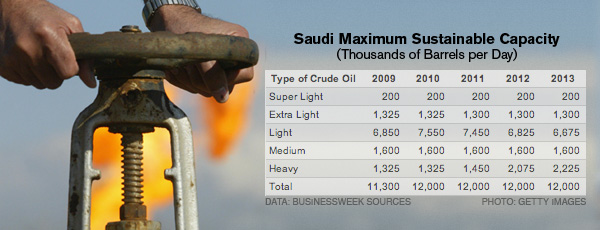
|
"China, the world's
second-largest energy consumer, imported 11 percent more crude oil in the first half of
2008 than in the year-earlier period. Crude imports
stood at 90.53 million tons, the General Administration of Customs said on Thursday. The
growth rate was down 0.2 percentage points from last year. The imports were valued at
64.98 billion U.S. dollars, up 85.8 percent, as world prices surged. Import prices hit a
record high of 849.10 U.S. dollars per ton in June. Angola, Saudi Arabia, and Iran were
the top three oil suppliers."
China's crude oil import volume up 11% in first half
Xinhua, 10 July
2008 |
"Gazprom wants to buy any additional natural gas produced by Libya
and some of the country's oil, the North African country's top oil official
said Wednesday.'Gazprom has expressed its willingness to buy Libyan oil and any
available quantities of gas,' Shokri Ghanem told Reuters, adding it did not mean Gazprom
would buy all of Libya's oil. Earlier on Wednesday, Gazprom
said in a statement after its chief executive, Alexei Miller, met with the Libyan leader
Muammar Gaddafi that it hoped to buy 'all future volumes' of gas, oil and liquefied natural gas available for export at
market prices. A cooperation agreement signed in 2006 between Gazprom, which supplies
about a quarter of Europe's gas, and Algeria prompted fears that the two biggest suppliers
to Europe could work together in a similar way to the OPEC group of oil exporters.
State-run Gazprom's latest bid to strengthen its grip on gas supplies around Europe comes
as no surprise, David Cox, the president of Poyry Energy Consulting, said."
Gazprom offers to buy all of Libya's gas and oil
Reuters, 10 July
2008 |
"The secretary general of OPEC says the oil producing group
cannot replace any shortfalls if Iran is attacked and its crude is taken off
the market. Abdalla Salem El-Badri also says OPEC has no contingency plans to produce
more if Iran is attacked. He spoke Thursday at OPEC headquarters in Vienna. Iran is
OPEC's second-largest oil producer."
OPEC chief: We can't replace Iranian oil
Associated
Press, 10 July 2008 |
"Ever since the rise of the automobile in the
1950s, the American Dream has featured a home in the suburbs and two cars in the garage.
Now the iconic white picket fence comes with a hefty price tag in the form of the cost of
the gasoline needed to drive to work and to the supermarket, and the suburban idyll is
under review. In different parts of the United States, there are signs of change. While home prices in the
suburbs have crashed, apartments in city centers are in demand. Home builders across the
country are frantically trying to unload land they had intended for new subdivisions. And
planners are rethinking how they can meet demand for housing....A recent survey of 903
brokers affiliated with national real estate chain
Coldwell Banker suggests that pressure is building. Almost 80 percent of them said higher
fuel costs are increasing their clients' desire to live in cities....Experts like
Christopher Leinberger, a visiting fellow at the Brookings Institution and head of the
graduate program in real estate development at the University of Michigan, note that
people are now willing to pay a premium to live in the city, a reversal from the last 50
years. 'These are not the cyclical changes that recessions cause every few years. These
are game-changing structural changes,' Leinberger said. 'The market is demanding walkable
urban product....Prices are up 5 percent in Washington's Georgetown neighborhood, an area
of upscale townhomes, and down 30 percent on the city's fringe, Leinberger noted."
Suburbs feeling the pinch as fuel prices soar
Reuters, 10 July 2008 |
"....over a 40-year career in investment banking, Mr [Matt] Simmons
adds, he has learnt never to rely on wishful thinking. Most of the world’s oil
analysts, he believes, are far too optimistic about how long existing fields will last,
the prospects for new discoveries, technology’s ability to unlock new sources and to
extend the life of existing ones, and so on. He prefers to rely on data rather than
daydreams. And according to the American government’s own numbers, the world’s
oil output has been more-or-less flat since 2005. It was data that made Mr Simmons famous.
He spent the summer of 2003 at his holiday home in Maine, poring over technical studies
describing the state of Saudi Arabia’s oilfields. Although the Saudi authorities do
not release much evidence to support their claims of vast oil reserves, engineers from
Saudi Aramco, the state-owned oil firm, do give talks at conferences and publish papers
about their experience of reservoir modelling and management. Based on these, Mr Simmons
concluded that Saudi Arabia’s biggest fields were already past their peaks, required
ever more expensive technological fixes to prop up production and would soon enter a
period of inevitable and rapid decline....Simmons & Company, the investment bank Mr
Simmons went on to found (along with Michael Huffington, an oilman and politician), helped
to funnel money and financial advice to the nascent 'oil services' industry, which
performs tasks such as seismic surveys and drilling wells on behalf of oil firms. Indeed,
Mr Simmons says it was his bank that coined the very phrase 'oil services'. It has handled
over 500 merger-and-acquisition deals in the industry—49 of them last year alone. All
this means that Mr Simmons can draw upon long experience and deep knowledge of the oil
industry. He does not dispute the main criticism of the 'peak oil' theory: that
improvements in technology, spurred by high prices, will eventually allow new fields to be
found, more oil to be recovered from existing fields and artificial oil to be conjured
from substances such as tar sands, coal and shale. But he thinks such advances will take
longer to appear and have less of an impact than his detractors assume. As it is, he
points out, all the world’s drilling rigs are working flat out, and old ones are
being retired faster than new ones can be produced. The same is true of geologists and
many more of the industry’s essential inputs. This is slowing the development of new
fields and pushing up the cost. By the same token, the technology being used to extract
oil today has been in the works since the 1970s. It will take a long time for the next
generation of clever kit to come into widespread use. Besides, many technological
improvements seem to have simply speeded up the extraction of oil, rather than increasing
the share of each reservoir that can be recovered. In short, as Mr Simmons readily
concedes, the debate between proponents and critics of 'peak oil' boils down to an
argument about timing. The optimists think that technology will advance quickly enough to
offset declining production from mammoth fields such as those Mr Simmons studied in Saudi
Arabia. But he and his disciples think the declines will come too soon, and be too sharp,
for the world to adapt in time. The whole row could easily be solved, he says, if Saudi
Arabia would only allow independent auditors to assess its reserves. In the meantime, Mr
Simmons is taking no chances. He plans to start up a farm near his house in Maine, in case
the supply chain that provides America with food breaks down for lack of fuel. He plans to
fertilise his fields with manure, rather than chemicals derived from oil and natural gas.
He thinks globalisation must stop, and that as much trade as possible should be conducted
by boat, to conserve whatever oil remains. But Mr Simmons has not despaired. He holds out
great hope for wave energy, and believes that at least one of the many different species
of seaweed found along Maine’s coast will yield oil that can be turned into biofuel.
He has got Simmons & Company involved in alternative energy. It is a brave choice for
someone who is so pessimistic about technology."
The only way is down
The
Economist, 10 July 2008 |
"An oil giant that planned to refine the same Canadian tar sands as
BP Whiting has canceled plans for an expansion in Ontario. Shell Canada is scrapping a
proposed refinery project in Sarnia, which would have turned tar-like crude from oil sands
in Alberta, Canada, into refinery-ready light oil, the company announced
Tuesday....Shell’s decision could affect BP Whiting’s ultimate fate, said Denny
Larson, executive director of California-based Global Community Monitor, who has helped
the Hammond-based Bucket Brigade protest BP Whiting’s modernization. Larson said a
firestorm of environmental protests was part of the reason Shell canceled its plans."
Shell cancels Canadian tar sands expansion
Post-Tribune,
Chicago, 9 July 2008 |
"China, the world's second-biggest energy consumer, shut 2.5 percent
of its coal-fired power plants, prompting local governments to limit electricity
consumption and issue warnings on possible blackouts. Insufficient
coal supplies forced the closure of 58 power- generating units in central and northern
China as of July 6, or 14,020 megawatts of capacity,
data from the State Grid Corp. of China showed
yesterday. The nation's total coal-fired capacity stood at 554,420 megawatts last year,
according to the State Electricity Regulatory Commission. 'The power problem is beginning
to look deep-seated and structural and unlikely to be resolved rapidly,' said John Kemp, a London-based analyst with
Sempra Metals Ltd."
China Shuts More Coal Power Plants; Warns on Shortage
Bloomberg,
8 July 2008 |
"A Deloitte
Insight Economics report says global uranium mine
output is meeting 64 per cent of current demand,
with the remainder met by rapidly declining secondary
sources. It says that output shortfall probably will
be over by 2015 because of mine expansions and new mines now planned, including Canada's Cigar Lake and Midwest mines, a number of mines in
Kazakhstan and the proposed Olympic Dam expansion in Australia....It says Australia, which has the world's largest share of estimated
uranium resources, has a market share of below 20 per cent. A policy shift by federal ALP
in early 2007 paved the way for potential new exploration and new mine development but so
far none of the governments in four states that ban uranium mining has changed its
position. The Queensland and West Australian state governments this month both restated
their opposition to uranium mining. WA Premier Alan Carpenter, at an event to launch the
state's first solar power station to be connected to the main grid, rejected renewed calls
for WA to drop the uranium ban. And Queensland Mines and Energy Minister Geoff Wilson says
he also isn't swayed. The Queensland Resources Council has circulated a Deloitte assessment, commissioned by the Australian Uranium
Association, of the potential economic benefit to
Queensland from uranium sales.Mr Wilson restated a commitment to the ban but the QRC says
this exposes 'a gulf' between the Queensland and federal governments over uranium mining
that threatens Australia's 'credibility as a climate change policy leader'. Mr Wilson said
the Queensland Government's position on uranium mining was unchanged – there was no
uranium mining in this state. 'The economic arguments are far outweighed by environmental,
health, safety, security, social and other concerns,' he said. Queensland had ample coal
and gas and an 'enormous program to roll out renewable energy and clean coal' and in that
case saw the risks of uranium as outweighing any perceived benefits, he said. 'The
Deloitte report forecasts that by lifting the ban on uranium, Queensland could win around
2 per cent of the global market by 2030. That's hardly the solution to climate change that
it is presented to be."
War over uranium mine ban
Courier
Mail (Australia), 8 July 2008 |
"Crude output from Mexico's
Cantarell, the world's third-largest oil field, is falling at the fastest pace in 12 years as investment limits keep state-owned Petroleos Mexicanos from fully
exploiting deposits and finding new ones. Production
at the Gulf of Mexico development dropped 34 percent in May from a year earlier, the biggest decline since October 1995, according to data compiled by
the government and Bloomberg. That was when Hurricane Roxanne's 131 miles-per-hour
(114-knot) winds shut down offshore wells for a week.... Falling production is curbing
exports to the U.S., which buys about 80 percent of the oil Mexico sells abroad. Sales to
the U.S. declined to 1.07 million barrels a day in May, the lowest since November 1995....
The company replaced 50 percent of the oil it extracted in 2007. At current production
rates, Pemex's oil reserves would run out in 9.2 years if it added no new deposits. Pemex
has been unable to take full advantage of record oil prices. Crude-oil futures traded in
New York climbed to a record above $145 a barrel this month, the highest since trading
began in 1983. Cantarell's output dropped by more than 540,000 barrels a day in May from a
year earlier as the deposit lost pressure, making it more difficult and expensive to
extract crude. Pemex has been injecting nitrogen for more than 10 years to stimulate
production. The development peaked at 65 percent of the company's 3.3 million barrels of
daily crude output in 2003. In May, it fell to 37 percent of total production. The world's
largest oil field is Ghawar in Saudi Arabia, followed by Burgan in Kuwait and
Cantarell."
Pemex Cantarell Output Drops 34% on Spending
Bloomberg,
7 July 2008 |
"The great oil shock of 2008 is bad enough for us. It poses a mortal
threat to the whole economic strategy of emerging Asia. The
manufacturing revolution of China and her satellites has been built on cheap transport
over the past decade. At a stroke, the trade model
looks obsolete. No surprise that Shanghai's bourse is down 56pc since October, one of the
world's most spectacular bear markets in half a century. Asia's intra-trade model is a
Ricardian network where goods are shipped in a criss-cross pattern to exploit comparative
advantage. Profit margins are wafer-thin. Products are sent to China for final assembly,
then shipped again to Western markets. The snag is obvious. The cost of a 40ft container
from Shanghai to Rotterdam has risen threefold since the price of oil exploded. 'The
monumental energy price increases will be a 'game-changer' for Asia,' said Stephen Jen,
currency chief at Morgan Stanley. The region's trade model is about to be 'stress-tested'.
Energy subsidies have disguised the damage. China has held down electricity prices, though
global coal costs have tripled since early 2007. Loss-making industries are being propped
up. This merely delays trouble. 'The true impact of the shock will only be revealed over
time, as subsidies are gradually rolled back,' he said. Last week, China raised internal
rail freight rates by 17pc. BP 's Statistical Review says China's use of energy per unit
of gross domestic product is three times that of the US, five times Japan's, and eight
times Britain's. China's factories 'were not built with current energy levels in mind',
said Mr Jen. The outcome will be 'non-linear'. My translation: China is at risk of blowing
up."
Oil price shock means China is at risk of blowing up
Daily
Telegraph, 7 July 2008 |
"In its 'Energy scenarios to 2050' report, Shell is, for the first
time, comfortable in discussing the contentious notion of 'peak oil' – the moment
when oil production flattens out and then heads towards terminal decline, as more oil has
been extracted from the ground than is left in it. Shell predicts that global oil
production will peak around 2020. But the company neatly side-steps the debate in its
scenarios by predicting in both the Scramble and Blueprints scenarios that the decline
rate of global production will be virtually negligible up to 2040."
Energy: Shell’s future scenarios – Staring into energy’s black hole
Ethical Corporation, 6
July 2008 |
"The number of financial market bets on crude oil prices hitting $200
a barrel before the end of this year has almost doubled in the past month, a further sign of growing concern that oil prices will continue to
rise sharply in the near term. The strong buying of
these call options - contracts that give holders the
right to buy crude oil at a predetermined price and date - comes as spot oil prices in London yesterday hit a record high around
the $146 a barrel level."
Bets double on oil hitting $200
Financial
Times, 4 July 2008 |
"Gordon Brown on Thursday
dismissed the notion that speculators were behind record oil prices, even as the Treasury select committee said it would hold the
country’s first parliamentary hearing into the issue. Attending a session of the
liaison committee, which is comprised of senior MPs, Mr Brown was asked by John McFall, a
Labour MP, what he was 'going to do about speculators' in oil markets, citing concerns
expressed by both US presidential candidates, John McCain and Barack Obama. Mr McFall
pointed out that the US futures regulator had last month required that ICE Futures Europe,
a London-based – but US-owned – oil futures exchange, impose position limits on
traders. He also highlighted a string of recent US congressional hearings into the issue
of speculation in oil markets. But Mr Brown said: 'I have looked at that and I know what
you are talking about and that there are these inquiries going on. But I would say to you
that in an oil market where demand exceeds supply today, tomorrow – and people expect
it to exceed supply next year and a few years afterwards – that is the primary reason
why the price is going up. 'You cannot put down to speculation the whole of the problem
that we are dealing with at the moment,' Mr Brown said. The Treasury select
committee’s decision to hold a hearing is a sign that the intense political pressure
to address – or be seen to address – the causes of high oil prices is emerging
in Britain after initially appearing in the US. The hearing will take place on July 15....Mr Brown’s comments echo the conclusions of a number of
economists and regulators overseeing the oil markets, as well as the International Energy
Agency. The IEA said in a report this week: 'Blaming
speculation is an easy solution which avoids taking the necessary steps to improve
supply-side access and investment or to implement measures to improve energy efficiency.'
On Wednesday Adair Turner, chairman-designate of the Financial Services Authority, told a
separate Treasury committee hearing into his appointment that there was 'no large
accumulation of evidence that speculation is playing a major role in what’s happening
to oil prices'."
MPs plan hearing on fuel costs
Financial
Times, 3 July 2008 |
"As the cost of oil has soared, everyone has been looking for someone
else to blame. The MPs on the Treasury select committee on Thursday fixed on the
mysterious and allegedly powerful role of 'speculation', echoing Harold Wilson’s
famous evocation of the 'gnomes of Zurich'. Launching an investigation may make MPs feel
as though they are making a useful contribution to one of the biggest problems facing
Britain and the world economy. But economists and experts who have studied the question
have generally concluded that there is no clear connection between investment flows into
the oil market and rising prices. The superficial appeal of blaming speculators is
obvious. As Lord Desai, the economics professor and Labour peer, wrote in the
Financial Times last month, financial investors have $260bn in commodity markets,
compared with just $13bn five years ago, and much of that money has gone into oil. He
argued that the 'paper market' for oil futures, where daily turnover is many times daily
physical oil production, was helping to drive up the prices because it was driven by
expectations of price rises in the future. In
principle, however, speculation in oil futures can affect the price of real barrels of
crude only if it creates an expectation that prices will be higher in the future than they
are now, encouraging people to store oil so they can sell it at a higher price later on. That is not really the case today. Although the price of oil to be
delivered in nine months’ time is a little higher than the price of oil for next
month, the price of oil for five years from now is cheaper. Nor
is there any big build-up in stockpiles of oil to suggest that crude is being kept off the
market. There seems to be little or no correlation
between the amount of financial investment in a commodity and the commodity’s price.
BP pointed out that financial investors had been betting heavily on a fall in the US gas
price over the past year, and yet the price of gas had risen sharply. Commodities where
there is effectively no financial investment at all, such as rice, have also gone up
sharply in price. BlackRock, the investment manager, this week presented figures showing
that the volume of futures contracts in US oil had risen by nearly 300 per cent since
1995, over which time the oil price has risen by 700 per cent. The volume of futures
contracts in lean hogs, meanwhile, rose by more than 600 per cent, but prices are up less
than 50 per cent. The reality of the oil market, and reason why prices have soared, is
that demand is still growing, especially in oil-producing countries and China, and supply
faces serious challenges. There is not a lot that any MPs’ inquiry can do about
that."
Speculators targeted in blame game
Financial
Times, 3 July 2008 |
"Indian firms could invest $2-$2.5 billion for stakes in Canadian tar
sands projects, a top official said on Thursday, as part of efforts to secure overseas
energy assets to fuel the country's fast-growing economy. Oil Secretary M.S. Srinivasan
said at the World Petroleum Congress in Madrid the companies were looking to pick up
holdings rather than buy foreign firms. Earlier this year, the head of state-run explorer
Oil and Natural Gas Corp R.S. Sharma said his firm was interested in tar or oil sands
opportunities in Canada and was willing to make a large investment. Srinivasan said Indian
firms had explored buying stakes in Alberta tar sands projects two years ago to help make
up for stagnating domestic output. Since then, companies from other countries, including
China, South Korea and Norway, have snapped up northern Alberta unconventional crude
assets, leading some analysts to wonder how much prime acreage remains up for grabs."
India eyes $2.5 bln investment in Canada tar sands
Reuters, 3 July
2008 |
"Monday, the Iraqi oil minister officially invited 35 oil companies
to make their offers for development of the oil fields of the country that holds the
third-largest proven reserves in the world, estimated at 117 billion barrels.....The
Western press talks primarily about Western oil companies, although it's the Chinese and
the Japanese that are the best-placed in the race for contracts. (See Le Temps of June 23,
2008). CNPC, which holds the sole valid contract concluded in 1997 under Saddam Hussein,
and Japex are ready to get to work. Their contracts are still "baking."
Officials at the two Asian majors are waiting until Iraq has a legal foundation - the new
oil law is still blocked in Parliament - to go into action. But the two companies are
already looking for derricks to install on the existing Ahdab and Gharraf fields - which
have not yet ever been exploited. Author of a report on Iraqi oil for IHS
Petroconsultants, Mohamed Zine, emphasizes that 'Beijing and Tokyo don't negotiate
contracts only; they're ready to grant vast loans for construction and improvement of
Iraq's infrastructure.' Another great advantage: Japex and CNPC are likely to obtain
long-term contracts allowing them to take a share of production. The Western majors will
have to settle for technical assistance contracts with a maximum two-year duration that
don't require Parliament's endorsement, but that do allow them to deal with the most
urgent matters first: to restore threatened oil fields."
Chinese and Japanese Best-Placed for Oil Contracts in Iraq
Le
Temps, 2 July 2008 |
"The IEA said in a report that spare OPEC capacity will shrink by
2013, keeping the market 'tight.'' The growth in global
excess supply will peak at about 2.5 million barrels a day in 2010, dropping to less than a million a day for the next three years, the
agency said."
Crude Oil Rises a Second Day as IEA Predicts `Tight' Supplies
Bloomberg,
2 July 2008 |
"The oil market is tight and speculators are not to blame for the
high price of crude, the International Energy Agency (IEA) said in a detailed criticism of
the call for action against speculators in the crude oil futures market. The oil price
rose back above $142 a barrel yesterday amid fears about tight supply and possible armed
conflict between Iran and Israel. Light, sweet crude for August delivery rose $2.02 to
trade at $142.02 a barrel in New York and Brent crude futures rose $2.27 to $142.10 in
London. The IEA said that rising demand in the emerging markets of Asia, Latin America and
the Middle East and poor supply growth were the main reasons for the high price. In its
Medium-Term Oil Market Report, the agency predicted
that global oil product demand would increase by 1.6 per cent per year over the next
half-decade, but it has lowered its estimates for growth in non-Opec supplies of crude,
because of project delays and a doubling in costs.
The IEA suggested that the attempt to blame speculators in the futures market was a result
of consumer shock over oil prices. 'Like alchemists looking for a way to turn basic
elements into gold, everyone wants a simplistic explanation for high prices,' it said.
While recognising that speculation can have a day-to-day impact on crude prices, the IEA
said that the underlying market told a different story. 'The fact that all producers are
working flat out and that there is no sign of any abnormal stockbuild gives a strong
indication that current oil prices are justified by fundamentals,' the IEA said. Six
factors were more important than investment flows in the price of crude: low spare
capacity within Opec; geopolitical concerns, such as civil conflict in Nigeria and
concerns over Iran; the expectation of rising prices because of concerns about peak oil
and Chinese demand; rising oil industry costs; tight refining capacity; and stockbuilding
by refiners seeking to lock in profits."
Speculators are not to blame for oil, says IEA
London
Times, 2 July 2008 |
"Crude oil prices surged on Wednesday more
than $2.50 to $142.73 a barrel, but still below Tuesday's record high of $143.67 a barrel.
The report also said that current oil prices were 'justified by fundamentals.' The IEA
said that despite billions of dollars of investment, the challenge of pumping ever more
oil out of their aging fields is proving so great that non-Opec
countries will in the next five years have to rely on biofuels, such as corn-based
ethanol, for 50 per cent of their growth in overall fuels. The fast decline of fields - especially in the North
Sea and Mexico where production is shrinking by more than 20 per cent each year -
means that 14.8m of the 16m barrels of new supply
from non-Opec countries over the next five years will go to making up for losses from old
fields producing less and less each year. But Opec is also struggling, with project delays impacting its ability
to add new capacity. The IEA substantially downgraded its expectations for Opec crude
capacity from 2008-2013, cutting earlier forecasts by 1.2m b/d. The IEA said it believed Saudi
Arabia was having bigger problems than the kingdom, the world's largest exporter, was
willing to admit to, despite its national oil
company having gone to great lengths last month to reassure energy ministers gathered in
Jeddah that, except for Khursaniyah, its capacity editions were running on schedule. The
IEA said: 'State company Aramco insists that [Khursaniyah] delays are not symptomatic of
likely delays at their other projects. Nonetheless, latest market intelligence leads us to
push back our estimates for the Nuayyim increment and for Manifa, by six to nine months
compared with the July
2007 forecast.' All this is happening while demand growth is continuing, especially in
the developing countries, whose oil needs are expected to have almost caught up with those
of the developed world by 2013. Global oil demand is
expected to grow by 1.6 per cent a year over the next five years, rising from 86.9m b/d to
94.1m b/d. This is despite the IEA having slashed
its forecasts for rich countries' demand because of lower growth, especially in the US,
which is struggling under the double burden of a credit crisis and high oil prices. The
IEA now expects OECD demand to contract by 0.1 per cent a year, rather than grow by 1 per
cent, a revision the group said 'constitutes the major change versus last year's
Medium-Term Oil Market Report.' The IEA added that a number of highly populous developing
countries are getting wealthier. 'It is only right that they should aspire to the standard
of living seen in the OECD - one that includes the same intensity of use of energy. But if
the supply of oil is restricted, then the only way in which balance can be achieved is
through a gradual price increase until demand is curbed in OECD countries.' But the IEA
warned governments not to blame speculators. It said: 'Like alchemists looking for a way
to turn basic elements into gold, everyone wants a simplistic explanation for high
prices,' bluntly adding: "Often it is a case of political expediency to find a
scapegoat for higher prices rather than undertake serious analysis or perhaps confront
difficult decisions."
IEA warns of tightening oil supplies
Financial
Times, 1 July 2008 |
"World oil supply will rise more slowly than expected by 2013,
leaving little spare capacity on the market despite weaker demand growth, the
International Energy Agency said on Tuesday. In its Medium-Term Oil Market Report, the Paris-based agency said global supply capacity will reach
95.33 million barrels per day (bpd) by 2012, some 2.7 million bpd less than its previous
forecast a year ago. The outlook signals little
relief from high oil prices, which have hit record peaks above $140 a barrel on supply
concerns and robust demand in Asia and the Middle East, adding a strain to the world
economy....Consumption will rise by an average 1.6
percent a year between 2008 and 2013, or 1.5 million bpd on average, the IEA said, down
from a previous medium term forecast of 2.2 percent. Annual supply additions will match or
exceed average demand growth through 2010 but slow to less than 1 million bpd from 2011 to
2013. Average total supply growth in the period stands at 1.15 million bpd a year.....The agency expressed concern about high prices, which it says are the
result of strong demand and supply bottlenecks rather than speculation, a factor blamed by
Saudi Arabia and other oil exporters. 'Record prices in the oil market in recent months
have become a threat to the global economy and social welfare of millions of people,' said
IEA Executive Director Nobuo Tanaka at the World
Petroleum Congress in Madrid. 'Some are calling it
the third oil shock.' Analysts said the report would support crude for delivery in future
years, which has been rising sharply in recent months on concern a supply crunch may be
looming. The IEA itself said a year ago that was a
risk by 2012....Accelerated
declines at mature oilfields and delays and cost
overruns at new projects account for the lower supply forecast. The delays stem in part
from shortages of manpower and equipment such as rigs. Output
in 2012 from outside the Organization of the Petroleum Exporting Countries, source of
about three in every five barrels, is now expected to be 1.4 million bpd less than
previously thought. Supply will rise to 51.1 million bpd in 2013 from 49.9 million bpd in
2008, the IEA said. Output
of non-OPEC crude alone will remain flat or fall in the next five years. Production capacity in OPEC countries, also facing cost overruns and
delays at new projects, is also expected to lag earlier expectations. OPEC, 12 of whose 13 members pump oil at agreed rates, usually
holds some production idle to meet rises in demand or fill shortages. That reserve is
expected to wane to a 'minimal' level by 2013, the
IEA said....The group's effective spare capacity will
rise from 2.5 million bpd in 2008 to more than 4 million bpd in 2009, before falling by
2013 to about 1 million bpd - just over 1 percent of global demand. 'Supply will continue to struggle to keep up with demand due to project
delays because of continuing equipment and labour shortages,' said Brian Hicks, co-manager
of U.S. Global Investors' Global Resources Fund. 'Effective spare capacity falling below 2
percent of global demand remains supportive of oil prices.'"
IEA sees world oil supplies staying tight
Reuters, 1 July
2008 |
"Iraq, with proven reserves of 115 billion barrels, is to open up six
huge oilfields for the first time in 36 years. The country is set to welcome back
American, British and French multinationals among 41 foreign companies invited to bid for
long-term deals as well as short-term service contracts. Yesterday Iraq's Oil Minister
announced that his country's energy industry is to be opened up to foreign participation.
He wants multinationals, with cash and new technology, to make up for neglect and
sanctions and rebuild the industry's ageing infrastructure, lift production and take
advantage of today's record oil prices. Iraq's present output of 2.5 million barrels a day
is the highest since the allied invasion five years ago. But it is well below the
country's potential, as technical breakdowns, political wrangling and the sabotaging of
strategic pipelines by al-Qaeda continue to thwart attempts to boost output. The Baghdad Government wants to raise production to 2.9 million
barrels by the end of next year."
Oiling Iraq's Revival
London
Times, 1 July 2008 |
"On June 27th, Ray Leonard showed 18 slides and delivered 20 minutes
of remarks to a private invited group of roughly 50 different players—from industry,
government, academia, think tanks, etc.—who were all focused on key energy issues
during a three-day seminar.....Ray Leonard is Vice-President-Eurasia with Kuwait Energy
Company, the first non-national oil company based in the Middle East. During a 19-year
career with Amoco he served in Trinidad, Norway and West Africa. In 1989 he was appointed
Director of New Ventures for the Soviet Union, Eastern Europe and China. In 1998, he
became Exploration VP for a newly formed company in Kazakstan. He became VP-Exploration
and New Ventures for Yukos in 2001, with responsibility for diversifying the upstream
portfolio into East Siberia, the Russian Shelf and Central Asia..... In 2001, he wrote a
paper on peak oil that two U.S.-based publications turned down but which Yukos then
published in Russian. At a recent energy seminar, Leonard handed out copies of his 2001
paper to the 50 attendees. The key quote up front is this: 'By
2010, the production of the fuel that has driven the world’s economy will start to
rapidly decline. This will conflict with the steadily increasing demand for oil. The
collision of these two trends will lead to shortages and increased prices, providing a
strong incentive to shift to alternative fuel resources…Due to unequal distribution
through the world of oil and gas supply and consumption, [the upcoming] transition will
result in significant shifts in global power and wealth.'”
World oil reserves and future production
Energy Bulletin, 30 June 2008 |
"The era of globalisation is over and rocketing energy prices mean
the world is poised for the re-emergence of regional economies based on locally produced
goods and services, according to a former energy adviser to President Bush and the pioneer
of the 'peak oil' theory. Matt Simmons, chief
executive of Simmons & Company, a Houston energy
consultancy, said that global oil production had peaked in 2005 and was set for a steep
decline from present levels of about 85 million barrels per day. 'By 2015, I think we
would be lucky to be producing 60 million barrels and we should worry about producing only
40 million,' he told The Times. His controversial views, rejected by many mainstream
experts, suggest that some of the world's biggest oilfields, particularly in Kuwait and
those of Saudi Arabia, the world's leading producer, are in decline. 'It's just the law of
numbers,' he said. 'A lot of these oilfields are 40 years old. Once they roll over, they
roll over very fast.'.... Mr Simmons set out a radical vision of the future, envisaging a
society in which food and many other essentials are sourced and consumed locally and
increasing numbers of people work from home. He claimed that the alternative was
increasing political instability and conflict over the planet's diminishing resources. 'We
are living in an unsustainable society,' he said. 'If we don't change we are just going to
start fighting one another...So let's just start assuming the worst and plan for
it.'”
Former President Bush energy adviser says oil is running out
London
Times, 29 June 2008 |
"Four oil giants - Exxon Mobil, Shell, Total and BP - are to announce
next week no-bid contracts to start servicing the creaking Iraqi oil infrastructure,
crippled for decades by lack of investment and often targeted by insurgents. The deals
came as the Oil Ministry announced that exports had
hit a post-war high, due in large part to better
security after the US troop 'surge' of the past year and the turning of Sunni insurgents
on erstwhile al-Qaeda allies. The news has caused many Iraqis - as well as US neocons - to
hope that an oil boom could finally allow economic recovery and tackle the soaring
unemployment that has fuelled militia violence and crime."
Exxon Mobil, Shell, Total and BP return to Iraq
London
Times, 28 June 2008 |
"A dispute over costs and taxes is hindering a huge offshore gas
development that could bring fresh fuel supplies to Britain. The argument over the
exploitation of gasfields in the West of Shetlands area reveals sharp differences between
the oil industry and Whitehall over the prospects for big oil and gas discoveries in
British waters. Two gas finds by Total, the French multinational, and another by Chevron
are at the centre of a debate over the development of infrastructure in the Atlantic
Margin between the Shetland Islands and the Faeroes, an area of deep water and violent
storms where exploration is expensive and dangerous. Eight men drowned last year when a
tug capsized during work on the anchor of a drilling ship. The Government is keen to see
major infrastructure, including offshore platforms, developed to exploit existing and
future gas discoveries, but some oil companies, including Total, have doubts about the
prospects for big finds and want a lower-cost development. At a meeting with the Prime
Minister in Aberdeen last month, the French company expressed its scepticism over the
likelihood of big discoveries in the West of Shetlands region. According to estimates by
the Department for Business, Enterprise and Regulatory Reform (BERR), 4 billion barrels of
oil and gas could be extracted there, almost a fifth of the total left on the UK
continental shelf. However, Oil and Gas UK, the North
Sea oil industry association, reckons the figure is more likely to be between 2 billion
and 2.5 billion.... Total wants a quick decision. It
reckons that its gas could come ashore by 2012 if it begins work immediately, but the
Government is keen that a tender be conducted among the West of Shetlands operators to
determine whether there is an appetite for investment in a large piece of infrastructure.
Total is happy to consult but fears further delays. A big offshore platform would require
at least an extra year of construction. Laggan, the
probable site of such a platform, lies in water depths of more than half a kilometre. Huge waves and powerful sub-sea currents make work in the area difficult
and drilling operations are restricted to three
months in the summer."
Storm clouds gather over the West of Shetlands, Britain's last gas frontier
London
Times, 28 June 2008 |
"A new forecast calls for gasoline prices to hit $7 (U.S.) a gallon
in the next two years and oil to soar to $200 a barrel by 2010. The report by CIBC World
Markets also predicts there will be 10 million fewer cars on the road in the United States
by 2012. 'Over the next four years, we are likely to
witness the greatest mass exodus of vehicles off America's highways in history,' Jeffrey Rubin, the lead author, wrote in Thursday's report. Economist
Benjamin Tal, who co-authored the report with Mr. Rubin, said Canadians can expect to pay
about $1.85 to $2.00 per litre of gas at the pumps by 2010."
$7-a-gallon gas, 10-million fewer cars: Rubin
Globe
and Mail, 26 June 2008 |
"Arriva on Thursday reported 'strong growth' in its train and bus
operations, with group revenue expected to increase by more than 50 per cent in the first
half of the year. In a trading update, the group highlighted the trend for UK public
transport operators to benefit from substantial
increases in passenger numbers, as rising fuel prices persuade more people to abandon
their cars for trains and buses."
Arriva benefits from switch to public transport
Financial
Times, 26 June 2008 |
"Householders will be warned
today to expect five years of higher home energy bills to pay for a green power
revolution. John Hutton, the Business Secretary, will outline plans for a massive shift
away from fossil fuels to wind, solar and tidal power, but will add that the change comes at a price. 'We think there will be a
cost,' he told The Times yesterday. The plan, which he calls the biggest shake-up in
Britain's power generation since the Industrial Revolution, requires £100 billion of new
investment but would lead to five years of higher gas and electricity bills from about
2015, he said. Homeowners will be given financial incentives to fit their roofs with
solar panels and there will be ambitious targets to increase their use from 90,000 today
to seven million within the next 12 years. The plan also envisages a 90 per cent increase
in the use of ground and air-source heat pumps that provide 'free' heat by tapping the
warmth in the air or the earth. Mr Hutton will also outline a 'feed-in tariff' allowing
homes that generate surplus electricity to sell it to the national grid as an incentive to
switch. The news comes a day after the chiefs of the big six energy companies gave warning
that energy bills, which have already risen more than 15 per cent this year, would rise
again within the next few months because of the rising price of oil. Mr Hutton said the renewable cost would be 'relatively modest',
set against the current increases in the prices of coal, oil and gas and the scale would
depend on movements in world oil prices. But he said
that it was a necessary price to pay if Britain was serious about addressing climate
change and switching to green technology. 'At the end of the day, we as consumers, we pay
for the product. That's how it is,' he said. Under the green energy programme, more than a
third of Britain's electricity would be generated from wind power by 2020 by 3,500 onshore
wind turbines - about 2,000 are currently operational - and 7,000 offshore. This should
help Britain to meet its EU target of generating 15 per cent of its energy from renewables
by 2020. Another big growth area will be bio-energy, where about 6 per cent of electricity
will be generated from burning wood, straw and energy crops. Large areas of woodland will
be used and sewage works will be encouraged to supply biogas. The plan also calls for a
steep increase in the use of biofuels to run aircraft and trains.....The biggest
challenge, he said, would be attracting companies to make the cumulative £100 billion
investment and beating competition from other European countries rushing to do the same
thing. If successful, it would lead to the creation of 160,000 British jobs. 'We're in a
race for this investment,' he said. He will also announce today an agreement with Ofgem,
the energy regulator, to give priority to renewable projects gaining access to the grid.
He has also signed a deal with the MoD to speed up the delivery of offshore wind farms
without interfering with radar. 'There is no way of making these changes without there
being some impact on the natural environment. I'm afraid some people will look out of
their windows and see a wind turbine,' he said. 'People need to wake up. We either make
these changes or we don't. What we don't have is this magic third option of just carrying
on as we are.'”
Higher gas and electricity bills to pay for shift from fossil fuels
London
Times, 25 June 2008 |
"OPEC member Kuwait will
increase its oil output by 300,000 barrels per day starting mid-2009, the official state news agency KUNA reported, citing Oil Minister
Mohammad Al-Olaim. Olaim 'affirmed... that Kuwait is capable of increasing its oil output
(currently) but wondered if the market needed that increase', KUNA reported. Kuwait will
spend $55 billion on oil projects over the coming five years, Olaim said without
specifying whether the money would be allocated for production capacity expansion or other
projects."
Kuwait to hike oil output in '09
Reuters,
24 June 2009 |
"The increasing cost of living has forced one in three Britons to
turn to 'The Good Life' and become more self-sufficient by growing their own fruit and
vegetables, according to a study. According to new research, one third of the population
is following the example of the 1970s sitcom starring Felicity Kendal and Richard Briers
by cultivating tomatoes, peas, cauliflower and potatoes. Of those who are not growing
their own food, 63 per cent plan to do so within two
years instead of buying fruit and vegetables from supermarkets. The 12 per cent rise in the cost of staple groceries over the last
year, which has added £750 to the average annual grocery bill, is to blame for the
increase in those growing their own."
Cost of food drives one in three to grow own fruit and veg
Daily
Telegraph, 23 June 2008 |
"Emergency talks to address the high global oil price broke up in
disarray last night as ministers traded accusations over the cause of the increase and
reports of fresh rebel attacks in Nigeria threatened to overwhelm a Saudi pledge to pump
more oil. After raids on facilities operated by Shell and Chevron, it emerged that Nigeria, once Africa's biggest oil producer, is pumping oil at its
lowest level in 25 years — between 1.2 million
and 1.5 million barrels a day, representing a reduction of at least 325,000 barrels. The
news is expected to unsettle oil markets today, despite an earlier pledge from the
summit's host, King Abdullah, to boost Saudi production by 200,000 barrels a day to 9.7
million, to raise long-term capacity from 11.7 million to 15 million barrels within a
decade, and to pump more oil if the market demanded it."
Fears of oil price rises as attacks in Nigeria offset gains at summit
London
Times, 23 June 2008 |
"The European Union and the Opec oil
cartel spent yesterday in an entirely vacuous summit. Everything ministers said when it
was over was wrong or unwise. Of the two organisations, the EU has more reason to be
defensive, but the past three days have also shown how much Opec has to rely on wishful
thinking in place of policy.... The second part of the EU-Opec statement 'recognised the
importance of secure future demand for crude and products in spurring timely investment
both upstream and downstream, thus contributing to greater security of supply'. The EU,
which imports 80 per cent of its oil, offered an assurance that it would not cut imports
over the next couple of decades..... It was a summit with the sole purpose of being seen
(on the European side) to be doing something about the pain of high oil prices, without
either side being able to do much about it at all. The slowdown in US and European growth
may take the price down from its heights, but the still fast-growing demand from China and
India may stop it falling much. In the battle to avoid blame, it is no surprise that
ministers claim more influence than they have, and accuse the phantom villains of the
world markets."
London Times, 23 June 2008
Oil-price
promises are only good at face value |
"Crude oil fell more than $2 a barrel after record fuel prices cut
consumption, causing U.S. inventories to rise for the first time in six weeks....Daniel Yergin, chairman of Cambridge
Energy Research Associates, told a congressional panel that oil prices are being driven by
'new fundamentals' involving the merging of oil and financial markets. He added that the
price of oil has hit a 'break point' where the U.S. will begin to seek alternatives.
Gasoline demand
has averaged 9.28 million barrels a day over the past four weeks, down 2.1 percent from the same period last year, the department said. Demand for distillate fuel, a category that
includes heating oil and diesel, averaged 4.06 million barrels a day, down by 1.1 percent
from a year earlier. 'In our view, 2007 may well have been the top, the break point, in
terms of U.S. gasoline demand,' Yergin said in prepared testimony to the Joint Economic
Committee. Consumption of gasoline in the U.S. increases during the summer, when Americans
take to the highways for vacations."
Oil Drops More Than $2 After Supply Gains First Time in 6
Weeks
Bloomberg,
25 June 2008 |
"The world outside Opec is struggling to produce more oil, according
to America's Energy Information Administration, which yesterday reduced its forecast for non-Opec supplies of oil and at the same
time trimmed its forecast of global demand for crude.
The sombre long-term outlook by the US government forecasters, who predict a 50 per cent
increase in energy consumption by 2030, came as the organisation signalled a short-term
rise in US crude oil stocks.....Evidence of falling
petrol consumption in America is mounting as hard-pressed US households cancel journeys
and change their behaviour to cope with the cost of expensive fuel. The emerging markets will account for the bulk of the 50 per cent surge
in energy demand in the quarter century to 2030, said the EIA in its International Energy
Outlook 2008, published yesterday. While demand from states which are not members of the
Organisation for Economic Co-operation and Development (OECD) is expected to rise by 85
per cent, the richer countries of the OECD will use just 19 per cent more energy. The surge in prices is blamed on Far Eastern and Middle Eastern
demand for crude, rising costs and lack of growth in Opec output. The forecasts include a reference case that sees prices easing in the
medium term as unconventional oil supplies, such as
Canadian tar sands, as well as new conventional oil supplies from Brazil and Central Asia
reach the marketplace. In its reference case the oil
price dips to $70 per barrel by 2015 and then rises with inflation to $113 by 2030. However, the EIA admits that the current market conditions suggest
a path that more closely resembles its high-price scenario in which the oil price reaches $186 in 2030. In its reference case, world oil demand reaches 112 million bpd in 2030, but higher oil prices would trim demand by some 13 million barrels. Guy
Caruso, administrator of the EIA, said: 'We do think that over the next five to ten years
the high prices will bring on new supplies that will put downward pressure on price. But
we are not going back to the historic price we saw in the 1980s and 1990s.' Between 1980
and 2000, the crude oil price averaged about $25 per barrel."
EIA reduces forecast for non-Opec oil production
London
Times, 26 June 2006 |
"High-speed ferries between
Ireland and Britain are slowing down by a quarter of an hour per trip to save fuel and
face being replaced by conventional ferries operating at half the speed unless the oil
price falls. Stena Line has also introduced a fuel
surcharge of £10 per vehicle and £2 for foot passengers. The crossing time between Dun
Laoghaire, Co Dublin, and Holyhead, North Wales, will rise from 99 minutes to 115. The
trip from Belfast to Stranraer will take 119 minutes, an increase of up to 14 minutes
depending on the time of day. The reduction in speed will reduce fuel consumption by 8 per
cent. Michael McGrath, Stena’s Irish Sea
director, hinted that the high oil price could result in the withdrawal of the HSS
ferries, aluminium catamarans the size of a football pitch that travel at more than 40mph.
They would be replaced by conventional ferries operating with a top speed of 25mph,
meaning journey times would return to the three hours that was normal before the HSSs were
introduced in the mid-1990s....Stena blamed high oil
prices last year when it withdrew one HSS from the North Sea route between Harwich and the
Hook of Holland. The price then was $70 (£38) a barrel but has since almost doubled. The
North Sea HSS is being stored in Belfast awaiting a buyer but, like dozens of fast ferries
laid up in docks around the world, may never return to service. The HSSs were designed in
the 1980s when oil was a fraction of its current price and were built to operate until at
least 2022. They use more than twice as much fuel as a conventional ferry. They consume
gas oil, similar to kerosene used in jet aircraft and double the price of standard marine
fuel. Container ships are also slowing down to save
fuel, adding two or three days to the voyage from manufacturing centres in the Far East to
European ports. A study has found that the
world’s shipping industry wastes almost three million barrels of oil a day by using
ageing vessels that have not been upgraded with fuel-saving technology. A study has found
that the world’s shipping industry wastes almost three million barrels of oil a day
by using ageing vessels that have not been upgraded with fuel-saving technology. The DK
Group found that fitting new propellers and engines and installing devices that allow
ships to glide on a cushion of air would reduce global marine fuel consumption by up to 40
per cent."
Future of fast ferries in doubt as cost of fuel soars
London
Times, 24 June 2008 |
"Passengers face acute overcrowding on key railway routes because capacity will be exhausted many years before any new lines could
be built, according to Network Rail. The
infrastructure company is to commission a study into the costs and benefits of new lines
on five inter-city routes. But it admitted that a high-speed network was unlikely to be
built soon because of funding constraints and environmental concerns. The company is
expected to focus on a few short stretches of track operating at conventional speed to
relieve the worst pinch points on long-distance routes, including London to Peterborough,
Rugby and Swindon.... The high cost of housing in
London and fuel prices were two of the factors contributing to the continuing strong
growth in demand for rail travel. In the past decade
passenger numbers have grown by 45 per cent and the amount of freight carried by trains
has grown by 60 per cent. But constraints on the capacity of the network have meant that
the number of trains has risen by only about 20 per cent. The Government is planning to
reduce public funding of the railways by £1.5 billion a year and has said that passengers
will have to pay three quarters of the cost of the network by 2014. The cost is currently
split evenly between the farepayer and the taxpayer."
Network Rail forecasts overcrowded trains, longer journeys and no new lines
London
Times, 24 June 2008 |
"At the peak, [UK] oil production was
worth about £20bn per annum, or roughly 6pc of GDP. Moreover, the UK became a substantial
net exporter of oil, with the oil surplus worth £8bn, or more than 2pc of GDP. And oil
had a major impact on the public finances. At the
peak, the tax revenues from the North Sea amounted to £12bn, or 3.5pc of GDP and 8pc of
overall tax revenues. But the steady decline in North Sea production, set against the
continued rise in UK demand for oil, has caused the position to change dramatically. Oil
production is still worth about £20bn a year but this amounts to only about 1.5pc of our
current GDP. And, as our chart shows, we are no longer net exporters of
oil. Last year we were net importers to the tune of about £3bn, or
0.2pc of GDP. The Treasury still gains from tax on North Sea oil and again the nominal revenues are not far off what they were at the peak, but as a share of GDP they are only 0.6pc, and as a share of total tax
revenues they are less than 2pc.....The result of higher oil revenues is lower taxes,
higher spending or lower borrowing than there would otherwise be. The problem is that it
is impossible to perceive this benefit because the money gets lost in the general fund.
And, in any case, the amounts are now not huge. This year, North
Sea taxes are officially forecast to bring in £10bn, some £2.2bn more than last year. That does not even quite pay for the bail-out of the losers from the
abolition of the 10p tax band."
Treasury is one of the few UK winners from the surge in oil prices
Daily
Telegraph, 23 June 3008
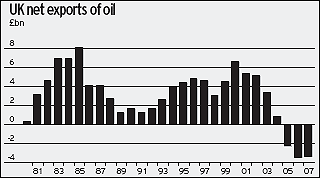
|
"The uranium industry's worst year is about to collide with a nuclear
construction program in India and China that rivals the ones undertaken during the oil
crisis of the 1970s....Plans for India and China to end electricity shortages will ripple
from northwest Canada to the Australian outback and the flatlands of Kazakhstan, the
primary sources of uranium. India will start up three reactors this year, with another six
due in 2009, in India, China, Russia, Canada and Japan. Uranium demand worldwide will rise
as fast as oil this year, or 0.8 percent, Deutsche Bank AG forecasts.....The world needs
to build 32 new nuclear plants each year as part of measures to cut emissions in half by
2050, the Paris-based International Energy Agency said....Because malfunctions
shut reactors in Japan, the U.K. and Germany, nuclear power production and uranium use dropped 2 percent in 2007, only the third time consumption
has fallen since the 1970s, according to data compiled by BP Plc, Europe's second-largest
oil company by market value. Prices are so low that some uranium mines are close to being
unprofitable, says Merrill Lynch & Co., the third-largest U.S. securities firm....In
India, Nuclear Power Corp.'s 220-megawatt Kaiga plant in the southern province of Karnatka
and another at Rawatbhata in the northern state of Rajasthan are due to come on line this
year. China started two units in 2007 and will bring on three more through 2011, says the
World Nuclear Association. Iran plans to begin generation this year at its 950-megawatt
Bushehr reactor, which is at the center of the nation's conflict with the West....Uranium demand was 66,500 metric tons last year, according to data
from Denver-based consultant TradeTech LLP. Consumption may jump 55 percent to 102,000
tons by 2020, forecasts Macquarie Group Ltd., Australia's biggest securities firm. Uranium
use now is 69 percent greater than the 39,429 tons that was mined in 2006, the most recent
data from the WNA show. The balance comes from inventories and decommissioned weapons. A
Russian accord to export fuel recovered from warheads to the U.S. expires in 2013.
'Secondary supplies are finite and rapidly being depleted,' Deutsche Bank analysts led by Michael Lewis said in a June 20 report. 'Continual supply issues and the likelihood of increased demand from
utilities should drive the spot price higher during the third quarter of this year.'
Demand is set to increase as existing reactors are brought back on line, while nuclear
energy gains converts. South Africa, which is struggling to meet electricity demand, plans
to award a contract for construction of a 120 billion-rand ($15 billion) nuclear plant. In
the U.K., the Labour government wants more atomic capacity to reduce its emissions. U.S.
Republican presidential candidate John McCain said last week he will push
to almost double the number of nuclear reactors to lessen the nation's dependence on
foreign oil. Barack Obama, the presumptive
Democratic nominee, also backs nuclear power. There are 104 reactors operating in the
U.S., though the last to come on line was in 1990, according to the Nuclear
Energy Institute. Prices will have to increase if uranium
production is to meet the rising demand, said Kevin Smith, head of uranium trading at
New York-based commodities brokerage Traxys. Canada's Cameco Corp., the world's largest uranium producer, reported it spent a
total of about C$45 ($44) to produce a pound of uranium in the first quarter, compared
with its average realized price of C$40.85 a pound. While Cameco, which also mines gold,
still posted a profit for the quarter, lower uranium prices are a problem for other
companies developing new mines, according to Smith. 'There are a lot of production
projects that are feeling the pain,' Smith says."
Uranium to Fetch $90 as Indian Reactors Drive Demand
Bloomberg,
23 June 2008 |
"Even as Gordon Brown proposed a 'new deal' between oil producers and
consumers, the outlook worsened in the dirty market for crude – a short-term world of
crises, logjams, turbulence and market speculation. In the Niger delta, an oil pipeline
operated by Chevron was blown up yesterday, and an offshore oil platform was attacked by
rebels last week. Nigeria, an Opec state, has probably lost a third of production. This
wipes out what gain might emerge from King Abdullah’s promise of more oil from Saudi
Arabia, even assuming that the market wanted his barrels. The
truth is that the world doesn’t need the extra Saudi crude. It’s the wrong sort
of oil – too sulphurous and viscous for refiners trying to produce more petrol,
diesel and jet fuel. The world wants 'light crudes'
such as the UK’s Brent or Nigeria’s Bonny Light, but these are in short
supply."
Oil production: it's like asking a tobacco firm to invest in nicotine patches
London
Times, 23 June 2003 |
"Since 1981, there has been a federal moratorium banning any new
drilling in these areas. Any rigs that were already up were permitted to continue
extracting oil, and many are still operating in the Gulf Coast. But among the biggest
questions about McCain's proposal to lift the moratorium are how soon any new drilling
would produce a significant flow of oil, and how much oil is sitting there in the first
place. As recently as May 29, at a town hall appearance in Greendale, Wis., McCain noted that lifting the
moratorium would be at best a band-aid for the nation's energy problems and that the oil
it would provide wouldn't be available anytime soon: '[W]ith those resources, which would
take years to develop, you would only postpone or temporarily relieve our dependency on
fossil fuels,' McCain said. 'We are going to have to go to alternative energy.' He
certainly has the right to change his opinion on policy options. But the facts are more in
line with his earlier statement that drilling would not offer short-term relief for energy
prices. The Energy and Information Administration concluded
in a 2007 report that: EIA: The projections in the
OCS (Outer Continental Shelf) access case indicate that access to the Pacific, Atlantic,
and eastern Gulf regions would not have a significant impact on domestic crude oil and
natural gas production or prices before 2030.
Something that takes 22 years to deliver significant results hardly qualifies as a
'short-term' solution. Why would it take so long? To vastly oversimplify: First, the
government has to identify properties to be leased and hold a lease sale. Then, winning
bidders need to contract with drilling rigs (all of which are booked for the next five
years, according to the New York Times), drill exploratory holes and analyze core samples
– "They drilled 75 holes in the North Sea before they figured out the
geology" sufficiently to begin drilling productive wells, says Lucian Pugliaresi,
president of the oil industry-funded Energy Policy Research Foundation Inc. And then, if
oil is found, companies would have to order and put in place production equipment, build
pipelines to get the oil to shore, and get various permits and environmental analyses
every step of the way."
McCain's Power Outage
Newsweek, 20 June 2008 |
"Record prices at the pumps are causing drivers to slow down on
motorways to conserve fuel. The average speed of traffic in free-flowing conditions on the
M6 between Birmingham and Carlisle fell by 0.9per cent in the first half of June compared
with the same period last year. The small reduction in the average speed conceals a much
larger fall in the proportion of motorists who choose to drive well in excess of the limit
when the roads are clear enough to do so. The study also found that congestion had fallen by up to 12 per cent in the past month because there were fewer cars on the road."
Average motorway speeds fall as the price of fuel rises
London
Times, 19 June 2008 |
"Afghanistan
and three of its neighbouring countries have agreed to build a $7.6-billion (U.S.)
pipeline that would deliver natural gas from Turkmenistan to energy-starved Pakistan and
India – a project running right through the volatile Kandahar province – raising
questions about what role Canadian Forces may play in defending the project. To prepare for proposed construction in 2010, the Afghan government has
reportedly given assurances it will clear the route of land mines, and make the path free
of Taliban influence. In a report to be released Thursday, energy economist John Foster
says the pipeline is part of a wider struggle by the United States to counter the
influence of Russia and Iran over energy trade in the region. The so-called
Turkmenistan-Afghanistan-Pakistan-India pipeline has strong support from Washington
because the U.S. government is eager to block a competing pipeline that would bring gas to
Pakistan and India from Iran....the project is seen as a key part of Afghanistan's
strategic development plan, which Canada and its NATO partners have endorsed as critical
to establishing its political stability."
Pipeline opens new front in Afghan war
Globe
and Mail, 19 June 2008 |
"Four Western oil companies are in the final stages of negotiations
this month on contracts that will return them to Iraq, 36 years after losing their oil
concession to nationalization as Saddam Hussein rose to power. Exxon Mobil, Shell,
Total and BP — the original partners in the Iraq Petroleum Company — along with
Chevron and a number of smaller oil companies, are in talks with Iraq's Oil Ministry for
no-bid contracts to service Iraq's largest fields, according to ministry officials, oil
company officials and an American diplomat. The deals, expected to be announced on
June 30, will lay the foundation for the first commercial work for the major companies in
Iraq since the American invasion, and open a new and potentially lucrative country for
their operations. The no-bid contracts are unusual for the industry, and the offers
prevailed over others by more than 40 companies, including companies in Russia, China and
India. The contracts, which would run for one to two years and are relatively small by
industry standards, would nonetheless give the companies an advantage in bidding on future
contracts in a country that many experts consider to
be the best hope for a large-scale increase in oil production....The Iraqi government's stated goal in inviting back the major companies
is to increase oil production by half a million barrels per day by attracting modern
technology and expertise to oil fields now desperately short of both.....For the American
government, increasing output in Iraq, as elsewhere, serves the foreign policy goal of
increasing oil production globally to alleviate the exceptionally tight supply that is a
cause of soaring prices. The Iraqi Oil Ministry, through a spokesman, said the no-bid
contracts were a stop-gap measure to bring modern skills into the fields while the oil law
was pending in Parliament. 'The bigger prize everybody is waiting for is development
of the giant new fields' Leila Benali, an authority on Middle East oil at Cambridge Energy
Research Associates, said in a telephone interview from the firm's Paris office. The
current contracts, she said, are a 'foothold' in Iraq for companies striving for these
longer-term deals....It is not only one of the few countries where oil reserves are
up for grabs, but also one of the few that is viewed within the industry as having
considerable potential to rapidly increase production....A total of 46 companies,
including the leading oil companies of China, India and Russia, had memorandums of
understanding with the Oil Ministry, yet were not awarded contracts....In an
interview with Newsweek last fall, the former chief executive of Exxon, Lee Raymond,
praised Iraq's potential as an oil-producing country and added that Exxon was in a
position to know. 'There is an enormous amount of oil in Iraq,' Raymond said. 'We were
part of the consortium, the four companies that were there when Saddam Hussein threw us
out, and we basically had the whole country.'"
Deals with Iraq are set to bring oil giants back
International Herald
Tribune, 19 June 2008 |
"The government had planned to increase nuclear generating capacity
to 40 GWe by 2020 (of total 1000 GWe then), with a further 18 GWe nuclear being under
construction then, requiring an average of 2 GWe per year being added. In May 2007 the National Development and Reform Commission
announced that its target for nuclear generation capacity in 2030 was 160 GWe. In
March 2008 the newly-formed State Energy Bureau (SEB) said that the target for 2020 should
be at least 5% of electricity from nuclear power, requiring at least 50 GWe to be in
operation by then. In June 2008 the China Electrical Council projected 60 GWe of
nuclear capacity by 2020....China's known uranium
resources of 70,000 tU are theoretically sufficient to fill the requirements for the
mainland nuclear program for the short-term. Production of some 840 t/yr - including that
from heap leach operations at several mines in Xinjiang region - supplies about half of
current needs. The balance is imported (reportedly from Kazakhstan, Russia, and Namibia).
By international standards, China's ores are low-grade and production has
been inefficient.... With the prospective need to import much more uranium, China
Nuclear International Uranium Corporation (SinoU) was set up by CNNC to acquire uranium
resources internationally. It is setting up a mine in Niger and is investigating
prospects in Kazakhstan, Uzbekistan, Mongolia, Namibia and Algeria. Canada and South
Africa are also seen as potential suppliers for SinoU."
Nuclear Power in China
World Nuclear Association, June 2008 |
"The Chinese Government drilled half a million metres searching for
uranium last year, but will inevitably have to go offshore to meet its nuclear fuel needs,
Weike Cong from the China National Nuclear Corporation says. Mr Cong told the AusIMM's
International Uranium Conference 2008 in Adelaide yesterday, that nuclear energy accounted
for less than 2 per cent of China's energy production at the moment, or about 9078
megawatt hours sourced from 11 nuclear plants. Another 7900 MWe - eight reactors - were
under construction. The government has ambitious
growth plans however, recently boosting a plan to have 40GWe installed by 2020 to 60GWe,
with another 18GWe under construction. Even to meet
the 40GWe target, China would have to build 3-5 nuclear reactors per year, and spend more
than $US60 billion, Mr Cong said. He said China's
uranium needs were expected to increase from 1200-1500 tonnes per year to 7000-10,000tpa
by 2025. To fill this need, the government was
investing heavily in local exploration, as well as investing
offshore in Australia, Canada, Africa and Kazakhstan. These programs would not meet the
country's needs however, and it would still have to buy uranium on the world market. Mr Cong said the nuclear industry had a good safety record in China, and
therefore had strong public support."
Chinese forced to look offshore
The
Advertiser (Adelaide), 18 June 2008 |
"Consumers could be hit by energy price rises of up to 40 per cent
this year as power companies struggle to maintain profitability in the face of a trebling
in wholesale gas prices....National Grid expects gas
output from the North Sea to fall 11 per cent this winter, significantly more than
expected. More gas will need to be shipped to the UK from overseas as liquefied natural
gas. That will put the UK in direct competition with Japan and South Korea, which are
entirely dependent on LNG imports and pay top global prices."
Consumers face up to 40% rise in energy bills as gas price soars
London
Times, 18 June 2008 |
"Namibia Power Corp., the state-run utility, plans to build a coal-fired power plant with a capacity to produce as much as 800
megawatts of electricity to meet growing demand from uranium mines....Namibia
is Africa's second-biggest producer of uranium, after Niger. NamPower is investing 9 billion
Namibian dollars ($1.11 billion) over five years to expand electricity-generation
capacity. The southern African nation imports about half of the power it uses, mainly from
neighboring South Africa, where Eskom Holdings Ltd. has been forced to implement rolling
blackouts as it struggles to meet demand."
NamPower Plans Coal-Fired Power Plant to Supply Uranium
Mines
Bloomberg,
18 June 2008 |
"Consumers could be hit by energy price rises of up to 40 per cent
this year as power companies struggle to maintain profitability in the face of a trebling
in wholesale gas prices. Leading market analysts said yesterday that an increase of that
magnitude would drive average UK energy bills from £1,048 at present to £1,467 within
seven months....Wholesale gas prices, which are linked to global oil prices, have
increased nearly threefold in a year from 36.35p per therm in June last year to 94.54p
yesterday.... Patrick Herren, an independent energy market analyst, said
about half the cost of a household’s gas bill and one third of the cost of an
electricity bill was the commodity cost of the gas itself, with the rest being made up of
transport and distribution costs. Moreover, National
Grid expects gas output from the North Sea to fall 11 per cent this winter, significantly
more than expected. More gas will need to be shipped to the UK from overseas as liquefied
natural gas. That will put the UK in direct competition with Japan and South Korea, which
are entirely dependent on LNG imports and pay top global prices."
Consumers face up to 40% rise in energy bills as gas price soars
London
Times, 18 June 2008 |
"E.ON chief executive Wulf Bernotat on Tuesday reiterated the German
utility's interest in building nuclear power stations in Britain, but said it would take at least 10 years before they could start operating.... 'Our view is that it would take at least until 2018, possibly a bit
later, so 2019-20 is probably right,' he said at the event in Barcelona. Bernotat said each new nuclear
power plant would cost 4.0-4.5 billion euros ($6.20-6.98 billion) to build and that his
company could do it without financial help."
E.ON CEO says no new UK nuclear plants before 2018
Reuters, 17 June 2008 |
"Current global uranium resources will provide for 200 years of
nuclear power generation at 2005 consumption levels, but this
figure could shrink rapidly if there was a big drive for this technology around the world, an expert said on Tuesday. International Nuclear Energy Academy
chairperson Bertrand Barre said if there was, however, a more sluggish reemergence of
nuclear power, there would be no questions around uranium supplies. He told a breakfast
function in Johannesburg that conventional global uranium resource stood at 15-million
tons. 'If there is a big renaissance, those two centuries [of supply] will shrink pretty
quickly,' he stated. But Barre, who is also scientific adviser to French nuclear firm
Areva, said that new generation technology, which
would likely be commercialised by around 2040, would
make redundant the question of uranium supplies running out. 'Present day pressure water
reactors use less than 1% of the total energy contained in the uranium ore that has been
extracted. It's pitifully low,' he stated. 'But the 99% is still there in the huge
supplies of depleted uranium, and we know of the technology that can use that as a fuel.
Barre was referring to what was called fourth-generation
nuclear technology, which would likely be able to
utilise far more of the potential energy in nuclear fuel."
Global uranium supplies sufficient for nuclear needs with new generation technology
Engineering News, 17
June 2008 |
"China is still standing firm by its
statement that it will be able to meet its own domestic uranium demand until 2020,
although some Chinese companies are scuttling to
develop overseas uranium supplies as a result of the country's ambitious nuclear power
development plan, released last year. Under the government plan, the country will have an installed capacity of
40 gigawatts of nuclear power by 2020, though there has been talk of raising the target to
60 GW. To meet the current target, China will need 4,058.4 tonnes of natural uranium in
2010, which will double to 8,769.4 tonnes in 2020,
according to Chen Yuehui, deputy president of China Nuclear International Uranium Corp.
(SinoU), the overseas uranium development-focused subsidiary of China National Nuclear
Corp. (CNNC) Speaking at the 2008 China Nuclear Energy Congress in Beijing, Chen did not reveal China's current annual uranium output, though he said that by the end of 2007, China
had over 300 uranium mines with total proven reserves of more than 300,000 tonnes. He
predicted that the country's uranium production capacity will balloon by around 350% over
the next 10 years. Based on these figures, Chen said, China's proven uranium resources
will be able to support domestic demand for nuclear energy until 2020 or even 2030. Zhou Zhenxing, general manager of CGNPC Uranium Resources Co. Ltd., under
China Guangdong Nuclear Power Holding Corp. (CGNPC), said at the forum that detailed
geological surveys have only explored around 40% of the entire country, indicating that
with more investment and geological exploration, more large uranium mines will be
uncovered in the coming years. Nevertheless, Chen
said that China may yet experience a uranium shortage in the long run. As the process of
uranium exploration and exploitation takes a long time before results become apparent -
around 10 to 15 years - overseas uranium exploitation will be invaluable in meeting
China's long-term uranium demands. Chen believes
that first choice countries will be China's northwestern neighbors, such as Uzbekistan,
Kazakhstan, Mongolia and Russia, while second choice countries will be the African
countries of Niger, Namibia, Nigeria, South Africa and Algeria. As well as these
developing countries, Canada and Australia are also good choices for China, in Chen's
view. Progress on sourcing overseas uranium is already underway. SinoU, set up in 2006, is
now constructing the Azelik uranium mine in Niger, together with China's ZTE Corp. and
three Nigerien companies. The project is expected to begin trial operations in 2009 and
reach an annual production capacity of 700 tonnes in 2011.... Chen also revealed CNNC and
CGNPC are discussing the establishment a joint venture to develop uranium mines in
Kazakhstan. According to the initial plan, annual
uranium output in Kazakhstan may reach 2,000 tonnes.....
Sinosteel also signed a letter of intent with Canada's Ditem in April on joint uranium
exploration in Canada. In addition, the company is now planning to conduct joint uranium
exploration in Kyrgyzstan with Australia's Monaro Mining. Per-tonne
uranium exploration costs of less than RMB 800,000 ($115,942) accounted for 60.80% of
China's total uranium exploration bill, while exploration costs of below RMB 1 million
($144,928) per tonne amounted to 75.26% of the total. In comparison, uranium exploration
costs in Kazakhstan stand at around $22,046 per tonne."
China Looks to Foreign Uranium to Meet Future Demand
Resource Investor,
17 June 2008 |
"The International Energy Agency estimates that, if incomes in
developing Asian countries increase by just 10 per cent, their demand for oil will soar by
70 per cent. What this means for the world economy can be summed up in one word: trouble. There are 150 net importer countries of oil, and only five nations export
more than two million barrels a day. Andrew McKillop, an oil analyst and author who has
advised the European Commission, admits a looming global economic downturn may send prices
down to as low as $85 in the short term. But he argues 'the floor-price profile will stay
inclined, upward.... Nestled in the picturesque Dart
Valley, the sleepy Devon market town of Totnes is an unlikely place to start a revolution.
But it is one of a growing handful of so-called 'transition towns', communities trying to
wean themselves off relying on oil by changing the way they live - walking and cycling or
using public transport rather than filling their cars; growing their own vegetables; and
shopping locally to avoid trucking their produce for miles. In Totnes they are not waiting
for petrol to get cheap.Two years ago the town's inhabitants were the eccentric fringe of
the green movement. But now, as petrol prices soar, others are clamouring to join them.
Rob Hopkins, of the Transition Town movement, says it currently has up to 700 communities
registering an interest in joining, most from the UK but some as far afield as
Australia."
Oil crisis: £100 to fill up the tank? Just get used to the idea
Observer, 15
June 2008 |
"Under the gleam of blinding lamps, engulfed by banks of angrily
frothing flasks, Makoto Watanabe is plotting a slimy, lurid-green revolution. He has spent
his life in search of a species of algae that efficiently 'sweats' crude oil, and has
finally found it. Now, exploiting the previously unrecognised power of pondlife, Professor
Watanabe dreams of transforming Japan from a voracious energy importer into an
oil-exporting nation to rival any member of Opec. The professor has given himself a decade
to effect this seemingly implausible conversion.....The Japanese Government has supplied
him with hefty grants to work on ways of industrialising the algae cultures. The professor
admits that there is much work to be done to bring the financial and environmental costs
of creating algae oilfields down to reasonable levels: to meet Japan’s current oil
needs would require an algae-filled paddyfield the size of Yorkshire. But – in
laboratory conditions at least – the powers of Botryococcus braunii are astonishing.
A field of corn, when converted into biofuel ethanol, may produce about 0.2 tonnes of oil
equivalent per hectare. Rapeseed may generate around 1.2 tonnes. Micro algae can
theoretically produce between 50 and 140 tonnes using the same plot of land. The discovery
of Botryococcus braunii and its precious excretions has taken years. The oil-producing
properties of Botryococcus algae have been known for decades, but the volume and quality
varies between species. There remain, however,
substantial obstacles before cars and aircraft are all running on algae. Although field tests have proved that there is little technical difficulty
in breeding or harvesting the algae, the sums do not add up. A prospective algae-breeding
oil concern would either have to invest billions of dollars in expensive breeder tanks
– at a cost of around three times what the oil would sell for on the international
market over the lifetime of the tanks – or find an enormous expanse of well-irrigated
land in a country where labour can be bought very cheaply. It is for this reason that
Professor Watanabe believes the world’s first algae farms will be constructed in
countries such as Indonesia or Vietnam."
Japanese scientists create diesel-producing algae
London
Times, 14 June 2008 |
"Inside LS9’s cluttered laboratory – funded by $20 million
of start-up capital from investors including Vinod Khosla, the Indian-American
entrepreneur who co-founded Sun Micro-systems – Mr Pal explains that LS9’s bugs
are single-cell organisms, each a fraction of a billionth the size of an ant. They start
out as industrial yeast or nonpathogenic strains of E. coli, but LS9 modifies them
by custom-de-signing their DNA. 'Five to seven years ago, that process would have taken
months and cost hundreds of thousands of dollars,' he says. 'Now it can take weeks and
cost maybe $20,000.' Because crude oil (which can be refined into other products, such as
petroleum or jet fuel) is only a few molecular stages removed from the fatty acids
normally excreted by yeast or E. coli during fermentation, it does not take much
fiddling to get the desired result. For fermentation to take place you need raw material,
or feedstock, as it is known in the biofuels industry. Anything will do as long as it can
be broken down into sugars, with the byproduct ideally burnt to produce electricity to run
the plant. The company is not interested in using corn as feedstock, given the
much-publicised problems created by using food crops for fuel, such as the tortilla
inflation that recently caused food riots in Mexico City. Instead, different types of
agricultural waste will be used according to whatever makes sense for the local climate
and economy: wheat straw in California, for example, or woodchips in the South....Using
genetically modified bugs for fermentation is essentially the same as using natural
bacteria to produce ethanol, although the energy-intensive final process of distillation
is virtually eliminated because the bugs excrete a substance that is almost pump-ready.
The closest that LS9 has come to mass production is a 1,000-litre fermenting machine,
which looks like a large stainless-steel jar, next to a wardrobe-sized computer connected
by a tangle of cables and tubes. It has not yet been plugged in. The machine produces the
equivalent of one barrel a week and takes up 40 sq ft of floor space. However, to substitute America’s weekly oil consumption of 143 million
barrels, you would need a facility that covered about 205 square miles, an area roughly
the size of Chicago. That is the main problem: although LS9 can produce its bug fuel in
laboratory beakers, it has no idea whether it will be able produce the same results on a
nationwide or even global scale. 'Our plan is to
have a demonstration-scale plant operational by 2010 and, in parallel, we’ll be
working on the design and construction of a commercial-scale facility to open in 2011,'
says Mr Pal, adding that if LS9 used Brazilian sugar cane as its feedstock, its fuel would
probably cost about $50 a barrel."
Scientists find bugs that eat waste and excrete petrol
London
Times, 14 June 2008 |
"For decades the big western powers have sought to carve out spheres
of influence in resource rich areas such as the Middle East. But competition is
intensifying, particularly with the emergence of China and India as major oil importers
seeking international supplies. A new round of
great-power competition is underway in Central Asia, for example, as Europe, Russia, China
and the US vie for access to the region's energy reserves, while the US military has expressed concern at mounting tensions over
the resources of the South China Sea. The five countries bordering the Arctic recently met
to avert open confrontation over claims to the area's mineral resources. In Africa,
meanwhile, competition between Asian, European and US companies and governments for oil
and mining deals has been likened by some commentators to the 19th Century 'scramble for
Africa'. There are potential benefits in all this for resource-rich but poor countries as
outside powers woo them with ever bigger financial and development packages. But there is
a risk that historic patterns will be repeated: that is, the outside powers will continue
to prop up unsavoury regimes in these countries just because they happen to be friendly to
their interests, while corruption and economic mismanagement undermine long-term
development. There is also a risk that great power
competition will turn to all-out conflict if any of the big oil importers feels that its
access to supplies is seriously endangered. America
certainly went to war to protect its oil supplies in the first Gulf war - whether or not
oil was a motive in the more recent invasion of Iraq."
Oil - paying the political price
BBC Online, 13 June 2008 |
"Gordon Brown has signalled he wants Britain to play a major role in the race to build an extra 1,000 nuclear power
stations across the world as part of his vision for ending the global 'addiction to oil'. The Prime Minister, who will be flying to Saudia Arabia for an emergency
oil summit next week, said in spite of the risks of terrorism, Africa could build nuclear
power plants to meet growing demands for energy. He promised that by the end of the month
the Government would publish its plans for a 700 per cent increase in energy from
renewable sources such as wind farms, wave power, biomass, and solar energy. But he made
it clear that nuclear must play an increasing role in Britain's energy. Not since Margaret
Thatcher returned from a visit to see the French nuclear plants has a prime minister shown
such enthusiasm for nuclear power."
Brown says world needs 1,000 extra nuclear power stations
Independent,
13 June 2008 |
"Sir Stuart Rose, the executive chairman
of Marks & Spencer, has said that high petrol
prices are deterring customers from driving to out-of-town retail parks, in the latest example of how the consumer economy is being affected by
rising commodity prices. Sir Stuart said that M&S has noticed changes in shopping
habits over recent months. The number of people taking car trips to out-of-town shopping
centres has fallen as the price of petrol has risen, he said. 'If a tank of petrol costs
40pc more than it did, are you going to get in the car and go to Bluewater and spend £30
or are you going to go to the high street? We are seeing traffic changes already,' said
Sir Stuart, speaking at the British Retail Consortium (BRC) conference in London
yesterday."
Marks & Spencer boss says oil price is hitting out-of-town retail
Daily
Telegraph, 13 June 2008 |
"World oil supply is enough at present but future supply is more of a
concern as output nears a peak from which it will decline, the top official for OPEC
member Libya said on Thursday. 'There is enough crude
in the market,' said Shokri Ghanem, chairman of Libya's National Oil Corporation. Asked if
supply was part of the issues leading to record-high prices, he said: 'It will be, in the
future.Speculation is playing and important role but it not the only factor,' he said. 'It
is the erosion of the dollar, it is geopolitics, is refinery bottlenecks, it is the
increase in demand, it is peak oil getting soon.' Ghanem is among a growing minority of oil industry officials who are
concerned that oil supplies may be approaching a peak, an idea many in the industry have
derided."
Libya says oil supply problem lies ahead
Reuters,
12 June 2008 |
"Today's security agenda is often presented as a long list of
threats: international terrorism, transnational crime, the threat of a new pandemic, energy insecurity and the
dangers of climate change. These are all pressing issues but it is too easy to present
them as disparate and unconnected....The binding theme in all this is the interdependence
that comes with globalisation: the extent to which we are all connected, reliant upon and
vulnerable to each other, just about wherever we live on the planet. No issue is more
emblematic of this than climate change, which may yet become a contributing factor to
population displacement and societal conflicts around the world. And no issue is more symbolic of its realities than energy security,
where the UK faces concerns over both the security and price of our increasingly
international energy supply.... This is not a temporary state of affairs but a permanent one and an interdependent world is a world of shared destinies, where
insecurities in one part of the world can quickly affect security in another."
Lord Robertson of Port Ellen, former General-Secretary of Nato, and
Lord Ashdown of Norton-sub-Hamdon, former High Representative of the International
Community in Bosnia & Herzegovina
We must beef up the UN and the EU
London
Times, 12 June 2008 |
"The steady rise in Russian oil output over the last decade has
almost single-handedly fed the ravenous growth in demand for crude in China. Without
Russia, China's economic boom would probably have stuttered to a halt several years ago.
But the output growth rate is now fading fast and voices have been raised within the
Russian oil fraternity that 10 million barrels per day may be as far as it can go. Russian oil production has declined for five months in a row to
less than 9.5 million b/d. The IEA is still
reckoning 10 million b/d for the year, an optimistic forecast given the turmoil at one of
the country's biggest producers, TNK-BP, where a power struggle is being waged between BP,
several oligarchs and, again, Gazprom."
Gazprom's bravado about $250 a barrel oil conceals output jitters
Globe
and Mail, 12 June 2008 |
"The International Energy Agency says
Russia has turned into the biggest crude oil producer, a title traditionally belonged to
Saudi Arabia. The IEA declared on Tuesday that
Russia has been the biggest crude oil producer in the first quarter of 2008, extracting
9.5 million barrels per day, ahead of Saudi Arabia at 9.2 million barrels, AFP reported. The IEA ranks the United States as the third-biggest
producer with 5.1 million barrels per day, followed by Iran, pumping 4 million barrels per
day. China is in fifth place with output of 3.8 million barrels per day. In principle,
Russia’s oil bonanza could continue for years: it has the world’s
seventh-biggest oil reserves, at 80 billion barrels, according to BP, a British oil firm.
And oilmen reckon there are 100 billion more barrels to find—'the biggest exploration
prize in the world', in the words of Robert Dudley, the boss of TNK-BP, BP’s Russian
joint venture."
IEA: Russia is biggest oil producer
Tehran Times, 12 June 2008 |
"British motorists are shunning
their cars following record rises in the price of fuel, the International Energy Agency
said on Tuesday. The IEA, a widely respected body,
said that 'British motorists are clearly driving less' following a doubling in crude oil
prices over the past year. Petrol retailers have disclosed that fuel sales dropped sharply
over the past few weeks and the latest figures appear to show that demand for petrol in
Britain has slumped by as much as 20 per cent over the past 12 months. According to the
IEA, a part of the Organisation for Economic Co-operation and Development, motorists are
instead choosing to take public transport as their cars become too expensive to run.
Speaking to The Daily Telegraph on Tuesday, Eduardo Lopez, the IEA's chief oil analyst,
said: 'British motorists are clearly driving less. They are switching to public transport,
which is much easier to do in Britain than in America, where people living in the suburbs
often have to drive whether or not they want to.' The analysis provides some of the first
hard evidence that motorists are realising that they have to change their behaviour in
response to the sharp rise in petrol prices. The drop in demand for petrol among British
drivers is greater than that being experienced in other countries. The analysis backs up
evidence collected from surveys of motorists conducted by the AA, which indicate that most
people are now attempting to cut back. Luke Bosdet, an AA spokesman, said drivers had
become much more conscious of cost. 'We may be turning the clocks back to the 1970s when
working people couldn't afford to drive any more,' he said. 'That's the scary part of
this. We know that two thirds of motorists are looking for ways to cut fuel use but what
we don’t know is whether they are giving up longer journeys.... Ray Holloway, from
the Petrol Retailers Association, said that there had been a sharp fall in fuel sales over
the past three weeks, especially in the north of England. However, he said he was
surprised by the drop in demand reported by the IEA. 'We don’t see evidence that it
has fallen off a cliff,' he said."
Petrol sales fall 20pc as drivers feel the pinch
Daily
Telegraph, 11 June 2006 |
"Speaking at a mining conference in Toronto, [Cameco] Chief Financial
Officer Kim Goheen said new construction of nuclear reactors, led by China, Russia and
India, should result in steep uranium production deficits that will drive prices higher.
'Global support for nuclear energy has never been stronger as the world grapples with
balancing an increasing electricity demand with security of supply and climate-change
issues,' he told a mining conference in Toronto. He
said the world's fleet of about 440 nuclear reactors should grow by 83 by 2017, which
should result in a cumulative deficit of 450 million pounds of uranium to that point. Current reactor demand is seen at 182 million pounds this year, while
mined output is expected to be about 125 million pounds. Mined uranium production has
fallen short of reactor demand for years, due to weak prices in the past decade, which
stifled exploration and led to abandonment of mines. The shortfall has been made up by
secondary sources, such as decommissioned nuclear weapons or recycled uranium. But as
these sources evaporate, resources will fall short of
demand, Goheen said."
Cameco sees long-term uranium deficit, price rise
Reuters, 11 June 2008 |
"Global oil production fell for
the first time in five years in 2007 and reserves also declined as prices rose to records, BP Plc said in its annual Statistical
Review of World Energy. Crude oil production dropped 0.2 percent to 81.533 million
barrels a day last year, from 81.659 million barrels a day in 2006, the London-based
company said today. Proved reserves were 1,237.9 billion barrels at the end of last year,
compared with a revised total of 1,239.5 billion barrels for 2006....The 3.69 million barrel-a-day difference between BP estimates for
production and consumption is accounted for by global stockpile changes, use of
non-petroleum additives and substitute fuels, the company said."
Global Crude Oil Production Dropped in 2007, BP Says
Bloomberg,
11 June 2008 |
"The chief executive of the world's largest
energy company has issued the most dire warning yet about the soaring the price of oil,
predicting that it will hit $250 per barrel 'in the foreseeable future'. The forecast from
Alexey Miller, the head of the Kremlin-owned gas giant Gazprom, would herald the
arrival of £2-per-litre petrol and send shockwaves through the economy. His
comments were the most stark to be expressed by an industry executive and come just days
after the oil price registered its largest-ever single-day spike, hitting $139.12 per
barrel last week amid fears that the world's faltering supply will be unable to keep
up with demand. Mr Miller's prediction is well beyond even the most heady market
forecasts, the most extreme of which fall between $150 and $200 per barrel, and was
explained only by vague references to demand from the developing world. It
nonetheless stoked an already febrile atmosphere of growing public anger across
Europe over a soaring fuel cost that is wreaking havoc at nearly every level of the
economy... Mr Miller placed some of the blame on financial speculators for oil's
price rise – it has more than doubled in the past year – but said that the
primary reason is simple supply and demand, driven by the rapidly expanding
countries of the developing world, principally China and India. It is a view shared
by the International Energy Agency. In its
monthly oil report, the developed world's energy watchdog said yesterday that the
'abnormally high prices [for oil] are largely explained by fundamentals'. But whether the price of oil will reach $250 is uncertain at best.
Most expect it to reach a breaking point before that figure. The IEA said that the high
price would eventually 'choke off' demand and a balance between supply and demand
would return. What is certain is that for Europe, Mr Miller's role will become
increasingly important as head of the continent's single biggest gas supplier."
An ominous warning that the rapid rise in oil prices has only just begun
Independent,
11 June 2008 |
"China, the world's second-biggest energy consumer, plans to add more
nuclear-power capacity by 2020, step up uranium imports and explore
for the fuel in nations as diverse as Kazakhstan and Niger. The country's nuclear-power capacity will rise to at least 60 gigawatts by the end of
the next decade, Wang Yonggan, secretary of the China
Electricity Council, said at the National Nuclear Congress in Beijing today. Overall
generation capacity will double to 1,500 gigawatts by then, Wang said. China is turning to alternative energy sources to cut
its reliance on polluting coal, which generates almost 80 percent of the nation's
electricity. Atomic power will account for more than 5 percent of total output by 2020,
Wang said. 'Five percent is still not high,' Simon Lee, an analyst at Morgan Stanley
Asia Ltd., said from Hong Kong by telephone....The
country would require 7,000 metric tons of uranium a year to operate 40 gigawatts of
nuclear capacity, Xu Yuming, executive director of the China Nuclear Energy Association,
said at the conference today.... 'Overseas uranium
will fuel less than one-third of China's nuclear-power plants by 2020,' Li Jinying,
director of planning at China National Nuclear, said on the sidelines of the conference.
By then, China's nuclear capacity may even reach 70 gigawatts, Li said, emphasizing that's
his personal view....China National Nuclear and Shenzhen-based ZTE Energy Co. are setting
up uranium mines in Niger, he said. Production is slated to start next year, with annual
output to reach 700 tons by 2011. 'The ultimate goal is 1,000 tons,' Chen said."
China Plans More Nuclear Reactors, Uranium Imports
Bloomberg,
11 June 2008 |
"On Wednesday, BP is launching the latest edition of the BP Statistical Review of World Energy.
This is the 57th year of its existence and during that time the review has established a
reputation as one of the most reliable sources for objective energy data worldwide. At
times such as these it is a useful analytical tool for those both inside and outside the
industry. It also exposes some myths that need to be put to rest if we are to find the
right solutions to big global problems such as energy security and climate change. The
first myth is that high prices are caused by technical factors, such as speculation. While
these factors may have an impact on the margins, the
data clearly show that high prices are really caused by economic fundamentals. Global energy demand growth in 2007 was above average for the fifth year
in a row, driven by the fastest period of economic growth since the early 1970s. Demand
growth is concentrated in those emerging nations that also subsidise fuel prices, such as
China, India and – increasingly – the oil-producing nations themselves. Yet
energy supply has struggled to respond. Production by
the Organisation of the Petroleum Exporting Countries fell by 350,000 barrels of oil a day
last year. The production situation is even more
challenging in the market-oriented nations of the Organisation for Economic Co-operation
and Development, where many existing basins are maturing fast. In Britain, for instance,
North Sea gas production recorded the world’s lar-gest decline for the second year in
a row, falling by 10 per cent in 2007. UK oil output rose very slightly, but this is a
one-off, based on a single big new field. Production remains on a downward trend. The last
time oil prices surged to this kind of level, 30 years ago, new production from the North
Sea helped bring prices down. This time, new OECD production will have to come from
frontier provinces such as the Canadian oil sands, the Arctic and the deep waters of the
Gulf of Mexico. Another big impact on supply is Russia, where production has begun to
decline. It is a little-known fact that, until now, the growing demand for oil from China
and India in recent years has been met almost barrel for barrel by rising supply from
Russia."
Tony Hayward, Chief
Executive Of BP - Let the markets solve the energy crisis
Financial
Times, 10 June 2008 |
"World oil demand will rise at its slowest pace in six years during
2008 as a raft of fuel subsidy cuts in Asia erodes consumption, the International Energy
Agency said on Tuesday. But the adviser to 27 industrialized economies also sharply
lowered its projection for supply outside the Organization of the Petroleum Exporting
Countries, increasing consumers' reliance on the exporter group. In its monthly Oil Market
Report, the IEA said global oil demand will rise by 800,000 barrels per day (bpd) this
year, 230,000 bpd less than its previous forecast. The head of the IEA's oil industry and
markets division, Lawrence Eagles, told Reuters this year's demand growth will be the
slowest since 2002, when consumption grew by 735,000 bpd and crude averaged just over $26
a barrel...The report adds to evidence that high oil prices, which hit a record $139.12 on
Friday, are slowing oil use. The IEA has more than
halved its estimate for demand growth this year from 2.2 million bpd in July 2007. Rising prices have forced several Asian economies to trim subsidies on
domestic fuel in recent weeks.... The IEA cut its
forecast for non-OPEC supply growth to 460,000 bpd, against 680,000 bpd in its previous
report. As a result, it raised its expected demand
for OPEC oil for the year by 300,000 bpd to 31.6 million bpd. The
IEA said oil stocks in OECD countries fell 8.1 million barrels in April, in contrast to a
typical build at that time of year, and voiced concern about lean inventories. 'Although the numbers look relatively balanced, we're now into the last
month of the second quarter when typically you see a crude stockbuild and there is still
no sign of a significant increase,' Eagles said. 'That is a concern.'"
IEA trims world oil demand, cuts supply forecast
Reuters, 10
June 2008 |
"In a case that could affect oil refineries around the country, plans
by ConocoPhillips to expand its refinery in Roxana, Illinois were sidelined on Friday when
an appeal board of the U.S. Environmental Protection Agency upheld a challenge to the air
permit required for the project. The decision sends ConocoPhillips and the Illinois EPA,
which had granted the permits for the Wood River refinery expansion, back to the drawing
board. The legal challenge mounted by environmental groups in August 2007 argued that
harmful air pollution from the refinery’s flares, which relieve pressure in the
refining process, was not being sufficiently controlled....ConocoPhillips
wants to expand the refinery to process crude oil extracted from Canadian tar sands, an energy source that the environmentalists point out generates three
times more greenhouse gases than gasoline made from conventional oils."
U.S. EPA Rejects ConocoPhillips Refinery Expansion
ENS, 10 June 2008 |
"From 2002 to 2005, the proportion of US vehicle sales taken by
so-called 'sport utility vehicles', the tank-like SUVs that have come to symbolise the
American driver, has risen from 52 per cent to 55 per cent. No more. Suddenly, these
trends have come to a juddering halt. Startling
figures highlighted by Ethan Harris, of Lehman Brothers, show that last year, for the
first time since at least the early Eighties, the number of miles driven by Americans fell
year-on-year – and fell sharply, dropping by about 4 per cent. At the same time, sales of SUVs have stalled, falling by 24 per cent last
month from their levels a year earlier. Yet over the past few weeks and months a sudden
and striking convergence of global trends and attitudes has begun to suggest that it is
not only rich American SUV drivers, struggling to pay to fill up at the pumps, who are
running out of road. Rather, the entire world seems to have arrived at some sort of
economic turning point."
Rising fuel costs take the drive out of the US
London
Times, 9 June 2008 |
"Oil prospecting remains a risky game, and costs have marched up in
line with the oil price. Companies that at the start of the decade would have expected a
decent return on a field at $20-$30 a barrel now have to clear $70-$80 and more to make
money."
Oil explorers find new fields to conquer
Sunday
Times, 8 June 2008 |
"The mismatch between uranium demand and supply in the country would
continue for some years despite efforts to secure additional supplies, said Atomic Energy
Commission (AEC) Chairman and Department of Atomic Energy (DAE) Secretary Anil Kakodkar. India's nuclear power plants have been working at about half their
capacity of 4,000 Mw due to shortage of the fuel. 'India is also exploring possibilities
of importing uranium,' he said. He hinted that the
sourcing process would ease if the civil nuclear cooperation programme with the US comes
off....The mismatch was the result of slow opening of new uranium mines, he said, adding
that Uranium Corporation of India Limited would shortly open a mine and build a mill at
Tummalapalli village in Kadapa district of Andhra Pradesh with a capacity of 15,000 tonnes
per annum. It was also looking at Meghalaya, Rajasthan and Karnataka for construction of
mines and mills, he said. On the prototype fast breeder reactor, the AEC chairman said the
first such reactor would start working in 2010-11. This apart, four more fast breeder
reactors would be set up in the country by 2020 with a targeted production of 20,000 Mw.
'Nuclear fuel will not replace fossil fuels completely but add to the capacity,' he said,
stressing the role of research and development for effective use of energy resources."
Uranium shortage to stay for some years: Kakodkar
Business
Standard, 8 June 2008 |
"Anil Kakodkar, Chairman, Atomic Energy Commission, has said that the
mismatch between demand and supply of energy in the country is an issue larger than the
imbalance in nuclear fuel. The energy crisis faced by India is likely to worsen in
proportion to the economic growth. To overcome the situation, the
country requires additional energy resources which are many times more than what is
available now, Dr. Kakodkar said at the annual day
celebrations of the National Fuel Complex (NFC) here on Saturday. He said the demand for
electricity would increase ten-fold by 2050. After
taking into account all available generation options, the country would still be left with
a power shortage of 400 giga watts (one giga watt is equal to one billion watts). The
shortage would be four times the current production levels. It was in this context that import
of fuel — uranium — to bridge the gap
through civilian nuclear cooperation assumed significance. The situation would largely
ease if uranium required for generation of 30,000-40,000 MW of power was imported, he said
adding that nuclear energy was an inevitable option under the circumstances. Dr. Kakodkar
observed that there was a huge shortage in the supply of uranium, although the country was
on the road to increasing production."
Energy shortage the larger issue, says Anil Kakodkar
The Hindu, 8 June
2008 |
"Global oil supplies are adequate and there are no moves within OPEC
to hold an emergency meeting to discuss record oil prices, Libya's top oil official said
on Sunday. 'I think there is enough oil in the market, I did not hear anybody calling for
a meeting,' Shokri Ghanem, head of Libya's National
Oil Corporation, told Reuters in a telephone
interview.... Oil was becoming more difficult and costly to produce, and global supplies
were nearing their peak, Ghanem said. 'The easy,
cheap oil is over, peak oil is looming,' Ghanem said.
Ghanem said last year that it may not be possible to boost global supply beyond 100
million barrels, from about 87 million bpd now."
Oil supply adequate, no calls for OPEC meet
Reuters, 8 June 2008 |
"Governments around the world
must spend $45 trillion (£23trn) if they are to halve carbon emissions by 2050, according to a leading energy watchdog, as it called for an 'energy
revolution'. If current policies are maintained, CO2 emissions will more than double, The
International Energy Agency (IEA) warned. It also warned that oil demand will rise by 70
per cent over the same period if governments fail to act, on the day that oil prices leapt
once more – up more than $11 a barrel to a record above $139 – as a Morgan
Stanley analyst predicted they could reach $150 a barrel in a month's time. The IEA called
yesterday for 'unprecedented' action to completely transform the way energy is produced,
adding: 'Our current path is not sustainable.' The
total $45 trillion needed for investment in technology and deployment to overhaul the
energy markets before 2050 equates to 1.1 per cent of average annual global gross domestic
product over that period. This emerged yesterday as
the IEA launched a report entitled 'Energy Technology Perspectives'. The report was
commissioned by the Group of Eight (G8) countries three years ago, asking for guidance on
how to achieve a clean, clever and competitive energy future. Nobuo Tanaka, executive
director of the IEA, said: 'There should be no doubt – meeting the target of a 50 per
cent cut in emissions represents a formidable challenge. We would require immediate policy
action and technological transition on an unprecedented scale.' It has laid out steps to
reverse the trends, although it admits the challenge is daunting as 'no single form of
technology can provide the full solution'....Despite the growth in awareness of global
warming and companies worldwide pledging to become greener, carbon emissions have
accelerated in recent years. Mr Tanaka said: 'We are very far from sustainable
development, despite the widespread recognition of the long-term problem.' This has been
driven by a higher use of coal in the wake of oil and gas prices rising, as well as the
rapid development of India and China, both coal-based economies."
IEA calls for $45trn global revolution in energy technology
Independent,
7 July 2008 |
"Nations should fight rising oil prices by cutting subsidies and
vastly increasing investment in energy, while oil-producing countries need to ramp up
output and divulge more information about how much they produce, the U.S. energy secretary
said Saturday. Samuel Bodman, attending two days of meetings in northern Japan among
energy chiefs from Group of Eight industrialized countries and other top economies, said the surge in world oil prices was largely a simple problem of
supply and demand. Production has stalled since 2005 at 85 million barrels a day, while economic growth — particularly in China and India — has
pushed demand ever higher, Bodman said before a meeting of ministers from the U.S., Japan,
South Korea, India and China. 'We're in a difficult
position where we have a lid on production and we have increasing demand in the world,' he told a small group of reporters, dismissing the effects of speculation
and unclear inventory levels and other factors on oil prices. 'I would devoutly hope we
... see a reduction of the use of oil in the world on the one hand, and an increase in the
supply so we can see some mitigation in the pressure on price,' Bodman said. Oil prices
made their biggest single-day surge on Friday, soaring $11 to $138.54 on the New York
Mercantile Exchange, an 8 percent increase. That followed a $5.50 increase the day before,
taking oil futures more than 13 percent higher in just two days. While demand has
increased as supply has stalled, analysts have also cited the decline of the U.S. dollar,
fears about the long-term supply of oil, and aggressive speculation as factors in rising
prices. Bodman said he would likely urge China and other countries at the Japan meeting to
slash fuel subsidies, which make gasoline cheaper for consumers — thereby giving them
no reason to reduce consumption and allow prices to level off or drop. The International
Energy Agency has estimated that oil subsidies in China, India and the Middle East in 2007
totaled some $55 billion. At the same time, he urged nations to pay heed to an IEA report
that the world needs $22 trillion investment in energy supply infrastructure by 2030 to
meet rising demand, while developing alternative energy sources. 'We have a situation
where we have these high prices and the only solution
is to diversify your resources, diversify your sources of fuel,' he said, listing nuclear
energy, natural gas and renewable sources such as wind and hydropower....Rising prices were having a negative effect on world economies. The
U.S. government, for instance, reported on Friday the nation's unemployment rate rose to
5.5 percent in May, a monthly rise of half a percentage point, the biggest in 22
years."
Energy chief: Flat production behind oil prices
Associated
Press, 7 June 2008 |
"Worldwide oil production will
stabilize at about 95 million b/d before 2020, including extra heavy crude from Venezuela
and Canada, said Total SA Chief Executive Officer Christophe de Margerie based on a
long-term, internal company oil study, just released. Energy savings and efficiency are therefore 'absolutely necessary' to
limit an ever-increasing demand pulled along by emerging countries and transport with an
ever stronger focus on light products, the study said. A
further 5 million b/d might be added with products processed from biofuels, gas-to-liquids
and coal-to-liquids, condensates, LPG, and the addition of refining gains, raising to 100
million b/d the overall oil supply to which the world will have to adapt within the time
frame, the study said. 'A very ambitious plateau,
which will be difficult to uphold,' De Margerie said. Jean-Jacques Mosconi, Total's head
of strategy and economic intelligence, said the 116 million b/d supply assumption by 2030
given out by the International Energy Agency is 'too optimistic.' Total's scenario was
revealed at a seminar for the press held to deliver the message Total was anxious to
impart that energy development and the environment are inextricably linked. De Margerie
said it was production and not reserves that are failing, production limited by both
geological and geopolitical uncertainties that are slowing down the development of new
capacities. Mosconi said the world's remaining known oil reserves amount to 1,000 billion
bbl, as much as has already been produced, with 60% of conventional reserves concentrated
in the Middle East. He added that there are 200 billion bbl still to be discovered and
potentially 300 billion bbl more reserves if recovery rates are increased to 37% from the
current 32%. To gradually bring these oil resources into production, more cutting-edge
technology will be required as well as higher investments, he insisted. Total's 'energy
vision' is that by 2030 the share of fossil energies in the energy mix would still be
about 75%. While in 2005 energy fossils accounted for 81% of the mix—of which 35% was
for oil and 21% for gas—by 2030 oil will account for 30% and gas for 22%. Coal,
nuclear, hydro, biofuels, biomass outside biofuels, and renewables will account for the
rest. In a short reference to natural gas, Mosconi indicated that resources 'are very
abundant' and concentrated in Russia and the Middle East. The growth of gas production,
however, will rely on the development of LNG projects."
Total: World oil output to reach 95 million b/d by 2020
Oil
and Gas Journal, 6 June 2008 |
"'Effective Opec spare capacity stands at 2.3mbd on paper, although refinery outages,
crude quality
and high prices mean much of this oil would be difficult to [bring to] market,' said the
International Energy Agency in its May oil market report.... Saudi
is thought to account for 80pc of this 'paper' spare capacity. Oil data has been treated as a state secret by Riyadh since Saudi Aramco
was nationalised in 1988, making accurate assessment of reserves very difficult. Matt
Simmons, author of Twilight in the Desert, a book arguing that the sun is setting on the
giant oil fields of Saudi Arabia, said: 'The odds of the kingdom having any spare
capacity, in my opinion, are low. The odds that their crude oil production is now starting
into permanent decline are getting quite high.'.... If
Saudi Arabia ever admitted that its reserve and production figures were inflated, it would
weaken the country's political clout within Opec, and also as an ally of the US.... Questions about whether Saudi Arabia has little or no viable spare
capacity resurfaced last month when President George W Bush went calling on King Abdullah
to plead for him to turn on the taps. Bush's reward was a mere 300,000 barrels a day more,
an offer deemed so derisory it caused an increase in the oil price. Opec secretary general
Abdalla Salem el-Badri recently announced $160bn of investment over the next three years,
increasing production capacity by 15pc to cope with global demand. Maybe Bush's successor
will have more luck once Opec has built its new capacity. Critics of Nopec say the
legislation is self-defeating because it assumes Saudi Arabia is capable of turning on the
taps at a moment's notice - despite evidence to the contrary. Yet the Nopec Bill cleared
the House of Representatives last month with a majority of more than two thirds, making it
immune to presidential veto.... The big impact of Nopec is that it changes the US
anti-trust laws to allow the prosecution of sovereign states. The US Justice Department
would be given the power to sue Opec in the US courts....Nopec intends to break up the
Opec cartel and therefore free up global supply, but debate rages over whether there is
enough to go around."
Peak oil debate will rage as long as doubts remain over Opec’s reserves
Daily
Telegraph, 6 June 2008 |
"In their Uranium Industry Report published Thursday, Haywood
Securities forecasts primary uranium production at
113.5 million pounds this year, which is well below reactor demand as secondary uranium
sources dwindle. Haywood predicts that the second
half of 2008 will see a rejuvenation of the spot price. Meanwhile, demand continues to
outstrip primary supply, while a sustained injection of capital is needed to meet required
primary production increases, according to Haywood. In the report, Haywood analyst Geordie
Mark noted that production costs have increased
across the sector with the uranium price representing only a small fraction of operating
costs. The World Nuclear Association had earlier
forecast uranium production of 124.8 million pounds of U3O8 this year, which had been
projected to be a 16.5% increase on 2007 production. However, Mark said that, 'based on
the stilted flow of supply to venture on stream thus far due to various technical and
infrastructural impediments, it is anticipated that
2008 production will rise only moderately above 2007 production. Mark attributed the drop in production to: 1. ongoing production pressure
within the sector; 2. Uncertainty of power and acid supply; and, 3. Technical nuances of
bringing new production on-stream. 'Consequently, these factors provide greater potential
for upward pressure on the spot price.' Haywood asserted that 2008 primary production
'will continue to fall short of future reactor demand. Thus, the entire sector will be
ever more reliant on dwindling secondary supplies that progressively become more
expensive, as well as technically, and politically difficult to extract....'Primary uranium production has failed to deliver at estimated
forecast rates over the last few years, and 2008 appears to be no except with Q1
production data being lower than either the forecast estimates and/or the previous quarter for a range of operations owned by Cameco,
BHP Billiton, Denison Mines, Energy Resources, Australia, Paladin Energy, AngloGold
Ashanti, Uranium One and Uranium Resources.'.... Mark acknowledged that 'future growth is
at a bottleneck that continues to narrow and lengthen due to infrastructural impediments,
political and NGO engagement, and an over reliance on second source material.' Haywood
advises that, in the midterm, increased uranium production capacity is going to be largely
derived by the expansion of current mines, or the exploitation of deposits in currently
producing countries, such as Kazakhstan, the United States, Canada and Australia. 'This is
primarily due to infrastructural, regulatory and community support that is in place to
expand and/or develop mines in locations with a ready draw on personnel currently engaged
in mining,' Mark suggested....Haywood forecasts that primary production to 2015 will
continue to rely on secondary supplies, 'which is unsustainable, and particularly acute in
an environment seeking to expand nuclear energy capacity.'"
Rejuvenation of spot uranium price predicted for 2H 2008
Mining
and Resources, 6 June 2008 |
"There are widespread signs that the surging oil price is leading to
demand destruction in the largest consumer of oil—the United States. From reports of
the sharpest ever year-over-year drop in miles driven, SUV sales falling off a cliff and
cutbacks airlines are making to their flight operations, U.S. consumers are clearly coming
under severe stress. Oil spending as a share of the
global economy has risen to more than 7 percent, a level last seen in late 1979. What happened next is instructive: from 1980 to 1983, the consumption of
oil fell by 10 percent, and it took another seven years for oil consumption to reach the
1979 peak level of consumption."
What Goes Up Must Come Down
Newsweek, 9 June 2008 |
"A six-year rally in oil has sent prices up six-fold as demand from
emerging economies such as China and India strain supplies. High prices have started to
eat away at global growth however, with some consumers such as the United States and the
United Kingdom showing signs of lowering consumption. Some Asian governments -- including
India -- have decided to cut fuel subsidies, stirring concern rising prices could cut
further into demand. The International Energy Agency
(IEA), an adviser to 27 industrialized countries, said it may cut issues its latest its
2008 demand growth projection further after having already more than halved it to 1.03
million barrels per day (bpd)."
Oil surges more than $9 to record $137
Reuters, 6 June 2008 |
"Production from Alberta's oil
sands climbed to an average 1.32 million barrels a day last year, a 5 percent rise over
2006 and could get to 3.2 million per day by 2017,
the province's energy regulator said on Thursday. In its annual reserves and supply-demand
report, Alberta's Energy Resources Conservation Board said the province's output of
tar-like bitumen rose to a total 482 million barrels in 2007 and could rise above one
billion barrels within nine years..... Alberta producers replaced only 68 percent of their
conventional oil production with new discoveries last year, pushing reserves down 3.5
percent from 2006 to 1.5 billion barrels. In 2007, the province's combined output of
bitumen, conventional oil and natural gas liquids rose 3 percent to 1.9 million barrels
per day, the regulator said. Natural gas production dropped slightly to a total 4.7
trillion cubic feet from reserves of 38 trillion cubic feet."
Oil sands output to nearly triple by 2017 - report
Reuters, 5 June 2008 |
"Malcolm Wicks, the Energy Minister, was accused of recklessness
yesterday for supporting the construction of a coal-fired power plant. The Environmental
Audit Select Committee said that the Government was rushing into the planned £1.5billion
E.ON plant at Kingsnorth, Kent, before it had successfully developed carbon-cleaning
technology. Carbon capture and storage (CCS) technology is intended to capture the carbon
produced when fossil fuels are burnt in power plants, so that it can be safely stored
rather than being released into the atmosphere. Timothy Yeo, the committee chairman,
expressed deep concerns at the Government's support for coal-fired power, which he
described as the dirtiest form of energy. 'There are alternatives available. We are
rushing into this even before you know whether we have CCS. That's what to us seems
extremely dangerous.' Although the Government hopes
to have a working version of CCS by 2014, Mr Wicks admitted that there was no guarantee
that it would be successfully developed. Until it
was, he said, the European Trading Scheme would be an effective check on carbon emissions
created by businesses. Mr Wicks defended the use of coal in power stations as necessary.
'Coal is and will continue to be, in our judgment, a vital part of the energy mix.
Diversity is vital. If we don't have coal, it will
bring forth an extra dash for gas. We need to think of the national security implications
for that.' Describing CCS as vital and 'dear to my
heart', he said: 'We are leading the world on CCS technology.' He said that it would take
hundreds of millions of pounds to develop but that the cost would be passed back to voters
either as taxpayers or as utility company customers."
Backing of Kingsnorth coal-fired power plant branded 'reckless'
London
Times, 5 June 2008 |
"Since the discovery of oil in the North Sea, the equivalent of
37billion barrels of oil have been extracted from the UK Continental Shelf, leaving up to
25.5billion barrels still to be recovered. However, industry
experts believe that the remaining reserves exceed current estimates by as much as a fifth..... Alex Kemp, Professor of petroleum economics at Aberdeen University,
said: 'We've produced, since day one, 37 billion barrels of oil. The remaining reserves on
central estimates could be 20-22 billion barrels equivalent and on optimistic estimates
could be over 30. So there still is a substantial amount left.'... New technology and the
rising price of oil mean that it is now economically viable to drill fields once
considered too difficult or too remote.... The suggestion that the North Sea could harbour
more oil than was previously forecast will cheer the Government, which made a surprise
change last week to North Sea taxes, designed to boost falling investment levels in the UK
Continental Shelf. Investment in the shelf dropped by
about £1billion in real terms to £4.9billion last year but much of the investment is coming from new entrants that are smaller
and more dynamic than the behemoths of Shell and BP."
North Sea 'far from scraping bottom of oil barrel'
London
Times, 4 June 2008 |
"Tougher environmental rules governing production from Canada's
oil-sands region will contribute to a global crude supply crunch, Total SA Chief Executive Officer Christophe de Margerie said. 'Alberta
was considered the most cowboyish' among oil producers in the past, de Margerie told
French deputies at a finance hearing in the National Assembly in Paris today. That was
before legislation to tighten environmental regulations concerning the tar-like sands was
proposed, he said.... Total, based in Paris, earmarked $10
billion to $15 billion during the next 10 years to boost production from the region.
Alberta's oil-sands, about 750 kilometers (466 miles) northeast of Calgary, are estimated
by the provincial government to hold the largest oil reserves in the world outside Saudi
Arabia. Total operates the Joslyn project, which began production in 2006, and in December
started commercial output from the Surmont venture with ConocoPhillips. The producer's
Joslyn mine project in Canada is scheduled to begin producing in 2013. That may be delayed
until 2014 because regulatory hearings on its environmental impact will begin later than
expected, the Globe & Mail newspaper reported last week, citing the head of the
company's local unit. Total hasn't confirmed a delay.... About
C$156 billion ($154 billion) is forecast to be spent on oil-sands developments, according
to Alberta. The projected investments may more than double daily output to 2.8 million
barrels by 2015, Canada's National Energy Board said in a November report."
Total Says Tougher Oil-Sands Laws May Hinder Global Supply
Bloomberg,
4 June 2008 |
"U.S. regulators should weigh the environmental impact of oil sands
extraction in Canada before granting permits for pipelines that will carry the rising
flood of Canadian crude to refineries in the United States, a green group said on
Wednesday. The recommendation was one of several in a report by the Washington-based
Environmental Integrity Project on massive expansions and retoolings of U.S. refineries
aimed at running more oil derived from the oil sands of northern Alberta. The report,
called 'Tar Sands: Feeding U.S. Refinery Expansions with Dirty Fuel,' said two-thirds of
1.6 million barrels a day of planned refinery capacity additions target oil sands
feedstock.... Apart from 17 refinery expansions and
five new plants under construction or consideration in the United States, the study
identified another 827,120 barrels of existing refining capacity being converted to run
oil sands crude. More than $100 billion worth of projects aimed at tapping Alberta's oil
sands, the largest oil source outside the Middle
East, are under way or on the drawing board as companies look to feed U.S. demand for
secure energy supplies."
U.S. should weigh impact of Canada oil sands: report
Reuters, 4 June 2008 |
"Responding to a consumer shift to more fuel-efficient vehicles, General
Motors said Tuesday that it would stop making pickup trucks and big S.U.V.s at four
North American assembly plants and would consider selling its Hummer brand. The moves,
announced Tuesday by the company chairman, Rick
Wagoner, will slash 500,000 units from the automaker’s overall production, and
pave the way for increased investment in smaller cars and passenger vehicles. Within three
years, he said, trucks will account for less than 40 percent of the vehicles that G.M.
produces in North America, down from about half today. Mr.
Wagoner said that rising gasoline prices had forced a 'structural shift' by American
consumers away from truck-based vehicles built by G.M. 'These prices are changing consumer
behavior and changing it rapidly,' Mr. Wagoner said
in announcing the cuts before G.M.’s centennial shareholders meeting in Wilmington,
Del. 'We don’t believe it’s a spike or a temporary shift. We believe it is, by
and large, permanent.'”
G.M. Closing 4 Truck Plants in Shift Toward Cars
New
York Times, 4 June 2008 |
"Despite the apparent plentiful uranium supplies, in 2006 world
uranium production of 39,603 tonnes only accounted for about 60 per cent of world reactor
requirements, with the shortfall coming from secondary sources such as government
inventories from the dismantling of nuclear weapons. 'Most secondary resources are
now in decline and the gap will increasingly need to be closed by new production,' the
report's joint author, the OECD Nuclear Energy Agency, said. 'Given the long lead time typically required to bring new
resources into production, uranium supply shortfalls could develop if production
facilities are not implemented in a timely manner.' The
IAEA said the demand picture was 'increasingly complex', with significant nuclear
power builds underway in China, India, Korea, Japan and the Russian Federation, and
phase-out programs underway in several European countries. 'Yet the report notes that
new builds along with plant life extensions should increase global installed nuclear
capacity in the coming decades, thereby increasing demand for uranium. Projections for
2030 indicate a range of expected growth in demand from a low estimate of 38 per cent to a
high case of roughly 78 per cent.' The report said Canada and Australia accounted for 44
per cent of global uranium production, with other top producers including Kazakhstan (13
per cent), Niger (9 per cent), the Russian Federation (8 per cent), Namibia (8 per cent),
Uzbekistan (6 per cent), and the US (5 per cent). World nuclear energy capacity was
expected to grow from 372 gigawatts in 2007 to between 509 GWe (38 per cent higher) and
663 GWe (80 per cent higher) by 2030.''
Uranium supply to last for 100 years
The
Advertiser (Adelaide), 4 June 2008 |
"At the end of
2006, world uranium production (39 603 tonnes) provided about 60% of world
reactor requirements (66 500 tonnes) for the 435 commercial nuclear reactors in
operation. The gap between production and requirements was made up by secondary sources
drawn from government and commercial inventories (such as the dismantling of over
12 000 nuclear warheads and the re-enrichment of uranium tails). Most secondary resources are now in decline and
the gap will increasingly need to be closed by new production. Given
the long lead time typically required to bring new resources into production, uranium
supply shortfalls could develop if production facilities are not implemented in a timely
manner. World nuclear energy capacity is
expected to grow from 372 GWe in 2007 to between 509 GWe (+38%) and 663 GWe (+80%) by
2030. To fuel this expansion, annual uranium requirements
are anticipated to rise to between 94 000 tonnes and 122 000 tonnes,
based on the type of reactors in use today."
OECD Nuclear Energy Agency/International Atomic Energy Agency
Press Release, 3 June 2008 |
"A barrel of oil today is worth a barrel of oil tomorrow. If the
dollar is worth less tomorrow than today, then the dollar value of a barrel of oil will be
higher tomorrow. Against a basket of currencies, the dollar has fallen by 25 percent since
2003, and considerably more since its peak in 2001. But, whatever the allocation of blame
for today's price, the most important factor in the big picture is supply and demand....
Says Charles Maxwell, senior energy analyst at Weeden & Co: 'So long as capacity
utilization in the world crude oil producing system is running at 98 percent, which it is
today, and so long as perhaps one-and-a-half, 2 percent, that’s excess, is in the
form of Saudi heavy, sour crudes, which the typical American refinery can’t use any
more of -- they use some, but they can’t use any more of because it has very serious
effects in pitting the insides of these pipes and then requiring the refinery to shut down
for a long time and the redoing of all the pipes -- we’re going to have these
periodic price rises of this sort.' Explains Maxwell: 'Any system needs to have a little
cushion between adversity that strikes -- weather factors or cut-offs for political
purposes or political struggles from civil wars. We don’t have in this system enough
of a cushion. Normally, capacity utilization is
considered ideal around 94 to 95 percent. So our 98 percent capacity utilization is well
above that and we can’t get it down, because it takes 5 to 7 years to create it and
we aren’t spending the money today that would create it 5 to 7 years out.'... the supply-demand challenges facing the world are much more serious
than the speculative and other factors contributing to the present run-up in price."
What's Driving Skyrocketing Oil Prices?
CounterPunch, 2 June 2008 |
"World oil demand is shrinking more quickly than first thought due to
weak consumption in some major consuming countries, the International Energy Agency's head
said on Monday. The IEA may cut its forecast for world oil demand growth further, said
Nobuo Tanaka, executive director of the agency which advises 27 industrialised countries,
during the Reuters Energy Summit. He also conceded that a forecast of around 100 million
barrels per day (bpd) for oil supply in 2030 was 'more reasonable' than a higher IEA
estimate which some industry officials doubt can be achieved. The IEA, whose forecasts are
an industry benchmark, now predicts world oil demand will rise by 1.03 million bpd in
2008. It has more than halved its estimate from 2.2 million bpd in July 2007.... The WEO's
current reference scenario sees world output rising to 116 million bpd by 2030 from about
86 million bpd now. But some industry executives have questioned if that is possible. Global production is set to stabilise just below 100 million bpd
by 2020, executives at French oil company Total said on Monday."
IEA may trim world oil demand further
Reuters, 2 June 2008 |
"Just as the credit crunch seems to be ending,
the world faces a much more serious economic threat: the explosion of oil prices and the
possibility of a return to 1970s-style inflation.... Specifically, there are four big
steps that governments in oil-consuming regions could take once they recognise the
existential economic threat of a $100 oil price....The fourth big step in reducing global
oil dependence would be for Europe and Britain, as well as the US, to create far greater
financial incentives for renewable and nuclear electricity generation. The ultimate aim should be a shift from oil-based to
electricity-based technologies in all industries and throughout the global economy. If such measures are adopted, there can be no doubt that the price
mechanism will cut long-term oil demand drastically. So much so that the peak oil thesis
about the inevitable dwindling of global oil production will almost certainly stay
untested and unproven; for, in the end, a large part of the world's oil supplies will be
abandoned for ever, virtually worthless, in the ground."
Stone Age lesson on taming the oil price
London
Times, 2 June 2008 |
"A consortium of foreign oil companies led by French giant Total is
threatening to block government plans to fully develop the North Sea's last frontier,
which contains over a fifth of Britain's flagging oil and gas reserves. In a surprise
visit to the Oil & Gas UK conference in Aberdeen last week, Gordon Brown met senior
executives from the consortium - which includes US heavyweight Chevron, Italy's ENI and
Denmark's Dong Energy - and some of their rivals to try to broker a deal. The two sides
are represented on an industry task force set up by the government to work out how best to develop the estimated 4 billion barrels of oil and gas
equivalent lying beneath deep water west of the Shetland Islands. Total, which owns the
largest fields in the region, is resisting demands that it build a pipeline large enough
to transport the gas stranded in fields owned by the consortium's rivals. It says to do so
without tax incentives would not be economic. It has instead proposed building a smaller
pipeline, costing a third less, which would connect with its existing infrastructure
elsewhere in the North Sea to bring the consortium's gas to the British mainland. Its rivals worry that Total will deny them access to its pipeline. This
would mean that up to half of the reserves could remain unexploited at a time when oil
prices are hitting $130 a barrel and the government wants to maximise remaining North Sea
production."
French threat to North Sea oil reserves
Observer,
1 June 2008 |
"There are signs that the fuel crisis is persuading Americans to
think about leaving the car in the garage. In March this year, the number of miles driven by American motorists was 11
billion fewer than in March 2007, according to the
Transportation Department. That is the sharpest drop year on year that the
department has ever recorded, and the first fall of any kind recorded in the month of
March since 1979. The US Energy Department projects that this year, domestic gas
consumption will drop by 190,000 barrels a day and overall petroleum use by 330,000
barrels
a day, the first annual fall since 1991. But those figures look less impressive when
expressed as percentages. Eleven billion fewer miles
is a drop of 4.3 per cent and 330,000
barrels is less than 1 per cent of the country's total daily consumption."
Shocked! How the oil crisis has hit the world
Independent,
31 May 2008 |
"The projected growth of Alberta oil sands production, which has in
place some 1.75 trillion bbl of resources, is triggering a wave of investments, said Wood
Mackenzie Ltd., Edinburgh. Pipeline companies and refiners plan to invest more than $31
billion by 2015 to export and distribute oil sands products and to process them in the US
refining system, based on disclosed project costs. That's not counting investments in
internal pipelines in Alberta, the Canadian refining and upgrading system, or undisclosed
refining investment, officials said. 'Overall planned investments are well positioned to
ensure sufficient pipeline and refinery capacity to 2015, but any delays to key pipeline
projects could result in significant bottlenecks,' warned Lindsay Sword, global refinery
research manager for Wood Mackenzie....The report
forecasts that production of synthetic crude oil and Canadian heavy blends will grow by 2
million b/d during 2008-15, with half to be heavy
blends. Wood Mackenzie said incremental pipeline capacity will exceed the new supply
through 2015, and new US refinery capacity will keep pace with the expected new
volumes....According to the report, by 2015 only small volumes of oil sands products will
reach the US Gulf, where the vast majority of heavy oils are now processed. 'There are two
reasons for this: pipeline limitations and the new capacity being built in the Midwest
aimed specifically at processing Canadian heavy blends,' said Agustin Prieto, senior
downstream analyst for Wood Mackenzie and primary author of the report. 'Canadian heavy
blends are only likely to reach the US Gulf if projects in the Midwest do not proceed as
planned,' he said."
WoodMac: US refiners, pipelines invest in Canadian tar sands
Oil
and Gas Journal, 30 May 2008 |
"....the global increase in demand [for uranium] is expected to be
steady over the next five years, but not spectacular. Beyond that, the analysts noted that
it is possible demand could accelerate as a new generation of nuclear power plants come
online. But they're still a little dubious about the
so-called 'nuclear renaissance' given that it is becoming more difficult to finance
nuclear plants and there is a shortage of skilled people to run them. New uranium mine production could also offset much of the growth in
demand."
Uranium prices to stabilize at US$60
National
Post (Canada), 30 May 2008 |
"Fuel
protests triggered by rising oil prices have spread to more countries across Europe, with thousands of fishermen on strike. Union leaders said Portugal's
entire coastal fleet stayed in port on Friday, while in Spain, 7,000 fishermen held
protests at the agriculture ministry. French fishermen have been protesting for weeks,
with Belgian and Italian colleagues also involved. UK and Dutch lorry drivers held similar
protests earlier this week. The strike reflects anger at the rising cost of fuel, with oil
prices above $130 (83.40 euros; £65.80) a barrel. Trade unions say the cost of diesel has
become prohibitively high, after rising 300% over the past five years. Wholesale fish
prices, meanwhile, have been static for 20 years."
Europe fuel protests spread wider
BBC, 30 May 2008 |
"Brazilian state oil company Petrobras on Thursday announced a new
'important' find of light oil 36 API grade in the shallow waters of the Santos basin off
Sao Paulo state's coast. Unlike a slew of recent discoveries in the subsalt cluster at
great depths at sea, the find was made above the layer of salt about 6,560 feet (2,000
meters) under the ocean floor and and at a water depth of just 770 feet (235 meters),
which should make future output easier.... Last November, Petrobras put estimated
recoverable reserves at a giant subsalt Tupi field in the same basin at between 5 billion
and 8 billion barrels, which would make it one of the world's biggest oil discoveries in
the past 20 years. Geologists say Brazil's subsalt
potential could be 70 billion barrels or more, but experts agree that production may be
technically challenging and costly, partly because salt movement requires reinforced
piping, which can still be damaged. Production from
above the salt level is easier."
Petrobras makes new, 'important' light oil find
Reuters, 30 May 2008 |
"In a rushed display of Whitehall policymaking on the hoof, the
Government tinkered with North Sea taxes yesterday and announced two small oilfield
developments – a drop to fill the ocean that is Britain’s daily consumption of
crude oil.... The department gave the go-ahead for two new oilfields, West Don and Don
South West, which together would bring an extra 50,000 barrels per day ashore when the oil
begins flowing next year. In addition, the changes to the PRT regime would enable the
investment that could add 20,000 barrels per day, the department said. Good as it sounds,
the extra oil will not arrest the steady decline in Britain’s oil and gas output,
which averaged 2.8 million barrels per day (bpd) last year, down by about 100,000 barrels
per day from 2006. Britain’s hydrocarbon output has been in rapid decline since
2001 when it reached 4.2 million bpd..."
North Sea oil tax relaxed to boost output
London
Times, 29 May 2008 |
"The problem is exacerbated by a
growing mismatch between the type of oil being produced and the refineries that must
process it. The most common benchmark prices, including the one used in this article,
refer to “light” crude, the least viscous sort, which produces the most petrol
and diesel when refined. “Heavy” oil, by contrast, yields more fuel oil, which
is used mainly for heating. At the moment, diesel is in short supply and there is a glut
of fuel oil. That makes processing heavy oil unprofitable for some refineries, since the
gains from diesel are outweighed by losses on fuel oil. As refineries turn instead to
lighter grades, it pushes their prices yet higher. The discount on heavier crudes has
risen to record levels. But even then, points out Ed Morse, of Lehman Brothers, another
investment bank, Iran is having trouble selling the stuff. It is storing huge quantities
of unsold oil on tankers moored off its coast.
Presumably, Iran and other heavy-oil producers will eventually be obliged to drop prices
far enough to make processing the stuff worth refiners' while. In the longer run, more
refineries will invest in the equipment needed to crack more diesel out of heavy oil. Both
steps will, in effect, increase the world's oil supply, and so help to ease prices. But
improving an existing refinery or building a new one is a slow and capital-intensive
business. Firms tend to be very conservative in their investments, since refineries have
decades-long life-spans, during which prices and profits can fluctuate wildly. It can also
be difficult to find a site and obtain the right permits—one of the reasons why no
new refineries have been built in America for over 30 years. Worse, new kit is becoming
ever more expensive. Cambridge Energy Research
Associates (CERA), a consultancy, calculates that capital costs
for refineries and petrochemical plants have risen by 76% since 2000. Much the same
applies to the development of new oilfields. CERA reckons that
the cost of developing them has risen even faster—by 110%. At the same time, oilmen remain scarred by the rapid expansion of output
in the late 1970s, in response to previous spikes in prices, that led to a glut and so to
a prolonged slump. PFC Energy has examined projects that are already under way, and
concluded that global oil production will grow by
over 3m barrels a day (b/d) over the course of this year and next. In particular, it expects production outside OPEC to grow by about
500,000 b/d both years-a marked increase from the near stagnation of recent years.
Meanwhile, the high price is clearly beginning to crimp demand. The growth in global
consumption last year was barely a quarter what it was in 2004 (see chart); this year, it
is likely be even lower. In rich countries (or at least among the members of the
Organisation for Economic Co-operation and Development (OECD),
a rough proxy), the effect is even more pronounced. Consumption has been falling for the
past two and a half years."
Double, double, oil and trouble
The Economist, 29
May 2008 |
"The cost of a gallon of gas gets all the headlines, but the natural gas that will heat many American homes next winter is
going up in price as fast or faster.... Only a month
after Cheniere
Energy inaugurated its $1.4 billion liquefied natural gas terminal here, an empty
supertanker sat in its berth with no place to go while workers painted empty storage
tanks. The nearly idle terminal is a monument to a stalled experiment, one that was
supposed to import so much L.N.G. from around the world that homes would be heated and
factories humming at bargain prices. But now L.N.G. shipments to the United States are
slowing to a trickle, and Cheniere and other companies have dropped plans to build more
terminals. A longstanding assumption of American energy policy has been that natural gas
would be plentiful abroad, and therefore readily available for importation, as production
falls off in North America, where many fields are tapped out. But some experts are
starting to question that idea, saying natural gas
could be subject to the same explosion in overseas demand that has made oil so expensive. As it is, the supertankers that were supposed to deliver cargoes of gas
from Africa and the Middle East to the United States are taking them to places like Spain
and Japan instead, pushing up gas prices and depleting the nation’s stockpiles as the
hurricane season approaches. 'A few years ago people looked at L.N.G. as a solution to
North America’s gas needs,' said Nikos Tsafos, an analyst with PCF Energy, a
consulting firm. 'But today we see that there is less L.N.G. around than people expected,
and there is more competition for that L.N.G. from markets that are willing to pay more
than the United States'...Prices in Asia and Europe have soared, as producers have sold
more supply on the spot market where prices are higher than those in traditional long term
contracts. World demand for natural gas has grown
about 2.6 percent a year over the last decade, but in Asia, the Middle East, Latin America
and Africa it has averaged 7 percent over the same period, according to a recent UBS
report.... Natural gas, unlike oil, is still a
regional commodity and its price is only loosely connected to world oil benchmark prices.
But L.N.G. has tied regional markets closer, and the arc of natural gas prices appears to
be following close behind oil in recent months because of tightening L.N.G. supplies. The
same increases in the prices of steel and other materials and shortages in labor that are
making it more expensive to explore for oil are making L.N.G. development more costly too.
Meanwhile, countries that produce oil and gas like Libya and Algeria are replacing their
oil-powered electricity plants with natural gas-burning plants. That way, they are able to
export more oil, which costs less to ship than L.N.G.”
Global Demand Squeezing Natural Gas Supply
New
York Times, 29 May 2008 |
"Opec's 12 members produce around 36 million barrels a day, while the
rest of the world ('non-OPEC') produces about 50 million barrels a day. But many experts
– including ExxonMobil's chief executive Rex Tillerson – expect aggregate non-Opec production to peak by around 2010, for the usual geological reasons. With non-Opec production either flat
or falling, we are in Opec's hands as never before. Gordon Brown hopes the cartel can be
pressured into raising output, but the signs are that they either will not or cannot. In
the past, Opec has deliberately restricted its oil production in order to maintain or
raise the oil price, with varying degrees of success. Today, however, the cartel has
almost no spare capacity; they are pumping flat out, just like everybody else. To create
any surplus would mean investing billions – and the end result would presumably be a
lower oil price. This may not seem a strikingly attractive bargain from Opec's point of
view. But neither is it to Opec's advantage to let the oil price rip. That would
eventually cause a deep global recession, demand would slump and so would their earnings.
So it is fundamentally in their interests to invest and expand their production capacity
– if they can. However, there is good reason to suspect that cartel members have been
exaggerating their reserves figures, and that even mighty Saudi Arabia may be running into
geological constraints. Until recently, Saudi officials were telling anyone who would
listen that, in effect, the kingdom had a bottomless well. But last month, oil minister Ali al-Naimi announced that all plans to
expand oil production capacity beyond 2009 had been shelved, claiming there would be no demand for the additional oil. This is
arguable but highly unlikely, and even the mildly sceptical will suspect the move was not
entirely voluntary. The International Energy Agency has also expressed doubts. Two Opec members do have the potential to raise output
substantially: Nigeria, where production is severely hampered by continuous assaults from
rebel groups in the Niger Delta, and Iraq, whose
giant, untapped fields are off limits because of daily violence and the failure to agree a
new law governing foreign involvement in the oil industry. The chances of either of these
producers coming good in even the medium term are vanishingly slight. Yet this is the
leaky lifeboat to which Mr Brown clings. Amid the rising panic, Arctic nations are scrambling for the oil industry's final
frontier. But the amount of undiscovered hydrocarbons in the province is estimated to be
relatively limited, at 176 billion barrels – theoretically, six years' supply at
current consumption. And three quarters of that is
predicted to be not oil but gas, which is difficult to produce in such hostile conditions.
So the Arctic is unlikely to produce significant amounts of oil any time soon....The facts
are stark: the amount discovered has been falling for 40 years; for every barrel we find each year, we now guzzle three; output is
already falling in over 60 of the world's 98 oil producing countries..."
Gordon Brown doesn't get the oil crisis
Daily
Telegraph, 29 May 2008 |
"ConocoPhillips said Thursday
that rising exploration and production expenses are increasing the cost of adding crude
output to $100 a barrel. A weak dollar, rising
prices for commodities needed to build oil infrastructure and fewer resources to search
for new deposits are to blame, John Lowe, executive
vice president for exploration and production at Houston-based ConocoPhillips, said at a conference sponsored by Sanford C. Bernstein & Co. 'You
add all those factors up, and you get an incremental
cost of supply somewhere in that $90 to $100. And I
think it's moving higher, not lower,' Lowe said. Rising costs, lack of access to deposits
that are easy to exploit and shortages of labor and equipment are limiting the ability of
major oil companies to increase output even after prices rose to a record above $135 a
barrel last week. Lehman Brothers Holdings estimated that the top six Western oil
companies will spend a record $98.7 billion this year on exploration and production....'We
hear publicly about $60, but I think there are some secret numbers that are much higher,'
Thierry Pilenko, CEO at Paris-based Technip, said in a May 7 interview. An example is
mining oil from Canada's tar sands in Alberta, which requires massive, costly
infrastructure. 'The hurdle rates of two years ago don't make it anymore,' said Pilenko,
head of Europe's second-largest oil field services provider. 'So if people are still
talking about tar sands projects, they must have raised their hurdle rates."
Producing oil grows more costly
Bloomberg, 29 May 2008 |
"Oil markets are 'stressed' by a lack of supply that's expected to
continue for the foreseeable future, the International Energy Agency's deputy executive
director said today. Oil is a 'commodity under stress,' Bill Ramsey said at a conference
in Paris. 'Price are going up because there is no
other option. There is not enough spare capacity throughout the system.' Crude futures in New York reached a record $135.09 on May 22 and have
doubled in the past year. They traded at $126.96 a barrel today..... Oil demand is
dropping in nations belonging to the Organization for Economic Cooperation and
Development, and is likely to fall in emerging countries as governments move to dismantle
state subsidies designed to cushion local populations from high prices. Past moves by
Indonesia to raise prices lowered demand by 300,000 barrels a day, Ramsey said. 'These
social programs are designed to protect fragile consumers. Price rises will be beyond what
they can pay.' Financial demands on governments are proving to be too much in the face of
record oil prices, he said. 'Countries are having to take money away from health,
education and other programs to pay for oil imports.' Forecasts of lower demand will be
included in the next edition of its annual World Energy Outlook, to be published Nov. 12,
he said. The fact that some people in emerging countries will no longer be able to afford
fuel 'will show up' in the IEA's forecasts, Ramsey said."
Energy agency foresees more expensive oil
Bloomberg, 28 May
2008 |
"The global economy is facing the third great oil shock of recent
decades. The oil price, just $10 a barrel a decade ago, has reached $135, pushing up the
price of petrol and domestic heating as well as contributing to higher food prices. And I
know that families up and down the country are feeling the impact in the cost of filling
up at the petrol station and in the rise in gas and electricity bills. As every country
faces increased costs, it is now understood that a global shock on this scale requires
global solutions. This is why the UK is arguing that at the top of the economic agenda for
the forthcoming G8 summit in Japan should be a global strategy for addressing the impact
of higher oil prices. The cause of rising prices is
clear: growing demand and too little supply to meet it both now and - perhaps of even
greater significance - in the future. Higher demand
is one of the major results of the scope, speed and scale of globalisation as Asian
economies, as well as Opec countries themselves, demand more oil. To take one example: by 2020 there could be as many as 140m cars in China - more than
three times as many as today. Overall, by 2020,
global demand for energy will rise by 50%. It is the market's belief that ever-growing
demand will continue to outstrip supply that has pushed up the oil price. And we are
becoming increasingly aware of the technical,
financial and political barriers to the production of more oil. Every country must find ways of being more efficient and diversifying
supply. And as continuing high oil prices present us all with an immense challenge, the way we confront these issues will define our era. While the world will always seek new sources of supply, and we must
continue to reduce barriers to investment, our strategic interests - reducing energy
costs, increasing our energy security, tackling climate change - all now point in the same
direction: decreasing dependency on oil, through substitution with other energy sources
and through energy efficiency. And what we do to change the balance for the medium and
long term can have an effect in the short term because it can give greater certainty about
future supply and demand, and create a more stable market. So
our goal that Britain becomes a low-carbon economy is now an economic priority as well as
an environmental imperative. And if we are to ensure
a better deal for consumers, energy security and lower greenhouse gas emissions, Britain, Europe and the world will have to change how we use
energy and the type of energy we use. So, as John
Hutton has said, we need to accelerate the development and deployment of alternative
sources of energy, reducing global dependence on oil. Britain will increase its investment
in renewables, including decentralised generation....But however much we might wish
otherwise, there is no easy answer to the global oil problem without a comprehensive
international strategy. We have made a start, but over the coming weeks, as this new
economic challenge moves to being the first item on every country's agenda, getting the
world to act together will be the top priority at the EU and G8 summits and beyond."
Gordon Brown: We must all act together
Guardian,
28 May 2008 |
"In prepared remarks,
John Lowe, executive vice president of exploration and production for Houston-based
ConocoPhillips, the number three U.S. oil and gas company behind ExxonMobil and Chevron,
told the Senate Judiciary Committee last week that 75
percent of the world's available oil reserves are 'completely controlled by national oil
companies and are not accessible.' Only 7 percent of
those reserves are directly accessible to Big Oil, he said. Oil companies have
traditionally looked to so-called conventional petroleum resources—pockets of
underground oil and gas wedged between water and impermeable rock—which gush to the
surface when tapped by drilling. Nathan says high
prices have made it increasingly economically viable to extract more unconventional forms
of oil, in particular the asphaltlike tar sands (also known as oil
sand, or extremely heavy crude oil) plentiful in northern Alberta, Canada. Converting
petroleum from tar sands into a type of oil is more costly because it requires strip-mining
or the injection of steam to drain the
petroleum. Lou Burke, manager of biofuels
for ConocoPhillips, says the company is still largely focused on finding more
cost-effective ways to extract and refine traditional oil and gas. But he rattles off a
diverse array of research projects that the company is pursuing for the longer term. He says the company has
a patent on a process to extract methane gas from
hydrates—essentially cages of ice—by
exposing it to liquid carbon dioxide, which becomes trapped in the hydrate in return. 'You
release a hydrate and then form a hydrate, which is pretty cool,' he says, especially
given that methane gas
hydrates represent the most abundant global natural carbon resource. In another
approach, his group has demonstrated in the lab all the chemical
reactions necessary to turn biomass such as corn fiber into biocrude, an intermediate product on the way to gasoline and diesel fuel, he says,
although the reactions are not yet efficient enough
to operate on a large scale. ConocoPhillips teamed
up with Tyson Foods, Inc., of Arkansas in 2007 to convert waste fat from livestock animals
and agricultural waste into conventional diesel fuel. Burke says the company has a
commercial refinery in Borger, Texas, turning inedible beef tallow into diesel, and a
second plant in Cork, Ireland, doing the same with soybeans. Burke notes that novel
concepts such as renewable diesel are 'a very small part of our portfolio' and are unlikely to supply vast quantities of energy, but he says they demonstrate a certain mind-set. 'The world needs a lot
of energy,' he says, 'and we need to diversify our sources.'"
Geopolitics and Geology Force Oil Companies to Explore New Options
Scientific
American, 28 May 2008 |
"Hundreds of thousands of people were hit by electricity blackouts
yesterday when seven power stations shut down. The
unscheduled stoppages were regarded as an unprecedented sign of the fragility of
Britain’s power infrastructure. Operations were
cancelled, people were stuck in lifts, traffic lights failed and fire engines were sent
out on false alarms. Householders were unable to use any appliances or make phonecalls as
the blackouts hit areas including Cleveland, Cheshire, Lincolnshire and London. It was
unclear last night why the power stations had failed. As the cuts escalated, the National
Grid was forced to issue the most serious possible warning — 'demand control
imminent' — and urged suppliers to provide lower-voltage electricity to meet
demand.... David Porter, chief executive of the Association of Electricity Producers, said
that the National Grid’s actions showed that the market was working well. However, he
added that more investment was required urgently to prevent more regular problems. Mr
Porter said: 'A lot of plant is getting old and is scheduled to close. More plant will be
forced to close because of environmental pressure. The more clarity we can get from
Government to help build new power stations, the better.' The largest independent energy
consultancy, McKinnon & Clarke, called on the Government to build new power stations
to reinforce the crumbling infrastructure. David Hunter, energy analyst at the company,
said: 'The Government’s inability to make long-term energy security decisions over
the last decade is coming home to roost. Since the ‘dash for gas’ in the 1990s,
the lack of political will to make tough decisions has left Britain short of power.”
Blackouts hit thousands as generators fail
London Times, 28 May
2008 |
"Soaring oil prices are a global long-term problem, said British
Prime Minister Gordon Brown... 'This is not just a national problem. It is a global
problem of supply and demand, not just in the short term but the medium term and the long term.' "
Brown says high oil prices a 'long term' problem
Thomson
Financial News, 28 May 2008 |
"Saudi
Arabian Oil Co. will spend $129 billion between 2009 and 2014 on expanding and upgrading
its oil and gas infrastructure as the world's biggest oil company responds to rapidly
rising domestic and international energy requirements,
company officials said. Saudi Aramco's largest-ever capital expenditure program, to be
launched under its new five-year business plan starting next year, will see the company
spend the bulk of the funds on turning it into one of the world's top-five refiners and a
major petrochemical producer. State-owned Aramco has allocated $70 billion for domestic
and international refining and petrochemical joint ventures with partners such as Dow
Chemical Co. and Total SA, Khalid Al Falih, executive vice president for operations, is
quoted as saying on the company's Web site. Aramco, which last week celebrated its 75th
anniversary, will spend another $59 billion on its own projects, both in upstream and
downstream, Al Falih said. In addition, the Dhahran, eastern Saudi Arabia-based company,
which presently pumps more than 10% of total global crude consumption, already has
projects to the tune of $65 billion under implementation, Al Falih said. Aramco's crude oil production capacity will reach 12 million
barrels a day by the end of next year, he said, from about 10.5 million barrels day at
present."
Saudi Aramco to spend $129 billion from 2009 to 2014
Dow
Jones, 27 May 2008
|
"The invasion of Iraq by Britain and the US has trebled the price of
oil, according to a leading expert, costing the world a staggering $6 trillion in higher
energy prices alone. The oil economist Dr Mamdouh Salameh, who advises both the World Bank
and the UN Industrial Development Organisation (Unido), told The Independent on Sunday
that the price of oil would now be no more than $40 a barrel, less than a third of the
record $135 a barrel reached last week, if it had not been for the Iraq war.... Dr
Salameh, director of the UK-based Oil Market Consultancy Service, and an authority on
Iraq's oil, said it is the only one of the world's
biggest producing countries with enough reserves substantially to increase its flow.
Production in eight of the others – the US, Canada, Iran, Indonesia, Russia, Britain,
Norway and Mexico – has peaked, he says, while China and Saudia Arabia, the remaining
two, are nearing the point at of decline. Before the
war, Saddam Hussein's regime pumped some 3.5 million barrels of oil a day, but this had
now fallen to just two million barrels. Dr Salameh told the all-party parliamentary group
on peak oil last month that Iraq had offered the United States a deal, three years before
the war, that would have opened up 10 new giant oil fields on 'generous' terms in return
for the lifting of sanctions. 'This would certainly have prevented the steep rise of the
oil price,' he said. 'But the US had a different idea. It planned to occupy Iraq and annex
its oil.'"
Oil: A global crisis
Independent
On Sunday, 25 May 2008 |
"The International Energy Agency has ordered an inquiry into whether
the world could run out of oil, The Observer has learnt. It will consider whether fears
about global shortages are real. Observers say that the IEA, which provides authoritative
research to OECD countries, is concerned that the supply of oil could fail to keep up with
demand driven by the fast-industrialising economies of China and India. The investigation
comes at a time of mounting concern that the sky-high price of oil could derail the global
economy and plunge the world into recession. Oil hit $135 a barrel last week, the highest
price on record, forcing airlines to cut back on flights to save fuel and pushing up the
cost of living around the globe. Lawrence Eagles, head of oil markets research at the IEA,
said the situation was complex but added: 'Our findings will form part of short- and
long-term forecasts that we intend to publish in July and November. Up to now we have
believed that supply can cope with demand. One caveat is that we don't know for certain
whether estimates of reserves in countries such as Saudi Arabia are entirely accurate.'
John Waterlow, analyst at oil research consultancy Wood Mackenzie, said: 'Many
oil-producing countries are closed, secretive societies where it can be difficult to
pinpoint the level of provable reserves.'... The IEA
is worried about an extremely narrow capacity margin by 2012, when demand is expected to
have reached 95 million barrels a day. At that point spare capacity could be at just a
million barrels a day - which may not be enough to
make good any sudden interruption of supply from volatile countries such as Nigeria or
Venezuela - or Iraq, which is now estimated to have overtaken Saudi Arabia as the largest
holder of reserves."
IEA probes fears that oil will run out
Observer, 25 May 2008 |
"Petroleos Mexicanos, the state-owned oil company, said April crude production fell
the most in more than 12 years as output at its largest field declined faster than the
company forecast. Crude oil production fell 13
percent to 2.767 million barrels a day in April,
Mexico City-based Pemex, as the company is known, said today on its Web site. Output a
year earlier was 3.182 million barrels a day. The decline was the largest since October
1995, when output fell 29 percent. Pemex Chief Executive Officer Jesus Reyes Heroles set a goal of
producing 3.1 million barrels of crude a day in July of last year. The company has only
met that goal once since it was set. Output has been on a decline since reaching a peak in
December 2003. Since 1999, proved reserves have been more than halved to 14.7 billion
barrels of crude oil equivalent. 'There is no clear sign that this decline is going to
slow down,'' said David Shields, an independent energy
analyst in Mexico City. ' I don't think there is any point in trying to forecast an annual
average.'.... Output at Cantarell, Pemex's biggest field, fell 33 percent to 1.07 million
barrels a day, according to the Energy Ministry. That was the lowest output since March
1996 at the field, which peaked at 2.192 million barrels a day in December 2003 and once
accounted for about 60 percent of the company's output. The company forecast output at
Cantarell would fall 15 percent annually until 2012. Exports fell 14 percent to 1.439
million barrels a day. Pemex, the third-largest
supplier of crude to the U.S., has said it will cut exports as output falls so that it can
refine more of its own oil.''
Pemex Says April Oil Output Drop Biggest in 12 Years
Bloomberg,
23 May 2008 |
"Oil production from countries outside OPEC is stagnating despite a
more than sixfold rise in oil prices since 2002, driven partly by the failure of non-OPEC
producers to deliver a lot more oil. A Reuters survey of 12 analysts put the consensus
forecast for non-OPEC oil supply in 2008 at 49.56 million barrels per day (bpd), down from
50.36 million bpd estimated in the previous poll in March. The
poll points to supply growth from producers outside the Organization of the Petroleum
Exporting Countries of 0.67 percent in 2008 versus 2007, which compares with growth of
about 1.4 percent estimated in the previous poll. Annual
non-OPEC supply growth in 2008 is averaging 680,000 bpd, according to the International
Energy Agency's latest Oil Market Report. But biofuels
contributed 425,000 bpd of this total, making non-OPEC oil growth just 255,000 bpd. 'Non-OPEC production will continue to struggle to grow in the next few
years, and the growth in non-conventional fuels, which account for almost 90 percent of
our estimated non-OPEC supply this year, is not going to help,' said Giovanni Serio,
energy analyst at Goldman Sachs.... With the exceptions of Saudi Arabia,
the United Arab Emirates and Kuwait, OPEC is pumping almost as much as it can.... Credit
Suisse analysts see non-OPEC supply as flat or negative through 2012 or longer. 'Non-OPEC
has not been refilling the production hopper with new projects at a fast enough rate, and
we are now likely to see a 2010-2015 'doughnut hole' emerge in non-OPEC production,' they
said in a research note. Russian production fell to
9.28 million bpd in year-to-date 2008 from 9.37 million bpd in the same period last year, according to JP Morgan estimates. Societe Generale estimated that
Russian production was down 100,000 bpd year-on-year in the first quarter 2008."
Non-OPEC oil output growth slows to a trickle
Reuters, 23
May 2008 |
"Canada is poised to become Venezuela north--without the loopy
President and the deadweight national oil company as unwanted partners--as the biggest oil
boom in North American history hits terminal velocity. An estimated $124 billion will be
invested from 2007 to 2012, according to the Athabasca Regional Issues Working Group, an
industry association. Production in Alberta's oil
sands will more than quadruple, to about 5 million bbl. daily, by 2015; Canada currently exports an average of 1.9 million bbl. daily (from all
sources) to the U.S., more than any country, including Saudi Arabia. That's about 20% of
total U.S. imports. "Canada has emerged as an energy superpower," says economist
Peter Tertzakian of Calgary-based ARC Financial Corp., an energy-investment firm with a
nearly $1.9 billion asset portfolio. He adds that going forward, 10% to 15% of the world's
incremental oil production will come from Canada's oil sands...The bulk of Canada's new
energy will get pushed through an expanded pipeline network straight to waiting U.S.
upgrading plants and refineries, a majority of which are located in such Midwestern states
as Minnesota, North Dakota and Ohio. Shell, Chevron, British Petroleum and Total S.A. of
France, along with about 20 smaller but no less ambitious players, are also transforming
Alberta's boreal oil patch into the primary supplier of feedstock for an integrated North
American energy market."
Well-Oiled Machine
TIME, 22 May 2008 |
"The possibility of global conflicts
breaking out over scarce oil and gas resources was highlighted yesterday by the chief
executive of Scottish and Southern Energy (SSE). Ian Marchant told the All-Energy show in
Aberdeen that this could be one outcome if more was not done to reduce oil
dependency....The world was addicted to hydrocarbons, said Mr Marchant, who pointed out
that global oil output was soon expected to reach a
plateau....The CEO also suggested that the overhead
Beauly-Denny power line may, by 2020, have set a world record for delays in consent for
its infrastructure. He predicted that oil and gas could be by far the biggest source of
global political tension and conflict by that year. He said political co-operation was
needed for the best-case scenario to come about."
SSE boss says developed nations must wean themselves off oil dependency
The Press And
Journal, 22 May 2008 |
"The world's premier energy monitor is
preparing a sharp downward revision of its oil-supply forecast, a shift that reflects
deepening pessimism over whether oil companies can keep abreast of booming demand. The
Paris-based International Energy Agency is in the middle of its first attempt to
comprehensively assess the condition of the world's top 400 oil fields. Its findings won't
be released until November, but the bottom line is already clear: Future crude supplies
could be far tighter than previously thought....For several years, the IEA has predicted
that supplies of crude and other liquid fuels will arc gently upward to keep pace with
rising demand, topping 116 million barrels a day by 2030, up from around 87 million
barrels a day currently. Now, the agency is worried
that aging oil fields and diminished investment mean that companies could struggle to
surpass 100 million barrels a day over the next two decades. The decision to rigorously survey supply -- instead of just demand, as in
the past -- reflects an increasing fear within the agency and elsewhere that oil-producing
regions aren't on track to meet future needs. 'The oil investments required may be much,
much higher than what people assume,' said Fatih Birol, the IEA's chief economist and the
leader of the study, in an interview with The Wall Street Journal. 'This is a dangerous
situation.'.... the direction of the IEA's work echoes the gathering supply-side gloom
articulated by some Big Oil executives in recent months. A growing number of people in the
industry are endorsing a version of the "peak-oil" theory: that oil production
will plateau in coming years, as suppliers fail to replace depleted fields with enough
fresh ones to boost overall output. All of that has prompted numerous upward revisions to
long-term oil-price forecasts on Wall Street....the IEA's pessimism over future supplies
has been building for some time. Last summer, the
agency warned that OPEC's spare capacity could shrink 'to minimal levels by 2012.' In
November, it said its analysis of projects known to be in the works suggested that the
world could face a shortfall by 2015 of as much as 12.5 million barrels a day, unless
there was a sharp drop in expected demand....The
U.S. Energy Department's own forecasting shop, the Energy Information Administration, has
long stuck to the same demand-driven methodology as the IEA, assuming that supply will
keep up with the world's growing hunger for oil. But the U.S. agency also has embarked on
its own supply study, which it hopes to complete this summer. Like the IEA, its
preliminary findings are somewhat gloomy: They suggest daily output of conventional crude
oil alone, now about 73 million barrels, will plateau at 84 million barrels, and that it
will take a significant uptick in production of nonconventional fuels such as ethanol to
push global fuel supplies over 100 million barrels a day by 2030. 'We are optimistic in
terms of resource availability, but wary about whether the investments get made in the
right places and at a pace that will bring on supply to meet demand,' says Guy Caruso, the
U.S. agency's administrator....A study released earlier this year by the Cambridge Energy
Research Associates, a consulting firm and unit of IHS, concluded that the depletion rate
of the world's 811 biggest fields is around 4.5% a year. At that rate, oil companies have
to make huge investments just to keep overall production steady. Others say the depletion
rate could be higher. 'We are of the opinion that the public isn't aware of the role of
the decline rate of existing fields in the energy supply balance, and that this rate will
accelerate in the future,' says the IEA's Mr. Birol."
Energy Watchdog Warns Of Oil-Production Crunch
Wall
St Journal, 22 May 2008 |
"After successfully forecasting current oil prices at the first All
Energy conference in 2001, John Westwood, an energy expert, said here on Wednesday that
'more pain is to come' for world energy. Speaking at the opening session of the All
Energy'08, the 8th in the annual series, John Westwood, Chairman of energy analysts
Douglas-Westwood, a research consultant company for international energy industries, said
'there is a strengthening view that the 'peak oil scenario' is approaching much faster
than any of us expected.' He said people such as
Christoph De Margerie, CEO of Total, and T. Boone Pickens believe the world will never
exceed its current level of production as new oil fields fail to compensate for declining
ones. The energy expert said recently published
statistics suggest production from ten out of the top 13 international oil companies,
including BP, Chevron, Total and Shell may have already passed it speak. He said that in
1970 such oil companies controlled about 80 percent of world reserves whereas today that
80 percent is in the hands of national oil companies."
'Peak oil scenario' approaching faster than expected
Xinhua, 21 May
2008 |
"U.S. Energy Secretary Sam Bodman said on Wednesday that record oil
prices fairly reflect tight supplies and strong global oil demand, and that speculators
were not at fault for pushing up petroleum costs. 'When you look at the numbers, the production of oil has really been flat,' Bodman told reporters. 'Clearly, we have an increasing demand for oil
in the world.' Asked if the current U.S. oil price, which topped a record $134 a barrel on
Wednesday at the New York Mercantile Exchange, fairly reflects supply and demand
conditions, Bodman said, 'I think it does.'"
US says oil price shows tight supply, strong demand
Reuters, 21 May 2008 |
"Crude oil rose to a record above $134 a barrel as U.S. stockpiles unexpectedly dropped and banks raised price
forecasts because of supply constraints and demand growth. 'What we have here is a
situation where essentially higher prices aren't generating any more supply,' Paul Sankey, an analyst at Deutsche
Bank Securities in New York said in an interview with Bloomberg radio. 'What we have to do
is keep pricing the commodity higher until demand starts falling,' which 'is around $150 a
barrel.'''
Oil Rises Above $134 on U.S. Supply Drop, Bank Price
Forecasts
Bloomberg,
21 May 2008 |
"Earlier this month, UBS AG forecast that Brent crude oil, a
benchmark for two-thirds of global supplies, would rise to $200 a barrel by 2015. The
increase results from demand outpacing spare supply
capacity sometime in 2013 to 2015, according to the
May 15 report by UBS economist Jan Stuart."
Oil for 2016 Delivery Passes $141 on Supply Concern
Bloomberg,
21 May 2008 |
"Fears of a shortage within five years propelled long-term oil
futures prices to almost $140 a barrel on Tuesday, further stoking inflationary pressures
in the global economy. Investors rushed to buy oil futures contracts as far forward as
December 2016, pushing their prices as high as $139.50 a barrel, up more than $9.50 on the
day. The spot price hit a record $129.60 a barrel. Veteran
traders said they had never seen such a jump and said investors were increasingly betting
that oil production would soon peak because of geopolitical and geological constraints. Neil McMahon, of Sanford Bernstein, said: 'Peak oil views –
regardless of whether right or wrong – are seeping into the market and supporting
high prices.' Anne-Louise Hittle, of Wood Mackenzie, added that investors were shifting
their focus from the short-term to the medium-term, where supply fears played a bigger
role. Since January, long-term futures oil contracts,
such as those for delivery in 2016, have jumped almost 60 per cent, while near-term prices
have gone up 35 per cent. That trend was exacerbated
by T. Boone Pickens, the influential investor who believes world oil production is about
to peak as aging fields run dry. He warned that oil prices would hit $150 a barrel by the
end of the year. 'Eighty-five million barrels of oil a day is all the world can produce,
and the demand is 87m,' Mr Pickens told CNBC. 'It’s just that simple.' Mr
Pickens’s view is still in the minority in the oil industry. But concerns over future
oil supplies are fast moving into the mainstream and influencing investors. Politicians
have expressed concern that speculators are forcing prices higher and Joseph Lieberman,
the influential senator, said he was considering legislation to limit big institutional
investors in commodities markets. Some energy
executives have warned that geopolitical supply constraints will mean production will not
be able to match demand as early as 2012 to 2015....
Nervousness about Chinese energy demand was exacerbated on Tuesday when officials said 32
power plants had been forced to close because of coal shortages."
Shortage fears push oil futures near $140
Financial
Times, 20 May 2008 |
"Jean Nortier, CEO of Uranium One, another
Canada–based uranium producer, also predicted last week that the uranium market will
lift again over the next three to five years. To confront volatile uranium prices,
the expert suggested that China prepare a strategic uranium reserve. 'At the moment,
China's uranium consumption has little connection with the international market,' he said.
'However, it is still necessary to gain experience regarding international uranium trade
and exploitation.' The expert said that China's present nuclear power sector accounts for
around only 1.8% of the country's total energy consumption, thought plans are underway to
bring this figure up to 4% or more by 2020. 'By that time, China
may need 7,000 tonnes to 8,000 tonnes of uranium per annum. The country only has around
100,000 tonnes of uranium reserves though, according
to information China has submitted to the International Atomic Energy Agency (IAEA),' he
said."
Uranium Price Slump Unlikely to Extend Further
Resource Investor,
20 May 2008 |
"AngloGold Ashanti Ltd, Africa`s biggest uranium and
gold producer, said it is rescheduling some of its uranium sales contracts because
unreliable electricity supplies in South Africa may hamper output. Power supplies in South
Africa were cut for almost a week in January amid a nationwide power shortage, reducing
production from some of the world`s largest precious-metal mines, including those where
uranium is extracted as a byproduct. Since restoring power, the state-owned utility has
limited the amount of electricity industrial customers may use and has warned that shortages will persist until about 2012."
AngloGold may amend uranium contracts, citing power supplies
Mining
Journal, 20 May 2008 |
"Iraqi oil production is now 350 billion barrels, a figure surpassing
pre-war levels and Saudi Arabia's 264 billion barrels, Iraqi Deputy Prime Minister Burhum
Saleh recently announced. During Saddam Hussein's time, Iraq had an unofficial estimate of
up to 525 billion barrels. The amount was kept secret due to fears oil companies would
pressure for a U.S.-led invasion of the country, reports said."
Iraq Holds World's Largest Oil Reserves
ANI, 20 May 2008 |
"Italian oil company Eni SpA (ENI.MI: Quote, Profile, Research) expects to
start producing oil from tar sands in the Republic of Congo by 2011, its chief executive
officer said on Tuesday, a day after signing a development deal with the African country.
The deposits could hold billions of barrels of oil and potentially boost Eni's reserves,
now at 7 billion barrels of oil equivalent."
Eni sees first oil from Congo tar sands 2011
Reuters, 20 May 2008 |
"Italian oil company Eni SpA signed an accord with the Republic of
Congo on Monday for exploration and development of tar sands in the African nation.
Studies of a 100-square-km (39-square-mile) section of the deposits at Tchikatanga and
Tchikatanga-Makolas indicate recoverable reserves of between 500 million and 2.5 billion
barrels, Eni said in a statement. The deposits cover 1,790 square km (690 square miles).
'I believe that the opening of this new front for non-conventional oil in Africa could be
an extraordinary event, a new frontier,' Chief Executive Paolo Scaroni told reporters at
the signing."
Italy's Eni, Congo sign tar sands accord
Reuters, 19 May 2008 |
"Never have so many oil and gas companies spent so much to produce so
little. That's the challenge facing Exxon Mobil Corp., Royal Dutch Shell Plc, BP Plc, Chevron Corp., Total SA and
ConocoPhillips, which will spend a record $98.7 billion this year on exploration and
production, Lehman Brothers Holdings Inc. estimates. Costs more than quadrupled since 2000
as explorers targeted more challenging reservoirs and demand rose for labor and material. New supply from outside OPEC nations will meet about 20 percent of
growth in world demand during the next four years,
data from the International Energy Agency show. The lack
of supply has traders betting oil will remain at about $120 a barrel for at least eight
years, according to futures on the New York Mercantile Exchange. The wagers are buttressed
by delays at fields including Kashagan, a Kazakh
deposit where the budget has more than doubled to $136 billion and the first production is
eight years behind schedule. Waters frozen half the
year forced contractors to build artificial islands, while care must be taken to protect
workers from deadly hydrogen sulfide fumes emitted by the wells. 'The future is going to
be very trying for the international oil companies,' said Robert
Ebel, chairman of the energy program at the Center for Strategic and International
Studies in Washington. 'There's no more easy oil for them. Kashagan is a shining example
of the problems they face bringing new oil into play.'.... The
cost to find and develop a barrel of crude between 2000 and 2007 more than quadrupled to
$18 from $4, said Andrew
Latham, vice president of exploration services at Wood Mackenzie Consultants Ltd. in
Edinburgh. Demand in the period climbed 11 percent, or 8.8 million barrels a day,
according to the IEA. Consumption will jump another 8.5 percent to 95.8 million barrels a
day by 2012, the figures show. Higher prices for steel, cement and labor have contributed
to inflation, Schlumberger Ltd. Chief Executive Officer Andrew Gould said at a Washington
energy conference today. 'As a very rough measure of this inflation, upstream spending
increased by 120 percent between 2004 and 2007, while the number of wells drilled
increased by only 52 percent,' Gould said. Even as countries reclaim their reserves, many
are relying on high oil prices rather than increased production to meet government
budgets. Output in Russia is expected to fall for the first time in a decade, and Saudi
Arabia's decision this month to increase output by 300,000 barrels a day still won't
offset a 390,000 barrel-a-day drop in monthly OPEC production in April."
Not Enough Oil Is Lament of BP, Exxon on Spending
Bloomberg,
19 May 2008 |
"President George Bush yesterday told leaders of the oil-rich states
of the Middle East that they must face up to a future without their precious hydrocarbons.
In a stark warning, he said their supplies were running out and urged them to reform and
diversify their economies. The outgoing United States president told the World Economic
Forum, meeting in the Egyptian resort of Sharm el-Sheikh, that it was time to 'prepare for
the economic changes ahead'."
Bush to Arab nations: You're running out of oil
Scotsman,
19 May 2008 |
"Gazprom, the Russian state-controlled gas monopoly and the main
supplier to the EU, should concentrate on supplying its domestic market to avoid shortages at home,
one of the country's leading liberals has argued. Anatoly Chubais, architect of Russia's
1990s privatisation programme and now the head of its former electricity monopoly, said:
'I think that, in strategic terms, our priorities should not be Europe or China.'....
Gazprom supplies a quarter of the EU's gas. But there are concerns in the EU over the
company's continued ability to meet foreign demand and the way that it uses bilateral
deals to divide member states."
Russian energy chief urges gas export rethink
Financial
Times, 19 May 2008 |
"An acute
shortage of natural gas has led to the city states of the United Arab Emirates seeking
alternative fuels to keep the air cool, the lights on and the water running. Abu Dhabi is working with Suez, the French utility company, on a
nuclear power project but coal is emerging as the best quick fix to avert blackouts as the
world’s biggest hydrocarbon exporters struggle to cope with high prices for oil and
natural gas, infrastructure weakness and a development boom. Some of the world’s
biggest oil exporters may soon find themselves reliant on imported fuel from a leading
coal exporter, such as South Africa.....The dramatic transformation is taking place because, for
the first time, the Gulf states are beginning to feel the burden of the soaring cost of
fossil fuels. In March Dubai introduced an electricity pricing system that increased
tariffs for heavy users. The new tariffs apply only to foreign businesses, expatriates and
foreign-owned businesses. Emiratis are exempt. The sudden gas shortage has caught the Gulf
states by surprise at a time when demand for power and water desalination is increasing
annually at double-digit percentage rates....'Demand for natural gas is rising at 12 per
cent per annum. In the summer the UAE is burning liquid fuel [fuel oil and diesel] for
peak power generation,' said Peter Barker-Homek, Taqa’s chief executive. 'Should
there be alternatives [to burning oil], such as coal and nuclear? Probably, yes. If you
have a product worth $120 per barrel, you want to sell it. The question about coal is
always the environment. It is definitely cheaper than using crude oil.' Last summer
Abu Dhabi’s oil output fell by 600,000 barrels per day as natural gas was diverted
from injection into oil wells to power stations to meet peak demand for electricity. The Emirate has substantial reserves of gas but much of this is
earmarked for injection into wells to maintain pressure and to improve oil output. With the crude oil price reaching $125 (£64) per barrel, the diversion
of gas into local power stations is a huge cost to the country."
Gulf states may soon need coal imports to keep the lights on
Times,
19 May 2008 |
"Kuwait is the Middle East’s third largest oil producer and
according to official figures possesses the fourth largest proven reserves in the world.
Almost two thirds of crude output comes from the Greater Burgan oilfield, the world’s
second largest oil reservoir. The government has outlined plans to spend $51bn over the
next five years developing its energy industry to raise oil production capacity even
further from its current 2.7 million barrels-a-day and slow the depletion of reserves from
existing fields. According to Farouk al-Zanki, chief
executive of state-owned Kuwait Oil Company, the national plan is to raise oil production
capacity in stages to three million barrels a day by 2010, 3.5 million bpd by 2015 and
then to four million bpd by 2020. However, arguments
over the exact level of Kuwait’s proven oil reserves with former Oil Minister Sheikh
Ali Jarrah al-Sabah last year seem to confirm press reports that reserves have fallen to
48 billion barrels from a previously stated 100 billion barrels. The latter figure has
subsequently been officially reinstated, thereby also confirming the country’s OPEC
quota that is based on proven reserve data....Al Shuwaib says that Kuwait is also striving
to increase production of natural gas, which is urgently needed for power generation,
desalination and industrial users. Since Kuwait is unable at present to meet its own gas
needs, it is negotiating over gas imports with both Iran and Iraq as well as with other GCC
states. At the same time Kuwait is seeking to increase domestic production of natural gas
and condensates on a phased basis. The aim is to raise gas output to 600 million cubic
feet-a-day by 2010 from 180 million cf/d at present, with expectations that this could
rise to one billion cf/d and more."
Kuwait seeks to enhance oil and gas production
AME, 18 May 2008 |
"The International Energy Agency, the energy adviser to 27
nations, cut its forecast for global oil demand in 2008 for a fourth month as record
prices crimp consumption in the world's most developed economies. The forecast was cut by 390,000 barrels a day to 86.84 million
barrels a day, from 87.23 million barrels last month,
the Paris-based agency said today in its monthly report. After today's revision, which
'may not be the last,'' the group expects world consumption to grow 1.2 percent this year,
the slowest expansion since 2006. Oil prices have doubled over the last year to $126.40 a
barrel yesterday, and record energy costs may cause a global recession, IEA Executive
Director Nobuo Tanaka said last month.... Demand
in both in China and the Middle East will rise 4.9 percent this year, making up for a drop
in demand from North America and Europe, the IEA said. Countries in Asia, including India
and Indonesia, subsidize fuel to allow consumers to buy at below-market prices.....Saudi
Arabian crude output was down 30,000 barrels a day to 8.77 million barrels a day in April,
the IEA said. Iran produced 3.93 million barrels a day, less than last month's 4.02
million, the group said. Biofuels will contribute about two-thirds of the total growth in
non-OPEC fuel production this year, increasing by 425,000 barrels a day, the report said.
Total non-OPEC supply will average 50.4 million barrels a day in 2008, an annual increase
of 680,000 barrels."
IEA Cuts 2008 Oil Demand Forecast for Fourth Month
Bloomberg,
13 May 2008 |
"In 2000 a Saudi oil geologist named Sadad I. Al Husseini made a
startling discovery. Husseini, then head of
exploration and production for the state-owned oil company, Saudi Aramco, had long been skeptical of the oil industry's upbeat forecasts for
future production. Since the mid-1990s he had been studying data from the 250 or so major
oil fields that produce most of the world's oil. He looked at how much crude remained in
each one and how rapidly it was being depleted, then added all the new fields that oil
companies hoped to bring on line in coming decades. When he tallied the numbers, Husseini
says he realized that many oil experts 'were either misreading the global reserves and
oil-production data or obfuscating it.'...Where mainstream forecasts showed output rising
steadily each year in a great upward curve that kept up with global demand, Husseini's
calculations showed output leveling off, starting as early as 2004. Just as alarming, this
production plateau would last 15 years at best, after which the output of conventional oil
would begin 'a gradual but irreversible decline.'...for the past few years, despite a
sustained rise in price, global conventional oil output has hovered around 85 million
barrels a day, which happens to be just where Husseini's calculations suggested output
would begin to level off."
Tapped Out
National
Geographic, June 2008 |
"When President George Bush went to see Saudi Arabia's King Abdullah
in January to plead for higher oil output, he was politely rebuffed. The rematch is likely
to be a great deal more strained. If the Saudis deny help once again, they risk
incalculable damage to their strategic alliance with Washington. The price of crude has
rocketed by over $30 a barrel since that last fruitless meeting, briefly touching the once
unthinkable level of $127.... The US-Saudi tango has been on thin ice ever since the
terrorist attacks of 9/11. Sixteen of the hijackers were Saudi nationals. The Bush family
has cleaved closely to the Saudi monarchy, but strong factions in Washington see Riyadh's
Wahabi monarchy as part of the Mid-East problem-- not the solution. Saudi Arabia's one
saving grace -- in the eyes of US critics -- is that it has over the years been willing to
cap extreme surges in the price of oil, deploying its power as the world's swing producer.
This time Riyadh is giving no ground.....The Saudis
have let their output fall from 9.5m to 8.5m bpd over the last two years, camouflaging the move behind the accession of Ecuador and Angola to the
group (which boosted nominal supply). OPEC failed to compensate for a 330,000 bpd drop in
Nigerian production in April, allowing the market to tighten further. Dr Fadhil Chalabi, a former OPEC secretary-general and now
director of the Centre for Global Energy Studies, said the Saudis have roughly 2m barrels
per day of scare capacity. Three quarters is heavy sulfurous crude that requires special
refineries, which are already working flat out. 'They have about half a million barrels a
day of good crude that they could put on the market. The puzzle is why they are not doing
it. The soaring price is obviously telling us that the world needs more oil,' he said. 'I can't understand why the Saudis would risk their strategic
relationship with the US over this. 'They need the US more than ever given the growing
influence of Iran in the region,' he said. One clue comes from the March bulletin of
OAPEC, the Arab sub-group of the OPEC producers' cartel. It notes sourly that President
Bush is aiming to reduce US dependency on oil imports 'particularly from the Middle East',
by 75pc by the year 2025. 'This has created some ambiguity in the US position on the
future of oil consumption,' it said. Touchee. King Abdullah's retort to the Bush speech
was to announce that Saudi Arabia would stop developing big projects after the Khurais
field comes on stream in next year with 1.2m bpd, leaving the country's oil in the ground
for future generations. Chris Skrebowski, Editor of
Petroleum Review, said the awful truth is that Saudi Arabia cannot raise oil output much
even if it tries. 'The myth of Saudi spare capacity is convenient for everybody: it gives
OPEC leverage, and it gives the West hope. 'But Saudi reserves are secret. They have never
been verified,' he said. Mr Skrebowski said oil is soaring because output is falling in
Mexico, the US, and the North Sea. Russia stunned the markets with a 1pc fall in first
quarter in Russia. 'We are running the system flat out,'h e said....Bulls bet that roaring Chinese demand growth of 400,000 bpd each year
will keep going, while fuel subsidies in much of Asia and the Mid-East insulate users from
the real cost of crude. But if the downturn spreads from North America to Europe, Japan,
and even China, it could upset with the delicately balance forces of supply and demand.
The International Energy Agency (IEA) says demand will cool to 86.8m bpd this year,
falling below supply for several quarters. It estimates for demand growth in 2008 at just
1m bpd , less than half the level predicted last July."
US-Saudi oil axis faces day of truth
Daily
Telegraph, 15 May 2008 |
"A group of Democratic Senators Tuesday
threatened to block a multi-million dollar US arms deal with Saudi
Arabia, unless the kingdom ups oil production and
helps cut soaring gasoline prices. The senators introduced a resolution of disapproval on
the arms sale, as President George
W. Bush prepared to head for Saudi Arabia, partly on a mission to contain runaway oil
prices. 'We are saying to the Saudis that, if you don't help us, why should we be helping
you?' said New York Democratic Senator Chuck Schumer. 'We are saying that we need real
relief, and we need it quickly. You need our arms, but we need you to cooperate and not
strangle American consumers.' The resolution, expected to be fast-tracked to the senate
floor, would prohibit the mammoth arms sale unless Saudi Arabia agrees to increase oil
production by one million barrels per day. Schumer, speaking as the price of a barrel of
crude oil hit a record 126.98 dollars, said the extra Saudi oil could bring down the price
of a gallon of gasoline at the pump by 50 to 75 cents. 'We're losing our wealth. Our
economy is heading south. That is the highest priority, not the Saudis getting the
top-notch weapons,' Schumer said. The American Automobile Association said the average
price of a gallon of gas in the United States hit 3.73 dollars on Tuesday. The United
States offered last year to sell Saudi Arabia and Gulf states a 20 billion dollar arms
package, as part of a wider regional program aimed at deterring Iran and Syria, Lebanon's Hezbollah and Al-Qaeda."
US Senators threaten Saudi arms deal over oil prices
Agence
France Presse, 14 May 2008 |
"The concentration of carbon dioxide in the atmosphere has reached a
record high, according to new figures that renew fears that climate change could begin to
slide out of control. Scientists at the Mauna Loa observatory in Hawaii say that CO2 levels in the atmosphere now stand at 387 parts per million
(ppm), up almost 40% since the industrial revolution and the highest for at least the last
650,000 years. The figures, published by the US
National Oceanic and Atmospheric Administration (NOAA) on its website, also confirm that
carbon dioxide, the chief greenhouse gas, is accumulating in the atmosphere faster than
expected. The annual mean growth rate for 2007 was 2.14ppm - the fourth year in the past
six to see an annual rise greater than 2ppm. From 1970 to 2000, the concentration rose by
about 1.5ppm each year, but since 2000 the annual rise has leapt to an average
2.1ppm."
World CO2 levels at record high, scientists warn
Guardian,
13 May 2008 |
"Two decades from now Americans could get as much electricity from
windmills as from nuclear power plants, according to a U.S. government report that lays
out a possible plan for wind energy growth. The report, a collaboration between the
Energy Department research labs and industry, concludes wind
energy could generate 20 percent of the nation's electricity by 2030, about the same share now produced by nuclear reactors. Such growth
would pose a number of major challenges, but is achievable without the need of major new
technological breakthroughs, said the report released Monday. 'The report indicates
that we can do this nationally for less than half a cent per kilowatt hour if we have the
vision,' said Andrew Karsner, the Energy Department's assistant secretary for efficiency
and renewable energy."
Report says wind can produce a fight of US electricity needs by 2030
Associated
Press, 12 May 2008 |
"A new generation of nuclear
power plants is on the drawing boards in the U.S., but the projected cost is causing some
sticker shock: $5 billion to $12 billion a plant, double to quadruple earlier rough
estimates. Nuclear power is regaining favor as an
alternative to other sources of power generation, such as coal-fired plants, which have
fallen out of favor because they are major polluters. But the high cost could lead to
sharply higher electricity bills for consumers and inevitably reignite debate about the
nuclear industry's suitability to meet growing energy needs."
New Wave of Nuclear Plants Faces High Costs
Wall St Journal, 12 May
2008 |
"BP confirmed yesterday the $2 billion 'hydrogen energy' coal-to-gas
plant at Kwinana, south of Perth, would not proceed. The plant was to have been
constructed by Hydrogen Energy, a joint venture between BP and Rio Tinto, and was designed
to burn coal, converting it into water, hydrogen and carbon dioxide. The hydrogen was
intended to be used as fuel for a 500MW power plant supplying electricity for 500,000
homes, while the CO2 was slated to be buried in geological strata between Fremantle and
Rottnest Island, Perth's holiday playground. The proposed onshore site was close to BP
Kwinana oil refinery and Rio's HISmelt direct iron ore smelting plant. But after more than
two years of investigations and several million dollars of research, BP has now admitted that the geological formations off Perth
contain gas 'chimneys' that mean it is next to impossible to establish a seal in the
strata that could contain the CO2."
Chimneys sweep BP clean coal plan away
The
Australian, 10 May 2008 |
"If anyone had any doubt that Iraq was a lot about oil, they
shouldn't after the recent Capitol Hill appearance by our ambassador to Baghdad, Ryan
Crocker. In a closed House hearing, Crocker put the fear of god in Congress. His message:
If we leave Iraq, Iraq will destabilize the Gulf, and a destabilized Gulf equals unstable
oil prices.... There was a time when we could count on Saudi Arabia to make up a shortfall
in oil when something like Iraq came up. During the Gulf War Saudi Arabia boosted its
production by 3.1 million barrels a day to make up for the 5.1 million barrels a day of
Kuwaiti and Iraqi production that was taken off markets. Oil prices rose relatively
little. Today, Saudi Arabia either refuses or can't
increase its production. The peak oil Cassandras are
convinced the Saudis can't. Saudi Arabia's mega fields like Ghawar are depleted, they say.
And we'd better get used to gasoline at $4 a gallon and up. But Crocker wasn't all bad
news. He said that if we were to stabilize Iraq, and attract investors to the oil sector,
Iraq could become the largest producer in the world, surpassing Saudi Arabia. Crocker
didn't put it in terms this baldly, but he might as well have said: We keep an army in
Iraq, and we go back to the days of cheap oil. Anyone can afford to drive an SUV if they
want one."
Playing the Iraq Oil Card
TIME, 9 May 2008 |
"Over the past seven years,
according to Citibank, Russia accounted for 80% of the growth in oil production outside
the Organisation of the Petroleum Exporting Countries. The increase in its output in the
early part of the decade matched the growth in demand from China and India almost barrel
for barrel. Yet in April, production fell for the fourth month in a row. It is now over 2% below the peak of 9.9m barrels a day (b/d) reached in
October last year. Before that, the growth in Russia's output had been slowing steadily,
suggesting that the drop is not a blip. Leonid Fedun, a vice-president of Lukoil, a local
oil firm, says Russia's production will never top 10m b/d. The discovery that Russia can
no longer be relied upon to cater to the world's ever-increasing appetite for oil is
naturally helping to propel prices to record levels.... Mr Fedun says the western Siberian
fields have reached their natural limit. To keep production at today's levels requires
ever more investment. To get Russia's output growing again, firms must make huge
investments to develop new fields in remote provinces such as eastern Siberia and the
Sakhalin region."
Trouble in the pipeline
Economist,
8 May 2008 |
"Russia on Tuesday signed off on a series of steep price rises for
domestic gas, power and railway services for the
next four years on the eve of Dmitry
Medvedev's inauguration as the country's new president. Mr Medvedev, who will be sworn
in as Russia's president on Wednesday, will inherit a potentially poisoned chalice of
increasing economic and political risks as inflation surges to as much as 14.3 per cent.
Thousands of people across the country took to the streets on May
Day in rare demonstrations against rising food prices and living costs, the same day
as a pre-election price freeze on basic foodstuffs expired. The Russian government,
however, on Tuesday added to the pressure when it agreed annual increases on state-capped
prices of 25 per cent a year for household electricity sales and of 28 per cent a year for
the wholesale gas market, rising eventually to a jump
of 40 per cent in 2011...Andrei
Klepach, Russia's deputy economy minister, said the increases in tariffs, which had
been heavily subsidised for years, had been designed to keep 'significant' inflationary
effect to a minimum. The government also stepped back from a plan to liberalise gas prices
to bring them level with European ones because of inflationary fears."
Russia agrees 40% rise in energy prices
Financial
Times, 6 May 2008 |
"...unusual is that oil has maintained its upward momentum in the
face of sharply diminished U.S. demand, which fell in February to 19.7 million barrels a
day. That was down a million barrels a day from the 2007 average. The main factors that
could send prices down, analysts say, would be a sharp downturn in global oil demand or
some sudden flight from commodities among international investors. 'It's not that the
genie is out of the bottle -- it's that 100 genies are out of the bottle,' said Daniel
Yergin, chairman of Cambridge Energy Research Associates. Normally known for optimistic
forecasts of lowering oil prices, Mr. Yergin's firm now says the price could rise to $150
a barrel this year. The world's diminished spare production capacity remains the strongest
single catalyst for high prices, Mr. Yergin says. The
world's safety cushion -- the amount of readily available oil that could be pumped in a
moment of crisis -- is now around two million barrels a day, according to most estimates.
That's just 2.3% of daily demand, and nearly all of the safety cushion is in one country,
Saudi Arabia. Everyone else is pretty much pumping all they can, which makes the world
vulnerable to political or other shocks.... Non-OPEC
production may grow this year by about 1%, below many analysts' expectations. The
Paris-based International Energy Agency, funded by
consuming nations, in April again cut its 2008 non-OPEC supply outlook for the year, this
time by 85,000 barrels a day to 50.5 million barrels a day....Saudi Arabia, the cartel's
largest supplier by far, has sent strong signals recently that it doesn't see adding
additional production capacity beyond 2009....Many
analysts now contend that oil prices will fall only following a sharp and sustained drop
in demand in the U.S. and other large consuming countries. So far, demand declines in the
world's largest oil consumer, the U.S., have been more than made up for by increased
consumption in China, Russia, the Middle East and elsewhere. The IEA says Chinese oil
demand will rise almost 5% this year and once again play the biggest role in driving
global consumption growth."
Some See Oil At $150 a Barrel This Year
Wall
St Journal, 7 May 2008 |
"The oil and gas industry will
need to invest $50-100 trillion to rebuild its ageing infrastructure within the next 7 years and stave off a serious drop in oil and gas
production, Matt Simmons, chairman of Simmons & Co. International, told OGJ May 5 at
the Offshore Technology Conference in Houston. In a worst-case scenario, Simmons said, oil
and gas output could fall by 10-20% by 2013 if industry does not replace its rusting,
corroded assets. Spare capacity also has run out because formerly cheap prices for oil and
gas precluded upgrading and construction of new facilities. The average age of offshore
rigs is 25 years, and oil companies have ignored the problem for the past few decades
because of the low energy prices, which meant that maintenance has been expensive.
However, the upward trend in prices can help pay for the rebuilding of the energy system,
Simmons stated. 'There is no blueprint in place, and this is a global problem. The longer
the blueprint is postponed, the more acute the crisis will get,' he said. The
reconstruction problem is compounded by the shortage of skilled engineers to carry out the
work and the scarcity of raw materials."
OTC: $100 trillion needed to rebuild energy infrastructure
Oil
and Gas Journal, 5 May 2008 |
"For more than a decade, English petroleum geologist Colin Campbell
has been sounding the warning bell about the coming of peak oil and its disturbing
ramifications for the world. Since 2005 Dr. Robert Hirsch has been giving specific
warnings for the United States through a series of Department of Energy-sponsored reports
outlining the dangers to America if the peak finds us unprepared. And in the past year,
the GAO, the National Petroleum Council, and scores of other organizations and governments
around the world have reported on the severe consequences the world might incur once the
peak has been achieved..... Facts on the ground demand urgent, robust and sustained action
at the highest levels of government. The America public gets it, as an April 20 poll by
WorldPublicOpinion.org found that 76 percent of
Americans 'believe that their government should make long term plans to replace oil as a
primary source of energy.' With such a high
percentage of the population agreeing with such a necessity, where are our national
leaders on this issue? While our presidential candidates continue to be satisfied
discussing such critical issues as what someone's pastor said, (who is bitter and who gets
angry a lot), there has been not one substantive exchange regarding the most pressing
issue facing our country. Someone must step up and
lead before a crisis of global proportions is thrust upon us and our only option is the implementation of draconian damage-control
measures. Pray such a leader surfaces soon."
The coming crisis
Washington
Times, 5 May 2008 |
"Bloomberg reported last week that investment house Macquarie was
forecasting an average price of $65,10/lb this year and $60/lb next year, which was a
reduction from its previous forecast of $89,90/lb this year and $82,50/lb next year.
Macquarie said after a uranium surplus this year and next year, there would be a 'gradual
but significant tightening in the market' by 2012 as uranium
would be ordered for new nuclear reactors being commissioned between 2013 and 2016.... Uranium companies are scrambling to bring new projects on stream to
meet future demand but have been hit by implementation problems ranging from flooding at
Cameco’s Cigar Lake project to shortages of sulphuric acid at Uranium One’s
Kazakhstan mines and technical issues at its Dominion Mine in SA, as well as permit delays
in various countries.... Bloomberg also reported that Russian state-owned mining company
Uranium Holding ARMZ would treble output to 10 300 tons of uranium a year at a cost of
$8,6bn with assistance from Russian billionaire Oleg Deripaska, Canada’s Cameco
Corporation and Japan’s Mitsui."
Lower uranium price fails to deter miners
Business
Day, 5 May 2008 |
"On the eve of the Offshore Technology Conference here, the latest production figures for non-OPEC sources, 60 percent of
global supply, indicate output has stalled at about 50 million barrels a day. The flat production is particularly worrisome, because it comes at a
time of record-high prices that ordinarily would stimulate production growth. As that has
not occurred, the world's capacity to produce oil from conventional sources might have
been reached. The obstacles to increased production are many: Drilling costs have climbed.
Trained workers are scarce. Production from older fields in the North Sea and Alaska is at
40 percent to 60 percent below their peaks. Most of the world's oil reserves are
controlled by national oil companies and are out of the multinationals' reach. Mexico's
national oil company, Pemex, is incapable of developing new fields, but most Mexicans
oppose any foreign investment in Mexico's energy sector. In Venezuela, President Chavez
has made a hash of his country's oil industry, nationalizing some assets and mismanaging
others. The challenge for the multinationals can be seen in Exxon Mobil's latest
production figures. Despite the incentive of oil selling for more than $100 a barrel, the
company's production of crude fell sharply, sparking a tumble in its stock price. If the
world's largest private oil company can't maintain, much less expand, its production in a
climate of growing demand and high prices, the world
is almost certainly courting a production shortfall in the arena that has been a
consistent source of growth."
Plateau
Houston Chronicle, 3
May 2008 |
"In Nigeria, Africa's biggest oil producer, output has already fallen 20% because of
repeated attacks by militants in the Niger delta. But now a recent report by the
government's energy advisers has concluded that even if investment is maintained at
current levels 'total oil and gas production will
decline by 30 per cent from its current level by 2015'."
Oil is expensive because oil is scarce
Daily
Telegraph, 3 May 2008 |
"The
US and its allies are worried that the sanctions regime against Tehran is under threat
from a possible new wave of European investment in Iran's
strategically important gas sector. Tehran has
already concluded gas deals with Chinese
and Malaysian companies - ending a protracted lull in investment in its energy sector
- and has alarmed Washington by reaching an agreement with a Swiss group. The dilemma
threatens to expose the limited US influence over foreign companies strategic
decisions....the US fears that a 25-year supply agreement concluded in March between
Elektrizitäts-Gesellschaft Laufenburg (EGL)
of Switzerland
and Iran could encourage other deals, particularly in the gas sector, despite American
calls for tougher sanctions against Tehran over its controversial nuclear programme. The
Swiss government says the deal could be worth up to €27bn ($42bn, £21bn).... Flynt
Leverett, a former US
National Security Council adviser on the Middle
East, says pressure is growing on non-US companies to conclude supply contracts with
Iran in the wake of the deals already signed between Tehran and Sinopec
of China and SKS of Malaysia. So angry is Washington about the Swiss deal that it has
suggested that Switzerland's role as the US representative in Cuba
and Iran could be at risk. Swiss officials reply that no international sanctions
prohibit investment in the Iranian energy sector, and that the
gas supply contract signed by EGL is intended to alleviate energy shortages in Italy....Flynt Leverett, a former US
National Security Council adviser on the Middle
East, says pressure is growing on non-US companies to conclude supply contracts with
Iran in the wake of the deals already signed between Tehran and Sinopec
of China and SKS of Malaysia. So angry is Washington about the Swiss deal that it has
suggested that Switzerland's role as the US representative in Cuba
and Iran could be at risk. Swiss officials reply that no international sanctions
prohibit investment in the Iranian energy sector, and that the gas supply contract signed
by EGL is intended to alleviate energy shortages in Italy."
Iran-Europe gas deals anger Washington
Financial
Times, 30 April 2008 |
"In my official mandate I don't often speak about wars and
such. But what I can tell you is, that energy issues and geopolitics are interwoven too
much. The energy supply is becoming less and less an economic enterprise, but instead an
economic enterprise plus geopolitics! That's bad news, and I don't like that at all. We
need a dialogue between the producers and consumers."
IEA Chief Economist
Fatih Birol interview: 'Leave oil before it leaves us'
International Politik, April 2008 |
"Soaring oil prices have not slowed China's consumption of oil as
statistics show that China's apparent consumption of
crude oil and refined oil products both hit record highs in the first quarter of the year. According to statistics released
Tuesday by the China Petroleum and Chemical Industry Association (CPCIA), China's apparent consumption of oil products composed of gasoline,
diesel and kerosene rose by 16.5 percent year on year
to 52.73 million tonnes in the first three months, and crude oil, rose by eight percent to
91.8 million tonnes.... The growth of oil products consumption was a record high and much
higher than the same period of last year, which was only 3.6 percent, said Shu Zhaoxia,
professor of the Economics and Development Research Institute of China Petrochemical
Corporation (Sinopec Group). Sinopec Group is China's top oil refiner. The growth of crude
oil consumption was 2.5 percentage points higher than a year ago."
China's oil consumption hits record high in Q1
Xinhua, 29
April 2008 |
"Royal Dutch Shell Plc, Europe's largest
oil company, said it's examining a carbon capture project at its Scotford refinery and
upgrader in the Canadian province of Alberta.....Alberta, Canada's biggest carbon
dioxide-emitting province, passed regulations last year forcing companies like Shell to
cut greenhouse emissions per unit of output. Shell, Exxon Mobil Corp. and the rest of the
oil industry may face higher costs to exploit Canada's tar sands, the biggest deposit
outside of Saudi Arabia, because of efforts to curb climate change."
Shell Examines Carbon Capture Project at Its Canadian
Refinery
Bloomberg,
29 April 2008 |
"Members of the Rockefeller family are calling on Exxon Mobil Corp to
make governance changes and increase spending on alternative fuels, sharpening the focus
on the company's practices as oil soars close to $120. John D. Rockefeller founded
the Standard Oil Co in 1870 and it became a precursor to Exxon Mobil. Exxon Mobil is the
world's largest publicly traded oil company based on market capitalization and is a
favorite target of consumer advocate groups and politicians unhappy with record prices for
oil and gas and their effect on the environment. Fifteen descendants of the oil baron
are involved in four shareholder resolutions seeking changes at Exxon, including dividing
the CEO and chairmanship positions held by Rex Tillerson. Peter O'Neill,
great-great-grandson of Rockefeller, said 66 of the 78 adult Rockefellers currently
supported their stance. Exxon posted the largest ever annual profit by a U.S. company
last year and its first-quarter results, scheduled for Thursday morning, are expected to
be at or near record levels.But the Rockefeller's said the company was too focused on
short-term windfalls. They said the company's reluctance to invest in alternative energy
could result in lost profits down the road. Neva Rockefeller Goodwin, great
granddaughter of John D. Rockefeller and a Tufts University economist, called on Exxon to
reconnect with the forward-looking vision of her great grandfather."
Rockefellers call for change at Exxon Mobil
Reuters, 30 April 2008 |
"A multi-billion-dollar gas pipeline project linking Iran, Pakistan
and India that is bitterly opposed by Washington is set to go ahead after Iran's President
Mahmoud Ahmadinejad made a historic first visit to meet leaders of the new coalition
government in Islamabad. Mr Ahmadinejad's arrival to finalise the ambitious
Iran-Pakistan-India project, known as the 'Peace Pipeline', came just days after India's
Petroleum and Natural Gas Minister Murli Deora affirmed New Delhi's support for the
pipeline during a visit to Pakistan. Indian participation in the IPI project is seen as a
major snub to Washington and a measure of New Delhi's and Islamabad's unwillingness to
allow the US todictate the terms of relations with Iran. Pakistan, both under the former
dictatorship of President Pervez Musharraf and its new democratic Government, has made
plain that it intends to maintain close relations with Tehran.....The pipeline, estimated
to cost $7.8 billion and to be completed by 2011, is to traverse 2775km stretching from
Iran to Pakistan and then into India. It was first proposed in 1989 by Indian economist
and environmental scientist Rajendra Pachauri....Last week, as part of its overall drive
for energy security, India signed an agreement covering the US-backed, $3.5 billion
Turkmen-istan-Afghanistan-Pakistan-India gas pipeline project to be financed by the Asian
Development Bank. US assurances that gas delivered through that 1680km pipeline would
fulfil India's needs have fallen on deaf ears."
India and Pakistan snub US
The
Australian, 29 April 2008 |
"Brazil's plan to become one of
the world's biggest oil exporters hinges on exploiting crude 6 miles below the ocean
surface in deposits so hot they can melt the metal used to carry uranium to nuclear
plants. Tapping what may be the biggest oil finds in the Western Hemisphere in three
decades will require equipment that can withstand 18,000 pounds per square inch of
pressure, enough to crush a pickup truck, pipes that can carry oil at temperatures above
500 degrees Fahrenheit (260 Celsius) and drill bits that can penetrate layers of salt more
than one mile thick. Petroleo Brasileiro SA, the
state-controlled oil company, is betting on the Tupi and Carioca fields to become one of
the world's seven biggest crude exporters. Until the
tools needed to exploit the reservoirs are invented, the crude will remain locked under
the sea, said Matt Cline, a U.S. Energy Department
economist.... Brazil's oil will be harder to develop than the Gulf of Mexico, where the
deepest wells are now in production, Cline said. Exxon Mobil Corp. and Chevron Corp., the two biggest U.S. oil companies, saw diamond-crusted
drill bits disintegrate and steel pipes crumple when they attempted to tap deposits
beneath the Gulf's seafloor two years ago.... Pumping oil from the Brazilian finds, parts
of which are 32,000 feet (10,000 meters) below the ocean's surface, will require boring
almost twice as far down as the world's deepest producing offshore well.... 'A big find
might not be a good find if it costs so much to develop that it's not commercially
viable,' S&P's Vital said. 'We don't have any idea at all yet of all the costs that
are going to be involved. Those costs are going to set the floor for oil prices.'.....Chevron, which has the deepest Gulf of Mexico exploration well, including
distance below the seafloor, destroyed as many as a dozen $50,000 drill bits at each of
the 14 wells in its $4.7 billion Tahiti project. Exxon Mobil abandoned a Gulf project that would have been the deepest
well after pressure and heat shut down the venture in August 2006.....'These challenges in the Brazilian offshore area are too great for
any one company or even country to be able to digest themselves,' Vital said."
Brazil Oil Trapped by 500-Degree Heat, Salt Barrier
Bloomberg,
28 April 2008 |
"Last summer, as Americans focused on the surge in Iraq, most ignored
a military exercise with a potentially more far-reaching impact. In a remote location in
the Ural Mountains, Russia, China, and several Central Asian nations gathered for a
massive war game, ironically dubbed 'Peace Mission 2007.'.... the exercise highlighted an
alarming new reality. With much less fanfare than the early days of the Cold War, the
world is entering a new arms race, and with it, a dangerous new web of military
relationships. According to the Stockholm International Peace Research Institute, which
tracks international armed forces spending, between 1997 and 2006 global military
expenditures jumped by nearly 40 percent. Driven
mainly by anxiety over oil and natural resources, countries are building their arsenals of
conventional weapons at a rate not seen in decades,
beefing up their armies and navies, and forging potential new alliances that could divide
up the world in unpredictable ways....As easily accessible global stocks of oil dwindle,
the world supply of oil and gas has been concentrated in a smaller and smaller number of
hands over just the past decade. Some 80 percent of all reserves now are concentrated in
fewer than 10 nations. The biggest consumers desperately want to protect their secure
flows of oil and gas from this handful of key suppliers, while simultaneously preventing
their rivals from inking deals with resource-rich nations....The biggest of these nations
is China, which will surpass the United States in its petroleum use within the next two
decades. And, fittingly, it is China that is driving a great deal of the current arms
race....the United States is building its own military-energy ties."
Rearming the world
Boston
Globe, 27 April 2008 |
"Energy will be a leading priority when France assumes its half-year
turn to preside over the European Union, beginning July 1. French Prime Minister Francois
Fillon recently asked Claude Mandil, former executive director of the International Energy
Agency, what France should do to enhance EU energy security....Mandil said relations with
Russia remain too confrontational, with the EU giving the impression of 'having its back
to the wall.' Instead of trying to 'reform' Russia, and insisting that it join the Energy
Charter, 'which it will never do,' he said, the EU should reduce its dependence on Russia
through energy efficiency, LNG development, renewables, and nuclear power. Heavy gas users
such as Germany and the Baltic countries should develop LNG import capability to lessen
their reliance on piped gas from Russia, although Mandil insists Russia has always been a
reliable supplier to them. The Nabucco gasline is the typical example of how confrontation with Russia can be
counterproductive, explained Mandil. The project was to carry Caspian Sea gas through
Turkey to EU countries as an alternative to gas transported from Russia and was described
as a means of countering Russia's 'domination' over the gas market. The result was
contrary to expectations as Russia reacted swiftly, depriving Nabucco of its gas by
setting up its own long-term contracts with East Caspian gas producers, and launching the
South Stream gasline, thus dividing Nabucco supporters. Mandil's conclusion is that Nabucco will now only be built if it is supplied with either Russian or Iranian
gas or both. Iranian gas is out of the question
until international tensions over its nuclear program are eased. But Mandil suggests that
one day Nabucco could benefit from Iranian exports and should stand by to take advantage
of such a possibility. He also advises that if Nabucco is built, Russian gas must be
accepted, and the gasline must be built not against Gazprom but with Gazprom."
France's EU presidency to highlight energy
Oil
and Gas Journal, 25 April 2008 |
"A top foreign affairs official with the Russian government says the
country needs investment in new oil fields amid recent reports that Russian oil production has peaked.... The latest data on Russian oil production showed that for the first
time in a decade, output fell in the first three months of this year. Merrill Lynch
analyst Francisco Blanch said in a recent report to investors that Russia surpassed Saudi
Arabia as the world's largest oil producer in 2007 with an average daily output of 9.84
million barrels. But first-quarter production this year fell to an average 9.75 million
barrels per day.... Barring change, Blanch said, Russian oil and gas production growth
likely will slow dramatically over the next several years."
Russian calls for boost in oil field investment
Houston Chronicle, 24
April 2008 |
".....the Saudis, who after spending $100 billion or so on new oil
wells in recent years, say they will soon have the capacity to produce 12.5 million
barrels a day. However, the King of Saudi Arabia announced last week that he has decided
to leave some of their oil in the ground for the grandchildren. Somebody passed the word
the Saudi production was going down to 9 million
barrels a day from 9.2 million ...The most important
factor, however, may be the Chinese who insist on growing their economy at 10 or 11
percent a year. Chinese oil imports are up 14 percent over last year in the first quarter
and by almost 25 percent in March as domestic production stagnates and Beijing prepares
for the Olympics. Chinese imports for May are already looking to be above
normal.....Despite the weakening U.S. economy, the Department of Energy still shows U.S.
oil and gasoline consumption up by nearly one percent over last year. Thus far in 2008 our
crude imports are down 1.7 percent over last year and our net imports of refined products
are down by 5.2 percent."
The Peak Oil Crisis: The Case for 2008
Falls
Church News-Press, 24 April 2008 |
"As in the Seventies, a driving force behind the inflation threat is
soaring oil prices. But just as four decades ago, a
drastic surge in energy costs is coupled with huge increases in prices for an even more
basic necessity: food. The fallout has been as startling as the upward spike in the prices
of oil and foodstuffs. Across the world, a popular
backlash has erupted....Western efforts to promote biofuels have meant tracts of land once
used for food being given over to crops for this purpose. Droughts in Australia and other
disruptions have exacerbated food shortages. Worldwide stocks of wheat and rice have
dropped from about 30 per cent of annual consumption in 2000 to only 15 per cent.
Oil prices are, meantime, kept at record levels by a combination of scant spare capacity
for extracting and refining crude, strong global demand and Middle Eastern unrest, as well
as speculation. A growing number of economists believe that the fundamental forces now at
work will keep food and fuel prices high for years to come."
Inflation: vengeful return of the dragon that we thought had died
London
Times, 24 April 2008 |
"The United States hopes to sign a cooperation agreement with Estonia
on oil shale in
the summer, a top U.S. official said. 'High oil prices have raised the interest of
countries having oil shale deposits toward the exploitation of these deposits,' said Jeff
Kupfer, deputy secretary at the U.S. Department of Energy. 'Estonia's longtime experience
in this field makes us a good partner for cooperation in research and business alike.' The
comments, which came after a meeting with Estonian Minister of Economy and Communications
Juhan Parts on Friday, were reported by BNS. According to the report, the United States
could and should be involved in the work of the Estonian center for oil shale research.
Kupfer said he promised to support Estonia's aspiration to join the 21 countries that are
members of the Global Nuclear Energy Partnership."
Estonia, U.S. to research oil shale
UPI
Energy Watch, 23 April 2008 |
"Oil output in Russia, the world's biggest supplier after Saudi
Arabia, has 'peaked'' and may decline in the coming years, said billionaire Viktor Vekselberg, an owner of BP Plc's
venture TNK-BP. Russian companies need tax breaks to spur exploration and development of
new fields to revive growth, Vekselberg told an American Chamber of Commerce conference in
Moscow today. Oil output is falling for the first time in a decade as Soviet-era wells dry
up and the costs of developing harder-to- reach deposits surge. Russia pumped 9.76 million
barrels a day in March, down from 9.83 million in December, according to CDU TEK, the
Energy Ministry's central dispatch unit. 'The output level we have today is a plateau,
stagnation,' Energy Minister Viktor Khristenko said in an interview
April 10...The sector that has helped us all these years now deserves support,' Finance
Minister Alexei Kudrin told Economy Ministry
officials on March 25. Kudrin said one proposal, a cut in the crude-extraction tax, would
save companies a combined 100 billion rubles ($4.3 billion) a year. That's not enough to
spur development in the Arctic and other remote areas, Vekselberg said today."
Russian Oil Has `Peaked,' Billionaire Vekselberg Says
Bloomberg,
23 April 2008 |
"The era of natural gas selling at a discount to oil in North America
in terms of relative heat content is about to end, an energy industry consulting firm
predicted Tuesday. In a study released at the American Association of Petroleum Geologists
convention, Wood Mackenzie forecasts gas returning to
its historic one to seven price relationship with oil by about 2012, a shift the firm calls price re-linkage. 'Under current market
conditions, with oil pricing over $100 a barrel, a re-linkage would mean gas prices of as
much as $13 or $14,' Ed Kelly, Wood Mackenzie's vice president of North American gas and
power, said in a news release.....Gas has been knocked out of its historic relationship to
oil by soaring oil prices coupled with pressure on natural gas prices due to increased
North American supply, due largely to the success of
recent shale gas plays, Wood Mackenzie said. More
equivalent pricing will come when demand for natural
gas exceeds domestic supply in about 2012 and the gap has to be closed by importing
liquefied natural gas (LNG), which much of the world
prices in relationship to oil, experts said. 'Relying on LNG will tie gas prices more
tightly to oil. Hence, in the long term, if oil prices remain high, we could see gas
prices following suit,' Kelly said in the release."
Natgas headed back to price parity with oil - firm
Reuters, 22 April
2008 |
"Navy Adm. Mike Mullen told noncommissioned officers here today that
this is the most dangerous period he has seen in his more than 40 years in uniform.
Mullen, the chairman of the Joint Chiefs of Staff, said the threats of extremism and changes happening around the world associated with energy and
resources make the present day 'the most uncertain and potentially the most dangerous time
since I’ve been serving,' he said at a
noncommissioned officer quarterly breakfast."
NCOs’ Service Vital to Nation During Dangerous Time, Mullen Says
American Forces, 22
April 2008 |
"Looking out to the year 2050, Shell strategist Jeremy Bentham says
demand will go up, while oil supplies will be harder to find. But how nations and
companies react is harder to predict. 'We anticipate that you'll begin to see a plateauing
of easily accessible conventional oil and gas around
about the 2015, 2020 type of period,' Bentham tells
Steve Inskeep."
Oil Has Two Potential Futures, Shell Strategist Says
National Public
Radio (US), 22 April 2008 |
"Most people believe oil is running out and governments need to find
another fuel, but Americans are alone in thinking their leaders are out of touch with
reality on this issue, an international poll said on Sunday. On average, 70 percent of
respondents in 15 countries and the Palestinian territories said they thought oil supplies
had peaked. Only 22 percent of the nearly 15,000 respondents in nations ranging from China
to Mexico believed enough new oil would be found to keep it a primary fuel source. 'What's
most striking is there's such a widespread consensus around the world that oil is running
out and governments need to make a real effort to find new sources of energy,' said Steven
Kull, director of WorldPublicOpinion.org,
a global research organization that conducted the poll....The current tightening of the
oil market is not temporary but will continue and the price of oil will rise
substantially, most respondents said. 'They think it's just going to keep going higher and
a fundamental adaptation is necessary,' Kull said in a telephone interview. In the United
States, the world's biggest oil consumer and among the biggest emitters of climate-warming
pollution from fossil fuel use, 76 percent of respondents said oil is running out, but
most believed the U.S. government mistakenly assumes there would be enough to keep oil a
main source of fuel. 'Americans perceive that the government is not facing reality,' Kull
said.... Only in Nigeria did a majority - 53 percent - believe enough new oil would be
found to keep it a primary energy source, a reflection of its status as a major oil
exporter and member of OPEC. The poll was conducted in China, India, the United States,
Indonesia, Nigeria, Russia, Mexico, Britain, France, Iran, Azerbaijan, Ukraine, Egypt,
Turkey, South Korea and the Palestinian territories. The margin of error varied from
country to country, ranging from plus or minus 3 percentage points to plus or minus 4.5
percentage points, Kull said. WorldPublicOpinion.org involves research centers around the
world, and the locations of these centers determined which countries were included in the
poll. Kull noted that the poll included countries that make up 58 percent of the global
population. The project is managed by the Program on International Policy Attitudes at the
University of Maryland."
Oil Running Out as Prime Energy Source: World Poll
Reuters, 21 April 2008 |
"Saudi Arabia, the world’s biggest oil producer, has put on hold plans to increase long-term production capacity
from its vast oil fields beyond existing proposals,
its most powerful policymakers have said. In a series of statements, including one by the
king himself, the kingdom has warned consumers it does not reckon there is a need for
further expansion beyond 12.5m barrels a day, an assumption disputed by the world’s
biggest developed countries."
Saudis put off longer-term oil capacity rise
Financial
Times, 20 April 2008 |
"Oil players like Royal Dutch Shell and Exxon Mobil may have to spend
more- between $2 and $13 a barrel- to exploit Canada's tar sands. The increase in costs
follows a requirement by the government for oil
producers to store carbon dioxide underground,
Bloomberg reported yesterday. The report said the anti-climate change initiative the
additional cost would have to be passed on to consumers through higher energy bills."
Oil Production In Canada's Tar Sands To Cost More
AHN, 20 April 2008 |
"Fifty years ago the decolonisation of Africa began. The next
half-century may see the continent recolonised. But the new imperialism will be less
benign. Great powers aren't interested in administering wild places any more, still less
in settling them: just raping them. Black gangster governments sponsored by
self-interested Asian or Western powers could become the central story in 21st-century
African history..... Zimbabwe is not Iraq. Any great power could pick a leader in Zimbabwe
today, send in a modest military support force to sustain him in power, and follow this up
with ten jumbo jets filled with economic, technical and political advisers and
half-a-billion-pound's-worth of reconstruction aid. Within a couple of years the
intervening power would be sponsoring something tantamount to a puppet government there.
In modern management-speak, there exist bunches of low-hanging fruit, overlooked, on the
African continent....Meanwhile, China's support for a vicious Sudanese regime in Khartoum
has been too widely commented on to need rehearsing. Hydrocarbons
are the prize.... The American neocons were unlucky
in the pilot projects they chose. For those seeking the creation of biddable states, Iraq
and Afghanistan proved among the least amenable places to pick....Why then did the great
(and lesser) powers of the day turn their backs on empire in Africa in the 20th century,
and why in the 21st might their successors return to an interest in acquiring political
grip? European imperial powers lost the will rather than the capacity to own and govern
overseas resources. A world in which all could buy
and sell on the global market was arriving. It is a world, however, which is now feeling
the pinch in the natural resources with which Africa is richly endowed.... it is when China, then America, and perhaps even Russia or India
follow, that the scramble for Africa will truly be resumed. Hypocrisy, they say, is the
homage that vice pays to virtue. During the last scramble for Africa, colonial
administration was the homage greed paid to responsibility. But greed may be less
sentimental during the next. From a resource-starved industrialised world in the 21st
Century, reponsibility for Africa will get no more than a passing nod."
The new scramble for Africa begins
London
Times, 19 April 2008 |
"Russia has agreed to cancel $4.5bn
(£2.3bn) of Libyan debt in exchange for major contracts for Russian firms. The
announcement came during a visit to Tripoli on Thursday by the Russian President, Vladimir
Putin. The two countries signed deals on energy
co-operation, military assistance and construction
of a 500km (310-mile) railway line in Libya. Libya was a big importer of Soviet weaponry
during the Cold War, when it accumulated large debts. Russia's state gas monopoly Gazprom
plans large-scale exploration and production projects with Libya's national energy
company. They will include liquefied natural gas
installations and gas-fired electricity plants in
Libya."
Russia swaps Libya debt for deals
BBC Online, 18 April 2008 |
"A group of American and British shareholders in BP joined forces
yesterday to protest over the oil company's decision to start extracting oil from Canadian
tar sands. Eleven fund managers, which together manage total assets worth more than $10
billion (£5 billion), said that BP's move into tar sands last year was 'deeply
disappointing' and represented a 'disturbing step backwards' for the company. In a
reversal of the group's former stance on oil sands, BP entered the business last December
when it announced a joint venture with Canada's Husky Energy to co-develop the Sunrise
project in Alberta, with a joint investment worth $3 billion. The first oil is expected to
be produced in 2012, with output likely to rise to 200,000 barrels per day within a
decade. The fund managers, who together hold about $40 million of BP stock, include Boston
Common Asset Management, Trillium Asset Management, Rathbone Greenbank Investments and
NorthStar Asset Management, and used BP's annual meeting in London yesterday to issue a
joint declaration emphasising the environmental damage caused by extracting oil from the
bitumen-rich sands. Miles Litvinoff, of the Ecumenical Council for Social Responsibility,
said: 'Oil sands development offers some of the worst
life-cycle environmental impacts of any fossil fuel - emitting nearly triple the
greenhouse gas emissions of traditional oil extraction. He said: 'Prior to BP's announcement in December, we had understood that
our company would not pursue tar sands development due to the heavy carbon footprint of
both the operations and the end product. We fear the implication that BP is retreating
from an excellent strategic position designed to exploit the long-term shift away from
high-carbon fuel sources and question whether this may undermine BP's future
competitiveness.' Sir Peter Sutherland, BP's chairman, responded by saying that BP was
taking steps to mitigate the negative environmental impacts of the project and remained
committed to renewable energy. Mr Hayward also expressed optimism that the company would
exceed the production goals it promised to deliver through to 2020."
Fund managers attack BP over tar sands plan
London
Times, 18 April 2008 |
"Russia's vast oil and gas reserves
were seen not so long ago as the best hope of meeting growing world energy demand. No
more. This week a top Russian oil executive echoed earlier official warnings that oil
production could fall for the first time in a decade....Much can be done in the short term
to stabilise falling output and ensure that a managed
decline does not become a precipitous one."
Preparing for the age of peak oil
Financial
Times, 16 April 2008 |
"Brazil's Carioca prospect may
have 98 percent less crude than a figure cited by the country's oil agency, Credit Suisse
Group said, challenging claims that the field is the
biggest-ever discovery outside the Middle East. Haroldo Lima, director of Brazil's
National Oil Agency, sent shares of Petroleo Brasileiro SA and other Carioca stakeholders
higher when he said April 14 that the offshore field may hold 33 billion barrels of oil.
That figure is 'way off the mark,' Mark Flannery, a Credit Suisse analyst
in New York, said today on a conference call with clients. An estimate of about 600
million barrels 'sounds reasonable,' Flannery said, adding that the firm isn't yet giving
an official assessment of its own. The estimate cited by Lima was probably intended for
the entire subsea geological formation known as Sugar Loaf, which encompasses multiple
fields, Credit Suisse said....Flannery and other Credit Suisse analysts convened today's
call in response to Lima's comment after returning from a trip to Brazil. The analysts met
with Petroleo Brasileiro executives during their visit.... Lima told Brazilian lawmakers
yesterday that he obtained the estimate of 33 billion barrels from a publication called
World Oil. Petrobras, as state-controlled Petroleo Brasileiro is known, said it needs at
least three months to determine how much oil can be recovered from Carioca. Brazilian
prosecutors said they will investigate Lima's comments and whether other officials had
information about the oil field, Globo newswire reported yesterday. Lima and Gabrielli
face a hearing over Lima's claims in Brazil's lower house, Agencia Estado said
today."
Brazil Field Smaller Than Claimed, Credit Suisse Says
Bloomberg,
16 April 2008 |
"The EU has struggled over recent
years to break free from its heavy reliance on Russian oil and gas supplies. Iraq and former Soviet republics like Turkmenistan have been aggressively courted in recent months with the aim of securing
energy supply pacts. Last week, Turkmen authorities promised EU officials to supply 353
billion cubic feet of gas starting next year. Early this year, the Iraqi Oil Ministry said
it was negotiating with Royal Dutch Shell PLC to conduct output tests on Akkas gas field,
a prized natural gas field in western Iraq. The field, located in the former Sunni
insurgent stronghold of Anbar province, has estimated reserves of more than 2.15 trillion
cubic feet. The European Commission added that Iraq was also committed to increasing its
oil production to reach 3 million barrels per day by the end of this year and that it
aimed for 4.5 million by 2012. 'This should be a favorable contribution toward decreasing
oil prices,' the commission statement said. 'Iraq confirms it is exploring new areas for
production.'"
EU: Iraq offers to increase gas supplies to Europe
Associated Press, 16 April 2008 |
"The European Union said on Wednesday it was close to clinching a
preliminary energy pact with Iraq as part of the bloc's efforts to reduce its heavy
dependence on Russian oil and gas. European Commission President Jose Manuel Barroso said
after talks with Iraqi Prime Minister Nuri al-Maliki he hoped a memorandum of
understanding could be signed within weeks, and that the country's oil minister had been
invited back to Brussels in May with the aim of concluding negotiations.....Separately, a
Commission statement issued after talks between European Energy Commissioner Andris
Piebalgs and Oil Minister Hussain al-Shahristani in Brussels said Iraq had pledged an
initial 5 billion cubic metres (bcm) of gas to the EU per year, with the likelihood of
more in the future. Earlier, the Iraqi prime minister said the two-day visit by an Iraqi
delegation to the headquarters of the EU and NATO was aimed at deepening ties, and held out the prospect of enhanced energy cooperation
and business openings for European companies....EU officials said ahead of al-Maliki's
visit they hoped to reach an outline agreement with Iraq to import Iraqi gas via the
planned Nabucco pipeline across Turkey to central Europe...The
EU wants to diversify gas supplies away from Russia,
which provides a quarter of its needs. Connecting fields in western Iraq to a planned Arab
Gas Pipeline would enable Baghdad to supply gas to Nabucco, which is due to come on line in 2013. 'Iraq made a political gesture of
goodwill from Iraq to the EU and promised at least 5 bcm of gas in a first stage from the
Akkas field, and indicated that probably there would be more in the future for the
European Union,' the Commission said. 'Iraq confirmed that part of their gas will flow to
Europe through various routes and potentially from various fields.' A Commission official
said that of the 35 companies granted access to the Akkas field near the Syrian border, 11
were from the EU. Gas was due to flow from the field
in two to three years, the official added. The
European Commission said on Monday it had secured a guarantee last week of 10 billion cubic metres a year of natural gas from Turkmenistan
from 2009 as part of the drive to ensure sufficient supplies to make Nabucco commercially
viable....Earlier, al-Maliki gave a European
Parliament committee an upbeat assessment of Iraq's efforts to get its war-ravaged society
and economy back on track. He said Iraq was 'close to agreeing a final version' of a
long-awaited oil and gas law, delay over which has held back investment in the
sector."
EU says close to Iraq energy pact, wins gas pledge
Reuters, 16 April
2008 |
"Japan is celebrating a groundbreaking science experiment in the
Arctic permafrost that may eventually reshape the country's fragile economy and Tokyo's
relationships with the outside world. For an unprecedented six straight days, a
state-backed drilling company has managed to extract industrial quantities of natural gas
from underground sources of methane hydrate - a form of gas-rich ice once thought to exist
only on the moons of Saturn. In fact, the seabeds
around the Japanese coast turn out to conceal massive deposits of the elusive sorbet-like
compound in their depths, and a country that has long assumed it had virtually no fossil
fuels could now be sitting on energy reserves containing 100 years' fuel. Critically for Japan, which imports 99.7 per cent of the oil, gas and
coal needed to run its vast economy, the lumps of energy-filled ice offer the tantalising
promise of a little energy independence. Environmentalists, though, are horrified by the
idea of releasing huge quantities of methane from under the seabeds. Although methane is a
cleaner-burning fossil fuel than coal or oil, the as yet untapped methane hydrates
represent 'captured' greenhouse gasses that some believe should remain locked under the
sea. The mining of methane ice could also wreak havoc on marine ecosystems....Its six-day
continuous extraction of methane from a deposit more than a kilometre below the Earth's
surface has been hailed as the breakthrough Japan had been waiting for: undersea
experiments in Japanese waters are to begin early next year. Commercial production, a
Jogmec spokesman told The Times, would begin within the decade."
Japan's Arctic methane hydrate haul raises environment fears
London
Times, 14 November 2008 |
"A deal to supply the EU with 10bn cubic metres of Turkmen
gas per year from 2009 has been hailed by officials as 'an important step'. The
agreement will boost the EU-backed Nabucco pipeline - planned to reduce reliance on
Russian gas, which accounts for a quarter of EU supplies. The
Turkmen gas will only make up a small percentage of EU demands and it is not clear how it
will reach Europe. Nabucco is due to be built
in 2010 and the first gas will flow in 2013."
EU secures Turkmenistan gas deal
BBC Online, 14 April 2008 |
"Namibia's electricity supplier asked consumers whether they wanted
higher rates or less power — and the result, based on responses sent by cell phone
text message: rates will rise by 18.3 percent. The Electricity Control Board and power
utility NamPower announced the increase Tuesday. The country has been grappling with
shortfalls from South Africa, from which it imports the bulk of its supplies. Namibia, Africa's second-biggest uranium producer, imports about 50 percent of its electricity, mainly from neighboring
South Africa, which has been experiencing a shortage of power due to increased
demand."
Namibia hikes electricity prices by nearly 20 percent
Associated
Press, 15 April 2008 |
"Russian oil production, for years a vital source of new supplies for
world markets, is showing signs of a slump, adding to uncertainties that have helped push
oil prices to record highs. Russian output fell for the first time in a decade in the
first three months of this year, according to the International Energy Agency, which
represents industrialized oil-consuming countries. It said Russian production averaged
about 10 million barrels a day, a 1% drop from the first-quarter of 2007.... New developments so far are failing to offset the decline. Sakhalin 1, a huge project off Russia's east coast led by Exxon Mobil
Corp., accounted for much of Russia's production growth in 2007. But output there will
drop by more than 25% this year, according to OAO Rosneft, the state-run oil giant that is
a partner in the project.....Most forecasts predict
that liquid-fuel demand world-wide will hit 100 million barrels a day by 2015. To meet
that, producers will first have to make up for steep declines in existing fields. That
decline rate now subtracts an estimated 4.5 million barrels a day from annual output. Former big producers like the U.K., Norway and Mexico are also fighting
to squeeze oil from once mighty but now increasingly old and tired fields. In Canada,
where output is increasing thanks to massive investments in Alberta's oil sands,
production costs now top $65 a barrel by some estimates. Mexico last week pushed a plan to
allow its state oil company to enter into service agreements with foreign oil companies,
but observers said it may not be enough to attract big investment."
Russian Oil Slump Stirs Supply Jitters
Wall St Journal, 15 April
2008 |
"The future supply of Russian oil is
threatened by a likely decline in production levels, one of the country's top oil
executives has warned. Lukoil's Leonid Fedun said $1
trillion would have to be spent on developing new reserves if current output levels were
to be maintained. Recent figures show Russian output
fell 1% in the first quarter of 2008. The possibility of less oil from one of the
world's key suppliers will add more pressure to prices now at record highs. The surprise fall in Russian oil output in the first part of the
year has raised fears about the ability of global supply to keep pace with demand over the
next decade. Russian production averaged 10 million
barrels a day in the first three months of 2008, according to the International Energy
Agency, down 1% on the same period last year. Blamed on supply problems in western Siberia and weather conditions
making it harder to move drilling equipment, the fall contrasts with substantial output
rises in recent years. Once highly-productive fields in Siberia are slowly being exhausted
and the huge cost of searching for oil in the untapped but remote region of eastern
Siberia has deterred firms. 'When the well's productivity falls, you have to keep drilling
more and more,' Mr Fedun said, referring to the steady depletion of older fields. 'You have seen it in Alaska and the Gulf of Mexico and now you are
seeing it in Siberia.' Analysts at Citigroup
recently said annual increases in Russian output could 'no longer be taken for granted'
but argued that production was expected to rise until 2012. One energy expert said the Russian industry was now acknowledging
a crisis which had been evident to independent observers for several years. 'We now see production peaked last year,' Mikhail Kroutikhin, editor in
chief of the Russian Petroleum Investor told the BBC. 'I believe the decline will continue
for quite a number of years.'... Russian worries underline longstanding concerns about
whether there is enough oil to meet the needs of the global economy, particularly
fast-growing China and India. They are also a particular cause of concern for several of
Europe's largest economies, such as Germany, which buy a large share of their oil from
Russia. 'Russia is not going to be a very reliable supplier of energy in a few years,' Mr
Kroutikhin warned."
'Threat' to future of Russia oil
BBC, 15 April 2008 |
"Russian oil production, for years a vital source of new supplies for
world markets, is showing signs of a slump, adding to uncertainties that have helped push
oil prices to record highs. Russian output fell for the first time in a decade in the
first three months of this year, according to the International Energy Agency, which
represents industrialized oil-consuming countries. It said Russian production averaged
about 10 million barrels a day, a 1% drop from the first-quarter of 2007. Declining production from the world's largest oil producer and one
of its largest exporters puts further pressures on an already strained market and adds to
the potential for higher prices for a global economy coping with a slowdown. Global production constraints -- along with surging demand, rising
oil-field expenses and political instability in petroleum-rich regions -- already have
sent oil to more than $110 a barrel from $30 in about four years. In New York futures
markets Monday, oil reached another new high on the falling dollar and other supply
constraints. It settled at $111.76 a barrel, up $1.62, or 1.5%. Industry watchers and
Russian officials generally blame the country's production slowdown on a combination of
weather and tight electricity supplies in some parts of the country. In a longer-term worry, they also point to aging Siberian fields
that once fueled its production growth. Many Russian
oil officials say the industry could still resume growth. Some Western analysts point to
more optimistic data and forecasts. Citigroup said in a report late last month that it
expects Russian oil volumes to increase by 1.5 million barrels a day between now and 2012,
largely thanks to new projects in eastern Siberia. Still, it cautioned: 'Russian oil
production growth is no longer to be taken for granted.' The IEA predicts Russian oil
production will resume growth this year. But it estimates an annual increase of only 0.8%
over 2007, compared with an average 2.5% in the past three years and much faster growth
before that. Russia's energy ministry expects a rise of 1.8%. But earlier this month, Yuri Trutnev, the nation's natural-resources
minister, said on Russian television that the country's full-year production may be lower
than last year's. Russia's stumbling production growth highlights a troubling reality:
Despite soaring oil prices in the past five years, crude output from nations outside the
Organization for Petroleum Exporting Countries has remained essentially flat since 2005,
defying the normal link between high prices and increased production....Russia's rising affluence, leading to greater domestic consumption, is
also reducing the amount it can export to the rest of the world. Driven by Russia, demand
from the former Soviet Union is expected to rise 1.6% this year to 4.2 million barrels a
day. In an interview, Leonid Fedun, vice president of OAO Lukoil, one of Russia's biggest
oil companies, said a mild winter and higher temperatures mean Siberia's icy ground is
less stable, making it harder to move drilling rigs between oil wells. He acknowledged
that the fall also reflects a longer-term trend --
the depletion of Siberia's older fields. 'Western
Siberia is repeating the fate of Prudhoe Bay, with a time lag of five to six years,' he
said. 'When the well's productivity falls, you have to keep drilling more and more. You've
seen it in Alaska and the Gulf of Mexico, and now you're seeing it in Siberia.'...Most forecasts predict that liquid-fuel demand world-wide will hit
100 million barrels a day by 2015. To meet that, producers will first have to make up for
steep declines in existing fields. That decline rate now subtracts an estimated 4.5
million barrels a day from annual output. Former big
producers like the U.K., Norway and Mexico are also fighting to squeeze oil from once
mighty but now increasingly old and tired fields. In Canada, where output is increasing
thanks to massive investments in Alberta's oil sands, production costs now top $65 a
barrel by some estimates. Mexico last week pushed a plan to allow its state oil company to
enter into service agreements with foreign oil companies, but observers said it may not be
enough to attract big investment."
Russian Oil Slump Stirs Supply Jitters
Wall
St Journal, 15 April 2008 |
"ARC Energy Trust said on Monday it's backing a plan to capture and
store carbon-dioxide emissions from the burgeoning oil sands upgrading hub near Edmonton,
Alberta, that could boost output at its nearby oil field. ARC,
Canada's fourth-biggest energy trust, will study injecting carbon dioxide from upgraders,
facilities that convert tar-like bitumen from the oil sands into refinery-ready crude,
into its Redwater oil field. ARC, which has partnered with the Alberta Research Council,
said the Redwater area could store one billion tonnes of carbon dioxide, or 20 years of
output of gas from the Heartland upgrading hub, and boost production from the field. 'We
think the potential for enhanced oil recovery (from the field) is upwards of 15,000
barrels per day,' John Dielwart, ARC's chief executive, told reporters."
ARC Energy Trust to study oil sands CO2 burial
Reuters, 14 April
2008 |
"A deep-water exploration area could contain as much as 33 billion
barrels of oil, an amount that would nearly triple Brazil's reserves and make the offshore
bloc the world's third-largest known oil reserve, a top oil official said
Monday.....National Petroleum Agency President Haroldo Lima cautioned that his information
on the field off the coast of Rio de Janeiro is unofficial and needs to be confirmed.
While the potential Brazil find could add significant supplies to a global oil market many
see as tight, it would likely take the better part of
a decade before any of oil finds its way to market.
The site will need to be studied further, and drilling platforms must be designed, built
and transported before it can start producing oil."
Brazil oil field could be huge find
Associated
Press, 14 April 2008 |
"Proximity and possession of energy may even better than access to
cheap capital in coming years. Energy is a kind of capital, isn't it? If that's the case,
Australia has a huge capital base, with its reserves of coal, natural gas, and uranium. Thermal coal prices are set to double from US$55 to US$125. That's based on the agreement between Japan's Chubu electric power and
Xstrata which should be come the benchmark for 2000-09 contract prices. Spot prices for
thermal coal have tripled in the last year. Spot
coking coal (steel marking) prices have quadrupled in the last 12 months, and in the last
two months they've doubled. Notice a pattern? 'The value of announced cross-border acquisitions by China so far
this calendar year is now US$24.5 billion from 56 deals according to Thomson
Financial-already almost equaling the record of $US29.8 billion for all of 2007,' according to Colleen Ryan in the Financial Review. As usual in the
financial world, the easiest way to find where asset prices are headed is to follow the
money. 'China's acquisitions of foreign targets reached US$15 billion in the mining
sector-the most active sector, largely comprising companies engaged in metals, mining, and
chemicals-rising from just US$243 million in the same period last year,' Ryan
writes."
Chinese Foreign Mining Acquisition Equal to All of 2007
Daily Reckoning
(Australia), 14 April 2008 |
"Saudi Arabia's King Abdullah
said he had ordered some new oil discoveries left untapped to preserve oil wealth in the world's top exporter for future generations, the official Saudi
Press Agency (SPA) reported. 'I keep no secret from
you that when there were some new finds, I told them, 'no, leave it in the ground, with
grace from god, our children need it',' King Abdullah said in remarks made late on
Saturday, SPA said. The U.S. President George W. Bush in January urged the Saudi king to
help tame soaring prices by encouraging OPEC to pump more oil. On separate trips to Saudi
Arabia this year, the U.S. energy secretary also asked for more oil, while the vice
president discussed high prices with the king. The kingdom has spent billions on building
over 2 million bpd of spare crude capacity and is the only country in the world able to
bring online large volumes of crude supply quickly to deal with unexpected supply
shortages.... Saudi Arabia has trimmed its output to around 9 million bpd to reflect lower
customer demand, a Saudi oil source said on Friday. The kingdom had in previous months
pumped around 9.2 million bpd. Crude demand traditionally dips at this time of year after
the end of winter as refiners carry out maintenance and prepare to meet summer demand. Saudi production capacity stands at around 11.3 million bpd, and
is scheduled to rise to 12. 5 million bpd next year."
Saudi King says keeping some oil finds for future
Reuters, 13 April 2008 |
"World oil demand will rise much less than expected in 2008 because
of slower economic growth in the United States and elsewhere, the International Energy
Agency (IEA) said on Friday. The cut to demand growth is the IEA's biggest since 2001 and
follows the release of lower economic growth forecasts by the International Monetary Fund
(IMF) this week, and the impact of high oil prices
above $110 a barrel....The cut in demand growth
brings the IEA's view closer to that of OPEC, which expects an expansion of 1.2 million
bpd this year and has rebuffed calls from consumer countries for more oil to lower
prices.....The IEA said weaker demand might not translate into lower oil prices given
supply risks in countries such as Nigeria and Iraq. Oil rose in the second half of 2007
even though inventories were also climbing, it noted. 'That perhaps explains why, in the
face of weakening economic growth, prices continue to remain high: there is concern that projected stockbuilds may not materialise,
or may not be high enough.'"
IEA cuts world oil demand growth by most in 7 years
Reuters, 11 April 2008 |
"Russia will cut taxes on oil companies to overcome production
'stagnation' after a decade of growth, Energy and Industry Minister Viktor Khristenko said. 'The output level we have today is a plateau, stagnation,' Khristenko said in an interview with Bloomberg Television in
Moscow.'... Output may fall for the first time in a decade this year as producers struggle
with soaring costs and aging fields. Finance Minister Alexei Kudrin said last month that the
government may cut its crude-extraction tax by 100 billion rubles to spur development of
harder-to-reach deposits.....Production in Russia, the largest oil supplier after Saudi
Arabia, declined
1.3 percent in March to 9.76 million barrels a day, compared with the same month last
year. Natural Resources Minister Yuri Trutnev warned last month that
there may be a drop in output this year for the first time since 1998."
Russia to Cut Oil Taxes as Production 'Stagnates'
Bloomberg,
10 April 2008 |
"Tough environmental regulations that will increase significantly the
costs faced by two British companies, BP and Royal Dutch Shell, in exploiting Canada's
huge oil sands reserves were yesterday backed by Malcolm Wicks, the energy
minister....Speaking during a visit to Canada, the minister lauded the 'very far-sighted'
move by Canada’s federal government to force new
oil sands projects to capture and store their carbon
dioxide emissions after 2012. 'Canada’s oils sands could provide up to 5 per cent of global
supply ... [but] I understand the concerns about the environmental impact,' he said.
Canada’s stringent carbon capture requirements will add to the costs of the projects
planned by BP and Shell in the sands, an environmentally sensitive reserve that is the
largest outside Saudi Arabia. Mr Wicks admitted the regulations had commercial
consequences, saying: 'if you look at it very narrowly, it will impact on the costs of the
companies.' But he stressed the 'prohibitive' long-term cost of failing to address climate
change, including a failure to find sustainable ways of exploiting fossil fuels."
Canada oil sands rules get minister's backing
Financial
Times, 9 April 2008 |
"Demand for liquefied natural
gas in the US and Europe will surpass Asian consumption by as early as 2015, while global
LNG demand is set to triple between now and 2030, US
giant ExxonMobil said today. ExxonMobil said overall energy demand was expected to grow at
1.3% per year and gas consumption was expected to account for about a quarter of global
energy consumption by 2030, up from about 20% now. 'From our projections, no fossil fuel
will grow faster than natural gas,' Alan Hirshberg, vice president of Established Areas
Project at ExxonMobil, said at an oil and gas conference in Perth. 'By 2030, overall LNG
demand will more than triple from where it is today and the regional distribution will
significantly change.' The global LNG business has so far been driven by Asia, underpinned
by consumption in Japan, South Korea and Taiwan. Asian demand currently accounts for about
two-thirds of global LNG consumption. But growing dependence on gas imports in the US and
Europe will result in Western demand surpassing Asian consumption by as early as 2015,
changing demand patterns for the first time in 30 years, Hirshberg said."
ExxonMobil 'LNG demand set to triple'
Upstream Online, 8 April
2008 |
"China Hydraulic and Hydroelectric Construction Group Corp.
(Sinohydro Corp.) announce yesterday that it had t eamed up with China Nuclear
International Uranium Corporation (Sino-Uranium) to sign a
uranium mining and metallurgy turn-key project in Azelik, Niger. Under the contract valued at USD 139.92 million, the two state-owned
companies will jointly establish a 600,000-ton uranium mine project as well as purchase
and install two 6MW power generation sets in a gas-fired power plant and a metal
hydrometallurgy plant in the African country....At the end of 2006, Sino-Uranium was
inaugurated in Beijing, and then it started building up a presence in foreign markets, in line with the strategy of 'go abroad'. Being a wholly-owned affiliate of China National Nuclear Corporation
(CNNC), the company always helps its parent exploit overseas uranium reserves and achieve
project financing."
2 China State-Owned Firms Ink Niger Uranium Project
Trading
Markets, 9 April 2009 |
"China National Nuclear Corp., the
nation's largest nuclear power plant builder, said it is looking for Canadian acquisitions
or partners to help boost uranium reserves and its plans to sell reactors in North
America. The state-owned company is considering options including takeovers and supply
agreements that range in value from 'several hundred million dollars to more than a
billion,' Cui Jianchun, general manager of subsidiary CNNC Finance Co., said in an
interview in Toronto. ...'Canada is a large country with proven reserves and our
governments have signed a cooperation agreement to make this easier,' Cui said yesterday.
'China has plans for as many as 30 new nuclear plants between now and 2020, so our need for uranium is great.'
China National Nuclear executives have met counterparts from Saskatoon, Saskatchewan-based
Cameco Corp., the world's largest uranium producer. The two
companies aren't in 'direct' talks on an agreement, Cui said, declining to identify any
other parties the company is interested in. Cameco spokeswoman Alice Wong wasn't immediately available
to comment.... China, the world's largest energy consumer after the U.S., will increase spending on
nuclear power plants by 13 percent to 450 billion yuan ($64 billion) during the 15 years
ending 2020, the National Development and Reform Commission, the country's top economic
planner, said Nov. 2. China needs to add two reactors a year to meet a target of
generating 4 percent of its power from nuclear plants by 2020, from about 2.3 percent
now."
China Nuclear Seeks Canadian Acquisition for Uranium Reserves
Bloomberg,
9 April 2008 |
"Blackmont Capital analyst George Topping expects that uranium will
make gains in the second half of 2008 due to the depletion of inventories built up by
nuclear power plants during the panic buying of the second half of 2007. Permitting problems in Australia, North America, Europe and Asia, with names like Aurora
Energy Resources Inc., Tournigan
Gold Corp., Khan
Resources Inc. and Laramide
Resources Ltd. all affected, will lead to limited growth in new mine supply, he told
clients in a note. 'Furthermore, China plans to create strategic stockpiles of other
energy sources, not just oil,' Mr. Topping added. He expects Cameco Corp., the
world’s largest and most liquid uranium company with more than 600 million pounds of
U308 resources, to boost production from 21 million pounds in 2007 to 32 million by
2015."
Uranium expected to rise on falling inventories and limited mine supply
National
Post, 8 April 2008 |
"Kazakhstan may impose an oil export duty as soon as mid-2008 to stabilise domestic supplies, a senior government official said on Monday, in a development likely to
worry potential newcomers to its oil business. Kiinov said the measure would apply to 27
million tonnes of oil exports, or about 40 percent of last year's production."
Kazakhstan may impose oil duty from 2008
Reuters,
7 April 2009 |
"The water requirements of at least 12 new uranium mines by 2015 will
come to about 53 million cubic metres, compared to a
total water supply of 67 million cubic metres presently provided by NamWater to all its
customers countrywide. According to NamWater Chief
Executive Dr Vaino Shivute, an envisaged water desalination plant at the coast was
imperative and would be constructed in order to supply 25 million cubic metres from
seawater by January 2010....Responding to questions, Shivute admitted that the scenic
Namib Desert in the Namib-Naukluft Park, where most of the new mines would be situated,
would be scarred by many new pipelines....Once all the uranium was depleted - around 2030
- mining companies would have to rehabilitate the mined areas."
Namibia: The Price of Uranium Mining - a Namib Desert Scarred By Pipelines
The Namibian, 7 April 2007 |
"Though the Organization of the Petroleum Exporting Countries (OPEC) tries mightily to suggest a disconnect exists
between the current price and supply of oil -- pegging crude's strength mostly to
geopolitics, US refinery woes and speculators while insisting the market is adequately
supplied -- the numbers, as it is said, do not lie. And those numbers show that while
world oil demand is on the rise, production from
across the globe, be it from OPEC, Organisation for Economic Co-operation and Development
(OECD) states, or non-OECD sources, was lower in 2007 than it was the previous year.
Indeed, $100/barrel oil has only served to highlight just how tight the global
supply/demand balance is at present. The mythic dollar figure, begs the question: If oil
is so valuable, why isn't more of it being pulled from the ground? The International Energy Agency (IEA), in its December 2007 monthly
report, forecast oil production from the OECD states at 19.8 million barrels per day (b/d)
in 2007, down from 20 million b/d in 2006. OECD output in 2008 is expected to decline
further, to 19.5 million b/d, said IEA. Non-OECD production was pegged by the IEA at 27.9
million b/d in 2007, down 900,000 b/d from 2006, before rebounding to 29 million b/d in
2008. The IEA last fall cautioned that project delays and cost overruns 'remain a key
downside risk' to its supply forecast, noting some 735,000 b/d of future output was
affected by those factors as of the fall of 2007....The IEA numbers are an eye-opener,
according to Stuart Staniford, an independent oil analyst based in California. 'It tells
you that the new capacity being brought on has already been canceled out by declines in
the existing production base,' Staniford said, citing the North Sea and its maturing
fields in particular. 'There just aren't enough new projects being brought on to offset
the depletion.' Moves made a year ago by OPEC to trim supply contributed to the tightness;
the cartel slashed a combined 1.7 million b/d of production in November 2006 and February
2007 in a bid to thin what it believed were ample stocks in consuming nations. But even
OPEC, despite the invariable calls from the West to 'open the spigots,' can be of limited
help, at least in the short term. Data published in March by the US Energy Information
Administration put OPEC's spare production capacity in February at 1.4 million b/d, every
barrel of it held by Saudi Arabia. Staniford cautions against looking to the OPEC kingpin
for comfort, saying the Saudis have not been able to keep up with their own reserve
depletion. 'They still have some undeveloped reserves, but they were slow to bring them on
stream,' he said."
Depletion of oil reserves outpaces new production
Platts,
3 April 2008 |
"Opec's disappearing excess
capacity is the root cause of oil above $100 a barrel. The decrease in excess capacity started last summer after power shortages
in the Gulf region. As the summer heat receded and some excess capacity again became
available, it quickly vanished again. Political and technical factors have reduced oil
production in some Opec members. Others with excess capacity compensated by increasing
their own production above their quota. Either way, excess
production capacity has vanished...the way that some
organisations and analysts have interpreted market fundamentals is flawed, because they
exclude the role of excess capacity. Their picture of the historical relationship between
oil prices and inventory levels is a case in point. Why are oil prices breaking records
while inventories are rising? The historical relationship between total oil stocks and oil
prices has an embedded assumption in it that analysts are now ignoring: excess capacity
should not decline below a certain level. In fact it is total stocks, which include
inventories in the industrial countries and excess capacity in the oil producing
countries, which are the main determinant of oil prices. In spite of rising inventories, vanishing capacity makes current total stocks so small that the
increase in oil prices is the necessary result of market fundamentals.... Our focus this year should be on exports
from the oil producing countries, especially from
the Gulf region, not on production or capacity increases. Capacity
might increase, but exports could well decline. Why?
Economic growth, population growth, and urbanisation in the Gulf have increased demand for
electricity to the extent that power shortages will be the norm in the next few years. Power shortages and inadequate generation capacity have delayed
several development projects, industrial plants, and other construction projects in
several Gulf cities. A large number of housing
towers stand empty in some Gulf cities for lack of electricity. It is not 'peak oil' that
is fuelling the current increase in oil prices, it is 'peak power'. Sadly, the whole world
will pay for these power shortages in the form of higher oil and gas prices. A heat wave this summer would force countries in the Gulf region
to divert natural gas from use in the oil fields to power plants during peak demand. This, in turn, will reduce oil production and crimp exports. Countries that use water injection will divert crude oil from
exports and burn it directly in power plants. The
result is a decrease in exports - and an environmental disaster. Let us remember that
there is no additional natural gas in the region. All
natural gas, including gas from unfinished projects, has been allocated. Let us also note that these
countries have started importing fuel oil for power plants. Such imports have become expensive and put strains on the world refining
markets. In short, even building more power plants will not solve the problem. There is no gas for these plants. One final complication: diverting crude from exports will lower
government revenues, which are used in part to finance these plants! One fact is clear: If
Opec had excess capacity, it could flush out speculators, lower oil prices, and help the
ailing dollar, thereby helping itself by increasing production. To conclude: Let us forget
about 'peak oil' for now and focus on the more immediate crisis: 'peak power'."
Forget about 'peak oil' and instead focus on 'peak power'
Financial
Times, 2 April 2008 |
"LNG supplies have failed to arrive in the UK, despite wholesale
prices signaling attractive returns. UK wholesale gas prices have been at a premium to the
US market; however, this has failed to encourage LNG shippers, which have diverted tankers
away from the UK. Cargo needs, capacity planning and concerns about the security of supply
should be raised, given that market fundamentals are not at work.... Given that LNG
imports have been widely publicized to mitigate gas supply bottlenecks and volatility, it
is apparent that economics is not the only driver behind LNG deliveries. The UK's
vulnerability as a major player on the LNG buy-side has been exposed; moreover, the
long-term risk management of the UK's future gas and power generation needs have been
questioned. Strength in overseas demand, ironically with less transparent indicators, and
exchange rate differentials, have clearly come into play from competing LNG consumers such
as Japan, Turkey, France and Spain."
UK LNG: foreign suppliers are failing to deliver
Energy
Business Review, 1 April 2008 |
"Royal Dutch Shell CEO Jeroen van der Veer said Tuesday he expected
easy-to-produce oil and gas would likely peak in the next 10
years. Van der Veer said while depletion of maturing
conventional resources would certainly play a key role in peak production, lack of access
to remaining large reserves, such as in Saudi Arabia, was also a central component in his
forecast. Remaining resources, such as gas trapped in difficult-to-tap reservoirs or oil
sands and shales, will require increasingly costly investments per barrel to produce.
'It's becoming technologically expensive, capital intensive and lead times are growing
longer,' van der Veer said at an energy supply scenario seminar at the Center for
Strategic International Studies. Van der Veer said that while several countries would
maintain large remaining conventional oil and gas reserves — such as Saudi Arabia,
Venezuela and Iran — they would likely constrain remaining supplies. For other
resources, such as in the Arctic, cost would restrict production growth."
Shell CEO: Easy-to-produce oil, gas to peak in next decade
Associated
Press, 1 April 2008 |
"The
US and its allies are worried that the sanctions regime against Tehran is under threat
from a possible new wave of European investment in Iran's
strategically important gas sector. Tehran has
already concluded gas deals with Chinese
and Malaysian companies - ending a protracted lull in investment in its energy sector
- and has alarmed Washington by reaching an agreement with a Swiss group. The dilemma
threatens to expose the limited US influence over foreign companies strategic
decisions....the US fears that a 25-year supply agreement concluded in March between
Elektrizitäts-Gesellschaft Laufenburg (EGL)
of Switzerland
and Iran could encourage other deals, particularly in the gas sector, despite American
calls for tougher sanctions against Tehran over its controversial nuclear programme. The
Swiss government says the deal could be worth up to €27bn ($42bn, £21bn).... Flynt
Leverett, a former US
National Security Council adviser on the Middle
East, says pressure is growing on non-US companies to conclude supply contracts with
Iran in the wake of the deals already signed between Tehran and Sinopec
of China and SKS of Malaysia. So angry is Washington about the Swiss deal that it has
suggested that Switzerland's role as the US representative in Cuba
and Iran could be at risk. Swiss officials reply that no international sanctions
prohibit investment in the Iranian energy sector, and that the
gas supply contract signed by EGL is intended to alleviate energy shortages in Italy....Flynt Leverett, a former US
National Security Council adviser on the Middle
East, says pressure is growing on non-US companies to conclude supply contracts with
Iran in the wake of the deals already signed between Tehran and Sinopec
of China and SKS of Malaysia. So angry is Washington about the Swiss deal that it has
suggested that Switzerland's role as the US representative in Cuba
and Iran could be at risk. Swiss officials reply that no international sanctions
prohibit investment in the Iranian energy sector, and that the gas supply contract signed
by EGL is intended to alleviate energy shortages in Italy."
Iran-Europe gas deals anger Washington
Financial
Times, 30 April 2008 |
"In my official mandate I don't often speak about wars and
such. But what I can tell you is, that energy issues and geopolitics are interwoven too
much. The energy supply is becoming less and less an economic enterprise, but instead an
economic enterprise plus geopolitics! That's bad news, and I don't like that at all. We
need a dialogue between the producers and consumers."
IEA Chief Economist
Fatih Birol interview: 'Leave oil before it leaves us'
International Politik, April 2008 |
"Royal Dutch Shell Plc, Europe's largest
oil company, said it's examining a carbon capture project at its Scotford refinery and
upgrader in the Canadian province of Alberta.....Alberta, Canada's biggest carbon
dioxide-emitting province, passed regulations last year forcing companies like Shell to
cut greenhouse emissions per unit of output. Shell, Exxon Mobil Corp. and the rest of the
oil industry may face higher costs to exploit Canada's tar sands, the biggest deposit
outside of Saudi Arabia, because of efforts to curb climate change."
Shell Examines Carbon Capture Project at Its Canadian
Refinery
Bloomberg,
29 April 2008 |
"Members of the Rockefeller family are calling on Exxon Mobil Corp to
make governance changes and increase spending on alternative fuels, sharpening the focus
on the company's practices as oil soars close to $120. John D. Rockefeller founded
the Standard Oil Co in 1870 and it became a precursor to Exxon Mobil. Exxon Mobil is the
world's largest publicly traded oil company based on market capitalization and is a
favorite target of consumer advocate groups and politicians unhappy with record prices for
oil and gas and their effect on the environment. Fifteen descendants of the oil baron
are involved in four shareholder resolutions seeking changes at Exxon, including dividing
the CEO and chairmanship positions held by Rex Tillerson. Peter O'Neill,
great-great-grandson of Rockefeller, said 66 of the 78 adult Rockefellers currently
supported their stance. Exxon posted the largest ever annual profit by a U.S. company
last year and its first-quarter results, scheduled for Thursday morning, are expected to
be at or near record levels.But the Rockefeller's said the company was too focused on
short-term windfalls. They said the company's reluctance to invest in alternative energy
could result in lost profits down the road. Neva Rockefeller Goodwin, great
granddaughter of John D. Rockefeller and a Tufts University economist, called on Exxon to
reconnect with the forward-looking vision of her great grandfather."
Rockefellers call for change at Exxon Mobil
Reuters, 30 April 2008 |
"A multi-billion-dollar gas pipeline project linking Iran, Pakistan
and India that is bitterly opposed by Washington is set to go ahead after Iran's President
Mahmoud Ahmadinejad made a historic first visit to meet leaders of the new coalition
government in Islamabad. Mr Ahmadinejad's arrival to finalise the ambitious
Iran-Pakistan-India project, known as the 'Peace Pipeline', came just days after India's
Petroleum and Natural Gas Minister Murli Deora affirmed New Delhi's support for the
pipeline during a visit to Pakistan. Indian participation in the IPI project is seen as a
major snub to Washington and a measure of New Delhi's and Islamabad's unwillingness to
allow the US todictate the terms of relations with Iran. Pakistan, both under the former
dictatorship of President Pervez Musharraf and its new democratic Government, has made
plain that it intends to maintain close relations with Tehran.....The pipeline, estimated
to cost $7.8 billion and to be completed by 2011, is to traverse 2775km stretching from
Iran to Pakistan and then into India. It was first proposed in 1989 by Indian economist
and environmental scientist Rajendra Pachauri....Last week, as part of its overall drive
for energy security, India signed an agreement covering the US-backed, $3.5 billion
Turkmen-istan-Afghanistan-Pakistan-India gas pipeline project to be financed by the Asian
Development Bank. US assurances that gas delivered through that 1680km pipeline would
fulfil India's needs have fallen on deaf ears."
India and Pakistan snub US
The
Australian, 29 April 2008 |
"As oil prices soared to
record levels in recent years, basic economics suggested that consumption would fall and
supplies would rise as producers drilled for more oil.
But as prices flirt with $120 a barrel, many energy experts are becoming worried that
neither seems to be happening. Higher prices have done little to suppress global demand or
attract new production, and the resulting mismatch has sent oil prices ever higher. A central reason that oil supplies are not rising much is that
major producers outside the OPEC
cartel, like Russia,
Mexico
and Norway,
are showing troubling signs of sluggishness. Unlike
OPEC, whose explicit goal is to regulate the supply of oil to keep prices up, these
countries are the free traders of the oil market, with every incentive to produce flat-out
at a time of high prices....' According to normal economic theory, and the history of oil,
rising prices have two major effects,' said Fatih Birol, the chief economist at the
International Energy Agency in Paris. 'They reduce demand and they induce oil supplies.
Not this time.'....Countries
outside the Organization of the Petroleum Exporting Countries have been the main source of
production growth in the past three decades, as new fields were discovered in Alaska, the
North Sea and the Caspian region. But analysts at Barclays
Capital said last week that non-OPEC supplies were 'seemingly dead in the water.' Goldman
Sachs raised similar concerns last month, saying that growth in non-OPEC supplies 'can
no longer be taken for granted.'....'What is disturbing here is that things seem to get
worse, not better,' said David Greely, an analyst at Goldman Sachs. 'These high prices are
not attracting meaningful new supplies.' The outlook for oil supplies 'signals a period of
unprecedented scarcity,' Jeff Rubin, an analyst at CIBC World Markets, said last week. Oil prices might exceed $200 a barrel by 2012, he said, a level that
would very likely mean $7-a-gallon gasoline in the United States. Some regions are simply running out of reserves. Norway’s production
has slumped by 25 percent since its peak in 2001, and in Britain, output has dropped 43
percent in eight years. Production from the giant Prudhoe Bay field in Alaska has dropped
by 65 percent from its peak two decades ago. At the same time, oil consumption keeps
expanding. Global consumption is forecast to increase by 1.2
million barrels a day this year, to 87.2 million barrels a day, with much of the growth in
demand coming from China, India and the Middle East, according to the International Energy
Agency, a group that advises industrialized countries....Mexico, the second-biggest exporter to the United States, seems
increasingly helpless to find new supplies to offset the collapse of its largest oil
field, Cantarell. A combination of falling production and rising domestic consumption
could wipe out Mexico’s exports within five years..... Russian energy officials
warned recently that the days of stunning growth that followed the collapse of the Soviet
Union were over, as the country focuses on stabilizing its output. Russia today produces
about 10 million barrels of oil a day, up from a low of 6 million barrels in 1996....As
countries like Russia slow output, analysts say OPEC will have to pick up the slack. The
oil cartel accounts for 40 percent of the world’s oil exports and owns more than 75
percent of global reserves. But there are serious concerns that OPEC will also find it
tough to increase production. Saudi Arabia, the world’s top oil exporter, is
completing a $50 billion plan to increase capacity to 12.5 million barrels a day, but it
signaled recently that it would not go beyond that.
That means Saudi Arabia could fall short of the 15 million barrels a day that most experts
had expected it to produce in the long run. OPEC’s 13 members plan to spend $150
billion to expand their capacity by five million barrels a day by 2012. But OPEC will need to pump 60 million barrels a day by 2030, up from
around 36 million barrels a day today, to meet the projected growth in demand. Analysts say that without Iran and
Iraq — where nearly 30 years of wars and sanctions have crippled oil production
— reaching that level will be impossible."
Oil Price Rise Fails to Open Tap
New
York Times, 29 April 2008 |
"Brazil's plan to become one of
the world's biggest oil exporters hinges on exploiting crude 6 miles below the ocean
surface in deposits so hot they can melt the metal used to carry uranium to nuclear
plants. Tapping what may be the biggest oil finds in the Western Hemisphere in three
decades will require equipment that can withstand 18,000 pounds per square inch of
pressure, enough to crush a pickup truck, pipes that can carry oil at temperatures above
500 degrees Fahrenheit (260 Celsius) and drill bits that can penetrate layers of salt more
than one mile thick. Petroleo Brasileiro SA, the
state-controlled oil company, is betting on the Tupi and Carioca fields to become one of
the world's seven biggest crude exporters. Until the
tools needed to exploit the reservoirs are invented, the crude will remain locked under
the sea, said Matt Cline, a U.S. Energy Department
economist.... Brazil's oil will be harder to develop than the Gulf of Mexico, where the
deepest wells are now in production, Cline said. Exxon Mobil Corp. and Chevron Corp., the two biggest U.S. oil companies, saw diamond-crusted
drill bits disintegrate and steel pipes crumple when they attempted to tap deposits
beneath the Gulf's seafloor two years ago.... Pumping oil from the Brazilian finds, parts
of which are 32,000 feet (10,000 meters) below the ocean's surface, will require boring
almost twice as far down as the world's deepest producing offshore well.... 'A big find
might not be a good find if it costs so much to develop that it's not commercially
viable,' S&P's Vital said. 'We don't have any idea at all yet of all the costs that
are going to be involved. Those costs are going to set the floor for oil prices.'.....Chevron, which has the deepest Gulf of Mexico exploration well, including
distance below the seafloor, destroyed as many as a dozen $50,000 drill bits at each of
the 14 wells in its $4.7 billion Tahiti project. Exxon Mobil abandoned a Gulf project that would have been the deepest
well after pressure and heat shut down the venture in August 2006.....'These challenges in the Brazilian offshore area are too great for
any one company or even country to be able to digest themselves,' Vital said."
Brazil Oil Trapped by 500-Degree Heat, Salt Barrier
Bloomberg,
28 April 2008 |
"Currently, Kazakhstan is the world's third largest uranium
exporter--after Australia and Canada. At 1.5 million metric tons, it holds roughly 19 percent of the
world's uranium reserves. More than 50 percent of Kazakh reserves are suitable for
extraction by in-situ leaching, a cheap and environmentally
friendly method compared to extracting uranium from open pits or deep shaft mines. In
2007, the country produced 6,637 metric tons and is projected to produce 9,445 metric tons
this year. The country is gearing up to produce
18,700 metric tons of uranium annually by 2015 and 27,000 metric tons by 2025. Bearing in mind the positive impact of Kazakhstan's assertive nuclear
plans, caution must also be voiced. Some challenges
and risks associated with the country's quick move into the nuclear energy field: Kazakhstan is unprepared for the environmental impact an increase in
uranium mining would cause, and the country lacks adequate regulations governing the
rehabilitation of land used by mining enterprises...Kazakhstan is situated in an unstable
region, bordering weak Central Asian republics such as Uzbekistan and near war-torn
Afghanistan. Some experts have argued that existing drug-trafficking routes from
Afghanistan through Central Asia could also be used to smuggle radioactive
materials--although there isn't any evidence this has ever occurred.....Corruption is a
serious problem in Kazakhstan. And despite the fact that there's no evidence that the
Kazakh nuclear industry is corrupt, the threat that crooked official could undermine the
country's nonproliferation policies by making lucrative side deals with rogue countries or
terrorist groups remains.....Less of a concern, but certainly a big challenge is finding
enough qualified workers for an expanded Kazakh nuclear industry. Even though specialists
are being trained at the country's universities, Kazakhstan needs to invest considerably
more money to ensure its future nuclear work force can meet the type of demand the country
is anticipating."
Kazakhstan's nuclear ambitions
Bulletin
of the Atomic Scientists, 28 April 2008 |
"Last summer, as Americans focused on the surge in Iraq, most ignored
a military exercise with a potentially more far-reaching impact. In a remote location in
the Ural Mountains, Russia, China, and several Central Asian nations gathered for a
massive war game, ironically dubbed 'Peace Mission 2007.'.... the exercise highlighted an
alarming new reality. With much less fanfare than the early days of the Cold War, the
world is entering a new arms race, and with it, a dangerous new web of military
relationships. According to the Stockholm International Peace Research Institute, which
tracks international armed forces spending, between 1997 and 2006 global military
expenditures jumped by nearly 40 percent. Driven
mainly by anxiety over oil and natural resources, countries are building their arsenals of
conventional weapons at a rate not seen in decades,
beefing up their armies and navies, and forging potential new alliances that could divide
up the world in unpredictable ways....As easily accessible global stocks of oil dwindle,
the world supply of oil and gas has been concentrated in a smaller and smaller number of
hands over just the past decade. Some 80 percent of all reserves now are concentrated in
fewer than 10 nations. The biggest consumers desperately want to protect their secure
flows of oil and gas from this handful of key suppliers, while simultaneously preventing
their rivals from inking deals with resource-rich nations....The biggest of these nations
is China, which will surpass the United States in its petroleum use within the next two
decades. And, fittingly, it is China that is driving a great deal of the current arms
race....the United States is building its own military-energy ties."
Rearming the world
Boston
Globe, 27 April 2008 |
"Energy will be a leading priority when France assumes its half-year
turn to preside over the European Union, beginning July 1. French Prime Minister Francois
Fillon recently asked Claude Mandil, former executive director of the International Energy
Agency, what France should do to enhance EU energy security....Mandil said relations with
Russia remain too confrontational, with the EU giving the impression of 'having its back
to the wall.' Instead of trying to 'reform' Russia, and insisting that it join the Energy
Charter, 'which it will never do,' he said, the EU should reduce its dependence on Russia
through energy efficiency, LNG development, renewables, and nuclear power. Heavy gas users
such as Germany and the Baltic countries should develop LNG import capability to lessen
their reliance on piped gas from Russia, although Mandil insists Russia has always been a
reliable supplier to them. The Nabucco gasline is the typical example of how confrontation with Russia can be
counterproductive, explained Mandil. The project was to carry Caspian Sea gas through
Turkey to EU countries as an alternative to gas transported from Russia and was described
as a means of countering Russia's 'domination' over the gas market. The result was
contrary to expectations as Russia reacted swiftly, depriving Nabucco of its gas by
setting up its own long-term contracts with East Caspian gas producers, and launching the
South Stream gasline, thus dividing Nabucco supporters. Mandil's conclusion is that Nabucco will now only be built if it is supplied with either Russian or Iranian
gas or both. Iranian gas is out of the question
until international tensions over its nuclear program are eased. But Mandil suggests that
one day Nabucco could benefit from Iranian exports and should stand by to take advantage
of such a possibility. He also advises that if Nabucco is built, Russian gas must be
accepted, and the gasline must be built not against Gazprom but with Gazprom."
France's EU presidency to highlight energy
Oil
and Gas Journal, 25 April 2008 |
"A top foreign affairs official with the Russian government says the
country needs investment in new oil fields amid recent reports that Russian oil production has peaked.... The latest data on Russian oil production showed that for the first
time in a decade, output fell in the first three months of this year. Merrill Lynch
analyst Francisco Blanch said in a recent report to investors that Russia surpassed Saudi
Arabia as the world's largest oil producer in 2007 with an average daily output of 9.84
million barrels. But first-quarter production this year fell to an average 9.75 million
barrels per day.... Barring change, Blanch said, Russian oil and gas production growth
likely will slow dramatically over the next several years."
Russian calls for boost in oil field investment
Houston Chronicle, 24
April 2008 |
".....the Saudis, who after spending $100 billion or so on new oil
wells in recent years, say they will soon have the capacity to produce 12.5 million
barrels a day. However, the King of Saudi Arabia announced last week that he has decided
to leave some of their oil in the ground for the grandchildren. Somebody passed the word
the Saudi production was going down to 9 million
barrels a day from 9.2 million ...The most important
factor, however, may be the Chinese who insist on growing their economy at 10 or 11
percent a year. Chinese oil imports are up 14 percent over last year in the first quarter
and by almost 25 percent in March as domestic production stagnates and Beijing prepares
for the Olympics. Chinese imports for May are already looking to be above
normal.....Despite the weakening U.S. economy, the Department of Energy still shows U.S.
oil and gasoline consumption up by nearly one percent over last year. Thus far in 2008 our
crude imports are down 1.7 percent over last year and our net imports of refined products
are down by 5.2 percent."
The Peak Oil Crisis: The Case for 2008
Falls
Church News-Press, 24 April 2008 |
"As in the Seventies, a driving force behind the inflation threat is
soaring oil prices. But just as four decades ago, a
drastic surge in energy costs is coupled with huge increases in prices for an even more
basic necessity: food. The fallout has been as startling as the upward spike in the prices
of oil and foodstuffs. Across the world, a popular
backlash has erupted....Western efforts to promote biofuels have meant tracts of land once
used for food being given over to crops for this purpose. Droughts in Australia and other
disruptions have exacerbated food shortages. Worldwide stocks of wheat and rice have
dropped from about 30 per cent of annual consumption in 2000 to only 15 per cent.
Oil prices are, meantime, kept at record levels by a combination of scant spare capacity
for extracting and refining crude, strong global demand and Middle Eastern unrest, as well
as speculation. A growing number of economists believe that the fundamental forces now at
work will keep food and fuel prices high for years to come."
Inflation: vengeful return of the dragon that we thought had died
London
Times, 24 April 2008 |
"The United States hopes to sign a cooperation agreement with Estonia
on oil shale in
the summer, a top U.S. official said. 'High oil prices have raised the interest of
countries having oil shale deposits toward the exploitation of these deposits,' said Jeff
Kupfer, deputy secretary at the U.S. Department of Energy. 'Estonia's longtime experience
in this field makes us a good partner for cooperation in research and business alike.' The
comments, which came after a meeting with Estonian Minister of Economy and Communications
Juhan Parts on Friday, were reported by BNS. According to the report, the United States
could and should be involved in the work of the Estonian center for oil shale research.
Kupfer said he promised to support Estonia's aspiration to join the 21 countries that are
members of the Global Nuclear Energy Partnership."
Estonia, U.S. to research oil shale
UPI
Energy Watch, 23 April 2008 |
"Oil output in Russia, the world's biggest supplier after Saudi
Arabia, has 'peaked'' and may decline in the coming years, said billionaire Viktor Vekselberg, an owner of BP Plc's
venture TNK-BP. Russian companies need tax breaks to spur exploration and development of
new fields to revive growth, Vekselberg told an American Chamber of Commerce conference in
Moscow today. Oil output is falling for the first time in a decade as Soviet-era wells dry
up and the costs of developing harder-to- reach deposits surge. Russia pumped 9.76 million
barrels a day in March, down from 9.83 million in December, according to CDU TEK, the
Energy Ministry's central dispatch unit. 'The output level we have today is a plateau,
stagnation,' Energy Minister Viktor Khristenko said in an interview
April 10...The sector that has helped us all these years now deserves support,' Finance
Minister Alexei Kudrin told Economy Ministry
officials on March 25. Kudrin said one proposal, a cut in the crude-extraction tax, would
save companies a combined 100 billion rubles ($4.3 billion) a year. That's not enough to
spur development in the Arctic and other remote areas, Vekselberg said today."
Russian Oil Has `Peaked,' Billionaire Vekselberg Says
Bloomberg,
23 April 2008 |
"The era of natural gas selling at a discount to oil in North America
in terms of relative heat content is about to end, an energy industry consulting firm
predicted Tuesday. In a study released at the American Association of Petroleum Geologists
convention, Wood Mackenzie forecasts gas returning to
its historic one to seven price relationship with oil by about 2012, a shift the firm calls price re-linkage. 'Under current market
conditions, with oil pricing over $100 a barrel, a re-linkage would mean gas prices of as
much as $13 or $14,' Ed Kelly, Wood Mackenzie's vice president of North American gas and
power, said in a news release.....Gas has been knocked out of its historic relationship to
oil by soaring oil prices coupled with pressure on natural gas prices due to increased
North American supply, due largely to the success of
recent shale gas plays, Wood Mackenzie said. More
equivalent pricing will come when demand for natural
gas exceeds domestic supply in about 2012 and the gap has to be closed by importing
liquefied natural gas (LNG), which much of the world
prices in relationship to oil, experts said. 'Relying on LNG will tie gas prices more
tightly to oil. Hence, in the long term, if oil prices remain high, we could see gas
prices following suit,' Kelly said in the release."
Natgas headed back to price parity with oil - firm
Reuters, 22 April
2008 |
"Navy Adm. Mike Mullen told noncommissioned officers here today that
this is the most dangerous period he has seen in his more than 40 years in uniform.
Mullen, the chairman of the Joint Chiefs of Staff, said the threats of extremism and changes happening around the world associated with energy and
resources make the present day 'the most uncertain and potentially the most dangerous time
since I’ve been serving,' he said at a
noncommissioned officer quarterly breakfast."
NCOs’ Service Vital to Nation During Dangerous Time, Mullen Says
American Forces, 22
April 2008 |
"Looking out to the year 2050, Shell strategist Jeremy Bentham says
demand will go up, while oil supplies will be harder to find. But how nations and
companies react is harder to predict. 'We anticipate that you'll begin to see a plateauing
of easily accessible conventional oil and gas around
about the 2015, 2020 type of period,' Bentham tells
Steve Inskeep."
Oil Has Two Potential Futures, Shell Strategist Says
National Public
Radio (US), 22 April 2008 |
"Most people believe oil is running out and governments need to find
another fuel, but Americans are alone in thinking their leaders are out of touch with
reality on this issue, an international poll said on Sunday. On average, 70 percent of
respondents in 15 countries and the Palestinian territories said they thought oil supplies
had peaked. Only 22 percent of the nearly 15,000 respondents in nations ranging from China
to Mexico believed enough new oil would be found to keep it a primary fuel source. 'What's
most striking is there's such a widespread consensus around the world that oil is running
out and governments need to make a real effort to find new sources of energy,' said Steven
Kull, director of WorldPublicOpinion.org,
a global research organization that conducted the poll....The current tightening of the
oil market is not temporary but will continue and the price of oil will rise
substantially, most respondents said. 'They think it's just going to keep going higher and
a fundamental adaptation is necessary,' Kull said in a telephone interview. In the United
States, the world's biggest oil consumer and among the biggest emitters of climate-warming
pollution from fossil fuel use, 76 percent of respondents said oil is running out, but
most believed the U.S. government mistakenly assumes there would be enough to keep oil a
main source of fuel. 'Americans perceive that the government is not facing reality,' Kull
said.... Only in Nigeria did a majority - 53 percent - believe enough new oil would be
found to keep it a primary energy source, a reflection of its status as a major oil
exporter and member of OPEC. The poll was conducted in China, India, the United States,
Indonesia, Nigeria, Russia, Mexico, Britain, France, Iran, Azerbaijan, Ukraine, Egypt,
Turkey, South Korea and the Palestinian territories. The margin of error varied from
country to country, ranging from plus or minus 3 percentage points to plus or minus 4.5
percentage points, Kull said. WorldPublicOpinion.org involves research centers around the
world, and the locations of these centers determined which countries were included in the
poll. Kull noted that the poll included countries that make up 58 percent of the global
population. The project is managed by the Program on International Policy Attitudes at the
University of Maryland."
Oil Running Out as Prime Energy Source: World Poll
Reuters, 21 April 2008 |
"Saudi Arabia, the world’s biggest oil producer, has put on hold plans to increase long-term production capacity
from its vast oil fields beyond existing proposals,
its most powerful policymakers have said. In a series of statements, including one by the
king himself, the kingdom has warned consumers it does not reckon there is a need for
further expansion beyond 12.5m barrels a day, an assumption disputed by the world’s
biggest developed countries."
Saudis put off longer-term oil capacity rise
Financial
Times, 20 April 2008 |
"Oil players like Royal Dutch Shell and Exxon Mobil may have to spend
more- between $2 and $13 a barrel- to exploit Canada's tar sands. The increase in costs
follows a requirement by the government for oil
producers to store carbon dioxide underground,
Bloomberg reported yesterday. The report said the anti-climate change initiative the
additional cost would have to be passed on to consumers through higher energy bills."
Oil Production In Canada's Tar Sands To Cost More
AHN, 20 April 2008 |
"Fifty years ago the decolonisation of Africa began. The next
half-century may see the continent recolonised. But the new imperialism will be less
benign. Great powers aren't interested in administering wild places any more, still less
in settling them: just raping them. Black gangster governments sponsored by
self-interested Asian or Western powers could become the central story in 21st-century
African history..... Zimbabwe is not Iraq. Any great power could pick a leader in Zimbabwe
today, send in a modest military support force to sustain him in power, and follow this up
with ten jumbo jets filled with economic, technical and political advisers and
half-a-billion-pound's-worth of reconstruction aid. Within a couple of years the
intervening power would be sponsoring something tantamount to a puppet government there.
In modern management-speak, there exist bunches of low-hanging fruit, overlooked, on the
African continent....Meanwhile, China's support for a vicious Sudanese regime in Khartoum
has been too widely commented on to need rehearsing. Hydrocarbons
are the prize.... The American neocons were unlucky
in the pilot projects they chose. For those seeking the creation of biddable states, Iraq
and Afghanistan proved among the least amenable places to pick....Why then did the great
(and lesser) powers of the day turn their backs on empire in Africa in the 20th century,
and why in the 21st might their successors return to an interest in acquiring political
grip? European imperial powers lost the will rather than the capacity to own and govern
overseas resources. A world in which all could buy
and sell on the global market was arriving. It is a world, however, which is now feeling
the pinch in the natural resources with which Africa is richly endowed.... it is when China, then America, and perhaps even Russia or India
follow, that the scramble for Africa will truly be resumed. Hypocrisy, they say, is the
homage that vice pays to virtue. During the last scramble for Africa, colonial
administration was the homage greed paid to responsibility. But greed may be less
sentimental during the next. From a resource-starved industrialised world in the 21st
Century, reponsibility for Africa will get no more than a passing nod."
The new scramble for Africa begins
London
Times, 19 April 2008 |
"Russia has agreed to cancel $4.5bn
(£2.3bn) of Libyan debt in exchange for major contracts for Russian firms. The
announcement came during a visit to Tripoli on Thursday by the Russian President, Vladimir
Putin. The two countries signed deals on energy
co-operation, military assistance and construction
of a 500km (310-mile) railway line in Libya. Libya was a big importer of Soviet weaponry
during the Cold War, when it accumulated large debts. Russia's state gas monopoly Gazprom
plans large-scale exploration and production projects with Libya's national energy
company. They will include liquefied natural gas
installations and gas-fired electricity plants in
Libya."
Russia swaps Libya debt for deals
BBC Online, 18 April 2008 |
"A group of American and British shareholders in BP joined forces
yesterday to protest over the oil company's decision to start extracting oil from Canadian
tar sands. Eleven fund managers, which together manage total assets worth more than $10
billion (£5 billion), said that BP's move into tar sands last year was 'deeply
disappointing' and represented a 'disturbing step backwards' for the company. In a
reversal of the group's former stance on oil sands, BP entered the business last December
when it announced a joint venture with Canada's Husky Energy to co-develop the Sunrise
project in Alberta, with a joint investment worth $3 billion. The first oil is expected to
be produced in 2012, with output likely to rise to 200,000 barrels per day within a
decade. The fund managers, who together hold about $40 million of BP stock, include Boston
Common Asset Management, Trillium Asset Management, Rathbone Greenbank Investments and
NorthStar Asset Management, and used BP's annual meeting in London yesterday to issue a
joint declaration emphasising the environmental damage caused by extracting oil from the
bitumen-rich sands. Miles Litvinoff, of the Ecumenical Council for Social Responsibility,
said: 'Oil sands development offers some of the worst
life-cycle environmental impacts of any fossil fuel - emitting nearly triple the
greenhouse gas emissions of traditional oil extraction. He said: 'Prior to BP's announcement in December, we had understood that
our company would not pursue tar sands development due to the heavy carbon footprint of
both the operations and the end product. We fear the implication that BP is retreating
from an excellent strategic position designed to exploit the long-term shift away from
high-carbon fuel sources and question whether this may undermine BP's future
competitiveness.' Sir Peter Sutherland, BP's chairman, responded by saying that BP was
taking steps to mitigate the negative environmental impacts of the project and remained
committed to renewable energy. Mr Hayward also expressed optimism that the company would
exceed the production goals it promised to deliver through to 2020."
Fund managers attack BP over tar sands plan
London
Times, 18 April 2008 |
"Russia's vast oil and gas reserves
were seen not so long ago as the best hope of meeting growing world energy demand. No
more. This week a top Russian oil executive echoed earlier official warnings that oil
production could fall for the first time in a decade....Much can be done in the short term
to stabilise falling output and ensure that a managed
decline does not become a precipitous one."
Preparing for the age of peak oil
Financial
Times, 16 April 2008 |
"Brazil's Carioca prospect may
have 98 percent less crude than a figure cited by the country's oil agency, Credit Suisse
Group said, challenging claims that the field is the
biggest-ever discovery outside the Middle East. Haroldo Lima, director of Brazil's
National Oil Agency, sent shares of Petroleo Brasileiro SA and other Carioca stakeholders
higher when he said April 14 that the offshore field may hold 33 billion barrels of oil.
That figure is 'way off the mark,' Mark Flannery, a Credit Suisse analyst
in New York, said today on a conference call with clients. An estimate of about 600
million barrels 'sounds reasonable,' Flannery said, adding that the firm isn't yet giving
an official assessment of its own. The estimate cited by Lima was probably intended for
the entire subsea geological formation known as Sugar Loaf, which encompasses multiple
fields, Credit Suisse said....Flannery and other Credit Suisse analysts convened today's
call in response to Lima's comment after returning from a trip to Brazil. The analysts met
with Petroleo Brasileiro executives during their visit.... Lima told Brazilian lawmakers
yesterday that he obtained the estimate of 33 billion barrels from a publication called
World Oil. Petrobras, as state-controlled Petroleo Brasileiro is known, said it needs at
least three months to determine how much oil can be recovered from Carioca. Brazilian
prosecutors said they will investigate Lima's comments and whether other officials had
information about the oil field, Globo newswire reported yesterday. Lima and Gabrielli
face a hearing over Lima's claims in Brazil's lower house, Agencia Estado said
today."
Brazil Field Smaller Than Claimed, Credit Suisse Says
Bloomberg,
16 April 2008 |
"The EU has struggled over recent
years to break free from its heavy reliance on Russian oil and gas supplies. Iraq and former Soviet republics like Turkmenistan have been aggressively courted in recent months with the aim of securing
energy supply pacts. Last week, Turkmen authorities promised EU officials to supply 353
billion cubic feet of gas starting next year. Early this year, the Iraqi Oil Ministry said
it was negotiating with Royal Dutch Shell PLC to conduct output tests on Akkas gas field,
a prized natural gas field in western Iraq. The field, located in the former Sunni
insurgent stronghold of Anbar province, has estimated reserves of more than 2.15 trillion
cubic feet. The European Commission added that Iraq was also committed to increasing its
oil production to reach 3 million barrels per day by the end of this year and that it
aimed for 4.5 million by 2012. 'This should be a favorable contribution toward decreasing
oil prices,' the commission statement said. 'Iraq confirms it is exploring new areas for
production.'"
EU: Iraq offers to increase gas supplies to Europe
Associated Press, 16 April 2008 |
"The European Union said on Wednesday it was close to clinching a
preliminary energy pact with Iraq as part of the bloc's efforts to reduce its heavy
dependence on Russian oil and gas. European Commission President Jose Manuel Barroso said
after talks with Iraqi Prime Minister Nuri al-Maliki he hoped a memorandum of
understanding could be signed within weeks, and that the country's oil minister had been
invited back to Brussels in May with the aim of concluding negotiations.....Separately, a
Commission statement issued after talks between European Energy Commissioner Andris
Piebalgs and Oil Minister Hussain al-Shahristani in Brussels said Iraq had pledged an
initial 5 billion cubic metres (bcm) of gas to the EU per year, with the likelihood of
more in the future. Earlier, the Iraqi prime minister said the two-day visit by an Iraqi
delegation to the headquarters of the EU and NATO was aimed at deepening ties, and held out the prospect of enhanced energy cooperation
and business openings for European companies....EU officials said ahead of al-Maliki's
visit they hoped to reach an outline agreement with Iraq to import Iraqi gas via the
planned Nabucco pipeline across Turkey to central Europe...The
EU wants to diversify gas supplies away from Russia,
which provides a quarter of its needs. Connecting fields in western Iraq to a planned Arab
Gas Pipeline would enable Baghdad to supply gas to Nabucco, which is due to come on line in 2013. 'Iraq made a political gesture of
goodwill from Iraq to the EU and promised at least 5 bcm of gas in a first stage from the
Akkas field, and indicated that probably there would be more in the future for the
European Union,' the Commission said. 'Iraq confirmed that part of their gas will flow to
Europe through various routes and potentially from various fields.' A Commission official
said that of the 35 companies granted access to the Akkas field near the Syrian border, 11
were from the EU. Gas was due to flow from the field
in two to three years, the official added. The
European Commission said on Monday it had secured a guarantee last week of 10 billion cubic metres a year of natural gas from Turkmenistan
from 2009 as part of the drive to ensure sufficient supplies to make Nabucco commercially
viable....Earlier, al-Maliki gave a European
Parliament committee an upbeat assessment of Iraq's efforts to get its war-ravaged society
and economy back on track. He said Iraq was 'close to agreeing a final version' of a
long-awaited oil and gas law, delay over which has held back investment in the
sector."
EU says close to Iraq energy pact, wins gas pledge
Reuters, 16 April
2008 |
"A deal to supply the EU with 10bn cubic metres of Turkmen
gas per year from 2009 has been hailed by officials as 'an important step'. The
agreement will boost the EU-backed Nabucco pipeline - planned to reduce reliance on
Russian gas, which accounts for a quarter of EU supplies. The
Turkmen gas will only make up a small percentage of EU demands and it is not clear how it
will reach Europe. Nabucco is due to be built
in 2010 and the first gas will flow in 2013."
EU secures Turkmenistan gas deal
BBC Online, 14 April 2008 |
"Namibia's electricity supplier asked consumers whether they wanted
higher rates or less power — and the result, based on responses sent by cell phone
text message: rates will rise by 18.3 percent. The Electricity Control Board and power
utility NamPower announced the increase Tuesday. The country has been grappling with
shortfalls from South Africa, from which it imports the bulk of its supplies. Namibia, Africa's second-biggest uranium producer, imports about 50 percent of its electricity, mainly from neighboring
South Africa, which has been experiencing a shortage of power due to increased
demand."
Namibia hikes electricity prices by nearly 20 percent
Associated
Press, 15 April 2008 |
"Russian oil production, for years a vital source of new supplies for
world markets, is showing signs of a slump, adding to uncertainties that have helped push
oil prices to record highs. Russian output fell for the first time in a decade in the
first three months of this year, according to the International Energy Agency, which
represents industrialized oil-consuming countries. It said Russian production averaged
about 10 million barrels a day, a 1% drop from the first-quarter of 2007.... New developments so far are failing to offset the decline. Sakhalin 1, a huge project off Russia's east coast led by Exxon Mobil
Corp., accounted for much of Russia's production growth in 2007. But output there will
drop by more than 25% this year, according to OAO Rosneft, the state-run oil giant that is
a partner in the project.....Most forecasts predict
that liquid-fuel demand world-wide will hit 100 million barrels a day by 2015. To meet
that, producers will first have to make up for steep declines in existing fields. That
decline rate now subtracts an estimated 4.5 million barrels a day from annual output. Former big producers like the U.K., Norway and Mexico are also fighting
to squeeze oil from once mighty but now increasingly old and tired fields. In Canada,
where output is increasing thanks to massive investments in Alberta's oil sands,
production costs now top $65 a barrel by some estimates. Mexico last week pushed a plan to
allow its state oil company to enter into service agreements with foreign oil companies,
but observers said it may not be enough to attract big investment."
Russian Oil Slump Stirs Supply Jitters
Wall St Journal, 15 April
2008 |
"The future supply of Russian oil is
threatened by a likely decline in production levels, one of the country's top oil
executives has warned. Lukoil's Leonid Fedun said $1
trillion would have to be spent on developing new reserves if current output levels were
to be maintained. Recent figures show Russian output
fell 1% in the first quarter of 2008. The possibility of less oil from one of the
world's key suppliers will add more pressure to prices now at record highs. The surprise fall in Russian oil output in the first part of the
year has raised fears about the ability of global supply to keep pace with demand over the
next decade. Russian production averaged 10 million
barrels a day in the first three months of 2008, according to the International Energy
Agency, down 1% on the same period last year. Blamed on supply problems in western Siberia and weather conditions
making it harder to move drilling equipment, the fall contrasts with substantial output
rises in recent years. Once highly-productive fields in Siberia are slowly being exhausted
and the huge cost of searching for oil in the untapped but remote region of eastern
Siberia has deterred firms. 'When the well's productivity falls, you have to keep drilling
more and more,' Mr Fedun said, referring to the steady depletion of older fields. 'You have seen it in Alaska and the Gulf of Mexico and now you are
seeing it in Siberia.' Analysts at Citigroup
recently said annual increases in Russian output could 'no longer be taken for granted'
but argued that production was expected to rise until 2012. One energy expert said the Russian industry was now acknowledging
a crisis which had been evident to independent observers for several years. 'We now see production peaked last year,' Mikhail Kroutikhin, editor in
chief of the Russian Petroleum Investor told the BBC. 'I believe the decline will continue
for quite a number of years.'... Russian worries underline longstanding concerns about
whether there is enough oil to meet the needs of the global economy, particularly
fast-growing China and India. They are also a particular cause of concern for several of
Europe's largest economies, such as Germany, which buy a large share of their oil from
Russia. 'Russia is not going to be a very reliable supplier of energy in a few years,' Mr
Kroutikhin warned."
'Threat' to future of Russia oil
BBC, 15 April 2008 |
"Russian oil production, for years a vital source of new supplies for
world markets, is showing signs of a slump, adding to uncertainties that have helped push
oil prices to record highs. Russian output fell for the first time in a decade in the
first three months of this year, according to the International Energy Agency, which
represents industrialized oil-consuming countries. It said Russian production averaged
about 10 million barrels a day, a 1% drop from the first-quarter of 2007. Declining production from the world's largest oil producer and one
of its largest exporters puts further pressures on an already strained market and adds to
the potential for higher prices for a global economy coping with a slowdown. Global production constraints -- along with surging demand, rising
oil-field expenses and political instability in petroleum-rich regions -- already have
sent oil to more than $110 a barrel from $30 in about four years. In New York futures
markets Monday, oil reached another new high on the falling dollar and other supply
constraints. It settled at $111.76 a barrel, up $1.62, or 1.5%. Industry watchers and
Russian officials generally blame the country's production slowdown on a combination of
weather and tight electricity supplies in some parts of the country. In a longer-term worry, they also point to aging Siberian fields
that once fueled its production growth. Many Russian
oil officials say the industry could still resume growth. Some Western analysts point to
more optimistic data and forecasts. Citigroup said in a report late last month that it
expects Russian oil volumes to increase by 1.5 million barrels a day between now and 2012,
largely thanks to new projects in eastern Siberia. Still, it cautioned: 'Russian oil
production growth is no longer to be taken for granted.' The IEA predicts Russian oil
production will resume growth this year. But it estimates an annual increase of only 0.8%
over 2007, compared with an average 2.5% in the past three years and much faster growth
before that. Russia's energy ministry expects a rise of 1.8%. But earlier this month, Yuri Trutnev, the nation's natural-resources
minister, said on Russian television that the country's full-year production may be lower
than last year's. Russia's stumbling production growth highlights a troubling reality:
Despite soaring oil prices in the past five years, crude output from nations outside the
Organization for Petroleum Exporting Countries has remained essentially flat since 2005,
defying the normal link between high prices and increased production....Russia's rising affluence, leading to greater domestic consumption, is
also reducing the amount it can export to the rest of the world. Driven by Russia, demand
from the former Soviet Union is expected to rise 1.6% this year to 4.2 million barrels a
day. In an interview, Leonid Fedun, vice president of OAO Lukoil, one of Russia's biggest
oil companies, said a mild winter and higher temperatures mean Siberia's icy ground is
less stable, making it harder to move drilling rigs between oil wells. He acknowledged
that the fall also reflects a longer-term trend --
the depletion of Siberia's older fields. 'Western
Siberia is repeating the fate of Prudhoe Bay, with a time lag of five to six years,' he
said. 'When the well's productivity falls, you have to keep drilling more and more. You've
seen it in Alaska and the Gulf of Mexico, and now you're seeing it in Siberia.'...Most forecasts predict that liquid-fuel demand world-wide will hit
100 million barrels a day by 2015. To meet that, producers will first have to make up for
steep declines in existing fields. That decline rate now subtracts an estimated 4.5
million barrels a day from annual output. Former big
producers like the U.K., Norway and Mexico are also fighting to squeeze oil from once
mighty but now increasingly old and tired fields. In Canada, where output is increasing
thanks to massive investments in Alberta's oil sands, production costs now top $65 a
barrel by some estimates. Mexico last week pushed a plan to allow its state oil company to
enter into service agreements with foreign oil companies, but observers said it may not be
enough to attract big investment."
Russian Oil Slump Stirs Supply Jitters
Wall
St Journal, 15 April 2008 |
"ARC Energy Trust said on Monday it's backing a plan to capture and
store carbon-dioxide emissions from the burgeoning oil sands upgrading hub near Edmonton,
Alberta, that could boost output at its nearby oil field. ARC,
Canada's fourth-biggest energy trust, will study injecting carbon dioxide from upgraders,
facilities that convert tar-like bitumen from the oil sands into refinery-ready crude,
into its Redwater oil field. ARC, which has partnered with the Alberta Research Council,
said the Redwater area could store one billion tonnes of carbon dioxide, or 20 years of
output of gas from the Heartland upgrading hub, and boost production from the field. 'We
think the potential for enhanced oil recovery (from the field) is upwards of 15,000
barrels per day,' John Dielwart, ARC's chief executive, told reporters."
ARC Energy Trust to study oil sands CO2 burial
Reuters, 14 April
2008 |
"A deep-water exploration area could contain as much as 33 billion
barrels of oil, an amount that would nearly triple Brazil's reserves and make the offshore
bloc the world's third-largest known oil reserve, a top oil official said
Monday.....National Petroleum Agency President Haroldo Lima cautioned that his information
on the field off the coast of Rio de Janeiro is unofficial and needs to be confirmed.
While the potential Brazil find could add significant supplies to a global oil market many
see as tight, it would likely take the better part of
a decade before any of oil finds its way to market.
The site will need to be studied further, and drilling platforms must be designed, built
and transported before it can start producing oil."
Brazil oil field could be huge find
Associated
Press, 14 April 2008 |
"Proximity and possession of energy may even better than access to
cheap capital in coming years. Energy is a kind of capital, isn't it? If that's the case,
Australia has a huge capital base, with its reserves of coal, natural gas, and uranium. Thermal coal prices are set to double from US$55 to US$125. That's based on the agreement between Japan's Chubu electric power and
Xstrata which should be come the benchmark for 2000-09 contract prices. Spot prices for
thermal coal have tripled in the last year. Spot
coking coal (steel marking) prices have quadrupled in the last 12 months, and in the last
two months they've doubled. Notice a pattern? 'The value of announced cross-border acquisitions by China so far
this calendar year is now US$24.5 billion from 56 deals according to Thomson
Financial-already almost equaling the record of $US29.8 billion for all of 2007,' according to Colleen Ryan in the Financial Review. As usual in the
financial world, the easiest way to find where asset prices are headed is to follow the
money. 'China's acquisitions of foreign targets reached US$15 billion in the mining
sector-the most active sector, largely comprising companies engaged in metals, mining, and
chemicals-rising from just US$243 million in the same period last year,' Ryan
writes."
Chinese Foreign Mining Acquisition Equal to All of 2007
Daily Reckoning
(Australia), 14 April 2008 |
"Saudi Arabia's King Abdullah
said he had ordered some new oil discoveries left untapped to preserve oil wealth in the world's top exporter for future generations, the official Saudi
Press Agency (SPA) reported. 'I keep no secret from
you that when there were some new finds, I told them, 'no, leave it in the ground, with
grace from god, our children need it',' King Abdullah said in remarks made late on
Saturday, SPA said. The U.S. President George W. Bush in January urged the Saudi king to
help tame soaring prices by encouraging OPEC to pump more oil. On separate trips to Saudi
Arabia this year, the U.S. energy secretary also asked for more oil, while the vice
president discussed high prices with the king. The kingdom has spent billions on building
over 2 million bpd of spare crude capacity and is the only country in the world able to
bring online large volumes of crude supply quickly to deal with unexpected supply
shortages.... Saudi Arabia has trimmed its output to around 9 million bpd to reflect lower
customer demand, a Saudi oil source said on Friday. The kingdom had in previous months
pumped around 9.2 million bpd. Crude demand traditionally dips at this time of year after
the end of winter as refiners carry out maintenance and prepare to meet summer demand. Saudi production capacity stands at around 11.3 million bpd, and
is scheduled to rise to 12. 5 million bpd next year."
Saudi King says keeping some oil finds for future
Reuters, 13 April 2008 |
"World oil demand will rise much less than expected in 2008 because
of slower economic growth in the United States and elsewhere, the International Energy
Agency (IEA) said on Friday. The cut to demand growth is the IEA's biggest since 2001 and
follows the release of lower economic growth forecasts by the International Monetary Fund
(IMF) this week, and the impact of high oil prices
above $110 a barrel....The cut in demand growth
brings the IEA's view closer to that of OPEC, which expects an expansion of 1.2 million
bpd this year and has rebuffed calls from consumer countries for more oil to lower
prices.....The IEA said weaker demand might not translate into lower oil prices given
supply risks in countries such as Nigeria and Iraq. Oil rose in the second half of 2007
even though inventories were also climbing, it noted. 'That perhaps explains why, in the
face of weakening economic growth, prices continue to remain high: there is concern that projected stockbuilds may not materialise,
or may not be high enough.'"
IEA cuts world oil demand growth by most in 7 years
Reuters, 11 April 2008 |
"Russia will cut taxes on oil companies to overcome production
'stagnation' after a decade of growth, Energy and Industry Minister Viktor Khristenko said. 'The output level we have today is a plateau, stagnation,' Khristenko said in an interview with Bloomberg Television in
Moscow.'... Output may fall for the first time in a decade this year as producers struggle
with soaring costs and aging fields. Finance Minister Alexei Kudrin said last month that the
government may cut its crude-extraction tax by 100 billion rubles to spur development of
harder-to-reach deposits.....Production in Russia, the largest oil supplier after Saudi
Arabia, declined
1.3 percent in March to 9.76 million barrels a day, compared with the same month last
year. Natural Resources Minister Yuri Trutnev warned last month that
there may be a drop in output this year for the first time since 1998."
Russia to Cut Oil Taxes as Production 'Stagnates'
Bloomberg,
10 April 2008 |
"Tough environmental regulations that will increase significantly the
costs faced by two British companies, BP and Royal Dutch Shell, in exploiting Canada's
huge oil sands reserves were yesterday backed by Malcolm Wicks, the energy
minister....Speaking during a visit to Canada, the minister lauded the 'very far-sighted'
move by Canada’s federal government to force new
oil sands projects to capture and store their carbon
dioxide emissions after 2012. 'Canada’s oils sands could provide up to 5 per cent of global
supply ... [but] I understand the concerns about the environmental impact,' he said.
Canada’s stringent carbon capture requirements will add to the costs of the projects
planned by BP and Shell in the sands, an environmentally sensitive reserve that is the
largest outside Saudi Arabia. Mr Wicks admitted the regulations had commercial
consequences, saying: 'if you look at it very narrowly, it will impact on the costs of the
companies.' But he stressed the 'prohibitive' long-term cost of failing to address climate
change, including a failure to find sustainable ways of exploiting fossil fuels."
Canada oil sands rules get minister's backing
Financial
Times, 9 April 2008 |
"Demand for liquefied natural
gas in the US and Europe will surpass Asian consumption by as early as 2015, while global
LNG demand is set to triple between now and 2030, US
giant ExxonMobil said today. ExxonMobil said overall energy demand was expected to grow at
1.3% per year and gas consumption was expected to account for about a quarter of global
energy consumption by 2030, up from about 20% now. 'From our projections, no fossil fuel
will grow faster than natural gas,' Alan Hirshberg, vice president of Established Areas
Project at ExxonMobil, said at an oil and gas conference in Perth. 'By 2030, overall LNG
demand will more than triple from where it is today and the regional distribution will
significantly change.' The global LNG business has so far been driven by Asia, underpinned
by consumption in Japan, South Korea and Taiwan. Asian demand currently accounts for about
two-thirds of global LNG consumption. But growing dependence on gas imports in the US and
Europe will result in Western demand surpassing Asian consumption by as early as 2015,
changing demand patterns for the first time in 30 years, Hirshberg said."
ExxonMobil 'LNG demand set to triple'
Upstream Online, 8 April
2008 |
"China Hydraulic and Hydroelectric Construction Group Corp.
(Sinohydro Corp.) announce yesterday that it had t eamed up with China Nuclear
International Uranium Corporation (Sino-Uranium) to sign a
uranium mining and metallurgy turn-key project in Azelik, Niger. Under the contract valued at USD 139.92 million, the two state-owned
companies will jointly establish a 600,000-ton uranium mine project as well as purchase
and install two 6MW power generation sets in a gas-fired power plant and a metal
hydrometallurgy plant in the African country....At the end of 2006, Sino-Uranium was
inaugurated in Beijing, and then it started building up a presence in foreign markets, in line with the strategy of 'go abroad'. Being a wholly-owned affiliate of China National Nuclear Corporation
(CNNC), the company always helps its parent exploit overseas uranium reserves and achieve
project financing."
2 China State-Owned Firms Ink Niger Uranium Project
Trading
Markets, 9 April 2009 |
"China National Nuclear Corp., the
nation's largest nuclear power plant builder, said it is looking for Canadian acquisitions
or partners to help boost uranium reserves and its plans to sell reactors in North
America. The state-owned company is considering options including takeovers and supply
agreements that range in value from 'several hundred million dollars to more than a
billion,' Cui Jianchun, general manager of subsidiary CNNC Finance Co., said in an
interview in Toronto. ...'Canada is a large country with proven reserves and our
governments have signed a cooperation agreement to make this easier,' Cui said yesterday.
'China has plans for as many as 30 new nuclear plants between now and 2020, so our need for uranium is great.'
China National Nuclear executives have met counterparts from Saskatoon, Saskatchewan-based
Cameco Corp., the world's largest uranium producer. The two
companies aren't in 'direct' talks on an agreement, Cui said, declining to identify any
other parties the company is interested in. Cameco spokeswoman Alice Wong wasn't immediately available
to comment.... China, the world's largest energy consumer after the U.S., will increase spending on
nuclear power plants by 13 percent to 450 billion yuan ($64 billion) during the 15 years
ending 2020, the National Development and Reform Commission, the country's top economic
planner, said Nov. 2. China needs to add two reactors a year to meet a target of
generating 4 percent of its power from nuclear plants by 2020, from about 2.3 percent
now."
China Nuclear Seeks Canadian Acquisition for Uranium Reserves
Bloomberg,
9 April 2008 |
"Blackmont Capital analyst George Topping expects that uranium will
make gains in the second half of 2008 due to the depletion of inventories built up by
nuclear power plants during the panic buying of the second half of 2007. Permitting problems in Australia, North America, Europe and Asia, with names like Aurora
Energy Resources Inc., Tournigan
Gold Corp., Khan
Resources Inc. and Laramide
Resources Ltd. all affected, will lead to limited growth in new mine supply, he told
clients in a note. 'Furthermore, China plans to create strategic stockpiles of other
energy sources, not just oil,' Mr. Topping added. He expects Cameco Corp., the
world’s largest and most liquid uranium company with more than 600 million pounds of
U308 resources, to boost production from 21 million pounds in 2007 to 32 million by
2015."
Uranium expected to rise on falling inventories and limited mine supply
National
Post, 8 April 2008 |
"Kazakhstan may impose an oil export duty as soon as mid-2008 to stabilise domestic supplies, a senior government official said on Monday, in a development likely to
worry potential newcomers to its oil business. Kiinov said the measure would apply to 27
million tonnes of oil exports, or about 40 percent of last year's production."
Kazakhstan may impose oil duty from 2008
Reuters,
7 April 2009 |
"The water requirements of at least 12 new uranium mines by 2015 will
come to about 53 million cubic metres, compared to a
total water supply of 67 million cubic metres presently provided by NamWater to all its
customers countrywide. According to NamWater Chief
Executive Dr Vaino Shivute, an envisaged water desalination plant at the coast was
imperative and would be constructed in order to supply 25 million cubic metres from
seawater by January 2010....Responding to questions, Shivute admitted that the scenic
Namib Desert in the Namib-Naukluft Park, where most of the new mines would be situated,
would be scarred by many new pipelines....Once all the uranium was depleted - around 2030
- mining companies would have to rehabilitate the mined areas."
Namibia: The Price of Uranium Mining - a Namib Desert Scarred By Pipelines
The Namibian, 7 April 2007 |
"Though the Organization of the Petroleum Exporting Countries (OPEC) tries mightily to suggest a disconnect exists
between the current price and supply of oil -- pegging crude's strength mostly to
geopolitics, US refinery woes and speculators while insisting the market is adequately
supplied -- the numbers, as it is said, do not lie. And those numbers show that while
world oil demand is on the rise, production from
across the globe, be it from OPEC, Organisation for Economic Co-operation and Development
(OECD) states, or non-OECD sources, was lower in 2007 than it was the previous year.
Indeed, $100/barrel oil has only served to highlight just how tight the global
supply/demand balance is at present. The mythic dollar figure, begs the question: If oil
is so valuable, why isn't more of it being pulled from the ground? The International Energy Agency (IEA), in its December 2007 monthly
report, forecast oil production from the OECD states at 19.8 million barrels per day (b/d)
in 2007, down from 20 million b/d in 2006. OECD output in 2008 is expected to decline
further, to 19.5 million b/d, said IEA. Non-OECD production was pegged by the IEA at 27.9
million b/d in 2007, down 900,000 b/d from 2006, before rebounding to 29 million b/d in
2008. The IEA last fall cautioned that project delays and cost overruns 'remain a key
downside risk' to its supply forecast, noting some 735,000 b/d of future output was
affected by those factors as of the fall of 2007....The IEA numbers are an eye-opener,
according to Stuart Staniford, an independent oil analyst based in California. 'It tells
you that the new capacity being brought on has already been canceled out by declines in
the existing production base,' Staniford said, citing the North Sea and its maturing
fields in particular. 'There just aren't enough new projects being brought on to offset
the depletion.' Moves made a year ago by OPEC to trim supply contributed to the tightness;
the cartel slashed a combined 1.7 million b/d of production in November 2006 and February
2007 in a bid to thin what it believed were ample stocks in consuming nations. But even
OPEC, despite the invariable calls from the West to 'open the spigots,' can be of limited
help, at least in the short term. Data published in March by the US Energy Information
Administration put OPEC's spare production capacity in February at 1.4 million b/d, every
barrel of it held by Saudi Arabia. Staniford cautions against looking to the OPEC kingpin
for comfort, saying the Saudis have not been able to keep up with their own reserve
depletion. 'They still have some undeveloped reserves, but they were slow to bring them on
stream,' he said."
Depletion of oil reserves outpaces new production
Platts,
3 April 2008 |
"LNG supplies have failed to arrive in the UK, despite wholesale
prices signaling attractive returns. UK wholesale gas prices have been at a premium to the
US market; however, this has failed to encourage LNG shippers, which have diverted tankers
away from the UK. Cargo needs, capacity planning and concerns about the security of supply
should be raised, given that market fundamentals are not at work.... Given that LNG
imports have been widely publicized to mitigate gas supply bottlenecks and volatility, it
is apparent that economics is not the only driver behind LNG deliveries. The UK's
vulnerability as a major player on the LNG buy-side has been exposed; moreover, the
long-term risk management of the UK's future gas and power generation needs have been
questioned. Strength in overseas demand, ironically with less transparent indicators, and
exchange rate differentials, have clearly come into play from competing LNG consumers such
as Japan, Turkey, France and Spain."
UK LNG: foreign suppliers are failing to deliver
Energy
Business Review, 1 April 2008 |
"Royal Dutch Shell CEO Jeroen van der Veer said Tuesday he expected
easy-to-produce oil and gas would likely peak in the next 10
years. Van der Veer said while depletion of maturing
conventional resources would certainly play a key role in peak production, lack of access
to remaining large reserves, such as in Saudi Arabia, was also a central component in his
forecast. Remaining resources, such as gas trapped in difficult-to-tap reservoirs or oil
sands and shales, will require increasingly costly investments per barrel to produce.
'It's becoming technologically expensive, capital intensive and lead times are growing
longer,' van der Veer said at an energy supply scenario seminar at the Center for
Strategic International Studies. Van der Veer said that while several countries would
maintain large remaining conventional oil and gas reserves — such as Saudi Arabia,
Venezuela and Iran — they would likely constrain remaining supplies. For other
resources, such as in the Arctic, cost would restrict production growth."
Shell CEO: Easy-to-produce oil, gas to peak in next decade
Associated
Press, 1 April 2008 |
"Russia’s oil and gas reserves are slowly shrinking due to their
constable production, says the rector of St. Petersburg Mining Institute Vladimir
Litvinenko. He claims that Russia may run out of oil in 10 years and gas in 20 years
approximately. The professor noted that the volume of anticipated oil deposits is
estimated at 40 billion tones, 25% of which are on the continental shelf. Besides, almost 90% of all discovered in the last century economic reserves of
liquid hydrocarbons are already in operation, he
added."
Russian oil is running out
Russia-Infocenter, 31 March 2008 |
"In Kazakhstan, where the family of President Nursultan Nazarbayev
controls much of the country's abundant resources, [Kazatomprom Chairman Mukhtar]
Dzhakishev, 44 years old, is a rare breed: a Moscow-educated entrepreneur who took over a
floundering mining industry - and the world's largest uranium deposit outside Australia -
when the Soviets broke camp here. Now, after three years of skyrocketing uranium prices,
he has found himself at the forefront of a global uranium boom that is fast making him one
of the most powerful men in the country - and increasingly influential beyond
it.....Worldwide, 34 new reactors are under construction, and 280 are being planned or
proposed. China alone has broken ground on five reactors to feed that nation's insatiable
need for power. That has raised questions about whether uranium producers can find enough
of the element to fuel this long-term growth. In 2006 producers met only 62% of demand.
(The rest was recycled from a diminishing supply of decommissioned warheads or taken from
dwindling Cold War stockpiles.) The World Nuclear Association says uranium mining could
need to increase by almost 300% in the next two decades. Talk of such a crunch has brought
the market to fever pitch. Spot prices for uranium jumped from about $7 a pound in late
2000 to a record high of $136 in June. Prices today hover at $74. More than 400 uranium
companies are listed publicly, hedge funds buy warehouses of the stuff, and old U.S. mines
are grinding back to life. Applications for new mines in Colorado and Utah have risen more
than 200% since 2003. Internationally, the world's largest uranium suppliers - Canada's
Cameco, France's Areva, and Australia's BHP Billiton (BHP)
and Rio Tinto (RTP)
- are scouring for pay dirt at a pace rivaled only by Big Oil. And though existing mines
are being expanded in Canada, Australia, and Africa, what producers really want is access
to the deposits in Kazakhstan. 'Kazakhstan needs to deliver,' says Nick Carter, an analyst
at Ux Consulting, a U.S. research firm. The boom has put Dzhakishev in an enviable
position. First, he made an audacious promise to more than quintuple production by 2015,
to 27,000 metric tons a year, which could quench the market's thirst. Now he wants the
world to rely on Kazakhstan for all things nuclear - not just the metal for fuel. Uranium,
which today accounts for a fraction of the nation's GDP, would become as important for its
economy as the $35 billion Kazakh oil industry is currently. In the past few months
Dzhakishev has gone on a high-profile international deal-signing tear, landing agreements
aimed at transforming Kazatomprom from an obscure Third World mining group to a
full-fledged, integrated nuclear energy powerhouse. Last summer he locked up contracts to
ship half of China's uranium imports, agreed to buy 10% of U.S. reactor maker Westinghouse
(owned by Japan's Toshiba), and scored a deal with Cameco (CCJ)
to build a conversion facility, a technologically advanced link in the nuclear fuel cycle.
'It's been honeymoon, honeymoon, honeymoon,' he gloats. But the game is far from over. Dzhakishev's production forecasts are wildly optimistic, requiring
the skilled labor, improved infrastructure, and materials to run 16 new mines. That would
be tough to execute in any business environment; Kazakhstan is an especially
rough-and-tumble place. It is an emerging market with an autocratic government and a rap
sheet for bribery that ranked it near the bottom of Transparency International's global
corruption index last year. And Dzhakishev's plan could be laid waste by the kind of
volatility to which metals commodities are prone. When fresh supply flooded the market,
the price of uranium plunged last July, sending futures contracts down with it. 'I don't
know if they have the resources to do it,' says Benoit de Galbert, project manager for
Katco, Dzhakishev's joint venture with Areva, who believes a top-to-bottom modernization
is needed. 'Dzhakishev is pushing, but sometimes you have the impression he is alone.'"
Nuclear power's white-hot metal
Fortune,
27 March 2008 |
"Russian oil output may fall
this year for the first time in a decade as the
world's second-biggest supplier struggles with rising costs and harder-to-reach fields,
Natural Resources Minister Yuri Trutnev said. 'Two years ago, we
said the growth rate was falling, and we said this was bad for Russia, remember?' Trutnev
said in televised remarks after a government meeting in Moscow today. 'Now we're saying the production rate is falling this year. This is
not a bogeyman, unfortunately, this is real,'
Trutnev said, without giving a specific forecast. A decline would end a 10-year, 58
percent surge in production, which fell to 6.2 million barrels a day in 1998, when prices
dipped below $10 a barrel and Russia defaulted on about $40 billion of domestic debt and
devalued the ruble. Trutnev's outlook contradicts that of the Energy Ministry, which
expects an increase of 1.8 percent to 10 million barrels a day of crude and gas
condensate, or about 11 percent of world consumption. The International Energy Agency, an
adviser to 27 industrialized nations, expects demand to rise 2 percent this year to 87.54
million barrels a day. ... Output fell 0.7 percent in
January and 0.9 percent in February, to 9.79 million barrels a day, compared with the same months last year, according to Energy Ministry
data. Saudi Arabia is the world's biggest producer of crude oil. Zurich-based Credit
Suisse said it now expects output to fall 0.5 percent, after earlier predicting a 0.7
percent rise. 'National production has reached a plateau and onshore production appears to
be in decline,' said Ronald Smith, chief strategist at Alfa
Bank, by phone in Moscow today."
Russian Oil Output May Fall for First Time in Decade in
2008
Bloomberg,
27 March 2008 |
"China must seriously consider how it can
manage its future uranium demands in light of its ambitious nuclear power plans and
soaring international prices, an industry expert told Interfax at a conference
yesterday. 'China has released an aggressive plan for nuclear power development, but no
appropriate explanation as to how it will ensure
adequate domestic uranium supplies,' the expert, who
wished to remain anonymous, said. Released last year, China's nuclear power development
plan sets a target of 40,000 megawatts to be obtained by 2020. Zhang Guobao, director of
the country's new National Energy Bureau, said recently that with some developments
already underway, actual capacity at this time may be as high as 60,000 MW. In light of
these goals and rising prices, China seems ill
prepared to deal with future uranium supply requirements, the expert said. The country mainly relies on domestic uranium sources
at present, but this will have to change as demand increases greatly as 2020 approaches. With an installed nuclear power capacity of 40,000 MW, China would
require roughly 7,000 tonnes of uranium on an annual basis, the expert said, and noted
that demand would be significantly higher still if capacity was to reach 60,000 MW. The expert said there is not enough investment in, or policy incentives
covering, the nation's uranium exploitation sector, which is monopolized by China National
Nuclear Corp. (CNNC) and its subsidiaries. In regards to overseas exploitation, the expert
said China is also moving slowly. Japanese companies moved quickly to snatch up overseas
uranium resources, especially in Kazakhstan, while China has lagged behind. 'Japanese
companies were quick to buy high-quality reserves in Kazakhstan, while China holds just a
few low-quality reserves in the region,' he said."
Uranium Supplies Need Greater Consideration in China's Nuclear Plans
Interfax-China, 28
March 2008 |
"Largely unnoticed in America are the
increasingly frequent electricity shortages developing around the world. Many of these are
caused by shifting weather patterns that are leaving hydro-electric dams with insufficient
water to produce at full capacity. While some aspects of global climate change are
temporary, many, such as the melting of glaciers, seem destined to last for decades, or
perhaps centuries, thereby depriving the world of some of the best sources of cheap,
renewable electric energy. Thermal power production across the globe is struggling to cope
with high prices and shortages of coal, fuel oil and diesel. Several poorer countries have
shut down the bulk of their generation capacity as they are no longer able to pay the fuel
bills to keep going..... Energy shortages are now so frequent across the world there is a
new web site, www.energyshortage.org, devoted
to keeping track of them all. There are currently 96 different places in the world that
have reported some form of energy shortages in recent months. These range from large areas
of China, through the sub continent to small South Pacific islands such as Saipan and the
Marianas that have not been heard from much since World War II. Nearly every government in
the world has announced plans for more electricity production. Most would like nuclear
power plants that would, in theory, free them from the vagaries of hydro power and the
steadily increasing prices of fossil fuels. Unfortunately, most of these plans have no
foundation in reality, for unless the country is a wealthy one, the rapidly increasing
prices of major projects such as oil refineries and power plants, particularly of the
nuclear variety, are going to become prohibitively costly very soon. As for nuclear power
stations, it is almost certain those few countries that have the capability to design and
build them are going to be preoccupied for decades with building them for their domestic
market or the ultra-rich oil exporters. In addition to the many hardships that billions of
people around the world are going to be facing in the next few years as load shedding
(rolling blackouts) of lengthening duration become more common, are the numerous
repercussions of this phenomenon in the developed counties where the lights are likely to
stay on for a while longer. Political instability is going to be at the head of the
problem list.....A recent study points out that shortages of electricity are
'dramatically' curbing world metal production. Aluminum, which requires massive amounts of electricity to produce, is
at the top of the list with the likelihood that world production will be cut by 800,000
tons this year. South Africa, which produces much of the world’s precious metal
supply, is facing many years of power shortages and has already lost considerable
production. There is more than speculation behind the recent run-up in commodity
prices."
The peak oil crisis: Load shedding
Fall-Church
News Press, 27 March 2008 |
"India's Oil and Natural Gas
Corporation (ONGC) and the Hinduja Group are in discussions with Iran for the signing of a
mid-April contract that would pump billions of dollars into Iran's
South Pars gas field and the south Azadegan oil field,
ONGC chairman and Managing Director RS Sharma told reporters Wednesday."
ONGC, Hinduja Prepared to Invest Billions in Iran Oil and Gas Fields
Rigzone, 27 March 2008 |
"As gasoline prices broke records in 2007, Americans cut back on their driving for the first time in more
than 20 years, according to the U.S. Federal Highway
Administration. Total travel fell 0.4 percent to 3.00 trillion miles from 3.01 trillion
miles in 2006...With gasoline prices still climbing, other data shows Americans are
responding by changing their gas-guzzling habits. Not only are they driving less, but they
are buying more fuel-efficient vehicles and utilizing more public transportation. Daily
ridership on U.S. subways and public buses is at the highest level in more than 50
years."
Americans drove less in 2007 for first time: government
Reuters, 26 March
2008 |
"The 'peak oil' debate continued to
rage with one of its principal proponents, energy sector investment banker Matthew
Simmons, appearing on CNBC Tuesday to insist that major oil firms are 'actually in
liquidation.'....Simmons' assessment of major oil companies' fate is the 'grim reality,'
he says, of the firms even as they insist that vast potential remains from unconventional
sources. Among those untapped reserves are the 'tar
sands' or 'oil sands' of Canada — naturally occurring mixtures of earth, water and
oil found largely in Alberta....But Simmons said
it's 'convenient' for major oil firms like Shell to book reserves, such as its oil sands
project in Alberta, but doing so amounts to an exercise in 'turning gold into lead'
because of the vast energy and potable water resources needed there to produce low-quality
oil. The water is converted to steam to blow oil from
the sands and then to melt the tar, but this still leaves low-quality oil that is later
mixed with higher quality oil to finally yield synthetic crude. The cost of Shell’s Canada oil
sands project has now ballooned to $14 billion but would yield only 100,000 barrels per
day — about the same as a single major well in
Saudi Arabia — making it an unsure business proposition, Simmons said."
Oil Firms 'In Liquidation,' Says 'Peak Oil' Advocate
CNBC, 25 March 2008 |
"The United Arab Emirates says it will
establish a $100 million agency to look into developing nuclear energy to satisfy rising
electricity demand in the Gulf oil exporter on Iran's doorstep. 'Analysis of future
domestic electricity demand ... has concluded that peaceful nuclear power generation
represents an environmentally promising and commercially competitive option which could
make a significant contribution to the UAE's economy and future energy security,' a
government statement carried by the official WAM news agency said.... Gulf Arab states -- among the world's largest oil and gas
producers -- are considering nuclear power as they look to meet escalating domestic
electricity demand without burning more fuel and
eating into record export revenues....Like Saudi Arabia and Qatar and other Gulf oil
exporters, the UAE needs nuclear energy to meet rapidly rising demands for electricity and
desalinated water. Electricity demand in the Gulf Arab state has rocketed, straining the
country's power grid, as record oil revenues fuel economic expansion and the population
mushrooms."
UAE says to explore nuclear energy for electricity
Reuters,
25 March 2008 |
"China raised February crude imports by 18.1 per cent over a year
earlier to match a record high on a daily basis, the General Adminsitration of Customs said on Monday. Crude
imports last month were 14.29 million tonnes (or 3.6 million barrels per day), confirming
preliminary data, about the same with the previous peak in April 2007. Imports for the
first two months rose 9.5 percent at 28.23 million tonnes, the customs said The world's
second-largest oil consumer also boosted February diesel imports by nearly ten times over
a year earlier at 327,753 tonnes, as oil firms continued to stock up after two months of
near-record purchases to fight a supply shortage late 2007. Gasoline exports fell 80.6 per
cent at 131,716 tonnes. Fuel oil import rose 8.7 per cent to 1.72 million tonnes, but were
below average monthly rate in 2007 as sky-high import cost dampened demand from Chinese
power plants and small refineries."
China Feb crude imports at peak, diesel imports surge
Reuters,
24 March 2008 |
"A recent article in the UK's Sunday Times warns that,
although UK natural gas prices are already at historically high levels, they are set to
increase by 25% by next winter. Part of the problem is that the UK is increasingly
dependent on imports of liquefied natural gas (LNG), and this winter (2007/08) Japan has
been paying twice as much for spot LNG cargoes as the UK has. The implications looking
forward are that to secure spot LNG cargoes in future, residents of the UK should be
prepared to pay much more for their gas. Meanwhile, in its latest weekly podcast, Platts
explains why there are essentially three seperate markets for LNG supplies, and media
reports suggest that Russia will be soon be hiking its gas prices for exports to Europe. In other words, barring economic meltdown, natural gas prices are
set for double digit increases, annually."
UK Natural Gas Prices, Already at Historically High levels, Set To Rise
The Oil Drum, 18 March 2008 |
"The international consensus is that to avoid the worst excesses of
climate change, global greenhouse gas emissions must peak by 2015, then start falling
— down at least 50 per cent by 2050. Even
industry's own predictions don't foresee carbon capture and storage becoming commercially
viable before 2020 or 2030, and that will miss the
critical threshold for turning things around."
Why carbon capture is an illusion
Globe
and Mail, 18 March 2008 |
"Shell is gearing up for a huge expansion of its carbon-intensive tar
sands operation in Canada at a time when it has been struggling to replace conventional
reserves. In an annual strategy update yesterday, Jeroen van der Veer, chief executive,
said the Canadian business was at the centre of its wider ambitions to meet growing energy
demand - with the high cost of developing Athabasca and other projects easily accommodated
by crude prices that hit new highs yesterday of $112 a barrel. 'Canadian heavy oil, where
we have 20bn barrels of resources, is a classical new technology and integration play that
Shell can do well. Alberta has the potential to become a major production heartland for
Shell for decades to come,' said Van der Veer, who admitted
the conventional reserves replacement ratio had slumped from 158% in 2006 to 17% last year. The Anglo-Dutch oil group is producing 155,000 barrels a day from tar
sands, had plans to raise this to 500,000 barrels and has just formally applied for a
licence to enable it to raise that figure to 770,000. The
exploitation of tar sands is controversial because the methods used can be highly water
and power intensive as well as being far more carbon intensive, but Shell said it had halved the energy intensity of its tar sands
operation in four years."
Shell wants to produce five times more oil from tar sands
Guardian, 18
March 2008 |
"The point at which the world’s oil output would peak and
production would enter a terminal decline might become a global reality as soon as 2011,
an expert predicted on Tuesday. Peak oil, which referred to the point when no further
production expansion would be possible, had become a contentious issue of debate in recent
years with analysts predicting various dates and scenarios at when peak oil would be a
reality. Speaking at the Oil Africa conference in Cape Town Energy Institute researcher
Chris Skrebowski said that while a debate on the issue continued to rage globally, the
reality was that the world would soon begin to run out of oil reserves. In fact, he said
that some oil-producing countries had already begun to experience peak oil. 'Approximately 28 of the world’s significant - as well as 40
minor - oil producers are experiencing a decline in production.' To this extent, Skrebowski explained that the Organisation for Economic
Cooperation and Development (OECD) oil-production peaked in 1997 and had now experienced a
decline of over 10% of 2,2-million barrels a day a day (bbl/d). Similarly, the North Sea
oil field had peaked in 2000 and production had declined by 1,6-million bbl/d, and
non-Opec production peaked in 2002 and had declined by 771 000 bb/d. He explained that peak oil was predicted to become a reality in
2011 on the basis that the world’s major oil fields were being depleted at a rate of
4,5% a year. In other words, if the rate of depletion of the world’s major oil fields
continued at a rate of between 4,5% and 5% a year, oil production could peak, and
subsequently decline, as early as 2011. However, if the rate of depletion should exceed 5%
a year, peak oil could become a reality as early as 2010, said Skrewboski. Once the state of peak oil was reached, which was represented as
93-million bb/d, Skrebowski explained that global supply would rapidly fall short of
demand and would further drive up the oil price. To this extent, Skrebowski
predicted that the oil price could reach as high as $140/bl by 2011 and would continue to
rise as supply became increasingly constrained."
Global oil production likely to peak in 2011 - analyst
Engineering News, 18
March 2008 |
"Crude oil prices in excess of $100 a barrel reflect the reality in
the market place, U.S. Vice President Dick Cheney said on Monday. Cheney, on a trip to the
Middle East that started in Iraq, said he did not see
a lot of excess production capacity worldwide.
Cheney this week will visit Saudi Arabia, where President George W. Bush in January called
on OPEC to increase production. Asked about the prospects for increased oil production in
the region, Cheney told reporters in Baghdad traveling with him: 'One of the problems
we've got now obviously is that there is not a lot of excess capacity worldwide.' He said
statistics from a Washington energy consulting group had shown that 'there's just not a
lot out there, and some of that excess capacity represents high sulfur crude for example,
it's not very attractive and not easily marketed.' Cheney said there had also been a
'dramatic increase' in demand from countries like China and India, and also a lot of
countries that used to produce oil primarily for export were now consuming a larger part
of what they produce as their economies develop like some of the Gulf states."
Cheney says high oil price reflects market reality
Reuters, 17
March 2008 |
"In 1973, after the first oil
shock, the world’s central banks lost control
of inflation; the aftershocks continued for about 20 years, including peaks of inflation
in the 1970s to 1980s, the 1987 stock market crash and the 1990 recession. So far as the
New York banks are concerned, the current credit
crunch has had an impact comparable with the 1973
rise in the oil price. We may be only at the beginning of a new struggle between the
forces of inflation and deflation. We do not know how long this period will be –
there is unlikely to be any miracle cure from one month to the next."
Today's market tip: don't buy shares in Labour
London
Times, 17 March 2008 |
"Five years after the United States invaded Iraq,
plenty of people believe that the war was waged chiefly to secure U.S. petroleum supplies
and to make Iraq safe -- and lucrative -- for the U.S. oil industry. We may not know the
real motivations behind the Iraq war for years, but it remains difficult to distill oil
from all the possibilities. That's because our society and economy have been nursed on
cheap oil, and the idea that oil security is a right as well as a necessity has become
part of our foreign policy DNA, handed down from Franklin D. Roosevelt to Jimmy
Carter to George H.W. Bush. And the war and its untidy aftermath have, in fact, swelled
the coffers of the world's biggest oil companies. But it hasn't happened in the way anyone
might have imagined. Instead of making Iraq an open
economy fueled by a thriving oil sector, the war has failed to boost the flow of oil from
Iraq's giant well-mapped reservoirs, which oil experts say could rival Saudi
Arabia's and produce 6 million barrels a day, if not more. Thanks to insurgents'
sabotage of pipelines and pumping stations, and foreign companies' fears about safety and
contract risks in Iraq, the country is still struggling in vain to raise oil output to its
prewar levels of about 2.5 million barrels a day. As
it turns out, that has kept oil off the international market at just the moment when the
world desperately needs a cushion of supplies to keep prices down. Demand from China
is booming, and political strife has limited oil production in Nigeria
and Venezuela. In the absence of Iraqi supplies, prices have soared
three-and-a-half-fold since the U.S. invasion on March 20, 2003. (Last week, they
shattered all previous records, even after adjusting for inflation.) The profits of the
five biggest Western oil companies have jumped from $40 billion to $121 billion over the
same period. While the United States has rid itself of Saddam Hussein and whatever threat he might have posed, oil revenues have
filled the treasuries of petro-autocrats in Iran,
Venezuela and Russia,
emboldening those regimes and complicating U.S. diplomacy in new ways. American consumers
are paying for this turmoil at the pump. If the overthrow of Hussein was supposed to be a
silver bullet for the American consumer, it turned out to be one that ricocheted and tore
a hole through his wallet. 'If we went to war for oil, we did it as clumsily as anyone
could do. And we spent more on the war than we could ever conceivably have gotten out of
Iraq's oil fields even if we had particular control over them,' says Anthony Cordesman, an expert on U.S. strategy at the Center for Strategic and International Studies who rejects the idea that the
war was designed on behalf of oil companies. But that doesn't mean that oil had nothing to
do with the invasion. In his recent memoir, former Federal Reserve chairman Alan Greenspan said: 'I am saddened that it is politically inconvenient to
acknowledge what everyone knows: The Iraq war is largely about oil.' Says Cordesman: 'To
say that we would have taken the same steps against a dictator in Africa
or Burma
as we took in Iraq is to ignore the strategic realities that drove American behavior.'....
Yahya Sadowski, an associate professor at the American University of Beirut, argues that
'the neo-conservative cabal' had a 'grand plan' to ramp up Iraqi production, 'flood the
world market with Iraqi oil' and drive the price down to $15 a barrel. That would
stimulate the U.S. economy, 'finally destroy' OPEC,
wreck the economies of 'rogue states' such as Iran and Venezuela, and 'create more
opportunities for 'regime change.' ' There are historical roots for all this suspicion.
After World War I, the Western powers carved up oil-producing interests in the Middle
East. In Iraq, the French were given about a quarter of the national consortium, and
the U.S. government pressured its allies to turn over an equal share to a handful of
American companies."
A Crude Case For War?
Washington
Post, 16 March 2008 |
"Oil giant Royal Dutch Shell is set to slash its 2007 reserves
figures by more than half, it has been reported. The company will mark down its reserves
by 1.3 billion barrels - around one year's production - according to the Observer
newspaper. Chief executive Jeroen van der Veer is
also expected to say that production growth will be near zero until 2010 in a strategy update on Monday, the report says. Shell was at the centre
of the biggest crisis in its history in 2004 when it overstated its reserves by a fifth,
shaking confidence in the firm and sparking lawsuits which the oil major has settled at a
cost of more than £200 million. Mr van der Veer is expected to cite problems in Russia
and Nigeria as the reason for the reserves downgrade, the report says.... The company's
reserves replacement ratio is expected to have fallen to around 80% last year - meaning
Shell only found enough oil and gas to replace 80% of what it produced - according to the
newspaper."
Shell 'to cut oil reserves figures'
Press Association, 16
March 2008 |
"Crude oil futures prices for delivery until 2016 have surged above
$100 a barrel as investors bet that oil costs will
remain high in the long term even if they weaken in the short because the impact of the US
economic slowdown. Every futures contract until
December 2016 finished last week above $100 a barrel for the first time after a strong
rally in long-dated futures prices. The Nymex December 2016 future settled on Friday at
$103.59 a barrel. The surge in long-dated prices comes as the International Energy Agency,
the western countries’ oil watchdog, meets financial, trading, producing, refining
and economic experts on Monday to discuss the roots of the current price rise. The meeting
signals policymakers’ growing concerns about the rise in the oil price from about $50
a barrel in early 2007 to a record high of $111 last week. Those concerns will be
reinforced by the recent surge in forward prices, analysts said. Long-dated oil futures
have outperformed spot prices during the past six months. The five-year forward price has
risen 45.3 per cent since September, while the spot price has risen by 38.1 per cent.
Harry Tchilinguirian of BNP Paribas said the recent move reflected a shift in sentiment. 'Long-dated prices, a proxy for the cost of new oil supply, are still high and volatile and continue to reflect the ingrained
supply-side concerns in market sentiment – not just for this year, but beyond,' he
said.... Kevin Norrish, of Barclays Capital, which recently increased its 2015 oil price
forecast to $135 a barrel, said rising inflation meant the
cost of extracting oil from the Canadian tar sands had risen by 300 per cent since 2001 – a steeper increase than that of oil prices over the same period.
Jeffrey Currie of Goldman Sachs warned that the need for further investments was 'likely
[to] lead to explosive prices in the next couple of years, with oil prices potentially
spiking toward $175 a barrel'. The rise in long-dated prices is making it more difficult
for industrial consumers, such as airlines and utilities, to hedge their fuel costs using
futures as they can no longer take advantage of much lower forward prices to secure
cheaper supplies."
Investors bet on $100 a barrel oil until 2016
Reuters, 16
March 2008 |
"Vice President Dick Cheney, embarking on a 10-day trip
to the Middle East, will discuss with Arab allies how to bring about a peaceful resolution
to international concern over Iran's suspected development of nuclear weapons, a senior
administration official said. Cheney leaves today on a trip that will take him to Saudi
Arabia, Turkey, Israel and possibly Iraq. Also high on the agenda will be a discussion of
oil prices with Saudi King Abdullah. High crude oil prices are 'damaging' the markets of Saudi Arabia's biggest
customers and encouraging the development 'alternative forms of energy,' President George
W. Bush said in a Public Broadcasting System interview last week when asked about Cheney's
trip. The resignation last week of Admiral William Fallon as U.S. commander in the
region fed speculation among Arab nations that the U.S. policy toward Iran is turning more
confrontational. Fallon once referred to tough White House rhetoric on Iran as 'not
helpful and not useful.'...Bush met with King Abdullah in January on a trip to
the Middle East. Following the meeting, White House spokeswoman Dana Perino said there was 'a hope'
that the Organization of Petroleum Exporting Countries would increase production. Since
then, the prices of crude oil futures have risen more than 20 percent, reaching as high as
$111 a barrel last week. 'I hope that the King will listen very carefully to the vice
president,' Bush said in the March 12 PBS interview. Cheney has made several trips to
Saudi Arabia as vice president, and has friendships with Saudis dating back to his days as
defense secretary during the first Persian Gulf War. Craig Unger, author of 'House of
Bush, House of Saud' and 'The Fall of the House of Bush' said of Cheney that 'there is
nothing to suggest that he has some new cards to play with the Saudis on oil, and that he
will be more effective than Bush was in January.'''
Cheney Will Discuss Iran, Oil Prices on Mideast Trip
Bloomberg,
16 March 2008 |
"The 'peak-oil' debate returned on the final day of The Wall Street
Journal’s 'ECO:nomics' conference, politely pitting a reluctant oil-industry worrier,
Christophe de Margerie, head of France’s Total SA, against Daniel Yergin, head of
bullish Cambridge Energy Research Associates. The question they hashed out: What does a
$110-a-barrel price say about the supply of oil?... CERA
currently thinks the new ceiling of global oil production is 105 million barrels a day, and that’s only because personnel and equipment shortages are
delaying new projects. Mr. de Margerie was less sanguine. 'There’s a virtual world,
and then there’s reality,' he said. The crunch is due to a slate of 'above-ground'
factors that make it unlikely the world will ever produce the amounts of oil Mr. Yergin or
the International Energy Agency think it will, Mr. de Margerie said. That includes sudden
and voracious demand from China and India; cost issues that make exploration more
expensive for companies; geopolitical barriers that make that exploration untenable; and
environmental constraints that hamstring oil production in way they never did
before."
Peak Oil? Industry Numbers Disagree
Wall
St Journal, 14 March 2008 |
"James Schlesinger, who was the nation's first secretary of
energy, had a grim analysis of the nation's current energy predicament this morning at an
energy summit in Washington, D.C., sponsored by the National Academy of Sciences.
Schlesinger, now a senior adviser to Lehman Brothers and chairman of the nonprofit
engineering organization Mitre, predicted that energy prices would continue to rise and
declared that the United States would never see energy independence as long as it depended on the internal combustion engine."
Schlesinger: No Energy Security in Sight
U.S.
News & World Report, 13 March 2008 |
"Pity Dick Cheney, when Air Force Two lifts off on Sunday for the
Middle East. Reviving the Israeli-Palestinian peace talks looks to be the simpler part of
his mission, compared with the task that awaits him in the Saudi capital of Riyadh —
persuading the 13-country OPEC cartel to help bring down the soaring price of oil by
boosting output. As cynics might say, good luck with that. The stakes could hardly be
higher: With a U.S. recession looming and the dollar at its lowest-ever value against
major currencies, oil prices reached a new record high on Thursday, crashing through the
$111-a-barrel mark. That's a climb of about 30% in just six months, and this week it sent
the prices at U.S. gas pumps soaring to a record national average of $3.27 a gallon....
President Bush last week urged Saudi Arabia — the world's leading oil producer —
to help ease the crisis by pumping more oil onto the world market. He made a similar
appeal in person when he visited King Abdullah in January. And now comes a new attempt by
Cheney, as part of his 10-day trip to the region to discuss a number of crises. But oil
analysts believe Cheney is unlikely to be any more successful than Bush has been.
Washington argues that a deep economic downturn in the United States — which consumes
a quarter of the world's energy — could drive down global demand for oil, and wind up
hurting oil-rich countries. But OPEC's 13 oil ministers — whose countries account for
about 40% of the world's oil supply — have heard that argument from U.S. officials
before, and have rejected it at three meetings in the past six months, most recently in
Vienna on March 5....The Bush Administration could be working on the assumption that the
Saudis and other allies could quietly increase production unilaterally, and relieve
pressure on prices. After all, OPEC output quotas are hardly effectively policed. But
analysts believe that assumption may be false. Priddy believes Americans might be unfairly pinning the blame on
oil-rich countries. 'They want to find someone to blame and Gulf countries aren't popular
to begin with,' he says. But producers are contending with rising production costs, while extracting oil has become more difficult as land-based wells with
plentiful reserves have been depleted in many places, leaving expensive, complicated
deep-sea drilling as the best hope for tapping massive new reserves. The even larger problem facing Washington, however, is that as pricey as
oil is these days, there's no shortage of customers elsewhere in the world.... The major
reason for the current high prices is that OPEC's production has been seriously stretched
by the huge increase in demands from booming China and India, as well as from oil-rich
countries in the Middle East itself, says Lawrence Eagles, chief economist of the
Paris-based International Energy Agency [head of the IEA's Oil Industry and Markets
division], the watchdog for oil-consuming countries like the United States and those in
the European Union. 'Most OPEC members are working
close to flat-out,' he says. 'There is little spare capacity outside of the United Arab
Emirates and Saudi Arabia, and some of that is relatively poor quality crude.' And right now, global demand continues to rise."
Why OPEC Won't Boost Oil Supplies
TIME, 13 March
2008 |
"World oil demand will be less than
expected this year because of slower economic growth in industrialised countries and
record prices, the International Energy Agency said on Tuesday. The IEA also said in its monthly Oil Market Report that oil
supply would be almost 1 million barrels per day higher than demand in the second quarter
following OPEC's decision last week to leave supply unchanged. World consumption will
average 87.5 million barrels per day (bpd) in 2008, 80,000 bpd less than the previous
forecast, said the IEA, adviser to 27 industrialised countries. Demand in the OECD was cut
by about 190,000 bpd. 'There's quite a big downward revision to demand in industrialised
countries,' Lawrence Eagles, head of the IEA's Oil Industry and Markets division, told
Reuters. 'Some of that weakness is related to slightly milder weather. There is also an
effect from economic weakness and high prices.'"
IEA sees slower 2008 oil demand
Reuters, 11
March 2008 |
"The first book of the 'The Limits to
Growth' series was published in 1972 by a group of researchers of the Massachusetts
Institute of Technology: Dennis Meadows, Donella Meadows, Jorgen Randers and William
Behrens III. The book reported the results of a study commissioned by a group of
intellectuals who had formed the 'Club of Rome' a few years before. It examined the
evolution of the whole world's economy by means of a mathematical model based on 'system
dynamics', a method that had been developed earlier on by Jay W. Forrester. Using
computers, a novelty for the time, the LTG world model could keep track of a large number
of variables and of their interactions as the system changed with time. The authors
developed a number of scenarios for the world's future in various assumptions. They found that, unless specific measures were taken, the world's
economy tended to collapse at some time in 21st century. The collapse was caused by a
combination of resource depletion, overpopulation, and growing pollution (this last
element we would see today as related to global warming).... The LTG study had everything that was needed to become a major
advance in science. It came from a prestigious institution, the MIT; it was sponsored by a
group of brilliant and influential intellectuals, the Club of Rome; it used the most
modern and advanced computation techniques and, finally, the events that were taking place
a few years after publication, the great oil crisis of the 1970s, seemed to confirm the
vision of the authors. Yet, the study failed in generating a robust current of academic
research and, a couple of decades after the publication, the general opinion about it had
completely changed. Far from being considered the scientific revolution of the century, in
the 1990s LTG had become everyone's laughing stock.... This demolition was greatly helped
by a factor that initially had bolstered the credibility of the study: the world oil
crisis of the 1970s. The crisis had peaked in 1979 but, in the years that followed, oil
started flowing abundantly from the North Sea and from Saudi Arabia. With oil prices
plummeting down, it seemed to many that the crisis had been nothing but a scam; the failed
attempt of a group of fanatic sheiks of dominating the world using oil as a weapon. Oil,
it seemed, was, and had always been, plentiful and was destined to remain so forever. With
the collapse of the Soviet Union and the 'New Economy' appearing, all worries seemed to be
over. History had ended and all what we needed to do was to relax and enjoy the fruits
that our high technology would provide for us. At this point, a perverse effect started to
act on people's minds. In the late 1980s, all what was remembered of the LTG book,
published almost two decades before, was that it had predicted some kind of catastrophe at
some moment in the future. If the world oil crisis had been that catastrophe, as it had
seemed to many, the fact that it was over was the refutation of the same prediction. This
factor had a major effect on people's perception of the LTG study. The change in attitudes
was gradual and spanned a number of years, however we can locate a specific date and an
author for the actual turning point, the switch that changed LTG from a respectable, if
debatable, study to everybody's laughing stock. It happened in 1989 when Ronald Bailey,
science editor of the Forbes magazine, published a sneering attack (Bailey 1989) against
Jay Forrester, the father of system dynamics. The attack was also directed against the LTG
book which Bailey said was, 'as wrong-headed as it is possible to be'. To prove his point
Bailey revived an observation that had already been made in 1972 by a group of economists
on the 'New York Times' (Passel 1972). Bailey said that: ' ' Limits to Growth' predicted
that at 1972 rates of growth the world would run out of gold by 1981, mercury by 1985, tin
by 1987, zinc by 1990, petroleum by 1992, copper, lead and natural gas by 1993.' In 1993
Bailey reiterated his accusations in the book titled 'Ecoscam.' This time, he could state
that none of the predictions of the 1972 LTG study had turned out to be correct. Of
course, Bailey’s accusations are just plain wrong. What he had done was extracting a
fragment of the LTG text and criticizing it out of context. In table 4 of the second
chapter of the book, he had found a row of data (column 2) for the duration, expressed in
years, of some mineral resources. He had presented these data as the only 'predictions'
that the study had made and he had based his criticism on that, totally ignoring the rest
of the book. Reducing a book of more than a hundred pages to a few numbers is not the only
fault of Bailey's criticism. The fact is that none of the numbers he had selected was a
prediction and nowhere in the book it was stated that these numbers were supposed to be
read as such. Table 4 was there only to illustrate the effect of a hypothetical continued
exponential growth on the exploitation of mineral resources. Even without bothering to read the whole book, the text of chapter 2
clearly stated that continued exponential growth was not to be expected. The rest of the
book, then, showed various scenarios of economic collapse that in no case took place
before the first decades of 21st century."
Cassandra's curse: how 'The Limits to Growth' was demonized
The Oil Drum, 9 March 2008 |
"Oil
sands projects could face tougher regulatory scrutiny
after a federal court judge yesterday found the approval of Imperial Oil Ltd.'s $8-billion
oil sands mine insufficient on climate change and greenhouse gas emissions. A
federal-Alberta review panel approved Imperial's Kearl mine last year, saying it was in
the public interest, although it worried about 'critical challenges' on environmental
issues and local problems in Fort McMurray. Alta. The panel didn't explain why it
decided that 3.7 million tonnes of greenhouse gas emissions each year - equivalent of
800,000 cars on the road - wouldn't be significant, Federal Court of Canada Judge Danièle
Tremblay-Lamer said in a judgment published yesterday. 'The panel dismissed as
insignificant the greenhouse gas emissions without any rationale,' Judge Tremblay-Lamer
wrote, calling on the panel to revisit the specific question. The court victory by
environmental groups, four of which had appealed the panel ruling, signals that the
spotlight and assessment of oil sands projects will become ever-more intense....Shawn
Denstedt, a partner at law firm Osler Hoskin & Harcourt LLP in Calgary who works on
many oil sands regulatory applications, said companies are ready to deal with tougher
assessments. 'The scrutiny of projects is becoming
more and more stringent,' he said."
Ruling could snarl oil sands projects
Globe
and Mail, 6 March 2008 |
"Non-OPEC oil producers were unlikely to improve their production
over 2008, in a year when the market most needed their output to rise and make an
considerable impact, analysts said on Wednesday. Russia seems to bear the brunt of
analysts’ ire. Kevin Norrish, commodities research analyst at Barclays Capital, said,
'The latest data from Russia revealed that oil production was at 9.79 million barrels
barrel per day (bpd), unchanged from 9.78 million bpd in January and down year-over-year
for a second consecutive month.' Norrish said
disappointments were not limited to Russia as the recent flow of data suggests continued
positive demand conditions yet parallel non-OPEC supply weakness. Lehman Brothers forecast that non-OPEC supply was likely to record a
growth of only 650,000 bpd or 1.3% in year-over-year terms, and would not do much to
alleviate the burden on OPEC crude. Furthermore, 70%
of the 650k bpd growth is coming from non-crude liquids such as biofuels, condensates
synthetic crude and other conversion supplies, and only 30% from crude oil, according to a note issued by the investment bank. Lehman believes that
FSU growth, expected at 430k bpd, may make a strong contribution, but it merely offsets declines in the North Sea (-280k bpd) and Mexico
(-180k bpd). Deepwater [and] tar sands were seen as
crucial, as Brazil is expected to grow production by a further 270k bpd and an additional
170k bpd is expected from Canadian tar sands. Overall, 2008
could be the year for a 'last hurrah' for the non-OPEC crude supply, but nothing more, Lehman said. Looking beyond the figures, analyst
Stephen Schork, principal author of The Schork Report, also feels that 2008 could have
been a year for non-OPEC oil producers to prove their mettle, but the market must expect
nothing more than the usual disappointments."
Non-OPEC Oil Production Likely to Disappoint Over 2008, Analysts Say
CEP
News, 5 March 2008 |
"Saudi Aramco, the largest supplier of liquefied petroleum gas to
Asia, said its exports may start declining from 2010
because local demand for the fuel is set to double in four years. . . . Saudi Arabia's domestic demand for LPG may rise to more than 20
million tons in 2012 from about 10 million this year, according to Aramco."
Saudi Arabia LPG Exports May Start Falling in 2010, Aramco Says
Bloomberg, 29 February 2008 |
"Norwegian state-owned petroleum company Petoro reported a 6.7
percent drop in oil production for the fourth quarter on Thursday though higher gas output
kept total production steady. Oil and natural gas liquids (NGL) production fell to 664,000
barrels per day in the fourth quarter from 712,000 bpd a year earlier, Petoro AS said in a
statement...Norway is struggling to maintain oil production against a declining
trend as production from ageing North Sea oilfields tapers off, though Norwegian gas
production is growing steeply."
Norway state oil group Petoro's Q4 output falls
Reuters,
28 February 2008 |
"While demand for both key fossil fuels still rages ahead, new
supplies are struggling to grow fast enough to offset rising production declines from old
(and very old) oil and gas basins. For two decades, the number of exploration discoveries
has declined and the size of the average new discovery also shrank. For the sake of the
global economy, the United States needs to assume the leading role in guiding the world's
key oil consuming nations to a rapid change in the intensity of how we now use oil and
gas. It is impossible to predict any precise timing of when peak supply will be reached,
nor the duration this peak output will stay at an 'undulating plateau' before then going
into what could be a steep decline. Hence, the world's leaders need to assume we have no
more than three to five years to make a transition to a post-peak oil and gas world. A
global energy summit needs to be convened by the end of the first month of the new
presidency. At this summit, mandates must be instituted for how key stakeholders will
begin reducing their use of oil and gas in ways that make a significant impact on this
pending crisis."
Energy policy: U.S. needs to show world the way
Houston
Chronicle, 23 February 2008 |
"Uranium One Inc., the developer of South Africa's largest deposit of
the nuclear fuel, cut its 2008 output forecast by a third and said Chief Executive Officer
Neal Froneman quit. The shares lost almost a quarter of their value. A
slower-than-expected rate of underground development at the Dominion mine in South Africa
was the main reason for the revision, the Toronto-based company said in a statement to
Johannesburg's stock exchange today. Uranium One now estimates production this year at
3.15 million pounds, and cut its 2009 forecast 15 percent to 6.8 million pounds. 'We're
removing 1.5 million pounds that the market anticipated having' this year, Executive Vice
President of Business Development Jean Nortier, appointed interim CEO, said from his
mobile phone today.... The original plan for the South African mine was based on
assumptions including equipment availability and mineworker rates that didn't materialize,
Nortier said, adding that power cuts and equipment failures also slowed development."
Uranium One Cuts Production Forecast 32%
Bloomberg,
21 February 2008 |
"Sir Richard Branson today claimed aviation could be made “truly
sustainable” at the launch of test flight fuelled in part by coconut oil. But the
Virgin boss conceded that meaningful supplies of alternative fuel might not be available
before the advent of peak oil, which he said could happen within six years.... 'Apart from
global warming, in about four or five years’ time there’s going to be more
demand for fuel than there is fuel on this planet. So fuel prices will go through the
roof, and so planes, ships, we’ve all got to come up with alternatives'."
Branson: nuts to peak oil
Global Public Media, 24
February 2008 |
"In a few months Saudi Arabia is going to be bringing on stream its
new field Kurisayah that will hit peak production by the end of the year of around 500,000
barrels per day. When that happens if oil is still sitting in the $90 range or higher, we
will know all bets are off. If China can continue to suck up all available oil at that
price, then everything could change…"
Peak Oil Passnotes: China Has Spoken
Resource Investor,
22 February 2008 |
"The world will have to suffer a deep economic downturn before
serious attempts are made to kick the oil habit, according to the chairman of PFC Energy,
the Washington based oil consultancy. In an interview with lastoilshock.com and Global Public Media, Robin West
said it would be very difficult for the oil industry ever to produce more than 95-100
million barrels per day, and that when output growth stops the oil price will go 'through
the roof'. This will cause 'massive demand destruction, a huge recession, and only then
will you see very substantial substitution'. Mr West was in London to deliver a
presentation at the IP Week oil conference entitled 'Dances with Wolves', about the
dwindling power of the international oil companies....Asked if he agreed with IEA chief
economist Fatih Birol, who said last year that Iraq must increase its output exponentially
if the world is to avoid a supply crunch by 2015, Mr West said 'I think we're going to get
into a nasty crunch at some point, one way or another. If Iraq comes on, the crunch can be
deferred for a while – but it's coming'."
Oil production constraints to cause 'huge recession'
Global Media, 20 February 2008 |
"New chief executive [at BP], Tony Hayward, has already embarked on a
cost-cutting programme that will see the removal of 14,500 jobs and slice $1bn (£515m)
off the company's overheads as part of a wider plan to streamline and simplify the
business. But the biggest change at the oil major is associated with none of these
initiatives: it is the decision to accept that high crude prices of between $60 and $90
per barrel are here to stay, which will affect the whole strategy of BP. This 'seismic
shift,' as one veteran analyst described it, promises to hasten in an era of higher
dividends, more capital expenditure and investments in high-cost areas such as the oil
sands of Canada that were previously considered too costly – and too environmentally
unfriendly. BP is not only going back to basics, it appears to be dropping a central plank
of Browne's strategy, the green promise to go 'beyond petroleum', in favour of going back
to petroleum – a move which many believe has riled the former boss. In what some saw
as a thinly veiled criticism, Browne argued at a recent conference that some energy groups
were 'in denial' over the need to clean up their carbon output. The move into tar sands
through a deal with Huskey Oil has been condemned by Greenpeace as 'a climate crime'
because three times as much carbon is produced
extracting the crude from the ground compared with ordinary oil operations. Steam or hot
water has to be used to separate the oil from the sand and then more power must be used to
turn it into useable fuel. Hayward has also upset green groups by downgrading the
company's alternative energy portfolio and dropping plans for an innovative carbon capture
and storage experiment at Peterhead, Scotland. The
former head of exploration and production makes clear that under his regime everything,
including renewable fuels, must pay their way, at a time when BP is under serious pressure
to restore the financial standing of a group that was once pre-eminent with City
investors. The firm was once the biggest company on the UK stock market and the most
dangerous takeover predator, but a reversal of fortunes has left it vulnerable to
acquisition itself.... There have also been rumblings that some staffers inside BP are
unhappy about the change in direction while a senior manager who left in December has
questioned the wider strategy of the oil industry in searching for ever more reserves at a
time when the world is trying to reduce its carbon output. Jan-Peter Onstwedder, formerly
BP's most senior risk manager calculates potential carbon emissions from proven oil, gas
and coal reserves at around 700bn tonnes, compared with about 500bn tonnes which can be
emitted this century while keep temperature increases within less dangerous bounds."
BP goes back to its carbon roots
Guardian, 20 February 2008 |
"Canadians' concerns over Alberta oil-sands development centre
largely around its impact on climate change. And for good reason. In a list of 207 nations ranked by greenhouse gas emissions,
Alberta's oil sands come out higher than 145 of them.
And that comparison is based on 2007 emissions. Under its proposed 'intensity' caps to
fight global warming, the Harper government predicts a near doubling in oil-sand emissions
by 2020. But as a study released last week by the advocacy group Environmental Defence
shows, the dangers posed by the tar sands go far beyond climate change. The most
frightening is the leaching of toxins into the region's water supplies, which the study
terms 'a giant slow-motion oil spill.'... The study, Canada's Toxic Tar Sands: The Most
Destructive Project on Earth, goes on to discuss the massive tailing ponds containing a
poisonous mixture of water and oil that result from the oil extraction process. It says
they constitute 'a megadisaster waiting to happen to the region's water supplies.' Already
covering more than 50 square kilometres, these lakes of toxic soup are held back only by
earthen dikes, one of which rivals China's Three Gorges as the largest dam on the
planet."
The scary oil sands
Toronto Star, 19 February 2008 |
"Discussion of energy in Europe today tends to be dominated by what
are described as environmental issues, chiefly the question of carbon emissions and global
warming. So much so, in fact, that the rather more
urgent matter of security of supply is all too often overlooked. But it is now becoming
acute. It has two dimensions. The first relates to
the potential unreliability of our sources of primary energy. We have long been used to
the fact that our oil comes overwhelmingly from the endemically unstable Middle East — an
instability that in the age of al-Qaeda has grown, just when the decline of North Sea oil
is increasing our dependence on it. But Europe is now, in addition, substantially and
increasingly dependent on Russian gas to fuel its power stations. As Javier Solana, the E.U.'s High
Representative for Foreign and Security Policy, delicately put it earlier this month,
'There is justified concern across Europe about Russia seeming more interested in
investing in future leverage than in future production.' Not that Europe is doing anything
about it, by way of constructing adequate gas storage to meet any interruption of supply.
But the greater threat to Europe's energy supply lies at home, in the looming prospect of
a growing gap between demand for electricity and the capacity of power stations to supply
it. The problem is probably most acute in Germany, which is committed — on
politically compelling but rationally inexplicable grounds — not only to building no
more nuclear power stations, but to closing down those it already has. But environmental
opposition to building conventional, fossil-fuel power stations, because of the
carbon-dioxide emissions these cause, is also strong and growing stronger, supported by
the environment wings of Europe's governments.....[Carbon Capture] is a wonderful
solution to the emissions and energy-security problem, since the carbon dioxide produced
by burning the coal is captured and buried deep underground, rather than being let loose
in the atmosphere. There is only one snag: the
technology does not exist. It may, in 10, 20 or 30 years' time: there is growing R&D
activity in this sphere. Or it may not: as the present Chancellor of the Exchequer,
Alistair Darling, told the House of Commons early last year, when he was the minister
responsible for U.K. energy policy, the technologies required for commercial CCS 'might
never become available.' Not surprisingly, Whitehall
has now discreetly dropped the CCS condition for Kingsnorth [coal fired power station].
All in all, the likelihood of the lights going out in Europe at some point over the next
20 years has never been greater...."
Nigel Lawson, former British Chancellor - Viewpoint - Darkness Looms
TIME,
14 February 2008 |
"Oil companies, oil-producing countries, and consumers need to act
now to avoid the oil crisis that is coming within the next 10 years, said John B. Hess,
chairman and chief executive of Hess Corp. 'It is not only a matter of demand. It is not
only a matter of supply…. We need to take steps on both fronts, and we need to start
today,' Hess told an overflow crowd Feb. 12 at the Cambridge Energy Research Associates'
annual energy conference in Houston. 'Given the long lead times of at least 5-10 years
from discovery to production, an oil crisis is coming and sooner than most people think.
Unfortunately, we are behaving in ways that suggest we do not know there is a serious
problem,' Hess said.... In the US, there is an average fuel mileage requirement of 23.4
mpg for passenger cars and 17.7 mpg for light trucks and sport utility vehicles, 'all
powered by an internal combustion engine that is fairly energy inefficient, with less than
20% of fuel actually converted to useful energy,' Hess said. The federal government has
mandated that fuel economy standards increase to 35 mpg by 2020 and new hybrid vehicles
are now on the US market. 'But unless there is a major breakthrough beyond these
improvements, such as the introduction of a commercially and technically proven fuel-cell
car, we should not expect to lower demand,' Hess warned.... 'We are currently consuming 86
million b/d [of crude], and we project that oil demand will continue to grow between 1-1.5
million b/d each year for the next decade, at least. Recessions may interrupt this growth,
but only temporarily.'.... 'Since 1980, discoveries have not replaced our annual global
crude oil production,' Hess noted. 'Discoveries are getting smaller and located in more
difficult environments, such as the deepwater Gulf of Mexico, Brazil, and West Africa,
where companies are now drilling in water depths of up to 7,000 ft and searching for
targets that are in some cases more than 30,000 ft deep. Such numbers were unimaginable 10
years ago and speak to the industry's extraordinarily innovative technology to meet
increasingly complex challenges to find, develop, and produce crude oil.' He said, 'We
need to find a new production province like the Alaska North Slope or Angola every year to
ensure that we can grow our oil resource base to support increases in production for
future generations. We stopped making such meaningful discoveries during the late 1990s.'
There is concern whether non-OPEC producing countries can maintain their supply role of a
few years ago. According to Hess, US oil production peaked in 1970. North Sea production
peaked in 2000. Mexico peaked in 2004. 'Within the next few years, conventional non-OPEC
production will reach a plateau. In fact, 60% of the
world's oil production is from countries that have already peaked,' Hess warned.....Renewable fuels, natural gas liquids, and
unconventional oil resources such as oil sands and oil shale 'need to be encouraged,' Hess
said. However, he said, 'Their contributions to
supply are not material enough to bridge the gap in oil requirements over the next 10
years....' Hess said, 'We must increase investment.
In 2007, global E&P investment was estimated to be approximately $350 billion, having
grown about 15% each year over the previous 5 years. This increased investment has helped
offset field declines and added new production.' But given the long lead times from
investment to production, he said, 'The current sum that both OPEC and non-OPEC nations
are investing is far below what is needed to ensure sufficient production for our future.'
With oil demand growing 1-1.5 million b/d, global
crude supply capacity will fall short of global demand between 2015-20. 'While the International Energy Agency predicts global demand to average
98.5 million b/d in 2015, based upon current behavior, I do not see how we will meet this
projection,' Hess said....Another challenge is the growing cost and reduced availability
of equipment, supplies, and services needed to increase production. 'All producers have
felt the impact of the rapid rise in costs, as rates for steel and offshore drilling rigs
have skyrocketed. For example, a deepwater rig that cost $100,000-200,000/day in 2002
today costs $500,000-600,000/day—if you can find one available. Even if the supply
industry were able to increase its investment, the significant lag time would still mean a
shortfall in terms of meeting future requirements,' said Hess. There also is a shortage of
trained and experienced manpower...."
CERA: Action needed to avoid oil crisis,
Hess chief says
PennEnergy,
15 February 2008 |
"According to executives of major oil companies, the planet has
plenty of oil to feed growing demand for energy. It's just getting more difficult and more
expensive to produce the oil that's left. So difficult, in fact, that the head of Hess
Corp. predicts the globe could face shortages, price spikes and maybe even political
instability in the next decade or so. 'An oil crisis
is coming, and sooner than most people think,' Hess
chief executive John Hess said during a panel discussion at the Cambridge Energy Research
Associates annual conference. 'We need to act now. Unfortunately, we are behaving in
ways that suggest we do not know there is a serious problem,' he said. At issue is whether
oil companies are investing enough money to boost production to meet swiftly growing
demand and whether governments are setting up hurdles to that process.... Exxon predicts
global demand for crude oil will rise around 40 percent by 2030. Mr. Hess said individuals
and governments must address rising demand by conserving energy. The leaders of some of
the world's largest energy companies were responding to the theory that people have used
most of the oil that's easy to recover, and shortages will soon follow. Some proponents of
this theory suspect that Saudi Arabia, the largest crude oil exporting country in the
world, may soon see its production rates decline as oil fields age."
Oil execs: Crisis coming, but not because of scarcity
Dallas
News, 13 February 2008 |
"Shell Europe's vice president of exploration, Tom Botts, will review
some hard truths at Subsea 08 when he gives his keynote address to 200 representatives
from the global subsea sector. Speaking at the major subsea oil and gas event, which kicks
off Feb. 12 at the AECC, Mr Botts will focus on the global future of an industry which was
developed in Aberdeen. 'There is no more easy oil,' Botts will warn, 'and the subsea industry is critical to unlocking more
oil to meet world supply.'"
Shell VP, Exploration: 'No More Easy Oil'
Rigzone, 12 February 2008 |
"... the world needs to invest $22 trillion - roughly 50% more than
the entire annual economic output of the U.S. - in energy alone over the next 25 years to
meet its growing needs."
Energy: The $22 trillion question
CNN, 8
February 2008 |
"Stymied in their plans to build coal-burning power plants, American
utilities are turning to natural gas to meet expected growth in demand, risking a new
upward spiral in the price of that fuel. Utility executives say they have little choice.
With opposition to coal plants rising across the country — including a statement by
three investment banks Monday saying they are wary of financing new ones — the
executives see plants fired by natural gas as the only kind that can be constructed
quickly and can supply reliable power day and night. But North
American supplies of natural gas will be flat or declining in coming years, according to the Energy Information Administration. The United States
already has high natural gas prices, a problem for homeowners and many industries, like
chemical and fertilizer producers. Some experts fear a boom in gas demand for electricity
generation will send prices even higher."
Utilities Turn From Coal to Gas, Raising Risk of Price Increase
New
York Times, 5 February 2008 |
"BP has been holding meetings with Iraqi oil officials as it speeds
up plans to re-enter one of the biggest but politically most controversial oil provinces
in the world, five years after the toppling of Saddam Hussein by the British and US
military.... BP said it was 'possible' some of its executives might meet the Iraqi oil
minister, Hussain al-Shahristani, today at a Royal Institute of International Affairs
conference in London, sponsored by BP, Shell and other western oil majors. A spokesman for
BP, which will report annual profits of about $18bn, confirmed managers met Iraqi oil
officials last week in Jordan and talked about providing technical assistance. Iraq has
more than 115bn barrels of recoverable reserves, an attraction for oil groups at a time
when easily recoverable reserves are becoming more difficult to secure. BP was last night
playing down any likelihood of an imminent move into Iraq. 'It is a country of interest to
us but we are waiting for political and security stability to return before we will take
anything further,' a spokesman said. The group has already undertaken technical studies on
the Rumeila oilfield for the new government of Iraq. It is gearing up for further
involvement following the drafting of a new oil law in Iraq. The chief executive of Shell,
Jeroen van der Veer, also admitted last week that his company was looking closely at
re-entering Iraq. When British and American forces invaded five years ago, Tony Blair and
George Bush denied they were waging war to secure oil supplies. The appearance of
Shahristani with British energy minister Malcolm Wicks today will be met with campaigners
from the charity War on Want and other groups that have formed a coalition called Hands
Off Iraqi Oil. They claim the country will lose 'billions of pounds in oil income' under
the proposed new law which they say the British and US governments are pressing Baghdad to
sign. 'It is a scandal that BP and Shell intend to raid Iraqis' oil wealth for themselves.
Not content with record profits, they would deny millions of people the money needed to
rebuild their shattered land,' said Ruth Tanner, senior campaigns officer at War on
Want."
BP positions itself for share of Iraqi oil
Guardian, 5 February 2008 |
"At the time of the US invasion, Vice-President Dick Cheney and other senior
US officials boldly predicted that production would exceed three million barrels a day
within eight months, generating more than enough money to rebuild Iraq. They
underestimated the desperate state of Iraq’s oil infrastructure after 23 years of
war, sanctions and postinvasion looting. 'It was held together with bits of string and
chewing gum,' said one US official. Even now the facilities that The Times visited in
Kirkuk this week were shockingly corroded and dilapidated. The Bush Administration also
failed to foresee the virulence of the insurgency. The website Iraq Pipeline Watch records
466 attacks on oil infrastructure or employees since 2003, and that is probably a fraction
of the real total. US officials reckon as many as half the industry’s most skilled
workers fled Iraq, or were killed, as Iraq descended into mayhem. The insurgents have used
the oil that was supposed to finance the country’s reconstruction to fund their
efforts to destroy it. They and other criminals have routinely tapped into the pipelines
to steal oil, hijacked tankers and diverted huge amounts of oil from production facilities
with the help of corrupt employees.... The Oil Ministry will soon invite bids from
international oil companies to increase output from Iraq’s half-dozen poorly-managed,
investment-starved 'super-giant' fields from early next year. That
would more than double production to six million barrels a day within three or four years, Hussain al-Sharistani, the Oil Minister, told The Times. Thereafter, multinationals will be invited to develop new fields. Competition will be intense, with no guarantee that Western companies
will prevail. 'Everybody in the world, more than 45 companies, have approached us . . .
the Chinese, Russians, Indians, Brazilians,' Mr al-Sharistani said. "
Beneath the desert sands flows lifeblood of economic recovery
London
Times, 1 February 2008 |
"Shell .... should not be judged by the size of its profits, but by
the nature of its investments. For all big oil companies, the question today is how they
use their newfound fortunes to meet rising demand for energy, while responding to global
warming. Unfortunately, one of Shell's answers is tar
sands. For many years the firm has been
repositioning itself as a sensitive energy company, talking up its green credentials. But
the environmental consequences of developing oil sands - bituminous lakes that contain
sand, water and heavy crude oil - are breathtaking... Getting
oil out of these black lakes of bitumen generates about three times as much greenhouse
gases as conventional oil production. Staggering
quantities of fresh water and natural gas, a relatively clean-burning fuel, are needed to
produce dirty oil. The rebranding of tar sands as 'oil sands', which sound cleaner, cannot
mask the environmental devastation that will be wreaked if drilling continues..... The oil sands are already the largest single contributor to
Canada's greenhouse gas emissions. If they were all
to be mined, the climactic consequences are unthinkable..... The oil companies argue that
tar sands will help to bridge the coming energy gap. They are right. But investing in
high-cost production drains investment away from alternative energy sources that help the
world to curb climate change, rather than accelerate it. The high price of crude makes
investment in tar sands economically viable. This does not make them environmentally
sensible. Shell risks being perceived, once again, not just as Big Oil, but as Bad
Oil."
Big Oil V Bad Oil
London
Times, 1 February 2008 |
"Royal Dutch Shell reported annual
profits of $27.6 billion (£13.9 billion) yesterday, smashing European company records and
prompting calls for a windfall tax on 'obscene' oil profits. But the record results, which
were boosted by surging global crude prices, masked uncomfortable truths about the
company’s lacklustre operational performance. The
Anglo-Dutch oil giant suffered a 6 per cent slump in daily oil production last year to 3.3 million barrels, down from 3.5 million in 2006. It also faced a 10
per cent rise in costs and a steep drop in both refining margins and cashflow. Questions
also persist about the strength of Shell’s reserve base, although full details of
this will not be disclosed until March 17....Jeroen van der Veer, the chief executive, who
described the results as 'satisfactory', blamed increased costs on the fact that Shell’s upstream oil and gas projects were becoming ever
'bigger and more complex' and were often located in remote and challenging environments.....Shell revealed that production had been hit by the reduction of its
stake in the Sakhalin gas project in Russia, after pressure from Moscow, and by technical problems in Canada, where the group extracts crude oil
from bitumen-rich sands. The results also showed
that Shell poured $33 billion into its upstream activities last year – more than its
entire full-year profits – yet was still struggling to maintain production and
replenish reserves. 'They are struggling to stand still,' one senior investment banker
said yesterday."
Shell’s record $27bn profits invite calls for windfall tax
London
Times, 1 February 2008 |
"Peak oil production occurred in
Mexico in 2004-that is, under the limitations of
current regulations-says George Baker, publisher of Mexico Energy Intelligence in Houston.
Mexico's most important field, Cantarell, is in
serious decline, and the recently announced KMZ and Chicontepec prospects are 'suspect' as
well, he says. A Pemex business-as-usual scenario is
unlikely. Despite a debottlenecking project in 1989 and nitrogen injection in 2000,
Cantarell production peaked at slightly more than 2 million barrels per day. Consequently,
Mexico's exports peaked at the same time, near some 1.88 million barrels per day. and have
since fallen to just over 1.7 million barrels per day, according to Baker....Mexican oil
company Pemex's 10-year plan to drill 10,000 development wells and invest $24 billion to
accelerate recovery of light and heavy crude oil from the Paleocanal de Chicontepec Field
is a 'highly speculative investment, given the adverse geological parameters of the field,
the rapid annual decline rate of 50% and the low rate of initial production, typically
below 150 barrels per day.' He adds, 'oil exports have taken all of Cantarell production
since November 2006, a worrisome trend for Pemex and its customers and government. Before,
Cantarell supplied all of the export market plus a cushion of domestic use. Now that
cushion is gone, and is likely not to return.'"
Mexico's Oil Output Has Peaked, Under Current Limitations
Oil
and Gas Investor, 25 January 2008 |
"Rössing Uranium Limited told New
Era that a reduction in the mine's current electricity usage will have a negative impact
on its production of uranium oxide with production loss anticipated at 5000 tonnes of ore
per day. Due to severe power shortages, the national power utility, NamPower, requested
its customers especially those in the mining industry to reduce their power consumption by
20 percent....The mining industry accounts for 20 percent of the country's Gross Domestic
Product (GDP). Reduced power supply is likely to result in a 5000 tonnes of ore less. The
usual daily production is between 80000 and 100000 tonnes of ore. Hoveka added that the
frequency at which the mine is called to reduce consumption will determine the ultimate
impact on production. Occasional reductions can probably be offset but regular reductions will impact on ore supply and ultimately on
production. The bigger problem is that this restriction on power will impact on the mine's
capacity to expand its activities. Diesel is an alternative but at significant additional
cost and delay."
Namibia: Power Outages to Hit Production
New Era (Windhoek), 25 January 2008 |
"World
demand for oil and gas will outstrip supply within seven years, according to Royal Dutch Shell.
The oil multinational is predicting that conventional supplies will not keep pace with
soaring population growth and the rapid pace of economic development. Jeroen van der Veer,
Shell’s chief executive, said in an e-mail to the company’s staff this week that
output of conventional oil and gas was close to peaking. He wrote: 'Shell estimates that after 2015 supplies of easy-to-access oil and gas will no longer
keep up with demand.' The boss of the world’s
second-largest oil company forecast that, regardless of government policy initiatives and
investment in renewables, the world would need more nuclear power and unconventional
fossil fuels, such as oil sands.... Mr van der Veer’s prediction that the oil
industry would soon struggle to deliver sufficient
conventional oil and gas to meet demand echoes growing concern from other oil bosses."
Shell chief fears oil shortage in seven years
London
Times, 25 January 2008 |
"Despite the mining industry in the southern African region
contributing immensely to the region's Foreign Direct Investment (FDI), an energy crisis
that has hit the region is threatening to overturn such gains and deny mining companies
maximum benefits from the current strong minerals market. The region's major mining
countries of Zambia, Zimbabwe, Botswana and South Africa confess that power outages are
proving to be spanners in the works of an enhanced mining industry in the region. The countries have attributed the outages to archaic
infrastructure failing to handle a growing demand for energy. Namibia, which is fast
becoming a hotbed for uranium mining companies, is the latest African country to have gone
public that all major mining investment will have to wait due to an energy crisis. Media
reports in Namibia indicate that NamPower - Namibia's state electricity utility company
has ordered that all new mines will have to wait at least until 2009 to get grid power. The Namibian problem has been compounded by reports that South Africa's
energy company, Eskom would stop exporting electricity to neighbouring countries because
the company is incapable of meeting its own domestic demand. Eskom has also suggested that
the South African government should not venture into new big projects until 2013 when the
utility company believes the energy crisis would have subsided."
Energy crises impact whole Southern African region mining sector
Mineweb,
24 January 2008 |
"If the economy continues growing at 4%-plus a year then inland
residents in areas like Africa's economic powerhouse, Gauteng, should start getting
worried about a looming 'huge' liquid fuel supply shortage, experts warned on Wednesday. There would be massive shortages of petroleum products by as early
as 2010, Industrial Development Corporation chief
economist Lumkile Mondi said. Johannesburg-based Econometrix economist Tony Twine said
that, at current growth rates, 'yes, we should start getting concerned' about petrol and
diesel supply to the hinterland. Should these predictions prove true, it would be yet
another blow to business and residents, adding to the power-supply woes that have been
plaguing the country. Areas around South Africa have
experienced intensified power cuts over the past fortnight, and Eskom, which supplies 95%
of the country's power, said that it would struggle to meet demand until around 2012. This was also increasing diesel and petrol consumption, as businesses
and residents scrambled to buy generators. Twine pointed out that traffic lights without
electricity were causing large-scale congestion on the roads, which increased motorists'
petrol consumption."
Experts warn SA could face ‘huge’ liquid fuel shortage
Engineering News, 23
January 2008 |
"Mexico's crude oil production
fell by 5.3 percent in 2007 as compared to the
previous year, but natural gas output increased by 13 percent, the state-run oil company
Pemex said in announcing year-end results on Monday. Oil production fell by about 174,000
barrels per day to a daily average of 3.082 million barrels daily, 'mainly due to the
expected decline at Cantarell,' the company said in a news statement. Discovered in the
1970s, the offshore Cantarell field has long been Mexico's biggest-yielding field, but
recoverable oil there is now running out."
Mexico's crude oil production fell 5.3 percent in 2007, year-end figures show
Associated
Press, 21 January 2008 |
"Peak oil, the point in time at which the maximum global petroleum
production rate is reached, will arrive sooner than most observers expect and bring about
an economic crisis that will be much greater than the one that is currently taking place
in the world markets, according to author David Strahan. Speaking at the World Future
Energy Summit in Abu Dhabi, Strahan said peak oil may arrive as early as 2017, but no
later than 2020. He noted that oil production is
falling in 60 of the world's 98 oil producing countries, and that aggregate oil production in the OECD peaked in 1997 and has
been in decline ever since. Once peak oil is reached, prices for petroleum could double as
other sources of energy will not be sufficient to meet demand, thus bring about an
economic crisis, he claims."
Peak oil to arrive sooner than expected
AME, 23 January 2008 |
"Located in Kazakh waters in the northeastern Caspian Sea, Kashagan
is the biggest oilfield discovery since the 1960s. With reserves of between 9 and 13
billion barrels of oil, its development is encountering unprecedented technical
difficulties and has been plagued by delays and cost overruns. When the consortium led by
Italy’s Eni presented a revised development plan last year to the Kazakh government, delaying first production by two years until 2010 and doubling the first phase costs to $20 billion, Kazakhstan demanded
major contract revisions. The government claims that the real cost of Kashagan’s
development has ballooned to $136 billion."
Peak Oil Review - January 21st, 2008
ASPO-USA, 21 January 2008 |
"....the problem is that the easy-to-produce oil or easy-to-produce
gas will be depleted or with difficult access. But if you look at difficult oil or
difficult gas, which we in the industry call the unconventionals, such as oil sands or
shales, they may be exploitable. But per barrel, you
need a lot more technology and a lot more investments, and per barrel you need a lot more
brain to produce it. It’s much more expensive."
Interview with Shell CEO, Joeren van der Veer
Oil Demand, the Climate and the Energy Ladder
New
York Times, 19 January 2008 |
"CERA has drawn fire among skeptics for being one of the most
optimistic forecasters in the industry. The company predicted in June that world oil
production, now at just above 85 million barrels a day, could hit 112 million barrels a
day by 2017. The task of reaching that mark appears daunting. According to CERA’s own
rate of decline, the world’s existing fields by 2017 will be producing about 33
million fewer barrels a day than they are now. So hitting
a production level of 112 million barrels a day within a decade would require adding 59
million barrels a day in new capacity — or more than six times today’s daily
output from Saudi Arabia, the world’s largest oil exporter. CERA argues that nearly half of that output will come from
nonconventional sources such as biofuels and natural-gas liquids. 'However you spin it, a 4.5% decline rate is a very sobering fact,' says Thomas Petrie, a veteran Denver-based oil banker and Merrill Lynch
& Co. vice president. 'People are running hard to find new sources of oil, and
that’s just to keep even. When was the last time we discovered another Iran?' On top
of making up for natural productivity declines, the International Energy Agency yesterday
predicted that global demand for energy will jump 2.3% this year, to 87.8 million barrels
a day. Asia alone, the IEA says, will require a million barrels a day more by the end of
the year than it did in December 2007."
New Fields May Offset Oil Drop
Wall
St Journal, 17 January 2008 |
"World oil production may peak in the coming years, but it will be
because of a decline in demand for petroleum rather than constraint on supply, a BP
economist said on Wednesday....The BP economist said
there were also concerns whether there is enough investment. Many major producing countries ban foreign investment in their oilfields
or allow it on terms the oil firms deem uncompetitive. 'An imminent peak in oil production
is not likely,' Davies said. 'Valid concerns remain over investment, especially in
resource-rich regions.'Davies said it was possible to boost world oil production to 100
million barrels per day, a rate senior figures, such as the chief executive of French oil
company Total, have questioned in recent months. The world is expected to need more than
100 million bpd of oil later this century, according to forecasts from the International
Energy Agency and others, up from around 86 million bpd now. 'I believe 100 million
barrels per day is achievable,' Davies said. 'This is achievable in resource terms but it does come down to how much investment is going to take place.' "
World oil demand to peak before supply - BP
Guardian, 16 January 2008 |
"The estimates in Section 5.5
indicate that meeting the RTFO target of 5% replacement of oil based transport fuels,
without using imports, would require anywhere between
10 and 45% of the UK arable land area. The inclusion
of energy production from organic and municipal wastes would raise this contribution and
reduce the land requirement. This is a relatively small but nevertheless useful
contribution; but it is clear that the transition to
a low-carbon transport economy will require a much wider range of policies, and involve several more technologies and practices, than we have been
able to pursue in this report. The key ones include: • Improvements in vehicle fuel
efficiency. For example hybrids and plug-in hybrids
could potentially double or more the efficiency of passenger vehicles, and thus they could double the effectiveness of the biofuel
programmes. The plug-in hybrid also opens up the
important possibility of the batteries being recharged through low carbon energy forms for
electricity generation, such as renewable energy and nuclear power, which would further
reduce the ‘carbon footprint’ of transport....
• Alternative
fuelled vehicles, such as hydrogen with fuel-cells or fully
electric vehicles.... the key will be to have a
combination of policies that: (1) extend the principle of carbon pricing to transport; (2)
extend the incentives for innovation to the development and use of low carbon/high efficiency vehicles and the use of electricity or hydrogen as a vehicle fuel...."
Sustainable biofuels: prospects and challenges
Royal Society, January
2008 |
"It is not possible
to make precise estimates of the potential of
biofuels globally because yields vary enormously
with region, crop and management practices. The
survey by Sims et al (2006) shows yields being in theregion of 30 gigajoules (109 joules) per hectare per
year (GJ/ha/yr) (approximately 0.65 t/ha/yr) for
biodiesel from oil seed rape, and 15, 40, 110 and
115 GJ/ha/yr for ethanol from wheat, maize,
sugarcane and sugar beetrespectively. Taking 50 GJ/ha/yr as a very rough average, meeting
10% of the world’s demands for transport fuels, which are
currently about 170 exajoules (1018 joules) per year (EJ/yr) (emitting
over 3.5 GtC/yr) would
require about 340 Mha, or approximately 7% of land under crops and pasture (amounting to 5 billion hectares). It is
relevant to add that degraded agricultural lands, woodlands and watersheds are thought to
amount to nearly 2000 Mha, 500 Mha in Africa alone (UNEP 2002). Although such estimates
are highly uncertain, the point arises, once again, that there is an opportunity to
produce biofuels in ways that would help to restore degraded lands and watersheds, an
immense ‘win–win’ opportunity at the international level. This will need to
be taken forward by a number of government departments including DfID, FCO, DEFRA and
DBERR. Such calculations are readily repeated under alternative assumptions. Based on the
carbon-wedges methodology of Pacala & Socolow (2004), biofuels could potentially
contribute to perhaps 1 Gt of carbon abatement in the long term, and perhaps 2 Gt if more efficient
biofuel supply and use chains are rapidly developed. This
would imply an energy production from biofuels of roughly 35 EJ/yr rising to 70 EJ/yr. For comparison, the 2 billion people without access to modern energy
forms consumed 45 EJ of biofuels each year in the 1990s (mainly firewood and dung for
cooking), most of it with very low energy conversion efficiencies of 3–5% (Barnes
& Floor 1996; World Bank 1996)."
Sustainable biofuels: prospects and challenges
Royal Society, January
2008 |
"[EU] Energy Commissioner Andris
Piebalgs has drawn attention to the 'overlooked'
issue of dwindling oil reserves coupled with rapidly growing and unprecedented global
demand. His comments were made in the run-up to the publication
of a widely-anticipated package of Commission legislative proposals on
energy and climate change. Speaking to the Swiss Energy Congress on 14 January, Piebalgs
warned that global energy demand is expected to more than double by 2030, and questioned
whether the provision of oil can 'keep up' with demand in this period. With the Commission
set to release on 23 January a series of proposals designed to help the EU realise
its commitment of reducing CO2 emissions by 20% by
2020, Piebalgs argued that while tackling climate change is crucial, policymakers should not lose sight of the issue of security of
fossil fuel supply. The combined challenge of
climate change and supply security leads to the conclusion that the EU cannot 'hang on' to
its 'old, fossil energy system', he said.... Piebalgs referred to varying predictions
about when the oil production peak will be reached, with some experts saying it will
be in 20 years and others arguing that the world is already at peak
production. Highlighting the potential gravity of the problem, Piebalgs noted that
the oil crisis of the 1970s presented a discrepancy between oil supply and demand of only
5%, but that in a post-peak oil scenario, the gap between supply capacity and demand could
widen by 4% annually, leading to a 20% gap within five years.... To date, the
Commission has not dealt extensively with peak oil, at least not in public fora. It is
unclear if Piebalgs' speech is a sign that the EU executive intends to devote more
attention to the issue."
EU energy chief warns about 'peak oil'
EurActiv.com,
16 January 2008 |
"Last year [Christophe de Margerie, chief executive of Total]
declared that the world would never be able to
increase its output of oil from the current level of 85m barrels per day (b/d) to 100m b/d, let alone the 120m b/d that energy analysts predict will be needed by
2030. .....none have gone as far as Mr de Margerie in asserting that the oil industry is
nearing a peak in production. Mr de Margerie is careful to point out that he is not
predicting 'peak oil' in a geological sense. His definition of peak oil is 'when supply
cannot meet demand'. He believes that the fuel that the world needs to keep its cars and
factories running may well be out there, somewhere. It is just getting harder and harder
to extract, for technical as well as political reasons. For one thing, he points out, the
output of existing fields is declining by 5m-6m b/d every year. That means that oil firms
have to find lots of new fields just to keep production at today's levels. Moreover, the
sorts of fields that Western oil firms are starting to develop, in very deep water, or of
nearly solid, tar-like oil, are ever more technically challenging. There is not enough
skilled labour and fancy equipment in the world, he believes, to ramp up production as
quickly as people hope. Oil might be a little easier to get at in places like the Middle
East or Russia. 'But we can't just say we'd like it, we want it, we'll take it,' says Mr
de Margerie. Oil-soaked countries, he believes, will not open up their reserves for
exploitation just to make life easier for companies like his. All of which leaves Western
oil giants in something of a pickle. 'We all think
the same,' he says of other oil bosses, 'it's just a question of whether we say it.'.... Perhaps the best measure of Mr de Margerie's gloomy outlook for the
oil industry is his eagerness to get Total into nuclear power. Though he says he is not
about to increase Total's token 1% stake in Areva, France's nuclear-engineering giant, he
clearly sees nuclear energy as part of Total's future. Why would an oil firm want to enter
such a controversial field, unless it feels that it is already out on a limb?"
Totally different
Economist, 10
January 2008 |
"Kazakhstan, the world's third-biggest uranium producer, plans to
increase output fivefold within a decade and overtake Canada as the largest supplier of
nuclear fuel. The Central Asian nation intends to mine 30,000 metric tons a year by 2018,
Mukhtar Dzhakishev, president of state-run producer Kazatomprom, said in an e-mailed
response to questions on Jan. 8. Kazakhstan extracted 5,279 tons in 2006, about 4,600 tons
less than Canada, according to the World Nuclear Association in London. 'It's important
for Kazakhstan to get the maximum stake in the nuclear fuel market,' Dzhakishev, 44, said
from Almaty. 'The price of uranium will definitely continue to rise because of the
excessive demand. The shortage of uranium will reach
a critical level in 2014.' ... Kazatomprom has yet
to determine its expansion cost, Dzhakishev said."
Kazakhstan to Increase Uranium Output Fivefold, Overtake Canada
Bloomberg,
10 January 2008 |
"Inflation-busting rises in energy prices for consumers are
'regrettable', Prime Minister Gordon Brown said on Wednesday.... 'That is as a result of a
60 to 80 percent rise in coal, in gas, in electricity. That's a result of factors that are
hitting every economy in the world,' Brown said."
Brown says utility price rises 'regrettable'
Reuters, 9
January 2008 |
“Crude oil prices have risen to a historic $100
per barrel (West Texas Intermediate [WTI]), the culmination of a $25 price increase over
several months, to reach a record that once seemed untouchable. Until now, the world has
never experienced a triple-digit oil price. The all-time inflation-adjusted high was in
April 1980, when, CERA calculates, crude oil hit $99.04 per barrel in terms of 2007 US
dollars. The broader significance of a $90–$100 price range is that it highlights in
dramatic fashion how different the oil market environment—and indeed the world
economy—is today compared to the past two decades.
- The jump in price from $75 at the
beginning of September to $100 in early January 2008 highlights the dominant sentiment
driving the oil market-that oil supply will be unable to keep pace with rising demand.
However, if oil demand growth hits the brakes because of an economic slowdown or an easing
of supply anxiety, we could see a steep fall in price.
- Hundred dollar oil-give or take-is an
exclamation point for two major trends: the rapid rise of Asia and the shift in economic
power to exporting countries.
- Today's price levels bring us further into
the range where the oil price can contribute to an economic slowdown. The effect on
economic and oil demand growth depends on the duration of $90-$100 oil. Although this is overshadowed by news
of the current record price, for 2007 the annual average for WTI was $72-not $100.
- Historical assumptions about the
dynamics of oil prices, demand, supply, and the global economy have given way to a new,
but still unfolding, paradigm. This new paradigm is not without risks and dangers. The
world economy can withstand the headwinds of very high oil prices much better than in the
past, but prices of $90 to $100-plus push geopolitics and the economy deeper into
uncharted territory.
- The high prices of 1980 were at the
beginning of the worst three-year period of economic growth of the past four decades. For the oil price to potentially
play a similar role in a significant economic slowdown, prices would have to average from
$100 to $120 per barrel for six months to a year."
$100 Oil: Moving Deeper Into Uncharted Territory
Cambridge
Energy Research Associates, 3 January 2008
|
EARLIER PEAK OIL AND ENERGY CRISIS
NEWS
Click Here |